EP4566548A1 - Sac de recuperation et ensemble laparoscopique - Google Patents
Sac de recuperation et ensemble laparoscopique Download PDFInfo
- Publication number
- EP4566548A1 EP4566548A1 EP24216997.7A EP24216997A EP4566548A1 EP 4566548 A1 EP4566548 A1 EP 4566548A1 EP 24216997 A EP24216997 A EP 24216997A EP 4566548 A1 EP4566548 A1 EP 4566548A1
- Authority
- EP
- European Patent Office
- Prior art keywords
- bag
- opening
- tube
- main
- wall
- Prior art date
- Legal status (The legal status is an assumption and is not a legal conclusion. Google has not performed a legal analysis and makes no representation as to the accuracy of the status listed.)
- Pending
Links
Images



Classifications
-
- A—HUMAN NECESSITIES
- A61—MEDICAL OR VETERINARY SCIENCE; HYGIENE
- A61B—DIAGNOSIS; SURGERY; IDENTIFICATION
- A61B17/00—Surgical instruments, devices or methods
- A61B17/00234—Surgical instruments, devices or methods for minimally invasive surgery
-
- A—HUMAN NECESSITIES
- A61—MEDICAL OR VETERINARY SCIENCE; HYGIENE
- A61B—DIAGNOSIS; SURGERY; IDENTIFICATION
- A61B1/00—Instruments for performing medical examinations of the interior of cavities or tubes of the body by visual or photographical inspection, e.g. endoscopes; Illuminating arrangements therefor
- A61B1/00131—Accessories for endoscopes
-
- A—HUMAN NECESSITIES
- A61—MEDICAL OR VETERINARY SCIENCE; HYGIENE
- A61B—DIAGNOSIS; SURGERY; IDENTIFICATION
- A61B17/00—Surgical instruments, devices or methods
- A61B17/00234—Surgical instruments, devices or methods for minimally invasive surgery
- A61B2017/00287—Bags for minimally invasive surgery
-
- A—HUMAN NECESSITIES
- A61—MEDICAL OR VETERINARY SCIENCE; HYGIENE
- A61B—DIAGNOSIS; SURGERY; IDENTIFICATION
- A61B17/00—Surgical instruments, devices or methods
- A61B17/00234—Surgical instruments, devices or methods for minimally invasive surgery
- A61B2017/00292—Surgical instruments, devices or methods for minimally invasive surgery mounted on or guided by flexible, e.g. catheter-like, means
- A61B2017/00336—Surgical instruments, devices or methods for minimally invasive surgery mounted on or guided by flexible, e.g. catheter-like, means with a protective sleeve, e.g. retractable or slidable
Definitions
- the invention relates to a retrieval bag with a flexible bag wall defined at its upper end by a main bag opening and, with its lower third, forming a bag bottom opposite the main bag opening.
- the relative positional specifications "top” and “bottom” or “upper” and “lower” refer to the usual intended orientation of the functional retrieval bag, during which the contents are introduced through the main bag opening and, driven by gravity, can sink from top to bottom to the bag bottom.
- the invention relates to a method for using such a laparoscopic arrangement.
- a generic retrieval bag, a generic laparoscopic device and a method for their use are known from WO 99/01068 A1 .
- Laparoscopy is a branch of surgery in which abdominal operations are performed without a major abdominal incision. Instead, the necessary surgical instruments are inserted into the abdominal cavity through one or (usually) several small incisions, and the operation is performed under real-time video observation.
- retrieval bags are used. These are flexible bags that are folded or rolled up into a small size and are inserted into the abdominal cavity and unfolded there, so that the pieces of tissue can be inserted into the retrieval bag through the main opening, for example using a grasping instrument. The piece of tissue can then be safely removed from the abdominal cavity together with the retrieval bag through one of the incisions.
- the aforementioned, generic WO 99/01068 A1 discloses a retrieval bag whose main bag opening is surrounded by a guide channel made of folded-over bag wall, wherein a spring-elastic wire runs in said guide channel.
- This wire is deformed into a very narrow ellipse in preparation for a laparoscopic operation, so that the main bag opening is essentially closed.
- the retrieval bag is then rolled up from its main bag opening perpendicular to and around said wire ellipse, so that it forms a small-volume, compact bag roll.
- This bag roll is pushed into a tube, in the lumen of which a piston-like slider is arranged, the handle of which protrudes from a first end of the tube.
- the bag roll can be pushed out of the second end of the tube by pushing the slider.
- a retrieval bag is required during laparoscopic surgery, such a tube equipped with a bag roll and pusher is inserted into an incision in the abdominal wall so that its first end, with the pusher, protrudes from the incision and is accessible to the surgeon, while its second, open end protrudes into the abdominal cavity.
- the bag roll is pushed into the abdominal cavity through a tube, where the main bag opening widens due to the spring force of the spring wire. This is intended to unroll the retrieval bag at the same time.
- This dual function of the spring wire which primarily acts as an opener, is prone to errors.
- a flexible unrolling pulling means which is accessible from the outside of the bag and fixed to the bag bottom and which is preferably longer than a given distance between its fixing point on the bag bottom and the main bag opening.
- a flexible unrolling pulling means which is fixed to the bag bottom and is preferably longer than a distance between its fixing point on the bag bottom and the main bag opening when the bag wall is unrolled, is rolled up in the bag roll rolled up from the bag bottom, running parallel to the bag wall, so that its free end protrudes from the bag roll in the area of the main bag opening.
- the basic idea of the invention is to attach to the bag bottom, which is defined here as the entire area of the lower third of the bag wall, i.e., the third opposite the main bag opening, an unrolling traction means, for example a thread or a band, which is accessible from the outside of the bag and which, when producing a compact bag roll, can be rolled up together with the bag, in particular adjacent to the outside of its bag wall, and which, due to its preferred minimum length, protrudes with its free end from said bag roll.
- the bag can be rolled up from the bag bottom towards the main bag opening. Pulling on the unrolling traction means then inevitably leads to the bag unrolling away from the main bag opening.
- this remains accessible in every rolled-up and unrolled state, so that even incomplete unrolling does not impede access to the main bag opening.
- the mechanical movement of the bag required during the unrolling process is reduced to a minimum.
- the bag roll into which the retrieval bag according to the invention can be rolled in the context of the laparoscopic assembly according to the invention is at least as compact as retrieval bags of the same volume that are rolled in the opposite direction, i.e., from the main bag opening to the bag bottom.
- the design of the laparoscopic assembly according to the invention with a tube and bag roll arranged therein therefore presents no disadvantages compared to the prior art. However, the advantages in terms of easier and more reliable unrolling are obvious.
- a slider is arranged in the lumen of the tube adjacent to the retrieval roll, said slider projecting from a first end of the tube, so that the bag roll can be pushed out of the tube by pushing the slider at the second end of the tube while the tube is held in place.
- the slider can be designed as a piston, independent of the bag roll.
- the bag roll can be ejected from the tube and The tube can then be handled independently of the roll and the slider.
- the tube then provides access for the introduction of other instruments, such as a grasping tool, a cutting tool, or an optical system. It is even possible to use such a grasping or cutting tool itself initially as a slider and then, after the bag roll has been ejected, in its actual function.
- the slider is fixed to the bag wall in the area of the main bag opening. This fixation can be done directly or indirectly.
- the idea behind this design, described here as a "net-like" design, is to assign the slider a dual function: namely, on the one hand, as the actual slider, by means of which the bag roll is pushed out of the tube, and on the other hand, as a holder for the retrieval bag.
- unrolling the retrieval bag by pulling on the unrolling traction device can be facilitated by supporting the applied tensile force via the holder/slider. A separate gripping tool for applying this supporting force is not required with this design.
- the (functional) slider can be realized by an element specially provided for this purpose and preferably captively connected to the tube or by a gripping, cutting or other tool, in particular a surgical instrument, which is subsequently used as such.
- the unrolling traction device can preferably be designed as a thread or band.
- the unrolling traction device is designed as a multi-strand thread or multi-strand band, the free strand ends of which are connected to one another to form at least one loop or merge into one another.
- Such a design makes it possible to apply the tensile force required for unrolling to the unrolling traction device by means of a hook instead of a pliers-like gripping tool.
- the fixed ends of the multi-strand thread or band can merge into one another at some distance from their fixing point on the bag bottom, resulting in a lasso-like design. It is also conceivable, of course, to attach a ring or eyelet to the free end of the unrolling traction device.
- the entire lower region of the retrieval bag i.e., the entire bag base
- the bag base particularly preferably has a spout, with the unrolling traction device being fixed to said spout.
- a spout opening which may already be present or can be inserted into the initially closed spout tip, thus represents an auxiliary opening provided in addition to the main bag opening.
- the auxiliary opening can be used, for example, to introduce a morcellator into the retrieval bag.
- said spout opening must be accessible from the outside during a laparoscopic operation. Fixing the unrolling traction device to said spout proves particularly advantageous here.
- the unrolling pull is applied to the unrolling traction device using a tool, which is inserted into the abdominal cavity through an abdominal incision, the unrolling traction device and then the connected spout can be pulled outward through that same abdominal incision, leaving the spout opening available for convenient insertion of the morcellator.
- the main part of the retrieval bag which remains in the abdominal cavity, remains largely undeformed. It is sufficient if the spout forms a flexible protrusion of the bag wall. A rigid design of the spout is possible but not mandatory.
- the main bag opening is advantageously provided with a circumferential wall reinforcement. This is beneficial in order to achieve a good definition of the opened state of the bag and to to provide a well-defined abutment to support the unrolling tensile force.
- the wall reinforcement is designed as a spring-elastic retainer, which is guided in a guide channel surrounding the main bag opening and is preformed such that it forms a ring when not subjected to force.
- the retainer can be designed as a spring wire ring, as is generally known in the prior art.
- Such a spring wire ring can be deformed into a very narrow ellipse, which, as part of the bag roll, can be inserted into the tube of the laparoscopic arrangement according to the invention. After the bag roll is pushed out, it automatically unfolds, allowing easy access to the interior of the bag through the main bag opening.
- the ring formed by the opener in the unforced state is preferably designed as an open ring with a first end that is fixed relative to the bag wall and a free second end, so that the clear width of the main bag opening can be reduced by pulling on the second end while the first end is held firmly.
- the opener forms a spring-elastic loop by means of which the main bag opening can be closed and, advantageously, automatically widens again when the pulling force is removed.
- One or both proximal ends of the open ring can, if sufficiently rigid, also be designed as sliders of the laparoscopic arrangement according to the invention, whereby this element is assigned three functions: as the actual slider, as a holder for the retrieval bag, and as an actuating element for opening and closing the main bag opening.
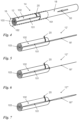
- FIG. 1 shows a highly schematic representation of a retrieval bag 10 according to the invention.
- the retrieval bag 10 has a main bag opening 101, which forms an open end of a bag wall 102 that completely surrounds it.
- the bag wall 102 extends perpendicular to the main bag opening 101 to an opposite, essentially closed bag end, where it forms a bag bottom 103.
- the bag bottom 103 has a flexible protrusion of the Bag wall 102, at the end of which there is a spout opening 105, so that the spout 104 forms an additional, channel-like access to the interior of the retrieval bag 10 in addition to the main bag opening 101.
- the spout 104 is initially closed and is only opened when necessary, e.g., by cutting off the spout tip.
- An unwinding traction means 20 designed as a thread or band is fixed to the grommet 104.
- the length Lz of the unrolling traction means 20 is greater than the length Lb of the retrieval bag 10, ie longer than the distance between the main bag opening 110 and its fixing point on the bag bottom 103 when the retrieval bag 10 is unrolled, as in Figure 1
- the spout 104 can be folded or folded over around its attachment line on the bag wall 103. This is particularly useful in embodiments in which the spout is not a self-stabilizing body, but is made of two films joined together at the edges.
- the area of the grommet 104 and the unrolling traction means 20 is in Figure 1 shown several times to illustrate some of the various possible design variations of the unrolling traction means 20.
- the unrolling traction means is loop-shaped, whereby the partial strands forming the loop can converge directly at the grommet 4 or already at a distance from it.
- Another alternative is to provide the free end of the unrolling traction means 20 with a ring or an eyelet.
- Figure 2 shows the recovery bag of Figure 1 in a preparatory state for the assembly of a laparoscopic device according to the invention, in particular its bag roll.
- the unrolling traction means 20 is laid from its attachment point on the spout 104 parallel to the bag wall 102 to the main bag opening 101 and beyond.
- the retrieval bag is then wound around its bottom-side edge, as indicated by the rotation arrow 30, with the unrolling traction means 20, laid parallel to the bag wall 102, also being rolled up.
- FIG. 3 schematically shown bag roll 12.
- the bag roll 12 is an essential component of the Figure 4 roughly schematically shown laparoscopic arrangement 14 according to the invention.
- This comprises a Figure 4 tube 16, shown only in dashed lines, into which the bag roll 12 is preferably inserted over its entire length.
- the volume restriction imposed by the tube 16 prevents the bag roll 12 from unrolling automatically.
- the laparoscopic assembly 14 further comprises a pusher 18 that is only partially inserted into the tube 16.
- This can be a specialized element that is preferably captively connected to the tube 16, or it can be an instrument with another primary use, e.g., a surgical grasping or cutting instrument that is only temporarily repurposed as a pusher 18.
- the end of the tube 16 into which the pusher 18 is inserted is referred to as the first end 161, and the opposite tube end is referred to as the second end 262 of the tube 16.
- the bag roll 12 can be pushed out of the second end 162 of the tube 16.
- the Figures 5 to 7 show different modifications of the bag roll 12 of Figure 3 .
- a rod-like slider 18' is fixed to the bag roll 12', in particular to the main bag opening 101.
- the slider 18' thus fulfills a dual function, namely as the actual slider and as a holder for the bag roll 12' (or, after its unrolling, for the retrieval bag 12).
- the integrated slider 18' allows a supporting force to be applied in the area of the main bag opening 101 that counteracts the pulling force. This can be additionally supported by the main bag opening 101 being provided with a stiffening wall reinforcement not shown separately in the figures.
- the slider 18" is also fixed in the area of the main bag opening.
- it is realized by a tensile, flexible spring wire, which runs around the entire main bag opening 101 in a guide channel not shown separately, in order to form an open ring, which, however, in the rolled-up state of the bag roll 12", as in Figure 6 shown, is compressed into a narrow ellipse.
- the slider 18" fulfills three functions here, namely the actual slider function, which in the context of Figure 5 the previously described holder function and the function of a closure pulling means.
- the main bag opening 101 will open automatically due to the elastic spring force of the spring wire. However, if a pull is applied to the free end of the slider 18" while simultaneously holding its other end, fixed to the retrieval bag 10, the main bag opening 101 can be closed like a loop.
- the integrated, triple-functional slider 18' is designed as a spring wire ring twisted into an "8" and guided through an eyelet 181 in the area of the main bag opening 101.
- the Figure 7 The free 8-belly shown on the right serves as a handle for the slider 18′′′; the second 8-belly encircles the main bag opening in a guide channel, as already described in the context of Figure 6 described. Pulling on the handle of the slider 18'" while the eyelet 181 is held tight leads to a narrowing of the main bag opening 101.
- Figure 6 For the rest, reference can be made to the explanations for Figure 6 be referred to.
Landscapes
- Health & Medical Sciences (AREA)
- Life Sciences & Earth Sciences (AREA)
- Surgery (AREA)
- General Health & Medical Sciences (AREA)
- Public Health (AREA)
- Veterinary Medicine (AREA)
- Nuclear Medicine, Radiotherapy & Molecular Imaging (AREA)
- Animal Behavior & Ethology (AREA)
- Molecular Biology (AREA)
- Engineering & Computer Science (AREA)
- Biomedical Technology (AREA)
- Heart & Thoracic Surgery (AREA)
- Medical Informatics (AREA)
- Biophysics (AREA)
- Radiology & Medical Imaging (AREA)
- Physics & Mathematics (AREA)
- Pathology (AREA)
- Optics & Photonics (AREA)
- Surgical Instruments (AREA)
- Bag Frames (AREA)
Applications Claiming Priority (1)
| Application Number | Priority Date | Filing Date | Title |
|---|---|---|---|
| DE102023134402.1A DE102023134402A1 (de) | 2023-12-08 | 2023-12-08 | Bergebeutel, Iaparoskopische Anordnung und Verfahren zu deren Benutzung |
Publications (1)
| Publication Number | Publication Date |
|---|---|
| EP4566548A1 true EP4566548A1 (fr) | 2025-06-11 |
Family
ID=93796816
Family Applications (1)
| Application Number | Title | Priority Date | Filing Date |
|---|---|---|---|
| EP24216997.7A Pending EP4566548A1 (fr) | 2023-12-08 | 2024-12-03 | Sac de recuperation et ensemble laparoscopique |
Country Status (3)
| Country | Link |
|---|---|
| EP (1) | EP4566548A1 (fr) |
| CN (1) | CN120114108A (fr) |
| DE (1) | DE102023134402A1 (fr) |
Citations (3)
| Publication number | Priority date | Publication date | Assignee | Title |
|---|---|---|---|---|
| WO1999001068A1 (fr) | 1997-07-01 | 1999-01-14 | Roberto Bennardo | Dispositif servant a enlever des parties anatomiques par laparoscopie |
| EP3741304A2 (fr) * | 2019-05-24 | 2020-11-25 | Medi-Globe GmbH | Dispositif d'extraction et dispositif d'application doté d'un dispositif d'extraction |
| KR20210128153A (ko) * | 2020-04-16 | 2021-10-26 | 주식회사 세종메디칼 | 외과수술용 엔도백 |
Family Cites Families (2)
| Publication number | Priority date | Publication date | Assignee | Title |
|---|---|---|---|---|
| DE102016114786A1 (de) * | 2016-08-10 | 2018-02-15 | Paul Hartmann Ag | Fassschlaufe für Saugkörper zur endoluminalen Unterdrucktherapie |
| CN218589047U (zh) * | 2022-04-07 | 2023-03-10 | 宁波市医疗中心李惠利医院 | 腹腔镜手术肌瘤粉碎用一次性保护袋 |
-
2023
- 2023-12-08 DE DE102023134402.1A patent/DE102023134402A1/de active Pending
-
2024
- 2024-12-03 EP EP24216997.7A patent/EP4566548A1/fr active Pending
- 2024-12-06 CN CN202411785632.3A patent/CN120114108A/zh active Pending
Patent Citations (3)
| Publication number | Priority date | Publication date | Assignee | Title |
|---|---|---|---|---|
| WO1999001068A1 (fr) | 1997-07-01 | 1999-01-14 | Roberto Bennardo | Dispositif servant a enlever des parties anatomiques par laparoscopie |
| EP3741304A2 (fr) * | 2019-05-24 | 2020-11-25 | Medi-Globe GmbH | Dispositif d'extraction et dispositif d'application doté d'un dispositif d'extraction |
| KR20210128153A (ko) * | 2020-04-16 | 2021-10-26 | 주식회사 세종메디칼 | 외과수술용 엔도백 |
Also Published As
| Publication number | Publication date |
|---|---|
| CN120114108A (zh) | 2025-06-10 |
| DE102023134402A1 (de) | 2025-06-12 |
Similar Documents
| Publication | Publication Date | Title |
|---|---|---|
| EP1389453B1 (fr) | Anneau pour produire une constriction artificielle du tract gastro-intestinal | |
| DE69413718T2 (de) | Chirurgisches netzwerk mit halbsteifen grenzelementen | |
| DE19515280C2 (de) | Vorrichtung zum Entfernen von Gewebe oder dergleichen aus der Bauchhöhle | |
| DE69718576T2 (de) | Vormontierter Nähfadenanker mit starrem Verlängerungsteil | |
| DE69509641T2 (de) | Nähgerät | |
| DE10203956B4 (de) | Ligiervorrichtung | |
| EP1648313B1 (fr) | Dispositif de mise en place endoscopique de clips medicaux se refermant automatiquement | |
| DE60224186T2 (de) | Satz mit medizinischem befestigungselement und vorrichtung zur anordnung des befestigungselements | |
| DE69726794T2 (de) | Knochenankereinführvorrichtung | |
| DE60115705T2 (de) | Unterstützungsanordnung an der unterseite des ureters bei der behandlung der inkontinenz bei der frau | |
| EP2316351B1 (fr) | Instrument médical destiné à installer des pinces pour tissu | |
| DE69731676T2 (de) | Vormontierter Nähfadenanker | |
| DE69815740T2 (de) | Partiell vorgefertigter chirurgischer Knoten | |
| EP0513286B1 (fr) | Dispositif comprenant une prothese implantable dans le corps d'un patient | |
| DE102010037529A1 (de) | Einrichtung, vorgesehen, um an einem Katheter befestigt oder mit diesem verbunden zu werden, Katheter und Verfahren | |
| DE202008007774U1 (de) | Endoskopkappe | |
| DE102008046561A1 (de) | Systeme zur Implantation und Ausführung der Reparatur von Weichgeweben | |
| EP2040629B1 (fr) | Dispositif de prélèvement non invasif de fascia | |
| EP1683487A2 (fr) | Dispositif de fermeture d'une blessure à perforation à trocart | |
| EP0499243A1 (fr) | Pochette d'extraction pour chirurgie endoscopique | |
| EP0829242A1 (fr) | Dispositif de retrait d'une endoprothèse implantée | |
| EP1818019A1 (fr) | Emballage pour un élément d'ancrage médical avec fil en velours | |
| EP4566548A1 (fr) | Sac de recuperation et ensemble laparoscopique | |
| DE102016007738A1 (de) | Vorrichtung zur Transplantation einer Descemet-Membran | |
| DE102024105461A1 (de) | Clip-system |
Legal Events
| Date | Code | Title | Description |
|---|---|---|---|
| PUAI | Public reference made under article 153(3) epc to a published international application that has entered the european phase |
Free format text: ORIGINAL CODE: 0009012 |
|
| STAA | Information on the status of an ep patent application or granted ep patent |
Free format text: STATUS: THE APPLICATION HAS BEEN PUBLISHED |
|
| AK | Designated contracting states |
Kind code of ref document: A1 Designated state(s): AL AT BE BG CH CY CZ DE DK EE ES FI FR GB GR HR HU IE IS IT LI LT LU LV MC ME MK MT NL NO PL PT RO RS SE SI SK SM TR |
|
| STAA | Information on the status of an ep patent application or granted ep patent |
Free format text: STATUS: REQUEST FOR EXAMINATION WAS MADE |
|
| 17P | Request for examination filed |
Effective date: 20251112 |