EP4566552A2 - Instrument chirurgical à ultrasons avec plaquette de serrage remplaçable - Google Patents
Instrument chirurgical à ultrasons avec plaquette de serrage remplaçable Download PDFInfo
- Publication number
- EP4566552A2 EP4566552A2 EP25172329.2A EP25172329A EP4566552A2 EP 4566552 A2 EP4566552 A2 EP 4566552A2 EP 25172329 A EP25172329 A EP 25172329A EP 4566552 A2 EP4566552 A2 EP 4566552A2
- Authority
- EP
- European Patent Office
- Prior art keywords
- clamp arm
- clamp
- pad
- ultrasonic
- clamp pad
- Prior art date
- Legal status (The legal status is an assumption and is not a legal conclusion. Google has not performed a legal analysis and makes no representation as to the accuracy of the status listed.)
- Pending
Links
Images













Classifications
-
- A—HUMAN NECESSITIES
- A61—MEDICAL OR VETERINARY SCIENCE; HYGIENE
- A61B—DIAGNOSIS; SURGERY; IDENTIFICATION
- A61B17/00—Surgical instruments, devices or methods
- A61B17/32—Surgical cutting instruments
- A61B17/320068—Surgical cutting instruments using mechanical vibrations, e.g. ultrasonic
- A61B17/320092—Surgical cutting instruments using mechanical vibrations, e.g. ultrasonic with additional movable means for clamping or cutting tissue, e.g. with a pivoting jaw
-
- A—HUMAN NECESSITIES
- A61—MEDICAL OR VETERINARY SCIENCE; HYGIENE
- A61B—DIAGNOSIS; SURGERY; IDENTIFICATION
- A61B17/00—Surgical instruments, devices or methods
- A61B2017/00017—Electrical control of surgical instruments
-
- A—HUMAN NECESSITIES
- A61—MEDICAL OR VETERINARY SCIENCE; HYGIENE
- A61B—DIAGNOSIS; SURGERY; IDENTIFICATION
- A61B17/00—Surgical instruments, devices or methods
- A61B2017/0042—Surgical instruments, devices or methods with special provisions for gripping
- A61B2017/00424—Surgical instruments, devices or methods with special provisions for gripping ergonomic, e.g. fitting in fist
-
- A—HUMAN NECESSITIES
- A61—MEDICAL OR VETERINARY SCIENCE; HYGIENE
- A61B—DIAGNOSIS; SURGERY; IDENTIFICATION
- A61B17/00—Surgical instruments, devices or methods
- A61B2017/0046—Surgical instruments, devices or methods with a releasable handle; with handle and operating part separable
- A61B2017/00473—Distal part, e.g. tip or head
-
- A—HUMAN NECESSITIES
- A61—MEDICAL OR VETERINARY SCIENCE; HYGIENE
- A61B—DIAGNOSIS; SURGERY; IDENTIFICATION
- A61B17/00—Surgical instruments, devices or methods
- A61B17/28—Surgical forceps
- A61B17/2812—Surgical forceps with a single pivotal connection
- A61B17/282—Jaws
- A61B2017/2825—Inserts of different material in jaws
-
- A—HUMAN NECESSITIES
- A61—MEDICAL OR VETERINARY SCIENCE; HYGIENE
- A61B—DIAGNOSIS; SURGERY; IDENTIFICATION
- A61B17/00—Surgical instruments, devices or methods
- A61B17/28—Surgical forceps
- A61B17/2812—Surgical forceps with a single pivotal connection
- A61B17/282—Jaws
- A61B2017/2829—Jaws with a removable cover
-
- A—HUMAN NECESSITIES
- A61—MEDICAL OR VETERINARY SCIENCE; HYGIENE
- A61B—DIAGNOSIS; SURGERY; IDENTIFICATION
- A61B17/00—Surgical instruments, devices or methods
- A61B17/32—Surgical cutting instruments
- A61B17/320068—Surgical cutting instruments using mechanical vibrations, e.g. ultrasonic
- A61B2017/320072—Working tips with special features, e.g. extending parts
-
- A—HUMAN NECESSITIES
- A61—MEDICAL OR VETERINARY SCIENCE; HYGIENE
- A61B—DIAGNOSIS; SURGERY; IDENTIFICATION
- A61B17/00—Surgical instruments, devices or methods
- A61B17/32—Surgical cutting instruments
- A61B17/320068—Surgical cutting instruments using mechanical vibrations, e.g. ultrasonic
- A61B2017/320072—Working tips with special features, e.g. extending parts
- A61B2017/320074—Working tips with special features, e.g. extending parts blade
-
- A—HUMAN NECESSITIES
- A61—MEDICAL OR VETERINARY SCIENCE; HYGIENE
- A61B—DIAGNOSIS; SURGERY; IDENTIFICATION
- A61B17/00—Surgical instruments, devices or methods
- A61B17/32—Surgical cutting instruments
- A61B17/320068—Surgical cutting instruments using mechanical vibrations, e.g. ultrasonic
- A61B17/320092—Surgical cutting instruments using mechanical vibrations, e.g. ultrasonic with additional movable means for clamping or cutting tissue, e.g. with a pivoting jaw
- A61B2017/320093—Surgical cutting instruments using mechanical vibrations, e.g. ultrasonic with additional movable means for clamping or cutting tissue, e.g. with a pivoting jaw additional movable means performing cutting operation
-
- A—HUMAN NECESSITIES
- A61—MEDICAL OR VETERINARY SCIENCE; HYGIENE
- A61B—DIAGNOSIS; SURGERY; IDENTIFICATION
- A61B17/00—Surgical instruments, devices or methods
- A61B17/32—Surgical cutting instruments
- A61B17/320068—Surgical cutting instruments using mechanical vibrations, e.g. ultrasonic
- A61B17/320092—Surgical cutting instruments using mechanical vibrations, e.g. ultrasonic with additional movable means for clamping or cutting tissue, e.g. with a pivoting jaw
- A61B2017/320094—Surgical cutting instruments using mechanical vibrations, e.g. ultrasonic with additional movable means for clamping or cutting tissue, e.g. with a pivoting jaw additional movable means performing clamping operation
-
- A—HUMAN NECESSITIES
- A61—MEDICAL OR VETERINARY SCIENCE; HYGIENE
- A61B—DIAGNOSIS; SURGERY; IDENTIFICATION
- A61B17/00—Surgical instruments, devices or methods
- A61B17/32—Surgical cutting instruments
- A61B17/320068—Surgical cutting instruments using mechanical vibrations, e.g. ultrasonic
- A61B17/320092—Surgical cutting instruments using mechanical vibrations, e.g. ultrasonic with additional movable means for clamping or cutting tissue, e.g. with a pivoting jaw
- A61B2017/320095—Surgical cutting instruments using mechanical vibrations, e.g. ultrasonic with additional movable means for clamping or cutting tissue, e.g. with a pivoting jaw with sealing or cauterizing means
Definitions
- a variety of surgical instruments include an end effector having a blade element that vibrates at ultrasonic frequencies to cut and/or seal tissue (e.g., by denaturing proteins in tissue cells). These instruments include one or more piezoelectric elements that convert electrical power into ultrasonic vibrations, which are communicated along an acoustic waveguide to the blade element. The precision of cutting and coagulation may be controlled by the operator's technique and adjusting the power level, blade edge angle, tissue traction, and blade pressure. Some instruments have a clamp arm and clamp pad for grasping tissue with the blade element.
- ultrasonic surgical instruments examples include the HARMONIC ACE ® Ultrasonic Shears, the HARMONIC WAVE ® Ultrasonic Shears, the HARMONIC FOCUS ® Ultrasonic Shears, and the HARMONIC SYNERGY ® Ultrasonic Blades, all by Ethicon Endo-Surgery, Inc. of Cincinnati, Ohio. Further examples of such devices and related concepts are disclosed in U.S. Pat. No. 5,322,055, entitled "Clamp Coagulator/Cutting System for Ultrasonic Surgical Instruments," issued June 21, 1994 , the disclosure of which is incorporated by reference herein; U.S. Pat. No.
- Some ultrasonic surgical instruments may include a cordless transducer such as that disclosed in U.S. Pub. No. 2012/0112687, entitled “Recharge System for Medical Devices,” published May 10, 2012 , the disclosure of which is incorporated by reference herein; U.S. Pub. No. 2012/0116265, entitled “Surgical Instrument with Charging Devices,” published May 10, 2012 , the disclosure of which is incorporated by reference herein; and/or U.S. Pat. App. No. 61/410,603, filed November 5, 2010 , entitled “Energy-Based Surgical Instruments,” the disclosure of which is incorporated by reference herein.
- ultrasonic surgical instruments may include an articulating shaft section.
- Examples of such ultrasonic surgical instruments are disclosed in U.S. Pub. No. 2014/0005701, published January 2, 2014 , entitled “Surgical Instruments with Articulating Shafts,” the disclosure of which is incorporated by reference herein; and U.S. Pub. No. 2014/0114334, published April 24, 2014 , entitled “Flexible Harmonic Waveguides/Blades for Surgical Instruments,” the disclosure of which is incorporated by reference herein.
- proximal and distal are defined herein relative to an operator or other operator grasping a surgical instrument having a distal surgical end effector.
- proximal refers the position of an element closer to the operator or other operator and the term “distal” refers to the position of an element closer to the surgical end effector of the surgical instrument and further away from the operator or other operator.
- FIG. 1 shows components of an exemplary surgical system (10) in diagrammatic block form.
- system (10) comprises an ultrasonic generator (12) and an ultrasonic surgical instrument (20).
- instrument (20) is operable to cut tissue and seal or weld tissue (e.g., a blood vessel, etc.) substantially simultaneously, using ultrasonic vibrational energy.
- Generator (12) and instrument (20) are coupled together via cable (14).
- Cable (14) may comprise a plurality of wires; and may provide unidirectional electrical communication from generator (12) to instrument (20) and/or bidirectional electrical communication between generator (12) and instrument (20).
- cable (14) may comprise a "hot” wire for electrical power to surgical instrument (20), a ground wire, and a signal wire for transmitting signals from surgical instrument (20) to ultrasonic generator (12), with a shield surrounding the three wires.
- separate "hot” wires are used for separate activation voltages (e.g., one "hot” wire for a first activation voltage and another "hot” wire for a second activation voltage, or a variable voltage between the wires proportional to the power requested, etc.).
- any other suitable number or configuration of wires may be used.
- system (10) may incorporate generator (12) into instrument (20), such that cable (14) may simply be omitted.
- generator (12) may comprise the GEN04, GEN11, or GEN 300 sold by Ethicon Endo-Surgery, Inc. of Cincinnati, Ohio.
- generator (12) may be constructed in accordance with at least some of the teachings of U.S. Pub. No. 2011/0087212, entitled “Surgical Generator for Ultrasonic and Electrosurgical Devices,” published April 14, 2011 , the disclosure of which is incorporated by reference herein.
- any other suitable generator (12) may be used.
- generator (12) is operable to provide power to instrument (20) to perform ultrasonic surgical procedures.
- Instrument (20) comprises a handle assembly (22), which is configured to be grasped in one hand (or two hands) of an operator and manipulated by one hand (or two hands) of the operator during a surgical procedure.
- handle assembly (22) may be grasped like a pencil by the operator.
- handle assembly (22) may include a scissor grip that may be grasped like scissors by the operator.
- handle assembly (22) may include a pistol grip that may be grasped like a pistol by the operator.
- handle assembly (22) may be configured to be gripped in any other suitable fashion.
- instrument (20) may substitute handle assembly (22) with a body that is coupled to a robotic surgical system that is configured to operate instrument (20) (e.g., via remote control, etc.).
- a blade (24) extends distally from the handle assembly (22).
- Handle assembly (22) includes an ultrasonic transducer (26) and an ultrasonic waveguide (28), which couples ultrasonic transducer (26) with blade (24).
- Ultrasonic transducer (26) receives electrical power from generator (12) via cable (14). By virtue of its piezoelectric properties, ultrasonic transducer (26) is operable to convert such electrical power into ultrasonic vibrational energy.
- Ultrasonic waveguide (28) may be flexible, semi-flexible, rigid, or have any other suitable properties.
- ultrasonic transducer (26) is integrally coupled with blade (24) via ultrasonic waveguide (28).
- ultrasonic waveguide (28) When ultrasonic transducer (26) is activated to vibrate at ultrasonic frequencies, such vibrations are communicated through ultrasonic waveguide (28) to blade (24), such that blade (24) will also vibrate at ultrasonic frequencies.
- blade (24) When blade (24) is in an activated state (i.e., vibrating ultrasonically), blade (24) is operable to effectively cut through tissue and seal tissue.
- Ultrasonic transducer (26), ultrasonic waveguide (28), and blade (24) together thus form an acoustic assembly providing ultrasonic energy for surgical procedures when powered by generator (12).
- Handle assembly (22) is configured to substantially isolate the operator from the vibrations of the acoustic assembly formed by transducer (26), ultrasonic waveguide (28), and blade (24).
- ultrasonic waveguide (28) may amplify the mechanical vibrations transmitted through ultrasonic waveguide (28) to blade (24).
- Ultrasonic waveguide (28) may further have features to control the gain of the longitudinal vibration along ultrasonic waveguide (28) and/or features to tune ultrasonic waveguide (28) to the resonant frequency of system (10).
- ultrasonic waveguide (28) may have any suitable cross-sectional dimensions/configurations, such as a substantially uniform cross-section, be tapered at various sections, be tapered along its entire length, or have any other suitable configuration.
- Ultrasonic waveguide (28) may, for example, have a length substantially equal to an integral number of one-half system wavelengths (n ⁇ /2).
- Ultrasonic waveguide (28) and blade (24) may be fabricated from a solid core shaft constructed out of a material or combination of materials that propagates ultrasonic energy efficiently, such as titanium alloy (i.e., Ti-6Al-4V), aluminum alloys, sapphire, stainless steel, or any other acoustically compatible material or combination of materials.
- a material or combination of materials that propagates ultrasonic energy efficiently, such as titanium alloy (i.e., Ti-6Al-4V), aluminum alloys, sapphire, stainless steel, or any other acoustically compatible material or combination of materials.
- the distal end of blade (24) is located at a position corresponding to an anti-node associated with resonant ultrasonic vibrations communicated through waveguide (28) (i.e., at an acoustic anti-node), in order to tune the acoustic assembly to a preferred resonant frequency f o when the acoustic assembly is not loaded by tissue.
- the distal end of blade (24) is configured to move longitudinally in the range of, for example, approximately 10 to 500 microns peak-to-peak, and in some instances in the range of about 20 to about 200 microns at a predetermined vibratory frequency f o of, for example, 55.5 kHz.
- transducer (26) of the present example When transducer (26) of the present example is activated, these mechanical oscillations are transmitted through waveguide (28) to reach blade (24), thereby providing oscillation of blade (24) at the resonant ultrasonic frequency.
- the ultrasonic oscillation of blade (24) may simultaneously sever the tissue and denature the proteins in adjacent tissue cells, thereby providing a coagulative effect with relatively little thermal spread.
- an electrical current may also be provided through blade (24) to also cauterize the tissue.
- ultrasonic waveguide (28) and blade (24) may comprise components sold under product codes SNGHK and SNGCB by Ethicon Endo-Surgery, Inc. of Cincinnati, Ohio.
- ultrasonic waveguide (28) and/or blade (24) may be constructed and operable in accordance with the teachings of U.S. Pat. No. 6,423,082, entitled "Ultrasonic Surgical Blade with Improved Cutting and Coagulation Features," issued July 23, 2002 , the disclosure of which is incorporated by reference herein.
- ultrasonic waveguide (28) and/or blade (24) may be constructed and operable in accordance with the teachings of U.S. Pat. No.
- Handle assembly (22) of the present example also includes a control selector (30) and an activation switch (32), which are each in communication with a circuit board (34).
- circuit board (34) may comprise a conventional printed circuit board, a flex circuit, a rigid-flex circuit, or may have any other suitable configuration.
- Control selector (30) and activation switch (32) may be in communication with circuit board (34) via one or more wires, traces formed in a circuit board or flex circuit, and/or in any other suitable fashion.
- Circuit board (34) is coupled with cable (14), which is in turn coupled with control circuitry (16) within generator (12).
- Activation switch (32) is operable to selectively activate power to ultrasonic transducer (26).
- activation switch (32) when switch (32) is activated, such activation provides communication of appropriate power to ultrasonic transducer (26) via cable (14).
- activation switch (32) may be constructed in accordance with any of the teachings of the various references cited herein. Other various forms that activation switch (32) may take will be apparent to those of ordinary skill in the art in view of the teachings herein.
- surgical system (10) is operable to provide at least two different levels or types of ultrasonic energy (e.g., different frequencies and/or amplitudes, etc.) at blade (24).
- control selector (30) is operable to permit the operator to select a desired level/amplitude of ultrasonic energy.
- control selector (30) may be constructed in accordance with any of the teachings of the various references cited herein. Other various forms that control selector (30) may take will be apparent to those of ordinary skill in the art in view of the teachings herein.
- control circuitry (16) of generator (12) when an operator makes a selection through control selector (30), the operator's selection is communicated back to control circuitry (16) of generator (12) via cable (14), and control circuitry (16) adjusts the power communicated from generator (12) accordingly the next time the operator actuates activation switch (32).
- the level/amplitude of ultrasonic energy provided at blade (24) may be a function of characteristics of the electrical power communicated from generator (12) to instrument (20) via cable (14).
- control circuitry (16) of generator (12) may provide electrical power (via cable (14)) having characteristics associated with the ultrasonic energy level/amplitude or type selected through control selector (30).
- Generator (12) may thus be operable to communicate different types or degrees of electrical power to ultrasonic transducer (26), in accordance with selections made by the operator via control selector (30).
- generator (12) may increase the voltage and/or current of the applied signal to increase the longitudinal amplitude of the acoustic assembly.
- generator (12) may provide selectability between a "level 1" and a "level 5,” which may correspond with a blade (24) vibrational resonance amplitude of approximately 50 microns and approximately 90 microns, respectively.
- control circuitry (16) may be configured to be apparent to those of ordinary skill in the art in view of the teachings herein. It should also be understood that control selector (30) and activation switch (32) may be substituted with two or more activation switches (32). In some such versions, one activation switch (32) is operable to activate blade (24) at one power level/type while another activation switch (32) is operable to activate blade (24) at another power level/type, etc.
- control circuitry (16) is located within handle assembly (22).
- generator (12) only communicates one type of electrical power (e.g., just one voltage and/or current available) to handle assembly (22), and control circuitry (16) within handle assembly (22) is operable to modify the electrical power (e.g., the voltage of the electrical power), in accordance with selections made by the operator via control selector (30), before the electrical power reaches ultrasonic transducer (26).
- generator (12) may be incorporated into handle assembly (22) along with all other components of surgical system (10). For instance, one or more batteries (not shown) or other portable sources of power may be provided in handle assembly (22). Still other suitable ways in which the components depicted in FIG. 1 may be rearranged or otherwise configured or modified will be apparent to those of ordinary skill in the art in view of the teachings herein.
- FIGS. 2-5 illustrate an exemplary ultrasonic surgical instrument (100). At least part of instrument (100) may be constructed and operable in accordance with at least some of the teachings of U.S. Pat. No. 5,322,055 ; U.S. Pat. No. 5,873,873 ; U.S. Pat. No. 5,980,510 ; U.S. Pat. No. 6,325,811 ; U.S. Pat. No. 6,773,444 ; U.S. Pat. No. 6,783,524 ; U.S. Pat. No. 8,461,744 ; U.S. Pat. No. 8,623,027 ; U.S. Pub. No. 2006/0079874 ; U.S. Pub. No.
- instrument (100) is operable to cut tissue and seal or weld tissue (e.g., a blood vessel, etc.) substantially simultaneously. It should also be understood that instrument (100) may have various structural and functional similarities with the HARMONIC ACE ® Ultrasonic Shears, the HARMONIC WAVE ® Ultrasonic Shears, the HARMONIC FOCUS ® Ultrasonic Shears, and/or the HARMONIC SYNERGY ® Ultrasonic Blades. Furthermore, instrument (100) may have various structural and functional similarities with the devices taught in any of the other references that are cited and incorporated by reference herein.
- Instrument (100) of the present example comprises a handle assembly (120), a shaft assembly (130), and an end effector (140).
- Handle assembly (120) comprises a body (122) including a pistol grip (124) and a pair of buttons (126).
- Handle assembly (120) also includes a trigger (128) that is pivotable toward and away from pistol grip (124). It should be understood, however, that various other suitable configurations may be used, including but not limited to a pencil-grip configuration or a scissor-grip configuration.
- End effector (140) includes an ultrasonic blade (160) and a pivoting clamp arm (144).
- Clamp arm (144) is coupled with trigger (128) such that clamp arm (144) is pivotable toward ultrasonic blade (160) in response to pivoting of trigger (128) toward pistol grip (124); and such that clamp arm (144) is pivotable away from ultrasonic blade (160) in response to pivoting of trigger (128) away from pistol grip (124).
- trigger (128) Various suitable ways in which clamp arm (144) may be coupled with trigger (128) will be apparent to those of ordinary skill in the art in view of the teachings herein.
- one or more resilient members are used to bias clamp arm (144) and/or trigger (128) to the open position shown in FIG. 4 .
- An ultrasonic transducer assembly (112) extends proximally from body (122) of handle assembly (120). Transducer assembly (112) is coupled with a generator (116) via a cable (114). Transducer assembly (112) receives electrical power from generator (116) and converts that power into ultrasonic vibrations through piezoelectric principles.
- Generator (116) may include a power source and control module that is configured to provide a power profile to transducer assembly (112) that is particularly suited for the generation of ultrasonic vibrations through transducer assembly (112).
- generator (116) may comprise a GEN 300 sold by Ethicon Endo-Surgery, Inc. of Cincinnati, Ohio.
- generator (116) may be constructed in accordance with at least some of the teachings of U.S. Pub. No. 2011/0087212, entitled “Surgical Generator for Ultrasonic and Electrosurgical Devices,” published April 14, 2011 , the disclosure of which is incorporated by reference herein. It should also be understood that at least some of the functionality of generator (116) may be integrated into handle assembly (120), and that handle assembly (120) may even include a battery or other on-board power source such that cable (114) is omitted. Still other suitable forms that generator (116) may take, as well as various features and operabilities that generator (116) may provide, will be apparent to those of ordinary skill in the art in view of the teachings herein.
- Blade (160) of the present example is operable to vibrate at ultrasonic frequencies in order to effectively cut through and seal tissue, particularly when the tissue is being clamped between clamp arm (144) and blade (160).
- Blade (160) is positioned at the distal end of an acoustic drivetrain.
- This acoustic drivetrain includes transducer assembly (112) and an acoustic waveguide (102).
- Transducer assembly (112) includes a set of piezoelectric discs (not shown) located proximal to a horn (not shown) of rigid acoustic waveguide (102).
- the piezoelectric discs are operable to convert electrical power into ultrasonic vibrations, which are then transmitted along acoustic waveguide (102), which extends through shaft assembly (130), to blade (160) in accordance with known configurations and techniques.
- acoustic waveguide 102
- shaft assembly 130
- blade 160
- this portion of the acoustic drivetrain may be configured in accordance with various teachings of various references that are cited herein.
- Waveguide (102) is secured within shaft assembly (130) via a pin (133), which passes through waveguide (102) and shaft assembly (130).
- Pin (133) is located at a position along the length of waveguide (102) corresponding to a node associated with resonant ultrasonic vibrations communicated through waveguide (102).
- ultrasonic blade (160) When ultrasonic blade (160) is in an activated state (i.e., vibrating ultrasonically), ultrasonic blade (160) is operable to effectively cut through and seal tissue, particularly when the tissue is being clamped between clamp arm (144) and ultrasonic blade (160).
- waveguide (102) may be configured to amplify mechanical vibrations transmitted through waveguide (102).
- waveguide (102) may include features operable to control the gain of the longitudinal vibrations along waveguide (102) and/or features to tune waveguide (102) to the resonant frequency of the system.
- the distal end of blade (160) is located at a position corresponding to an anti-node associated with resonant ultrasonic vibrations communicated through waveguide (102), in order to tune the acoustic assembly to a preferred resonant frequency f o when the acoustic assembly is not loaded by tissue.
- the distal end of blade (160) is configured to move longitudinally in the range of, for example, approximately 10 to 500 microns peak-to-peak, and in some instances in the range of about 20 to about 200 microns at a predetermined vibratory frequency f o of, for example, 55.5 kHz.
- transducer assembly (112) of the present example When transducer assembly (112) of the present example is activated, these mechanical oscillations are transmitted through waveguide (102) to reach blade (160), thereby providing oscillation of blade (160) at the resonant ultrasonic frequency.
- the ultrasonic oscillation of blade (160) may simultaneously sever the tissue and denature the proteins in adjacent tissue cells, thereby providing a coagulative effect with relatively little thermal spread.
- an electrical current may also be provided through blade (160) and clamp arm (144) to also cauterize the tissue.
- buttons (126) may be activate buttons (126) to selectively activate transducer assembly (112) to activate blade (160).
- two buttons (126) are provided - one for activating blade (160) at a low power and another for activating blade (160) at a high power.
- a foot pedal may be provided to selectively activate transducer assembly (112).
- Buttons (126) of the present example are positioned such that an operator may readily fully operate instrument (100) with a single hand. For instance, the operator may position their thumb about pistol grip (124), position their middle, ring, and/or little finger about trigger (128), and manipulate buttons (126) using their index finger.
- any other suitable techniques may be used to grip and operate instrument (100); and buttons (126) may be located at any other suitable positions.
- Shaft assembly (130) of the present example comprises an outer sheath (132), an inner tube (134) slidably disposed within outer sheath (132), and a waveguide (102) disposed within inner tube (134).
- inner tube (134) is operable to translate longitudinally within outer sheath (132) relative to outer sheath (132) to selectively pivot clamp arm (144) toward and away from blade (160).
- Shaft assembly (130) of the present example further includes a rotation assembly (150). Rotation assembly (150) is operable to rotate the entire shaft assembly (130) and end effector (140) relative to handle assembly (120) about a longitudinal axis of shaft assembly (130).
- rotation assembly (150) is operable to selectively lock the angular position of shaft assembly (130) and end effector (140) relative to handle assembly (120) about the longitudinal axis of shaft assembly (130).
- a rotation knob (152) of rotation assembly (150) may be translatable between a first longitudinal position, in which shaft assembly (130) and end effector (140) are rotatable relative to handle assembly (120) about the longitudinal axis of shaft assembly (130); and a second longitudinal position, in which shaft assembly (130) and end effector (140) are not rotatable relative to handle assembly (120) about the longitudinal axis of shaft assembly (130).
- shaft assembly (130) may have a variety of other components, features, and operabilities, in addition to or in lieu of any of those noted above.
- Other suitable configurations for shaft assembly (130) will be apparent to those of ordinary skill in the art in view of the teachings herein.
- end effector (140) includes ultrasonic blade (160) and clamp arm (144).
- Clamp arm (144) includes a clamp pad (146) secured to an underside of clamp arm (144), facing blade (160).
- Clamp arm (144) is pivotably coupled with a distal end of outer sheath (132) of shaft assembly (130) above ultrasonic blade (160) via a pin (145). As best seen in FIG.
- a distal end of inner tube (134) is rotatably coupled with a proximal end of clamp arm (144) below ultrasonic blade (160) via a pin (135) such that longitudinal translation of inner tube (134) causes rotation of clamp arm (144) about pin (145) toward and away from ultrasonic blade (160) to thereby clamp tissue between clamp arm (144) and ultrasonic blade (160) to cut and/or seal the tissue.
- proximal longitudinal translation of inner tube (134) relative to outer sheath (132) and handle assembly (120) causes clamp arm (144) to move toward ultrasonic blade (160); and distal longitudinal translation of inner tube (134) relative to outer sheath (132) and handle assembly (120) causes clamp arm (144) to move away from ultrasonic blade (160).
- trigger (128) is pivotably coupled to handle assembly (120) via a pin (123A) such that trigger (128) is operable to rotate about pin (123A).
- trigger (128) is coupled with a yoke (125) via a linkage (129) such that rotation of trigger (128) about pin (123A) causes longitudinal translation of yoke (125).
- a first end (129A) of linkage (129) is rotatably coupled with a proximal portion of trigger (128) via a pin (123B).
- a second end (129B) of linkage (129) is rotatably coupled with a proximal portion of yoke (125) via a pin (123C).
- a pair of elongate oval-shaped projections (127) extend inwardly from interior surfaces of body (122).
- An interior surface of each oval-shaped projection (127) defines an elongate oval-shaped slot (127A).
- Pin (123C) passes completely through the proximal portion of yoke (125) and second end (129B) of linkage (129) such that ends of pin (123C) extend from opposite sides of yoke (125). These ends of pin (123C) are slidably and rotatably disposed within oval-shaped slots (127A).
- a pin (123D) passes completely through a distal portion of yoke (125) such that ends of pin (123D) extend from opposite sides of yoke (125).
- pin (123D) are slidably and rotatably disposed within oval-shaped slots (127A).
- yoke (125) is longitudinally translatable within oval-shaped slots (127A) via pins (123C, 123D) between a proximal longitudinal position and a distal longitudinal position.
- proximal portion of trigger (128) is coupled with yoke (125) via linkage (129), pivoting of trigger (128) toward and away from pistol grip (124) will cause longitudinal translation of yoke (125) within oval-shaped slots (127A).
- pivoting of trigger (128) toward pistol grip (124) will cause proximal longitudinal translation of yoke (125) within oval-shaped slots (127A); and that pivoting of trigger (128) away from pistol grip (124) will cause distal longitudinal translation of yoke (125) within oval-shaped slots (127A).
- a distal portion of yoke (125) is coupled with inner tube (134) of shaft assembly (130) via a coupling assembly (135).
- inner tube (134) is longitudinally translatable within outer sheath (132), such that inner tube (134) is configured to longitudinally translate concurrently with yoke (125).
- pivoting of trigger (128) toward pistol grip (124) causes proximal longitudinal translation of yoke (125)
- pivoting of trigger (128) toward pistol grip (124) will cause proximal longitudinal translation of inner tube (134) relative to outer sheath (132) and handle assembly (120)
- pivoting of trigger (128) away from pistol grip (124) causes distal longitudinal translation of yoke (125)
- pivoting of trigger (128) away from pistol grip (124) will cause distal longitudinal translation of inner tube (134) relative to outer sheath (132) and handle assembly (120).
- one or more resilient members are used to bias clamp arm (144) and/or trigger (128) to the open position shown in FIG. 4 .
- a spring (136) is positioned within a proximal end of body (122) of handle assembly (120). Spring (136) bears against body (122) and a proximal end of yoke (125) to thereby bias yoke (125) toward the distal position. Biasing of yoke (125) toward the distal position causes inner tube (134) to be biased distally and further causes trigger (128) to be biased away from pistol grip (124).
- instrument (100) may be configured in numerous other ways as will be apparent to those of ordinary skill in the art in view of the teachings herein.
- at least part of instrument (100) may be constructed and/or operable in accordance with at least some of the teachings of any of the following, the disclosures of which are all incorporated by reference herein: U.S. Pat. No. 5,322,055 ; U.S. Pat. No. 5,873,873 ; U.S. Pat. No. 5,980,510 ; U.S. Pat. No. 6,325,811 ; U.S. Pat. No. 6,783,524 ; U.S. Pub. No.
- clamp pad (146) may experience a substantial amount of wear and dear during use of end effector (140).
- clamp pad (146) may be formed of a polytetrafluoroethylene (PTFE) material.
- Clamp pad (146) may encounter heat, compression forces, and vibrations generated via blade (160), which may work together to eventually wear out the material forming clamp pad (146). It may therefore be desirable to provide a version of end effector (140) where clamp pad (146) is replaceable. In particular, it may be desirable to enable replacement of clamp pad (146) without necessarily also having to replace clamp arm (144) and/or other components of end effector (140).
- PTFE polytetrafluoroethylene
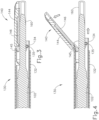
- FIGS. 6A-B show an exemplary end effector (50) with a detachable clamp arm (56) and replaceable clamp pads (58a, 58b).
- End effector (50) may be readily incorporated into ultrasonic instrument (20, 100) described above.
- End effector (50) further includes an outer sheath (72), an inner tube (76), an ultrasonic blade (79), and a pivot pin (57).
- Outer sheath (72), inner tube (76), and blade (79) are substantially similar to outer sheath (132), inner tube (134) and ultrasonic blade (160), respectively, discussed above.
- Detachable clamp arm (56) includes coupling holes (52a, 52b) that are configured to receive pivot pin (57).
- Clamp arm (56) is pivotally coupled to outer sheath (72) via pivot pin (57).
- Clamp arm (56) is pivotally coupled to inner sheath (76) via integral studs (54b), which are disposed in openings (54c) of inner sheath (76).
- Clamp pads (58a, 58b) further include tapered tenons (59a, 59b) that are configured to mate with complementary mortises (not shown) defined by detachable clamp arm (56).
- Tenons (59a, 59b) are configured to slide within mortises (not shown) at the proximal end of clamp arm (56) when clamp arm (56) is detached from outer sheath (72). Therefore, when clamp arm (56), with assembled clamp pads (58a, 58b), is attached to outer sheath (72) via pivot pin (57), pivot pin (57) prevents clamp pads (58a, 58b) from sliding proximally relative to clamp arm (56). In other words, pivot pin (57) and the closed distal end of clamp arm (56) confine clamp pads (58a, 58b) within the mortise via tenons (59a, 59b), with pivot pin (57) and the closed distal end of clamp arm (56) cooperating to act as longitudinal stops.
- clamp pads (58a, 58b) When detachable clamp arm (56) is assembled to outer sheath (72), clamp pads (58a, 58b) may be fixed relative to clamp arm (56). However, after a surgical procedure, clamp pads (58a, 58b) may be removed from detachable clamp arm (56) by removing pivot pin (57) to decouple clamp arm (56) and outer sheath (72). Once pivot pin (57) is removed from coupling holes (52a, 52b), clamp arm (56) may be removed from outer sheath (72), which enables clamp pads (58a, 58b) to slide relative to clamp arm (56) in the proximal direction. Used clamp pads (58a, 58b) may then be removed and replaced with new clamp pads (58a, 58b) with similar qualities.
- clamp arm (56) with new clamp pads (58a, 58b) may be coupled to outer sheath (72) via pivot pin (57), thereby fixing clamp pads (58a, 58b) relative to clamp arm (56).
- end effector (50) may be further constructed and operable in accordance with at least some of the teachings of U.S. Pat. No. 7,544,200, entitled “Combination Tissue Pad for Use with an Ultrasonic Surgical Instrument,” issued June 9, 2009 , the disclosure of which is incorporated by reference herein.
- end effector (50) allows for replacement of clamp pads (58a, 58b)
- end effector (50) requires removal of clamp arm (56) from outer sheath (72) in order to replace clamp pads (58a, 58b).
- Providing replacement of a clamp pad (58a, 58b, 14-6) from a clamp arm (56, 144) without having to first remove the clamp arm (56, 144) from anything may simplify the process of sterilizing the instrument (20, 100), thereby saving time and/or costs associated with replacing clamp pad (58a, 58b, 146).
- instrument (100) may be further modified in accordance with at least some of the teachings of U.S. Patent App. No. 14/623,812, entitled “Ultrasonic Surgical Instrument with Removable Handle Assembly,” filed February 17, 2015 , the disclosure of which is incorporated by reference herein.
- instrument (100) may be modified to enable clamp arm (144) to be hyperextended to pivot wider than the open position shown in FIG. 4 , as disclosed in U.S. Patent App. No. 14/623,812 (see, e.g., FIGS. 36A-36B and associated text of U.S. Patent App. No. 14/623,812 ).
- Such hyperextension of clamp arm (144) may provide easier access to clamp pad (146) and thereby further facilitate replacement of clamp pad (146).
- instrument (100) may be further modified in accordance with at least some of the teachings of U.S. Patent App. No. 14/553,378, entitled “Ultrasonic Surgical Instrument with Blade Cooling through Retraction,” filed November 25, 2014 , the disclosure of which is incorporated by reference herein.
- instrument (100) may be modified to enable blade (160) to be retracted proximally from the position shown in FIG. 4 , as disclosed in U.S. Patent App. No. 14/553,378 (see, e.g., FIGS. 20A-20B and associated text of U.S. Patent App. No. 14/553,378 ).
- Such retraction of blade (160) may also provide easier access to clamp pad (146) and thereby further facilitate replacement of clamp pad (146) in accordance with the teachings below.
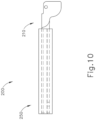
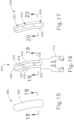
- FIGS. 7-10 show an exemplary alternative clamp arm assembly (200) and related components that may be readily incorporated into end effector (50, 140) in place of clam arm (56, 144) and clamp pad (58a, 58b, 146).
- Clamp arm assembly (200) of this example comprises a clamp arm (210) and a clamp pad (250).
- clamp arm (210) includes a proximal portion (214) and an elongated distal portion (220).
- Proximal portion (214) includes coupling members (212) that are configured to pivotally couple with outer sheath (72, 132) or inner tube (76, 134) as described above.
- Elongated distal portion (220) includes a proximal end (229), a distal end (228), a pair of inwardly extending mating recesses (226), and a T-shaped cross-section defined by flattened surfaces (224) and an elongated rib (222) extending from proximal end (229) to distal end (228).
- Elongated distal portion (220) is configured to receive clamp pad (250) at distal end (228), which may eliminate the need for clamp arm (210) to be removed from the rest of instrument (20, 100) in order to install clamp pad (250).
- clamp pad (250) includes a proximal face (252) defining a proximal opening (254), a distal face (262) defining a distal opening (264), an exterior surface (251) defining a complementary sleeve (266) and a complementary elongated slot (260), both of which extend from proximal opening (254) to distal opening (264).
- Clamp pad (250) further includes a pair of complementary mating nubs (258) that are positioned to correspond with mating recesses (226) of clamp arm (210) when clamp pad (250) is fully seated on clamp arm (210).
- proximal opening (254) of clamp pad (250) is configured to receive distal end (228) of clamp arm (210).
- the cross-sectional area of proximal opening (254) and distal opening (264) are defined by complementary sleeve (266) and complementary elongated slot (260).
- Complementary sleeve (266) and complementary elongated slot (260) are dimensioned to complement elongated flattened surfaces (224) and elongated rib (222), respectively.
- This complementary T-shaped configuration prevents clamp pad (250) from rotating about the longitudinal axis defined by elongated distal portion (220) of clamp arm (210) once clamp pad (250) is fitted around clamp arm (210).
- clamp pad (250) will mate with clamp arm (210) in a predefined orientation such that the portion of exterior surface (251) that is configured to compress tissue against blade (24, 79, 160) consistently faces the appropriate direction each time clamp pad (250) is replaced.
- mating recesses (226) of clamp arm (210) and complementary mating nubs (258) of clamp pad (250) are configured to mate with each other once clamp pad (250) is placed in its desired location relative to clamp arm (210).
- Mating recesses (226) and mating nubs (258) may be configured to provide a snap fit.
- mating nubs (258) may slightly deform around distal end (228) of clamp arm (210) until nubs (258) reach mating recesses (226). Nubs (258) may then snap into place within mating recesses (226).
- clamp pad (250) is substantially prevented from inadvertently translating along the longitudinal axis defined by elongated distal portion (220). However, an operator may still remove clamp pad (250) for replacement by providing a sufficient distally oriented force on clamp pad (250) as clamp arm (210) is held stationary.
- clamp pad (250) As shown in FIG. 10 , with clamp pad (250) unable to rotate or translate about the longitudinal axis defined by elongated distal portion (220) of clamp arm (210), clamp pad (250) is substantially fixed relative to clamp arm (210). Therefore, clamp pad (250) may be installed on clamp arm (210) without needing to first decouple clamp arm (210) from the rest of instrument (20, 100). Likewise, a spent clamp pad (250) may be removed from clamp arm (210) without needing to first decouple clamp arm (210) from the rest of instrument (20, 100).
- clamp pad (250) may be formed of a polymeric material that is resilient and/or elastomeric to assist in gripping onto clamp arm (210).
- at least the portion of clamp pad (250) that will contact tissue and compress the tissue against blade (24, 79, 160) during use of clamp arm assembly (200) may comprise polytetrafluoroethylene.
- suitable materials and combinations of materials that may be used to form clamp pad (250) and different regions thereof will be apparent to those of ordinary skill in the art in view of the teachings herein.
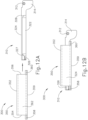
- FIGS. 11-12B show another exemplary alternative clamp arm assembly (300) and related components that may be readily incorporated into end effector (50, 140) in place of clam arm (56, 144) and clamp pad (58a, 58b, 146).
- Clamp arm assembly (300) of this example includes a clamp arm (310) and an elastomeric clamp pad (350).
- Clamp arm (310) includes a proximal portion (314) and an elongated distal portion (320).
- Proximal portion (214) includes coupling members (312) that are configured to pivotally couple with outer sheath (72, 132) or inner tube (76, 143) as described above.
- Elongated distal portion (320) includes a proximal stop (328), a distal stop (327), a protruding head (326), a flattened surface (324), and a narrowed portion (322).
- Flattened surface (324) and narrowed portion (322) both extend from proximal stop (328) to distal stop (327).
- elongated distal portion (320) is dimensioned to receive and mate with elastomeric clamp pad (350).
- Clamp pad (350) includes a proximal face (356), a distal face (354), an exterior surface (352), an elongated channel (362) extending from proximal face (356) to distal face (354), a distal base (358) extending distally from distal face (354), a proximal base (360) extending proximally from proximal face (356), and a contact portion (359) that is partially defined by proximal base (360), distal base (358), and exterior surface (352).
- elongated channel (362) is configured to receive protruding head (326) of elongated distal portion (320) at proximal face (356) of clamp pad (350). This may eliminate the need for clamp arm (310) to be decoupled from the rest of from the rest of instrument (20, 100) in order to install or replace clamp pad (350).
- Protruding head (326) is dimensioned to be larger than the cross-sectional area of elongated channel (362). In other words, head (326) has a width that exceeds the inner diameter of channel (362).
- elastomeric clamp pad (350) is formed of a resilient material that allows stretching to an expanded configuration but provides a bias toward a contracted configuration.
- protruding head (326) enlarges the dimensions of elongated channel (362), allowing clamp pad (350) to slide over elongated distal portion (320).
- contact between protruding head (326) and the inner sidewall of channel (362) creates a frictional braking force, which may lead to some resistance of clamp pad (350) sliding over elongated distal portion (320).
- Elongated distal portion (320) and elongated channel (362) are dimensioned such that protruding head (326) will exit elongated channel (362) at distal face (354) once elongated distal portion (320) has completely received clamp pad (350) as shown in FIG. 12B .
- protruding head (326) has traveled through elongated channel (362)
- elongated channel (362) resiliently contracts to recover to its original dimensions.
- distal stop (327) of clamp arm (310) prevents clamp pad (350) from traveling distally in relation to clamp arm (310).
- distal stop (327) provides a stop that substantially prevents clamp pad (350) from traveling distally from clamp arm (320).
- proximal stop (328) is positioned to engage proximal face (356) when clamp pad (350) is in its final position, thereby preventing clamp pad (350) from traveling proximally in relation to clamp arm (310).
- clamp pad (350) is substantially incapable of translating along the longitudinal axis as defined by elongated distal portion (320) once clamp pad (350) is fully seated on clamp arm (310).
- an operator may still remove clamp pad (350) for replacement by providing a sufficient distally oriented force on clamp pad (350) as clamp arm (310) is held stationary, as will be described in greater detail below.
- Flattened surface (324) and narrowed portion (322) define a cross sectional area that is configured to mate with elongated channel (362).
- flattened surface (324) and narrowed portion (322) may be dimensioned to provide an interference fit with elongated channel (362). Such an interference fit may further secure clamp pad (350) relative to clamp arm (310).
- flattened surface (324) and narrowed portion (322) may provide any other suitable fit with elongated channel (362).
- Distal base (358) and proximal base (360) are dimensioned to mate with the underside of protruding head (326) and the underside of proximal stop (328) respectively. Both bases (358, 360) have arched faces that mate with protruding head (326), and proximal stop (328) respectively. Engagement between bases (358, 360) and protruding head (326) and proximal stop (328) prevents tube pad (320) from rotating about the longitudinal axis defined by elongated distal portion (320) of clamp arm (310) once clamp pad (350) is fully seated on clamp arm (310).
- bases (358, 360) mating with protruding head (326) and proximal stop (328) ensures that clamp pad (350) will consistently mate with clamp arm (310) with a predefined orientation such that the portion of exterior surface (352) that is configured to compress tissue against blade (24, 79, 160) consistently faces the appropriate direction each time clamp pad (350) is replaced.
- other mating features could be utilized to prevent rotation of clamp pad (350) about the longitudinal axis defined by elongated distal portion (320) and to provide angular indexing that ensures consistent mating of clamp arm (310) and clamp pad (350).
- clamp pad (350) As shown in FIG. 12B , with clamp pad (350) unable to rotate or translate about the longitudinal axis defined by elongated distal portion (320) of clamp arm (310), clamp pad (350) is substantially fixed relative to clamp arm (310). Therefore, clamp pad (350) may be installed on clamp arm (310) without needing to first decouple clamp arm (310) from the rest of instrument (20, 100). Likewise, a spent clamp pad (350) may be removed from clamp arm (310) without needing to first decouple clamp arm (310) from the rest of instrument (20, 100).
- clamp pad (350) may be formed of a polymeric material that is resilient and/or elastomeric to assist in gripping onto clamp arm (310).
- at least the portion of clamp pad (350) that will contact tissue and compress the tissue against blade (24, 79, 160) during use of clamp arm assembly (300) may comprise polytetrafluoroethylene.
- suitable materials and combinations of materials that may be used to form clamp pad (350) and different regions thereof will be apparent to those of ordinary skill in the art in view of the teachings herein.
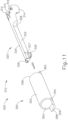
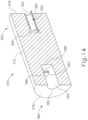
- FIGS. 13-14 show an exemplary instrument (370) that may be used to install and remove clamp pad (350) to and from clamp arm (310).
- Instrument (370) of this example includes an exterior surface (372) defining a grip (374), a pad installation portion (390), and a pad removal portion (380).
- Grip (374) is designed to allow an operator to easily handle instrument (370) while either installing or removing pad (350) onto or from clamp arm (310).
- Grip (374) may have any suitable texture, surface treatment, and/or configuration as will be apparent to one having ordinary skill in the art in view of the teachings herein.
- instrument (370) is described as being used with clamp pad (350) and clamp arm (310), though it should be understood that instrument (370) may be readily modified for use with clamp pad (250) and clamp arm (210) or any other kind of clamp pad that provides a snap fit or interference fit with a corresponding clamp arm.
- Pad installation portion (390) includes an installation face (378), an installation entry (392), an installation tube (394) configured to house clamp pad (350), and an installation stop (396) dimensioned to receive protruding head (326) of clamp arm (310) once clamp pad (350) is completely installed.
- Instrument (370) allows an operator to utilize grip (374) to place installation entry (392) directly above clamp arm (310). With clamp pad (350) already in installation tube (394), an operator may utilize instrument (370) to develop a sufficient grip required to distribute the force required to allow protruding head (326) to travel through elongated channel (362). Once protruding head (326) snaps is located in its final position relative to clamp pad (350) as described above, protruding head (326) will enter installation stop (396).
- protruding head (326) has been positioned distal to clamp pad (350), protruding head (326) will carry clamp pad (350) with clamp arm (310) due to interaction between protruding head (326) and distal face (354).
- Pad removal portion (380) includes a removal face (376), a removal entry (382), a removal channel (384) configured to receive clamp pad (350) already installed on clamp arm (310), a removal stop (388), a blade fixture (386) fixed within removal channel (384), and a blade (387) attached to blade fixture (386).
- Instrument (370) allows an operator to utilize grip (374) to place removal entry (382) directly above clamp arm (310). With clamp pad (350) already installed on clamp arm (310), an operator may utilize instrument (370) to insert clamp pad (350) and clamp arm (310) into removal channel (384).
- Blade (387) is positioned on blade fixture (386) to make contact with clamp pad (350) as clamp pad (350) and clamp arm (310) travel within removal channel (384) toward removal stop (388). Blade (387) is positioned to engage clamp pad (350) but not engage clamp arm (310).
- blade (387) is configured to engage clamp pad (350) in such a manner to retain clamp pad (350) in removal channel (384).
- blade (386) is oriented along a plane that is perpendicular to the longitudinal axis of removal channel (384). In some other versions, blade (386) is oriented along a plane that is obliquely oriented relative to the longitudinal axis of removal channel (384).
- blade (386) may be configured to pivot or deflect distally as clamp arm assembly (300) is inserted into removal channel (384); yet not pivot or deflect proximally as clamp arm (310) is pulled proximally from removal channel (384). Blade (386) may thus act as a pawl, providing just one-way movement of clamp pad (350) in removal channel (384) to retain clamp pad (350) in channel (384) by snagging clamp pad (350) in channel.
- blade (387) may be configured to sever at least a portion of clamp pad (350) as clamp arm assembly (300) is inserted into removal channel (384).
- blade (387) is oriented along a plane that is parallel with the longitudinal axis of removal channel (384). It should be understood that severing at least a portion of clamp pad (350) may relax a grip that clamp pad (350) might otherwise have on clamp arm (310), thereby promoting removal of clamp pad (350) from clamp arm (310).
- clamp pad (350) may effectively enlarge channel (362) in clamp pad (350), facilitating the passage of head (326) through channel (362) as clamp arm (310) is pulled proximally relative to clamp pad (350).
- clamp arm (310) may be removed from channel (384) with the severed clamp pad (350) still coupled with clamp arm (310), such that the operator must then peel or otherwise remove the severed clamp pad (350) from clamp arm (310).
- instrument (370) to facilitate removal of clamp pad (350) from clamp arm (310) will be apparent to those of ordinary skill in the art in view of the teachings herein.
- an operator may use pad removal portion (380) to remove a spent clamp pad (350) as described above, then simply rotate instrument (370) 180° to orient pad installation portion (390) toward clamp arm (310). The operator may then use pad installation portion (390) to install a replacement clamp pad (350) on clamp arm (310) as described above. It should therefore be understood that instrument (370) may be used to remove and replace a clamp pad (350) on the same clamp arm (310) in a single procedure.
- FIGS. 15-22D show another exemplary clamp arm assembly (400) and related components that may be readily incorporated into end effector (50, 140) in place of clam arm (56, 144) and clamp pad (58a, 58b, 146).
- Clamp arm assembly (400) of this example includes a clamp arm (410), a clamp pad (450), and a sliding lock (490).
- clamp pad (450) may be inserted from the underside of clamp arm (410), and then sliding lock (490) may be slid from the top of clamp arm (410) in the proximal direction to fix replaceable clamp pad (450) in relation to clamp arm (410).
- clamp arm includes a frame (416), bridging members (418), a proximal portion (414), and a distal portion (420).
- Frame and bridging members (418) define openings (422) that accommodate inserted portions of clamp pad (450) as will be described in greater detail below.
- clamp pad (450) includes a pad portion (452) that is configured to be positioned under frame (416) and a mating portion (454) that is configured to be positioned through and above openings (422).
- Mating portion (4-54) further includes a frame engagement portion (458), a narrow lock engagement portion (457), and a wide lock engagement portion (456).
- Frame engagement portion (458) and pad portion (452) help define frame channel (462), where frame (416) is housed.
- Frame engagement portion (458), narrow lock engagement portion (457), and wide lock engagement portion (456) define locking channel (460), which sliding lock (490) engages in order to fix clamp pad (450) relative to clamp arm (410).
- sliding lock (490) includes a cap (492) and two arms (494) extending inwardly from cap (492).
- the interior of cap (492) and arms (494) define T-shaped slot (496).
- T-shaped slot (496) is configured to mate with wide lock engagement portion (456) and narrow lock engagement portion (457) to fix replaceable clamp pad (450) relative to clamping arm (410).
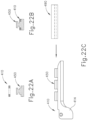
- FIGS. 22A-D show how exemplary clamp arm assembly (400) is assembled.
- first replaceable clamp pad (450) is inserted from the underside of clamp arm (410).
- each mating portion (454) extends through and above a respective opening (422) defined by frame (416) and bridging members (418) of clamp arm (410).
- frame (416) is located within frame channel (462) as defined by frame engagement portion (458) and pad portion (452).
- narrow lock engagement portion (457) and wide lock engagement portion (456) extend above opening (422) defined by frame (416) and bridging members (4-16).
- narrow lock engagement portion (457) and wide lock engagement portion (456) define a complementary T-shaped rail that is configured to mate with T-shaped slot (496) defined by cap (492) and arms (49-4) of sliding lock (4-90). Therefore, sliding lock (490) may slide in the proximal direction, with arms (494) of sliding lock (490) engaging locking channel (460), allowing T-shaped slot (496) to mate with both narrow lock engagement portion (457) and wide lock engagement portion (456) as shown in FIG. 22D .
- replaceable clamp pad (450) is locked between the confines of frame (416) of clamp arm (410) and T-slot (496) of sliding lock (490), preventing replaceable clamp pad (450) from further movement relative to clamp arm (410).
- narrow lock engagement portion (457) and wide lock engagement portion (456) define a T-shaped rail to mate with T-shaped slot (496) in the present example
- any number of suitable geometries may be used to mate sliding lock (490) with mating portion (454) or replaceable clamp pad (450), such as but not limited to, a dovetail slot or any other connecting method apparent to one having ordinary skill in the art in view of the teachings herein.
- Sliding lock (490) may provide a snap fit with either distal portion (420) or proximal portion (414) of clamp arm (410), preventing inadvertent longitudinal translation of replaceable clamp pad (450) relative to clamp arm (410).
- detents may be used to selectively retain the longitudinal position of sliding lock (490) relative to clamp arm (410).
- any other suitable structures or methods may be used to selectively retain the longitudinal position of sliding lock (490) relative to clamp arm (410) as will be apparent to one having ordinary skill in the art in view of the teachings herein. It should also be understood that the fit between sliding lock (490) and clamp arm (410) may nevertheless permit an operator to intentionally remove sliding lock (490) from clamp arm (410) in order to replace a spent clamp pad (450).
- clamp pad (450) may be formed of a polymeric material that is rigid to maintain secure engagement with sliding lock (490).
- at least the portion of clamp pad (450) that will contact tissue and compress the tissue against blade (24, 79, 160) during use of clamp arm assembly (400) may comprise polytetrafluoroethylene.
- suitable materials and combinations of materials that may be used to form clamp pad (450) and different regions thereof will be apparent to those of ordinary skill in the art in view of the teachings herein.
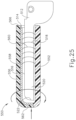
- FIGS. 23-25 show another exemplary clamp arm assembly (500) and related components that may be readily incorporated into end effector (50, 140) in place of clam arm (56, 144) and clamp pad (58a, 58b, 146).
- Clamp arm assembly (500) of this example includes a threaded clamp arm (510) and a threaded clamp pad (550).
- Threaded clamp arm (510) includes a proximal end (512), a distal end (522), an external threaded region (518), a lead in nose (520) distal in relation to threaded region (518), an optional stop boss (514), and an elongate portion (516) connecting proximal end (512) to distal end (522).
- Threaded clamp pad (550) includes a tissue contact pad (552), a proximal opening (554), a proximal end (566), a closed distal end (562), a casing (558) defining a complementary internal threaded region (560), and an optional polytetrafluoroethylene shell (556) surrounding casing (558).
- threaded clamp arm (510) may be inserted into proximal opening (554) of threaded clamp pad (550).
- Lead in nose (520) of threaded clamp arm (510) may help reduce the chances of threaded region (518) and complementary threaded region (560) cross-threading.
- an operator may rotate threaded clamp pad (550) around threaded clamp arm (510), thereby connecting threaded clamp arm (510) and threaded clamp pad (550).
- threaded regions (518, 560) each comprise complementary helical threading to provide a screw-in relationship between clamp arm (510) and clamp pad (520).
- threaded regions (518, 560) each comprise complementary ribbing or teeth that provide a ratcheting slide-in relationship between clamp arm (510) and clamp pad (520).
- Optional stop boss (514) may be positioned on threaded claiming arm (510) at a location where stop boss (514) will engage proximal end (566) of threaded clamp pad (550) at a position where tissue contact pad (552) is facing in the desired angular direction (i.e., with tissue contact pad (552) oriented to face blade (24, 79, 160)).
- optional polytetrafluoroethylene shell (556) surrounding casing (558) may be configured in such a way that closed distal end (562) engages distal end (522) of threaded clamp arm (510) at a location where stop boss (514) will engage proximal end (566) of threaded clamp pad (550) at a position where tissue contact pad (552) is facing in the desired angular direction (i.e., with tissue contact pad (552) oriented to face blade (24, 79, 160)).
- clamp pad (550) may be secured to clamp arm (510) simply by rotating clamp pad (550) about clamp arm (510) until clamp arm (510) grounds out against clamp pad (550). To remove clamp pad (550) for replacement, clamp pad (550) may simply be rotated in the opposite direction until threaded regions (518, 560) are disengaged from each other.
- FIGS. 26A-33C show another exemplary clamp arm assembly (600) and related components that may be readily incorporated into end effector (50, 140) in place of clam arm (56, 144) and clamp pad (58a, 58b, 146).
- Clamp arm assembly (600) of this example includes a clamp arm (610) and a clamp pad (650).
- clamp arm (610) has a pair of tab slots (622) that are configured to receive foldable tabs (652) of clamp pad (650) in order to couple clamp arm (610) with clamp pad (650). It should be understood that FIGS. 26A-33C only show a portion of clamp arm assembly (600).
- clamp arm (610) would include various features that would enable clamp arm (610) to pivotally mount to outer sheath (72, 132) and inner tube (76, 134) as described above. Such features may be configured and operable to receive pins (135, 145) just like clamp arm (144) described above. Alternatively, such features may be configured similar to coupling holes (52a, 52B) and studs (54b) of clamp arm (56) described above. Alternatively, clamp arm (610) may be mounted in any other suitable fashion.
- clamp arm (610) includes a proximal end (614), a distal end (612), a top (618), sides (624), and a bottom (626).
- Top (618) of clamp arm (610) partially defines a recess (620).
- Recess (620) is further defined by recess walls (616) and recess floor (628).
- Tal) slots (622) extend from recess floor (628) to bottom (626) of clamp arm (610).
- clamp pad (650) includes a body (651), a proximal end (656), a distal end (654), a bottom (66,4), a top (662), sides (658), and a set of foldable tabs (652) extending upwardly from a base (660).
- Base (660) may be unitarily coupled to foldable tabs (652).
- Base (660) and foldable tabs (652) may comprise of any suitable material, including but not limited to, aluminum, steel, malleable plastics, or any other suitable material known to a person having ordinary skill in the art in view of the teachings herein.
- Base (660) may be inserted within body (651), or fixedly secured to top (662).
- Base (660) may be fixedly secured to top (662) by any suitable methods, such as welding or any other suitable method known to a person having ordinary skill in the art in view of the teaching herein.
- Foldable tabs (652) are capable of folding toward top (662) of pad (650). Tabs (652) are malleable such that tabs (652) will maintain a bent configuration when tabs (652) are bent by the operator, as is shown in the sequence from FIG. 26A (un-bent configuration) to FIG. 26B (bent configuration).
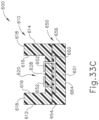
- FIGS. 33A-33C show how clamp pad (650) is attached to clamp arm (610).
- clamp pad (650) is placed underneath clamp arm (610) in such a way that foldable tabs (652) are adjacent to tab slots (622) of clamp arm (610).
- FIG. 33B clamp pad (650) is inserted upwardly toward clamp arm (610) in such a way that foldable tabs (652) pass through tab slots (622), with a portion of foldable tabs (652) extending within recess (620) above tab slots (622).
- bottom (626) of clamp arm (610) is in contact with top (662) of clamp pad (650).
- distal end (612) of clamp arm (610) may align with distal end (654) of clamp pad (650) while proximal end (614) of clamp arm (610) may align with proximal end (656) of clamp pad.
- foldable tabs (652) may be folded toward recess bottom (628). While foldable tabs (652) are folded toward each other in FIG. 33C , it should be understood that tabs (652) may alternatively be folded away from each other - either toward sides (624, 658), toward ends (612, 614), or in any other suitable directions.
- the malleable properties of tabs (652) will maintain this bent configuration of tabs (652), such that bent tabs (652) will effectively secure clamp pad (650) to clamp arm (610).
- Recess (620) is dimensioned to allow an operator to access tabs (652) in such a way as to bend tabs (652) in a position to fix pad (650) to clamp arm (610), and to bend tabs (652) in a position to free pad (650) from clamp arm (610).
- Contact between tabs (652) and clamp arm (610) fixes the position of pad (650) relative to clamp arm (610) during a procedure while also allowing for pad (650) to be replaced when needed.
- the operator may bend tabs (652) back from the position shown in FIG. 33C to the position shown in FIG. 33B , which will allow the operator to pull a spent clamp pad (650) away from clamp arm (610) and thereby replace clamp pad (650) with a new clamp pad (650).
- FIGS. 34-37 show another exemplary clamp arm assembly (700) and related components that may be readily incorporated into end effector (50, 140) in place of clam arm (56, 144) and clamp pad (58a, 58b, 146).
- Clamp arm assembly (700) of this example includes a clamp arm (710), and a cartridge pad assembly (750).
- cartridge pad assembly (750) is configured to be inserted from the top of clamp arm (710), while clamp arm (710) is configured to retain cartridge pad assembly (750) utilizing various retention methods.
- FIG. 34 shows clamp arm (710) including a proximal end (714), a distal end (720), an elongated frame (718) extending from proximal end (714) to distal end (720), a pair of kidney slots (712), and a pair of laterally oriented distal openings (716).
- Elongated frame (718) further defines an opening (722) in which pad (756) may be inserted.
- Clamp arm (710) generally defines a "U" shape in this example.
- FIG. 35 show cartridge pad assembly (750) including a proximal end (757), a distal end (758), a clip-in cartridge (760) extending from proximal end (757) to distal end (758), a tissue contact pad (756) attached to the bottom of clip-in cartridge (760), a pair of legs (752) at proximal end (757), and a pair of laterally oriented distal openings (754) at distal end (758).
- Tissue contact pad (756) may be fixedly secured to clip-in cartridge (760) using any suitable features ore techniques as will be apparent to those of ordinary skill in the art in view of the teachings herein.
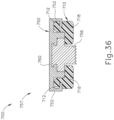
- FIGS. 36-37 show how cartridge pad assembly (750) is secured to clamp arm (710).
- FIG. 36 shows proximal end (757) where legs (752) of cartridge pad assembly (750) are inserted within kidney slots (712) of clamp arm (710).
- legs (752) are first inserted into kidney slots (712)
- distal end (758) of cartridge pad assembly (750) forms an oblique angle with elongated frame (718).
- distal end (758) of cartridge pad assembly (750) becomes parallel with elongated frame (718) such that tissue contact pad (756) extends through elongated frame (718).
- Pad (756) also extends through elongated frame (718) in such a way that pad (756) may make contact with tissue without frame (718) also necessarily contacting tissue.
- Legs (752) and kidney slots (712) interact so that clip-in cartridge (760), and therefore pad (756), do not move relative to elongated frame (718) when distal end (758) of clip-in cartridge (750) is connected to elongated frame (718). It should be understood that legs (752) and kidney slots (712) cooperate to effectively secure the proximal end of cartridge pad assembly (750) to the proximal end of clamp arm (710).
- FIG. 37 shows distal end (758) where openings (754) of cartridge pad assembly (750) are positioned to align with openings (716) of clamp arm (710).
- clip-in cartridge (760) includes recesses (762) that also align with openings (716, 754). It should be understood that openings (716, 754) and recesses (762) will be aligned when legs (752) reach the distal ends of respective kidney slots (712). With openings (716, 754) and recesses (762) aligned, a pair of pins (790) may be inserted into openings (716, 754) and recesses (762) to secure the distal end of cartridge pad assembly (750) to clamp arm (710).
- kidney slots (712) coupling with legs (752) and distal openings (716, 754) coupling with recesses (762) via pins (790) a variety of other structures and technique may be utilized to couple either or both proximal ends (714, 757) and distal ends (720, 758).
- clip-in cartridge (760) could be sized to provide an interference fit with the interior of elongated frame (718) in such a way that when clip-in cartridge is pressed against elongated frame (718), the interior of elongated frame (718) couples to clip-in cartridge (760).
- Other suitable methods of securing clip-in cartridge (760) to elongate frame (718) will be apparent to those of ordinary skill in the art in view of the teachings herein.
- the above described assembly method may be reversed to replace a spent cartridge pad assembly (750).
- the operator may simply remove pins (790) from openings (716, 754) and recesses (762), pivot distal end (758) of cartridge pad assembly (750) away from distal end (720) of clamp arm (710), and remove legs (752) from kidney slots (712) in order to decouple a spent cartridge pad assembly (750) from clamp arm (710).
- the operator may then perform the above-described assembly steps to secure a new cartridge pad assembly (750) to clamp arm (710). These assembly and disassembly steps may all be carried out without having to remove clamp arm (710) from the rest of instrument (20, 100).
- An ultrasonic instrument comprising: (a) a body; (b) a shaft assembly, wherein the shaft assembly extends distally from the body, wherein the shaft assembly comprises an acoustic waveguide, wherein the waveguide is configured to acoustically couple with an ultrasonic transducer; and (c) an end effector, wherein the end effector comprises: (i) an ultrasonic blade in acoustic communication with the waveguide, (ii) a clamp arm pivotally coupled with the shaft assembly, wherein the clamp arm further comprises a proximal portion and an elongated distal portion, and (iii) a clamp pad, wherein the clamp pad is configured to removably couple with the clamp arm while the clamp arm is pivotally coupled to the shaft assembly.
- the ultrasonic instrument of Example 2 wherein the clamp pad further comprises a sleeve configured to receive the elongated flattened surface and the elongated protrusion.
- the clamp pad further comprises an elastomeric tube, wherein the elastomeric tube is configured to slide over the protruding head.
- the clamp arm further comprises a frame defining an opening
- the clamp pad further comprise a pad portion and a mating portion extending above the pad portion, wherein to mating portion is configured to extend through the opening.
- Example 7 The ultrasonic instrument of Example 7, wherein the end effector further comprises a sliding lock, wherein the sliding lock is configured to engage the mating portion of the clamp pad.
- the clamp arm further comprises a first threaded portion around the elongated distal portion, wherein the clamp pad further comprises a second threaded portion configured to mate with the first threaded portion.
- the clamp arm further comprises a stop feature, wherein the stop feature is configured to engage a proximal end of clamp pad to orient the clamp pad relative to the clamp arm.
- the clamp arm further comprises a recess, wherein the recess comprises a floor, wherein the clamp arm further comprises a slot extending into the floor of the recess.
- clamp pad further comprises a padded portion and a cartridge, wherein the cartridge is fixed to the padded portion.
- the clamp arm comprises an elongated frame defining a slot, wherein the padded portion is configured to enter the slot, wherein the cartridge is configured to couple with the elongated frame.
- the ultrasonic instrument of Example 16 wherein the elongated frame comprises a kidney slot, wherein the cartridge further comprises a leg configured to mate with the kidney slot.
- An ultrasonic instrument comprising: (a) a body; (b) a shaft assembly, wherein the shaft assembly comprises an acoustic waveguide, wherein the waveguide is configured to acoustically couple with an ultrasonic transducer; and (c) an end effector; wherein the end effector comprises: (i) an ultrasonic blade in acoustic communication with the waveguide, (ii) a clamp arm pivotally coupled with the shaft assembly, and (iii) a clamp pad, wherein the clamp pad and the clamp arm are configured to enable the clamp pad to be secured to the clamp arm while the clamp arm is pivotally coupled to the shaft assembly, wherein the clamp pad and the clamp arm are further configured to enable the clamp pad to be removed from the clamp arm while the clamp arm is pivotally coupled to the shaft assembly.
- An instrument for installing a clamp pad on a clamp arm and and removing a clamp pad from a clamp arm comprising: (a) a body comprising a first end and second end; (b) a pad installation portion associated with the first end, wherein the pad installation portion comprises an installation channel configured to house the clamp pad; and (c) a pad removal portion associated with the second end, wherein the pad removal portion comprises: (i) a removal channel configured to receive a clamp pad installed on a clamp arm, and (ii) a pad removal feature located within the removal tube, wherein the pad removal feature is configured to selectively disengage at least a portion of the clamp pad from the clamp arm.
- any of the versions of instruments described herein may include various other features in addition to or in lieu of those described above.
- any of the instruments described herein may also include one or more of the various features disclosed in any of the various references that are incorporated by reference herein.
- teachings herein may be readily applied to any of the instruments described in any of the other references cited herein, such that the teachings herein may be readily combined with the teachings of any of the references cited herein in numerous ways.
- Other types of instruments into which the teachings herein may be incorporated will be apparent to those of ordinary skill in the art.
- any ranges of values referred to herein should be read to include the upper and lower boundaries of such ranges. For instance, a range expressed as ranging "between approximately 1.0 inches and approximately 1.5 inches” should be read to include approximately 1.0 inches and approximately 1.5 inches, in addition to including the values between those upper and lower boundaries.
- Versions of the devices described above may have application in conventional medical treatments and procedures conducted by a medical professional, as well as application in robotic-assisted medical treatments and procedures.
- various teachings herein may be readily incorporated into a robotic surgical system such as the DAVINCI TM system by Intuitive Surgical, Inc., of Sunnyvale, California.
- DAVINCI TM system by Intuitive Surgical, Inc., of Sunnyvale, California.
- teachings herein may be readily combined with various teachings of U.S. Pat. No. 6,783,524, entitled "Robotic Surgical Tool with Ultrasound Cauterizing and Cutting Instrument," published August 31, 2004 , the disclosure of which is incorporated by reference herein.
- Versions described above may be designed to be disposed of after a single use, or they can be designed to be used multiple times. Versions may, in either or both cases, be reconditioned for reuse after at least one use
- Reconditioning may include any combination of the steps of disassembly of the device, followed by cleaning or replacement of particular pieces, and subsequent reassembly.
- some versions of the device may be disassembled, and any number of the particular pieces or parts of the device may be selectively replaced or removed in any combination.
- Upon cleaning and/or replacement of particular parts some versions of the device may be reassembled for subsequent use either at a reconditioning facility, or by an operator immediately prior to a procedure.
- reconditioning of a device may utilize a variety of techniques for disassembly, cleaning/replacement, and reassembly. Use of such techniques, and the resulting reconditioned device, are all within the scope of the present application.
- versions described herein may be sterilized before and/or after a procedure.
- the device is placed in a closed and sealed container, such as a plastic or TYVEK bag.
- the container and device may then be placed in a field of radiation that can penetrate the container, such as gamma radiation, x-rays, or high-energy electrons.
- the radiation may kill bacteria on the device and in the container.
- the sterilized device may then be stored in the sterile container for later use.
- a device may also be sterilized using any other technique known in the art, including but not limited to beta or gamma radiation, ethylene oxide, or steam.
Landscapes
- Health & Medical Sciences (AREA)
- Surgery (AREA)
- Engineering & Computer Science (AREA)
- Life Sciences & Earth Sciences (AREA)
- Heart & Thoracic Surgery (AREA)
- Nuclear Medicine, Radiotherapy & Molecular Imaging (AREA)
- Mechanical Engineering (AREA)
- Biomedical Technology (AREA)
- Dentistry (AREA)
- Medical Informatics (AREA)
- Molecular Biology (AREA)
- Animal Behavior & Ethology (AREA)
- General Health & Medical Sciences (AREA)
- Public Health (AREA)
- Veterinary Medicine (AREA)
- Surgical Instruments (AREA)
Applications Claiming Priority (4)
| Application Number | Priority Date | Filing Date | Title |
|---|---|---|---|
| US14/836,347 US10507033B2 (en) | 2015-08-26 | 2015-08-26 | Ultrasonic surgical instrument with replaceable clamp pad |
| EP20185805.7A EP3753505B1 (fr) | 2015-08-26 | 2016-08-17 | Instrument chirurgical ultrasonore à tampon de serrage remplaçable |
| EP16757448.2A EP3340902B1 (fr) | 2015-08-26 | 2016-08-17 | Instrument chirurgical ultrasonore à tampon de serrage remplaçable |
| PCT/US2016/047341 WO2017034878A1 (fr) | 2015-08-26 | 2016-08-17 | Instrument chirurgical ultrasonore à tampon de serrage remplaçable |
Related Parent Applications (2)
| Application Number | Title | Priority Date | Filing Date |
|---|---|---|---|
| EP16757448.2A Division EP3340902B1 (fr) | 2015-08-26 | 2016-08-17 | Instrument chirurgical ultrasonore à tampon de serrage remplaçable |
| EP20185805.7A Division EP3753505B1 (fr) | 2015-08-26 | 2016-08-17 | Instrument chirurgical ultrasonore à tampon de serrage remplaçable |
Publications (2)
| Publication Number | Publication Date |
|---|---|
| EP4566552A2 true EP4566552A2 (fr) | 2025-06-11 |
| EP4566552A3 EP4566552A3 (fr) | 2025-08-27 |
Family
ID=56801834
Family Applications (3)
| Application Number | Title | Priority Date | Filing Date |
|---|---|---|---|
| EP20185805.7A Active EP3753505B1 (fr) | 2015-08-26 | 2016-08-17 | Instrument chirurgical ultrasonore à tampon de serrage remplaçable |
| EP25172329.2A Pending EP4566552A3 (fr) | 2015-08-26 | 2016-08-17 | Instrument chirurgical à ultrasons avec plaquette de serrage remplaçable |
| EP16757448.2A Active EP3340902B1 (fr) | 2015-08-26 | 2016-08-17 | Instrument chirurgical ultrasonore à tampon de serrage remplaçable |
Family Applications Before (1)
| Application Number | Title | Priority Date | Filing Date |
|---|---|---|---|
| EP20185805.7A Active EP3753505B1 (fr) | 2015-08-26 | 2016-08-17 | Instrument chirurgical ultrasonore à tampon de serrage remplaçable |
Family Applications After (1)
| Application Number | Title | Priority Date | Filing Date |
|---|---|---|---|
| EP16757448.2A Active EP3340902B1 (fr) | 2015-08-26 | 2016-08-17 | Instrument chirurgical ultrasonore à tampon de serrage remplaçable |
Country Status (6)
| Country | Link |
|---|---|
| US (2) | US10507033B2 (fr) |
| EP (3) | EP3753505B1 (fr) |
| JP (1) | JP6862424B2 (fr) |
| CN (1) | CN108348274B (fr) |
| BR (1) | BR112018003725B1 (fr) |
| WO (1) | WO2017034878A1 (fr) |
Families Citing this family (65)
| Publication number | Priority date | Publication date | Assignee | Title |
|---|---|---|---|---|
| US10835307B2 (en) | 2001-06-12 | 2020-11-17 | Ethicon Llc | Modular battery powered handheld surgical instrument containing elongated multi-layered shaft |
| US9089360B2 (en) | 2008-08-06 | 2015-07-28 | Ethicon Endo-Surgery, Inc. | Devices and techniques for cutting and coagulating tissue |
| US8663220B2 (en) | 2009-07-15 | 2014-03-04 | Ethicon Endo-Surgery, Inc. | Ultrasonic surgical instruments |
| US11090104B2 (en) | 2009-10-09 | 2021-08-17 | Cilag Gmbh International | Surgical generator for ultrasonic and electrosurgical devices |
| US8469981B2 (en) | 2010-02-11 | 2013-06-25 | Ethicon Endo-Surgery, Inc. | Rotatable cutting implement arrangements for ultrasonic surgical instruments |
| US9439668B2 (en) | 2012-04-09 | 2016-09-13 | Ethicon Endo-Surgery, Llc | Switch arrangements for ultrasonic surgical instruments |
| US20140005705A1 (en) | 2012-06-29 | 2014-01-02 | Ethicon Endo-Surgery, Inc. | Surgical instruments with articulating shafts |
| US9393037B2 (en) | 2012-06-29 | 2016-07-19 | Ethicon Endo-Surgery, Llc | Surgical instruments with articulating shafts |
| US9351754B2 (en) | 2012-06-29 | 2016-05-31 | Ethicon Endo-Surgery, Llc | Ultrasonic surgical instruments with distally positioned jaw assemblies |
| US9198714B2 (en) | 2012-06-29 | 2015-12-01 | Ethicon Endo-Surgery, Inc. | Haptic feedback devices for surgical robot |
| US9408622B2 (en) | 2012-06-29 | 2016-08-09 | Ethicon Endo-Surgery, Llc | Surgical instruments with articulating shafts |
| US9226767B2 (en) | 2012-06-29 | 2016-01-05 | Ethicon Endo-Surgery, Inc. | Closed feedback control for electrosurgical device |
| US9095367B2 (en) | 2012-10-22 | 2015-08-04 | Ethicon Endo-Surgery, Inc. | Flexible harmonic waveguides/blades for surgical instruments |
| US20140135804A1 (en) | 2012-11-15 | 2014-05-15 | Ethicon Endo-Surgery, Inc. | Ultrasonic and electrosurgical devices |
| US10092310B2 (en) | 2014-03-27 | 2018-10-09 | Ethicon Llc | Electrosurgical devices |
| US9737355B2 (en) | 2014-03-31 | 2017-08-22 | Ethicon Llc | Controlling impedance rise in electrosurgical medical devices |
| US9913680B2 (en) | 2014-04-15 | 2018-03-13 | Ethicon Llc | Software algorithms for electrosurgical instruments |
| US10285724B2 (en) | 2014-07-31 | 2019-05-14 | Ethicon Llc | Actuation mechanisms and load adjustment assemblies for surgical instruments |
| US10245095B2 (en) | 2015-02-06 | 2019-04-02 | Ethicon Llc | Electrosurgical instrument with rotation and articulation mechanisms |
| US11141213B2 (en) | 2015-06-30 | 2021-10-12 | Cilag Gmbh International | Surgical instrument with user adaptable techniques |
| US10507033B2 (en) | 2015-08-26 | 2019-12-17 | Ethicon Llc | Ultrasonic surgical instrument with replaceable clamp pad |
| US10736685B2 (en) | 2015-09-30 | 2020-08-11 | Ethicon Llc | Generator for digitally generating combined electrical signal waveforms for ultrasonic surgical instruments |
| US10595930B2 (en) | 2015-10-16 | 2020-03-24 | Ethicon Llc | Electrode wiping surgical device |
| US12193698B2 (en) | 2016-01-15 | 2025-01-14 | Cilag Gmbh International | Method for self-diagnosing operation of a control switch in a surgical instrument system |
| US11229471B2 (en) | 2016-01-15 | 2022-01-25 | Cilag Gmbh International | Modular battery powered handheld surgical instrument with selective application of energy based on tissue characterization |
| US11129670B2 (en) | 2016-01-15 | 2021-09-28 | Cilag Gmbh International | Modular battery powered handheld surgical instrument with selective application of energy based on button displacement, intensity, or local tissue characterization |
| US10828058B2 (en) | 2016-01-15 | 2020-11-10 | Ethicon Llc | Modular battery powered handheld surgical instrument with motor control limits based on tissue characterization |
| US10555769B2 (en) | 2016-02-22 | 2020-02-11 | Ethicon Llc | Flexible circuits for electrosurgical instrument |
| US10456193B2 (en) | 2016-05-03 | 2019-10-29 | Ethicon Llc | Medical device with a bilateral jaw configuration for nerve stimulation |
| US10376305B2 (en) | 2016-08-05 | 2019-08-13 | Ethicon Llc | Methods and systems for advanced harmonic energy |
| US11266430B2 (en) | 2016-11-29 | 2022-03-08 | Cilag Gmbh International | End effector control and calibration |
| US20190038308A1 (en) * | 2017-08-02 | 2019-02-07 | Covidien Lp | Jaw members for surgical instruments and surgical instruments incorporating the same |
| US11179177B2 (en) * | 2019-04-30 | 2021-11-23 | Cilag Gmbh International | Ultrasonic blade and clamp arm matching design |
| CN110584751B (zh) * | 2019-09-27 | 2024-10-01 | 湖南瀚德微创医疗科技有限公司 | 一种提高超声切割止血刀使用寿命的钳头 |
| US11937863B2 (en) | 2019-12-30 | 2024-03-26 | Cilag Gmbh International | Deflectable electrode with variable compression bias along the length of the deflectable electrode |
| US12114912B2 (en) | 2019-12-30 | 2024-10-15 | Cilag Gmbh International | Non-biased deflectable electrode to minimize contact between ultrasonic blade and electrode |
| US20210196352A1 (en) | 2019-12-30 | 2021-07-01 | Ethicon Llc | Partially conductive clamp arm pad to enable electrode wear through and minimize short circuiting |
| US11944366B2 (en) | 2019-12-30 | 2024-04-02 | Cilag Gmbh International | Asymmetric segmented ultrasonic support pad for cooperative engagement with a movable RF electrode |
| US11759251B2 (en) | 2019-12-30 | 2023-09-19 | Cilag Gmbh International | Control program adaptation based on device status and user input |
| US12702409B2 (en) | 2019-12-30 | 2026-08-11 | Cilag Gmbh International | Surgical instrument comprising a flex circuit |
| US12053224B2 (en) | 2019-12-30 | 2024-08-06 | Cilag Gmbh International | Variation in electrode parameters and deflectable electrode to modify energy density and tissue interaction |
| US11696776B2 (en) | 2019-12-30 | 2023-07-11 | Cilag Gmbh International | Articulatable surgical instrument |
| US12076006B2 (en) | 2019-12-30 | 2024-09-03 | Cilag Gmbh International | Surgical instrument comprising an orientation detection system |
| US11452525B2 (en) | 2019-12-30 | 2022-09-27 | Cilag Gmbh International | Surgical instrument comprising an adjustment system |
| US12082808B2 (en) | 2019-12-30 | 2024-09-10 | Cilag Gmbh International | Surgical instrument comprising a control system responsive to software configurations |
| US12064109B2 (en) | 2019-12-30 | 2024-08-20 | Cilag Gmbh International | Surgical instrument comprising a feedback control circuit |
| US11950797B2 (en) | 2019-12-30 | 2024-04-09 | Cilag Gmbh International | Deflectable electrode with higher distal bias relative to proximal bias |
| US11786291B2 (en) | 2019-12-30 | 2023-10-17 | Cilag Gmbh International | Deflectable support of RF energy electrode with respect to opposing ultrasonic blade |
| US11986201B2 (en) | 2019-12-30 | 2024-05-21 | Cilag Gmbh International | Method for operating a surgical instrument |
| US20210196358A1 (en) | 2019-12-30 | 2021-07-01 | Ethicon Llc | Electrosurgical instrument with electrodes biasing support |
| US11707318B2 (en) | 2019-12-30 | 2023-07-25 | Cilag Gmbh International | Surgical instrument with jaw alignment features |
| US11911063B2 (en) | 2019-12-30 | 2024-02-27 | Cilag Gmbh International | Techniques for detecting ultrasonic blade to electrode contact and reducing power to ultrasonic blade |
| US12023086B2 (en) | 2019-12-30 | 2024-07-02 | Cilag Gmbh International | Electrosurgical instrument for delivering blended energy modalities to tissue |
| US12262937B2 (en) | 2019-12-30 | 2025-04-01 | Cilag Gmbh International | User interface for surgical instrument with combination energy modality end-effector |
| US11812957B2 (en) | 2019-12-30 | 2023-11-14 | Cilag Gmbh International | Surgical instrument comprising a signal interference resolution system |
| US11937866B2 (en) | 2019-12-30 | 2024-03-26 | Cilag Gmbh International | Method for an electrosurgical procedure |
| US11660089B2 (en) | 2019-12-30 | 2023-05-30 | Cilag Gmbh International | Surgical instrument comprising a sensing system |
| US11779329B2 (en) | 2019-12-30 | 2023-10-10 | Cilag Gmbh International | Surgical instrument comprising a flex circuit including a sensor system |
| US12343063B2 (en) | 2019-12-30 | 2025-07-01 | Cilag Gmbh International | Multi-layer clamp arm pad for enhanced versatility and performance of a surgical device |
| US12336747B2 (en) | 2019-12-30 | 2025-06-24 | Cilag Gmbh International | Method of operating a combination ultrasonic / bipolar RF surgical device with a combination energy modality end-effector |
| US11779387B2 (en) | 2019-12-30 | 2023-10-10 | Cilag Gmbh International | Clamp arm jaw to minimize tissue sticking and improve tissue control |
| US20210196359A1 (en) | 2019-12-30 | 2021-07-01 | Ethicon Llc | Electrosurgical instruments with electrodes having energy focusing features |
| US12564418B2 (en) * | 2020-05-15 | 2026-03-03 | Covidien Lp | Articulating ultrasonic surgical instruments and systems |
| CN112741673A (zh) * | 2020-12-30 | 2021-05-04 | 常州柯柏电子科技有限公司 | 一种新型手持超声切割器用联动机构 |
| CN112754608B (zh) * | 2021-01-21 | 2025-07-04 | 武汉联影智融医疗科技有限公司 | 一种末端夹持装置及超声刀系统 |
Citations (24)
| Publication number | Priority date | Publication date | Assignee | Title |
|---|---|---|---|---|
| US5322055A (en) | 1993-01-27 | 1994-06-21 | Ultracision, Inc. | Clamp coagulator/cutting system for ultrasonic surgical instruments |
| US5324299A (en) | 1992-02-03 | 1994-06-28 | Ultracision, Inc. | Ultrasonic scalpel blade and methods of application |
| US5873873A (en) | 1997-10-10 | 1999-02-23 | Ethicon Endo-Surgery, Inc. | Ultrasonic clamp coagulator apparatus having improved clamp mechanism |
| US5980510A (en) | 1997-10-10 | 1999-11-09 | Ethicon Endo-Surgery, Inc. | Ultrasonic clamp coagulator apparatus having improved clamp arm pivot mount |
| US6283981B1 (en) | 1998-06-29 | 2001-09-04 | Ethicon Endo-Surgery | Method of balancing asymmetric ultrasonic surgical blades |
| US6309400B2 (en) | 1998-06-29 | 2001-10-30 | Ethicon Endo-Surgery, Inc. | Curved ultrasonic blade having a trapezoidal cross section |
| US6325811B1 (en) | 1999-10-05 | 2001-12-04 | Ethicon Endo-Surgery, Inc. | Blades with functional balance asymmetries for use with ultrasonic surgical instruments |
| US6423082B1 (en) | 2000-03-31 | 2002-07-23 | Ethicon Endo-Surgery, Inc. | Ultrasonic surgical blade with improved cutting and coagulation features |
| US6783524B2 (en) | 2001-04-19 | 2004-08-31 | Intuitive Surgical, Inc. | Robotic surgical tool with ultrasound cauterizing and cutting instrument |
| US6994010B2 (en) | 2000-08-14 | 2006-02-07 | Peach Office Products Ltd. | Cutting tool for a punching machine, method for producing said cutting tool and punching machine |
| US20060079874A1 (en) | 2004-10-08 | 2006-04-13 | Faller Craig N | Tissue pad for use with an ultrasonic surgical instrument |
| US20070191713A1 (en) | 2005-10-14 | 2007-08-16 | Eichmann Stephen E | Ultrasonic device for cutting and coagulating |
| US20070282333A1 (en) | 2006-06-01 | 2007-12-06 | Fortson Reginald D | Ultrasonic waveguide and blade |
| US20080200940A1 (en) | 2007-01-16 | 2008-08-21 | Eichmann Stephen E | Ultrasonic device for cutting and coagulating |
| US20080234710A1 (en) | 2007-03-22 | 2008-09-25 | Neurohr Mark A | Ultrasonic surgical instruments |
| US20100069940A1 (en) | 2008-09-12 | 2010-03-18 | Miller Matthew C | Ultrasonic Device for Fingertip Control |
| US20110015660A1 (en) | 2009-07-15 | 2011-01-20 | Ethicon Endo-Surgery, Inc. | Rotating transducer mount for ultrasonic surgical instruments |
| US20110087212A1 (en) | 2009-10-09 | 2011-04-14 | Ethicon Endo-Surgery, Inc. | Surgical generator for ultrasonic and electrosurgical devices |
| US8057498B2 (en) | 2007-11-30 | 2011-11-15 | Ethicon Endo-Surgery, Inc. | Ultrasonic surgical instrument blades |
| US20120112687A1 (en) | 2010-11-05 | 2012-05-10 | Houser Kevin L | Recharge system for medical devices |
| US20120116265A1 (en) | 2010-11-05 | 2012-05-10 | Houser Kevin L | Surgical instrument with charging devices |
| US20140005701A1 (en) | 2012-06-29 | 2014-01-02 | Ethicon Endo-Surgery, Inc. | Surgical instruments with articulating shafts |
| US8623027B2 (en) | 2007-10-05 | 2014-01-07 | Ethicon Endo-Surgery, Inc. | Ergonomic surgical instruments |
| US20140114334A1 (en) | 2012-10-22 | 2014-04-24 | Ethicon Endo-Surgery, Inc. | Flexible harmonic waveguides/blades for surgical instruments |
Family Cites Families (22)
| Publication number | Priority date | Publication date | Assignee | Title |
|---|---|---|---|---|
| US4452244A (en) | 1980-01-24 | 1984-06-05 | Thomas J. Fogarty | Endarterectomy roller |
| US5250072A (en) * | 1990-12-10 | 1993-10-05 | Jain Krishna M | Surgical clamp jaw cover |
| GB9209206D0 (en) | 1992-04-29 | 1992-06-17 | Hoskin William J | Blood vessel clamps |
| US5728121A (en) * | 1996-04-17 | 1998-03-17 | Teleflex Medical, Inc. | Surgical grasper devices |
| US6579304B1 (en) * | 1997-02-03 | 2003-06-17 | Applied Medical Resources Corporation | Surgical clamp with improved traction |
| US8092473B2 (en) * | 1997-02-03 | 2012-01-10 | Applied Medical Resources Corporation | Surgical clamp with improved traction |
| US6024750A (en) | 1997-08-14 | 2000-02-15 | United States Surgical | Ultrasonic curved blade |
| JP3686765B2 (ja) * | 1998-04-16 | 2005-08-24 | オリンパス株式会社 | 超音波処置具 |
| US6099539A (en) | 1998-07-27 | 2000-08-08 | Thomas J. Fogarty | Surgical clamp pad with interdigitating teeth |
| US6387112B1 (en) * | 1999-06-18 | 2002-05-14 | Novare Surgical Systems, Inc. | Surgical clamp having replaceable pad |
| US6214023B1 (en) * | 1999-06-21 | 2001-04-10 | Ethicon Endo-Surgery, Inc. | Ultrasonic surgical instrument with removable clamp arm |
| US6432118B1 (en) * | 1999-10-05 | 2002-08-13 | Ethicon Endo-Surgery, Inc. | Multifunctional curved blade for use with an ultrasonic surgical instrument |
| US6406485B1 (en) * | 1999-10-08 | 2002-06-18 | Pilling Weck Incorporated | Surgical grasping device and components thereof |
| US8685056B2 (en) * | 2011-08-18 | 2014-04-01 | Covidien Lp | Surgical forceps |
| US20140249557A1 (en) | 2013-03-01 | 2014-09-04 | Ethicon Endo-Surgery, Inc. | Thumbwheel switch arrangements for surgical instruments |
| US10172636B2 (en) | 2013-09-17 | 2019-01-08 | Ethicon Llc | Articulation features for ultrasonic surgical instrument |
| EP3073939B1 (fr) | 2013-11-26 | 2024-04-17 | Ethicon LLC | Instrument chirurgical ultrasonore ayant un clampage par étapes |
| US9724120B2 (en) * | 2013-12-17 | 2017-08-08 | Ethicon Endo-Surgery, Llc | Clamp arm features for ultrasonic surgical instrument |
| US10010340B2 (en) | 2014-02-28 | 2018-07-03 | Ethicon Llc | Ultrasonic surgical instrument with removable handle assembly |
| US10433863B2 (en) | 2014-11-25 | 2019-10-08 | Ethicon Llc | Ultrasonic surgical instrument with blade cooling through retraction |
| CN204336989U (zh) * | 2014-12-12 | 2015-05-20 | 浙江微度医疗器械有限公司 | 一种便于拆装的施夹钳 |
| US10507033B2 (en) | 2015-08-26 | 2019-12-17 | Ethicon Llc | Ultrasonic surgical instrument with replaceable clamp pad |
-
2015
- 2015-08-26 US US14/836,347 patent/US10507033B2/en active Active
-
2016
- 2016-08-17 JP JP2018510471A patent/JP6862424B2/ja active Active
- 2016-08-17 EP EP20185805.7A patent/EP3753505B1/fr active Active
- 2016-08-17 EP EP25172329.2A patent/EP4566552A3/fr active Pending
- 2016-08-17 CN CN201680062606.5A patent/CN108348274B/zh active Active
- 2016-08-17 EP EP16757448.2A patent/EP3340902B1/fr active Active
- 2016-08-17 BR BR112018003725-7A patent/BR112018003725B1/pt active IP Right Grant
- 2016-08-17 WO PCT/US2016/047341 patent/WO2017034878A1/fr not_active Ceased
-
2019
- 2019-08-23 US US16/549,821 patent/US11497520B2/en active Active
Patent Citations (29)
| Publication number | Priority date | Publication date | Assignee | Title |
|---|---|---|---|---|
| US5324299A (en) | 1992-02-03 | 1994-06-28 | Ultracision, Inc. | Ultrasonic scalpel blade and methods of application |
| US5322055A (en) | 1993-01-27 | 1994-06-21 | Ultracision, Inc. | Clamp coagulator/cutting system for ultrasonic surgical instruments |
| US5322055B1 (en) | 1993-01-27 | 1997-10-14 | Ultracision Inc | Clamp coagulator/cutting system for ultrasonic surgical instruments |
| US5873873A (en) | 1997-10-10 | 1999-02-23 | Ethicon Endo-Surgery, Inc. | Ultrasonic clamp coagulator apparatus having improved clamp mechanism |
| US5980510A (en) | 1997-10-10 | 1999-11-09 | Ethicon Endo-Surgery, Inc. | Ultrasonic clamp coagulator apparatus having improved clamp arm pivot mount |
| US6309400B2 (en) | 1998-06-29 | 2001-10-30 | Ethicon Endo-Surgery, Inc. | Curved ultrasonic blade having a trapezoidal cross section |
| US6283981B1 (en) | 1998-06-29 | 2001-09-04 | Ethicon Endo-Surgery | Method of balancing asymmetric ultrasonic surgical blades |
| US6325811B1 (en) | 1999-10-05 | 2001-12-04 | Ethicon Endo-Surgery, Inc. | Blades with functional balance asymmetries for use with ultrasonic surgical instruments |
| US6773444B2 (en) | 1999-10-05 | 2004-08-10 | Ethicon Endo-Surgery, Inc. | Blades with functional balance asymmetries for use with ultrasonic surgical instruments |
| US6423082B1 (en) | 2000-03-31 | 2002-07-23 | Ethicon Endo-Surgery, Inc. | Ultrasonic surgical blade with improved cutting and coagulation features |
| US6994010B2 (en) | 2000-08-14 | 2006-02-07 | Peach Office Products Ltd. | Cutting tool for a punching machine, method for producing said cutting tool and punching machine |
| US6783524B2 (en) | 2001-04-19 | 2004-08-31 | Intuitive Surgical, Inc. | Robotic surgical tool with ultrasound cauterizing and cutting instrument |
| US7544200B2 (en) | 2004-10-08 | 2009-06-09 | Ethicon Endo-Surgery, Inc. | Combination tissue pad for use with an ultrasonic surgical instrument |
| US20060079874A1 (en) | 2004-10-08 | 2006-04-13 | Faller Craig N | Tissue pad for use with an ultrasonic surgical instrument |
| US20070191713A1 (en) | 2005-10-14 | 2007-08-16 | Eichmann Stephen E | Ultrasonic device for cutting and coagulating |
| US20070282333A1 (en) | 2006-06-01 | 2007-12-06 | Fortson Reginald D | Ultrasonic waveguide and blade |
| US20080200940A1 (en) | 2007-01-16 | 2008-08-21 | Eichmann Stephen E | Ultrasonic device for cutting and coagulating |
| US20080234710A1 (en) | 2007-03-22 | 2008-09-25 | Neurohr Mark A | Ultrasonic surgical instruments |
| US8623027B2 (en) | 2007-10-05 | 2014-01-07 | Ethicon Endo-Surgery, Inc. | Ergonomic surgical instruments |
| US8591536B2 (en) | 2007-11-30 | 2013-11-26 | Ethicon Endo-Surgery, Inc. | Ultrasonic surgical instrument blades |
| US8057498B2 (en) | 2007-11-30 | 2011-11-15 | Ethicon Endo-Surgery, Inc. | Ultrasonic surgical instrument blades |
| US20100069940A1 (en) | 2008-09-12 | 2010-03-18 | Miller Matthew C | Ultrasonic Device for Fingertip Control |
| US20110015660A1 (en) | 2009-07-15 | 2011-01-20 | Ethicon Endo-Surgery, Inc. | Rotating transducer mount for ultrasonic surgical instruments |
| US8461744B2 (en) | 2009-07-15 | 2013-06-11 | Ethicon Endo-Surgery, Inc. | Rotating transducer mount for ultrasonic surgical instruments |
| US20110087212A1 (en) | 2009-10-09 | 2011-04-14 | Ethicon Endo-Surgery, Inc. | Surgical generator for ultrasonic and electrosurgical devices |
| US20120116265A1 (en) | 2010-11-05 | 2012-05-10 | Houser Kevin L | Surgical instrument with charging devices |
| US20120112687A1 (en) | 2010-11-05 | 2012-05-10 | Houser Kevin L | Recharge system for medical devices |
| US20140005701A1 (en) | 2012-06-29 | 2014-01-02 | Ethicon Endo-Surgery, Inc. | Surgical instruments with articulating shafts |
| US20140114334A1 (en) | 2012-10-22 | 2014-04-24 | Ethicon Endo-Surgery, Inc. | Flexible harmonic waveguides/blades for surgical instruments |
Also Published As
| Publication number | Publication date |
|---|---|
| US10507033B2 (en) | 2019-12-17 |
| EP3340902A1 (fr) | 2018-07-04 |
| JP6862424B2 (ja) | 2021-04-21 |
| EP3753505C0 (fr) | 2025-04-30 |
| EP3340902B1 (fr) | 2020-07-15 |
| CN108348274B (zh) | 2021-09-10 |
| US11497520B2 (en) | 2022-11-15 |
| CN108348274A (zh) | 2018-07-31 |
| JP2018525146A (ja) | 2018-09-06 |
| EP3753505B1 (fr) | 2025-04-30 |
| WO2017034878A1 (fr) | 2017-03-02 |
| US20200078043A1 (en) | 2020-03-12 |
| BR112018003725A2 (pt) | 2018-09-25 |
| US20170056059A1 (en) | 2017-03-02 |
| BR112018003725B1 (pt) | 2022-07-19 |
| EP3753505A1 (fr) | 2020-12-23 |
| EP4566552A3 (fr) | 2025-08-27 |
Similar Documents
| Publication | Publication Date | Title |
|---|---|---|
| US11497520B2 (en) | Ultrasonic surgical instrument with replaceable clamp pad | |
| US11357532B2 (en) | Snap fit clamp pad for ultrasonic surgical instrument | |
| US12004768B2 (en) | Methods and features for coupling ultrasonic surgical instrument components together | |
| EP3744267A1 (fr) | Instrument chirurgical doté d'un ensemble d'articulation à verrouillage sélectif | |
| EP3232954B1 (fr) | Instrument chirurgical à ultrasons à double mode | |
| US11517773B2 (en) | Ultrasonic surgical instrument clamp arm with snap-on clamp pad | |
| US9907565B2 (en) | Activation features for ultrasonic surgical instrument | |
| BR112018007724B1 (pt) | Instrumento cirúrgico | |
| JP7483753B2 (ja) | 超音波ブレード及びクランプアーム整合設計 | |
| US10413314B2 (en) | Ultrasonic surgical instrument with activation member pair and slidable cover | |
| WO2025017461A1 (fr) | Instrument chirurgical avec bras de serrage et raccord de charnière d'arbre de pivot |
Legal Events
| Date | Code | Title | Description |
|---|---|---|---|
| PUAI | Public reference made under article 153(3) epc to a published international application that has entered the european phase |
Free format text: ORIGINAL CODE: 0009012 |
|
| STAA | Information on the status of an ep patent application or granted ep patent |
Free format text: STATUS: THE APPLICATION HAS BEEN PUBLISHED |
|
| AC | Divisional application: reference to earlier application |
Ref document number: 3340902 Country of ref document: EP Kind code of ref document: P Ref document number: 3753505 Country of ref document: EP Kind code of ref document: P |
|
| AK | Designated contracting states |
Kind code of ref document: A2 Designated state(s): AL AT BE BG CH CY CZ DE DK EE ES FI FR GB GR HR HU IE IS IT LI LT LU LV MC MK MT NL NO PL PT RO RS SE SI SK SM TR |
|
| REG | Reference to a national code |
Ref country code: DE Ref legal event code: R079 Free format text: PREVIOUS MAIN CLASS: A61B0017280000 Ipc: A61B0017320000 |
|
| PUAL | Search report despatched |
Free format text: ORIGINAL CODE: 0009013 |
|
| AK | Designated contracting states |
Kind code of ref document: A3 Designated state(s): AL AT BE BG CH CY CZ DE DK EE ES FI FR GB GR HR HU IE IS IT LI LT LU LV MC MK MT NL NO PL PT RO RS SE SI SK SM TR |
|
| RIC1 | Information provided on ipc code assigned before grant |
Ipc: A61B 17/32 20060101AFI20250721BHEP Ipc: A61B 17/28 20060101ALN20250721BHEP |
|
| STAA | Information on the status of an ep patent application or granted ep patent |
Free format text: STATUS: REQUEST FOR EXAMINATION WAS MADE |
|
| 17P | Request for examination filed |
Effective date: 20260225 |
|
| GRAP | Despatch of communication of intention to grant a patent |
Free format text: ORIGINAL CODE: EPIDOSNIGR1 |
|
| STAA | Information on the status of an ep patent application or granted ep patent |
Free format text: STATUS: GRANT OF PATENT IS INTENDED |
|
| RIC1 | Information provided on ipc code assigned before grant |
Ipc: A61B 17/32 20060101AFI20260604BHEP Ipc: A61B 17/28 20060101ALN20260604BHEP |
|
| INTG | Intention to grant announced |
Effective date: 20260615 |
|
| GRAS | Grant fee paid |
Free format text: ORIGINAL CODE: EPIDOSNIGR3 |
|
| GRAA | (expected) grant |
Free format text: ORIGINAL CODE: 0009210 |
|
| STAA | Information on the status of an ep patent application or granted ep patent |
Free format text: STATUS: THE PATENT HAS BEEN GRANTED |