EP4567121A1 - Procédé combiné de production de bioéthanol et d'un produit protéique de fruit oléagineux - Google Patents
Procédé combiné de production de bioéthanol et d'un produit protéique de fruit oléagineux Download PDFInfo
- Publication number
- EP4567121A1 EP4567121A1 EP23213897.4A EP23213897A EP4567121A1 EP 4567121 A1 EP4567121 A1 EP 4567121A1 EP 23213897 A EP23213897 A EP 23213897A EP 4567121 A1 EP4567121 A1 EP 4567121A1
- Authority
- EP
- European Patent Office
- Prior art keywords
- product
- oilseed
- bioethanol
- mixture
- separated
- Prior art date
- Legal status (The legal status is an assumption and is not a legal conclusion. Google has not performed a legal analysis and makes no representation as to the accuracy of the status listed.)
- Pending
Links
Images

Classifications
-
- C—CHEMISTRY; METALLURGY
- C12—BIOCHEMISTRY; BEER; SPIRITS; WINE; VINEGAR; MICROBIOLOGY; ENZYMOLOGY; MUTATION OR GENETIC ENGINEERING
- C12P—FERMENTATION OR ENZYME-USING PROCESSES TO SYNTHESISE A DESIRED CHEMICAL COMPOUND OR COMPOSITION OR TO SEPARATE OPTICAL ISOMERS FROM A RACEMIC MIXTURE
- C12P7/00—Preparation of oxygen-containing organic compounds
- C12P7/02—Preparation of oxygen-containing organic compounds containing a hydroxy group
- C12P7/04—Preparation of oxygen-containing organic compounds containing a hydroxy group acyclic
- C12P7/06—Ethanol, i.e. non-beverage
- C12P7/08—Ethanol, i.e. non-beverage produced as by-product or from waste or cellulosic material substrate
- C12P7/10—Ethanol, i.e. non-beverage produced as by-product or from waste or cellulosic material substrate substrate containing cellulosic material
-
- A—HUMAN NECESSITIES
- A23—FOODS OR FOODSTUFFS; TREATMENT THEREOF, NOT COVERED BY OTHER CLASSES
- A23J—PROTEIN COMPOSITIONS FOR FOODSTUFFS; WORKING-UP PROTEINS FOR FOODSTUFFS; PHOSPHATIDE COMPOSITIONS FOR FOODSTUFFS
- A23J1/00—Obtaining protein compositions for foodstuffs; Bulk opening of eggs and separation of yolks from whites
- A23J1/14—Obtaining protein compositions for foodstuffs; Bulk opening of eggs and separation of yolks from whites from leguminous or other vegetable seeds; from press-cake or oil-bearing seeds
- A23J1/148—Obtaining protein compositions for foodstuffs; Bulk opening of eggs and separation of yolks from whites from leguminous or other vegetable seeds; from press-cake or oil-bearing seeds by treatment involving enzymes or microorganisms
-
- A—HUMAN NECESSITIES
- A23—FOODS OR FOODSTUFFS; TREATMENT THEREOF, NOT COVERED BY OTHER CLASSES
- A23K—FODDER
- A23K10/00—Animal feeding-stuffs
- A23K10/30—Animal feeding-stuffs from material of plant origin, e.g. roots, seeds or hay; from material of fungal origin, e.g. mushrooms
- A23K10/37—Animal feeding-stuffs from material of plant origin, e.g. roots, seeds or hay; from material of fungal origin, e.g. mushrooms from waste material
-
- C—CHEMISTRY; METALLURGY
- C11—ANIMAL OR VEGETABLE OILS, FATS, FATTY SUBSTANCES OR WAXES; FATTY ACIDS THEREFROM; DETERGENTS; CANDLES
- C11B—PRODUCING, e.g. BY PRESSING RAW MATERIALS OR BY EXTRACTION FROM WASTE MATERIALS, REFINING OR PRESERVING FATS, FATTY SUBSTANCES, e.g. LANOLIN, FATTY OILS OR WAXES; ESSENTIAL OILS; PERFUMES
- C11B1/00—Production of fats or fatty oils from raw materials
- C11B1/10—Production of fats or fatty oils from raw materials by extracting
-
- C—CHEMISTRY; METALLURGY
- C12—BIOCHEMISTRY; BEER; SPIRITS; WINE; VINEGAR; MICROBIOLOGY; ENZYMOLOGY; MUTATION OR GENETIC ENGINEERING
- C12M—APPARATUS FOR ENZYMOLOGY OR MICROBIOLOGY; APPARATUS FOR CULTURING MICROORGANISMS FOR PRODUCING BIOMASS, FOR GROWING CELLS OR FOR OBTAINING FERMENTATION OR METABOLIC PRODUCTS, i.e. BIOREACTORS OR FERMENTERS
- C12M21/00—Bioreactors or fermenters specially adapted for specific uses
- C12M21/12—Bioreactors or fermenters specially adapted for specific uses for producing fuels or solvents
-
- A—HUMAN NECESSITIES
- A23—FOODS OR FOODSTUFFS; TREATMENT THEREOF, NOT COVERED BY OTHER CLASSES
- A23D—EDIBLE OILS OR FATS, e.g. MARGARINES, SHORTENINGS OR COOKING OILS
- A23D9/00—Other edible oils or fats, e.g. shortenings or cooking oils
- A23D9/02—Other edible oils or fats, e.g. shortenings or cooking oils characterised by the production or working-up
Definitions
- the invention relates to a combined process for producing bioethanol and an oilseed protein product. Furthermore, the invention relates to a combined plant for producing the bioethanol and the oilseed protein product using the combined process, as well as to a feed obtainable by the combined process.
- bioethanol produced from renewable resources instead of petroleum-based ethanol has become increasingly important in recent years.
- a process for producing ethanol from biomass is being developed in DE 10 2006 040 567 A1
- the biomass is crushed and then fermented to produce bioethanol.
- Demiray E. et al. investigated the effect of soluble soy protein on the enzymatic hydrolysis of apple pomace for bioethanol production. They found that soluble soy protein enables two times lower enzyme consumption and thus more economical enzymatic hydrolysis and bioethanol production.
- oilseeds are also known from the prior art, in particular methods for processing soybeans to obtain soy protein products.
- US 4,075,361 A A process for producing an edible extract from an oilseed, wherein the oilseed is ground in the presence of a hot alkaline extraction solution, preferably containing sodium hydroxide. After the extraction step, the mixture of ground oilseed and extraction solution is neutralized with an acidic solution and then centrifuged.
- the US 4,457,869 A discloses a process for extracting an oilseed, in which the oilseed is contacted with an isopropanol-based solvent in an extractor to obtain a liquid miscella and a meal. Cooling and phase separation separate the solvent from the miscella and recover it, and evaporation separates the solvent from the meal and recovers it.
- the EP 3 295 803 A1 discloses a process for obtaining protein preparations from sunflower seeds.
- the sunflower husks are dehulled and then partially deoiled by pressing. Extraction steps are then carried out using a solvent, yielding a defatted, protein-containing flour as a protein preparation.
- a combination of two or more extraction solvents of different polarity can be used, e.g., water, acids, alcohols (e.g., isopropanol, ethanol, methanol), ketones (e.g., acetone), ethers, alkanes (n-hexane, isohexane).
- a lipophilic extraction can be carried out first, followed by a hydrophilic extraction, or vice versa.
- the WO 2022/006165 A1 and the WO 2022/183031 A1 refer to devices, systems, and methods for processing soybeans with an alcohol-based solvent to extract oil.
- the alcohol-based solvent may be ethanol (e.g., ethanol from renewable feedstocks, including organically grown feedstocks) or isopropyl alcohol.
- the DE 27 52 595 A1 relates to a process for producing a protein concentrate.
- An oil-containing seed material e.g., soybeans
- aqueous-alcoholic solutions e.g., solutions of alcohol in water.
- the WO 2022/043248 A1 Refers to a process for the industrial extraction of cold-pressed kernel oil.
- the kernels of an oil-bearing seed e.g., soybeans
- the cold-pressed kernel oil is then pressed from the low-hull fraction.
- a portion of the resulting presscake is recycled, mixed with the low-hull fraction, and pressed again.
- the remaining presscake is extracted with a solvent (e.g., hexane or ethanol) and dried to form a protein concentrate.
- a solvent e.g., hexane or ethanol
- oleaginous fruit protein products particularly oleaginous fruit protein concentrate or oleaginous fruit protein isolate
- oleaginous fruit by-product which may contain, in particular, oleaginous fruit molasses and/or oleaginous fruit protein liquor.
- this oleaginous fruit by-product can be used as an additive in animal feed, it is usually incinerated because the quantities generated are too large to be fully utilized for animal feeding purposes.
- bioethanol production processes both in terms of their energy balance and CO2 footprint, but also with regard to the use of the products or intermediates produced.
- Particularly desirable are processes or combinations of processes that support or enable a production or energy cycle in the sense of a biorefinery.
- the second process can essentially also be carried out according to common processes, as long as the extraction is carried out with ethanol as the extraction agent, which establishes the inventive combination between the first and second processes (see, for example, WO 2022/006165 A1 , WO 2022/183031 A1 , WO 2022/043248 A1 ).
- the temperature during separation using the molecular sieve generally depends on the manufacturer, but is preferably in the range of 120 to 180°C, more preferably 160 to 170°C, and/or the pressure is preferably in the range of 2 to 6 bar, more preferably 3 to 5 bar.
- the molecular sieve preferably has a pore size of 0.25 to 0.35 nm, in particular 0.30 nm.
- Oleaginous fruit protein concentrate has a similar composition to oleaginous fruit protein isolate, but may also have a lower protein content (approximately 40 to 90% by weight, preferably 50 to 90% by weight, especially 60 to 80% by weight) and a higher proportion of fiber, carbohydrate, and/or fat compared to oleaginous fruit protein isolate.
- the oilseed by-product obtained in the second process preferably contains a carbohydrate or a mixture of two or more carbohydrates, wherein preferably at least one carbohydrate, in particular at least one starch, is saccharifiable.
- the oilseed by-product preferably contains at least 15% by weight of such a saccharifiable carbohydrate, more preferably at least 20% by weight, even more preferably at least 30% by weight, and particularly preferably at least 40% by weight, based on the proportion of carbohydrates in the oilseed by-product and based on the dry matter weight of the oilseed by-product.
- higher values are also possible, in particular if short-chain carbohydrates, e.g., stachyose and raffinose, are present.
- a saccharifiable carbohydrate is understood to be a carbohydrate (in particular a starch) that can be broken down (i.e., saccharified) by mashing and thus made fermentable. Fermentation of the sugar produced by mashing (i.e., conversion of the sugar into ethanol) can then take place in step (b) of the first process.
- the combined process can increase the amount of bioethanol produced by the first process by approximately 2500 m3 per year if the ratio of oilseed by-product to carbohydrate-containing feedstock in the mash is 1:10 (w/w). It is preferred if the oilseed by-product obtained in the second process also contains a protein (or a mixture of two or more proteins). Since proteins are not fermentable, they are contained in the stillage separated from the fermented broth. The stillage is therefore particularly rich in protein, allowing it to be used as a high-quality animal feed.
- an oilseed starting product is provided.
- the oilseed starting product is preferably obtained from oilseeds.
- the provision of the oilseed starting product comprises processing the oilseeds, in particular a Separating the shells of oilseeds and/or crushing the oilseeds.
- oilseeds include rapeseed, sunflower seeds, linseed, mustard seeds, peanut seeds, grape seeds, pumpkin seeds, soybeans, coconuts, avocados, coffee beans, oil palm seeds, oil palm fruits, olive kernels, and cottonseeds.
- the processability of oilseeds by extraction with alcohol-based solvents is based on the WO 2022/006165 A1 and the WO 2022/183031 A1 known.
- the oilseeds are preferably soybeans, sunflower seeds, and/or rapeseeds, particularly preferably soybeans. This allows a particularly high yield of oilseed protein product to be achieved in the second process.
- the oilseed starting product accordingly preferably contains crushed and/or dehulled oilseeds; preferably crushed and/or dehulled soybeans, crushed and/or dehulled sunflower seeds, and/or crushed and/or dehulled rapeseeds; particularly preferably crushed and/or dehulled soybeans.
- soybeans in particular crushed and/or dehulled soybeans
- a soy protein concentrate (SPC) and/or a soy protein isolate (SPI) can be obtained as the oilseed protein product in the second process, wherein a soy molasses and/or a soy protein liquor (SPL) can be obtained as an oilseed by-product.
- SPC soy protein concentrate
- SPI soy protein isolate
- SPL soy protein liquor
- At least a portion of the shells separated from the oilseeds is preferably used in the production of the mash provided in step (a) of the first process and/or dried together with the stillage.
- the further use of separated shells in the first process enables higher-value utilization of these shells.
- the comminution, in particular grinding and/or pressing, of the oilseeds preferably takes place at elevated temperature.
- Comminution preferably takes place at a temperature of 50°C or above, more preferably 70°C or above, even more preferably 90°C or above, particularly preferably 110°C or above. This allows the oilseeds to be (post-)dried at the same time; in particular, any water still contained in the oilseeds can be separated.
- the thermal energy required for crushing and/or pressing the oilseeds is preferably thermal energy obtained at least in part in the combined process, in particular thermal energy obtained during the separation of at least part of the bioethanol from the fermented broth in step (c) (in particular thermal energy obtained during the condensation of the bioethanol after separating the bioethanol-water mixture into bioethanol and water), and/or thermal energy obtained during the condensation of the water separated during the drying of the stillage.
- the energy balance of the combined process can be significantly improved by utilizing thermal energy obtained in the combined process.
- step (ii) of the second process the oil crop starting product is extracted with a first extraction agent to obtain a first miscella and a first extraction product.
- “Miscella” (Latin for "mixed") is understood according to the invention—as well as in the art—to refer to a mixture of organic extraction agent (solvent) and oil, which is obtained as an intermediate product during the extraction of vegetable oils.
- This extraction preferably serves Defatting and/or deoiling of the oil-bearing fruit starting product.
- the first extraction product therefore preferably contains an at least partially defatted and/or deoiled solid.
- the oil and/or fat contained in the oil-bearing fruit starting product is accordingly preferably at least partially, more preferably largely (i.e.
- the extraction in step (ii) of the second process is preferably carried out at elevated temperature, preferably at 50°C or above, more preferably at 60°C or above, even more preferably at 65°C to 100°C, in particular at 70 to 90°C. This allows deoiling and/or defatting to take place more quickly and completely.
- the thermal energy required for the extraction in step (ii) is preferably at least partially thermal energy obtained in the combined process, preferably thermal energy obtained during the separation of at least a portion of the bioethanol from the fermented broth in step (c) (in particular thermal energy obtained during the condensation of the bioethanol after the separation of the bioethanol-water mixture into bioethanol and water), and/or thermal energy obtained during the condensation of the water separated during the drying of the stillage.
- At least a portion of the oil and/or fat contained in the first miscella is separated from the first miscella.
- This separation preferably comprises distillation and/or stripping. This allows separated oil and/or fat to be recovered and used for other applications.
- the distillation is preferably fractional distillation. This allows individual carbon fractions to be separated from one another, enabling their immediate reuse, for example, as fuel.
- the first extractant contained in the first miscella is separated from the first miscella, preferably by distillation and/or stripping.
- the at least partial separation of the first extractant from the first miscella enables its reuse in the combined process.
- the separation of at least one Part of the oil and/or fat (including separation into individual carbon fractions) and the separation of at least part of the first extractant from the first miscella can be carried out in the same distillation apparatus or in the same stripper.
- the separation of at least part of the oil and/or fat and at least part of the first extractant from the first miscella are independent of steps (iii) and (iv) of the second process. Therefore, this separation can be carried out in parallel with step (iii) and/or (iv) of the second process, or also following step (iii) or (iv).
- the separation of at least part of the first extractant and optionally also at least part of the oil and/or fat from the first miscella is preferably carried out at an elevated temperature, at 50°C or above, more preferably at 60°C or above, even more preferably at 65°C to 100°C, in particular at 70 to 90°C.
- the thermal energy required for the separation is preferably at least partly thermal energy obtained in the combined process, preferably thermal energy obtained when separating at least part of the bioethanol from the fermented broth in step (c) (in particular thermal energy obtained when condensing the bioethanol after separating the bioethanol-water mixture into bioethanol and water), and/or thermal energy obtained when condensing the water separated when drying the stillage.
- step (c) This allows the separation, in particular distillation, in step (c) to be carried out as efficiently as possible, especially since the ethanol content of the separated, first extractant can be higher than the ethanol content of the fermented broth immediately after its fermentation.
- the use of the separated, first extractant in step (c) of the first process makes it possible to separate at least part of the ethanol contained in the first extractant, together with at least part of the ethanol obtained in step (b) by Separating the bioethanol obtained by fermentation from the fermented broth.
- a separate dewatering step of the first extractant can thus be omitted, as this is carried out during step (c). This reduces the acquisition costs for the second process.
- the first extractant (containing ethanol, preferably bioethanol) separated from the first miscella can be stored prior to its use in the first process, in particular in the storage container, optionally together with the cleaning agent (also containing ethanol, preferably bioethanol) used to clean the molecular sieve (in step (c) of the first process).
- the cleaning agent also containing ethanol, preferably bioethanol
- step (iii) of the second process the first extraction product is separated into the first mixture containing the oleaginous fruit protein product and the second mixture containing the oleaginous fruit by-product.
- the design of the second process after step (ii) may vary depending on the oleaginous fruit protein product to be produced; in particular, a different process procedure may be required for the production of the oleaginous fruit protein isolate and the oleaginous fruit protein concentrate.
- the simultaneous production of the oleaginous fruit protein isolate and the oleaginous fruit protein concentrate can also occur.
- This can be achieved by using a first portion of the first extraction product to produce the oleaginous fruit protein concentrate and a second portion of the first extraction product to produce the oleaginous fruit protein isolate.
- the possibility of producing both of these oleaginous fruit protein products increases the flexibility of the combined process, especially since, depending on demand or order situation, either both oleaginous fruit protein products or just one of them can be produced simultaneously.
- the first extraction product in step (iii) is preferably treated with a second extractant to separate it into the first mixture and the second mixture.
- the second mixture is also called the second miscella.
- the first mixture contains the oleaginous protein concentrate plus, if present, a small amount of remaining second extractant.
- the second mixture contains an oleaginous by-product, which includes the oleaginous molasses.
- the oleaginous molasses typically contains carbohydrates, a small amount of protein, fats, and fiber.
- the second mixture contains the majority of the second extractant.
- the extraction in step (iii) of the second process is preferably carried out at elevated temperature, preferably at 25°C or above, more preferably at 30°C or above, even more preferably at 35 to 50°C. This allows the separation of the first extraction product into the first mixture and the second mixture to take place more quickly and effectively.
- the thermal energy required for the extraction in step (iii) is preferably at least partially thermal energy obtained in the combined process, preferably thermal energy obtained during the separation of at least a portion of the bioethanol from the fermented broth in step (c) (in particular thermal energy obtained during the condensation of the bioethanol after the separation of the bioethanol-water mixture into bioethanol and water), and/or thermal energy obtained during the condensation of the water separated during the drying of the stillage.
- the second extraction agent preferably contains ethanol (especially bioethanol) and water (e.g. 20 to 90 wt% or 40 to 90 wt%; Peng et al., Foods 10 (2021), 2222 ), wherein the ethanol content is preferably in the range from 55 to 90 wt%, more preferably from 60 to 80 wt%, based on the weight of the second extractant.
- the ethanol contained in the second extractant preferably contains bioethanol produced in the first process, in particular bioethanol separated in step (c) of the first process; particularly preferably the ethanol contained in the second extractant is bioethanol produced in the first process. This additional linking of the two combined processes enables a further improvement in the process efficiency.
- carbohydrates can be extracted from the first extraction product. These carbohydrates are then preferably at least partially, more preferably for the most part, contained in the second miscella.
- the second extractant is separated from the second mixture, preferably by distillation and/or stripping.
- the at least partial separation of the second extractant enables its reuse.
- the separated second extractant can subsequently be used again as a second extractant.
- the separation of at least a portion of the second extractant from the second mixture preferably takes place at an elevated temperature, preferably at 25°C or above, more preferably at 30°C or above, even more preferably at 35 to 50°C.
- the second extractant separated from the second mixture preferably has an ethanol content of 55% by weight or more, more preferably 60% by weight or more, even more preferably 65% by weight or more, particularly preferably 70% by weight or more, based on the weight of the separated second extractant; the remaining portion (to obtain 100% by weight) is preferably water. This makes it possible to obtain a suitable ratio of ethanol to water to efficiently carry out the second extraction. If the separated second extractant, which contains ethanol and water, is reused as the second extractant, dehydration of the ethanol can be omitted. At least a portion of the second extractant is preferably reused as the second extractant.
- the separated second extractant can be purified before reuse as the second extractant, wherein the purification preferably comprises filtration.
- the separated second extractant contains ethanol (in particular bioethanol) and water, it can be used in step (c) of the first process.
- the separated second extractant is added to the fermented broth obtained in step (b) of the first process, preferably after at least partial separation of water and/or stillage from the fermented broth, in particular after partial distillation of the fermented broth.
- step (c) of the first process at least a portion of the ethanol used as the second extractant can be separated from the fermented broth together with at least a portion of the bioethanol obtained by fermentation in step (b).
- bioethanol produced in the first process is used as the second extractant, and at least a portion of the second extractant is subsequently used in step (c) of the first process. This enables bioethanol to be circulated in the combined process, further improving sustainability and process efficiency.
- oilseed protein product to be produced is an oilseed protein isolate, in particular a soy protein isolate
- first extractant contained in the first extraction product is separated from the first extraction product between steps (ii) and (iii). This separation is preferably carried out by evaporation.
- the first extraction product can be better separated into the first and second mixtures in the subsequent step (iii).
- the thermal energy required for evaporation is preferably at least partially thermal energy obtained in the combined process, preferably thermal energy obtained during the separation of at least a portion of the bioethanol from the fermented broth in step (c), and/or thermal energy obtained during the condensation of the water separated during the drying of the stillage. This allows the energy balance of the combined process to be significantly improved.
- the evaporated first extractant can subsequently be condensed.
- the thermal energy obtained in this way can also be used in the combined process.
- the first extractant separated from the first extraction product if it contains ethanol (in particular bioethanol), is preferably used in step (c) of the first process.
- the separated first extractant is added to the fermented broth obtained in step (b) of the first process, preferably after at least partially separating water and/or stillage from the fermented broth, in particular after partially distilling the fermented broth.
- step (c) of the first process at least a portion of the ethanol, in particular bioethanol, used as the first extractant can be separated from the (preferably partially distilled) fermented broth together with at least a portion of the bioethanol obtained by fermentation in step (b).
- (bio)ethanol can circulate in the combined process, which contributes to improving the process efficiency and sustainability of the combined process.
- the oilseed protein product to be produced is an oilseed protein isolate
- water is preferably added to the first extraction product in step (iii)
- the pH is preferably adjusted to 7-9.5, more preferably to 9, the undissolved residue is separated off, and then the pH of the first, now dissolved extraction product is adjusted substantially to the isoelectric point, preferably at pH 3 to pH 5, of the oilseed protein product in order to precipitate at least a portion of the oilseed protein isolate.
- the extraction is first carried out under neutral alkaline conditions, the residue is separated off, and finally the precipitation is carried out isoelectrically, optionally with appropriate pH adjustment. This allows the first extraction product to be separated into the first (precipitated) mixture and the second mixture.
- the first mixture contains the oilseed protein isolate and, optionally, a small amount of the water added beforehand in step (iii).
- the second mixture contains the oilseed by-product, which contains the oilseed protein liquor.
- the oil fruit protein liquor typically contains carbohydrates, proteins and fats, but (in contrast to oil fruit molasses) no okara (or only a comparatively small proportion of okara).
- the fat content of this product is therefore preferably negligible and is therefore preferably less than 2% by weight, more preferably less than 1% by weight, in particular in the range of 0.5 to 0.2% by weight.
- the second mixture preferably contains most of the water added in step (iii).
- Okara is generally referred to as a by-product of soy product manufacturing, consisting of the fibers and proteins left over from the soybean during the production of soy products (such as soy milk or tofu). It contains proteins, fiber, vitamins (vitamin D), soy lecithin, linoleic acid, linolenic acid, phytosterols, tocopherol, and minerals such as calcium, phosphorus, and iron.
- Okara consists of 76 to 80% water, 3.5 to 4.0% protein, and 20 to 24% solids. When wet, okara contains 8 to 15% lipids, 12 to 14.5% crude fiber, 24% protein, and 17% of the protein of the original soybeans.
- step (iv) of the second process at least a portion of the oilseed protein product, in particular soy protein product, is separated from the first mixture and optionally at least a portion of the oilseed by-product, in particular soy by-product, is separated from the second mixture.
- the separated second extractant is preferably added to the fermented broth obtained in step (b) of the first process; if appropriate, it is preferably condensed beforehand. Then, in step (c) of the first process, at least a portion of the ethanol, in particular bioethanol, contained in the second extractant can be separated from the fermented broth together with at least a portion of the bioethanol obtained by fermentation in step (b) of the first process. The bioethanol produced can subsequently be (re)used as the first and/or second extractant. Thus, bioethanol can circulate in the combined process. Before being added to the fermented broth, the second extractant separated from the oilseed protein concentrate can be stored, in particular in a storage tank. If the second extractant is condensed after separation, thermal energy can be recovered. This can be used in the combined process, further improving the energy balance of the combined process.
- ethanol in particular bioethanol
- the oilseed protein concentrate can be collected after step (iv) of the second process, in particular after drying, in particular in a second collection container.
- the second collection container can be of a suitable size for sale, or the oilseed protein concentrate can subsequently be transferred to a suitable container.
- the oilseed protein concentrate produced is preferably used as a high-quality food and/or animal feed.
- the oil crop by-product contains an oil crop molasses
- step (iv) at least a portion of the oil crop by-product containing the oil crop molasses is separated from the second mixture (in particular from the second miscella).
- the separation preferably comprises stripping and/or decanting.
- at least a portion of the separated oil crop by-product is used in the first process and is contained in the mash provided in step (a), preferably at least partially in the mashed state.
- the oil crop by-product may be evaporated prior to its use in the first process. This allows the water content of the oil crop by-product to be reduced.
- the water separated from the oil crop by-product is preferably treated (i.e., purified) so that it can be reused.
- the separation of at least a portion of the oilseed by-product from the second mixture is preferably carried out at an elevated temperature, preferably at 25°C or above, more preferably at 30°C or above, even more preferably at 35 to 50°C.
- the thermal energy required for the separation is preferably at least partly thermal energy obtained in the combined process, preferably thermal energy obtained when separating at least a portion of the bioethanol from the fermented broth in step (c) (in particular thermal energy obtained when condensing the bioethanol after separating the bioethanol-water mixture into bioethanol and water), and/or thermal energy obtained when condensing the water separated during drying of the stillage.
- the oilseed by-product contains an oilseed molasses
- at least a portion of the second extractant is separated from the second mixture.
- the separation preferably comprises distilling, stripping, centrifuging, evaporating, and/or decanting.
- the second extractant separated from the second mixture in particular from the oilseed by-product containing the oilseed molasses, can be reused.
- the second extractant contains ethanol (in particular bioethanol)
- the second extractant separated by evaporation is preferably optionally condensed and in step (c) of the first process.
- the separated second extractant is added to the fermented broth obtained in step (b) of the first process, preferably after at least partial separation of water and/or stillage from the fermented broth, in particular after partial distillation of the fermented broth.
- step (c) of the first process at least a portion of the ethanol, in particular bioethanol, contained in the second extractant can be separated from the (preferably partially distilled) fermented broth together with at least a portion of the bioethanol obtained by fermentation in step (b) of the first process.
- the bioethanol produced can subsequently be (re)used as the first and/or second extractant.
- bioethanol can circulate in the combined process.
- the second extractant separated from the second mixture can be stored, in particular in a storage container.
- At least a portion of the second mixture can be used in the first process after separating at least a portion of the second extractant, and this portion of the second mixture can be included in the mash provided in step (a).
- the second mixture can be evaporated prior to use in the first process. This allows the water content of the second mixture to be reduced.
- the second mixture used in the first process has a dry matter weight of 10 to 80 wt%, more preferably 15 to 50 wt%, even more preferably 20 to 40 wt%, particularly preferably 25 to 35 wt%, based on the total weight of the second mixture.
- At least a portion of the second mixture (after at least a portion of the second extractant has been separated) and/or at least a portion of the oilseed by-product (after separating at least a portion of the oilseed by-product from the second mixture) can be used in the first process and included in the mash provided in step (a).
- at least a portion of the oilseed by-product is separated from the second mixture and used in the first process, so that this portion of the oilseed by-product is contained in the mash provided in step (a).
- the separation of at least a portion of the oilseed by-product and at least a portion of the second extractant from the second mixture preferably takes place in the same distillation apparatus or in the same stripper. This simplifies the process.
- the separation of at least a portion of the oilseed protein isolate from the first mixture in step (iv) of the second process preferably comprises dewatering the oilseed protein isolate, in particular evaporating water, centrifuging, decanting, and/or sedimenting.
- the oilseed protein isolate is washed with water before dewatering. This can improve the purity of the oilseed protein isolate.
- the separated oilseed protein isolate is preferably dried, in particular spray-dried. This can remove any remaining water.
- Water separated from the oleaginous fruit protein isolate, in particular from the oleaginous fruit protein isolate is preferably treated for reuse.
- the oleaginous fruit protein isolate after step (iv) of the second process contains a water content of 15% by weight or less, more preferably 10% by weight or less, even more preferably 8% by weight or less, in particular 2 to 7% by weight, based on the total weight of the oleaginous fruit protein isolate.
- the oleaginous fruit protein isolate thus preferably has a high purity and is accordingly ready for sale or consumption.
- At least a portion of the second mixture (containing the oleaginous by-product) can be used in the first process, and this portion of the second mixture can be included in the mash provided in step (a).
- at least a portion of the oleaginous by-product (containing the oleaginous protein liquor) is separated from the second mixture.
- Separation preferably comprises dewatering the oleaginous by-product, in particular evaporating water, centrifuging, decanting, and/or sedimenting. This can reduce the water content of the oleaginous by-product. It is preferred if separating at least a portion of the oleaginous by-product from the second mixture comprises evaporating water. Water separated from the second mixture, in particular from the oleaginous by-product, in step (iv) is preferably treated for reuse.
- oilseed protein product, in particular soy protein product, produced in the second process can be collected, in particular in a second collection container.
- the oilseed protein product produced in the second process is preferably used as animal feed and/or as food.
- the oleaginous fruit protein isolate and the oleaginous fruit protein concentrate are produced simultaneously and/or consecutively (e.g., alternately) in the second process, resulting in both an oleaginous fruit by-product containing the oleaginous fruit molasses and an oleaginous fruit by-product containing the oleaginous fruit protein liquor, preferably at least a portion of the oleaginous fruit by-product containing the oleaginous fruit molasses and at least a portion of the oleaginous fruit by-product containing the oleaginous fruit protein liquor, or at least a portion of the second mixture containing the respective oleaginous fruit by-product, are used together in the first process.
- the mash provided in step (a) of the first process contains the oleaginous fruit protein liquor and the oleaginous fruit molasses. This allows the oleaginous fruit by-products produced in the combined process to be utilized to the best possible extent.
- the invention further relates to a feedstuff obtainable by the combined process according to the invention and containing shells of oilseeds, preferably comminuted shells of oilseeds, in particular ground shells of oilseeds, wherein the oilseeds preferably contain soybeans, wherein the oilseeds in particular contain soybeans, sunflower seeds and/or Rapeseeds are used.
- shells of oilseeds preferably comminuted shells of oilseeds, in particular ground shells of oilseeds
- the oilseeds preferably contain soybeans
- the oilseeds in particular contain soybeans, sunflower seeds and/or Rapeseeds are used.
- the feed also contains oilseed shells, more preferably crushed oilseed shells, in particular ground oilseed shells, wherein the oilseeds preferably contain soybeans, sunflower seeds, and/or rapeseeds, in particular wherein the oilseeds are soybeans.
- oilseed shells can also be put to useful use.
- the first separation unit of the first plant is located downstream of the fermenter.
- the first separation unit comprises a distillation apparatus.
- the The first separation unit preferably comprises a molecular sieve, a membrane, and/or an adsorbent, particularly preferably a molecular sieve. This allows the bioethanol-water mixture to be separated into bioethanol and water.
- the molecular sieve, the membrane, and/or the adsorbent is preferably arranged downstream of the distillation apparatus of the first separation unit.
- a section of the first separation unit comprising the molecular sieve is connected to the fermenter in such a way that carbon dioxide can be conducted from the fermenter to this section of the first separation unit.
- this section of the first separation unit comprising the molecular sieve is connected to the distillation apparatus of the first separation unit in such a way that an ethanol-containing cleaning agent used to clean the molecular sieve can be conducted from the section of the first separation unit comprising the molecular sieve to the distillation apparatus.
- the ethanol-containing cleaning agent used can then be added to the fermented broth, preferably after at least partially separating water and/or stillage from the fermented broth, in particular after partially distilling the fermented broth.
- the section of the first separation unit comprising the molecular sieve be connected to the second separation unit, in particular to a second extraction device of the second separation unit.
- Ethanol-containing cleaning agent used to dewater (regenerate) the molecular sieve can then be fed to the second extraction device for use as a second extraction agent.
- the first plant preferably further comprises a comminution unit for comminution of the carbohydrate-containing starting material, and optionally of shells of oilseeds, in particular soybeans.
- the comminution unit can be a comminution unit for dry grinding and/or wet grinding.
- the comminution unit can comprise a mill and/or a pestle.
- the mill can comprise, for example, a conical, disc, and/or impact mill. This allows the carbohydrate-containing starting material to be efficiently comminuted.
- the comminution unit is located upstream of the fermenter and, optionally, the mashing apparatus.
- the first plant has a dryer, in particular a feed dryer, for drying the stillage.
- the dryer is preferably connected to the first separation unit, in particular to the distillation apparatus of the first separation unit.
- the stillage separated in the first separation unit, in particular in the distillation apparatus can then be fed to the dryer.
- the dryer is preferably connected to the comminution unit of the first plant, in particular if the comminution unit is designed to comminute the carbohydrate-containing starting material in the wet state. Then, during comminution, in particular during wet grinding, Fibers separated from the starting material, maize gluten and/or maize gluten feed are dried together with the stillage.
- the first plant in particular the first separation unit, preferably further comprises a first collecting container for collecting the bioethanol produced in the first process.
- the first extraction device is connected to the first separation unit, in particular to the first collection container, in particular such that bioethanol produced in the first process and optionally collected in the first collection container can be fed to the first extraction device for use as the first extraction agent. This simplifies the process control, since bioethanol produced in the first plant can be fed directly to the first extraction device.
- the second separation unit is connected downstream of the first extraction device. If the oilseed protein product to be produced is an oilseed protein concentrate, the second separation unit preferably has a second extraction device for separating the first extraction product into the first mixture and the second mixture. If the oilseed protein product to be produced is an oilseed protein isolate, the second separation unit preferably has a dryer and a precipitation device. The precipitation device is connected downstream of the dryer. The dryer can be used to separate at least a portion of the first extractant contained in the first extraction product from the first extraction product. The precipitation device can be used to separate the first extraction product into the first (precipitated) mixture and the second mixture.
- the third separation unit is located downstream of the second separation unit.
- the third separation unit comprises a dryer.
- the dryer can be configured to separate at least a portion of the oilseed protein product from the first mixture under reduced pressure (e.g., at 800 mbar or below) and/or at elevated temperature.
- the separated oilseed protein product can also be further dried in the dryer of the third separation unit to remove any remaining second extractant.
- the fourth separation unit is connected to the second separation unit. It is configured to separate at least a portion of the oilseed by-product from the second mixture.
- the fourth separation unit preferably comprises a stripper, a distillation apparatus, a centrifuge, a decanter, a sedimenter, and/or an evaporator. If the oilseed by-product contains the oilseed molasses, the fourth separation unit preferably comprises a distillation apparatus or a stripper configured to separate both a portion of the oilseed by-product and a portion of the second extractant from the second mixture. The separation can thus take place in the same distillation apparatus or stripper, which significantly simplifies the design of the combined plant and the process control.
- the fourth separation unit is preferably connected to the mashing apparatus and/or to the dryer, in particular the feed dryer, of the first plant.
- the oilseed by-product separated in the fourth separation unit can then be fed to the first plant, so that it can be used in the process described in step (a).
- provided mash, and/or the oilseed by-product can be fed to the dryer and dried together with the stillage.
- the second system preferably also comprises a fifth separation unit for separating at least a portion of the first extractant contained in the first miscella and/or for separating at least a portion of the oil and/or fat contained in the first miscella.
- the fifth separation unit is preferably connected to the first extraction device.
- the fifth separation unit preferably comprises a distillation apparatus or a stripper configured to separate both a portion of the first extractant and a portion of the oil and/or fat from the first miscella. The separation can thus take place in the same distillation apparatus or stripper, which significantly simplifies the design of the combined system and the process control.
- the second separation unit comprises a second extraction device
- the fifth separation unit is preferably connected to the second separation unit, in particular to the second extraction device.
- the first extractant separated from the first miscella can then be fed to the second separation unit for use as the second extractant. Additionally or alternatively, it is also preferred if the fifth separation unit is connected to the first separation unit, in particular to the distillation apparatus of the first separation unit. Then, the first extractant separated from the first miscella can be fed to the first separation unit, in particular to the distillation apparatus, and added to the fermented broth obtained in step (b) of the first process, preferably after at least partial separation of water and/or stillage from the fermented broth, in particular after partial distillation of the fermented broth.
- the second plant preferably further comprises an evaporator configured to evaporate the second mixture and/or the oilseed by-product.
- This evaporator is preferably connected to the second separation unit and/or the fourth separation unit, as well as to the mashing apparatus, if present.
- the second mixture obtained in step (iii) of the combined process, in particular the second miscella, and/or the oilseed by-product can be evaporated prior to use in the first process.
- the second plant has a processing unit for processing the provided oilseed starting product.
- the processing unit is connected upstream of the first extraction device.
- the processing unit has a peeling unit for peeling the oilseed starting product and/or a comminution unit for comminution of the oilseed starting product.
- the comminution unit can have a mill and/or a pestle.
- the mill can, for example, have a conical, disc, and/or impact mill. This allows the oilseed starting product to be efficiently comminuted.
- the processing unit, in particular the peeling unit, of the second plant is preferably connected to the comminution unit of the first plant.
- Shells separated from the oilseeds can then be fed to the comminution unit of the first plant and comminuted together with the carbohydrate-containing starting material.
- the processing unit, in particular the peeling unit, of the second plant is preferably connected to the dryer, in particular Feed dryer, connected to the first system. Then, husks separated from oilseeds, especially soybeans, can be dried together with the stillage.
- the second plant in particular the third separation unit, preferably further comprises a second collecting container for collecting the oilseed protein product produced in the second process.
- the combined system in particular the first separation unit, preferably comprises a storage container for storing separated first extractant, separated second extractant, and/or separated cleaning agent, each containing ethanol, preferably bioethanol.
- This storage container is preferably connected to the distillation apparatus of the first separation unit.
- the storage container is preferably connected to the section of the first separation unit containing the molecular sieve, to the second separation unit, to the third separation unit, to the fourth separation unit, and/or to the fifth separation unit.
- the ethanol-containing cleaning agent used to clean the molecular sieve; the first extractant separated from the first miscella; the second extractant separated from the second mixture; and/or the second extractant separated from the oilseed protein product, in particular the oilseed protein concentrate, can be stored in the storage container, in particular prior to their further use in the combined process.
- the combined plant in particular the first plant, comprises a wastewater treatment unit.
- the wastewater treatment unit is preferably connected to the first separation unit and/or to the dryer (in particular, the feed dryer) of the first plant. Water separated in these plant components can then be fed to the wastewater treatment unit for purification.
- the first extraction device, the second separation unit, the third separation unit, the fourth separation unit, the fifth separation unit and/or the processing plant is/are preferably connected to the first separation unit, in particular to the molecular sieve, and/or to the dryer, in particular to the feed dryer, of the first plant, in particular to a connecting element suitable for transporting thermal energy.
- the connecting element can comprise a pipe and/or a line, preferably with thermal insulation. Thermal energy obtained in the combined plant, in particular in the first plant, can then be used in the combined process, in particular in the second plant.
- the thermal energy can be transported by known methods. For example, the thermal energy can be transported by means of a heat transfer fluid, in particular water.
- the second plant comprises two second separation units, two third separation units, optionally two fourth separation units, and optionally two second collection containers.
- the second plant is then configured to produce oilseed protein isolate and oilseed protein concentrate simultaneously and/or consecutively.
- a first portion of the first extraction product can be used to produce the oilseed protein concentrate, in particular soy protein concentrate, and a second part of the first extraction product is used to produce the oilseed protein isolate, in particular soy protein isolate.
- bioethanol is also meant; this does not apply in the reverse case, i.e., when “bioethanol” is mentioned, “ethanol” (which can also be obtained from petroleum, for example) is not meant.
- connecting one system component to another means that these two system components are fluidly connected.
- a fluid e.g., bioethanol
- Oilseed protein products obtainable according to the invention
- the present invention relates to oleaginous fruit protein products obtainable by the combined process according to the invention, in particular oleaginous fruit protein concentrates, oleaginous fruit protein isolates, oleaginous fruit oil products, oleaginous fruit lecithin products, or oleaginous fruit fiber products.
- oleaginous fruit protein products obtainable by the combined process according to the invention, in particular oleaginous fruit protein concentrates, oleaginous fruit protein isolates, oleaginous fruit oil products, oleaginous fruit lecithin products, or oleaginous fruit fiber products.
- soy-based starting materials i.e., in particular, soy protein concentrates (SPCs), soy protein isolates (SPIs), soy oil products, soy lecithin products, or soy fiber products.
- the oilseed protein products produced using the combination process according to the invention exhibit special features due to the extraction with bioethanol from the first process, which have a positive effect on the content and efficacy of the ingredients, such as phytoestrogens or inhibitors (trypsin inhibitors), or on the presence of known contaminants in the starting material (tropane alkaloids (from henbane, datura, or belladonna, such as atropine and scopolamine) or mycotoxins (deoxynivalenol, T2 and HT2 toxins, or zearalenone)) in the final product.
- contaminants such as mycotoxins can accumulate in a stand-alone ethanol process because ethanol is constantly circulating.
- the quality of the bioethanol used in the first process as an extraction agent allows a gentle and improved recovery of the oilseed protein products in the process according to the invention, whereby overall improved oilseed protein products can also be obtained.
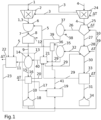
- Fig. 1 is a schematic flow diagram of a combined process.
- a carbohydrate-containing starting material 1 is comminuted in a comminution unit 2.
- the comminution takes place by means of dry milling, wherein the carbohydrate-containing starting material 1 is mixed together with hulls 3, wherein the hulls 3 are at least a part of hulls separated from oilseeds in the second process, in order to obtain an oilseed starting product 4.
- the comminuted, carbohydrate-containing starting material 1 and the comminuted Shells 3 and an oilseed by-product 5 obtained in the second process, which contains an oilseed molasses, are added to a mashing apparatus 6, wherein the ratio of oilseed by-product 5 to carbohydrate-containing starting material 1 is 1:10 (wt%/wt%).
- Mashing takes place in the mashing apparatus 6 in the presence of an alpha-amylase.
- the mash 7 is then added to a fermenter 8.
- the fermentation produces a fermented broth 9 containing bioethanol 10, a stillage 11, and water, with carbon dioxide 12 being produced as a by-product.
- the fermented broth 9 is fed to a first separation unit 13.
- the first separation unit 13 has a distillation apparatus 14 in which the stillage 11 is separated from a bioethanol-water mixture 15.
- the resulting bioethanol-water mixture 15 is then separated into bioethanol 10 and water 17 using a molecular sieve 16 of the first separation unit 13.
- the bioethanol 10 can be present in a gaseous state and subsequently condensed to collect it in a first collection tank 18 of the first separation unit 13.
- Thermal energy ⁇ T can be recovered, which can be used in the combined process.
- the bioethanol 10 collected in the first collection tank 18 has a purity of 99.0 wt% or higher (based on the weight of the bioethanol 10).
- the water 17 separated from the bioethanol 10 can be fed to a wastewater treatment unit 19 for processing.
- the molecular sieve 16 can be cleaned with an ethanol-containing cleaning agent 20.
- the ethanol contained in the cleaning agent 20 can be bioethanol 10 produced in the first process.
- the cleaning agent 20 can be fed to a storage container 21 for storage.
- the stillage 11 contained in the fermented broth 9 is fed to a dryer 22, in particular a feed dryer, for drying.
- Hulls 3 obtained in the second process can also be added to the dryer 22, with which the stillage 11 (and the crushed hulls 3 already contained therein) can be dried.
- a portion of the oilseed by-product 5 obtained in the second process can be added to the dryer 22, with which the stillage 11 can be dried.
- the dried stillage 11 can be used as high-quality feed.
- Gaseous water 23 separated during the drying of the stillage 11 is subsequently condensed, whereby thermal energy ⁇ T is recovered. This water 23 can then be fed to the wastewater treatment unit 19 for treatment.
- an oilseed starting product 4 is provided by processing in a processing unit 24.
- the processing unit 24 has a peeling unit and a comminution unit (not shown).
- the oilseed starting product 4 is first peeled in the peeling unit, with the separated shells 3 being fed to the comminution unit 1 and, if appropriate, to the dryer 22.
- the peeled oilseed starting product 4 is then comminuted in the comminution unit of the processing unit 24. Comminution can take place at elevated temperature, wherein thermal energy ⁇ T obtained in the combined process can be used.
- the peeled oilseed starting product 4 is then fed to the first extraction device 25, where it is extracted with bioethanol 10 supplied from the first collection container 18, which is used as the first extraction agent 39.
- the extraction can take place at elevated temperature, wherein thermal energy ⁇ T obtained in the combined process can be used.
- a first miscella 26 and a first extraction product 27 are obtained.
- the first extraction product 27 is subsequently fed to a second separation unit 28, which has a second extraction device.
- the second extraction agent 29 which contains bioethanol 10 and water, the first extraction product 27 is separated into a first mixture 30 containing an oilseed protein product 31, which is an oilseed protein concentrate, and a second mixture 32 (also referred to as second miscella) containing the oilseed by-product 5.
- the extraction in the second extraction device can take place at elevated temperature, wherein thermal energy ⁇ T obtained in the combined process can be used.
- the second extraction agent 29 can be removed from the storage container 21.
- the bioethanol 10 can also be removed from the first collection container 18, and water can be added in an appropriate amount.
- the first mixture 30 is subsequently fed to a third separation unit 33 to separate at least a portion of the oleaginous protein product 31 from the first mixture 30.
- the third separation unit 33 has a dryer. In the dryer, at least a portion of the second extractant 29 is evaporated, and the oleaginous protein product 31 is subsequently dried to remove any remaining second extractant. Evaporation and drying take place at elevated temperature, whereby thermal energy ⁇ T obtained in the combined process can be used.
- Separated second extractant 29 is fed to the storage container 21, while the dried oleaginous protein product 31 can be collected in a second collection container 34.
- the second mixture 32 containing the oilseed by-product 5 is fed to a fourth separation unit 35 in order to separate at least a portion of the oilseed by-product 5 from the second mixture 32.
- the fourth separation unit 35 has a stripper. By means of the stripper, at least a portion of the second extractant 29 can be separated from the second mixture 32 and subsequently fed to the storage tank 21 for reuse in the combined process.
- the oilseed by-product 5 is then fed to the mashing apparatus 6. Alternatively, it could also be added to the comminuted carbohydrate-containing starting material 1 and the comminuted hulls 3 prior to addition to the mashing apparatus 6.
- the oilseed by-product 5 can then be evaporated by means of an evaporator 36 in order to reduce the water content.
- the separated water 41 can be fed to the wastewater treatment unit 19.
- Fig. 1 It can be seen that the first miscella 26 is fed from the first extraction device 25 to a fifth separation unit 37.
- the fifth separation unit 37 has a stripper in which at least a portion of an oil and/or fat 38 and at least a portion of the first extraction agent 39 contained in the first miscella 26 are separated from the first miscella 26.
- the separated oil and/or fat 38 can be recovered and used for other applications.
- the separated first extraction agent 39 is fed to the storage container 21.
- the separated first extraction agent 39 could also be second extraction device of the second separation unit 28 for use as second extraction agent 29, wherein the concentration can be adjusted with water if necessary.
- Fig. 1 also shows that the storage vessel 21 is connected to the distillation apparatus 14. This makes it possible, depending on demand, availability, and/or capacity, to feed a (bio)ethanol-containing mixture 40 stored in the storage vessel 21 to the distillation apparatus 14.
- the mixture 40 can then be processed together with the fermented broth 9 in step (c) of the first method.
- the mixture 40 or a portion thereof is only fed to the distillation apparatus 14 after the fermented broth 9 has already been partially distilled, and accordingly, any water contained in the fermented broth 9 and/or the stillage 11 have already been at least partially separated from the fermented broth 9.
- At least a portion of the ethanol or bioethanol contained in the mixture 40 can be separated from the fermented broth 9 together with at least a portion of the bioethanol 10 contained in the (preferably partially distilled) fermented broth 9.
- Fig. 2 shows another schematic flow diagram of a combined process.
- the combined process of Fig. 2 largely corresponds to that of the Fig. 1 ; the following discussion is limited to the differences.
- the second procedure differs in particular from the one in Fig. 1
- the second separation unit 28 comprises a dryer 42 and a precipitation apparatus 43.
- the first extraction product 27 obtained by extraction in the first extraction device 25 is fed to the dryer 42.
- at least a portion of the first extraction agent 39 contained in the first extraction product 27 (where bioethanol 10 from the first collection container 18 was used as the first extraction agent 39) is separated from the first extraction product 27. This is done by evaporating the bioethanol 10 at elevated temperature, wherein thermal energy ⁇ T obtained in the combined process can be used.
- the evaporated bioethanol 10 can subsequently be condensed; the thermal energy obtained in this way can be used in the combined process.
- the bioethanol 10 can subsequently be fed to the storage container 21, particularly if it is contaminated.
- the first extraction product 27 remaining after the evaporation of at least a portion of the bioethanol 10 is subsequently transferred to the precipitation apparatus 43, to which water 44 is also added.
- This water 44 can, for example, be taken from the wastewater treatment unit 19.
- the pH of the first extraction product 27 is adjusted substantially to the isoelectric point of an oilseed protein product 45 to be produced, which is an oilseed protein isolate, in order to precipitate at least a portion of the oilseed protein product 45. This allows the first extraction product 27 to be separated into the first (precipitated) mixture 46 and the second mixture 47.
- the first mixture 46 contains the oilseed protein product 45 and, optionally, a small amount of the water 44.
- the second mixture 47 contains an oilseed by-product 5, which contains an oilseed protein liquor, and the majority of the water 44
- the first mixture 46 is then fed to the third separation unit 33 in order to separate at least a portion of the oilseed protein product 45 from the first mixture 46.
- the third separation unit 33 has a dryer in which the oilseed protein product 45 is dried. This takes place at an elevated temperature, wherein thermal energy ⁇ T obtained in the combined process can be used.
- the dried oilseed protein product 45 can be collected in the second collection container 34.
- the second mixture 47 is fed to the fourth separation unit 35 in order to separate at least a portion of the oilseed by-product 5 from the second mixture 47.
- the fourth separation unit 35 has an evaporator. This makes it possible to reduce the water content of the oilseed by-product 5. Water 48 separated from the oilseed by-product 5 can be fed to the wastewater treatment unit 19 for treatment.
Landscapes
- Chemical & Material Sciences (AREA)
- Life Sciences & Earth Sciences (AREA)
- Engineering & Computer Science (AREA)
- Organic Chemistry (AREA)
- Zoology (AREA)
- Wood Science & Technology (AREA)
- Health & Medical Sciences (AREA)
- Biochemistry (AREA)
- Microbiology (AREA)
- Biotechnology (AREA)
- Polymers & Plastics (AREA)
- Genetics & Genomics (AREA)
- Bioinformatics & Cheminformatics (AREA)
- Chemical Kinetics & Catalysis (AREA)
- Molecular Biology (AREA)
- Food Science & Technology (AREA)
- General Health & Medical Sciences (AREA)
- General Engineering & Computer Science (AREA)
- Mycology (AREA)
- Sustainable Development (AREA)
- Biomedical Technology (AREA)
- Animal Husbandry (AREA)
- Physiology (AREA)
- Botany (AREA)
- Oil, Petroleum & Natural Gas (AREA)
- General Chemical & Material Sciences (AREA)
- Fodder In General (AREA)
- Preparation Of Compounds By Using Micro-Organisms (AREA)
- Peptides Or Proteins (AREA)
Priority Applications (2)
| Application Number | Priority Date | Filing Date | Title |
|---|---|---|---|
| EP23213897.4A EP4567121A1 (fr) | 2023-12-04 | 2023-12-04 | Procédé combiné de production de bioéthanol et d'un produit protéique de fruit oléagineux |
| PCT/EP2024/084678 WO2025119976A2 (fr) | 2023-12-04 | 2024-12-04 | Procédé combiné de production de bioéthanol et d'un produit à base de protéines de fruits oléagineux |
Applications Claiming Priority (1)
| Application Number | Priority Date | Filing Date | Title |
|---|---|---|---|
| EP23213897.4A EP4567121A1 (fr) | 2023-12-04 | 2023-12-04 | Procédé combiné de production de bioéthanol et d'un produit protéique de fruit oléagineux |
Publications (1)
| Publication Number | Publication Date |
|---|---|
| EP4567121A1 true EP4567121A1 (fr) | 2025-06-11 |
Family
ID=89076051
Family Applications (1)
| Application Number | Title | Priority Date | Filing Date |
|---|---|---|---|
| EP23213897.4A Pending EP4567121A1 (fr) | 2023-12-04 | 2023-12-04 | Procédé combiné de production de bioéthanol et d'un produit protéique de fruit oléagineux |
Country Status (2)
| Country | Link |
|---|---|
| EP (1) | EP4567121A1 (fr) |
| WO (1) | WO2025119976A2 (fr) |
Citations (10)
| Publication number | Priority date | Publication date | Assignee | Title |
|---|---|---|---|---|
| US4075361A (en) | 1975-09-18 | 1978-02-21 | Paul Taylor Co. | Process for preparing stable full fat oilseed extract |
| DE2752595A1 (de) | 1976-11-26 | 1978-06-01 | Dravo Corp | Verfahren zur herstellung eines proteinkonzentrats |
| US4457869A (en) | 1982-05-07 | 1984-07-03 | Shell Oil Company | Oilseed extraction process |
| DE102006040567A1 (de) | 2006-08-30 | 2008-03-06 | Bayer Technology Services Gmbh | Verfahren zur Herstellung von Bioethanol |
| CN105200094A (zh) * | 2014-05-30 | 2015-12-30 | 中粮营养健康研究院有限公司 | 一种利用微生物发酵木质纤维素原料产乙醇的方法 |
| US20170233767A1 (en) * | 2011-10-06 | 2017-08-17 | Hamlet Protein A/S | Method for the simultaneous production of ethanol and a fermented, solid product |
| EP3295803A1 (fr) | 2009-02-27 | 2018-03-21 | Fraunhofer-Gesellschaft zur Förderung der angewandten Forschung e.V. | Préparations de protéines de graines de tournesol et leur procédé de préparation |
| WO2022006165A1 (fr) | 2020-06-29 | 2022-01-06 | Crown Iron Works Company | Extraction de substance oléagineuse à l'aide d'un solvant à base d'alcool |
| WO2022043248A1 (fr) | 2020-08-27 | 2022-03-03 | Neumueller Waldemar | Procédé d'extraction industrielle d'huile de noyau pressée à froid et concentré de protéines issu de graines contenant de l'huile décortiquée à l'aide d'un auxiliaire de pression intrinsèque à la graine |
| WO2022183031A1 (fr) | 2021-02-25 | 2022-09-01 | Crown Iron Works Company | Récupération de solvant alcoolique pour l'extraction de matière oléagineuse |
Family Cites Families (1)
| Publication number | Priority date | Publication date | Assignee | Title |
|---|---|---|---|---|
| CA2887574A1 (fr) * | 2012-10-11 | 2014-04-17 | Butamax Advanced Biofuels Llc | Procedes et systemes pour la production de produits de fermentation |
-
2023
- 2023-12-04 EP EP23213897.4A patent/EP4567121A1/fr active Pending
-
2024
- 2024-12-04 WO PCT/EP2024/084678 patent/WO2025119976A2/fr active Pending
Patent Citations (10)
| Publication number | Priority date | Publication date | Assignee | Title |
|---|---|---|---|---|
| US4075361A (en) | 1975-09-18 | 1978-02-21 | Paul Taylor Co. | Process for preparing stable full fat oilseed extract |
| DE2752595A1 (de) | 1976-11-26 | 1978-06-01 | Dravo Corp | Verfahren zur herstellung eines proteinkonzentrats |
| US4457869A (en) | 1982-05-07 | 1984-07-03 | Shell Oil Company | Oilseed extraction process |
| DE102006040567A1 (de) | 2006-08-30 | 2008-03-06 | Bayer Technology Services Gmbh | Verfahren zur Herstellung von Bioethanol |
| EP3295803A1 (fr) | 2009-02-27 | 2018-03-21 | Fraunhofer-Gesellschaft zur Förderung der angewandten Forschung e.V. | Préparations de protéines de graines de tournesol et leur procédé de préparation |
| US20170233767A1 (en) * | 2011-10-06 | 2017-08-17 | Hamlet Protein A/S | Method for the simultaneous production of ethanol and a fermented, solid product |
| CN105200094A (zh) * | 2014-05-30 | 2015-12-30 | 中粮营养健康研究院有限公司 | 一种利用微生物发酵木质纤维素原料产乙醇的方法 |
| WO2022006165A1 (fr) | 2020-06-29 | 2022-01-06 | Crown Iron Works Company | Extraction de substance oléagineuse à l'aide d'un solvant à base d'alcool |
| WO2022043248A1 (fr) | 2020-08-27 | 2022-03-03 | Neumueller Waldemar | Procédé d'extraction industrielle d'huile de noyau pressée à froid et concentré de protéines issu de graines contenant de l'huile décortiquée à l'aide d'un auxiliaire de pression intrinsèque à la graine |
| WO2022183031A1 (fr) | 2021-02-25 | 2022-09-01 | Crown Iron Works Company | Récupération de solvant alcoolique pour l'extraction de matière oléagineuse |
Non-Patent Citations (6)
| Title |
|---|
| ABRAHAM G ET AL: "PROCESS ENGINEERING ECONOMIC EVALUATION OF THE ETHANOL EXTRACTION OF COTTONSEED: PRELIMINARY ANALYSIS", JOURNAL OF THE AMERICAN OIL CHEMISTS SOCIETY, SPRINGER, DE, vol. 68, no. 5, 1 May 1991 (1991-05-01), pages 418 - 421, XP000215000, ISSN: 0003-021X, DOI: 10.1007/BF02663759 * |
| FUKUI K ET AL: "Ethanol washing does not attenuate the hypocholesterolemic potential of soy protein", NUTRITION, ELSEVIER, AMSTERDAM, NL, vol. 20, no. 11-12, 1 November 2004 (2004-11-01), pages 984 - 990, XP004652890, ISSN: 0899-9007, DOI: 10.1016/J.NUT.2004.08.011 * |
| LUQUE DE CASTRO M D ET AL: "Coupling of continuous separation techniques with unsegmented flow systems", ANALYTICA CHIMICA ACTA, ELSEVIER, AMSTERDAM, NL, vol. 261, no. 1-2, 25 May 1992 (1992-05-25), pages 425 - 434, XP026589602, ISSN: 0003-2670, [retrieved on 19920525], DOI: 10.1016/0003-2670(92)80223-T * |
| NEHMEH MOHAMAD ET AL: "Bio-Refinery of Oilseeds: Oil Extraction, Secondary Metabolites Separation towards Protein Meal Valorisation-A Review", PROCESSES, vol. 10, no. 5, 24 April 2022 (2022-04-24), CH, pages 841, XP093173935, ISSN: 2227-9717, DOI: 10.3390/pr10050841 * |
| PENG ET AL., FOODS, vol. 10, 2021, pages 2222 |
| SISSONS J ET AL: "The effect of giving feeds containing soya-bean meal treated or extracted with ethanol on digestive processes in the prerurninant calf", BRITISH JOURNAL OF NUTRITION, vol. 42, no. 3, 1 November 1979 (1979-11-01), UK, pages 477 - 485, XP093173529, ISSN: 0007-1145, DOI: 10.1079/BJN19790139 * |
Also Published As
| Publication number | Publication date |
|---|---|
| WO2025119976A3 (fr) | 2025-11-27 |
| WO2025119976A2 (fr) | 2025-06-12 |
Similar Documents
| Publication | Publication Date | Title |
|---|---|---|
| US12486481B2 (en) | Systems and methods for stillage fractionation | |
| US8481768B2 (en) | Integrated process for the preparation of fatty acid methyl ester (biodiesel) | |
| US9523104B2 (en) | Processes and systems for the production of alcohols | |
| US20070089356A1 (en) | Co-production of biodiesel and an enriched food product from distillers grains | |
| US20070099278A1 (en) | Production of biodiesel from combination of corn (maize) and other feed stocks | |
| EP0970234A1 (fr) | Procede de valorisation d'une biomasse vegetale et presse a vis pour la mise en oeuvre de ce procede | |
| US20090181153A1 (en) | Dry-Mill Ethanol Plant Extraction Enhancement | |
| US20150037857A1 (en) | Oil compositions and methods of production | |
| EP2059603A1 (fr) | Procédé de production de bioalcool, en particulier de bioéthanol et/ou de biobutanol | |
| EP2124625A1 (fr) | Grains de maïs broyés à sec utilisés pour produire de la biomasse | |
| KR101733082B1 (ko) | 바이오매스로부터 추출성 성분을 효율적으로 제거 혹은 회수하는 방법 | |
| WO2008009733A2 (fr) | Procédé perfectionné de production d'éthanol, de gluten et de son à partir de céréales | |
| JP2014518926A (ja) | オイルケーキに対する直接的な反応性粉砕プロセス | |
| CN107094985B (zh) | 一种用花生粕联产花生浓缩蛋白和副产品的生产方法 | |
| EP4567121A1 (fr) | Procédé combiné de production de bioéthanol et d'un produit protéique de fruit oléagineux | |
| US9220287B2 (en) | Lesquerella seed products and method and device for producing same | |
| EP3950914A1 (fr) | Procédé de mise en uvre d'un fonctionnement combiné d'une installation de production de bioéthanol et d'une installation de biogaz | |
| CN117965651A (zh) | 一种从蒜头果中高效提取神经酸的方法 | |
| WO2009065504A1 (fr) | Préparation d'alcools extraits d'une biomasse par distillation in situ | |
| DE102007001614A1 (de) | Energieautarkes Verfahren zur Herstellung von Bioethanol aus lignocellulose-, protein- und stärke- und/oder zuckerhaltigen Einsatzstoffen | |
| EP1531919B1 (fr) | Procede pour extraire une fraction lipidique et une fraction proteique d'une substance de depart vegetale | |
| EP4461140A1 (fr) | Procédé et système pour augmenter le rendement en huile d'un sous-produit de type drêche entière produit dans un processus de broyage à sec de maïs | |
| WO2012084729A1 (fr) | Procédé de fractionnement de graines de jatropha | |
| CN107011990A (zh) | 反应性粉碎麻风树种子的方法 | |
| DE102007002129A1 (de) | Zusammensetzungen verwendbar als Gärsubstrat |
Legal Events
| Date | Code | Title | Description |
|---|---|---|---|
| PUAI | Public reference made under article 153(3) epc to a published international application that has entered the european phase |
Free format text: ORIGINAL CODE: 0009012 |
|
| STAA | Information on the status of an ep patent application or granted ep patent |
Free format text: STATUS: THE APPLICATION HAS BEEN PUBLISHED |
|
| AK | Designated contracting states |
Kind code of ref document: A1 Designated state(s): AL AT BE BG CH CY CZ DE DK EE ES FI FR GB GR HR HU IE IS IT LI LT LU LV MC ME MK MT NL NO PL PT RO RS SE SI SK SM TR |
|
| STAA | Information on the status of an ep patent application or granted ep patent |
Free format text: STATUS: THE APPLICATION IS DEEMED TO BE WITHDRAWN |