EP4567254A1 - Hinterkantenelement für eine strebe eines gasturbinenabgasdiffusors, strebenanordnung und gasturbinenabgasdiffusor - Google Patents
Hinterkantenelement für eine strebe eines gasturbinenabgasdiffusors, strebenanordnung und gasturbinenabgasdiffusor Download PDFInfo
- Publication number
- EP4567254A1 EP4567254A1 EP24211102.9A EP24211102A EP4567254A1 EP 4567254 A1 EP4567254 A1 EP 4567254A1 EP 24211102 A EP24211102 A EP 24211102A EP 4567254 A1 EP4567254 A1 EP 4567254A1
- Authority
- EP
- European Patent Office
- Prior art keywords
- trailing member
- longitudinal end
- trailing
- downstream
- upstream
- Prior art date
- Legal status (The legal status is an assumption and is not a legal conclusion. Google has not performed a legal analysis and makes no representation as to the accuracy of the status listed.)
- Pending
Links
Images

Classifications
-
- F—MECHANICAL ENGINEERING; LIGHTING; HEATING; WEAPONS; BLASTING
- F01—MACHINES OR ENGINES IN GENERAL; ENGINE PLANTS IN GENERAL; STEAM ENGINES
- F01D—NON-POSITIVE DISPLACEMENT MACHINES OR ENGINES, e.g. STEAM TURBINES
- F01D25/00—Component parts, details, or accessories, not provided for in, or of interest apart from, other groups
- F01D25/30—Exhaust heads, chambers, or the like
-
- F—MECHANICAL ENGINEERING; LIGHTING; HEATING; WEAPONS; BLASTING
- F01—MACHINES OR ENGINES IN GENERAL; ENGINE PLANTS IN GENERAL; STEAM ENGINES
- F01D—NON-POSITIVE DISPLACEMENT MACHINES OR ENGINES, e.g. STEAM TURBINES
- F01D25/00—Component parts, details, or accessories, not provided for in, or of interest apart from, other groups
- F01D25/16—Arrangement of bearings; Supporting or mounting bearings in casings
- F01D25/162—Bearing supports
-
- F—MECHANICAL ENGINEERING; LIGHTING; HEATING; WEAPONS; BLASTING
- F01—MACHINES OR ENGINES IN GENERAL; ENGINE PLANTS IN GENERAL; STEAM ENGINES
- F01D—NON-POSITIVE DISPLACEMENT MACHINES OR ENGINES, e.g. STEAM TURBINES
- F01D25/00—Component parts, details, or accessories, not provided for in, or of interest apart from, other groups
- F01D25/24—Casings; Casing parts, e.g. diaphragms, casing fastenings
-
- F—MECHANICAL ENGINEERING; LIGHTING; HEATING; WEAPONS; BLASTING
- F01—MACHINES OR ENGINES IN GENERAL; ENGINE PLANTS IN GENERAL; STEAM ENGINES
- F01D—NON-POSITIVE DISPLACEMENT MACHINES OR ENGINES, e.g. STEAM TURBINES
- F01D25/00—Component parts, details, or accessories, not provided for in, or of interest apart from, other groups
- F01D25/24—Casings; Casing parts, e.g. diaphragms, casing fastenings
- F01D25/246—Fastening of diaphragms or stator-rings
-
- F—MECHANICAL ENGINEERING; LIGHTING; HEATING; WEAPONS; BLASTING
- F01—MACHINES OR ENGINES IN GENERAL; ENGINE PLANTS IN GENERAL; STEAM ENGINES
- F01D—NON-POSITIVE DISPLACEMENT MACHINES OR ENGINES, e.g. STEAM TURBINES
- F01D5/00—Blades; Blade-carrying members; Heating, heat-insulating, cooling or antivibration means on the blades or the members
- F01D5/12—Blades
- F01D5/14—Form or construction
- F01D5/147—Construction, i.e. structural features, e.g. of weight-saving hollow blades
-
- F—MECHANICAL ENGINEERING; LIGHTING; HEATING; WEAPONS; BLASTING
- F01—MACHINES OR ENGINES IN GENERAL; ENGINE PLANTS IN GENERAL; STEAM ENGINES
- F01D—NON-POSITIVE DISPLACEMENT MACHINES OR ENGINES, e.g. STEAM TURBINES
- F01D9/00—Stators
- F01D9/02—Nozzles; Nozzle boxes; Stator blades; Guide conduits, e.g. individual nozzles
-
- F—MECHANICAL ENGINEERING; LIGHTING; HEATING; WEAPONS; BLASTING
- F01—MACHINES OR ENGINES IN GENERAL; ENGINE PLANTS IN GENERAL; STEAM ENGINES
- F01D—NON-POSITIVE DISPLACEMENT MACHINES OR ENGINES, e.g. STEAM TURBINES
- F01D9/00—Stators
- F01D9/06—Fluid supply conduits to nozzles or the like
- F01D9/065—Fluid supply or removal conduits traversing the working fluid flow, e.g. for lubrication-, cooling-, or sealing fluids
-
- F—MECHANICAL ENGINEERING; LIGHTING; HEATING; WEAPONS; BLASTING
- F05—INDEXING SCHEMES RELATING TO ENGINES OR PUMPS IN VARIOUS SUBCLASSES OF CLASSES F01-F04
- F05D—INDEXING SCHEME FOR ASPECTS RELATING TO NON-POSITIVE-DISPLACEMENT MACHINES OR ENGINES, GAS-TURBINES OR JET-PROPULSION PLANTS
- F05D2220/00—Application
- F05D2220/30—Application in turbines
- F05D2220/32—Application in turbines in gas turbines
-
- F—MECHANICAL ENGINEERING; LIGHTING; HEATING; WEAPONS; BLASTING
- F05—INDEXING SCHEMES RELATING TO ENGINES OR PUMPS IN VARIOUS SUBCLASSES OF CLASSES F01-F04
- F05D—INDEXING SCHEME FOR ASPECTS RELATING TO NON-POSITIVE-DISPLACEMENT MACHINES OR ENGINES, GAS-TURBINES OR JET-PROPULSION PLANTS
- F05D2230/00—Manufacture
- F05D2230/20—Manufacture essentially without removing material
- F05D2230/23—Manufacture essentially without removing material by permanently joining parts together
- F05D2230/232—Manufacture essentially without removing material by permanently joining parts together by welding
-
- F—MECHANICAL ENGINEERING; LIGHTING; HEATING; WEAPONS; BLASTING
- F05—INDEXING SCHEMES RELATING TO ENGINES OR PUMPS IN VARIOUS SUBCLASSES OF CLASSES F01-F04
- F05D—INDEXING SCHEME FOR ASPECTS RELATING TO NON-POSITIVE-DISPLACEMENT MACHINES OR ENGINES, GAS-TURBINES OR JET-PROPULSION PLANTS
- F05D2240/00—Components
- F05D2240/10—Stators
- F05D2240/12—Fluid guiding means, e.g. vanes
- F05D2240/122—Fluid guiding means, e.g. vanes related to the trailing edge of a stator vane
-
- F—MECHANICAL ENGINEERING; LIGHTING; HEATING; WEAPONS; BLASTING
- F05—INDEXING SCHEMES RELATING TO ENGINES OR PUMPS IN VARIOUS SUBCLASSES OF CLASSES F01-F04
- F05D—INDEXING SCHEME FOR ASPECTS RELATING TO NON-POSITIVE-DISPLACEMENT MACHINES OR ENGINES, GAS-TURBINES OR JET-PROPULSION PLANTS
- F05D2240/00—Components
- F05D2240/10—Stators
- F05D2240/12—Fluid guiding means, e.g. vanes
- F05D2240/128—Nozzles
-
- F—MECHANICAL ENGINEERING; LIGHTING; HEATING; WEAPONS; BLASTING
- F05—INDEXING SCHEMES RELATING TO ENGINES OR PUMPS IN VARIOUS SUBCLASSES OF CLASSES F01-F04
- F05D—INDEXING SCHEME FOR ASPECTS RELATING TO NON-POSITIVE-DISPLACEMENT MACHINES OR ENGINES, GAS-TURBINES OR JET-PROPULSION PLANTS
- F05D2260/00—Function
- F05D2260/94—Functionality given by mechanical stress related aspects such as low cycle fatigue [LCF] of high cycle fatigue [HCF]
- F05D2260/941—Functionality given by mechanical stress related aspects such as low cycle fatigue [LCF] of high cycle fatigue [HCF] particularly aimed at mechanical or thermal stress reduction
Definitions
- the present disclosure relates to a trailing member for a strut of a gas turbine exhaust diffuser as set forth in the claims. It further relates to a strut assembly comprising the trailing member and a gas turbine exhaust diffuser comprising the strut assembly.
- an inner diffuser barrel is suspended inside an outer diffuser barrel by struts.
- the inner barrel may contain, for instance, an aft bearing of the gas turbine rotor.
- the thus formed annular flow conduit is flowed through by exhaust gases, which may reach temperatures well in excess of 500 °C, which temperature is subject to change comparatively quickly when the gas turbine power output changes.
- the strut may actually be a strut assembly comprising an upstream strut body and a downstream trailing member.
- the trailing member may form a trailing edge and may be referred to as a trailing edge member.
- the strut body is attached to the inner and outer diffuser barrels, for instance and most commonly by a weld connection, in certain known diffusers the radially outer end of the trailing member is not fixed to the outer diffuser barrel.
- a flow shield is provided at and attached to the outer diffuser barrel.
- the flow shield which is essentially a skirt of sheet metal extending around a part of the circumference of a downstream portion of the trailing member, includes the downstream end of the trailing member and terminates, upstream in known embodiments, at least essentially flush with the seam between the strut body and the trailing member.
- the flow shield reduces ingestion of hot combustion gases into a gap between the radially outer end of the trailing member and the outer diffuser barrel and limits the amplitude of vibration of the radially outer end of the trailing member.
- the present disclosure is directed to a trailing member for a strut of a gas turbine exhaust diffuser, the trailing member comprising: an upstream side, a downstream end spaced along a downstream direction from the upstream side, two side walls extending from the upstream side to the downstream end, wherein a distance between the two side walls decreases along a direction from the upstream side to the downstream end, whereby a cross-section of the trailing member tapers from the upstream side to the downstream end, wherein a longitudinal extent of the trailing member extends along the upstream side of the trailing member between a first longitudinal end of the trailing member and a second longitudinal end of the trailing member, wherein a first edge of each side wall is disposed proximate to the first longitudinal end of the trailing member; and wherein a stress relief slot is provided in at least one of the first and second side walls of the two side walls and opens at the first edge of the respective side wall.
- a strut of a gas turbine exhaust diffuser having the trailing member and a gas turbine exhaust diffuser having the strut are also provided.
- a trailing member for a strut of a gas turbine exhaust diffuser.
- the trailing member extends from an upstream side, or, in more particular embodiments, an upstream face, along a downstream direction to a downstream end.
- the downstream end in frequent embodiments may form a trailing edge.
- the trailing member may also be referred to as a trailing edge member.
- the trailing member in these frequent embodiments may provide a trailing edge of a strut assembly.
- Two side walls extend from the upstream side to the downstream end, wherein a distance between the two side walls decreases along a direction from the upstream side to the downstream end, whereby a cross-section of the trailing member tapers from the upstream side to the downstream end. More particularly, in various embodiments, the two side walls meet at a trailing edge of the trailing member.
- a longitudinal extent of the trailing member extends along the upstream side of the trailing member between a first longitudinal end of the trailing member and a second longitudinal end of the trailing member. More specifically, it may be intended that the trailing member be installed in an exhaust diffuser as part of a strut assembly with the first longitudinal end proximate or adjacent to an outer, i.e., radially outer, diffuser barrel and the second longitudinal end proximate or adjacent to an inner, i.e., radially inner, diffuser barrel.
- the first longitudinal end of the trailing member may thus be referred to as a radially outer longitudinal end of the trailing member, and the second longitudinal end of the trailing member may be referred to as a radially inner longitudinal end of the trailing member.
- a first, or, in aspects, radially outer, edge of each side wall is disposed proximate to the first longitudinal end of the trailing member.
- each side wall is disposed at the first longitudinal end of the trailing member or defines the first longitudinal end of the trailing member, respectively.
- a stress relief slot is provided in at least one of the first and second side walls and opens at the first edge of the respective side wall.
- a stress relief slot, or at least one stress relief slot is provided in both of the first and second side walls and opens at the first edge of the respective side wall. In use, the stress relief slot enables a certain degree of deformation of the trailing member at the first longitudinal end, proximate or adjacent to the outer barrel, with reduced stresses and helps to avoid cracking.
- At least one stress relief slot provided in at least one of the first and second side walls and opening at the first edge of the respective side wall, when starting at its open end at the first edge of the respective side wall, terminates at a rounded stress relief hole. Hence, notching and related stress concentrations at the end of the stress relief slot are avoided.
- the trailing member comprises a cover plate between the first and second side walls adjacent the first longitudinal end of the trailing member and extending across at least one of the at least one stress relief slot of at least one of the first and second side walls, wherein a stress relief slot is arranged in the cover plate and opens out at an edge of the cover plate adjacent to the at least one of the at least one stress relief slot of at least one of the first and second side walls.
- the cover plate does not impede deformation of the first and/or second side wall, which is enabled by the stress relief slot(s) of the respective side wall. It goes without saying that a stress relief slot of the cover plate, when starting at an open end at an edge of the cover plate, may also terminate at a rounded stress relief hole.
- a cover plate provided adjacent to the first longitudinal end of the trailing member between the first and second walls may be provided with a U-shaped cutout adjacent an upstream edge of cover plate.
- the cover plate may be weld connected to the first and second side walls. Along a distance adjacent to the upstream edge of the cover plate, the weld seam may be omitted. A gap between the cover plate and each of the first and second side walls thus is open. Accordingly, movement between the side walls and the cover plate is enabled in the region where the weld seam is omitted, and stress concentrations due, for instance, to thermal expansion differential are avoided.
- the first edge of each of the first and second side wall may be convexly shaped in a side view onto the face of the respective side wall. More in particular, the first edge may comprise a kink in the side view and may more in particular comprise at least one straight edge segment, in the side view, terminating at the kink. In other embodiments, the kink, in the side view, may be provided between two straight edge segments.
- Said design enables specific adaption of the first longitudinal end of the trailing member to the outer barrel and enables an advantageous and adapted arrangement and dimensioning of a gap between the first longitudinal end of the trailing member and the outer barrel.
- the presence and width of a gap between the first longitudinal end of the trailing member and the outer barrel may thus vary in progression from the upstream side of the trailing member to the downstream end of the trailing member and may allow advantageous adaption to the requirement to reduce mechanical stress formation.
- each of the first and second side wall comprises a convex corner and wherein one of the at least one stress relief slot opens at the convex corner.
- This embodiment may be found particularly useful if the parts of the first and second side walls upstream - i.e., proximate to the upstream end of the trailing member - are intended to be connected and in particular to be weld connected to the outer barrel in order to mitigate stresses, which may develop between the more upstream and the more downstream sections of the first and second side walls.
- each side wall is recessed adjacent to the upstream side of the trailing member, thus having a recessed section. This means that, when the trailing member is installed in a diffuser, the most upstream radially outer corner of the trailing member provides a window and does not interfere with the weld seam through which a strut body is attached to the outer barrel of the diffuser. Further, the thus provided window facilitates inspection of said weld seam and the interface in general by simply optical inspection.
- the recessed section may comprise a concave corner, and the stress relief slot opens at said concave corner.
- a distance between the upstream side of the trailing member and the downstream end of the trailing member decreases, in particular linearly, from the first longitudinal end of the trailing member to the second longitudinal end of the trailing member. That is, an extent of the trailing member in the upstream-downstream direction decreases from the first longitudinal end of the trailing member to the second longitudinal end of the trailing member, and in more particular embodiments the trailing member may be wedge-shaped.
- the length of the strut assembly in an upstream-downstream direction is smaller at a radially inner position than at a radially outer position. This might yield aerodynamic benefits.
- a stress relief slot may be provided proximate to the second (i.e., when in use as intended radially inner) longitudinal end of the trailing member. Said stress relief slot opens at the downstream end of the trailing member.
- Each stress relief slot herein described when seen starting at an open end, may terminate at a rounded stress relief hole. As noted above, unfavorable stress concentrations at the end of the respective stress relief slot may thus be avoided.
- a strut assembly in another aspect, comprises a strut body and a trailing member of any type described above.
- the strut body extends longitudinally between a first longitudinal end and a second longitudinal end.
- the strut body has an upstream end and a downstream side.
- the trailing member is attached to and longitudinally extends along the downstream side of the strut body, thereby forming a trailing, or downstream, section of the strut assembly.
- the upstream side of the trailing member is arranged adjacent to the downstream side of the strut body.
- the first longitudinal end of the trailing member is arranged proximate to the first longitudinal end of the strut body, and the second longitudinal end of the trailing member is arranged proximate to the second longitudinal end of the strut body. From this, it flows that the first longitudinal end of the strut body is intended, or adapted and configured, to be located radially outside when installed in a diffuser, whereas the second longitudinal end is intended to be located radially inward.
- the upstream end of the strut body may in particular be shaped convexly rounded in a cross-sectional view of the strut body so as to provide an aerodynamically shaped leading edge of the strut assembly, whereas the trailing member may provide a trailing edge of the strut assembly.
- the first (i.e., per the intended use, radially outer) longitudinal end of the trailing member is arranged proximate to the first longitudinal end of the strut body, wherein the trailing member, in a direction from the first longitudinal end of the trailing member to the second longitudinal end of the trailing member and measured along the upstream side of the trailing member, ends before the second longitudinal end of the strut body measured along the downstream side of the strut body.
- first longitudinal end of the trailing member and the first longitudinal end of the strut body may be intended to be provided adjacent to and extending radially inward from an outer barrel of a diffuser
- second longitudinal end of the trailing member and the second longitudinal end of the strut body may be intended to be provided adjacent to and extending radially outward from an inner barrel of the diffuser.
- the downstream end of the strut body is not covered by the trailing member, which in turn may yield adverse aerodynamic effects.
- adverse effects on structural integrity caused by thermal stresses by the interference of the strut body, the trailing member, and the inner barrel of the diffuser are avoided.
- the section of the strut assembly along which the downstream end of the strut body is not covered by the trailing member may be comparatively small, and, as this section is provided in a radially inner region, a comparatively small fraction of the total mass flow may be affected by the aerodynamic imperfection, and the adverse aerodynamic effects may be more than outweighed by the gain through the avoidance of potential mechanical stress amplification.
- a turboengine diffuser for one instance, but not limited to, a gas turbine exhaust diffuser, which comprises an inner barrel and an outer barrel, defining a flow path between them, and at least one strut assembly of any type set forth above extending between the inner barrel and the outer barrel.
- the first longitudinal end of the strut body is attached, in particular weld-connected, to the outer barrel, and the second longitudinal end of the strut body is attached, in particular weld-connected, to the inner barrel.
- a flow shield is provided and attached, in particular weld-connected, to the outer barrel.
- the flow shield extends along a part of the circumference of a downstream portion of the trailing member adjacent to the first longitudinal end of the trailing member, including extending around the downstream end of the trailing member.
- An upstream edge of the flow shield is spaced from the downstream side of the strut body in a downstream direction of the diffuser.
- the flow shield serves, on the one hand, to inhibit excessive ingestion of gases (for instance combustion gases) between the radially outward provided longitudinal end of the trailing member and, on the other hand, inhibits excessive mechanical vibrations of the trailing member.
- a gap may be provided between the trailing member and the outer barrel along a downstream section of the first longitudinal end of the trailing member, including the downstream end of the trailing member, wherein the first and second side walls of the trailing member are weld-connected to the outer barrel along at least a part of an upstream section of the trailing member.
- a stress relief slot provided in at least one of the first and second side walls may open at the edge of the respective side wall(s) in the non-welded section and adjacent to or bordering a downstream end of the weld seam.
- proximate to shall, in particular in relation to its use in connection with ends or sides of a member, express that one end or side of the member is closer to a specific second member or landmark of a member than another end or side.
- a member or landmark of a member that is described to be proximate to a second member or landmark of a member may, in more particular embodiments, be directly adjacent to or in contact with the second member or landmark of a member.
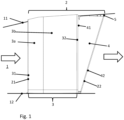
- FIG. 1 shows a view of an exemplary strut assembly 2 in a diffuser of a turboengine, for instance in the diffuser 1 of an exhaust section of a gas turbine engine.
- Diffuser 1 is defined generally as an annulus between outer barrel 11 and inner barrel 12.
- Inner barrel 12 may house, for instance, an aft bearing of a gas turbine engine and other components.
- a multitude of circumferentially arranged and radially extending strut assemblies, such as shown strut assembly 2 provide structural support between outer barrel 11 and inner barrel 12.
- a flow of combustion gases flows through diffuser 1 as indicated by arrows in FIG. 1 .
- the diffuser 1 serves to decelerate gases from the expansion turbine and thus to regain static pressure, which has a beneficial impact on efficiency. It is thus desired that strut assemblies, such as strut assembly 2, do not yield excessive resistance to a flow of gases through diffuser 1.
- Strut assembly 2 comprises strut body 3 and trailing member 4.
- Strut body 3 may be cooled, for instance, in that a flow of cooling air is provided through strut body 3. Said coolant flow may be directed longitudinally through strut body 3, which corresponds to a radial flow when relating it to the diffuser 1.
- Strut body 3 in the presently shown exemplary embodiment, comprises two sections, namely upstream section 3a and downstream section 3b. This, however, is not relevant for the herein described subject matter.
- a first, radially outer, longitudinal end of strut body 3 is weld-connected to outer barrel 11, while a second, radially inner, longitudinal end of strut body 3 is weld-connected to inner barrel 12.
- Strut body 3 thus provides structural support between outer barrel 11 and inner barrel 12.
- An upstream side 31 of strut body 3 is rounded in a cross-sectional view of strut body 3 to form an aerodynamically shaped leading edge 21 of strut assembly 2.
- An upstream side 41 of trailing member 4 is attached to a downstream side 32 of strut body 3 to jointly form strut assembly 2.
- a downstream end 42 of trailing member 4 provides a trailing edge 22 of strut assembly 2.
- a cross-sectional geometry of strut assembly 2 thus is generally droplet-shaped.
- trailing member 4 is generally wedge-shaped.
- An upstream-downstream extent of trailing member 4 thus increases in a radially outward direction.
- a flow shield 5 is attached to radially outer barrel 11 and extends along a part of the circumference of the downstream portion of trailing member 4 adjacent the first, radially outer end of trailing member 4.
- the flow shield 5 is a skirt closely extending around the boundary of the downstream portion of the radially outer end of trailing member 4.
- one function of flow shield 5 may be to avoid excessive ingestion of combustion gases into a gap, which is present between outer barrel 11 and the downstream section of trailing member 4.
- a function of flow shield 5 may be to attenuate vibrations of the cantilevering downstream portion of the radially outer end of trailing member 4.
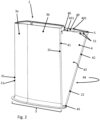
- FIG. 2 shows a more detailed view of strut assembly 2 separate from diffuser 1.
- Trailing member 4 comprises two side walls 43 and 44, wherein side walls 43 and 44 meet at the downstream end 42 of trailing member 4 to jointly form trailing edge 22.
- Side walls 43 and 44 may in certain embodiments be sections of one monolithic member of sheet metal, for instance, but may in other embodiments be separate members joined to each other, for instance along trailing edge 42. Only an edge 441 of side wall 44 is visible in the present depiction; however, the shape and location of side wall 44 will be readily apparent to a person having skill in the art.
- a first edge 431 of first side wall 43 and a first edge 441 of second side wall 44 are disposed proximate to or form a first longitudinal end of trailing member 4, which is intended to be provided as a radially outer longitudinal end of trailing member 4.
- a cover plate 49 is provided between first side wall 43 and second side wall 44 adjacent to the first longitudinal end of trailing member 4 or to first edges 431 and 441 of side walls 43 and 44, respectively.
- Cover plate 49 closes trailing member 4, which may be a hollow member defined by first and second side walls 43 and 44 and an upstream end wall, at first longitudinal end 41 of trailing member 4.
- the first longitudinal end 41 of trailing member 4 is recessed at recess 46 adjacent to the upstream side 41 of trailing member 4 and/or adjacent to the downstream side 32 of strut body 3, respectively.
- Stress relief slot 45 is provided proximate to an opposite second longitudinal end of trailing member 4 in order to account for potentially arising stress concentrations due to the intersection of the strut body 3, trailing member 4, and inner barrel 12.
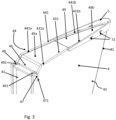
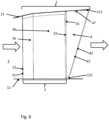
- FIG. 3 shows a detailed view of the first longitudinal end of trailing member 4 together with flow shield 5.
- First edge 431 of first side wall 43 of trailing member 4 comprises upstream section 431a and downstream section 431b.
- downstream section 431b of first edge 431 of first side wall 43 is angled radially inwardly, or towards the opposite, second longitudinal end of trailing member 4, relative to upstream section 431a of first edge 431 of side wall 43.
- first edge 441 of second side wall 44 of trailing member 4 comprises upstream section 441a and downstream section 441b.
- downstream section 441b of first edge 441 of second side wall 44 is angled radially inward, or towards an opposite, second longitudinal end of trailing member 4, relative to upstream section 441a of first edge 441 of second side wall 44.
- first edge 431, 441 of each of first and second side walls 43, 44 are convexly shaped in a side view of the respective side wall.
- first longitudinal end of trailing member 4 is convexly shaped in a side view onto any of side walls 43, 44.
- Cover plate 49 also comprises two sections 49a and 49b, wherein downstream section 49b is angled radially inward, or towards the second longitudinal end of trailing member 4 relative to upstream section 49a of cover plate 49, when seen along an upstream-downstream direction.
- This geometry enables that a gap between the first longitudinal end of trailing member 4 and outer barrel 11 may be configured smaller in an upstream section of the first longitudinal end of trailing member 4 than in a downstream section of the first longitudinal end of trailing member 4.
- Flow shield 5 may be configured such that an upstream edge of flow shield 5 is spaced from the downstream side of strut body 3 in a downstream direction of exhaust diffuser 1, as can be seen in FIG. 1 .
- a weld seam by which the flow shield 5 is attached to outer barrel 11 and a weld seam by which strut body 3 is attached to outer barrel 11 do not intersect.
- the first longitudinal end of trailing member 4 is further provided with recess 46 adjacent upstream side 41 of trailing member 4.
- the recess is provided in that first edges 431, 441 of side walls 43, 44 are recessed at upstream side 41 of trailing member 4.
- the recessed section of each of first edges 431, 441, respectively, of side walls 43 and 44 comprises a concave corner.
- Each stress relief slot 47, 48, when starting at an open end at the first edge 431, 441 of the respective side wall 43, 44 terminates at a rounded stress relief hole, of which only stress relief hole 471 of stress relief slot 47 is visible in the present depiction.
- the stress relief hole (e.g., 471) is sized and shaped to avoid notching effects at the end of a respective stress relief slot (e.g., 47).
- Cover plate 49 extends across stress relief slots 47, 48 of side walls 43, 44. Cover plate 49 is provided with stress relief slots 491, 492 which open out at an edge of cover plate 49 adjacent each of stress relief slots 47, 48 of side walls 43, 44. As can be seen, stress relief slots 491, 492 of cover plate 49 also terminate at rounded stress relief holes (without reference numerals). As upstream end 41 of trailing member 4 is recessed from the downstream section of the first longitudinal end of trailing member 4, a weld seam by which the upstream edges of sidewalls 43, 44 are joined to the downstream side of strut body 3 ( FIGS. 1 and 2 ) does not intersect with the weld seam by which strut body 3 is attached to outer barrel 11.
- cover plate 49 is weld-connected to the inner side of side walls 43 and 44 in a section downstream of stress relief slots 47 and 48, or 491 and 492, respectively, while the weld seam is omitted and a gap between cover plate 49 and the inner surfaces of side walls 43 and 44 is left open at the upstream end of the trailing member 4, such that no stresses are induced between cover plate 49 and side walls 43 and 44 adjacent strut body 3, when trailing member 4 is installed as intended.
- the stress relief slots 47, 48, 491, 492 provided at the first longitudinal end of trailing member 4 together with the avoidance of intersecting weld seams reduce mechanical stresses and thus the risk of cracking.
- recess 46 facilitates optical inspection of the interface between strut body 3, trailing member 4, and outer barrel 11.
- flow shield 5 is also provided with stress relief slots 51, which open out at a free edge of flow shield 5.
- Stress relief slots 51 are essentially anchor-shaped and terminate in rounded stress relief holes.
- FIG. 4 illustrates a strut assembly 2 installed within a diffuser 1, which incorporates a different embodiment of trailing member 4.
- an upstream side 41 of trailing member 4 is joined to a downstream side 32 of strut body 3. Consequently, trailing member 4 forms a trailing section of strut assembly 2.
- flow shield 5 is attached to outer barrel 11 and extends along a part of the circumference of the downstream portion of trailing member 4 adjacent the first, radially outward end of trailing member 4.
- Trailing member 4 in a direction from the first, radially outer longitudinal end of trailing member 4 to the second, radially inner longitudinal end of trailing member 4, ends before the second longitudinal end of strut body 3 such that a gap 121 is provided between the second longitudinal end of trailing member 4 and inner barrel 12.
- said second longitudinal end of trailing member 4 in the present embodiment cantilevers freely from downstream side 32 of strut body 3, rather than being fixed to inner barrel 12 as well as to strut body 3, the second longitudinal end of trailing member 4 experiences lower stresses adjacent the second longitudinal end of trailing member 4 compared to the embodiment of FIGS. 1 through 3 , and the stress relief slot 45 adjacent the second longitudinal end of trailing member 4 is thus omitted.
- aerodynamics may be impaired adjacent inner barrel 12. However, dependent upon the ratio between the diameter of outer barrel 11 and the diameter of inner barrel 12, the affected share of the total mass flow is sufficiently small to disregard said aerodynamic disadvantage.
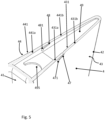
- FIG. 5 shows a detailed view of the first longitudinal end of trailing member 4 of FIG. 4 , i.e., the longitudinal end which is adapted and configured, or destined, respectively, to be provided as the radially outer longitudinal end of trailing member 4.
- the flow shield 5 is not shown for better visibility.
- First edges 431 and 441 comprise upstream sections 431a and 441a and downstream sections 431b and 441b. When seen along an upstream-downstream direction, downstream sections 431and 441b are angled towards the second longitudinal end of trailing member 4 relative to the respective upstream sections 431a and 441a.
- the first edge 431, 441 of each of first and second side walls 43, 44 is convexly shaped in a side view of the respective side wall.
- the first longitudinal end of trailing member 4 is convexly shaped in a side view onto any of side walls 43, 44.
- stress relief slots 47 and 48 open at the corner points of first edges 431 and 441 of side walls 43, 44 where upstream sections 431a and 441a and respective downstream sections 431and 441b meet.
- Stress relief slots 47 and 48 are tilted or angled relative to the longitudinal extent of trailing member 4, or a radial direction when trailing member 4 is installed as intended. Stress relief slots 47 and 48 extend, when starting form the openings at the respective edges, beneath upstream sections 431a and 441a of first edges 431 and 441 of side walls 43 and 44. Said tilt provides a particularly efficient relief of stresses when trailing member 4 is installed inside a diffuser 1.
- Stress relief slots 47 and 48 terminate at rounded stress relief holes 471 and 481, respectively.
- An upstream edge of cover plate 49 is located a distance downstream from upstream end 41 of trailing member 4 such that the first longitudinal end of trailing member 4 is open adjacent upstream side 41. Further, U-shaped cutout 495 is provided at the upstream edge of cover plate 49. The cutout 495 may have a shape other than a U-shape, if desired.
- FIG. 6 shows the configuration of FIG. 4 without the flow shield 5.
- An upstream section of the first, radially outer end of trailing member 4 is weld-connected to outer barrel 11.
- upstream sections 431a and 441a of first edges 431 and 441 of side walls 43 and 44 are weld-connected to outer barrel 11.
- a gap 111 is provided between outer barrel 11 and a downstream section of the first longitudinal end of trailing member 4.
- gap 111 is provided between barrel 11 and downstream sections 431b and 441b of first edges 431 and 441 of side walls 43 and 44.
- gap 111 is normally covered by flow shield 5.
- stress relief slots 47 and 48 extend beneath the welded sections of first edges 431 and 441 of side walls 43 and 44, and between the respective welded sections and non-welded sections of first edges 431 and 441. Stress relief slots 47 and 48 provide an amount of flexibility to side walls 43 and 44 adjacent to the respective first edges 431 and 441 to accommodate a certain degree of deformation without inducing excessive stresses.
Landscapes
- Engineering & Computer Science (AREA)
- Mechanical Engineering (AREA)
- General Engineering & Computer Science (AREA)
- Architecture (AREA)
- Physics & Mathematics (AREA)
- Fluid Mechanics (AREA)
- Supercharger (AREA)
Applications Claiming Priority (1)
| Application Number | Priority Date | Filing Date | Title |
|---|---|---|---|
| PL44695523 | 2023-12-01 |
Publications (1)
| Publication Number | Publication Date |
|---|---|
| EP4567254A1 true EP4567254A1 (de) | 2025-06-11 |
Family
ID=93432180
Family Applications (1)
| Application Number | Title | Priority Date | Filing Date |
|---|---|---|---|
| EP24211102.9A Pending EP4567254A1 (de) | 2023-12-01 | 2024-11-06 | Hinterkantenelement für eine strebe eines gasturbinenabgasdiffusors, strebenanordnung und gasturbinenabgasdiffusor |
Country Status (4)
| Country | Link |
|---|---|
| US (1) | US20250179936A1 (de) |
| EP (1) | EP4567254A1 (de) |
| JP (1) | JP2025093874A (de) |
| KR (1) | KR20250084041A (de) |
Citations (5)
| Publication number | Priority date | Publication date | Assignee | Title |
|---|---|---|---|---|
| EP1508399B1 (de) * | 2003-08-22 | 2006-12-27 | Siemens Aktiengesellschaft | Schaufel einer Strömungsmaschine und Verfahren zur Verhinderung der Rissausbreitung in der Schaufel einer Strömungsmaschine |
| US20160208642A1 (en) * | 2015-01-16 | 2016-07-21 | Siemens Energy, Inc. | Turbine exhaust cylinder/turbine exhaust manifold bolted full span turbine exhaust flaps |
| US9556749B2 (en) * | 2011-12-05 | 2017-01-31 | General Electric Technology Gmbh | Exhaust gas housing for a gas turbine and gas turbine having an exhaust gas housing |
| EP2365191B1 (de) * | 2010-03-08 | 2018-08-29 | United Technologies Corporation | Belastbare Struktur für eine Gasturbine |
| EP3336318B1 (de) * | 2016-12-16 | 2020-06-17 | General Electric Company | Streben für abgasaustrittsgehäuse von turbinensystemen |
-
2024
- 2024-11-06 EP EP24211102.9A patent/EP4567254A1/de active Pending
- 2024-11-15 JP JP2024199583A patent/JP2025093874A/ja active Pending
- 2024-11-26 KR KR1020240170529A patent/KR20250084041A/ko active Pending
- 2024-11-26 US US18/960,227 patent/US20250179936A1/en active Pending
Patent Citations (5)
| Publication number | Priority date | Publication date | Assignee | Title |
|---|---|---|---|---|
| EP1508399B1 (de) * | 2003-08-22 | 2006-12-27 | Siemens Aktiengesellschaft | Schaufel einer Strömungsmaschine und Verfahren zur Verhinderung der Rissausbreitung in der Schaufel einer Strömungsmaschine |
| EP2365191B1 (de) * | 2010-03-08 | 2018-08-29 | United Technologies Corporation | Belastbare Struktur für eine Gasturbine |
| US9556749B2 (en) * | 2011-12-05 | 2017-01-31 | General Electric Technology Gmbh | Exhaust gas housing for a gas turbine and gas turbine having an exhaust gas housing |
| US20160208642A1 (en) * | 2015-01-16 | 2016-07-21 | Siemens Energy, Inc. | Turbine exhaust cylinder/turbine exhaust manifold bolted full span turbine exhaust flaps |
| EP3336318B1 (de) * | 2016-12-16 | 2020-06-17 | General Electric Company | Streben für abgasaustrittsgehäuse von turbinensystemen |
Also Published As
| Publication number | Publication date |
|---|---|
| JP2025093874A (ja) | 2025-06-24 |
| US20250179936A1 (en) | 2025-06-05 |
| KR20250084041A (ko) | 2025-06-10 |
Similar Documents
| Publication | Publication Date | Title |
|---|---|---|
| US7819628B2 (en) | Assembly comprised of a vane and of a cooling liner, turbomachine nozzle guide vanes assembly comprising this assembly, turbomachine and method of fitting and of repairing this assembly | |
| US8240987B2 (en) | Gas turbine engine systems involving baffle assemblies | |
| US4739621A (en) | Cooling scheme for combustor vane interface | |
| JP5414200B2 (ja) | タービンロータブレード組立体及びそれを製作する方法 | |
| JP4781244B2 (ja) | タービンノズル及びタービンエンジン | |
| JP5981717B2 (ja) | ターボ機械部品用のインピンジメントプレート | |
| US6761536B1 (en) | Turbine blade platform trailing edge undercut | |
| US8251665B2 (en) | Turbine blade and gas turbine equipped with a turbine blade | |
| US9970320B2 (en) | Exhaust housing hub for a turbomachine | |
| US20060045732A1 (en) | Duct with integrated baffle | |
| US4378961A (en) | Case assembly for supporting stator vanes | |
| US6533542B2 (en) | Split ring for gas turbine casing | |
| KR20020083498A (ko) | 냉각 팁 슈라우드를 구비하는 터빈 블레이드를 포함하는터빈조립체 | |
| JP5074014B2 (ja) | タービンエンジンノズルアセンブリ及びガスタービンエンジン | |
| JP2012145105A5 (de) | ||
| CN105804806A (zh) | 用于燃烧器涡轮界面的框架节段 | |
| EP3000990B1 (de) | Halter einer turbinenummantelung | |
| JP5599546B2 (ja) | タービンシュラウド組立体及びガスタービンエンジンを組み立てる方法 | |
| JP2003227344A (ja) | ターボチャージャ | |
| US8920117B2 (en) | Fabricated gas turbine duct | |
| EP4567254A1 (de) | Hinterkantenelement für eine strebe eines gasturbinenabgasdiffusors, strebenanordnung und gasturbinenabgasdiffusor | |
| JPH0647922B2 (ja) | ステータ組立体 | |
| GB2503857A (en) | Exhaust case for a turbomachine with a flexible hub | |
| JPS59180006A (ja) | ガスタ−ビン静翼セグメント | |
| CN113710875B (zh) | 涡轮发动机叶片、相关涡轮发动机分配器和涡轮发动机 |
Legal Events
| Date | Code | Title | Description |
|---|---|---|---|
| PUAI | Public reference made under article 153(3) epc to a published international application that has entered the european phase |
Free format text: ORIGINAL CODE: 0009012 |
|
| STAA | Information on the status of an ep patent application or granted ep patent |
Free format text: STATUS: THE APPLICATION HAS BEEN PUBLISHED |
|
| AK | Designated contracting states |
Kind code of ref document: A1 Designated state(s): AL AT BE BG CH CY CZ DE DK EE ES FI FR GB GR HR HU IE IS IT LI LT LU LV MC ME MK MT NL NO PL PT RO RS SE SI SK SM TR |
|
| RAP3 | Party data changed (applicant data changed or rights of an application transferred) |
Owner name: GE VERNOVA TECHNOLOGY GMBH |
|
| STAA | Information on the status of an ep patent application or granted ep patent |
Free format text: STATUS: REQUEST FOR EXAMINATION WAS MADE |
|
| 17P | Request for examination filed |
Effective date: 20250924 |