EP4567409A1 - Überwachungsvorrichtung, system und verfahren zur detektion eines elements in einem fluid - Google Patents
Überwachungsvorrichtung, system und verfahren zur detektion eines elements in einem fluid Download PDFInfo
- Publication number
- EP4567409A1 EP4567409A1 EP23383264.1A EP23383264A EP4567409A1 EP 4567409 A1 EP4567409 A1 EP 4567409A1 EP 23383264 A EP23383264 A EP 23383264A EP 4567409 A1 EP4567409 A1 EP 4567409A1
- Authority
- EP
- European Patent Office
- Prior art keywords
- fluid
- data
- monitoring device
- sample
- sensor
- Prior art date
- Legal status (The legal status is an assumption and is not a legal conclusion. Google has not performed a legal analysis and makes no representation as to the accuracy of the status listed.)
- Pending
Links
Images


Classifications
-
- G—PHYSICS
- G01—MEASURING; TESTING
- G01N—INVESTIGATING OR ANALYSING MATERIALS BY DETERMINING THEIR CHEMICAL OR PHYSICAL PROPERTIES
- G01N21/00—Investigating or analysing materials by the use of optical means, i.e. using sub-millimetre waves, infrared, visible or ultraviolet light
- G01N21/62—Systems in which the material investigated is excited whereby it emits light or causes a change in wavelength of the incident light
- G01N21/63—Systems in which the material investigated is excited whereby it emits light or causes a change in wavelength of the incident light optically excited
- G01N21/65—Raman scattering
-
- G—PHYSICS
- G01—MEASURING; TESTING
- G01N—INVESTIGATING OR ANALYSING MATERIALS BY DETERMINING THEIR CHEMICAL OR PHYSICAL PROPERTIES
- G01N1/00—Sampling; Preparing specimens for investigation
- G01N1/02—Devices for withdrawing samples
- G01N1/22—Devices for withdrawing samples in the gaseous state
- G01N1/2273—Atmospheric sampling
-
- G—PHYSICS
- G01—MEASURING; TESTING
- G01N—INVESTIGATING OR ANALYSING MATERIALS BY DETERMINING THEIR CHEMICAL OR PHYSICAL PROPERTIES
- G01N15/00—Investigating characteristics of particles; Investigating permeability, pore-volume or surface-area of porous materials
- G01N15/06—Investigating concentration of particle suspensions
- G01N15/0606—Investigating concentration of particle suspensions by collecting particles on a support
- G01N15/0618—Investigating concentration of particle suspensions by collecting particles on a support of the filter type
- G01N15/0625—Optical scan of the deposits
-
- G—PHYSICS
- G01—MEASURING; TESTING
- G01N—INVESTIGATING OR ANALYSING MATERIALS BY DETERMINING THEIR CHEMICAL OR PHYSICAL PROPERTIES
- G01N33/00—Investigating or analysing materials by specific methods not covered by groups G01N1/00 - G01N31/00
- G01N33/0004—Gaseous mixtures, e.g. polluted air
- G01N33/0009—General constructional details of gas analysers, e.g. portable test equipment
- G01N33/0027—General constructional details of gas analysers, e.g. portable test equipment concerning the detector
- G01N33/0036—General constructional details of gas analysers, e.g. portable test equipment concerning the detector specially adapted to detect a particular component
- G01N33/0047—Organic compounds
-
- G—PHYSICS
- G01—MEASURING; TESTING
- G01N—INVESTIGATING OR ANALYSING MATERIALS BY DETERMINING THEIR CHEMICAL OR PHYSICAL PROPERTIES
- G01N15/00—Investigating characteristics of particles; Investigating permeability, pore-volume or surface-area of porous materials
- G01N2015/0042—Investigating dispersion of solids
- G01N2015/0046—Investigating dispersion of solids in gas, e.g. smoke
-
- G—PHYSICS
- G01—MEASURING; TESTING
- G01N—INVESTIGATING OR ANALYSING MATERIALS BY DETERMINING THEIR CHEMICAL OR PHYSICAL PROPERTIES
- G01N15/00—Investigating characteristics of particles; Investigating permeability, pore-volume or surface-area of porous materials
- G01N2015/0042—Investigating dispersion of solids
- G01N2015/0053—Investigating dispersion of solids in liquids, e.g. trouble
-
- G—PHYSICS
- G01—MEASURING; TESTING
- G01N—INVESTIGATING OR ANALYSING MATERIALS BY DETERMINING THEIR CHEMICAL OR PHYSICAL PROPERTIES
- G01N2201/00—Features of devices classified in G01N21/00
- G01N2201/02—Mechanical
- G01N2201/022—Casings
- G01N2201/0221—Portable; cableless; compact; hand-held
-
- G—PHYSICS
- G01—MEASURING; TESTING
- G01N—INVESTIGATING OR ANALYSING MATERIALS BY DETERMINING THEIR CHEMICAL OR PHYSICAL PROPERTIES
- G01N2201/00—Features of devices classified in G01N21/00
- G01N2201/12—Circuits of general importance; Signal processing
- G01N2201/129—Using chemometrical methods
- G01N2201/1296—Using chemometrical methods using neural networks
-
- G—PHYSICS
- G01—MEASURING; TESTING
- G01N—INVESTIGATING OR ANALYSING MATERIALS BY DETERMINING THEIR CHEMICAL OR PHYSICAL PROPERTIES
- G01N33/00—Investigating or analysing materials by specific methods not covered by groups G01N1/00 - G01N31/00
- G01N33/0004—Gaseous mixtures, e.g. polluted air
- G01N33/0009—General constructional details of gas analysers, e.g. portable test equipment
- G01N33/0027—General constructional details of gas analysers, e.g. portable test equipment concerning the detector
- G01N33/0031—General constructional details of gas analysers, e.g. portable test equipment concerning the detector comprising two or more sensors, e.g. a sensor array
- G01N33/0034—General constructional details of gas analysers, e.g. portable test equipment concerning the detector comprising two or more sensors, e.g. a sensor array comprising neural networks or related mathematical techniques
-
- G—PHYSICS
- G01—MEASURING; TESTING
- G01N—INVESTIGATING OR ANALYSING MATERIALS BY DETERMINING THEIR CHEMICAL OR PHYSICAL PROPERTIES
- G01N33/00—Investigating or analysing materials by specific methods not covered by groups G01N1/00 - G01N31/00
- G01N33/0004—Gaseous mixtures, e.g. polluted air
- G01N33/0009—General constructional details of gas analysers, e.g. portable test equipment
- G01N33/0027—General constructional details of gas analysers, e.g. portable test equipment concerning the detector
- G01N33/0036—General constructional details of gas analysers, e.g. portable test equipment concerning the detector specially adapted to detect a particular component
- G01N33/004—CO or CO2
-
- G—PHYSICS
- G01—MEASURING; TESTING
- G01N—INVESTIGATING OR ANALYSING MATERIALS BY DETERMINING THEIR CHEMICAL OR PHYSICAL PROPERTIES
- G01N33/00—Investigating or analysing materials by specific methods not covered by groups G01N1/00 - G01N31/00
- G01N33/0004—Gaseous mixtures, e.g. polluted air
- G01N33/0009—General constructional details of gas analysers, e.g. portable test equipment
- G01N33/0062—General constructional details of gas analysers, e.g. portable test equipment concerning the measuring method or the display, e.g. intermittent measurement or digital display
- G01N33/0063—General constructional details of gas analysers, e.g. portable test equipment concerning the measuring method or the display, e.g. intermittent measurement or digital display using a threshold to release an alarm or displaying means
-
- G—PHYSICS
- G01—MEASURING; TESTING
- G01N—INVESTIGATING OR ANALYSING MATERIALS BY DETERMINING THEIR CHEMICAL OR PHYSICAL PROPERTIES
- G01N33/00—Investigating or analysing materials by specific methods not covered by groups G01N1/00 - G01N31/00
- G01N33/18—Water
-
- G—PHYSICS
- G01—MEASURING; TESTING
- G01N—INVESTIGATING OR ANALYSING MATERIALS BY DETERMINING THEIR CHEMICAL OR PHYSICAL PROPERTIES
- G01N33/00—Investigating or analysing materials by specific methods not covered by groups G01N1/00 - G01N31/00
- G01N33/48—Biological material, e.g. blood, urine; Haemocytometers
- G01N33/483—Physical analysis of biological material
- G01N33/487—Physical analysis of biological material of liquid biological material
-
- G—PHYSICS
- G01—MEASURING; TESTING
- G01N—INVESTIGATING OR ANALYSING MATERIALS BY DETERMINING THEIR CHEMICAL OR PHYSICAL PROPERTIES
- G01N33/00—Investigating or analysing materials by specific methods not covered by groups G01N1/00 - G01N31/00
- G01N33/48—Biological material, e.g. blood, urine; Haemocytometers
- G01N33/483—Physical analysis of biological material
- G01N33/497—Physical analysis of biological material of gaseous biological material, e.g. breath
- G01N33/4975—Physical analysis of biological material of gaseous biological material, e.g. breath other than oxygen, carbon dioxide or alcohol, e.g. organic vapours
Definitions
- the present invention refers to techniques for monitoring a fluid, typically air or water, but also applicable to others such as urine, plasma, etc. It falls within the health and/or industrial sectors. It is capable of detecting the presence of multiple elements, particularly volatile organic compounds generated due to the metabolism of bacteria, fungi, viruses, etc. It can be applied to identify a disease, not only infectious but cancer or others where the human or animal body emits distinctive VOCs.
- Microorganisms have adapted to favor their survival and dispersion in the air through sprays, dust particles, dry leaf fragments, water droplets and even droplets of saliva expelled when coughing or speaking. In this way, microorganisms can travel long distances, allowing the disease transmission.
- the health sector is developing methods for detecting microorganisms in environmental sources for the control and reduction of these infectious diseases.
- Patent documents describing microorganism detection systems are also known in the state of the art.
- Patent US11460407 B2 which describes a method and apparatus for analyzing gas quality, through a Raman spectroscopic examination of a gas sample from a space to be monitored. Spectroscopic examination produces a measurement spectrum that extends over a wavelength range. A deviation of the measurement spectrum of at least one comparison sample is then detected. Based on the deviation detected, a gas quality warning is produced.
- this proposal is intended for the analysis of some environmental indicator such as temperature, pressure or relative humidity.
- Patent Application CN114858779A describes an gas detection smart method and device, and the method comprises the following steps: providing a microfluidic channel and arranging a SERS substrate in the microfluidic channel; continuously introducing gas to be detected into the microfluidic channel; detecting gas to be detected in the microfluidic channel by adopting Raman detection equipment; performing Raman spectrum analysis according to the detected Raman spectrum to obtain the components and their concentration in the analyzed gas.
- the invention relates to a monitoring device according to claim 1 and a detection system according to claim 7. It also refers to a detection method according to claim 11, which includes the steps and operations carried out by the aforementioned system.
- the invention allows the detection of an element present in a fluid sample that, for example, is associated with bacteria, fungi, or gases of certain metabolites, among others.
- the invention uses Raman spectroscopy and machine learning (ML)-based processing and neural networks. It allows not only to identify but also to quantify an element.
- ML machine learning
- the objective element of detection through the emission of volatile organic compounds (VOCs) associated with a disease or the metabolism of a microorganism typically is a bacteria, a fungus or a virus. However, it can also be configured to detect inert elements such as harmful gas emissions.
- VOCs volatile organic compounds
- the applications can be numerous. It is enough to establish an association between the VOC detected and a cause. Therefore, it can be used to detect various circumstances, such as diseases associated with bacteria, fungi and viruses. Also for certain tumors.
- the fluid is generally air or water, although it can be used for a non-pretreated sample, such as a blood, plasma, urine and/or stool sample.
- VOCs volatile organic compounds
- microorganisms excreted by microorganisms as a result of their own metabolism and that usually allow them to establish interactions, beneficial or harmful, with each other and/or with other organisms. These VOCs vary. There are VOCs produced by tumor cells or infected by other microorganisms (bacteria, viruses and/or fungi).
- Raman spectroscopy is an analysis technique based on the inelastic scattering of monochromatic light (typically a laser).
- monochromatic light typically a laser
- the frequency of photons in monochromatic light changes when interacting with a sample.
- the photons are absorbed by the sample and then re-emitted.
- the frequency of the re-emitted photons is shifted up or down compared to the original monochromatic frequency, called the Raman effect, allowing the sample to be characterized.
- the monitoring device to which the invention refers includes a particle sensor, a VOC sensor that has a compartment with an inlet and an outlet so that a fluid can flow, a lens and a laser emitter.
- a concave mirror is optically coupled with the lens to concentrate light to a measurement area of the VOC sensor.
- the particle sensor electrostatically filters particles in a fluid sample, provides a filtered fluid sample to the VOC sensor compartment, and additionally provides particle data present in the fluid sample.
- the VOC sensor obtains spectrophotometric data based on Raman spectrography on the filtered fluid sample from the compartment.
- the monitoring device can incorporate additional sensors and be portable.
- a carbon dioxide sensor is advantageous, since a high concentration of carbon dioxide in the fluid sample can be indicative of problems (e. g., infection).
- the monitoring device incorporates data processing capacity through a processing unit (a microprocessor and/or a microcontroller), (e. g., spectrophotometric data). It can also incorporate a communication unit to send a message with the processed data to other devices.
- a processing unit e. g., spectrophotometric data
- a communication unit to send a message with the processed data to other devices.
- the processing unit uses spectrophotometric data with additional particle data and/or carbon dioxide data to apply machine learning algorithms to a previously trained neural network.
- the device itself can autonomously produce information about the presence and/or quantity of a certain element in the fluid sample.
- the fluid can come from the environment or from a patient.
- the system for detecting an element in a fluid to which this invention relates includes one or more monitoring devices as described above, and also a server to perform most of the processing tasks and operations, mainly with data from each monitoring device and applying machine learning classification algorithms on a previously trained neural network.
- the system can produce information about the presence and/or quantity of an element in a fluid sample monitored by a certain monitoring device.
- an organism or microorganism whose metabolism emits gases associated with the presence of a fungus, a bacteria or a virus can be detected. Also, a certain harmful gas without being associated with a biological process can be detected.
- a method of detecting an element in a fluid comprises electrostatically filtering a particle sample of the fluid, depositing the particles to obtain a filtered sample and particle data in the fluid; applying Raman spectrography on the filtered sample and obtaining a set of spectrophotometric data; processing the spectrophotometric data set by applying one or more classification algorithms in a trained neural network and obtaining information about the presence of one or more elements in the sample; producing detection information and generating a warning message with information about the presence of one or more elements.
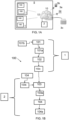
- FIGURE 1A schematically illustrates a very high level block diagram of a detection system 5 according to an embodiment of the invention.
- the detection system 5 includes a server 2 and monitoring devices 1 that may be portable and equipped with their own battery, ready to be deployed in various locations from which they can communicate monitoring data (wirelessly or not) through a communications network 10 (Internet, 3/4/5G, etc.).
- Each monitoring device 1 includes a processing unit 150 and communication unit 140 for sending a message to the server 2, including, in other embodiments, to a user device, such as a mobile phone 3b, or a computer 3a.
- the monitoring data (mainly including spectrophotometric data and, additionally, CO2 data, particles, etc.) are received by server 2, which processes and classifies them to identify if they correspond to any element by applying machine learning (ML) algorithms on a neural network previously trained with examples.
- the server 2 of the detection system 5 can be configured to send information related to the detection, either to another external server 3c (for example, from a hospital computer system), or to user devices 3b, 3a, typically associated with supervision or surveillance staff.
- FIGURE 1B schematically illustrates a flowchart with the main steps of the detection method 100, which comprises a sequence with the following steps:
- method 100 allows the presence of volatile organic compounds (VOCs) produced by bacteria, viruses or fungi to be determined in an ambient air sample.
- VOCs volatile organic compounds
- diseases cancer
- the monitoring device 1 is adapted to collect a sample of air exhaled by a patient (e. g. through a mouthpiece or an adapter for a respirator).
- data acquisition is carried out with the monitoring device 1, while the processing and detection, mainly, is carried out with the server 2 (see FIGURE 1A ).
- the electrostatic filtering step 101 and the Raman spectrography applying step 102 are carried out by the monitoring device 1.
- the processing step 103 and the detection information producing step 104 are carried out by the server 2.
- At least part of the tasks associated with server 2 can be transferred to monitoring device 1.
- This trained neural network 103b is the result of a training step 90 previously carried out (see FIGURE 4 ). Additionally, it can be continuously retrained with current data acquired by the monitoring device 1.
- the neural network is trained with various ML algorithms, the one that provides the best performance is determined, and said algorithm is chosen to retrain the neural network. These testing, selection and retraining steps are repeated dynamically and iteratively and can also be applied to current data acquired by each monitoring device 1.
- the algorithm is no longer the most appropriate and an another one more complex must be used to differentiate between more bacteria.
- it is advantageous to change the algorithm and configuration of the neural network.
- it is a programmed process that runs automatically, typically on server 2 of detection system 5.
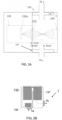
- FIGURE 2A illustrates some components of an embodiment of the monitoring device 1 in a fluid (e. g., air) where part of the components for data acquisition can be seen.
- a compartment 131 is shown where a VOC sensor 132 is located, which can preferably be carried out with a Raman spectrophotometer.
- the VOC sensor 132 has a laser emitter (not shown in this figure) and a lens 133.
- the VOC sensor 132 has an associated particle detector 139 that also acts as a particle sensor to improve the acquisition of spectrophotometric data by filtering particles from the fluid that passes into compartment 131.
- CO2 data is obtained with a CO2 sensor 137.
- a concave mirror 134 is incorporated after the lens 133 of the VOC sensor 132 to increase the signal-to-noise ratio and obtain better readings.
- the concave mirror 134 allows the light not reflected by the molecules and refracted to be collected. Thus, the light is concentrated in the measurement area of the VOC sensor 132. To concentrate it correctly in the measurement area, the degree of curvature of the concave mirror 134 must be calculated from its focal distance.
- this measurement area is a CMOS sensor circuit 132a in the case of a Raman spectrophotometer, so the focal distance of the concave mirror 134 should be the same or very similar to that of the lens 133.
- FIGURE 2B illustrates with arrows the circulation path of a fluid in an embodiment of the monitoring device 1.
- the fluid e. g., air
- a small fan not shown
- the fan itself of the particle sensor 139 coupled with input 1a is used.
- the fluid filtered by the particle sensor 139 then passes to the VOC sensor 132 (which may incorporate the concave mirror already indicated in FIGURE 2A ). After which, the fluid can pass through a CO2 sensor 137 or another additional sensors until it leaves through an outlet 1b.
- air from a respirator can be collected.
- an adapter is used to connect input 1a to the output of said respirator and the fan can be dispensed with.
- FIGURES 3A-3B show the filtering effect in compartment 131 of an air monitoring device 1, where is previously illustrated ( FIGURE 3A ) and subsequently ( FIGURE 3B ) to electrostatic filtering.
- the air is passed through compartment 131, and electrostatic deposition is applied to remove the particles present in the air that arrives from an inlet 132a and leaves outlet 132b by positive pressure from compartment 131 the filtered air.
- This filtering can be done with a particle sensor integrated with the VOC sensor 131. In this way, the laser emitter 135 associated with the VOC sensor does not interact with particles already filtered.
- FIGURE 3C shows a graphic representation where the normalized intensity is represented on the ordinate axis; on the abscissa axis, the Raman shift expressed in wave numbers (cm-1).
- the upper curve corresponds to a spectrum with Raman spectrophotometric data from the VOC sensor present in a sample and the lower curve is the bulk reference. Generally, thousands of data are acquired per second.
- FIGURE 4 illustrates a support assembly 6 to obtain the VOCs released by a controlled colony of a certain microorganism and its quantity (or a mixture of microorganisms that are capable of cohabiting with their respective CFUs).
- the assembly 6 includes a Petri dish 41 or similar to facilitate the growth of the microorganism 101b, includes a water container 46 to maintain humidity, a temperature sensor 44 and a humidity sensor 45 to facilitate the control of environmental conditions according to the type of microorganism.
- the assembly 6 further includes a VOC sensor 132 to acquire CFU quantity, Raman spectrophotometric data, and optionally the assembly 6 can acquire particle data and CO2 data.
- the above components are located within a chamber 42 (e. g., with dimensions 70cm x 25cm x 30cm).
- Spectrophotometric, particle and CO2 data are labeled and associated with a certain element (e. g. a certain bacteria) and are used as examples to train a neural network with which to subsequently identify samples in the environment or in a patient.
- assembly 6 serves to acquire data with which, properly labeled, a training stage of the neural network can be carried out (see FIGURE 1B ) in a computer.
- the neural network Once the neural network is trained on the computer, it can be transferred to another equipment (for example, to the monitoring device, or more usually to the detection system server; see FIGURE 1A ).
- a database of pathogenic bacteria is used, for example, from NCBI and the database of human pathogens based on the classification of airborne bacteria through high yield sequencing of 16S rRNA to obtain the relationship between PM 2. 5 and PM 10 with respect to bacterial families.
- other parameters that affect the growth of colonies are taken into account with which to obtain information on their quantity.
Landscapes
- Health & Medical Sciences (AREA)
- Chemical & Material Sciences (AREA)
- Life Sciences & Earth Sciences (AREA)
- Analytical Chemistry (AREA)
- General Health & Medical Sciences (AREA)
- Pathology (AREA)
- Immunology (AREA)
- Physics & Mathematics (AREA)
- General Physics & Mathematics (AREA)
- Biochemistry (AREA)
- Engineering & Computer Science (AREA)
- Combustion & Propulsion (AREA)
- Medicinal Chemistry (AREA)
- Food Science & Technology (AREA)
- Dispersion Chemistry (AREA)
- Biomedical Technology (AREA)
- Molecular Biology (AREA)
- Nuclear Medicine, Radiotherapy & Molecular Imaging (AREA)
- Investigating, Analyzing Materials By Fluorescence Or Luminescence (AREA)
Priority Applications (2)
| Application Number | Priority Date | Filing Date | Title |
|---|---|---|---|
| EP23383264.1A EP4567409A1 (de) | 2023-12-07 | 2023-12-07 | Überwachungsvorrichtung, system und verfahren zur detektion eines elements in einem fluid |
| PCT/EP2024/083965 WO2025119766A1 (en) | 2023-12-07 | 2024-11-28 | Monitoring device, system and method for detecting an element in a fluid |
Applications Claiming Priority (1)
| Application Number | Priority Date | Filing Date | Title |
|---|---|---|---|
| EP23383264.1A EP4567409A1 (de) | 2023-12-07 | 2023-12-07 | Überwachungsvorrichtung, system und verfahren zur detektion eines elements in einem fluid |
Publications (1)
| Publication Number | Publication Date |
|---|---|
| EP4567409A1 true EP4567409A1 (de) | 2025-06-11 |
Family
ID=89427194
Family Applications (1)
| Application Number | Title | Priority Date | Filing Date |
|---|---|---|---|
| EP23383264.1A Pending EP4567409A1 (de) | 2023-12-07 | 2023-12-07 | Überwachungsvorrichtung, system und verfahren zur detektion eines elements in einem fluid |
Country Status (2)
| Country | Link |
|---|---|
| EP (1) | EP4567409A1 (de) |
| WO (1) | WO2025119766A1 (de) |
Citations (6)
| Publication number | Priority date | Publication date | Assignee | Title |
|---|---|---|---|---|
| US20080007728A1 (en) * | 2006-07-07 | 2008-01-10 | Thomas Wayne Schneider | Air sampler module for enhancing the detection capabilities of a chemical detection device or system |
| WO2021061330A1 (en) | 2019-09-23 | 2021-04-01 | Zeteo Tech, Inc. | Systems and methods of rapid and autonomous detection of aerosol particles |
| US20210199656A1 (en) * | 2018-08-31 | 2021-07-01 | University Of Montana | Apparatus and Method for the Detection of Bioaerosols |
| WO2022150353A1 (en) * | 2021-01-05 | 2022-07-14 | Wayne State University | Raman-based systems and methods for material identification |
| CN114858779A (zh) | 2022-05-30 | 2022-08-05 | 南通朗地罗拉安全设备有限公司 | 一种智能化气体检测方法及装置 |
| US11460407B2 (en) | 2017-08-04 | 2022-10-04 | Carl Zeiss Jena Gmbh | Sample-based gas quality control by means of raman spectroscopy |
-
2023
- 2023-12-07 EP EP23383264.1A patent/EP4567409A1/de active Pending
-
2024
- 2024-11-28 WO PCT/EP2024/083965 patent/WO2025119766A1/en active Pending
Patent Citations (6)
| Publication number | Priority date | Publication date | Assignee | Title |
|---|---|---|---|---|
| US20080007728A1 (en) * | 2006-07-07 | 2008-01-10 | Thomas Wayne Schneider | Air sampler module for enhancing the detection capabilities of a chemical detection device or system |
| US11460407B2 (en) | 2017-08-04 | 2022-10-04 | Carl Zeiss Jena Gmbh | Sample-based gas quality control by means of raman spectroscopy |
| US20210199656A1 (en) * | 2018-08-31 | 2021-07-01 | University Of Montana | Apparatus and Method for the Detection of Bioaerosols |
| WO2021061330A1 (en) | 2019-09-23 | 2021-04-01 | Zeteo Tech, Inc. | Systems and methods of rapid and autonomous detection of aerosol particles |
| WO2022150353A1 (en) * | 2021-01-05 | 2022-07-14 | Wayne State University | Raman-based systems and methods for material identification |
| CN114858779A (zh) | 2022-05-30 | 2022-08-05 | 南通朗地罗拉安全设备有限公司 | 一种智能化气体检测方法及装置 |
Non-Patent Citations (1)
| Title |
|---|
| PETROV D V, MTROSOV I I, KOSTENKO M A: "Multipass Raman gas analyzer for monitoring of atmospheric air composition", OPTICS AND LASER TECHNOLOGY, vol. 152, 108155, 11 April 2022 (2022-04-11), XP087046348, Retrieved from the Internet <URL:https://doi.org/10.1016/j.optlastec.2022.108155> * |
Also Published As
| Publication number | Publication date |
|---|---|
| WO2025119766A1 (en) | 2025-06-12 |
Similar Documents
| Publication | Publication Date | Title |
|---|---|---|
| Huffman et al. | Real-time sensing of bioaerosols: Review and current perspectives | |
| US11839463B2 (en) | Diagnosis of respiratory diseases using analysis of exhaled breath and aerosols | |
| JP6019143B2 (ja) | 試料内の微生物因子の迅速な同定および/または特徴付けのためのシステムおよび方法 | |
| EP3004323B1 (de) | Schneller mikrobennachweis | |
| CN104136908B (zh) | 用于鉴定培养物中微生物的光谱手段和方法 | |
| Sandrin et al. | Characterization of microbial mixtures by mass spectrometry | |
| US20200305849A1 (en) | Systems and methods for monitoring microbiome markers/molecules in waste environments | |
| Qian et al. | Array optimization based on weighted and Hilbert–Schmidt schemes of multisensor detection system | |
| US20230028710A1 (en) | Identification of microbial contaminations or infections in liquid samples by raman spectroscopy | |
| US12364411B2 (en) | Diagnosis of respiratory diseases using analysis of exhaled breath and aerosols | |
| CN109313173A (zh) | 紧凑型气体分析设备和方法 | |
| US20150284763A1 (en) | Method of Using Laser-Induced Breakdown Spectroscopy for the Identification and Classification of Bacteria | |
| US12092569B2 (en) | Method and system for detecting a biological substance by hyperspectral imaging | |
| Fung et al. | Analysis of airborne biomarkers for point-of-care diagnostics | |
| EP4567409A1 (de) | Überwachungsvorrichtung, system und verfahren zur detektion eines elements in einem fluid | |
| US6649417B2 (en) | Tissue-based standoff biosensors for detecting chemical warfare agents | |
| Aernecke et al. | Design, implementation, and field testing of a portable fluorescence-based vapor sensor | |
| Jung et al. | Distinguishing biotic and abiotic particles using an ultraviolet aerodynamic particle sizer for real-time detection of bacterial bioaerosols | |
| US20240328986A1 (en) | Device for reading, processing and transmitting test result data for pathogens or viruses in fluid test samples | |
| Yang et al. | Bacterial typing and identification based on Fourier transform infrared spectroscopy | |
| EP4002425A1 (de) | Erwartungstreue ionenidentifizierung durch mehrere ionen | |
| Naumann | FT-IR spectroscopy of microorganisms at the Robert Koch Institute: experiences gained during a successful project | |
| KR20150005736A (ko) | 관심 샘플 중의 관심 대상물을 확인하고 특징화하기 위한 관심 샘플의 하이퍼스펙트랄 이미징 및 분석 | |
| US20260060567A1 (en) | Systems and methods for capturing aerosolized biomaterial particles using packed beds | |
| Camarlinghi et al. | I-dOne: A diagnostic tool in the field of identification of clinically relevant microbial strains |
Legal Events
| Date | Code | Title | Description |
|---|---|---|---|
| PUAI | Public reference made under article 153(3) epc to a published international application that has entered the european phase |
Free format text: ORIGINAL CODE: 0009012 |
|
| STAA | Information on the status of an ep patent application or granted ep patent |
Free format text: STATUS: THE APPLICATION HAS BEEN PUBLISHED |
|
| AK | Designated contracting states |
Kind code of ref document: A1 Designated state(s): AL AT BE BG CH CY CZ DE DK EE ES FI FR GB GR HR HU IE IS IT LI LT LU LV MC ME MK MT NL NO PL PT RO RS SE SI SK SM TR |
|
| STAA | Information on the status of an ep patent application or granted ep patent |
Free format text: STATUS: REQUEST FOR EXAMINATION WAS MADE |
|
| 17P | Request for examination filed |
Effective date: 20251210 |
|
| RAX | Requested extension states of the european patent have changed |
Extension state: BA Payment date: 20251210 |