EP4567671A1 - Convolutions analogiques numériques quantiques pour classification d'images - Google Patents
Convolutions analogiques numériques quantiques pour classification d'images Download PDFInfo
- Publication number
- EP4567671A1 EP4567671A1 EP24171385.8A EP24171385A EP4567671A1 EP 4567671 A1 EP4567671 A1 EP 4567671A1 EP 24171385 A EP24171385 A EP 24171385A EP 4567671 A1 EP4567671 A1 EP 4567671A1
- Authority
- EP
- European Patent Office
- Prior art keywords
- quantum
- qubits
- image
- analog
- digital
- Prior art date
- Legal status (The legal status is an assumption and is not a legal conclusion. Google has not performed a legal analysis and makes no representation as to the accuracy of the status listed.)
- Pending
Links
Images


Classifications
-
- G—PHYSICS
- G06—COMPUTING OR CALCULATING; COUNTING
- G06N—COMPUTING ARRANGEMENTS BASED ON SPECIFIC COMPUTATIONAL MODELS
- G06N3/00—Computing arrangements based on biological models
- G06N3/02—Neural networks
- G06N3/04—Architecture, e.g. interconnection topology
- G06N3/0464—Convolutional networks [CNN, ConvNet]
-
- G—PHYSICS
- G06—COMPUTING OR CALCULATING; COUNTING
- G06N—COMPUTING ARRANGEMENTS BASED ON SPECIFIC COMPUTATIONAL MODELS
- G06N10/00—Quantum computing, i.e. information processing based on quantum-mechanical phenomena
- G06N10/60—Quantum algorithms, e.g. based on quantum optimisation, quantum Fourier or Hadamard transforms
-
- G—PHYSICS
- G06—COMPUTING OR CALCULATING; COUNTING
- G06N—COMPUTING ARRANGEMENTS BASED ON SPECIFIC COMPUTATIONAL MODELS
- G06N3/00—Computing arrangements based on biological models
- G06N3/02—Neural networks
- G06N3/08—Learning methods
- G06N3/084—Backpropagation, e.g. using gradient descent
-
- G—PHYSICS
- G06—COMPUTING OR CALCULATING; COUNTING
- G06V—IMAGE OR VIDEO RECOGNITION OR UNDERSTANDING
- G06V10/00—Arrangements for image or video recognition or understanding
- G06V10/70—Arrangements for image or video recognition or understanding using pattern recognition or machine learning
- G06V10/77—Processing image or video features in feature spaces; using data integration or data reduction, e.g. principal component analysis [PCA] or independent component analysis [ICA] or self-organising maps [SOM]; Blind source separation
- G06V10/774—Generating sets of training patterns; Bootstrap methods, e.g. bagging or boosting
-
- G—PHYSICS
- G06—COMPUTING OR CALCULATING; COUNTING
- G06V—IMAGE OR VIDEO RECOGNITION OR UNDERSTANDING
- G06V10/00—Arrangements for image or video recognition or understanding
- G06V10/70—Arrangements for image or video recognition or understanding using pattern recognition or machine learning
- G06V10/82—Arrangements for image or video recognition or understanding using pattern recognition or machine learning using neural networks
-
- G—PHYSICS
- G06—COMPUTING OR CALCULATING; COUNTING
- G06V—IMAGE OR VIDEO RECOGNITION OR UNDERSTANDING
- G06V2201/00—Indexing scheme relating to image or video recognition or understanding
- G06V2201/03—Recognition of patterns in medical or anatomical images
Definitions
- the invention relates to quantum computing. Specifically, regarding certain embodiments, the invention is defined by the appended independent claims. Other embodiments of the invention are defined in the dependent claims and are also described throughout the text.
- the invention also relates to a computer-implemented method for enhancing image classification tasks by using digital-analog quantum computing (DAQC).
- DAQC digital-analog quantum computing
- the method is based on Digital-Analog Quantum Computing (DAQC).
- the object of the invention is to provide an improved method for image classification using a digital quantum computer.
- the invention pertains to a computer-implemented method for image classification (in particular of medical images) using a quantum computer comprising a quantum processing unit (QPU) with a plurality of qubits and a central processing unit (CPU).
- QPU quantum processing unit
- CPU central processing unit
- the method for image classification comprises:
- the trained CNN is used in the method to classify the input images.
- the new images are provided to the CNN as input and the CNN is run as described herein.
- analog blocks provided by the QPU of the quantum computer as native allows to create entanglement among the plurality of qubits. Ion certain embodiments, all the qubits are being entangled. In other embodiments, only a fraction of the qubits are being entangled.
- Varying the topologies of the entangled qubits may be done by applying multiple digital-analog quantum kernels (DAQK) to convolve the original input images.
- DAQK digital-analog quantum kernels
- a single DAQK is responsible to generate a set of new, convolved images, from one of the original input images.
- Applying multiple DAQKs by varying the topology of the entanglement of the DAQK generates a large number of convolved images.
- DAQK digital analog quantum kernels
- DAQK digital analog quantum kernels
- the method comprises training the classical Convolutional Neural Network with a training set of images wherein the training images are convolved using DAQKs.
- the training set of images may contain 2 to 50 images, in particular 5 to 30, for example 10 to 15 input images.
- the convolving of the training images using DAQKs comprises one or more of the following steps a to g:
- the digital-analog quantum kernel effectively performs convolutions on image data, leveraging quantum circuits and measurement processes to encode information into new pixels and generate convolved images.
- the same sequence may be used to conceive the input image.
- convolving the training images using DAQKs comprises the steps of scanning each image from a training set with DAQK in order to generate the new, i.e. convolved images.
- the number of new images grows with the number of qubits measured as well as the number of DAQKs used.
- the analog blocks include multi-qubit interactions native to the quantum processing unit (QPU).
- QPU quantum processing unit
- the digital, single-qubit blocks are generated using electromagnetic pulses. This can be done by applying the pulses on the qubits individually. This operation changes the state of the qubits and it is equivalent to a single-qubit quantum gate.
- the method comprises performing a measurement of the state of at least some of the qubits on which a digital analog quantum convolutional layer was applied.
- the number of qubits measured dictates the number of convolved images generated by each original image.
- the quantum computer on which the method is performed uses neutral atoms, trapped ions, superconducting circuits and/or photons.
- the invention pertains to a data processing apparatus/device/system comprising means for carrying out [the steps of] the method described herein.
- the invention refers to a data processing system (which may also be referred to as an image classification system) comprising means for carrying out [the steps of] the method described herein, in particular comprising:
- the invention refers to a data processing system, wherein the digital-analog blocks are configured for entanglement patterns that enhance the convolution of input data for the extraction of particular features.
- the invention pertains to a computer program [product] comprising instructions which, when the program is executed by a computer, cause the computer to carry out [the steps of] the method described herein.
- the invention pertains to a computer-readable [storage] medium comprising instructions which, when executed by a computer, cause the computer to carry out [the steps of] the method described herein.
- the invention pertains to the use of the method as described herein for classifying a medical input image as showing a malignant cancer or not.
- the invention pertains to the use of a plurality of quantum generated images, in particular as described above and herein, for training a classical Convolutional Neural Network (CNN) for image classification.
- CNN Convolutional Neural Network
- the object of the invention is to provide an improved method for image classification.
- the invention pertains to a computer-implemented method for image classification using a quantum computer with a quantum processing unit (QPU) and a plurality of qubits and a central processing unit (CPU).
- the method comprises one or all of the following steps:
- the invention refers to a method for the implementation of entangled digital analog quantum kernels (DAQK) using analog quantum blocks, leveraging native operations of quantum hardware (neutral atoms).
- DAQK digital analog quantum kernels
- This method overcomes the challenges associated with creating and maintaining entanglement by harnessing the inherent capabilities of quantum processors.
- Analog quantum blocks inherent to the quantum hardware, allow for the application of highly entangled states with enhanced fidelity.
- the method enhances the efficiency and practicality of integrating entanglement into quantum-assisted Convolutional Neural Networks. This method does not only address the limitations posed by the difficulty of implementing fully entangled circuits, but also unlocks the true potential of quantum-enhanced feature extraction for image classification tasks.
- Image classification is a pattern recognition that assigns categories to images based on the contextual information derived from their content. This approach is based on the significance of the spatial relationships between pixels, particularly those within a specified neighborhood. By analyzing these relationships, the method aims to utilize the contextual information, e.g., the texture, patterns, and shapes found in the image, to accurately classify an image into one of several predefined categories or sub-populations. Classification in the context of the invention is the problem of identifying which of a set of categories or sub-populations an observation belongs to.
- the process is mathematically underpinned by transforming the input image, represented as a matrix or tensor I ⁇ R W ⁇ H ⁇ C for an image with width W , height H , and C color channels, through a series of computational steps.
- This mathematical framework underlies the capability of CNNs to classify images by learning from the complex interplay of pixels' spatial relationships.
- a neutral atom quantum computer is a modality of quantum computers built out of Rydberg atoms. To perform computation, the atoms are trapped in a magneto-optical trap. Qubits are then encoded in the energy levels of the atoms. Initialization and operation of the computer is performed via the application of lasers on the qubits.
- the laser can accomplish, for example, arbitrary single qubit gates and a CZ gate for universal quantum computation.
- the CZ gate is carried out by leveraging the Rydberg blockade which leads to strong interactions when the qubits are physically close to each other.
- To perform a CZ gate a Rydberg ⁇ pulse is applied to the control qubit, a 2 ⁇ on the target qubit and then a ⁇ on the control. Measurement is enforced at the end of the computation with a camera that generates an image of the outcome by measuring the fluorescence of the atoms.
- a trapped-ion quantum computer is one in which ions, or charged atomic particles, are confined and suspended in free space using electromagnetic fields. Qubits are stored in stable electronic states of each ion, and quantum information can be transferred through the collective quantized motion of the ions in a shared trap. For single qubit operations, lasers are applied to induce coupling between the qubit states or, for entanglement between qubits, coupling between the internal qubit states and the external motional states.
- the invention involves digital quantum gates along with analog or native quantum gates to improve the accuracy of image classification.
- Digital gates are realized in quantum hardware using electromagnetic pulses. For example, in trapped ion processors, lasers are used, in superconducting hardware microwave pulses are used and in neutral atoms optical tweezers and laser pulses are used.
- the optimal combination of the digital and analog gates produces a shallower circuit depth for a specific problem and improved accuracy. Moreover, it shows improved performance over classical models.
- CNN Convolutional Neural Network
- digital-analog blocks are used to produce highly entangled quantum circuits instead of purely digital circuits. Since the digital-analog blocks are native to the hardware, they present a substantially higher fidelity to its digital counterpart, since the digital implementation would require a large number of two-qubit interactions. The digital implementation for a similar operation would lead to a large circuit depth beyond the coherence time of the current generation of quantum computers.
- the invention may involve machine learning in certain embodiments.
- Applications of the invention include image classification problems, such as medical image diagnosis and healthcare in general, object detection, and several other pattern recognitions from images.
- the invention can be applied in finance, for instance, for recognizing counterfeit banknotes. It can also be applied in signal pattern recognition.
- the example below refers to medical image recognition as a possible application of the method of the invention.
- Quantum computing It is a field of computation, which aims at outperforming classical computation by exploiting quantum mechanical phenomena. In this regard, it is necessary to introduce a qubit, which is a basic unit of quantum information.
- Qubit The qubit may be considered as the quantum analog of a classical bit. It is representative of a physical system that may be in two different states, generally denoted by
- One example of the physical device that may be used as a qubit is an electron spin.
- Unitary operation The time evolution of qubits is specified by a unitary operator acting on qubit states.
- the unitary operator plays the role of a gate in the quantum computing. In general, these gates are generated via some Hamiltonian that makes a qubit system to evolve in time.
- Quantum circuit is a model for quantum computation in which a computation is a sequence of quantum gates, which are reversible transformations on a quantum mechanical analog of an n-bit register. This register consists of n qubits.
- Circuit depth It is defined as the number of parallel unitary operations that can be performed for a given algorithm to run on a given quantum hardware.
- Coherence time It is the duration over which a quantum system, such as a qubit in a quantum computer, maintains its quantum state without significant decoherence. Decoherence is the process by which a quantum system loses its quantum mechanical properties, typically due to interactions with its external environment, leading to the loss of superposition and entanglement. Coherence time sets a limit on the time available to perform quantum operations or computations before the quantum information is degraded.
- a Hamiltonian is an operator representing the total energy of a quantum system, essential for describing the system's evolution over time. Particularly relevant are k-local Hamiltonians, where each term in the Hamiltonian involves interactions among at most k qubits. This concept is crucial in the realm of quantum simulations and algorithms, as it realistically models physical systems which typically exhibit local interactions. For instance, a 2-local Hamiltonian includes terms that describe interactions between pairs of qubits but not three or more simultaneously.
- Pauli operators are represented by three 2x2 matrices, known as the Pauli matrices, each corresponding to a different quantum spin direction (x, y, and z) for a qubit.
- Rydberg Hamiltonian A well-known way to implement time-dependent multi-body quantum Hamiltonian operations is through Rydberg atoms, where dipole-dipole interactions can be mapped to spin Hamiltonians which has also been proposed for learning tasks.
- ⁇ i x y are Pauli matrices
- ⁇ ( t ) is the Rabi frequency
- ⁇ ( t ) is the detuning of the energy levels
- ⁇ i I ⁇ ⁇ i z
- I is the identity matrix
- Expectation value It is the average of the measurable quantity of a quantum system which can include the energy, momentum or other dynamical quantity. It is obtained by the following relation ⁇ ⁇ t O t ⁇ t ⁇ ⁇ ⁇ t
- O ( t ) is the time dependent (or maybe independent) operator of interest
- ⁇ ( t ) is the time dependent wavefunction of the quantum system that determines its state at a particular time t.
- Neutral atoms quantum computer utilize individual neutral atoms as qubits, controlled and manipulated using lasers and magnetic fields in ultra-high vacuum environments. This approach leverages the weak interaction of neutral atoms with electric fields to minimize environmental noise and decoherence, a major challenge in quantum computing. By trapping and cooling atoms to near absolute zero, initializing their quantum states, and precisely executing quantum logic gates through laser-induced interactions, these systems can perform complex computations that exploit quantum mechanics unique properties, such as superposition and entanglement.
- Neutral atom quantum computers promise scalability, long coherence times, and high-fidelity operations, positioning them as a compelling platform for advancing quantum computing's capabilities in solving problems beyond the reach of classical computers.
- Quantum gate A quantum gate is a fixed unitary evolution.
- Analog block An analog block is a parametrized entangling unitary evolution with more than one parameter.
- a digital block is a fixed unitary evolution up to a set of local rotations upto 2-qubits.
- Trotterization It is a technique used in quantum computing to simulate the evolution of quantum systems governed by Hamiltonians that are sums of non-commuting terms. It breaks down the exponential of a sum of operators into a product of exponentials of these operators, as e A + B t ⁇ e At n e Bt n n allowing for an approximate simulation of the quantum system's dynamics.
- a and B are, generally, non-commuting operators, t represents time, and n is the number of subdivisions or steps in the approximation. As n approaches infinity, this approximation becomes exact.
- This method is based on the Trotter-Suzuki formula, which provides a way to approximate the evolution operator of the entire system through a sequence of simpler operations that are easier to implement on a quantum computer.
- Methods of quantum computing Among the approaches to do quantum computing, there are mainly two, analog and digital methods.
- the analog method aims to design the hardware to mimic a certain problem (Hamiltonian). While being high in accuracy, it has the disadvantage that it is specific to a given problem and lacks flexibility.
- DQC digital quantum computation
- the digital quantum gates single and two-qubit are used to tune the hardware to reach a certain target Hamiltonian.
- DAQC Digital-Analog Quantum Computing
- noisy intermediated scale (NISQ) devices It refers to the current generation of quantum computers that are characterized by their relatively small number of qubits and the presence of noise and errors in their operations.
- Encoding a problem in quantum computing refers to the process of translating a specific computational problem or algorithm into a form that is suitable for a quantum computer to execute.
- Neural network A neural network, is a computational model inspired by the network of neurons in the human brain. It's designed to recognize patterns and solve complex problems in a way that mimics human thought processes. It consists of layers of nodes or neurons each of which can receive input, process it, and pass on output to subsequent layers.
- the basic structure includes an input layer, one or more hidden layers, and an output layer. Each neuron in a layer is connected to neurons in the next layer through "weights,” which are adjusted during the training process to minimize the difference between the network's output and the desired output.
- This training process typically involves feeding the network a large amount of data so it can learn the relationships between inputs and outputs, a process known as "learning.”
- CNNs Convolutional Neural Networks
- CNNs have emerged as powerful tools for image classification tasks. These neural networks are specifically designed to process visual data, mimicking the human visual system's hierarchical organization. These neural networks employ convolutional layers to automatically learn and extract relevant features from input images, capturing spatial hierarchies and patterns. This feature extraction is followed by pooling layers that downsample the spatial dimensions, reducing computational complexity while retaining essential information. The final layers typically consist of fully connected layers for classification. During the training process, CNNs adjust their parameters through backpropagation, optimizing their ability to recognize and classify patterns in images. The success of CNNs in image classification tasks can be attributed to their ability to automatically learn and hierarchically represent complex features, making them integral in various applications, from facial recognition to medical image analysis.
- Quantum Convolutional neural networks At the intersection of quantum computing and image classification, recent studies have explored the integration of quantum layers as a preprocessing step in Convolutional Neural Networks (CNNs).
- CNNs Convolutional Neural Networks
- quantum layers are employed to encode image data into a quantum representation, leveraging quantum superposition and entanglement. This quantum-encoded latent representation is then fed into classical CNN layers for subsequent processing and classification.
- Such hybrid architectures aim to harness the computational advantages of quantum systems for certain data encoding tasks, potentially offering improvements in feature representation and subsequently enhancing the overall performance of image classification models.
- the implementation of fully entangled quantum circuits presents a challenge due to the increased complexity and resource demands.
- Image Classification is a fundamental task in the field of computer vision that involves categorizing images into predefined classes or labels. The goal is to train a model that can accurately identify the class of new, unseen images based on the features learned during the training process. This process is widely used in various applications, such as facial recognition systems, medical image analysis, autonomous vehicles, and many more.
- Kernel is a function used to transform the input data into a higher-dimensional space. This transformation makes it easier to find a linear separation between different classes of data in case they are not linearly separable in the original space. Common examples include the linear kernel, polynomial kernel, and radial basis function (RBF) kernel. Kernels help in dealing with complex, non-linear relationships without explicitly computing the coordinates in a higher-dimensional space, thus saving computational resources.
- CNN Kernel A CNN (Convolutional Neural Network) kernel, also known as a filter or feature detector, is a fundamental component used in the convolutional layers of a CNN architecture.
- the kernel is essentially a small matrix of weights that slides (or convolves) over the input data (e.g., an image) to perform feature extraction by applying a dot product between the kernel and the local region of the input it covers at each position.
- Quantum Kernel In quantum machine learning, a quantum kernel is the quantum analog of these classical kernels. The idea is to use a quantum computer to project classical data into a quantum feature space (i.e., the state space of a quantum system) and then to compute the similarity between these quantum states. This approach can potentially exploit the high-dimensional state space of quantum systems to achieve better performance on certain tasks than classical kernel methods.
- DAQK Digital analog quantum kernels
- Single-DAQK Uses a single entangling map for generating the new images. In Fig. 1 , for example, it would represent only one of the multiple circuits shown. The number of quantum-generated images is restricted by the number of qubits.
- Multi-DAQK Uses multiple entangling maps for generating the new images.
- t would represent all the multiple circuits shown.
- the number of quantum-generated images is restricted by the number of qubits multiplied by the number of different entangling maps.
- Entangling map in the context of quantum information and quantum computing refers to a quantum operation that takes a separable (i.e., non-entangled) state of two or more quantum systems and transforms it into an entangled state. Entanglement is a fundamental property of quantum mechanics, where the states of two or more quantum systems become intertwined in such a way that the state of one system cannot be described independently of the state of the others, even when the systems are spatially separated.
- Model Complexity It is defined as the complexity of the function in the output layer of the machine learning model. This is characterized by the number of terms in the output layer. It helps to fit more complex data.
- Topology of entangled qubits It refers to a particular geometry or graph formed by entangled qubits as in Fig.1 .
- Quantum layer This refers to a component within a quantum neural network (QNN) or a hybrid quantum-classical machine learning model.
- QNN quantum neural network
- quantum layers operate similarly to layers in classical neural networks but process and transform information using quantum mechanics principles.
- Dataset preparation and selection The computational experiments were conducted using publicly available datasets of medical images, specifically the MedMNIST dataset. In particular, data was utilized for breast cancer classification, where the images have dimensions of 28x28 pixels. A total of 546 data points were used for training, 156 for testing, and 78 for validation.
- the quantum circuit employs digital-analog blocks, native to neutral atom systems. These blocks enable the entanglement of atoms in specific patterns, determined by a predefined connectivity graph.
- the primary quantum operation utilized my be derived from the Rydberg Hamiltonian, facilitating the convolution of input data through the system.
- Feature Extraction via Quantum Entanglement By entangling atoms in various configurations, the method captures complex relationships and patterns within the image data, significantly enhancing the feature extraction process. Different configurations, including single and multiple circuit setups with varying kernel sizes (2x2 and 3x3), are experimented with to optimize the extraction process.
- the method involves measuring the expected value of an observable for each qubit, translating these quantum measurements into classical information. This information is then used to create new images, which are subsequently flattened in certain embodiments and fed into a, for example, classical dense neural network.
- This network includes two fully connected hidden layers, allowing for the integration of quantum-processed data with traditional machine learning architectures.
- Hyperparameters and layers The kernel size employed was 2x2 (corresponding to 4 qubits in the case of the quantum layer).
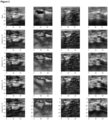
- the pixel values traverse through the digital-analog quantum circuit, and the expected value of an observable in each qubit (channel) is individually measured. These values are then stored in new images (4 new images, as 4 qubits were measured, as showed in Figure 2 ). Subsequently, these 4 new images are flattened and passed through a classical dense neural network with two fully connected hidden layers.
- the classical counterpart contains the same configuration, except that a classical convolutional layer is applied in the raw image instead of a quantum one.
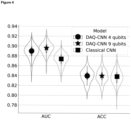
- Model performance To assess the method's performance and compare it with the results of a public benchmark, the evaluated metrics included AUC (Area Under the ROC Curve) and test accuracy (ACC).
- Figure 3 illustrates the ROC curve, and Table 1 presents the model performances. It can be observed that the method of the invention using a digital-analog quantum layer outperforms the values obtained from a benchmark available on the MedMNIST website.
- Table 1 Model AUC ACC Digital-analog quantum CNN 0.919 0.872 Classical CNN 0.831 0.871
- AUC is a more reliable metric for unbalanced data, because it takes into account both true positive and false positive rates. In unbalanced datasets, where one class may be much more prevalent than the other, accuracy can be misleading as a classifier that simply predicts the majority class may appear to have high accuracy.
- AUC assesses the method's ability to distinguish between classes, even in imbalanced situations, making it a more robust and informative metric in such circumstances.
- the Table 2 displays the best ACC and AUC results following a search for optimal hyperparameters, employing a known grid search technique.
- the hyperparameters considered in the search included: activation function, learning rate, and dropout.
- Table 2 Model AUC ACC 2x2 kernel, single circuit, measuring all qubits 0.909 0.891 2x2 kernel, 4 circuits, measuring all qubits 0.919 0.872 2x2 kernel, 4 circuits, measuring a single qubit 0.921 0.858 3x3 kernel, single circuit, measuring all qubits 0.912 0.878 3x3 kernel, 4 circuits, measuring all qubits 0.927 0.877 3x3 kernel, 4 circuits, measuring a single qubit 0.902 0.853
Landscapes
- Engineering & Computer Science (AREA)
- Theoretical Computer Science (AREA)
- Physics & Mathematics (AREA)
- General Physics & Mathematics (AREA)
- Evolutionary Computation (AREA)
- Artificial Intelligence (AREA)
- Computing Systems (AREA)
- Software Systems (AREA)
- Health & Medical Sciences (AREA)
- General Health & Medical Sciences (AREA)
- Mathematical Physics (AREA)
- Data Mining & Analysis (AREA)
- General Engineering & Computer Science (AREA)
- Life Sciences & Earth Sciences (AREA)
- Databases & Information Systems (AREA)
- Multimedia (AREA)
- Molecular Biology (AREA)
- Medical Informatics (AREA)
- Computational Linguistics (AREA)
- Biophysics (AREA)
- Biomedical Technology (AREA)
- Computer Vision & Pattern Recognition (AREA)
- Condensed Matter Physics & Semiconductors (AREA)
- Pure & Applied Mathematics (AREA)
- Mathematical Optimization (AREA)
- Mathematical Analysis (AREA)
- Computational Mathematics (AREA)
- Image Analysis (AREA)
Priority Applications (2)
| Application Number | Priority Date | Filing Date | Title |
|---|---|---|---|
| EP24217619.6A EP4567672A1 (fr) | 2023-12-06 | 2024-12-04 | Convolutions analogiques numériques quantiques pour classification d'images |
| PCT/EP2024/084954 WO2025120102A1 (fr) | 2023-12-06 | 2024-12-05 | Convolutions numériques-analogiques quantiques pour classification d'image |
Applications Claiming Priority (1)
| Application Number | Priority Date | Filing Date | Title |
|---|---|---|---|
| EP23214623 | 2023-12-06 |
Publications (1)
| Publication Number | Publication Date |
|---|---|
| EP4567671A1 true EP4567671A1 (fr) | 2025-06-11 |
Family
ID=89122107
Family Applications (1)
| Application Number | Title | Priority Date | Filing Date |
|---|---|---|---|
| EP24171385.8A Pending EP4567671A1 (fr) | 2023-12-06 | 2024-04-19 | Convolutions analogiques numériques quantiques pour classification d'images |
Country Status (1)
| Country | Link |
|---|---|
| EP (1) | EP4567671A1 (fr) |
-
2024
- 2024-04-19 EP EP24171385.8A patent/EP4567671A1/fr active Pending
Non-Patent Citations (4)
| Title |
|---|
| ANTON SIMEN ET AL: "Digital-analog quantum convolutional neural networks for image classification", ARXIV.ORG, CORNELL UNIVERSITY LIBRARY, 201 OLIN LIBRARY CORNELL UNIVERSITY ITHACA, NY 14853, 1 May 2024 (2024-05-01), XP091744353 * |
| ESSAM H HOUSSEIN ET AL: "Hybrid quantum convolutional neural networks model for COVID-19 prediction using chest X-Ray images", ARXIV.ORG, CORNELL UNIVERSITY LIBRARY, 201 OLIN LIBRARY CORNELL UNIVERSITY ITHACA, NY 14853, 8 February 2021 (2021-02-08), XP081884479 * |
| MATIC ANDREA ET AL: "Quantum-classical convolutional neural networks in radiological image classification", 2022 IEEE INTERNATIONAL CONFERENCE ON QUANTUM COMPUTING AND ENGINEERING (QCE), IEEE, 18 September 2022 (2022-09-18), pages 56 - 66, XP034231965, DOI: 10.1109/QCE53715.2022.00024 * |
| MAXWELL HENDERSON ET AL: "Quanvolutional Neural Networks: Powering Image Recognition with Quantum Circuits", ARXIV.ORG, CORNELL UNIVERSITY LIBRARY, 201 OLIN LIBRARY CORNELL UNIVERSITY ITHACA, NY 14853, 9 April 2019 (2019-04-09), XP081167154 * |
Similar Documents
| Publication | Publication Date | Title |
|---|---|---|
| Sajjan et al. | Quantum machine learning for chemistry and physics | |
| Kerenidis et al. | Quantum algorithms for deep convolutional neural networks | |
| Alam et al. | Quantum-classical hybrid machine learning for image classification (iccad special session paper) | |
| Carleo et al. | Machine learning and the physical sciences | |
| Ovalle-Magallanes et al. | Quantum angle encoding with learnable rotation applied to quantum–classical convolutional neural networks | |
| Kulkarni et al. | Quantum computing methods for supervised learning | |
| JP2024132890A (ja) | 画像を分類するためのハイブリッド量子古典分類システムおよび訓練方法 | |
| Meedinti et al. | A quantum convolutional neural network approach for object detection and classification | |
| Bai et al. | Superposition-enhanced quantum neural network for multi-class image classification | |
| Pande | A comprehensive review of data encoding techniques for quantum machine learning problems | |
| Jahin et al. | Lorentz-equivariant quantum graph neural network for high-energy physics | |
| Yin | Quantum support vector machines: theory and applications | |
| Kashyap et al. | Quantum convolutional neural network architecture for multi-class classification | |
| Hammad et al. | Quantum similarity learning for anomaly detection | |
| Wu et al. | A multi-topology quantum convolutional neural network with qubit-measurement attention for image classification | |
| Golchha et al. | A deep learning model for multiclass image classification using quantum CNN | |
| Bengio | On the challenge of learning complex functions | |
| Zhang et al. | Hybrid quantum convolutional neural network for multi-channel image classification | |
| Evans et al. | A quick introduction to quantum machine learning for non-practitioners | |
| EP4567671A1 (fr) | Convolutions analogiques numériques quantiques pour classification d'images | |
| Ahmed | Pattern recognition with Quantum Support Vector Machine (QSVM) on near term quantum processors. | |
| EP4567672A1 (fr) | Convolutions analogiques numériques quantiques pour classification d'images | |
| Kim | Hybrid quantum-classical machine learning for dementia detection | |
| Ali et al. | Mnist fashion classification using quantum convolutional neural networks | |
| Guruprakash et al. | OPTIMIZING QUANTUM-ENHANCED DILATED CONVOLUTIONAL NETWORKS FOR SCALABLE AND EFFICIENT QUANTUM IMAGE RECOGNITION. |
Legal Events
| Date | Code | Title | Description |
|---|---|---|---|
| PUAI | Public reference made under article 153(3) epc to a published international application that has entered the european phase |
Free format text: ORIGINAL CODE: 0009012 |
|
| STAA | Information on the status of an ep patent application or granted ep patent |
Free format text: STATUS: THE APPLICATION HAS BEEN PUBLISHED |
|
| AK | Designated contracting states |
Kind code of ref document: A1 Designated state(s): AL AT BE BG CH CY CZ DE DK EE ES FI FR GB GR HR HU IE IS IT LI LT LU LV MC ME MK MT NL NO PL PT RO RS SE SI SK SM TR |
|
| STAA | Information on the status of an ep patent application or granted ep patent |
Free format text: STATUS: THE APPLICATION IS DEEMED TO BE WITHDRAWN |