EP4567701A1 - Procédé de création de chaîne de blocs, et appareil associé - Google Patents
Procédé de création de chaîne de blocs, et appareil associé Download PDFInfo
- Publication number
- EP4567701A1 EP4567701A1 EP22956059.4A EP22956059A EP4567701A1 EP 4567701 A1 EP4567701 A1 EP 4567701A1 EP 22956059 A EP22956059 A EP 22956059A EP 4567701 A1 EP4567701 A1 EP 4567701A1
- Authority
- EP
- European Patent Office
- Prior art keywords
- node
- blockchain
- capability
- information
- transaction
- Prior art date
- Legal status (The legal status is an assumption and is not a legal conclusion. Google has not performed a legal analysis and makes no representation as to the accuracy of the status listed.)
- Pending
Links
Images




Classifications
-
- H—ELECTRICITY
- H04—ELECTRIC COMMUNICATION TECHNIQUE
- H04L—TRANSMISSION OF DIGITAL INFORMATION, e.g. TELEGRAPHIC COMMUNICATION
- H04L63/00—Network architectures or network communication protocols for network security
- H04L63/20—Network architectures or network communication protocols for network security for managing network security; network security policies in general
-
- H—ELECTRICITY
- H04—ELECTRIC COMMUNICATION TECHNIQUE
- H04L—TRANSMISSION OF DIGITAL INFORMATION, e.g. TELEGRAPHIC COMMUNICATION
- H04L41/00—Arrangements for maintenance, administration or management of data switching networks, e.g. of packet switching networks
- H04L41/08—Configuration management of networks or network elements
- H04L41/0866—Checking the configuration
-
- G—PHYSICS
- G06—COMPUTING OR CALCULATING; COUNTING
- G06Q—INFORMATION AND COMMUNICATION TECHNOLOGY [ICT] SPECIALLY ADAPTED FOR ADMINISTRATIVE, COMMERCIAL, FINANCIAL, MANAGERIAL OR SUPERVISORY PURPOSES; SYSTEMS OR METHODS SPECIALLY ADAPTED FOR ADMINISTRATIVE, COMMERCIAL, FINANCIAL, MANAGERIAL OR SUPERVISORY PURPOSES, NOT OTHERWISE PROVIDED FOR
- G06Q20/00—Payment architectures, schemes or protocols
- G06Q20/04—Payment circuits
- G06Q20/06—Private payment circuits, e.g. involving electronic currency used among participants of a common payment scheme
- G06Q20/065—Private payment circuits, e.g. involving electronic currency used among participants of a common payment scheme using e-cash
-
- G—PHYSICS
- G06—COMPUTING OR CALCULATING; COUNTING
- G06Q—INFORMATION AND COMMUNICATION TECHNOLOGY [ICT] SPECIALLY ADAPTED FOR ADMINISTRATIVE, COMMERCIAL, FINANCIAL, MANAGERIAL OR SUPERVISORY PURPOSES; SYSTEMS OR METHODS SPECIALLY ADAPTED FOR ADMINISTRATIVE, COMMERCIAL, FINANCIAL, MANAGERIAL OR SUPERVISORY PURPOSES, NOT OTHERWISE PROVIDED FOR
- G06Q20/00—Payment architectures, schemes or protocols
- G06Q20/22—Payment schemes or models
- G06Q20/223—Payment schemes or models based on the use of peer-to-peer networks
-
- G—PHYSICS
- G06—COMPUTING OR CALCULATING; COUNTING
- G06Q—INFORMATION AND COMMUNICATION TECHNOLOGY [ICT] SPECIALLY ADAPTED FOR ADMINISTRATIVE, COMMERCIAL, FINANCIAL, MANAGERIAL OR SUPERVISORY PURPOSES; SYSTEMS OR METHODS SPECIALLY ADAPTED FOR ADMINISTRATIVE, COMMERCIAL, FINANCIAL, MANAGERIAL OR SUPERVISORY PURPOSES, NOT OTHERWISE PROVIDED FOR
- G06Q20/00—Payment architectures, schemes or protocols
- G06Q20/30—Payment architectures, schemes or protocols characterised by the use of specific devices or networks
- G06Q20/36—Payment architectures, schemes or protocols characterised by the use of specific devices or networks using electronic wallets or electronic money safes
- G06Q20/367—Payment architectures, schemes or protocols characterised by the use of specific devices or networks using electronic wallets or electronic money safes involving electronic purses or money safes
- G06Q20/3678—Payment architectures, schemes or protocols characterised by the use of specific devices or networks using electronic wallets or electronic money safes involving electronic purses or money safes e-cash details, e.g. blinded, divisible or detecting double spending
-
- G—PHYSICS
- G06—COMPUTING OR CALCULATING; COUNTING
- G06Q—INFORMATION AND COMMUNICATION TECHNOLOGY [ICT] SPECIALLY ADAPTED FOR ADMINISTRATIVE, COMMERCIAL, FINANCIAL, MANAGERIAL OR SUPERVISORY PURPOSES; SYSTEMS OR METHODS SPECIALLY ADAPTED FOR ADMINISTRATIVE, COMMERCIAL, FINANCIAL, MANAGERIAL OR SUPERVISORY PURPOSES, NOT OTHERWISE PROVIDED FOR
- G06Q20/00—Payment architectures, schemes or protocols
- G06Q20/38—Payment protocols; Details thereof
- G06Q20/382—Payment protocols; Details thereof insuring higher security of transaction
-
- G—PHYSICS
- G06—COMPUTING OR CALCULATING; COUNTING
- G06Q—INFORMATION AND COMMUNICATION TECHNOLOGY [ICT] SPECIALLY ADAPTED FOR ADMINISTRATIVE, COMMERCIAL, FINANCIAL, MANAGERIAL OR SUPERVISORY PURPOSES; SYSTEMS OR METHODS SPECIALLY ADAPTED FOR ADMINISTRATIVE, COMMERCIAL, FINANCIAL, MANAGERIAL OR SUPERVISORY PURPOSES, NOT OTHERWISE PROVIDED FOR
- G06Q20/00—Payment architectures, schemes or protocols
- G06Q20/38—Payment protocols; Details thereof
- G06Q20/382—Payment protocols; Details thereof insuring higher security of transaction
- G06Q20/3827—Use of message hashing
-
- G—PHYSICS
- G06—COMPUTING OR CALCULATING; COUNTING
- G06Q—INFORMATION AND COMMUNICATION TECHNOLOGY [ICT] SPECIALLY ADAPTED FOR ADMINISTRATIVE, COMMERCIAL, FINANCIAL, MANAGERIAL OR SUPERVISORY PURPOSES; SYSTEMS OR METHODS SPECIALLY ADAPTED FOR ADMINISTRATIVE, COMMERCIAL, FINANCIAL, MANAGERIAL OR SUPERVISORY PURPOSES, NOT OTHERWISE PROVIDED FOR
- G06Q20/00—Payment architectures, schemes or protocols
- G06Q20/38—Payment protocols; Details thereof
- G06Q20/382—Payment protocols; Details thereof insuring higher security of transaction
- G06Q20/3829—Payment protocols; Details thereof insuring higher security of transaction involving key management
-
- G—PHYSICS
- G06—COMPUTING OR CALCULATING; COUNTING
- G06Q—INFORMATION AND COMMUNICATION TECHNOLOGY [ICT] SPECIALLY ADAPTED FOR ADMINISTRATIVE, COMMERCIAL, FINANCIAL, MANAGERIAL OR SUPERVISORY PURPOSES; SYSTEMS OR METHODS SPECIALLY ADAPTED FOR ADMINISTRATIVE, COMMERCIAL, FINANCIAL, MANAGERIAL OR SUPERVISORY PURPOSES, NOT OTHERWISE PROVIDED FOR
- G06Q20/00—Payment architectures, schemes or protocols
- G06Q20/38—Payment protocols; Details thereof
- G06Q20/389—Keeping log of transactions for guaranteeing non-repudiation of a transaction
-
- G—PHYSICS
- G06—COMPUTING OR CALCULATING; COUNTING
- G06Q—INFORMATION AND COMMUNICATION TECHNOLOGY [ICT] SPECIALLY ADAPTED FOR ADMINISTRATIVE, COMMERCIAL, FINANCIAL, MANAGERIAL OR SUPERVISORY PURPOSES; SYSTEMS OR METHODS SPECIALLY ADAPTED FOR ADMINISTRATIVE, COMMERCIAL, FINANCIAL, MANAGERIAL OR SUPERVISORY PURPOSES, NOT OTHERWISE PROVIDED FOR
- G06Q20/00—Payment architectures, schemes or protocols
- G06Q20/38—Payment protocols; Details thereof
- G06Q20/40—Authorisation, e.g. identification of payer or payee, verification of customer or shop credentials; Review and approval of payers, e.g. check credit lines or negative lists
- G06Q20/401—Transaction verification
-
- H—ELECTRICITY
- H04—ELECTRIC COMMUNICATION TECHNIQUE
- H04L—TRANSMISSION OF DIGITAL INFORMATION, e.g. TELEGRAPHIC COMMUNICATION
- H04L63/00—Network architectures or network communication protocols for network security
- H04L63/20—Network architectures or network communication protocols for network security for managing network security; network security policies in general
- H04L63/205—Network architectures or network communication protocols for network security for managing network security; network security policies in general involving negotiation or determination of the one or more network security mechanisms to be used, e.g. by negotiation between the client and the server or between peers or by selection according to the capabilities of the entities involved
-
- H—ELECTRICITY
- H04—ELECTRIC COMMUNICATION TECHNIQUE
- H04L—TRANSMISSION OF DIGITAL INFORMATION, e.g. TELEGRAPHIC COMMUNICATION
- H04L67/00—Network arrangements or protocols for supporting network services or applications
- H04L67/34—Network arrangements or protocols for supporting network services or applications involving the movement of software or configuration parameters
-
- H—ELECTRICITY
- H04—ELECTRIC COMMUNICATION TECHNIQUE
- H04L—TRANSMISSION OF DIGITAL INFORMATION, e.g. TELEGRAPHIC COMMUNICATION
- H04L9/00—Cryptographic mechanisms or cryptographic arrangements for secret or secure communications; Network security protocols
- H04L9/32—Cryptographic mechanisms or cryptographic arrangements for secret or secure communications; Network security protocols including means for verifying the identity or authority of a user of the system or for message authentication, e.g. authorization, entity authentication, data integrity or data verification, non-repudiation, key authentication or verification of credentials
- H04L9/3236—Cryptographic mechanisms or cryptographic arrangements for secret or secure communications; Network security protocols including means for verifying the identity or authority of a user of the system or for message authentication, e.g. authorization, entity authentication, data integrity or data verification, non-repudiation, key authentication or verification of credentials using cryptographic hash functions
- H04L9/3239—Cryptographic mechanisms or cryptographic arrangements for secret or secure communications; Network security protocols including means for verifying the identity or authority of a user of the system or for message authentication, e.g. authorization, entity authentication, data integrity or data verification, non-repudiation, key authentication or verification of credentials using cryptographic hash functions involving non-keyed hash functions, e.g. modification detection codes [MDCs], MD5, SHA or RIPEMD
-
- H—ELECTRICITY
- H04—ELECTRIC COMMUNICATION TECHNIQUE
- H04L—TRANSMISSION OF DIGITAL INFORMATION, e.g. TELEGRAPHIC COMMUNICATION
- H04L9/00—Cryptographic mechanisms or cryptographic arrangements for secret or secure communications; Network security protocols
- H04L9/50—Cryptographic mechanisms or cryptographic arrangements for secret or secure communications; Network security protocols using hash chains, e.g. blockchains or hash trees
-
- H—ELECTRICITY
- H04—ELECTRIC COMMUNICATION TECHNIQUE
- H04L—TRANSMISSION OF DIGITAL INFORMATION, e.g. TELEGRAPHIC COMMUNICATION
- H04L63/00—Network architectures or network communication protocols for network security
- H04L63/12—Applying verification of the received information
- H04L63/123—Applying verification of the received information received data contents, e.g. message integrity
-
- H—ELECTRICITY
- H04—ELECTRIC COMMUNICATION TECHNIQUE
- H04W—WIRELESS COMMUNICATION NETWORKS
- H04W12/00—Security arrangements; Authentication; Protecting privacy or anonymity
- H04W12/10—Integrity
- H04W12/106—Packet or message integrity
-
- H—ELECTRICITY
- H04—ELECTRIC COMMUNICATION TECHNIQUE
- H04W—WIRELESS COMMUNICATION NETWORKS
- H04W12/00—Security arrangements; Authentication; Protecting privacy or anonymity
- H04W12/10—Integrity
- H04W12/108—Source integrity
Definitions
- This application relates to the field of communication technologies, and in particular, to a blockchain creation method and a related apparatus.
- a blockchain is a distributed ledger integrating a plurality of technologies such as a cryptography technology, a peer-to-peer (peer-to-peer, P2P) network, and a distributed database.
- a cryptography technology such as a cryptography technology, a peer-to-peer (peer-to-peer, P2P) network, and a distributed database.
- P2P peer-to-peer
- the blockchain transforms a conventional authority center and central trust into a group consensus and decentralized trust, and constructs the tamper-proof distributed ledger that is guaranteed by using the cryptography technology.
- evolution of a current blockchain is independent of network evolution. That is, the current blockchain as an independent distributed storage bypasses a communication network, and cannot be combined with the communication network. In addition, the communication network cannot directly create and manage the blockchain either.
- the method further includes:
- another node (for example, the second node) having a blockchain establishment requirement may send the blockchain establishment requirement information to the LAF, to create or manage the blockchain by using the LAF.
- the blockchain establishment requirement information includes one or more of the following requirements: a blockchain structure, a block structure, a consensus mechanism, a throughput requirement, whether a blockchain supports an editing function, an access control policy for the blockchain, a quantity of first nodes, policy information, identification information of the first node, a capability of the first node, the type of the first node, a mode supported by the first node, configuration information corresponding to the first node, and whether the first node is capable of providing a trusted execution environment for running of the blockchain.
- the blockchain establishment requirement information includes the policy information; and the sending the first message to the at least one first node based on the blockchain establishment requirement information includes:
- a requirementer for example, the second node
- the second node does not need to obtain details of an infrastructure of an underlying blockchain, but directly releases a chain establishment node policy to the LAF.
- the LAF automatically identifies an underlying node satisfying the policy, to construct the blockchain. It is simpler and easier to use for the second node.
- network privacy and security are improved.
- the obtaining identification information of a network element in which the first node is located, address information of the first node, or identification information of the first node based on the policy information includes:
- the LAF after interworking with the fourth node (for example, a UDM or a PCF), the LAF obtains the related information of the node. This can be compatible with an existing communication network, and has higher applicability.
- the fourth node for example, a UDM or a PCF
- the blockchain establishment requirement information includes the identification information of the first node; and the sending the first message to the at least one first node based on the blockchain establishment requirement information includes: sending the first message to the at least one first node based on the identification information of the first node.
- the blockchain establishment requirement information directly includes an identifier of the first node, so that the requirement is clearer.
- the LAF may directly deliver the first message to the first node without performing excessive processing. This helps improve blockchain creation or management efficiency.
- the sending the first message to the at least one first node based on the identification information of the first node includes:
- an access function and a blockchain management function (namely, the LAF) of the first node in the network are separated because the access function may not only be provided for the LAF to use, but also be provided for another network element to use. Therefore, function boundaries between network elements are clearer. In addition, compatibility corresponding to a case in which the solution is applied to a 5G system is further improved.
- the obtaining the identification information of the network element in which the first node is located or the address information of the first node based on the identification information of the first node includes:
- the type of the first node is the terminal device; and the first response message includes the identification information of the first node, or the second response message includes the identification information of the network element in which the first node is located or the address information of the first node; and the fourth node is a policy control function PCF, or the fifth node is a unified data management UDM.
- the method further includes: sending a blockchain establishment result to the second node based on the first indication message from the at least one first node.
- the LAF may obtain a configuration status of the first node in real time. This helps manage a blockchain status, and can improve efficiency of responding to the requirementer of the blockchain creation.
- the sending a blockchain establishment result to the second node based on the first indication message from the at least one first node includes:
- the blockchain establishment log displays details of the configuration status of the blockchain node. This helps manage the node and obtain more detailed information to provide the more detailed information for the requirementer of the blockchain creation.
- the blockchain establishment result is the blockchain establishment success; or if the amount of configuration success information is less than a first quantity threshold, the blockchain establishment result is the blockchain establishment failure.
- the method further includes: if the amount of configuration success information is less than the first quantity threshold, reselecting a node satisfying a blockchain establishment requirement, and configuring the node to be the blockchain node.
- the method further includes: receiving blockchain capability information of a plurality of nodes, where the plurality of nodes include the at least one first node.
- the blockchain capability information of the nodes is received, which helps subsequently identify accurately the node satisfying the blockchain establishment requirement.
- the method further includes:
- the sixth node may be a UDM, or the sixth node may be a newly designed network element, for example, a UTDM. This is not limited herein.
- the sixth node is the UDM, compatibility of the solution in this application with the 5G system can be improved.
- the sixth node is the UDM, applicability of the solution in this application can be improved.
- the blockchain capability information includes a mode supported by the node, and the mode includes one or more of the following:
- the terminal device serves as a client
- the access network device serves as a micronode
- the core network element and the independent node serve as full nodes.
- a terminal device 1 serves as a client
- a terminal device 2 serves as a micronode
- the access network device and the independent node serve as full nodes.
- the terminal device serves as a client
- the application function node serves as a micronode
- the core network element and the independent node serve as full nodes.
- the node in the client mode and the node in the micronode mode include at least one of the following capabilities: a smart-contract deployment, invoking, or execution capability, a transaction reporting, querying, or execution capability, a block querying capability, a computing capability, a storage capability, a network capability, a security algorithm capability, and a trusted-execution-environment provision capability; and the node in the light-node mode and the node in the full-node mode include at least one of the following capabilities: the smart-contract deployment, invoking, or execution capability, the transaction reporting, querying, or execution capability, the block querying capability, the computing capability, the storage capability, the network capability, the security algorithm capability, the trusted-execution-environment provision capability, and a consensus capability.
- the blockchain capability information includes at least one of the following capabilities: a smart-contract deployment, invoking, or execution capability, a transaction reporting, querying, or execution capability, a block querying capability, a computing capability, a storage capability, a network capability, a security algorithm capability, a trusted-execution-environment provision capability, and a consensus capability.
- the method further includes:
- this application provides a blockchain creation method.
- the method includes: A first node receives a first message, where the first message is for configuring the first node to be a blockchain node, a type of the first node includes at least one of the following: a terminal device, an access network device, a core network element, an independent node, an application function node, and an edge network node, and the terminal device, the access network device, the core network element, the independent node, the application function node, and the edge network node are nodes having a blockchain capability in a communication network.
- the first node sends a first indication message, where the first indication message indicates whether the first node is successfully configured.
- the method further includes: The first node sends blockchain capability information.
- the blockchain capability information includes a mode supported by the node, and the mode includes one or more of the following:
- the node in the client mode and the node in the micronode mode include at least one of the following capabilities: a smart-contract deployment, invoking, or execution capability, a transaction reporting, querying, or execution capability, a block querying capability, a computing capability, a storage capability, a network capability, a security algorithm capability, and a trusted-execution-environment provision capability; and the node in the light-node mode and the node in the full-node mode include at least one of the following capabilities: the smart-contract deployment, invoking, or execution capability, the transaction reporting, querying, or execution capability, the block querying capability, the computing capability, the storage capability, the network capability, the security algorithm capability, the trusted-execution-environment provision capability, and a consensus capability.
- the blockchain capability information includes at least one of the following capabilities: a smart-contract deployment, invoking, or execution capability, a transaction reporting, querying, or execution capability, a block querying capability, a computing capability, a storage capability, a network capability, a security algorithm capability, a trusted-execution-environment provision capability, and a consensus capability.
- the first indication message indicates that the first node is successfully configured; and the method further includes:
- this application provides a blockchain creation method.
- the method includes: A second node determines blockchain establishment requirement information.
- the second node sends the blockchain establishment requirement information.
- the fourth node stores the blockchain capability information of the plurality of nodes, where the blockchain capability information is for a ledger anchor function to determine the at least one first node.
- the processing unit when obtaining the identification information of the network element in which the first node is located or the address information of the first node based on the identification information of the first node, the processing unit is configured to:
- the apparatus further includes a storage unit.
- the storage unit or the transceiver unit is configured to:
- the blockchain capability information includes a mode supported by the node, and the mode includes one or more of the following:
- the node in the client mode and the node in the micronode mode include at least one of the following capabilities: a smart-contract deployment, invoking, or execution capability, a transaction reporting, querying, or execution capability, a block querying capability, a computing capability, a storage capability, a network capability, a security algorithm capability, and a trusted-execution-environment provision capability; and the node in the light-node mode and the node in the full-node mode include at least one of the following capabilities: the smart-contract deployment, invoking, or execution capability, the transaction reporting, querying, or execution capability, the block querying capability, the computing capability, the storage capability, the network capability, the security algorithm capability, the trusted-execution-environment provision capability, and a consensus capability.
- the blockchain capability information includes at least one of the following capabilities: a smart-contract deployment, invoking, or execution capability, a transaction reporting, querying, or execution capability, a block querying capability, a computing capability, a storage capability, a network capability, a security algorithm capability, a trusted-execution-environment provision capability, and a consensus capability.
- the transceiver unit is further configured to:
- this application provides a communication apparatus.
- the apparatus is a first node, and the apparatus includes:
- the transceiver unit is further configured to: send blockchain capability information.
- the blockchain capability information includes a mode supported by the node, and the mode includes one or more of the following:
- the node in the client mode and the node in the micronode mode include at least one of the following capabilities: a smart-contract deployment, invoking, or execution capability, a transaction reporting, querying, or execution capability, a block querying capability, a computing capability, a storage capability, a network capability, a security algorithm capability, and a trusted-execution-environment provision capability; and the node in the light-node mode and the node in the full-node mode include at least one of the following capabilities: the smart-contract deployment, invoking, or execution capability, the transaction reporting, querying, or execution capability, the block querying capability, the computing capability, the storage capability, the network capability, the security algorithm capability, the trusted-execution-environment provision capability, and a consensus capability.
- the blockchain capability information includes at least one of the following capabilities: a smait-contract deployment, invoking, or execution capability, a transaction reporting, querying, or execution capability, a block querying capability, a computing capability, a storage capability, a network capability, a security algorithm capability, a trusted-execution-environment provision capability, and a consensus capability.
- the first indication message indicates that the first node is successfully configured; and the transceiver unit is further configured to:
- this application provides a communication apparatus.
- the apparatus is a second node, and the apparatus includes:
- the blockchain establishment requirement information includes one or more of the following requirements: a blockchain structure, a block structure, a consensus mechanism, a throughput requirement, whether a blockchain supports an editing function, an access control policy for the blockchain, a quantity of first nodes, policy information, identification information of the first node, a capability of the first node, a type of the first node, a mode supported by the first node, configuration information corresponding to the first node, and whether the first node is capable of providing a trusted execution environment for running of the blockchain.
- the type of the first node includes at least one of the following:
- the transceiver unit is further configured to:
- the blockchain establishment result includes a blockchain establishment success or a blockchain establishment failure.
- the mode includes one or more of the following:
- the node in the client mode and the node in the micronode mode include at least one of the following capabilities: a smart-contract deployment, invoking, or execution capability, a transaction reporting, querying, or execution capability, a block querying capability, a computing capability, a storage capability, a network capability, a security algorithm capability, and a trusted-execution-environment provision capability; and the node in the light-node mode and the node in the full-node mode include at least one of the following capabilities: the smart-contract deployment, invoking, or execution capability, the transaction reporting, querying, or execution capability, the block querying capability, the computing capability, the storage capability, the network capability, the security algorithm capability, the trusted-execution-environment provision capability, and a consensus capability.
- this application provides a communication apparatus.
- the apparatus is a fourth node, and the apparatus includes:
- the network element in which the first node is located is an access and mobility management function AMF.
- the type of the first node is the terminal device
- the first query request includes the policy information
- the first response message includes the identification information of the first node
- the fourth node is a policy control function PCF.
- the type of the first node is the terminal device
- the first query request includes the identification information of the first node
- the first response message includes the identification information of the network element in which the first node is located or the address information of the first node
- the fourth node is a unified data management UDM.
- the first response message includes the identification information of the network element in which the first node is located or the address information of the first node;
- the apparatus further includes a storage unit.
- the storage unit is configured to store the blockchain capability information of the plurality of nodes, where the blockchain capability information is for a ledger anchor function to determine the at least one first node.
- this application provides a communication apparatus.
- the apparatus may be a LAF.
- the LAF may be an access network device, a core network element, or another device, may be an apparatus in the access network device, the core network element, or the another device, or may be an apparatus that can be used together with the access network device, the core network element, or the another device.
- the communication apparatus may alternatively be a chip system.
- the communication apparatus may perform the method according to the first aspect.
- a function of the communication apparatus may be implemented by using hardware, or may be implemented by the hardware executing corresponding software.
- the hardware or the software includes one or more units or modules corresponding to the foregoing function.
- the unit or the module may be software and/or hardware.
- this application provides a communication apparatus.
- the apparatus may be a first node (for example, the first node may be a terminal device, an access network device, a core network element, an independent node, an application function node, or an edge network node), may be an apparatus in the first node, or may be an apparatus that can be used together with the first node.
- the communication apparatus may alternatively be a chip system.
- the communication apparatus may perform the method according to the second aspect.
- a function of the communication apparatus may be implemented by using hardware, or may be implemented by the hardware executing corresponding software.
- the hardware or the software includes one or more units or modules corresponding to the foregoing function.
- the unit or the module may be software and/or hardware.
- this application provides a communication apparatus.
- the apparatus may be a fourth node, may be an apparatus in the fourth node, or may be an apparatus that can be used together with the fourth node.
- the communication apparatus may alternatively be a chip system.
- the communication apparatus may perform the method according to the fourth aspect.
- a function of the communication apparatus may be implemented by using hardware, or may be implemented by the hardware executing corresponding software.
- the hardware or the software includes one or more units or modules corresponding to the foregoing function.
- the unit or the module may be software and/or hardware.
- this application provides a communication apparatus.
- the apparatus may be a LAF.
- the LAF may be an access network device, a core network element, or another device.
- the communication apparatus includes a processor and a transceiver.
- the processor and the transceiver are configured to execute a computer program or instructions stored in at least one memory, so that the apparatus implements the method according to any one of the implementations of the first aspect.
- the communication apparatus may further include the memory.
- the processor, the transceiver, and the memory are coupled.
- this application provides a communication apparatus.
- the apparatus may be a first node (for example, the first node may be a terminal device, an access network device, a core network element, an independent node, an application function node, or an edge network node).
- the communication apparatus includes a processor and a transceiver.
- the processor and the transceiver are configured to execute a computer program or instructions stored in at least one memory, so that the apparatus implements the method according to any one of the implementations of the second aspect.
- the communication apparatus further includes the memory.
- the processor, the transceiver, and the memory are coupled.
- this application provides a communication apparatus.
- the apparatus may be a second node.
- the communication apparatus includes a processor and a transceiver.
- the processor and the transceiver are configured to execute a computer program or instructions stored in at least one memory, so that the apparatus implements the method according to any one of the implementations of the third aspect.
- the communication apparatus further includes the memory.
- the processor, the transceiver, and the memory are coupled.
- this application provides a communication apparatus.
- the apparatus may be a core network element (for example, a fourth node, a fifth node, or a sixth node).
- the communication apparatus includes a processor and a transceiver.
- the processor and the transceiver are configured to execute a computer program or instructions stored in at least one memory, so that the apparatus implements the method according to any one of the implementations of the fourth aspect.
- the communication apparatus further includes the memory.
- the processor, the transceiver, and the memory are coupled.
- this application provides a computer-readable storage medium.
- the storage medium stores a computer program or instructions.
- the computer program or the instructions are executed by a computer, the method according to any one of the first aspect to the sixth aspect is implemented.
- this application provides a computer program product including instructions.
- the computer program product includes computer program code.
- the computer program code is run on a computer, the method according to any one of the first aspect to the sixth aspect is implemented.
- a communication system includes a LAF and at least one first node.
- the at least one first node sends a first indication message to the LAF, where the first indication message indicates whether the first node for sending the first indication information is successfully configured.
- the communication system further includes a second node, where
- the blockchain establishment requirement information includes one or more of the following requirements: a blockchain structure, a block structure, a consensus mechanism, a throughput requirement, whether a blockchain supports an editing function, an access control policy for the blockchain, a quantity of first nodes, policy information, identification information of the first node, a capability of the first node, the type of the first node, a mode supported by the first node, configuration information corresponding to the first node, and whether the first node is capable of providing a trusted execution environment for running of the blockchain.
- the blockchain establishment requirement information includes the policy information or the identification information of the first node
- the communication system further includes a fourth node; and that the LAF is configured to send the first message to the at least one first node based on the blockchain establishment requirement information includes:
- the network element in which the first node is located is an access and mobility management function AMF.
- the type of the first node is the terminal device
- the first query request includes the policy information
- the first response message includes the identification information of the first node
- the fourth node is a policy control function PCF.
- the type of the first node is the terminal device
- the first query request includes the identification information of the first node
- the first response message includes the identification information of the network element in which the first node is located or the address information of the first node
- the fourth node is a unified data management UDM.
- the first response message includes the identification information of the network element in which the first node is located or the address information of the first node;
- the blockchain establishment result is the blockchain establishment success; or if the amount of configuration success information is less than a first quantity threshold, the blockchain establishment result is the blockchain establishment failure.
- the at least one first node is further configured to: send blockchain capability information to the LAF.
- the LAF is further configured to store the blockchain capability information
- the blockchain capability information includes a mode supported by the node, and the mode includes one or more of the following:
- the blockchain capability information includes at least one of the following capabilities: a smart-contract deployment, invoking, or execution capability, a transaction reporting, querying, or execution capability, a block querying capability, a computing capability, a storage capability, a network capability, a security algorithm capability, a trusted-execution-environment provision capability, and a consensus capability.
- the LAF is configured to send a second message to a third node, where the third node is a successfully configured node in the at least one first node, and the second message is for canceling the third node serving as the blockchain node; and the third node is configured to send a second indication message to the LAF, where the second indication message indicates whether the third node is successfully canceled.
- "at least one” means one or more, "a plurality of” means two or more, “at least two” means two or three or more.
- “And/or” is for describing an association relationship between associated objects, and indicates that three relationships may exist. For example, “A and/or B” may indicate the following three cases: Only A exists, only B exists, and both A and B exist, where A and B may be singular or plural. The character “/” usually indicates an "or” relationship between the associated objects. "At least one of the following” or a similar expression thereof indicates any combination of these items, including a single item or any combination of a plurality of items.
- LTE long term evolution
- FDD frequency division duplex
- TDD time division duplex
- 5th generation 5th generation
- 5G new radio
- 6th generation 6th generation
- WLAN wireless Local Area Network
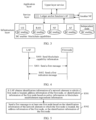
- FIG. 1 is a diagram of an architecture of a communication system.
- a terminal device may access a wireless network to communicate with another device through the wireless network.
- the terminal device may communicate with another terminal device.
- the wireless network includes a (radio) access network ((radio) access network, (R)AN) and a core network (core network, CN).
- the (R)AN (described as a RAN below) is for enabling the terminal device to access the wireless network
- the CN is for managing the terminal device.
- the terminal device includes a device that provides voice and/or data connectivity for a user.
- the terminal device is a device that has a wireless transceiver function, and may be deployed on land, where the deployment includes indoor, outdoor, handheld, wearable, or vehicle-mounted deployment; may be deployed on water (for example, on a ship); or may be deployed in the air (for example, on an airplane, a balloon, or a satellite).
- the RAN may include one or more RAN devices (in other words, access network devices), and an interface between the access network device and the terminal device may be a Uu interface (also referred to as an air interface).
- RAN devices in other words, access network devices
- Uu interface also referred to as an air interface
- FIG. 2 is a diagram of an architecture of another communication system.
- the communication system is a system architecture in a 5G non-roaming scenario.
- the communication system includes the following network functions and entities: a network slice selection function (network slice selection function, NSSF), a network exposure function (network exposure function, NEF), a network repository function (network function repository function, NRF), a policy control function (policy control function, PCF), a unified data management (unified data management, UDM), an application function (application function, AF), an authentication server function (authentication server function, AUSF), an access and mobility management function (access and mobility management function, AMF), a session management function (session management function, SMF), UE, and a (radio) access network ((radio) access network, (R)AN), a user plane function (user plane function, UPF), and a data network (data network, DN).
- a network slice selection function network slice selection function
- NEF network exposure function
- NRF network repository function
- the CN may further include another possible network element, for example, a service communication proxy (service communication proxy, SCP), a network slice admission control function (network slice admission control function, NSACF) network element, or a unified data repository (unified data repository, UDR) network element.
- SCP service communication proxy
- NSACF network slice admission control function
- UDR unified data repository
- function network elements may have names of the function network elements shown in FIG. 2 .
- function network elements may still have the names of the function network elements shown in FIG. 2 , or may have other names.
- the policy control network element may be the PCF.
- the policy control function may still be the PCF, or may have another name. This is not limited in this application.
- Nnssf is a service-oriented interface provided by the NSSF
- Nnef is a service-oriented interface provided by the NEF
- Nnrf is a service-oriented interface provided by the NRF
- Npcf is a service-oriented interface provided by the PCF
- Nudm is a service-oriented interface provided by the UDM
- Naf is a service-oriented interface provided by the AF
- Nausf is a service-oriented interface provided by the AUSF
- Namf is a service-oriented interface provided by the AMF
- Nsmf is a service-oriented interface provided by the SMF
- N1 is a reference point between the UE and the AMF
- N2 is a reference point between the (R)AN and the AMF
- N3 is a reference point between the (R)AN and the UPF
- N4 is a reference point between the SMF and the UPF
- N6 is a reference point between the UPF and the DN
- N9 is a reference
- Nnssf, Nnef, Nnrf, Npcf, Nudm, Naf, Nausf, Namf, Nsmf, N1, N2, N3, N4, N6, and N9 in FIG. 2 refer to meanings defined in a related standard protocol. This is not limited herein.
- the communication systems (for example, the communication systems shown in FIG. 1 and FIG. 2 ) described in embodiments of this application may also be described as telecommunications networks, communication networks, or the like. This is not limited herein.
- a name of a network element or a node in this application may also be referred to as another name. This is not limited herein.
- a new network element or a newly designed network element described in this application may be an entirely new network element, may be an extension, update, addition, or the like of a function of an existing network element, or may be a combination, integration, or the like of functions of a plurality of existing network elements. This is not limited herein.
- a fourth node, a fifth node, and a sixth node described in embodiments of this application may be same network elements, or may be different network elements. This is specifically determined based on an actual scenario, and is not limited herein.
- the fourth node and the fifth node are different network elements.
- the fourth node may be a PCF
- the fifth node may be a UDM.
- the fourth node, the fifth node, and the sixth node may be the same network elements, for example, OAMs.
- the fourth node, the fifth node, and the sixth node may be the same network elements, for example, NRFs.
- the fourth node, the fifth node, and the sixth node may be the same network elements, for example, NEFs.
- the node in embodiments of this application may be a device, a chip, a network function, or the like. This is not limited herein.
- the ledger is a technology for sharing, replicating, or synchronizing data between nodes by using a consensus mechanism.
- a blockchain (blockchain, BC) is one of ledger technologies. Based on the ledger, a tamper-proof technology guaranteed by using a cryptography mechanism is further added in the blockchain.
- a blockchain node may run on a physical node, or may run in a virtual environment of the physical node.
- the physical node herein is the first node in this application. It may be understood that, in addition to being applicable to blockchain creation, this application may further be extended to ledger creation. Alternatively, another name subsequently replaces the two names: the blockchain and the ledger. This is not limited herein.
- the LAF in this application may be a new NF in a core network (that is, deployed in the core network), the LAF may be deployed in a RAN, or the LAF may be deployed in a network element or a device beyond the core network and the RAN.
- the LAF may be configured to perform blockchain-related work in a telecommunications network.
- the LAF is responsible for management of a life cycle of the blockchain, where the management includes, for example, blockchain deployment and access control.
- a network element configured to perform the blockchain-related work in the telecommunications network may alternatively not be limited to being named the LAF, or may have another name. This is specifically determined based on an actual scenario, and is not limited herein.
- the LAF may alternatively be a device, a chip, or the like. This is not limited herein.
- the INN in this application is a node that is deployed in a communication network and that has a blockchain capability.
- the independent node is a node that may be deployed at any location in the telecommunications network and that has the blockchain capability.
- the independent node complies with a protocol stack of the telecommunications network, and accepts unified management and scheduling performed by the telecommunications network, but is not bound to a communication node, for example, a terminal device, an access network device, or a core network device, in form.
- the node that may be deployed at the any location in the telecommunications network and that has the blockchain capability may alternatively not be limited to being named a LAF, or may have another name. This is specifically determined based on an actual scenario, and is not limited herein. For ease of description, the following mainly uses the independent node as an example for description.
- the independent node when the independent node is deployed in the terminal device, the independent node complies with a protocol stack of the terminal device; when the independent node is deployed in the RAN, the independent node complies with a protocol stack of the RAN; or when the independent node is deployed in the core network, the independent node complies with a protocol stack of an NF.
- the independent node may alternatively be a software-hardware integrated server designed for a blockchain technology, namely, a blockchain all-in-one machine.
- an independent node deployed in the RAN may be started when a blockchain node integrated into the RAN cannot satisfy a performance requirement, where the independent node complies with a protocol stack of the RAN to perform communication, and may provide a high-performance blockchain capability.
- a node corresponding to an AF is the AF node.
- the AF node in this application is a node having a blockchain capability. It may be understood that an objective of interaction between the AF and a 5G core network is to provide a service. According to an operator deployment policy, a trusted AF may directly access an internal network function of the 5G core network to improve service processing efficiency, or may exchange information with the corresponding internal network function via a NEF.
- the blockchain node in addition to being deployed in an internal network element in the telecommunications network, the blockchain node may further be extended to the AF, to be applicable to a scenario in which participation of the AF is needed.
- the edge network node is a node used in edge computing.
- the edge computing is computing performed at or near a physical location of a user or a data source, so that a delay can be reduced, and bandwidth can be saved.
- the edge network node belongs to the communication network.
- the blockchain structure includes a single chain, a parallel chain, a shard, a directed acyclic graph (directed acyclic graph, DAG), and the like. This is not limited herein.
- the block structure is content and a data structure inside a block.
- the consensus mechanism refers to a process of agreeing on a network/data/transaction status in a decentralized manner, and is also referred to as the consensus algorithm.
- the consensus mechanism includes a proof-of-work (proof-of-work, PoW) mechanism, a proof-of-stake (proof-of-stake, PoS) mechanism, delegated proof of stake (delegated proof of stake, DPOS), reliable, replicated, redundant, and fault-tolerant (reliable, replicated, redundant, and fault-tolerant, RAFT), practical Byzantine fault tolerance (practical byzantine fault tolerance, PBFT), and the like. This is not limited herein.
- TEE Trusted execution environment
- the TEE is a secure area constructed in a central processing unit by using a software-hardware method, to ensure that a program and data loaded in the TEE are protected in terms of confidentiality and integrity.
- the access control policy for the blockchain includes LAF authorization, LAF access control, LAF transparent transmission, and LAF proxy.
- LAF access control The LAF performs access control. For example, the LAF directly verifies A, and A may directly access the blockchain after the verification succeeds. The LAF performs verification at each time of request.
- LAF transparent transmission The LAF performs transparent transmission of an access request, and a ledger node performs access control. For example, the LAF does not perform processing, and directly forwards a request of A to the blockchain, and the blockchain node performs access control.
- LAF proxy The LAF performs a proxy service, and provides access data. For example, A submits the request to the LAF. After verification performed by the LAF succeeds, the LAF obtains the access data from the chain, and then replies to A with the access data.
- the configuration information corresponding to the node may be understood as a requirement configuration of the blockchain for the node to report a transaction.
- the configuration information for the node may be a configuration of a trigger condition of transaction reporting, and the trigger condition may be time-based triggering, frequency-based triggering, or condition-based triggering.
- the time-based triggering means that the transaction is generated based on a time interval, and is reported to the blockchain.
- the terminal device/a base station is configured to periodically report environment perception information, or the NF is configured to periodically report the network status.
- the frequency-based triggering means that a configuration is that information reporting is performed once every n times an event occurs, where n is an integer greater than 0.
- the condition-based triggering means reporting is performed when a condition is satisfied. For example, each time the terminal device accesses an AMF, the transaction is generated and reported. For another example, when network traffic reaches a threshold, the transaction is generated and reported.
- the mode supported by the node includes one or more of the following: a client mode, a micronode mode, a light-node mode, and a full-node mode.
- a node in client mode is configured to generate the transaction or a transaction proposal.
- the transaction proposal is transaction content pre-executed by a client. For example, A transfers CNY X to B.
- the transaction is a state that is of the client and that is after the transaction proposal is executed. For example, A and B initially correspond to CNY 10.
- a node in micronode mode is configured to preprocess the transaction or the transaction proposal, where the preprocessing the transaction or the transaction proposal includes one or more of the following: 1 verifying the transaction or the transaction proposal; 2 executing the transaction proposal to generate the transaction; and 3 generating a microblock based on the transaction.
- the verifying the transaction or the transaction proposal means verifying a signature and integrity of the transaction or the transaction proposal, and verifying transaction content.
- the microblock is a block generated in the following manner: After receiving the transaction sent by the client, the micronode verifies validity of the transaction.
- the micronode generates a transaction tree by performing Merkle processing (not necessarily the Merkle processing) on a transaction on which the verification succeeds, and generates the block by endorsing the transaction tree (the micronode signs the transaction tree).
- a node in light-node mode is configured to process the transaction, the transaction proposal, or the microblock, and the processing the transaction, the transaction proposal, or the microblock includes one or more of the following: 1 verifying the transaction or the transaction proposal; 2 executing the transaction proposal to generate the transaction; and 3 reaching a consensus on the transaction or the microblock, and generating a complete block based on the transaction or the microblock.
- the complete block is a full block generated in the following manner: A full node/light node receives the microblock sent by the micronode, does not verify a single transaction anymore, only needs to verify a result of endorsing the single transaction by the microblock, performs Merkle processing on a plurality of microblocks, and then encapsulates a plurality of microblocks obtained through the Merkle processing into one block, to generate the full block.
- a node in full-node mode includes a function of the node in the light-node mode, and is configured to store the complete block.
- the capability of the node includes one or more capabilities such as a smart-contract deployment capability, a smart-contract invoking capability, a smart-contract execution capability, a transaction reporting capability, a transaction querying capability, a transaction execution capability, a block querying capability, a computing capability, a storage capability, a network capability, a security algorithm capability, a trusted-execution-environment provision capability, and a consensus capability.
- capabilities such as a smart-contract deployment capability, a smart-contract invoking capability, a smart-contract execution capability, a transaction reporting capability, a transaction querying capability, a transaction execution capability, a block querying capability, a computing capability, a storage capability, a network capability, a security algorithm capability, a trusted-execution-environment provision capability, and a consensus capability.
- the smart-contract deployment capability means that the node can install a program of a smart contract.
- the smart-contract invoking capability means that the node can invoke the program of the smart contract.
- the smart-contract execution capability means that the node can execute the program of the smart contract, and provide a computing resource and a running environment for execution of the smart contract.
- the transaction reporting capability means that the node can generate a transaction, and send the transaction to the node, where the node may be the full node, the micronode, or the light node.
- the transaction querying capability means that the node can query the blockchain for a related transaction by using a keyword, for example, a transaction ID, a transaction hash, a transaction party ID, or transaction content.
- the transaction execution capability means that the node can execute a transaction, and obtain a status that is of a transaction party and that is after the transaction is executed.
- the block querying capability means that the node can query the blockchain for the related transaction by using a keyword, for example, a block height, a block hash, or block content.
- the block height is a sequence number of the block on the chain.
- the computing capability is a computing processing capability of the blockchain node, for example, the central processing unit (central processing unit, CPU), a graphics processing unit (graphics processing unit, GPU), or a storage status.
- the storage capability refers to a size of hard disk space.
- the security algorithm capability refers to an algorithm supported by the node.
- the trusted-execution-environment provision capability means that the node is capable of providing a trusted execution environment for deployment, invoking, and execution of the smart contract or running of the blockchain.
- the consensus capability refers to a consensus algorithm supported by the node.
- the smart contract refers to a protocol that can be for automatically executing a task that originally can be completed only manually.
- the smart contract is any protocol that can be for automatically executing some functions, for example, a contract that can be for automatically calculating an amount of money to be paid by a contracting party and arranging payment of the money.
- the blockchain may be used in a plurality of scenarios, for example: Scenario 1: The blockchain in the telecommunications network needs UE/the access network device (for example, the base station) to report information such as an environment, a key performance indicator (key performance indicator, KPI), and surveying and mapping, including: KPI indicator data information generated by various types of actual operation in a conventional network, where the KPI indicator data information is mainly collected locally by the base station, then directly reported to a local subnetwork management and database system through a private interface, and next reported to a higher-level network management and data center through hierarchical summary statistics; and the UE may report various network KPI data in real time by using the blockchain technology.
- KPI key performance indicator
- a new service needs a large amount of surveying-and-mapping data of a user.
- a sensor of a tested automobile usually captures images and information of another automobile, a pedestrian, a bicycle, a traffic sign, a traffic light, a roadside, a lane, another infrastructure, and a road landscape.
- environment humidity, an environment temperature, an environment condition, and the like are surveyed and mapped.
- the network may record and store the surveying-and-mapping data by using the blockchain.
- Scenario 2 The blockchain in the telecommunications network may alternatively be for recording various dynamic data of a network element.
- an operator has service data of the terminal, for example, user profile information (namely, information subscribed to by the user with the operator when the user accesses a network), location information, identification (Identification, ID) information, public land mobile network (public land mobile network, PLMN) information, and service information.
- the blockchain may provide personal information (for example, a trip during an epidemic) related to the user for the user to use.
- Data on the blockchain in the telecommunications network may alternatively be provided for UE, the RAN, the CN, an application function (namely, a third-party application), and the like as a service.
- an application function namely, a third-party application
- implementation of the foregoing scenarios needs the telecommunications network to have a complete management architecture and method for blockchain capabilities, and blockchain construction and deployment of various entities (for example, the UE, the RAN, and the CN) in the telecommunications network.
- evolution of a current blockchain is independent of network evolution. That is, the current blockchain bypasses the communication network as an independent distributed storage, and cannot be combined with the communication network.
- the communication network cannot directly manage and configure the blockchain either.
- embodiments of this application provide a blockchain creation method, to combine a blockchain with a communication network.
- FIG. 3 is a diagram of a blockchain architecture according to an embodiment of this application. As shown in FIG. 3 , the blockchain architecture in this application is mainly divided into three layers.
- FIG. 3 is merely an example for description.
- the blockchain architecture is not limited in this application.
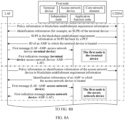
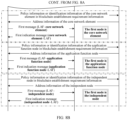
- FIG. 4 is a schematic flowchart of a blockchain creation method according to an embodiment of this application. As shown in FIG. 4 , the blockchain creation method includes the following steps S401 and S402.
- a LAF sends a first message to at least one first node.
- the LAF sends the first message to the at least one first node, where the first message is for configuring the first node to be a blockchain node, it is understood as that the first message indicates the first node to be the blockchain node, or it is as understood as that the first message is for activating the first node to be the blockchain node.
- the configuring the first node to be a blockchain node may be understood as configuring the first node to be a node in a newly established blockchain when the new blockchain is established.
- the configuring the first node to be a blockchain node may alternatively be understood as adding, based on an established blockchain, the first node to be a node in the blockchain. That is, the existing blockchain is managed or maintained.
- configuration information included in first messages corresponding to different first nodes is different.
- a first message corresponding to any first node may include configuration information for the first node.
- the configuration information may include a configuration for the first node to report a transaction.
- the configuration information is for configuring a specific transaction condition.
- some information about another communication node corresponding to the first node needs to be configured because the blockchain node needs to communicate with the another communication node. Therefore, the another communication node needs to be configured.
- a LAF sends a first message to at least one first node may be understood as that the LAF sends the first message to the at least one first node based on blockchain establishment requirement information. Understanding of that the LAF sends the first message to the at least one first node based on blockchain establishment requirement information is described in detail below. Details are not described herein.
- the blockchain establishment requirement information may be generated by the LAF. That is, when the LAF has a blockchain establishment requirement, the LAF may determine blockchain establishment requirement information of the LAF, and determine the at least one first node based on the blockchain establishment requirement information. Alternatively, the blockchain establishment requirement information may be generated and sent to the LAF by another node (for ease of description, a second node is used as an example for description subsequently). Therefore, the LAF may determine the at least one first node based on the blockchain establishment requirement information received from the second node.
- the second node herein is a node having a blockchain establishment requirement.
- the second node may be a management plane, a management node, or an administrator of an operator.
- the second node may be another service layer or a user, for example, a data service node, a vehicle-to-everything node, a vertical industry user, or a terminal user. This is not limited herein.
- the blockchain establishment requirement information includes one or more of the following requirements: a blockchain structure, a block structure, a consensus mechanism, a throughput requirement, whether a blockchain supports an editing function, an access control policy for the blockchain, a quantity of first nodes, policy information, identification information of the first node, a capability of the first node, the type of the first node, a mode supported by the first node, configuration information corresponding to the first node, and whether the first node is capable of providing a trusted execution environment for running of the blockchain.
- a capability of the any first node includes one or more of the following capabilities: a smart-contract deployment capability, a smart-contract invoking capability, a smart-contract execution capability, a transaction reporting capability, a transaction querying capability, a transaction execution capability, a block querying capability, a computing capability, a storage capability, a network capability, a security algorithm capability, a trusted-execution-environment provision capability, a consensus capability, and the like.
- a mode supported by the any first node may include a client mode, a micronode mode, a light-node mode, and a full-node mode.
- one first node supports only one mode in one blockchain; and modes supported by a same first node in different blockchains may be the same, or may be different. This is not limited herein.
- the quantity of first nodes may be understood as a total quantity of first nodes included in the blockchain, the quantity of first nodes may be understood as a minimum quantity of first nodes that need to be included in the blockchain, or the like. This is not limited herein.
- the policy information may be understood as information for determining the blockchain node. That is, a first node corresponding to an identifier is not directly specified, and there are some condition constraints.
- the condition constraints may be for determining the first node.
- policy information of the terminal device may be: 1. a terminal device satisfying performance in a registration phase, for example, a terminal device having the trusted execution environment; 2. a terminal device currently connected to a base station, for example, a terminal device currently connected to a base station whose ID is 1101100100111111; or 3. a terminal device having a fixed location for long time, for example, a terminal device connected, for the long time, to a base station whose ID is 1101100100111111. Examples are not used one by one herein.
- policy information of the access network device may be: 1. location information of the access network device, for example, an access network device located in a cell in an area; or 2. security and computing capabilities of the access network device, for example, an access network device having the trusted execution environment and a CPU 4-core computing capability. Examples are not used one by one herein.
- policy information of the core network element may be a core network element related to a service, for example, a network element that manages mobility; or for another example, a network element whose current traffic is idle.
- policy information of the independent node may be an independent node satisfying some performance requirements, for example, a CPU 64-core independent node, an independent node with a primary storage of 100 G, or an independent node with a gigabit network interface. Examples are not used one by one herein.
- policy information of the application function node may be an application function node satisfying some performance requirements, for example, a CPU 64-core application function node, an application function node with a primary storage of 100 G, or an application function node with a gigabit network interface. Examples are not used one by one herein.
- Table 1 shows a specific example of the blockchain establishment requirement information provided in this embodiment of this application.
- the blockchain establishment requirement information may include one or more items in Table 1.
- a 1 st column indicates a requirement parameter, namely, each requirement in the blockchain establishment requirement information
- a 2 nd column indicates parameter details, namely, a detailed configuration for a corresponding requirement
- a 3 rd column indicates a parameter description, namely, a specific description of a meaning of the requirement parameter.
- Table 1 Requirement parameter Parameter details Parameter description Identification information of the first node ID 1, ID 2, ID 3, ... IDs of nodes participating in the blockchain Blockchain structure Single chain, parallel chain, shard, DAG, ...
- the terminal device satisfying performance in a registration phase 2. the terminal device currently connected to a base station; and 3. the terminal device having a fixed location for long time Terminal device supporting the client mode SUPI 7, SUPI 8, ...; or Explicitly indicate: ID information of terminal devices supporting the client mode; or policy information 1-7, policy information 1-8, ... policy information of terminal devices supporting the client mode, for example, 1. the terminal device satisfying performance in a registration phase; 2. the terminal device currently connected to a base station; and 3.
- the terminal device having a fixed location for long time Whether the access network device participates 0/1 Whether the access network device participates in the blockchain 0: no/1: yes (or 0 indicates yes, and 1 indicates no) Whether the access network device can provide the trusted execution environment for the running of the blockchain 0/1 0: no/1: yes (or 0 indicates no, and 1 indicates yes)
- the security and computing capabilities of the access network device Whether the core network element participates 0/1 Whether the core network element participates in the blockchain 0: no/1: yes (or 0 indicates yes, and 1 indicates no) Whether the core network element can provide the trusted execution environment for the running of the blockchain 0/1 0: no/1: yes (or 0 indicates no, and 1 indicates yes)
- policy information of core network elements supporting the micronode mode for example, core network elements related to a service Core network element supporting the client mode ID 3-7, ID 3-8, ...; or Explicitly indicate: ID information of core network elements supporting the client mode; or policy information 3-7, policy information 3-8, ...
- policy information of core network elements supporting the client mode for example, core network elements related to a service
- core network elements related to a service When the independent node participates 0/1 Whether the independent node participates in the blockchain 0: no/1: yes (or 0 indicates yes, and 1 indicates no) Whether the independent node can provide the trusted execution environment for the running of the blockchain 0/1 0: no/1: yes (or 0 indicates no, and 1 indicates yes)
- policy information of independent nodes supporting the micronode mode for example, independent nodes satisfying some performance requirements Independent node supporting the client mode ID 4-7, ID 4-8, ...; or Explicitly indicate: ID information of independent nodes supporting the client mode; or policy information 4-7, policy information 4-8, ...
- policy information of independent nodes supporting the client mode for example, independent nodes satisfying some performance requirements Whether the application function node participates 0/1 Whether the application function node participates in the blockchain 0: no/1: yes (or 0 indicates yes, and 1 indicates no) Whether the application function node can provide the trusted execution environment for the running of the blockchain 0/1 0: no/1: yes (or 0 indicates no, and 1 indicates yes)
- policy information of application function nodes supporting the full-node mode for example, application function nodes satisfying some performance requirements
- the LAF performs authorization by using an authorization code
- LAF access control The LAF performs access control LAF transparent transmission: The LAF performs transparent transmission of an access request, and a ledger node performs access control LAF proxy:
- the LAF performs a proxy service, and provides access data Access control policy for the blockchain-access network device LAF authorization, LAF access control, LAF transparent transmission, and LAF proxy Same as above Access control policy for the blockchain-core network element LAF authorization, LAF access control, LAF transparent transmission, and LAF proxy Same as above Access control policy for the blockchain-independent node L
- step S401 the following step S400 may further be included.
- S400 A plurality of nodes send blockchain capability information to the LAF. Accordingly, the LAF receives the blockchain capability information from the plurality of nodes.
- the plurality of nodes include the at least one first node.
- each node having a blockchain capability may report blockchain capability information of the node to the LAF.
- the node may report latest blockchain capability information of the node to the LAF.
- blockchain capability information reported by any node may include a mode supported by the node and a capability of the node in mode, for example, the client mode, the micronode mode, the light-node mode, or the full-node mode. This is not limited herein.
- a node in the client mode and a node in the micronode mode include at least one of the following capabilities: the smart-contract deployment, invoking, or execution capability, the transaction reporting, querying, or execution capability, the block querying capability, the computing capability, the storage capability, the network capability, the security algorithm capability, and the trusted-execution-environment provision capability.
- a node in light-node mode and a node in the full-node mode include at least one of the following capabilities: the smart-contract deployment, invoking, or execution capability, the transaction reporting, querying, or execution capability, the block querying capability, the computing capability, the storage capability, the network capability, the security algorithm capability, the trusted-execution-environment provision capability, and the consensus capability.
- blockchain capability information reported by any node may alternatively directly include at least one of the following capabilities: the smart-contract deployment capability, the smart-contract invoking capability, the smart-contract execution capability, the transaction reporting capability, the transaction querying capability, the transaction execution capability, the block querying capability, the computing capability, the storage capability, the network capability, the security algorithm capability, the trusted-execution-environment provision capability, the consensus capability, and the like. This is not limited herein.
- the node when reporting the blockchain capability information, the node may not report a mode supported by the node, but report only the capability of the node.
- the LAF may store the blockchain capability information of the plurality of nodes, that is, locally store the received blockchain capability information of the plurality of nodes.
- the LAF may alternatively send the received blockchain capability information of the plurality of nodes to a sixth node. Therefore, the sixth node may receive and store the blockchain capability information of the plurality of nodes from the LAF.
- the sixth node when the nodes are terminal devices, the sixth node may be a unified data management (unified data management, UDM); when the nodes are access network devices (for example, base stations), the sixth node may be an OAM; when the nodes are NFs, the sixth node may be an NRF; when the nodes are AFs, the sixth node may be a NEF; or when the nodes are INNs, the sixth node may be the LAF, or the sixth node may be another network element or the like.
- the sixth node may alternatively be a newly defined network element, for example, a unified trusted data management (unified trusted data management, UTDM). This is not limited herein.
- the newly defined network element may be configured to store blockchain capability information of one or more types of nodes such as the terminal device, the access network device, the core network element, the independent node, the application function node, and the edge network node. It may be understood that a name of the newly defined network element may alternatively not be limited to the UTDM. For ease of description, the UTDM is mainly used as an example for description subsequently.
- the blockchain capability information reported by each node is used by the LAF to determine, before the LAF delivers the first message, a node or nodes satisfying the blockchain establishment requirement, to send first messages to the nodes satisfying the requirement.
- the LAF may determine, based on the blockchain establishment requirement information and the blockchain capability information reported by each node, the node or the nodes that may serve as the first node or the first nodes. After determining the first nodes, the LAF may send the first messages to the first nodes.
- the LAF receives a first indication message from the at least one first node.
- the first indication message indicates whether the first node is successfully configured, or it is understood as that the first indication message indicates whether the first node is successfully activated.
- the first indication message includes configuration success information or configuration failure information, or it is understood as that the first indication message includes activation success information or activation failure information.
- the LAF may determine a blockchain establishment result based on the first indication message from the at least one first node.
- the blockchain establishment result includes a blockchain establishment success or a blockchain establishment failure.
- the LAF may determine the blockchain establishment result based on an amount of configuration success information returned by the first node, or the LAF may determine the blockchain establishment result based on an amount of configuration failure information returned by the first node.
- the blockchain establishment result is the blockchain establishment success; or if the amount of configuration success information is less than a first quantity threshold, the blockchain establishment result is the blockchain establishment failure.
- the blockchain establishment result is the blockchain establishment failure; or if the amount of configuration failure information is less than a second quantity threshold, the blockchain establishment result is the blockchain establishment success.
- a node satisfying the blockchain establishment requirement is reselected, and the node is configured to be the blockchain node; or if the amount of configuration failure information is greater than or equal to the second quantity threshold, a node satisfying the blockchain establishment requirement is reselected, and the node is configured to be the blockchain node.
- the first quantity threshold and the second quantity threshold may be set to be the same or different. This is specifically determined based on an actual application scenario, and is not limited herein.
- the LAF may further send a second message to a third node, where the third node is a successfully configured node in the at least one configured first node, and the second message is for canceling the third node serving as the blockchain node.
- the LAF may receive a second indication message from the third node, where the second indication message indicates whether the third node is successfully canceled.
- the LAF may further cancel or delete one or more nodes in the blockchain, to create or manage the blockchain.
- the LAF may further update or change configuration information for a configured blockchain node.
- the first node is a terminal device 1.
- the terminal device 1 is initially configured to be a full node in the blockchain, in a subsequent blockchain management process, the LAF may further update the terminal device 1 to a micronode in the blockchain, and the like. This is specifically determined based on an actual application scenario, and is not limited herein.
- the LAF may further send the blockchain establishment result to the another node having the blockchain establishment requirement.
- a blockchain establishment log may further be sent, where the blockchain establishment log includes a requirement completion status.
- Table 2 shows a specific example of the blockchain establishment log provided in this embodiment of this application. As shown in Table 2 below, a 1 st column indicates a requirement parameter, and a 2 nd column indicates an actual requirement completion status. It may be understood that Table 2 is merely an example. During specific implementation, the blockchain establishment log may be provided based on a specific requirement parameter. For example, at least one row in Table 2 is included.
- Table 2 Requirement parameter Requirement completion status Identification information of the first node Completed/Uncompleted Blockchain structure Completed/Uncompleted Consensus mechanism Completed/Uncompleted Throughput Completed/Uncompleted Whether being editable is supported Completed/Uncompleted Access control policy for the blockchain-access network device LAF authorization Access control policy for the blockchain-core network element LAF access control Access control policy for the blockchain-independent node LAF transparent transmission Access control policy for the blockchain-application function node LAF proxy Access control policy for the blockchain-access network device LAF access control
- Table 3 shows another example of the blockchain establishment log provided in this embodiment of this application.
- a 1 st column indicates a type of a node
- a 2 nd column indicates a requirement configuration for the node
- a 3 rd column indicates an actual requirement completion status. It may be understood that Table 3 is merely an example. For example, at least one row in Table 3 may be included.
- Table 3 Type of the node Requirement configuration for the node Requirement completion status Terminal device SUPI 1-full-node mode The SUPI 1 succeeds SUPI 2-full-node mode The SUPI 2 fails ... ...
- Access network device gNB 1-full-node mode A gNB 1 succeeds gNB 2-light-node mode A gNB 2 succeeds ... ... Core network element Null Null Independent node Null Null Application function node AF 1-full-node mode An AF 1 succeeds AF 2-client mode An AF 2 succeeds ... ...
- the communication network is combined with the blockchain, so that the communication network directly creates and manages the blockchain.
- a decentralized public key infrastructure (decentralized public key infrastructure, DKPI) service is used as an example.
- the administrator namely, the second node
- the administrator may send a chain establishment requirement of a DPKI to the LAF.
- the LAF determines nodes on which the DPKI is to be deployed, and respective modes of deployment on the nodes. Therefore, the LAF publishes first messages to the nodes to configure the nodes to be blockchain nodes.
- the LAF can automatically parse a blockchain creation requirement of a requirementer, comprehensively manage an infrastructure of the blockchain in the telecommunications network, shield details of an underlying blockchain in the telecommunications network for the requirementer, and provide a more convenient blockchain creation/management service for the requirementer.
- Blockchain establishment requirement information in FIG. 5 includes the policy information
- blockchain establishment requirement information in FIG. 6 includes the identification information of the first node.
- FIG. 5 is a schematic flowchart of a blockchain creation method according to an embodiment of this application. As shown in FIG. 5 , the blockchain creation method includes S501 and S502.
- a LAF obtains identification information of a network element in which a first node is located, address information of the first node, or identification information of the first node based on policy information in blockchain establishment requirement information.
- a LAF obtains identification information of a network element in which a first node is located, address information of the first node, or identification information of the first node based on policy information in blockchain establishment requirement information
- the LAF obtains, from information locally stored by the LAF, the identification information of the network element in which the first node is located, the address information of the first node, or the identification information of the first node based on the policy information.
- the LAF may store information related to the first node. For example, when a type of the first node is an independent node, because the independent node is an entity that does not exist in an existing communication network, the LAF may store information about the independent node.
- identification information of any first node may uniquely identify the first node.
- the identification information of the first node may be subscription permanent identifier (subscription permanent identifier, SUPI) information, a device ID, an international mobile equipment identity (international mobile equipment identity, IMEI), or the like. This is not limited herein.
- the identification information of the first node may be a physical cell identifier (physical cell identifier, PCI), a cell global identifier (cell global identifier, CGI), a device ID, or the like. This is not limited herein.
- the identification information of the first node may be a fully qualified domain name (fully qualified domain name, FQDN), a uniform resource identifier (uniform resource identifier, URI), a network function ID, or the like. This is not limited herein.
- the identification information of the first node may be an FQDN, a URI, or the like. This is not limited herein.
- the identification information of the first node may be an FQDN, a URI, a node ID, or the like. This is not limited herein.
- a LAF obtains identification information of a network element in which a first node is located, address information of the first node, or identification information of the first node based on policy information in blockchain establishment requirement information
- the LAF sends a first query request to a fourth node, where the first query request includes the policy information. Accordingly, the fourth node receives the first query request from the LAF.
- the fourth node may obtain the identification information of the network element in which the first node is located, the address information of the first node, or the identification information of the first node based on the policy information included in the first query request, and further feed back a first response message to the LAF, where the first response message carries the identification information of the network element in which the first node is located, the address information of the first node, or the identification information of the first node.
- types of the first node are a terminal device, an access network device, a core network element, an independent node, an application function node, and an edge network node.
- a type of the first node is the terminal device.
- the LAF may obtain, based on the policy information by using the following steps, the identification information of the network element in which the first node is located: S1.
- the LAF sends the first query request to the fourth node, where the first query request includes the policy information.
- the fourth node receives the first query request from the LAF.
- the fourth node may obtain the identification information (for example, a SUPI) of the first node based on the policy information included in the first query request.
- S2 The fourth node feeds back the first response message to the LAF, where the first response message includes the SUPI.
- S3 The LAF sends a second query request to a fifth node, where the second query request includes the SUPI. Accordingly, the fifth node receives the second query request from the LAF, and obtains, based on the SUPI included in the second query request, the identification information of the network element (for example, an AMF) in which the first node is located.
- S4 The fifth node feeds back a second response message to the LAF, where the second response message includes the identification information of the AMF.
- the fourth node may be specifically a PCF
- the fifth node may be specifically a UDM.
- the fourth node when the fourth node is a new network element, the fourth node may include information related to one or more types of nodes such as the terminal device, the access network device, the core network element, the application function node, the independent node, and the edge network node.
- the fourth node may be referred to as a UTDM, or the fourth node may have another name. This is not limited herein.
- information related to the terminal device, the access network device, the core network element, the application function node, the independent node, and/or the edge network node may be aggregated to a same network function (namely, the fourth node, where for example, the fourth node may be the UTDM). Therefore, the terminal device may directly obtain, through query from the fourth node based on the policy information, the AMF in which the terminal device is located.
- a type of the first node is the access network device.
- the fourth node may be specifically an OAM, a UTDM, or the like. This is not limited herein.
- information that is about the first node and that is obtained by the LAF based on the policy information is the identification information of the network element in which the first node is located.
- the network element in which the first node is located may be an AMF. This is not limited herein.
- information that is about the first node and that is obtained by the LAF based on the policy information may be the address information of the first node.
- the address information of the first node may be an internet protocol (internet protocol, IP) address.
- IP internet protocol
- the information that is about the first node and that is obtained by the LAF based on the policy information may alternatively be the identification information of the first node.
- the identification information of the first node may be an FQDN, a URI, or the like. This is not limited herein.
- the fourth node may be specifically an NRF, a UTDM, or the like. This is not limited herein.
- a type of the first node is the application function node.
- the fourth node may be specifically a NEF, a UTDM, or the like. This is not limited herein.
- information that is about the first node and that is obtained by the LAF based on the policy information may be whether the node is currently idle, a current resource occupation status, a physical location, address information (for example, an IP address), an FQDN, a URI, and/or the like.
- the fourth node may be a UTDM or the like. This is not limited herein.
- the fourth node may be specifically a UTDM or the like. This is not limited herein.
- the LAF sends a first message to at least one first node based on the identification information of the network element in which the first node is located, the address information of the first node, or the identification information of the first node.
- the LAF may send the first message to the at least one first node based on the identification information of the network element in which the first node is located, the address information of the first node, or the identification information of the first node.
- the LAF may send the first message to the first node via the network element (for example, the AMF) in which the first node is located.
- the network element for example, the AMF
- the LAF may send the first message to the first node via the IP address of the first node, or the LAF may send the first message to the first node via the FQDN or the URI.
- the LAF may send the first message to the first node via the FQDN or the URI.
- FIG. 6 is a schematic flowchart of another blockchain creation method according to an embodiment of this application. As shown in 6, the blockchain creation method includes S601 and S602.
- a LAF obtains identification information of a first node from blockchain establishment requirement information.
- the blockchain establishment requirement information may directly include the identification information of the first node.
- the identification information of the first node refer to the related descriptions in S501. Details are not described herein again.
- the LAF sends a first message to at least one first node based on the identification information of the first node.
- the LAF may directly send the first message to the at least one first node based on the identification information of the first node. For example, when a type of the first node is a core network element, the identification information of the first node is a URI. Therefore, the LAF may send the first message to the corresponding core network element based on the URI. In another example, when a type of the first node is an application function node, the identification information of the first node is a URI. Therefore, the LAF may send the first message to the corresponding application function node based on the URI.
- that the LAF sends a first message to at least one first node based on the identification information of the first node may be understood as that the LAF obtains identification information of a network element in which the first node is located or address information of the first node based on the identification information of the first node, and further sends the first message to the at least one first node based on the identification information of the network element in which the first node is located or the address information of the first node.
- the LAF obtains information about the first node based on the identification information of the first node may be understood as follows:
- the LAF sends a second query request to a fifth node, where the second query request includes the identification information of the first node.
- the fifth node receives the second query request from the LAF, further obtains the identification information of the network element in which the first node is located or the address information of the first node based on the identification information of the first node in the second query request, and further feeds back a second response message to the LAF, where the second response message includes the identification information of the network element in which the first node is located or the address information of the first node.
- types of the first node are a terminal device, an access network device, a core network element, an independent node, an application function node, and an edge network node.
- the fifth node is a UDM
- the information about the first node obtained based on the identification information of the first node is the identification information of the network element in which the first node is located.
- a network element in which the terminal device is located is an AMF.
- the fifth node may be an OAM
- the information about the first node obtained based on the identification information of the first node is the identification information of the network element in which the first node is located.
- a network element in which the access network device is located is an AMF.
- the fifth node may be an NRF, and the information about the first node obtained based on the identification information of the first node is the address information of the first node.
- an address information of the core network element is an IP address of the core network element.
- the fifth node may be a NEF, and the information about the first node obtained based on the identification information of the first node is the address information of the first node.
- address information of the application function node is an IP address.
- the LAF may also aggregate all information related to the terminal device, the access network device, the core network element, the application function node, the independent node, and/or the edge network node. Therefore, that the LAF obtains identification information of a network element in which the first node is located or address information of the first node based on the identification information of the first node is internal implementation of the LAF.
- the fifth node may alternatively be a new network element, for example, a UTDM or another name.
- the new network element aggregates all the information related to the terminal device, the access network device, the core network element, the application function node, the independent node, and/or the edge network node.
- FIG. 7A , FIG. 7B , FIG. 8A , and FIG. 8B provides further descriptions with reference to FIG. 7A , FIG. 7B , FIG. 8A , and FIG. 8B .
- FIG. 7A and FIG. 7B are a diagram of an establishment process of a blockchain comprising a plurality of types of nodes according to an embodiment of this application.
- the blockchain may need to be deployed on a plurality of types of first nodes, for example, one or more types of nodes such as a terminal device, an access network device, a core network element, an application function node, and an independent node.
- a LAF After parsing blockchain establishment requirement information, a LAF needs to interact with other network elements to obtain information about the first nodes, for example, identification information of an AMF (namely, an AMF ID) in which the terminal device is located, an ID of an AMF in which the access network device is located, address information (for example, an IP address) of the core network element, and address information (for example, an IP address) of the application function node.
- identification information of an AMF namely, an AMF ID
- an ID of an AMF in which the access network device is located an ID of an AMF in which the access network device is located
- address information for example, an IP address
- address information for example, an IP address
- an IP address for example, an IP address of the application function node.
- functions of the other network elements may still use the standard in 5G.
- a UDM stores information about the terminal device
- an OAM stores information about the access network device
- an NRF stores information about the core network element
- a NEF stores information about the application
- the LAF may store information about the independent node, or another network element may store information about the independent node.
- the LAF may store information about the independent node, or another network element may store information about the independent node.
- FIG. 7A and FIG. 7B an example in which the LAF stores the information about the independent node is mainly used for description. Details are as follows:
- FIG. 8A and FIG. 8B are another diagram of an establishment process of a blockchain comprising a plurality of types of nodes according to an embodiment of this application.
- the blockchain may need to be deployed on a plurality of types of first nodes, for example, one or more types of nodes such as a terminal device, an access network device, a core network element, an application function node, and an independent node.
- a LAF needs to interact with another network element to obtain information about the first nodes.
- the another network element is a new network element, for example, a UTDM. Details are as follows:
- FIG. 9 is a diagram of a structure of a communication apparatus according to an embodiment of this application.
- the communication apparatus shown in FIG. 9 may be configured to implement some or all functions of the LAF in embodiments corresponding to the blockchain creation methods, the communication apparatus shown in FIG. 9 may be configured to implement some or all functions of the first node in embodiments corresponding to the blockchain creation methods, the communication apparatus shown in FIG. 9 may be configured to implement some or all functions of the second node in embodiments corresponding to the blockchain creation methods, the communication apparatus shown in FIG. 9 may be configured to implement some or all functions of the fourth node in embodiments corresponding to the blockchain creation methods, the communication apparatus shown in FIG. 9 may be configured to implement some or all functions of the fifth node in embodiments corresponding to the blockchain creation methods, or the communication apparatus shown in FIG. 9 may be configured to implement some or all functions of the sixth node in embodiments corresponding to the blockchain creation methods.
- the apparatus may include a transceiver unit 901, a processing unit 902, and/or a storage unit 903.
- the processing unit 902 is configured to perform data processing.
- the transceiver unit 901 is integrated with a receiving unit and a sending unit.
- the storage unit 903 is configured to store data/information, for example, blockchain capability information.
- the transceiver unit 901 may also be referred to as a communication unit.
- the transceiver unit 901 may be split into a receiving unit and a sending unit.
- the apparatus further includes a storage unit (not shown in FIG. 9 temporarily).
- the storage unit may be configured to store instructions and/or the data, and the processing unit 902 may read the instructions and/or the data in the storage unit, so that the apparatus implements an action of the LAF, the first node, the second node, the fourth node, the fifth node, or the sixth node in the foregoing method embodiments.
- the communication apparatus is a LAF, may be an apparatus in the LAF, or may be an apparatus that can be used together with the LAF.
- the LAF may be specifically a core network element or deployed in an access network device. This is not limited herein.
- the communication apparatus may alternatively be a chip system.
- the transceiver unit 901 is configured to send a first message to at least one first node, where the first message is for configuring the first node to be a blockchain node, a type of the first node includes at least one of the following: a terminal device, an access network device, a core network element, an independent node, an application function node, and an edge network node, and the terminal device, the access network device, the core network element, the independent node, the application function node, and the edge network node are nodes having a blockchain capability in a communication network.
- the transceiver unit 901 is configured to receive a first indication message from the at least one first node, where the first indication message indicates whether the first node is successfully configured.
- the transceiver unit 901 is further configured to receive blockchain establishment requirement information from a second node;
- the blockchain establishment requirement information includes one or more of the following requirements: a blockchain structure, a block structure, a consensus mechanism, a throughput requirement, whether a blockchain supports an editing function, an access control policy for the blockchain, a quantity of first nodes, policy information, identification information of the first node, a capability of the first node, the type of the first node, a mode supported by the first node, configuration information corresponding to the first node, and whether the first node is capable of providing a trusted execution environment for running of the blockchain.
- the blockchain establishment requirement information includes the policy information; and the apparatus further includes the processing unit 902, where when the first message is sent to the at least one first node based on the blockchain establishment requirement information, the processing unit 902 is configured to:
- the processing unit 902 when obtaining the identification information of the network element in which the first node is located, the address information of the first node, or the identification information of the first node based on the policy information, the processing unit 902 is configured to:
- the blockchain establishment requirement information includes the identification information of the first node; and the apparatus further includes the processing unit 902, where when the first message is sent to the at least one first node based on the blockchain establishment requirement information, the processing unit 902 is configured to: send the first message to the at least one first node based on the identification information of the first node by using the transceiver unit 901.
- the processing unit 902 when the first message is sent to the at least one first node based on the identification information of the first node, the processing unit 902 is configured to:
- the processing unit 902 when obtaining the identification information of the network element in which the first node is located or the address information of the first node based on the identification information of the first node, the processing unit 902 is configured to:
- the network element in which the first node is located is an access and mobility management function AMF.
- the type of the first node is the terminal device; and the first response message includes the identification information of the first node, or the second response message includes the identification information of the network element in which the first node is located or the address information of the first node; and the fourth node is a policy control function PCF, or the fifth node is a unified data management UDM.
- the first response message includes the identification information of the network element in which the first node is located or the address information of the first node
- the second response message includes the identification information of the network element in which the first node is located or the address information of the first node
- the processing unit 902 is further configured to: send a blockchain establishment result to the second node based on the first indication message from the at least one first node by using the transceiver unit 901.
- the processing unit 902 when the blockchain establishment result is sent to the second node based on the first indication message from the at least one first node, the processing unit 902 is further configured to:
- the first indication message includes configuration success information or configuration failure information
- the blockchain establishment result includes a blockchain establishment success or a blockchain establishment failure
- the processing unit 902 is configured to: send, by using the transceiver unit 901, the blockchain establishment result to the second node based on an amount of configuration success information included in the first indication message from the at least one first node.
- the blockchain establishment result is the blockchain establishment success; or if the amount of configuration success information is less than a first quantity threshold, the blockchain establishment result is the blockchain establishment failure.
- the processing unit 902 is further configured to: if the amount of configuration success information is less than the first quantity threshold, reselect a node satisfying a blockchain establishment requirement, and configuring the node to be the blockchain node.
- the transceiver unit 901 is further configured to: receive blockchain capability information of a plurality of nodes, where the plurality of nodes include the at least one first node.
- the apparatus further includes the storage unit 903.
- the storage unit 903 or the transceiver unit 901 is configured to:
- the blockchain capability information includes a mode supported by the node, and the mode includes one or more of the following:
- the node in the client mode and the node in the micronode mode include at least one of the following capabilities: a smart-contract deployment, invoking, or execution capability, a transaction reporting, querying, or execution capability, a block querying capability, a computing capability, a storage capability, a network capability, a security algorithm capability, and a trusted-execution-environment provision capability; and the node in the light-node mode and the node in the full-node mode include at least one of the following capabilities: the smart-contract deployment, invoking, or execution capability, the transaction reporting, querying, or execution capability, the block querying capability, the computing capability, the storage capability, the network capability, the security algorithm capability, the trusted-execution-environment provision capability, and a consensus capability.
- the blockchain capability information includes at least one of the following capabilities: a smart-contract deployment, invoking, or execution capability, a transaction reporting, querying, or execution capability, a block querying capability, a computing capability, a storage capability, a network capability, a security algorithm capability, a trusted-execution-environment provision capability, and a consensus capability.
- the transceiver unit 901 is further configured to:
- the communication apparatus is a first node, may be an apparatus in the first node, or may be an apparatus that can be used together with the first node.
- the first node may be specifically a terminal device, an access network device, a core network element, an independent node, an application function node, an edge network node, or the like. This is not limited herein.
- the communication apparatus may alternatively be a chip system.
- the transceiver unit 901 is configured to receive a first message, where the first message is for configuring the first node to be a blockchain node, a type of the first node includes at least one of the following: a terminal device, an access network device, a core network element, an independent node, an application function node, and an edge network node, and the terminal device, the access network device, the core network element, the independent node, the application function node, and the edge network node are nodes having a blockchain capability in a communication network.
- the transceiver unit 901 is configured to send a first indication message, where the first indication message indicates whether the first node is successfully configured.
- the transceiver unit 901 is further configured to: send blockchain capability information.
- the blockchain capability information includes a mode supported by the node, and the mode includes one or more of the following:
- the node in the client mode and the node in the micronode mode include at least one of the following capabilities: a smart-contract deployment, invoking, or execution capability, a transaction reporting, querying, or execution capability, a block querying capability, a computing capability, a storage capability, a network capability, a security algorithm capability, and a trusted-execution-environment provision capability; and the node in the light-node mode and the node in the full-node mode include at least one of the following capabilities: the smart-contract deployment, invoking, or execution capability, the transaction reporting, querying, or execution capability, the block querying capability, the computing capability, the storage capability, the network capability, the security algorithm capability, the trusted-execution-environment provision capability, and a consensus capability.
- the blockchain capability information includes at least one of the following capabilities: a smart-contract deployment, invoking, or execution capability, a transaction reporting, querying, or execution capability, a block querying capability, a computing capability, a storage capability, a network capability, a security algorithm capability, a trusted-execution-environment provision capability, and a consensus capability.
- the first indication message indicates that the first node is successfully configured; and the transceiver unit 901 is further configured to:
- the communication apparatus is a second node, may be an apparatus in the second node, or may be an apparatus that can be used together with the second node.
- the communication apparatus may alternatively be a chip system.
- the processing unit 902 is configured to determine blockchain establishment requirement information.
- the transceiver unit 901 is configured to send the blockchain establishment requirement information.
- the blockchain establishment requirement information includes one or more of the following requirements: a blockchain structure, a block structure, a consensus mechanism, a throughput requirement, whether a blockchain supports an editing function, an access control policy for the blockchain, a quantity of first nodes, policy information, identification information of the first node, a capability of the first node, a type of the first node, a mode supported by the first node, configuration information corresponding to the first node, and whether the first node is capable of providing a trusted execution environment for running of the blockchain.
- the type of the first node includes at least one of the following:
- the transceiver unit 901 is further configured to:
- the blockchain establishment result includes a blockchain establishment success or a blockchain establishment failure.
- the mode includes one or more of the following:
- the node in the client mode and the node in the micronode mode include at least one of the following capabilities: a smart-contract deployment, invoking, or execution capability, a transaction reporting, querying, or execution capability, a block querying capability, a computing capability, a storage capability, a network capability, a security algorithm capability, and a trusted-execution-environment provision capability; and the node in the light-node mode and the node in the full-node mode include at least one of the following capabilities: the smart-contract deployment, invoking, or execution capability, the transaction reporting, querying, or execution capability, the block querying capability, the computing capability, the storage capability, the network capability, the security algorithm capability, the trusted-execution-environment provision capability, and a consensus capability.
- the communication apparatus is the fourth node, may be an apparatus in the fourth node, or may be an apparatus that can be used together with the fourth node.
- the fourth node may be specifically a core network element in 5G or a core network element newly defined in 6G. This is not limited herein.
- the communication apparatus may alternatively be a chip system.
- the transceiver unit 901 is configured to receive a first query request, where the first query request includes policy information, or the first query request includes identification information of a first node.
- the transceiver unit 901 is configured to send a first response message, where when the first query request includes the policy information, the first response message includes identification information of a network element in which the first node is located, address information of the first node, or the identification information of the first node; or when the first query request includes the identification information of the first node, the first response message includes identification information of a network element in which the first node is located or address information of the first node.
- a type of the first node includes at least one of the following: a terminal device, an access network device, a core network element, an independent node, an application function node, and an edge network node, and the terminal device, the access network device, the core network element, the independent node, the application function node, and the edge network node are nodes having a blockchain capability in a communication network.
- the network element in which the first node is located is an access and mobility management function AMF.
- the type of the first node is the terminal device
- the first query request includes the policy information
- the first response message includes the identification information of the first node
- the fourth node is a policy control function PCF.
- the type of the first node is the terminal device
- the first query request includes the identification information of the first node
- the first response message includes the identification information of the network element in which the first node is located or the address information of the first node
- the fourth node is a unified data management UDM.
- the first response message includes the identification information of the network element in which the first node is located or the address information of the first node;
- the apparatus further includes the storage unit 903.
- the transceiver unit 901 is configured to receive blockchain capability information of a plurality of nodes, where the plurality of nodes include at least one first node, the type of the first node includes at least one of the following: the terminal device, the access network device, the core network element, the independent node, the application function node, and the edge network node, and the terminal device, the access network device, the core network element, the independent node, the application function node, and the edge network node are the nodes having a blockchain capability in the communication network.
- the storage unit 903 is configured to store the blockchain capability information of the plurality of nodes, where the blockchain capability information is for a ledger anchor function to determine the at least one first node.
- FIG. 10 is a diagram of a structure of another communication apparatus according to an embodiment of this application.
- the communication apparatus includes a processor 1010 and an interface circuit 1020.
- the processor 1010 and the interface circuit 1020 are coupled to each other.
- the interface circuit 1020 may be a transceiver or an input/output interface.
- the communication apparatus may further include a memory 1030, configured to store instructions executed by the processor 1010, input data needed by the processor 1010 to run the instructions, or data generated by running the instructions by the processor 1010.
- the processor 1010 is configured to perform a function of the foregoing processing unit 902
- the interface circuit 1020 is configured to perform a function of the foregoing transceiver unit 901.
- the chip When the communication apparatus is a chip used in a LAF, the chip implements a function of the LAF in the foregoing method embodiment.
- the chip receives information from another network element (or an entity or a node), or the chip sends information to another network element (or an entity or a node).
- the chip When the communication apparatus is a chip used in a first node, the chip implements a function of the first node in the foregoing method embodiment.
- the chip receives information from another network element (or an entity or a node); or the first node chip sends information to another network element (or an entity).
- the chip used in the second node implements a function of the second node in the foregoing method embodiment.
- the chip used in the second node receives information from another network element, or the chip used in the second node sends information to another network element (or an entity or a node).
- the chip When the communication apparatus is a chip used in a fourth node, the chip implements a function of the fourth node in the foregoing method embodiment.
- the chip receives information from another network element, or the chip sends information to another network element (or an entity or a node).
- the chip When the communication apparatus is a chip used in a fifth node, the chip implements a function of the fifth node in the foregoing method embodiment.
- the chip receives information from another network element, or the chip sends information to another network element (or an entity or a node).
- the chip When the communication apparatus is a chip used in a sixth node, the chip implements a function of the sixth node in the foregoing method embodiment.
- the chip receives information from another network element, or the chip sends information to another network element (or an entity or a node).
- the method steps in embodiments of this application may be implemented by using hardware, or may be implemented by the processor executing software instructions.
- the software instructions may include a corresponding software module.
- the software module may be stored in a random access memory (random access memory, RAM), a flash memory, a read-only memory (Read-Only Memory, ROM), a programmable read-only memory (programmable ROM, PROM), an erasable programmable read-only memory (erasable PROM, EPROM), an electrically erasable programmable read-only memory (electrically EPROM, EEPROM), a register, a hard disk, a removable hard disk, a CD-ROM, or any other form of storage medium well-known in the art.
- RAM random access memory
- ROM read-only memory
- PROM programmable read-only memory
- EPROM erasable programmable read-only memory
- electrically erasable programmable read-only memory electrically EPROM, EEPROM
- register a hard disk
- a storage medium is coupled to a processor, so that the processor can read information from the storage medium, and can write information to the storage medium.
- the storage medium may alternatively be a component of the processor.
- the processor and the storage medium may be disposed in an ASIC.
- the ASIC may be located in the LAF, the first node, the second node, the fourth node, the fifth node, or the sixth node.
- the processor and the storage medium may alternatively exist as discrete components in the LAF, the first node, the second node, the fourth node, the fifth node, or the sixth node.
- All or some of the foregoing embodiments may be implemented by using software, hardware, firmware, or any combination thereof.
- the software is used to implement embodiments, all or some of embodiments may be implemented in a form of a computer program product.
- the computer program product includes one or more computer programs or instructions.
- the computer programs or the instructions are loaded and executed on a computer, the procedures or functions according to embodiments of this application are all or partially generated.
- the computer may be a general-purpose computer, a dedicated computer, a computer network, or another programmable apparatus.
- the computer programs or the instructions may be stored in a computer-readable storage medium, or may be communicated by using the computer-readable storage medium.
- the computer-readable storage medium may be any usable medium accessible by the computer, or a data storage device, for example, a server, integrating one or more usable media.
- the usable medium may be a magnetic medium, for example, a floppy disk, a hard disk, or a magnetic tape; may be an optical medium, for example, a digital versatile disc (digital versatile disc, DVD); or may be a semiconductor medium, for example, a solid-state drive (solid-state drive, SSD).
- An embodiment of this application further provides a computer-readable storage medium.
- the computer-readable storage medium stores computer-executable instructions. When the computer-executable instructions are executed, the method performed by the LAF, the first node, the second node, the fourth node, the fifth node, or the sixth node in the foregoing method embodiment is enabled to be implemented.
- An embodiment of this application further provides a computer program product.
- the computer program product includes a computer program.
- the computer program When the computer program is executed, the method performed by the LAF, the first node, the second node, the fourth node, the fifth node, or the sixth node in the foregoing method embodiment is enabled to be implemented.
- An embodiment of this application further provides a communication system.
- the communication system includes a LAF or one or more nodes in a first node, a second node, a fourth node, a fifth node, a sixth node, or the like.
- the LAF is configured to perform the method performed by the LAF in the foregoing method embodiment.
- the first node is configured to perform the method performed by the first node in the foregoing method embodiment.
- the second node is configured to perform the method performed by the second node in the foregoing method embodiment.
- the fourth node is configured to perform the method performed by the fourth node in the foregoing method embodiment.
- the fifth node is configured to perform the method performed by the fifth node in the foregoing method embodiment.
- the sixth node is configured to perform the method performed by the sixth node in the foregoing method embodiment.
Landscapes
- Engineering & Computer Science (AREA)
- Business, Economics & Management (AREA)
- Accounting & Taxation (AREA)
- Computer Security & Cryptography (AREA)
- Finance (AREA)
- General Physics & Mathematics (AREA)
- Physics & Mathematics (AREA)
- General Business, Economics & Management (AREA)
- Strategic Management (AREA)
- Theoretical Computer Science (AREA)
- Computer Networks & Wireless Communication (AREA)
- Signal Processing (AREA)
- Computer Hardware Design (AREA)
- Computing Systems (AREA)
- General Engineering & Computer Science (AREA)
- Financial Or Insurance-Related Operations Such As Payment And Settlement (AREA)
Applications Claiming Priority (1)
| Application Number | Priority Date | Filing Date | Title |
|---|---|---|---|
| PCT/CN2022/114801 WO2024040512A1 (fr) | 2022-08-25 | 2022-08-25 | Procédé de création de chaîne de blocs, et appareil associé |
Publications (2)
| Publication Number | Publication Date |
|---|---|
| EP4567701A1 true EP4567701A1 (fr) | 2025-06-11 |
| EP4567701A4 EP4567701A4 (fr) | 2025-08-27 |
Family
ID=90012027
Family Applications (1)
| Application Number | Title | Priority Date | Filing Date |
|---|---|---|---|
| EP22956059.4A Pending EP4567701A4 (fr) | 2022-08-25 | 2022-08-25 | Procédé de création de chaîne de blocs, et appareil associé |
Country Status (4)
| Country | Link |
|---|---|
| US (1) | US20250193079A1 (fr) |
| EP (1) | EP4567701A4 (fr) |
| CN (1) | CN119923656A (fr) |
| WO (1) | WO2024040512A1 (fr) |
Cited By (1)
| Publication number | Priority date | Publication date | Assignee | Title |
|---|---|---|---|---|
| EP4622199A4 (fr) * | 2022-12-07 | 2025-12-24 | Huawei Tech Co Ltd | Procédé d'établissement de chaîne de blocs et appareil de communication |
Family Cites Families (6)
| Publication number | Priority date | Publication date | Assignee | Title |
|---|---|---|---|---|
| CN108650182B (zh) * | 2018-04-20 | 2020-09-25 | 腾讯科技(深圳)有限公司 | 网络通信方法、系统、装置、设备及存储介质 |
| CN109246179B (zh) * | 2018-06-30 | 2021-06-01 | 华为技术有限公司 | 维护区块链的方法和装置、服务器和计算机可读存储介质 |
| CN111405607B (zh) * | 2019-01-02 | 2023-05-09 | 中国移动通信有限公司研究院 | 一种网络切换方法、设备及区块链系统 |
| EP3772205A1 (fr) * | 2019-07-31 | 2021-02-03 | Nokia Technologies Oy | Accès contrôlé par l'utilisateur à des données dans un réseau de communication |
| US12143395B2 (en) * | 2020-05-05 | 2024-11-12 | International Business Machines Corporation | Low trust privileged access management |
| GB2597927A (en) * | 2020-08-05 | 2022-02-16 | Nchain Holdings Ltd | Connecting to the blockchain network |
-
2022
- 2022-08-25 WO PCT/CN2022/114801 patent/WO2024040512A1/fr not_active Ceased
- 2022-08-25 CN CN202280099481.9A patent/CN119923656A/zh active Pending
- 2022-08-25 EP EP22956059.4A patent/EP4567701A4/fr active Pending
-
2025
- 2025-02-21 US US19/060,254 patent/US20250193079A1/en active Pending
Cited By (1)
| Publication number | Priority date | Publication date | Assignee | Title |
|---|---|---|---|---|
| EP4622199A4 (fr) * | 2022-12-07 | 2025-12-24 | Huawei Tech Co Ltd | Procédé d'établissement de chaîne de blocs et appareil de communication |
Also Published As
| Publication number | Publication date |
|---|---|
| WO2024040512A1 (fr) | 2024-02-29 |
| EP4567701A4 (fr) | 2025-08-27 |
| US20250193079A1 (en) | 2025-06-12 |
| CN119923656A (zh) | 2025-05-02 |
Similar Documents
| Publication | Publication Date | Title |
|---|---|---|
| US11258822B2 (en) | Network function service discovery method and device | |
| US12432174B2 (en) | Information obtaining method and apparatus | |
| US11343311B2 (en) | Edge computing for internet of things security with blockchain authentication | |
| EP4075867A1 (fr) | Procédé, dispositif et système de détermination d'instance d'application | |
| WO2020220865A1 (fr) | Procédé de vérification d'identité pour service de fonction de réseau, et dispositif associé | |
| MX2012010363A (es) | Metodo y aparato para soportar comunicaciones de maquina a maquina. | |
| US20230222491A1 (en) | Systems and methods for transfer of non-fungible assets across multiple blockchain systems | |
| WO2021135187A1 (fr) | Procédé et appareil de commande de tranche | |
| US20240048986A1 (en) | Communication method and apparatus | |
| US11825396B2 (en) | Systems and methods for network based dynamic network slice selection control and federation | |
| US12069544B2 (en) | Broadcast method, apparatus, and system | |
| WO2021159415A1 (fr) | Procédé, appareil et système de communication | |
| US20250193079A1 (en) | Blockchain creation method and related apparatus | |
| WO2021128103A1 (fr) | Procédé, dispositif, et système de traitement de demande de localisation | |
| CN114666873A (zh) | 一种无线通信的方法、装置和系统 | |
| WO2025031192A1 (fr) | Procédé et appareil de communication | |
| EP4478763A1 (fr) | Procédé et appareil de communication | |
| CN116866965A (zh) | 一种备份方法、通信装置及通信系统 | |
| US20240430089A1 (en) | Communication method, terminal device, and communication apparatus | |
| US12568350B2 (en) | Method for geolocating a communication tower using cell id and interpolation | |
| CN120568380B (zh) | 通信方法、装置、系统以及存储介质 | |
| US20240396979A1 (en) | Communication method, communication apparatus, and communication system | |
| US20250267612A1 (en) | Communication method, communication apparatus, and communication system | |
| US20250097092A1 (en) | Authentication method and communication apparatus | |
| WO2026001734A1 (fr) | Procédé et appareil de communication |
Legal Events
| Date | Code | Title | Description |
|---|---|---|---|
| STAA | Information on the status of an ep patent application or granted ep patent |
Free format text: STATUS: THE INTERNATIONAL PUBLICATION HAS BEEN MADE |
|
| PUAI | Public reference made under article 153(3) epc to a published international application that has entered the european phase |
Free format text: ORIGINAL CODE: 0009012 |
|
| STAA | Information on the status of an ep patent application or granted ep patent |
Free format text: STATUS: REQUEST FOR EXAMINATION WAS MADE |
|
| 17P | Request for examination filed |
Effective date: 20250306 |
|
| AK | Designated contracting states |
Kind code of ref document: A1 Designated state(s): AL AT BE BG CH CY CZ DE DK EE ES FI FR GB GR HR HU IE IS IT LI LT LU LV MC MK MT NL NO PL PT RO RS SE SI SK SM TR |
|
| A4 | Supplementary search report drawn up and despatched |
Effective date: 20250730 |
|
| RIC1 | Information provided on ipc code assigned before grant |
Ipc: G06Q 20/06 20120101AFI20250724BHEP Ipc: H04L 9/40 20220101ALI20250724BHEP Ipc: H04L 9/00 20220101ALI20250724BHEP Ipc: H04L 67/00 20220101ALI20250724BHEP Ipc: H04L 9/32 20060101ALI20250724BHEP |
|
| DAV | Request for validation of the european patent (deleted) | ||
| DAX | Request for extension of the european patent (deleted) |