EP4567715A1 - Génération de représentations synthétiques - Google Patents
Génération de représentations synthétiques Download PDFInfo
- Publication number
- EP4567715A1 EP4567715A1 EP24216714.6A EP24216714A EP4567715A1 EP 4567715 A1 EP4567715 A1 EP 4567715A1 EP 24216714 A EP24216714 A EP 24216714A EP 4567715 A1 EP4567715 A1 EP 4567715A1
- Authority
- EP
- European Patent Office
- Prior art keywords
- representation
- examination
- contrast
- synthetic
- examination area
- Prior art date
- Legal status (The legal status is an assumption and is not a legal conclusion. Google has not performed a legal analysis and makes no representation as to the accuracy of the status listed.)
- Pending
Links
Images



Classifications
-
- G—PHYSICS
- G06—COMPUTING OR CALCULATING; COUNTING
- G06T—IMAGE DATA PROCESSING OR GENERATION, IN GENERAL
- G06T11/00—Two-dimensional [2D] image generation
-
- A—HUMAN NECESSITIES
- A61—MEDICAL OR VETERINARY SCIENCE; HYGIENE
- A61K—PREPARATIONS FOR MEDICAL, DENTAL OR TOILETRY PURPOSES
- A61K49/00—Preparations for testing in vivo
- A61K49/06—Nuclear magnetic resonance [NMR] contrast preparations; Magnetic resonance imaging [MRI] contrast preparations
- A61K49/08—Nuclear magnetic resonance [NMR] contrast preparations; Magnetic resonance imaging [MRI] contrast preparations characterised by the carrier
- A61K49/10—Organic compounds
- A61K49/101—Organic compounds the carrier being a complex-forming compound able to form MRI-active complexes with paramagnetic metals
- A61K49/106—Organic compounds the carrier being a complex-forming compound able to form MRI-active complexes with paramagnetic metals the complex-forming compound being cyclic, e.g. DOTA
- A61K49/108—Organic compounds the carrier being a complex-forming compound able to form MRI-active complexes with paramagnetic metals the complex-forming compound being cyclic, e.g. DOTA the metal complex being Gd-DOTA
-
- G—PHYSICS
- G06—COMPUTING OR CALCULATING; COUNTING
- G06T—IMAGE DATA PROCESSING OR GENERATION, IN GENERAL
- G06T5/00—Image enhancement or restoration
- G06T5/60—Image enhancement or restoration using machine learning, e.g. neural networks
-
- G—PHYSICS
- G06—COMPUTING OR CALCULATING; COUNTING
- G06T—IMAGE DATA PROCESSING OR GENERATION, IN GENERAL
- G06T5/00—Image enhancement or restoration
- G06T5/70—Denoising; Smoothing
-
- G—PHYSICS
- G06—COMPUTING OR CALCULATING; COUNTING
- G06T—IMAGE DATA PROCESSING OR GENERATION, IN GENERAL
- G06T5/00—Image enhancement or restoration
- G06T5/90—Dynamic range modification of images or parts thereof
- G06T5/94—Dynamic range modification of images or parts thereof based on local image properties, e.g. for local contrast enhancement
-
- G—PHYSICS
- G06—COMPUTING OR CALCULATING; COUNTING
- G06T—IMAGE DATA PROCESSING OR GENERATION, IN GENERAL
- G06T2207/00—Indexing scheme for image analysis or image enhancement
- G06T2207/10—Image acquisition modality
- G06T2207/10072—Tomographic images
- G06T2207/10081—Computed x-ray tomography [CT]
-
- G—PHYSICS
- G06—COMPUTING OR CALCULATING; COUNTING
- G06T—IMAGE DATA PROCESSING OR GENERATION, IN GENERAL
- G06T2207/00—Indexing scheme for image analysis or image enhancement
- G06T2207/20—Special algorithmic details
- G06T2207/20081—Training; Learning
-
- G—PHYSICS
- G06—COMPUTING OR CALCULATING; COUNTING
- G06T—IMAGE DATA PROCESSING OR GENERATION, IN GENERAL
- G06T2207/00—Indexing scheme for image analysis or image enhancement
- G06T2207/20—Special algorithmic details
- G06T2207/20084—Artificial neural networks [ANN]
-
- G—PHYSICS
- G06—COMPUTING OR CALCULATING; COUNTING
- G06T—IMAGE DATA PROCESSING OR GENERATION, IN GENERAL
- G06T2207/00—Indexing scheme for image analysis or image enhancement
- G06T2207/30—Subject of image; Context of image processing
- G06T2207/30004—Biomedical image processing
-
- G—PHYSICS
- G06—COMPUTING OR CALCULATING; COUNTING
- G06T—IMAGE DATA PROCESSING OR GENERATION, IN GENERAL
- G06T2210/00—Indexing scheme for image generation or computer graphics
- G06T2210/41—Medical
Definitions
- Systems, methods, and computer programs disclosed herein relate to generating synthetic representations, such as synthetic radiologic images.
- Machine learning models are being used not only to recognize signs of disease in medical images of the human or animal body (see, for example, WO2018202541A1 , WO2020229152A1 ), but also increasingly to generate synthetic (artificial) medical images.
- WO2019/074938A1 and WO2022184297A1 describe methods for generating a synthetic radiological image showing an examination area of an examination object after application of a standard amount of a contrast agent, although only a smaller amount of contrast agent than the standard amount was applied.
- the standard amount is the amount recommended by the manufacturer and/or distributor of the contrast agent and/or the amount approved by a regulatory authority and/or the amount listed in a package insert for the contrast agent.
- the methods described in WO2019/074938A1 and WO2022184297A can therefore be used to reduce the amount of contrast agent.
- the machine learning models disclosed in the cited publications are or include convolutional neural networks. Such machine learning models can be difficult to train, and they often require extensive tuning of hyperparameters; such models can be unstable and sometimes produce images that are not realistic or do not match the training data. Overfitting is a frequently observed problem (see, e.g., P. Thanapol et al.: Reducing Overfitting and Improving Generalization in Training Convolutional Neural Network (CNN) under Limited Sample Sizes in Image Recognition, 2020, 5th International Conference on Information Technology (InCIT), pp. 300-305, doi: 10.1109/InCIT50588.2020.9310787 .
- the present disclosure relates to a computer-implemented method comprising the steps:
- the present disclosure provides a computer system comprising:
- the present disclosure provides a non-transitory computer readable storage medium having stored thereon software instructions that, when executed by a processing unit of a computer system, cause the computer system to perform the following steps:
- the present disclosure relates to a use of a contrast agent in an examination of an examination area of a new examination object, the examination comprising:
- the present disclosure relates to a contrast agent for use in an examination of an examination area of a new examination object, the examination comprising:
- the present disclosure provides a kit comprising a contrast agent and computer-readable program code that, when executed by a processing unit of a computer system, cause the computer system to execute the following steps:
- the articles “a” and “an” are intended to include one or more items and may be used interchangeably with “one or more” and “at least one.”
- the singular form of “a”, “an”, and “the” include plural referents, unless the context clearly dictates otherwise. Where only one item is intended, the term “one” or similar language is used.
- the terms “has”, “have”, “having”, or the like are intended to be open-ended terms. Further, the phrase “based on” is intended to mean “based at least partially on” unless explicitly stated otherwise.
- phrase “based on” may mean “in response to” and be indicative of a condition for automatically triggering a specified operation of an electronic device (e.g., a controller, a processor, a computing device, etc.) as appropriately referred to herein.
- an electronic device e.g., a controller, a processor, a computing device, etc.
- the present disclosure provides means for generating a synthetic representation of an examination area of an examination object.
- the "examination object" is a living being.
- the "examination object" is a mammal.
- the "examination object” is a human.
- the "examination area” is a part of the examination object, for example an organ or part of an organ or a plurality of organs or another part of the examination object.
- the examination area may be a liver, kidney, heart, lung, brain, stomach, bladder, prostate, intestine, pancreas, thyroid, breast, uterus, or a part of said parts or another part of the body of a mammal (for example a human).
- a mammal for example a human
- the examination area includes a liver or part of a liver or the examination area is a liver or part of a liver of a mammal, e.g. a human.
- the examination area includes a heart or part of a heart or the examination area is a heart or part of a heart of a mammal, e.g. a human.
- the examination area includes a stomach or part of a stomach or the examination area is a stomach or part of a stomach of a mammal, e.g. a human.
- the examination area includes a pancreas or part of a pancreas or the examination area is a pancreas or part of a pancreas of a mammal, e.g. a human.
- the examination area includes a kidney or part of a kidney or the examination area is a kidney or part of a kidney of a mammal, e.g. a human.
- the examination area includes one or both lungs or part of a lung of a mammal, e.g. a human.
- the examination area includes a breast or part of a breast or the examination area is a breast or part of a breast of a female mammal, e.g. a female human.
- the examination area includes a prostate or part of a prostate or the examination area is a prostate or part of a prostate of a male mammal, e.g. a male human.
- synthetic means that the synthetic representation is not the (direct) result of a physical measurement on a real obj ect under examination, but that the synthetic representation has been generated by a conditional generative model.
- a synonym for the term “synthetic” is the term “artificial”.
- a synthetic representation may however be based on one or more measured representations, i.e., the conditional generative model may be able to generate the synthetic representation based on one or more measured representations (and/or other/further data).
- the synthetic representation is generated based on a native representation of the examination area of the examination object and a contrast-enhanced representation of the examination area of the examination object.
- the generation of the synthetic representation may be based on further data.
- the native representation represents the examination area of the examination object without contrast agent.
- the contrast-enhanced representation represents the examination area of the examination object after administration of a first amount of a contrast agent.
- Contrast agents are substances or mixtures of substances that improve the depiction of structures and functions of the body in radiological examinations.
- iodine-containing solutions are usually used as contrast agents.
- MRI magnetic resonance imaging
- superparamagnetic substances for example iron oxide nanoparticles, superparamagnetic iron-platinum particles (SIPPs)
- paramagnetic substances for example gadolinium chelates, manganese chelates, hafnium chelates
- sonography liquids containing gas-filled microbubbles are usually administered intravenously.
- PET positron emission tomography
- contrast agents Contrast in PET images is caused by the differential uptake of the radiotracer in different tissues or organs.
- a radiotracer is a radioactive substance that is injected into the examination object.
- the radiotracer emits positrons.
- a positron collides with an electron within the examination region of the examination object, both particles are annihilated, producing two gamma rays that are emitted in opposite directions. These gamma rays are then detected by a PET scanner, allowing the creation of detailed images of the body's internal functioning.
- contrast agents can be found in the literature (see for example A.S.L. Jascinth et al.: Contrast Agents in computed tomography: A Review, Journal of Applied Dental and Medical Sciences, 2016, vol. 2, issue 2, 143-149 ; H. Lusic et al.: X-ray-Computed Tomography Contrast Agents, Chem. Rev. 2013, 113, 3, 1641-1666; https://www.radiology.wisc.edu/wp-content/uploads/2017/10/contrast-agents-tutorial.pdf , M.R. Nouh et al.: Radiographic and magnetic resonances contrast agents: Essentials and tips for safe practices, World J Radiol. 2017 Sep.
- Trotter et al. Positron Emission Tomography (PET)/Computed Tomography (CT) Imaging in Radiation Therapy Treatment Planning: A Review of PET Imaging Tracers and Methods to Incorporate PET/CT, Advances in Radiation Oncology (2023) 8, 101212 ).
- PET Positron Emission Tomography
- CT Computerized Tomography
- the synthetic representation represents the examination area of the examination object after administration of a second amount of the contrast agent.
- the second amount is higher than the first amount.
- the first amount is equal to or less than the standard amount.
- the standard amount is the amount recommended by the manufacturer and/or distributor of the contrast agent and/or the amount approved by a regulatory authority and/or the amount listed in a package insert for the contrast agent.
- the standard amount of Primovist ® is 0.025 mmol Gd-EOB-DTPA disodium/kg body weight.
- the second amount is equal to or greater than the standard amount.
- the first amount is less than the standard amount, and the second amount is equal to the standard amount.
- the first amount is equal to or less than the standard amount, and the second amount is greater than the standard amount.
- the first amount is equal to the standard amount, and the second amount is greater than the standard amount.
- the first amount is less than the standard amount, and the second amount is greater than the standard amount.
- the contrast agent is an MRI contrast agent. In an embodiment of the present disclosure, the contrast agent is an extracellular MRI contrast agent. In an embodiment of the present disclosure, the contrast agent is an intracellular MRI contrast agent. In an embodiment of the present disclosure, the contrast agent is a hepatobiliary MRI contrast agent.
- a hepatobiliary contrast agent has the characteristic features of being specifically taken up by liver cells (hepatocytes), accumulating in the functional tissue (parenchyma) and enhancing contrast in healthy liver tissue.
- hepatobiliary contrast agent is the disodium salt of gadoxetic acid (Gd-EOB-DTPA disodium), which is described in US Patent No. 6 039 931A and is commercially available under the trade names Primovist ® and Eovist ® .
- Further hepatobiliary contrast agents are described inter alia in WO2022/194777 .
- the contrast agent is an agent that includes gadolinium(III) 2-[4,7,10-tris(carboxymethyl)-1,4,7,10-tetrazacyclododec-1-yl]acetic acid (also referred to as gadolinium-DOTA or gadoteric acid).
- the contrast agent is an agent that includes gadolinium(III) ethoxybenzyldiethylenetriaminepentaacetic acid (Gd-EOB-DTPA); preferably, the contrast agent includes the disodium salt of gadolinium(III) ethoxybenzyldiethylenetriaminepentaacetic acid (also referred to as gadoxetic acid).
- Gd-EOB-DTPA gadolinium(III) ethoxybenzyldiethylenetriaminepentaacetic acid
- gadoxetic acid also referred to as gadoxetic acid
- the contrast agent is an agent that includes gadolinium(III) 2-[3,9-bis[1-carboxylato-4-(2,3-dihydroxypropylamino)-4-oxobutyl]-3,6,9,15-tetrazabicyclo[9.3.1]pentadeca-1(15),11,13-trien-6-yl]-5-(2,3-dihydroxypropylamino)-5-oxopentanoate (also referred to as gadopiclenol) (see for example WO2007/042504 and WO2020/030618 and/or WO2022/013454 ).
- the contrast agent is an agent that includes dihydrogen [( ⁇ )-4-carboxy-5,8,11-tris(carboxymethyl)-1-phenyl-2-oxa-5,8,11-triazatridecan-13-oato(5-)]gadolinate(2-) (also referred to as gadobenic acid).
- the contrast agent is an agent that includes tetragadolinium [4,10-bis(carboxylatomethyl)-7- ⁇ 3,6,12,15-tetraoxo-16-[4,7,10-tris-(carboxylatomethyl)-1,4,7,10-tetraazacyclododecan-1-yl]-9,9-bis( ⁇ [( ⁇ 2-[4,7,10-tris-(carboxylatomethyl)-1,4,7,10-tetraazacyclododecan-1-yl]propanoyl ⁇ amino)acetyl]-amino ⁇ methyl)-4,7,11,14-tetraazahepta-decan-2-yl ⁇ -1,4,7,10-tetraazacyclododecan-1-yl]acetate (also referred to as gadoquatrane) (see for example J.
- the contrast agent is an agent that includes a Gd 3+ complex of a compound of the formula (I) where
- the contrast agent is an agent that includes a Gd 3+ complex of a compound of the formula (II) where
- C 1 -C 3 alkyl denotes a linear or branched, saturated monovalent hydrocarbon group having 1, 2 or 3 carbon atoms, for example methyl, ethyl, n-propyl or isopropyl.
- C 2 -C 4 alkyl denotes a linear or branched, saturated monovalent hydrocarbon group having 2, 3 or 4 carbon atoms.
- C 2 -C 4 refers to a linear or branched, saturated monovalent group of the formula (C 2 -C 4 alkyl)-O-, in which the term “C 2 -C 4 alkyl” is as defined above, for example a methoxy, ethoxy, n-propoxy or isopropoxy group.
- the contrast agent is an agent that includes gadolinium 2,2',2"-(10- ⁇ 1-carboxy-2-[2-(4-ethoxyphenyl)ethoxy]ethyl ⁇ -1,4,7,10-tetraazacyclododecane-1,4,7-triyl)triacetate (see for example WO2022/194777 , example 1).
- the contrast agent is an agent that includes gadolinium 2,2',2"- ⁇ 10-[1-carboxy-2- ⁇ 4-[2-(2-ethoxyethoxy)ethoxy]phenyl ⁇ ethyl]-1,4,7,10-tetraazacyclododecane-1,4,7-triyl ⁇ triacetate (see for example WO2022/194777 , example 2).
- the contrast agent is an agent that includes gadolinium 2,2',2"- ⁇ 10-[(1R)-1-carboxy-2- ⁇ 4-[2-(2-ethoxyethoxy)ethoxy]phenyl ⁇ ethyl]-1,4,7,10-tetraazacyclododecane-1,4,7-triyl ⁇ triacetate (see for example WO2022/194777 , example 4).
- the contrast agent is an agent that includes gadolinium (2S,2'S,2"S)-2,2',2"- ⁇ 10-[(1S)-1-carboxy-4- ⁇ 4-[2-(2-ethoxyethoxy)ethoxy]phenyl ⁇ butyl]-1,4,7,10-tetraazacyclododecane-1,4,7-triyl ⁇ tris(3-hydroxypropanoate (see for example WO2022/194777 , example 15).
- the contrast agent is an agent that includes gadolinium 2,2',2"- ⁇ 10-[(1S)-4-(4-butoxyphenyl)-1-carboxybutyl]-1,4,7,10-tetraazacyclododecane-1,4,7-triyl ⁇ triacetate (see for example WO2022/194777 , example 31).
- the contrast agent is an agent that includes gadolinium - 2,2',2"- ⁇ (2 S )-10-(carboxymethyl)-2-[4-(2-ethoxyethoxy)benzyl]-1,4,7,10-tetraazacyclododecane-1,4,7-triyl ⁇ triacetate.
- the contrast agent is an agent that includes gadolinium 2,2',2"-[10-(carboxymethyl)-2-(4-ethoxybenzyl)-1,4,7,10-tetraazacyclododecane-1,4,7-triyl]triacetate.
- the contrast agent is an agent that includes gadolinium(III) 5,8-bis(carboxylatomethyl)-2-[2-(methylamino)-2-oxoethyl]-10-oxo-2,5,8,11-tetraazadodecane-1-carboxylate hydrate (also referred to as gadodiamide).
- the contrast agent is an agent that includes gadolinium(III) 2-[4-(2-hydroxypropyl)-7,10-bis(2-oxido-2-oxoethyl)-1,4,7,10-tetrazacyclododec-1-yl]acetate (also referred to as gadoteridol).
- the contrast agent is an agent that includes gadolinium(III) 2,2',2"-(10-((2R,3S)-1,3,4-trihydroxybutan-2-yl)-1,4,7,10-tetraazacyclododecane-1,4,7-triyl)triacetate (also referred to as gadobutrol or Gd-DO3A-butrol).
- Each representation may be an image, i.e., a representation in real space; however, it may also be a representation in another space, such as a representation in frequency space or a representation in projection space.
- the examination area is normally represented by a number of image elements (for example pixels or voxels or doxels), which may for example be in a raster arrangement in which each image element represents a part of the examination area, wherein each image element may be assigned a colour value or grey value.
- the colour value or grey value represents a signal intensity, for example the attenuation of X-rays in case of X-ray images.
- DICOM Digital Imaging and Communications in Medicine
- the examination area is represented by a superposition of fundamental vibrations.
- the examination area may be represented by a sum of sine and cosine functions having different amplitudes, frequencies, and phases.
- the amplitudes and phases may be plotted as a function of the frequencies, for example, in a two- or three-dimensional plot. Normally, the lowest frequency (origin) is placed in the centre. The further away from this centre, the higher the frequencies.
- Each frequency can be assigned an amplitude representing the frequency in the frequency-space representation and a phase indicating the extent to which the respective vibration is shifted towards a sine or cosine vibration.
- the k-space data produced by magnetic resonance imaging (MRI) is an example of a representation in frequency space.
- a representation in real space can for example be converted (transformed) by a Fourier transform into a representation in frequency space.
- a representation in frequency space can for example be converted (transformed) by an inverse Fourier transform into a representation in real space.
- the representation of an examination area in the projection space can, for example, be the result of a computer tomographic examination prior to image reconstruction.
- the raw data obtained in the computed tomography examination can be understood as a projection-space representation.
- computed tomography the intensity or attenuation of X-ray radiation as it passes through the examination object is measured. From this, projection values can be calculated.
- the object information encoded by the projection is transformed into an image (real-space depiction) through a computer-aided reconstruction.
- the reconstruction can be effected with the Radon transform.
- the Radon transform describes the link between the unknown examination object and its associated projections.
- image means a data structure that represents a spatial distribution of a physical signal.
- the spatial distribution may be of any dimension, for example 2D, 3D, 4D or any higher dimension.
- the spatial distribution may be of any shape, for example forming a grid and thereby defining pixels or voxels, the grid being possibly irregular or regular.
- the physical signal may be any signal, for example proton density, tissue echogenicity, tissue radiolucency, measurements related to the blood flow, information of rotating hydrogen nuclei in a magnetic field, color, level of gray, depth, surface or volume occupancy, such that the image may be a 2D or 3D RGB/grayscale/depth image, or a 3D surface/volume occupancy model.
- An image is usually composed of discrete image elements (e.g., pixels for 2D images, voxels for 3D images, doxels for 4D images).
- Radiology is the branch of medicine concerned with the application of electromagnetic radiation and mechanical waves (including, for example, ultrasound diagnostics) for diagnostic, therapeutic and/or scientific purposes.
- electromagnetic radiation and mechanical waves including, for example, ultrasound diagnostics
- other ionizing radiation such as gamma rays or electrons are also used.
- imaging since a primary purpose is imaging, other imaging procedures such as sonography and magnetic resonance imaging (MRI) are also included in radiology, although no ionizing radiation is used in these procedures.
- MRI magnetic resonance imaging
- the term "radiology” as used in the present disclosure includes, in particular, the following examination procedures: computed tomography, magnetic resonance imaging, sonography, positron emission tomography (PET).
- Each radiological representation can be, e.g., a 2D or 3D CT scan or MRI scan.
- the synthetic representation is generated using a pre-trained conditional generative model.
- a "generative model” is a type of machine learning model that is designed to learn and generate new data that resembles the training data it was trained on. Generative models capture the underlying distribution of the training data and can generate samples from that distribution.
- conditional generative model is a type of generative model that generates data (in this case, synthetic representations) given certain conditions or constraints.
- Conditional generative models take additional input in the form of a condition that guides the process of generating the synthetic representation. In general, this condition can be anything that provides some sort of context for the generation process, such as a class label, a text description, an image, or any other piece of information.
- the pre-trained conditional generative model is or comprises a diffusion model, or at least the denoising model of a diffusion model.
- Diffusion models focus on modeling the step-by-step evolution of a data distribution from a "simple" starting point to a "more complex” distribution.
- the underlying concept of diffusion models is to transform a simple and easily sampleable distribution, typically a Gaussian distribution, into a more complex data distribution of interest. This transformation is achieved through a series of invertible operations. Once the model learns the transformation process, it can generate new samples by starting from a point in the simple distribution and gradually "diffusing" it to the desired complex data distribution.
- a diffusion model When (pre-)trained, a diffusion model usually comprises a noising model and a denoising model.
- the noising model usually comprises a plurality of noising stages.
- the noising model is configured to receive input data (e.g., an image) and produce noisy data in response to receipt of the input data.
- the noising model introduces noise to the input data to obfuscate the input data after a number of stages, or "timesteps" T.
- the noising model can be or can include a finite number of steps T or an infinite number of steps ( T ⁇ ⁇ ).
- the noising model may have the same weights/architectures for all timesteps or different weights/architectures for each timestep.
- the number of timesteps can be global (i.e., timesteps are the same for all pixels of an image) or local (e.g., each pixel in an image might have a different timestep).
- the denoising model is configured to reconstruct the input data from noise data.
- the denoising model is configured to produce samples matching the input data after a number of stages.
- the diffusion model may include Markov chains at the noising model and/or denoising model.
- the diffusion models may be implemented in discrete time, e.g., where each layer corresponds to a timestep.
- the diffusion model may also be implemented in arbitrarily deep (e.g., continuous) time.
- Diffusion models can be conceptually similar to a variational autoencoder (VAE) whose structure and loss function provides for efficient training of arbitrarily deep (e.g., infinitely deep) models.
- VAE variational autoencoder
- the diffusion model can be trained using variational inference, for example.
- the diffusion model can be a Latent Diffusion Model (LDM).
- LDM Latent Diffusion Model
- the diffusion approach in the case of an image is not performed in real space (e.g., pixel space or voxel space or doxel space, as the case may be), but in so-called latent space based on a representation of the image, usually a compressed representation (see, e.g., R. Rombach et al.: High-Resolution Image Synthesis with Latent Diffusion Models, arXiv:2112.10752v2 ).
- the diffusion model may be a Denoising Diffusion Probabilistic Model (DDPM).
- DDPMs are a class of generative models that work by iteratively adding noise to input data (e.g., an image or a compressed representation) and then learning to denoise from the noisy signal to generate new samples (see, e.g., J. Ho et al.: Denoising Diffusion Probabilistic Models, arXiv:2006.11239v2 ).
- the diffusion model may be a Score-based Generative Model (SGM).
- SGM Score-based Generative Model
- the data is perturbed with random Gaussian noise of various magnitudes.
- the gradient of log probability density as score function samples are generated towards decreasing noise levels and the model is trained by estimating the score functions for noisy data distribution (see, e.g., Y. Song et al.: Score-Based Generative Modeling through Stochastic Differential Equations, arXiv:2011.13456v2 ).
- the diffusion model may be a Denoising Diffusion Implicit Model (DDIM) (see, e.g.: J. Song et al.: Denoising Diffusion Implicit Models, arXiv:2010.02502v4 ).
- DDPMs Denoising Diffusion Implicit Models
- a critical drawback of DDPMs is that they require many iterations to produce a high-quality sample. For DDPMs, this is because the generative process (from noise to data) approximates the reverse of the forward diffusion process (from data to noise), which could have thousands of steps; iterating over all the steps is required to produce a single sample.
- DDIMs are implicit probabilistic models that are closely related to DDPMs, in the sense that they are trained with the same objective function.
- DDIMs allow for much faster sampling while keeping an equivalent training objective. They do this by estimating the addition of multiple Markov chain steps and adding them all at once. DDIMs construct a class of non-Markovian diffusion processes which makes sampling from reverse process much faster. This modification in the forward process preserves the goal of DDPM and allows for deterministically encoding an image to the noise map.
- DDIMs enable control over image synthesis owing to the latent space flexibility (attribute manipulation) (see, e.g., K. Preechakul et al.: Diffusion autoencoders: Toward a meaningful and decodable representation, arXiv:2111.15640v3 ).
- DDIM can be thought of as an image decoder that decodes the latent code x T back to the input image. This process can yield a very accurate reconstruction; however, x T still does not contain high-level semantics as would be expected from a meaningful representation.
- conditional generative model is or comprises a conditional diffusion model.
- conditional diffusion model a condition is used to denoise latent data and reconstruct the input data (see, e.g., P. Dhariwal, A. Nichol: "Diffusion models beat GANs on image synthesis," arXiv:2105.05233v4 ).
- One benefit of conditioning the diffusion model with information-rich representations is a more efficient denoising process.
- such a condition can be based on a text (e.g., text-to-image), on an image, on audio data, or on other information.
- a text e.g., text-to-image
- the conditional generative model is a pre-trained machine learning model.
- pre-trained refers to a model that has been trained on a training dataset in advance and is made available for use. Pre-training often involves training a model on a task or dataset that is different from the specific task for which the model will be used later. The pre-training process involves exposing the model to a vast amount of data and allowing it to learn general patterns and representations from that data. This enables the model to capture common features and structures that are useful across various related tasks.
- the model is typically trained using unsupervised or self-supervised learning methods, where the target data are generated automatically or do not require human intervention.
- the pre-trained conditional generative model of the present disclosure was trained to reconstruct a plurality of reference representations of the examination area of a plurality of examination objects.
- plurality means more than ten, e.g., more than a hundred or even more than a thousand.
- the training data is generated based on a plurality of data sets from a plurality of examination objects.
- the pre-training includes the following steps, which are explained in more detail below:
- reference is used in this description to distinguish the phase of pre-training the conditional generative model from the phase of using the pre-trained model for generating a synthetic representation.
- the term “reference” otherwise has no limitation on meaning.
- a “reference representation” is a representation of the examination area of an examination object which is used to pre-train the conditional generative model. If the pre-trained conditional generative model is used to generate a synthetic representation for an examination object, the examination object is also referred to as a "new" examination object in this disclosure. Again, the term “new” is used only to distinguish the pre-training phase from the phase of using the pre-trained conditional generative model for generating synthetic representations.
- a training data set comprises a plurality of reference representations of the examination area of a plurality of examination objects.
- Each examination object of the plurality of examination objects is a living being such as an animal, e.g. a mammal, and/or a human. In an embodiment of the present disclosure, each examination object is a human.
- the examination area is a part of the examination object, e.g., a liver, kidney, heart, lung, brain, stomach, bladder, prostate, intestine, eye, breast, thyroid, pancreas, uterus, or a part of said parts or another part of the examination object.
- the examination area is usually the same for all examination objects.
- Each representation of the examination area of each examination object is usually a radiologic representation.
- the radiologic representation may by a representation with or without contrast.
- the training data set comprises a plurality of reference representations of the examination area of a plurality of examination objects, the reference representations comprising native and/or contrast-enhanced radiologic representations.
- the amount of contrast agent administered to an examination object may be the same for some or all contrast-enhanced representations or may vary for all.
- the training data may comprise pairs of reference representations for one or more examination objects, such a pair comprising one reference representation being a native reference representation representing the examination area of the examination object without contrast agent, and the other reference representation representing the examination area after administration of a contrast agent.
- the training data may comprise triplets of reference representations for one or more examination objects, such triplet comprising a first reference representation being a native reference representation representing the examination area of the examination object without contrast agent, a second reference representation representing the examination area after administration of a first amount of a contrast agent, and a third reference representation representing the examination area after administration of a second amount of a contrast agent.
- Each reference representation can be a representation in real space (image space, spatial domain), a representation in frequency space (frequency domain), a representation in the projection space or a representation in another space, as described above.
- An embedding is generated for each reference representation. It is possible that more than one embedding is generated for one or more or all reference representations. An embedding is generated based on the respective reference representation. It is possible that one or more embeddings are generated based on more than one reference representation of an examination object.
- An “embedding” is a numerical representation of a reference representation that captures the salient features of the reference representation.
- the embedding can be a vector or a matrix or a tensor or another arrangement of numbers.
- An embedding usually captures the meaning or semantics of the reference representation. It aims to encode the high-level information and concepts present in the reference representation, allowing machines to understand and reason about the content of the reference representation.
- Embeddings are generated with the help of an encoder.
- the encoder can be part of the conditional generative model or a separate unit.
- An embedding can be obtained, for example, by passing the reference representation through a pre-trained machine learning model and then extracting the output of one layer of the machine learning model.
- the machine learning model for generating embeddings can be or comprise a (pre-trained) convolutional neural network, for example.
- CNNs Convolutional neural networks
- These artificial neural networks consist of multiple layers that progressively extract features at different levels of abstraction, capturing both low-level details and higher-level semantic concepts.
- the CNN can be part of a classifier or autoencoder, for example.
- the embeddings are generated with an encoder of an optionally pre-trained autoencoder.
- An “autoencoder” is a type of neural network architecture that is primarily used for unsupervised learning and dimensionality reduction. It may be designed to learn a compressed representation of the input data and then reconstruct the original data from this compressed representation (the embedding).
- An autoencoder usually comprises two main components: an encoder and a decoder.
- the encoder takes the input data and maps it to a lower-dimensional latent space representation, also known as the embedding.
- the decoder then takes this embedding and reconstructs the original input data from it.
- the objective of an autoencoder is to minimize the reconstruction error, which encourages the model to learn a compressed representation that captures the most salient features of the input data.
- An autoencoder is often implemented as an artificial neural network that comprises a convolutional neural network (CNN) to extract features from, e.g., images as input data.
- CNN convolutional neural network
- An example of such an autoencoder is the U-Net (see, e.g., O. Ronneberger et al.: U-net: Convolutional networks for biomedical image segmentation, International Conference on Medical image computing and computer-assisted intervention, 234-241, Springer, 2015, DOI: 10.1007/978-3-319-24574-4_28 ).
- Further examples of autoencoders are sparse autoencoders, denoising autoencoders, variational autoencoders (VAEs), and generative adversarial networks (GANs).
- the autoencoder can be (pre-)trained based on (e.g., non-annotated) reference representations.
- Autoencoders can be (pre-)trained using a self-supervised learning approach, meaning they do not require labeled data for training.
- the embeddings are generated with the help of a pre-trained vision transformer.
- Transformers are widely used for various natural language processing tasks, including machine translation, text summarization, sentiment analysis, and more.
- transformers At the core of the transformer model is the transformer architecture, which relies heavily on attention mechanisms to process sequential data efficiently. Unlike traditional recurrent neural networks (RNNs) or convolutional neural networks (CNNs), transformers do not employ recurrent or convolutional operations. Instead, they use attention mechanisms to capture contextual relationships between, e.g., words or tokens in a sequence.
- RNNs recurrent neural networks
- CNNs convolutional neural networks
- the transformer architecture consists of two main components: the encoder and the decoder.
- the encoder processes the input sequence, modeling its contextual relationships, while the decoder generates the output sequence based on the encoded information.
- Both the encoder and decoder are usually composed of multiple layers of attention mechanisms and feed-forward neural networks.
- the attention mechanism allows the model to focus on different parts of the input sequence while considering the dependencies between tokens.
- Transformers have significantly contributed to advancements in machine learning, particularly in natural language processing tasks. Their ability to capture contextual information efficiently has resulted in state-of-the-art performance on various benchmarks and has paved the way for numerous applications in the field (see, e.g., T. Lin et al.: A survey of transformers, AI Open, Volume 3, 2022, Pages 111-132 ).
- Transformers have been applied to images (vision transformer).
- a vision transformer the input image is divided into a sequence of patches, which are then flattened and fed into a series of transformer layers.
- These transformer layers comprise attention modules and feed-forward neural networks.
- the attention mechanism allows the model to capture the relationships between different patches and learn global context information, while the feed-forward networks enable non-linear transformations (see, e.g., S. Khan et al.: Transformers in Vision: A Survey, arXiv:2101.01169v5 ).
- vision transformers are their ability to model long-range dependencies and capture global context, which is crucial for understanding complex visual patterns and relationships.
- the (vision) transformer is preferably pre-trained.
- the (vision) transformer may have been pre-trained in a supervised, self-supervised or unsupervised approach.
- Self-supervised learning is a type of machine learning paradigm where a model is trained to learn from the data itself, without the need for human-labelled annotations. Instead of relying on external labels provided by humans, the model generates its own supervisory signals from the input data, making it a form of unsupervised learning.
- the (vision) transformer may have been pre-trained in a DINO approach.
- DINO self-DIstillation with NO labels
- DINO is a self-supervised learning method specifically designed to improve the performance of vision transformers in image classification tasks (see, e.g., M. Caron et al.: Emerging Properties in Self-Supervised Vision Transformers, arXiv:2104.14294v2 ).
- DINO introduces a novel approach to self-supervised learning for vision transformers by leveraging two main components: clustering and distillation. Initially, the model is trained to cluster the augmented views of the input data. This clustering helps the model to discover semantically similar instances within the dataset. Then, a distillation process is performed, where the model learns to transfer knowledge from a teacher network to a student network. The teacher network provides soft targets, or guidance, to the student network, which helps improve the student's performance. By combining clustering and distillation, DINO enables the model to learn more robust and discriminative representations, leading to better generalization and performance on downstream tasks such as image classification.
- the vision transformer is pre-trained using a DiNOv2 approach.
- DiNOv2 Discriminative NOise Contrastive Learning V2
- DINOv2 Learning Robust Visual Features without Supervision, arXiv:2304.07193v1 .
- the embeddings are embeddings generated with the help of an encoder of a pre-trained CLIP model.
- CLIP Content Language-Image Pretraining
- A. Radford et al. Learning Transferable Visual Models From Natural Language Supervision, arXiv:2103.00020v1 ).
- CLIP is (pre-)trained in a self-supervised manner, where large-scale datasets of images and their associated text are used to learn joint representations.
- the model is trained to associate images and their textual descriptions by maximizing their similarity in the learned embedding space. This allows CLIP to understand and reason about images and text in a shared semantic space.
- the base model uses a ViT-L/14 transformer architecture as an image encoder and uses a masked self-attention transformer as a text encoder. These encoders are trained to maximize the similarity of (image, text) pairs via a contrastive loss.
- CLIP The key innovation of CLIP is its ability to generalize across different domains and tasks. By training on a diverse range of image and text pairs, CLIP can perform a variety of tasks without task-specific fine-tuning. For example, CLIP can perform zero-shot image classification, where it can classify images into categories it has never seen during training, solely based on textual descriptions.
- the image encoder of a pre-trained CLIP model is used which was pre-trained on medical images, such as BiomedCLIP (see, e.g., S. Zhang et al.: Large-Scale Domain-Specific Pretraining for Biomedical Vision-Language Processing, arXiv:2303.00915v1 ).
- Embeddings can be generated before pre-training the conditional generative model and then saved. Embeddings can also be generated during pre-training of the conditional generative model.
- Generating an embedding of one or more reference representations usually comprises: inputting the one or more reference representations into an encoder, and receiving the embedding of the one or more reference representations as an output of the encoder.
- Pre-training the conditional generative model usually involves the following steps: For each data set:
- the pre-training of the conditional generative model can be ended when a stop criterion is met.
- a stop criterion can be for example: a predefined maximum number of training steps/cycles/epochs has been performed, deviations between output data and target data can no longer be reduced by modifying the model parameters, a predefined minimum of the loss function is reached, and/or an extreme value (e.g., maximum or minimum) of another performance value is reached.
- the pre-trained conditional generative model can be saved, transferred to a separate computer system and/or used to generate a synthetic representation of the examination area of a new examination object.
- the reference representations of the training data set can be or comprise annotated representations. In other words, for some or all reference representations, an annotation may be available.
- the annotation may provide information about the nature of the reference representation (e.g., CT representation, MRI representation, microscopic image, and/or the like), what is represented by the representation (e.g., which examination area) and/or from which examination object the representation was obtained, and/or how the representation was created (e.g., which measurement protocol was used, whether a contrast agent was administered, which contrast agent was administered, and/or the amount of contrast agent administered, if applicable, which radiation dose was used, at which time the representation was generated (e.g., before or after administration of a contrast agent)), and/or other/further information about the representation and/or the content of the representation and/or the generation of the representation.
- CT representation e.g., CT representation, MRI representation, microscopic image, and/or the like
- what is represented by the representation e.g., which examination area
- the representation e.g., which examination area
- the representation e.g., which examination object
- how the representation was created e.g.,
- the reference representations of the training data set are or comprise non-annotated representations.
- a semantic representation may be generated.
- a text encoder e.g., a text encoder of a CLIP model (see, e.g., A. Radford et al.: Learning Transferable Visual Models From Natural Language Supervision, arXiv:2103.00020v1 ), or any other word embedding technique (see, e.g., S. Selva Birunda and R. Kanniga Devi: A Review on Word Embedding Techniques for Text Classification in Innovatove Data Communication Technologies and Application, Proceedings of ICIDCA 2020, Vol. 59, Springer, ISSN 2367-4512, 267-281 ; M. T. Pilehvar, J. Camacho-Collados: Embeddings in Natural Language Processing, Morgan&Claypool Publishers 2021, ISBN: 9781636390222 ).
- annotation is not a text file
- another encoder can be used to generate a semantic representation of the annotation, such as an image encoder, an encoder of a pre-trained autoencoder, and/or the like.
- the semantic representation may be used as additional conditional input to the conditional generative model.
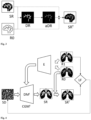
- Fig. 1 shows schematically by way of example the pre-training of a conditional generative model.
- the conditional generative model CGM is a diffusion model.
- the diffusion model comprises a noising model NM and a denoising model DM.
- conditional generative model CGM is pre-trained on training data TD.
- the training data TD comprise a multitude of reference representations RR1, RR2, RR3, RR4, RR5, RR6 of an examination area of a multitude of examination objects.
- the examination area comprises the brain of a multitude of humans.
- conditional generative model CGM is configured and trained to gradually add noise to the reference representations RR1, RR2, RR3, RR4, RR5, RR6 and regenerate (reconstruct) the reference representations from the noise data (denoising).
- An encoder E (e.g., an image encoder) is used to generate one or more embeddings for each reference representation RR1, RR2, RR3, RR4, RR5, RR6.
- the one or more embeddings are used as conditions when reconstructing the reference representation.
- Fig. 1 the reconstructed reference representations are marked with the reference signs RR1 R , RR2 R , RR3 R , RR4 R , RR5 R , and RR6 R .
- conditional generative model CGM Once the conditional generative model CGM has been pre-trained, it can be used to generate a synthetic representation of the examination area of a new examination object. This is shown in Figs. 2 and 4 .
- a native representation and a contrast-enhanced representation of the examination area of the new examination object is provided.
- the contrast-enhanced representation serves as target data.
- the native representation and/or the contrast-enhanced representation are usually measured data, i.e., the result of a measurement on the new examination object. It is possible that the measured data is processed or transformed to generate the respective representation of the examination area of the new examination object.
- the measured data may be k-space data that is subjected to an inverse Fourier transform to generate a real-space representation of the examination area of the new examination object (however, this does not mean that the representation of the examination area of the examination object cannot consist of k-space data).
- One or more embeddings are generated based on the native and/or contrast-enhanced representation.
- the one or more embeddings are preferably generated with the same encoder that was used to generate the embeddings of the reference representations during training of the conditional generative model.
- everything that is disclosed in this disclosure for the embeddings of the reference representation also applies analogously to the one or more embeddings of the native representation and/or the contrast-enhanced representation.
- the conditional generative model is configured to generate the synthetic representation based on the starting data, using the one or more embeddings as a condition.
- the starting data can be noise data.
- the noise data can be random Gaussian noise, for example.
- the conditional generative model may be configured and pre-trained to gradually denoise the noise data and generate a synthetic representation of the examination area of the new examination object.
- the synthetic representation is transformed.
- the result of the transformation operation is a transformed synthetic representation of the examination area of the new examination object.
- generating a transformed synthetic representation may comprise: reducing the contrast-enhancement of the synthetic representation.
- Generating a transformed synthetic representation may comprise: reducing the contrast-enhancement of the synthetic representation, so that the contrast-enhancement of the transformed synthetic representation corresponds to the contrast-enhancement of the contrast-enhanced representation (target data).
- Generating a transformed synthetic representation may comprise: reducing the contrast-enhancement of the synthetic representation, so that the transformed synthetic representation represents the examination area of the new examination object after administration of the first amount of contrast agent.
- the transformed synthetic representation is a contrast-enhanced representation of the examination area of the new examination object in which the contrast is reduced compared to the synthetic representation.
- the transformation is intended to undo what the conditional generative model is supposed to achieve: Based on a native representation representing the examination area of the new examination object without contrast agent and/or a contrast-enhanced representation representing the examination area of the new examination object after administration of a first amount of a contrast agent, the conditional generative model shall generate a synthetic contrast-enhanced representation representing the examination area after administration of a second amount of the contrast agent, wherein the second amount is larger than the first amount.
- a transformed synthetic representation is to be generated from the synthetic representation, which represents the examination area of the new examination object after administration of the first amount of the contrast agent.
- the transformed synthetic representation should therefore come as close as possible to the contrast-enhanced representation (target data).
- the aim of the transformation is to convert the synthetic representation so that it corresponds to the (e.g., measured) contrast-enhanced representation of the examination area of the new examination object (target data).
- the transformed synthetic representation is compared with the contrast-enhanced representation of the examination area of the new examination object (target data)
- a loss function may be used to quantify deviations between the contrast-enhanced representation of the examination area of the new examination object and the transformed synthetic representation.
- the deviations may be reduced in an optimization process by modifying the starting data and/or the one or mode embeddings and/or parameters of the pre-trained conditional generative model.
- a new synthetic representation is generated with the modified starting data and/or the modified embedding(s) and/or the modified parameters. This is then converted into a new transformed synthetic representation and deviations between the new transformed synthetic representation and the contrast-enhanced representation of the examination area of the new examination object is quantified. The procedure may be continued until a stop criterion is reached.
- Such stop criteria can be for example: a predefined maximum number of steps has been performed, deviations between output data and target data can no longer be reduced by modifying the starting data and/or embedding(s) and/or model parameters, a predefined minimum of the loss function is reached, and/or an extreme value (e.g., maximum or minimum) of another performance value is reached.
- the last synthetic representation generated can be output (e.g., shown on a display and/or printed out on a printer), stored in a data memory and/or transferred to another computer system.
- the last generated synthetic representation is first converted into another representation, which is then output, stored and/or transferred to a separate computer system.
- the last generated synthetic representation it is possible for the last generated synthetic representation to be a representation in frequency space or projection space and for this to be converted into a real-space representation.
- Modifications are usually made as part of an optimization process, e.g. a gradient descent optimization process.
- Modifying the one or more embeddings may comprise modifying model parameters of the one or more encoders used to generate the one or more embeddings.
- Modifying the one or more embeddings may include modifying the manner in which multiple (i.e., more than one) embeddings are combined into a single embedding.
- Fig. 2 shows schematically by way of example the use of a pre-trained conditional generative model to generate a synthetic representation of the examination area of a new examination object.
- the pre-trained conditional generative model may have been trained as described with reference to Fig. 1 .
- the pre-trained conditional generative model CGM t comprises a pre-trained denoising model DM t of a diffusion model.
- the noising model NM shown in Fig. 1 is not required to generate synthetic representations. It may be discarded.
- a native representation R0 and a contrast-enhanced representation R1 of the examination area of a new examination object are provided.
- the native representation R0 and the contrast-enhanced representation R1 are radiologic representations, such as CT representations or MRI representations.
- conditional generative model CGM t has been pre-trained to reconstruct reference representations of human brains (see Fig. 1 ), and the representations R0 and R1 also represent a human brain.
- the native representation R0 represents the examination area of the new examination object without contrast agent.
- the contrast-enhanced representation R1 represents the examination area of the new examination object after administration of a first amount of a contrast agent.
- the representation R1 serves as target data.
- One or more embeddings are generated from the representation R1 with the help of the encoder E, which are used as a condition for generating the synthetic representation SR.
- the synthetic representation SR is generated based on the starting data SD.
- the denoising model DM t of the pre-trained conditional generative model CGM t is configured and pre-trained to generate the synthetic representation SR based on the starting data SD under the conditions specified by the one or more embeddings generated by the encoder E.
- the synthetic representation SR is converted into the transformed synthetic representation SR T .
- the native representation R0 is involved in the transformation.
- the transformed synthetic representation SR T is compared with the contrast-enhanced representation R1. Deviations between the transformed synthetic representation SR T and contrast-enhanced representation R1 are quantified (e.g., by using the loss function LF) and the deviations are reduced by modifying the starting data SD and/or the one or more embeddings generated by the encoder E and/or parameters of the conditional generative model CGM t .
- the modified starting data and/or embedding(s) and/or modified parameters form the basis for a further optimization cycle, i.e. the steps described from the generation of the synthetic representation to the modification of the starting data and/or embedding(s) can be repeated once or several times. With each cycle, the deviations usually become smaller and the quality of the synthetic representation better.
- the last synthetic representation generated can be output (e.g., shown on a display and/or printed out on a printer), stored in a data memory and/or transferred to another computer system.
- Such stop criteria can be for example: a predefined maximum number of steps has been performed, deviations between the transformed synthetic representation SR T and the contrast-enhanced representation R1 can no longer be reduced by modifying the starting data SD and/or the one or more embeddings and/or the model parameters, a predefined minimum of the loss function is reached, and/or an extreme value (e.g., maximum or minimum) of another performance value is reached.
- one or more embeddings are generated by the encoder E only based on the representation R1. It is also possible that one or more embeddings are only generated based on the representation R0. It is possible that one or more embeddings are generated based on the representations R1 and R0. It is possible that one or more embeddings are generated based on the difference between the representation R0 and the representation R1 (e.g., R1-R0). It is possible that more than one encoder is used to generate embeddings. If several embeddings are generated, they can be combined into a single embedding as described herein.
- the synthetic representation generated by the conditional generative model is transformed and the transformed synthetic representation is compared with the target data in order to quantify deviations.
- the transformation of the synthetic representation is a process that reverses what the conditional generative model is intended to achieve.
- the model is to be made to generate a synthetic representation representing the examination area of the new examination object after application of a second amount of a contrast agent, the second amount being larger than the first amount.
- the attenuation factor is usually a real number that is greater than zero and less than one.
- the result of the multiplication is an attenuated difference representation.
- the attenuated difference representation can be added to the native representation.
- the result of this addition is a transformed synthetic representation of the examination area of the new examination object.
- the result of the addition is a synthetic contrast-enhanced representation of the examination area of the new examination object, in which the contrast enhancement is lower than in the case of the synthetic representation.
- the pre-trained conditional generative model is to be made to generate a synthetic representation in which the contrast enhancement after transformation corresponds to the contrast enhancement of the contrast-enhanced representation.
- the model is to be made to generate a synthetic representation which, after transformation, represents the examination area of the new examination object after application of the first amount of contrast agent.
- the attenuated difference representation can also be subtracted from the synthetic representation to generate the transformed synthetic representation.
- a frequency-dependent weighting function can have the function of a filter.
- Preferred weight functions are Hann function (also referred to as the Hann window) and Poisson function (Poisson window). Examples of other weight functions can be found for example at https://de.wikipedia.org/wiki/Fensterfunktion#Bei admir_von_Fensterfunktionen; F.J. Harris et al.: On the Use of Windows for Harmonic Analysis with the Discrete Fourier Transform, Proceedings of the IEEE, vol. 66, No.
- Fig. 3 shows schematically an example of generating a transformed synthetic representation.
- the representations R0, SR and SR T shown in Fig. 3 correspond to the representations R0, SR and SR T shown in Fig. 2 .
- the attenuation factor ⁇ is a real number. Usually, the attenuation factor ⁇ is greater than zero and less than 1: 0 ⁇ ⁇ ⁇ 1.
- the transformed synthetic representation SR T is generated.
- the generation of the transformed synthetic representation may comprise further steps, such as filtering or the like. It should be noted that Fig. 3 shows only one possibility of a transformation; further possibilities are conceivable.
- Fig. 4 shows schematically another example of using a pre-trained conditional generative model to generate a synthetic representation of the examination area of a new examination object.
- a native representation R0 and a contrast-enhanced representation R1 are received.
- the native representation R0 and the contrast-enhanced representation R1 are radiologic representations, such as CT representations or MRI representations.
- the native representation R0 represents the examination area of a new examination object without contrast agent.
- the contrast-enhanced representation R1 represents the same examination area of the same examination object after administration of a first amount of contrast agent.
- the examination area comprises the lungs of a human.
- An encoder E is used to generate one or more embeddings based on the native representation R0 and the first representation R1. As described, it is also possible for one or more embeddings to be generated based on only one of the representations.
- the pre-trained conditional generative model CGM t comprises a denoising model DM t of a conditional diffusion model.
- the pre-trained conditional generative model CGM t may have been pre-trained in a process as described with reference to Fig. 1 .
- the conditional generative model CGM t was pre-trained based on representations of human lungs, as the pre-trained conditional generative model CGM t is used in the example shown in Fig. 4 to generate a synthetic representation SR of a human lung.
- the pre-trained conditional generative model CGM t is configured and was pre-trained to generate the synthetic representation SR of the examination area of the new examination object based on starting data SD.
- the starting data SD can be noise data, for example.
- the synthetic representation SR represents the examination area of the examination object after application of a second amount of a contrast agent, wherein the second amount is larger than the first amount.
- the synthetic representation SR is converted into a transformed synthetic representation SR T .
- the native representation R0 is used for the transformation.
- the transformed synthetic representation SR T represents the examination area of the examination object after application of the first amount of the contrast agent.
- the transformed synthetic representation SR T it is possible, for example, to subtract the native representation R0 from the synthetic representation SR, multiply the result of the subtraction by an attenuation factor (e.g., a real number that is greater than zero and less than 1) and either add the result of the multiplication to the native representation R0 or subtract it from the synthetic representation SR to obtain the transformed synthetic representation SR T .
- an attenuation factor e.g., a real number that is greater than zero and less than 1
- a loss function LF is used to quantify deviations between the transformed synthetic representation SR T and the contrast-enhanced representation R1.
- the starting data SD and/or the one or more embeddings and/or one or more parameters of the pre-trained conditional generative model CGM t are modified to reduce the deviations.
- the process its repeated one or more times.
- the last synthetic representation generated (or a synthetic image generated therefrom) can be output (e.g., shown on a display and/or printed out on a printer), stored in a data memory and/or transferred to another computer system.
- Fig. 5 shows a schematic example of generating an embedding based on a representation of an examination area of an examination object.
- the representation R1 is split into fixed-size patches P1 to P9.
- Patch embeddings a to i are generated by flattening the patches P1 to P9 and mapping the flattened patches by linear projection to a dimension corresponding to the input dimension of the transformer T.
- Position embeddings 1 to 9 are added to the patch embeddings to retain positional information. The resulting sequence serves as input to the transformer T.
- the sequence is preceded by an embedding * with the position 0, which can contain global information about the representation R1, e.g., which examination region it shows and/or the measurement conditions under which it was generated and/or other/further information.
- the transformer T generates an embedding E1 from the sequence.
- Fig. 6 shows a schematic example of generating several embeddings using an encoder and combining the embeddings into a single embedding.
- Fig. 6 shows a native representation R0 and a contrast-enhanced representation R1.
- the representations R0 and R1 shown in Fig. 6 may correspond to the representations shown in Fig. 4 .
- the native representation R0 and the contrast-enhanced representation R1 are radiologic representations, such as CT representations or MRI representations.
- the native representation R0 represents the examination area of a new examination object without contrast agent.
- the contrast-enhanced representation R1 represents the same examination area of the same examination object after administration of a first amount of contrast agent.
- the examination area comprises the lungs of a human.
- Patches are generated from each representation R0 and R1, and fed to the encoder E.
- the encoder E comprises a transformer.
- the encoder E generates a first embedding E1 based on the patches of the native representation R0, and second embedding E2 based on the patches of the contrast-enhanced representation R1.
- the embeddings can be generated as described in relation to Fig. 5 .
- the embeddings E1 and E2 are combined into a single image embedding EC.
- This combined embedding EC can be used as a condition when reconstructing a reference representation and/or when generating a synthetic representation.
- the embeddings E1 and E2 can be combined into the single image embedding EC in various ways, e.g., by concatenation, by summing the image embeddings together elementwise, by performing a principal component analysis (PCA) and generating an embedding based on principle components, by taking the element-wise mean (e.g., arithmetic means) of the image embeddings, by taking the element-wise maximum (e.g., arithmetic means) of the image embeddings, by weighted averaging, and/or by using a trainable machine learning model (such as an artificial neural network).
- PCA principal component analysis
- non-transitory is used herein to exclude transitory, propagating signals or waves, but to otherwise include any volatile or non-volatile computer memory technology suitable to the application.
- the term "computer” should be broadly construed to cover any kind of electronic device with data processing capabilities, including, by way of non-limiting example, personal computers, servers, embedded cores, computing system, communication devices, processors (e.g., digital signal processor (DSP)), microcontrollers, field programmable gate array (FPGA), application specific integrated circuit (ASIC), etc.) and other electronic computing devices.
- processors e.g., digital signal processor (DSP)
- microcontrollers e.g., field programmable gate array (FPGA), application specific integrated circuit (ASIC), etc.
- ASIC application specific integrated circuit
- processor includes a single processing unit or a plurality of distributed or remote such units.
- Fig. 7 illustrates a computer system (1) according to some example implementations of the present disclosure in more detail.
- the computer may include one or more of each of a number of components such as, for example, processing unit (20) connected to a memory (50) (e.g., storage device).
- processing unit (20) connected to a memory (50) (e.g., storage device).
- memory e.g., storage device
- the processing unit (20) may be composed of one or more processors alone or in combination with one or more memories.
- the processing unit is generally any piece of computer hardware that is capable of processing information such as, for example, data, computer programs and/or other suitable electronic information.
- the processing unit is composed of a collection of electronic circuits some of which may be packaged as an integrated circuit or multiple interconnected integrated circuits (an integrated circuit at times more commonly referred to as a "chip").
- the processing unit may be configured to execute computer programs, which may be stored onboard the processing unit or otherwise stored in the memory (50) of the same or another computer.
- the processing unit (20) may be a number of processors, a multi-core processor or some other type of processor, depending on the particular implementation. Further, the processing unit may be implemented using a number of heterogeneous processor systems in which a main processor is present with one or more secondary processors on a single chip. As another illustrative example, the processing unit may be a symmetric multi-processor system containing multiple processors of the same type. In yet another example, the processing unit may be embodied as or otherwise include one or more ASICs, FPGAs or the like. Thus, although the processing unit may be capable of executing a computer program to perform one or more functions, the processing unit of various examples may be capable of performing one or more functions without the aid of a computer program. In either instance, the processing unit may be appropriately programmed to perform functions or operations according to example implementations of the present disclosure.
- the memory (50) is generally any piece of computer hardware that is capable of storing information such as, for example, data, computer programs (e.g., computer-readable program code (60)) and/or other suitable information either on a temporary basis and/or a permanent basis.
- the memory may include volatile and/or non-volatile memory, and may be fixed or removable. Examples of suitable memory include random access memory (RAM), read-only memory (ROM), a hard drive, a flash memory, a thumb drive, a removable computer diskette, an optical disk, a magnetic tape or some combination of the above.
- Optical disks may include compact disk - read only memory (CD-ROM), compact disk - read/write (CD-R/W), DVD, Blu-ray disk or the like.
- the memory may be referred to as a computer-readable storage medium.
- the computer-readable storage medium is a non-transitory device capable of storing information, and is distinguishable from computer-readable transmission media such as electronic transitory signals capable of carrying information from one location to another.
- Computer-readable medium as described herein may generally refer to a computer-readable storage medium or computer-readable transmission medium.
- the processing unit (20) may also be connected to one or more interfaces for displaying, transmitting and/or receiving information.
- the interfaces may include one or more communications interfaces and/or one or more user interfaces.
- the communications interface(s) may be configured to transmit and/or receive information, such as to and/or from other computer(s), network(s), database(s) or the like.
- the communications interface may be configured to transmit and/or receive information by physical (wired) and/or wireless communications links.
- the communications interface(s) may include interface(s) (41) to connect to a network, such as using technologies such as cellular telephone, Wi-Fi, satellite, cable, digital subscriber line (DSL), fiber optics and the like.
- the communications interface(s) may include one or more short-range communications interfaces (42) configured to connect devices using short-range communications technologies such as NFC, RFID, Bluetooth, Bluetooth LE, ZigBee, infrared (e.g., IrDA) or the like.
- short-range communications technologies such as NFC, RFID, Bluetooth, Bluetooth LE, ZigBee, infrared (e.g., IrDA) or the like.
- the user interfaces may include a display (30).
- the display may be configured to present or otherwise display information to a user, suitable examples of which include a liquid crystal display (LCD), light-emitting diode display (LED), plasma display panel (PDP) or the like.
- the user input interface(s) (11) may be wired or wireless, and may be configured to receive information from a user into the computer system (1), such as for processing, storage and/or display. Suitable examples of user input interfaces include a microphone, image or video capture device, keyboard or keypad, joystick, touch-sensitive surface (separate from or integrated into a touchscreen) or the like.
- the user interfaces may include automatic identification and data capture (AIDC) technology (12) for machine-readable information. This may include barcode, radio frequency identification (RFID), magnetic stripes, optical character recognition (OCR), integrated circuit card (ICC), and the like.
- the user interfaces may further include one or more interfaces for communicating with peripherals such as printers and the like.
- program code instructions may be stored in memory, and executed by processing unit that is thereby programmed, to implement functions of the systems, subsystems, tools and their respective elements described herein.
- any suitable program code instructions may be loaded onto a computer or other programmable apparatus from a computer-readable storage medium to produce a particular machine, such that the particular machine becomes a means for implementing the functions specified herein.
- These program code instructions may also be stored in a computer-readable storage medium that can direct a computer, processing unit or other programmable apparatus to function in a particular manner to thereby generate a particular machine or particular article of manufacture.
- the instructions stored in the computer-readable storage medium may produce an article of manufacture, where the article of manufacture becomes a means for implementing functions described herein.
- the program code instructions may be retrieved from a computer-readable storage medium and loaded into a computer, processing unit or other programmable apparatus to configure the computer, processing unit or other programmable apparatus to execute operations to be performed on or by the computer, processing unit or other programmable apparatus.
- Retrieval, loading and execution of the program code instructions may be performed sequentially such that one instruction is retrieved, loaded and executed at a time. In some example implementations, retrieval, loading and/or execution may be performed in parallel such that multiple instructions are retrieved, loaded, and/or executed together. Execution of the program code instructions may produce a computer-implemented process such that the instructions executed by the computer, processing circuitry or other programmable apparatus provide operations for implementing functions described herein.
- a computer system (1) may include processing unit (20) and a computer-readable storage medium or memory (50) coupled to the processing circuitry, where the processing circuitry is configured to execute computer-readable program code (60) stored in the memory.
- processing unit (20) and a computer-readable storage medium or memory (50) coupled to the processing circuitry, where the processing circuitry is configured to execute computer-readable program code (60) stored in the memory.
- computer-readable program code 60
- one or more functions, and combinations of functions may be implemented by special purpose hardware-based computer systems and/or processing circuitry which perform the specified functions, or combinations of special purpose hardware and program code instructions.
- Fig. 8 schematically shows an embodiment of the computer-implemented method for generating a synthetic medical representation in the form of a flow chart. The method comprises the steps:
- the computer-readable program code of the present disclosure may also be marketed in combination with a contrast agent.
- a contrast agent Such a combination is also referred to as a kit.
- a kit includes the contrast agent and the computer-readable program code.
- Such a kit includes the contrast agent and means for allowing a purchaser to obtain the computer-readable program code, e.g., download it from an Internet site. These means may include a link, i.e., an address of the Internet site from which the computer-readable program code may be obtained, e.g., from which the computer-readable program code may be downloaded to a computer system connected to the Internet.
- Such means may include a code (e.g., an alphanumeric string or a QR code, or a DataMatrix code or a barcode or other optically and/or electronically readable code) by which the purchaser can access the computer-readable program code.
- a link and/or code may, for example, be printed on a package of the contrast agent and/or printed on a package insert for the contrast agent.
- a kit is thus a combination product comprising a contrast agent and a computer-readable program code (e.g., in the form of access to the computer-readable program code or in the form of executable program code on a data carrier) that is offered for sale together.
Landscapes
- Health & Medical Sciences (AREA)
- Physics & Mathematics (AREA)
- Theoretical Computer Science (AREA)
- Engineering & Computer Science (AREA)
- General Physics & Mathematics (AREA)
- Nuclear Medicine, Radiotherapy & Molecular Imaging (AREA)
- Radiology & Medical Imaging (AREA)
- Animal Behavior & Ethology (AREA)
- General Health & Medical Sciences (AREA)
- Public Health (AREA)
- Veterinary Medicine (AREA)
- Life Sciences & Earth Sciences (AREA)
- Epidemiology (AREA)
- Medicinal Chemistry (AREA)
- Chemical & Material Sciences (AREA)
- Image Analysis (AREA)
- Magnetic Resonance Imaging Apparatus (AREA)
Applications Claiming Priority (2)
| Application Number | Priority Date | Filing Date | Title |
|---|---|---|---|
| EP23214619 | 2023-12-06 | ||
| EP24179377 | 2024-05-31 |
Publications (1)
| Publication Number | Publication Date |
|---|---|
| EP4567715A1 true EP4567715A1 (fr) | 2025-06-11 |
Family
ID=93650484
Family Applications (1)
| Application Number | Title | Priority Date | Filing Date |
|---|---|---|---|
| EP24216714.6A Pending EP4567715A1 (fr) | 2023-12-06 | 2024-12-02 | Génération de représentations synthétiques |
Country Status (2)
| Country | Link |
|---|---|
| US (1) | US20250191242A1 (fr) |
| EP (1) | EP4567715A1 (fr) |
Families Citing this family (1)
| Publication number | Priority date | Publication date | Assignee | Title |
|---|---|---|---|---|
| US20250200821A1 (en) * | 2023-12-18 | 2025-06-19 | Nvidia Corporation | Image generation using text |
Citations (13)
| Publication number | Priority date | Publication date | Assignee | Title |
|---|---|---|---|---|
| US6039931A (en) | 1989-06-30 | 2000-03-21 | Schering Aktiengesellschaft | Derivatized DTPA complexes, pharmaceutical agents containing these compounds, their use, and processes for their production |
| WO2007042504A2 (fr) | 2005-10-07 | 2007-04-19 | Guerbet | Composes comprenant une partie de reconnaissance d'une cible biologique, couplee a une partie de signal capable de complexer le gallium |
| WO2014036473A1 (fr) * | 2012-08-31 | 2014-03-06 | Kenji Suzuki | Technique d'apprentissage supervisée par machine servant à la réduction de la dose de rayonnement en imagerie tomographique par ordinateur |
| WO2016193190A1 (fr) | 2015-06-04 | 2016-12-08 | Bayer Pharma Aktiengesellschaft | Nouveaux composés de chélates de gadolinium pour utilisation dans l'imagerie par résonance magnétique |
| WO2018202541A1 (fr) | 2017-05-02 | 2018-11-08 | Bayer Aktiengesellschaft | Améliorations dans la détection radiologique de l'hypertension pulmonaire thromboembolique chronique |
| WO2019074938A1 (fr) | 2017-10-09 | 2019-04-18 | The Board Of Trustees Of The Leland Stanford Junior University | Réduction de dose de contraste pour imagerie médicale à l'aide d'un apprentissage profond |
| WO2020030618A1 (fr) | 2018-08-06 | 2020-02-13 | Bracco Imaging Spa | Agents de contraste à base de pcta portant du gadolinium |
| WO2020229152A1 (fr) | 2019-05-10 | 2020-11-19 | Bayer Consumer Care Ag | Identification de signes candidats indiquant une fusion oncogénique ntrk |
| WO2022013454A1 (fr) | 2020-07-17 | 2022-01-20 | Guerbet | Procede de preparation d'un ligand chelateur derive de pcta |
| WO2022184297A1 (fr) | 2021-03-02 | 2022-09-09 | Bayer Aktiengesellschaft | Apprentissage automatique dans le domaine de la radiologie avec injecton d'agent de contraste |
| WO2022194777A1 (fr) | 2021-03-15 | 2022-09-22 | Bayer Aktiengesellschaft | Nouvel agent de contraste destiné à être utilisé dans l'imagerie par résonance magnétique |
| US20230377099A1 (en) * | 2022-05-19 | 2023-11-23 | Nvidia Corporation | Synthesizing content using diffusion models in content generation systems and applications |
| WO2024052156A1 (fr) | 2022-09-05 | 2024-03-14 | Bayer Aktiengesellschaft | Génération d'images radiologiques améliorées par contraste artificiel |
-
2024
- 2024-12-02 EP EP24216714.6A patent/EP4567715A1/fr active Pending
- 2024-12-11 US US18/977,509 patent/US20250191242A1/en active Pending
Patent Citations (13)
| Publication number | Priority date | Publication date | Assignee | Title |
|---|---|---|---|---|
| US6039931A (en) | 1989-06-30 | 2000-03-21 | Schering Aktiengesellschaft | Derivatized DTPA complexes, pharmaceutical agents containing these compounds, their use, and processes for their production |
| WO2007042504A2 (fr) | 2005-10-07 | 2007-04-19 | Guerbet | Composes comprenant une partie de reconnaissance d'une cible biologique, couplee a une partie de signal capable de complexer le gallium |
| WO2014036473A1 (fr) * | 2012-08-31 | 2014-03-06 | Kenji Suzuki | Technique d'apprentissage supervisée par machine servant à la réduction de la dose de rayonnement en imagerie tomographique par ordinateur |
| WO2016193190A1 (fr) | 2015-06-04 | 2016-12-08 | Bayer Pharma Aktiengesellschaft | Nouveaux composés de chélates de gadolinium pour utilisation dans l'imagerie par résonance magnétique |
| WO2018202541A1 (fr) | 2017-05-02 | 2018-11-08 | Bayer Aktiengesellschaft | Améliorations dans la détection radiologique de l'hypertension pulmonaire thromboembolique chronique |
| WO2019074938A1 (fr) | 2017-10-09 | 2019-04-18 | The Board Of Trustees Of The Leland Stanford Junior University | Réduction de dose de contraste pour imagerie médicale à l'aide d'un apprentissage profond |
| WO2020030618A1 (fr) | 2018-08-06 | 2020-02-13 | Bracco Imaging Spa | Agents de contraste à base de pcta portant du gadolinium |
| WO2020229152A1 (fr) | 2019-05-10 | 2020-11-19 | Bayer Consumer Care Ag | Identification de signes candidats indiquant une fusion oncogénique ntrk |
| WO2022013454A1 (fr) | 2020-07-17 | 2022-01-20 | Guerbet | Procede de preparation d'un ligand chelateur derive de pcta |
| WO2022184297A1 (fr) | 2021-03-02 | 2022-09-09 | Bayer Aktiengesellschaft | Apprentissage automatique dans le domaine de la radiologie avec injecton d'agent de contraste |
| WO2022194777A1 (fr) | 2021-03-15 | 2022-09-22 | Bayer Aktiengesellschaft | Nouvel agent de contraste destiné à être utilisé dans l'imagerie par résonance magnétique |
| US20230377099A1 (en) * | 2022-05-19 | 2023-11-23 | Nvidia Corporation | Synthesizing content using diffusion models in content generation systems and applications |
| WO2024052156A1 (fr) | 2022-09-05 | 2024-03-14 | Bayer Aktiengesellschaft | Génération d'images radiologiques améliorées par contraste artificiel |
Non-Patent Citations (31)
| Title |
|---|
| A. DOSOVITSKY ET AL.: "An Image is Worth 16x16 Words: Transformers for Image Recognition at Scale", ARXIV:2010.11929V2 |
| A. FRINGUELLO MINGO ET AL.: "Amplifying the Effects of Contrast Agents on Magnetic Resonance Images Using a Deep Learning Method Trained on Synthetic Data", INVESTIGATIVE RADIOLOGY, vol. 58, no. 12, 2023, pages 853 - 864 |
| A. IGNEE ET AL.: "Ultrasound contrast agents", ENDOSC ULTRASOUND, vol. 5, no. 6, November 2016 (2016-11-01), pages 355 - 362 |
| A. RADFORD ET AL.: "Learning Transferable Visual Models From Natural Language Supervision", ARXIV:2103.00020V1 |
| A.S.L. JASCINTH ET AL.: "Contrast Agents in computed tomography: A Review", JOURNAL OF APPLIED DENTAL AND MEDICAL SCIENCES, vol. 2, 2016, pages 143 - 149 |
| ACR MANUAL ON CONTRAST MEDIA, 2020, ISBN: 978-1-55903-012-0 |
| AMIRHOSSEIN KAZEROUNI ET AL: "Diffusion Models for Medical Image Analysis: A Comprehensive Survey", ARXIV.ORG, CORNELL UNIVERSITY LIBRARY, 201 OLIN LIBRARY CORNELL UNIVERSITY ITHACA, NY 14853, 14 November 2022 (2022-11-14), XP091368786 * |
| DAYARATHNA SANUWANI ET AL: "Deep learning based synthesis of MRI, CT and PET: Review and analysis", MEDICAL IMAGE ANALYSIS, OXFORD UNIVERSITY PRESS, OXOFRD, GB, vol. 92, 1 December 2023 (2023-12-01), XP087448589, ISSN: 1361-8415, [retrieved on 20231201], DOI: 10.1016/J.MEDIA.2023.103046 * |
| F.J. HARRIS ET AL.: "On the Use of Windows for Harmonic Analysis with the Discrete Fourier Transform", PROCEEDINGS OF THE IEEE, vol. 66, no. 1, 1978, XP002002194, Retrieved from the Internet <URL:https://docs.scipy.org/doc/scipy/reference/signal.windows.html> DOI: 10.1109/PROC.1978.10837 |
| H. LUSIC ET AL.: "X-ray-Computed Tomography Contrast Agents", CHEM. REV., vol. 113, no. 3, 2013, pages 1641 - 1666, XP055559399, Retrieved from the Internet <URL:https://www.radiology.wisc.edu/wp-content/uploads/2017/10/contrast-agents-tutorial.pdf> DOI: 10.1021/cr200358s |
| J. HO ET AL.: "Denoising Diffusion Probabilistic Models", ARXIV:2006.11239V2 |
| J. LOHRKE ET AL.: "Preclinical Profile of Gadoquatrane: A Novel Tetrameric, Macrocyclic High Relaxivity Gadolinium-Based Contrast Agent", INVEST RADIOL., vol. 57, no. 10, 2022, pages 629 - 638 |
| J. SONG ET AL.: "Denoising Diffusion Implicit Models", ARXIV:2010.02502V4 |
| J. TROTTER ET AL.: "Positron Emission Tomography (PET)/Computed Tomography (CT) Imaging in Radiation Therapy Treatment Planning", A REVIEW OF PET IMAGING TRACERS AND METHODS TO INCORPORATE PET, vol. 8, 2023, pages 101212 |
| K. CATCH: "The Radon Transformation and Its Application in Tomography", JOURNAL OF PHYSICS CONFERENCE SERIES, no. 1, 1903, pages 012066 |
| K. M. M PRABHU: "Window Functions and Their Applications in Signal Processing", vol. 978, 2014, CRC PRESS, pages: 4665 - 1583 |
| K. PREECHAKUL ET AL.: "Diffusion autoencoders: Toward a meaningful and decodable representation", ARXIV:2111.15640V3 |
| L.C. ABONYI ET AL.: "Intravascular Contrast Media in Radiography: Historical Development & Review of Risk Factors for Adverse Reactions", SOUTH AMERICAN JOURNAL OF CLINICAL RESEARCH, vol. 3, 2016, pages 1 - 10 |
| M. CARON ET AL.: "Emerging Properties in Self-Supervised Vision Transformers", ARXIV:2104.14294V2 |
| M. OQUAB ET AL.: "DINOv2: Learning Robust Visual Features without Supervision", ARXIV:2304.07193V1 |
| M. T. PILEHVARJ. CAMACHO-COLLADOS: "Embeddings in Natural Language Processing", 2021, MORGAN&CLAYPOOL PUBLISHERS |
| M.R. NOUH ET AL.: "Radiographic and magnetic resonances contrast agents: Essentials and tips for safe practices", WORLD J RADIOL., vol. 9, no. 9, 28 September 2017 (2017-09-28), pages 339 - 349 |
| O. RONNEBERGER ET AL.: "International Conference on Medical image computing and computer-assisted intervention", 2015, SPRINGER, article "U-net: Convolutional networks for biomedical image segmentation", pages: 234 - 241 |
| P. THANAPOL ET AL.: "Reducing Overfitting and Improving Generalization in Training Convolutional Neural Network (CNN) under Limited Sample Sizes in Image Recognition", 5TH INTERNATIONAL CONFERENCE ON INFORMATION TECHNOLOGY (INCIT, 2020, pages 300 - 305, XP033875803, DOI: 10.1109/InCIT50588.2020.9310787 |
| R. ROMBACH ET AL.: "High-Resolution Image Synthesis with Latent Diffusion Models", ARXIV:2112.10752V2 |
| S. KHAN ET AL.: "Transformers in Vision: A Survey", ARXIV:2101.01169V5 |
| S. SELVA BIRUNDAR. KANNIGA DEVI: "Innovatove Data Communication Technologies and Application, Proceedings of ICIDCA", vol. 59, 2020, SPRINGER, article "A Review on Word Embedding Techniques for Text Classification" |
| S. ZHANG ET AL.: "Large-Scale Domain-Specific Pretrainingfor Biomedical Vision-Language Processing", ARXIV:2303.00915V1 |
| T. DARCET ET AL.: "Vision Transformers Need Registers", ARXIV:2309.16588V1 |
| T. LIN ET AL.: "A survey of transformers", AI OPEN, vol. 3, 2022, pages 111 - 132 |
| Y. SONG ET AL.: "Score-Based Generative Modeling through Stochastic Differential Equations", ARXIV:2011.13456V2 |
Also Published As
| Publication number | Publication date |
|---|---|
| US20250191242A1 (en) | 2025-06-12 |
Similar Documents
| Publication | Publication Date | Title |
|---|---|---|
| Fu et al. | Deep learning approaches using 2D and 3D convolutional neural networks for generating male pelvic synthetic computed tomography from magnetic resonance imaging | |
| Gibson et al. | NiftyNet: a deep-learning platform for medical imaging | |
| Glatard et al. | A virtual imaging platform for multi-modality medical image simulation | |
| Gillmann et al. | Uncertainty‐aware Visualization in Medical Imaging‐A Survey | |
| US12175730B2 (en) | Image learning method, apparatus, program, and recording medium using generative adversarial network | |
| Tiago et al. | A data augmentation pipeline to generate synthetic labeled datasets of 3D echocardiography images using a GAN | |
| Saab et al. | Doubly weak supervision of deep learning models for head CT | |
| Zhou et al. | Learning stochastic object models from medical imaging measurements by use of advanced ambient generative adversarial networks | |
| Liu et al. | MAGAN: mask attention generative adversarial network for liver tumor CT image synthesis | |
| EP4567715A1 (fr) | Génération de représentations synthétiques | |
| Currie et al. | Intelligent imaging: Applications of machine learning and deep learning in radiology | |
| Lei et al. | MRI-based pseudo CT generation using classification and regression random forest | |
| US20250292447A1 (en) | Generation of a synthetic medical image | |
| US20250349101A1 (en) | Segmentation of medical images | |
| Xin et al. | Text3DSAM: Text-Guided 3D Medical Image Segmentation Using SAM-Inspired Architecture | |
| WO2025119803A1 (fr) | Génération de représentations médicales de synthèse | |
| Lei et al. | Brain MRI classification based on machine learning framework with auto-context model | |
| Polson et al. | Pytomography: A python library for quantitative medical image reconstruction | |
| Pan et al. | Full-dose PET synthesis from low-dose PET using 2D high efficiency denoising diffusion probabilistic model | |
| EP4621717A1 (fr) | Génération d'une image médicale synthétique | |
| Babu et al. | Generative Adversarial Networks in Medical Image Analysis: A Comprehensive Survey | |
| WO2025260252A1 (fr) | Segmentation d'images médicales | |
| Ahmed et al. | Lesion Detection in Optical Coherence Tomography with Transformer-Enhanced Detector | |
| US20250378594A1 (en) | Generating synthetic representations | |
| EP4672132A1 (fr) | Génération d'images radiologiques synthétiques |
Legal Events
| Date | Code | Title | Description |
|---|---|---|---|
| PUAI | Public reference made under article 153(3) epc to a published international application that has entered the european phase |
Free format text: ORIGINAL CODE: 0009012 |
|
| STAA | Information on the status of an ep patent application or granted ep patent |
Free format text: STATUS: THE APPLICATION HAS BEEN PUBLISHED |
|
| AK | Designated contracting states |
Kind code of ref document: A1 Designated state(s): AL AT BE BG CH CY CZ DE DK EE ES FI FR GB GR HR HU IE IS IT LI LT LU LV MC ME MK MT NL NO PL PT RO RS SE SI SK SM TR |
|
| STAA | Information on the status of an ep patent application or granted ep patent |
Free format text: STATUS: REQUEST FOR EXAMINATION WAS MADE |
|
| GRAP | Despatch of communication of intention to grant a patent |
Free format text: ORIGINAL CODE: EPIDOSNIGR1 |
|
| STAA | Information on the status of an ep patent application or granted ep patent |
Free format text: STATUS: GRANT OF PATENT IS INTENDED |
|
| 17P | Request for examination filed |
Effective date: 20251211 |
|
| INTG | Intention to grant announced |
Effective date: 20251222 |
|
| RIC1 | Information provided on ipc code assigned before grant |
Ipc: G06T 5/60 20240101AFI20251213BHEP Ipc: G06T 5/70 20240101ALI20251213BHEP Ipc: G16H 30/40 20180101ALI20251213BHEP Ipc: G06T 7/00 20170101ALI20251213BHEP |
|
| GRAS | Grant fee paid |
Free format text: ORIGINAL CODE: EPIDOSNIGR3 |
|
| GRAA | (expected) grant |
Free format text: ORIGINAL CODE: 0009210 |
|
| STAA | Information on the status of an ep patent application or granted ep patent |
Free format text: STATUS: THE PATENT HAS BEEN GRANTED |