EP4567739A1 - Bildverarbeitungsverfahren und -vorrichtung sowie vorrichtung - Google Patents
Bildverarbeitungsverfahren und -vorrichtung sowie vorrichtung Download PDFInfo
- Publication number
- EP4567739A1 EP4567739A1 EP23893613.2A EP23893613A EP4567739A1 EP 4567739 A1 EP4567739 A1 EP 4567739A1 EP 23893613 A EP23893613 A EP 23893613A EP 4567739 A1 EP4567739 A1 EP 4567739A1
- Authority
- EP
- European Patent Office
- Prior art keywords
- target
- body shape
- images
- reconstruction model
- reconstruction
- Prior art date
- Legal status (The legal status is an assumption and is not a legal conclusion. Google has not performed a legal analysis and makes no representation as to the accuracy of the status listed.)
- Pending
Links
Images





Classifications
-
- G—PHYSICS
- G06—COMPUTING OR CALCULATING; COUNTING
- G06T—IMAGE DATA PROCESSING OR GENERATION, IN GENERAL
- G06T17/00—Three-dimensional [3D] modelling for computer graphics
- G06T17/20—Finite element generation, e.g. wire-frame surface description, tesselation
-
- G—PHYSICS
- G06—COMPUTING OR CALCULATING; COUNTING
- G06T—IMAGE DATA PROCESSING OR GENERATION, IN GENERAL
- G06T17/00—Three-dimensional [3D] modelling for computer graphics
-
- G—PHYSICS
- G06—COMPUTING OR CALCULATING; COUNTING
- G06F—ELECTRIC DIGITAL DATA PROCESSING
- G06F3/00—Input arrangements for transferring data to be processed into a form capable of being handled by the computer; Output arrangements for transferring data from processing unit to output unit, e.g. interface arrangements
- G06F3/01—Input arrangements or combined input and output arrangements for interaction between user and computer
- G06F3/048—Interaction techniques based on graphical user interfaces [GUI]
- G06F3/0487—Interaction techniques based on graphical user interfaces [GUI] using specific features provided by the input device, e.g. functions controlled by the rotation of a mouse with dual sensing arrangements, or of the nature of the input device, e.g. tap gestures based on pressure sensed by a digitiser
- G06F3/0488—Interaction techniques based on graphical user interfaces [GUI] using specific features provided by the input device, e.g. functions controlled by the rotation of a mouse with dual sensing arrangements, or of the nature of the input device, e.g. tap gestures based on pressure sensed by a digitiser using a touch-screen or digitiser, e.g. input of commands through traced gestures
-
- G—PHYSICS
- G06—COMPUTING OR CALCULATING; COUNTING
- G06N—COMPUTING ARRANGEMENTS BASED ON SPECIFIC COMPUTATIONAL MODELS
- G06N3/00—Computing arrangements based on biological models
- G06N3/02—Neural networks
- G06N3/04—Architecture, e.g. interconnection topology
- G06N3/0464—Convolutional networks [CNN, ConvNet]
-
- G—PHYSICS
- G06—COMPUTING OR CALCULATING; COUNTING
- G06T—IMAGE DATA PROCESSING OR GENERATION, IN GENERAL
- G06T5/00—Image enhancement or restoration
- G06T5/50—Image enhancement or restoration using two or more images, e.g. averaging or subtraction
-
- G—PHYSICS
- G06—COMPUTING OR CALCULATING; COUNTING
- G06T—IMAGE DATA PROCESSING OR GENERATION, IN GENERAL
- G06T7/00—Image analysis
- G06T7/10—Segmentation; Edge detection
- G06T7/11—Region-based segmentation
-
- G—PHYSICS
- G06—COMPUTING OR CALCULATING; COUNTING
- G06T—IMAGE DATA PROCESSING OR GENERATION, IN GENERAL
- G06T7/00—Image analysis
- G06T7/50—Depth or shape recovery
- G06T7/55—Depth or shape recovery from multiple images
-
- G—PHYSICS
- G06—COMPUTING OR CALCULATING; COUNTING
- G06T—IMAGE DATA PROCESSING OR GENERATION, IN GENERAL
- G06T7/00—Image analysis
- G06T7/70—Determining position or orientation of objects or cameras
-
- G—PHYSICS
- G06—COMPUTING OR CALCULATING; COUNTING
- G06T—IMAGE DATA PROCESSING OR GENERATION, IN GENERAL
- G06T7/00—Image analysis
- G06T7/97—Determining parameters from multiple pictures
-
- G—PHYSICS
- G06—COMPUTING OR CALCULATING; COUNTING
- G06V—IMAGE OR VIDEO RECOGNITION OR UNDERSTANDING
- G06V10/00—Arrangements for image or video recognition or understanding
- G06V10/20—Image preprocessing
- G06V10/25—Determination of region of interest [ROI] or a volume of interest [VOI]
-
- G—PHYSICS
- G06—COMPUTING OR CALCULATING; COUNTING
- G06V—IMAGE OR VIDEO RECOGNITION OR UNDERSTANDING
- G06V10/00—Arrangements for image or video recognition or understanding
- G06V10/40—Extraction of image or video features
- G06V10/42—Global feature extraction by analysis of the whole pattern, e.g. using frequency domain transformations or autocorrelation
-
- G—PHYSICS
- G06—COMPUTING OR CALCULATING; COUNTING
- G06V—IMAGE OR VIDEO RECOGNITION OR UNDERSTANDING
- G06V10/00—Arrangements for image or video recognition or understanding
- G06V10/70—Arrangements for image or video recognition or understanding using pattern recognition or machine learning
- G06V10/82—Arrangements for image or video recognition or understanding using pattern recognition or machine learning using neural networks
-
- G—PHYSICS
- G06—COMPUTING OR CALCULATING; COUNTING
- G06V—IMAGE OR VIDEO RECOGNITION OR UNDERSTANDING
- G06V40/00—Recognition of biometric, human-related or animal-related patterns in image or video data
- G06V40/10—Human or animal bodies, e.g. vehicle occupants or pedestrians; Body parts, e.g. hands
- G06V40/103—Static body considered as a whole, e.g. static pedestrian or occupant recognition
-
- G—PHYSICS
- G06—COMPUTING OR CALCULATING; COUNTING
- G06T—IMAGE DATA PROCESSING OR GENERATION, IN GENERAL
- G06T2207/00—Indexing scheme for image analysis or image enhancement
- G06T2207/20—Special algorithmic details
- G06T2207/20081—Training; Learning
-
- G—PHYSICS
- G06—COMPUTING OR CALCULATING; COUNTING
- G06T—IMAGE DATA PROCESSING OR GENERATION, IN GENERAL
- G06T2207/00—Indexing scheme for image analysis or image enhancement
- G06T2207/20—Special algorithmic details
- G06T2207/20084—Artificial neural networks [ANN]
-
- G—PHYSICS
- G06—COMPUTING OR CALCULATING; COUNTING
- G06T—IMAGE DATA PROCESSING OR GENERATION, IN GENERAL
- G06T2207/00—Indexing scheme for image analysis or image enhancement
- G06T2207/30—Subject of image; Context of image processing
- G06T2207/30196—Human being; Person
Definitions
- This application relates to the field of computer technology, and more particularly, to an image processing method for device and equipment.
- one approach to digitizing human body features involves using specialized scanning equipment for body feature reconstruction. This method requires interaction between the user and the specialized scanning equipment, which is neither convenient nor cost-effective.
- Another approach involves electronic devices estimating the user's size information based on images. However, this estimation method lacks accuracy and significantly deviates from the user's actual body shape.
- Various aspects of the present application provide an image processing method, device, and equipment, aimed at improving the convenience and accuracy of body shape reconstruction while reducing its cost.
- embodiments of the present application provide an image processing method, which includes:
- inputting the at least two images to be processed into the target three-dimensional (3D) reconstruction model to reconstruct the target 3D body shape corresponding to the target object includes:
- determining the global feature corresponding to the target object through the target three-dimensional (3D) reconstruction model includes:
- determining a set of semantic features corresponding to each of the target image patches includes: inputting each of the target image patches into a convolutional neural network (CNN)-based deep encoder to extract a set of semantic features corresponding to the target image patch, wherein the target three-dimensional (3D) reconstruction model includes the CNN-based deep encoder.
- CNN convolutional neural network
- fusing the at least two sets of the semantic features to obtain the global feature includes: inputting the at least two sets of semantic features as at least two sequences into a feature fusion module to obtain the global feature, wherein the target three-dimensional (3D) reconstruction model includes the feature fusion module.
- determining the shooting parameter and posture parameter corresponding to the target object through the target three-dimensional (3D) reconstruction model includes: performing prediction processing on the images to be processed using an encoder and a regressor to obtain the shooting parameter and posture parameter, wherein the target 3D reconstruction model includes the encoder and the regressor.
- reconstructing the target 3D body shape based on the global feature, shooting parameter, and posture parameter through the target 3D reconstruction model includes:
- the method before inputting the at least two images to be processed into the target three-dimensional (3D) reconstruction model, the method further includes:
- outputting the target three-dimensional (3D) body shape includes:
- the method further includes: in response to a touch operation performed on the target 3D body shape, adjusting the target 3D body shape according to a preset adjustment type corresponding to the touch operation, wherein the preset adjustment type includes at least one of rotation, magnification, or reduction.
- embodiments of the present application provide an image processing method, including:
- an image processing device which includes:
- the reconstruction module is specifically configured to:
- the reconstruction module is specifically configured to:
- the reconstruction module is specifically configured to: input each of the target image patches into a deep encoder based on a convolutional neural network (CNN) to extract a set of semantic features corresponding to the target image patch; wherein the target 3D reconstruction model includes the deep encoder based on the convolutional neural network.
- CNN convolutional neural network
- the reconstruction module is specifically configured to: input the at least two sets of semantic features as at least two sequences into a feature fusion module to obtain the global feature, wherein the target three-dimensional (3D) reconstruction model includes the feature fusion module.
- the reconstruction module is specifically configured to: perform prediction processing on the images to be processed using an encoder and a regressor to obtain the shooting parameter and posture parameter, wherein the target three-dimensional (3D) reconstruction model includes the encoder and the regressor.
- the reconstruction module is specifically configured to:
- the device further includes:
- the output module is specifically configured to:
- the device further includes: an adjustment module is configured to, in response to a touch operation performed on the target three-dimensional (3D) body shape, adjust the target 3D body shape according to a preset adjustment type corresponding to the touch operation, wherein the preset adjustment type includes at least one of rotation, magnification, or reduction.
- an adjustment module is configured to, in response to a touch operation performed on the target three-dimensional (3D) body shape, adjust the target 3D body shape according to a preset adjustment type corresponding to the touch operation, wherein the preset adjustment type includes at least one of rotation, magnification, or reduction.
- embodiments of the present application also provide an image processing device, which includes:
- embodiments of the present application provide an electronic device, which includes:
- embodiments of the present application provide a computer-readable storage medium, wherein the computer-readable storage medium stores computer-executable instructions, and when the computer-executable instructions are executed by a processor, they are used to implement any one of the image processing methods described in the first or second aspect.
- embodiments of the present application provide a computer program product, which includes a computer program that, when executed by a processor, implements any one of the image processing methods described in the first or second aspect.
- the electronic device acquires at least two images of a target object to be processed. These images include images captured from at least two different shooting angles. The at least two images are then input into a target three-dimensional (3D) reconstruction model to reconstruct the target 3D body shape corresponding to the target object.
- This target 3D reconstruction model is trained based on M preset dimensional key points, where M is a positive integer.
- M is a positive integer.
- the target 3D body shape is subsequently output.
- the embodiment of this application allows the reconstruction of the target object's 3D body shape by inputting at least two images into the target 3D reconstruction model. This improves the convenience of body shape reconstruction and reduces costs.
- the target 3D reconstruction model is trained based on preset dimensional key points, it achieves higher accuracy. Additionally, by using images from different perspectives as input, the accuracy of human body shape reconstruction is further enhanced.
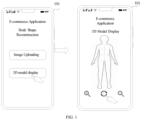
- FIG. 1 is a schematic diagram of an application scenario provided by an exemplary embodiment of this application. As shown in FIG. 1 , it includes an electronic device 101.
- the electronic device 101 can be a smartphone, a computer, a smart wearable watch, or other devices.
- the specific type of electronic device 101 is not limited in this embodiment of the application.
- a user when a user performs body feature digitization, i.e., body shape reconstruction, using the electronic device 101, they can first click on an image upload control to upload at least two images to be processed. Afterward, the user can click on a 3D model display control, and the electronic device can generate a three-dimensional (3D) model of the human body that closely matches the user's features and display the 3D model on a model display page. On the model display page, the user can interact with the 3D model of the human body by performing operations such as zooming in, zooming out, or rotating.
- body feature digitization i.e., body shape reconstruction
- body shape digitization can help recommend clothing styles suitable for a consumer's (user's) body type (e.g., broad shoulders, long legs, petite figure). It can also suggest the appropriate size of clothing based on the consumer's size data, addressing the issue of size selection difficulties during online shopping. Furthermore, it can assist industries and merchants in reducing the high return rates caused by size mismatches.
- the first approach involves using professional scanning equipment for 3D human body reconstruction (3D reconstruction).
- This 3D reconstruction typically refers to 3D mesh reconstruction, which can reconstruct the geometric contours of a target object but does not include textures to obtain a texture-less model of the object.
- the method of performing 3D reconstruction with professional scanning equipment requires users to physically enter large 3D scanning devices or have a professional operate portable 3D scanning equipment to conduct the reconstruction.
- This method of body shape reconstruction has high equipment costs and requires users to be physically present at the location, making it inconvenient and inefficient.
- the second approach is size estimation based on a single image.
- This method uses a single image of a human body to estimate the user's size information. However, it results in significant errors in representing the human body shape and cannot accurately reconstruct a 3D model of the human body. Additionally, using a single image for two-dimensional reconstruction has low accuracy.
- FIG. 2 shows a schematic diagram of human body size information display in related technologies.
- the electronic device can estimate the user's size information, such as shoulder width and body measurements (e.g., bust, waist, and hips).
- the electronic device can display fixed preset two-dimensional (2D) images 201 (for example, two preset 2D images can be preconfigured) and present the user's size information through dimensional annotations.
- 2D images 201 for example, two preset 2D images can be preconfigured
- present the user's size information through dimensional annotations.
- the electronic device can later establish a consumer body feature profile for size guidance and size recommendations.
- this size estimation method as it is based solely on a single image, does not achieve 3D body shape reconstruction and thus has low accuracy.
- HPS human pose and shape reconstruction
- the electronic device acquires at least two images of a target object to be processed. These images include images captured from at least two different shooting angles. The at least two images are then input into a target three-dimensional (3D) reconstruction model to reconstruct the target 3D body shape corresponding to the target object.
- This target 3D reconstruction model is trained based on M preset dimensional key points, where M is a positive integer.
- M is a positive integer.
- the target 3D body shape is then output.
- the embodiment of this application enables 3D body shape reconstruction of the target object by inputting at least two images into the target 3D reconstruction model. This improves the convenience of body shape reconstruction and reduces costs. Additionally, since the target 3D reconstruction model is trained based on preset dimensional key points, it achieves higher precision. Moreover, using images captured from different angles as input enhances the accuracy of human body shape reconstruction.
- FIG. 3 is a schematic flow diagram of an image processing method provided by an exemplary embodiment of this application. Please refer to FIG. 3 .
- the method may include the following steps: S301: obtaining at least two images of a target object to be processed, wherein the at least two images to be processed include images captured from at least two different shooting angles.
- the execution entity of the embodiments of this application can be an electronic device or an image processing device set within the electronic device.
- the electronic device can refer to a user-side terminal device or a cloud server.
- the image processing device can be implemented through software or a combination of software and hardware.
- This application embodiment does not impose any restrictions on the specific execution entity. For ease of understanding, the following explanation takes an electronic device as the execution entity as an example.
- the target object may refer to a consumer, user, or similar entity.
- the images to be processed refer to the images uploaded by the user.
- the number of images to be processed is at least two, corresponding to at least two shooting angles.
- the images to be processed may include an image captured from a frontal view and an image captured from a side view.
- features related to the width of the human body can be extracted from the frontal view image, while features related to the depth (thickness) of the human body can be extracted from the side view image.
- the embodiments of this application perform human body shape reconstruction based on at least two images captured from at least two shooting angles. This provides more essential information, ensuring the completeness and comprehensiveness of subsequent human body feature extraction, thereby improving the accuracy of body shape reconstruction.
- the user can interact with a preset control on the electronic device.
- This preset control can be, for example, an image upload control or a body shape reconstruction control.
- the specific configuration of the preset control is not limited in this application embodiment.
- the electronic device displays an image upload page. The user can either capture at least two images from different perspectives in real-time for upload or select at least two images from different perspectives from the local photo gallery for upload. In this way, the electronic device can acquire at least two images to be processed, captured from at least two shooting angles.
- S302 inputting the at least two images to be processed into a target three-dimensional (3D) reconstruction model to reconstruct a target 3D body shape corresponding to the target object, wherein the target 3D reconstruction model is trained based on M preset dimensional key points, and M is a positive integer.
- 3D three-dimensional
- the target three-dimensional (3D) reconstruction model refers to a model used for 3D body shape reconstruction.
- the target 3D reconstruction model may include a plurality of sub-models, such as a human detector, a deep encoder (encoder), a feature fusion module (e.g., transformer fusion), a fitting module (regression), a regressor, and a human body reconstruction model (3D mesh), among others. It may also include other models.
- the specific composition of the target 3D reconstruction model is not limited in this application embodiment.
- the human body shape is unique, distinguishing it from the human body pose. While a person's pose can vary infinitely, their body shape is singular, similar to the uniqueness of a human face. Body shape is one of the most important characteristics of the human body.
- the target 3D body shape refers to the 3D reconstruction model of the target object, which corresponds to the human body shape of the target object.
- the target 3D reconstruction model can be deployed on a cloud server. In this case, the electronic device can upload at least two images to be processed to the cloud server, which performs image processing and returns the target 3D body shape to the electronic device. This approach improves processing speed and conserves the electronic device's resources.
- the target 3D reconstruction model can also be deployed locally on the electronic device, allowing the device itself to perform image processing to obtain the target 3D body shape. This application embodiment does not impose limitations on the deployment location of the target 3D reconstruction model.
- Preset dimensional key points refer to preconfigured key points that represent the dimensions of the human body shape.
- the number of these preset dimensional key points can be M, which could specifically be 62 or another number. This application embodiment does not impose limitations on the exact number of preset dimensional key points.
- skeletal key points are typically used to supervise the reconstruction of body shape and pose.
- skeletal key points can usually only estimate the pose and cannot accurately predict the body shape. This is because the same set of skeletal key points can correspond to different body shapes. For instance, when a user's body weight changes (e.g., gaining or losing weight), the skeletal key points remain mostly unchanged, but the body shape undergoes significant changes.
- FIG. 4 is a schematic diagram of skeletal key points in related technologies. As shown in FIG. 4 , 17 skeletal key points are defined in related technologies, corresponding to a plurality of joints of the human body. These key points can effectively estimate the pose and actions of the human body. However, they cannot accurately reflect the user's body shape, such as weight changes (e.g., fatness or thinness).
- weight changes e.g., fatness or thinness
- preset dimensional key points of the human body are used to supervise the reconstruction of body shape, and the target three-dimensional (3D) reconstruction model is trained accordingly.
- This approach can accurately reflect the actual size parameters of various parts of the user's body, ensuring better correspondence between the key points and body shape parameters. It allows for a precise representation of the human body shape, thereby improving the accuracy of body shape reconstruction.
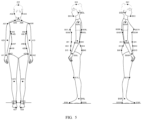
- FIG. 5 is a schematic diagram of preset dimensional key points provided by an exemplary embodiment of this application.
- this embodiment uses 62 preset dimensional key points, which can accurately reflect the size parameters of various parts of the human body. Compared to skeletal key points, preset dimensional key points can more efficiently and accurately represent human body shapes, addressing the issue where the same set of skeletal key points may correspond to a plurality of body shapes.
- the number M of preset dimensional key points can also be other values, and their positions can be set to different locations. These settings can be flexibly adjusted based on actual needs. This application embodiment does not impose limitations on the number or positions of the preset dimensional key points.
- the electronic device after determining the target 3D body shape, can output and display the target 3D body shape.
- the user can intuitively view the 3D human model and subsequently use this 3D model for tasks such as selecting and purchasing clothing.
- the electronic device can process the 3D body shape. For example, it can add hair, clothing, or blur the face for privacy.
- the electronic device can also load and render animations and display the target 3D body shape in an animated format, enhancing the liveliness and appeal of the model display.
- the electronic device acquires at least two images of the target object to be processed. These images include images captured from at least two different shooting angles.
- the at least two images are then input into a target three-dimensional (3D) reconstruction model to reconstruct the 3D body shape corresponding to the target object.
- the target 3D reconstruction model is trained based on M preset dimensional key points, where M is a positive integer.
- M is a positive integer.
- the target 3D body shape is then output.
- the embodiment achieves the reconstruction of the target object's 3D body shape, enhancing the convenience of body shape reconstruction and reducing costs.
- the target 3D reconstruction model is trained based on preset dimensional key points, it provides higher precision.
- using images captured from different angles as input improves the accuracy of human body shape reconstruction.
- FIG. 6 illustrates the flow diagram of another image processing method provided by an exemplary embodiment of this application. Please refer to FIG. 6 .
- This image processing method may include the following steps:
- global features refer to the collection of the target object's human body shape characteristics across various dimensions.
- Shooting parameters refer to parameters such as the camera's shooting height, shooting angle, etc.
- Posture parameters include the target object's pose and body shape parameters.
- pose parameters refer to the gestures or posture of the target object, which can be represented using a rotation matrix. This rotation matrix may include information such as the rotation direction and rotation angle of a specific body part relative to a certain joint.
- Shape parameters refer to the three-dimensional data of the target object, which may include specific measurements such as shoulder width, height, chest depth, etc., represented in numerical form.
- the model can determine the global features, shooting parameters, and posture parameters based on the images. Subsequently, these parameters can be used to reconstruct the 3D body shape model of the human body.
- the global features can be obtained through the following steps (1) to (4):
- semantic features refer to characteristics such as the human body contours of the target object within the target patches.
- These semantic features are learned by the target 3D reconstruction model through large amounts of sample data, without requiring manual definition. During the training process, users only need to input the data and specify the learning objectives.
- the 3D reconstruction model autonomously learns and extracts the semantic features, simplifying user operations and improving convenience.
- step (3) can be achieved as follows: inputting each target image patch into a deep encoder based on a convolutional neural network (CNN) to extract a set of semantic features corresponding to the target patch.
- the target 3D reconstruction model includes a deep encoder based on a convolutional neural network.
- the target 3D reconstruction model may include a deep encoder based on a convolutional neural network (CNN-based Encoder), where the encoder's weights are shared.
- CNN-based Encoder convolutional neural network
- the electronic device can input each target image patch into this weight-sharing deep encoder to extract the semantic features.
- the semantic features extracted under each shooting angle may differ. Therefore, after the electronic device extracts at least two sets of semantic features corresponding to at least two target patches, it can fuse these semantic features to obtain the target object's overall, multi-angle global features (fused feats).
- step (4) can be achieved as follows: inputting the at least two sets of semantic features as at least two sequences into a feature fusion module to obtain the global features.
- the target 3D reconstruction model includes a feature fusion module.
- the target 3D reconstruction model may include a feature fusion module, which is used to fuse the semantic features to obtain the global features.
- the electronic device can treat the N semantic features as N sequences (where N is a positive integer greater than or equal to 2). For example, sequence 1 could represent the target object captured from the frontal view, while sequence 2 could represent the target object captured from the side view.
- the electronic device can input these N semantic features into the feature fusion module to obtain the global features corresponding to the target object.
- the shooting parameters and posture parameters can be obtained as follows: performing prediction processing on the images to be processed using an encoder and a fitting module to obtain the shooting parameters and posture parameters; the target 3D reconstruction model includes an encoder and a fitting module.
- the target 3D reconstruction model may include an encoder (encoder) and a regressor (regression).
- the encoder and regressor can be used to perform prediction processing on the images to be processed, determining the shooting parameters as well as the posture parameters (pose parameters and body shape parameters) of the images.
- FIG. 7 illustrates the prediction process of shooting parameters and posture parameters in an exemplary embodiment of this application.
- the electronic device can input the image to be processed 701 into the encoder 702.
- the encoder 702 performs encoding, and the regressor 703 performs fitting. Through this process, the shooting parameters, pose parameters, and body shape parameters can be obtained.
- S603 reconstructing the target 3D body shape based on the global feature, shooting parameter, and posture parameter through the target 3D reconstruction model.
- the electronic device can reconstruct the target 3D body shape based on these parameters using the target 3D reconstruction model.
- S403 can be achieved through the following steps (5) to (6):
- the predicted parameters refer to a parameter array composed of the global features, shooting parameters, and posture parameters.
- the target 3D reconstruction model may include a regressor built using a fully connected network (fc-based regressor), which is used to perform feature fitting and obtain the predicted parameters.
- the fused features can be used as the input to the fully connected network-based regressor, which fits parameters such as the shooting parameters and posture parameters (params) to derive the predicted parameters.
- the target 3D reconstruction model may include a human body reconstruction model, which can be an extended human model that supports preset dimensional key points (e.g., extended-SMPL) for reconstructing the 3D body shape model (3D mesh).
- the electronic device can fit the global features, shooting parameters, and posture parameters to obtain the predicted parameters, then input these predicted parameters into the human body reconstruction model to reconstruct the target 3D body shape. In this way, through feature fitting and 3D model reconstruction, the system can accurately generate the 3D body shape model, significantly improving the precision of body shape reconstruction.
- S604 performing preset processing on the target 3D body shape to obtain a 3D body shape to be displayed, wherein the preset processing includes at least one of clothing addition or facial processing; and displaying the 3D body shape to be displayed.
- preset processing refers to display-related processing of the target 3D body shape, which may include adding clothing, adding hair, facial processing, and similar tasks.
- clothing refers to default or preconfigured 3D garments; facial processing may include operations like face blurring, among others.
- preset processing can also include other types of operations, and this application embodiment does not impose limitations on the specific types or number of preset processing methods.
- S605 in response to a touch operation performed on the target 3D body shape, adjusting the target 3D body shape according to a preset adjustment type corresponding to the touch operation; wherein the preset adjustment types include at least one of rotation, magnification, or reduction.
- a touch operation refers to the user's interactive action on the target 3D body shape or the 3D body shape to be displayed. This may include actions such as rotating, sliding, or tapping, among others.
- the specific types of touch operations are not limited in this embodiment.
- the preset adjustment type refers to the type of adjustment corresponding to the touch operation, which can specifically include actions such as rotation, magnification, or reduction, among others.
- the user when the user needs to rotate or zoom in on a specific part of the target 3D body shape model (i.e., the target 3D body shape), they can perform a sliding operation directly on the target 3D body shape model or use a preset rotation or zoom control.
- the electronic device in response to the user's touch operation, can adjust the target 3D body shape model according to the preset adjustment type corresponding to the touch operation.
- the electronic device obtains at least two images of the target object taken from at least two different shooting angles.
- the images are then input into the target 3D reconstruction model, which determines the global features, shooting parameters, and posture parameters corresponding to the target object.
- the target 3D reconstruction model reconstructs the target 3D body shape.
- the reconstructed 3D body shape undergoes preset processing to produce a 3D body shape to be displayed, which is then presented to the user.
- the electronic device adjusts the 3D body shape according to the preset adjustment type corresponding to the touch operation.
- this embodiment of the application enables the automatic extraction of global features, shooting parameters, and posture parameters of the target object through the target 3D reconstruction model, and reconstructs the target 3D body shape. This improves the convenience of body shape reconstruction and reduces costs. Moreover, using a plurality of images from a plurality of shooting angles for image processing enhances the precision of body shape reconstruction. At the same time, post-processing is applied to the target 3D body shape, and users are enabled to interact with the model, optimizing the model's display effect and further improving the user interaction experience.
- FIG. 8 illustrates the training flow of a target 3D reconstruction model in an exemplary embodiment of this application. Please refer to FIG. 8 , which includes the following steps:
- these points can be compared with the preset dimensional key points to determine the deviation between the two, and the loss value can be calculated.
- the preset dimensional key points refer to the ground truth (GT) size key points that are manually labeled.
- the number of these preset dimensional key points can be M.
- the preset dimensional key point can be obtained by manually annotating 2D images.
- This approach is cost-effective, scalable, and can efficiently represent the human body shape.
- After obtaining the sample 3D body shape model it can be projected onto a 2D plane to generate the sample dimensional key point.
- the deviation between the two can be determined, and this deviation can be used to calculate the loss value.
- parameter tuning and iterative training can be performed based on the loss value.
- the parameters of the preset 3D reconstruction model can be adjusted, and iterative training can be performed.
- the target 3D reconstruction model can be obtained, which can then be used for inference in subsequent processes.
- a supervised training approach is used for model training.
- Supervised training refers to a method where the model is guided to automatically extract features from the raw input that are necessary to complete a specified task.
- the manually labeled preset dimensional key point ground truth (GT) is used as supervision to calculate the loss value and guide the training of the entire model. This approach improves the accuracy of the model training process.
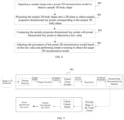
- FIG. 9 illustrates an exemplary technical logic diagram for image processing provided in this application embodiment.
- the target 3D reconstruction model 901 may include a human detector, a deep encoder, a feature fusion module, a regressor, and a human body reconstruction model.
- the electronic device obtains at least two images of the target object captured from at least two different angles. These images are first input into the human detector, which detects the regions of the person in the images and segments them to obtain at least two target image patches. Subsequently, the electronic device inputs these target patches into a deep encoder based on a convolutional neural network (CNN), which shares weights, to extract a set of semantic features corresponding to each target patch.
- CNN convolutional neural network
- the electronic device treats the extracted semantic features as at least two sequences and inputs them into a feature fusion module based on a transformer, obtaining multi-angle fused global features.
- the fused global features are then used as inputs to a regressor built with a fully connected network, which fits parameters such as the shooting parameters, pose, and body shape to obtain predicted parameters.
- the electronic device inputs these predicted parameters into an extended human body reconstruction model that supports dimensional key points, obtaining the reconstructed 3D body shape of the target.
- the target 3D reconstruction model takes the images to be processed as input and outputs the 3D body shape of the target person, significantly improving the convenience and accuracy of body shape reconstruction.
- the sample 3D body shape can be projected onto a 2D plane using a standard pinhole camera model, along with its corresponding dimensional key points, to obtain the sample projection dimensional key points.
- the manually annotated preset dimensional key points are used as supervision to calculate the loss value and guide the training of the entire model, ultimately obtain the target 3D reconstruction model.
- the portion of the pinhole camera model within the dashed box in FIG. 9 is used only during the training phase and is not executed during actual inference.
- the pinhole camera model is used in the training phase solely for projecting the 3D model onto the 2D plane.
- the target 3D reconstruction model can directly output the target 3D body shape model without requiring the use of the pinhole camera model.
- the electronic device uses at least two images captured from at least two different shooting angles as input. It extracts the semantic features corresponding to each shooting angle separately and then performs feature fusion. This approach ensures that the extracted human body features are comprehensive and global, enabling high-precision body shape reconstruction.
- preset dimensional key points are used as body shape representations to supervise the training of the preset 3D reconstruction model.
- M preset dimensional key points which are highly correlated with human body characteristics, are defined to replace the skeletal key point approach commonly used in related technologies.
- the preset dimensional key points can be obtained by manually annotating 2D images, making the approach cost-effective and scalable. Compared to skeletal key points, these dimensional key points provide a more efficient representation of human body shapes, addressing the issue in which the same set of skeletal key points can correspond to a plurality of possible body shapes.
- a single monocular image is often used for 2D reconstruction.
- an image is essentially a 2D projection of a 3D object. Since a monocular image inherently loses one dimension of information, it is typically impossible to reconstruct the 3D information of an object accurately using just a single image.
- the electronic device uses monocular, multi-angle images to perform 3D human body reconstruction.
- a weight-sharing deep encoder is used to separately extract the semantic features for each viewing angle.
- a feature fusion module performs multi-angle and global feature fusion to generate the global features.
- the fused global features are used as the input to the prediction head, which regresses the body shape parameters, pose parameters, and shooting parameters to obtain the predicted parameters.
- the predicted parameters are fed into the human body reconstruction model to obtain the target 3D body shape.
- FIG. 10 illustrates another flow diagram of an image processing method provided in this exemplary embodiment. Please refer to FIG. 10 , where the method may include the following steps:
- the first control refers to a preconfigured image upload control
- the second control refers to a preconfigured 3D body shape generation control
- the electronic device can display both the first and second controls simultaneously on the user interface.
- the interface can display an "Image Upload” control (first control) and a "3D Model Generation” control (second control). Users can click the "Image Upload” control to upload the images to be processed and then click the "3D Model Generation” control to generate the target 3D body shape.
- the electronic device may only display the second control on the user interface.
- a user wants to generate the target 3D body shape, they can click the second control.
- the electronic device in response to the user's touch operation on the second control, will display an image upload interface, which includes the first control.
- the user can select the images to be processed and touch the first control to upload the images.
- the electronic device can then obtain the images to be processed and input them into the target 3D reconstruction model for body shape reconstruction.
- the first and second controls can be presented in other display methods as well, and this application embodiment does not impose any limitations on their specific display approach.
- the electronic device after reconstructing the target 3D body shape, can display the target 3D body shape on the interface. This allows users to intuitively view the reconstructed 3D body shape, facilitating subsequent operations such as clothing selection and purchase.
- the electronic device responds to a touch operation on the first control to obtain at least two images of the target object to be processed. These images include at least two images taken from different shooting angles.
- the electronic device inputs the at least two images into the target 3D reconstruction model to reconstruct the target 3D body shape corresponding to the target object.
- the target 3D reconstruction model is trained using M preset dimensional key points, where M is a positive integer.
- M is a positive integer.
- the reconstructed target 3D body shape is output and displayed.
- this application embodiment allows the reconstruction of the target object's 3D body shape by inputting at least two images into the target 3D reconstruction model. This improves the convenience of body shape reconstruction and reduces costs.
- the target 3D reconstruction model is trained based on preset dimensional key points, the reconstruction precision is higher. Using images from different angles as input further enhances the accuracy of human body shape reconstruction.
- FIG. 11 illustrates the structural diagram of an image processing device provided in this exemplary embodiment. Please refer to FIG. 11 , where the image processing device 110 includes the following components:
- the reconstruction module 112 is specifically used to:
- the reconstruction module 112 is specifically used to:
- the reconstruction module 112 is specifically used to: input each target image patch into a deep encoder based on a convolutional neural network (CNN) to extract a set of semantic features corresponding to each target image patch; the target 3D reconstruction model includes the deep encoder based on a convolutional neural network.
- CNN convolutional neural network
- the reconstruction module 112 is specifically used to: input the at least two sets of semantic features as at least two sequences into a feature fusion module to obtain the global features.
- the target 3D reconstruction model includes the feature fusion module.
- the reconstruction module 112 is specifically used to: perform prediction processing on the images to be processed using an encoder and a regressor, to obtain the shooting parameters and posture parameters; the target 3D reconstruction model includes the encoder and the regressor.
- the reconstruction module 112 is specifically used to:
- the device 110 further includes:
- the output module 113 is specifically used to:
- the device 110 further includes: adjustment module configured used to adjust the target 3D body shape in response to a touch operation on the target 3D body shape.
- the adjustment is performed according to the preset adjustment type corresponding to the touch operation.
- the preset adjustment types include at least one of rotation, magnification, or reduction.
- the image processing device 110 provided in this application embodiment can execute the technical solutions described in the above method embodiments. Its implementation principles and beneficial effects are similar, and thus will not be repeated here.
- FIG. 12 illustrates the structural diagram of another image processing device 120 provided in this exemplary embodiment. Please refer to FIG. 12 , where the image processing device 120 includes:
- the image processing device 120 provided in this application embodiment can execute the technical solutions described in the above method embodiments. Its implementation principles and beneficial effects are similar, and thus will not be repeated here.
- FIG. 13 illustrates the structural diagram of an electronic device 130 provided in this exemplary embodiment. Please refer to FIG. 13 , where the electronic device 130 may include a processor 131 and a memory 132. As an example, the processor 131 and memory 132 are interconnected via a bus 133.
- the memory 132 stores computer-executable instructions.
- the processor 131 executes the computer-executable instructions stored in the memory 132, enabling the processor 131 to perform the image processing method as described in the above method embodiments.
- this application embodiment provides a computer-readable storage medium, which stores computer-executable instructions.
- the instructions When executed by a processor, they are used to implement the image processing method described in the above method embodiments.
- this application embodiment also provides a computer program product, which includes a computer program.
- the computer program When executed by a processor, the computer program can implement the image processing method described in the above method embodiments.
- the embodiments of the present invention can be provided in the form of a method, system, or computer program product. Therefore, the present invention can be implemented as a purely hardware-based embodiment, a purely software-based embodiment, or an embodiment that combines software and hardware aspects. Furthermore, the present invention can take the form of a computer program product implemented on one or more computer-readable storage media containing computer-usable program code. These storage media include, but are not limited to, magnetic disk storage, CD-ROM, optical storage, and the like.
- These computer program instructions can also be stored in a computer-readable storage medium that directs a computer or other programmable data processing device to operate in a specific manner.
- the instructions stored in the computer-readable storage medium produce an article of manufacture that includes instruction means for implementing the functions specified in one or more flows in the flowcharts and/or one or more blocks in the block diagrams.
- a computing device includes one or more processors, input/output interfaces, network interfaces, and memory.
- the memory may include non-persistent storage in the form of computer-readable media, such as random access memory (RAM), and/or non-volatile memory, such as read-only memory (ROM) or flash memory (flash RAM).
- RAM random access memory
- ROM read-only memory
- flash RAM flash memory
- a computer-readable medium includes permanent and non-permanent, removable and non-removable media implemented in any method or technology for storing information.
- the information may include computer-readable instructions, data structures, program modules, or other data.
- Examples of computer storage media include, but are not limited to: phase-change memory (PRAM), static random-access memory (SRAM), dynamic random-access memory (DRAM), other types of random-access memory (RAM), read-only memory (ROM), electrically erasable programmable read-only memory (EEPROM), flash memory, or other memory technologies; compact disc read-only memory (CD-ROM), digital versatile discs (DVD), or other optical storage; magnetic cassettes, magnetic tapes, magnetic disk storage, or other magnetic storage devices; or any other non-transitory medium capable of storing information that can be accessed by a computing device.
- a computer-readable medium does not include transitory computer-readable media, such as modulated data signals and carrier waves.
Landscapes
- Engineering & Computer Science (AREA)
- Theoretical Computer Science (AREA)
- Physics & Mathematics (AREA)
- General Physics & Mathematics (AREA)
- Computer Vision & Pattern Recognition (AREA)
- Software Systems (AREA)
- Evolutionary Computation (AREA)
- Multimedia (AREA)
- Computing Systems (AREA)
- General Health & Medical Sciences (AREA)
- Artificial Intelligence (AREA)
- Health & Medical Sciences (AREA)
- General Engineering & Computer Science (AREA)
- Databases & Information Systems (AREA)
- Computer Graphics (AREA)
- Geometry (AREA)
- Medical Informatics (AREA)
- Human Computer Interaction (AREA)
- Biomedical Technology (AREA)
- Computational Linguistics (AREA)
- Data Mining & Analysis (AREA)
- Molecular Biology (AREA)
- Mathematical Physics (AREA)
- Biophysics (AREA)
- Life Sciences & Earth Sciences (AREA)
- Image Analysis (AREA)
- Processing Or Creating Images (AREA)
Applications Claiming Priority (2)
| Application Number | Priority Date | Filing Date | Title |
|---|---|---|---|
| CN202211477751.3A CN115984455A (zh) | 2022-11-23 | 2022-11-23 | 图像处理方法、装置及设备 |
| PCT/CN2023/129575 WO2024109522A1 (zh) | 2022-11-23 | 2023-11-03 | 图像处理方法、装置及设备 |
Publications (2)
| Publication Number | Publication Date |
|---|---|
| EP4567739A1 true EP4567739A1 (de) | 2025-06-11 |
| EP4567739A4 EP4567739A4 (de) | 2025-11-19 |
Family
ID=85971147
Family Applications (1)
| Application Number | Title | Priority Date | Filing Date |
|---|---|---|---|
| EP23893613.2A Pending EP4567739A4 (de) | 2022-11-23 | 2023-11-03 | Bildverarbeitungsverfahren und -vorrichtung sowie vorrichtung |
Country Status (5)
| Country | Link |
|---|---|
| US (1) | US20250200880A1 (de) |
| EP (1) | EP4567739A4 (de) |
| KR (1) | KR20250113395A (de) |
| CN (1) | CN115984455A (de) |
| WO (1) | WO2024109522A1 (de) |
Cited By (1)
| Publication number | Priority date | Publication date | Assignee | Title |
|---|---|---|---|---|
| WO2026088051A1 (en) * | 2024-10-21 | 2026-04-30 | Esenca Digital Workwear S.R.L. | Ai based body measurement system and method thereof |
Families Citing this family (4)
| Publication number | Priority date | Publication date | Assignee | Title |
|---|---|---|---|---|
| CN115984455A (zh) * | 2022-11-23 | 2023-04-18 | 阿里巴巴(中国)有限公司 | 图像处理方法、装置及设备 |
| CN117788091B (zh) * | 2023-10-18 | 2024-08-02 | 北京农夫铺子技术研究院 | 基于用户消费大数据的元宇宙电商平台构建方法及系统 |
| CN118972669B (zh) * | 2024-07-03 | 2025-05-27 | 阿里巴巴达摩院(杭州)科技有限公司 | 对象生成方法、4d对象生成方法及视频生成方法 |
| CN119342246B (zh) * | 2024-09-20 | 2025-11-25 | 维沃移动通信有限公司 | 视频生成方法、装置、电子设备及可读存储介质 |
Family Cites Families (11)
| Publication number | Priority date | Publication date | Assignee | Title |
|---|---|---|---|---|
| US10706262B2 (en) * | 2018-01-08 | 2020-07-07 | 3DLOOK Inc. | Intelligent body measurement |
| CN111028354A (zh) * | 2018-10-10 | 2020-04-17 | 成都理工大学 | 一种基于图像序列的模型形变人脸三维重建方案 |
| CN113496507B (zh) * | 2020-03-20 | 2024-09-27 | 华为技术有限公司 | 一种人体三维模型重建方法 |
| CN111784818B (zh) * | 2020-06-01 | 2024-04-16 | 北京沃东天骏信息技术有限公司 | 生成三维人体模型的方法、装置及计算机可读存储介质 |
| CN112418399B (zh) * | 2020-11-20 | 2024-03-26 | 清华大学 | 训练姿态估计模型的方法、装置、姿态估计的方法及装置 |
| CN112669441B (zh) * | 2020-12-09 | 2023-10-17 | 北京达佳互联信息技术有限公司 | 一种对象重建方法、装置、电子设备和存储介质 |
| CN112950769A (zh) * | 2021-03-31 | 2021-06-11 | 深圳市慧鲤科技有限公司 | 三维人体重建方法、装置、设备及存储介质 |
| CN113936094A (zh) * | 2021-09-17 | 2022-01-14 | 青岛海尔科技有限公司 | 对象参数获取方法、装置及设备 |
| CN114821506A (zh) * | 2022-05-11 | 2022-07-29 | 北京地平线机器人技术研发有限公司 | 多视角语义分割方法、装置、电子设备和存储介质 |
| CN115082381B (zh) * | 2022-05-27 | 2025-07-18 | 西安电子科技大学广州研究院 | 一种基于u型网络的多目标分割方法及装置 |
| CN115984455A (zh) * | 2022-11-23 | 2023-04-18 | 阿里巴巴(中国)有限公司 | 图像处理方法、装置及设备 |
-
2022
- 2022-11-23 CN CN202211477751.3A patent/CN115984455A/zh active Pending
-
2023
- 2023-11-03 WO PCT/CN2023/129575 patent/WO2024109522A1/zh not_active Ceased
- 2023-11-03 KR KR1020257014534A patent/KR20250113395A/ko active Pending
- 2023-11-03 EP EP23893613.2A patent/EP4567739A4/de active Pending
-
2025
- 2025-03-06 US US19/072,895 patent/US20250200880A1/en active Pending
Cited By (1)
| Publication number | Priority date | Publication date | Assignee | Title |
|---|---|---|---|---|
| WO2026088051A1 (en) * | 2024-10-21 | 2026-04-30 | Esenca Digital Workwear S.R.L. | Ai based body measurement system and method thereof |
Also Published As
| Publication number | Publication date |
|---|---|
| CN115984455A (zh) | 2023-04-18 |
| US20250200880A1 (en) | 2025-06-19 |
| EP4567739A4 (de) | 2025-11-19 |
| WO2024109522A1 (zh) | 2024-05-30 |
| KR20250113395A (ko) | 2025-07-25 |
Similar Documents
| Publication | Publication Date | Title |
|---|---|---|
| US20250200880A1 (en) | Image processing method and apparatus, and device | |
| US10470510B1 (en) | Systems and methods for full body measurements extraction using multiple deep learning networks for body feature measurements | |
| US10679046B1 (en) | Machine learning systems and methods of estimating body shape from images | |
| US20170193693A1 (en) | Systems and methods for generating time discrete 3d scenes | |
| WO2021063271A1 (zh) | 人体模型重建方法、重建系统及存储介质 | |
| Han et al. | Caricatureshop: Personalized and photorealistic caricature sketching | |
| CN109285215A (zh) | 一种人体三维模型重建方法、装置和存储介质 | |
| CN109801380A (zh) | 一种虚拟试衣的方法、装置、存储介质及计算机设备 | |
| Sheng et al. | A lightweight surface reconstruction method for online 3D scanning point cloud data oriented toward 3D printing | |
| Chen et al. | Autosweep: Recovering 3d editable objects from a single photograph | |
| WO2024240180A1 (zh) | 图像处理方法、显示方法及计算设备 | |
| Rasoulzadeh et al. | Strokes2surface: recovering curve networks from 4D architectural design sketches | |
| CN116309005A (zh) | 虚拟换装方法、装置、电子设备及可读介质 | |
| Wang et al. | Geneman: Generalizable single-image 3d human reconstruction from multi-source human data | |
| Li et al. | PLDGAN: portrait line drawing generation with prior knowledge and conditioning target | |
| Marelli et al. | Faithful fit, markerless, 3d eyeglasses virtual try-on | |
| CN108629824B (zh) | 图像生成方法、装置、电子设备及计算机可读介质 | |
| Chu et al. | A cloud service framework for virtual try-on of footwear in augmented reality | |
| Li et al. | Efficient bundle optimization for accurate camera pose estimation in mobile augmented reality systems | |
| Liu et al. | Image matting and 3D reconstruction in one loop | |
| Zhang et al. | Visual Harmony: LLM’s Power in Crafting Coherent Indoor Scenes from Images | |
| CN114067046B (zh) | 一种单张图片重建手部三维模型并显示的方法及系统 | |
| Xu et al. | An ensemble learning-based prediction model for image forensics from IoT camera in smart cities | |
| Wang et al. | Personalized Hand Modeling from Multiple Postures with Multi‐View Color Images | |
| Liu et al. | New anti-blur and illumination-robust combined invariant for stereo vision in human belly reconstruction |
Legal Events
| Date | Code | Title | Description |
|---|---|---|---|
| STAA | Information on the status of an ep patent application or granted ep patent |
Free format text: STATUS: THE INTERNATIONAL PUBLICATION HAS BEEN MADE |
|
| PUAI | Public reference made under article 153(3) epc to a published international application that has entered the european phase |
Free format text: ORIGINAL CODE: 0009012 |
|
| STAA | Information on the status of an ep patent application or granted ep patent |
Free format text: STATUS: REQUEST FOR EXAMINATION WAS MADE |
|
| 17P | Request for examination filed |
Effective date: 20250307 |
|
| AK | Designated contracting states |
Kind code of ref document: A1 Designated state(s): AL AT BE BG CH CY CZ DE DK EE ES FI FR GB GR HR HU IE IS IT LI LT LU LV MC ME MK MT NL NO PL PT RO RS SE SI SK SM TR |
|
| A4 | Supplementary search report drawn up and despatched |
Effective date: 20251017 |
|
| RIC1 | Information provided on ipc code assigned before grant |
Ipc: G06T 17/00 20060101AFI20251013BHEP Ipc: G06V 10/80 20220101ALI20251013BHEP Ipc: G06T 7/55 20170101ALI20251013BHEP Ipc: G06T 7/70 20170101ALI20251013BHEP Ipc: G06V 10/82 20220101ALI20251013BHEP |
|
| DAV | Request for validation of the european patent (deleted) | ||
| DAX | Request for extension of the european patent (deleted) |