EP4567872A2 - Materialentfernungsvorrichtung und verfahren zum entfernen von material von einem objektträger - Google Patents
Materialentfernungsvorrichtung und verfahren zum entfernen von material von einem objektträger Download PDFInfo
- Publication number
- EP4567872A2 EP4567872A2 EP25169453.5A EP25169453A EP4567872A2 EP 4567872 A2 EP4567872 A2 EP 4567872A2 EP 25169453 A EP25169453 A EP 25169453A EP 4567872 A2 EP4567872 A2 EP 4567872A2
- Authority
- EP
- European Patent Office
- Prior art keywords
- removal
- radiation
- regions
- chemical assistant
- object support
- Prior art date
- Legal status (The legal status is an assumption and is not a legal conclusion. Google has not performed a legal analysis and makes no representation as to the accuracy of the status listed.)
- Pending
Links
Images
Classifications
-
- H—ELECTRICITY
- H10—SEMICONDUCTOR DEVICES; ELECTRIC SOLID-STATE DEVICES NOT OTHERWISE PROVIDED FOR
- H10P—GENERIC PROCESSES OR APPARATUS FOR THE MANUFACTURE OR TREATMENT OF DEVICES COVERED BY CLASS H10
- H10P72/00—Handling or holding of wafers, substrates or devices during manufacture or treatment thereof
- H10P72/04—Apparatus for manufacture or treatment
- H10P72/0402—Apparatus for fluid treatment
- H10P72/0418—Apparatus for fluid treatment for etching
- H10P72/0421—Apparatus for fluid treatment for etching for drying etching
-
- G—PHYSICS
- G03—PHOTOGRAPHY; CINEMATOGRAPHY; ANALOGOUS TECHNIQUES USING WAVES OTHER THAN OPTICAL WAVES; ELECTROGRAPHY; HOLOGRAPHY
- G03F—PHOTOMECHANICAL PRODUCTION OF TEXTURED OR PATTERNED SURFACES, e.g. FOR PRINTING, FOR PROCESSING OF SEMICONDUCTOR DEVICES; MATERIALS THEREFOR; ORIGINALS THEREFOR; APPARATUS SPECIALLY ADAPTED THEREFOR
- G03F7/00—Photomechanical, e.g. photolithographic, production of textured or patterned surfaces, e.g. printing surfaces; Materials therefor, e.g. comprising photoresists; Apparatus specially adapted therefor
- G03F7/70—Microphotolithographic exposure; Apparatus therefor
- G03F7/70691—Handling of masks or workpieces
- G03F7/707—Chucks, e.g. chucking or un-chucking operations or structural details
-
- G—PHYSICS
- G03—PHOTOGRAPHY; CINEMATOGRAPHY; ANALOGOUS TECHNIQUES USING WAVES OTHER THAN OPTICAL WAVES; ELECTROGRAPHY; HOLOGRAPHY
- G03F—PHOTOMECHANICAL PRODUCTION OF TEXTURED OR PATTERNED SURFACES, e.g. FOR PRINTING, FOR PROCESSING OF SEMICONDUCTOR DEVICES; MATERIALS THEREFOR; ORIGINALS THEREFOR; APPARATUS SPECIALLY ADAPTED THEREFOR
- G03F7/00—Photomechanical, e.g. photolithographic, production of textured or patterned surfaces, e.g. printing surfaces; Materials therefor, e.g. comprising photoresists; Apparatus specially adapted therefor
- G03F7/70—Microphotolithographic exposure; Apparatus therefor
- G03F7/708—Construction of apparatus, e.g. environment aspects, hygiene aspects or materials
- G03F7/70908—Hygiene, e.g. preventing apparatus pollution, mitigating effect of pollution or removing pollutants from apparatus
- G03F7/70925—Cleaning, i.e. actively freeing apparatus from pollutants, e.g. using plasma cleaning
-
- H—ELECTRICITY
- H01—ELECTRIC ELEMENTS
- H01J—ELECTRIC DISCHARGE TUBES OR DISCHARGE LAMPS
- H01J37/00—Discharge tubes with provision for introducing objects or material to be exposed to the discharge, e.g. for the purpose of examination or processing thereof
- H01J37/02—Details
- H01J37/22—Optical, image processing or photographic arrangements associated with the tube
- H01J37/226—Optical arrangements for illuminating the object; optical arrangements for collecting light from the object
- H01J37/228—Optical arrangements for illuminating the object; optical arrangements for collecting light from the object whereby illumination or light collection take place in the same area of the discharge
-
- H—ELECTRICITY
- H10—SEMICONDUCTOR DEVICES; ELECTRIC SOLID-STATE DEVICES NOT OTHERWISE PROVIDED FOR
- H10P—GENERIC PROCESSES OR APPARATUS FOR THE MANUFACTURE OR TREATMENT OF DEVICES COVERED BY CLASS H10
- H10P72/00—Handling or holding of wafers, substrates or devices during manufacture or treatment thereof
- H10P72/04—Apparatus for manufacture or treatment
- H10P72/0431—Apparatus for thermal treatment
- H10P72/0436—Apparatus for thermal treatment mainly by radiation
-
- H—ELECTRICITY
- H10—SEMICONDUCTOR DEVICES; ELECTRIC SOLID-STATE DEVICES NOT OTHERWISE PROVIDED FOR
- H10P—GENERIC PROCESSES OR APPARATUS FOR THE MANUFACTURE OR TREATMENT OF DEVICES COVERED BY CLASS H10
- H10P72/00—Handling or holding of wafers, substrates or devices during manufacture or treatment thereof
- H10P72/04—Apparatus for manufacture or treatment
- H10P72/0451—Apparatus for manufacturing or treating in a plurality of work-stations
- H10P72/0468—Apparatus for manufacturing or treating in a plurality of work-stations comprising a chamber adapted to a particular process
- H10P72/0471—Apparatus for manufacturing or treating in a plurality of work-stations comprising a chamber adapted to a particular process comprising at least one ion or electron beam chamber
-
- H—ELECTRICITY
- H10—SEMICONDUCTOR DEVICES; ELECTRIC SOLID-STATE DEVICES NOT OTHERWISE PROVIDED FOR
- H10P—GENERIC PROCESSES OR APPARATUS FOR THE MANUFACTURE OR TREATMENT OF DEVICES COVERED BY CLASS H10
- H10P72/00—Handling or holding of wafers, substrates or devices during manufacture or treatment thereof
- H10P72/50—Handling or holding of wafers, substrates or devices during manufacture or treatment thereof for positioning, orientation or alignment
- H10P72/57—Mask-wafer alignment
-
- H—ELECTRICITY
- H10—SEMICONDUCTOR DEVICES; ELECTRIC SOLID-STATE DEVICES NOT OTHERWISE PROVIDED FOR
- H10P—GENERIC PROCESSES OR APPARATUS FOR THE MANUFACTURE OR TREATMENT OF DEVICES COVERED BY CLASS H10
- H10P72/00—Handling or holding of wafers, substrates or devices during manufacture or treatment thereof
- H10P72/70—Handling or holding of wafers, substrates or devices during manufacture or treatment thereof for supporting or gripping
- H10P72/72—Handling or holding of wafers, substrates or devices during manufacture or treatment thereof for supporting or gripping using electrostatic chucks
-
- H—ELECTRICITY
- H10—SEMICONDUCTOR DEVICES; ELECTRIC SOLID-STATE DEVICES NOT OTHERWISE PROVIDED FOR
- H10P—GENERIC PROCESSES OR APPARATUS FOR THE MANUFACTURE OR TREATMENT OF DEVICES COVERED BY CLASS H10
- H10P72/00—Handling or holding of wafers, substrates or devices during manufacture or treatment thereof
- H10P72/70—Handling or holding of wafers, substrates or devices during manufacture or treatment thereof for supporting or gripping
- H10P72/76—Handling or holding of wafers, substrates or devices during manufacture or treatment thereof for supporting or gripping using mechanical means, e.g. clamps or pinches
- H10P72/7604—Handling or holding of wafers, substrates or devices during manufacture or treatment thereof for supporting or gripping using mechanical means, e.g. clamps or pinches the wafers being placed on a susceptor, stage or support
- H10P72/7614—Handling or holding of wafers, substrates or devices during manufacture or treatment thereof for supporting or gripping using mechanical means, e.g. clamps or pinches the wafers being placed on a susceptor, stage or support characterised by a plurality of individual support members, e.g. support posts or protrusions
-
- H—ELECTRICITY
- H10—SEMICONDUCTOR DEVICES; ELECTRIC SOLID-STATE DEVICES NOT OTHERWISE PROVIDED FOR
- H10P—GENERIC PROCESSES OR APPARATUS FOR THE MANUFACTURE OR TREATMENT OF DEVICES COVERED BY CLASS H10
- H10P72/00—Handling or holding of wafers, substrates or devices during manufacture or treatment thereof
- H10P72/70—Handling or holding of wafers, substrates or devices during manufacture or treatment thereof for supporting or gripping
- H10P72/76—Handling or holding of wafers, substrates or devices during manufacture or treatment thereof for supporting or gripping using mechanical means, e.g. clamps or pinches
- H10P72/7604—Handling or holding of wafers, substrates or devices during manufacture or treatment thereof for supporting or gripping using mechanical means, e.g. clamps or pinches the wafers being placed on a susceptor, stage or support
- H10P72/7616—Handling or holding of wafers, substrates or devices during manufacture or treatment thereof for supporting or gripping using mechanical means, e.g. clamps or pinches the wafers being placed on a susceptor, stage or support characterised by a coating, a hardness or a material
-
- H—ELECTRICITY
- H01—ELECTRIC ELEMENTS
- H01J—ELECTRIC DISCHARGE TUBES OR DISCHARGE LAMPS
- H01J2237/00—Discharge tubes exposing object to beam, e.g. for analysis treatment, etching, imaging
- H01J2237/30—Electron or ion beam tubes for processing objects
- H01J2237/31—Processing objects on a macro-scale
- H01J2237/3151—Etching
-
- H—ELECTRICITY
- H10—SEMICONDUCTOR DEVICES; ELECTRIC SOLID-STATE DEVICES NOT OTHERWISE PROVIDED FOR
- H10P—GENERIC PROCESSES OR APPARATUS FOR THE MANUFACTURE OR TREATMENT OF DEVICES COVERED BY CLASS H10
- H10P72/00—Handling or holding of wafers, substrates or devices during manufacture or treatment thereof
- H10P72/04—Apparatus for manufacture or treatment
- H10P72/0431—Apparatus for thermal treatment
- H10P72/0434—Apparatus for thermal treatment mainly by convection
Definitions
- the present invention relates to material removal apparatuses and methods used in the manufacture of object supports.
- the object supports such as a reticle support or wafer/substrate support, may be used in lithographic apparatuses.
- a lithographic apparatus is a machine constructed to apply a desired pattern onto a substrate.
- a lithographic apparatus can be used, for example, in the manufacture of substrates comprising integrated circuits (ICs).
- a lithographic apparatus may, for example, project a pattern at a patterning device (e.g., a mask) onto a layer of radiation-sensitive material (resist) provided on a substrate.
- a patterning device e.g., a mask
- resist radiation-sensitive material
- a lithographic apparatus may use electromagnetic radiation.
- the wavelength of this radiation determines the minimum size of features, which can be formed on the substrate.
- the lithographic apparatus may use deep-ultra violet (DUV) exposure light, having a wavelength of 436 nm (g-line) or 365 nm (i-line) or 248 nm (KrF) or 193 nm (ArF), or may use extreme ultraviolet (EUV) radiation, having a wavelength within the range 4 to 20 nm, for example 6.7 nm or 13.5 nm.
- DUV deep-ultra violet
- EUV extreme ultraviolet
- a patterning device typically referred to as the "mask” or “reticle” (all three terms are synonymous), is used to pattern a radiation beam.
- the patterned radiation beam is then used to expose a portion of the substrate.
- Each of the patterning device and substrate is supported by a respective object support, i.e., a patterning device support and a substrate support.
- a hard coating e.g., a diamond or other carbon-based layer coating
- Such a coating may require a removal step, e.g., an etch step, to remove some of the hard coating and configure (e.g., flatten) the contact surface or other surface of the object support, during the manufacturing process.
- the contact surface may comprise a surface that contacts the object supported by the object support, e.g., burl top surfaces configured to support the object.
- Such an object support may be an electrostatic object support or vacuum object support, which retain the object electrostatically or with a vacuum, respectively.
- a material removal apparatus comprising a chamber for receiving an object from which material is to be removed.
- the apparatus further comprises a chemical assistant source being operable to provide a chemical assistant within the chamber, a radiation source for generating at least one radiation beam for locally photodissociating the chemical assistant only at one or more removal regions of said object, and an ion beam source for generating at least one ion beam at the one or more removal regions to remove material from said one or more removal regions.
- a method for removing material from one or more removal regions on an object support comprises: providing a chemical assistant, irradiating said one or more removal regions to locally photodissociate the chemical assistant only at the one or more removal regions of said object, generating at least one ion beam, and directing the at least one ion beam at the one or more removal regions to remove material from said one or more removal regions.
- an object support comprising one or more contact surfaces having been flattened using the method of the second aspect.
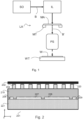
- Figure 1 shows a lithographic system comprising a radiation source SO and a lithographic apparatus LA.
- the radiation source SO is configured to generate an exposure radiation beam B and to supply the exposure radiation beam B to the lithographic apparatus LA.
- the lithographic apparatus LA comprises an illumination system IL, a support structure MT (or reticle stage) configured to support a patterning device MA (e.g., a mask or reticle), a projection system PS and a substrate table WT (a wafer table or a substrate holder) configured to support a substrate W (e.g., a resist coated semiconductor wafer).
- a patterning device MA e.g., a mask or reticle
- a projection system PS e.g., a projection system
- a substrate table WT a wafer table or a substrate holder
- the illumination system IL is configured to condition the exposure radiation beam B before the exposure radiation beam B is incident upon the patterning device MA.
- the illumination system IL may include optical elements.
- the optical elements provide the exposure radiation beam B with a desired cross-sectional shape and a desired intensity distribution.
- the illumination system IL may include other devices in addition to the optical elements.
- the exposure radiation beam B interacts with the patterning device (or reticle) MA.
- the support structure MT hereafter a reticle stage, may support the patterning device MA by clamping it electrostatically or by a vacuum, and may be configured to scan the patterning device MA during exposures.
- the reticle stage WT may have an array of projections, referred to as burls, projecting from at least one side reticle stage body.
- burls projections
- the projection system PS is configured to project the patterned exposure radiation beam B' onto a substrate W held by the substrate table WT.
- the projection system PS may apply a reduction factor to the patterned exposure radiation beam B', thus forming an image with features that are smaller than corresponding features on the patterning device MA. For example, a reduction factor of 2, 4 or 8 may be applied.
- the substrate W may include previously formed patterns. Where this is the case, the lithographic apparatus LA aligns the image, formed by the patterned exposure radiation beam B', with a pattern previously formed on the substrate W.
- the substrate W to be exposed may be supported by a substrate holder WT (i.e., the object that directly supports a substrate), which in turn is supported by a position module (not illustrated in Figure 1 ) for moving the substrate holder WT relative to the patterned radiation beam B', for example.
- the substrate holder WT may have an array of projections, referred to as burls, projecting from at least one side. When the substrate W rests on the top of the burls on the at least one side of the substrate holder WT, the substrate W may be spaced apart from a main body of the substrate holder WT.
- a particle i.e., a contaminating particle such as a dust particle
- the total surface area of the burls may only correspond to a small fraction of the total area of the substrate W or substrate holder WT. As such, it is more probable that any particle will lie between burls and its presence will have no effect.
- vacuum clamping the space between the substrate holder WT and substrate W and optionally between the substrate table WT and substrate holder are partially evacuated so that the substrate W is held in place by the higher pressure of gas or liquid above it.
- Vacuum clamping may not be used where the beam path and/or the environment near the substrate W or substrate holder WT is kept at a low or very low pressure, e.g., for extreme ultraviolet (EUV) radiation lithography. In this case, it may not be possible to develop a sufficiently large pressure difference across the substrate W (or substrate holder WT) to clamp it. Electrostatic clamping may, therefore, be used. In electrostatic clamping, a potential difference is established between the substrate W and the substrate holder WT. The potential difference may generate a clamping force. Note: the same applies accordingly for the patterning device MA supported by the reticle stage MT. The forces experienced by the patterning device MA may even be higher, as the accelerations induced by the reticle stage MT may even be higher than those induced by the substrate holder WT, as a result of the optical reduction factor.
- EUV extreme ultraviolet
- Figure 2 depicts a side view of a highly simplified schematic of an electrostatic object support 201, hereafter an electrostatic clamp, which may form part of an object support for supporting an object 202 (such as a substrate W or reticle MA).
- the object 202 is disposed on the object support.
- the clamp 201 provides a clamping force, i.e., the object 202 is attracted onto the object support, for instance, by electrostatic forces.
- the object 202 may be supported on top of the protrusions or burls 204 protruding from the object support 201, such as described with reference to EP0947884 , which is incorporated herein by reference.
- the electrostatic clamp 201 comprises a stack arranged such that a first or upper surface of electrodes 207, 208, 209 is in contact with a first dielectric (or semi-dielectric) layer 219 and a second surface or lower surface of the electrode is in contact with a second dielectric (or semi-dielectric) layer 221.
- the dielectric layers 219, 221 are provided in order to maintain a charge provided on at least the first electrode portion 207.
- the electrode 207, 208, 209 is depicted in dotted lines in order to indicate that the electrode is disposed within the stack structure of the electrostatic clamp 201. In other words, the electrode is not disposed on an outer surface of the clamp 201.
- the burls 204 may be integral with the dielectric layer 219.
- Burls 204 may in that case have a (e.g., conductive) coating 220 such as (e.g., doped) diamond.
- This top coating 220 provides a relatively hard object support surface layer (hard contact surface).
- the electrostatic clamp may additionally have burls on the bottom side so as to support and clamp the electrostatic clamp 201 on a support structure such as a position module to move the electrostatic clamp 201, for example relative to a patterned radiation beam B', during use.
- This contact layer may be comprised of a hard material such as diamond, e.g., mono- or polycrystalline diamond, or other carbon-based material such as diamondlike carbon (DLC).
- the contact layer may comprise a diamond coating over a dielectric base layer (for other object supports, the base layer may comprise another material), for example coating 220.
- the (carbon based material) layer comprising a hard material, e.g., diamond or DLC, may have a thickness in the range of 200 nanometers to 6 micrometers, preferably between 2 and 5 micrometers.
- the hard material layer may be provided by means of a chemical vapor deposition (CVD) process, for example a hot-filament CVD process.
- the layer may comprise two or more layers, for example, a first layer and a second layer, wherein the second layer is formed on the first layer. Both the first and second layer may be provided by means of a CVD process.
- the material composition and characteristics of both layers may differ.
- the layer may comprise diamond grains. These diamond grains may be sized between 100 nanometers and 1 micrometer, dependent on the layer thickness and growth conditions, e.g., growth temperature.
- the hard material may comprise dopants. Providing dopants to the layer, e.g., diamond layer, may enhance the characteristics of the material, for example the hardness, crystallinity, and or resistivity.
- an ion-beam may be used, for example, in an ion beam figuring (IBF) process.
- IBF ion beam figuring
- a drawback of known IBF processes is that the ion beam, which is typically high energy, forms an amorphous carbon layer on top of the hard material layer (e.g., the diamond layer).
- This amorphous carbon (layer, sometimes called soft layer, has a thickness which is not uniform leading to fast initial wear. Because of this, the amorphous carbon layer requires removal e.g., as part of the IBF process using the ion beam.
- the speed of this amorphous carbon layer removal process is very time-consuming and typically requires two iterations of removal and measurement, i.e., to initially measure the flatness and perform a first removal step and to repeat this to measure and remove the amorphous carbon layer.
- burls have typically a width (e.g., diameter) of tens to hundreds or micrometers.
- the burl may have a diameter in the range of from about 200 micrometer to about 500 micrometer.
- burls On top of the burls, for example on top surface of the burls 204 as illustrated in Figure 2 , smaller burls (not illustrated) may be provided. These mini-burls may be formed on-top of a base-burl. As these mini-burls are even smaller than the base-burls (for example having a diameter of a few hundreds of micrometers), using the known IBF technique at these mini-burls becomes even more challenging.
- etch rate of diamond and the etch rate of a typical dielectric material of a electrostatic clamp is similar. Because of this, significant dielectric material around the burls may also be removed during the burl flattening and amorphous carbon layer removal process. This results in a variation in dielectric thickness and therefore a variation in clamping force, and non-idealities in backfill gas flow from a backfill gas system (backfill gas may be provided between support and object to improve thermal conductivity conditions during clamping).
- a vacuum or other object support may not comprise a dielectric base layer, it may be desirable not to etch the base layer of any of these supports when configuring the contact layer.
- the base layer of these supports may comprise, for example, silicon carbide (SiC), SiSiC or more generally a ceramic or glass material.
- SiC silicon carbide
- SiSiC silicon carbide
- a ceramic containing silicon carbide used as the base material (or as a layer) may be a sintered body or polycrystal of silicon carbide.
- Chemical assisted IBF processes are known, typically in the context of etching silicon.
- a chemical assistant e.g., a reactive gas
- a chemical assistant for diamond removal is largely ineffective at increasing removal speed.
- object support material removal such as surface configuring or structuring (e.g., patterning (roughening) or flattening)
- a chemically assisted IBF process whereby a reactive gas is used to chemically assist the IBF process, and wherein one or more optical (electromagnetic) radiation beams are used to locally excite, i.e., photodissociate, the gas only in the one or more regions being treated (i.e., only in the regions being configured/etched).
- Such object support material removal or configuring may, for example, comprise burl surface flattening (i.e., the removal regions are burl top surfaces), and in particular the material being flattened and removed may comprise diamond or other carbon-based material.
- burl surface flattening i.e., the removal regions are burl top surfaces
- the material being flattened and removed may comprise diamond or other carbon-based material.
- the methods disclosed herein may be used to configure other removal regions.
- the method may comprise illuminating regions between burls in order enhance etching at those regions (e.g., to selectively etch between burls without etching the burls).
- the method may comprise introducing the chemical assistant (e.g., a reactive gas) into the chamber in which the IBF process is being performed and focusing a beam of radiation onto a (e.g., diamond) coated removal region, such as a burl contact surface, that is to be configured (e.g., flattened).
- the beam of radiation can be focused to an area coincident with the removal region, such that substantially only this removal region is irradiated.
- the reactive gas photodissociates at the removal region, where the radiation beam is focused, thereby producing projectiles (e.g., ions or radicals). These projectiles are therefore produced (only) locally at the removal region (e.g., burl contact surface).
- the irradiated burl contact surface (or other removal region) is etched much more quickly than the (nonirradiated) surrounding dielectric (or other base material). Because of this, the material removal or flattening may be performed much more quickly, such that the ion beam removes very little base material (e.g., dielectric) in the time that the burl contact surface has been etched to a desired flatness or roughness.
- the ion beam is still used to do the physical sputtering, as without physical sputtering the chemical etching rates saturate at quite/very low levels.
- the ion beam may be a (relative) low energy beam because the focusing requirements are much more relaxed, due to the removal only occurring to a substantial degree in the irradiated region for the proposed removal timescales. Because of the low energy of the proposed ion beam, the amorphous carbon layer (soft layer) will not form, or at least formed in a much smaller amount. This means there may be no need to remove this layer.
- the ion beam energy may be, for example, less than 10 keV, less than 5 keV, less than 2 keV, less than 1 keV, less than 800 eV, less than 600 eV or less than 500 eV (e.g., between 100 and 500 eV).
- a further advantage is improved control of the removal process through control of the radiation beam(s) rather than control of the ion beam.
- a radiation beam is much simpler to control and, as has already been described, to focus onto a small area.
- only irradiated areas of the object support will be significantly etched by the ion beam and therefore the etching is effectively controlled via control of the radiation beam.
- the radiation beam may comprise visible or higher energy radiation, e.g., red, green, or blue light or light of higher energy.
- the radiation beam may comprise a wavelength of 750 nm or less, 620 nm or less, 570 nm or less, 520 nm or less for example. Radiation with different wavelengths may be used.
- the radiation beam may comprise radiation of two or more wavelengths.
- the reactive gas may comprise any reactive molecular gas which can be photodissociated to provide (e.g., positive and negative) ions (heterolytic cleavage) or radicals (homolytic cleavage), which facilitate removal/etching. Which mechanism occurs and projectiles generated depends on the wavelength of the radiation beam. Either mechanisms will work and are included in the concepts disclosed herein. Diamond removal will depend on the type of bombardment species. While radicals may be less effective in facilitating removal than ions, the amount generated may be increased during this process, for example, to enhance the removal rate for any amorphous carbon generated after initially etching the diamond. Control of the removal process may also be easier using radicals.
- the number of radicals (or ions) for dissociation depends on the wavelength and intensity of the radiation, and the concentration of the chemical assistant (e.g., the partial gas pressure) and therefore can be controlled via control of any one or more of these parameters.
- the yield of photodissociation is typically known for various gas systems.
- the gas may comprise for example a halogen compound, e.g., a fluoride, chloride or iodide which photodissociates to provide halogen (e.g., fluorine, chlorine or iodine) ions or radicals.
- a halogen compound e.g., a fluoride, chloride or iodide which photodissociates to provide halogen (e.g., fluorine, chlorine or iodine) ions or radicals.
- a suitable compound is xenon difluoride.
- Other examples include molecular chlorine gas, hydrogen iodide and nitrosyl chloride.
- the molecular gas may comprise a suitable oxide such as nitrogen dioxide, hydrogen peroxide or di-tert-butyl peroxide. These are only examples, and any molecular gas which photodissociates to provide species (e.g., ions or radicals), which facilitate material removal via ion beam can be used.
- the temperature of the object support (e.g., the burl contact surfaces) and/or pressure of the reactive gas may be controlled to facilitate formation of an adsorbed monolayer of the (e.g., condensed) reactive gas molecules on the surfaces being treated (i.e., the burl contact surfaces).
- the object support temperature may be lowered to initiate monolayer adsorption on the burl surfaces that are to be treated, without need of the gas to be of a high pressure. This adsorbed monolayer further facilitates the photodissociation of the chemical assistant.
- the ion beam may be, for example, a positive ion beam; e.g., an argon ion beam or other noble ion beam.
- the object support material removal apparatus may be configured such that at least one of the one or more ion beams and the one or more radiation beams act simultaneously on one or more removal regions (i.e., such that the ion beam acts on one or more irradiated removal regions).
- the proposed module may be configured to perform the methods disclosed herein.
- the ion beam source may generate one ion beam and the radiation source may generate one radiation beam, such that the beams together irradiate and bombard with ions a removal region.
- the ion beam may be relatively unfocused such that it bombards more than one removal region at any one time.
- the radiation beam source may generate more than one radiation beam to irradiate all the removal regions being bombarded simultaneously.
- the ion beam source may generate multiple ion beams, with the radiation source operable to generate respective beams for each removal region being bombarded by the multiple ion beams.
- each (at least one) radiation beam may overlap an ion beam at respective (at least one) removal regions.
- the object support material removal apparatus may comprise a temperature conditioning arrangement (e.g., cooling module) for temperature conditioning (e.g., cooling the object being treated) the object support.
- a pressure regulation arrangement may also be provided for control of the chemical assistant partial pressure within the chamber.
- the temperature conditioning and/or pressure regulation arrangements may be configured to promote adsorption (e.g., monolayer adsorption) of the chemical assistant on at least the surface of the removal regions.
- the chamber may also optionally comprise a radical getter pump.
- the radical getter pump may be arranged near the IBF filament in order to scavenge unwanted radicals and to protect the filaments.
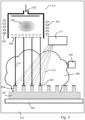
- FIG 3 is a simplified schematic illustration of a material removal apparatus and material removal method.
- An object support 301 e.g., the object support 201 of Figure 2 or otherwise
- Each burl 304 contact surface i.e., the diamond coated surface 320
- a chemical assistant supply (gas supply) 306 provides a chemical assistant or gas 308 within a chamber 310 (e.g., removal or etching chamber).
- a radiation source 311 e.g., radiation beam module
- the gas 308 irradiated in the region of the burl contact surfaces will photodissociate to provide assistant ions or radicals.
- the gas is xenon difluoride, fluorine ions or fluorine radicals may be generated at these regions.
- the radiation beams 312 are focused and controlled such that substantially only the (e.g., diamond) coated contact surfaces 320 are irradiated, and therefore substantially no adjacent dielectric region is irradiated. As stated, the beams may be controlled to irradiation other removal regions, e.g., to etch between burls.
- the radiation source 311 may be operable to focus each said at least one radiation beam to a spot at the removal region.
- the spot may have a size of, for example, 500 micrometer or smaller in diameter, or smaller than 250 micrometer in diameter on said object (e.g., a spot equal to or smaller than 200 ⁇ m on said object).
- the spot of the radiation beam may be circular shaped.
- the spot of the radiation beam may be line shaped, with a length of 500 micrometers or less.
- the spot of the radiation beam may have a curved shape, with a length of 500 micrometer or less.
- a line-shaped or a curve-shaped spot may be used to match the local geometry of the surface or region that is being treated (etched).
- the spot of the radiation beam may have any shape that is advantageous for the material removal process.
- An ion beam source 314 (e.g., argon ion beam source) generates one or more ion beams 316 (e.g., argon ion beams), which acts upon (bombards with ions) the irradiated regions comprising assistant ions or radicals, thereby etching and structuring (e.g., flattening or roughening) these surfaces much faster than without chemical assistance.
- ion beam source 314 will not be described in detail, as such sources and how they operate are well known. Any suitable ion beam source may be used.
- the ion beam source may comprise a gas inlet 322 for receiving an atomic gas (e.g., a noble gas such as argon), an RF coil 324 which turns the gas into plasma 326, thereby generating the argon ions. These argon ions are then accelerated toward the target (object support) by an accelerator grid 328.
- an atomic gas e.g., a noble gas such as argon
- an RF coil 324 which turns the gas into plasma 326, thereby generating the argon ions.
- These argon ions are then accelerated toward the target (object support) by an accelerator grid 328.
- the material removal apparatus may comprise a temperature regulation arrangement 330 (e.g., any suitable temperature regulating arrangement, which here is schematically represented by box 330) for controlling the temperature of the object support (e.g., cooling the object). Cooling the object support during the treatment may encourage a monolayer coverage of the chemical assistant to form on the (e.g., diamond) surface 320, which is being etched.
- gas source 306 and/or chamber 310 may have a pressure regulation arrangement to regularize the partial gas pressure to help achieve the same aim.
- the material removal apparatus may be configured to direct the one or more ion beams 316 and the one or more radiation beams 312 in synchronization over the surface to remove material from at least some of a plurality of removal regions sequentially. For example, where there is only one radiation beam 312 and ion beam 316, or where the number of radiation beams 312 and ion beams 316 are fewer than the number of removal regions, a subset of removal regions (comprising one or more removal regions) may be configured by overlapping a radiation beam 312 and an ion beam 316 respectively at each removal region of the subset. After this, the one or more ion beams 316 and the one or more radiation beams 312 may be moved substantially in synchronization to another subset of removal regions, such that each subset is configured in sequence.
- any object support such as any wafer table WT or any reticle support MT may benefit from having its (e.g., carbon based coated) contact surface treated (e.g., flattened) using the methods described herein.
- vacuum object supports and electrostatic object supports may benefit from the concepts disclosed herein.
- the methods may be particularly beneficial for electrostatic supports as known flattening processes are also etching the dielectric, resulting in an uneven dielectric thickness and therefore clamping strength over the object. This can induce distortions in the object thereby affecting imaging performance.
- the proposed method can be expected to remove the hard material (e.g., diamond) locally at a rate possibly 10 times or more faster, which means that the etching of dielectric will be minimal during the removal process. Additionally, this speed increase may be achieved with a low energy ion beam, resulting in little or no formation of an amorphous carbon layer and therefore no need for an iterative measure and remove process. Hence, the time required for the manufacturing process is reduced.
- the hard material e.g., diamond
- a 'light pattern' can be provided at the area of interest.
- the etching process is (mainly) promoted at the pattern area. This provides an opportunity to configure or structure the irradiated surface, e.g., to impose a configuration other than flattening.
- the chemical assistant supply 306 may comprise one or more nozzles that are arranged to provide the chemical assistant (gas) 308 locally.
- the chemical assistant 308 is provided by the one or more nozzles in the vicinity of the area of interest.
- the efficiency of the gas usage is improved.
- the etching process may further be enhanced.
- One or more material extraction ports may be provided near the etching area, arranged to remove (or extract) material during the material removal process. Herewith, avoiding or reducing debris (removed material) to interfere the etching process.
- Embodiments of the invention may form part of a mask inspection apparatus, a metrology apparatus, or any apparatus that measures or processes an object such as a wafer (or other substrate) or mask (or other patterning device). These apparatus may be generally referred to as lithographic tools. Such a lithographic tool may use vacuum conditions or ambient (non-vacuum) conditions.
Landscapes
- Physics & Mathematics (AREA)
- Public Health (AREA)
- Epidemiology (AREA)
- Engineering & Computer Science (AREA)
- General Physics & Mathematics (AREA)
- Health & Medical Sciences (AREA)
- Life Sciences & Earth Sciences (AREA)
- Atmospheric Sciences (AREA)
- Analytical Chemistry (AREA)
- Chemical & Material Sciences (AREA)
- Environmental & Geological Engineering (AREA)
- Plasma & Fusion (AREA)
- Exposure And Positioning Against Photoresist Photosensitive Materials (AREA)
- Drying Of Semiconductors (AREA)
- Cleaning In General (AREA)
Priority Applications (1)
| Application Number | Priority Date | Filing Date | Title |
|---|---|---|---|
| EP25169453.5A EP4567872A3 (de) | 2025-04-09 | 2025-04-09 | Materialentfernungsvorrichtung und verfahren zum entfernen von material von einem objektträger |
Applications Claiming Priority (1)
| Application Number | Priority Date | Filing Date | Title |
|---|---|---|---|
| EP25169453.5A EP4567872A3 (de) | 2025-04-09 | 2025-04-09 | Materialentfernungsvorrichtung und verfahren zum entfernen von material von einem objektträger |
Publications (2)
| Publication Number | Publication Date |
|---|---|
| EP4567872A2 true EP4567872A2 (de) | 2025-06-11 |
| EP4567872A3 EP4567872A3 (de) | 2025-11-12 |
Family
ID=95251140
Family Applications (1)
| Application Number | Title | Priority Date | Filing Date |
|---|---|---|---|
| EP25169453.5A Pending EP4567872A3 (de) | 2025-04-09 | 2025-04-09 | Materialentfernungsvorrichtung und verfahren zum entfernen von material von einem objektträger |
Country Status (1)
| Country | Link |
|---|---|
| EP (1) | EP4567872A3 (de) |
Citations (1)
| Publication number | Priority date | Publication date | Assignee | Title |
|---|---|---|---|---|
| EP0947884A2 (de) | 1998-03-31 | 1999-10-06 | Asm Lithography B.V. | Lithographischer Projektionsapparat mit Substrathalter |
Family Cites Families (3)
| Publication number | Priority date | Publication date | Assignee | Title |
|---|---|---|---|---|
| US5814156A (en) * | 1993-09-08 | 1998-09-29 | Uvtech Systems Inc. | Photoreactive surface cleaning |
| US8303833B2 (en) * | 2007-06-21 | 2012-11-06 | Fei Company | High resolution plasma etch |
| US12531217B2 (en) * | 2021-03-31 | 2026-01-20 | Taiwan Semiconductor Manufacturing Company, Ltd. | Laser array system for improved local CD uniformity |
-
2025
- 2025-04-09 EP EP25169453.5A patent/EP4567872A3/de active Pending
Patent Citations (1)
| Publication number | Priority date | Publication date | Assignee | Title |
|---|---|---|---|---|
| EP0947884A2 (de) | 1998-03-31 | 1999-10-06 | Asm Lithography B.V. | Lithographischer Projektionsapparat mit Substrathalter |
Also Published As
| Publication number | Publication date |
|---|---|
| EP4567872A3 (de) | 2025-11-12 |
Similar Documents
| Publication | Publication Date | Title |
|---|---|---|
| US7375038B2 (en) | Method for plasma etching a chromium layer through a carbon hard mask suitable for photomask fabrication | |
| CN101174086B (zh) | 使用蚀刻反应器蚀刻纳米压印模板 | |
| KR100808694B1 (ko) | 포토마스크 제조의 프로세스 통합을 위한 클러스터 툴 및 방법 | |
| US20130048606A1 (en) | Methods for in-situ chamber dry clean in photomask plasma etching processing chamber | |
| US7008877B2 (en) | Etching of chromium layers on photomasks utilizing high density plasma and low frequency RF bias | |
| KR101114131B1 (ko) | 듀얼 주파수 바이어스를 갖는 화학적 기상 증착 챔버 및이를 이용하여 포토마스크를 제조하기 위한 방법 | |
| TWI689995B (zh) | 被處理體之處理方法 | |
| EP3007208B1 (de) | Verfahren zur verarbeitung eines zielobjekts | |
| US9911622B2 (en) | Method of processing target object | |
| US20090325387A1 (en) | Methods and apparatus for in-situ chamber dry clean during photomask plasma etching | |
| US12325911B2 (en) | Method and apparatus for forming a patterned layer of material | |
| TWI707382B (zh) | 被處理體之處理方法 | |
| JP2008116949A (ja) | マスクエッチングプロセス | |
| US20020001957A1 (en) | Method for forming fine patterns by thinning developed photoresist patterns using oxygen radicals | |
| CN1839349A (zh) | 利用电子束的薄层高分辨率加工方法 | |
| US9177824B2 (en) | Photoresist treatment method by low bombardment plasma | |
| CN1516826A (zh) | 用于制造衰减相移光掩模坯的离子束沉积方法 | |
| EP4567872A2 (de) | Materialentfernungsvorrichtung und verfahren zum entfernen von material von einem objektträger | |
| CN101461031B (zh) | 用于光刻衬底的温度控制方法 | |
| TW202414542A (zh) | 離子佈植用於增加與阻劑材料的黏合 | |
| TWI864529B (zh) | 圖案化目標層之方法、圖案化目標層之設備 | |
| TW202509682A (zh) | 物件固持器 | |
| JP2985321B2 (ja) | マスクパタ−ン形成方法 | |
| WO2022207272A1 (en) | Conditioning apparatus and method | |
| TW202409716A (zh) | 用於euv微影之表膜 |
Legal Events
| Date | Code | Title | Description |
|---|---|---|---|
| PUAI | Public reference made under article 153(3) epc to a published international application that has entered the european phase |
Free format text: ORIGINAL CODE: 0009012 |
|
| STAA | Information on the status of an ep patent application or granted ep patent |
Free format text: STATUS: THE APPLICATION HAS BEEN PUBLISHED |
|
| AK | Designated contracting states |
Kind code of ref document: A2 Designated state(s): AL AT BE BG CH CY CZ DE DK EE ES FI FR GB GR HR HU IE IS IT LI LT LU LV MC ME MK MT NL NO PL PT RO RS SE SI SK SM TR |
|
| PUAL | Search report despatched |
Free format text: ORIGINAL CODE: 0009013 |
|
| AK | Designated contracting states |
Kind code of ref document: A3 Designated state(s): AL AT BE BG CH CY CZ DE DK EE ES FI FR GB GR HR HU IE IS IT LI LT LU LV MC ME MK MT NL NO PL PT RO RS SE SI SK SM TR |
|
| RIC1 | Information provided on ipc code assigned before grant |
Ipc: H01L 21/67 20060101AFI20251006BHEP Ipc: H01L 21/683 20060101ALI20251006BHEP Ipc: H01L 21/687 20060101ALI20251006BHEP Ipc: H01J 37/00 20060101ALI20251006BHEP Ipc: H01L 21/68 20060101ALI20251006BHEP |