EP4568009A1 - Coupleur balun de configuration de fente à matrice de mise en boîtier - Google Patents
Coupleur balun de configuration de fente à matrice de mise en boîtier Download PDFInfo
- Publication number
- EP4568009A1 EP4568009A1 EP24158788.0A EP24158788A EP4568009A1 EP 4568009 A1 EP4568009 A1 EP 4568009A1 EP 24158788 A EP24158788 A EP 24158788A EP 4568009 A1 EP4568009 A1 EP 4568009A1
- Authority
- EP
- European Patent Office
- Prior art keywords
- semiconductor device
- metal layer
- pillars
- packaged semiconductor
- arms
- Prior art date
- Legal status (The legal status is an assumption and is not a legal conclusion. Google has not performed a legal analysis and makes no representation as to the accuracy of the status listed.)
- Pending
Links
Images




Classifications
-
- H—ELECTRICITY
- H01—ELECTRIC ELEMENTS
- H01P—WAVEGUIDES; RESONATORS, LINES, OR OTHER DEVICES OF THE WAVEGUIDE TYPE
- H01P5/00—Coupling devices of the waveguide type
- H01P5/08—Coupling devices of the waveguide type for linking dissimilar lines or devices
- H01P5/10—Coupling devices of the waveguide type for linking dissimilar lines or devices for coupling balanced lines or devices with unbalanced lines or devices
-
- H—ELECTRICITY
- H10—SEMICONDUCTOR DEVICES; ELECTRIC SOLID-STATE DEVICES NOT OTHERWISE PROVIDED FOR
- H10W—GENERIC PACKAGES, INTERCONNECTIONS, CONNECTORS OR OTHER CONSTRUCTIONAL DETAILS OF DEVICES COVERED BY CLASS H10
- H10W90/00—Package configurations
-
- H—ELECTRICITY
- H01—ELECTRIC ELEMENTS
- H01P—WAVEGUIDES; RESONATORS, LINES, OR OTHER DEVICES OF THE WAVEGUIDE TYPE
- H01P1/00—Auxiliary devices
- H01P1/04—Fixed joints
- H01P1/047—Strip line joints
-
- H—ELECTRICITY
- H01—ELECTRIC ELEMENTS
- H01P—WAVEGUIDES; RESONATORS, LINES, OR OTHER DEVICES OF THE WAVEGUIDE TYPE
- H01P3/00—Waveguides; Transmission lines of the waveguide type
- H01P3/02—Waveguides; Transmission lines of the waveguide type with two longitudinal conductors
- H01P3/08—Microstrips; Strip lines
-
- H—ELECTRICITY
- H01—ELECTRIC ELEMENTS
- H01Q—ANTENNAS, i.e. RADIO AERIALS
- H01Q1/00—Details of, or arrangements associated with, antennas
- H01Q1/12—Supports; Mounting means
- H01Q1/22—Supports; Mounting means by structural association with other equipment or articles
- H01Q1/2283—Supports; Mounting means by structural association with other equipment or articles mounted in or on the surface of a semiconductor substrate as a chip-type antenna or integrated with other components into an IC package
-
- H—ELECTRICITY
- H01—ELECTRIC ELEMENTS
- H01Q—ANTENNAS, i.e. RADIO AERIALS
- H01Q1/00—Details of, or arrangements associated with, antennas
- H01Q1/27—Adaptation for use in or on movable bodies
- H01Q1/32—Adaptation for use in or on road or rail vehicles
- H01Q1/3208—Adaptation for use in or on road or rail vehicles characterised by the application wherein the antenna is used
- H01Q1/3233—Adaptation for use in or on road or rail vehicles characterised by the application wherein the antenna is used particular used as part of a sensor or in a security system, e.g. for automotive radar, navigation systems
-
- H—ELECTRICITY
- H10—SEMICONDUCTOR DEVICES; ELECTRIC SOLID-STATE DEVICES NOT OTHERWISE PROVIDED FOR
- H10W—GENERIC PACKAGES, INTERCONNECTIONS, CONNECTORS OR OTHER CONSTRUCTIONAL DETAILS OF DEVICES COVERED BY CLASS H10
- H10W42/00—Arrangements for protection of devices
-
- H—ELECTRICITY
- H10—SEMICONDUCTOR DEVICES; ELECTRIC SOLID-STATE DEVICES NOT OTHERWISE PROVIDED FOR
- H10W—GENERIC PACKAGES, INTERCONNECTIONS, CONNECTORS OR OTHER CONSTRUCTIONAL DETAILS OF DEVICES COVERED BY CLASS H10
- H10W44/00—Electrical arrangements for controlling or matching impedance
- H10W44/20—Electrical arrangements for controlling or matching impedance at high-frequency [HF] or radio frequency [RF]
-
- H—ELECTRICITY
- H10—SEMICONDUCTOR DEVICES; ELECTRIC SOLID-STATE DEVICES NOT OTHERWISE PROVIDED FOR
- H10W—GENERIC PACKAGES, INTERCONNECTIONS, CONNECTORS OR OTHER CONSTRUCTIONAL DETAILS OF DEVICES COVERED BY CLASS H10
- H10W70/00—Package substrates; Interposers; Redistribution layers [RDL]
- H10W70/60—Insulating or insulated package substrates; Interposers; Redistribution layers
- H10W70/62—Insulating or insulated package substrates; Interposers; Redistribution layers characterised by their interconnections
- H10W70/65—Shapes or dispositions of interconnections
-
- H—ELECTRICITY
- H10—SEMICONDUCTOR DEVICES; ELECTRIC SOLID-STATE DEVICES NOT OTHERWISE PROVIDED FOR
- H10W—GENERIC PACKAGES, INTERCONNECTIONS, CONNECTORS OR OTHER CONSTRUCTIONAL DETAILS OF DEVICES COVERED BY CLASS H10
- H10W90/00—Package configurations
- H10W90/701—Package configurations characterised by the relative positions of pads or connectors relative to package parts
-
- H—ELECTRICITY
- H10—SEMICONDUCTOR DEVICES; ELECTRIC SOLID-STATE DEVICES NOT OTHERWISE PROVIDED FOR
- H10W—GENERIC PACKAGES, INTERCONNECTIONS, CONNECTORS OR OTHER CONSTRUCTIONAL DETAILS OF DEVICES COVERED BY CLASS H10
- H10W44/00—Electrical arrangements for controlling or matching impedance
- H10W44/20—Electrical arrangements for controlling or matching impedance at high-frequency [HF] or radio frequency [RF]
- H10W44/203—Electrical connections
- H10W44/216—Waveguides, e.g. strip lines
-
- H—ELECTRICITY
- H10—SEMICONDUCTOR DEVICES; ELECTRIC SOLID-STATE DEVICES NOT OTHERWISE PROVIDED FOR
- H10W—GENERIC PACKAGES, INTERCONNECTIONS, CONNECTORS OR OTHER CONSTRUCTIONAL DETAILS OF DEVICES COVERED BY CLASS H10
- H10W44/00—Electrical arrangements for controlling or matching impedance
- H10W44/20—Electrical arrangements for controlling or matching impedance at high-frequency [HF] or radio frequency [RF]
- H10W44/251—Electrical arrangements for controlling or matching impedance at high-frequency [HF] or radio frequency [RF] for monolithic microwave integrated circuits [MMIC]
-
- H—ELECTRICITY
- H10—SEMICONDUCTOR DEVICES; ELECTRIC SOLID-STATE DEVICES NOT OTHERWISE PROVIDED FOR
- H10W—GENERIC PACKAGES, INTERCONNECTIONS, CONNECTORS OR OTHER CONSTRUCTIONAL DETAILS OF DEVICES COVERED BY CLASS H10
- H10W90/00—Package configurations
- H10W90/701—Package configurations characterised by the relative positions of pads or connectors relative to package parts
- H10W90/721—Package configurations characterised by the relative positions of pads or connectors relative to package parts of bump connectors
- H10W90/724—Package configurations characterised by the relative positions of pads or connectors relative to package parts of bump connectors between a chip and a stacked insulating package substrate, interposer or RDL
Definitions
- the present disclosure relates to packaged millimetre or microwave frequency semiconductor devices having signal couplers between a semiconductor die and a package substrate.
- mm-wave monolithic microwave integrated circuits
- a cost-effective and performance-driven packaging technique to connect the MMICs IOs to the PCB can be realized by using a ball-grid-array based (BGA) package structure.
- BGA ball-grid-array based package structure. Examples of these packages are embedded wafer level ball grid array (eWLB), flip-chip chip-scale package (FCCSP) and flip-chip ball-grid array (FCBGA).
- eWLB embedded wafer level ball grid array
- FCCSP flip-chip chip-scale package
- FCBGA flip-chip ball-grid array
- a galvanic connection from the silicon die (MMIC) to the PCB board is then obtained, which includes two intermediate transitions: firstly, a die-to-package transition, which connects the die to the package laminate metal-and-dielectric layers, or the die to a metallization layer on top of a dielectric layer.
- a differential implementation of the silicon circuitry is generally preferred, as this decreases the sensitivity of the active circuitry to external (common-mode) signals present, for example, on the PCB lines. And so the transition from die to package will be differential as well.
- the second transition is the package-to-PCB interface, which connects the package to the PCB using the (solder-ball) ball-grid array.
- This interface can be designed to be either differential or single-ended. In general, on the PCB it is typically preferred to work with single-ended signals to, for example, feed single-ended antennas, and because routing of single-ended transmission lines may be easier to accomplish than of balanced differential transmission lines.
- mm-wave die-interfaces which are differential.
- the majority of the PCB antenna solutions for automotive radars are based on arrays of patches which are fed using stripline lines having characteristic impedances in the order of 50 ⁇ .
- the package-ball connection single-ended thus requiring an on-die or in-package integrated BALUN.
- On-die BALUNs are typically high-loss because of the thickness of the metal is limited to a max of 1 ⁇ 2um for the conventional CMOS process and extendable to 3 ⁇ 4um for the relatively expensive "ultra-thick metal" (UTM) process nodes.
- UDM ultra-thick metal
- a further limitation of using a micro-strip based balun is the challenge of providing a tunable impedance range to the die. This limitation is dictated by the design rules of the packaging technology (for example, line width, gap and stack height) which restricts the range of realizable impedances on the package.
- a packaged semiconductor device comprising a semiconductor die comprising a monolithic microwave integrated circuit, MMIC, wherein the MMIC has a differential output; a package substrate, comprising at least a first metal layer, a second metal layer and a third metal layer, and electrically connected to the semiconductor die by a plurality of pillars between the semiconductor die and the first metal layer, wherein the first and third metal layers comprise a ground plane, and the second metal layer, therebetween, comprises a single-ended stripline; wherein the differential output is galvanically connected to the first metal layer by a pair of pillars aligned along a first axis; wherein the packaged semiconductor device comprises a balun coupler between the differential output, and the single-ended stripline aligned along a second axis; wherein the balun coupler comprises an opening in the first metal layer, the opening comprising two arms extending in a first direction parallel to the second axis.
- balun integrated with the coupler from die to package may be useful for space-saving, and may give good electro-static-discharge (ESD) protection, since the ground and the signal pin may be galvanically connected, by being shorted on a typically thick ground plane. In case of an ESD events the active components are protected due to this short circuit.
- the configuration may provided a high common mode rejection ratio of up to 25-30 dB. Furthermore, this arrangement allows several degrees of freedom, which may be useful for example in order to be able to match to a range of impedances.
- the first axis is parallel to the second axis.
- the opening has an "H" configuration comprising the two arms, being elongate, and a bridge section therebetween.
- An H configuration has a high degree of symmetry which may be beneficial in allowing a broad bandwidth for which VSWR is low - under two, in particular.
- the high degree of symmetry may also provide particularly effective cancellation for example between the electric fields on the different arms of the "H". In turn this may result in little radiation, and effective, low loss coupling.
- the pair of pillars are located between the two elongate arms and one either side of the bridge section.
- the pillars may be symmetrically arranged either side of the bridge section that is to say they may be equidistant from the bridge section, and may be midway between the two elongate arms; this may enhance the symmetry of the device, leading to improved cancellation of the fields and unwanted radiation
- the packaged semiconductor device further comprises at least two ground bumps between the elongate arms and either side of the pair of pillars. This may result in improved shielding of the signal.
- the package substrate further comprises a fourth metal layer.
- the first axis is aligned orthogonal to the second axis. This may result in a device in which the incoming differential signal is propagating in the same direction as the outgoing single-ended signal
- the two arms are a first arm and a second arm, wherein the opening further comprises third and fourth arms extending in a direction orthogonal to the first and second arms. This may result in an incomplete loop for the opening.
- Each of the pair of parallel arms may have oppositely directed electric fields, and this may result in cancellation, or partial cancellation, of fields.
- the opening forms an incomplete loop in which the third arm connects the first and second arm, and the fourth arm is connected to the second arm.
- the pair of pillars are located on either side of the third arm, such that a one of the pair of pillars is within the incomplete loop and another of the pair of pillars is outside the incomplete loop.
- the packaged semiconductor device may further comprise, or be mounted on, a printed circuit board, electrically connected to the package substrate by a ball grid array.
- the MMIC comprises a transmitter circuit for a radar device.
- the radar device may be an automotive radar device.
- the present disclosure is not limited to radar devices.
- the MMIC may comprise plurality of transmitter circuits for an automotive radar device.
- a packaged semiconductor device comprising a semiconductor die comprising a monolithic microwave integrated circuit, MMIC, wherein the MMIC has a differential output; and a package substrate, comprising a balun coupler, and a stripline transmission line formed in a second metal layer being between a first metal layer electrically connected to the semiconductor die by a plurality of pillars and a third metal layer, wherein the first and third metal layers each comprise a reference plane; wherein the differential output is galvanically connected to the first metal layer by a pair of pillars, of the plurality of pillars, aligned along a first axis; wherein the stripline transmission line is aligned along a second axis; and wherein the balun coupler comprises an opening in the first metal layer, the opening comprising two arms extending in a first direction parallel to the second axis.
- FIG.s are diagrammatic and not drawn to scale. Relative dimensions and proportions of parts of these FIG.s have been shown exaggerated or reduced in size, for the sake of clarity and convenience in the drawings.
- the same reference signs are generally used to refer to corresponding or similar features in modified and different embodiments
- FIG. 1A shows, schematically, a section through of a packaged semiconductor device 100 according to embodiments of the present disclosure.
- the package semiconductor device 100 comprises a semiconductor die 110, and a package substrate 120.
- the semiconductor die 110 includes a MMIC thereon and therein, although this is not shown in the schematic view.
- the package substrate 120 may be described as being a multilayer laminate substrate.
- the package substrate includes at least three metal layers.
- a first metal layer 122 is located on a first major, or top, surface of the package substrate; a second metal layer 124 is buried within the package substrate, and a third metal layer 126 is located on a second major, or bottom, surface of the package substrate 120.
- the first 122 and third 126 metal layers form a ground plane for transmission of millimetre wave signals; the second metal layer is patterned to form one or more stripline transmission lines; it may include additional metal therebetween.
- a stripline transmission line is a variant of a microstrip transmission line, in which the primary conductor or transmission line is located between two reference or ground planes separated by dielectric (whereas in a conventional microstrip transmission line, the primary conductor or transmission line is typically located on the surface, and separated from a single reference or ground plane by dielectric),
- a stripline may be referred to, generically, as a microstrip or microstrip transmission line
- the first metal layer includes an opening or slot 130 therein as will be discussed in more detail hereinbelow.
- the opening is generally completely surrounded by metal, and thus may be considered to be “finite”
- the metal layers are separated by dielectric layers formed of insulating material 128 which comprises low-loss dielectric, as will be familiar to the skilled person.
- Package substrate 120 supports functions including signal power distribution, heat dissipation, and protection, .
- the semiconductor die 110 is connected to the package substrate 120 through a matrix of solder balls or pillars, which may alternatively be described as "bumps", or "C4s" (controlled collapse chip connections"), typically formed from copper.
- FIG. 1A shows two example groups of pillars.
- a first group comprises a pair of pillars being a first pillar 142 and a second pillar 144.
- the pillars are connected to the MMIC circuit in the semiconductor die 110 by metal tracks or traces 152a, 154a carrying high frequency that is to say millimetre wave or microwave signals. Shown in the FIG. are the pair of signal tracks 152a and 154a which carry between them a differential, or balanced, millimetre wave signal, to contact pads 152, 154, which are connected to respective pillars 142 and 144. Also shown are a second group of pillars 146. These may generally referred to as ground pillars, and are connected to metal regions 156 on the semiconductor die which are grounded.
- the pillars may be arranged in a regular or irregular array, as will be exemplified in more detail hereinbelow. In general, there may be more ground pillars than differential signal pillars, although only two ground pillars are shown in FIG. 1A , for the purposes of illustration.
- galvanic connection may be provided between the first metal layer 122 and the second metal layer which comprises the stripline transmission lines 124, the galvanic connection is typically provided by means of vertical shorting via formed of a metal such as copper.
- the example shown in FIG. 1 A includes one such via 162, located at the end of the stripline transmission line.
- FIG. 1B shows a schematic, partial, plan view of the packaged semiconductor device of FIG. 1A .
- the semiconductor die 110 and the MMIC circuit thereon are not shown except for the differential metal tracks or traces 152a and 154b which , in use, carry the differential signal S+ and S- to the contact pads 152 and 154 which are connected to for the differential signal pillars 142 and 144, and the pair of contact pads 156 for the ground pillars 146.
- FIG. 1B shows the first metal layer 122, having the opening or slot 130 therein.
- the opening or slot comprises two arms 132 and 134 extending in a first direction which is parallel to an axis between the differential signal pillars 142 and 144.
- the opening slot 130 has the geometrical form of an "H", in which the two arms are elongate, and are connected by a bridge region 136.
- the stripline transmission line 124 is parallel to the elongate arms of the "H" configuration of the opening or slot 130. Note that in the schematic view, shown in this FIG. (and FIG. 2B ), the dielectric is hidden, so the stripline 172 is visible through the slot. As can be seen from FIG. 1B and FIG.
- the arrangement of the slot in the first metal layer at the surface of the package substrate 120 acts as a balun in that it converts the differential, that is to say, balanced, signal on lines or tracks 152a and 154a, to a single-ended, that is to say unbalanced, signal on stripline transmission line 124.
- the slot thus acts as balun coupler in that it both couples the signal from the semiconductor die 110 to the package substrate 120 and converts the signal from differential to single-ended.
- FIG. 1A and FIG. 1B includes galvanic coupling to the stripline transmission line through the suitably positioned via 162.
- FIG. 2A and FIG. 2B show alternative embodiments according to the present disclosure, in which the coupling is non-galvanic.
- FIG. 2a and FIG. 2B are generally similar to FIG. 1A and FIG. 1B respectively, and depict a package semiconductor device 200 comprising a semiconductor die 110 having signal contact pads 152 and 154 connecting to signal tracks 152a and 154a, and ground pads 156.
- the signal contact pads 152 and 154, and ground pad 156 are connected to a package substrate 220 by means of metal pillars 142 and 144, and 146 respectively.
- the package substrate 220 includes a first metal layer 222 on its first major surface, a second metal layer comprising stripline transmission lines 224 within its body, and a third metal layer 226 on its second major surface.
- the opening or slot 230 takes the geometrical form of an "H" having first 232 and second 234 elongate arms connected by a bridge section 236.
- the end of the transmission line is extended away from the slot by a distance of approximately "one quarter wavelength", that is to say ⁇ /4, to form an open-circuited stub 224a, as will be familiar to the skilled person.
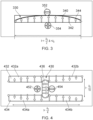
- FIG. 3 this shows a metal layer (such as the first metal layer 122 on a first major surface of a package substrate) having therein a conventional "straight slot" 330, fed by feed points 352 and 354, such as the pillars 142 and 144.
- the slot has a length I which is between about half lambda and lambda, where lambda is the wavelength of the signal, that is to say, ⁇ 2 ⁇ l ⁇ ⁇ .
- the width of the slot is small compared to the wavelength, typically, w ⁇ ⁇ 20 , and is thus typically of the order of 50 ⁇ m.
- a conventional straight slot can be used as an antenna in many applications due to the nature of the in-phase electric field (E-field) distribution 340, which is depicted as the envelope of individual the field vectors 342, 344 etc. on the left and right arm of the slots as shown in FIG. 3 .
- the conventional straight slot is an effective antenna for radiating the signal (both in and out of the paper as shown, and also along the ground plane, up and down as shown).
- FIG. 4 shows a metal layer having therein an "H" configuration slot 430 according to embodiments of the present disclosure.
- the slot 430 comprises first elongate arm 432 having a left branch 432a and a right branch 432b, and second elongate arm 434 having a left branch 434a and a right branch 434b.
- the elongate arms are connected by a bridge section 436.
- Feed points 452 and 454 are located adjacent, or proximate, to and on either side of the bridge section 436.
- the elongate arms are separated by a relatively small distance l ⁇ ⁇ 0 10 compared with the wavelength of the signal, and the length of each of the elongate arms is at least one quarter of the target wavelength ⁇ 0 , that is to say l > ⁇ 0 4 .
- the E-field lines bend to follow the slot geometry (that is to say, they point away from the positive feed-point 452 and towards the negative feed point 454) such that that the two sides (left and right) are excited 180° out of phase, thereby supressing or even cancelling any radiation from each arm. Further suppression of radiation is achieved due to the 180° phase difference between the top and bottom slot sections. This may result in higher isolation between the neighbouring channels, which may or may not also consist of slot geometry, and lower losses.
- FIG. 5A shows a packaged semiconductor device 500 according to one or more embodiments.
- the device 500 is similar to that shown in FIG. 2 discussed above, and comprises a semiconductor die 110 and a package substrate 520.
- the packaged substrate is arranged with a quarter lambda stub to provide open circuit, non-galvanic, coupling into the stripline transmission line 224 in the package substrate 520.
- the first and third metal layers 222 and 226 are electrically coupled together by a so-called "via fence".
- a via fence is a plurality of vias directly coupling the first and third metal layers 222 and 226. For the purpose of clarity, shown in the FIG. is only a single via 552.
- the via fence may be arranged with vias substantially surrounding the end portion and in particular the start of the stripline transition line.
- FIG. 5B shows a model-based simulation of the electromagnetic (EM) insertion loss at 560, and the return losses at the die (at plot 562) and at the stripline (at plot 564) at the reference planes close to the transition, plotted against frequency over a 70 to 90 GHz frequency range.
- the slot dimensions used in the for simulations were in ranges of 100-250 ⁇ m for I 1 , 1000-1500 ⁇ m for I 2 , 50-75 ⁇ for both w 1 and w 2 , the stripline width was in a range of 50-75 ⁇ m and an open stub length between 250 and 300 ⁇ m.
- the transition also allows for an impedance transformation over the die-to-package interface.
- FIG. 6A shows one such geometrical configuration.
- the FIG. depicts, similar to FIG. 2A , a partial plan view of a packaged semiconductor device in which a first metal layer 622 on the top surface of a package substrate includes an opening or slot 630.
- Two feed points 652 and 654 provide a differential feed to the opening or slot 630.
- the opening or slot 630 comprises two arms 632 and 634 extending in a first direction parallel to an axis joining the two feed points 652 and 654.
- the opening or slot 630 includes two additional arms 636 and 638 which are generally orthogonal to arms 632 and 634.
- the arms are arranged to form a continuously connected slot, with generally right-angled corners between arms 636 and 634, between arms 634 and 638, and between arms 638 and 632.
- the feed points are located one either side of one of the arms, in this case arm 636.
- the stripline transmission line 624 is shown, and in this embodiment, it extends in a direction which is orthogonal to the axis joining the feed points.
- this embodiment results in a single-ended or unbalanced transmission line in the package substrate which is aligned to - that it is to say it has an axis parallel to - the direction of the tracks supplying the signal to the feed points.
- the stripline transmission line is parallel to the axis joining the feed points and thus generally orthogonal to the direction of the tracks supplying the signal to the feed point.
- the signal undergoes a 90° or right angle turn within the balun coupler, whereas in the embodiment shown in FIG. 6A the signal continues in the same general direction as it is coupled from its differential form in the semiconductor die to its single-ended form in the stripline transmission line in the package substrate.
- the total length of the opening or strip slot may be around one-half lambda that is to say half the wavelength of the signal which is coupled.
- the phase difference between the signal in the pair of opposing arms 634 and 632 is thus generally less than 90° and, as can be seen from electric field lines 632a, 632b,..., and 634a, 634b..
- the fields in the two arms tend to cancel each other to suppress radiation.
- the phase difference between the signal in the pair of opposing arms 636 and 638 is generally less than 90° and the electric field in the two arms tend to cancel each other to suppress radiation.
- radiation suppression and cancellation in opposing arms is generally more effective and more complete in the "H" configuration than the embodiment shown in FIG. 6A .
- FIG. 6B shows model-based simulations of the electromagnetic (EM) insertion loss, for the configuration shown in FIG. 6A at 660, and the return losses at the die (at plot 662) and at the stripline (at plot 664) at the reference planes close to the transition, plotted against frequency over a 70 to 90 GHz frequency range. Comparing this FIG. with the plots of FIG. 5B , it is apparent that the embodiment shown in FIG. 6A results in an increase in the insertion loss as the frequency moves away from the design frequency, together with higher return losses, compared with the "H" configuration. On the other hand, being able to route the single-ended stripline transmission line in the same direction as the differential signal may result in a more compact device design for some applications.
- EM electromagnetic
- FIG. 7A shows, schematically a side view of a packaged semiconductor device 100 mounted on a circuit board or PCB 730 by means of solder balls 710.
- the packaged semiconductor device 100 comprises a semiconductor die 110 and a package substrate 220.
- the semiconductor die 110 is electrically connected to the package substrate 220 by means of pillars such as solder pillars which include ground pillars 146, and a pair of differential signal pillars 142 and 144.
- the pillars 142 and 144 are positioned either side of a bridge section 236 of an opening or slot 230 which has two elongate arms 232 and 234, in a first metal layer 222 at the first, or top, surface of the package substrate 220.
- the package substrate 220 includes a third metal layer 226 on its second major, or bottom, surface.
- the slot operates as a balun coupler to a stripline transmission line comprised in the second metal layer 224 within the package substrate 220.
- FIG. 7A also shows a fourth metal layer 728, also within the package substrate 220, which is connected to parts of the second metal layer, which parts which do not form the stripline transmission line, by a plurality of electrically conductive vias 554. (it should be noted that, the fourth metal layer may alternatively be referred to as M3, counting from the top of the substrate, and the third metal layer as M4).
- the non-signal parts of the second metal, as well as the other metal layers, will generally all be ground, to assist in isolation.
- the substrate may include more metal layers interleaved between, and/or surrounding the low-loss dielectric.
- FIG. 7B shows schematically, a plan view of the device 100 of FIG. 7A mounted on the circuit board 730.
- the "fence" of the grounding vias 552 around the stripline transmission line 224 is clearly apparent in this view, as is the configuration of the opening or slot in the first metal layer 222 which forms the balun coupler.
- the electrically conductive vias 554 connecting the parts of the second and fourth metal layers other than the stripline transition line are also arranged in a fence configuration, which acts as an outer shielding of the coax. Providing such a via fence and connecting the vias emulates a waveguide with a much higher cut-off frequency, which helps to restrict any losses due to the radiation int the substrate.
- a coaxial connection 560 within the package which is used to route the signal from the stripline in the second metal layer through the fourth metal layer (728) to the third metal layer 226 (at the bottom of the package).
- the signal is transferred to the PCB by means of a signal ball (not visible) which is under the coax and is surrounded by the solder balls 710 and which are grounded and thus provided additional shielding.
- FIG. 7C shows a perspective view of the device 100 and circuit board 730 shown in FIG. 7A and FIG. 7B .
- the differential signal lines on the die are shown as 752.
- the vias 552 and 554 which form the fences are more clearly visible. It is also more clearly apparent that the stripline transmission line 224 is separated from other metal regions 724 within the same metal layer by a gap 726.
Landscapes
- Engineering & Computer Science (AREA)
- Computer Security & Cryptography (AREA)
- Radar, Positioning & Navigation (AREA)
- Remote Sensing (AREA)
- Microelectronics & Electronic Packaging (AREA)
- Semiconductor Integrated Circuits (AREA)
Priority Applications (1)
| Application Number | Priority Date | Filing Date | Title |
|---|---|---|---|
| CN202411788636.7A CN120127092A (zh) | 2023-12-07 | 2024-12-06 | 狭槽配置管芯到封装平衡-不平衡转换耦合器 |
Applications Claiming Priority (1)
| Application Number | Priority Date | Filing Date | Title |
|---|---|---|---|
| EP23386131 | 2023-12-07 |
Publications (1)
| Publication Number | Publication Date |
|---|---|
| EP4568009A1 true EP4568009A1 (fr) | 2025-06-11 |
Family
ID=89474382
Family Applications (1)
| Application Number | Title | Priority Date | Filing Date |
|---|---|---|---|
| EP24158788.0A Pending EP4568009A1 (fr) | 2023-12-07 | 2024-02-21 | Coupleur balun de configuration de fente à matrice de mise en boîtier |
Country Status (3)
| Country | Link |
|---|---|
| US (1) | US20250192078A1 (fr) |
| EP (1) | EP4568009A1 (fr) |
| CN (1) | CN120127092A (fr) |
Families Citing this family (1)
| Publication number | Priority date | Publication date | Assignee | Title |
|---|---|---|---|---|
| US12483445B2 (en) * | 2023-12-07 | 2025-11-25 | Nxp B.V. | Differential transmitter circuitry with ESD circuitry |
Citations (3)
| Publication number | Priority date | Publication date | Assignee | Title |
|---|---|---|---|---|
| US20110316642A1 (en) * | 2010-06-28 | 2011-12-29 | Murata Manufacturing Co., Ltd. | Module |
| WO2022122114A1 (fr) * | 2020-12-07 | 2022-06-16 | Telefonaktiebolaget Lm Ericsson (Publ) | Agencement de symétriseur large bande |
| US20220328432A1 (en) * | 2021-04-09 | 2022-10-13 | Nxp B.V. | Packaged integrated circuit device with built-in baluns |
-
2024
- 2024-02-21 EP EP24158788.0A patent/EP4568009A1/fr active Pending
- 2024-12-02 US US18/965,223 patent/US20250192078A1/en active Pending
- 2024-12-06 CN CN202411788636.7A patent/CN120127092A/zh active Pending
Patent Citations (3)
| Publication number | Priority date | Publication date | Assignee | Title |
|---|---|---|---|---|
| US20110316642A1 (en) * | 2010-06-28 | 2011-12-29 | Murata Manufacturing Co., Ltd. | Module |
| WO2022122114A1 (fr) * | 2020-12-07 | 2022-06-16 | Telefonaktiebolaget Lm Ericsson (Publ) | Agencement de symétriseur large bande |
| US20220328432A1 (en) * | 2021-04-09 | 2022-10-13 | Nxp B.V. | Packaged integrated circuit device with built-in baluns |
Non-Patent Citations (1)
| Title |
|---|
| WU PENG ET AL: "A wideband microstrip balun structure", 2014 IEEE MTT-S INTERNATIONAL MICROWAVE SYMPOSIUM (IMS2014), IEEE, 1 June 2014 (2014-06-01), pages 1 - 3, XP032615359, DOI: 10.1109/MWSYM.2014.6848433 * |
Also Published As
| Publication number | Publication date |
|---|---|
| US20250192078A1 (en) | 2025-06-12 |
| CN120127092A (zh) | 2025-06-10 |
Similar Documents
| Publication | Publication Date | Title |
|---|---|---|
| US11658390B2 (en) | Wireless communications package with integrated antenna array | |
| KR100818897B1 (ko) | 기판에 형성된 방사 요소들로서 비아들을 사용하여안테나를 구성하는 장치 및 방법 | |
| US7884682B2 (en) | Waveguide to microstrip transducer having a ridge waveguide and an impedance matching box | |
| US7675466B2 (en) | Antenna array feed line structures for millimeter wave applications | |
| US6639487B1 (en) | Wideband impedance coupler | |
| US7545329B2 (en) | Apparatus and methods for constructing and packaging printed antenna devices | |
| US6304220B1 (en) | Antenna with stacked resonant structures and a multi-frequency radiocommunications system including it | |
| EP3547442A1 (fr) | Structure d'antenne avec élément de couplage intégré et boîtier de semiconducteur l'utilisant | |
| US7940143B2 (en) | Vertical transmission line structure that includes bump elements for flip-chip mounting | |
| US11791535B2 (en) | Non-galvanic interconnect for planar RF devices | |
| US8022784B2 (en) | Planar transmission line-to-waveguide transition apparatus having an embedded bent stub | |
| US6501352B1 (en) | High frequency wiring board and its connecting structure | |
| US20250192078A1 (en) | Slot-configuration die-to-package balun coupler | |
| US12308510B2 (en) | Terahertz band waveguide module and mounting method of IC chip | |
| US20250189623A1 (en) | Planar balun structure | |
| US7109821B2 (en) | Connections and feeds for broadband antennas | |
| CN117954843B (zh) | 一种毫米波雷达射频前端模组 | |
| CN114927856B (zh) | 一种适用于雷达感应的毫米波封装天线 | |
| US20110241803A1 (en) | Signal transmission line | |
| EP4468342A1 (fr) | Boîtier de circuit intégré | |
| US10784215B2 (en) | Millimeter wave integrated circuit and system with a low loss package transition | |
| US20250349759A1 (en) | Launcher in package semiconductor device and assembly | |
| US12586889B2 (en) | Conversion apparatus from chip package to waveguide, radio frequency apparatus and radar apparatus | |
| EP4080677B1 (fr) | Réseau d'adaptation bimode intégré à ondes millimétriques | |
| CN121096991A (zh) | 一种基于htcc的w波段cbga封装垂直过渡结构 |
Legal Events
| Date | Code | Title | Description |
|---|---|---|---|
| PUAI | Public reference made under article 153(3) epc to a published international application that has entered the european phase |
Free format text: ORIGINAL CODE: 0009012 |
|
| STAA | Information on the status of an ep patent application or granted ep patent |
Free format text: STATUS: THE APPLICATION HAS BEEN PUBLISHED |
|
| AK | Designated contracting states |
Kind code of ref document: A1 Designated state(s): AL AT BE BG CH CY CZ DE DK EE ES FI FR GB GR HR HU IE IS IT LI LT LU LV MC ME MK MT NL NO PL PT RO RS SE SI SK SM TR |
|
| STAA | Information on the status of an ep patent application or granted ep patent |
Free format text: STATUS: REQUEST FOR EXAMINATION WAS MADE |
|
| 17P | Request for examination filed |
Effective date: 20251211 |