EP4568060A1 - Verfahren und vorrichtung zur erzeugung eines digitalen reisepasses einer lithium-ionen-batteriezelle - Google Patents
Verfahren und vorrichtung zur erzeugung eines digitalen reisepasses einer lithium-ionen-batteriezelle Download PDFInfo
- Publication number
- EP4568060A1 EP4568060A1 EP24214694.2A EP24214694A EP4568060A1 EP 4568060 A1 EP4568060 A1 EP 4568060A1 EP 24214694 A EP24214694 A EP 24214694A EP 4568060 A1 EP4568060 A1 EP 4568060A1
- Authority
- EP
- European Patent Office
- Prior art keywords
- cell
- intrinsic
- phase
- incidence
- during
- Prior art date
- Legal status (The legal status is an assumption and is not a legal conclusion. Google has not performed a legal analysis and makes no representation as to the accuracy of the status listed.)
- Pending
Links
Images




Classifications
-
- H—ELECTRICITY
- H02—GENERATION; CONVERSION OR DISTRIBUTION OF ELECTRIC POWER
- H02J—ELECTRIC POWER NETWORKS; CIRCUIT ARRANGEMENTS OR SYSTEMS FOR SUPPLYING OR DISTRIBUTING ELECTRIC POWER; SYSTEMS FOR STORING ELECTRIC ENERGY
- H02J7/00—Circuit arrangements for charging or discharging batteries or for supplying loads from batteries
- H02J7/80—Circuit arrangements for charging or discharging batteries or for supplying loads from batteries including monitoring or indicating arrangements
- H02J7/84—Control of state of health [SOH]
-
- G—PHYSICS
- G01—MEASURING; TESTING
- G01R—MEASURING ELECTRIC VARIABLES; MEASURING MAGNETIC VARIABLES
- G01R31/00—Arrangements for testing electric properties; Arrangements for locating electric faults; Arrangements for electrical testing characterised by what is being tested not provided for elsewhere
- G01R31/36—Arrangements for testing, measuring or monitoring the electrical condition of accumulators or electric batteries, e.g. capacity or state of charge [SoC]
- G01R31/3644—Constructional arrangements
- G01R31/3648—Constructional arrangements comprising digital calculation means, e.g. for performing an algorithm
-
- G—PHYSICS
- G01—MEASURING; TESTING
- G01R—MEASURING ELECTRIC VARIABLES; MEASURING MAGNETIC VARIABLES
- G01R31/00—Arrangements for testing electric properties; Arrangements for locating electric faults; Arrangements for electrical testing characterised by what is being tested not provided for elsewhere
- G01R31/36—Arrangements for testing, measuring or monitoring the electrical condition of accumulators or electric batteries, e.g. capacity or state of charge [SoC]
- G01R31/367—Software therefor, e.g. for battery testing using modelling or look-up tables
-
- G—PHYSICS
- G01—MEASURING; TESTING
- G01R—MEASURING ELECTRIC VARIABLES; MEASURING MAGNETIC VARIABLES
- G01R31/00—Arrangements for testing electric properties; Arrangements for locating electric faults; Arrangements for electrical testing characterised by what is being tested not provided for elsewhere
- G01R31/36—Arrangements for testing, measuring or monitoring the electrical condition of accumulators or electric batteries, e.g. capacity or state of charge [SoC]
- G01R31/382—Arrangements for monitoring battery or accumulator variables, e.g. SoC
-
- G—PHYSICS
- G01—MEASURING; TESTING
- G01R—MEASURING ELECTRIC VARIABLES; MEASURING MAGNETIC VARIABLES
- G01R31/00—Arrangements for testing electric properties; Arrangements for locating electric faults; Arrangements for electrical testing characterised by what is being tested not provided for elsewhere
- G01R31/36—Arrangements for testing, measuring or monitoring the electrical condition of accumulators or electric batteries, e.g. capacity or state of charge [SoC]
- G01R31/392—Determining battery ageing or deterioration, e.g. state of health
Definitions
- the present invention belongs to the field of management of “Lithium-Ion” type batteries. More particularly, a method and a device are proposed for generating a digital passport of a Lithium-Ion battery cell, with the aim of providing a synthetic and easily exploitable representation of the state of health of the cell. This digital passport can in particular be used to evaluate the possibility of reusing the cell for a second life.
- the proposal for a regulation on batteries 2020/353 (COD), repealing European Directive 2006/66/EC and amending European Union (EU) Regulation No. 2019/1020 aims to improve the management of lithium batteries and waste from these batteries in the European Union.
- the proposal includes a series of measures aimed, among other things, at increasing the collection rate of batteries, reducing the amount of hazardous substances contained in batteries and improving battery recycling. This will help protect the environment and conserve natural resources.
- This proposal for a regulation on batteries is currently under examination by the European Parliament and the Council of the European Union.
- This proposed regulation also introduces the concept of a "digital battery passport” making it possible to provide synthetic and easily exploitable data regarding the safety of the battery, its dismantling and/or its second-life reuse.
- the present invention aims to remedy all or part of the drawbacks of the prior art, in particular those set out above.
- the invention may further comprise one or more of the following characteristics, taken individually or in any technically possible combination.
- the total intrinsic spectral density is normalized relative to a maximum value of the total intrinsic spectral density.
- the spectral density of the intrinsic component is calculated from a Hilbert transform of the intrinsic component.
- the proposed method differs significantly from conventional methods in that it is based on the analysis of the derivative of the floating current during a CV phase of a CC-CV charge cycle. At first glance, there is no evidence to suggest that this signal contains relevant information for monitoring the cell health status.
- Empirical mode decomposition is particularly well suited to analyzing this signal. This decomposition also has the advantage of being relatively fast and not very demanding in terms of computing capacity.
- the method further comprises, for each CV phase, an estimation of a statistical reliability of the CV phase as a function of the intrinsic components of the floating current derivative signal.
- the CV phase is filtered if it is deemed unreliable.
- the statistical reliability of the CV phase is estimated based on an entropy calculated for a sum of the intrinsic components of the floating current derivative signal.
- the statistical reliability of the CV phase is estimated by comparing the total intrinsic energy with a predetermined energy threshold, or with the total intrinsic energies calculated for all or part of previous CV phases.
- the method comprises a step of detecting at least one failure of the cell during its first life from the incidence values stored in the computer file forming the digital passport of the cell.
- the detection of said at least one failure comprises a comparison of the incidence value with a predetermined incidence threshold, for one or more consecutive CV phases.
- the detection of said at least one failure comprises a comparison of a distance between the incidence value and an average incidence value with a predetermined distance threshold, for one or more consecutive CV phases.
- the detection of one or more failures of the cell during its first life, from the digital passport of the cell can in particular make it possible to estimate the possibility or not of reusing the cell in its second life (for example depending on the number and/or the importance of the failures observed).
- the method when at least one failure is detected, the method further comprises a verification whether said at least one detected failure is linked to the environment in which the cell has evolved.
- the verification whether said at least one detected failure is linked to the environment comprises a comparison, for a given period, of incidence values stored for said cell during said period with incidence values determined for at least one other cell subjected to the same environment during said period.
- the verification whether said at least one detected failure is linked to the environment comprises a comparison, for a given period, of environmental measurements taken and stored during said period with a predetermined threshold.
- failures linked to the environment are in fact generally less detrimental to the possibility of reusing the battery in a second life than failures intrinsic to the cell (for example failures linked to a manufacturing defect or to early degradation of the cell).
- the method includes a step of determining, from the digital passport of the cell, whether or not the cell can be reused for a second life.
- the present application provides a method and a device for generating a “digital passport” of a cell of a Lithium-Ion battery.
- a charging cycle of a Lithium-Ion battery cell typically comprises two phases: a first constant current charging phase, or CC phase (for "Constant Current” in English) and a second constant voltage charging phase, or CV phase (for "Constant Voltage” in English). This is called a CC-CV charging cycle.
- CC phase for "Constant Current” in English
- CV phase for "Constant Voltage” in English
- CC-CV charging cycle for "Constant Voltage” in English.
- the first charging phase (CC phase) is typically carried out at constant current, more sophisticated charging schemes may exist during this first phase, with a change in the current, for example, to maximize the charging speed while remaining within the charging range compatible with the accumulator.
- the end of the first charging phase is then marked by reaching a voltage threshold which triggers the switch to the second charging phase at constant voltage (CV phase).
- CV phase constant voltage
- these particular cases of the first charging phase will be considered as also covered by the term CC-CV charging "constant current - constant voltage" used in this application.
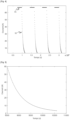
- FIG. 4 is a graph representing four successive CC-CV charge cycles of a Lithium-Ion battery cell.
- the current flowing through the cell is represented on the ordinate (in amperes) and the time is represented on the abscissa (in seconds).
- Each cycle has a CC phase 31 and a CV phase 32.
- the current flowing in the cell during the CC phase 31 is substantially constant, and it exhibits an exponential decrease during the CV phase 32.
- the Figure 5 is a graph showing in more detail the CV 32 phase of a CC-CV charge cycle of the cell.
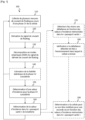
- FIG. 1 schematically represents the main steps of an example of implementation of a method 100 according to the invention for generating a digital passport of a cell of a Lithium-Ion battery.
- the resulting computer file forms a digital passport for the cell.
- the incidence values stored in this passport are representative of a history of the cell's health status during its first life.
- the floating current measurements during the CV phase are for example carried out by a battery management system (BMS) connected to the cell.
- BMS battery management system
- the measurements are for example carried out with an acquisition frequency of between one and sixty seconds, for an acquisition duration of ten to sixty minutes. However, nothing would prevent the measurements from being carried out with a different acquisition frequency, and/or for a different acquisition duration. It is advantageous to use a number of measurements of between thirty and fifty per CV phase (using a larger number of measurements does not necessarily imply a significant improvement in the method; using a smaller number of measurements may, however, limit the performance of the method). All of the measurements collected during the collection step 110 form a “floating current” signal.
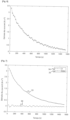
- the graph of the Figure 5 represents an example of a floating current signal obtained in the collection step 110.
- the floating current signal obtained in the step 110 is derived to obtain a floating current derivative signal.
- the graph of the Figure 6 represents an example of a floating current derivative signal obtained in the derivation step 120 (this is the derivative of the floating current signal shown on the graph of the Figure 5 ).
- step 130 the floating current derivative signal is decomposed according to an empirical mode decomposition. It should be noted that the floating current signal is generally too “smooth” and that it hardly allows a decomposition into empirical modes, which is why we are interested in its derivative, even if nothing could suggest at first glance that this floating current derivative signal could contain relevant information on the health status of the cell.
- Empirical mode decomposition consists of decomposing a signal into a sum of functions, similar to what Fourier series decomposition or wavelet decomposition does.
- One of the peculiarities of empirical mode decomposition is that the basis of functions into which the signal is decomposed is not known a priori, but is constructed adaptively based on the properties of the signal.
- Empirical mode decomposition corresponds to the first part of the Hilbert-Huang Transform (HHT).
- Empirical mode decomposition consists of decomposing a signal in the form of a sum of a residual signal and intrinsic mode functions (IMFs). In the present application, these intrinsic mode functions are also called “intrinsic components”.
- intrinsic components are not defined analytically. Rather, they are determined adaptively based on signal properties.
- r(t) corresponds to the residual signal
- N is the number of intrinsic components of the EMD decomposition
- c i is the intrinsic component of index i.
- Each successive intrinsic component c i ( t ) contains oscillations of lower frequency than the previous one.
- the residual signal corresponds to a general trend of the signal s ( t ).
- the empirical mode decomposition involves a succession of sifting processes.
- the first sifting process takes the signal s ( t ) directly as input.
- the sifting process consists of identifying all the local extrema of the input signal, and connecting the local maxima, respectively the local minima, by cubic spline interpolation, in order to obtain an upper envelope, respectively a lower envelope. An average between the upper envelope and the lower envelope can then be calculated and subtracted from the input signal. If the intermediate signal obtained (subtraction of the input signal with the average of the upper and lower envelopes) is not an intrinsic component, the sifting process is repeated on the intermediate signal. (which therefore becomes the input signal for a new sieving process) until an intrinsic component is obtained. The sieving processes are repeated until the last intrinsic component is obtained, i.e. for example until the intermediate signal becomes monotonic or has only one local extremum. The remaining signal then corresponds to the residual signal r(t).
- a stopping criterion can be defined for the sieving process. For example, the stopping criterion is satisfied if the standard deviation between the results of two successive sieving processes is less than or equal to a predetermined stopping threshold.
- the stopping threshold can typically be between 0.2 and 0.3.
- Empirical mode decomposition algorithms are available in programming libraries, for example in MATLAB or Python.
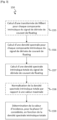
- the intrinsic components obtained in step 130 are then used in step 150 to determine an incidence value representative of the health status of the cell for the CV phase considered.
- the incidence value of the CV phase considered can then correspond to the total intrinsic energy of the CV phase, or to an average value of the total intrinsic energy for all or part of the total intrinsic energies calculated for previous CV phases.
- the incidence value of the CV phase under consideration may correspond to the area of the total intrinsic spectral density of the CV phase, or to an average value of the area of the total intrinsic spectral density for all or part of the total intrinsic energies calculated for previous CV phases.
- the incidence value could also correspond to a set of samples of the total intrinsic spectral density.
- the incidence value of a phase CV can correspond to a pair of values including the total intrinsic energy and the area (or a set of samples) of the total intrinsic spectral density of the CV phase considered.
- the spectral densities of the various intrinsic components can be calculated using the Welch method. However, nothing would prevent the use of other spectral density estimation methods, such as the Bartlett or Blackman-Tukey methods.
- the spectral density of each intrinsic component can optionally be calculated from a Hilbert transform of the intrinsic component.
- the step 150 of determining the incidence value comprises an additional step 155 of calculating a Hilbert transform of each intrinsic component of the floating current derivative signal, prior to the step 156 of calculating the spectral densities of the intrinsic components.
- the Hilbert transform extends a real signal into the complex domain.
- the transformed signal then exhibits zero amplitude responses at zero frequencies. This avoids artifacts when exploiting the information contained in the processed signal.
- the Hilbert transform thus optimizes spectral density calculations.
- the total intrinsic spectral density can be normalized, for example with respect to a maximum value of the total intrinsic spectral density. It is particularly advantageous to carry out this normalization when one wishes to “map” the total intrinsic spectral density and compare the different maps obtained for different CV phases.
- a map of the total intrinsic spectral density corresponds to a representation of the amplitude, the spectral position and the spectral width of the different peaks of the total intrinsic spectral density. This map can be carried out from a set of samples of the total intrinsic spectral density.
- Figure 11 is an example of mapping the total intrinsic spectral densities calculated for different dates (this plot will be described in detail later).
- each incidence value determined for each CV phase in step 150 is stored, in step 160, in the computer file forming the cell's digital passport.
- each incidence value is associated with information on the time of occurrence of the CV phase to which it corresponds. This information can, for example, correspond to a date of occurrence, with the day and possibly the time at which the CV phase took place. This information could also simply correspond to a CV phase number (this number being incremented with each new CV phase observed by the cell during its first life).
- THE figures 8 and 9 represent examples of incidence values, associated with the dates of the CV phases for which they were determined, for a Lithium-Ion battery cell during a given period (between July 2021 and April 2023).
- each incidence value corresponds to an average of the total intrinsic energies calculated for twenty consecutive CV phases.
- each incidence value corresponds to the area of the total intrinsic spectral density calculated for each of the CV phases successively undergone by the cell during the period considered.
- the number of incidence values represented on figure 8 is therefore less than the number of incidence values represented on the Figure 9 (on the figure 8 , an incidence value corresponds to twenty consecutive CV phases while on the figure 9 , one incidence value corresponds to a single CV phase).
- the set of incidence values represented on the figures 8 and 9 can correspond to a digital passport of the cell.
- the volume of data required to form this passport is relatively small, for example of the order of a few kilobytes to a few tens of kilobytes.
- THE figures 10 And 11 illustrate other examples of representation of incidence values. As illustrated in the Figure 10 , it is possible to represent the incidence values in the form of a graphical strip.
- the longitudinal axis of the strip represents the evolution of time.
- a color code represents the incidence value at a given date (for example the value of the total intrinsic energy, or the value of the area of the total intrinsic spectral density).
- the method 100 according to the invention can also include an optional step 140 of estimating the statistical reliability of a CV phase, and filtering the CV phase if it is deemed unreliable (we can also see in the figures 8 and 9 that for certain dates incidence values were not determined or stored).
- This filtering of CV phases deemed unreliable makes it possible to limit the number of incidence values to be stored, and consequently to limit the size of the cell's digital passport. This also makes it possible to avoid introducing aberrant values into the cell's digital passport.
- the statistical reliability of a CV phase is estimated based on the intrinsic components of the floating current derivative signal obtained for the CV phase.
- the statistical reliability of the CV phase is estimated based on an entropy calculated for a sum of the intrinsic components of the floating current derivative signal (for example for the sum of all the intrinsic components obtained by the EMD decomposition, or for the sum of a predefined maximum number of the first intrinsic components obtained by the EMD decomposition).
- Different entropy calculation methods can be considered, such as for example a Shannon entropy calculation, or a Kolmogorov entropy calculation.
- the CV phases for which the calculated entropy is too low are filtered.
- a Shannon entropy threshold between 0.25 and 0.5 can in particular be considered.
- the statistical reliability of the CV phase is estimated by comparing the total intrinsic energy calculated for the CV phase with a predetermined energy threshold. For example, CV phases that have an outlier total intrinsic energy value (greater than the energy threshold) are filtered out.
- the statistical reliability of the CV phase is estimated by comparing the total intrinsic energy calculated for the CV phase with the total intrinsic energies calculated for all or part of previous CV phases. (e.g. total intrinsic energies can be compared with each other, or the total intrinsic energy of the current CV phase can be compared with an average value of total intrinsic energies of previous CV phases). Different statistical tests can be considered for this purpose (Pierce test, Pierson test, etc.).
- the digital passport obtained by method 100 described above can in particular be used to determine whether or not the cell can be recycled for a second life.
- the cell has suffered one or more failures during its first life.
- the possibility or not of reusing the cell in a second life can then be estimated based on the number and/or the importance of the failures observed by the cell during its first life.
- the method 100 may include an optional step 170 of detecting one or more failures of the cell during its first life, from the incidence values stored in the computer file forming the digital passport of the cell.
- the detection of a failure can be implemented by comparing the incidence value with a predetermined incidence threshold, for one or more consecutive CV phases.
- failure detection could be implemented by comparing a distance between an incidence value and an average incidence value with a predetermined distance threshold, for one or more consecutive CV phases.
- the figures 8 and 9 highlight abnormal behavior of the cell in November 2022. Indeed, the total intrinsic energy values ( figure 8 ) and total intrinsic spectral density area ( Figure 9 ) are particularly high during the month of November 2022. This highlights a possible failure of the cell during this period. In addition, it can be observed that the incidence values then take lower values compared to the values observed before November 2022. This highlights premature (or early) aging of the cell following the failure in November 2022.
- the abnormal behavior of the cell in November 2022 can also be observed on the graphical representations of the figures 10 And 11 .
- On the Figure 11 a change in the position and width of the main peak of the spectral density can be observed from November 2022.
- method 100 may include an optional verification step 180 if a detected failure is linked to the environment in which the cell evolved.
- This verification 180 may in particular comprise a comparison, for a given period, of incidence values stored for the cell during said period with incidence values determined and stored for at least one other cell subjected to the same environment during said period. If the incidence values observed for one or more other cells subjected to the same environment highlight a similar abnormal development during a given period, then it is highly probable that this abnormal behavior is linked to the environment (for example because of an exceptional increase in the temperature experienced by the different cells during this period).
- the verification 180 may comprise a comparison, for a given period, of environmental measurements taken and stored during said period with a predetermined threshold. This may involve, for example, the recording of measurements of the temperature to which the cell was exposed.
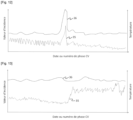
- Figures 12 and 13 illustrate the evolution over time of the incidence value of a battery cell (curve 35) as well as the evolution over time, during the same period, of the temperature experienced by the cell (curve 36).
- the failure highlighted by the peak in incidence value is most likely related to the environment as a similar peak is observed at the same time for the temperature experienced by the cell.
- FIG. 14 schematically represents a device 10 for generating a digital passport of a cell 21 of a Lithium-Ion battery 22.
- the device 10 comprises in particular a memory 11, a battery management system 13 and a computing unit 12 connected to the memory 11 and to the battery management system 13.
- the digital passport corresponds to a computer file 14 saved in the memory 11.
- This computer file 14 includes a set of incidence values representative of a history of health states of the cell 21 during a first life of the cell 21.
- the battery management system is configured to provide current measurements made at cell 21 during a CV phase of a CC-CV charge cycle.
- the calculation unit 12 is configured to implement the method 100 according to any one of the implementation modes described above.
- the device 10 may further comprise a sensor configured to measure the environment (for example a temperature sensor).
- a sensor configured to measure the environment (for example a temperature sensor).
- the battery management system 13 may also be configured to provide floating current measurements of one or more other cells 22 subjected to the same environment as the cell 21.
- the present invention achieves the set objectives.
- the evolution of the incidence values observed for the different CV phases of the cell provides a particularly relevant database for estimating its state of health and the possibility of reusing it in a second life.
- the volume of data to be stored to form the cell's digital passport remains particularly low.
- This digital passport can therefore be easily exchanged between different entities interested in the cell's state of health.
Landscapes
- Physics & Mathematics (AREA)
- General Physics & Mathematics (AREA)
- Engineering & Computer Science (AREA)
- Power Engineering (AREA)
- Secondary Cells (AREA)
- Power Sources (AREA)
Applications Claiming Priority (1)
| Application Number | Priority Date | Filing Date | Title |
|---|---|---|---|
| FR2313263A FR3155903B1 (fr) | 2023-11-29 | 2023-11-29 | Méthode et dispositif pour générer un passeport numérique d’une cellule de batterie Lithium-Ion |
Publications (1)
| Publication Number | Publication Date |
|---|---|
| EP4568060A1 true EP4568060A1 (de) | 2025-06-11 |
Family
ID=90363360
Family Applications (1)
| Application Number | Title | Priority Date | Filing Date |
|---|---|---|---|
| EP24214694.2A Pending EP4568060A1 (de) | 2023-11-29 | 2024-11-22 | Verfahren und vorrichtung zur erzeugung eines digitalen reisepasses einer lithium-ionen-batteriezelle |
Country Status (4)
| Country | Link |
|---|---|
| US (1) | US20250172629A1 (de) |
| EP (1) | EP4568060A1 (de) |
| CA (1) | CA3257396A1 (de) |
| FR (1) | FR3155903B1 (de) |
Citations (4)
| Publication number | Priority date | Publication date | Assignee | Title |
|---|---|---|---|---|
| US20170146608A1 (en) | 2015-11-20 | 2017-05-25 | Korea Advanced Institute Of Science And Technology | Method of dynamically extracting entropy of battery |
| EP3324197A1 (de) | 2016-11-22 | 2018-05-23 | Commissariat à l'Energie Atomique et aux Energies Alternatives | Verfahren zur bestimmung des zustands einer batteriezelle |
| CN111308379A (zh) * | 2020-03-13 | 2020-06-19 | 北京理工大学 | 一种基于局部恒压充电数据的电池健康状态估计方法 |
| US20220381849A1 (en) | 2019-10-25 | 2022-12-01 | Shandong University | Multi-fault diagnosis method and system for battery packs based on corrected sample entropy |
-
2023
- 2023-11-29 FR FR2313263A patent/FR3155903B1/fr active Active
-
2024
- 2024-11-22 EP EP24214694.2A patent/EP4568060A1/de active Pending
- 2024-11-26 US US18/959,963 patent/US20250172629A1/en active Pending
- 2024-11-26 CA CA3257396A patent/CA3257396A1/fr active Pending
Patent Citations (4)
| Publication number | Priority date | Publication date | Assignee | Title |
|---|---|---|---|---|
| US20170146608A1 (en) | 2015-11-20 | 2017-05-25 | Korea Advanced Institute Of Science And Technology | Method of dynamically extracting entropy of battery |
| EP3324197A1 (de) | 2016-11-22 | 2018-05-23 | Commissariat à l'Energie Atomique et aux Energies Alternatives | Verfahren zur bestimmung des zustands einer batteriezelle |
| US20220381849A1 (en) | 2019-10-25 | 2022-12-01 | Shandong University | Multi-fault diagnosis method and system for battery packs based on corrected sample entropy |
| CN111308379A (zh) * | 2020-03-13 | 2020-06-19 | 北京理工大学 | 一种基于局部恒压充电数据的电池健康状态估计方法 |
Non-Patent Citations (4)
| Title |
|---|
| LI KAIQUAN ET AL: "A comparative study of battery state-of-health estimation based on empirical mode decomposition and neural network", JOURNAL OF ENERGY STORAGE, vol. 54, 1 October 2022 (2022-10-01), NL, pages 105333, XP093176794, ISSN: 2352-152X, DOI: 10.1016/j.est.2022.105333 * |
| NORDEN E. HUANG ET AL.: "The empirical mode decomposition and the Hilbert spectrum for non-linear and non-stationary time series analysis", PROC. R. SOC. LOND. A, vol. 454, 1998, pages 903 - 995, XP002410420 |
| RUAN HAOKAI ET AL: "State of Health Estimation of Lithium-Ion Battery Based on Constant-Voltage Charging Reconstruction", IEEE JOURNAL OF EMERGING AND SELECTED TOPICS IN POWER ELECTRONICS, IEEE, PISCATAWAY, NJ, USA, vol. 11, no. 4, 20 July 2021 (2021-07-20), pages 4393 - 4402, XP011945626, ISSN: 2168-6777, [retrieved on 20210721], DOI: 10.1109/JESTPE.2021.3098836 * |
| XIA FEI ET AL: "State of health and remaining useful life prediction of lithium-ion batteries based on a disturbance-free incremental capacity and differential voltage analysis method", JOURNAL OF ENERGY STORAGE, ELSEVIER BV, NL, vol. 64, 24 March 2023 (2023-03-24), XP087298776, ISSN: 2352-152X, [retrieved on 20230324], DOI: 10.1016/J.EST.2023.107161 * |
Also Published As
| Publication number | Publication date |
|---|---|
| FR3155903A1 (fr) | 2025-05-30 |
| CA3257396A1 (fr) | 2025-10-31 |
| FR3155903B1 (fr) | 2025-10-17 |
| US20250172629A1 (en) | 2025-05-29 |
Similar Documents
| Publication | Publication Date | Title |
|---|---|---|
| EP2434304B1 (de) | Verfahren und System zur in situ Batteriediagnose mittels elektrochemischer Impedanzspektroskopie | |
| EP2575205B1 (de) | Verfahren und System zur Diagnose des inneren Zustands einer Batterie durch Abgabe eines akustischen Signals | |
| EP2362234B1 (de) | Nicht intrusives Verfahren zur Bestimmung der elektrischen Impedanz einer Batterie | |
| EP3503274B1 (de) | Verfahren zur bestimmung des gesundheitszustands einer brennstoffzelle unter verwendung von messungen während der benutzung | |
| EP2410346B1 (de) | Verfahren zur Bestimmung eines Parameter mindestens eines Akkus einer Batterie | |
| EP2856187B1 (de) | Vorrichtung und verfahren zur bestimmung eines energiezustandes gemäss daten aus dem verarbeitungsverfahren | |
| EP3089888A1 (de) | Verfahren, vorrichtung und system zur messung des integritätszustandes einer batterie in einem elektro- oder hybridfahrzeug während des betriebs und verfahren zur erstellung eines modells für solch eine messung | |
| FR2994745A1 (fr) | Procede d'estimation du vieillissement d'une batterie | |
| FR2956486A1 (fr) | Methode de diagnostic in situ de batteries par spectroscopie d'impedance electrochimique | |
| FR2999722A1 (fr) | Localisation d'un ou plusieurs defauts dans un ensemble electrochimique. | |
| EP4568060A1 (de) | Verfahren und vorrichtung zur erzeugung eines digitalen reisepasses einer lithium-ionen-batteriezelle | |
| EP3835800B1 (de) | Diagnose von energiespeichersystemen in betrieb | |
| FR3131457A1 (fr) | Procédé et système de gestion d’un dispositif de batterie d’un véhicule électrique ou hybride contenant une mesure de tension des cellules reliées à une barre d’interconnexion | |
| EP4206710B1 (de) | Bestimmung des gesundheitszustandes eines elektrischen akkumulators durch umwandlung | |
| EP2406647A1 (de) | Verfahren zur bestimmung des ladestatus einer elektrochemischen quelle zum ziehen eines elektrofahrzeugs | |
| EP4564036A1 (de) | Verfahren und vorrichtung zur erkennung eines ausfalls einer lithium-ionen-batteriezelle | |
| EP4722747A1 (de) | Verfahren und vorrichtung zur erkennung eines ausfalls einer lithium-ionen-batterie | |
| FR3167214A1 (fr) | Méthode et dispositif pour estimer un état de santé d’une batterie Lithium-Ion | |
| EP4386403B1 (de) | Verfahren und vorrichtung zur bestimmung eines die zukünftigen nutzung einer batterie repräsentativen belastungsprofils für eine bestimmte anwendung | |
| EP4078208B1 (de) | Verfahren zur bestimmung eines sondensignals, charakterisierungsverfahren unter verwendung eines solchen signals und vorrichtung dafür | |
| FR3131381A1 (fr) | Détermination du rendement d’un accumulateur électrique par conversion | |
| FR3167248A1 (fr) | Méthode et dispositif pour trier des cellules de batteries lithium-ion selon leur type | |
| CA3257399A1 (fr) | Méthode et dispositif pour détecter une défaillance d’une cellule de batterie lithium-ion | |
| EP4723274A1 (de) | Nachweis einer lithiumablagerung in einer lithium-ionen-batteriezelle | |
| EP2947471B1 (de) | Verfahren und vorrichtung zur diagnose der regenerationsfähigkeit einer batterie |
Legal Events
| Date | Code | Title | Description |
|---|---|---|---|
| PUAI | Public reference made under article 153(3) epc to a published international application that has entered the european phase |
Free format text: ORIGINAL CODE: 0009012 |
|
| STAA | Information on the status of an ep patent application or granted ep patent |
Free format text: STATUS: REQUEST FOR EXAMINATION WAS MADE |
|
| 17P | Request for examination filed |
Effective date: 20241122 |
|
| AK | Designated contracting states |
Kind code of ref document: A1 Designated state(s): AL AT BE BG CH CY CZ DE DK EE ES FI FR GB GR HR HU IE IS IT LI LT LU LV MC ME MK MT NL NO PL PT RO RS SE SI SK SM TR |