EP4568169A1 - Coordination de forme d'onde d'aido aléatoire - Google Patents
Coordination de forme d'onde d'aido aléatoire Download PDFInfo
- Publication number
- EP4568169A1 EP4568169A1 EP24217730.1A EP24217730A EP4568169A1 EP 4568169 A1 EP4568169 A1 EP 4568169A1 EP 24217730 A EP24217730 A EP 24217730A EP 4568169 A1 EP4568169 A1 EP 4568169A1
- Authority
- EP
- European Patent Office
- Prior art keywords
- random number
- information
- signal
- partially
- user device
- Prior art date
- Legal status (The legal status is an assumption and is not a legal conclusion. Google has not performed a legal analysis and makes no representation as to the accuracy of the status listed.)
- Pending
Links
Images




Classifications
-
- H—ELECTRICITY
- H04—ELECTRIC COMMUNICATION TECHNIQUE
- H04L—TRANSMISSION OF DIGITAL INFORMATION, e.g. TELEGRAPHIC COMMUNICATION
- H04L9/00—Cryptographic mechanisms or cryptographic arrangements for secret or secure communications; Network security protocols
- H04L9/06—Cryptographic mechanisms or cryptographic arrangements for secret or secure communications; Network security protocols the encryption apparatus using shift registers or memories for block-wise or stream coding, e.g. DES systems or RC4; Hash functions; Pseudorandom sequence generators
- H04L9/065—Encryption by serially and continuously modifying data stream elements, e.g. stream cipher systems, RC4, SEAL or A5/3
- H04L9/0656—Pseudorandom key sequence combined element-for-element with data sequence, e.g. one-time-pad [OTP] or Vernam's cipher
- H04L9/0662—Pseudorandom key sequence combined element-for-element with data sequence, e.g. one-time-pad [OTP] or Vernam's cipher with particular pseudorandom sequence generator
-
- H—ELECTRICITY
- H04—ELECTRIC COMMUNICATION TECHNIQUE
- H04L—TRANSMISSION OF DIGITAL INFORMATION, e.g. TELEGRAPHIC COMMUNICATION
- H04L27/00—Modulated-carrier systems
- H04L27/0008—Modulated-carrier systems arrangements for allowing a transmitter or receiver to use more than one type of modulation
-
- H—ELECTRICITY
- H04—ELECTRIC COMMUNICATION TECHNIQUE
- H04B—TRANSMISSION
- H04B1/00—Details of transmission systems, not covered by a single one of groups H04B3/00 - H04B13/00; Details of transmission systems not characterised by the medium used for transmission
- H04B1/59—Responders; Transponders
-
- H—ELECTRICITY
- H04—ELECTRIC COMMUNICATION TECHNIQUE
- H04W—WIRELESS COMMUNICATION NETWORKS
- H04W4/00—Services specially adapted for wireless communication networks; Facilities therefor
- H04W4/80—Services using short range communication, e.g. near-field communication [NFC], radio-frequency identification [RFID] or low energy communication
-
- H—ELECTRICITY
- H04—ELECTRIC COMMUNICATION TECHNIQUE
- H04L—TRANSMISSION OF DIGITAL INFORMATION, e.g. TELEGRAPHIC COMMUNICATION
- H04L2209/00—Additional information or applications relating to cryptographic mechanisms or cryptographic arrangements for secret or secure communication H04L9/00
- H04L2209/80—Wireless
- H04L2209/805—Lightweight hardware, e.g. radio-frequency identification [RFID] or sensor
-
- Y—GENERAL TAGGING OF NEW TECHNOLOGICAL DEVELOPMENTS; GENERAL TAGGING OF CROSS-SECTIONAL TECHNOLOGIES SPANNING OVER SEVERAL SECTIONS OF THE IPC; TECHNICAL SUBJECTS COVERED BY FORMER USPC CROSS-REFERENCE ART COLLECTIONS [XRACs] AND DIGESTS
- Y02—TECHNOLOGIES OR APPLICATIONS FOR MITIGATION OR ADAPTATION AGAINST CLIMATE CHANGE
- Y02D—CLIMATE CHANGE MITIGATION TECHNOLOGIES IN INFORMATION AND COMMUNICATION TECHNOLOGIES [ICT], I.E. INFORMATION AND COMMUNICATION TECHNOLOGIES AIMING AT THE REDUCTION OF THEIR OWN ENERGY USE
- Y02D30/00—Reducing energy consumption in communication networks
- Y02D30/70—Reducing energy consumption in communication networks in wireless communication networks
Definitions
- the example and non-limiting embodiments relate generally to internet of things (Iot) and, more particularly, to ambient internet of things.
- Ambient Internet-of-Things generally relates to an ecosystem comprising a number of objects which are connected with a wireless sensor network, such as using low-cost self-powered sensor nodes for example.
- Standards for Ambient IoT are being considered by 3GPP, IEEE and Bluetooth SIG.
- an example apparatus comprising: at least one processor; and at least one memory storing instructions that, when executed with the at least one processor, cause the apparatus to: receive a signal from a user device; generate a random number based, at least partially, upon seed information received from an activator, where the seed information is at least partially common to seed information in the user device; and determine information from the received signal based, at least partially, upon the generated random number.
- an example method comprising: receiving a signal from a user device; generating a random number based, at least partially, upon seed information received from an activator, where the seed information is at least partially common to seed information in the user device; and determining information from the received signal based, at least partially, upon the generated random number.
- an example non-transitory program storage device readable by an apparatus tangibly embodying a program of instructions executable with the apparatus for performing operations, the operations comprising: receiving a signal from a user device; generating a random number based, at least partially, upon seed information received from an activator, where the seed information is at least partially common to seed information in the user device; and determining information from the received signal based, at least partially, upon the generated random number.
- an example apparatus comprising: means for receiving a signal from a user device; means for generating a random number based, at least partially, upon seed information received from an activator, where the seed information is at least partially common to seed information in the user device; and means for determining information from the received signal based, at least partially, upon the generated random number.
- FIG. 1 this figure shows a block diagram of possible and non-limiting examples of devices in which features as described herein may be practiced.
- the activator may be a user equipment (UE).
- the reader may be a radio access network (RAN) node, such as a gNb or base station for example.
- RAN radio access network
- the reader may be a user equipment (UE).
- Fig. 1 shows a block diagram of one possible and non-limiting example of some devices.
- a user equipment (UE) 110, radio access network (RAN) node 170, and network element(s) 190 are illustrated.
- Examples of network equipment, network device, or a network entity might be understood to include, at least part of, a transmission reception point or a cell or a gNB or node for example.
- the user equipment (UE) 110 is in wireless communication with a wireless network 100.
- a UE is a wireless device that can access the wireless network 100.
- the UE 110 includes one or more processors 120, one or more memories 125, and one or more transceivers 130 interconnected through one or more buses 127.
- Each of the one or more transceivers 130 includes a receiver, Rx, 132 and a transmitter, Tx, 133.
- the one or more buses 127 may be address, data, or control buses, and may include any interconnection mechanism, such as a series of lines on a motherboard or integrated circuit, fiber optics or other optical communication equipment, and the like.
- the one or more transceivers 130 are connected to one or more antennas 128.
- the one or more memories 125 include computer program code 123.
- the UE 110 includes a module 140, comprising one of or both parts 140-1 and/or 140-2, which may be implemented in a number of ways.
- the module 140 may be implemented in hardware as module 140-1, such as being implemented as part of the one or more processors 120.
- the module 140-1 may be implemented also as an integrated circuit or through other hardware such as a programmable gate array.
- the module 140 may be implemented as module 140-2, which is implemented as computer program code 123 and is executed by the one or more processors 120.
- the one or more memories 125 and the computer program code 123 may be configured to, with the one or more processors 120, cause the user equipment 110 to perform one or more of the operations as described herein.
- the UE 110 communicates with RAN node 170 via a wireless link 111.
- the RAN node 170 in this example is a base station that provides access by wireless devices such as the UE 110 to the wireless network 100.
- the RAN node 170 may be, for example, a base station for 5G, also called New Radio (NR).
- the RAN node 170 may be a NG-RAN node, which is defined as either a gNB or a ng-eNB.
- a gNB is a node providing NR user plane and control plane protocol terminations towards the UE, and connected via the NG interface to a 5GC (such as, for example, the network element(s) 190).
- the ng-eNB is a node providing E-UTRA user plane and control plane protocol terminations towards the UE, and connected via the NG interface to the 5GC.
- the NG-RAN node may include multiple gNBs, which may also include a central unit (CU) (gNB-CU) 196 and distributed unit(s) (DUs) (gNB-DUs), of which DU 195 is shown.
- the DU may include or be coupled to and control a radio unit (RU).
- the gNB-CU is a logical node hosting RRC, SDAP and PDCP protocols of the gNB or RRC and PDCP protocols of the en-gNB that controls the operation of one or more gNB-DUs.
- the gNB-CU terminates the F1 interface connected with the gNB-DU.
- the F1 interface is illustrated as reference 198, although reference 198 also illustrates a link between remote elements of the RAN node 170 and centralized elements of the RAN node 170, such as between the gNB-CU 196 and the gNB-DU 195.
- the gNB-DU is a logical node hosting RLC, MAC and PHY layers of the gNB or en-gNB, and its operation is partly controlled by gNB-CU.
- One gNB-CU supports one or multiple cells.
- One cell is supported by only one gNB-DU.
- the gNB-DU terminates the F1 interface 198 connected with the gNB-CU.
- the DU 195 is considered to include the transceiver 160, e.g., as part of a RU, but some examples of this may have the transceiver 160 as part of a separate RU, e.g., under control of and connected to the DU 195.
- the RAN node 170 may also be an eNB (evolved NodeB) base station, for LTE (long term evolution), or any other suitable base station or node.
- eNB evolved NodeB
- the RAN node 170 includes one or more processors 152, one or more memories 155, one or more network interfaces (N/W I/F(s)) 161, and one or more transceivers 160 interconnected through one or more buses 157.
- Each of the one or more transceivers 160 includes a receiver, Rx, 162 and a transmitter, Tx, 163.
- the one or more transceivers 160 are connected to one or more antennas 158.
- the one or more memories 155 include computer program code 153.
- the CU 196 may include the processor(s) 152, memories 155, and network interfaces 161. Note that the DU 195 may also contain its own memory/memories and processor(s), and/or other hardware, but these are not shown.
- the RAN node 170 includes a module 150, comprising one of or both parts 150-1 and/or 150-2, which may be implemented in a number of ways.
- the module 150 may be implemented in hardware as module 150-1, such as being implemented as part of the one or more processors 152.
- the module 150-1 may be implemented also as an integrated circuit or through other hardware such as a programmable gate array.
- the module 150 may be implemented as module 150-2, which is implemented as computer program code 153 and is executed by the one or more processors 152.
- the one or more memories 155 and the computer program code 153 are configured to, with the one or more processors 152, cause the RAN node 170 to perform one or more of the operations as described herein.
- the functionality of the module 150 may be distributed, such as being distributed between the DU 195 and the CU 196, or be implemented solely in the DU 195.
- the one or more network interfaces 161 communicate over a network such as via the links 176 and 131.
- Two or more gNBs 170 may communicate using, e.g., link 176.
- the link 176 may be wired or wireless or both and may implement, for example, an Xn interface for 5G, an X2 interface for LTE, or other suitable interface for other standards.
- the one or more buses 157 may be address, data, or control buses, and may include any interconnection mechanism, such as a series of lines on a motherboard or integrated circuit, fiber optics or other optical communication equipment, wireless channels, and the like.
- the one or more transceivers 160 may be implemented as a remote radio head (RRH) 195 for LTE or a distributed unit (DU) 195 for gNB implementation for 5G, with the other elements of the RAN node 170 possibly being physically in a different location from the RRH/DU, and the one or more buses 157 could be implemented in part as, for example, fiber optic cable or other suitable network connection to connect the other elements (e.g., a central unit (CU), gNB-CU) of the RAN node 170 to the RRH/DU 195.
- Reference 198 also indicates those suitable network link(s).
- the cell makes up part of a base station. That is, there can be multiple cells per base station. For example, there could be three cells for a single carrier frequency and associated bandwidth, each cell covering one- third of a 360 degree area so that the single base station's coverage area covers an approximate oval or circle. Furthermore, each cell can correspond to a single carrier and a base station may use multiple carriers. So if there are three 120 degree cells per carrier and two carriers, then the base station has a total of 6 cells.
- the wireless network 100 may include a network element or elements 190 that may include core network functionality, and which provides connectivity via a link or links 181 with a further network, such as a telephone network and/or a data communications network (e.g., the Internet).
- a further network such as a telephone network and/or a data communications network (e.g., the Internet).
- core network functionality for 5G may include access and mobility management function(s) (AMF(S)) and/or user plane functions (UPF(s)) and/or session management function(s) (SMF(s)).
- AMF(S) access and mobility management function(s)
- UPF(s) user plane functions
- SMF(s) session management function
- Such core network functionality for LTE may include MME (Mobility Management Entity)/SGW (Serving Gateway) functionality. These are merely exemplary functions that may be supported by the network element(s) 190, and note that both 5G and LTE functions might be supported.
- the RAN node 170 is coupled via a link 131 to a network element 190.
- the link 131 may be implemented as, e.g., an NG interface for 5G, or an S1 interface for LTE, or other suitable interface for other standards.
- the network element 190 includes one or more processors 175, one or more memories 171, and one or more network interfaces (N/W I/F(s)) 180, interconnected through one or more buses 185.
- the one or more memories 171 include computer program code 173.
- the one or more memories 171 and the computer program code 173 are configured to, with the one or more processors 175, cause the network element 190 to perform one or more operations.
- the wireless network 100 may implement network virtualization, which is the process of combining hardware and software network resources and network functionality into a single, software-based administrative entity, a virtual network.
- Network virtualization involves platform virtualization, often combined with resource virtualization.
- Network virtualization is categorized as either external, combining many networks, or parts of networks, into a virtual unit, or internal, providing network-like functionality to software containers on a single system. Note that the virtualized entities that result from the network virtualization are still implemented, at some level, using hardware such as processors 152 or 175 and memories 155 and 171, and also such virtualized entities create technical effects.
- the computer readable memories 125, 155, and 171 may be of any type suitable to the local technical environment and may be implemented using any suitable data storage technology, such as semiconductor based memory devices, flash memory, magnetic memory devices and systems, optical memory devices and systems, fixed memory and removable memory.
- the computer readable memories 125, 155, and 171 may be means for performing storage functions.
- the processors 120, 152, and 175 may be of any type suitable to the local technical environment, and may include one or more of general purpose computers, special purpose computers, microprocessors, digital signal processors (DSPs) and processors based on a multi-core processor architecture, as non-limiting examples.
- the processors 120, 152, and 175 may be means for performing functions, such as controlling the UE 110, RAN node 170, and other functions as described herein.
- the various embodiments of the user equipment 110 can include, but are not limited to, cellular telephones such as smart phones, tablets, personal digital assistants (PDAs) having wireless communication capabilities, portable computers having wireless communication capabilities, image capture devices such as digital cameras having wireless communication capabilities, gaming devices having wireless communication capabilities, music storage and playback appliances having wireless communication capabilities, Internet appliances permitting wireless Internet access and browsing, tablets with wireless communication capabilities, as well as portable units or terminals that incorporate combinations of such functions.
- cellular telephones such as smart phones, tablets, personal digital assistants (PDAs) having wireless communication capabilities, portable computers having wireless communication capabilities, image capture devices such as digital cameras having wireless communication capabilities, gaming devices having wireless communication capabilities, music storage and playback appliances having wireless communication capabilities, Internet appliances permitting wireless Internet access and browsing, tablets with wireless communication capabilities, as well as portable units or terminals that incorporate combinations of such functions.
- PDAs personal digital assistants
- portable computers having wireless communication capabilities
- image capture devices such as digital cameras having wireless communication capabilities
- gaming devices having wireless communication capabilities
- music storage and playback appliances having wireless communication capabilities
- the random seed may be encoded using a procedure that only allow the AIOT device to be able to decrypt it; to prevent an eavesdropper from acquiring the random seed from the activation signal.
- PLS physical layer security
- PLS has been rather popular in the academia in the last decades, although it has never been very successful in the industry: PLS solutions have the advantage that are typically far less power hungry, as much computationally simpler, when compared to cryptographic solutions, although that comes with the drawback of lower performance.
- PLS may have the potential in certain deployments, for instance ambient internet of things (A-IoT or AIOT), where a device may have no battery at all or a battery with very little energy or power, and where cryptography is just not applicable.
- A-IoT or AIOT ambient internet of things
- a device may have no battery at all or a battery with very little energy or power, and where cryptography is just not applicable.
- cryptography is just not applicable.
- New Radio is a very secure system, and many algorithms and protocols have been introduced to guarantee not only authentication and confidentiality/privacy, but also other security functionalities such as data integrity and availability. These protocols are implemented in different layers and locations, but mainly at PDCP and above layers, and rely on cryptography.
- the approach used by NR relies on cryptography which cannot be directly applied to this A-IoT. This is because passive and semi-passive tags used with A-IoT have such low power availability that even basic cryptographic algorithms are not applicable. Therefore, with features as described herein novel solutions and protocols may be provided to address the two security functionalities noted above with a confidentiality mechanism for A-IoT tags.
- Rapporteur listed the following functionalities for Ambient IoT in RAN: Rapporteur: Assumptions on potentially required functionality to be supported need to be identified for Ambient IoT in RAN. To avoid detailed WG-level analysis, the potential functionalities are expected to be general and to meet the RAN design targets for Ambient IoT air interface. The following potential assumed RAN functionalities were found in the submitted papers (please refer also to design targets above).
- the Ambient IoT device may be provided with a carrier wave from other node(s) either inside or outside the topology.
- the links in each topology may be bidirectional or unidirectional.
- BS, UE, assisting node, or intermediate node could be multiple BSs or UEs, respectively.
- the mixture of indoor and outdoor placement of such nodes is regarded as a network implementation choice.
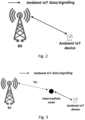
- Topology 1 BS ⁇ -> AloT device
- Topology 1 (depicted in Fig. 2 ), the Ambient IoT device directly and bidirectionally communicates with a base station.
- the communication between the base station and the ambient IoT device includes Ambient IoT data and/or signaling.
- This topology includes the possibility that the BS transmitting to the Ambient IoT device is a different from the BS receiving from the Ambient IoT device.
- Topology 2 BS ⁇ -> intermediate node ⁇ -> AloT device
- the Ambient IoT device communicates bidirectionally with an intermediate node between the device and base station.
- the intermediate node can be a relay, IAB node, UE, repeater, etc. which is capable of Ambient IoT.
- the intermediate node transfers the information between BS and the Ambient IoT device.
- Topology 3 BS ⁇ -> assisting node ⁇ -> AloT device ⁇ -> BS device
- the Ambient IoT device transmits data/signaling to a base station and receives data/signaling from the assisting node; or the Ambient IoT device receives data/signaling from a base station and transmits data/signaling to the assisting node.
- the assisting node can be a relay, IAB, UE, repeater, etc. which is capable of ambient IoT.
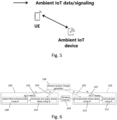
- Topology 4 UE ⁇ -> AloT device
- the Ambient IoT device communicates bidirectionally with a UE.
- the communication between UE and the ambient IoT device includes Ambient IoT data and/or signaling.
- a procedure may be provided to coordinate and reset said generation via an activator.
- the seed may be used to commonly initialize the random number generator at both the reader and the AIOT device.
- the exchange of the common seed may be both authenticated and encrypted using security primitives in place for those interfaces.
- a random seed (or seed state, or just seed) is a number (or vector) which may be used to initialize a number generator or pseudorandom number generator. For a seed to be used in a pseudorandom number generator, it does not need to be random. Because of the nature of number generating algorithms, so long as the original seed is ignored, the rest of the values that the algorithm generates will follow probability distribution in a pseudorandom manner.
- a pseudorandom number generator's number sequence is completely determined by the seed: thus, if a pseudorandom number generator is reinitialized with the same seed, it will produce the same sequence of numbers.
- a secret encryption key is pseudorandomly generated, having the seed will allow one to obtain the key. High entropy is important for selecting good random seed data. If the same random seed is deliberately shared, it becomes a secret key, so two or more systems using matching pseudorandom number algorithms and matching seeds can generate matching sequences of non-repeating numbers which can be used to synchronize remote systems.
- a common agreed random seed may be exchanged between an activator and a reader.
- the AIOT device may receive an activation signal which includes seed information.
- the AIOT device may modulate the information content using a random modulation scheme or order that is generated based on the received random seed.
- the AIOT device may apply a random phase delay to the AIOT signal.
- the reader may de-rotate and demodulate the received signal as per a predefined agreement with the activator.
- the random seed received by the AIOT device may be used to the modulate the information content by changing the modulation scheme/order or phase delay.
- the phase delay applied by the AIOT device may be selected in such a way that it points the transmission towards the legitimate reader only.
- the random number generator may drive the modulator such that the symbols transmitted by the AIOT device in the same AIOT signal belong all to the same modulation.
- the random number generator may drive the modulator such that the symbols transmitted by the AIOT device in the same AIOT signal belong to different modulations.
- the seed used to commonly initialize the random number generator at a reader and the AIOT device do not need to be AIOT device specific.
- the seed used to commonly initialize the random number generator at the reader and the AIOT device may be a same seed reused for different AIOT devices.
- the activation signal may be used for: a) targeting the AIOT detection by the reader or b) acting as a reset of the generator at both AIOT.
- a method may be provided for protection of an AIOT device against eavesdropping.
- the method may comprise use of randomizing the AIOT transmission (such as in modulation and phase domains for example) using an AIOT ID specific random seed.
- the AIOT device and the reader 202 may use a common random seed to prevent eavesdropping. This may comprise:
- Some technical advantages of the proposed method may include implementing an L1 randomizing scheme which:
- Another technical advantage with the proposed method is to provide confidentiality of the AIOT communication, since an eavesdropper cannot decode the AIOT signals and, thus, cannot access the data that the AIOT devices transfer to the NR network.
- Another technical advantage with the proposed method is that it is lightweight and does not require higher layer security protocols to be implemented at the AIOT device; since the AIOT device is expected to be power and computationally limited, and with only physical layer support.
- implementation may be modular in the sense that layers of confidentiality may be added/removed by exploiting selectivity in various domains like space, modulation, etc.
- Fig. 6 is a diagram illustrating examples of an AIOT device 200 and an AIOT reader 202.
- the reader 202 may be, for example, the UE 110 or any other sort of suitable wireless electromagnetic reader.
- the reader 202 is used to interact with the AIOT device via a wireless link 204.
- the AIOT device 200 may, similar to the UE, comprise a processor, a memory (having instructions or code) and a transmitter and receiver for communicating with the reader and an activator 206.
- the activator 206 may comprise a random integer generator which may be shared by both the AIOT device 200 and the reader 202.
- the activator 206 may provide one or more signals 201, 203 to the AIOT device 200 and one or more signals 205, 207 to the reader 202.
- the AIOT device 200 may use information in the signal 201 for determining or selecting a modulation scheme or order. As illustrated with 210, the AIOT device 200 may use information in the signal 203 for determining or generating and applying a phase delay. As illustrated with 212, the reader 202 may use information in the signal 205 for demodulating the signal provided from the AIOT device 200, through the link 204, which was modulated via 208. As illustrated with 214, the reader 202 may use information in the signal 207 for compensating for the phase delay used by the AIOT device 200 at 210. Signals 201 and 203 may be a common signal or multiple signals, and signals 205 and 207 may be a common signal or multiple signals. Also signals 205 and 207 may be bi-directional between the activator and the reader.
- FIG. 7 shows an example signaling exchange among the reader 202, the activator 206 and the AIOT device 200.
- An initialization phase (steps 2-4) may be provided to make sure that the random number generator at the activator 206 is initialized with a same seed for both the reader and AIOT device 200.
- this example comprises:
- the proposed method provides confidentiality of the AIOT communication, since an eavesdropper cannot decode the AIOT signals and, thus, cannot access the data that the AIOT devices transfer to the NR network.
- phase delay applied by the AIOT device may be selected in such a way that it points the transmission towards the legitimate reader only.
- the AIOT device may be configured to transmit in the known/expected direction of the reader. This may be done either by the NW or by the activator itself, via a new configuration message.
- a technical advantage provided with this second type of embodiment is that spatial selectivity may be exploited to narrow down the coverage of the AIOT signal and, thus, make the AIOT signal hearable (detectable) only in a dedicated direction(s); a direction(s) where the reader is expected to be found. This means that the eavesdroppers outside these dedicated direction(s) will be prevented from hearing (detecting) the signal.
- the random number generator may drive the modulator such that the symbols transmitted by the AIOT device in the same AIOT signal belong all to a same modulation such as, for example, a QAM (quadrature amplitude modulation) modulation.
- the random number generator may drive the modulator such that the symbols transmitted by the AIOT device in a same AIOT signal belong to different modulations, for example (assuming that L symbols are transmitted in 3 sets using 3 different modulations):
- a technical advantage provided with these types of modulation embodiments is that this offers an additional layer of AIOT comms confidentiality: by exploiting the selectivity in modulation domain, the mapping between bits and constellation points, and constellation order are constantly changing, and this makes the task of the eavesdropper harder, since the illegitimate device must also guess the modulation order during its attempt to decode the AIOT signal.
- the seed used to commonly initialize the random number generator at the reader and the AIOT device may be AIOT device specific such as, for example, with one seed per AIOT device and different AIOT devices have different seeds.
- such restriction is not implemented, and a same seed may be reused for different AIOT devices.
- the receiver, i.e., the reader, and transmitter, i.e., the AIOT device may know and share a same seed, and it is fine if another AIOT device reuse the same seed because what matters is that an attacker does not know such seed and, therefore, cannot decode what the AIOT device transmits.
- a technical advantage provided with these types of initialization embodiments is that the solution offers a simpler implementation alternative of the confidentiality mechanisms from the previous embodiments, in the sense that the NR NW does not need to assign unique seeds to each of the potentially thousands of AIOT devices which may reside in the NR NW at a time.
- the activation signal may serve multiple purposes such as, for example,:
- a technical advantage provided with these types of reset embodiments is that the synchronization error may be easily corrected and, thus, it is ensured that the reader and the AIOT device itself use the same randomization scheme i.e., that the waveform the AIOT generates is the same as the one the reader expects. In this way, it is ensured that the reader can understand the AIOT device.
- the reader may be provided as a UE as noted above.
- the UE reader method implements steps 10-12 from Fig. 7 .
- N is drawn from e.g. the uniform distribution in the interval [a, z]
- This example method may be used for picking a number at random from the interval [a, z].
- K log 2 ( Round up N to the next highest power of 2)
- modulate function i.e. the bit to modulation mapping can be randomly permutated using as basis the seed s
- an example of such a method could be implemented using (as an example) the Fisher-Yates shuffle:
- the task of the reader is to determine the information bits b, having received signal y(t) and knowing (i.e. having been configured):
- the information bit vector b represents the ID of the AIOT device.
- the reader may report the range to the NW.
- the NW may then locate the device, such as with using multiple readers reports for example.
- a method may be provided for protection of AIOT devices against eavesdropping that relies on randomizing the AIOT transmission in modulation and phase domains using a AIOT ID specific random seed. If features as described herein are used with a UE, UE energy saving may be provided due to simpler computations.
- an apparatus comprising: at least one processor; and at least one memory storing instructions that, when executed with the at least one processor, cause the apparatus to: receive an activation signal comprising seed information, where the seed information is common to seed information in a reader; generate a signal based upon the seed information from the received activation signal and at least one predetermined instruction; and send the generated signal from the apparatus.
- the activation signal may comprise an internet-of-things activation signal.
- the seed information may comprise randomly generated encryption seed information.
- the at least one memory may store instructions that, when executed with the at least one processor, cause the apparatus to generate the signal comprises encrypting data information.
- the at least one predetermined instruction may be based, at least partially, upon the seed information.
- the at least one predetermined instruction may be in a set of instructions respectively based upon different seed information.
- the at least one memory may store instructions that, when executed with the at least one processor, cause the apparatus to predetermine the set of instructions in agreement with a sender of the activation signal prior to receiving the activation signal.
- the at least one memory may store instructions that, when executed with the at least one processor, cause the apparatus to set a random number generator in common with a common random integer generator of the reader and an activator.
- the at least one memory may store instructions that, when executed with the at least one processor, cause the apparatus to generate a random number based, at least partially, upon the seed information from the received activation signal.
- the at least one memory may store instructions that, when executed with the at least one processor, cause the apparatus to determine a modulation for the signal based upon the randomly generated number and a number-to-modulation mapping.
- the at least one memory may store instructions that, when executed with the at least one processor, cause the apparatus to determine a phase delay for the signal based upon the randomly generated number and a number-to-phase-delay mapping.
- the at least one memory may store instructions that, when executed with the at least one processor, cause the apparatus to determine the phase delay to determine a direction to direct the signal towards the reader.
- the at least one memory may store instructions that, when executed with the at least one processor, cause the apparatus to transmit symbols in the signal with a same modulation.
- the at least one memory may store instructions that, when executed with the at least one processor, cause the apparatus to transmit symbols in the signal at least partially with different modulations.
- the at least one memory may store instructions that, when executed with the at least one processor, cause the apparatus to transmit symbols in the signal with at least two of the modulations: M-QAM, M-PSK, M-PAM, or OOK.
- the seed information may be configured to be used for a single user device and a single reader.
- the seed information may be configured to be used for more than one user device.
- the received activation signal may be configured to reset a random number generator of the apparatus.
- a method may be provided comprising: receiving, with an apparatus, an activation signal comprising seed information as illustrated with block 902, where the seed information is common to seed information in a reader; generating a signal based upon the seed information from the received activation signal and at least one predetermined instruction as illustrated with block 904; and sending the generated signal from the apparatus as illustrated with block 906.
- the activation signal may comprise an internet-of-things activation signal.
- the seed information may comprise randomly generated encryption seed information.
- the generating of the signal may comprise encrypting data information.
- the at least one predetermined instruction may be based, at least partially, upon the seed information.
- the at least one predetermined instruction may be in a set of instructions respectively based upon different seed information.
- the method may comprise predetermining the set of instructions in agreement with a sender of the activation signal prior to receiving the activation signal.
- the method may comprise setting a random number generator in common with a common random integer generator of the reader and an activator.
- the method may comprise generating a random number based, at least partially, upon the seed information from the received activation signal.
- the method may comprise determining a modulation for the signal based upon the randomly generated number and a number-to-modulation mapping.
- the method may comprise determining a phase delay for the signal based upon the randomly generated number and a number-to-phase-delay mapping.
- the method may comprise selecting the phase delay to select a direction to direct the signal towards the reader.
- the method may comprise transmitting symbols in the signal with a same modulation.
- the method may comprise transmitting symbols in the signal at least partially with different modulations.
- the method may comprise transmitting symbols in the signal with at least two of the modulations: M-QAM, M-PSK, M-PAM, or OOK.
- the seed information may be configured to be used for a single user device and a single reader.
- the seed information may be configured to be used for more than one user device.
- the received activation signal may be configured to reset a random number generator of the apparatus.
- a non-transitory program storage device may be provided readable by an apparatus, tangibly embodying a program of instructions executable with the apparatus for performing operations, the operations comprising: receiving an activation signal comprising seed information, where the seed information is common to seed information in a reader; generating a signal based upon the seed information from the received activation signal and at least one predetermined instruction; and sending the generated signal from the apparatus.
- an apparatus comprising: means for receiving an activation signal comprising seed information, where the seed information is common to seed information in a reader; means for generating a signal based upon the seed information from the received activation signal and at least one predetermined instruction; and means for sending the generated signal from the apparatus.
- an apparatus comprising: circuitry configured for receiving an activation signal comprising seed information, where the seed information is common to seed information in a reader; circuitry configured for generating a signal based upon the seed information from the received activation signal and at least one predetermined instruction; and circuitry configured for sending the generated signal from the apparatus.
- an apparatus comprising: at least one processor; and at least one memory storing instructions that, when executed with the at least one processor, cause the apparatus to: determine seed information based upon communication between the apparatus and an activator; receive a signal; and determine information from the signal based upon the seed information and at least one predetermined instruction.
- the seed information may comprise internet-of-things seed information.
- the seed information may comprise randomly generated encryption seed information.
- the signal may comprise encrypting data information.
- the at least one memory may store instructions that, when executed with the at least one processor, cause the apparatus to select the at least one predetermined instruction from a plurality of predetermined instructions and is based, at least partially, upon the seed information.
- the at least one predetermined instruction may be in a set of the plurality of predetermined instructions respectively based upon different seed information.
- the at least one memory may store instructions that, when executed with the at least one processor, cause the apparatus to select the at least one predetermined instruction in agreement with the activator prior to receiving the signal.
- the at least one memory may store instructions that, when executed with the at least one processor, cause the apparatus to set a random number generator in common with a common random integer generator of at least one other device.
- the at least one memory may store instructions that, when executed with the at least one processor, cause the apparatus to generate a random number based, at least partially, upon the seed information, where the seed information is received from the activator.
- the at least one memory may store instructions that, when executed with the at least one processor, cause the apparatus to determine a demodulation for the signal based upon the randomly generated number and a number-to-modulation mapping.
- the at least one memory may store instructions that, when executed with the at least one processor, cause the apparatus to determine a phase delay compensation for the signal based upon the randomly generated number and a number-to-phase-delay mapping.
- the at least one memory may store instructions that, when executed with the at least one processor, cause the apparatus to reset the random number generator based upon an activation signal received by the apparatus.
- the activation signal may be configured to reset a random number generator in a user device.
- a method may be provided comprising: determining seed information based upon communication between an apparatus and an activator as illustrated with block 1002; receiving a signal as illustrated with block 1004; and determining information from the signal based upon the seed information and at least one predetermined instruction as illustrated with block 1006.
- the seed information may comprise internet-of-things seed information.
- the seed information may comprise randomly generated encryption seed information.
- the signal may comprise encrypting data information.
- the method may comprise selecting the at least one predetermined instruction from a plurality of predetermined instructions based, at least partially, upon the seed information.
- the at least one predetermined instruction may be in a set of the plurality of predetermined instructions respectively based upon different seed information.
- the method may comprise selecting the at least one predetermined instruction in agreement with the activator prior to receiving the signal.
- the method may comprise setting a random number generator in common with a common random integer generator of at least one other device.
- the method may comprise generating a random number based, at least partially, upon the seed information, where the seed information is received from the activator.
- the method may comprise determining a demodulation for the signal based upon the randomly generated number and a number-to-modulation mapping.
- the method may comprise determining a phase delay compensation for the signal based upon the randomly generated number and a number-to-phase-delay mapping.
- the method may comprise resetting the random number generator based upon an activation signal received by the apparatus.
- the activation signal may be configured to reset a random number generator in a user device.
- a non-transitory program storage device may be provided readable by an apparatus, tangibly embodying a program of instructions executable with the apparatus for performing operations, the operations comprising: determining seed information based upon communication between the apparatus and an activator; receiving a signal; and determining information from the signal based upon the seed information and at least one predetermined instruction.
- an apparatus comprising: means for determining seed information based upon communication between the apparatus and an activator; means for receiving a signal; and means for determining information from the signal based upon the seed information and at least one predetermined instruction.
- an apparatus comprising: circuitry configured for determining seed information based upon communication between the apparatus and an activator; circuitry configured for receiving a signal; and circuitry configured for determining information from the signal based upon the seed information and at least one predetermined instruction.
- an apparatus comprising: at least one processor; and at least one memory storing instructions that, when executed with the at least one processor, cause the apparatus to: determine seed information based upon communication between the apparatus and a reader; send the seed information to a user device, where the user device is configured to use the seed information to form a signal to send to the reader.
- the reader may comprise an internet-of-things reader and the user device comprises an internet-of-things device.
- the signal may comprise an internet-of-things communication data signal.
- the seed information may comprise randomly generated seed information.
- the at least one memory may store instructions that, when executed with the at least one processor, cause the apparatus to provide the seed information as common seed information shared between the apparatus and the reader.
- the at least one memory may store instructions that, when executed with the at least one processor, cause the apparatus to send the seed information with an activation signal comprises an internet-of-things activation signal.
- the seed information may be configured to be used with the user device to generate the signal comprising encrypting data information.
- the seed information may be configured to be used with a predetermined instruction at the user device to generate the signal, where the predetermined instruction is configured to be selected dependent, at least partially, upon the seed information.
- the seed information may be configured to be used to select the at least one predetermined instruction from a set of instructions respectively based upon different seed information.
- the seed information may be configured to be used with a random number generator of the user device in a common manner as with a random integer generator of the reader.
- the seed information may be configured to be used with the user device to determine a modulation for the signal based upon a randomly generated number, by the random number generator of the user device, and a number-to-modulation mapping in the user device.
- the seed information may be configured to be used with the user device to determine a phase delay for the signal based upon a randomly generated number, by the random number generator of the user device, and a number-to-phase-delay mapping.
- the at least one memory may store instructions that, when executed with the at least one processor, cause the apparatus to send at least one activation signal to the user device and the reader configured reset a random number generator of the user device and a random number generator of the reader.
- a method comprising: determining seed information based upon communication between an apparatus and a reader as illustrated with block 1102; sending the seed information to a user device as illustrated with block 1104, where the user device is configured to use the seed information to form a signal to send to the reader.
- the reader may comprise an internet-of-things reader and the user device comprises an internet-of-things device.
- the signal may comprise an internet-of-things communication data signal.
- the seed information may comprise randomly generated seed information.
- the method may comprise providing the seed information as common seed information shared between the apparatus and the reader.
- the sending of the seed information with an activation signal may comprise an internet-of-things activation signal.
- the seed information may be configured to be used with the user device to generate the signal comprising encrypting data information.
- the seed information may be configured to be used with a predetermined instruction at the user device to generate the signal, where the predetermined instruction is configured to be selected dependent, at least partially, upon the seed information.
- the seed information may be configured to be used to select the at least one predetermined instruction from a set of instructions respectively based upon different seed information.
- the seed information may be configured to be used with a random number generator of the user device in a common manner as with a random integer generator of the reader.
- the seed information may be configured to be used with the user device to determine a modulation for the signal based upon a randomly generated number, by the random number generator of the user device, and a number-to-modulation mapping in the user device.
- the seed information may be configured to be used with the user device to determine a phase delay for the signal based upon a randomly generated number, by the random number generator of the user device, and a number-to-phase-delay mapping.
- the method may comprise sending at least one activation signal to the user device and the reader, where the at least one activation signal is configured to reset a random number generator of the user device and a random number generator of the reader.
- a non-transitory program storage device readable by an apparatus, tangibly embodying a program of instructions executable with the apparatus for performing operations, the operations comprising: determining seed information based upon communication between the apparatus and a reader; sending the seed information to a user device, where the user device is configured to use the seed information to form a signal to send to the reader.
- an apparatus comprising: means for determining seed information based upon communication between the apparatus and a reader; and means for sending the seed information to a user device, where the user device is configured to use the seed information to form a signal to send to the reader.
- an apparatus comprising: circuitry configured for determining seed information based upon communication between the apparatus and a reader; and circuitry configured for sending the seed information to a user device, where the user device is configured to use the seed information to form a signal to send to the reader.
- an apparatus comprising: at least one processor; and at least one memory storing instructions that, when executed with the at least one processor, cause the apparatus to: receive a signal from a user device; generate a random number based, at least partially, upon seed information received from an activator, where the seed information is at least partially common to seed information in the user device; and determine information from the received signal based, at least partially, upon the generated random number.
- the at least one memory may store instructions that, when executed with the at least one processor, cause the apparatus to generate the random number based, at least partially, upon a uniform distribution in an interval.
- the at least one memory may store instructions that, when executed with the at least one processor, cause the apparatus to determine a modulation at least partially based upon the generated random number.
- the at least one memory may store instructions that, when executed with the at least one processor, cause the apparatus to determine a phase based upon the generated random number.
- the at least one memory may store instructions that, when executed with the at least one processor, cause the apparatus to determine a waveform at least partially based upon the generated random number.
- the apparatus may be configured to determine the waveform based upon at least one of: modulation or phase information.
- the at least one memory may store instructions that, when executed with the at least one processor, cause the apparatus to determine the information comprising identifying the user device as a most likely device from an index of devices.
- the at least one memory may store instructions that, when executed with the at least one processor, cause the apparatus to determine the information comprising finding a bit vector identification of the most likely device based at least partially on the index of devices.
- the determined information may comprise range information regarding a range between the apparatus and the user device.
- the at least one memory may store instructions that, when executed with the at least one processor, cause the apparatus to send a report from the apparatus, where the report comprises the range information.
- the at least one memory may store instructions that, when executed with the at least one processor, cause the apparatus to use a predefined random number to phase information mapping to regenerate a phase delay, used in the user device to create the signal, and compensate for the phase delay in the received signal.
- the phase delay in the received signal may be configured based, at least partially, upon a random number generated in the user device which is the same as the generated random number in the apparatus.
- the at least one memory may store instructions that, when executed with the at least one processor, cause the apparatus to use a predefined random number to modulation mapping to regenerate modulation, used in the user device to create the signal, and demodulate the received signal.
- the modulation in the received signal may be configured based, at least partially, upon a random number generated in the user device which is the same as the generated random number in the apparatus.
- the user device may comprise an ambient internet of things device.
- the received signal may comprise encrypting data information.
- the received signal may comprise an internet-of-things activation signal.
- the at least one memory may store instructions that, when executed with the at least one processor, cause the apparatus to receive the seed information from the activator, and at least partially configure a random number generator based upon the seed information, prior to receiving the activation signal.
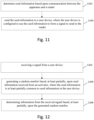
- a method may be provided comprising: receiving a signal from a user device as illustrated with block 1202; generating a random number based, at least partially, upon seed information received from an activator as illustrated with block 1204, where the seed information is at least partially common to seed information in the user device; and determining information from the received signal based, at least partially, upon the generated random number as illustrated with block 1206.
- the generating of the random number may be based, at least partially, upon a uniform distribution in an interval.
- the method may comprise determining a waveform at least partially based upon the generated random number.
- the determining of the waveform may be based upon at least one of: modulation or phase information.
- the method may comprise using the modulation to generate signals for bit vector identifications in a list of device identifications.
- the method may comprise using the phase to determine resulting signals for the bit vector identifications.
- the method may comprise determining channel gains and delays for the resulting signals.
- the method may comprise identifying the user device as a most likely device from an index of devices.
- the method may comprise finding a bit vector identification of the most likely device based at least partially on the index of devices.
- the determined information may comprise range information regarding a range between the apparatus and the user device.
- the method may comprise sending a report from the apparatus, where the report comprises the range information.
- the method may comprise using a predefined random number to phase information mapping to regenerate a phase delay, used in the user device to create the signal, and compensating for the phase delay in the received signal.
- the phase delay in the received signal may be configured based, at least partially, upon a random number generated in the user device which is the same as the generated random number in the apparatus.
- the method may comprise using a predefined random number to modulation mapping to regenerate modulation, used in the user device to create the signal, and demodulating the received signal.
- the modulation in the received signal may be configured based, at least partially, upon a random number generated in the user device which is the same as the generated random number in the apparatus.
- the user device may comprise an ambient internet of things device.
- the received signal may comprise encrypting data information.
- the received signal may comprise an internet-of-things activation signal.
- the method may comprise receiving the seed information from the activator, and at least partially configuring a random number generator based upon the seed information, prior to receiving the activation signal.
- a non-transitory program storage device may be provided readable by an apparatus, tangibly embodying a program of instructions executable with the apparatus for performing operations, the operations comprising: receiving a signal from a user device; generating a random number based, at least partially, upon seed information received from an activator, where the seed information is at least partially common to seed information in the user device; and determining information from the received signal based, at least partially, upon the generated random number.
- an apparatus comprising: means for receiving a signal from a user device; means for generating a random number based, at least partially, upon seed information received from an activator, where the seed information is at least partially common to seed information in the user device; and means for determining information from the received signal based, at least partially, upon the generated random number.
- an apparatus comprising: circuitry configured for receiving a signal from a user device; circuitry configured for generating a random number based, at least partially, upon seed information received from an activator, where the seed information is at least partially common to seed information in the user device; and circuitry configured for determining information from the received signal based, at least partially, upon the generated random number.
- the word “wave” may be interchangeably used with the word “signal”.
- the signal may be provided in the form of a wave, such as a wave having a specific waveform.
- non-transitory is a limitation of the medium itself (i.e., tangible, not a signal) as opposed to a limitation on data storage persistency (e.g., RAM vs. ROM).
- circuitry may refer to one or more or all of the following:
- circuitry also covers an implementation of merely a hardware circuit or processor (or multiple processors) or portion of a hardware circuit or processor and its (or their) accompanying software and/or firmware.
- circuitry also covers, for example and if applicable to the particular claim element, a baseband integrated circuit or processor integrated circuit for a mobile device or a similar integrated circuit in server, a cellular network device, or other computing or network device.
Landscapes
- Engineering & Computer Science (AREA)
- Signal Processing (AREA)
- Computer Networks & Wireless Communication (AREA)
- Computer Security & Cryptography (AREA)
- Mobile Radio Communication Systems (AREA)
Applications Claiming Priority (1)
| Application Number | Priority Date | Filing Date | Title |
|---|---|---|---|
| GB2318689.3A GB2636215A (en) | 2023-12-07 | 2023-12-07 | Coordination for random AIOT waveform |
Publications (1)
| Publication Number | Publication Date |
|---|---|
| EP4568169A1 true EP4568169A1 (fr) | 2025-06-11 |
Family
ID=89575765
Family Applications (1)
| Application Number | Title | Priority Date | Filing Date |
|---|---|---|---|
| EP24217730.1A Pending EP4568169A1 (fr) | 2023-12-07 | 2024-12-05 | Coordination de forme d'onde d'aido aléatoire |
Country Status (2)
| Country | Link |
|---|---|
| EP (1) | EP4568169A1 (fr) |
| GB (1) | GB2636215A (fr) |
Family Cites Families (3)
| Publication number | Priority date | Publication date | Assignee | Title |
|---|---|---|---|---|
| GB2410866B (en) * | 2004-02-06 | 2008-02-20 | Btg Int Ltd | Arbitration management method and system |
| KR100858053B1 (ko) * | 2006-05-10 | 2008-09-10 | 한국전자통신연구원 | 수동형 rfid 리더기 및 이의 동작 제어 방법 |
| KR101646615B1 (ko) * | 2009-09-22 | 2016-08-08 | 삼성전자주식회사 | 공유되는 씨드를 이용한 네트워크 코딩 방법 및 상기 방법을 위한 장치 |
-
2023
- 2023-12-07 GB GB2318689.3A patent/GB2636215A/en active Pending
-
2024
- 2024-12-05 EP EP24217730.1A patent/EP4568169A1/fr active Pending
Non-Patent Citations (3)
| Title |
|---|
| HAITHAM HASSANIEH JUE WANG DINA KATABI MIT MIT TADAYOSHI KOHNO MIT UNIVERSITY OF WASHINGTON: "Securing RFIDs by Randomizing the Modulation and Channel", 4 May 2015 (2015-05-04), pages 242 - 256, XP061024740, Retrieved from the Internet <URL:https://www.usenix.org/sites/default/files/nsdi15_full_proceedings_interior.pdf> [retrieved on 20150504] * |
| PARK HOORIN ET AL: "Tagora: A Collision-Exploitative RFID Authentication Protocol Based on Cross-Layer Approach", IEEE INTERNET OF THINGS JOURNAL, IEEE, USA, vol. 7, no. 4, 11 February 2020 (2020-02-11), pages 3571 - 3585, XP011783830, [retrieved on 20200414], DOI: 10.1109/JIOT.2020.2972915 * |
| TORO USMAN SALEH ET AL: "Backscatter Wireless Communications and Sensing in Green Internet of Things", IEEE TRANSACTIONS ON GREEN COMMUNICATIONS AND NETWORKING, IEEE, vol. 6, no. 1, 13 July 2021 (2021-07-13), pages 37 - 55, XP011900688, [retrieved on 20220215], DOI: 10.1109/TGCN.2021.3095792 * |
Also Published As
| Publication number | Publication date |
|---|---|
| GB202318689D0 (en) | 2024-01-24 |
| GB2636215A (en) | 2025-06-11 |
Similar Documents
| Publication | Publication Date | Title |
|---|---|---|
| US11184153B2 (en) | Ultra wideband secure ranging | |
| US10917768B2 (en) | Generation of signals with unpredictable transmission properties for wireless M2M networks | |
| CN113573409B (zh) | 一种通信方法及装置 | |
| EP3335432B1 (fr) | Dispositifs de rétrodiffusion et systèmes de réseau incorporant des dispositifs de rétrodiffusion | |
| CN101534505B (zh) | 通信装置和通信方法 | |
| US10812955B2 (en) | Generation of signals with unpredictable transmission properties for wireless M2M networks | |
| US10887744B2 (en) | Systems, methods and apparatuses for ensuring proximity of WiFi communication devices | |
| EP2805428B1 (fr) | Système de communication en champ proche (nfc) et procédé pour la communication en champ proche confidentielle | |
| US11166159B1 (en) | Methods and apparatus for secure fine timing measurement with encoded long training fields | |
| Letafati et al. | A new frequency hopping-aided secure communication in the presence of an adversary jammer and an untrusted relay | |
| US20260040060A1 (en) | Wireless communication system | |
| EP4568169A1 (fr) | Coordination de forme d'onde d'aido aléatoire | |
| Pierson et al. | Closetalker: Secure, short-range ad hoc wireless communication | |
| US20250024514A1 (en) | Random access method and apparatus | |
| KR100856408B1 (ko) | 데이터 전송 방법 및 장치 | |
| WO2025120486A1 (fr) | Coordination pour forme d'onde aiot aléatoire | |
| WO2022253298A1 (fr) | Procédé et appareil de transmission d'informations système | |
| Yan et al. | A trust-third-party based key management protocol for secure mobile RFID service based on the Internet of Things | |
| US20200120493A1 (en) | Apparatus and method for communications | |
| US20250233749A1 (en) | Authentication method and device | |
| Hancke | Noisy carrier modulation for HF RFID | |
| WO2025241580A1 (fr) | Détermination de fréquence pour transmission d2r dans un système iot ambiant | |
| Elbagoury et al. | Practical provably secure key sharing for near field communication devices | |
| Abubaker | Channel based relay attack detection protocol | |
| Hancke | Modulating a noisy carrier signal for eavesdropping-resistant HF RFID |
Legal Events
| Date | Code | Title | Description |
|---|---|---|---|
| PUAI | Public reference made under article 153(3) epc to a published international application that has entered the european phase |
Free format text: ORIGINAL CODE: 0009012 |
|
| STAA | Information on the status of an ep patent application or granted ep patent |
Free format text: STATUS: THE APPLICATION HAS BEEN PUBLISHED |
|
| AK | Designated contracting states |
Kind code of ref document: A1 Designated state(s): AL AT BE BG CH CY CZ DE DK EE ES FI FR GB GR HR HU IE IS IT LI LT LU LV MC ME MK MT NL NO PL PT RO RS SE SI SK SM TR |
|
| STAA | Information on the status of an ep patent application or granted ep patent |
Free format text: STATUS: REQUEST FOR EXAMINATION WAS MADE |
|
| 17P | Request for examination filed |
Effective date: 20251211 |