EP4568242A1 - Bildverarbeitungsvorrichtung und -verfahren - Google Patents
Bildverarbeitungsvorrichtung und -verfahren Download PDFInfo
- Publication number
- EP4568242A1 EP4568242A1 EP25150547.5A EP25150547A EP4568242A1 EP 4568242 A1 EP4568242 A1 EP 4568242A1 EP 25150547 A EP25150547 A EP 25150547A EP 4568242 A1 EP4568242 A1 EP 4568242A1
- Authority
- EP
- European Patent Office
- Prior art keywords
- transform
- flag
- encoding
- primary
- image
- Prior art date
- Legal status (The legal status is an assumption and is not a legal conclusion. Google has not performed a legal analysis and makes no representation as to the accuracy of the status listed.)
- Pending
Links
Images




























Classifications
-
- H—ELECTRICITY
- H04—ELECTRIC COMMUNICATION TECHNIQUE
- H04N—PICTORIAL COMMUNICATION, e.g. TELEVISION
- H04N19/00—Methods or arrangements for coding, decoding, compressing or decompressing digital video signals
- H04N19/60—Methods or arrangements for coding, decoding, compressing or decompressing digital video signals using transform coding
- H04N19/61—Methods or arrangements for coding, decoding, compressing or decompressing digital video signals using transform coding in combination with predictive coding
-
- H—ELECTRICITY
- H04—ELECTRIC COMMUNICATION TECHNIQUE
- H04N—PICTORIAL COMMUNICATION, e.g. TELEVISION
- H04N19/00—Methods or arrangements for coding, decoding, compressing or decompressing digital video signals
- H04N19/10—Methods or arrangements for coding, decoding, compressing or decompressing digital video signals using adaptive coding
- H04N19/102—Methods or arrangements for coding, decoding, compressing or decompressing digital video signals using adaptive coding characterised by the element, parameter or selection affected or controlled by the adaptive coding
- H04N19/12—Selection from among a plurality of transforms or standards, e.g. selection between discrete cosine transform [DCT] and sub-band transform or selection between H.263 and H.264
-
- H—ELECTRICITY
- H04—ELECTRIC COMMUNICATION TECHNIQUE
- H04N—PICTORIAL COMMUNICATION, e.g. TELEVISION
- H04N19/00—Methods or arrangements for coding, decoding, compressing or decompressing digital video signals
- H04N19/10—Methods or arrangements for coding, decoding, compressing or decompressing digital video signals using adaptive coding
- H04N19/102—Methods or arrangements for coding, decoding, compressing or decompressing digital video signals using adaptive coding characterised by the element, parameter or selection affected or controlled by the adaptive coding
- H04N19/124—Quantisation
-
- H—ELECTRICITY
- H04—ELECTRIC COMMUNICATION TECHNIQUE
- H04N—PICTORIAL COMMUNICATION, e.g. TELEVISION
- H04N19/00—Methods or arrangements for coding, decoding, compressing or decompressing digital video signals
- H04N19/10—Methods or arrangements for coding, decoding, compressing or decompressing digital video signals using adaptive coding
- H04N19/134—Methods or arrangements for coding, decoding, compressing or decompressing digital video signals using adaptive coding characterised by the element, parameter or criterion affecting or controlling the adaptive coding
- H04N19/157—Assigned coding mode, i.e. the coding mode being predefined or preselected to be further used for selection of another element or parameter
-
- H—ELECTRICITY
- H04—ELECTRIC COMMUNICATION TECHNIQUE
- H04N—PICTORIAL COMMUNICATION, e.g. TELEVISION
- H04N19/00—Methods or arrangements for coding, decoding, compressing or decompressing digital video signals
- H04N19/10—Methods or arrangements for coding, decoding, compressing or decompressing digital video signals using adaptive coding
- H04N19/169—Methods or arrangements for coding, decoding, compressing or decompressing digital video signals using adaptive coding characterised by the coding unit, i.e. the structural portion or semantic portion of the video signal being the object or the subject of the adaptive coding
- H04N19/17—Methods or arrangements for coding, decoding, compressing or decompressing digital video signals using adaptive coding characterised by the coding unit, i.e. the structural portion or semantic portion of the video signal being the object or the subject of the adaptive coding the unit being an image region, e.g. an object
- H04N19/176—Methods or arrangements for coding, decoding, compressing or decompressing digital video signals using adaptive coding characterised by the coding unit, i.e. the structural portion or semantic portion of the video signal being the object or the subject of the adaptive coding the unit being an image region, e.g. an object the region being a block, e.g. a macroblock
-
- H—ELECTRICITY
- H04—ELECTRIC COMMUNICATION TECHNIQUE
- H04N—PICTORIAL COMMUNICATION, e.g. TELEVISION
- H04N19/00—Methods or arrangements for coding, decoding, compressing or decompressing digital video signals
- H04N19/50—Methods or arrangements for coding, decoding, compressing or decompressing digital video signals using predictive coding
- H04N19/503—Methods or arrangements for coding, decoding, compressing or decompressing digital video signals using predictive coding involving temporal prediction
- H04N19/51—Motion estimation or motion compensation
- H04N19/513—Processing of motion vectors
- H04N19/517—Processing of motion vectors by encoding
-
- H—ELECTRICITY
- H04—ELECTRIC COMMUNICATION TECHNIQUE
- H04N—PICTORIAL COMMUNICATION, e.g. TELEVISION
- H04N19/00—Methods or arrangements for coding, decoding, compressing or decompressing digital video signals
- H04N19/70—Methods or arrangements for coding, decoding, compressing or decompressing digital video signals characterised by syntax aspects related to video coding, e.g. related to compression standards
Definitions
- the present disclosure relates to an information processing apparatus and method, and particularly to an information processing apparatus and method that make it possible to suppress decrease of the encoding efficiency.
- NPL 2 a secondary transform flag indicative of whether or not secondary transform in a unit of a transform block is to be applied is signaled (for example, refer to NPL 2).
- NPL 2 also it is disclosed that a secondary transform identifier indicative of which secondary transform is to be applied is derived on the basis of a primary transform identifier and an intra-prediction mode.
- the transform skip flag is 1 in a unit of a transform block, namely, it is indicated that transform skip is to be applied
- the transform skip is applied only to primary transform.
- secondary transform can be applied. Therefore, even if the transform skip is applied by a transform skip flag to a residual signal to which it is better to apply the transform skip such as, for example, a sparse residual signal in which the number of non-zero coefficients is small, secondary transform is applied and the energy compaction decreases, and there is the possibility that the encoding efficiency may be degraded.
- the present disclosure has been made taking such a situation as described above into consideration and makes it possible to suppress degradation of the encoding efficiency.
- An image processing apparatus is an image processing apparatus, including a control section configured to cause, where primary transform that is a transform process for a prediction residual that is a difference between an image and a prediction image of the image is to be skipped, also secondary transform, which is a transform process for a primary transform coefficient obtained by the primary transform of the prediction residual, to be skipped.
- An image processing method is an image processing method including causing, where primary transform that is a transform process for a prediction residual that is a difference between an image and a prediction image of the image is to be skipped, also secondary transform, which is a transform process for a primary transform coefficient obtained by the primary transform of the prediction residual, to be skipped.
- An image processing apparatus is an image processing apparatus including a control section configured to cause, where inverse primary transform that is inverse transform to primary transform that is a transform process for a prediction residual that is a difference between an image and a prediction image of the image is to be skipped, also inverse secondary transform, which is inverse transform to secondary transform that is a transform process for a primary transform coefficient obtained by the primary transform of the prediction residual, to be skipped.
- An image processing method is an image processing method including causing, where inverse primary transform that is inverse transform to primary transform that is a transform process for a prediction residual that is a difference between an image and a prediction image of the image is to be skipped, also inverse secondary transform, which is inverse transform to secondary transform that is a transform process for a primary transform coefficient obtained by the primary transform of the prediction residual, to be skipped.
- An image processing apparatus is an image processing apparatus including an encoding section configured to skip, where secondary transform is to be performed for a primary transform coefficient obtained by primary transform of a prediction residual that is a difference between an image and a prediction image of the image, encoding of first information relating to skip of the primary transform.
- An image processing method is an image processing method including skipping, where secondary transform is to be performed for a primary transform coefficient obtained by primary transform of a prediction residual that is a difference between an image and a prediction image of the image, encoding of first information relating to skip of the primary transform.
- An image processing apparatus is an image processing apparatus including a decoding section configured to skip, where inverse secondary transform that is inverse transform to secondary transform that is a transform process for a primary transform coefficient obtained by primary transform of a prediction residual that is a difference between an image and a prediction image of the image is to be performed, decoding of encoded data of first information relating to skip of inverse primary transform that is inverse transform to the primary transform.
- An image processing method is an image processing method including skipping, where inverse secondary transform that is inverse transform to secondary transform that is a transform process for a primary transform coefficient obtained by primary transform of a prediction residual that is a difference between an image and a prediction image of the image is to be performed, decoding of encoded data of first information relating to skip of inverse primary transform that is inverse transform to the primary transform.
- An image processing apparatus is an image processing apparatus including an encoding section configured to skip, where primary transform that is a transform process for a prediction residual that is a difference between an image and a prediction image of the image is to be skipped, encoding of first information relating to skip of secondary transform that is a transform process for a primary transform coefficient obtained by the primary transform of the prediction residual.
- An image processing method is an image processing method including skipping, where primary transform that is a transform process for a prediction residual that is a difference between an image and a prediction image of the image is to be skipped, encoding of first information relating to skip of secondary transform that is a transform process for a primary transform coefficient obtained by the primary transform of the prediction residual.
- An image processing apparatus is an image processing apparatus including a decoding section configured to skip, where inverse primary transform that is inverse transform to primary transform that is a transform process for a prediction residual that is a difference between an image and a prediction image of the image is to be skipped, decoding of encoded data of first information relating to skip of inverse secondary transform that is inverse transform to secondary transform that is a transform process for a primary transform coefficient obtained by the primary transform of the prediction residual.
- An image processing method is an image processing method including skipping, where inverse primary transform that is inverse transform to primary transform that is a transform process for a prediction residual that is a difference between an image and a prediction image of the image is to be skipped, decoding of encoded data of first information relating to skip of inverse secondary transform that is inverse transform to secondary transform that is a transform process for a primary transform coefficient obtained by the primary transform of the prediction residual.
- An image processing apparatus is an image processing apparatus including an encoding section configured to skip, where primary transform that is a transform process for a prediction residual that is a difference between an image and a prediction image of the image, secondary transform that is a transform process for a primary transform coefficient obtained by the primary transform of the prediction residual and quantization for a secondary transform coefficient obtained by the secondary transform of the primary transform coefficient are to be skipped, encoding of first information indicative of the substance of the primary transform.
- An image processing method is an image processing method including skipping, where primary transform that is a transform process for a prediction residual that is a difference between an image and a prediction image of the image, secondary transform that is a transform process for a primary transform coefficient obtained by the primary transform of the prediction residual and quantization for a secondary transform coefficient obtained by the secondary transform of the primary transform coefficient are to be skipped, encoding of first information indicative of the substance of the primary transform.
- An image processing apparatus is an image processing apparatus including a decoding section configured to skip, where dequantization for a quantization transform coefficient level obtained by decoding encoded data, inverse secondary transform for transforming a secondary transform coefficient obtained by the dequantization of the quantization transform coefficient level into a primary transform coefficient and inverse primary transform for transforming the primary transform coefficient into a prediction residual that is a difference between an image and a prediction image of the image are to be skipped, decoding of encoded data of first information relating to the substance of the inverse primary transform.
- An image processing method is an image processing method including skipping, where dequantization for a quantization transform coefficient level obtained by decoding encoded data, inverse secondary transform for transforming a secondary transform coefficient obtained by the dequantization of the quantization transform coefficient level into a primary transform coefficient and inverse primary transform for transforming the primary transform coefficient into a prediction residual that is a difference between an image and a prediction image of the image are to be skipped, decoding of encoded data of first information relating to the substance of the inverse primary transform.
- inverse primary transform that is inverse transform to primary transform that is a transform process for a prediction residual that is a difference between an image and a prediction image of the image is to be skipped
- inverse secondary transform which is inverse transform to secondary transform that is a transform process for a primary transform coefficient obtained by the primary transform of the prediction residual
- inverse secondary transform that is inverse transform to secondary transform that is a transform process for a primary transform coefficient obtained by primary transform of a prediction residual that is a difference between an image and a prediction image of the image is to be performed
- decoding of encoded data of first information relating to skip of inverse primary transform that is inverse transform to the primary transform is skipped.
- inverse primary transform that is inverse transform to primary transform that is a transform process for a prediction residual that is a difference between an image and a prediction image of the image is to be skipped
- decoding of encoded data of first information relating to skip of inverse secondary transform that is inverse transform to secondary transform that is a transform process for a primary transform coefficient obtained by the primary transform of the prediction residual is skipped.
- dequantization for a quantization transform coefficient level obtained by decoding encoded data where dequantization for a quantization transform coefficient level obtained by decoding encoded data, inverse secondary transform for transforming a secondary transform coefficient obtained by the dequantization of the quantization transform coefficient level into a primary transform coefficient and inverse primary transform for transforming the primary transform coefficient into a prediction residual that is a difference between an image and a prediction image of the image are to be skipped, decoding of encoded data of first information relating to the substance of the inverse primary transform is skipped.
- an image can be processed. Especially, degradation of the encoding efficiency can be suppressed.
- NPL 1 it is disclosed, for example, in NPL 1 that, in image encoding, after primary transform is performed for a prediction residual that is a difference between an image and a prediction image of the image, in order to increase the energy compaction (to concentrate transform coefficients to a low frequency region), secondary transform is further applied for each sub block in a transform block. Further, in NPL 1, also it is disclosed that a secondary transform identifier indicative of which secondary transform is to be applied is signaled in a unit of a CU.
- NPL 2 it is disclosed that, in an encoder, to determine which secondary transform is to be applied in a unit of a CU as disclosed in NPL 1 on the basis of RDO (Rate-Distortion Optimization) indicates a high degree of calculation complicatedness and a secondary transform flag indicative of whether or not secondary transform in a unit of a transform block is to be applied is signaled. Further, in NPL 2, also it is disclosed that a secondary transform identifier indicative of which secondary transform is to be applied is derived on the basis of a primary transform identifier and an intra-prediction mode.
- RDO Rate-Distortion Optimization
- the transform skip flag is 1 in a unit of a transform block, namely, it is indicated that transform skip is to be applied
- the transform skip is applied only to primary transform.
- secondary transform can be applied. Therefore, in the case where the concept of transform skip is considered, the secondary transform cannot be skipped (omitted), and there is the possibility that the arithmetic operation amount may increase.
- the transform skip is applied by a transform skip flag to a residual signal to which it is better to apply the transform skip such as, for example, a sparse residual signal in which the number of non-zero coefficients (also referred to as non-zero transform coefficients) is small, secondary transform is applied and the energy compaction decreases, and there is the possibility that the encoding efficiency may be degraded.
- primary transform Phor in the horizontal direction and primary transform Pver in the vertical direction designated by a primary transform identifier pt_idx are selected, and for a prediction residual D, matrix arithmetic operation is performed as indicated, for example, by the following expression (1) to obtain transform coefficients Coeff_P after primary transform (referred to also as primary transform coefficients).
- Coeff_P Phor ⁇ D ⁇ Pver T
- the operator " ⁇ ” indicates an operation for performing inner product between matrices (matrix product), and the operator "T” indicates an operation of a transposed matrix.
- the primary transform coefficient (Coeff_P) determined in such a manner as described above is subsequently subjected to secondary transform. Further, in the case such primary transform as described above is skipped (omitted), the prediction residual D is secondary-transformed.
- D 255 0 0 0 0 0 0 0 0 0 0 0 0 0 0 0 0 0 0 0 0 0 0 0 0 0 0 0 0 0 0 0 0 0 0 0 0 0 0 0 0 0 0
- the prediction residual D is scanned in accordance with a scanning order of coefficients of horizontal scan and is transformed into such a 1 ⁇ 16-dimensional vector X 1d as represented by the following expression (3).
- X 1d 255 0 0 0 0 0 0 0 0 0 0 0 0 0 0 0,0
- the operator "T” represents an operation of a transposed matrix.
- Y 1d [62730, -10710, -4590, -7650, -7650, -7905, 765, -510, 2805, -1020, -2295, 1020, 765, -510, 255, 0]
- bit shift arithmetic operation of N bits as represented by the following expression (6) is performed to determine a signal Z 1d after bit shift.
- Z 1d Y 1d ⁇ N
- the 1 ⁇ 16-dimensional vector Z 1d of the signal Z 1d after the norm normalization is transformed into such a 4 ⁇ 4 matrix Coeff as represented by the following expression (8) on the basis of a scan method designated by a scan identifier scanIdx.
- Coeff 245 ⁇ 42 ⁇ 18 ⁇ 30 ⁇ 30 ⁇ 31 3 ⁇ 2 11 ⁇ 4 ⁇ 9 4 3 ⁇ 2 1 0
- inverse primary transform that is inverse transform to primary transform that is a transform process for a prediction residual that is the difference between an image and a prediction image of the image is to be skipped
- inverse secondary transform that is inverse transform to secondary transform that is a transform process for primary transform coefficients obtained by primary transform of the prediction residual is skipped.
- an encoding process is executed in a processing unit called macro block.
- the macro block is a block having a uniform size of 16 ⁇ 16 pixels.
- HEVC High Efficiency Video Coding
- an encoding process is executed in a processing unit (encoding unit) called CU (Coding Unit).
- a CU is a block having a variable size, which is formed by recursively segmenting an LCU (Largest Coding Unit) that is a maximum encoding unit.
- the maximum size of a CU that can be selected is 64 ⁇ 64 pixels.
- the minimum size of a CU that can be selected is 8 ⁇ 8 pixels.
- a CU of the minimum size is called SCU (Smallest Coding Unit). It is to be noted that the maximum size of a CU is not limited to 64 ⁇ 64 pixels but may be a greater block size such as 128 ⁇ 128 pixels, 256 ⁇ 256 pixels or the like.
- a prediction process for prediction encoding is executed in a processing unit (prediction unit) called PU (Prediction Unit).
- PU Prediction Unit
- a PU is formed by segmenting a CU in one of several segmentation patterns.
- a PU is configured from a processing unit (prediction block) called PB (Prediction Block) for each of the luminance (Y) and the color differences (Cb and Cr).
- PB Prediction Block
- an orthogonal transform process is executed in a processing unit (transform unit) called TU (Transform Unit).
- a TU is formed by segmenting a CU or a PU to a certain depth. Further, a TU is configured from a processing unit (transform block) called TB (Transform block) for each of the luminance (y) and the color differences (Cb and Cr).
- TB Transform block
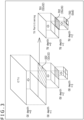
- FIG. 1 is an explanatory view illustrating an overview of recursive block segmentation regarding a CU in HEVC.
- the entirety of one quad tree is called CTB (Coding Tree Block), and a logical unit corresponding to the CTB is called CTU (Coding Tree Unit).
- C01 that is a CU having a size of 64 ⁇ 64 pixels is depicted as an example.
- the depth of segmentation of C01 is equal to 0. This signifies that C01 is the root of a CTU and corresponds to an LCU.
- the LCU size can be designated by a parameter that is encoded in an SPS (Sequence Parameter Set) or a PPS (Picture Parameter Set).
- C02 that is a CU is one of four CUs segmented from C01 and has a size of 32 ⁇ 32 pixels.
- the depth of segmentation of C02 is equal to 1.
- C03 that is a CU is one of four CUs segmented from C02 and has a size of 16 ⁇ 16 pixels.
- the depth of segmentation of C03 is equal to 2.
- C04 that is a CU is one of four CUs segmented from C03 and has a size of 8 ⁇ 8 pixels.
- the depth of segmentation of C04 is equal to 3.
- a CU is formed by recursively segmenting an image to be encoded.
- the depth of segmentation is variable. For example, to a flat image region like the blue sky, a CU of a comparatively great size (namely, of a small depth) can be set. On the other hand, to a steep image region including many edges, a CU of a comparatively small size (namely, of a great depth) can be set. Then, each of such set CUs becomes a processing unit in an encoding process.
- a PU is a processing unit in a prediction process including intra prediction and inter production.
- a PU is formed by segmenting a CU by one of several segmentation patterns.
- FIG. 2 is an explanatory view illustrating setting of a PU to a CU depicted in FIG. 1 .
- eight segmentation patterns of 2N ⁇ 2N, 2N ⁇ N, N ⁇ 2N, N ⁇ N, 2N ⁇ nU, 2N ⁇ nD, nL ⁇ 2N and nR ⁇ 2N are depicted.
- the two segmentation patterns of 2N ⁇ 2N and N ⁇ N can be selected from among the eight segmentation patterns (N ⁇ N can be selected only in the SCU).
- all of the eight segmentation patterns can be selected in the case where asymmetrical motion segmentation is enabled.
- a TU is a processing unit of an orthogonal transform process.
- a TU is formed by segmenting a CU (in regard to an intra CU, each PU in the CU) to a certain depth.
- FIG. 3 is an explanatory view illustrating setting of a TU to a CU depicted in FIG. 2 .
- T01 that is a TU has a size of 32 ⁇ 32 pixels, and the depth of the TU segmentation is equal to 0.
- T02 that is a TU has a size of 16 ⁇ 16 pixels, and the depth of the TU segmentation is equal to 1.
- T03 that is a TU has a size of 8 ⁇ 8 and the depth of the TU segmentation is equal to 2.
- FIG. 4 is an explanatory view illustrating a scanning order of CUs and PUs. At a left upper portion in FIG. 4 , C10, C11, C12 and C13 that are four CUs that can be included in one CTB are depicted.
- a numeral in a framework of each CU represents an order number of processing.
- the encoding process is executed in an order of C10 that is the left upper CU, C11 of the right upper CU, C12 of the left lower CU and C13 of the right lower CU.
- one or more PUs for inter prediction capable of being set to C11 that is a CU are depicted.
- one or more PUs for intra prediction capable of being set to C12 that is a CU are depicted.
- the PUs are scanned so as to follow from the left to the right and from the top to the bottom.
- a "block” as a partial region or a processing unit of an image (picture) (the “block” is not a block of a processing section).
- the “block” in this case indicates an arbitrary partial region in the picture, and the size, shape, characteristic or the like of it is not restricted.
- the "block” in this case includes an arbitrary partial region (processing unit) such as, for example, a TB, a TU, a PB, a PU, an SCU, a CU, an LCU (CTB), a sub block, a macro block, a tile, a slice or the like.
- processing unit such as, for example, a TB, a TU, a PB, a PU, an SCU, a CU, an LCU (CTB), a sub block, a macro block, a tile, a slice or the like.
- FIG. 5 is a block diagram depicting an example of a configuration of an image encoding apparatus that is a form of an image processing apparatus to which the present technology is applied.
- An image encoding apparatus 100 depicted in FIG. 5 is an apparatus that encodes a prediction residual between an image and a prediction image of the image like AVC or HEVC.
- the image encoding apparatus 100 incorporates a technology proposed by HEVC or a technology proposed by JVET (Joint Video Exploration Team).
- the image encoding apparatus 100 may include processing sections that are not indicated as blocks in FIG. 5 or may include processes or data flows that are not indicated as arrow marks or the like in FIG. 5 .
- the image encoding apparatus 100 includes, a control section 101, an arithmetic operation section 111, a transform section 112, a quantization section 113, an encoding section 114, a dequantization section 115, an inverse transform section 116, another arithmetic operation section 117, a frame memory 118 and a prediction section 119.
- the control section 101 segments a moving image inputted to the image encoding apparatus 100 into blocks (CUs, PUs, transform blocks (TBs) or the like) of processing units on the basis of a block size of a processing unit designated externally or in advance and supplies images I corresponding to the segmented blocks to the arithmetic operation section 111. Further, the control section 101 determines encoding parameters (header information Hinfo, prediction mode information Pinfo, transform information Tinfo and so forth) to be supplied to the associated blocks, for example, on the basis of RDO (Rate-Distortion Optimization). The determined encoding parameters are supplied to the associated blocks.
- encoding parameters header information Hinfo, prediction mode information Pinfo, transform information Tinfo and so forth
- the header information Hinfo includes such information as, for example, a video parameter set (VPS (Video Parameter Set)), a sequence parameter set (SPS (Sequence Parameter Set)), a picture parameter set (PPS (Picture Parameter Set)), a slice header (SH) and so forth.
- VPS Video Parameter Set
- SPS Sequence Parameter Set
- PPS Picture Parameter Set
- SH slice header
- the header information Hinfo includes information that defines an image size (horizontal width PicWidth, vertical width PicHeight), a bit density (luminance bitDepthY, color difference bitDepthC), a maximum value MaxCUsize/minimum value MinCUSize of the CU size, a maximum value MaxTBSize/minimum value MinTBSize of the transform block size, a maximum value MaxTSSize of the transform skip block (referred to also as maximum transform skip block size), an on/off flag (also referred to as validity flag) of each encoding tool and so forth.
- the on/off flags for encoding tools included in the header information Hinfo on/off flags relating to transform and quantization processes indicated below are available. It is to be noted that the on/off flag of each encoding tool can be interpreted also as a flag indicative of whether or not syntax relating to the encoding tool exists in encoded data. Further, in the case where the value of the on/off flag is 1 (true), this indicates that the encoding tool is usable, but in the case where the value of the on/off flag is 0 (false), this indicates that the encoding tool is not usable. It is to be noted that the interpretations of the flag value may be reversed.
- the secondary transform validity flag (st_enabled_flag) is a flag indicative of whether or not an encoding tool for performing secondary transform or an encoding tool for performing inverse transform (inverse secondary transform) as one of a transform process and an inverse process to the transform process is usable.
- the secondary transform validity flag is information indicative of whether or not secondary transform or inverse secondary transform (referred to also as (inverse) secondary transform) is permitted in a data unit that is made a target.
- this secondary transform validity flag is information relating to permission of (inverse) secondary transform of a data unit to be made a target.
- the transform quantization bypass validity flag (transquant_bypass_enabled_flag) is a flag indicative of whether or not an encoding tool for skipping, as one of transform and quantization or inverse processes to them (inverse transform and dequantization), transform and quantization or dequantization and inverse transform is usable.
- the transform quantization bypass validity flag is information indicative of whether or not skip (bypass) of transform and quantization or dequantization and inverse transform (also referred to as (inverse) transform and (de) quantization) is to be permitted.
- this transform quantization bypass validity flag is information relating to permission of skip (bypass) of (inverse) transform and (de) quantization of a data unit to be made a target.
- the transform skip validity flag (ts_enabled_flag) is a flag indicative of whether or not an encoding tool for skipping (inverse) transform including primary transform and secondary transform as one of a transform process and an inverse process to the transform process is usable.
- the transform skip validity flag is information indicative of whether or not skip of (inverse) transform is permitted in regard to a data unit that is made a target.
- the transform skip validity flag is information relating to permission of skip of (inverse) transform in regard to a data unit to be made a target.
- the transform skip validity flag acts only upon primary transform or inverse primary transform (referred to also as (inverse) primary transform) as described hereinabove. Therefore, in the present specification, description is sometimes given regarding the transform skip validity flag as information relating to ⁇ (inverse) primary transform.' In short, description is sometimes given regarding the transform skip validity flag as "information regarding permission of skip of '(inverse) primary transform' regarding a data unit to be made a target (information indicative of whether or not skip of '(inverse) primary transform' in regard to the data unit to be made a target)."
- header information Hinfo is arbitrary, and any information other than the examples described above may be included in this header information Hinfo.
- the prediction mode information Pinfo includes, for example, such information as described below.
- a PU size PUSize is information indicative of a PU size of a processing target PU (prediction block size).
- Intra prediction mode information IPinfo (for example, prev_intra_luma_pred_flag, mpm_idx, rem_intra_pred_mode and so forth in JCTVC-W1005, 7.3.8.5 Coding Unit syntax) is information relating to an intra-prediction mode of a block of a processing target.
- the transform information Tinfo includes, for example, such information as described below.
- a block side TBSize (or a logarithm value log2TBSize of TBSize with base 2, also referred to as transform block size) is information indicative of a block size of a processing target transform block.
- the transform quantization bypass flag is information indicative of whether or not (inverse) transform and (de) quantization are to be skipped (bypassed) in a data unit to be made a target (for example, cu_transquant_bypass_flag and so forth in JCTVC-W1005, 7.3.8.5 Coding unit syntax).
- the transform quantization bypass flag is information relating to skip (bypass) of (inverse) transform and (de) quantization in a data unit to be made a target.
- a transform skip flag (ts_flag) is information indicative of whether or not (inverse) transform is to be skipped (for example, transfrom_skip_flag and so forth in JCTVC-W1005, 7.3.8.11 Residual coding syntax syntax).
- this transform skip flag is information relating to skip of (inverse) transform of a data unit to be made a target.
- the transform skip flag acts only upon also called (inverse) primary transform as described hereinabove. Therefore, in the present specification, description is sometimes given regarding the transform skip flag as information relating to ⁇ (inverse) primary transform.' In short, description is sometimes given regarding the transform skip flag as "information regarding skip of '(inverse) primary transform' regarding a data unit to be made a target (information indicative of whether or not skip of '(inverse) primary transform' in regard to the data unit is to be made a target)."
- the primary transform identifier (pt-idx) is identifier indicative of which (inverse) primary transform is to be applied to (inverse) primary transform in the vertical direction and the horizontal direction for a data unit to be made a target (for example, refer to JVET-B1001, 2.5.1 Adaptive multiple Core transform. In JEM2, also referred to as emt_idx).
- the primary transform identifier is information relating to the substance of (inverse) primary transform for a data unit to be made a target.
- the secondary transform identifier (st_idx) is identifier indicative of which (inverse) secondary transform is to be applied for a data unit to be made a target (for example, refer to JVET-B1001, 2.5.2 Secondary Transforms. In JEM2, also referred to as nsst_idx or rot_idx).
- the secondary transform identifier is information relating to the substance of (inverse) secondary transform for a data unit to be made a target.
- the secondary transform identifier st_idx is identifier that designates, in the case where the value thereof is greater than 0, a matrix for (inverse) secondary transform.
- the secondary transform identifier st_idx indicates execution of (inverse) secondary transform. Further, for example, in the case where secondary transform identifier st_idx has a value 0, it indicates skip of (inverse) secondary transform.
- the scan identifier is information relating to a scan method.
- the quantization parameter (qp) is information indicative of a quantization parameter to be used in (de) quantization for a data unit to be made a target.
- the quantization matrix (scaling_matrix) is information indicative of a quantization matrix to be used in (de) quantization for a data unit to be made a target (for example, JCTVC-W1005, 7.3.4 scaling list data syntax).
- transform information Tinfo is arbitrary, and any information other than the examples described above may be included in this transform information Tinfo.
- the header information Hinfo is supplied, for example, to the associated blocks.
- the prediction mode information Pinfo is supplied, for example, to the encoding section 114 and the prediction section 119.
- the transform information Tinfo is supplied, for example, to the transform section 112, quantization section 113, encoding section 114, dequantization section 115 and inverse transform section 116.
- the arithmetic operation section 111 subtracts a prediction image P supplied from the prediction section 119 from an image I corresponding to the block of the inputted processing unit as indicated by the expression (9) to determine a prediction residual D and supplies the prediction residual D to the transform section 112.
- D I ⁇ P
- the transform section 112 performs a transform process for the prediction residual D supplied from the arithmetic operation section 111 on the basis of the transform information Tinfo supplied from the control section 101 to derive transform coefficients Coeff.
- the transform section 112 supplies the transform coefficients Coeff to the quantization section 113. It is to be noted that the transform section 112 can, upon transform skip or upon transform quantization bypass, skip (omit) a transform process (primary transform and secondary transform) and supply the prediction residual D as transform coefficients Coeff to the quantization section 113.
- the quantization section 113 performs scaling (quantization) of the transform coefficients Coeff supplied from the transform section 112 on the basis of transform information Tinfo supplied from the control section 101. In short, the quantization section 113 performs quantization of transform coefficients Coeff for which a transform process has been performed or transform coefficients Coeff whose transform process has been skipped (omitted) (namely, the prediction residual D).
- the quantization section 113 supplies the transform coefficients after the quantization obtained by the quantization, namely, quantization transform coefficient levels level obtained by the quantization, to the encoding section 114 and the dequantization section 115. It is to be noted that also it is possible for the quantization section 113 to skip (omit), upon transform quantization bypass, the quantization process and supply the transform coefficients Coeff as the quantization transform coefficient levels level to the encoding section 114.
- the encoding section 114 encodes quantization transform coefficient levels level and so forth supplied from the quantization section 113 by a predetermined method. For example, the encoding section 114 converts encoding parameters (header information Hinfo, prediction mode information Pinfo, transform information Tinfo and so forth) supplied from the control section 101 and the quantization transform coefficient levels level supplied from the quantization section 113 into syntax values of individual syntax elements, and encodes (for example, arithmetically encodes) the syntax values to generate a bit string (encoded data).
- encoding parameters header information Hinfo, prediction mode information Pinfo, transform information Tinfo and so forth
- the encoding section 114 derives residual information RInfo from the quantization transform coefficient levels level, and encodes the residual information RInfo to generate a bit string (encoded data).
- the residual information RInfo includes, for example, a last non-zero coefficient X coordinate (last_sig_coeff_x_pos), a last non-zero coefficient Y coordinate (last_sig_coeff_y_pos), a sub block non-zero coefficient presence/absence flag (coded_sub_block_flag), a non-zero coefficient presence/absence flag (sig_coeff_flag), a GR1 flag (grl_flag) that is flag information indicative of whether or not the level of a non-zero coefficient is greater than 1, a GR2 flag (gr2_flag) that is flag information indicative of whether or not the level of a non-zero coefficient is greater than 2, a sign code (sign_flag) that is a code indicative of whether the non-zero coefficient is in the positive or in the negative, a non-zero coefficient remaining level that is information indicative of a remaining level of the non-zero coefficient (coeff_abs_level_remaining) and so
- the substance of the residual information RInfo is arbitrary, and any information other than the examples described above may be included in the residual information RInfo.
- the encoding section 114 multiplexes, for example, a bit string (encoded data) of encoded syntax elements and outputs the bit string as a bit stream.
- the dequantization section 115 scales (dequantizes) the value of the quantization transform coefficient levels level supplied from the quantization section 113 on the basis of the transform information Tinfo supplied from the control section 101 and derives transform coefficients Coeff_IQ after the dequantization.
- the dequantization section 115 supplies the transform coefficients Coeff_IQ to the inverse transform section 116. It is to be noted that the dequantization section 115 can skip (omit), upon transform quantization bypass, the dequantization process and supply the quantization transform coefficient levels level as transform coefficients Coeff_IQ to the inverse transform section 116.
- the dequantization performed by the dequantization section 115 is an inverse process to the quantization performed by the quantization section 113 and is a process similar to dequantization performed by the image decoding apparatus hereinafter described. Accordingly, the dequantization is hereinafter described in the description regarding the image decoding apparatus.
- the inverse transform section 116 performs inverse transform for the transform coefficients Coeff_IQ supplied from the dequantization section 115 on the basis of the transform information Tinfo supplied from the control section 101 to derive a prediction residual D'.
- the inverse transform section 116 supplies the prediction residual D' to the arithmetic operation section 117. It is to be noted that also it is possible for the inverse transform section 116 to skip (omit), upon transform skip or upon transform quantization bypass, the inverse transform processes (inverse secondary transform and inverse primary transform) and supply the transform coefficients Coeff_IQ as the prediction residual D' to the arithmetic operation section 117.
- the inverse transform performed by the inverse transform section 116 is an inverse process to the transform performed by the transform section 112 and is a process similar to inverse transform performed by the image decoding apparatus hereinafter described.
- the arithmetic operation section 117 adds the prediction residual D' supplied from the inverse transform section 116 and a prediction image P (prediction signal) supplied from the prediction section 119 and corresponding to the prediction residual D' as represented by the expression (10) given below to derive a locally decoded image Rec.
- the frame memory 118 re-constructs a decoded image for each unit of a picture using the locally decoded image Rec supplied from the arithmetic operation section 117 and stores the decoded image into a buffer in the frame memory 118.
- the frame memory 118 reads out a decoded image designated by the prediction section 119 as a reference image from the buffer and supplies the decoded image to the prediction section 119.
- the frame memory 118 may store header information Hinfo, prediction mode information Pinfo, transform information Tinfo and so forth relating to generation of a decoded image into a buffer in the frame memory 118.
- the prediction section 119 acquires a decoded image stored in the frame memory 118 and designated by prediction mode information Pinfo as a reference image and uses the reference image to generate a prediction image P by a prediction method designated by the prediction mode information Pinfo.
- the prediction section 119 supplies the generated prediction image P to the arithmetic operation section 111 and the arithmetic operation section 117.
- Such an image encoding apparatus 100 as described above includes a control section that skips, in the case where primary transform that is a transform process for a prediction residual that is a difference between an image and a prediction image of the image is to be skipped, also secondary transform that is a transform process for a primary transform coefficient obtained by the primary transform of the prediction residual.
- FIG. 6 is a block diagram depicting a principal configuration example of the transform section 112.
- the transform section 112 includes a switch 131, a primary transform section 132 and a secondary transform section 133.
- the switch 131 is an embodiment of a control section for controlling execution of primary transform and secondary transform. For example, in the case where the switch 131 is to skip primary transform, it controls that also secondary transform is skipped. For example, the switch 131 controls the supplying destination of a prediction residual D supplied from the arithmetic operation section 111 in response to the value of the transform skip flag ts_flag relating to skip of primary information and included in the transform information Tinfo.
- the switch 131 controls such that at least primary transform is executed. In short, in this case, the switch 131 supplies the prediction residual D to the primary transform section 132.
- the switch 131 controls such that primary transform and secondary transform are skipped. In short, in this case, the switch 131 supplies the prediction residual D as the transform coefficients Coeff to the quantization section 113.
- the transform section 112 can readily suppress unnecessary increase of the processing amount of the transform.
- transform skip skip of primary transform and secondary transform
- the switch 131 can skip not only primary transform but also secondary transform more readily particularly in regard to a sparse residual signal in which the number of non-zero coefficients is small in this manner, and increase of the processing amount for transform can be suppressed to suppress degradation of the encoding efficiency.
- the switch 131 may control the supplying destination of the prediction residual D supplied from the arithmetic operation section 111 in response to the value of the transform quantization bypass flag transquant_bypass_flag included in the transform information Tinfo.
- the switch 131 controls such that at least primary transform is executed. In short, in this case, the switch 131 supplies the prediction residual D to the primary transform section 132.
- the switch 131 controls such that primary transform and secondary transform are skipped. In short, in this case, the switch 131 supplies the prediction residual D as the transform coefficients Coeff to the quantization section 113.
- the primary transform section 132 executes primary transform such as, for example, orthogonal transform or the like for the prediction residual D supplied from the switch 131. In short, the primary transform section 132 performs primary transform under the control of the switch 131.
- the primary transform section 132 executes primary transform by a method according to the value of the primary transform identifier pt_idx that is information, for example, relating to the substance of primary transform. For example, the primary transform section 132 selects primary transform Phor in the horizontal direction and primary transform Pver in the vertical direction designated by the primary transform identifier pt_idx and performs matrix arithmetic operation as represented, for example, by the following expression (11) for the prediction residual D supplied from the switch 131 to derive transform coefficients Coeff_P after the primary transform (referred to also as primary transform coefficient).
- Coeff_P Phor ⁇ D ⁇ Pver T
- the operator " ⁇ ” represents an operation for performing inner product (matrix product) between matrices
- the operator "T” represents an operation for a transposed matrix.
- the primary transform section 132 supplies the derived primary transform coefficients Coeff_P to the secondary transform section 133.
- the secondary transform section 133 converts the primary transform coefficients Coeff_P supplied from the primary transform section 132 into one-dimensional vector, performs matrix arithmetic operation for the one-dimensional vector, performs scaling for the one-dimensional vector for which the matrix arithmetic operation has been performed, and performs secondary transform that is a transform process for matrixing the scaled one-dimensional vector.
- the secondary transform section 133 performs secondary transform under the control of the switch 131.
- the secondary transform section 133 performs secondary transform for primary transform coefficients Coeff_P on the basis of a secondary transform identifier st_idx that is information relating to the substance of secondary transform and a scan identifier scanIdx that is information relating to a scan method for transform coefficients to derive transform coefficients Coeff after the secondary transform (also referred to as secondary transform coefficient).
- the secondary transform section 133 includes a rasterize section 141, a matrix arithmetic operation section 142, a scaling section 143, a matrixing section 144 and a secondary transform selection section 145.
- the rasterize section 141 converts the primary transform coefficients Coeff_P supplied from the primary transform section 132 for each unit of a sub block (4 ⁇ 4 sub block) into a 1 ⁇ 16-dimensional vector X 1d on the basis of a scan method for transform coefficients designated by the scan identifier scanIdx.
- the rasterize section 141 supplies the resulting vector X1 d to the matrix arithmetic operation section 142.
- a of FIG. 7 depicts scan types scanType designated by various values of the scan identifier scanIdx.
- the scan identifier scanIdx is 0, an oblique direction scan (up-right diagonal scan) is designated; in the case where the scan identifier scanIdx is 1, a horizontal direction scan (horizontal fast scan) is designated; and in the case where the scan identifier scanIdx is 2, a vertical direction scan (vertical fast scan) is designated.
- B of FIG. 7 to D of FIG. 7 depict scan orders of coefficients of the various scans for a 4 ⁇ 4 sub block. In B of FIG. 7 to D of FIG.
- a number applied to each coefficient position indicates an order number at which the coefficient position is scanned.
- B of FIG. 7 depicts an example of a scan order in the horizontal direction scan (horizontal fast scan);
- C of FIG. 7 depicts an example of a scan order in the vertical direction scan (vertical fast scan);
- D of FIG. 7 depicts an example of a scan order in the oblique direction scan (up-right diagonal scan).
- the scan identifier scanIdx indicates the horizontal scan hor.
- the rasterize section 141 scans the primary transform coefficients Coeff_P in accordance with a scan order of coefficients of the horizontal scan of B of FIG. 7 and converts the primary transform coefficients Coeff_P into such a 1 ⁇ 16-dimensional vector X 1d as indicated by the following expression (14).
- the rasterize section 141 supplies the determined vector X 1d to the matrix arithmetic operation section 142.
- X 1d [245, -42, -18, -30, -30, -31, 3, -2, 11, -4, -9, 4, 3, -2, 1, 0]
- the secondary transform selection section 145 reads out a matrix R for secondary transform designated by the secondary transform identifier st_idx from an internal memory (not depicted) of the secondary transform selection section 145 and supplies the matrix R to the matrix arithmetic operation section 142. For example, when the secondary transform identifier st_idx has a certain value, the secondary transform selection section 145 reads out the matrix R of 16 16 depicted in FIG. 8 for secondary transform and supplies the matrix R to the matrix arithmetic operation section 142.
- the secondary transform selection section 145 may select a matrix R for secondary transform in response to a secondary transform identifier st_idx and intra prediction mode information IPinfo (for example, a prediction mode number). As an alternative, the secondary transform selection section 145 may select a matrix R in response to motion prediction information MVinfo and secondary transform identifier st_idx in place of intra prediction mode information IPinfo.
- the matrix arithmetic operation section 142 performs such matrix arithmetic operation as represented by the following expression (15) using the one-dimensional vector X 1d and the matrix R for secondary transform and supplies a result Y 1d of the matrix arithmetic operation to the scaling section 143.
- Y 1d T R ⁇ X 1d T
- the operator "T” represents an operation of a transposed matrix.
- Y 1d [63055, 138, -639, 1088, -8168, -12139, -2581, -3003, -4190, -5866, 1984, 2271, 1989, -878, -681, 319]
- the scaling section 143 performs, in order to normalize the norm of the signal Y 1d supplied from the matrix arithmetic operation section 142, bit shift arithmetic operation of N (N is a natural number) bits as represented by the following expression (17) to determine a signal Z 1d after the bit shift.
- Z 1d Y 1d ⁇ N
- E is a 1 ⁇ 16-dimensional vector in which all elements have the value 1.
- the matrix R for secondary transform depicted in FIG. 8 is an 8-bit scaled matrix
- the value of N to be used for normalization of the norm by the scaling section 143 is 8.
- Z 1d [246, 1, -2, 4, -32, -47, -10, -12, -16, -23, 8, 9, 8, -3, -3, -1]
- the bit shift amount in norm normalization is N bits.
- the scaling section 143 supplies the signal Z 1d obtained in such a manner as described above to the matrixing section 144.
- the matrixing section 144 supplies the resulting transform coefficients Coeff to the quantization section 113.
- the switch 131 may cause primary transform and secondary transform to be skipped such that the quantization section 113 performs quantization for the prediction residual D and the encoding section 114 encodes the quantization transform coefficient level and the transform skip flag ts_flag to generate a bit stream including encoded data of them.
- control section 101 After the image encoding process is started, at step S101, the control section 101 performs an encoding controlling process and performs block segmentation, setting of encoding parameters and so forth.
- the prediction section 119 performs a prediction process to generate a prediction image of an optimum prediction mode and so forth. For example, in the prediction process, the prediction section 119 performs intra prediction to generate a prediction image of an optimum intra prediction mode and so forth, performs inter prediction to generate a prediction image of an optimum inter prediction mode and so forth and selects an optimum prediction mode from between the prediction modes on the basis of the cost function value or the like.
- the arithmetic operation section 111 arithmetically operates a difference between the input image and the prediction image of the optimum mode selected by the prediction process at step S102.
- the arithmetic operation section 111 generates a prediction residual D between the input image and the prediction image.
- the prediction residual D determined in this manner is reduced in data amount in comparison with the original image data. Accordingly, the data amount can be compressed in comparison with that in an alternative case in which the image is encoded as it is.
- the transform section 112 performs a transform process for the prediction residual D generated by the process at step S103 to derive transform coefficients Coeff. Details of the process at step S104 are hereinafter described.
- the quantization section 113 uses a quantization parameter calculated by the control section 101 and so forth to quantize the transform coefficients Coeff obtained by the process at step S104 and derive quantization transform coefficient levels level.
- the dequantization section 115 dequantizes the quantization transform coefficient levels level generated by the process at step S105 with a characteristic corresponding to the characteristic of quantization at step S105 to derive transform coefficients Coeff_IQ.
- the arithmetic operation section 117 adds the prediction image obtained by the prediction process at step S102 to the prediction residual D' derived by the process at step S107 to generate a decoded image that is decoded locally.
- the encoding section 114 encodes the quantization transform coefficient levels level obtained by the process at step S105. For example, the encoding section 114 encodes the quantization transform coefficient levels level that are information relating to the image by arithmetic encoding or the like to generate encoded data. Further, at this time, the encoding section 114 encodes various encoding parameters (header information Hinfo, prediction mode information Pinfo and transform information Tinfo). Furthermore, the encoding section 114 derives residual information RInfo from the quantization transform coefficient levels level and encodes the residual information RInfo. The encoding section 114 outputs the encoded data of the various information generated in this manner collectively as a bit stream to the outside of the image encoding apparatus 100. This bit stream is transmitted to the decoding side, for example, through a transmission line or a recording medium.
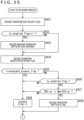
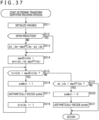
- the switch 131 decides whether or not the transform skip flag ts_flag is 1 (true). In the case where it is decided that the transform skip flag ts_flag is 1 (true) (the transform skip flag ts_flag indicates skip of a transform process), primary transform and secondary transform (processes at steps S122 to S130) are skipped and the transform process comes to an end, and the processing returns to FIG. 9 . In short, the switch 131 supplies the prediction residual D as transform coefficients Coeff to the quantization section 113. On the other hand, in the case where it is decided at step S121 that the transform skip flag ts_flag is 0 (false) (the transform skip flag ts_flag indicates execution of a transform process), the processing advances to step S122.
- the switch 131 may further decide whether or not the transform quantization bypass flag transquant_bypass_flag is 1 (true). Along with this, in the case where it is decided that the transform quantization bypass flag transquant_bypass_flag is 1 (true) (the transform quantization bypass flag transquant_bypass_flag indicates skip of a transform process and a quantization process), primary transform and secondary transform (processes at steps S122 to S130) are skipped and the transform process is ended, and the processing returns to FIG. 9 . In particular, the switch 131 supplies the prediction residual D as the transform coefficients Coeff to the quantization section 113.
- step S121 if it is decided at step S121 that the transform quantization bypass flag transquant_bypass_flag is 0 (false) (the transform quantization bypass flag transquant_bypass_flag indicates execution of a transform process and a quantization process), the processing advances to step S122.
- the primary transform section 132 performs primary transform for the prediction residual D on the basis of the primary transform identifier pt_idx to derive primary transform coefficients Coeff_P.
- the secondary transform section 133 decides whether or not the secondary transform identifier st_idx applies secondary transform (st_idx > 0) . In the case where it is decided that the secondary transform identifier st_idx is 0 (the secondary transform identifier st_idx indicates skip of secondary transform), secondary transform (processes at steps S124 to S130) is skipped and the transform process is ended, and the processing returns to FIG. 9 . In particular, the secondary transform section 133 supplies the primary transform coefficients Coeff_P as transform coefficients Coeff to the quantization section 113.
- step S123 in the case where it is decided at step S123 that the secondary transform identifier st_idx is greater than 0 (the secondary transform identifier st_idx indicates execution of secondary transform), the processing advances to step S124. Secondary transform is executed by the processes at steps S124 to S130.
- the secondary transform selection section 145 selects a matrix R for secondary transform designated by the secondary transform identifier st_idx.
- the secondary transform section 133 segments a transform block of a processing target into sub blocks and selects an unprocessed sub block.
- the rasterize section 141 converts the primary transform coefficients Coeff_P into a 1 ⁇ 16-dimensional vector X 1d on the basis of the scan method designated by the scan identifier scanIdx.
- the matrix arithmetic operation section 142 arithmetically operates a column product between the vector X 1d and the matrix R for secondary transform to determine a vector Y 1d .
- the scaling section 143 normalizes the norm of the vector Y 1d to determine a vector Z 1d .
- the matrixing section 144 converts the vector Z 1d into a 4 ⁇ 4 matrix on the basis of the scan method designated by the scan identifier scanIdx to determine transform coefficients Coeff of the sub block of the processing target.
- the transform coefficients Coeff are supplied to the quantization section 113.
- the secondary transform section 133 decides whether or not all sub blocks of the transform block of the processing target have been processed. In the case where it is decided that an unprocessed sub block exists, the processing returns to step S125, and the later processes are repeated. In short, the processes at steps S125 to S130 (secondary transform) are executed for each sub block of the transform block of the processing target. In the case where it is decided at step S130 that all sub blocks have been processed (secondary transform of all sub blocks has been performed), the transform process is ended and the processing returns to FIG. 9 .
- the image encoding apparatus 100 can skip not only primary transform but also secondary transform by indicating a skip of a transform process by the transform skip flag ts_flag. Accordingly, it is possible to perform, for example, in regard to a sparse residual signal in which the number of non-zero coefficients is small and to which it is desirable to apply transform skip, a transform process that achieves reduction of the processing amount of transform and reduction of degradation of the energy compaction more readily and improves the encoding efficiency.
- FIG. 11 is a block diagram depicting an example of a configuration of an image decoding apparatus that is a form of an image processing apparatus to which the present technology is applied.
- An image decoding apparatus 200 depicted in FIG. 11 is an image decoding apparatus that corresponds to the image encoding apparatus 100 of FIG. 5 and decodes encoded data (bit stream) generated by the image encoding apparatus 100 by a decoding method corresponding to the encoding method by the image encoding apparatus 100.
- the image decoding apparatus 200 incorporates the technology proposed in HEVC or the technology proposed in JVET.
- FIG. 11 principal ones of processing sections, flows of data and so forth are depicted and full ones are not necessarily depicted in FIG. 11 .
- the image decoding apparatus 200 may include processing sections that are not depicted as blocks in FIG. 11 or may include processes or flows of data not depicted as arrow marks or the like in FIG. 11 .
- the image decoding apparatus 200 includes a decoding section 211, a dequantization section 212, an inverse transform section 213, an arithmetic operation section 214, a frame memory 215 and a prediction section 216.
- encoded data generated by the image encoding apparatus 100 or the like are supplied, for example, as a bit stream or the like, for example, through a transmission medium, a recording medium or the like.
- the decoding section 211 decodes encoded data supplied thereto by a predetermined decoding method corresponding to the encoding method. For example, the decoding section 211 decodes syntax values of syntax elements from the bit string of encoded data (bit stream) supplied thereto in accordance with a definition of a syntax table.
- the syntax elements include such information as, for example, header information Hinfo, prediction mode information Pinfo, transform information Tinfo, residual information Rinfo and so forth.
- the decoding section 211 refers to the residual information Rinfo to derive quantization transform coefficient levels level of each coefficient position in each transform block.
- the decoding section 211 supplies the prediction mode information Pinfo, quantization transform coefficient levels level and transform information Tinfo obtained by the decoding to the associated blocks.
- the decoding section 211 supplies the prediction mode information Pinfo to the prediction section 216, supplies the quantization transform coefficient levels level to the dequantization section 212 and supplies the transform information Tinfo to the dequantization section 212 and the inverse transform section 213.
- the dequantization section 212 may skip (omit), upon transform quantization bypass, the dequantization process and supply the transform coefficients Coeff_IQ as transform coefficients Coeff_IQ to the inverse transform section 213.
- the inverse transform section 213 inversely transforms the transform coefficients Coeff_IQ supplied from the dequantization section 212 on the basis of the transform information Tinfo supplied from the decoding section 211 to derive a prediction residual D'.
- This inverse transform is a process inverse to the transform process performed by the transform section 112 ( FIG. 5 ) of the image encoding apparatus 100. It is to be noted that the inverse transform section 116 performs inverse transform similar to that by the inverse transform section 213. Details of the inverse transform are hereinafter described.
- the inverse transform section 213 supplies the obtained prediction residual D' to the arithmetic operation section 214.
- the inverse transform section 213 may skip (omit) the inverse transform process (inverse secondary transform and inverse primary transform) and supply the transform coefficients Coeff_IQ as the prediction residual D' to the arithmetic operation section 214.
- the arithmetic operation section 214 adds the prediction residual D' supplied from the inverse transform section 213 and a prediction image P (prediction signal) corresponding to the prediction residual D' to derive a locally decoded image Rec as indicated by an expression (21) given below.
- the frame memory 215 re-constructs a decoded image for each picture unit using the locally decoded image Rec supplied from the arithmetic operation section 214 and stores the decoded image into the buffer in the frame memory 215.
- the frame memory 215 reads out a decoded image designated by the prediction mode information Pinfo of the prediction section 216 as a reference image from the buffer and supplies the reference image to the prediction section 216. Further, the frame memory 215 may store header information Hinfo, prediction mode information Pinfo, transform information Tinfo and so forth relating to generation of the decoded image into the buffer in the frame memory 215.
- the prediction section 216 acquires a decoded image stored in the frame memory 215 and designated by prediction mode information Pinfo supplied from the decoding section 211 as a reference image and uses the reference image to generate a prediction image P by a prediction method designated by the prediction mode information Pinfo.
- the prediction section 216 supplies the generated prediction image P to the arithmetic operation section 214.
- Such an image decoding apparatus 200 as described above includes a control section that skips, in the case where inverse primary transform that is inverse transform to primary transform that is a transform process for a prediction residual that is a difference between an image and a prediction image of the image is to be skipped, also inverse secondary transform that is inverse transform to secondary transform that is a transform process for primary transform coefficients obtained by primary transform of the prediction residual.
- FIG. 12 is a block diagram depicting a principal configuration example of the inverse transform section 213 of FIG. 11 .
- the inverse transform section 213 includes a switch 231, an inverse secondary transform section 232 and an inverse primary transform section 233.
- the switch 231 is an embodiment of a control section for controlling execution of inverse secondary transform and inverse primary transform.
- the switch 231 controls such that, in the case where inverse primary transform is to be skipped, also inverse secondary transform is skipped.
- the switch 231 performs such control in response to the value of the value of the transform skip flag ts_flag that is information relating to skip of inverse primary transform.
- the switch 231 causes inverse secondary transform and inverse primary transform to be executed.
- the switch 231 supplies the transform coefficients Coeff_IQ to the inverse secondary transform section 232.
- the switch 231 causes inverse secondary transform and inverse primary transform to be skipped.
- the switch 231 supplies the transform coefficients Coeff_IQ as the prediction residual D' to the arithmetic operation section 214.
- the inverse transform section 213 can suppress unnecessary increase of the processing amount of inverse transform readily.
- the switch 231 can skip not only inverse primary transform but also inverse secondary transform more readily particularly in regard to such a sparse residual signal whose number of non-zero coefficients is small as described above, and increase of the processing amount for inverse transform can be suppressed to suppress decrease of the encoding efficiency.
- the switch 231 may control the supplying destination of the transform coefficients Coeff_IQ supplied from the outside in response to the value of the transform quantization bypass flag transquant_bypass_flag included in the transform information Tinfo.
- the switch 231 supplies the transform coefficients Coeff_IQ to the inverse secondary transform section 232.
- the switch 231 causes inverse secondary transform and inverse primary transform to be skipped.
- the switch 231 supplies the transform coefficients Coeff_IQ as the prediction residual D' to the arithmetic operation section 214.
- the inverse secondary transform section 232 performs inverse secondary transform for the transform coefficients Coeff_IQ on the basis of the secondary transform identifier st_idx that is information relating to the subject of the secondary transform and the scan identifier scanIdx that is information relating to the scan method of transform coefficients to derive transform coefficients Coeff_IS after the inverse secondary transform (referred to also as primary transform coefficients).
- the inverse secondary transform section 232 supplies the primary transform coefficients Coeff_IS to the inverse primary transform section 233. It is to be noted that details of the inverse secondary transform section 232 are hereinafter described.
- the inverse primary transform section 233 executes inverse primary transform such as, for example, inverse orthogonal transform or the like for the primary transform coefficients Coeff_IS supplied from the inverse secondary transform section 232. In short, the inverse primary transform section 233 performs inverse primary transform under the control of the switch 231.
- the operator " ⁇ ” represents an operation for performing inner product (matrix product) between matrices
- the operator "T” represents an operation of a transposed matrix.
- the expression (22) given above may be represented like the following expression (23).
- D ′ IPver ⁇ Coeff_IS ⁇ IPhor T
- the inverse primary transform section 233 supplies the resulting prediction residual D' to the arithmetic operation section 214.
- the inverse secondary transform section 232 includes a rasterize section 241, a matrix arithmetic operation section 242, a scaling section 243, a matrixing section 244 and an inverse secondary transform selection section 245.
- the rasterize section 241 converts transform coefficients Coeff_IQ supplied from the switch 231 for each sub block (4 4 sub block) into a 1 ⁇ 16-dimensional vector X 1d on the basis of a scan method for transform coefficients designated by the scan identifier scanIdx supplied from the decoding section 211.
- the rasterize section 241 supplies the resulting vector X 1d to the matrix arithmetic operation section 242. It is to be noted that the scan methods corresponding to the scan identifiers scanIdx that are information relating to scan methods for transform coefficients are such as described hereinabove with reference to FIG. 7 .
- each transform coefficients Coeff_IQ supplied to the inverse transform section 213 is such a 4 ⁇ 4 matrix as represented by the following expression (24).
- Coeff_IQ 245 ⁇ 42 ⁇ 18 ⁇ 30 ⁇ 30 ⁇ 31 3 ⁇ 2 11 ⁇ 4 ⁇ 9 4 3 ⁇ 2 1 0
- the secondary transform identifier st_idx has a certain value
- the inverse secondary transform selection section 245 reads out the transposed matrix R T of the matrix R of 16 16 depicted in FIG. 8 as the matrix IR for inverse secondary transform and supplies the transposed matrix R T to the matrix arithmetic operation section 242.
- an inverse matrix IR may be selected in response to the motion prediction information MVinfo and the secondary transform identifier st_idx in place of the intra prediction mode information IPinfo.
- the operator "T” represents an operation of a transposed matrix.
- the matrix arithmetic operation section 242 performs such matrix product as represented by the expression (26) using the vector X 1d represented by the expression (25) given hereinabove and a transposed matrix R T of the matrix R after the secondary transform depicted in FIG. 8 to derive such a vector Y 1d as represented by the following expression (27).
- the matrix arithmetic operation section 242 supplies the resulting vector Y 1d to the scaling section 243.
- Y 1d [65380, 78, 34, -68, -121, 43, -79, 130, -24, 83, 109, 76, 23, 58, 65, 52]
- the scaling section 243 performs, in order to normalize the norm of the signal Y 1d supplied from the matrix arithmetic operation section 242 for each sub block (4 ⁇ 4 sub block), such bit shift arithmetic operation of N (N is a natural number) bits as represented by the following expression (28) for all elements of the signal Y 1d to determine a signal Z 1d after the bit shift.
- Z 1d Y 1d ⁇ N
- the value of N to be used in normalization of the norm by the scaling section 243 is 8.
- Z 1d [255, 0, 0, 0, 0, 0, 0, 0, 0, 0, 0, 0, 0, 0]
- the bit shift amount after norm normalization is N bits.
- the matrixing section 244 accepts, for each sub block (4 ⁇ 4 sub block), the signal Z 1d after the norm normalization and the scan identifier scanIdx as inputs thereto and converts the 1 ⁇ 16-dimensional vector Z 1d supplied from the scaling section 243 into primary transform coefficients Coeff_IS of a 4 ⁇ 4 matrix on the basis of a scan method designated by the scan identifier scanIdx supplied from the decoding section 211.
- the matrixing section 244 matrixes the 1 ⁇ 16-dimensional vector Z 1d represented by the expression (30) on the basis of horizontal scan indicated by B of FIG. 7 and obtains such primary transform coefficients Coeff_IS of a 4 ⁇ 4 matrix as represented by the following expression (31).
- Coeff_IS 255 0 0 0 0 0 0 0 0 0 0 0 0 0 0 0 0 0 0 0 0 0 0 0 0 0 0 0 0 0 0 0 0 0 0 0 0 0 0 0 0 0 0 0 0 0 0 0 0
- the matrixing section 244 supplies the resulting primary transform coefficients Coeff_IS to the inverse primary transform section 233.
- the decoding section 211 decodes a bit stream (encoded data) supplied to the image decoding apparatus 200 to obtain information such as header information Hinfo, prediction mode information Pinfo, transform information Tinfo, residual information Rinfo, quantization transform coefficient levels level and so forth.
- the dequantization section 212 dequantizes the quantization transform coefficient levels level obtained by the process at step S201 to derive transform coefficients Coeff_IQ.
- This dequantization is an inverse process to the quantization performed at step S105 ( FIG. 9 ) of the image encoding process and is a process similar to the dequantization performed at step S106 ( FIG. 9 ) of the image encoding process.
- the inverse transform section 213 inversely transforms the transform coefficients Coeff_IQ obtained by the process at step S202 to derive a prediction residual D'.
- This inverse transform is an inverse process to the transform process performed at step S104 ( FIG. 9 ) of the image encoding process and is a process similar to the inverse transform performed at step S107 ( FIG. 9 ) of the image encoding process.
- the prediction section 216 performs prediction in a prediction mode same as that upon encoding on the basis of the prediction mode information Pinfo to generate a prediction image.
- the arithmetic operation section 214 adds the prediction image obtained by the process at step S204 to the prediction residual D' obtained by the process at step S203 to obtain a decoded image.
- the switch 231 decides whether or not the transform skip flag ts_flag is 1 (true). In the case where it is decided that the transform skip flag ts_flag is 1 (true) (the transform skip flag ts_flag indicates skip of an inverse transform process), inverse secondary transform and inverse primary transform (processes at steps S222 to S230) are skipped and the inverse transform process ends, and the processing returns to FIG. 13 . In short, the switch 231 supplies the transform coefficients Coeff_IQ as the prediction residual D' to the arithmetic operation section 214. On the other hand, in the case where it is decided that the transform skip flag ts_flag is 0 (false) (the transform skip flag ts_flag indicates execution of an inverse transform process), the processing advances to step S222.
- the switch 231 may further decide whether or not the transform quantization bypass flag transquant_bypass_flag is 1 (true). Along with this, in the case where transform quantization bypass flag transquant_bypass_flag is 1 (true) (the transform quantization bypass flag transquant_bypass_flag indicates skip of a dequantization process and an inverse transform process), inverse secondary transform and inverse primary transform (processes at steps S222 to S230) are skipped, and the inverse transform process ends and the processing returns to FIG. 13 . In short, the switch 231 supplies the transform coefficients Coeff_IQ as the prediction residual D' to the arithmetic operation section 214.
- the inverse secondary transform section 232 decides whether or not the secondary transform identifier st_idx applies inverse secondary transform (sd_idx > 0). In the case where it is decided that the secondary transform identifier st_idx is 0 (the secondary transform identifier st_idx indicates skip of inverse secondary transform), inverse secondary transform (processes at steps S223 to S229) is skipped, and the processing advances to step S230. In short, the inverse secondary transform section 232 supplies the transform coefficients Coeff_IQ as primary transform coefficients Coeff_P to the inverse primary transform section 233.
- step S222 in the case where it is decided at step S222 that the secondary transform identifier st_idx is greater than 0 (the secondary transform identifier st_idx indicates execution of inverse secondary transform), the processing advances to step S223. Inverse secondary transform is executed by the processes at steps S223 to S229.
- the inverse secondary transform selection section 245 selects a matrix IR for inverse secondary transform designated by the secondary transform identifier st_idx.
- the inverse secondary transform section 232 selects an unprocessed sub block included in a transform block of a processing target.
- the rasterize section 241 converts the transform coefficients Coeff_IQ into a 1 ⁇ 16-dimensional vector X 1d on the basis of a scan method designated by the scan identifier scanIdx.
- the matrix arithmetic operation section 242 arithmetically operates a matrix product between the vector X 1d and the matrix IR for inverse secondary transform to determine a vector Y 1d .
- the scaling section 243 normalizes the norm of the vector Y 1d to determine a vector Z 1d .
- the matrixing section 244 converts the vector Z1d into a matrix of 4 ⁇ 4 on the basis of a scan method designated by the scan identifier scanIdx to determine primary transform coefficients Coeff_P of the sub block of the processing target.
- the inverse secondary transform section 232 decides whether or not all sub blocks of the transform block of the processing target have been processed. In the case where an unprocessed sub block exists, the processing returns to step S224 and the later processes are repeated. In short, for each sub block of the transform block of the processing target, the processes at steps S224 to S229 (inverse secondary transform) are executed. In the case where it is decided at step S229 that all sub blocks have been processed (inverse secondary transform for all sub blocks has been performed), the processing advances to step S230.
- the inverse primary transform section 233 performs inverse primary transform for the primary transform coefficients Coeff_P on the basis of the primary transform identifier pt_idx to derive a prediction residual D'.
- the prediction residual D' is supplied to the arithmetic operation section 214.
- change of the processing order of the steps or change of the substance of a process may be performed within a range within which it can be carried out.
- a unit matrix of 16 ⁇ 16 may be selected as a matrix IR for inverse secondary transform such that the processes at steps S223 to S229 are executed.
- the image decoding apparatus 200 can skip not only inverse primary transform but also inverse secondary transform by indicating skip of a transform process by the transform skip flag ts_flag. Accordingly, it is possible to perform, for example, for a sparse residual signal in which the number of non-zero coefficients is small and to which it is desirable to apply transform skip, an inverse transform process that achieves reduction of the processing amount of inverse transform and reduction of degradation of the energy compaction and improves the encoding efficiency.
- the secondary transform identifier st_idx is encoded in a unit of a CU
- the transform skip flag ts_flag is encoded in a unit of each transform block included in a CU.
- the present technology described hereinabove in connection with the first embodiment is applied to this technology (JEM2) such that, in the case where the transform skip flag ts_flag is 1 (transform skip is applied), (inverse) primary transform and (inverse) secondary transform are skipped.
- the transform skip flag ts_flag cannot indicate skip of the (inverse) transform process in the CU, and the transform skip flag ts_flag is determines to 0.
- encoding of the transform skip flag ts_flag becomes redundant. Accordingly, there is the possibility that the encoding efficiency may be degraded.
- inverse secondary transform that is inverse transform to secondary transform that is a transform process for primary transform coefficients obtained by primary transform of a prediction residual that is a difference between an image and a prediction image of the image
- decoding of encoded data of first information relating to skip of inverse primary transform that is inverse transform to primary transform is skipped.
- FIG. 15 An example of a syntax table in which pseudo codes representing such control as described above are described is depicted in FIG. 15 .
- the secondary transform identifier st_idx is 0.
- the secondary transform identifier st_idx is not 0, namely, in the case where (inverse) secondary transform is executed, encoding of the transform skip flag ts_flag (decoding of encoded data of the transform skip flag ts_flag) is skipped.
- the image encoding apparatus 100 has a configuration basically similar to that in the case of the first embodiment.
- the image encoding apparatus 100 includes an encoding section for skipping encoding of first information relating to skip of primary transform.
- the encoding section 114 in this case skips, in the case where secondary transform is to be performed for primary transform coefficients obtained by primary transform of a prediction residual that is a difference between an image and a prediction image of the image, encoding of first information relating to skip of primary transform.
- FIG. 16 is a functional block diagram depicting an example of principal functions relating to encoding of a transform skip flag ts_flag, which is executed by executing a program or the like by the encoding section 114 in this case.
- the encoding section 114 can include, as functions relating to encoding of the transform skip flag ts_flag, for example, functions of a secondary transform validity flag encoding section 301, a secondary transform identifier encoding section 302, a transform skip validity flag encoding section 303, a maximum transform skip block size encoding section 304, a transform quantization bypass flag encoding section 305 and a transform skip flag encoding section 306.
- the secondary transform validity flag encoding section 301 performs a process relating to encoding of the secondary transform validity flag st_enabled_flag that is information relating to permission of secondary transform.
- the secondary transform identifier encoding section 302 performs a process relating to encoding of the secondary transform identifier st_idx that is information relating to the substance of secondary transform.
- the transform skip validity flag encoding section 303 performs a process relating to encoding of the transform skip validity flag ts_enabled_flag that is information relating to permission of skip of transform (primary transform).
- the maximum transform skip block size encoding section 304 performs a process relating to encoding of the maximum transform skip block size MaxTSSize indicative of a maximum size of a transform block with which skip of transform (primary transform) is permitted.
- the transform quantization bypass flag encoding section 305 performs a process relating to encoding of the transform quantization bypass flag transquant_bypass_flag that is information relating to skip (bypass) of transform (primary transform and secondary transform) and quantization.
- the transform skip flag encoding section 306 performs a process relating to encoding of the transform skip flag ts_flag that is information relating to skip of transform (primary transform).
- the image encoding apparatus 100 performs an image encoding process basically similarly to that in the case of the first embodiment. However, in this case, the image encoding apparatus 100 performs encoding of the transform skip flag ts_flag and so forth in response to the value of the secondary transform identifier st_idx and so forth at step S110 ( FIG. 9 ) of the image encoding process.
- An example of a flow of the encoding of the transform skip flag ts_flag and so forth is described with reference to a flow chart of FIG. 17 . In short, the encoding process depicted in FIG. 17 is executed as part of the encoding process performed at step S110 of FIG. 9 . Encoding of other encoding parameters and the quantization transform coefficient levels level is performed by arbitrary methods.
- the secondary transform validity flag encoding section 301 encodes the secondary transform validity flag st_enabled_flag included in the header information Hinfo to generate a bit string (encoded data) and outputs the encoded data.
- the encoded data of the secondary transform validity flag st_enabled_flag obtained by this encoding is included into a bit stream that includes encoded data of the quantization transform coefficient levels level.
- the secondary transform identifier encoding section 302 decides whether or not the secondary transform validity flag st_enabled_flag included in the header information Hinfo is 1 (true). In the case where it is decided that the secondary transform validity flag st_enabled_flag is 1, namely, in the case where it is decided that execution of secondary transform is permitted, the processing advances to step S303.
- the secondary transform identifier encoding section 302 encodes the secondary transform identifier st_idx to generate a bit string (encoded data) and outputs the encoded data.
- the encoded data of the secondary transform identifier st_idx obtained by this encoding is included into a bit stream that includes encoded data of the quantization transform coefficient levels level.
- step S302 in the case where it is decided at step S302 that the secondary transform validity flag st_enabled_flag is 0 (false), namely, in the case where execution of secondary transform is not permitted, the process at step S303 is skipped, and the processing advances to step S304.
- the secondary transform identifier encoding section 302 skips encoding of the secondary transform identifier st_idx. Since this makes it possible to skip encoding of redundant information, it is possible to suppress increase of the load of an encoding process and suppress degradation of the encoding efficiency.
- the transform skip validity flag encoding section 303 encodes the transform skip validity flag ts_enabled_flag included in the header information Hinfo to generate a bit string (encoded data) and outputs the encoded data.
- the encoded data of the transform skip validity flag ts_enabled_flag obtained by the encoding is included into a bit stream that includes encoded data of the quantization transform coefficient levels level.
- the maximum transform skip block size encoding section 304 encodes the maximum transform skip block size MaxTSSize (or the logarithm value log2MaxTSSize with base 2) to generate a bit string (encoded data) and outputs the encoded data.
- the encoded data of the maximum transform skip block size MaxTSSize obtained by the encoding is included into a bit stream including the encoded data of the quantization transform coefficient levels level.
- step S305 in the case where it is decided at step S305 that the transform skip validity flag ts_enabled_flag is 0, namely, in the case where transform skip is not permitted, the process at step S306 is skipped and the processing advances to step S307.
- the maximum transform skip block size encoding section 304 skips encoding of the maximum transform skip block size MaxTSSize (or log2MaxTSSize). Since this makes it possible to skip encoding of redundant information, it is possible to suppress increase of the load of the encoding process and suppress degradation of the encoding efficiency.
- the transform quantization bypass flag encoding section 305 encodes the transform quantization bypass flag transquant_bypass_flag to generate a bit string (encoded data) and outputs the encoded data.
- the encoded data of the transform quantization bypass flag transquant_bypass_flag obtained this encoding is included into a bit stream that includes encoded data of the quantization transform coefficient levels level.
- the transform skip flag encoding section 306 decides whether or not the transform quantization bypass flag transquant_bypass_flag included in the transform information Tinfo is 1 (true). In the case where it is decided that the transform quantization bypass flag transquant_bypass_flag is 1, namely, in the case where transform (primary transform and secondary transform) and quantization are to be skipped (bypassed), processes at steps S309 to S312 are skipped and the encoding process ends, and the processing returns to FIG. 9 .
- step S308 In the case where it is decided at step S308 that the transform quantization bypass flag transquant_bypass_flag is 0, namely, in the case where it is decided that transform and quantization are not to be skipped (bypassed), the processing advances to step S309.
- the transform skip flag encoding section 306 decides whether or not the value of the secondary transform identifier st_idx is greater than 0 (st_idx > 0). In the case where the value of the secondary transform identifier st_idx is greater than 0, namely, in the case where it is decided that secondary transform is to be executed, processes at steps S310 to S312 are skipped and the encoding process ends, and the processing returns to FIG. 9 .
- the transform skip flag encoding section 306 skips encoding of the transform skip flag ts_flag. Since this makes it possible to skip encoding of redundant information, it is possible to suppress increase of the load of an encoding process and suppress degradation of the encoding efficiency.
- step S309 In the case where it is decided at step S309 that the value of the secondary transform identifier st_idx is 0, namely, that secondary transform is to be skipped, the processing advances to step S310.
- the transform skip flag encoding section 306 decides whether or not the transform skip validity flag ts_enabled_flag included in the header information Hinfo is 1 (true). In the case where it is decided that the transform skip validity flag ts_enabled_flag is 0, namely, that transform skip is not permitted, processes at steps S311 and S312 are skipped and the encoding process ends, and the processing returns to FIG. 9 .
- the transform skip flag encoding section 306 skips encoding of the transform skip flag ts_flag. Since this makes it possible to skip encoding of redundant information, it is possible to suppress increase of the load of an encoding process and suppress degradation of the encoding efficiency.
- step S310 In the case where it is decided at step S310 that the transform skip validity flag ts_enabled_flag is 1, namely, that transform skip is permitted, the processing advances to step S311.
- the transform skip flag encoding section 306 skips encoding of the transform skip flag ts_flag. Since this makes it possible to skip encoding of redundant information, it is possible to suppress increase of the load of an encoding process and suppress degradation of the encoding efficiency.
- step S311 In the case where it is decided at step S311 that the size TBSize of the transform block of the processing target is equal to or smaller the maximum transform skip block size MaxTSSize, namely, in the case where it is decided that the conditional expression given above is 1 (true), the processing advances to step S312.
- the transform skip flag encoding section 306 encodes the transform skip flag ts_flag to generate a bit stream (encoded data) and outputs the encoded data.
- the encoded data of the transform skip flag ts_flag obtained by this encoding is included into a bit stream that includes encoded data of the quantization transform coefficient levels level.
- the image encoding apparatus 100 can skip encoding of the transform skip flag ts_flag in the case where the secondary transform identifier st_idx applies secondary transform (st_idx > 0) in the case where the secondary transform identifier st_idx is to be encoded in a unit of a CU.
- secondary transform identifier st_idx applies secondary transform (st_idx > 0) in the case where the secondary transform identifier st_idx is to be encoded in a unit of a CU.
- the encoding process described above may be subject to change of the processing order of the steps or change of the substance of the processes within a range within which it can be carried out. Further, the syntax and the conditional expression (32) given hereinabove can be changed in terms of arithmetic operation thereof within a range within which it can be carried out.
- the image decoding apparatus 200 has a configuration basically similar to that in the first embodiment.
- the image decoding apparatus 200 in this case includes a decoding section that skips, in the case where inverse secondary transform that is inverse transform to secondary transform that is a transform process for primary transform coefficients obtained by primary transform of a prediction residual that is a difference between an image and a prediction image of the image, decoding of encoded data of first information relating to skip of inverse primary transform that is inverse transform to the primary transform.
- a decoding section 211 skips decoding of encoded data of first information relating to skip of inverse primary transform that is inverse transform to the primary transform.
- FIG. 18 is a functional block diagram depicting an example of principle functions relating to decoding of the transform skip flag ts_flag, which is implemented by execution of a program and so forth by the decoding section 211 in this case.
- the decoding section 211 includes, as functions relating to decoding of the transform skip flag ts_flag by executing a program, for example, functions of a secondary transform validity flag decoding section 311, a secondary transform identifier decoding section 312, a transform skip validity flag decoding section 313, a maximum transform skip block size decoding section 314, a transform quantization bypass flag decoding section 315 and a transform skip flag decoding section 316.
- the secondary transform validity flag decoding section 311 performs a process relating to decoding of encoded data of the secondary transform validity flag st_enabled_flag that is information relating to permission of inverse secondary transform.
- the secondary transform identifier decoding section 312 performs a process relating to decoding of encoded data of the secondary transform identifier st_idx that is information relating to the substance of inverse secondary transform.
- the transform skip validity flag decoding section 313 performs a process relating to decoding of encoded data of the transform skip validity flag ts_enabled_flag that is information relating to permission of skip of inverse transform (inverse primary transform).
- the secondary transform validity flag decoding section 311 decodes the encoded data of the secondary transform validity flag st_enabled_flag included in a bit stream (encoded data) and outputs resulting data as part of the header information Hinfo.
- the secondary transform identifier decoding section 312 decides whether or not the decoded secondary transform validity flag st_enabled_flag is 1 (true). In the case where it is decided that the secondary transform validity flag st_enabled_flag is 0, namely, in the case where it is decided that execution of inverse secondary transform is not permitted, the processing advances to step S333.
- step S332 in the case where it is decided at step S332 that the secondary transform validity flag st_enabled_flag is 1, the processing advances to step S334.
- the secondary transform identifier decoding section 312 decodes the encoded data of the secondary transform identifier st_idx included in the bit stream (encoded data). After the process at step S334 ends, the processing advances to step S335.
- the processes relating to decoding of the secondary transform identifier st_idx described above may be subject to change of the processing order of the steps or change of the substance of the processes within a range within which it can be carried out.
- the transform skip validity flag decoding section 313 decodes the encoded data of the transform skip validity flag ts_enabled_flag included in the bit stream (encoded data) and outputs the decoded encoded data as part of the header information Hinfo.
- the maximum transform skip block size decoding section 314 decides whether or not the decoded transform skip validity flag ts_enabled_flag is 1 (true). In the case where it is decided that the transform skip validity flag ts_enabled_flag is 1, namely, in the case where it is decided that skip of inverse transform (inverse secondary transform and inverse primary transform) is permitted, the processing advances to step S337.
- the maximum transform skip block size decoding section 314 decodes encoded data of a maximum transform skip block size MaxTSSize (or a logarithm value log2MaxTSSize with base 2) included in the bit stream (encoded data). After the process at step S337 ends, the processing advances to step S338.
- step S336 the transform skip validity flag ts_enabled_flag is 0, namely, in the case where it is decided that skip of inverse transform is not permitted, since skip of inverse transform is not performed, the maximum transform skip block size MaxTSSize is unnecessary. Accordingly, in this case, the process at step S337 is skipped and the processing advances to step S338.
- the transform quantization bypass flag decoding section 315 decodes the encoded data of the transform quantization bypass flag transquant_bypass_flag included in the bit stream (encoded data) and outputs the encoded data as part of the transform information Tinfo.
- the transform skip flag decoding section 316 decides whether or not the transform quantization bypass flag transquant_bypass_flag is 1 (true). In the case where it is decided that the transform quantization bypass flag transquant_bypass_flag is 1, namely, in the case where it is decided that inverse transform (inverse secondary transform and inverse primary transform) and dequantization are to be skipped (bypassed), the processes at steps S340 and S342 are skipped, and the processing advances to step S343.
- the transform skip flag decoding section 316 skips decoding of the encoded data of the transform skip flag ts_flag. Since this makes it possible to skip decoding of redundant information, it is possible to suppress increase of the load of a decoding process and suppress degradation of the encoding efficiency.
- step S339 the transform quantization bypass flag transquant_bypass_flag is 0, namely, in the case where inverse transform and quantization are not to be skipped (bypassed), the processing advances to step S340.
- the transform skip flag decoding section 316 decides whether or not the value of the secondary transform identifier st_idx is greater than 0 (st_idx > 0). In the case where it is decided that the value of the secondary transform identifier st_idx is greater than 0, namely, in the case where it is decided that inverse secondary transform is to be executed, the processes at steps S341 and S342 are skipped and the processing advances to step S343.
- the transform skip flag decoding section 316 skips decoding of encoded data of the transform skip flag ts_flag. Since this makes it possible to skip decoding of redundant information, it is possible to suppress increase of the load of a decoding process and suppress degradation of the encoding efficiency.
- step S340 In the case where it is decided at step S340 that the value of the secondary transform identifier st_idx is 0, namely, that inverse secondary transform is to be skipped, the processing advances to step S341.
- the transform skip flag decoding section 316 decides whether or not the transform skip validity flag ts_enabled_flag included in the header information Hinfo is 1 (true). In the case where it is decided that the transform skip validity flag ts_enabled_flag is 0, namely, in the case where it is decided that transform skip is not permitted, the processing at step S342 is skipped and the processing advances to step S343.
- transform skip (skip of inverse transform) cannot be performed, then the value of the transform skip flag ts_flag is fixed to 0. Accordingly, in this case, since the transform skip flag ts_flag is not transmitted from the encoding side, the transform skip flag decoding section 316 skips decoding of the encoded data of the transform skip flag ts_flag. Since this makes it possible to skip encoding of redundant information, it is possible to suppress increase of the load of an encoding process and suppress degradation of the encoding efficiency.
- the transform skip flag ts_flag is fixed to 0. Accordingly, in this case, since the transform skip flag ts_flag is not transmitted from the encoding side, the transform skip flag decoding section 316 skips decoding of encoded data of the transform skip flag ts_flag. Since this makes it possible to skip encoding of redundant information, it is possible to suppress increase of the load of an encoding process and suppress degradation of the encoding efficiency.
- step S342 in the case where it is decided at step S342 that the size TBSize of the transform block of the processing target is equal to or smaller than the maximum transform skip block size MaxTSSize, namely, in the case where the conditional expression given above is 1 (true), the processing advances to step S344.
- the transform skip flag decoding section 316 decodes the encoded data of the transform skip flag ts_flag.
- the image decoding apparatus 200 can skip decoding of encoded data of the transform skip flag ts_flag in the case where the secondary transform identifier st_idx indicates execution of inverse secondary transform (st_idx > 0) in the case where the secondary transform identifier st_idx is encoded in a unit of a CU.
- st_idx indicates execution of inverse secondary transform (st_idx > 0) in the case where the secondary transform identifier st_idx is encoded in a unit of a CU.
- the decoding process described above may be subject to change of the processing order of the steps or change of the substance of the processes within a range within which it can be carried out. Further, the syntax and the conditional expression (32) given hereinabove can be changed in terms of arithmetic operation thereof within a range within which it can be carried out.
- the present technology described in the description of the first embodiment is applied to the technology described in NPL 2 such that, in the case where the transform skip flag ts_flag is 1 (transform skip is applied), (inverse) primary transform and (inverse) secondary transform are skipped.
- (inverse) secondary transform is skipped, and therefore, encoding of the secondary transform flag st_flag that is information relating to execution of the secondary transform becomes redundant. Accordingly, there is the possibility that the encoding efficiency may degrade.
- decoding of encoded data of first information relating to skip of inverse secondary transform that is inverse transform to secondary transform that is a transform process for primary transform coefficients obtained by the primary transform of the prediction residual is skipped.
- FIG. 20 An example of a syntax table in which pseudo codes representative of such control are described is depicted in FIG. 20 .
- one of conditions for encoding of the secondary transform flag st_flag namely, decoding of encoded data of the secondary transform flag st_flag
- the transform skip flag ts_flag is 0.
- the transform skip flag ts_flag is 1, namely, in the case where (inverse) primary transform is to be skipped
- encoding of the secondary transform flag st_flag decoding of encoded data of the secondary transform flag st_flag
- the transform quantization bypass flag transquant_bypass_flag is 0 is one of conditions for encoding of the secondary transform flag st_flag (namely, for decoding of encoded data of the secondary transform flag st_flag).
- the transform quantization bypass flag transquant_bypass_flag is 1, namely, (inverse) transform and (de) quantization are skipped, encoding of the secondary transform flag st_flag (decoding of encoded data of the secondary transform flag st_flag) is skipped.
- the image encoding apparatus 100 has a configuration basically similar to that in the first embodiment.
- the image encoding apparatus 100 described hereinabove in connection with the first embodiment includes an encoding section that skips, in the case where primary transform that is a transform process for a prediction residual that is a difference between an image and a prediction image of the image is skipped, encoding of first information relating to skip of secondary transform that is a transform process for primary transform coefficients obtained by the primary transform of the prediction residual.
- the encoding section 114 skips encoding of first information relating to skip of secondary transform that is a transform process for primary transform coefficients obtained by the primary transform of the prediction residual.
- FIG. 21 is a functional block diagram depicting an example of principal functions relating to encoding of the secondary transform flag st_flag, which is implemented by the encoding section 114 in this case executing a program and so forth. As depicted in FIG.
- the encoding section 114 in this case can include, as functions relating to encoding of the secondary transform flag st_flag by executing a program, a secondary transform validity flag encoding section 301, a transform skip validity flag encoding section 303, a maximum transform skip block size encoding section 304, a transform quantization bypass flag encoding section 305 and a transform skip flag encoding section 306 similar to those, for example, of the encoding section 114 described in connection with the second embodiment.
- the encoding section 114 can include, as a function relating to encoding of the secondary transform flag st_flag by executing a program, for example, a function of a secondary transform flag encoding section 321.
- the secondary transform flag encoding section 321 performs a process relating to encoding of the secondary transform flag st_flag that is information relating to execution of secondary transform. For example, in the case where the secondary transform flag st_flag is 1 (true), secondary transform is executed. On the other hand, for example, in the case where the secondary transform flag st_flag is 0 (false), secondary transform is skipped.
- the image encoding apparatus 100 performs an image encoding process basically similarly to that in the case of the first embodiment. However, in this case, the image encoding apparatus 100 performs encoding of the secondary transform flag st_flag and so forth in response to the value of the transform skip flag ts_flag and so forth at step S110 ( FIG. 9 ) of the image encoding process.
- An example of a flow of the encoding of the secondary transform flag st_flag and so forth is described with reference to flow charts of FIGS. 22 and 23 .
- the encoding process depicted in FIGS. 22 and 23 is executed as part of the encoding process performed at step S110 of FIG. 9 .
- Encoding of the other encoding parameters and quantization transform coefficient levels level is performed by an arbitrary method.
- steps S361 to S368 of FIG. 22 are executed similarly to the processes ( FIG. 17 ) at steps S304 to S308 and steps S310 to S312.
- step S365 in the case where it is decided at step S365 that the transform quantization bypass flag transquant_bypass_flag that is information relating to skip (bypass) of transform (primary transform and secondary transform) and quantization is 1, namely, in the case where it is decided that transform (primary transform and secondary transform) and dequantization are to be skipped (bypassed), the processing advances to step S371 of FIG. 23 .
- the transform quantization bypass flag transquant_bypass_flag is 0, namely, in the case where it is decided that transform and quantization are not to be skipped (bypassed)
- step S366 in the case where it is decided at step S366 that the transform skip validity flag ts_enabled_flag that is information relating to permission of skip of transform (primary transform) is 0, namely, in the case where it is decided that transform skip is not permitted, the processing advances to step S371 of FIG. 23 .
- the transform skip validity flag ts_enabled_flag is 1, namely, in the case where it is decided that transform skip is permitted, the processing advances to step S367.
- step S367 in the case where it is decided at step S367 that the size TBSize of the transform block of the processing target is greater than the maximum transform skip block size MaxTSSize that is a maximum size of a transform block with which skip of transform (primary transform) is permitted, the processing advances to step S371 of FIG. 23 .
- step S368 in the case where it is decided at step S367 that the size TBSize of the transform block of the processing target is equal to or smaller than the maximum transform skip block size MaxTSSize, the processing advances to step S368.
- a transform skip flag ts_flag that is information relating to skip of transform (primary transform) is generated, and after this process ends, the processing advances to step S371 of FIG. 23 .
- the secondary transform validity flag encoding section 301 encodes the secondary transform validity flag st_enabled_flag that is included in the header information Hinfo and is information relating to permission of secondary transform to generate a bit string (encoded data) and outputs the encoded data.
- the encoded data of the secondary transform validity flag st_enabled_flag obtained by this encoding is included into a bit stream that includes encoded data of quantization transform coefficient levels level.
- the secondary transform flag encoding section 321 decides whether or not the secondary transform validity flag st_enabled_flag included in the header information Hinfo is 1 (true). In the case where it is decided that the secondary transform validity flag st_enabled_flag is 0, namely, in the case where it is decided that execution of secondary transform is not permitted, processes at steps S373 to step S377 are skipped and the encoding process ends, and the processing returns to FIG. 9 .
- the secondary transform flag ts_flag is fixed to 0. Accordingly, in this case, since there is no necessity to transmit the secondary transform flag ts_flag to the decoding side, the secondary transform flag encoding section 321 skips encoding of the secondary transform flag st_flag. Since this makes it possible to skip encoding of redundant information, it is possible to suppress increase of the load of an encoding process and suppress degradation of the encoding efficiency.
- step S372 In the case where it is decided at step S372 that the secondary transform validity flag st_enabled_flag is 1, namely, in the case where it is decided that execution of secondary transform is permitted, the processing advances to step S373.
- the secondary transform flag encoding section 321 decides whether or not the transform quantization bypass flag transquant_bypass_flag is 1 (true). In the case where it is decided that the transform quantization bypass flag transquant_bypass_flag is 1, namely, in the case where it is decided that transform (primary transform and secondary transform) and quantization are to be skipped (bypassed), processes at steps S374 to S377 are skipped and the encoding process ends, and the processing returns to FIG. 9 .
- the transform skip flag encoding section 306 skips encoding of the secondary transform flag st_flag. Since this makes it possible to skip encoding of redundant information, it is possible to suppress increase of the load of an encoding process and suppress degradation of the encoding efficiency.
- step S373 In the case where it is decided at step S373 that the transform quantization bypass flag transquant_bypass_flag is 0, namely, in the case where it is decided that transform and quantization are not to be skipped (bypassed), the processing advances to step S374.
- the secondary transform flag encoding section 321 decides whether or not the transform skip flag ts_flag is 1 (true). In the case where it is decided that the transform skip flag ts_flag is 1, namely, in the case where it is decided that transform (primary transform) is to be skipped, processes at steps S375 to S377 are skipped and the encoding process ends, and the processing returns to FIG. 9 .
- the secondary transform flag encoding section 321 skips encoding of the secondary transform flag st_flag. Since this makes it possible to skip encoding of redundant information, it is possible to suppress increase of the load of an encoding process and suppress degradation of the encoding efficiency.
- step S374 In the case where it is decided at step S374 that the transform skip flag ts_flag is 0, namely, in the case where it is decided that transform (primary transform) is to be executed, the processing advances to step S375.
- the secondary transform flag st_flag is fixed to 0. Accordingly, in this case, since there is no necessity to transmit the secondary transform flag st_flag to the decoding side, the secondary transform flag encoding section 321 skips encoding of the secondary transform flag st_flag. Since this makes it possible to skip encoding of redundant information, it is possible to suppress increase of the load of an encoding process and suppress degradation of the encoding efficiency.
- step S376 In the case where it is decided at step S376 that the total number numSig of non-zero coefficients is equal to or greater than the predetermined threshold value TH, the processing advances to step S377.
- the secondary transform flag encoding section 321 encodes the secondary transform flag st_flag to generate a bit string (encoded data) and outputs the encoded data.
- the encoded data of the secondary transform flag st_flag obtained by this encoding is included into a bit stream that includes encoded data of quantization transform coefficient levels level.
- the encoding process described above may be subject to change of the processing order of the steps or change of the substance of the processes within a range within which it can be carried out. Further, the syntax and the conditional expression (33) given hereinabove can be changed in terms of arithmetic operation thereof within a range within which it can be carried out.
- the secondary transform identifier st_idx may be encoded in place of the secondary transform flag st_flag.
- the secondary transform flag st_flag depicted at the eighth stage from above of the syntax table depicted in FIG. 20 is replaced by the secondary transform identifier st_idx.
- the secondary transform flag encoding section 321 is replaced by the secondary transform identifier encoding section 302 having a function relating to encoding of the secondary transform identifier st_idx depicted in FIG. 16 .
- the steps of the flow chart of FIG. 23 are interpreted replacing the term of secondary transform flag st_flag into the secondary transform identifier st_idx.
- conditional expression (33) may be changed to a conditional expression (34) given below such that the secondary transform flag st_flag (or the secondary transform identifier st_idx) is encoded only in the case of a luminance.
- conditional expression (33) may be changed to a conditional expression (35) given below such that the secondary transform flag st_flag (or the secondary transform identifier st_idx) is encoded only in the case of intra prediction.
- the secondary transform flag st_flag or the secondary transform identifier st_idx
- the secondary transform flag st_flag is encoded, and in the case of inter prediction, encoding is omitted.
- conditional expressions (33) to (35) may be combined with each other.
- the image decoding apparatus 200 has a configuration basically similar to that in the first embodiment.
- the image decoding apparatus 200 in this case includes a decoding section that skips, in the case where inverse primary transform that is inverse transform to primary transform that is a transform process for a prediction residual that is a difference between an image and a prediction image to the image is to be skipped, decoding of encoded data of first information relating to skip of inverse secondary transform that is inverse transform to secondary transform that is a transform process for primary transform coefficients obtained by primary transform of the prediction residual.
- the decoding section 211 in this case skips, in the case where inverse primary transform that is inverse transform to primary transform that is a transform process for a prediction residual that is a difference between an image and a prediction image to the image is to be skipped, decoding of encoded data of first information relating to skip of inverse secondary transform that is inverse transform to secondary transform that is a transform process for primary transform coefficients obtained by primary transform of the prediction residual.
- FIG. 24 is a functional block diagram depicting an example of principal functions relating to decoding of the secondary transform flag st_flag, which is implemented by the decoding section 211 in this case executing a program and so forth.
- the decoding section 211 in this case includes, as functions relating to decoding of the secondary transform flag st_flag by executing a program, a secondary transform validity flag decoding section 311, a transform skip validity flag decoding section 313, a maximum transform skip block size decoding section 314, a transform quantization bypass flag decoding section 315 and a transform skip flag decoding section 316 similar, for example, to the decoding section 211 described hereinabove in connection with the second embodiment.
- the decoding section 211 further includes, as a function relating to decoding of the secondary transform flag st_flag by executing a program, for example, a function of a secondary transform flag decoding section 331.
- the secondary transform flag decoding section 331 performs a process relating to decoding of encoded data of the secondary transform flag st_flag that is information relating to execution of inverse secondary transform. For example, in the case where the secondary transform flag st_flag is 1 (true), inverse secondary transform is executed. On the other hand, for example, in the case where the secondary transform flag st_flag is 0 (false), inverse secondary transform is skipped.
- the image decoding apparatus 200 in this case performs an image decoding process basically similar to that in the first embodiment. However, in this case, the image decoding apparatus 200 performs decoding of encoded data of secondary transform flag st_flag and so forth in response to the value of the transform skip flag ts_flag and so forth at step S201 ( FIG. 13 ) of the image decoding process.
- An example of a flow of the decoding of encoded data of the secondary transform flag st_flag and so forth is described with reference to flow charts of FIGS. 25 and 26 . In short, the encoding process indicated in FIGS. 25 and 26 is executed as part of the decoding process performed at step S201 of FIG. 13 .
- step S385 in the case where it is decided at step S385 that the transform quantization bypass flag transquant_bypass_flag is 0, namely, in the case where transform and quantization are not to be skipped (bypassed), the processing advances to step S386.
- the secondary transform validity flag decoding section 311 decodes encoded data of the secondary transform validity flag st_enabled_flag included in the bit stream (encoded data) and outputs the resulting data as part of the header information Hinfo.
- step S392 In the case where it is decided at step S392 that the secondary transform validity flag st_enabled_flag is 1, namely, in the case where it is decided that execution of inverse secondary transform is permitted, the processing advances to step S393.
- the secondary transform flag decoding section 331 decides whether or not the transform quantization bypass flag transquant_bypass_flag is 1 (true). In the case where it is decided that the transform quantization bypass flag transquant_bypass_flag is 1, namely, in the case where it is decided that inverse transform (inverse secondary transform and inverse primary transform) and dequantization are to be skipped (bypassed), processes at steps S394 to S396 are skipped, and the processing advances to step S397.
- the secondary transform flag decoding section 331 skips decoding of the encoded data of the secondary transform flag st_flag. Since this makes it possible to skip decoding of redundant information, it is possible to suppress increase of the load of a decoding process and suppress degradation of the encoding efficiency.
- step S393 In the case where it is decided at step S393 that the transform quantization bypass flag transquant_bypass_flag is 0, namely, in the case where it is decided that inverse transform and dequantization are not to be skipped (bypassed), the processing advances to step S394.
- the secondary transform flag decoding section 331 decides whether or not the transform skip flag ts_flag is 1 (true). In the case where it is decided that the transform skip flag ts_flag is 1 (true), namely, in the case where it is decided that inverse transform (inverse primary transform) is to be skipped, processes at steps S395 and S396 are skipped, and the processing advances to step S397.
- the secondary transform flag decoding section 331 skips decoding of encoded data of the secondary transform flag st_flag. Since this makes it possible to skip decoding of redundant information, it is possible to suppress increase of the load of a decoding process and suppress degradation of the encoding efficiency.
- step S394 In the case where it is decided at step S394 that the transform skip flag ts_flag is 0 (false), namely, in the case where it is decided that inverse transform (inverse primary transform) is to be executed, the processing advances to step S395.
- the secondary transform flag decoding section 331 skips decoding of the encoded data of the secondary transform flag st_flag. Since this makes it possible to skip decoding of redundant information, it is possible to suppress increase of the load of a decoding process and suppress degradation of the encoding efficiency.
- the secondary transform flag decoding section 331 decodes the encoded data of the secondary transform flag st_flag.
- the decoding process described above may be subject to change of the processing order of the steps or change of the substance of the processes within a range within which it can be carried out. Further, the syntax and the conditional expression (33) given hereinabove can be changed in terms of arithmetic operation thereof within a range within which it can be carried out.
- the secondary transform identifier st_idx may be decoded in place of the secondary transform flag st_flag.
- the secondary transform flag st_flag depicted at the eighth stage from above of the syntax table depicted in FIG. 27 is replaced by the secondary transform identifier st_idx.
- the secondary transform flag decoding section 331 is replaced by the secondary transform identifier decoding section 312 having a function relating to decoding of the secondary transform identifier st_idx depicted in FIG. 18 .
- the steps of the flow chart of FIG. 26 are interpreted replacing the secondary transform flag st_flag into the secondary transform identifier st_idx.
- conditional expression (33) may be changed to the conditional expression (34) given hereinabove such that the secondary transform flag st_flag (or the secondary transform identifier st_idx) is decoded only in the case of a luminance.
- conditional expression (33) may be changed to the conditional expression (35) given hereinabove such that the secondary transform flag st_flag (or the secondary transform identifier st_idx) is decoded only in the case of intra prediction.
- the secondary transform flag st_flag or the secondary transform identifier st_idx
- the conditions of the conditional expressions (33) to (35) may be combined suitably.
- NPL 2 discloses that, in order to suppress the overhead of the secondary transform flag st_flag, in the case where the number of non-zero coefficients in a transform block is equal to or smaller than a predetermined threshold value TH (for example, 2), secondary transform is not applied and signaling of the secondary transform flag st_flag is skipped.
- a predetermined threshold value TH for example, 2
- decoding of encoded data of first information relating to skip of inverse secondary transform that is inverse transform to secondary transform that is a transform process for primary transform coefficients obtained by primary transform of a prediction residual that is a reference between an image and a prediction image of the image is skipped.
- FIG. 27 An example of a syntax table in which pseudo codes representative of such control are described is depicted in FIG. 27 .
- one of conditions for encoding of the secondary transform flag st_flag (decoding of encoded data of the secondary transform flag st_flag) is that an in-sub block average non-zero coefficient number numSigInSBK that is an average value, in a sub block unit, of numbers of non-zero coefficients included in a transform block of a processing target is equal to or greater than a predetermined threshold value (TH).
- TH predetermined threshold value
- the in-sub block average non-zero coefficient number numSigInSBK is smaller than the predetermined threshold value (TH), namely, in the case where non-zero coefficients of the sub block are sparse, encoding of the secondary transform flag st_flag (decoding of encoded data of the secondary transform flag st_flag) is skipped.
- the image encoding apparatus 100 has a configuration basically similar to that in the first embodiment.
- the image encoding apparatus 100 in this case includes an encoding section that skips, in the case where the average value, in a sub block unit, of numbers of non-zero coefficients included in a transform block of a processing target is smaller than a threshold value, encoding of first information relating to skip of secondary transform that is a transform process for primary transform coefficients obtained by the primary transform of a prediction residual that is a difference between an image and a prediction image of the image.
- the encoding section 114 skips encoding of first information relating to skip of secondary transform that is a transform process for primary transform coefficients obtained by the primary transform of the prediction residual that is a difference between an image and a prediction image of the image.
- the encoding section 114 in this case has a function basically similar to that described hereinabove in connection with the third embodiment by executing a program and so forth. In short, the encoding section 114 has such functional blocks as described hereinabove with reference to FIG. 21 .
- the image encoding apparatus 100 performs an image encoding process basically similarly to that in the case of the first embodiment. However, in this case, the image encoding apparatus 100 performs encoding of the secondary transform flag st_flag and so forth in response to the in-sub block average non-zero coefficient number numSigInSBK and so forth at step S110 ( FIG. 9 ) of the image encoding process.
- An example of a flow of the encoding of the secondary transform flag st_flag and so forth is described with reference to flow charts of FIGS. 28 and 29 . In short, the encoding process depicted in FIGS. 28 and 29 is executed as part of the encoding process performed at step S110 of FIG. 9 . Encoding of the other encoding parameters and quantization transform coefficient levels level is performed by an arbitrary method.
- step S405 or S408 After a process at step S405 or S408 ends, the processing advances to step S411 of FIG. 29 .
- Processes at steps S411 to S414 of FIG. 29 are executed similarly to the processes at steps S371 to S374 of FIG. 23 .
- the secondary transform flag encoding section 321 determines an in-sub block average non-zero coefficient number nmSigInSBK.
- the secondary transform flag encoding section 321 divides the determined total number numSig of non-zero coefficients by the total number of sub blocks in the transform block to derive the in-sub block average non-zero coefficient number numSigInSBK in accordance with the following expression (37).
- numSigInSBK numSig / TBSize * TBSize / 16
- numSigInSBK numSig ⁇ 2 * log2TBSize ⁇ 2
- log2TBSize is a logarithm value with base 2 of the transform block size TBSize. It is to be noted that, while the transform block here is assumed to have a rectangular shape of TBSize ⁇ TBSize, it may have an oblong of TBXSize ⁇ TBYSize. In this case, the expression (36) given above may be replaced with the following expression (39), and the expression (38) given hereinabove may be replaced with the following expression (40) .
- numSigInSBK numSig >> ((log2TBXSize - 2) + (log2TBYSize -2))
- the enumeration may be restricted to a predetermined region.
- the number of non-zero coefficients in sub blocks existing in a low frequency region may be enumerated.
- sub blocks existing in a left upper half of a transform block of TBXSize ⁇ TBYSize may be determined as indicated in the expression (41) given below.
- the expression (40) may be replaced by the following expression (42).
- numSigInSBK numSig >> ((log2TBXSize - 3) + (log2TBYSize - 3))
- the number numSig of non-zero coefficients in all of sub blocks (or sub blocks in a predetermined region) in a transform block is divided (or is subject to shift arithmetic operation) by the total number of all sub blocks (or sub blocks in the predetermined region) in the transform block
- numSBK represents the number of all sub blocks (or sub blocks in the predetermined region) in the transform block
- numSigInSBK (numSig + (numSBK >> 1))/(TBSize * TBSize/16)
- numSigInSBK (numSig + (numSBK >> 1)) >> (2 * (log2TBSize - 2))
- numSigInSBK (numSig + (numSBK >> 1)) >> ((log2TBXSize - 2) + (log2TBYSize - 2))
- numSigInSBK (numSig + (numSBK >> 1)) >> ((log2TBXSize - 3) + (log2TBYSize - 3))
- the number numSig of non-zero coefficients in all of sub blocks (or sub blocks in a predetermined region) in a transform block is divided (or is subject to shift arithmetic operation) by the total number of all sub blocks (or sub blocks in the predetermined region) in the transform block to derive an in-sub block average non-zero coefficient number numSigInSBK
- the sub block number to be used for the division may be replaced to a total number numNonZeroSBK (also called non-zero sub block number) of sub blocks in which a non-zero coefficient exists.
- the non-zero sub block number numNonZeroSBK is derived by an expression (47) given below.
- the non-zero sub block number numNonZeroSBK can be derived.
- the in-sub block average non-zero coefficient number numSigInSBK can be derived by an expression (48) given below in place of the expression (40).
- the in-sub block average non-zero coefficient number numSigInSBK may be derived on the basis of the number of non-zero coefficients in sub blocks in the predetermined region and the number of sub-blocks having a non-zero coefficient. For example, sub blocks existing in a left upper half of a transform block of TBXSize ⁇ TBYSize may be determined as a target.
- the non-zero coefficient number numSig is derived by the expression (41) described hereinabove
- the non-zero sub block number numNonZeroSBK is derived by an expression (49) given below.
- numSig and numNonZeroSBK are referred to such that the in-sub block average non-zero coefficient number numSigInSBK is derived by the expression (48) given above.
- step S416 After the in-sub block average non-zero coefficient number nmSigInSBK is determined in such a manner as described above, the processing advances to step S416.
- a predetermined threshold value TH TH
- the process at step S417 is skipped and the encoding process ends, and the processing returns to FIG. 9 .
- the in-sub block average non-zero coefficient number numSigInSBK is smaller than the predetermined threshold value TH, a sub block in which non-zero coefficients are sparse exists. If secondary transform is performed for such a sub block as just described, then the energy compaction degrades and there is the possibility that the encoding efficiency may degrade. Accordingly, in order to suppress degradation of the encoding efficiency, it is desirable to skip secondary transform. In short, in this case, control is performed such that secondary transform is skipped. Accordingly, the value of the secondary transform flag st_flag is fixed to 0. Accordingly, in this case, there is no necessity to transmit the secondary transform flag st_flag to the decoding side.
- the secondary transform flag encoding section 321 skips encoding of the secondary transform flag st_flag. Since this makes it possible to skip encoding of redundant information, it is possible to suppress increase of the load of an encoding process and suppress degradation of the encoding efficiency.
- the secondary transform flag encoding section 321 encodes the secondary transform flag st_flag to generate a bit string (encoded data), and outputs the encoded data.
- the encoded data of the secondary transform flag st_flag obtained by the encoding is included into a bit stream that includes encoded data of quantization transform coefficient levels level.
- the image encoding apparatus 100 can skip an encoding process of the secondary transform flag st_flag in regard to a signal in which sparse non-zero coefficients exist in sub blocks in a transform block.
- the processing amount relating to encoding of a secondary transform flag can be reduced.
- degradation of the energy compaction can be suppressed. In other words, reduction of the encoding efficiency can be suppressed.
- the secondary transform identifier st_idx may be encoded in place of the secondary transform flag st_flag.
- the secondary transform flag st_flag depicted at the eighth stage from above of the syntax table depicted in FIG. 27 is replaced to the secondary transform identifier st_idx.
- the secondary transform flag encoding section 321 is replaced to the secondary transform identifier encoding section 302 having a function relating to encoding of the secondary transform identifier st_idx depicted in FIG. 16 .
- the steps of the flow chart of FIG. 29 are interpreted replacing the term of secondary transform flag st_flag into the secondary transform identifier st_idx.
- the image encoding apparatus 100 can skip an encoding process of the secondary transform flag st_flag in regard to a signal in which sparse non-zero coefficients exist in sub blocks in a transform block.
- the processing amount relating to encoding of a secondary transform flag can be reduced.
- degradation of the energy compaction can be suppressed. In other words, reduction of the encoding efficiency can be suppressed.
- conditional expression (50) may be changed to a conditional expression (51) given below such that the secondary transform flag st_flag (or the secondary transform identifier st_idx) is encoded only in the case of a luminance.
- the secondary transform flag st_flag (or the secondary transform identifier st_idx) relating to a color difference is not encoded, it may be estimated equal to the secondary flag st_flag (or the secondary transform identifier st_idx) of the luminance.
- the secondary transform flag st_flag (or the secondary transform identifier st_idx) may be estimated equal to the value (0) indicating that secondary transform is to be skipped (omitted).
- conditional expression (50) may be changed to a conditional expression (52) given below such that the secondary transform flag st_flag (or the secondary transform identifier st_idx) is encoded only in the case of intra prediction.
- the secondary transform flag st_flag or the secondary transform identifier st_idx
- the secondary transform flag st_flag is encoded, and in the case of inter prediction, encoding is omitted.
- conditional expression (50) to (52) may be combined with each other.
- the encoding process described above may be subject to change of the processing order of the steps or change of the substance of the processes within a range within which it can be carried out. Further, the syntax and the conditional expressions (50) to (52) given hereinabove can be changed in terms of arithmetic operation thereof within a range within which it can be carried out.
- the image decoding apparatus 200 has a configuration basically similar to that in the first embodiment.
- the image decoding apparatus 200 in this case includes a decoding section that skips, in the case where an average value, in a sub block unit, of the number of non-zero coefficients included in a transform block of a processing target is smaller than a threshold value, decoding of encoded data of first information relating to skip of inverse secondary transform that is inverse transform to secondary transform that is a transform process for primary transform coefficients obtained by primary transform of a prediction residual that is a difference between an image and a prediction image of the image.
- the decoding section 211 in this case skips, in the case where an average value, in a sub block unit, of the number of non-zero coefficients included in a transform block of the processing target is smaller than a threshold value, decoding of encoded data of first information relating to skip of inverse secondary transform that is inverse transform to secondary transform that is a transform process for primary transform coefficients obtained by primary transform of a prediction residual that is a difference between an image and a prediction image of the image.
- the decoding section 211 has a function basically similar to that described hereinabove in connection with the third embodiment by executing a program and so forth. In short, the decoding section 211 has such functional blocks as described hereinabove with reference to FIG. 24 .
- the image decoding apparatus 200 performs an image decoding process basically similarly to that in the case of the first embodiment.
- the image decoding apparatus 200 performs decoding of encoded data of the secondary transform flag st_flag and so forth in response to the value of the in-sub block average non-zero coefficient number numSigInSBK and so forth.
- An example of a flow of the decoding of encoded data of the secondary transform flag st_flag and so forth is described with reference to flow charts of FIGS. 30 and 31 .
- the decoding process depicted in FIGS. 30 and 31 is executed as part of the decoding process performed at step S201 of FIG. 13 .
- Decoding of other encoding data and encoded data of quantization transform coefficient levels level is performed by an arbitrary method.
- step S431 of FIG. 31 After the process at steps S428 or S429 ends, the processing advances to step S431 of FIG. 31 .
- Processes at steps S431 to S434 of FIG. 31 are executed similarly to the processes at steps S391 to S394 of FIG. 26 .
- step S434 In the case where it is decided at step S434 that the transform skip flag ts_flag is 0, namely, in the case where transform (primary transform) is to be executed, the processing advances to step S435.
- the secondary transform flag decoding section 331 divides the total number numSig of non-zero coefficients by the total number of sub blocks in the transform block to derive the in-sub block average non-zero coefficient number numSigInSBK by the following expression (54).
- numSigInSBK numSig / TBSize * TBSize / 16
- numSigInSBK numSig > > 2 * log 2 TBSize ⁇ 2
- log2TBSize is a logarithm value with base 2 of the transform block size TBSize. It is to be noted that, while it is assumed that the transform block is an oblong of TBSize ⁇ TBSize, it may be a quadrangular shape of TBXSize ⁇ TBYSize. In this case, the expression (53) given above may be replaced with the following expression (56), and the expression (55) given hereinabove may be replaced with the following expression (57).
- numSigInSBK numSig >> ((log2TBXSize - 2) + (log2TBYSize - 2))
- log2TBXSize is a logarithm value with base 2 of the horizontal width TBXSize of the transform block
- log2TBYSize is a logarithm value with base 2 of the vertical width TBYSize of the transform block.
- the enumeration may be restricted to a predetermined region.
- a transform block of TBXSize ⁇ TBYSize the number of non-zero coefficients in sub blocks existing in a low frequency region may be enumerated.
- sub blocks existing in a left upper half of a transform block of TBXSize ⁇ TBYSize may be determined as a target as indicated in the expression (58) given below.
- the expression (57) may be replaced to the following expression (59).
- numSigInSBK numSig >> ((log2TBXSize - 3) + (log2TBYSize - 3))
- the number numSig of non-zero coefficients in all of sub blocks (or sub blocks in a predetermined region) in a transform block is divided (or is subject to shift arithmetic operation) by the total number of all sub blocks (or sub blocks in the predetermined region) in the transform block
- numSBK represents the number of all sub blocks (or sub blocks in the predetermined region) in the transform block
- numSigInSBK (numSig + (numSBK >> 1))/(TBSize * TBSize/16)
- numSigInSBK (numSig + (numSBK >> 1)) >> (2 * (log2TBSize - 2))
- numSigInSBK (numSig + (numSBK >> 1)) >> ((log2TBXSize - 2) + (log2TBYSize - 2))
- numSigInSBK (numSig + (numSBK >> 1)) >> ((log2TBXSize - 3) + (log2TBYSize - 3))
- the number numSig of non-zero coefficients in all of sub blocks (or sub blocks in a predetermined region) in a transform block is divided (or is subject to shift arithmetic operation) by the total number of all sub blocks (or sub blocks in the predetermined region) in the transform block to derive an in-sub block average non-zero coefficient number numSigInSBK
- the sub block number to be used for the division may be replaced to a total number numNonZeroSBK (also called non-zero sub block number) of sub blocks in which a non-zero coefficient exists.
- the non-zero sub block number numNonZeroSBK is derived by the expression (47) given hereinabove.
- the non-zero sub block number numNonZeroSBK can be derived.
- the in-sub block average non-zero coefficient number numSigInSBK can be derived by the expression (48) given hereinabove in place of the expression (54).
- the in-sub block average non-zero coefficient number numSigInSBK may be derived on the basis of the number of non-zero coefficients in sub blocks existing in the predetermined region and the number of sub-blocks having a non-zero coefficient. For example, sub blocks existing in a left upper half of a transform block of TBXSize ⁇ TBYSize may be determined as a target.
- the non-zero coefficient number numSig is derived by the expression (41) described hereinabove
- the non-zero sub block number numNonZeroSBK is derived by the expression (49) given below.
- the derived numSig and numNonZeroSBK are referred to such that the in-sub block average non-zero coefficient number numSigInSBK is derived by the expression (48) given hereinabove.
- step S436 After the in-sub block average non-zero coefficient number nmSigInSBK is determined in such a manner as described above, the processing advances to step S436.
- the in-sub block average non-zero coefficient number numSigInSBK is smaller than the predetermined threshold value TH, a sub block in which non-zero coefficients are sparse exists. If inverse secondary transform is performed for such a sub block as just described, then the energy compaction degrades and there is the possibility that the encoding efficiency may degrade. Accordingly, in order to suppress degradation of the encoding efficiency, it is desirable to skip inverse secondary transform. In short, in this case, control is performed such that inverse secondary transform is skipped. Accordingly, the value of the secondary transform flag st_flag is fixed to 0.
- the secondary transform flag decoding section 331 skips decoding of encoded data of the secondary transform flag st_flag. Since this makes it possible to skip decoding of redundant information, it is possible to suppress increase of the load of a decoding process and suppress degradation of the encoding efficiency.
- the secondary transform flag decoding section 331 decodes encoded data of the secondary transform flag st_flag.
- the image decoding apparatus 200 can skip a decoding process of the secondary transform flag st_flag for a signal in which sparse non-zero coefficients exist in sub blocks in a transform block.
- the processing amount relating to decoding of encoded data of a secondary transform flag can be reduced.
- degradation of the energy compaction can be suppressed in regard to a signal in which sparse non-zero coefficients exist in sub blocks in a transform block. In other words, decrease of the encoding efficiency can be suppressed.
- the secondary transform identifier st_idx may be decoded in place of the secondary transform flag st_flag.
- the secondary transform flag st_flag depicted at the eighth stage from above of the syntax table depicted in FIG. 27 is replaced by the secondary transform identifier st_idx.
- the secondary transform flag decoding section 331 is replaced by the secondary transform identifier decoding section 312 having a function relating to decoding of the secondary transform identifier st_idx depicted in FIG. 18 .
- the steps of the flow chart of FIG. 31 are interpreted replacing the secondary transform flag st_flag into the secondary transform identifier st_idx.
- the image decoding apparatus 200 can skip a decoding process of the secondary transform identifier st_idx. In particular, the processing amount relating to a decoding process of a secondary transform identifier can be reduced. Further, in regard to a signal in which sparse non-zero coefficients exist in sub blocks in a transform block, degradation of the energy compaction can be suppressed. In other words, decrease of the encoding efficiency can be suppressed.
- conditional expression (50) may be changed to the conditional expression (51) given hereinabove such that the secondary transform flag st_flag (or the secondary transform identifier st_idx) is decoded only in the case of a luminance.
- the secondary transform flag st_flag (or the secondary transform identifier st_idx) relating to a color difference is not decoded, it may be estimated equal to the secondary flag st_flag (or the secondary transform identifier st_idx) of the luminance. In other words, same inverse secondary transform is applied.
- the secondary transform flag st_flag (or the secondary transform identifier st_idx) may be estimated equal to the value (0) indicating that inverse secondary transform is to be skipped (omitted).
- conditional expression (50) may be changed to the conditional expression (52) given hereinabove such that the secondary transform flag st_flag (or the secondary transform identifier st_idx) is decoded only in the case of intra prediction.
- the secondary transform flag st_flag or the secondary transform identifier st_idx
- the conditions of the conditional expressions (50) to (52) may be combined suitably.
- the decoding process described above may be subject to change of the processing order of the steps or change of the substance of the processes within a range within which it can be carried out. Further, the syntax and the conditional expressions (50) to (52) given hereinabove can be changed in terms of arithmetic operation thereof within a range within which it can be carried out.
- a primary transform identifier pt_idx that designates which primary transform is to be applied to primary transform Phor in the horizontal direction and primary transform Pver in the vertical direction for each transform block. More particularly, a primary transform identifier pt_idx of a fixed length code is derived in such a manner as indicated by an expression (64) given below from a horizontal direction primary transform destination flag pt_hor_flag that designates which one of Thor1 and Thor2 is to be applied as the primary transform Phor in the horizontal direction and which one of Tver1 and Tver2 is to be applied as the primary transform Pver in the vertical direction.
- pt_idx pt_hor_flag ⁇ 1 + pt_ver_flag
- encoding is carried out by applying arithmetic encoding to a bin string of the primary transform identifier pt_idx to generate a bit string.
- a manner of the encoding is depicted in FIG. 32 .
- a manner of decoding of the primary transform identifier pt_idx corresponding to the encoding is depicted in FIG. 33 .
- the primary transform identifier pt_idx is binarized into a fixed length code. Selection of a context in arithmetic encoding and arithmetic decoding is performed as indicated by a table depicted in B of FIG. 32 or B of FIG. 33 .
- the transform quantization bypass flag transquant_bypass_flag indicates that transform quantization bypass is to be performed
- decoding of the primary transform identifier pt_idx is skipped (omitted) and besides it is estimated that the value of the primary transform identifier pt_idx is a value of an identifier (for example, -1) that indicates to use a predetermined orthogonal transform (for example, DCT-Type 2) for the primary transform Phor in the horizontal direction and the primary transform Pver in the vertical direction.
- truncated unary binarization (Truncated Unary Binarization) (also referred to as TU) is applied. This makes it possible to suppress degradation of the encoding efficiency.
- FIG. 34 An example of a syntax table in which pseudo codes representing such control are described is depicted in FIG. 34 .
- the transform quantization bypass flag transquant_bypass_flag is 0.
- the image encoding apparatus 100 has a configuration basically similar to that in the case of the first embodiment.
- the image encoding apparatus 100 described in connection with the first embodiment includes an encoding section that skips, in the case where primary transform that is a transform process for a prediction residual that is a difference between an image and a prediction image of the image, secondary transform that is a transform process for primary transform coefficients obtained by the primary transform of the prediction residual and quantization for secondary transform coefficients obtained by the secondary transform of the primary transform coefficients are to be skipped, encoding of first information representative of the substance of the primary transform.
- the encoding section 114 in this case skips, in the case where primary transform that is a transform process for a prediction residual that is a difference between an image and a prediction image of the image, secondary transform that is a transform process for primary transform coefficients obtained by the primary transform of the prediction residual and quantization for secondary transform coefficients obtained by the secondary transform of the primary transform coefficients are to be skipped, encoding of first information representative of the substance of the primary transform.
- FIG. 35 is a functional block diagram depicting an example of principal functions relating to encoding of a primary transform identifier, which is implemented by the encoding section 114 in this case executing a program and so forth.
- the encoding section 114 in this case can include, as functions relating to encoding of a primary transform identifier by executing a program, a primary transform validity flag encoding section 401 and a primary transform identifier encoding section 402, for example.
- the primary transform validity flag encoding section 401 performs a process relating to encoding of a primary transform validity flag pt_enabled_flag that is information relating to permission of primary transform.
- the primary transform identifier encoding section 402 performs a process relating to encoding of the primary transform identifier pt_idx that is information relating to the substance of primary transform.
- the image encoding apparatus 100 performs an image encoding process basically similarly to that in the case of the first embodiment. However, in this case, the image encoding apparatus 100 performs encoding of the primary transform identifier pt_idx and so forth in response to the value of the transform quantization bypass flag transquant_bypass_flag and so forth at step S110 ( FIG. 9 ) of the image encoding process.
- An example of a flow of the encoding of the primary transform identifier pt_idx and so forth is described with reference to flow charts of FIG. 36 .
- the encoding process depicted in FIG. 36 is executed as part of the encoding process performed at step S110 of FIG. 9 . Encoding of the other encoding parameters and quantization transform coefficient levels level is performed by an arbitrary method.
- the primary transform validity flag encoding section 401 encodes the primary transform validity flag pt_enabled_flag that is included in the header information Hinfo to generate a bit string (encoded data) and outputs the encoded data.
- the encoded data of the primary transform validity flag pt_enabled_flag obtained by this encoding is included into a bit stream that includes encoded data of quantization transform coefficient levels level.
- the primary transform identifier encoding section 402 decides whether or not the primary transform validity flag pt_enabled_flag included in the header information Hinfo is 1 (true). In the case where it is decided that the primary transform validity flag pt_enabled_flag is 0, namely, in the case where it is decided that execution of primary transform is not permitted, processes at steps S503 to step S508 are skipped and the encoding process ends, and the processing returns to FIG. 9 .
- the primary transform identifier encoding section 402 skips encoding of the primary transform identifier pt_idx. Since this makes it possible to skip encoding of redundant information, it is possible to suppress increase of the load of an encoding process and suppress degradation of the encoding efficiency.
- step S502 In the case where it is decided at step S502 that the primary transform validity flag pt_enabled_flag is 1, namely, in the case where it is decided that execution of primary transform is permitted, the processing advances to step S503.
- the primary transform identifier encoding section 402 decides whether or not the transform quantization bypass flag transquant_bypass_flag included in the transform information Tinfo is 1 (true). In the case where it is decided that the transform quantization bypass flag transquant_bypass_flag is 1, namely, in the case where it is decided that transform (primary transform and secondary transform) and quantization are to be skipped (bypassed), processes at steps S504 to S508 are skipped and the encoding process ends, and the processing returns to FIG. 9 .
- the primary transform identifier encoding section 402 skips encoding of the primary transform identifier pt_idx. Since this makes it possible to skip encoding of redundant information, it is possible to suppress increase of the load of an encoding process and suppress degradation of the encoding efficiency.
- step S503 In the case where it is decided at step S503 that the transform quantization bypass flag transquant_bypass_flag is 0, namely, in the case where it is decided that transform and quantization are not to be skipped (bypassed), the processing advances to step S504.
- the primary transform identifier encoding section 402 decides whether or not the transform skip flag ts_flag included in the transform information Tinfo is 1 (true). In the case where it is decided that the transform skip flag ts_flag is 1, namely, in the case where it is decided that transform (primary transform) is to be skipped, processes at steps S505 to S508 are skipped and the encoding process ends, and the processing returns to FIG. 9 .
- the primary transform identifier encoding section 402 skips encoding of the primary transform identifier pt_idx. Since this makes it possible to skip encoding of redundant information, it is possible to suppress increase of the load of an encoding process and suppress degradation of the encoding efficiency.
- step S504 In the case where it is decided at step S504 that the transform skip flag ts_flag is 0, namely, in the case where it is decided that transform (primary transform) is not to be skipped, the processing advances to step S505.
- the maximum primary transform block size MaxPTSize is information indicative of a maximum block size with which execution of primary transform is permitted.
- the primary transform identifier encoding section 402 skips encoding of the primary transform identifier pt_idx. Since this makes it possible to skip encoding of redundant information, it is possible to suppress increase of the load of an encoding process and suppress degradation of the encoding efficiency.
- step S505 In the case where it is decided at step S505 that the size TBSize of the transform block of the processing target is equal to or smaller than the maximum primary transform block size MaxPTSize, namely, in the case where it is decided that the conditional expression given hereinabove is 1 (true), the processing advances to step S506.
- the primary transform identifier encoding section 402 skips encoding of the primary transform identifier pt_idx. Since this makes it possible to skip decoding of redundant information, it is possible to suppress increase of the load of an encoding process and suppress degradation of the encoding efficiency.
- step S507 In the case where it is decided at step S507 that the total number numSig of non-zero coefficients is equal to or greater than the predetermined threshold value TH, the processing advances to step S508.
- the primary transform identifier encoding section 402 variable length encodes the primary transform identifier pt_idx to generate a bit string (encoded data) and outputs the encoded data. Details of the encoding are hereinafter described.
- the encoded data of the primary transform identifier pt_idx obtained by this encoding is included into a bit stream that includes encoded data of quantization transform coefficient levels level.
- the image encoding apparatus 100 can skip an encoding process of the primary transform identifier pt_idx in the case where transform quantization bypass is applied. In particular, reduction of the processing amount and the code amount relating to encoding of the primary transform identifier pt_idx can be reduced.
- conditional expression (66) may be changed to a conditional expression (67) given below such that the primary transform identifier pt_idx is encoded only in the case of a luminance.
- conditional expression (67) given below such that the primary transform identifier pt_idx is encoded only in the case of a luminance.
- conditional expressions (66) and (67) may be combined with each other.
- the encoding process described above may be subject to change of the processing order of the steps or change of the substance of the processes within a range within which it can be carried out. Further, the syntax and the conditional expressions (66) and (67) given hereinabove can be changed in terms of arithmetic operation thereof within a range within which it can be carried out.
- a CU primary transform flag cu_pt_flag (also referred to as adaptive primary transform flag apt_flag) indicative of whether or not a primary transform identifier pt_idx in a unit of a transform block is to be encoded is encoded in response to the value of the transform quantization bypass flag transquant_bypass_flag.
- the encoding section 114 further includes a CU primary transform flag encoding section 403 not depicted.
- the CU primary transform flag encoding section 403 encodes the CU primary transform flag cu_pt_flag when the transform quantization bypass flag transquant_bypass_flag is 0 (false) and besides the primary transform validity flag pt_enabled_flag is 1 (true), but omits encoding of the CU primary transform flag cu_pt_flag in any other case (the transform quantization bypass flag transquant_bypass_flag is 1 (true) or the primary transform validity flag pt_enabled_flag is 0 (false)).
- the transform quantization bypass flag is applied, there is no necessity to transmit the CU primary transform flag cu_pt_flag to the decoding side.
- the CU primary transform flag encoding section 403 skips encoding of the CU primary transform flag cu_pt_flag. Since this makes it possible to skip encoding of redundant information, it is possible to suppress increase of the load of an encoding process and suppress degradation of the encoding efficiency.
- the encoding condition of the primary transform identifier pt_idx by the primary transform identifier encoding section 402 is based, for example, on the following pseudo codes.
- the primary transform identifier encoding section 402 encodes the primary transform identifier pt_idx when the CU primary transform flag cu_pt_flag is 1 (true) and the transform skip flag ts_flag is 0 (false) and besides the non-zero coefficient number numSig is equal to or greater than a threshold value TH, but omits encoding of the primary transform identifier pt_idx in any other case (the CU primary transform flag cu_pt_flag is 0 (false) or the transform skip flag ts_flag is 1 (true) or else the non-zero coefficient number numSig is smaller than the threshold value TH).
- the primary transform identifier encoding section 402 skips encoding of the primary transform identifier pt_idx. Since this makes it possible to skip encoding of redundant information, it is possible to suppress increase of the load of an encoding process and suppress degradation of the encoding efficiency.
- the primary transform identifier encoding section 402 refers to the prediction mode information Pinfo to decide whether a CU including a processing target transform block is intra prediction or inter prediction. In the case where it is decided that the CU is inter prediction, the processing advances to step S513.
- the primary transform identifier encoding section 402 corrects the value of the primary transform identifier pt_idx as given by the following expression (68).
- pt_idx maxPTIdx ⁇ pt_idx
- the appearance probability of values of the primary transform identifier pt_idx has a tendency that it is opposite between intra prediction and inter prediction. Therefore, in order that, in the case of intra prediction, the primary transform identifier encoding section 402 performs arithmetic encoding setting a value (0) whose appearance frequency is highest to 0, a value (1) whose appearance frequency is second highest to 1, a value (2) whose appearance frequency is third highest to 2, and a value (3) whose appearance frequency is fourth highest to 3, and in the case of inter prediction, the primary transform identifier encoding section 402 performs arithmetic encoding setting a value (3) whose appearance frequency is highest to 0, a value (2) whose appearance frequency is second highest to 1, a value (3) whose appearance frequency is third highest to 2, and a value (0) whose appearance frequency is fourth highest to 3, the value of the primary transform identifier pt_idx that is made a target of arithmetic encoding is changed as indicated by the expression (68) given hereinabove.
- step S513 After the process at step S513 ends, the processing advances to step S514. On the other hand, in the case where it is decided at step S512 that the CU is intra prediction, the processing advances to step S514.
- the primary transform identifier encoding section 402 derives maxBinIdx indicative of the length of a bin string in the case where the primary transform identifier pt_idx is binarized with by TU as indicated by an expression (69) given below.
- maxBinIdx min pt_idx , maxPTIdx
- a context according to each binIdx as depicted in FIG. 38 to perform arithmetic encoding.
- the bypass mode is a mode in which arithmetic encoding is performed assuming that the appearance probabilities of the symbol 0 and the symbol 1 are equal to each other.
- the regular mode is a mode in which arithmetic encoding is performed while the appearance probabilities of the symbol 0 and the symbol 1 are updated.
- the value of an index ctxInc that designates a context is set to 0, but in the case of inter prediction, 1 is allocated.
- the context index ctxInc that designates different contexts between intra prediction and inter prediction is allocated.
- the tendency that the appearance probability of values of the primary transform identifier pt_idx is opposite between intra prediction and inter prediction in the expression (68) given hereinabove is utilized to make such modification that, for the primary transform identifier pt_idx, in the case of intra prediction, a value (0) whose appearance frequency is highest is set to 0, a value (1) whose appearance frequency is second highest is set to 1, a value (2) whose appearance frequency is third highest is set to 2, and a value (3) whose appearance frequency is fourth highest is set to 3, and in the case of inter prediction, a value (3) whose appearance frequency is highest is set to 0, a value (2) whose appearance frequency is second highest is set to 1, a value (3) whose appearance frequency is third highest is set to 2, and a value (0) whose appearance frequency is fourth highest is set to 3.
- arithmetic encoding is performed all in the bypass mode without performing arithmetic encoding in the regular mode that uses a context, and therefore, a bin string can be arithmetically encoded at a high speed in comparison with that by the method disclosed in NPL 1 and besides the memory size for retaining contexts can be reduced in comparison with that by the related art.
- arithmetic encoding in the regular mode in which a context is used is performed while the remaining bins are arithmetically encoded in the bypass mode. Therefore, a bin string can be arithmetically encoded at a high speed in comparison with that by the method disclosed in NPL 1 and besides the memory size for retaining contexts can be reduced. Also the encoding efficiency is improved.
- the processing returns to step S515 and the succeeding processes are repeated.
- the processes at steps S515 to S518 are repeated until after it is decided at step S515 that the value of binIdx is equal to or greater than the value of minBinIdx.
- the processing advances to step S519.
- the primary transform identifier encoding section 402 decides whether or not the primary transform identifier pt_idx is smaller than the maximum value maxPTIdx of the primary transform identifier pt_idx. In the case where it is decided that the value of the primary transform identifier pt_idx is smaller than the value of maxPTIdx (pt_idx ⁇ maxPTIdx), the processing advances to step S520.
- the primary transform identifier encoding process ends, and the processing returns to FIG. 36 .
- the processes at steps S520 and S521 are skipped and the primary transform identifier encoding process ends, and the processing returns to FIG. 36 .
- Pseudo codes of the processes described above are depicted in A of FIG. 39 .
- This makes it possible to implement binarization using such TU (truncated unary binarization) as depicted in B of FIG. 39 .
- TU truncated unary binarization
- the value of the primary transform identifier pt_idx is 1, then a bit string 10 is obtained.
- the nature that the appearance probability of the primary transform identifier pt_idx has a tendency that it is opposite between intra prediction and inter prediction can be utilized, and more efficient arithmetic encoding can be performed.
- a bin string can be arithmetically encoded at a high speed in comparison with that by the method disclosed in NPL 1 and besides the memory size for retaining contexts can be reduced in comparison with that according to the related art.
- a bin string can be arithmetically encoded at a high speed in comparison with that by the method disclosed in NPL 1 and besides the memory size for retaining contexts can be reduced. Also the encoding efficiency is improved.
- a bin string can be arithmetically encoded at a high speed in comparison with that by the method disclosed in NPL 1. Also the encoding efficiency is improved.
- change of the processing order of the steps or change of the substance of the processes may be performed within a range within which it can be carried out.
- arithmetic encoding may be set with the symbol symbol at step S516 set to 0 and with the symbol symbol at step S520 set to 1.
- binarization of the primary transform identifier pt_idx is performed using TU depicted in C of FIG. 39 .
- a lookup table of TU depicted in B of FIG. 39 or C of FIG. 39 may be referred to to determine a bin string from the value of the primary transform identifier pt_idx to encode the bin string.
- the image decoding apparatus 200 has a configuration basically similar to that of the case of the first embodiment.
- the image decoding apparatus 200 in this case includes a decoding section that skips, in the case where dequantization for quantization transform coefficient levels obtained by decoding of encoded data, inverse secondary transform for transforming secondary transform coefficients obtained by the dequantization of the quantization transform coefficient levels into primary transform coefficients and inverse primary transform for transforming the primary transform coefficients into a prediction residual that is a difference between an image and a prediction image of the image are to be skipped, decoding of encoded data of first information relating to the substance of the inverse primary transform.
- the decoding section 211 in this case skips, in the case where dequantization for quantization transform coefficient levels obtained by decoding of encoded data, inverse secondary transform for transforming secondary transform coefficients obtained by the dequantization of the quantization transform coefficient levels into primary transform coefficients and inverse primary transform for transforming the primary transform coefficients into a prediction residual that is a difference between an image and a prediction image of the image are to be skipped, decoding of encoded data of first information relating to the substance of the inverse primary transform.
- FIG. 40 is a functional block diagram depicting an example of principal functions relating to decoding of a primary transform identifier, which is implemented by the decoding section 211 in this case executing a program or the like.
- the decoding section 211 in this case includes, as functions relating to decoding of a primary transform identifier by executing a program, for example, a primary transform validity flag decoding section 411 and a primary transform identifier decoding section 412.
- the primary transform validity flag decoding section 411 performs a process relating to decoding of encoded data of a primary transform validity flag pt_enabled_flag that is information relating to permission of inverse primary transform.
- the primary transform identifier decoding section 412 performs a process relating to decoding of a primary transform identifier pt_idx that is information relating to the substance of inverse primary transform.
- the image decoding apparatus 200 performs an image decoding process basically similarly to that in the case of the first embodiment.
- the image decoding apparatus 200 performs decoding of encoded data of the primary transform identifier pt_idx and so forth in response to the value of the transform quantization bypass flag transquant_bypass_ flag and so forth.
- An example of a flow of the decoding of encoded data of the primary transform identifier pt_idx and so forth is described with reference to a flow chart of FIG. 41 .
- the decoding process depicted in FIG. 41 is executed as part of the decoding process performed at step S201 of FIG. 13 .
- Decoding of other encoding parameters and encoded data of quantization transform coefficient levels level is performed by an arbitrary method.
- the primary transform validity flag decoding section 411 decodes encoded data of the primary transform validity flag pt_enabled_flag from a bit stream (encoded data) and outputs the resulting data as part of header information.
- the primary transform identifier decoding section 412 decides whether or not a primary transform validity flag pt_enabled_flag included in the header information Hinfo is 1 (true). In the case where it is decided that the primary transform validity flag pt_enabled_flag is 0, processes at steps S543 to S547 are skipped, and the processing advances to step S548.
- the primary transform identifier decoding section 412 skips decoding of encoded data of the primary transform identifier pt_idx. Since this makes it possible to skip decoding of redundant information, it is possible to suppress increase of the load of a decoding process and suppress degradation of the encoding efficiency.
- step S542 in the case where it is decided at step S542 that the primary transform validity flag pt_enabled_flag is 1, the processing advances to step S543.
- the primary transform identifier decoding section 412 decides whether or not the transform quantization bypass flag transquant_bypass_flag included in the transform information Tinfo is 1 (true). In the case where it is decided that the transform quantization bypass flag transquant_bypass_flag is 1, namely, in the case where it is decided that inverse transform (inverse secondary transform and inverse primary transform) and dequantization are to be skipped (bypassed), processes at steps S543 to S547 are skipped, and the processing advances to step S548.
- the primary transform identifier pt_idx is unnecessary. Accordingly, in this case, since the primary transform identifier pt_idx is not transmitted from the encoding side, the primary transform identifier decoding section 412 skips decoding of the encoded data of the primary transform identifier pt_idx. Since this makes it possible to skip decoding of redundant information, it is possible to suppress increase of the load of a decoding process and suppress degradation of the encoding efficiency.
- step S543 In the case where it is decided at step S543 that the transform quantization bypass flag transquant_bypass_flag is 0, namely, in the case where it is decided that inverse transform and dequantization are not to be skipped (bypassed), the processing advances to step S544.
- the primary transform identifier decoding section 412 decides whether or not the transform skip flag ts_flag included in the transform information Tinfo is 1 (true). In the case where it is decided that the transform skip flag ts_flag is 1, namely, in the case where it is decided that inverse transform (inverse primary transform) is to be skipped, processes at steps S545 to S547 are skipped, and the processing advances to
- step S548
- the primary transform identifier decoding section 412 skips decoding of encoded data of the primary transform identifier pt_idx. Since this makes it possible to skip decoding of redundant information, it is possible to suppress increase of the load of a decoding process and suppress degradation of the encoding efficiency.
- step S544 In the case where it is decided at step S544 that the transform skip flag ts_flag is 0, namely, in the case where it is decided that inverse transform (inverse primary transform) is to be executed, the processing advances to step S545.
- the maximum primary transform block size MaxPTSize is information indicative of a maximum block size with which execution of inverse primary transform is permitted.
- the primary transform identifier pt_idx is not transmitted from the encoding side. Accordingly, the primary transform identifier decoding section 412 skips decoding of encoded data of the primary transform identifier pt_idx. Since this makes it possible to skip decoding of redundant information, it is possible to suppress increase of the load of a decoding process and suppress degradation of the encoding efficiency.
- the primary transform identifier pt_idx is not transmitted from the encoding side. Accordingly, the primary transform identifier decoding section 412 skips decoding of the encoded data of the primary transform identifier pt_idx. Since this makes it possible to skip decoding of redundant information, it is possible to suppress increase of the load of a decoding process and suppress degradation of the encoding efficiency.
- the primary transform identifier decoding section 412 decodes the encoded data of the primary transform identifier pt_idx. Details of the decoding are hereinafter described.
- step S549 After the process at step S549 ends, the decoding process ends, and the processing returns to FIG. 13 .
- the image decoding apparatus 200 can skip, in the case where transform quantization bypass is to be applied, a decoding process of the primary transform identifier pt_idx. In other words, reduction of the process amount and the code amount relating to decoding of the primary transform identifier pt_idx can be achieved.
- the decoding process described above may be subject to change of the processing order of the steps or change of the substance of the processes within a range within which it can be carried out. Further, the syntax and the conditional expression (66) given hereinabove can be changed in terms of arithmetic operation thereof within a range within which it can be carried out.
- the image decoding apparatus 200 described above is directed to an example in which, in the case where transform quantization bypass is applied, a decoding process of the primary transform identifier pt_idx in a unit of a transform block is skipped, the image decoding apparatus is not limited to this.
- the CU primary transform flag cu_pt_flag indicative of whether or not a primary transform identifier pt_idx in a unit of a transform block is to be decoded (encoded) is decoded in response to the value of the transform quantization bypass flag transquant_bypass_flag.
- the decoding section 214 further includes a CU primary transform flag decoding section 413 not depicted.
- the CU primary transform flag decoding section 413 performs a process relating to decoding of the CU primary transform flag cu_pt_flag that is information relating to permission of decoding (encoding) of the primary transform identifier pt_idx in a unit of a TU. Decoding of the CU primary transform flag cu_pt_flag by the CU primary transform flag decoding section 413 is performed, for example, on the basis of the following pseudo codes.
- the CU primary transform flag decoding section 413 decodes the CU primary transform flag cu_pt_flag when the transform quantization bypass flag transquant_bypass_flag is 0 (false) and besides the primary transform validity flag pt_enabled_flag is 1 (true), but in any other case (when the transform quantization bypass flag transquant_bypass_flag is 1 (true) or the primary transform validity flag pt_enabled_flag is 0 (false)), omits decoding of the CU primary transform flag cu_pt_flag and estimates the value of the CU primary transform flag cu_pt_flag to be 0.
- the CU primary transform flag decoding section 413 skips decoding of the CU primary transform flag cu_pt_flag and estimates the value of the CU primary transform flag cu_pt_flag to be 0. Since this makes it possible to skip decoding of redundant information, it is possible to suppress increase of the load of a decoding process and suppress degradation of the encoding efficiency.
- the decoding condition for the primary transform identifier pt_idx by the primary transform identifier decoding section 412 is based, for example, on the following pseudo codes.
- the primary transform identifier decoding section 412 decodes the primary transform identifier pt_idx when the CU primary transform flag cu_pt_flag is 1 (true) and the transform skip flag ts_flag is 0 (false) and besides the non-zero coefficient number numSig is equal to or greater than the threshold value TH, but, in any other case (when the CU primary transform flag cu_pt_flag is 0 (false) or the transform skip flag ts_flag is 1 (true) or else the non-zero coefficient number numSig is smaller than the threshold value TH), omits decoding of the primary transform identifier pt_idx and estimates that the value of the primary transform identifier pt_idx is the value (-1) that indicates application of a predetermined orthogonal transform (for example, of the DCT-Type 2 or the like).
- the primary transform identifier decoding section 412 skips decoding of the primary transform identifier pt_idx and estimates the value of the identifier as the value (-1) that indicates application of a predetermined orthogonal transform. Since this makes it possible to skip decoding of redundant information, it is possible to suppress increase of the load of a decoding process and suppress degradation of the encoding efficiency.
- bypass mode is a mode in which arithmetic decoding is performed assuming that the appearance probabilities of the symbol 0 and the symbol 1 are equal to each other.
- the regular mode is a mode in which arithmetic decoding is performed while the appearance probabilities of the symbol 0 and the symbol 1 are updated.
- the value of the index ctxInc that designates a context is set to 0, but in the case of inter prediction, 1 is allocated.
- the context index ctxInc that designates different contexts between intra prediction and inter prediction is allocated.
- the tendency that the appearance probability of values of the primary transform identifier pt_idx is opposite between intra prediction and inter prediction in the expression (68) given hereinabove is utilized to make such modification that, for the primary transform identifier pt_idx, in the case of intra prediction, a value (0) whose appearance frequency is highest is set to 0, a value (1) whose appearance frequency is second highest is set to 1, a value (2) whose appearance frequency is third highest is set to 2, and a value (3) whose appearance frequency is fourth highest is set to 3, and in the case of inter prediction, a value (3) whose appearance frequency is highest is set to 0, a value (2) whose appearance frequency is second highest is set to 1, a value (3) whose appearance frequency is third highest is set to 2, and a value (0) whose appearance frequency is fourth highest is set to 3 to perform arithmetic encoding.
- the memory size for retaining contexts can be reduced.
- arithmetic decoding is performed all in the bypass mode without performing arithmetic decoding in the regular mode in which a context is used, and therefore, a symbol can be decoded at a high speed in comparison with that by the method disclosed in NPL 1 and besides the memory size for retaining contexts can be reduced in comparison with that by the method disclosed in NPL 1.
- step S553 the primary transform identifier decoding section 412 decides whether the value of the symbol symbol is 1. In the case where it is decided that the symbol symbol is 1, the processing advances to step S554.
- the primary transform identifier decoding section 412 decides whether or not the value of the symbol symbol is 1. In the case where it is decided that the value of the symbol symbol is 1, the processing returns to step S552 and the processes at the succeeding steps are repeated.
- the primary transform identifier decoding section 412 refers to the prediction mode information Pinfo to decide whether a CU including the processing target transform block is intra prediction or inter prediction. In the case where it is decided that the CU is inter prediction, the processing advances to step S558.
- the primary transform identifier decoding section 412 corrects the value of the primary transform identifier pt_idx obtained by the decoding on the basis of the following expression (71).
- pt_idx maxPTIdx ⁇ pt_idx
- the appearance probability of values of the primary transform identifier pt_idx has a tendency that it is opposite between intra prediction and inter prediction. Therefore, in the case of intra prediction, arithmetic encoding is performed setting a value (0) whose appearance frequency is highest to 0, a value (1) whose appearance frequency is second highest to 1, a value (2) whose appearance frequency is third highest to 2, and a value (3) whose appearance frequency is fourth highest to 3, and in the case of inter prediction, arithmetic encoding is performed setting a value (3) whose appearance frequency is highest to 0, a value (2) whose appearance frequency is second highest to 1, a value (3) whose appearance frequency is third highest to 2, and a value (0) whose appearance frequency is fourth highest to 3.
- the primary transform identifier decoding section 412 performs processing as indicated by the expression (71) in order to restore collect allocation of such values of the primary transform identifier pt_idx.
- the primary transform identifier decoding process ends, and the processing returns to FIG. 41 .
- the process at step S558 is skipped and the primary transform identifier decoding process ends, and the processing returns to FIG. 41 .
- Pseudo codes of the processes described above are depicted in A of FIG. 43 .
- This makes it possible to implement multi-valuing (inverse binarization) in which such TU (truncated unary binarization) as depicted in B of FIG. 43 is used. For example, if the bit string is 0, then the value of the primary transform identifier pt_idx is 0. Meanwhile, for example, if the bit string is 10, then the value of the primary transform identifier pt_idx is 1.
- the nature that the appearance probability of the primary transform identifier pt_idx has a tendency that it is opposite between intra prediction and inter prediction can be utilized, and more efficient arithmetic decoding can be performed.
- change of the processing order of the steps or change of the substance of the processes may be performed within a range within which it can be carried out.
- decision condition of the symbols symbo is determined to be 1 at step S553 or S556, it may otherwise be equal to 0.
- inverse binarization of the primary transform identifier pt_idx is performed using the TU depicted in C of FIG. 43 .
- a lookup table for the TU depicted in B of FIG. 43 or C of FIG. 43 may be referred to to determine the value of the primary transform identifier pt_idx directly from a bit string.
- FIG. 44 is a view illustrating a shape of a CU, a PU and a TU in a sixth embodiment.
- the CU, PU and TU in the sixth embodiment are a CU, a PU and a TU of a QTBT (Quad tree plus binary tree) described in JVET-C0024, "EE2.1: Quadtree plus binary tree structure integration with JEM tools.”
- QTBT Quadtree plus binary tree
- division of a CU is performed by recursively repeating division of one block into four or two sub blocks, and as a result, a tree structure of a quad-tree (Quad-Tree) shape or of a binary-tree (Binary-Tree) shape in the horizontal direction or the vertical direction is formed.
- the shape of a CU may be a square or an oblong.
- the size of a CU size w in the horizontal direction ⁇ size h in the vertical direction
- the size of a CU size w in the horizontal direction ⁇ size h in the vertical direction
- the size of a CU size w in the horizontal direction ⁇ size h in the vertical direction
- the size of a CU size w in the horizontal direction ⁇ size h in the vertical direction
- the size of a CU size w in the horizontal direction ⁇ size h in the vertical direction
- the size of a CU size w in the horizontal direction ⁇ size h in the vertical direction
- the size of a CU size w in the horizontal direction ⁇ size h in the vertical direction
- the size of a CU size w in the horizontal direction ⁇ size h in the vertical direction
- the size of a CU size w in the horizontal direction ⁇ size h in the vertical direction
- the size of a CU size
- the size TBXSize in the horizontal direction and the size TBYSize in the vertical direction of a transform block are sometimes different from each other. Accordingly, in the sixth embodiment, as the maximum transform skip block size MaxTSSize, a greater one max(TBXSize, TBYSize) of the size TBXSize in the horizontal direction and the size TBYSize in the vertical direction of a transform skip block is set. Then, based on a comparison result between max(TBXSize, TBYSize) and the maximum transform skip block size MaxTSSize, encoding or decoding of the transform skip flag ts_flag relating to skip of (inverse) transform is skipped. Processes other than skip of encoding and decoding of the transform skip flag ts_flag in the sixth embodiment are similar to those in the third embodiment.
- FIG. 45 is a view depicting an example of a syntax table in which pseudo codes representative of control of encoding of the transform skip flag ts_flag and so forth in the sixth embodiment are described.
- the syntax table of FIG. 45 is same as the syntax table of FIG. 20 except the fourth stage from above.
- transform skip flag ts_flag decoding of encoded data of the transform skip flag ts_flag
- the transform skip validity flag ts_enabled_flag and the transform quantization bypass flag transquant_bypass_flag are 1.
- encoding of the transform skip flag ts_flag is skipped.
- the image encoding apparatus 100 has a configuration basically similar to that in the case of the first embodiment.
- the image encoding apparatus 100 described in connection with the first embodiment includes an encoding section that skips encoding of the transform skip flag ts_flag on the basis of a result of comparison between max(TBXSize, TBYSize) and the maximum transform skip block size MaxTSSize.
- the encoding section 114 skips encoding of the transform skip flag ts_flag on the basis of a comparison result between max(TBXSize, TBYSize) and the maximum transform skip block size MaxTSSize.
- FIG. 46 is a functional block diagram depicting an example of principal functions relating to encoding of the transform skip flag ts_flag, which are implemented by the encoding section 114 executing a program or the like.
- the encoding section 114 in this case can have, by executing a program, as functions relating to encoding of the transform skip flag ts_flag, a secondary transform validity flag encoding section 301, a transform skip validity flag encoding section 303, a maximum transform skip block size encoding section 304, a transform quantization bypass flag encoding section 305 and a secondary transform flag encoding section 321 similar to those, for example, of the encoding section 114 described in connection with the third embodiment.
- the encoding section 114 can have, as functions relating to encoding of the transform skip flag ts_flag, for example, a function of a transform skip flag encoding section 441 by executing a program.
- the transform skip flag encoding section 441 performs a process relating to encoding of the transform skip flag ts_flag on the basis of a result of comparison between max(TBXSize, TBYSize) and the maximum transform skip block size MaxTSSize.
- the image encoding apparatus 100 performs the image encoding process basically similar to that in the case of the first embodiment. However, in this case, the image encoding apparatus 100 performs, at step S110 ( FIG. 9 ) of the image encoding process, encoding of the transform skip flag ts_flag on the basis of a result of comparison between max(TBXSize, TBYSize) and the maximum transform skip block size MaxTSSize and so forth.
- An example of a flow of encoding of the transform skip flag ts_flag and so forth is described with reference to flow charts of FIGS. 47 and 48 . In other words, the encoding process depicted in FIGS. 47 and 48 is executed as part of the encoding process performed at step S110 of FIG. 9 . Encoding of other encoding parameters and quantization transform coefficient levels level is performed by an arbitrary method.
- Processes at steps S601 to S606 of FIG. 47 are similar to those at steps S361 to S366 of FIG. 22 , and therefore, description of them is omitted.
- max(TBXSize, TBYSize) of the transform block of the processing target is greater than the maximum transform skip block size MaxTSSize, namely, in the case where it is decided that the conditional expression given above is 0 (false)
- the process at step S608 is skipped (omitted), and the processing advances to step S609 of FIG. 48 .
- the transform skip flag encoding section 441 skips encoding of the transform skip flag ts_flag. Since this makes it possible to skip encoding of redundant information, it is possible to suppress increase of the load of an encoding process and suppress degradation of the encoding efficiency.
- step S607 In the case where it is decided at step S607 that max(TBXSize, TBYSize) of the transform block of the processing target is equal to or smaller than the maximum transform skip block size MaxTSSize, namely, in the case where it is decided that the conditional expression given above is 1 (true), the processing advances to step S608.
- Processes at steps S608 to S615 are similar to the process at step S368 of FIG. 22 and the processes at steps S371 to S377 of FIG. 23 , and therefore, description is omitted.
- the transform skip flag encoding section 441 skips encoding of the transform skip flag ts_flag on the basis of the size TBXSize in the horizontal direction and the size TBYSize in the vertical direction of the transform block. Accordingly, even in the case where the shape of the transform block is an oblong, encoding of the transform skip flag ts_flag can be skipped appropriately.
- the image decoding apparatus 200 has a configuration basically similar to that in the case of the first embodiment.
- the image decoding apparatus 200 in this case includes a decoding section that skips decoding of the transform skip flag ts_flag on the basis of a result of comparison between max(TBXSize, TBYSize) and the maximum transform skip block size MaxTSSize.
- the decoding section 211 in this case skips decoding of the transform skip flag ts_flag on the basis of a result of comparison between max(TBXSize, TBYSize) and the maximum transform skip block size MaxTSSize.
- FIG. 49 is a functional block diagram depicting an example of principal functions relating to decoding of encoded data of the transform skip flag ts_flag, which are implemented by the decoding section 211 in this case executing a program and so forth. As depicted in FIG.
- the decoding section 211 in this case can have, as functions relating to decoding of encoded data of the transform skip flag ts_flag by executing a program, functions of a secondary transform validity flag decoding section 311, a transform skip validity flag decoding section 313, a maximum transform skip block size decoding section 314, a transform quantization bypass flag decoding section 315 and a secondary transform flag decoding section 331 similar to those, for example, of the decoding section 211 described hereinabove in connection with the third embodiment. Further, the decoding section 211 can have a function, for example, of a transform skip flag decoding section 461 as a function relating to decoding of encoded data of the transform skip flag ts_flag by executing a program.
- the secondary transform flag decoding section 331 performs a process relating to decoding of encoded data of the transform skip flag ts_flag on the bases of a result of comparison between max(TBXSize, TBYSize) and the maximum transform skip block size MaxTSSize.
- the image decoding apparatus 200 in this case performs an image decoding process basically similarly to that in the case of the first embodiment. However, in this case, at step S201 ( FIG. 13 ) of the image decoding process, the image decoding apparatus 200 performs decoding of encoded data of the transform skip flag ts_flag in response to a result of comparison between max(TBXSize, TBYSize) and the maximum transform skip block size MaxTSSize and so forth.
- An example of a flow of the decoding of encoded data of the transform skip flag ts_flag is described with reference to flow charts of FIGS. 50 and 51 . In short, the encoding process depicted in FIGS. 50 and 51 is executed as part of the decoding process performed at step S201 of FIG. 13 .
- Processes at steps S631 to S636 of FIG. 50 are similar to the processes at steps S381 to S386 of FIG. 25 , and therefore, description of them is omitted.
- max(TBXSize, TBYSize) of the transform block of the processing target is greater than the maximum transform skip block size MaxTSSize, namely, in the case where it is decided that the conditional expression given above is 0 (false)
- the processing advances to step S638.
- the transform skip flag decoding section 461 skips decoding of the encoded data of the transform skip flag ts_flag. Since this makes it possible to skip encoding of redundant information, it is possible to suppress increase of the load of an encoding process and suppress degradation of the encoding efficiency.
- step S637 in the case where it is decided at step S637 that max(TBXSize, TBYSize) of the transform block of the processing target is equal to or smaller than the maximum transform skip block size MaxTSSize, namely, in the case where the conditional expression given above is 1 (true), the processing advances to step S639.
- Processes at steps S638 to S647 are similar to the processes at steps S388 and S389 of FIG. 25 and the processes at steps S391 to S398 of FIG. 26 , and therefore, description of them is omitted.
- the transform skip flag decoding section 461 skips encoding of the transform skip flag ts_flag on the basis of the size TBXSize in the horizontal direction and the size TBYSize in the vertical direction of the transform block. Accordingly, even in the case where the shape of the transform block is an oblong, decoding of the transform skip flag ts_flag can be skipped appropriately.
- the decision method of whether or not skip of encoding or decoding of the transform skip flag ts_flag is to be performed is not limited to the method described above if it is a method that decides whether the size of a transform block is greater than a maximum value of the transform skip block size on the basis of the size TBXSize in the horizontal direction and the size TBYSize in the vertical direction.
- the maximum transform skip block size MaxTSSize may be determined as a sum of the size MaxTSXSize in the horizontal direction and the size MaxTSYSize in the vertical direction such that, in the case where the sum of the size TBXSize in the horizontal direction and the size TBYSize in the vertical direction is greater than the maximum transform skip block size MaxTSSize (TBXSize + TBYSize > MaxTSSize), skip of encoding and decoding of the transform skip flag ts_flag is performed.
- the logarithm log2MaxTSSize may be determined as a sum of logarithms of the MaxTSXSize in the horizontal direction and the MaxTSYSize in the vertical direction of the maximum transform skip block such that, in the case where the sum of logarithms of the size TBXSize in the horizontal direction and the size TBYSize in the vertical direction (log2TBXSize + log2TBYSize) is greater than the logarithm log2MaxTSSize (log2TBXSize + log2TBYSize > log2MaxTSSize), skip of encoding and decoding of the transform skip flag ts_flag is performed.
- the size MaxTSXSize in the horizontal direction (or its logarithm value log2MaxTSXSize) and the size MaxTSYSize in the vertical direction (or its logarithm value log2MaxTSYSize) of the maximum transform skip block used for the decision are set to a parameter set of an SPS, a PPS, a slice header (SH) or the like and conveyed from the encoding side to the decoding side.
- a rectangular block formed from a square or an oblong depicted in FIG. 44 is applied to the block in the third embodiment
- a rectangular block depicted in FIG. 44 may be applied to a block in any embodiment other than the third embodiment.
- skip of encoding and decoding of the transform skip flag ts_flag is performed on the basis of the size TBXSize in the horizontal direction and the size TBYSize in the vertical direction similarly as in the sixth embodiment.
- AMT Adaptive Multiple core Transform
- An adaptive primary transform flag apt_flag (also referred to as CU primary transform flag cu_pt_flag) indicative of whether or not adaptive primary transform is to be carried out is signaled (transmitted to the decoding side) in a CU including a luminance transform block of a processing target.
- the adaptive primary transform flag apt_flag is likely to be signaled. Accordingly, there is the possibility that the code amount relating to apt_flag may become redundant, resulting in unnecessary increase of the code amount.
- FIG. 52 An example of a case in which a redundant code amount is generated in the methods disclosed in NPL 3 and NPL 4 is depicted in FIG. 52 .
- a table depicted in FIG. 52 indicates variations that can be taken by the transform quantization bypass flag transquant_bypass_flag, adaptive primary transform flag apt_flag, transform skip flag ts_flag, primary transform identifier pt_idx and secondary transform identifier st_idx in the methods disclosed in NPL 3 and NPL 4.
- countNonZeroCoeffs is a function that returns the number of non-zero coefficients (significant coefficients) existing in a transform block of a color signal indicated by compID.
- it is one of conditions for encoding of the adaptive primary transform flag apt_flag (decoding of encoded data of the adaptive primary transform flag apt_flag) that the transform quantization bypass flag transquant_bypass_flag is 0 (false).
- the adaptive primary transform flag apt_flag is 0 (false).
- the adaptive primary transform flag apt_flag is 1 (true)
- encoding of the transform skip flag ts_flag relating to a luminance transform block and transform blocks of color differences is skipped.
- the image encoding apparatus 100 has a configuration basically similar to that of the case of the first embodiment.
- the image encoding apparatus 100 described in connection with the first embodiment includes an encoding section that skips, in the case where primary transform that is a transform process for a prediction residual that is a difference between an image and a prediction image of the image, secondary transform that is a transform process for primary transform coefficients obtained by the primary transform of the prediction residual and quantization for secondary transform coefficients obtained by the secondary transform of the primary transform coefficients are to be skipped (upon transform quantization bypass), encoding of first information representative of the substance of the primary transform, which indicates on/off of adaptive primary transform.
- the encoding section 114 in this case skips, in the case where primary transform that is a transform process for a prediction residual that is a difference between an image and a prediction image of the image, secondary transform that is a transform process for primary transform coefficients obtained by the primary transform of the prediction residual and quantization for secondary transform coefficients obtained by the secondary transform of the primary transform coefficients are to be skipped, encoding of first information representative of on/off of adaptive primary transform.
- the image encoding apparatus 100 includes an encoding section that skips, in the case where adaptive primary transform is to be applied, encoding of second information indicative of on/off of transform skip.
- FIG. 56 is a functional block diagram depicting an example of principal functions relating to encoding of an adaptive primary transform flag and encoding of a transform skip flag, which are implemented by the encoding section 114 in this case executing a program or the like.
- the encoding section 114 in this case includes, as a function relating to encoding of an adaptive primary transform flag, for example, an adaptive primary transform flag encoding section 501 and, as a function relating to encoding of a transform skip flag, a transform skip flag encoding section 502, by executing a program.
- the adaptive primary transform flag encoding section 501 performs a process relating to encoding of the adaptive primary transform flag apt_flag that is information relating to on/off of adaptive primary transform.
- the transform skip flag encoding section 502 performs a process relating to encoding of the transform skip flag ts_flag that is information relating to on/off of transform skip.
- the image encoding apparatus 100 in this case performs an image encoding process basically similar to that in the case of the first embodiment. However, in this case, the image encoding apparatus 100 performs, at step S110 ( FIG. 9 ) of the image encoding process, encoding of the adaptive primary transform flag apt_flag and so forth in response to the value of the transform quantization bypass flag transquant_bypass_flag and so forth.
- step S110 FIG. 9
- the encoding process depicted in FIG. 57 is executed as part of the encoding process performed at step S110 of FIG. 9 .
- Encoding of other encoding parameters and encoded data of quantization transform coefficient levels level is performed by an arbitrary method.
- the adaptive primary transform flag encoding section 501 decides whether or not a condition Condition 1 depicted in a conditional expression (72) given below is 1 (true).
- the condition Condition 1 corresponds to the sixth stage from above of the syntax described hereinabove with reference to FIG. 54 .
- MaxPTSize represents a maximum value of the block size to which adaptive primary transform is applicable and is, for example, 64. It is to be noted that MaxPTSize is not limited to the value described above and may be set by a parameter that defines MaxPTSize conveyed in header information.
- conditional expression (72) a portion in which a block size and a threshold value are compared with each other may be replaced by a logarithmic representation as represented by the following conditional expression (73).
- log2MaxPTSize is 6. It is to be noted that the value of log2MaxPTSize is not limited to this and may be set by a parameter that defines log2MaxPTSize conveyed in header information.
- step S701 In the case where it is decided at step S701 that the condition Condition 1 is 1 (true), namely, in the case where it is decided that the adaptive primary transform flag is to be encoded, the processing advances to step S702.
- the adaptive primary transform flag encoding section 501 variable length encodes the adaptive primary transform flag apt_flag to generate a bit string (encoded data) and outputs the encoded data.
- step S701 In contrast, in the case where it is decided at step S701 that the condition Condition 1 is 0 (false), namely, in the case where the adaptive primary transform flag is not to be encoded, the process at step S702 is skipped, and the processing advances to step S703.
- the adaptive primary transform flag encoding section 501 skips encoding of the adaptive primary transform flag apt_flag. Since this makes it possible to skip encoding of redundant information, it is possible to suppress increase of the load of an encoding process and suppress degradation of the encoding efficiency.
- the transform skip flag encoding section 502 decides whether or not a condition Condition 2 indicated in a conditional expression (74) given below is 1 (true).
- the condition Condition 2 corresponds to the third stage from above of the syntax described hereinabove with reference to FIG. 55 .
- MaxTSSize represents a maximum value of a block size to which transform skip can be applied and is, for example, 16. It is to be noted that MaxTSSize is not limited to the value described above and may be set by a parameter that defines MaxTSSize conveyed in header information.
- conditional expression (74) a portion in which a block size and a threshold value are compared with each other may be replaced by a logarithmic representation as represented by the following conditional expression (75).
- ts_enabled_flag && (log2TbWidth * log2TbHeight) ⁇ log2MaxTSSize && !transquant_bypass_flag && !apt_flag
- log2MaxTSSize is 4. It is to be noted that the value of log2MaxTSSize is not limited to this and may be set by a parameter that defines log2MaxTSSize conveyed in header information.
- step S703 In the case where it is decided at step S703 that the condition Condition 2 is 1 (true), namely, in the case where it is decided that the transform skip flag is to be encoded, the processing advances to step S704.
- the transform skip flag encoding section 502 variable length encodes the transform skip flag ts_flag to generate a bit string (encoded data) and outputs the encoded data.
- the encoding process ends, and the processing returns to FIG. 9 .
- step S703 in case where it is decided at step S703 that the condition Condition 2 is 0 (false), namely, in the case where the transform skip flag is not to be encoded, the process at step S704 is skipped and the encoding process ends, and the processing returns to FIG. 9 .
- the transform skip flag encoding section 502 skips encoding of the transform skip flag ts_flag. Since this makes it possible to skip encoding of redundant information, it is possible to suppress increase of the load of an encoding process and suppress degradation of the encoding efficiency.
- Encoded data of the adaptive primary transform flag apt_flag and encoded data of the transform skip flag ts_flag obtained by such encoding are included into a bit stream that includes encoded data of quantization transform coefficient levels level.
- the image encoding apparatus 100 By executing the encoding process in such a manner as described above, in the case where the image encoding apparatus 100 applies transform quantization bypass, it can skip the encoding process of the adaptive primary transform flag apt_flag. In other words, the image encoding apparatus 100 can reduce the processing amount and the code amount relating to encoding of the adaptive primary transform flag apt_flag.
- the image encoding apparatus 100 when the image encoding apparatus 100 applies adaptive primary transform, it can skip the encoding process of the transform skip flag ts_flag. In particular, the processing amount and the code amount relating to encoding of the transform skip flag ts_flag can be reduced.
- condition Condition 1 is not limited to the conditional expression (72) and may be changed to a conditional expression (76) given below such that the adaptive primary transform flag is encoded (decoded) for each color space.
- condition condition 2 indicated by the conditional expression (74) given hereinabove is preferably changed to the following expression (77).
- countNonZeroCoeffs is a function that returns the number of non-zero coefficients (significant coefficients) existing in a transform block of a color signal indicated by compID.
- the condition Condition 1b indicated in the conditional expression (76) corresponds to the sixth stage from above of the syntax of FIG. 58 .
- the condition Condition 2b indicated in the conditional expression (77) corresponds to the third stage from above the syntax of FIG. 59 .
- condition Condition 2 is not limited to the conditional expression (74) and may be changed, for example, in the case where the color space identifier compID indicates the luminance and besides the adaptive primary transform flag apt_flag is 1 (true), to a conditional expression (78) given below such that encoding (decoding) of the transform skip flag ts_flag is omitted.
- countNonZeroCoeffs is a function that returns the number of non-zero coefficients (significant coefficients) existing in a transform block of a color signal represented by compID.
- the condition Condition 2c corresponds to the third stage from above of the syntax of FIG. 60 .
- the encoding process described above may be subject to change of the processing order of the steps or change of the substance of the processes within a range within which it can be carried out. Further, the syntax and the conditional expressions (72) to (78) given hereinabove can be changed in terms of arithmetic operation thereof within a range within which it can be carried out.
- the image decoding apparatus 200 has a configuration basically similar to that of the case of the first embodiment.
- the image decoding apparatus 200 in this case includes a decoding section that skips, in the case where dequantization for quantization transform coefficient levels obtained by decoding of encoded data, inverse secondary transform for transforming secondary transform coefficients obtained by the dequantization of the quantization transform coefficient levels into primary transform coefficients and inverse primary transform for transforming the primary transform coefficients into a prediction residual that is a difference between an image and a prediction image of the image are to be skipped, decoding of encoded data of first information relating to on/off of the adaptive primary transform.
- the decoding section 211 in this case skips, in the case where dequantization for quantization transform coefficient levels obtained by decoding of encoded data, inverse secondary transform for transforming secondary transform coefficients obtained by the dequantization of the quantization transform coefficient levels into primary transform coefficients and inverse primary transform for transforming the primary transform coefficients into a prediction residual that is a difference between an image and a prediction image of the image are to be skipped, decoding of encoded data of first information relating to on/off of adaptive primary transform.
- the decoding section 211 in this case skips, in the case where an inverse process to adaptive primary transform, namely, inverse adaptive primary transform, is carried out for primary transform coefficients obtained by dequantization and inverse secondary transform for quantization transform coefficient levels obtained by decoding of encoded data, decoding of encoded data of second information indicative of on/off of transform skip.
- FIG. 61 is a functional block diagram depicting an example of principal functions relating to decoding of a primary transform identifier implemented by the decoding section 211 in this case executing a program and so forth.
- the decoding section 211 in this case can have, for example, an adaptive primary transform flag decoding section 511 as a function relating to decoding of an adaptive primary transform flag and can have a transform skip flag decoding section 512 as a function relating to decoding of a transform skip flag, by executing a program.
- the adaptive primary transform flag decoding section 511 performs a process relating to decoding of encoded data of the adaptive primary transform flag apt_flag that is information relating to on/off of inverse adaptive primary transform.
- the transform skip flag decoding section 512 performs a process relating to decoding of encoded data of the transform skip flag ts_flag that is information relating to on/off of transform skip.
- the image decoding apparatus 200 in this case performs an image decoding process basically similarly to that in the case of the first embodiment. However, in this case, at step S201 ( FIG. 13 ) of the image decoding process, the image decoding apparatus 200 performs decoding of encoded data of the adaptive primary transform flag apt_flag and so forth in response to the value of the transform quantization bypass flag transquant_bypass_flag and so forth.
- An example of a flow of decoding of the adaptive primary transform flag apt_flag is described with reference to a flow chart of FIG. 62 .
- the decoding process depicted in FIG. 62 is executed as part of the decoding process performed at step S201 of FIG. 13 . Decoding of other encoding parameters and encoded data of quantization transform coefficient levels level is performed by an arbitrary method.
- the adaptive primary transform flag decoding section 511 decides whether or not the condition condition 1 indicated by the conditional expression (72) given hereinabove is 1 (true). In the case where it is decided that the condition condition 1 is 0 (false), namely, in the case where the adaptive primary transform flag is not to be decoded, the processing advances to step S712.
- the adaptive primary transform flag decoding section 511 skips decoding of encoded data of the adaptive primary transform flag apt_flag. Since this makes it possible to skip decoding of redundant information, it is possible to suppress increase of the load of a decoding process and suppress degradation of the encoding efficiency.
- step S712 After the process at step S712 ends, the processing advances to step S714. Meanwhile, in the case where it is decided at step S711 that the condition condition 1 is 1 (true), namely, in the case where it is decided that the adaptive primary transform flag is to be decoded, the processing advances to step S713.
- step S713 the adaptive primary transform flag decoding section 511 decodes encoded data of the adaptive primary transform flag apt_flag. After the process at step S713 ends, the processing advances to step S714.
- the transform skip flag decoding section 512 decides whether or not condition 2 indicated by the conditional expression (74) given hereinabove is 1 (true). In the case where it is decided that the condition condition 2 is 0 (false), namely, in the case where it is decided that the transform skip flag is not to be decoded, the processing advances to step S715.
- the transform skip flag decoding section 512 skips decoding of the transform skip flag ts_flag.
- the transform skip flag decoding section 512 skips decoding of encoded data of the transform skip flag ts_flag. Since this makes it possible to skip decoding of redundant information, it is possible to suppress increase of the load of a decoding process and suppress degradation of the encoding efficiency.
- step S715 After the process at step S715 ends, the decoding process ends and the processing returns to FIG. 13 .
- the processing advances to step S716.
- the transform skip flag decoding section 512 decodes encoded data of the transform skip flag ts_flag. After the process at step S716 ends, the decoding process ends, and the processing returns to FIG. 13 .
- the image decoding apparatus 200 can skip the decoding process of the adaptive primary transform flag apt_flag. In particular, the processing amount and the code amount relating to decoding of the adaptive primary transform flag apt_flag can be reduced.
- the image decoding apparatus 200 can skip the decoding process of the transform skip flag ts_flag. In particular, the processing amount and the code amount relating to decoding of the transform skip flag ts_flag can be reduced.
- condition condition 1 described hereinabove is not limited to the conditional expression (72) and may be changed to the conditional expression (76) given hereinabove such that the adaptive primary transform flag is decoded for each color space. In this case, it is desirable to change the conditional expression (74) given hereinabove in accordance with the conditional expression (77) given hereinabove.
- condition Condition 2 given hereinabove is not limited to the conditional expression (74) given hereinabove and may be changed, in the case where the color space identifier compID indicates the luminance and besides the adaptive primary transform flag apt_flag indicates 0 (false), to the conditional expression (78) given hereinabove such that decoding of the transform skip flag ts_flag is omitted.
- the decoding process described above may be subject to change of the processing order of the steps or change of the substance of the processes within a range within which it can be carried out. Further, the syntax and the conditional expressions (72) to (78) given hereinabove can be changed in terms of arithmetic operation thereof within a range within which it can be carried out.
- FIG. 63 An example of a case in which a redundant code amount occurs in the method disclosed in NPL 5 is depicted in FIG. 63 .
- the table depicted in FIG. 63 denotes variations that can be taken by the transform quantization bypass flag transquant_bypass_flag, transform skip flag ts_flag, adaptive primary transform flag apt_flag, primary transform identifier pt_idx and secondary transform identifier st_idx in the method disclosed in NPL 5.
- countNonZeroCoeffs is a function that returns the number of non-zero coefficients (significant coefficients) existing in a transform block of a color signal indicated by compID.
- a description relating to the adaptive primary transform flag apt_flag placed at the sixth to eighth stages from above (between the fifth and sixth stages from above in FIG. 65 ) in FIG. 54 is moved to the fifth and sixth stages from above in FIG. 66 .
- transform skip flag ts_flag is 0 (false) and the transform quantization bypass transquant_bypass_flag is 0 (false) is one of conditions for encoding of the adaptive primary transform flag apt_flag (decoding of encoded data of the adaptive primary transform flag apt_flag).
- the image encoding apparatus 100 has a configuration basically similar to that in the case of the first embodiment.
- the image encoding apparatus 100 described in connection with the first embodiment includes an encoding section that skips, in the case where primary transform that is a transform process for a prediction residual that is a difference between an image and a prediction image of the image, secondary transform that is a transform process for primary transform coefficients obtained by the primary transform for the prediction residual and quantization of the secondary transform coefficients obtained by the secondary transform for the primary transform coefficients are to be skipped (upon transform quantization bypass) or in the case where transform is to be skipped (upon transform skip), encoding of first information indicative of on/off of adaptive primary transform.
- the encoding section 114 in this case skips, in the case where primary transform that is a transform process for a prediction residual that is a difference between an image and a prediction image of the image, secondary transform that is a transform process for primary transform coefficients obtained by the primary transform for the prediction residual and quantization of the secondary transform coefficients obtained by the secondary transform for the primary transform coefficients are to be skipped or in the case where transform is to be skipped, encoding of first information indicative of on/off of adaptive primary transform.
- the image encoding apparatus 100 performs the image encoding process basically similarly to that in the case of the first embodiment. However, in this case, the image encoding apparatus 100 performs encoding of the adaptive primary transform flag apt_flag and so forth at step S110 ( FIG. 9 ) of the image encoding process in response to a value of the transform quantization bypass flag transquant_bypass_flag or the like.
- An example of a flow of the encoding of the adaptive primary transform flag apt_flag or the like is described with reference to a flow chart of FIG. 67 . In particular, the encoding process depicted in FIG. 67 is executed as part of the encoding process performed at step S110 of FIG. 9 . Encoding of the other encoding parameters and quantization transform coefficient levels level is performed by an arbitrary method.
- the transform skip flag flag encoding section 502 decides whether or not a condition Condition 3 indicated by a conditional expression (79) given below is 1 (true).
- the condition Condition 3 corresponds to the third stage from above of the syntax described with reference to FIG. 66 .
- Condition 3: ts_enabled_flag & & width * height ⁇ MaxTSSize & & ! transquant_bypass_flag
- MaxTSSize represents a maximum value of the block size with which transform skip can be applied and, for example, is 16. It is to be noted that MaxTSSize may not be set to the value just specified and may be set by a parameter that defines MaxTSSize conveyed in header information.
- conditional expression (79) a portion in which the block size and the threshold value are compared with each other may be replaced into a logarithm representation as in the following conditional expression (80).
- log2MaxTSSize is 4. It is to be noted that the value of log2MaxTSSize is not limited to this and may be set by a parameter that defines log2MaxTSSize conveyed in the header information.
- step S721 In the case where it is decided at step S721 that the condition Condition 3 is 1 (true), namely, in the case where it is decided that the transform skip flag is to be encoded, the processing advances to step S722.
- the transform skip flag encoding section 502 variable length encodes the transform skip flag ts_flag to generate a bit string (encoding data) and outputs the encoded data.
- step S723 the transform skip flag encoding section 502 variable length encodes the transform skip flag ts_flag to generate a bit string (encoding data) and outputs the encoded data.
- step S721 in the case where it is decided at step S721 that the condition Condition 3 is 0 (false), namely, in the case where it is decided that the transform skip flag is not to be encoded, the process at step S722 is skipped and the processing advances to step S723.
- the transform skip flag encoding section 502 skips encoding of the transform skip flag ts_flag. Since this makes it possible to skip encoding of redundant information, it is possible to suppress increase of the load of an encoding process and suppress degradation of the encoding efficiency.
- the adaptive primary transform flag encoding section 501 decides whether or not a condition Condition 4 indicated in a conditional expression (81) given below is 1 (true).
- the condition Condition 4 corresponds to the fifth stage from above of the syntax described with reference to FIG. 66 .
- MaxPTSize represents a maximum value of a block size with which adaptive primary transform can be applied and is, for example, 64. It is to be noted that MaxPTSize is not limited to the value just described and may be set by a parameter that defines MaxPTSize conveyed in header information.
- conditional expression (81) a portion in which the block size and the threshold value are compared with each other may be replaced into a logarithm representation as in the following conditional expression (82).
- log2MaxPTSize is 6. It is to be noted that the value of log2MaxPTSize is not limited to this and may be set by a parameter that defines log2MaxPTSize conveyed in header information.
- step S723 In the case where it is decided at step S723 that the condition Condition 4 is 1 (true), namely, in the case where it is decided that the adaptive primary transform flag is to be encoded, the processing advances to step S724.
- the adaptive primary transform flag encoding section 501 variable length encodes the adaptive primary transform flag apt_flag to generate a bit string (encoded data) and outputs the encoded data.
- the encoding process ends and the processing returns to FIG. 9 .
- step S724 ends, the encoding process ends and the processing returns to FIG. 9 .
- step S723 in the case where it is decided at step S723 that the condition Condition 4 is 0 (false), namely, in the case where it is decided that the adaptive primary transform flag is not to be encoded, the process at step S724 is skipped and the encoding process ends and the processing returns to FIG. 9 .
- the adaptive primary transform flag encoding section 501 skips encoding of the adaptive primary transform flag apt_flag. Since this makes it possible to skip encoding of redundant information, it is possible to suppress increase of the load of an encoding process and suppress degradation of the encoding efficiency.
- the encoded data of the adaptive primary transform flag apt_flag and the encoded data of the transform skip flag ts_flag obtained by the encoding are included into a bit stream that including encoded data of the quantization transform coefficient levels level.
- the image encoding apparatus 100 can skip the encoding process of the adaptive primary transform flag apt_flag in the case where the transform quantization bypass is to be applied. In particular, the processing amount and the code amount relating to encoding of the adaptive primary transform flag apt_flag can be reduced.
- the image encoding apparatus 100 can skip the encoding process of the adaptive primary transform flag apt_flag. In particular, the processing amount and the code amount relating to encoding of the adaptive primary transform flag apt_flag can be reduced.
- condition Condition 4 is not limited to the expression (81) and may be changed to a conditional expression (83) given below such that the adaptive primary transform flag is encoded (decoded) for each color space.
- countNonZeroCoeffs is a function that returns the number of non-zero coefficients (significant coefficients) existing in a transform block of a color signal indicated by compID.
- the condition Condition 4a corresponds to the fifth stage from above of the syntax of FIG. 68 .
- change of the processing order of the steps or change of the substance of the encoding process described above may be performed within a range within which it can be carried out. Further, arithmetic operation relating to the syntax described above and the conditional expressions (79) to (83) can be changed within a range within which it can be carried out.
- the image decoding apparatus 200 has a configuration basically similar to that of the case of the first embodiment.
- the image decoding apparatus 200 in this case includes a decoding section that skips, in the case where dequantization for quantization transform coefficient levels obtained by decoding of encoded data, inverse secondary transform for transforming secondary transform coefficients obtained by dequantization of the quantization transform coefficient levels into primary transform coefficients and inverse primary transform for transforming the primary transform coefficients into a prediction residual that is a difference between an image and a prediction image of the image are to be skipped or in the case where transform is to be skipped (upon transform skip), decoding of encoded data of first information relating to on/off of adaptive primary transform.
- the decoding section 211 in this case skips, in the case where dequantization for quantization transform coefficient levels obtained by decoding of encoded data, inverse secondary transform for transforming secondary transform coefficients obtained by dequantization of the quantization transform coefficient levels into primary transform coefficients and inverse primary transform for transforming the primary transform coefficients into a prediction residual that is a difference between an image and a prediction image of the image are to be skipped or in the case where transform is to be skipped, decoding of encoded data of first information relating to on/off of adaptive primary transform.
- the image decoding apparatus 200 performs the image decoding process basically similarly as in the case of the first embodiment. However, in this case, at step S201 ( FIG. 13 ) of the image decoding process, the image decoding apparatus 200 performs decoding of encoded data of the adaptive primary transform flag apt_flag or the like in response to the value of the transform quantization bypass flag transquant_bypass_flag or the like.
- An example of a flow of decoding of the adaptive primary transform flag apt_flag or the like is described with reference to a flow chart of FIG. 69 . In particular, the decoding process depicted in FIG. 69 is executed as part of the decoding process performed at step S201 of FIG. 13 . Decoding of the other encoding parameters and quantization transform coefficient levels level is performed by an arbitrary method.
- the transform skip flag decoding section 512 decides whether or not the condition Condition 3 indicated by the conditional expression (79) given hereinabove is 1 (true). In the case where it is decided that the condition Condition 3 is 0 (false), namely, in the case where it is decided that a transform skip flag is not to be decoded, the processing advances to step S732.
- the transform skip flag decoding section 512 skips decoding of the transform skip flag ts_flag.
- the transform skip flag decoding section 512 skips decoding of the encoded data of the transform skip flag ts_flag. Since this makes it possible to skip encoding of redundant information, it is possible to suppress increase of the load of a decoding process and suppress degradation of the encoding efficiency.
- step S732 After the process at step S732 ends, the processing advances to step S734. Further, in the case where it is decided at step S731 that the condition Condition 3 is 1 (true), namely, in the case where it is decided that the transform skip flag is to be decoded, the processing advances to step S733.
- step S733 the transform skip flag decoding section 512 decodes the encoded data of the transform skip flag ts_flag. After the process at step S733 ends, the processing advances to step S734.
- the adaptive primary transform flag decoding section 511 decides whether or not the condition Condition 4 indicated by the conditional expression (81) given hereinabove is 1 (true). In the case where it is decided that the Condition 4 is 0 (false), namely, in the case where it is decided that the adaptive primary transform flag is not to be decoded, the processing advances to step S735.
- the adaptive primary transform flag decoding section 511 skips decoding of the encoded data of the adaptive primary transform flag apt_flag. Since this makes it possible to skip decoding of redundant information, it is possible to suppress increase of the load of a decoding process and suppress degradation of the encoding efficiency.
- step S735 After the process at step S735 ends, the decoding process ends and the processing returns to FIG. 13 . Further, in the case where it is decided at step S734 that the condition Condition 2 is 1 (true), namely, in the case where it is decided that the transform skip flag is to be decoded, the processing advances to step S736.
- the adaptive primary transform flag decoding section 511 decodes the encoded data of the adaptive primary transform flag apt_flag. After the process at step S736 ends, the decoding process ends and the processing returns to FIG. 13 .
- the image decoding apparatus 200 can skip the decoding process of the adaptive primary transform flag apt_flag.
- the processing amount and the code amount relating to decoding of the adaptive primary transform flag apt_flag can be decreased.
- the data unit to which information relating to an image or information relating to encoding and decoding of an image described in the foregoing description (or of data to be made a target) is set arbitrarily and is not limited to the examples described above.
- the information may be set for each TU, TB, PU, PB, CU, LCU, sub block, block, tile, slice, picture, sequence or component, or data in such data units may be targeted.
- the data unit is set for each piece of information. In other words, all pieces of information may not be set (targeted) for each same data unit.
- the storage place of such information is arbitrary and such information may be stored into the header of the data unit, the parameter set or the like described above. Further, the information may be stored into a plurality of locations.
- control information relating to the present technology described in connection with the foregoing embodiments may be transmitted from the encoding side to the decoding side.
- control information for example, enabled_flag
- control information for designating an upper limit or a lower limit or both of the limits to the block size with application of the present technology described above is to be permitted (or inhibited) may be transmitted.
- the present technology can be applied to arbitrary image encoding and decoding in which primary transform, secondary transform and encoding (decoding, inverse secondary transform and inverse primary transform) are performed.
- specifications of transform (inverse transform), quantization (dequantization), encoding (decoding), prediction and so forth are arbitrary and are not limited to the examples described hereinabove.
- transform (inverse transform), (inverse) transform other than (inverse) primary transform and (inverse) secondary transform namely, three or more kinds of (inverse) transforms) may be performed.
- the encoding (decoding) may be or a reversible type or of an irreversible type.
- quantization (dequantization), prediction or the like may be omitted.
- a process has not been described above such as a filter process may be performed.
- a deblocking filter For example, as an in-loop filter, a deblocking filter, a sample adaptive offset (SAO; Sample Adaptive Offset) or an adaptive loop filter (ALF; Adaptive Loop Filter) may be applied.
- SAO Sample adaptive offset
- ALF adaptive loop filter
- the transform quantization bypass effective flag transquant_bypass_enabled_flag is set to 1 and is encoded
- the transform quantization bypass flag transquant_bypass_flag is set to 1 and is encoded.
- the transform quantization bypass flag transquant_bypass_flag for each predetermined unit for example, a CTU or a CU
- the transform quantization bypass flag transquant_bypass_flag for each predetermined unit is 1, by omitting encoding of a syntax factor for each predetermined unit regarding a filter or an in-loop filter that have an action for correcting a decoded image (deblocking filter, sample adaptive offset, adaptive loop filter), a redundant code amount can be decreased.
- a syntax factor such as a filter coefficient or an on/off flag of a filter process is omitted.
- the image decoding apparatus 200 that decodes encoded data encoded by lossless encoding decodes the transform quantization bypass validity flag transquant_bypass_enabled_flag and decodes the transform quantization bypass flag transquant_bypass_flag for each predetermined unit (for example, a CTU or a CU). Accordingly, in the case where the transform quantization bypass flag transquant_bypass_flag for each predetermined unit is 1, it is necessary to omit a process of a filter or an in-loop filter that have an action for correcting a decoded image (deblocking filter, sample adaptive offset, adaptive loop filter).
- the transform quantization bypass flag transquant_bypass_flag for each predetermined unit is 1, by omitting decoding of a syntax factor for each predetermined unit regarding a filter or an in-loop filter that have an action for correcting a decoded image (deblocking filter, sample adaptive offset, adaptive loop filter), the processing amount relating to decoding of redundant codes can be reduced.
- decoding of a syntax factor such as a filter coefficient or an on/off flag of a filter process is omitted.
- a system, an apparatus, a processing section and so forth to which the present technology is applied can be applied to arbitrary fields such as, for example, transportation, medical, crime prevention, agriculture, livestock industry, mining, beauty, factory, consumer electronics, weather, natural surveillance fields and so forth.
- the present technology can be applied also to a system or a device that transmits an image provided for appreciation. Further, for example, the present technology can be applied also to a system or a device that is provided for transportation. Furthermore, for example, the present technology can be applied also to a system or a device that is provided for security. Further, for example, the present technology can be applied also to a system or a device that is provided for sports. Furthermore, for example, the present technology can be applied also to a system or a device that is provided for agriculture. Further, for example, the present technology can be applied also to a system or a device that is provided for livestock industry.
- the present technology can be applied to a system or a device that supervises the state of the nature such as, for example, a volcano, a forest, an ocean or the like. Further, the present technology can be applied to a weather observation system or a weather observation device for observing, for example, a weather, a temperature, a humidity, a wind speed, sunshine hours or the like. Furthermore, the present technology can be applied also to a system, a device or the like for observing ecology of wildlife such as, for example, birds, fish, reptiles, amphibians, mammalians, insects, plants and so forth.
- the series of processes described hereinabove can be applied to a multi-view image encoding and decoding system that performs encoding and decoding of a multi-view image including images of a plurality of viewpoints (views (view)).
- the present technology may be applied to encoding or decoding of each viewpoint (view (view)).
- the series of processes described above can be applied to a hierarchical image encoding (scalable encoding) and decoding system that performs encoding and decoding of a hierarchical image layered (hierarchized) in a plurality of layers (hierarchies) so as to have a scalability (scalability) function in regard to a predetermined parameter.
- the present technology may be applied to encoding and decoding of each hierarchy (layer).
- While the series of processes described above can be executed by hardware, it may otherwise be executed by software. Where the series of processes is executed by software, a program that constructs the software is installed into a computer.
- the computer includes a computer incorporated in hardware for exclusive use, a personal computer, for example, for universal use that can execute various functions by installing various programs, and so forth.
- FIG. 70 is a block diagram depicting an example of a configuration of hardware of a computer that executes the series of processes described above in accordance with a program.
- a CPU Central Processing Unit
- ROM Read Only Memory
- RAM Random Access Memory
- an input/output interface 810 is connected to the bus 804. To the input/output interface 810, an inputting section 811, an outputting section 812, a storage section 813, a communication section 814 and a drive 815 are connected.
- the inputting section 811 includes, for example, a keyboard, a mouse, a microphone, a touch panel, an input terminal and so forth.
- the outputting section 812 includes a display, a speaker, an output terminal and so forth.
- the storage section 813 includes, for example, a hard disk, a R_AM disk, a nonvolatile memory and so forth.
- the communication section 814 includes, for example, a network interface.
- the drive 815 drives a removable medium 821 such as a magnetic disk, an optical disk, a magneto-optical disk, a semiconductor memory or the like.
- the CPU 801 loads a program stored, for example, in the storage section 813 into the RAM 803 through the input/output interface 810 and the bus 804 and executes the program to perform the series of processes described above.
- a program stored for example, in the storage section 813 into the RAM 803 through the input/output interface 810 and the bus 804 and executes the program to perform the series of processes described above.
- the program executed by the computer (CPU 801) can be recorded, for example, into the removable medium 821 as a package medium or the like and applied.
- the program can be installed into the storage section 813 through the input/output interface 810 by mounting the removable medium 821 on the drive 815.
- this program can be provided through a wired or wireless transmission medium such as a local area network, the Internet or a digital satellite broadcast.
- the program can be received by the communication section 814 and installed into the storage section 813.
- the image encoding apparatus 100 or the image decoding apparatus 200 can be applied to various electronic apparatus such as transmitters or receivers, for example, for distribution by a satellite broadcast, a wired broadcast such as a cable TV or the Internet, distribution to a terminal by cellular communication and so forth, or recording apparatus that record an image on a medium such as an optical disk, a magnetic disk, a flash memory or the like, reproduction apparatus for reproducing an image from such storage media as described above and so forth.
- various electronic apparatus such as transmitters or receivers, for example, for distribution by a satellite broadcast, a wired broadcast such as a cable TV or the Internet, distribution to a terminal by cellular communication and so forth, or recording apparatus that record an image on a medium such as an optical disk, a magnetic disk, a flash memory or the like, reproduction apparatus for reproducing an image from such storage media as described above and so forth.
- FIG. 71 is a view depicting an example of a schematic configuration of a television apparatus to which any embodiment described hereinabove is applied.
- a television apparatus 900 includes an antenna 901, a tuner 902, a demultiplexer 903, a decoder 904, a video signal processing section 905, a display section 906, an audio signal processing section 907, a speaker 908, an external interface (I/F) section 909, a control section 910, a user interface (I/F) section 911 and a bus 912.
- the tuner 902 extracts a signal of a desired channel from broadcasting signals received through the antenna 901 and demodulates the extracted signal. Then, the tuner 902 outputs an encoded bit stream obtained by the demodulation to the demultiplexer 903.
- the tuner 902 has a role as a transmission section in the television apparatus 900, which receives an encoded stream in which an image is encoded.
- the demultiplexer 903 demultiplexes a video stream and an audio stream of a broadcasting program of a viewing target from an encoded bit stream and outputs the demultiplexed streams to the decoder 904. Further, the demultiplexer 903 extracts auxiliary data such as an EPG (Electronic Program Guide) or the like from the encoded bit stream and supplies the extracted data to the control section 910. It is to be noted that the demultiplexer 903 may perform descramble in the case where the encoded bit stream is in a scrambled state.
- EPG Electronic Program Guide
- the decoder 904 decodes the video stream and the audio stream inputted from the demultiplexer 903. Then, the decoder 904 outputs video data generated by the decoding process to the video signal processing section 905. Further, the decoder 904 outputs audio data generated by the decoding process to the audio signal processing section 907.
- the video signal processing section 905 reproduces video data inputted from the decoder 904 and causes the display section 906 to display a video. Further, the video signal processing section 905 may cause the display section 906 to display an application screen image supplied through the network. Further, the video signal processing section 905 may perform additional processes such as, for example, noise removal and so forth for video data in accordance with a setting. Furthermore, the video signal processing section 905 may generate an image of a GUI (Graphical User Interface) such as, for example, a menu, a button, a cursor or the like and cause the generated image to be superimposed on an output image.
- GUI Graphic User Interface
- the display section 906 is driven by a drive signal supplied from the video signal processing section 905 and displays a video or an image on a video face of a display device (for example, a liquid crystal display, a plasma display, an OELD (Organic ElectroLuminescence Display) (organic EL display) or the like).
- a display device for example, a liquid crystal display, a plasma display, an OELD (Organic ElectroLuminescence Display) (organic EL display) or the like.
- the audio signal processing section 907 performs a reproduction process such as D/A conversion, amplification and so forth for audio data inputted from the decoder 904 and causes sound to be outputted from the speaker 908. Further, the audio signal processing section 907 may perform additional processes such as noise removal or the like for the audio data.
- the external interface section 909 is an interface for connecting the television apparatus 900 and an external apparatus or a network to each other.
- a video stream or an audio stream received through the external interface section 909 may be decoded by the decoder 904.
- the external interface section 909 has a role as a transmission section in the television apparatus 900, which receives an encoded stream in which images are encoded.
- the control section 910 includes a processor such as a CPU, and a memory such as a RAM, a ROM and so forth.
- the memory stores a program to be executed by the CPU, program data, EPG data, data acquired through a network and so forth.
- the program stored in the memory is read into and executed by the CPU, for example, upon activation of the television apparatus 900.
- the CPU executes the program to control operation of the television apparatus 900 in response to an operation signal inputted, for example, from the user interface section 911.
- the user interface section 911 is connected to the control section 910.
- the user interface section 911 includes a button and a switch for allowing, for example, a user to operate the television apparatus 900, a reception section for a remote controlling signal and so forth.
- the user interface section 911 detects an operation by the user through the components mentioned and generates an operation signal, and outputs the generated operation signal to the control section 910.
- the bus 912 connects the tuner 902, demultiplexer 903, decoder 904, video signal processing section 905, audio signal processing section 907, external interface section 909 and control section 910 to each other.
- the decoder 904 may have a function of the image decoding apparatus 200 described hereinabove.
- the decoder 904 may decode encoded data by a method described hereinabove in connection with the foregoing embodiments. By such decoding, the television apparatus 900 can suppress degradation of the encoding efficiency of a received encoded bit stream.
- the video signal processing section 905 may be configured, for example, so as to encode image data supplied from the decoder 904 and output the obtained encoded data to the outside of the television apparatus 900 through the external interface section 909. Further, the video signal processing section 905 may have the function of the image encoding apparatus 100 described hereinabove. In short, the video signal processing section 905 may encode image data supplied from the decoder 904 by the methods described hereinabove in connection with the embodiments. By such encoding, the television apparatus 900 can suppress degradation of the encoding efficiency of encoded data to be outputted.
- FIG. 72 is a view depicting an example of a schematic configuration of a portable telephone set to which the embodiments described hereinabove are applied.
- a portable telephone set 920 includes an antenna 921, a communication section 922, an audio codec 923, a speaker 924, a microphone 925, a camera section 926, an image processing section 927, a demultiplexing section 928, a recording and reproduction section 929, a display section 930, a control section 931, an operation section 932 and a bus 933.
- the antenna 921 is connected to the communication section 922.
- the speaker 924 and the microphone 925 are connected to the audio codec 923.
- the operation section 932 is connected to the control section 931.
- the bus 933 connects the communication section 922, audio codec 923, camera section 926, image processing section 927, demultiplexing section 928, recording and reproduction section 929, display section 930 and control section 931 to each other.
- the portable telephone set 920 performs such operations as transmission and reception of a voice signal, transmission and reception of an electronic mail or image data, pickup of an image, recording of data and so forth in various operation modes including a voice speech mode, a data communication mode, an image pickup mode and a videophone mode.
- an analog speech signal generated by the microphone 925 is supplied to the audio codec 923.
- the audio codec 923 converts the analog speech signal into speech data and A/D converts and compresses the speech data after the conversion. Then, the audio codec 923 outputs the speech data after the compression to the communication section 922.
- the communication section 922 encodes and modulates the speech data to generate a transmission signal. Then, the communication section 922 transmits the generated transmission signal to a base station (not depicted) through the antenna 921. On the other hand, the communication section 922 amplifies and frequency converts a wireless signal received through the antenna 921 to acquire a reception signal.
- the communication section 922 demodulates and decodes the reception signal to generate speech data and outputs the generated speech data to the audio codec 923.
- the audio codec 923 decompresses and D/A converts the speech data to generate an analog speech signal. Then, the audio codec 923 supplies the generated speech signal to the speaker 924 such that speech is outputted from the speaker 924.
- the control section 931 in the data communication mode, for example, the control section 931 generates character data that configure an electronic mail in response to operations by the user through the operation section 932. Further, the control section 931 controls the display section 930 to display characters. Further, the control section 931 generates electronic mail data in response to a transmission instruction from the user through the operation section 932 and outputs the generated electronic mail data to the communication section 922.
- the communication section 922 encodes and modulates the generated electronic mail data to generate a transmission signal. Then, the communication section 922 transmits the generated transmission signal to the base station (not depicted) through the antenna 921. On the other hand, the communication section 922 amplifies and frequency converts a wireless signal received through the antenna 921 to acquire a reception signal.
- the communication section 922 demodulates and decodes the reception signal to restore the electronic mail data and outputs the restored electronic mail data to the control section 931.
- the control section 931 controls the display section 930 to display the substance of the electronic mail and supplies the electronic mail data to the recording and reproduction section 929 such that the electronic data is written into its recording medium.
- the recording and reproduction section 929 has an arbitrary storage medium that is readable and writable.
- the storage medium may be a built-in type storage medium such as a RAM, a flash memory or the like or an externally mountable storage medium such as a hard disk, a magnetic disk, a magneto-optical disk, an optical disk, a USB (Universal Serial Bus) memory, a memory card or the like.
- a USB Universal Serial Bus
- the camera section 926 picks up an image of an image pickup object to generate image data and outputs the generated image data to the image processing section 927.
- the image processing section 927 encodes the image data inputted from the camera section 926 and supplies the encoded stream to the recording and reproduction section 929 so as to be written into the storage medium of the same.
- the recording and reproduction section 929 reads out an encoded stream recorded on the storage medium and outputs the encoded stream to the image processing section 927.
- the image processing section 927 decodes the encoded stream inputted from the recording and reproduction section 929 and supplies the image data to the display section 930 such that the image is displayed.
- the demultiplexing section 928 multiplexes a video stream encoded by the image processing section 927 and an audio stream inputted from the audio codec 923 and outputs the multiplexed stream to the communication section 922.
- the communication section 922 encodes and modulates the stream to generate a transmission signal. Then, the communication section 922 transmits the generated transmission signal to a base station (not depicted) through the antenna 921.
- the communication section 922 amplifies and frequency converts a wireless signal received through the antenna 921 to acquire a reception signal.
- the transmission signal and the reception signal can include an encoded bit stream.
- the communication section 922 demodulates and decodes the reception signal to restore the stream and outputs the restored stream to the demultiplexing section 928.
- the demultiplexing section 928 demultiplexes the video stream and the audio stream from the inputted stream and outputs the video stream to the image processing section 927 while it outputs the audio stream to the audio codec 923.
- the image processing section 927 decodes the video stream to generate video data.
- the video data is supplied to the display section 930, by which a series of images are displayed.
- the audio codec 923 decompresses and D/A converts the audio stream to generate an analog audio signal. Then, the audio codec 923 supplies the generated audio signal to the speaker 924 such that speech is outputted from the speaker 924.
- the image processing section 927 may have the function of the image encoding apparatus 100 described hereinabove.
- the image processing section 927 may encode image data by the methods described in the foregoing description of the embodiments. By such encoding, the portable telephone set 920 can suppress degradation of the encoding efficiency of encoded data.
- the image processing section 927 may have the function of the image decoding apparatus 200 described hereinabove.
- the image processing section 927 may decode encoded data by the methods described hereinabove in the foregoing description of the embodiments. By such decoding, the portable telephone set 920 can suppress degradation of the encoding efficiency of encoded data.
- FIG. 73 depicts an example of a schematic configuration of a recording and reproduction apparatus to which any embodiment described hereinabove is applied.
- a recording and reproduction apparatus 940 encodes, for example, audio data and video data of a received broadcasting program and records the encoded data on a recording medium. Further, the recording and reproduction apparatus 940 may encode, for example, audio data and video data acquired from a different apparatus and record the data on a recording medium. Further, the recording and reproduction apparatus 940 reproduces, for example, data recorded on the recording medium on a monitor and a speaker in response to an instruction of the user. At this time, the recording and reproduction apparatus 940 decodes audio data and video data.
- the recording and reproduction apparatus 940 includes a tuner 941, an external interface (I/F) section 942, an encoder 943, an HDD (Hard Disk Drive) section 944, a disk drive 945, a selector 946, a decoder 947, an OSD (On-Screen Display) section 948, a control section 949 and a user interface (I/F) 950.
- I/F external interface
- the tuner 941 extracts a signal of a desired channel from broadcasting signals received through an antenna (not depicted) and demodulates the extracted signal. Then, the tuner 941 outputs an encoded bit stream obtained by the demodulation to the selector 946. In other words, the tuner 941 has a role as the transmission section in the recording and reproduction apparatus 940.
- the external interface section 942 is an interface for connecting the recording and reproduction apparatus 940 and an external apparatus or a network to each other.
- the external interface section 942 may be, for example, an IEEE (Institute of Electrical and Electronic Engineers) 1394 interface, a network interface, a USB interface, a flash memory interface or the like.
- IEEE Institute of Electrical and Electronic Engineers 1394 interface
- video data and audio data received through the external interface section 942 are inputted to the encoder 943.
- the external interface section 942 has a role as a transmission section in the recording and reproduction apparatus 940.
- the encoder 943 encodes, in the case where video data and audio data inputted from the external interface section 942 are not in an encoded state, the video data and the audio data. Then, the encoder 943 outputs an encoded bit stream to the selector 946.
- the HDD section 944 records an encoded bit stream, in which content data of videos, audios and so forth are compressed, various programs and other data on an internal hard disk. Further, the HDD section 944 reads out, upon reproduction of videos and audios, such data from the hard disk.
- the disk drive 945 performs recording and reading out of data on and from a recording medium mounted thereon.
- the recording medium to be mounted on the disk drive 945 may be, for example, a DVD (Digital Versatile Disc) disk (DVD-Video, DVD-RAM (DVD - Random Access Memory), DVD-R (DVD - Recordable), DVD-RW (DVD - Rewritable), DVD+R (DVD + Recordable), DVD+RW (DVD + Rewriteable) and so forth) or a Blu-ray (registered trademark) disk or the like.
- DVD Digital Versatile Disc
- DVD-Video DVD-Video
- DVD-RAM DVD - Random Access Memory
- DVD-R DVD - Recordable
- DVD-RW DVD- Rewritable
- DVD+R DVD + Recordable
- DVD+RW DVD+RW
- the selector 946 selects, upon recording of videos and audios, an encoded bit stream inputted from the tuner 941 or the encoder 943 and outputs the selected encoded bit stream to the HDD 944 or the disk drive 945. On the other hand, upon reproduction of videos and audios, the selector 946 outputs an encoded bit stream inputted from the HDD 944 or the disk drive 945 to the decoder 947.
- the decoder 947 decodes an encoded bit stream to generate video data and audio data. Then, the decoder 947 outputs the generated video data to the OSD section 948. Further, the decoder 947 outputs the generated audio data to the external speaker.
- the OSD section 948 reproduces the video data inputted from the decoder 947 and displays a video. Further, the OSD section 948 may superimpose an image of a GUI such as, for example, a menu, a button, a cursor or the like on the displayed video.
- a GUI such as, for example, a menu, a button, a cursor or the like
- the control section 949 includes a processor such as a CPU or the like and a memory such as a RAM, a ROM and so forth.
- the memory stores a program to be executed by the CPU, program data and so forth.
- the program stored in the memory is read into and executed by the CPU, for example, upon activation of the recording and reproduction apparatus 940.
- the CPU controls operation of the recording and reproduction apparatus 940, for example, in response to an operation signal inputted from the user interface section 950.
- the user interface section 950 is connected to the control section 949.
- the user interface section 950 includes, for example, a button and a switch for allowing a user to operate the recording and reproduction apparatus 940, a reception section for a remote controlling signal and so forth.
- the user interface section 950 detects an operation by the user through the components to generate an operation signal and outputs the generated operation signal to the control section 949.
- the encoder 943 may have the functions of the image encoding apparatus 100 described above.
- the encoder 943 may encode image data by the methods described in the foregoing description of the embodiments. By such encoding, the recording and reproduction apparatus 940 can suppress degradation of the encoding efficiency of encoded data.
- the decoder 947 may have the functions of the image decoding apparatus 200 described hereinabove.
- the decoder 947 may decode encoded data by the methods described in the foregoing description of the embodiments. By such decoding, the recording and reproduction apparatus 940 can suppress degradation of the encoding efficiency of encoded data.
- FIG. 74 depicts an example of a schematic configuration of an image pickup apparatus to which any embodiment described hereinabove is applied.
- An image pickup apparatus 960 picks up an image of an image pickup object to generate an image and encodes and records image data on a recording medium.
- the image pickup apparatus 960 includes an optical block 961, an image pickup section 962, a signal processing section 963, an image processing section 964, a display section 965, an external interface (I/F) section 966, a memory section 967, a media drive 968, an OSD section 969, a control section 970, a user interface (I/F) section 971 and a bus 972.
- the optical block 961 is connected to the image pickup section 962.
- the image pickup section 962 is connected to the signal processing section 963.
- the display section 965 is connected to the image processing section 964.
- the user interface section 971 is connected to the control section 970.
- the bus 972 connects the image processing section 964, external interface section 966, memory section 967, media drive 968, OSD section 969 and control section 970 to each other.
- the optical block 961 includes a focus lens, a diaphragm mechanism and so forth.
- the optical block 961 forms an optical image of an image pickup object on an image pick plane of the image pickup section 962.
- the image pickup section 962 includes an image sensor such as a CCD (Charge Coupled Device) image sensor, a CMOS (Complementary Metal Oxide Semiconductor) image sensor or the like and converts an optical image formed on the image pickup plane into an image signal in the form of an electric signal by photoelectric conversion. Then, the image pickup section 962 outputs the image signal to the signal processing section 963.
- CCD Charge Coupled Device
- CMOS Complementary Metal Oxide Semiconductor
- the signal processing section 963 performs various camera signal processes such as knee correction, gamma correction, color correction and so forth for an image signal inputted from the image pickup section 962.
- the signal processing section 963 outputs the image data after the camera signal processes to the image processing section 964.
- the image processing section 964 encodes the image data inputted from the signal processing section 963 to generate encoded data. Then, the image processing section 964 outputs the generated encoded data to the external interface section 966 or the media drive 968. Further, the image processing section 964 decodes encoded data inputted from the external interface section 966 or the media drive 968 to generate image data. Then, the image processing section 964 outputs the generated image data to the display section 965. Further, the image processing section 964 may output image data inputted from the signal processing section 963 to the display section 965 such that an image is displayed. Further, the image processing section 964 may superimpose display data acquired from the OSD section 969 on the image to be outputted to the display section 965.
- the OSD section 969 generates an image of a GUI such as, for example, a menu, a button, a cursor or the like and outputs the generated image to the image processing section 964.
- a GUI such as, for example, a menu, a button, a cursor or the like
- the external interface section 966 is configured, for example, as a USB input/output terminal.
- the external interface section 966 connects the image pickup apparatus 960 and a printer to each other, for example, upon printing of an image.
- a drive is connected to the external interface section 966.
- a removable medium such as, for example, a magnetic disk, an optical disk or the like is mounted, and a program read out from the removable medium can be installed into the image pickup apparatus 960.
- the external interface section 966 may be configured as a network interface connected to a network such as a LAN, the internet or the like. In other words, the external interface section 966 has a role as a transmission section of the image pickup apparatus 960.
- the recording medium to be mounted on the media drive 968 may be an arbitrary readable and writable removable medium such as, for example, a magnetic disk, a magneto-optical disk, an optical disk, a semiconductor memory or the like. Further, a recording medium may be mounted fixedly on the media drive 968 such that a non-portable storage section such as, for example, a built-in type hard disk drive or an SSD (Solid State Drive) is configured.
- a non-portable storage section such as, for example, a built-in type hard disk drive or an SSD (Solid State Drive) is configured.
- the control section 970 includes a processor such as a CPU or the like and a memory such as a RAM, a ROM or the like.
- the memory stores therein a program to be executed by the CPU, program data and so forth.
- the program stored in the memory is read into and executed by the CPU, for example, upon activation of the image pickup apparatus 960.
- the CPU controls operation of the image pickup apparatus 960, for example, in response to an operation signal inputted from the user interface section 971.
- the user interface section 971 is connected to the control section 970.
- the user interface section 971 includes, for example, a button, a switch and so forth for allowing the user to operate the image pickup apparatus 960.
- the user interface section 971 detects an operation by the user through the components described to generate an operation signal and outputs the generated operation signal to the control section 970.
- the image processing section 964 may have the functions of the image encoding apparatus 100 described hereinabove.
- the image processing section 964 may encode image data by any method described in the foregoing description of the embodiments. By such encoding, the image pickup apparatus 960 can suppress degradation of the encoding efficiency of encoded data.
- the image processing section 964 may have the functions of the image decoding apparatus 200 described hereinabove.
- the image processing section 964 may decode encoded data by any method described in the foregoing description of the embodiments. By such decoding, the image pickup apparatus 960 can suppress degradation of the encoding efficiency of encoded data.
- the present technology can be carried out also as any constitution to be incorporated in an arbitrary apparatus or in an apparatus that configures a system, such as, for example, a processor as a system LSI (Large Scale Integration) or the like, a module that uses a plurality of processors or the like, a unit that uses a plurality of modules or the like, a set in which some other function is added to a unit (namely, part of constitutions of an apparatus).
- FIG. 75 is a view depicting an example of a schematic configuration of a video set to which the present technology is applied.
- a video set 1300 depicted in FIG. 75 has such a multifunctionalized configuration and is a combination, with a device having a function or functions relating to encoding and/or decoding of an image (one of or both encoding and decoding), a device having some other function relating to the function or functions.
- the video set 1300 includes a module group including a video module 1311, an external memory 1312, a power management module 1313, a front end module 1314 and so forth, and a device having relating functions such as a connectivity 1321, a camera 1322, a sensor 1323 and so forth.
- a module is a part in which several part functions related to each other are collected such that it has coherent functions.
- a particular physical configuration is arbitrary, for example, a module is conceivable in which electronic circuit elements having individual functions such as a plurality of processors, registers, capacitors and so forth and other devices and so forth are disposed on a wiring board or the like and integrated. Also it is conceivable to combine a module with another module, a process or the like to form a new module.
- the video module 1311 is a combination of constitutions having functions relating to image processing and includes an application processor, a video processor, a broadband modem 1333 and an RF module 1334.
- a processor includes constitutions, which have predetermined functions, integrated on a semiconductor chip by SoC (System On a Chip) and is called, for example, system LSI (Large Scale Integration) or the like.
- the constitutions having the predetermined functions may be logic circuits (hardware constitutions), may be a CPU, a ROM, a RAM and so forth and a program executed using them (software configuration) or may be a combination of both of them.
- a processor may include a logic circuit and a CPU, a ROM, a R_AM and so forth such that part of functions are implemented by the logic circuit (hardware constitution) and other functions are implemented by a program (software configuration) executed by the CPU.
- the application processor 1331 of FIG. 75 is a processor that executes an application relating to image processing.
- the application executed by the application processor 1331 not only can execute, in order to implement predetermined functions, arithmetic operation processing but also can control constitutions inside and outside of the video module 1311 such as, for example, the video processor 1332 and so forth if necessary.
- the video processor 1332 is a processor having a function relating to encoding and/or decoding of an image (one of or both encoding and decoding).
- the broadband modem 1333 performs digital modulation or the like for data (digital signal) to be transmitted by wired or wireless (or both wired and wireless) broadband communication performed through a broadband line such as the Internet, a public telephone network or the like to convert the data into an analog signal or converts an analog signal received by such broadband communication to convert the analog signal into data (digital signal).
- the broadband modem 1333 processes arbitrary information such as, for example, image data to be processed by the video processor 1332, a stream encoded from image data, an application program, setting data or the like.
- the RF module 1334 is a module that performs frequency conversion, modulation/demodulation, amplification, filtering and so forth for an RF (Radio Frequency) signal to be transmitted or received through an antenna. For example, the RF module 1334 performs frequency conversion and so forth for a baseband signal generated by the broadband modem 1333 to generate an RF signal. Further, for example, the RF module 1334 performs frequency conversion and so forth for an RF signal received through the front end module 1314 to generate a baseband signal.
- RF Radio Frequency
- the application processor 1331 and the video processor 1332 may be integrated so as to be configured as a single processor.
- the external memory 1312 is a module provided outside the video module 1311 and having a storage device utilized by the video module 1311.
- the storage device of the external memory 1312 may be implemented by any physical constitution, since generally it is frequently utilized for storage of a large amount of data such as image data of a unit of a frame, it is desirable to implement the storage device by a semiconductor memory that is comparatively less expensive and has a large capacity like a DRAM (Dynamic Random Access Memory).
- DRAM Dynamic Random Access Memory
- the power management module 1313 manages and controls power supply to the video module 1311 (constitutions in the video module 1311).
- the front end module 1314 is a module that provides a front end function (circuit at a transmission/reception end of the antenna side) to the RF module 1334. As depicted in FIG. 75 , the front end module 1314 includes, for example, an antenna section 1351, a filter 1352 and an amplification section 1353.
- the antenna section 1351 includes an antenna for transmitting and receiving a wireless signal and peripheral constitutions.
- the antenna section 1351 transmits a signal supplied from the amplification section 1353 as a wireless signal and supplies a received wireless signal as an electric signal (RF signal) to the filter 1352.
- the filter 1352 performs filter processing and so forth for an RF signal received through the antenna section 1351 and supplies the RF signal after the processing to the RF module 1334.
- the amplification section 1353 amplifies the RF signal supplied from the RF module 1334 and supplies the amplified RF signal to the antenna section 1351.
- the connectivity 1321 is a module having functions relating to connection to the outside.
- the physical configuration of the connectivity 1321 is arbitrary.
- the connectivity 1321 includes constitutions having a communication function according to a standard other than a communication standard with which the broadband modem 1333 is compatible, external input and output terminals and so forth.
- the connectivity 1321 may include a module having a communication function that complies with a wireless communication standard such as Bluetooth (registered trademark), IEEE 802.11 (for example, Wi-Fi (Wireless Fidelity, registered trademark)), NFC (Near Field Communication), IrDA (InfraRed Data Association) or the like, an antenna for transmitting and receiving a signal that complies with the standard, and so forth.
- the connectivity 1321 may include a module having a communication function that complies with a wired communication standard such as USB (Universal Serial Bus), HDMI (registered trademark) (High-Definition Multimedia Interface) or the like, a terminal that complies with the standard and so forth.
- the connectivity 1321 may include other data (signal) transmission functions such as analog input and output terminals and so forth.
- the connectivity 1321 may include a device of a transmission destination of data (signal).
- the connectivity 1321 may include a drive for performing reading out and writing of data from and into a recording medium such as a magnetic disk, an optical disk, a magneto-optical disk, a semiconductor memory or the like (including not only a drive for a removable medium but also a hard disk, an SSD (Solid State Drive), a NAS (Network Attached Storage) and so forth).
- the connectivity 1321 may include an outputting device of an image or sound (a monitor, a speaker or the like).
- the camera 1322 is a module having a function for picking up an image of an image pickup object to obtain image data of the image pickup object.
- Image data obtained by image pickup of the camera 1322 is, for example, supplied to and encoded by the video processor 1332.
- the sensor 1323 is a module having an arbitrary sensor function such as, for example, a sound sensor, an ultrasonic sensor, an optical sensor, an illuminance sensor, an infrared sensor, an image sensor, a rotation sensor, an angle sensor, an angular velocity sensor, a speed sensor, an acceleration sensor, an inclination sensor, a magnetic identification sensor, a shock sensor, a temperature sensor and so forth.
- Data detected by the sensor 1323 is supplied, for example, to the application processor 1331 and is utilized by an application or the like.
- the constitution described as a module in the foregoing description may be implemented as a processor, and conversely, the constitution described as a processor may be implemented as a module.
- the present technology can be applied to the video processor 1332 as hereinafter described. Accordingly, the video set 1300 can be carried out as a set to which the present technology is applied.
- FIG. 76 is a view depicting an example of a schematic configuration of the video processor 1332 ( FIG. 75 ) to which the present technology is applied.
- the video processor 1332 has a function for receiving an input of a video signal and an audio signal and encoding them by a predetermined method and a function for decoding encoded video data and audio data and reproducing and outputting a video signal and an audio signal.
- the video processor 1332 includes a video input processing section 1401, a first image scaling section 1402, a second image scaling section 1403, a video output processing section 1404, a frame memory 1405 and a memory controlling section 1406.
- the video processor 1332 further includes an encode-decode engine 1407, video ES (Elementary Stream) buffers 1408A and 1408B and audio ES buffers 1409A and 1409B.
- the video processor 1332 includes an audio encoder 1410, an audio decoder 1411, a multiplexing section (MUX (Multiplexer)) 1412, a demultiplexing section (DMUX (Demultiplexer)) 1413 and a stream buffer 1414.
- MUX Multiplexing section
- DMUX demultiplexing section
- the video input processing section 1401 acquires a video signal inputted, for example, from the connectivity 1321 ( FIG. 75 ) or the like and converts the video signal into digital image data.
- the first image scaling section 1402 performs format conversion, a scaling process of an image and so forth for image data.
- the second image scaling section 1403 performs a scaling process of an image in response to a format at an outputting designation through the video output processing section 1404 and performs format conversion, a scaling process of an image and so forth similar to those by the first image scaling section 1402 for image data.
- the video output processing section 1404 performs format conversion, conversion into an analog signal and so forth for image data and outputs the resulting analog signal as a reproduced video signal, for example, to the connectivity 1321 and so forth.
- the frame memory 1405 is a memory for image data shared by the video input processing section 1401, first image scaling section 1402, second image scaling section 1403, video output processing section 1404 and encode-decode engine 1407.
- the frame memory 1405 is implemented as a semiconductor memory such as, for example, a DRAM or the like.
- the memory controlling section 1406 receives a synchronizing signal from the encode-decode engine 1407 and controls writing and reading out access to the frame memory 1405 in accordance with an access schedule to the frame memory 1405 written in an access management table 1406A.
- the access management table 1406A is updated by the memory controlling section 1406 in response to a process executed by the encode-decode engine 1407, first image scaling section 1402, second image scaling section 1403 or the like.
- the encode-decode engine 1407 performs an encoding process of image data and a decoding process of a video stream that is encoded data of image data. For example, the encode-decode engine 1407 encodes image data read out from the frame memory 1405 and successively writes the encoded image data as a video stream into the video ES buffer 1408A. Further, for example, the encode-decode engine 1407 successively reads out and decodes a video stream from the video ES buffer 1408B and successively writes the decoded video stream as image data into the frame memory 1405. The encode-decode engine 1407 uses the frame memory 1405 as a working area in such encoding and decoding. Further, the encode-decode engine 1407 outputs a synchronizing signal to the memory controlling section 1406 at a timing at which, for example, processing for each macro block is to be started.
- the video ES buffer 1408A buffers a video stream generated by the encode-decode engine 1407 and supplies the buffered video stream to the multiplexing section (MUX) 1412.
- the video ES buffer 1408B buffers a video stream supplied from the demultiplexing section (DMUX) 1413 and supplies the buffered video stream to the encode-decode engine 1407.
- the audio ES buffer 1409A buffers an audio stream generated by the audio encoder 1410 and supplies the buffered audio stream to the multiplexing section (MUX) 1412.
- the audio ES buffer 1409B buffers an audio stream supplied from the demultiplexing section (DMUX) 1413 and supplies the buffered audio stream to the audio decoder 1411.
- the audio encoder 1410 digitally converts an audio signal inputted from the connectivity 1321 or the like and encodes the digital audio signal by a predetermined method such as, for example, an MPEG audio method, an AC3 (Audio Code number 3) method or the like.
- the audio encoder 1410 successively writes an audio stream, which is encoded data of an audio signal, into the audio ES buffer 1409A.
- the audio decoder 1411 decodes an audio stream supplied from the audio ES buffer 1409B, performs, for example, conversion into an analog signal or the like, and supplies the resulting analog signal as a reproduced audio signal, for example, to the connectivity 1321 or the like.
- the multiplexing section (MUX) 1412 multiplexes a video stream and an audio stream.
- the method of the multiplexing (namely, the format of a bit stream to be generated by the multiplexing) is arbitrary. Further, upon such multiplexing, also it is possible for the multiplexing section (MUX) 1412 to add predetermined header information and so forth to the bit stream. In other words, the multiplexing section (MUX) 1412 can convert the format of the stream by the multiplexing.
- the multiplexing section (MUX) 1412 multiplexes a video stream and an audio stream to convert the streams into a transport stream that is a bit stream of a format for transfer. Further, for example, the multiplexing section (MUX) 1412 multiplexes a video stream and an audio stream to convert them into data of a file format for recording (file data).
- the demultiplexing section (DMUX) 1413 demultiplexes a bit stream, in which a video stream and an audio stream are multiplexed, by a method corresponding to that of the multiplexing by the multiplexing section (MUX) 1412.
- the demultiplexing section (DMUX) 1413 extracts a video stream and an audio stream from a bit stream read out from the stream buffer 1414 (separates a video stream and an audio stream from each other).
- the demultiplexing section (DMUX) 1413 can convert the format of a stream by demultiplexing (reverse conversion to the conversion by the multiplexing section (MUX) 1412).
- the demultiplexing section (DMUX) 1413 can convert a transport stream supplied, for example, from the connectivity 1321, broadband modem 1333 or the like into a video stream and an audio stream by acquiring the transport stream through the stream buffer 1414 and demultiplexing the transport stream. Further, for example, the demultiplexing section (DMUX) 1413 can convert file data read out from various recording media, for example, by the connectivity 1321 into a video stream and an audio stream by acquiring the file data through the stream buffer 1414 and demultiplexing the file data.
- the stream buffer 1414 buffers a bit stream.
- the stream buffer 1414 buffers a transport stream supplied from the multiplexing section (MUX) 1412 and supplies the buffered transport stream, for example, to the connectivity 1321, broadband modem 1333 and so forth at a predetermined timing or on the basis of a request from the outside or the like.
- MUX multiplexing section
- the stream buffer 1414 buffers file data supplied from the multiplexing section (MUX) 1412 and supplies the buffered file data, for example, to the connectivity 1321 and so forth at a predetermined timing or on the basis of a request from the outside or the like such that the file data is recorded on various recording media.
- MUX multiplexing section
- the stream buffer 1414 buffers a transport stream acquired, for example, through the connectivity 1321, broadband modem 1333 or the like and supplies the buffered transport stream to the demultiplexing section (DMUX) 1413 at a predetermined timing or on the basis of a request from the outside or the like.
- DMUX demultiplexing section
- the stream buffer 1414 buffers file data read out from various recording media, for example, by the connectivity 1321 or the like and supplies the buffered file data to the demultiplexing section (DMUX) 1413 at a predetermined timing or on the basis of a request from the outside or the like.
- DMUX demultiplexing section
- a video signal inputted from the connectivity 1321 or the like to the video processor 1332 is converted into digital image data of a predetermined method such as a 4:2:2 Y/Cb/Cr method or the like by the video input processing section 1401 and is successively written into the frame memory 1405.
- the digital image data are read out into the first image scaling section 1402 or the second image scaling section 1403 and subjected to format conversion to that of a predetermined method such as the 4:2:0 Y/Cb/Cr method or the like and a scaling process, and then are written into the frame memory 1405 again.
- the image data is encoded by the encode-decode engine 1407 and written as a video stream into the video ES buffer 1408A.
- an audio signal inputted from the connectivity 1321 or the like to the video processor 1332 is encoded by the audio encoder 1410 and written as an audio stream into the audio ES buffer 1409A.
- the video stream of the video ES buffer 1408A and the audio stream of the audio ES buffer 1409A are read out to and multiplexed by the multiplexing section (MUX) 1412 such that they are converted into a transport stream, file data or the like.
- the transport stream generated by the multiplexing section (MUX) 1412 is buffered by the stream buffer 1414 and then is outputted to an external network, for example, through the connectivity 1321, broadband modem 1333 or the like.
- the file data generated by the multiplexing section (MUX) 1412 is buffered by the stream buffer 1414 and then outputted, for example, to the connectivity 1321 or the like and then recorded into various recording media.
- a transport stream inputted from an external network to the video processor 1332 is buffered by the stream buffer 1414 and then demultiplexed by the demultiplexing section (DMUX) 1413.
- file data read out from various recording media for example, by the connectivity 1321 or the like and inputted to the video processor 1332 is buffered by the stream buffer 1414 and then demultiplexed by the demultiplexing section (DMUX) 1413.
- a transport stream or file data inputted to the video processor 1332 is demultiplexed into a video stream and an audio stream by the demultiplexing section (DMUX) 1413.
- the audio stream is supplied through the audio ES buffer 1409B to and decoded by the audio decoder 1411 to reproduce an audio signal.
- the video stream is successively read out, after written into the video ES buffer 1408B, and decoded by the encode-decode engine 1407 and written into the frame memory 1405.
- the decoded image data is subjected to a scaling process by the second image scaling section 1403 and is written into the frame memory 1405.
- the decoded image data is read out into the video output processing section 1404 and format converted to a predetermined format such as the 4:2:2 Y/Cb/Cr format, whereafter it is converted into an analog signal and a video signal is reproduced and outputted.
- the present technology may be applied to the encode-decode engine 1407.
- the encode-decode engine 1407 may have the function of the image encoding apparatus 100 or the function of the image decoding apparatus 200 described above or both of them. This makes it possible to obtain advantageous effects similar to those of the respective embodiments described hereinabove with reference to FIGS. 1 to 69 .
- the present technology namely, the function of the image encoding apparatus 100 or the function of the image decoding apparatus 200 or both of them
- the present technology may be implemented by hardware such as logic circuits or the like or may be implemented by software such as an incorporated program or the like or else may be implemented by both of them.
- FIG. 77 is a view depicting a different example of a schematic configuration of the video processor 1332 to which the present technology is applied.
- the video processor 1332 has a function for encoding and decoding video data by a predetermined method.
- the video processor 1332 includes a control section 1511, a display interface 1512, a display engine 1513, an image processing engine 1514 and an internal memory 1515.
- the video processor 1332 further includes a codec engine 1516, a memory interface 1517, a multiplexing and demultiplexing section (MUX DMUX) 1518, a network interface 1519 and a video interface 1520.
- MUX DMUX multiplexing and demultiplexing section
- the control section 1511 controls operation of the processing sections in the video processor 1332 such as the display interface 1512, display engine 1513, image processing engine 1514, codec engine 1516 and so forth.
- the control section 1511 includes, for example, a main CPU 1531, a sub CPU 1532 and a system controller 1533.
- the main CPU 1531 executes a program and for forth for controlling operation of the processing sections in the video processor 1332.
- the main CPU 1531 generates a control signal in accordance with the program and so forth and supplies the control signal to the processing sections (namely, controls operation of the processing sections).
- the sub CPU 1532 plays an auxiliary role of the main CPU 1531.
- the sub CPU 1532 executes a child process, a subroutine or the like of the program or the like executed by the main CPU 1531.
- the system controller 1533 controls operation of the main CPU 1531 and the sub CPU 1532 such as to designate programs to be executed by the main CPU 1531 and the sub CPU 1532 or the like.
- the display interface 1512 outputs image data, for example, to the connectivity 1321 and so forth under the control of the control section 1511.
- the display interface 1512 converts image data in the form of digital data into an analog signal and outputs the image data as a reproduced video signal, or the image data of digital data as they are, to a monitor apparatus or the like of the connectivity 1321.
- the display engine 1513 performs various transform processes such as format conversion, size conversion, color region conversion and so forth for the image data under the control of the control section 1511 such that the image data satisfies hardware specifications of a monitor apparatus or the like on which an image of the image data is to be displayed.
- the image processing engine 1514 carries out predetermined image processing such as, for example, a filtering process and so forth for picture quality improvement for the image data under the control of the control section 1511.
- the internal memory 1515 is a memory provided in the inside of the video processor 1332 such that it is shared by the display engine 1513, image processing engine 1514 and codec engine 1516.
- the internal memory 1515 is used for transfer of data performed, for example, between the display engine 1513, image processing engine 1514 and codec engine 1516.
- the internal memory 1515 stores data supplied from the display engine 1513, image processing engine 1514 or codec engine 1516 and supplies, as occasion demands (for example, in accordance with a request), the data to the display engine 1513, image processing engine 1514 or codec engine 1516.
- this internal memory 1515 may be implemented by any storage device, since generally it is frequently utilized for storage of a small amount of data such as image data in a unit of a block, parameters or the like, preferably it is implemented by a semiconductor memory that has a comparatively (for example, in comparison with the external memory 1312) small capacity but is high in response speed like, for example, an SRAM (Static Random Access Memory).
- SRAM Static Random Access Memory
- the codec engine 1516 performs processing relating to encoding or decoding of image data.
- the method for encoding and decoding with which the codec engine 1516 is compatible is arbitrary, and the number of such methods may be one or a plural number.
- the codec engine 1516 may have codec functions of a plurality of encoding and decoding methods and perform encoding of image data or decoding of encoded data by a codec function selected from the codec functions.
- the codec engine 1516 includes, as functional blocks for processing relating to the codec, for example, an MPEG-2 Video 1541, an AVC/H.264 1542, an HEVC/H.265 1543, an HEVC/H.265 (Scalable) 1544, an HEVC/H.265 (Multi-view) 1545 and an MPEG-DASH 1551.
- an MPEG-2 Video 1541 an AVC/H.264 1542, an HEVC/H.265 1543, an HEVC/H.265 (Scalable) 1544, an HEVC/H.265 (Multi-view) 1545 and an MPEG-DASH 1551.
- the MPEG-2 Video 1541 is a functional block that encodes or decodes image data by the MPEG-2 method.
- the AVC/H.264 1542 is a functional block that encodes or decodes image data by the AVC method.
- the HEVC/H.265 1543 is a functional block that encodes or decodes image data by the HEVC method.
- the HEVC/H.265 (Scalable) 1544 is a functional block that scalably encodes or scalably decodes image data by the HEVC method.
- the HEVC/H.265 (Multi-view) 1545 is a functional block that multi-visually encodes or multi-visually decodes image data by the HEVC method.
- the MPEG-DASH 1551 is a functional block for transmitting and receiving image data by the MPEG-DASH (MPEG-Dynamic Adaptive Streaming over HTTP) method.
- MPEG-DASH is a technology for performing streaming of a video using the HTTP (HyperText Transfer Protocol) and has one of characteristics in that appropriate encoded data is selected and transmitted in a unit of a segment from among a plurality of encoded data that are prepared in advance and are different from each other in resolution and so forth.
- the MPEG-DASH 1551 performs generation of a stream that complies with the standard, transmission control of the stream and so forth, and for encoding and decoding of image data, the MPEG-2 Video 1541 to HEVC/H.265 (Multi-view) 1545 described above are utilized.
Landscapes
- Engineering & Computer Science (AREA)
- Multimedia (AREA)
- Signal Processing (AREA)
- Physics & Mathematics (AREA)
- Discrete Mathematics (AREA)
- General Physics & Mathematics (AREA)
- Compression Or Coding Systems Of Tv Signals (AREA)
- Compression Of Band Width Or Redundancy In Fax (AREA)
- Compression, Expansion, Code Conversion, And Decoders (AREA)
- Image Analysis (AREA)
- Image Processing (AREA)
Applications Claiming Priority (4)
| Application Number | Priority Date | Filing Date | Title |
|---|---|---|---|
| JP2016097170 | 2016-05-13 | ||
| JP2016114765 | 2016-06-08 | ||
| EP17795837.8A EP3454559A1 (de) | 2016-05-13 | 2017-03-23 | Bildverarbeitungsvorrichtung und -verfahren |
| PCT/JP2017/011715 WO2017195476A1 (ja) | 2016-05-13 | 2017-03-23 | 画像処理装置および方法 |
Related Parent Applications (1)
| Application Number | Title | Priority Date | Filing Date |
|---|---|---|---|
| EP17795837.8A Division EP3454559A1 (de) | 2016-05-13 | 2017-03-23 | Bildverarbeitungsvorrichtung und -verfahren |
Publications (1)
| Publication Number | Publication Date |
|---|---|
| EP4568242A1 true EP4568242A1 (de) | 2025-06-11 |
Family
ID=60266998
Family Applications (2)
| Application Number | Title | Priority Date | Filing Date |
|---|---|---|---|
| EP25150547.5A Pending EP4568242A1 (de) | 2016-05-13 | 2017-03-23 | Bildverarbeitungsvorrichtung und -verfahren |
| EP17795837.8A Ceased EP3454559A1 (de) | 2016-05-13 | 2017-03-23 | Bildverarbeitungsvorrichtung und -verfahren |
Family Applications After (1)
| Application Number | Title | Priority Date | Filing Date |
|---|---|---|---|
| EP17795837.8A Ceased EP3454559A1 (de) | 2016-05-13 | 2017-03-23 | Bildverarbeitungsvorrichtung und -verfahren |
Country Status (11)
| Country | Link |
|---|---|
| US (7) | US10595046B2 (de) |
| EP (2) | EP4568242A1 (de) |
| JP (1) | JP6822470B2 (de) |
| KR (1) | KR102397673B1 (de) |
| CN (1) | CN109076222B9 (de) |
| AU (2) | AU2017261992A1 (de) |
| CA (1) | CA3019490A1 (de) |
| MX (1) | MX392688B (de) |
| MY (1) | MY203127A (de) |
| RU (2) | RU2733096C2 (de) |
| WO (1) | WO2017195476A1 (de) |
Families Citing this family (65)
| Publication number | Priority date | Publication date | Assignee | Title |
|---|---|---|---|---|
| EP4568242A1 (de) | 2016-05-13 | 2025-06-11 | Sony Group Corporation | Bildverarbeitungsvorrichtung und -verfahren |
| CN114363636B (zh) * | 2016-07-05 | 2024-06-04 | 株式会社Kt | 用于处理视频信号的方法和装置 |
| CN110089115B (zh) * | 2016-08-26 | 2021-07-06 | 夏普株式会社 | 图像解码装置、图像编码装置 |
| US10779007B2 (en) * | 2017-03-23 | 2020-09-15 | Mediatek Inc. | Transform coding of video data |
| JP2019017066A (ja) * | 2017-07-03 | 2019-01-31 | パナソニック インテレクチュアル プロパティ コーポレーション オブ アメリカPanasonic Intellectual Property Corporation of America | 符号化装置、復号装置、符号化方法及び復号方法 |
| US11805256B2 (en) | 2017-07-31 | 2023-10-31 | Electronics And Telecommunications Research Institute | Image encoding/decoding method and device, and recording medium storing bitstream |
| WO2019069782A1 (ja) * | 2017-10-06 | 2019-04-11 | パナソニック インテレクチュアル プロパティ コーポレーション オブ アメリカ | 符号化装置、復号装置、符号化方法及び復号方法 |
| US11310517B2 (en) * | 2017-12-07 | 2022-04-19 | Electronics And Telecommunications Research Institute | Method and apparatus for encoding and decoding using selective information sharing between channels |
| US10567801B2 (en) * | 2018-03-07 | 2020-02-18 | Tencent America LLC | Method and apparatus for video coding with primary and secondary transforms |
| WO2019190204A1 (ko) * | 2018-03-27 | 2019-10-03 | 주식회사 케이티 | 비디오 신호 처리 방법 및 장치 |
| SI3764649T1 (sl) * | 2018-04-01 | 2023-12-29 | Lg Electronics Inc. | Obdelava video signala z uporabo reducirne sekundarne transformacije |
| KR20240040133A (ko) * | 2018-04-01 | 2024-03-27 | 엘지전자 주식회사 | 분할된 블록에 2차 변환을 적용하여 비디오 신호를 처리하는 방법 및 장치 |
| CA3039701A1 (en) * | 2018-04-06 | 2019-10-06 | Comcast Cable Communications, Llc | Systems, methods, and apparatuses for processing video |
| WO2019244669A1 (ja) * | 2018-06-22 | 2019-12-26 | ソニー株式会社 | 画像処理装置および方法 |
| CN110662035B (zh) * | 2018-06-29 | 2022-06-10 | 北京字节跳动网络技术有限公司 | 零单元的滤波 |
| AU2018204786B2 (en) * | 2018-06-29 | 2025-05-29 | Canon Kabushiki Kaisha | Method, apparatus and system for encoding and decoding a transformed block of video samples |
| TWI714153B (zh) | 2018-06-29 | 2020-12-21 | 大陸商北京字節跳動網絡技術有限公司 | 零單元的定義 |
| WO2020141855A1 (ko) * | 2019-01-01 | 2020-07-09 | 엘지전자 주식회사 | 영상 코딩 시스템에서 레지듀얼 부호 관련 정보를 사용하는 영상 디코딩 방법 및 그 장치 |
| KR102767215B1 (ko) * | 2019-01-07 | 2025-02-13 | 엘지전자 주식회사 | 이차 변환에 기반한 영상 코딩 방법 및 그 장치 |
| KR20260020207A (ko) * | 2019-01-14 | 2026-02-10 | 로즈데일 다이나믹스 엘엘씨 | 영상 코딩 시스템에서 레지듀얼 정보를 사용하는 영상 디코딩 방법 및 그 장치 |
| KR102392701B1 (ko) | 2019-01-15 | 2022-04-28 | 엘지전자 주식회사 | 변환 스킵 플래그를 이용한 영상 코딩 방법 및 장치 |
| EP3912351A4 (de) | 2019-02-24 | 2022-07-06 | Beijing Bytedance Network Technology Co., Ltd. | Unabhängige codierung der anzeige einer palettenmodusnutzung |
| US11159795B2 (en) * | 2019-03-04 | 2021-10-26 | Tencent America LLC | Max transform size control |
| BR112021017428A2 (pt) * | 2019-03-08 | 2021-11-16 | Beijing Bytedance Network Tech Co Ltd | Método de processamento de dados de vídeo, aparelho para processamento de dados de vídeo e meios de armazenamento e de gravação não transitórios legíveis por computador |
| US11616966B2 (en) * | 2019-04-03 | 2023-03-28 | Mediatek Inc. | Interaction between core transform and secondary transform |
| US11172211B2 (en) * | 2019-04-04 | 2021-11-09 | Tencent America LLC | Method and apparatus for video coding |
| CN114223207B (zh) * | 2019-04-16 | 2023-09-22 | 寰发股份有限公司 | 用次要变换编解码视讯数据的方法以及装置 |
| CN113748680B (zh) | 2019-04-16 | 2024-01-02 | 寰发股份有限公司 | 视频编解码系统中编解码视频数据的方法及装置 |
| WO2020216303A1 (en) | 2019-04-23 | 2020-10-29 | Beijing Bytedance Network Technology Co., Ltd. | Selective use of secondary transform in coded video |
| JP7269373B2 (ja) * | 2019-05-10 | 2023-05-08 | 北京字節跳動網絡技術有限公司 | ビデオ処理方法、装置、記憶媒体及び記憶方法 |
| KR102810866B1 (ko) | 2019-06-03 | 2025-05-22 | 엘지전자 주식회사 | 매트릭스 기반 인트라 예측 장치 및 방법 |
| CN117354521A (zh) | 2019-06-07 | 2024-01-05 | 北京字节跳动网络技术有限公司 | 视频比特流中的简化二次变换的有条件信令 |
| EP3962082A4 (de) * | 2019-06-12 | 2022-10-05 | Sony Group Corporation | Bildverarbeitungsvorrichtung und -verfahren |
| WO2020253642A1 (en) * | 2019-06-15 | 2020-12-24 | Beijing Bytedance Network Technology Co., Ltd. | Block size dependent use of secondary transforms in coded video |
| CN113940072B (zh) | 2019-06-19 | 2025-05-13 | 索尼集团公司 | 图像处理装置和方法 |
| KR102831659B1 (ko) * | 2019-06-19 | 2025-07-08 | 엘지전자 주식회사 | 영상 코딩 시스템에서 변환 커널 세트에 관한 정보에 대한 컨텍스트 코딩 |
| KR102211000B1 (ko) * | 2019-06-21 | 2021-02-02 | 삼성전자주식회사 | 비디오 복호화 방법 및 장치, 비디오 부호화 방법 및 장치 |
| CA3145389A1 (en) | 2019-06-24 | 2020-12-30 | Lg Electronics Inc. | Image encoding/decoding method, apparatus and method for transmitting bitstream using maximum size limitation of chroma transform block |
| CN112135148B (zh) | 2019-06-25 | 2022-05-10 | 华为技术有限公司 | 非可分离变换方法以及设备 |
| CN115941976A (zh) * | 2019-06-25 | 2023-04-07 | 三星电子株式会社 | 使用二次变换的视频信号处理方法及装置 |
| CN114175662B (zh) | 2019-07-20 | 2023-11-24 | 北京字节跳动网络技术有限公司 | 调色板模式使用指示的条件相关编解码 |
| CN117221536A (zh) | 2019-07-23 | 2023-12-12 | 北京字节跳动网络技术有限公司 | 调色板模式编解码的模式确定 |
| WO2021018166A1 (en) | 2019-07-29 | 2021-02-04 | Beijing Bytedance Network Technology Co., Ltd. | Scanning order improvements for palette mode coding |
| CN114208190B (zh) | 2019-08-03 | 2023-12-15 | 北京字节跳动网络技术有限公司 | 视频编解码中缩减二次变换的矩阵的选择 |
| CA3149102A1 (en) | 2019-08-06 | 2021-02-11 | Interdigital Vc Holdings France, Sas | Secondary transform for video encoding and decoding |
| CN114223208B (zh) | 2019-08-17 | 2023-12-29 | 北京字节跳动网络技术有限公司 | 为视频中的缩减二次变换的边信息的上下文建模 |
| KR20220053560A (ko) * | 2019-09-06 | 2022-04-29 | 소니그룹주식회사 | 화상 처리 장치 및 방법 |
| KR20220053563A (ko) * | 2019-09-06 | 2022-04-29 | 소니그룹주식회사 | 화상 처리 장치 및 방법 |
| EP4032306A1 (de) | 2019-09-20 | 2022-07-27 | Nokia Technologies Oy | Vorrichtung, verfahren und computerprogramm zur videocodierung und -decodierung |
| EP4064707A4 (de) | 2019-11-22 | 2023-01-11 | Sony Group Corporation | Bildverarbeitungsvorrichtung und -verfahren |
| AU2019275553B2 (en) | 2019-12-03 | 2022-10-06 | Canon Kabushiki Kaisha | Method, apparatus and system for encoding and decoding a coding tree unit |
| AU2019275552B2 (en) * | 2019-12-03 | 2022-10-13 | Canon Kabushiki Kaisha | Method, apparatus and system for encoding and decoding a coding tree unit |
| CN115176476A (zh) * | 2019-12-11 | 2022-10-11 | 索尼集团公司 | 图像处理装置、比特流生成方法、系数数据生成方法以及量化系数生成方法 |
| US11438611B2 (en) | 2019-12-11 | 2022-09-06 | Hfi Innovation Inc. | Method and apparatus of scaling window constraint for worst case bandwidth consideration for reference picture resampling in video coding |
| CN114616828B (zh) | 2019-12-18 | 2025-04-22 | 索尼集团公司 | 图像处理装置和方法 |
| EP4109898A4 (de) | 2019-12-30 | 2023-01-11 | Guangdong Oppo Mobile Telecommunications Corp., Ltd. | Transformationsverfahren, kodierer, dekodierer und speichermedium |
| WO2021134637A1 (zh) * | 2019-12-31 | 2021-07-08 | Oppo广东移动通信有限公司 | 变换方法、编码器、解码器以及存储介质 |
| CN119788855B (zh) | 2019-12-31 | 2025-12-26 | Oppo广东移动通信有限公司 | 变换方法、编码器、解码器以及存储介质 |
| US11445176B2 (en) * | 2020-01-14 | 2022-09-13 | Hfi Innovation Inc. | Method and apparatus of scaling window constraint for worst case bandwidth consideration for reference picture resampling in video coding |
| JP7622652B2 (ja) | 2020-01-24 | 2025-01-28 | ソニーグループ株式会社 | 画像処理装置および方法 |
| CN115606182B (zh) | 2020-03-25 | 2026-02-06 | 抖音视界有限公司 | 使用增强二次变换的编解码视频处理 |
| GB202008299D0 (en) * | 2020-06-02 | 2020-07-15 | Imagination Tech Ltd | Manipulation of data in a memory |
| CN114079773B (zh) * | 2020-08-21 | 2022-12-27 | 腾讯科技(深圳)有限公司 | 视频解码方法、装置、计算机可读介质及电子设备 |
| WO2022179414A1 (en) * | 2021-02-23 | 2022-09-01 | Beijing Bytedance Network Technology Co., Ltd. | Transform and quantization on non-dyadic blocks |
| JPWO2023166888A1 (de) * | 2022-03-03 | 2023-09-07 |
Family Cites Families (19)
| Publication number | Priority date | Publication date | Assignee | Title |
|---|---|---|---|---|
| US8428133B2 (en) * | 2007-06-15 | 2013-04-23 | Qualcomm Incorporated | Adaptive coding of video block prediction mode |
| US8634456B2 (en) * | 2008-10-03 | 2014-01-21 | Qualcomm Incorporated | Video coding with large macroblocks |
| JP5184447B2 (ja) * | 2009-06-22 | 2013-04-17 | 株式会社Kddi研究所 | 動画像符号化装置および復号装置 |
| CN102474268A (zh) * | 2009-08-06 | 2012-05-23 | 松下电器产业株式会社 | 编码方法、解码方法、编码装置及解码装置 |
| US8948241B2 (en) | 2009-08-07 | 2015-02-03 | Qualcomm Incorporated | Signaling characteristics of an MVC operation point |
| KR101807170B1 (ko) * | 2009-11-24 | 2017-12-08 | 에스케이 텔레콤주식회사 | 적응적 2차예측 기반 영상 부호화/복호화 방법, 장치 및 기록 매체 |
| KR20110069740A (ko) * | 2009-12-17 | 2011-06-23 | 에스케이 텔레콤주식회사 | 영상 부호화/복호화 방법 및 장치 |
| GB2492333B (en) * | 2011-06-27 | 2018-12-12 | British Broadcasting Corp | Video encoding and decoding using transforms |
| US20130003856A1 (en) * | 2011-07-01 | 2013-01-03 | Samsung Electronics Co. Ltd. | Mode-dependent transforms for residual coding with low latency |
| CN107105244B (zh) | 2011-10-18 | 2020-11-10 | 株式会社Kt | 一种在解码设备中对视频信号进行解码的方法 |
| EP2795901A1 (de) * | 2011-12-20 | 2014-10-29 | Motorola Mobility LLC | Verfahren und vorrichtung zur effizienten codierung einer transformationseinheit |
| KR20130116754A (ko) * | 2012-04-16 | 2013-10-24 | 주식회사 팬택 | 엔트로피 부복호화 방법 및 이러한 방법을 사용하는 장치 |
| US20130294524A1 (en) | 2012-05-04 | 2013-11-07 | Qualcomm Incorporated | Transform skipping and lossless coding unification |
| CN109905710B (zh) * | 2012-06-12 | 2021-12-21 | 太阳专利托管公司 | 动态图像编码方法及装置、动态图像解码方法及装置 |
| JP6553349B2 (ja) | 2014-11-25 | 2019-07-31 | 東都フォルダー工業株式会社 | 布類自動投入機におけるバッファリング装置 |
| JP2016114765A (ja) | 2014-12-15 | 2016-06-23 | 富士フイルム株式会社 | 反射フィルム、光学部材、ディスプレイおよび画像表示装置 |
| US10681379B2 (en) * | 2015-09-29 | 2020-06-09 | Qualcomm Incorporated | Non-separable secondary transform for video coding with reorganizing |
| CN114339229B (zh) * | 2016-05-04 | 2024-04-12 | 夏普株式会社 | 用于对变换数据进行编码的系统和方法 |
| EP4568242A1 (de) | 2016-05-13 | 2025-06-11 | Sony Group Corporation | Bildverarbeitungsvorrichtung und -verfahren |
-
2017
- 2017-03-23 EP EP25150547.5A patent/EP4568242A1/de active Pending
- 2017-03-23 RU RU2018138853A patent/RU2733096C2/ru active
- 2017-03-23 AU AU2017261992A patent/AU2017261992A1/en not_active Abandoned
- 2017-03-23 JP JP2018516373A patent/JP6822470B2/ja active Active
- 2017-03-23 CA CA3019490A patent/CA3019490A1/en active Pending
- 2017-03-23 US US16/087,475 patent/US10595046B2/en active Active
- 2017-03-23 KR KR1020187031806A patent/KR102397673B1/ko active Active
- 2017-03-23 WO PCT/JP2017/011715 patent/WO2017195476A1/ja not_active Ceased
- 2017-03-23 CN CN201780028126.1A patent/CN109076222B9/zh active Active
- 2017-03-23 MX MX2018013461A patent/MX392688B/es unknown
- 2017-03-23 MY MYPI2018704133A patent/MY203127A/en unknown
- 2017-03-23 EP EP17795837.8A patent/EP3454559A1/de not_active Ceased
- 2017-03-23 RU RU2020129092A patent/RU2020129092A/ru unknown
-
2019
- 2019-12-05 US US16/704,480 patent/US11070841B2/en active Active
- 2019-12-05 US US16/704,543 patent/US10869061B2/en active Active
-
2021
- 2021-06-15 US US17/348,071 patent/US11546635B2/en active Active
-
2022
- 2022-09-21 AU AU2022235590A patent/AU2022235590B2/en active Active
- 2022-12-15 US US18/082,182 patent/US11877008B2/en active Active
-
2023
- 2023-12-18 US US18/543,381 patent/US12200258B2/en active Active
-
2024
- 2024-12-19 US US18/986,762 patent/US20250126294A1/en active Pending
Non-Patent Citations (6)
| Title |
|---|
| "Algorithm description of Joint Exploration Test Model 2 (JEM2)", no. n16066, 4 April 2016 (2016-04-04), XP030022739, Retrieved from the Internet <URL:http://phenix.int-evry.fr/mpeg/doc_end_user/documents/114_San%20Diego/wg11/w16066-v2-w16066.zip w16066.doc> [retrieved on 20160404] * |
| H. HUANGK. ZHANGY. -W. HUANGS. LEI: "EE2.1: Quadtree plus binary tree structure integration with JEM tools", JVET-C0024, JOINT VIDEO EXPLORATION TEAM (JVET) OF ITU-T SG 16 WP 3 AND ISO/IEC JTC 1/SC 29/WG 11 3RD MEETING, 26 May 2016 (2016-05-26) |
| J. CHEN. ALSHINAG. J. SULLIVANJ. R. OHMJ. BOYCE: "Algorithm Description of Joint Exploration Test Model 2", JVET-B1001_V3, JOINT VIDEO EXPLORATION TEAM (JVET) OF ITU-T SG 16 WP 3 AND ISO/IEC JTC 1/SC 29/WG 11 2ND MEETING, 20 February 2016 (2016-02-20) |
| J. CHENE. ALSHINAG. J. SULLIVANJ. -R. OHMJ. BOYCE: "Algorithm Description of Joint Exploration Test Model 4", JVET-D1001, JOINT VIDEO EXPLORATION TEAM (JVET) OF ITU-T SG 16 WP 3 AND ISO/IEC JTC 1/SC 29/WG 11 4TH MEETING, 21 October 2016 (2016-10-21) |
| TSUKUBA (SONY) T ET AL: "EE2.7-related: On secondary transform when primary transform is skipped", no. JVET-C0045, 17 May 2016 (2016-05-17), XP030150138, Retrieved from the Internet <URL:http://phenix.int-evry.fr/jvet/doc_end_user/documents/3_Geneva/wg11/JVET-C0045-v1.zip JVET-C0045.docx> [retrieved on 20160517] * |
| X. ZHAOA. SAIDV. SEREGINM. KARCZEWICZJ. CHENR. JOSHI: "TU-level non-separable secondary transform", JVET-B0059, JOINT VIDEO EXPLORATION TEAM (JVET) OF ITU-T SG 16 WP 3 AND ISO/IEC JTC 1/SC 29/WG 11 2ND MEETING, 20 February 2016 (2016-02-20) |
Also Published As
Similar Documents
| Publication | Publication Date | Title |
|---|---|---|
| AU2022235590B2 (en) | Image processing device and method | |
| US10728552B2 (en) | Image processing apparatus and method | |
| US11695941B2 (en) | Image processing device and method | |
| AU2022203068B2 (en) | Apparatus and method for image processing | |
| US20240292031A1 (en) | Image processing apparatus and method | |
| EP3606066A1 (de) | Bildverarbeitungsvorrichtung und -verfahren | |
| EP3481063A1 (de) | Bildverarbeitungsvorrichtung und -verfahren | |
| HK40000785A (en) | Image processing device and method | |
| HK40000785B (zh) | 图像处理装置和方法 |
Legal Events
| Date | Code | Title | Description |
|---|---|---|---|
| PUAI | Public reference made under article 153(3) epc to a published international application that has entered the european phase |
Free format text: ORIGINAL CODE: 0009012 |
|
| STAA | Information on the status of an ep patent application or granted ep patent |
Free format text: STATUS: REQUEST FOR EXAMINATION WAS MADE |
|
| 17P | Request for examination filed |
Effective date: 20250123 |
|
| AC | Divisional application: reference to earlier application |
Ref document number: 3454559 Country of ref document: EP Kind code of ref document: P |
|
| AK | Designated contracting states |
Kind code of ref document: A1 Designated state(s): AL AT BE BG CH CY CZ DE DK EE ES FI FR GB GR HR HU IE IS IT LI LT LU LV MC MK MT NL NO PL PT RO RS SE SI SK SM TR |
|
| RAP3 | Party data changed (applicant data changed or rights of an application transferred) |
Owner name: SONY GROUP CORPORATION |