EP4568295A1 - Uplink-positionierungsverfahren, vorrichtung und prozessorlesbares speichermedium - Google Patents
Uplink-positionierungsverfahren, vorrichtung und prozessorlesbares speichermedium Download PDFInfo
- Publication number
- EP4568295A1 EP4568295A1 EP23849076.7A EP23849076A EP4568295A1 EP 4568295 A1 EP4568295 A1 EP 4568295A1 EP 23849076 A EP23849076 A EP 23849076A EP 4568295 A1 EP4568295 A1 EP 4568295A1
- Authority
- EP
- European Patent Office
- Prior art keywords
- positioning measurement
- information
- time
- uplink
- network device
- Prior art date
- Legal status (The legal status is an assumption and is not a legal conclusion. Google has not performed a legal analysis and makes no representation as to the accuracy of the status listed.)
- Pending
Links
Images



Classifications
-
- H—ELECTRICITY
- H04—ELECTRIC COMMUNICATION TECHNIQUE
- H04W—WIRELESS COMMUNICATION NETWORKS
- H04W4/00—Services specially adapted for wireless communication networks; Facilities therefor
- H04W4/02—Services making use of location information
- H04W4/023—Services making use of location information using mutual or relative location information between multiple location based services [LBS] targets or of distance thresholds
-
- G—PHYSICS
- G01—MEASURING; TESTING
- G01S—RADIO DIRECTION-FINDING; RADIO NAVIGATION; DETERMINING DISTANCE OR VELOCITY BY USE OF RADIO WAVES; LOCATING OR PRESENCE-DETECTING BY USE OF THE REFLECTION OR RERADIATION OF RADIO WAVES; ANALOGOUS ARRANGEMENTS USING OTHER WAVES
- G01S19/00—Satellite radio beacon positioning systems; Determining position, velocity or attitude using signals transmitted by such systems
- G01S19/01—Satellite radio beacon positioning systems transmitting time-stamped messages, e.g. GPS [Global Positioning System], GLONASS [Global Orbiting Navigation Satellite System] or GALILEO
- G01S19/02—Details of the space or ground control segments
-
- H—ELECTRICITY
- H04—ELECTRIC COMMUNICATION TECHNIQUE
- H04B—TRANSMISSION
- H04B7/00—Radio transmission systems, i.e. using radiation field
- H04B7/14—Relay systems
- H04B7/15—Active relay systems
- H04B7/185—Space-based or airborne stations; Stations for satellite systems
- H04B7/1851—Systems using a satellite or space-based relay
-
- H—ELECTRICITY
- H04—ELECTRIC COMMUNICATION TECHNIQUE
- H04B—TRANSMISSION
- H04B7/00—Radio transmission systems, i.e. using radiation field
- H04B7/14—Relay systems
- H04B7/15—Active relay systems
- H04B7/185—Space-based or airborne stations; Stations for satellite systems
- H04B7/1853—Satellite systems for providing telephony service to a mobile station, i.e. mobile satellite service
- H04B7/18545—Arrangements for managing station mobility, i.e. for station registration or localisation
- H04B7/18547—Arrangements for managing station mobility, i.e. for station registration or localisation for geolocalisation of a station
-
- H—ELECTRICITY
- H04—ELECTRIC COMMUNICATION TECHNIQUE
- H04W—WIRELESS COMMUNICATION NETWORKS
- H04W4/00—Services specially adapted for wireless communication networks; Facilities therefor
- H04W4/02—Services making use of location information
-
- H—ELECTRICITY
- H04—ELECTRIC COMMUNICATION TECHNIQUE
- H04W—WIRELESS COMMUNICATION NETWORKS
- H04W64/00—Locating users or terminals or network equipment for network management purposes, e.g. mobility management
Definitions
- the present disclosure relates to the field of communications technologies, and in particular, to an uplink positioning method and device, and a processor-readable storage medium.
- 4G 4th Generation
- 5G 5th Generation
- 4G 4th Generation
- 4G Mobile Communication Technology
- 5G Wireless Fifth Generation
- RAT Dependent Radio Access Technology Dependent
- TRP Transmission-Reception Point
- a specific network coverage is implemented by a satellite, and deployment of a TRP is only possible at a satellite end.
- the ground forms a coverage similar to a cellular network, especially for a low-orbit constellation, it is difficult to require that the UE always be within an effective coverage of multiple satellites, and it is difficult to realize multi-satellite positioning.
- Embodiments of the present disclosure provide an uplink positioning method and device, and a processor-readable storage medium, to resolve a problem that a positioning method in the related art is difficult to be applied to a satellite Internet system.
- An uplink positioning method includes: receiving, by a network device, an uplink positioning request message from a Location Management Function (LMF); determining, by the network device, a plurality of positioning measurement time instants and satellite information corresponding to each positioning measurement time instant; at each positioning measurement time instant, instructing, by the network device, a satellite corresponding to the positioning measurement time instant to perform uplink positioning measurement and obtain a plurality of positioning measurement results; and sending, by the network device to the LMF, the plurality of positioning measurement results and the positioning measurement time instant corresponding to each of the plurality of positioning measurement results and/or satellite information corresponding to each of the plurality of positioning measurement results.
- LMF Location Management Function
- the satellite information includes one or more of the following: identification information of a satellite; location information of a satellite; transmission-reception point (TRP) information, wherein the TRP information includes identification information of one or more TRPs and location information of each TRP.
- TRP transmission-reception point
- the uplink positioning request message includes time information of uplink positioning measurement; wherein determining, by the network device, the plurality of positioning measurement time instants includes: determining, by the network device, the plurality of positioning measurement time instants based on the time information of the uplink positioning measurement.
- the time information of the uplink positioning measurement includes one or more of the following: one or more time instants of performing the uplink positioning measurement; time requirement information of the uplink positioning measurement.
- the time requirement information of the uplink positioning measurement includes one or more of the following: start time of the uplink positioning measurement; end time of the uplink positioning measurement; a time interval of the uplink positioning measurement; a quantity of uplink positioning measurements.
- An uplink positioning method includes: sending an uplink positioning request message to a network device by a Location Management Function (LMF); receiving, by the LMF from the network device, a plurality of positioning measurement results and a positioning measurement time instant corresponding to each positioning measurement result and/or satellite information corresponding to each positioning measurement result; wherein the plurality of positioning measurement results are obtained through uplink positioning measurement performed by a satellite corresponding to the positioning measurement time instant which is instructed by the network device at each positioning measurement time instant of the plurality of positioning measurement time instants.
- LMF Location Management Function
- the satellite information includes one or more of the following: identification information of the satellite; location information of the satellite; TRP information, wherein the TRP information includes identification information of one or more TRPs and location information of each TRP.
- the uplink positioning request message includes time information of uplink positioning measurement; the time information of the uplink positioning measurement is used by the network device to determine the plurality of positioning measurement time instants.
- the time information of the uplink positioning measurement includes one or more of the following: one or more time instants of performing the uplink positioning measurement; time requirement information of the uplink positioning measurement.
- the time requirement information of the uplink positioning measurement includes one or more of the following: start time of the uplink positioning measurement; end time of the uplink positioning measurement; a time interval of the uplink positioning measurement; a quantity of uplink positioning measurements.
- a network device includes a memory, a transceiver, and a processor, wherein, the memory is configured to store a computer program; the transceiver is configured to send and receive data under control of the processor; and the processor is configured to read the computer program in the memory and perform the following operations: receiving, by the network device, an uplink positioning request message from a Location Management Function (LMF); determining, by the network device, a plurality of positioning measurement time instants and satellite information corresponding to each positioning measurement time instant; at each positioning measurement time instant, indicating, by the network device, to a satellite corresponding to the positioning measurement time instant to perform uplink positioning measurement and obtain a plurality of positioning measurement results; and sending, by the network device to the LMF, the plurality of positioning measurement results and the positioning measurement time instant corresponding to each positioning measurement result and/or satellite information corresponding to each positioning measurement result.
- LMF Location Management Function
- the satellite information includes one or more of the following: identification information of the satellite; location information of the satellite; TRP information, wherein the TRP information includes identification information of one or more TRPs and location information of each TRP.
- the uplink positioning request message includes time information of uplink positioning measurement; determining, by the network device, the plurality of positioning measurement time instants includes: determining, by the network device, the plurality of positioning measurement time instants based on the time information of the uplink positioning measurement.
- the time information of the uplink positioning measurement includes one or more of the following: one or more time instants of performing the uplink positioning measurement; time requirement information of the uplink positioning measurement.
- the time requirement information of the uplink positioning measurement includes one or more of the following: start time of the uplink positioning measurement; end time of the uplink positioning measurement; a time interval of the uplink positioning measurement; a quantity of uplink positioning measurements.
- the LMF includes a memory, a transceiver, and a processor, wherein, the memory is configured to store a computer program; the transceiver is configured to send and receive data under control of the processor; and the processor is configured to read the computer program in the memory and perform the following operations: sends an uplink positioning request message to a network device by the LMF; receiving, by the LMF from the network device, a plurality of positioning measurement results and a positioning measurement time instant corresponding to each positioning measurement result and/or satellite information corresponding to each positioning measurement result; wherein the plurality of positioning measurement results are obtained through uplink positioning measurement performed by a satellite corresponding to the positioning measurement time instant which is instructed by the network device at each positioning measurement time instant of the plurality of positioning measurement time instants.
- the satellite information includes one or more of the following: identification information of the satellite; location information of the satellite; TRP information, wherein the TRP information includes identification information of one or more TRPs and location information of each TRP.
- the uplink positioning request message includes time information of uplink positioning measurement; the time information of the uplink positioning measurement is used by the network device to determine the plurality of positioning measurement time instants.
- the time information of the uplink positioning measurement includes one or more of the following: one or more time instants of performing the uplink positioning measurement; time requirement information of the uplink positioning measurement.
- the time requirement information of the uplink positioning measurement includes one or more of the following: start time of the uplink positioning measurement; end time of the uplink positioning measurement; a time interval of the uplink positioning measurement; a quantity of uplink positioning measurements.
- a network device includes: a first receiving module, configured to receiving, by the network device, an uplink positioning request message from a Location Management Function (LMF); a determining module, configured to determine, by the network device, a plurality of positioning measurement time instants and satellite information corresponding to each positioning measurement time instant; an execution module, configured to at each positioning measurement time instant, instruct, by the network device, a satellite corresponding to the positioning measurement time instant to perform uplink positioning measurement and obtain a plurality of positioning measurement results; a first sending module, configured to send, by the network device to the LMF, the plurality of positioning measurement results and the positioning measurement time instant corresponding to each of the plurality of positioning measurement results and/or satellite information corresponding to each of the plurality of positioning measurement results.
- LMF Location Management Function
- the satellite information includes one or more of the following: identification information of a satellite; location information of a satellite; transmission-reception point (TRP) information, wherein the TRP information includes identification information of one or more TRPs and location information of each TRP.
- TRP transmission-reception point
- the uplink positioning request message includes time information of uplink positioning measurement; wherein determining, by the network device, the plurality of positioning measurement time instants includes: determining, by the network device, the plurality of positioning measurement time instants based on the time information of the uplink positioning measurement.
- the time information of the uplink positioning measurement includes one or more of the following: one or more time instants of performing the uplink positioning measurement; time requirement information of the uplink positioning measurement.
- the time requirement information of the uplink positioning measurement includes one or more of the following: start time of the uplink positioning measurement; end time of the uplink positioning measurement; a time interval of the uplink positioning measurement; a quantity of uplink positioning measurements.
- a LMF device includes: a second sending module, configured to send an uplink positioning request message to a network device by a Location Management Function (LMF); a second receiving module, configured to receive, by the LMF from the network device, a plurality of positioning measurement results and a positioning measurement time instant corresponding to each positioning measurement result and/or satellite information corresponding to each positioning measurement result; wherein the plurality of positioning measurement results are obtained through uplink positioning measurement performed by a satellite corresponding to the positioning measurement time instant which is instructed by the network device at each positioning measurement time instant of the plurality of positioning measurement time instants.
- LMF Location Management Function
- the satellite information includes one or more of the following: identification information of the satellite; location information of the satellite; TRP information, wherein the TRP information includes identification information of one or more TRPs and location information of each TRP.
- the uplink positioning request message includes time information of uplink positioning measurement; the time information of the uplink positioning measurement is used by the network device to determine the plurality of positioning measurement time instants.
- the time information of the uplink positioning measurement includes one or more of the following: one or more time instants of performing the uplink positioning measurement; time requirement information of the uplink positioning measurement.
- the time requirement information of the uplink positioning measurement includes one or more of the following: start time of the uplink positioning measurement; end time of the uplink positioning measurement; a time interval of the uplink positioning measurement; a quantity of uplink positioning measurements.
- a processor-readable storage medium stores a computer program, and the computer program is configured to cause a processor to perform the uplink positioning method at the network device side, or the computer program is configured to cause a processor to perform the uplink positioning method at the LMF side.
- the network device receives the uplink positioning request message sent by the LMF; and the network device determines the plurality of positioning measurement time instants and the satellite information corresponding to each positioning measurement resource, performs uplink positioning measurement according to the information to obtain a plurality of positioning measurement results, and sends the positioning measurement result to the LMF and the positioning measurement time instants and/or satellite information corresponding to each positioning measurement result.
- the satellite Since the satellite is in a moving state, the satellite is respectively located at a plurality of different positions corresponding to a plurality of positioning measurement time instants, so that uplink positioning measurement is performed at a plurality of positioning measurement time instants, which can be equivalent to multi-TRP positioning measurement in a positioning method in the related art, so as to complete uplink positioning of the terminal position by means of a single satellite, and uplink positioning in a satellite Internet system.
- the term "and/or” describes an association relationship between associated objects, indicating that there may be three relationships, for example, A and/or B may indicate that A exists alone, A and B exist at the same time, and B exists alone.
- the character “/” generally indicates an "or" relationship between the associated objects.
- a plurality of means two or more, and other quantifiers are similar.
- Embodiments of the present disclosure provide a service data transmission method, a terminal, a network node, and a storage medium, to resolve a problem of reduced transmission rate of a terminal.
- the method and the device are based on the same application concept, and because the method and the device solve the principle similar to the problem, the implementation of the apparatus and the method may refer to each other, and details are not described herein again.
- the applicable system may be a Global System of Mobile Communication (GSM) system, a Code Division Multiple Access (CDMA) system, a Wideband Code Division Multiple Access (WCDMA) system, a Long Term Evolution (LTE) system, a Long Term Evolution Advanced (LTE-A) system, a Universal Mobile Telecommunication System (UMTS), a Worldwide Interoperability for Microwave Access (LTE-A) system, a 5G new radio (NR) system, a 6G system, and the like.
- GSM Global System of Mobile Communication
- CDMA Code Division Multiple Access
- WCDMA Wideband Code Division Multiple Access
- LTE Long Term Evolution
- LTE-A Long Term Evolution Advanced
- UMTS Universal Mobile Telecommunication System
- NR 5G new radio
- the plurality of systems each include a terminal device and a network device.
- the system may further include a core network part, for example, an Evolved Packet System (EPS), a 5G system (5G System, 5 GS), and the like.
- a LCS location service request from the UE/LCS Client/AMF is sent to the LMF through the AMF, so that the LMF location service is enabled.
- the LMF finally obtains the location information of the terminal through the steps 3a and 3b, and sends information such as the location of the terminal to the AMF through step 4.
- LTE Positioning Protocol LTE Uplink Positioning Procedure
- RAT-related uplink positioning methods include Uplink Time Difference of Arrival (UL-TDOA) and Uplink Arrival Angle (UL-AoA).
- the serving base station and the plurality of TRPs may simultaneously receive and measure sounding reference signals (SRS) from the UE based on the assistance data information acquired from the location server LMF, including measurements for the horizontal angle of arrival of the uplink transmission (Azimuth Angle Of Arrival, A-AoA), the vertical angle of arrival of the uplink transmission (Zenith Angle Of Arrival, Z-AoA), a relative time of arrival (RTOA), and a Reference Signal Receiving Power (RSRP).
- the serving base station and the plurality of TRPs transmit their measurement results to the location server LMF, and the LMF performs final location calculation based on the SRS measurement results and other configuration information.
- the specific uplink positioning procedure includes the following steps:
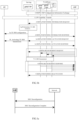
- FIG. 1c a process of configuring an SRS signal by a base station is shown in FIG. 1c .
- FIG. 1d is a schematic structural diagram of a network architecture to which an implementation of the present disclosure may be applied, as shown in FIG. 1d , the network architecture includes a terminal 11, a satellite 12, and a satellite gateway station 13, wherein, it should be noted that FIG. 1s shows a scenario in which a single satellite 12 is in different positions at different moments in a moving direction, that is, as shown in FIG. 1d , the satellite 12 is in different positions at T0, T1, T2, and T3, respectively.
- the satellite gateway station 13 may be disposed near the network device, and configured to obtain communication data from the network device, and then send the communication data to the satellite 12, and the satellite 12 sends the communication data to the terminal 11.
- the communication data of the terminal may also be sent to the satellite gateway station 13 through the satellite 12, and then sent to the network device, to implement communication data transmission in the satellite Internet.
- the terminal 11 in the embodiments of the present disclosure may be a device that provides voice and/or data connectivity to a user, a handheld device having a wireless connection function, or another processing device connected to a wireless modem.
- the names of the terminal device may be different, for example, in a 5G system, the terminal device may be referred to as user equipment (UE).
- UE user equipment
- the wireless terminal device may communicate with one or more core networks (CN) via a radio access network (RAN), and the wireless terminal device may be a mobile terminal device, such as a mobile phone (or referred to as a "cellular" phone) and a computer having a mobile terminal device, for example, may be a portable, pocket-sized, handheld, computer built-in or vehicle-mounted mobile device, which exchanges language and/or data with a radio access network.
- a mobile terminal device such as a mobile phone (or referred to as a "cellular" phone) and a computer having a mobile terminal device, for example, may be a portable, pocket-sized, handheld, computer built-in or vehicle-mounted mobile device, which exchanges language and/or data with a radio access network.
- PCS Personal Communication Service
- SIP Session Initiated Protocol
- WLL Wireless Local Loop
- PDA personal digital assistant
- the wireless terminal device may also be referred to as a system, a subscriber unit, a subscriber station, a mobile station, a mobile station, a remote station, an access point, a remote terminal, an access terminal, a user terminal, a user agent, and a user device, which are not limited in the embodiments of the present disclosure.
- the network device in this embodiment of the present disclosure may be a base station, and the base station may include a plurality of cells that provide a service for the terminal.
- the base station may also be referred to as an access point, or may be a device in the access network that communicates with the wireless terminal device through one or more sectors on the air interface, or another name.
- the network device may be configured to replace the received over-the-air frame with an Internet Protocol (IP) packet as a router between the wireless terminal device and the rest of the access network, where the rest of the access network may include an Internet Protocol (IP) communication network.
- IP Internet Protocol
- the network device may also coordinate attribute management of the air interface.
- the network device in the embodiments of the present disclosure may be a network device (a Base Transceiver Station, BTS) in a Global System for Mobile Communications (GSM) or a Code Division Multiple Access (Code Division Multiple Access, CDMA), or may be a 5G base station in a Long Term Evolution (LTE) system, a base station in 6G, a Home Evolved Node B (Femto), a pico base station (Pico), or the like, which is not limited in the embodiments of the present disclosure.
- the network device may include a centralized unit (CU) and a distributed unit (DU), and the centralized unit and the distribution unit may also be geographically separated.
- the network device may include a Transmitting Receiving Point (TRP).
- TRP Transmitting Receiving Point
- a 4G/5G RAT dependent positioning method is implemented by means of transceiving by multiple TRPs, and a plurality of TRPs are usually deployed in each cell.
- a specific network coverage is implemented by a satellite, and deployment of a TRP is only possible at a satellite end.
- the ground forms a coverage similar to a cellular network; especially for a low-orbit constellation, it is difficult to require that the UE always be within the effective coverage of multiple satellites, and it is difficult to realize multi-satellite positioning.
- the current 4G/5G RAT dependent positioning method is difficult to be directly applied to a satellite Internet system, especially in a low-orbit constellation scenario, and it is necessary to design a positioning method based on a single satellite.
- the LMF knows the deployment condition of the TRP in the network in advance and the configuration of the positioning reference signal (PRS) of each TRP.
- the LMF determines, based on the DL positioning requirement and the current location of the serving cell of the UE, PRS signals of which TRPs are measured by the UE, and configures the related PRS to the UE through the LPP protocol.
- a TRP may quickly move with a satellite, it is difficult for the LMF to determine a TRP satellite required for positioning a certain UE, and it is difficult to determine which PRS resources are configured for the UE.
- an embodiment of the present disclosure provides an uplink positioning method, where the entity of performing the method is a network device, optionally, the network device may be a base station, and the method includes the following steps.
- the network device receives the uplink positioning request message sent by the Location Management Function (LMF); and the network device determines the plurality of positioning measurement time instants and the satellite information corresponding to each positioning measurement resource, performs uplink positioning measurement according to the information to obtain a plurality of positioning measurement results, and sends the positioning measurement result to the LMF and the positioning measurement time instant and/or satellite information corresponding to each positioning measurement result.
- LMF Location Management Function
- the satellite Since the satellite is in a moving state, the satellite is respectively located at a plurality of different positions at a plurality of positioning measurement time instants, , so that uplink positioning measurement is performed at a plurality of positioning measurement time instants, which can be equivalent to multi-TRP positioning measurement in a positioning method in the related art, so as to complete uplink positioning of the terminal position by means of a single satellite, and uplink positioning in a satellite Internet system is implemented.
- the information about the positioning measurement resource related to the uplink positioning measurement may specifically be Sounding Reference Signal (SRS) information, and it should be noted that, in an actual application scenario, the network device can configure a corresponding SRS resource, provide the configuration information of the SRS resource to the terminal and the LMF, and specifically an interaction process of providing the configuration information of the SRS resource may be the interaction process of the positioning method in the related art and will not be repeated herein.
- SRS Sounding Reference Signal
- the uplink positioning request message may be an LTE Positioning Protocol (LPP) message, for example:
- LTP LTE Positioning Protocol
- the satellite information includes one or more of the following:
- the position information of the satellite corresponds to the position of the satellite at the positioning measurement time instant, and if the LMF has ephemeris information, the satellite position at each time instant may be calculated by using the time instants and the ephemeris information.
- the satellite information may only include the satellite ID; if the LMF does not know the ephemeris, the satellite information may only include only the location information of the satellite, and certainly does not exclude that both information is provided.
- that the network device determines the plurality of positioning measurement time instants specifically means that the network device itself determines the plurality of positioning measurement time instants, that is, the LMF only sends the uplink positioning request message to the network device to request to perform uplink positioning, and the specific positioning measurement time instants are completely determined by the network device itself, for example, the LMF does not provide any time information, and the base station determines, based on information such as ephemeris, a plurality of time instants to perform uplink positioning and allocates resources correspondingly.
- the uplink positioning request message includes time information of uplink positioning measurement.
- That the network device determines the plurality of positioning measurement time instants includes: that the network device determines the plurality of positioning measurement time instants based on the time information of the uplink positioning measurement.
- the LMF provides some time information to the network device through the uplink positioning request message, to assist the network device in determining the plurality of positioning measurement time instants.
- the LMF may specifically determine a specific time instant and inform the base station of the specific time instant, and correspondingly, the base station allocates resources, or the LMF may specifically specify the time information (for example, a time requirement related to positioning measurement), and the base station determines a specific time instant and correspondingly allocate resources.
- the time information of the uplink positioning measurement includes one or more of the following:
- an embodiment of the present disclosure provides an uplink positioning method, where an entity of performing the method is an LMF, and the method includes the following steps.
- the plurality of positioning measurement results is obtained by performing uplink positioning measurement by the satellite corresponding to the positioning measurement time instants indicated by the network device at the plurality of positioning measurement time instants.
- the network device receives the uplink positioning request message sent by the Location Management Function (LMF); and the network device determines the plurality of positioning measurement time instants and the satellite information corresponding to each positioning measurement resource, performs uplink positioning measurement according to the information to obtain a plurality of positioning measurement results, and sends the positioning measurement results to the LMF and the positioning measurement time instant and/or satellite information corresponding to each positioning measurement result.
- LMF Location Management Function
- the satellite Since the satellite is in a moving state, the satellite may respectively be located at a plurality of different positions corresponding to a plurality of positioning measurement time instants, so that uplink positioning measurement is performed at a plurality of positioning measurement time instants, which can be equivalent to multi-TRP positioning measurement in a positioning method in the related art, so as to complete uplink positioning of the terminal position by means of a single satellite, and uplink positioning in a satellite Internet system is implemented.
- the LMF may obtain the positioning calculation result based on the positioning calculation method in the related art and according to the plurality of positioning measurement results sent by the network device, the positioning measurement time instant corresponding to each positioning measurement result, and/or the satellite information corresponding to each positioning measurement result.
- the positioning calculation procedure is not specifically limited in the embodiments of the present disclosure.
- the information about the positioning measurement resource related to the uplink positioning measurement may specifically be SRS information, and it should be noted that, in an actual application scenario, the network device can configure a corresponding SRS resource, provide the configuration information of the SRS resource to the terminal and the LMF, and the specific interaction process of providing the configuration information of the SRS resource may be the interaction process of the positioning method in the related art, and is not repeated herein.
- the uplink positioning request message may be an LPP message, for example: (1) MEASUREMENT REQUEST message on the NRPPa interface; or (2) a POSITIONING INFORMATION REQUEST message; or (3) other newly defined NRPPa messages.
- the satellite information includes one or more of the following: (1) identification information of a satellite; (2) location information of the satellite; (3) TRP information, where the TRP information includes identification information of one or more TRPs and location information of each TRP, that is, related information of a satellite performing uplink positioning measurement at each positioning measurement time instant may be indicated by using an identifier and location information of a TRP provided in the satellite.
- the position information of the satellite corresponds to the position of the satellite at the positioning measurement time instant, and if the LMF has ephemeris information, the satellite position at each time instant may be calculated by using the time instants and the ephemeris information.
- the satellite information may only include the satellite ID; if the LMF does not know the ephemeris, the satellite information may only include only the location information of the satellite, and certainly does not exclude that both information is provided.
- that the network device determines the plurality of positioning measurement time instants specifically means that the network device itself determines the plurality of positioning measurement time instants, that is, the LMF only sends the uplink positioning request message to the network device to request to perform uplink positioning, and the specific positioning measurement time instants are completely determined by the network device itself, for example, the LMF does not provide any time information, and the base station determines, based on information such as ephemeris, a plurality of time instants to perform uplink positioning and allocates resources correspondingly.
- the uplink positioning request message includes time information of uplink positioning measurement.
- That the network device determines the plurality of positioning measurement time instants includes: that the network device determines the plurality of positioning measurement time instants based on the time information of the uplink positioning measurement.
- the LMF provides time information to the network device through the uplink positioning request message, to assist the network device in determining the plurality of positioning measurement time instants.
- the LMF may specifically determine a specific time instant and inform the base station of the specific time instant, and correspondingly, the base station allocates resources, or the LMF may specifically specify the time information (for example, a time requirement related to positioning measurement), and the base station determines a specific time instant and correspondingly allocate resources.
- the time information of the uplink positioning measurement includes one or more of the following:
- Embodiment 1 support to the UL positioning method in satellite Internet system (single satellite no-handover, LMF provides positioning time requirement information)
- the LMF requests the base station to initiate an uplink positioning request of a certain UE, where the request includes the time requirement information of the positioning measurement described above (for example, to perform four measurements, the interval is not less than 5 seconds, and needs to be completed before the x moment).
- the base station determines, based on a request of the LMF and/or information such as a current serving satellite of the UE, a serving cell, and an ephemeris, a plurality of specific time instants for completing the positioning measurement, and satellite information of satellite participating in positioning measurement at each time instant (the selected satellite may be a current serving satellite, or may be a satellite which is about to serve the UE, depending on a time decision of the base station on the positioning measurement).
- the selected satellite may be a current serving satellite, or may be a satellite which is about to serve the UE, depending on a time decision of the base station on the positioning measurement.
- the base station enables the selected satellite to complete related UL positioning measurement, and feeds back a result to the LMF after all the measurements are completed.
- the result includes specific measurement results, time information corresponding to each result, and satellite information corresponding to each result.
- the LMF calculates the location of the UE based on the result fed back by the gNB.
- Embodiment 2 support to the UL positioning method in a satellite Internet system (single satellite without handover, LMF indicates the specific positioning time)
- the overall process is the same as that of Embodiment 1, and the main difference lies in that the base station determines, based on information such as a current serving satellite of the UE, a serving cell, combined ephemeris, and time information specified by the LMF, to complete UL positioning measurement satellite information at each time instant.
- Embodiment 3 support to a UL positioning method in a satellite Internet system (UE performs inter-cell handover or even inter-satellite handover in a UL positioning measurement process, and the handover is a handover between cells under one base station, including intra-satellite and inter-satellite).
- UE performs inter-cell handover or even inter-satellite handover in a UL positioning measurement process, and the handover is a handover between cells under one base station, including intra-satellite and inter-satellite).
- the mechanism that the gNB determines that the specific positioning time instant is the same as that of the Embodiment 1 or the Embodiment 2, and but at different time instants, the cell or the satellite participating in the positioning process may change.
- the gNB indicates a corresponding satellite participating in positioning measurement to complete uplink positioning measurement. After all the measurements are completed, the measurement result of each time instant and the corresponding satellite information participating in the uplink positioning measurement are fed back to the LMF.
- the LMF calculates the position of the UE according to the above information to complete the UL positioning process.
- an embodiment of the present disclosure further provides a network device 400, including: a first receiving module 401, configured to receive, by the network device, an uplink positioning request message from an LMF; a determining module 402, configured to determine, by the network device, a plurality of positioning measurement time instants and satellite information corresponding to each positioning measurement time instant; and an execution module 403, configured to at each positioning measurement time instant, instruct, by the network device, a satellite corresponding to the positioning measurement time instant to perform uplink positioning measurement and obtain a plurality of positioning measurement results; and a first sending module 404, configured to send, by the network device to the LMF, the plurality of positioning measurement results and the positioning measurement time instant corresponding to each of the plurality of positioning measurement results and/or satellite information corresponding to each of the plurality of positioning measurement results.
- a first receiving module 401 configured to receive, by the network device, an uplink positioning request message from an LMF
- a determining module 402 configured to determine, by the network device, a plurality of positioning measurement time instants and
- the satellite information includes one or more of the following: identification information of a satellite; location information of a satellite; transmission-reception point (TRP) information, wherein the TRP information includes identification information of one or more TRPs and location information of each TRP.
- TRP transmission-reception point
- the uplink positioning request message includes time information of uplink positioning measurement; wherein determining, by the network device, the plurality of positioning measurement time instants includes: determining, by the network device, the plurality of positioning measurement time instants based on the time information of the uplink positioning measurement.
- the time information of the uplink positioning measurement includes one or more of the following: one or more time instants of performing the uplink positioning measurement; time requirement information of the uplink positioning measurement.
- the time requirement information of the uplink positioning measurement includes one or more of the following: start time of the uplink positioning measurement; end time of the uplink positioning measurement; a time interval of the uplink positioning measurement; a quantity of uplink positioning measurements.
- an embodiment of the present disclosure further provides an LMF device 500, including: a second sending module 501, configured to send an uplink positioning request message to a network device by the LMF; a second receiving module 502, configured to receive, by the LMF, a plurality of positioning measurement results sent by the network device and a positioning measurement time instant corresponding to each positioning measurement result and/or satellite information corresponding to each positioning measurement result; wherein the plurality of positioning measurement results are obtained through uplink positioning measurement performed by a satellite corresponding to the positioning measurement time instant which is instructed by the network device at each positioning measurement time instant of the plurality of positioning measurement time instants.
- the satellite information includes one or more of the following: identification information of the satellite; location information of the satellite; TRP information, wherein the TRP information includes identification information of one or more TRPs and location information of each TRP.
- the uplink positioning request message includes time information of uplink positioning measurement; the time information of the uplink positioning measurement is used by the network device to determine the plurality of positioning measurement time instants.
- the time information of the uplink positioning measurement includes one or more of the following: one or more time instants of performing the uplink positioning measurement; time requirement information of the uplink positioning measurement.
- the time requirement information of the uplink positioning measurement includes one or more of the following: start time of the uplink positioning measurement; end time of the uplink positioning measurement; a time interval of the uplink positioning measurement; a quantity of uplink positioning measurements.
- FIG. 6 is a structural diagram of a network device according to an embodiment of the present disclosure, as shown in FIG. 6 , the network device includes a memory 620, a transceiver 600, and a processor 610.
- the memory 620 is configured to store a computer program; the transceiver 600 is configured to send and receive data under the control of the processor 610; and the processor 610 is configured to read the computer program in the memory 620 and perform the following operations: receiving, by the network device, an uplink positioning request message from a LMF; determining, by the network device, a plurality of positioning measurement time instants and satellite information corresponding to each positioning measurement time instant; at each positioning measurement time instant, indicating, by the network device, to a satellite corresponding to the positioning measurement time instant to perform uplink positioning measurement and obtain a plurality of positioning measurement results; and sending, by the network device to the LMF, the plurality of positioning measurement results and the positioning measurement time instant corresponding to each positioning measurement result and/or satellite information corresponding to each positioning measurement result.
- the bus architecture may include any number of interconnected buses and bridges, and specifically, various circuits of one or more processors represented by the processor 610 and a memory represented by the memory 620 are linked together.
- the bus architecture may also link various other circuits, such as a peripheral device, a voltage regulator, and a power management circuit, which are well known in the art, and therefore are not further described herein.
- the bus interface provides an interface.
- the transceiver 600 may be a plurality of elements, including a transmitter and a receiver, and provides units for communicating with various other apparatuses on a transmission medium, where the transmission media include transmission media such as a wireless channel, a wired channel, and an optical cable.
- the user interface 630 may also be an interface capable of being externally connected to a device needing to be internally connected, and the connected device includes but is not limited to a keypad, a display, a speaker, a microphone, a joystick, and the like.
- the processor 610 is responsible for managing the bus architecture and general processing, and the memory 620 may store data used by the processor 600 when performing operations.
- the processor 610 may be a Central Processing Unit (CPU), an Application Specific Integrated Circuit (ASIC), a Field-Programmable Gate Array (FPGA), or a Complex Programmable Logic Device (CPLD), and the processor may also use a multi-core architecture.
- CPU Central Processing Unit
- ASIC Application Specific Integrated Circuit
- FPGA Field-Programmable Gate Array
- CPLD Complex Programmable Logic Device
- the processor invokes the computer program stored in the memory, and is configured to perform any one of the methods provided in the embodiments of the present disclosure according to the obtained executable instruction.
- the processor and the memory may also be physically separated.
- the satellite information includes one or more of the following: identification information of the satellite; location information of the satellite; TRP information, wherein the TRP information includes identification information of one or more TRPs and location information of each TRP.
- the uplink positioning request message includes time information of uplink positioning measurement; determining, by the network device, the plurality of positioning measurement time instants includes: determining, by the network device, the plurality of positioning measurement time instants based on the time information of the uplink positioning measurement.
- the time information of the uplink positioning measurement includes one or more of the following: one or more time instants of performing the uplink positioning measurement; time requirement information of the uplink positioning measurement.
- the time requirement information of the uplink positioning measurement includes one or more of the following: start time of the uplink positioning measurement; end time of the uplink positioning measurement; a time interval of the uplink positioning measurement; a quantity of uplink positioning measurements.
- FIG. 7 is a structural diagram of an LMF according to an embodiment of the present disclosure, as shown in FIG. 7 , the LMF includes a memory 720, a transceiver 700, and a processor 710:
- the memory 720 is configured to store a computer program; the transceiver 700 is configured to send and receive data under the control of the processor 710; and the processor 710 is configured to read the computer program in the memory 720 and perform the following operations: sends an uplink positioning request message to a network device by the LMF; receiving, by the LMF from the network device, a plurality of positioning measurement results and a positioning measurement time instant corresponding to each positioning measurement result and/or satellite information corresponding to each positioning measurement result; wherein the plurality of positioning measurement results are obtained through uplink positioning measurement performed by a satellite corresponding to the positioning measurement time instant which is instructed by the network device at each positioning measurement time instant of the plurality of positioning measurement time instants.
- the bus architecture may include any number of interconnected buses and bridges, and specifically, various circuits of one or more processors represented by the processor 710 and a memory represented by the memory 720 are linked together.
- the bus architecture may also link various other circuits, such as a peripheral device, a voltage regulator, and a power management circuit, which are well known in the art, and therefore are not further described herein.
- the bus interface provides an interface.
- the transceiver 700 may be a plurality of elements, including a transmitter and a receiver, and provides units for communicating with various other apparatuses on a transmission medium, where the transmission mediums include transmission media such as a wireless channel, a wired channel, and an optical cable.
- the user interface 730 may also be an interface capable of being externally connected to the internal required device, and the connected device includes but is not limited to a keypad, a display, a speaker, a microphone, a joystick, and the like.
- the processor 710 is responsible for managing the bus architecture and general processing, and the memory 720 may store data used by the processor 700 when performing operations.
- the processor 710 may be a Central Processing Unit (CPU), an Application Specific Integrated Circuit (ASIC), a Field-Programmable Gate Array (FPGA), or a Complex Programmable Logic Device (CPLD), and the processor may also use a multi-core architecture.
- CPU Central Processing Unit
- ASIC Application Specific Integrated Circuit
- FPGA Field-Programmable Gate Array
- CPLD Complex Programmable Logic Device
- the processor invokes the computer program stored in the memory, and is configured to perform any one of the methods provided in the embodiments of the present disclosure according to the obtained executable instruction.
- the processor and the memory may also be physically separated.
- the satellite information includes one or more of the following: identification information of the satellite; location information of the satellite; TRP information, wherein the TRP information includes identification information of one or more TRPs and location information of each TRP.
- the uplink positioning request message includes time information of uplink positioning measurement; the time information of the uplink positioning measurement is used by the network device to determine the plurality of positioning measurement time instants.
- the time information of the uplink positioning measurement includes one or more of the following: one or more time instants of performing the uplink positioning measurement; time requirement information of the uplink positioning measurement.
- the time requirement information of the uplink positioning measurement includes one or more of the following: start time of the uplink positioning measurement; end time of the uplink positioning measurement; a time interval of the uplink positioning measurement; a quantity of uplink positioning measurements.
- the above-mentioned network device and LMF provided in the embodiments of the present disclosure can implement all method steps implemented in the foregoing method embodiments, and can achieve the same technical effect, and details of the same parts and beneficial effects as those in the method embodiments in this embodiment are not described herein again.
- the division of the units in the embodiments of the present disclosure is schematic, and is merely a logical function division, and there may be another division manner in actual implementation.
- functional units in the embodiments of the present disclosure may be integrated into one processing unit, or each of the units may exist alone physically, or two or more units are integrated into one unit.
- the integrated unit may be implemented in a form of hardware, or may be implemented in a form of a software functional unit.
- the integrated unit When the integrated unit is implemented in the form of a software functional unit and sold or used as an independent product, the integrated unit may be stored in a processor-readable storage medium.
- the technical solutions of the present disclosure essentially or all or part of the technical solution may be embodied in the form of a software product, and the computer software product is stored in a storage medium, and includes several instructions for causing a computer device (which may be a personal computer, a server, or a network device) or a processor to perform all or part of the steps of the methods described in the embodiments of the present disclosure.
- the foregoing storage medium includes any medium that can store program code, such as a USB flash drive, a removable hard disk, a read-only memory (ROM), a random access memory (RAM), a magnetic disk, or an optical disk.
- An embodiment of the present disclosure further provides a processor-readable storage medium, where the processor-readable storage medium stores a computer program, and the computer program is configured to cause the processor to perform an uplink positioning method, or the computer program is configured to cause the processor to perform an uplink positioning method.
- the processor-readable storage medium may be any usable medium or data storage device accessible by a processor, including but not limited to a magnetic memory (for example, a floppy disk, a hard disk, a magnetic tape, a magneto-optical disk (DVD), a Blu-ray disk (BD), a High-Definition Versatile Disk (DVD), a Blu-ray disk (Blu-ray Disk, BD), a High-Definition Versatile Disk (EPROM), an Electrically Erasable Programmable Read Only Memory (EEPROM), a non-volatile memory (NAND Flash), a Solid State Disk (SSD)), and the like.
- a magnetic memory for example, a floppy disk, a hard disk, a magnetic tape, a magneto-optical disk (DVD), a Blu-ray disk (BD), a High-Definition Versatile Disk (DVD), a Blu-ray disk (Blu-ray Disk, BD), a High-Defin
- the embodiments of the present disclosure may be provided as a method, a system, or a computer program product. Therefore, the present disclosure may take the form of an entirely hardware embodiment, an entirely software embodiment, or an embodiment combining software and hardware aspects. Moreover, the present disclosure may use a form of a computer program product implemented on one or more computer-usable storage media (including but not limited to a disk memory, an optical memory, and the like) including computer-usable program codes.
- computer-usable storage media including but not limited to a disk memory, an optical memory, and the like
- These computer-executable instructions may be provided to a processor of a general-purpose computer, a special-purpose computer, an embedded processor, or other programmable data processing devices to generate a machine, so that the instructions executed by the processor of the computer or other programmable data processing devices generate means for implementing the functions specified in one or more flows of the flowcharts and/or one or more blocks in the block diagrams.
- processor-executable instructions may also be stored in a processor-readable memory that can direct a computer or other programmable data processing device to function in a particular manner, such that the instructions stored in the processor-readable memory produce an article of manufacture including an instruction device that implements the functions specified in one or more flows of the flowchart and/or one or more blocks of the block diagram.
- processor-executable instructions may also be loaded onto a computer or other programmable data processing device such that a series of operational steps are performed on the computer or other programmable device to produce a computer-implemented process, such that the instructions executed on the computer or other programmable device provide steps for implementing the functions specified in one or more flows of the flowchart and/or one or more blocks of the block diagram.
Landscapes
- Engineering & Computer Science (AREA)
- Computer Networks & Wireless Communication (AREA)
- Signal Processing (AREA)
- Physics & Mathematics (AREA)
- General Physics & Mathematics (AREA)
- Astronomy & Astrophysics (AREA)
- Aviation & Aerospace Engineering (AREA)
- Radar, Positioning & Navigation (AREA)
- Remote Sensing (AREA)
- Position Fixing By Use Of Radio Waves (AREA)
- Mobile Radio Communication Systems (AREA)
Applications Claiming Priority (2)
| Application Number | Priority Date | Filing Date | Title |
|---|---|---|---|
| CN202210926246.6A CN117560619A (zh) | 2022-08-03 | 2022-08-03 | 上行定位方法、设备及处理器可读存储介质 |
| PCT/CN2023/102373 WO2024027366A1 (zh) | 2022-08-03 | 2023-06-26 | 上行定位方法、设备及处理器可读存储介质 |
Publications (2)
| Publication Number | Publication Date |
|---|---|
| EP4568295A1 true EP4568295A1 (de) | 2025-06-11 |
| EP4568295A4 EP4568295A4 (de) | 2025-10-22 |
Family
ID=89815298
Family Applications (1)
| Application Number | Title | Priority Date | Filing Date |
|---|---|---|---|
| EP23849076.7A Pending EP4568295A4 (de) | 2022-08-03 | 2023-06-26 | Uplink-positionierungsverfahren, vorrichtung und prozessorlesbares speichermedium |
Country Status (3)
| Country | Link |
|---|---|
| EP (1) | EP4568295A4 (de) |
| CN (1) | CN117560619A (de) |
| WO (1) | WO2024027366A1 (de) |
Families Citing this family (1)
| Publication number | Priority date | Publication date | Assignee | Title |
|---|---|---|---|---|
| WO2026051350A1 (en) * | 2025-04-03 | 2026-03-12 | Lenovo (Beijing) Limited | Rat-dependent positioning in ntn |
Family Cites Families (6)
| Publication number | Priority date | Publication date | Assignee | Title |
|---|---|---|---|---|
| EP3823373A1 (de) * | 2019-11-14 | 2021-05-19 | FRAUNHOFER-GESELLSCHAFT zur Förderung der angewandten Forschung e.V. | Vorrichtung zur bestimmung einer benutzerposition |
| CN113452429A (zh) * | 2020-03-27 | 2021-09-28 | 华为技术有限公司 | 卫星星历更新的方法和通信装置 |
| US20220039056A1 (en) * | 2020-07-22 | 2022-02-03 | Qualcomm Incorporated | Methods and apparatus for user equipment based prioritization and reporting of positioning technologies and methods |
| WO2022081531A1 (en) * | 2020-10-12 | 2022-04-21 | Intel Corporation | Device location determination in 5g non-terrestrial networks |
| CN114698096A (zh) * | 2020-12-30 | 2022-07-01 | 维沃移动通信有限公司 | 非陆地网络定位方法、装置、设备及存储介质 |
| KR20230132577A (ko) * | 2021-01-22 | 2023-09-15 | 프라운호퍼 게젤샤프트 쭈르 푀르데룽 데어 안겐반텐 포르슝 에. 베. | 비-육상 컴포넌트를 포함하는 네트워크에서 위치 결정을 가능하게 하기 위한 측정 및 시그널링 |
-
2022
- 2022-08-03 CN CN202210926246.6A patent/CN117560619A/zh active Pending
-
2023
- 2023-06-26 WO PCT/CN2023/102373 patent/WO2024027366A1/zh not_active Ceased
- 2023-06-26 EP EP23849076.7A patent/EP4568295A4/de active Pending
Also Published As
| Publication number | Publication date |
|---|---|
| CN117560619A (zh) | 2024-02-13 |
| EP4568295A4 (de) | 2025-10-22 |
| WO2024027366A1 (zh) | 2024-02-08 |
Similar Documents
| Publication | Publication Date | Title |
|---|---|---|
| EP4068668B1 (de) | Informationsübertragungsverfahren und -vorrichtung | |
| JP7685515B2 (ja) | セルハンドオーバー方法、電子デバイス及び記憶媒体 | |
| EP4280716A1 (de) | Positionierungsverfahren und -vorrichtung | |
| JP7507962B2 (ja) | 測位用の測定方法、装置及び記憶媒体 | |
| KR20210021071A (ko) | 이중 연결을 위한 자동 이웃 관계 개선 기법 | |
| CN115442915B (zh) | 一种随机接入方法、用户设备及网络侧设备 | |
| CN114125692A (zh) | 定位方法、装置、终端、接入网设备及核心网设备 | |
| CN118139100A (zh) | 一种信息处理方法、装置及设备 | |
| WO2022161503A1 (zh) | 终端的定位方法、装置、设备、存储介质及程序产品 | |
| EP4568295A1 (de) | Uplink-positionierungsverfahren, vorrichtung und prozessorlesbares speichermedium | |
| EP4426023A1 (de) | Verfahren und vorrichtung zur unterstützten positionierung und speichermedium | |
| EP3618498A1 (de) | Verfahren zur verarbeitung von messinformationen, endgerät und zugangsnetzwerkknoten | |
| CN117479292A (zh) | 定位方法、装置及存储介质 | |
| US10805848B2 (en) | Information transmission method, network device and terminal device | |
| EP4561147A1 (de) | Informationsverarbeitungsverfahren und -vorrichtung sowie lesbares speichermedium | |
| EP4568296A1 (de) | Downlink-standortverfahren, vorrichtung und prozessorlesbares speichermedium | |
| CN117528562A (zh) | Mdt配置方法及装置 | |
| EP4564945A1 (de) | Informationsübertragungsverfahren und -vorrichtung sowie speichermedium | |
| EP4701097A1 (de) | Messkonfigurationsverfahren und -vorrichtung sowie zugehörige vorrichtung | |
| US20250274843A1 (en) | Information processing method and apparatus, and device | |
| CN115550904A (zh) | 信息发送方法、装置及存储介质 | |
| CN120835341A (zh) | 信息传输方法、装置、终端及网络设备 | |
| CN120857252A (zh) | 定位、信息传输方法、装置、终端、设备及定位服务器 | |
| CN121604000A (zh) | 一种训练感知模型的方法、用户设备、基站及服务器 | |
| CN119729751A (zh) | 一种定位处理方法及装置 |
Legal Events
| Date | Code | Title | Description |
|---|---|---|---|
| STAA | Information on the status of an ep patent application or granted ep patent |
Free format text: STATUS: THE INTERNATIONAL PUBLICATION HAS BEEN MADE |
|
| PUAI | Public reference made under article 153(3) epc to a published international application that has entered the european phase |
Free format text: ORIGINAL CODE: 0009012 |
|
| STAA | Information on the status of an ep patent application or granted ep patent |
Free format text: STATUS: REQUEST FOR EXAMINATION WAS MADE |
|
| 17P | Request for examination filed |
Effective date: 20250225 |
|
| AK | Designated contracting states |
Kind code of ref document: A1 Designated state(s): AL AT BE BG CH CY CZ DE DK EE ES FI FR GB GR HR HU IE IS IT LI LT LU LV MC ME MK MT NL NO PL PT RO RS SE SI SK SM TR |
|
| A4 | Supplementary search report drawn up and despatched |
Effective date: 20250919 |
|
| RIC1 | Information provided on ipc code assigned before grant |
Ipc: H04W 4/02 20180101AFI20250915BHEP Ipc: H04B 7/185 20060101ALI20250915BHEP Ipc: H04W 64/00 20090101ALI20250915BHEP Ipc: G01S 19/02 20100101ALI20250915BHEP |
|
| DAV | Request for validation of the european patent (deleted) | ||
| DAX | Request for extension of the european patent (deleted) |