EP4570060A1 - Système d'éclairage autonome pour culture de plantes - Google Patents
Système d'éclairage autonome pour culture de plantes Download PDFInfo
- Publication number
- EP4570060A1 EP4570060A1 EP24214769.2A EP24214769A EP4570060A1 EP 4570060 A1 EP4570060 A1 EP 4570060A1 EP 24214769 A EP24214769 A EP 24214769A EP 4570060 A1 EP4570060 A1 EP 4570060A1
- Authority
- EP
- European Patent Office
- Prior art keywords
- light
- cultivation
- red
- blue
- flowering
- Prior art date
- Legal status (The legal status is an assumption and is not a legal conclusion. Google has not performed a legal analysis and makes no representation as to the accuracy of the status listed.)
- Pending
Links
Images


Classifications
-
- A—HUMAN NECESSITIES
- A01—AGRICULTURE; FORESTRY; ANIMAL HUSBANDRY; HUNTING; TRAPPING; FISHING
- A01G—HORTICULTURE; CULTIVATION OF VEGETABLES, FLOWERS, RICE, FRUIT, VINES, HOPS OR SEAWEED; FORESTRY; WATERING
- A01G7/00—Botany in general
- A01G7/04—Electric or magnetic or acoustic treatment of plants for promoting growth
- A01G7/045—Electric or magnetic or acoustic treatment of plants for promoting growth with electric lighting
-
- A—HUMAN NECESSITIES
- A01—AGRICULTURE; FORESTRY; ANIMAL HUSBANDRY; HUNTING; TRAPPING; FISHING
- A01G—HORTICULTURE; CULTIVATION OF VEGETABLES, FLOWERS, RICE, FRUIT, VINES, HOPS OR SEAWEED; FORESTRY; WATERING
- A01G22/00—Cultivation of specific crops or plants not otherwise provided for
-
- A—HUMAN NECESSITIES
- A01—AGRICULTURE; FORESTRY; ANIMAL HUSBANDRY; HUNTING; TRAPPING; FISHING
- A01G—HORTICULTURE; CULTIVATION OF VEGETABLES, FLOWERS, RICE, FRUIT, VINES, HOPS OR SEAWEED; FORESTRY; WATERING
- A01G22/00—Cultivation of specific crops or plants not otherwise provided for
- A01G22/15—Leaf crops, e.g. lettuce or spinach
-
- A—HUMAN NECESSITIES
- A01—AGRICULTURE; FORESTRY; ANIMAL HUSBANDRY; HUNTING; TRAPPING; FISHING
- A01G—HORTICULTURE; CULTIVATION OF VEGETABLES, FLOWERS, RICE, FRUIT, VINES, HOPS OR SEAWEED; FORESTRY; WATERING
- A01G22/00—Cultivation of specific crops or plants not otherwise provided for
- A01G22/60—Flowers; Ornamental plants
-
- Y—GENERAL TAGGING OF NEW TECHNOLOGICAL DEVELOPMENTS; GENERAL TAGGING OF CROSS-SECTIONAL TECHNOLOGIES SPANNING OVER SEVERAL SECTIONS OF THE IPC; TECHNICAL SUBJECTS COVERED BY FORMER USPC CROSS-REFERENCE ART COLLECTIONS [XRACs] AND DIGESTS
- Y02—TECHNOLOGIES OR APPLICATIONS FOR MITIGATION OR ADAPTATION AGAINST CLIMATE CHANGE
- Y02P—CLIMATE CHANGE MITIGATION TECHNOLOGIES IN THE PRODUCTION OR PROCESSING OF GOODS
- Y02P60/00—Technologies relating to agriculture, livestock or agroalimentary industries
- Y02P60/14—Measures for saving energy, e.g. in green houses
Definitions
- the invention refers to an autonomous lighting system therefore autonomous light fixture, luminaire, light fitting with an adjustable optical radiation spectrum with an active module with system for changing, altering of optical radiation - light spectrum during cultivation to stimulate vegetation and control plant flowering.
- the invention also refers to lighting LED module for vegetation activation - vegetation stimulation and plant flowering control, as well as method for plant cultivation for activating vegetation and controlling flowering.
- the invention is used for cultivating red-leaf plants to control and activate flowering and vegetation.
- the invention can be used especially in vertical farms and greenhouse cultivation.
- Patent US11402089B2 outlines that such a system should include emitters in the ranges of 551-2000 nm and 100-500 nm, with additional emitters in the 490-510 nm range, alongside white LEDs.
- Each set of LEDs can be individually powered and controlled via a network connection, allowing precise spectral adjustments for specific growth needs.
- this solution relies on external controllers to manage the channels, requiring constant connectivity with each LED set, which could be a limitation and disadvantages .
- Another example of a luminaire designed for plant cultivation is disclosed in WO2013141824A1 . This luminaire is characterized by the variability of emitted energy within the photosynthetically active radiation (PAR) range.
- PAR photosynthetically active radiation
- the control module manages the combination of light sources and intensifies the spectral structure of the emitted light, enhancing both short and long wavelengths corresponding to chlorophyll a and chlorophyll b.
- the luminaire's spectral range is not strictly defined but is designed to cover specific wavelengths such as 430 nm, 452 nm, 642 nm, and 662 nm. It features a control module that allows spectrum adjustments based on the plant's developmental phase.
- the device is designed to be controlled via Wi-Fi, RF, IR, Bluetooth, or similar systems.
- control can be implemented using standards such as DMX, DALI, or 1-10V.
- DMX digital versatile disc
- DALI digital versatile disc
- 1-10V DMX, DALI, or 1-10V.
- the luminaire functions as an executive device, requiring external controller input to initiate changes in lighting parameters.
- Disadvantages of this solution is the need to maintain power on the communication line, which reduces the lighting fixture's efficiency.
- the solution does not have significant applications for inducing, controlling flowering in red-leaf plants specifically adapted to their developmental phases.
- US9681515B2 describes a method for adapting the emission spectrum of an integrated LED structure for photobiological processes. This method includes: generating output emission power by supplying a common current to semiconductor light-emitting sources in LEDs; tuning multiple emission spectrum intensity peaks to a nominal operating point by adjusting the common current to a range of average values; adjusting the intensity ratios of multiple emission spectrum peaks over a full range by regulating the common current from a minimum to a maximum value.
- a plant cultivation device with LED lighting contains LEDs emitting light in different colors and a control unit that adjusts the light intensity for each LED emitting light of the same color. This enables different lighting modes based on the type and growth stage of plants, with the capability to store relevant light intensity information for each lighting mode. Providing suitable light to the plant reduces energy consumption by limiting optical radiation in spectral ranges not used by plants. The ability to adjust the spectrum of optical radiation is essentially offered by many luminaires. However, most of these luminaires are laboratory-grade and allow control of multiple independent channels responsible for activating LEDs with different spectral characteristics. In luminaires for greenhouse applications and vertical farming, fixtures with two or more channels are available.
- US10772260 discloses a lighting system for plant cultivation.
- This system comprises a support plate assembly containing multiple holes and several LED modules that are detachably connected to the support plate within the holes, creating a gap between the LED module and the support plate.
- the cultivation lighting system can be configured to draw air through the gap above the LEDs and along the heatsink fins to reduce the LED module's temperature.
- the solution details a plant cultivation lighting system with multiple LED modules that are detachably connected to the support plate assembly. Additionally, the system is configured to allow the transmission of cultivation program information.
- the LEDs emit light within a wavelength range of approximately 400 nm to 700 nm.
- a drawback of this solution is the lack of control over the resultant spectrum-specifically, the inability to automatically adjust the spectrum over time according to the plant's developmental stage and size.
- US11297772 describes a cultivation lighting system consisting of a support plate assembly defining multiple holes and multiple LED modules.
- This system includes first, second, third, fourth, and fifth LEDs, each configured to emit light at different wavelengths at different times.
- the system features a cultivation program designed to regulate the intensity of light emitted by each LED type via a controller.
- the first LEDs are configured to emit light at wavelengths of 450-740 nm; the second LEDs emit light at wavelengths within the same range but different from the first LEDs; the third LEDs emit light with a color temperature of 2000-4000 K; the fourth LEDs emit light with a color temperature of 5000-10000 K; and the fifth LEDs emit light at wavelengths of 315-400 nm.
- this solution also lacks the ability to control the resultant light spectrum automatically, adjusting it over time based on the plant's development stage and size.
- US10149439 discloses similar system to the above, utilizing multiple LEDs with a wavelength range of approximately 400 nm to 700 nm.
- the lighting system includes at least one LED with a wavelength in the range of approximately 620 nm to 665 nm and at least one LED with a wavelength in the range of approximately 455 nm to 470 nm.
- this solution is not suitable for controlling e.g. inducing the flowering of red-leaf plants tailored to their developmental stage.
- CN113179788 disloses a method for adjusting and controlling the light environment to support cucumber growth at every growth stage.
- This method includes providing an artificial light source for growing cucumber seedlings to promote their development.
- the method for regulating and controlling sunlight to stimulate cucumber growth involves adjusting light parameters suitable for cucumber growth throughout the entire growth period, from seed germination to cucumber fruit harvesting.
- the light environment control method involves providing artificial light to cucumber seedlings during each growth stage, with the artificial light spectrum calculated based on the following percentage integration of light quality spectrum: 0-3% infrared, 65%-85% red light, 15%-30% blue light, 0-10% continuous visible light, and 0-3% ultraviolet light.
- this solution is not dedicated for controlling, inducing flowering in red-leaf plants specifically. Instead, it is focused on the entire growth process of cucumbers, from seed germination to fruit harvesting, requiring the same light spectrum with a dominance of red light throughout the growth period.
- the purpose and objective of the invention was to provide invention dedicated to an important group of plant - red-leaf plants, enabling the activation of vegetation and control of flowering while also being energy-efficient, economical.
- Photons with wavelengths in the 600 to 700 nm range generally define the red light spectrum, including deep red, which occurs around 660 nm.
- variable-spectrum lamps for inducing vegetation and controlling flowering, as well as adapting to the plant's developmental phase. Changes in the spectrum are linked to developmental stage transitions and the triggering of specific plant reactions. Controlling, inducing flowering through light selection based on the developmental phase was one of the invention's primary goals as a critical plant development reaction.
- PPFD photosynthetic photon flux density
- Electroluminescent light emitters such as blue LEDs, emit fewer photons than red LED light emitters despite having comparable radiometric efficiency.
- the PPFD stabilization developed for this invention involves delivering the same number of photons to the cultivation surface regardless of the configured optical radiation spectrum. During periods with a high red radiation component, significant energy savings can be achieved. By gradually altering the spectrum over time, the invention also preserves the aesthetic qualities of cultivated plants, ensures appropriate plant mass, and, most importantly, stimulates flowering.
- the radiation from the blue and red spectrum is selected to maintain a constant PPFD, meaning that the PPFD contribution of blue radiation is symmetrical to that of red radiation.
- the stabilization of PPFD involves delivering the same number of photons to the cultivation surface from the seedling stage to vegetation and the early flowering stage, regardless of the optical radiation spectrum configuration (red or blue).
- increasing the PPFD for blue light proportionally decreases the PPFD for red light by the same amount.
- a system was provided with an active mechanism to alter - change the optical radiation spectrum.
- This system includes algorithms - the provided light change function that change the light composition depending on the plant's life stage adjust the balance of blue and red components in the emitted optical radiation from the luminaire, tailored - dedicated to the selected developmental phase of the plant.
- Cultivation is conducted from the seedling or rooted cutting stage to the end of the expected vegetation phase during cultivation and, preferably, to the beginning of flowering if this stage is expected, required. For certain plants, such as lettuce, flowering is not desirable as the goal is yield harvesting, which is also included, accounted for in the invention.
- the spectral composition of radiation should comprises of less than 20% blue light, with a proportional red light component of at least 80% and up to 100%, depending on the advancement of the initial cultivation phase. Adjustments to the spectral composition during cultivation are performed according to a developed light change function tailored to the cultivation duration, from the initial stage to the end of vegetation and, if necessary, to the onset of flowering for its stimulation.
- a higher initial proportion of red light is used, but less than 80%, preferably less than 70%, with 20-30% blue light component.
- the proportion of blue light is gradually increased during cultivation according to a developed light change function, dedicated tailored to the cultivation duration. This is further disclosed based on the plant division - growth rate of the plants, from seedlings/rooted cuttings through vegetation and even to the onset of flowering, as required by the cultivation duration. The later the plant's developmental phase, especially when flowering stimulation is desired, the lower the percentage of red light and the higher the proportion of blue light is selected.
- the proportion of blue light exceeds 20% of the total light (combined blue and red light), preferably ranging from 30% to even 100%, with the blue light component increasing during cultivation at this stage.
- the spectral composition is adjusted according to the developed light change function. This adjustment aligns the light components with target values for red-leaf plant cultivation, depending on the growth rate from seedling/rooted cutting stages. Blue light is increased to above 20%, preferably to 30-100%, with a progressively higher proportion of blue light as the cultivation progresses.
- a higher proportion of red light is utilized, as described above, at levels below 80%.
- a significant proportion of blue light is introduced.
- the proportion of blue light is gradually increased, with a faster increase towards the end of cultivation in the vegetative phase.
- a stepwise function (light change function) is preferably used.
- the initial intensity of red light is at least 80%, while the proportion of blue light is preferably 10-20% of the total light (combined red and blue light).
- the final intensity of blue light exceeds 70%, preferably 70-80% of the total light, but can range from 70% to 100%.
- the adjustment of light intensity - light change, modification is tailored according to, based on four classifications, group of red-leaf plants, identified through experimental research. These classifications correspond to four established PPFD (photosynthetic photon flux density) modification functions - provided light change function that are specifically adapted to the growth rate of these plants, from the seedling/rooted cutting stage through vegetation / up to the onset of flowering.
- PPFD photosynthetic photon flux density
- red light in the range of 615 nm to 680 nm is used, preferably with a peak radiation at 663 nm, and blue light in the range of 420 nm to 480 nm, preferably with a peak radiation at 450 nm. It is advantageous to use at least one red light emitter in the range of 640 nm to 660 nm and at least one blue light emitter in the range of 440 nm to 460 nm.
- CCT correlated color temperature
- cultivation conducted according to the invention typically lasts 180 days, or 20-30 days for certain crops. For example, lettuce cultivation may last approximately 21-30 days.
- a control system designed to stabilize PPFD, ensuring that the same number of photons is delivered to the cultivation surface from the seedling or rooted cutting stage through vegetation and the onset of flowering or its suppression, regardless of the configured optical radiation spectrum.
- the described adjustment of the red-to-blue ratio - light change from red to blue - according to the plant's life stage is implemented, realized by altering - change PPFD values to correspond to the percentage of red and blue radiation, following - according to a linear, logarithmic, stepwise, or exponential function - provided light change functions.
- the specific spectral percentage is selected for each red-leaf plant species - plant groups based on its growth rate, from the seedling or rooted cutting stage (depending on the plant type) to vegetation and, preferably, the onset of flowering.
- the percentage of blue light radiation increases as the plant transitions from the seedling or rooted cutting stage (depending on the plant type and the start of cultivation using the invention) to the growth stage, i.e., vegetation.
- This increase in blue light proportion-PPFD- is implemented, realized through / based on the one of the provided adjustment functions (light change functions), with a corresponding decrease in red light radiation as cultivation progresses from the seedling stage to vegetation and, optionally, the onset of flowering.
- Example 1 cultivation experiments were conducted with representative species of red-leaf plants, and based on these experiments, specific light adjustment functions were provided - four light change functions depending on the developmental stage - change in contribution/input of red/blue light during duration of cultivation from the seedling or rooted cutting stage (depending on the plant type) to vegetation and, preferably, the onset of flowering if this is required.
- Example 1 presents only selected species from those studied to confirm the invention's development.
- transition functions - light change function were therefore provided, developed, from the previously described initial optical radiation spectrum to the previously described final optical radiation spectrum, i.e., transitioning from a high proportion of red light to an increasing proportion of blue light.
- the change can be realized, implemented using the developed adjustments-referred to as light change functions - including linear, logarithmic, stepwise, and exponential functions. These changes are executed by an algorithm, computer programme implemented in a computing unit - equipped with memory - computer-readable medium / storage with implementing light change functions - instructions, data carrier, such as a microprocessor-an active system for modifying the optical radiation spectrum for the cultivation of red-leaf plants-which forms part of an autonomous lighting fixture luminaire, light fitting with an autonomous lighting module.
- the type of function is selected depending on the cultivation duration, the developmental stage of the seedling/cutting, and the plant species, according to the described classification of plant depending of the duration of growth described below.
- a logarithmic function is suitable - dedicated - applied for long-growing red-leaf plant species, i.e., those requiring a long transition period from the seedling or rooted cutting stage (depending on the plant type) to the end of vegetation or even to onset of flowering, approximately 100-220 days, with 180 days as an example.
- An exponential function is used, according to the invention for short, fast-growing plants, typically requiring 20-40 days, with 30 days as an example.
- a linear function is applied for moderate growth transitions from the seedling/rooted cutting stage to the end of vegetation or the onset of flowering, typically less than 100 days, with 61 days as an example.
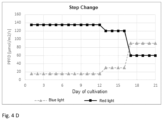
- a stepwise function is used for decorative red-leaf plants, as shown in the example of a cultivation period lasting approximately 21 days.
- the classification by growth duration is well known to those skilled in the art. According to the invention, a method for changing the proportion of red and blue light was developed - provided based on the studies, which is precisely illustrated in the provided graphs and the provided light change function were linked to the classification mentioned before.
- a linear phase adjustment - light change function is applied.
- stepwise function changes to the spectral ranges are set at least once during the cultivation period, preferably with two or three changes-i.e., gradual adjustments depending on the growth rate. It is thus possible to implement different stepwise change functions, such as a single change, double change, etc., with a double change being preferable-one around the middle phase of cultivation, according to the invention, and another a few days before the end.
- the function pertains to changing the output current of each light source channel-blue and red.
- the adjustment of the red and blue components is based on changes in the total PPFD (photosynthetic photon flux density)-i.e., the total number of photons per unit area of the cultivated surface for the red and blue components. This ensures that the same total number of photons is delivered to the cultivation surface throughout the cultivation period, from seedling to vegetation and the onset of flowering, regardless of the configured optical radiation spectrum.
- PPFD photosynthetic photon flux density
- the computational unit - carrier/medium with memory such as a microprocessor - the active system for modifying the optical radiation spectrum it is stored, saved the following: the plant species according to the aforementioned classification, the matching spectral change function - light change function based on the cultivation duration, and the determined cultivation time of the cultivated plant -from the seedling or rooted cutting stage (depending on the plant type) to, at most, the first signs of flowering (for some species, rapid flowering is undesirable, e.g., lettuce, where the growth period is extended).
- the initial development stage of the plant (the plant's advancement at the start of cultivation according to the invention) shall be stored, in the unit with memory, and based on this, the initial proportion of optical radiation spectrum in the red and blue ranges is adjusted depending on the development stage of the seedling/rooted cutting, and preferably the average cultivation temperature.
- the invention involves applying an appropriate computational unit-control-equipped with memory-where, in addition to implementing the aforementioned spectral change functions tailored to the growth rate of the plant, parameters such as the total cultivation duration, including the growth phases (from seedling/rooted cutting to the onset of flowering), the initial development stage, and the initial spectral proportion are input.
- the cultivation temperature is also recorded.
- the degree and range of wavelength adjustments and the percentage of red/blue light in the PPFD function over time are selected according to the previously described classification.
- an appropriate spectral change function is selected based on the aforementioned classification, tailored to the total cultivation duration and the classification of red-leaf plants by growth rate from seedling/rooted cutting to the onset of flowering.
- the initial percentage of red to blue light in the radiation spectrum is determined based on the development stage of the seedling/rooted cutting.
- a real-time measurement of cultivation time is preferably sent to the computational unit with the active system to adjust the percentage of specific radiation based on the total number of cultivation days entered in the system, in accordance with the spectral change function, and preferably real-time temperature readings to adapt to recorded conditions-for vertical farming.
- Changes in optical radiation over time can be implemented by maintaining the intensity of optical radiation on the cultivation surface while modifying the spectrum, by varying the intensity of optical radiation on the cultivation surface while keeping the spectrum constant, or by combining both mechanisms simultaneously.
- the invention thus includes developed adjustments to the proportions of blue and red light-spectral changes over time with the stabilization of symmetrical PPFD (maintaining constant optical radiation intensity on the cultivation surface).
- PPFD maintaining constant optical radiation intensity on the cultivation surface.
- Description of the lighting system an autonomous lighting system with a lighting module with an active spectrum-changing system and functions for selecting parameters to induce / controlling flowering.
- An autonomous lighting system also referred to as an autonomous module or autonomous lighting fixture, luminaire with an electroluminescent lighting module, comprises of functionally integrated components housed within a single enclosure.
- An autonomous lighting system can thus operate as part of a larger lighting system, which comprises N autonomous systems (modules), an external controller such as a computer, and communication systems-either wireless (e.g., Wi-Fi) or wired.
- N autonomous systems modules
- an external controller such as a computer
- communication systems-either wireless e.g., Wi-Fi
- a single autonomous lighting system-an autonomous lighting fixture-does not require an external controller to function.
- the essential component of a single autonomous system-an autonomous lighting fixture- is the electroluminescent lighting module, specifically an LED module, which includes at least one type of red LED and one type of blue LED-electroluminescent emitters.
- the lighting module contains LEDs, specifically at least one blue-light-emitting LED and at least one red-light-emitting LED within their respective wavelength ranges.
- the lighting module is therefore dual-channel, with separate control for the blue LEDs and red LEDs. For instance, it may contain two LEDs. It is also advantageous to equip the lighting module with at least one white-light-emitting LED. The specific wavelength ranges for the emitters are described later.
- the autonomous lighting system preferably includes a known LED module controller linked to the lighting module.
- the system also incorporates a computational unit equipped with memory, which is linked to the module and has the aforementioned spectrum-changing system implemented.
- This memory stores the four developed functions for modifying the light spectrum range, such as in a microcontroller or computer, which also stores other previously mentioned data.
- This computational unit can also function as the controller for the LED lighting module or can be connected to a separate LED module controller through which the spectrum range is modified.
- the autonomous system includes known power supply elements, such as a power supply unit.
- the system also features a real-time clock and environmental temperature sensor for the cultivation area, both connected to the computational unit with memory and, preferably, to the LED lighting module controller.
- the components are interconnected using known electronic communication means.
- the system is housed within an enclosure. It is advantageous for the system to include a heat sink.
- the enclosure of the described autonomous lighting fixture-system- is integrated with the heat sink.
- the memory of the computational unit is programmed with the necessary data to enable the adjustment and execution of the spectrum change algorithm, such as the plant species depending on the cultivation duration according to the aforementioned classification, the established cultivation duration-from the seedling or rooted cutting stage (depending on the plant type) to the end of vegetation or the onset of flowering, the initial development stage of the seedling/rooted cutting, and the initial proportion of the optical radiation spectrum in the red and blue ranges depending on the development stage of the seedling/rooted cutting, selected according to the species classification, preferably the average or expected cultivation temperature-the known temperature at which the given species should be cultivated, and the expected cultivation duration from the initial stage of seedling/rooted cutting to, at most, the beginning of flowering (in the case of a species where flowering is not desirable, the vegetative period can be extended using the invention, as described earlier).
- the spectrum change algorithm such as the plant species depending on the cultivation duration according to the aforementioned classification, the established cultivation duration-from the seedling or rooted cutting stage (depending on the plant type) to the end of vegetation
- the entire system preferably includes a real-time clock and an environmental temperature sensor, which are connected to the computational unit with memory, such as a microcontroller, to transmit real-time measurements of time and actual cultivation temperature.
- a real-time clock and an environmental temperature sensor which are connected to the computational unit with memory, such as a microcontroller, to transmit real-time measurements of time and actual cultivation temperature.
- This allows for adjusting the percentage of radiation and temperature according to the implemented wavelength change function and the specified cultivation days, as well as aligning the actual temperature in vertical farming with the specified cultivation temperature. These data are used to calculate whether a phase change in the plant's life cycle has occurred, which subsequently leads to a change in the light spectrum.
- Wireless e.g., Wi-Fi
- wired communication systems are used to connect the components of the autonomous module.
- the system preferably has an open architecture, allowing additional sensors to be integrated to monitor the state of the cultivation.
- the autonomous system thus includes an electroluminescent lighting component-a LED lighting module with at least two electroluminescent light emitters, preferably a dual-channel LED module.
- the LED module contains at least one red-light emitter in the range of 615 nm to 680 nm, preferably with a peak radiation at 663 nm, and at least one blue-light emitter in the range of 420 nm to 480 nm, preferably with a peak radiation at 450 nm.
- a dual-channel module is preferably used, where the red channel is controlled independently from the blue channel.
- the red channel is equipped with one or more light emitters in the range of 615 nm to 680 nm, preferably with a peak radiation at 663 nm
- the blue channel is equipped with one or more light emitters in the range of 420 nm to 480 nm, preferably with a peak radiation at 450 nm. It is possible to use, in the red channel, at least one white LED with a correlated color temperature in the range of 1600K to 3000K, and in the blue channel, at least one white LED with a correlated color temperature in the range of 4000K to 6500K.
- the autonomous system includes a computational unit equipped with memory and a light modification system connected to the LED module, making it a standalone unit.
- This unit is preferably integrated into a fixture with the lighting module and features an autonomous light modification system implemented in the computational unit, such as a microcontroller used within the fixture.
- the system uses its internal clock and data stored in the module's memory to execute specific light modification algorithms stored in the spectrum-changing system. The user can select the light modification algorithm from four different functions stored in the memory of the autonomous lighting system in the spectrum-changing system.
- the autonomous lighting system can also function as part of a larger lighting system.
- a larger lighting system consists of N lighting modules, an external controller (computer), and wireless (Wi-Fi) or wired communication systems.
- the advantage of integrating the systems into one larger system is the enhanced functionality, even for individual autonomous lighting modules. It allows users to create their own customized light control functions tailored to the developed modification algorithms, upload these algorithms to the memory of the autonomous lighting modules, modify the algorithms during cultivation, or directly control the system from an external computer.
- the invention also includes the standalone LED module, which is part of the aforementioned system.
- the dual-channel electroluminescent LED module is equipped with at least two electroluminescent light emitters, specifically at least one red emitter in the range of 615 nm to 680 nm, preferably 640 nm to 660 nm, and more preferably with a peak radiation at 663 nm.
- the second electroluminescent channel is equipped with at least one blue-light emitter in the range of 420 nm to 480 nm, preferably 440 nm to 460 nm, and more preferably with a peak radiation at 450 nm.
- Fig. 1-2 shows the general schematic of the autonomous lighting fixture-the entire autonomous system
- Fig. 3 a system of autonomous lighting modules, meaning a system comprising several autonomous units
- Fig. 4 illustrates spectral changes in lighting over time, including the developed spectral change functions - provided light change function.
- the graphs represent logarithmic changes over an extended period (180 days), exponential changes over a short period (30 days), linear changes over a medium-short period (61 days), and stepwise changes over a 21-day period.
- Fig. 1 shows a simplified block diagram of the autonomous system.
- the autonomous system was constructed with an LED lighting module, as previously described.
- the system mainly included a dual-channel electroluminescent module with two electroluminescent light emitters.
- One red emitter operated within the range of 640 nm to 660 nm.
- the second electroluminescent channel was equipped with one blue-light emitter with peak radiation between 440 nm and 460 nm.
- the channel with the red electroluminescent emitter also contained a white-light emitter with a correlated color temperature of 2700-3000K, while the channel with the blue-light emitter contained a white-light emitter with a correlated color temperature of 4000-5700K.
- the autonomous system includes a power supply.
- the system also features a real-time clock and an environmental temperature sensor, both connected to the computational unit with memory and to the LED lighting module controller.
- the components are interconnected using known electronic communication means.
- the system is enclosed in a housing. It also includes a heat sink.
- the applied lighting fixture consists of a dual-channel LED module (3) mounted in a housing that also functions as a heat sink (2), a power supply system, and a digital system-a known computational unit responsible for executing the active program for changing the optical radiation spectrum based on the cultivation duration.
- the computational unit is housed in an enclosure (1) located at one end of the fixture, equipped with a connector (4) for electrical connections.
- a multi-pin connector is used, enabling communication between the digital system and an external controller, as well as providing power to the system.
- a specialized end cap is located at the other end of the fixture (5). Both the end cap and the housing of the power supply and digital system are designed to be higher than the LEDs mounted on the module. This reduces the risk of damage to the LEDs if the fixture is improperly placed by an installer.
- both the end cap and the housing of the power supply and digital system should also be higher than the optical components to prevent scratching of these components if the fixture is placed with the optics facing downward.
- a design incorporating optical systems ensures the fixture's seal integrity.
- the entire system also includes a real-time clock and a sensor for the cultivation environment's temperature. These are connected to the computational unit with memory-a microcontroller-to transmit real-time measurements of time and temperature during cultivation, allowing adjustments to the percentage of radiation and temperature based on the implemented wavelength change function.
- the digital system an integral component of the fixture, operated using communication protocols such as Wi-Fi, Bluetooth, ZigBee, Z-Wave, and wired communication with an external controller.
- communication protocols such as Wi-Fi, Bluetooth, ZigBee, Z-Wave, and wired communication with an external controller.
- the fixture receives only the information regarding the plant species and the cultivation duration.
- Control and management are executed via the digital system embedded within the fixture.
- the embedded digital system is responsible for implementing the program that adjusts the channel drive based on the selected program. Spectrum changes over time are achieved by adjusting the output current of the power supply's converters.
- the power supply system which enables control of the output current value for each of the two independent LED chains, can be implemented using buck, boost, buck-boost, SEPIC, or flyback converters.
- the autonomous lighting system can operate within a larger lighting system, which consists of N autonomous systems (modules), an external controller such as a computer, and wireless (e.g., Wi-Fi) or wired communication systems.
- N autonomous systems modules
- an external controller such as a computer
- wireless e.g., Wi-Fi
- wired communication systems e.g., Wi-Fi
- a single autonomous system-an autonomous lighting fixture-does not require an external controller.
- red-leaf plants Among the species of short, fast-growing red-leaf plants were lettuce varieties such as Lollo Rossa, Apache, Rosela, Radicchio, Rosemary, Redin, Verala, and Butterhead Jubilatka. These species were cultivated for 21 to a maximum of 30 days from rooted cuttings, with the vegetative period extended. Stepwise or exponential functions were applied to these species.
- red-leaf plants with a moderate growth rate was Atriplex hortensis, the red variety of garden orache. These species were cultivated for 60 days, from rooted cuttings to the beginning of flowering.
- red-leaf decorative plants were Celosia, Caladium Scarlet Flame, Iresine herbstii, and Oxalis triangularis. These species were cultivated for 21 days from rooted cuttings.
- the cultivation period ranged from 21 to 180 days, depending on the group.
- the computational unit with memory microcontroller
- the following data were input: the number of cultivation days from the seedling/rooted cutting phase to the beginning of flowering (depending on the species), corresponding to the functions shown in the graphs in Fig. 3 -180 days, 61 days, 30 days, and 21 days-and the cultivation temperature according to the aforementioned species.
- Fig. 4 the graphs of example lighting changes during the cultivation period are presented.
- the cultivation was carried out in a PPFD range of 150-800 ⁇ mol/m 2 /s, with 150-200 ⁇ mol/m 2 /s determined as the threshold for proper growth of red-leaf plants.
- the example illustrates the total cumulative light intensity (PPFD) at levels of 150-800 ⁇ mol/m 2 /s, particularly 150-200 ⁇ mol/m 2 /s, along with cultivation time, initial blue light intensity, and final blue light intensity.
- the initial blue light intensity was 10% of the total (15 ⁇ mol/m 2 /s), while the final blue light intensity was 60% of the total (90 ⁇ mol/m 2 /s).
- the applied lighting fixture consists of a dual-channel LED module (3) mounted in a housing that also functions as a heat sink (2), a power supply system, and a digital system responsible for executing an active program to modify the optical radiation spectrum over the cultivation period.
- the digital system is housed in an enclosure (1) located at one end of the fixture, equipped with a multi-pin connector (4) enabling communication between the digital system and an external controller, as well as supplying power to the system.
- a specialized end cap is located at the other end of the fixture (5). Both the end cap and the housing of the power supply and digital system are designed to be higher than the LEDs mounted on the module.
- This design reduces the risk of damage to the LEDs if the fixture is improperly placed by an installer.
- both the end cap and the housing of the power supply and digital system should also be higher than the optical components to prevent scratching them if the fixture is placed with the optics facing downward.
- the construction, incorporating optical systems, ensures the fixture's seal integrity.
- This system was used for cultivating Rosela lettuce. Stepwise and exponential functions were applied. To inhibit flowering, the proportion of blue light was significantly increased on the 20th day of cultivation in the exponential function, and on the 16th day in the stepwise function, which contributed to achieving the desired harvest yield. This is illustrated in the graphs.
Landscapes
- Life Sciences & Earth Sciences (AREA)
- Botany (AREA)
- Environmental Sciences (AREA)
- Biodiversity & Conservation Biology (AREA)
- Ecology (AREA)
- Forests & Forestry (AREA)
- Cultivation Of Plants (AREA)
- Greenhouses (AREA)
Applications Claiming Priority (1)
| Application Number | Priority Date | Filing Date | Title |
|---|---|---|---|
| PL446840A PL446840A1 (pl) | 2023-11-24 | 2023-11-24 | Oprawa oświetleniowa do uprawy roślin z aktywnym systemem zmieniającym widmo promieniowania optycznego do uprawy roślin o czerwonych liściach |
Publications (1)
| Publication Number | Publication Date |
|---|---|
| EP4570060A1 true EP4570060A1 (fr) | 2025-06-18 |
Family
ID=94323107
Family Applications (1)
| Application Number | Title | Priority Date | Filing Date |
|---|---|---|---|
| EP24214769.2A Pending EP4570060A1 (fr) | 2023-11-24 | 2024-11-22 | Système d'éclairage autonome pour culture de plantes |
Country Status (2)
| Country | Link |
|---|---|
| EP (1) | EP4570060A1 (fr) |
| PL (1) | PL446840A1 (fr) |
Citations (11)
| Publication number | Priority date | Publication date | Assignee | Title |
|---|---|---|---|---|
| WO2013141824A1 (fr) | 2012-03-20 | 2013-09-26 | Vendeka Bilgi Teknolojileri Limited Şirketi | Armature d'éclairage de plante |
| CN103947469A (zh) | 2014-04-20 | 2014-07-30 | 李慧敏 | 一种红豆芽苗菜室内培养的光源控制技术 |
| CN103947470A (zh) | 2014-04-20 | 2014-07-30 | 李慧敏 | 一种黑豆芽苗菜室内培养的光源控制技术 |
| WO2014162848A1 (fr) * | 2013-04-03 | 2014-10-09 | 不二精工株式会社 | Dispositif d'émission d'air utilisable en vue de la culture de plantes |
| KR101463982B1 (ko) | 2014-04-25 | 2014-11-26 | 진영화 | Led조명을 구비한 식물재배장치 |
| US9681515B2 (en) | 2015-05-13 | 2017-06-13 | Juha Rantala | LED structure with a dynamic spectrum and a method |
| US10149439B2 (en) | 2014-12-18 | 2018-12-11 | Spectra Harvest Lighting, LLC | LED grow light system |
| US20200077598A1 (en) * | 2017-05-02 | 2020-03-12 | Lumigrow, Inc. | Lighting system and sensor array for growing plants |
| CN113179788A (zh) | 2021-05-21 | 2021-07-30 | 中国科学院长春应用化学研究所 | 一种促进黄瓜生长的光环境调控方法 |
| US11402089B2 (en) | 2019-06-06 | 2022-08-02 | Abundant Lighting Technology, Llc | LED growth light |
| JP2022118844A (ja) * | 2021-02-03 | 2022-08-16 | 株式会社カネカ | 植物の育成方法 |
Family Cites Families (3)
| Publication number | Priority date | Publication date | Assignee | Title |
|---|---|---|---|---|
| JP5723903B2 (ja) * | 2013-02-04 | 2015-05-27 | 昭和電工株式会社 | 植物栽培方法 |
| CN104979338B (zh) * | 2014-04-10 | 2018-07-27 | 光宝光电(常州)有限公司 | 发光二极管封装结构 |
| CN114902917B (zh) * | 2022-06-02 | 2023-08-29 | 中国科学院长春应用化学研究所 | 一种全人工光利用型植物工厂栽培薄皮甜瓜生长的光调控方法 |
-
2023
- 2023-11-24 PL PL446840A patent/PL446840A1/pl unknown
-
2024
- 2024-11-22 EP EP24214769.2A patent/EP4570060A1/fr active Pending
Patent Citations (13)
| Publication number | Priority date | Publication date | Assignee | Title |
|---|---|---|---|---|
| WO2013141824A1 (fr) | 2012-03-20 | 2013-09-26 | Vendeka Bilgi Teknolojileri Limited Şirketi | Armature d'éclairage de plante |
| WO2014162848A1 (fr) * | 2013-04-03 | 2014-10-09 | 不二精工株式会社 | Dispositif d'émission d'air utilisable en vue de la culture de plantes |
| CN103947469A (zh) | 2014-04-20 | 2014-07-30 | 李慧敏 | 一种红豆芽苗菜室内培养的光源控制技术 |
| CN103947470A (zh) | 2014-04-20 | 2014-07-30 | 李慧敏 | 一种黑豆芽苗菜室内培养的光源控制技术 |
| KR101463982B1 (ko) | 2014-04-25 | 2014-11-26 | 진영화 | Led조명을 구비한 식물재배장치 |
| US10149439B2 (en) | 2014-12-18 | 2018-12-11 | Spectra Harvest Lighting, LLC | LED grow light system |
| US10772260B2 (en) | 2014-12-18 | 2020-09-15 | Spectra Harvest Lighting, LLC | LED grow light system |
| US11297772B2 (en) | 2014-12-18 | 2022-04-12 | Spectra Harvest Lighting, LLC | LED grow light system |
| US9681515B2 (en) | 2015-05-13 | 2017-06-13 | Juha Rantala | LED structure with a dynamic spectrum and a method |
| US20200077598A1 (en) * | 2017-05-02 | 2020-03-12 | Lumigrow, Inc. | Lighting system and sensor array for growing plants |
| US11402089B2 (en) | 2019-06-06 | 2022-08-02 | Abundant Lighting Technology, Llc | LED growth light |
| JP2022118844A (ja) * | 2021-02-03 | 2022-08-16 | 株式会社カネカ | 植物の育成方法 |
| CN113179788A (zh) | 2021-05-21 | 2021-07-30 | 中国科学院长春应用化学研究所 | 一种促进黄瓜生长的光环境调控方法 |
Also Published As
| Publication number | Publication date |
|---|---|
| PL446840A1 (pl) | 2025-05-26 |
Similar Documents
| Publication | Publication Date | Title |
|---|---|---|
| US12336065B2 (en) | Horticulture grow lights | |
| RU2654259C2 (ru) | Динамическая рецептура света для растениеводства | |
| RU2696965C2 (ru) | Садоводческое осветительное устройство | |
| US10973173B2 (en) | Light sources adapted to spectral sensitivity of plants | |
| JP7085839B2 (ja) | 植物を照光するシステム及び方法 | |
| KR100944359B1 (ko) | 식물 재배용 다광원 조명장치 및 이를 이용한 식물 재배 방법 | |
| US9549507B2 (en) | Method for cultivating plant | |
| KR102285707B1 (ko) | 식물 재배용 광원을 이용한 식물 재배 장치 및 식물 재배 방법 | |
| CN107614973A (zh) | 用近红外光和可见光来刺激植物生长和发育的方法和设备 | |
| CN106413382B (zh) | 适应于植物的光谱灵敏度的光源 | |
| WO2024102071A2 (fr) | Système et procédé de contrôle de la croissance d'une plante | |
| EP3968755B1 (fr) | Procédé et système d'éclairage de végétaux | |
| EP4570060A1 (fr) | Système d'éclairage autonome pour culture de plantes | |
| CN207421851U (zh) | 发光设备和发光装置 | |
| CN120457901A (zh) | Led植物补光系统、设备及led植物补光方法 |
Legal Events
| Date | Code | Title | Description |
|---|---|---|---|
| PUAI | Public reference made under article 153(3) epc to a published international application that has entered the european phase |
Free format text: ORIGINAL CODE: 0009012 |
|
| STAA | Information on the status of an ep patent application or granted ep patent |
Free format text: STATUS: REQUEST FOR EXAMINATION WAS MADE |
|
| 17P | Request for examination filed |
Effective date: 20241206 |
|
| AK | Designated contracting states |
Kind code of ref document: A1 Designated state(s): AL AT BE BG CH CY CZ DE DK EE ES FI FR GB GR HR HU IE IS IT LI LT LU LV MC ME MK MT NL NO PL PT RO RS SE SI SK SM TR |
|
| RIN1 | Information on inventor provided before grant (corrected) |
Inventor name: MAZIKOWSKI, ADAM Inventor name: FELDZENSZTAJN, MATEUSZ |