EP4570064A1 - Verfahren zur reliefmarkierung von weichkäsen, markierungsplatte und in diesem verfahren verwendete schale - Google Patents
Verfahren zur reliefmarkierung von weichkäsen, markierungsplatte und in diesem verfahren verwendete schale Download PDFInfo
- Publication number
- EP4570064A1 EP4570064A1 EP23307217.2A EP23307217A EP4570064A1 EP 4570064 A1 EP4570064 A1 EP 4570064A1 EP 23307217 A EP23307217 A EP 23307217A EP 4570064 A1 EP4570064 A1 EP 4570064A1
- Authority
- EP
- European Patent Office
- Prior art keywords
- plate
- curd
- cheese
- marking
- pattern
- Prior art date
- Legal status (The legal status is an assumption and is not a legal conclusion. Google has not performed a legal analysis and makes no representation as to the accuracy of the status listed.)
- Pending
Links
Images



Classifications
-
- A—HUMAN NECESSITIES
- A01—AGRICULTURE; FORESTRY; ANIMAL HUSBANDRY; HUNTING; TRAPPING; FISHING
- A01J—MANUFACTURE OF DAIRY PRODUCTS
- A01J27/00—After-treatment of cheese; Coating of cheese
- A01J27/005—Marking cheese
-
- A—HUMAN NECESSITIES
- A01—AGRICULTURE; FORESTRY; ANIMAL HUSBANDRY; HUNTING; TRAPPING; FISHING
- A01J—MANUFACTURE OF DAIRY PRODUCTS
- A01J25/00—Cheese-making
- A01J25/007—Apparatus for making soft unripened cheese, e.g. cottage or cream cheese
-
- A—HUMAN NECESSITIES
- A01—AGRICULTURE; FORESTRY; ANIMAL HUSBANDRY; HUNTING; TRAPPING; FISHING
- A01J—MANUFACTURE OF DAIRY PRODUCTS
- A01J25/00—Cheese-making
- A01J25/11—Separating whey from curds; Washing the curds
- A01J25/115—Separating whey from curds; Washing the curds by discontinuous separation
-
- A—HUMAN NECESSITIES
- A01—AGRICULTURE; FORESTRY; ANIMAL HUSBANDRY; HUNTING; TRAPPING; FISHING
- A01J—MANUFACTURE OF DAIRY PRODUCTS
- A01J25/00—Cheese-making
- A01J25/12—Forming the cheese
-
- A—HUMAN NECESSITIES
- A01—AGRICULTURE; FORESTRY; ANIMAL HUSBANDRY; HUNTING; TRAPPING; FISHING
- A01J—MANUFACTURE OF DAIRY PRODUCTS
- A01J25/00—Cheese-making
- A01J25/12—Forming the cheese
- A01J25/13—Moulds therefor
-
- A—HUMAN NECESSITIES
- A01—AGRICULTURE; FORESTRY; ANIMAL HUSBANDRY; HUNTING; TRAPPING; FISHING
- A01J—MANUFACTURE OF DAIRY PRODUCTS
- A01J25/00—Cheese-making
- A01J25/16—Devices for treating cheese during ripening
- A01J25/162—Devices for treating cheese during ripening for storing or turning of cheese
Definitions
- the present invention relates to a method for marking a soft cheese or fresh cheese obtained from a curd.
- the invention also relates to a marking plate and a cheesecloth used for implementing this method.
- Pressed cheeses can be marked very easily during the pressing process. However, for soft cheeses, Camembert, Brie, etc., this process is not possible, as pressing would destroy the cheese.
- the curdling phase consists of producing a curd by solidifying the milk. To do this, rennet and ferments are added to the milk.
- the molding phase consists of pouring the curd into a perforated mold.
- the draining phase aims to remove the whey contained in the curd over several hours.
- the cheese obtained can be salted before a ripening phase during which mold develops and forms a down on the surface of the cheese.
- the mold can be a cheese pan with or without a bottom for draining the curd.
- the curd drains directly into the bottom through the mat made of different materials such as bamboo, food-grade plastic, etc.
- a metal plate can be placed on top of the curd to speed up draining.
- the curd in the cheese pan is turned several times to homogenize the acidification. If there is a metal plate on top, it is always placed back on top to speed up draining.
- the aim of the present invention is to produce a marking on a soft cheese or a fresh cheese.
- Another aim of the invention is precise marking without using a press which would damage the cheese.
- the first plate and/or the second plate has on one face a protruding pattern intended to engage with the curd, and in that after each turning of the curd, the first plate and the second plate remain respectively in contact with the same surfaces of the curd.
- the marking advantageously takes place during the draining phase.
- the marking is carried out over time, in successive stages.
- the successive stages of turning the curd prevent the plates from clumping together with the curd.
- the plates are carefully detached before turning the curd.
- the design made on the cheese can be the name of the cheese, a logo or any other symbol or writing.
- the strainer is a cylinder that can have a circular, square or other section. It is understood that the plates that are intended to slide in the strainer have a shape compatible with that of the strainer.
- the plates are sized so that the peripheral shape is almost identical to the internal shape of the cheesecloth.
- the person skilled in the art knows what dimensional deviation to apply to allow the plates to slide in the cheesecloth, with liquid evacuation without the curd passing through.
- the liquid which is usually water or whey, can drain through the perforations made in the wall of the strainer.
- the whey outlet is advantageously used to produce permanent, safe and precise marking.
- the curd is confined inside the cheesecloth, between a plate under the curd and another plate resting on top of the curd. With each turning, the plate that was below passes over, and the one that was above passes under. Between two turnings, the curd loses liquid and firms up. The curd thus loses volume, and the plate placed on top slides naturally while remaining placed on the upper surface of the curd.
- the priming plate and the first plate may be identical.
- This first plate which can therefore be used as a priming plate, may not have a pattern when the curd being processed does not allow to apply a pattern from the molding phase.
- This first plate also used as a priming plate, can include a pattern when the curd being processed does not risk sticking to the plate.
- the priming plate may not include the pattern. It may be a plate that is smooth on the face intended to be in contact with the curd. The smooth surface prevents the curd from sticking to the priming plate.
- the molding phase comprises filling the curd with curd, the priming plate being placed underneath.
- the second plate is placed on top, the curd is immediately turned over, the priming plate is replaced by the first plate (in the case where the priming plate is different from the first plate), and the curd is turned over again to have the first plate underneath at the start of the draining phase.
- the two turnings during the molding phase can be carried out immediately, that is to say in a few seconds or a few minutes depending on the rigidity of the curd, for example 15 minutes, while the time between two turnings during the draining phase is several tens of minutes, or even several hours.
- the draining phase thus begins with two new plates, the first plate and the second plate.
- This embodiment can be implemented in particular in the case where the cheese production requires the curd to rest for several hours before starting the draining phase.
- the two priming plates thus make it possible to contain the curd until its consistency is suitable for the first plate and the second plate to be placed.
- the strainer can comprise along its internal wall a first mark of complementary shape to a second mark made on each plate intended to slide in the strainer, so that the plates can slide in the strainer with always the same orientation.
- Such a marker is of a protruding or hollow nature and is made, for example, over the entire height of the curd.
- the plates When turning over during the draining phase, the plates are handled and can be detached from the surface of the curd and then replaced.
- the marker prevents the plate from pivoting. If, during turning over, a plate must be removed and then replaced in the curd, the marker allows this plate to be replaced in the same orientation, by replacing the pattern in the existing grooves.
- the marker can be a flat and the dowel can have a circular section.
- marker can be considered, such as a point, a triangle, a circle, ...
- the first plate and/or the second plate may comprise grooves made over a portion of the thickness of the plate on the face intended to be in contact with the curd. These grooves make it possible to leave an imprint on the surface of the cheese.
- the two patterns can be identical or different.
- the invention proposes marking on one side, on two sides with an identical pattern on both sides or two different patterns. Each side can thus be personalized.
- the draining phase may be followed, immediately or not, by a ripening phase during which at least one ripening plate is placed under the cheese, this ripening plate comprising the pattern on the face in contact with the cheese.
- the pattern used during draining is also used for ripening, preferably on one side only.
- the free side, on top is exposed to the air to allow cheese bacteria to develop and cover the top of the cheese with down, with or without marking. If there is a marking on the top, it will be reinforced during the next turning because the ripening plate can remain underneath each time it is turned.
- the ripening plate with the pattern can be constantly placed on the marked side each time it is turned over.
- the unmarked side can remain exposed when placed on top and, for example, be placed on a flat surface when placed underneath.
- the ripening plate can advantageously be perforated on the part not comprising the pattern. The air can thus easily reach the surface of the cheese.
- This process allows both sides of the cheese to continue to be marked throughout the ripening phase, which can last several weeks.
- Bacteria can grow on the openwork areas.
- the grooves created on the surface of the cheese by the pattern remain clearly visible at the end of the ripening phase.
- a plate for marking a soft cheese or fresh cheese obtained from a curd comprising a plate made of biocompatible material and a pattern made of biocompatible material produced on one face of the plate and protruding from the surface of this face, this pattern being intended to engage with the curd.
- This marking plate may also include a peripheral marker intended to cooperate with a complementary marker produced on a mold.
- a ruptureselle 1 in the form of a hollow cylinder without bottom.
- the section of this cylinder is circular, but other section shapes can be used such as for example the square or triangular shape.
- a mark 2 is made inside the strainer 1. This is a flat area which extends over the entire height of the strainer.
- Holes 3 are made through the wall of the strainer 1, all around, and are intended for the evacuation of water during the draining phase. These holes 3 are made in groups of four aligned according to the height as seen in the Figure 2 These groups are equally distributed around the perimeter of the strainer. Other random or non-random arrangements may be used for the distribution of holes across the wall of the strainer.
- the priming plate 4 is a plate in the shape of a flattened solid cylinder.
- the section of this priming plate 4 is circular with a diameter slightly smaller than the internal diameter of the curd. By slightly smaller, we mean a difference in diameter allowing the priming plate to slide inside the curd by gravity without curd being able to pass into the gap between the curd and the priming plate.
- the first marking plate 5 is a plate in the shape of a flattened solid cylinder.
- the section of this first marking plate 5 is circular with a diameter slightly smaller than the internal diameter of the curd. By slightly smaller, we mean a difference in diameter allowing the first marking plate to slide inside the curd by gravity without curd being able to pass into the gap between the curd and the first marking plate 5.
- This complementary mark 5a intended to face the mark 2 when the first plate is inserted into the mold 1.
- This complementary mark is a flat, that is to say a flat surface formed by cutting the first marking plate along a chord.
- a 5b crown can also be seen on the periphery of the first marking plate. This crown has a smooth surface which will be in contact with the curd.
- the crown 5b delimits an inner area of the first marking plate in which parallel grooves 5c are made. These parallel grooves 5c are made in a part of the thickness of the first marking plate, that is to say they do not pass through the thickness of the first marking plate.
- the ungrooved strips are at the same height as the surface of the smooth crown 5b.
- the 5d pattern is a writing protruding from the general surface of the first marking plate, this general surface including the surface of the crown 5b.
- the 5d pattern is a writing made in negative to be legible when transferred onto the surface of the cheese.
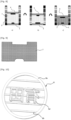
- illustration 5a is a sectional view of the first marking plate 5 with the pattern 5d.
- Illustration 5b is a sectional view of a second marking plate 6 with its pattern 6a which is different from the pattern 5d.
- the second marking plate includes the same features, shapes and dimensions as the first marking plate 5, only the pattern differs.
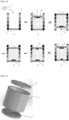
- step 6b the entire curd 7 is poured into the strainer 1.
- the curd 7 is covered with the second marking plate 6, the pattern 6a being inserted into the curd 7.
- step 6c the assembly is turned over: the strainer 1, the priming plate 4 and the second marking plate 6. With gravity, the curd 7, the second marking plate 6 and the priming plate 4 slide downwards so that the second marking plate 6 is at the bottom of the strainer 1 as can be seen in step 6d.
- step 6e the priming plate 4 is replaced by the first marking plate 5. Then the assembly is returned in step 6f.
- steps 6a to 6f are carried out successively without delay between each step. This gives a configuration where the curd 7 is contained in the curd between two marking plates.
- the first marking plate was in contact with the part of the curd that was poured first. This facilitated the marking.
- FIG. 7 is an exploded perspective view of the strainer 1, the first marking plate 5 arranged under the strainer, and the second marking plate 6 arranged above the strainer.
- the two plates are designed to slide inside the strainer 1.
- the molding phase is described with a starter plate without a pattern, it is possible to use a starter plate with a pattern in the case, for example, where the composition of the curd allows it to rest for long periods, notably several hours, on a pattern without the curd agglomerating to this pattern.
- the draining phase is described in accordance with the figure 8 . It starts according to the configuration of step 6f. The whole rests for several hours. The liquid, such as whey, contained in the curd 7 drains naturally via the holes 3. The overall volume of the curd 7 decreases. This causes the second marking plate 6 to slide downwards due to gravity. The pattern remains inserted in the curd 7.
- step 8b the assembly is turned over so that the second marking plate 6 is under the curd and the first marking plate is above the curd.
- Each marking plate retains its pattern inserted in the curd. Thanks to the different marks made on the marking plates and in the curd, the marking plates slide in the curd always in the same orientation. Thus, despite the different movements due to turning, the patterns remain in the same furrows in the curd. During a turning, a plate can be removed from the curd and then reintroduced, without generating other furrows in the curd.
- step 8c After a time delay of several hours, for example, in step 8c, the whole thing is turned over again. Such turnings can be carried out many times until the desired consistency of the curd transformed into cheese is obtained. During these turnings, the volume of the curd decreases over time, and the marking plates then adapt by sliding along the cheesecloth.
- the formed cheese is as shown in sectional view on the Figure 9 with a pattern on each side.
- This cheese can then rest outside the cheese pan so that suitable bacteria can develop; particularly during a ripening phase.
- a refining plate 8 consisting of a peripheral crown 8a inside which is made a grid 8b making the refining plate openwork.
- the same pattern 5d as on the first marking plate 5 is mounted on the grid 8b.
- the 8b grid allows air to penetrate widely through the ripening plate and reach a large part of the cheese's surface.
- This grid can be a grid or any other openwork shape.
- a refining step is illustrated during which the forming 7 is in the open air and placed on the refining plate 8.
- the pattern 5d ensures continuity of marking.
- a down 9 forms naturally over the entire surface, including in the groove formed by the pattern 6a.
- a refining step is illustrated during which the forming 7 is in the open air and placed on a second refining plate 10 bearing the same pattern 6a as the second marking plate 6.
- This pattern 6a ensures continuity of marking.
- a down 11 forms naturally over the entire surface, including in the furrow formed by the pattern 5d.
- the second ripening plate 10 When turning the cheese to change from the configuration of the Figure 11 to the configuration of the Figure 12 for example, the second ripening plate 10 can be placed above the cheese.
- the two ripening plates 8 and 10 With the cheese 7 stuck in the middle, the whole thing can be turned over without destroying the marking on the cheese.
- the bottom ripening plate 10 Once turned over, the bottom ripening plate 10 is left in place, to preserve the trace of the marking underneath.
- the top ripening plate 8 is removed to allow air to reach the cheese bacteria and thus allow them to develop and cover the marking with down.
- the marking will be reinforced during the next turnover by leaving the ripening plate underneath.
- FIG. 13 is a top photograph of a cheese marked with the 5d pattern according to the invention.
- the plates and the cheesecloth according to the invention can, for example, be made from one or a combination of the following food materials: aluminum, food plastic, porcelain, etc.
- At least one marking plate is used to maintain a pattern in the curd on one side and thus form this pattern in reverse in the cheese as it drains and matures.
Landscapes
- Life Sciences & Earth Sciences (AREA)
- Animal Husbandry (AREA)
- Environmental Sciences (AREA)
- Dairy Products (AREA)
Priority Applications (2)
| Application Number | Priority Date | Filing Date | Title |
|---|---|---|---|
| EP23307217.2A EP4570064A1 (de) | 2023-12-15 | 2023-12-15 | Verfahren zur reliefmarkierung von weichkäsen, markierungsplatte und in diesem verfahren verwendete schale |
| JP2024218464A JP2025096238A (ja) | 2023-12-15 | 2024-12-13 | ソフトチーズに凹凸をマーキングする方法、そのような方法で使用されるマーキングプレートおよびストレーナー |
Applications Claiming Priority (1)
| Application Number | Priority Date | Filing Date | Title |
|---|---|---|---|
| EP23307217.2A EP4570064A1 (de) | 2023-12-15 | 2023-12-15 | Verfahren zur reliefmarkierung von weichkäsen, markierungsplatte und in diesem verfahren verwendete schale |
Publications (1)
| Publication Number | Publication Date |
|---|---|
| EP4570064A1 true EP4570064A1 (de) | 2025-06-18 |
Family
ID=89542296
Family Applications (1)
| Application Number | Title | Priority Date | Filing Date |
|---|---|---|---|
| EP23307217.2A Pending EP4570064A1 (de) | 2023-12-15 | 2023-12-15 | Verfahren zur reliefmarkierung von weichkäsen, markierungsplatte und in diesem verfahren verwendete schale |
Country Status (2)
| Country | Link |
|---|---|
| EP (1) | EP4570064A1 (de) |
| JP (1) | JP2025096238A (de) |
Citations (3)
| Publication number | Priority date | Publication date | Assignee | Title |
|---|---|---|---|---|
| US1090102A (en) | 1912-11-07 | 1914-03-10 | Jan Johan Hendrik Gramser | Process for marking cheese. |
| FR2889411A1 (fr) * | 2005-08-05 | 2007-02-09 | Secril Soc Par Actions Simplif | Dispositif de moule pour le moulage de fromages a partir de caille |
| FR3112921A1 (fr) * | 2020-07-31 | 2022-02-04 | Projitec | moule pour le formage d’une meule de Comté et procédé de formage d’une telle meule |
-
2023
- 2023-12-15 EP EP23307217.2A patent/EP4570064A1/de active Pending
-
2024
- 2024-12-13 JP JP2024218464A patent/JP2025096238A/ja active Pending
Patent Citations (3)
| Publication number | Priority date | Publication date | Assignee | Title |
|---|---|---|---|---|
| US1090102A (en) | 1912-11-07 | 1914-03-10 | Jan Johan Hendrik Gramser | Process for marking cheese. |
| FR2889411A1 (fr) * | 2005-08-05 | 2007-02-09 | Secril Soc Par Actions Simplif | Dispositif de moule pour le moulage de fromages a partir de caille |
| FR3112921A1 (fr) * | 2020-07-31 | 2022-02-04 | Projitec | moule pour le formage d’une meule de Comté et procédé de formage d’une telle meule |
Also Published As
| Publication number | Publication date |
|---|---|
| JP2025096238A (ja) | 2025-06-26 |
Similar Documents
| Publication | Publication Date | Title |
|---|---|---|
| FR2613656A1 (fr) | Dispositif et matrice pour fabriquer une pierre artificielle, pierre artificielle en forme de plaque ainsi fabriquee, et procede de fabrication de cette pierre artificielle | |
| EP0559584B1 (de) | Formblock zur Herstellung von Käsen | |
| EP0449746B1 (de) | Verfahren zur Herstellung von Käse aus einer ausgepressten Paste und hierbei erhaltener Käse | |
| EP3061350B1 (de) | Herstellungsverfahren für einen aromatisierten käse | |
| EP0090737B1 (de) | Käse mit permanent verzierter Rinde, Verfahren zu seiner Herstellung und Vorrichtungen zur Durchführung dieses Verfahrens | |
| EP0823991B1 (de) | Multifunktions-Form zur Herstellung von Käse | |
| BE1004255A5 (fr) | Procede et moule en deux parties pour la fabrication de tablettes de chocolat de faible epaisseur, de preference a motifs. | |
| JP2025096238A (ja) | ソフトチーズに凹凸をマーキングする方法、そのような方法で使用されるマーキングプレートおよびストレーナー | |
| FR2677332A1 (fr) | Piece en matiere plastique telle que bouchon decore et son procede de fabrication. | |
| FR3011761A1 (fr) | Pied pour un accessoire et accessoire de reservoir de vehicule automobile, procede de fabrication d'un tel reservoir. | |
| FR2604943A1 (fr) | Procede de fabrication d'un element de construction en beton leger comportant des conduits longitudinaux et transversaux | |
| FR2679736A1 (fr) | Dispositif de moulage sous vide pour la fabrication des fromages a pates pressees cuites et demi-cuites. | |
| FR3112921A1 (fr) | moule pour le formage d’une meule de Comté et procédé de formage d’une telle meule | |
| WO2025021503A1 (fr) | Moule pour former un bloc de produit alimentaire fromager ou végétal à trous et procédé de réalisation d'un tel produit à trous | |
| FR2814656A1 (fr) | Fromage emballe dans du polystyrene | |
| FR2711037A1 (fr) | Moule à fromages, dispositif de soudure aux ultrasons pour la fabrication de ce moule et procédé de fabrication de fromages. | |
| FR2991135A1 (fr) | Plaque de moulage de produit alimentaire | |
| FR2777173A1 (fr) | Tampon pour patisserie et un procede de realisation de decoration pour patisserie | |
| BE656357A (de) | ||
| JP2014159295A (ja) | 鏡餅容器 | |
| FR2873326A1 (fr) | Procede d'obtention de chainon de motifs, et objet, notamment bijou, comportant un chainon de motifs | |
| JP2003304821A (ja) | ライス製サンドイッチの成形器及び成形法 | |
| FR3020243A1 (fr) | Moule et procede pour la production de plaques ajourees en produit alimentaire, notamment en chocolat | |
| FR2756139A1 (fr) | Procede pour fabriquer une piece pourvue de fines perforations, notamment un moule a fromage perfore | |
| FR2889411A1 (fr) | Dispositif de moule pour le moulage de fromages a partir de caille |
Legal Events
| Date | Code | Title | Description |
|---|---|---|---|
| PUAI | Public reference made under article 153(3) epc to a published international application that has entered the european phase |
Free format text: ORIGINAL CODE: 0009012 |
|
| STAA | Information on the status of an ep patent application or granted ep patent |
Free format text: STATUS: THE APPLICATION HAS BEEN PUBLISHED |
|
| AK | Designated contracting states |
Kind code of ref document: A1 Designated state(s): AL AT BE BG CH CY CZ DE DK EE ES FI FR GB GR HR HU IE IS IT LI LT LU LV MC ME MK MT NL NO PL PT RO RS SE SI SK SM TR |
|
| STAA | Information on the status of an ep patent application or granted ep patent |
Free format text: STATUS: THE APPLICATION IS DEEMED TO BE WITHDRAWN |