EP4570177A1 - Invasiver elektrochemischer sensor mit mehreren elektroden - Google Patents
Invasiver elektrochemischer sensor mit mehreren elektroden Download PDFInfo
- Publication number
- EP4570177A1 EP4570177A1 EP24218960.3A EP24218960A EP4570177A1 EP 4570177 A1 EP4570177 A1 EP 4570177A1 EP 24218960 A EP24218960 A EP 24218960A EP 4570177 A1 EP4570177 A1 EP 4570177A1
- Authority
- EP
- European Patent Office
- Prior art keywords
- substrate
- electrically conductive
- electrochemical sensor
- electrode
- wire
- Prior art date
- Legal status (The legal status is an assumption and is not a legal conclusion. Google has not performed a legal analysis and makes no representation as to the accuracy of the status listed.)
- Pending
Links
Images







Classifications
-
- A—HUMAN NECESSITIES
- A61—MEDICAL OR VETERINARY SCIENCE; HYGIENE
- A61B—DIAGNOSIS; SURGERY; IDENTIFICATION
- A61B5/00—Measuring for diagnostic purposes; Identification of persons
- A61B5/145—Measuring characteristics of blood in vivo, e.g. gas concentration or pH-value ; Measuring characteristics of body fluids or tissues, e.g. interstitial fluid or cerebral tissue
- A61B5/1468—Measuring characteristics of blood in vivo, e.g. gas concentration or pH-value ; Measuring characteristics of body fluids or tissues, e.g. interstitial fluid or cerebral tissue using chemical or electrochemical methods, e.g. by polarographic means
- A61B5/1473—Measuring characteristics of blood in vivo, e.g. gas concentration or pH-value ; Measuring characteristics of body fluids or tissues, e.g. interstitial fluid or cerebral tissue using chemical or electrochemical methods, e.g. by polarographic means invasive, e.g. introduced into the body by a catheter
-
- A—HUMAN NECESSITIES
- A61—MEDICAL OR VETERINARY SCIENCE; HYGIENE
- A61B—DIAGNOSIS; SURGERY; IDENTIFICATION
- A61B5/00—Measuring for diagnostic purposes; Identification of persons
- A61B5/145—Measuring characteristics of blood in vivo, e.g. gas concentration or pH-value ; Measuring characteristics of body fluids or tissues, e.g. interstitial fluid or cerebral tissue
- A61B5/1468—Measuring characteristics of blood in vivo, e.g. gas concentration or pH-value ; Measuring characteristics of body fluids or tissues, e.g. interstitial fluid or cerebral tissue using chemical or electrochemical methods, e.g. by polarographic means
- A61B5/1486—Measuring characteristics of blood in vivo, e.g. gas concentration or pH-value ; Measuring characteristics of body fluids or tissues, e.g. interstitial fluid or cerebral tissue using chemical or electrochemical methods, e.g. by polarographic means using enzyme electrodes, e.g. with immobilised oxidase
- A61B5/14865—Measuring characteristics of blood in vivo, e.g. gas concentration or pH-value ; Measuring characteristics of body fluids or tissues, e.g. interstitial fluid or cerebral tissue using chemical or electrochemical methods, e.g. by polarographic means using enzyme electrodes, e.g. with immobilised oxidase invasive, e.g. introduced into the body by a catheter or needle or using implanted sensors
-
- G—PHYSICS
- G01—MEASURING; TESTING
- G01N—INVESTIGATING OR ANALYSING MATERIALS BY DETERMINING THEIR CHEMICAL OR PHYSICAL PROPERTIES
- G01N27/00—Investigating or analysing materials by the use of electric, electrochemical, or magnetic means
- G01N27/26—Investigating or analysing materials by the use of electric, electrochemical, or magnetic means by investigating electrochemical variables; by using electrolysis or electrophoresis
- G01N27/28—Electrolytic cell components
- G01N27/283—Means for supporting or introducing electrochemical probes
-
- A—HUMAN NECESSITIES
- A61—MEDICAL OR VETERINARY SCIENCE; HYGIENE
- A61B—DIAGNOSIS; SURGERY; IDENTIFICATION
- A61B5/00—Measuring for diagnostic purposes; Identification of persons
- A61B5/145—Measuring characteristics of blood in vivo, e.g. gas concentration or pH-value ; Measuring characteristics of body fluids or tissues, e.g. interstitial fluid or cerebral tissue
- A61B5/14532—Measuring characteristics of blood in vivo, e.g. gas concentration or pH-value ; Measuring characteristics of body fluids or tissues, e.g. interstitial fluid or cerebral tissue for measuring glucose, e.g. by tissue impedance measurement
-
- A—HUMAN NECESSITIES
- A61—MEDICAL OR VETERINARY SCIENCE; HYGIENE
- A61B—DIAGNOSIS; SURGERY; IDENTIFICATION
- A61B5/00—Measuring for diagnostic purposes; Identification of persons
- A61B5/145—Measuring characteristics of blood in vivo, e.g. gas concentration or pH-value ; Measuring characteristics of body fluids or tissues, e.g. interstitial fluid or cerebral tissue
- A61B5/14539—Measuring characteristics of blood in vivo, e.g. gas concentration or pH-value ; Measuring characteristics of body fluids or tissues, e.g. interstitial fluid or cerebral tissue for measuring pH
-
- A—HUMAN NECESSITIES
- A61—MEDICAL OR VETERINARY SCIENCE; HYGIENE
- A61B—DIAGNOSIS; SURGERY; IDENTIFICATION
- A61B5/00—Measuring for diagnostic purposes; Identification of persons
- A61B5/145—Measuring characteristics of blood in vivo, e.g. gas concentration or pH-value ; Measuring characteristics of body fluids or tissues, e.g. interstitial fluid or cerebral tissue
- A61B5/14546—Measuring characteristics of blood in vivo, e.g. gas concentration or pH-value ; Measuring characteristics of body fluids or tissues, e.g. interstitial fluid or cerebral tissue for measuring analytes not otherwise provided for, e.g. ions, cytochromes
-
- G—PHYSICS
- G01—MEASURING; TESTING
- G01N—INVESTIGATING OR ANALYSING MATERIALS BY DETERMINING THEIR CHEMICAL OR PHYSICAL PROPERTIES
- G01N27/00—Investigating or analysing materials by the use of electric, electrochemical, or magnetic means
- G01N27/26—Investigating or analysing materials by the use of electric, electrochemical, or magnetic means by investigating electrochemical variables; by using electrolysis or electrophoresis
- G01N27/28—Electrolytic cell components
- G01N27/30—Electrodes, e.g. test electrodes; Half-cells
-
- A—HUMAN NECESSITIES
- A61—MEDICAL OR VETERINARY SCIENCE; HYGIENE
- A61B—DIAGNOSIS; SURGERY; IDENTIFICATION
- A61B2560/00—Constructional details of operational features of apparatus; Accessories for medical measuring apparatus
- A61B2560/04—Constructional details of apparatus
- A61B2560/0462—Apparatus with built-in sensors
- A61B2560/0468—Built-in electrodes
-
- A—HUMAN NECESSITIES
- A61—MEDICAL OR VETERINARY SCIENCE; HYGIENE
- A61B—DIAGNOSIS; SURGERY; IDENTIFICATION
- A61B2562/00—Details of sensors; Constructional details of sensor housings or probes; Accessories for sensors
- A61B2562/02—Details of sensors specially adapted for in-vivo measurements
- A61B2562/0209—Special features of electrodes classified in A61B5/24, A61B5/25, A61B5/283, A61B5/291, A61B5/296, A61B5/053
- A61B2562/0215—Silver or silver chloride containing
-
- A—HUMAN NECESSITIES
- A61—MEDICAL OR VETERINARY SCIENCE; HYGIENE
- A61B—DIAGNOSIS; SURGERY; IDENTIFICATION
- A61B2562/00—Details of sensors; Constructional details of sensor housings or probes; Accessories for sensors
- A61B2562/02—Details of sensors specially adapted for in-vivo measurements
- A61B2562/028—Microscale sensors, e.g. electromechanical sensors [MEMS]
-
- A—HUMAN NECESSITIES
- A61—MEDICAL OR VETERINARY SCIENCE; HYGIENE
- A61B—DIAGNOSIS; SURGERY; IDENTIFICATION
- A61B2562/00—Details of sensors; Constructional details of sensor housings or probes; Accessories for sensors
- A61B2562/16—Details of sensor housings or probes; Details of structural supports for sensors
- A61B2562/166—Details of sensor housings or probes; Details of structural supports for sensors the sensor is mounted on a specially adapted printed circuit board
Definitions
- the present invention relates to an invasive electrochemical sensor.
- An electrochemical test strip generally has a detection area to which a to-be-tested solution can be transferred in the form of a liquid drop or that can be immersed in the to-be-tested solution.
- existing electrochemical test strips cannot be used to perform invasive detection. When it comes to the continuous monitoring of biological/physiological parameters, an invasive detector is often more suitable than an existing non-invasive electrochemical test strip.
- the primary objective of the present invention is to provide a relatively low-cost invasive electrochemical sensor.
- the present invention provides an invasive multi-electrode electrochemical sensor (hereinafter also referred to as the electrochemical sensor for short) that includes a substrate, a plurality of wire electrodes and a plurality of gold fingers provided on the substrate.
- Each wire electrode includes an electrically conductive core and an insulating sheath.
- Each insulating sheath substantially covers the corresponding electrically conductive core while leaving a proximal end and a distal end of the corresponding electrically conductive core exposed.
- Each wire electrode has a substrate section and an invasion section. The proximal end and the distal end of the electrically conductive core of each wire electrode are located at the substrate section and the invasion section of the wire electrode respectively.
- each wire electrode is located on the substrate.
- the invasion section of each wire electrode extends outward from an edge of the substrate, and the invasion sections of the wire electrodes are at least partially wound around one another in a spiral manner.
- the electrically conductive core in the substrate section of each wire electrode is electrically connected to the corresponding gold finger. At least a part of the gold fingers is printed on the substrat by screen printing.
- the present invention provides an invasive electrochemical sensor by using multiple spirally wound wire electrodes. Screen-printed gold fingers are used to electrically connect to the wire electrodes respectively. It has many advantages such as low cost, disposable, small size and sensitive reactivity, thereby solving the shortcomings of the existing technology.
- the electrochemical sensor of the invention can be used to perform invasive detection on a host, and the host may be a human, an animal, or a plant.
- the electrochemical sensor can detect whether the host's body contains a target analyte, the concentration of the target analyte, and/or other to-be-detected values.
- the target analyte may be, for example but not limited to, glycated hemoglobin, blood sugar, a heavy metal, a nitrate, a nitrite, an allergen, formaldehyde, dissolved oxygen, uric acid, dopamine, ascorbic acid, potassium ferricyanide, acetaminophen, a halogen ion, a sulfur ion, an aqueous hydrogen peroxide solution, an arsenic(III) ion, a lead ion, a zinc ion, a chromium ion, phenols, an amino acid, or another similar compound.
- the to-be-detected value may be a physical parameter such as, but not limited to, a pH value or conductivity.
- the electrochemical sensor of the invention may also be implemented in such a way that it can be used in a non-invasive detection environment, e.g., to test a water sample taken from the environment or other aqueous solutions.
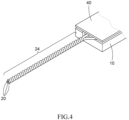
- the electrochemical sensor includes a substrate 10, three wire electrodes 20, three gold fingers 30, and a cover plate 40.
- the material of the substrate 10 may be, but is not limited to, polypropylene, polyethylene terephthalate, polyimide, polyethylene, polyurethane, or polycarbonate.
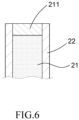
- Each wire electrode 20 includes an electrically conductive core 21 and an insulating sheath 22 (see FIG. 5 ). Each insulating sheath 22 substantially covers the corresponding electrically conductive core 21 while exposing a proximal end 211 and a distal end 212, or free end, of the corresponding electrically conductive core 21.
- each wire electrode 20 has a substrate section 23 and an invasion section 24. The proximal end 211 and the distal end 212 of the electrically conductive core 21 of each wire electrode 20 are located at the substrate section 23 and the invasion section 24 of the wire electrode 20 respectively.
- the substrate section 23 of each wire electrode 20 is provided on the substrate 10.
- the invasion section 24 of each wire electrode 20 extends outward from an edge of the substrate 10, and the length for which each invasion section 24 extends outward from the edge may be greater than 10 mm.
- the invasion sections 24 of the three wire electrodes 20 are wound around one another in a spiral manner. Winding the invasion sections 24 together in a spiral manner is advantageous in that the accuracy of detection is enhanced by the short distance and low electrical resistance among the electrodes.
- the electrically conductive core 21 in the invasion section 24 of at least one of the wire electrodes 20 is different in material from the electrically conductive cores 21 of the other wire electrodes 20.
- the electrically conductive cores of the three wire electrodes serve separately as a working electrode, an auxiliary electrode, and a pseudo electrode/reference electrode.
- the electrically conductive cores of the three wire electrodes may by, but are not limited to, the materials listed in Table 1.
- the insulating sheaths 22, on the other hand, are made of an insulating material to prevent the electrically conductive cores of different wire electrodes from direct electrical connection with one another and hence from forming a short circuit.
- the wire electrodes can be viewed as metallic wire ultramicroelectrodes (MWUME) when the diameter ⁇ of each electrically conductive core 21 is less than or equal to 25 ⁇ m, as metallic wire microelectrodes (MWME) when the diameter ⁇ of each electrically conductive core 21 is greater than 25 ⁇ m and less than 1000 ⁇ m, or as metallic wire electrodes (MWE) when the diameter ⁇ of each electrically conductive core 21 is greater than or equal to 1000 ⁇ m.
- MWUME metallic wire ultramicroelectrodes
- MWE metallic wire electrodes
- the gold fingers 30 are provided on the substrate 10.
- the electrically conductive core 21 in the substrate section 23 of each wire electrode 20 (e.g., the proximal end 211 of each electrically conductive core 21) is electrically connected to the corresponding gold finger 30.
- the electrical connection between each electrically conductive core 21 and the corresponding gold finger 30 may be formed by, for example but not limited to, soldering or application of electrically conductive tape.
- the gold fingers 30 may be printed on the substrate 10 by screen printing for example, and the material of the gold fingers 30 may be printed carbon paste or printed silver paste for example.
- the printed carbon paste or printed silver paste may further receive a surface treatment by, for example, being sputter-coated with a metal such as platinum, gold, copper, or silver. In this embodiment, the gold fingers 30 extend to an edge of the substrate 10.
- the cover plate 40 is provided on the substrate 10 such that the entire substrate sections 23 of the wire electrodes 20 are fixed between the cover plate 40 and the substrate 10.
- each electrically conductive core 21 may receive a surface treatment so as to have the configuration of being flush with the corresponding end face of the corresponding insulating sheath 22, or protruding from the corresponding end face of the corresponding insulating sheath 22, or having an irregular surface, or being sunken into the corresponding end face of the corresponding insulating sheath 22.
- One way of implementing the wire electrodes is to make the distal end 212 of each electrically conductive core 21 sunken into an end face 221 of the corresponding insulating sheath 22 while satisfying the relationship H w / ⁇ ⁇ 50, where H w is the depth to which the distal end 212 is sunken into the end face 221.
- the recess formed at the aforesaid end face of each insulating sheath may be filled with an enzyme layer (not shown).
- the distal end 212 of at least one of the electrically conductive cores 21 is made of a material different from the material of the other portion of the electrically conductive core 21.
- the distal end of this at least one electrically conductive core is made of carbon while the other portion of the electrically conductive core is made of copper in order to adapt to different detection environments.
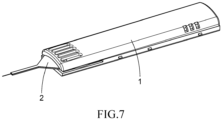
- the electrochemical sensor according to the embodiment shown in FIG. 1 to FIG. 4 can be used in combination with an electrochemical sensing relay 1.
- the electrochemical sensing relay 1 is configured to be electrically connected to each and every gold finger of the electrochemical sensor 2 and to relay the signals sensed by the electrochemical sensor to a remote receiving unit (e.g., a smartphone, a computer, or a cloud server) in order to perform further computation and/or display the computation result.
- a remote receiving unit e.g., a smartphone, a computer, or a cloud server
- the number of the wire electrodes can be adjusted.
- the spirally wound invasion sections of the four wire electrodes 20 can be used to detect more analytes at the same time than when fewer wire electrodes are provided, and as shown in FIG. 9 , the invasion sections of six wire electrodes may be spirally wound around the invasion section of a central wire electrode 20c that extends along a straight line, i.e., with the invasion section of at least one wire electrode that extends along a straight line serving as an axis around which the invasion sections of the other wire electrodes are spirally wound.
- FIG. 10 a reproducibility test was conducted in which a plurality of electrochemical sensors as shown in FIG. 1 took turns being immersed in each of two different aqueous solutions for three times.
- the test results show that the detection result of each aqueous solution was highly reproducible with the electrochemical sensor of the present invention.
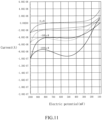
- an electrochemical sensor with three wire electrodes was immersed in 0.1 M PBS (phosphate-buffered saline), 500 ⁇ M aqueous hydrogen peroxide (H 2 O 2 ) solution, and 1000 ⁇ M aqueous hydrogen peroxide solution separately.
- the material of the major portions of the electrically conductive cores of the wire electrodes was carbon while the material of the distal ends of the electrically conductive cores was platinum.
- the test results show that the electrochemical sensor of the present invention was indeed capable of detecting different oxidation and reduction potentials in aqueous hydrogen peroxide solutions of different concentrations.
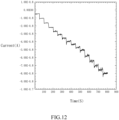
- the applicant used amperometry to test the performance of the electrochemical sensor of the present invention in detecting aqueous hydrogen peroxide solutions.
- the electrochemical sensor used in the test had three wire electrodes, with the material of the major portions of the electrically conductive cores of the wire electrodes being carbon, and the material of the distal ends of the electrically conductive cores being platinum.
- the applicant used amperometry together with the working parameters in Table 2 to detect aqueous hydrogen peroxide solutions of different concentrations. More specifically, the concentration of an aqueous hydrogen peroxide solution was adjusted every 50 seconds. Each of the first ten adjustments involved increasing the concentration by 100 ⁇ M, and each of the last five adjustments involved increasing the concentration by 200 ⁇ M.
- the final concentration was 2000 ⁇ M.
- the oxidation voltage was fixed at 600 mV.
- the test results show that the electrochemical sensor of the invention was able to detect the changes in concentration of the aqueous hydrogen peroxide solution sensitively, and that the detected current values are highly linearly correlated to the changes in concentration (see FIG. 13 ), indicating that the electrochemical sensor of the invention has high accuracy.
- Table 2 Elapsed time (s) Concentration of aqueous hydrogen peroxide solution ( ⁇ M) 0 0 50 100 100 200 150 300 200 400 250 500 300 600 350 700 400 800 450 900 500 1000 550 1200 600 1400 650 1600 700 1800 750 2000
- the embodiment shown in FIG. 14 is similar to the embodiment in FIG. 9 , the major difference being that the electrochemical sensor in FIG. 14 includes an axle 50, and that the central wire electrode 20c in FIG. 9 is replaced by the axle 50 while the invasion sections 24 of the other wire electrodes 20 are wound around the axle 50 spirally.
- a portion of the axle is configured to be fixed to the substrate (not shown).
- the portion of the axle 50 around which the invasion sections 24 are spirally wound extends along a straight line.
- the axle 50 has a terminal end 51, and the terminal end 51 protrudes beyond the distal ends 212 of the invasion sections 24.
- the terminal end 51 is solid and pointed and serves to change the structural strength of the invasion sections 24 so that the invasion sections 24 can be easily inserted into a detection target (e.g., soil or a plant) without the help of an additional placing device.
- the embodiment shown in FIG. 15 is similar to the embodiment in FIG. 14 , the major difference being that the terminal end 51 of the axle 50 in FIG. 15 is hollow and pointed and serves also to change the structural strength of the invasion sections 24.
- the hollow terminal end 51 helps disturb the tissue into which it is inserted, so that the tissue can contact the distal ends 212 of the invasion sections 24 easily through capillary action for example, thereby facilitating detection.
- the axle 50 may be a non-metallic, non-conductor wire, whose material may be, for example, ceramic, silicon dioxide, plastic, acrylic, or a polymer such as polypropylene (PP), polycarbonate (PC), or polyethylene (PE).
- each gold finger 30 that is not covered by the cover plate 40 is defined as an exposed section 31.
- the exposed sections 31 are parallel to one another and extend in an insertion direction L.
- the gold fingers 30 are provided on a working surface 11 of the substrate 10.
- the invasion section 24 of each wire electrode has a front-side portion 241, and the distal end 212 of the electrically conductive core of each wire electrode is located at the front-side portion of the invasion section of the wire electrode.
- the front-side portions 241 extend in a direction that is not parallel to the insertion direction L or the working surface 11. In this embodiment, the front-side portions 241 are perpendicular to the working surface 11.
- Another possible way of implementing the electrochemical sensor is to provide the invasion sections 24 with flexibility so that a user can adjust the extending direction of the front-side portions 241 according to the geometric properties of the detection target.
Landscapes
- Health & Medical Sciences (AREA)
- Life Sciences & Earth Sciences (AREA)
- Physics & Mathematics (AREA)
- Pathology (AREA)
- General Health & Medical Sciences (AREA)
- Molecular Biology (AREA)
- Chemical & Material Sciences (AREA)
- Biophysics (AREA)
- Animal Behavior & Ethology (AREA)
- Veterinary Medicine (AREA)
- Public Health (AREA)
- Surgery (AREA)
- Medical Informatics (AREA)
- Optics & Photonics (AREA)
- Heart & Thoracic Surgery (AREA)
- Engineering & Computer Science (AREA)
- Biomedical Technology (AREA)
- Chemical Kinetics & Catalysis (AREA)
- General Chemical & Material Sciences (AREA)
- Electrochemistry (AREA)
- Immunology (AREA)
- Biochemistry (AREA)
- General Physics & Mathematics (AREA)
- Analytical Chemistry (AREA)
- Emergency Medicine (AREA)
- Measurement Of The Respiration, Hearing Ability, Form, And Blood Characteristics Of Living Organisms (AREA)
Applications Claiming Priority (1)
| Application Number | Priority Date | Filing Date | Title |
|---|---|---|---|
| TW112148320A TWI862329B (zh) | 2023-10-19 | 2023-12-12 | 侵入式多電極電化學感測器 |
Publications (1)
| Publication Number | Publication Date |
|---|---|
| EP4570177A1 true EP4570177A1 (de) | 2025-06-18 |
Family
ID=93893723
Family Applications (1)
| Application Number | Title | Priority Date | Filing Date |
|---|---|---|---|
| EP24218960.3A Pending EP4570177A1 (de) | 2023-12-12 | 2024-12-11 | Invasiver elektrochemischer sensor mit mehreren elektroden |
Country Status (4)
| Country | Link |
|---|---|
| US (1) | US20250185957A1 (de) |
| EP (1) | EP4570177A1 (de) |
| JP (1) | JP7733948B2 (de) |
| CN (1) | CN120142407A (de) |
Citations (3)
| Publication number | Priority date | Publication date | Assignee | Title |
|---|---|---|---|---|
| US20100331644A1 (en) * | 2008-11-07 | 2010-12-30 | Dexcom, Inc. | Housing for an intravascular sensor |
| US20230148916A1 (en) * | 2021-11-12 | 2023-05-18 | Medtronic Minimed, Inc. | Sensor device monitors for calibration |
| US20230293060A1 (en) * | 2022-03-18 | 2023-09-21 | Stacy Hunt Duvall | Continuous multi-analyte sensor systems |
Family Cites Families (5)
| Publication number | Priority date | Publication date | Assignee | Title |
|---|---|---|---|---|
| US6175752B1 (en) * | 1998-04-30 | 2001-01-16 | Therasense, Inc. | Analyte monitoring device and methods of use |
| US8626257B2 (en) * | 2003-08-01 | 2014-01-07 | Dexcom, Inc. | Analyte sensor |
| WO2010099507A1 (en) * | 2009-02-26 | 2010-09-02 | Abbott Diabetes Care Inc. | Improved analyte sensors and methods of making and using the same |
| EP2482724A2 (de) * | 2009-09-30 | 2012-08-08 | Dexcom, Inc. | Transkutaner analytsensor |
| CA3105324A1 (en) * | 2011-06-17 | 2012-12-20 | Abbott Diabetes Care Inc. | Connectors for making connections between analyte sensors and other devices |
-
2024
- 2024-04-22 US US18/641,951 patent/US20250185957A1/en active Pending
- 2024-12-10 JP JP2024215083A patent/JP7733948B2/ja active Active
- 2024-12-11 EP EP24218960.3A patent/EP4570177A1/de active Pending
- 2024-12-11 CN CN202411815275.0A patent/CN120142407A/zh active Pending
Patent Citations (3)
| Publication number | Priority date | Publication date | Assignee | Title |
|---|---|---|---|---|
| US20100331644A1 (en) * | 2008-11-07 | 2010-12-30 | Dexcom, Inc. | Housing for an intravascular sensor |
| US20230148916A1 (en) * | 2021-11-12 | 2023-05-18 | Medtronic Minimed, Inc. | Sensor device monitors for calibration |
| US20230293060A1 (en) * | 2022-03-18 | 2023-09-21 | Stacy Hunt Duvall | Continuous multi-analyte sensor systems |
Also Published As
| Publication number | Publication date |
|---|---|
| JP2025093889A (ja) | 2025-06-24 |
| JP7733948B2 (ja) | 2025-09-04 |
| CN120142407A (zh) | 2025-06-13 |
| US20250185957A1 (en) | 2025-06-12 |
Similar Documents
| Publication | Publication Date | Title |
|---|---|---|
| AU2013252525B2 (en) | Sensor array | |
| US10349878B2 (en) | Electrochemical sensor having symmetrically distributed analyte sensitive areas | |
| EP2873969B1 (de) | Hämatokritmesssystem und entsprechendes Messverfahren | |
| US20190254574A1 (en) | Electrochemical sensor having symmetrically distributed analyte sensitive areas | |
| CN120458572B (zh) | 生物传感器及其制备方法、可穿戴设备 | |
| EP4570177A1 (de) | Invasiver elektrochemischer sensor mit mehreren elektroden | |
| EP1690083B1 (de) | Selbstkondensierender ph-sensor | |
| US20250185956A1 (en) | Invasive multi-electrode electrochemical sensor | |
| US20250169729A1 (en) | Invasive multi-electrode electrochemical sensor | |
| CN210408437U (zh) | 一种三电极针形酶传感器 | |
| EP4239328A1 (de) | Testgerät und messvorrichtung | |
| JPS5981550A (ja) | 電気化学的電池 | |
| JP2017075851A (ja) | 生体センサ、および生体センサから生体内の被験物質の濃度を測定する方法、持続血糖測定(cgm)システム | |
| HK1185780B (en) | Electrochemical sensor having symmetrically distributed analyte sensitive areas |
Legal Events
| Date | Code | Title | Description |
|---|---|---|---|
| PUAI | Public reference made under article 153(3) epc to a published international application that has entered the european phase |
Free format text: ORIGINAL CODE: 0009012 |
|
| STAA | Information on the status of an ep patent application or granted ep patent |
Free format text: STATUS: REQUEST FOR EXAMINATION WAS MADE |
|
| 17P | Request for examination filed |
Effective date: 20241211 |
|
| AK | Designated contracting states |
Kind code of ref document: A1 Designated state(s): AL AT BE BG CH CY CZ DE DK EE ES FI FR GB GR HR HU IE IS IT LI LT LU LV MC ME MK MT NL NO PL PT RO RS SE SI SK SM TR |