EP4570273A1 - Procédé de transfert d'un emballage pour le traitement dans une chambre de traitement d'un confinement dans des conditions aseptiques - Google Patents
Procédé de transfert d'un emballage pour le traitement dans une chambre de traitement d'un confinement dans des conditions aseptiques Download PDFInfo
- Publication number
- EP4570273A1 EP4570273A1 EP23216938.3A EP23216938A EP4570273A1 EP 4570273 A1 EP4570273 A1 EP 4570273A1 EP 23216938 A EP23216938 A EP 23216938A EP 4570273 A1 EP4570273 A1 EP 4570273A1
- Authority
- EP
- European Patent Office
- Prior art keywords
- container
- cover
- protective layer
- passage
- containment
- Prior art date
- Legal status (The legal status is an assumption and is not a legal conclusion. Google has not performed a legal analysis and makes no representation as to the accuracy of the status listed.)
- Pending
Links
Images


Classifications
-
- A—HUMAN NECESSITIES
- A61—MEDICAL OR VETERINARY SCIENCE; HYGIENE
- A61L—METHODS OR APPARATUS FOR STERILISING MATERIALS OR OBJECTS IN GENERAL; DISINFECTION, STERILISATION OR DEODORISATION OF AIR; CHEMICAL ASPECTS OF BANDAGES, DRESSINGS, ABSORBENT PADS OR SURGICAL ARTICLES; MATERIALS FOR BANDAGES, DRESSINGS, ABSORBENT PADS OR SURGICAL ARTICLES
- A61L2/00—Disinfection or sterilisation of materials or objects, in general; Accessories therefor
- A61L2/16—Disinfection or sterilisation of materials or objects, in general; Accessories therefor using chemical substances
- A61L2/20—Gaseous substances, e.g. vapours
- A61L2/208—Hydrogen peroxide
-
- A—HUMAN NECESSITIES
- A61—MEDICAL OR VETERINARY SCIENCE; HYGIENE
- A61B—DIAGNOSIS; SURGERY; IDENTIFICATION
- A61B50/00—Containers, covers, furniture or holders specially adapted for surgical or diagnostic appliances or instruments, e.g. sterile covers
- A61B50/30—Containers specially adapted for packaging, protecting, dispensing, collecting or disposing of surgical or diagnostic appliances or instruments
-
- A—HUMAN NECESSITIES
- A61—MEDICAL OR VETERINARY SCIENCE; HYGIENE
- A61L—METHODS OR APPARATUS FOR STERILISING MATERIALS OR OBJECTS IN GENERAL; DISINFECTION, STERILISATION OR DEODORISATION OF AIR; CHEMICAL ASPECTS OF BANDAGES, DRESSINGS, ABSORBENT PADS OR SURGICAL ARTICLES; MATERIALS FOR BANDAGES, DRESSINGS, ABSORBENT PADS OR SURGICAL ARTICLES
- A61L2/00—Disinfection or sterilisation of materials or objects, in general; Accessories therefor
- A61L2/16—Disinfection or sterilisation of materials or objects, in general; Accessories therefor using chemical substances
- A61L2/20—Gaseous substances, e.g. vapours
-
- B—PERFORMING OPERATIONS; TRANSPORTING
- B32—LAYERED PRODUCTS
- B32B—LAYERED PRODUCTS, i.e. PRODUCTS BUILT-UP OF STRATA OF FLAT OR NON-FLAT, e.g. CELLULAR OR HONEYCOMB, FORM
- B32B27/00—Layered products comprising a layer of synthetic resin
-
- A—HUMAN NECESSITIES
- A61—MEDICAL OR VETERINARY SCIENCE; HYGIENE
- A61L—METHODS OR APPARATUS FOR STERILISING MATERIALS OR OBJECTS IN GENERAL; DISINFECTION, STERILISATION OR DEODORISATION OF AIR; CHEMICAL ASPECTS OF BANDAGES, DRESSINGS, ABSORBENT PADS OR SURGICAL ARTICLES; MATERIALS FOR BANDAGES, DRESSINGS, ABSORBENT PADS OR SURGICAL ARTICLES
- A61L2103/00—Materials or objects being the target of disinfection or sterilisation
- A61L2103/23—Containers other than laboratory or medical, e.g. bottles or mail
-
- A—HUMAN NECESSITIES
- A61—MEDICAL OR VETERINARY SCIENCE; HYGIENE
- A61L—METHODS OR APPARATUS FOR STERILISING MATERIALS OR OBJECTS IN GENERAL; DISINFECTION, STERILISATION OR DEODORISATION OF AIR; CHEMICAL ASPECTS OF BANDAGES, DRESSINGS, ABSORBENT PADS OR SURGICAL ARTICLES; MATERIALS FOR BANDAGES, DRESSINGS, ABSORBENT PADS OR SURGICAL ARTICLES
- A61L2202/00—Aspects relating to methods or apparatus for disinfecting or sterilising materials or objects
- A61L2202/10—Apparatus features
- A61L2202/18—Aseptic storing means
Definitions
- the present invention relates to a method for transferring a container for processing in the process chamber of a containment under aseptic conditions in two embodiments.
- a single container comprises a receptacle with an aseptic internal volume and at least one first, sealed passage.
- the receptacle is, for example, a tub-shaped or tray-shaped container with articles arranged therein, such as vials, phials, or syringes.
- the articles can be positioned in a nest inserted into the container.
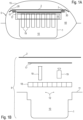
- the container 1 is, for example, a tub-shaped tub.
- the articles 19 are, in particular, phials, vials, or syringes.
- At least portions of the cover 2 and the envelope 15 preferably consist of a semipermeable nonwoven fabric, such as Tyvek® .
- the cover 2 is typically sealed, e.g., glued or welded, on the edge surface 11 surrounding the first opening 12 of the container 1 —forming a first adhesion 3 with the edge 30 —and thus preserves the internal volume 10 of the container 1 in a sterile state.
- the container 5 After unpacking the container 5 from the wrapping 15 and before it can be transferred under aseptic conditions into the process chamber of a containment for processing, the container 5 must be decontaminated externally.
- the disadvantage here is that certain decontaminating agents acting on the container 5 penetrate the semi-permeable cover 2 to an undesirably high extent into the interior volume 10 of the container 1 and its contents, and flow out into the process chamber of the containment after the cover 2 is opened. This can still be critical, even though the escaping decontaminating residues are quickly diluted in the process chamber.
- residues of the gaseous decontaminating agent - e.g. H 2 O 2 - remain within the article 19 , which can then change the effect of the medication when it is filled into the article 19 .
- residues of the decontaminant may be embedded in the material of the articles 19 and/or in their closure elements (e.g. plugs) and thus enter the container after a medication has been filled in.
- the object of the present invention is therefore to propose process-efficient measures based on the containers provided by the industry according to the prior art, so that the decontaminant directed onto the exterior of the container during an essential decontamination phase only passes through the cover into the interior volume of the container in a minimal, acceptable concentration.
- the key objective is to ensure that, as far as possible, no decontaminant enters the substance being processed, especially medications, during the process.
- the aim is always to ensure that no decontaminant gets into the medication so that the medication does not undergo any undesirable changes.
- the protective layer is applied to the cover as a separate agent and/or is formed by exposure to the cover, resulting in a structural change that acts as a protective layer. Exposure to the cover to form the protective layer occurs, for example, thermally or by irradiation, preferably with UV radiation or ultrasound.
- the cover is a semipermeable film, e.g., Tyvek® , which is attached to an edge of the container surrounding the passage by means of a first adhesive.
- the protective layer is in the form of a separate film and is bonded to the cover by means of a second adhesive. The extension of the protective layer ends before the outer edge of the cover.
- the decontaminant can penetrate through an outer edge of the cover, which is not shielded by the protective layer, to an edge of the first adhesion and onto a peripheral surface of the container.
- Hydrogen peroxide (H 2 O 2 ) or nitrogen dioxide (NO 2 ) or a fumigant in an appropriate concentration is used as the decontaminant.
- the container With its aseptic interior volume and the cover that seals the opening, is placed in a bag-like envelope.
- the container is prepared in a cleanroom, preferably with a cleanroom class C (according to GMP Annex 1: Good Manufacturing Practice), equivalent to Class 7 (according to ISO standard 14644-1).
- the container is transferred from the cleanroom to a RABS (Restricted Access Barrier System), where the surrounding enclosure is removed.
- the RABS preferably has a cleanroom class of Grade A for Supply (according to GMP Annex 1: Good Manufacturing Practice), equivalent to Class 5 (according to ISO standard 14644-1).
- the transfer device is linked to the RABS on the one hand and to the containment on the other.
- the protective layer is applied to the cover as a separate agent and/or is formed by acting on the cover, resulting in a structural change that acts as a protective layer.
- the action on the cover to form the protective layer occurs, for example, thermally or by irradiation, preferably with UV radiation or ultrasound.
- the cover is a semi-permeable film, e.g. Tyvek ® , which is applied to an edge surface of the container surrounding the second passage by means of a first
- the protective layer is secured by a separate adhesive, and the protective layer is provided as a film and is bonded to the cover by a second adhesive.
- the extension of the protective layer ends before the outer edge of the cover.
- the decontaminant can penetrate through an outer edge zone of the cover, which is not shielded by the protective layer, to an edge of the first adhesion and to the edge surface of the container surrounding the second opening.
- Hydrogen peroxide (H 2 O 2 ) or nitrogen dioxide (NO 2 ) or a fumigant in an appropriate concentration is used as the decontaminant.
- the container (1) with its aseptic interior volume and the cover that closes the second opening and the cover that closes the first opening is placed in a bag-like wrapping.
- the container is prepared in a cleanroom, preferably with cleanroom class C (according to GMP Annex 1: Good Manufacturing Practice), equivalent to class 7 (according to ISO standard 14644-1).
- the container is transferred from the cleanroom to a RABS (Restricted Access Barrier System), where the surrounding enclosure is removed.
- the RABS preferably has a cleanroom class of Grade A for Supply (according to GMP Annex 1: Good Manufacturing Practice), equivalent to Class 5 (according to ISO standard 14644-1).
- the transfer device is linked to the RABS on the one hand and to the containment on the other.
- the container 1 is made of Figure 1A , with the partially permeable cover 2 over the first passage 12 present at the top of the container 1.
- the container 1 is shown with its internal volume 10 without contents.
- the cover 2 is a semipermeable Film, e.g. Tyvek ® , and fixed on the edge surface 11 by means of a first adhesion 3 as an adhesive or welding, wherein the outer edge 30 of the first adhesion 3 extends to the outer edge of the edge surface 11 and the edge zone 20 of the cover 2 projects beyond the edge 30 of the first adhesion 3 and the outer edge of the edge surface 11 .
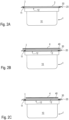
- a protective layer 4 is applied to the cover 2.
- the protective layer 4 is less permeable to the decontaminant introduced onto the container 5 during a later decontamination phase, so that the decontaminant only passes through the cover 2 into the interior volume 10 in a minimal, acceptable concentration.
- the protective layer 4 extends entirely over the cover 2, apart from its overhanging edge zone 20, and has the shape of a film as a separate means, which is bonded flatly to the cover 2 by means of the second adhesion 40.
- the protective layer 4 can be formed by a structure-changing action on the cover 2 , which then acts as a protective layer 4.
- the action on the cover 2 to form the protective layer 4 can be thermal or by irradiation, preferably with UV radiation or ultrasound.
- the protective layer 4 now ends before the overhanging edge zone 20 of the cover 2. This makes it possible for decontaminating agent to reach an edge 30 of the first adhesion 3 and an edge surface 11 of the container 1 during the later decontamination phase through an outer edge zone 20 of the cover 2, which is not shielded by the protective layer 4 .
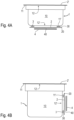
- FIG. 1A At the start of the transfer process in its second embodiment, after removal of the usually existing covering 15, a modified container 1 is available.
- Figure 1A ready.
- the container 1 with its aseptic interior volume 10 is again shown without contents.
- the first opening 12 provided at the top of the container 1 is closed with the impermeable cover 2' .
- the cover 2' is fixed to the edge surface 11 by means of adhesive or welding.
- This container 1 has a second opening 12' located at the bottom, which is closed with a partially permeable cover 2.
- the cover 2 is a semipermeable film, e.g., Tyvek® , and is fixed to the edge surface 11' by means of a first attachment 3 , either glued or welded, with the cover 2 projecting beyond the first attachment 3.
- a protective layer 4 is applied to the cover 2 .
- the protective layer 4 ends before the outer edge zone 20 of the cover 2. This allows the decontamination agent to reach an edge 30 of the first adhesion 3 and the edge surface 11' of the container 1 during the subsequent decontamination phase through the outer edge zone 20 of the cover 2, which is not shielded by the protective layer 4.
- the protective layer 4 has the form of a film as a separate means, which is connected to the cover 2 by means of the second adhesion 40. Regarding the properties, nature and alternative formation of the protective layer 4 , reference is made to the above description. Figures 2B and 3A reference is made.
- the provision of the container 5 with the semi-permeable cover 2 closing the container 1 takes place in the cleanroom 6, preferably with cleanroom class Grade C (according to GMP Annex 1: Good Manufacturing Practice), equivalent to class 7 (according to ISO standard 14644-1).
- the container 5 is transferred from the cleanroom 6 to the process chamber 70 of the RABS 7 , where the enclosure 15 surrounding the container 5 is removed.
- the RABS 7 preferably has a cleanroom class Grade A for Supply (according to GMP Annex 1: Good Manufacturing Practice), equivalent to Class 5 (according to ISO standard 14644-1).
- GMP Annex 1 Good Manufacturing Practice
- Class 5 accordinging to ISO standard 14644-1
- several supply air fans 76 and supply air filters 77 are arranged to generate a purified unidirectional displacement flow 75 flowing through the process chamber 70 .
- the cover 2 on the now unpacked container 5 is provided with the protective layer 4 , which is applied as a separate agent and/or produced by acting on the cover 2 with the resulting structural change, which acts as a protective layer 4 .
- the container 5 provided with the protective layer 4 is moved through an open exit gate 71 into a transfer device 8 , in which a decontamination phase is carried out.
- the transfer device 8 can, in particular, be in the form of a lock or a tunnel. Hydrogen peroxide (H 2 O 2 ) or nitrogen dioxide (NO 2 ) or a fumigant in an appropriate concentration have proven suitable as decontamination agents.
- the externally decontaminated container 5, whose cover 2 is provided with the protective layer 4 is transferred through an entrance gate 91 into the process chamber 90 of the containment 9.
- several supply air fans 96 and supply air filters 97 are arranged in the plenum of the containment 9 to generate a purified unidirectional displacement flow 95 flowing through the process chamber 90 .
- Containment 9 must meet cleanroom class Grade A (according to GMP Annex 1: Good Manufacturing Practice), equivalent to Class 5, i.e. the strict requirements regarding the purity of particles and germs in the air and on the surfaces, which is why Containment 9 is decontaminated, usually with H 2 O 2 .
- the protective layer 4 and the cover 2 are removed from the container 5 , preferably together as a composite, so that the first passage 12 to the inner volume 10 of the container 1 is opened and further processing can take place.
- Container 5 according to Figures 4A and 4B has the modified structure with a second passage 12' provided at the bottom or side of the container 1 , which is closed with the partially permeable cover 2 and associated protective layer 4. Furthermore, the uppermost first passage 12 is closed with an impermeable cover 2' . Therefore, the cover 2' must be removed from the container 1 in the process chamber 90 of the containment 9 in order to access the container 1 for further processing through the then opened first passage 12 . The inner volume 10 of the container 1 is accessible for further processing. Cover 2 and protective layer 4 , however, can remain on the container 1 , be disposed of together, or be recycled.
Landscapes
- Health & Medical Sciences (AREA)
- Life Sciences & Earth Sciences (AREA)
- Public Health (AREA)
- Veterinary Medicine (AREA)
- Animal Behavior & Ethology (AREA)
- General Health & Medical Sciences (AREA)
- Epidemiology (AREA)
- Surgery (AREA)
- General Chemical & Material Sciences (AREA)
- Chemical Kinetics & Catalysis (AREA)
- Chemical & Material Sciences (AREA)
- Engineering & Computer Science (AREA)
- Molecular Biology (AREA)
- Medical Informatics (AREA)
- Heart & Thoracic Surgery (AREA)
- Biomedical Technology (AREA)
- Nuclear Medicine, Radiotherapy & Molecular Imaging (AREA)
- Apparatus For Disinfection Or Sterilisation (AREA)
- Packages (AREA)
Priority Applications (2)
| Application Number | Priority Date | Filing Date | Title |
|---|---|---|---|
| EP23216938.3A EP4570273A1 (fr) | 2023-12-14 | 2023-12-14 | Procédé de transfert d'un emballage pour le traitement dans une chambre de traitement d'un confinement dans des conditions aseptiques |
| PCT/CH2024/000004 WO2025123154A1 (fr) | 2023-12-14 | 2024-12-10 | Procédé de transfert d'un emballage en vue de son traitement dans une chambre de traitement d'une enceinte de confinement dans des conditions aseptiques |
Applications Claiming Priority (1)
| Application Number | Priority Date | Filing Date | Title |
|---|---|---|---|
| EP23216938.3A EP4570273A1 (fr) | 2023-12-14 | 2023-12-14 | Procédé de transfert d'un emballage pour le traitement dans une chambre de traitement d'un confinement dans des conditions aseptiques |
Publications (1)
| Publication Number | Publication Date |
|---|---|
| EP4570273A1 true EP4570273A1 (fr) | 2025-06-18 |
Family
ID=89223006
Family Applications (1)
| Application Number | Title | Priority Date | Filing Date |
|---|---|---|---|
| EP23216938.3A Pending EP4570273A1 (fr) | 2023-12-14 | 2023-12-14 | Procédé de transfert d'un emballage pour le traitement dans une chambre de traitement d'un confinement dans des conditions aseptiques |
Country Status (2)
| Country | Link |
|---|---|
| EP (1) | EP4570273A1 (fr) |
| WO (1) | WO2025123154A1 (fr) |
Citations (3)
| Publication number | Priority date | Publication date | Assignee | Title |
|---|---|---|---|---|
| US20190125473A1 (en) * | 2016-04-28 | 2019-05-02 | Daikyo Seiko Ltd. | Container |
| EP3782809A1 (fr) * | 2019-08-20 | 2021-02-24 | Schott AG | Film et emballage pour applications d'emballage décontaminable de gaz ou de vapeur et procédé de création d'un emballage décontaminé les utilisant |
| US20230056171A1 (en) * | 2020-02-10 | 2023-02-23 | Syntegon Technology Gmbh | Sterilizing device and method for sterilizing an outer face of a receptacle |
-
2023
- 2023-12-14 EP EP23216938.3A patent/EP4570273A1/fr active Pending
-
2024
- 2024-12-10 WO PCT/CH2024/000004 patent/WO2025123154A1/fr active Pending
Patent Citations (3)
| Publication number | Priority date | Publication date | Assignee | Title |
|---|---|---|---|---|
| US20190125473A1 (en) * | 2016-04-28 | 2019-05-02 | Daikyo Seiko Ltd. | Container |
| EP3782809A1 (fr) * | 2019-08-20 | 2021-02-24 | Schott AG | Film et emballage pour applications d'emballage décontaminable de gaz ou de vapeur et procédé de création d'un emballage décontaminé les utilisant |
| US20230056171A1 (en) * | 2020-02-10 | 2023-02-23 | Syntegon Technology Gmbh | Sterilizing device and method for sterilizing an outer face of a receptacle |
Also Published As
| Publication number | Publication date |
|---|---|
| WO2025123154A1 (fr) | 2025-06-19 |
Similar Documents
| Publication | Publication Date | Title |
|---|---|---|
| DE102008030268B3 (de) | Verfahren zum Befüllen von Doppelkammersystemen in vorsterilisierbaren Trägersystemen und vorsterilisierbares Trägersystem | |
| DE60302236T2 (de) | Verpackung für sterile gegenstände oder zu sterilisierende gegenstände | |
| DE60132912T2 (de) | Verschlussmembran für eine verpackung für mit einem hochtemperatursterilisierungsfluid zu sterilisierende produkte | |
| EP3210669B1 (fr) | Procédé de transfert d'une pluralité de récipients et/ou d'éléments de fermeture dans une salle blanche et récipient de transport et d'emballage | |
| DE3878671T2 (de) | Verfahren zum verpacken und sterilisieren eines pharmazeutischen produktes und die entsprechende verpackung. | |
| DE102008030267B3 (de) | Verfahren zum Befüllen von Doppelkammersystemen in vorsterilisierbaren Trägersystemen und vorsterilisierbares Trägersystem | |
| EP3019405A1 (fr) | Dispositif et procédé de dépliage, de remplissage et de fermeture d'enveloppes d'emballage | |
| DE69715945T2 (de) | Verfahren zum sterilen Verpacken eines Produktes | |
| EP3823770A2 (fr) | Dispositif pour l'infiltration sans contamination d'un objet stérile d'un contenant dans un confinement et procédé correspondant | |
| EP2291244B1 (fr) | Procédé pour introduire un objet dans une chambre propre | |
| DE2439157A1 (de) | Verfahren und anordnung zum fuellen und verschliessen vorfabrizierter verpackungsbehaelter unter aseptischen bedingungen | |
| EP4570273A1 (fr) | Procédé de transfert d'un emballage pour le traitement dans une chambre de traitement d'un confinement dans des conditions aseptiques | |
| DE4229314A1 (de) | Verfahren zum Verpacken von chirurgischem Nahtmaterial | |
| DE19938027C2 (de) | Sterilisierbarer Strahlenschutzbehälter und Verfahren zur Sterilisierung radioaktiver Strahlenquellen | |
| DE102014112911B4 (de) | Verpackungssystem für aseptisch zu präsentierende medizinische Instrumente sowie Verfahren unter Verwendung des Verpackungssystems | |
| DE10301386A1 (de) | Umverpackung für vorfüllbare medizinische Behältnisse, insbesondere Spritzen | |
| EP1472142A1 (fr) | Procede pour steriliser un produit conditionne dans un emballage | |
| DE102020103327B4 (de) | Sterilisationseinrichtung sowie Verfahren zur Sterilisation einer Außenseite eines Gefäßes | |
| EP2802823A2 (fr) | Unité de filtrage avec abattant intégré pour boîte à gants ou salle blanche et méthode d'opération d'une boîte à gants out d'une salle blanche | |
| DE202025103611U1 (de) | Vorrichtung zum Rüsten einer Anlage zur Durchführung von Prozessschritten | |
| DE19812057A1 (de) | Behälter für medizinische Zwecke und Verfahren zu seiner Herstellung | |
| WO2026041691A2 (fr) | Dispositif comprenant au moins deux environnements contrôlés pouvant être couplés ou étant couplés l'un à l'autre par l'intermédiaire d'au moins une interface de transfert, procédé de transfert d'au moins une unité fonctionnelle | |
| DE102023135551A1 (de) | Vorrichtung zum Herstellen von Behältern mit Schleusenraum zum Ausschleusen von aussortierten Vorformlingen und/oder aussortierten Behältern aus einem Reinraum | |
| WO2025245648A1 (fr) | Procédé de transfert d'objets à partir d'une serrure vers la chambre de travail d'un confinement dans des conditions aseptiques | |
| WO2018202826A1 (fr) | Procédé de cryodessiccation sans contamination |
Legal Events
| Date | Code | Title | Description |
|---|---|---|---|
| PUAI | Public reference made under article 153(3) epc to a published international application that has entered the european phase |
Free format text: ORIGINAL CODE: 0009012 |
|
| STAA | Information on the status of an ep patent application or granted ep patent |
Free format text: STATUS: THE APPLICATION HAS BEEN PUBLISHED |
|
| AK | Designated contracting states |
Kind code of ref document: A1 Designated state(s): AL AT BE BG CH CY CZ DE DK EE ES FI FR GB GR HR HU IE IS IT LI LT LU LV MC ME MK MT NL NO PL PT RO RS SE SI SK SM TR |
|
| STAA | Information on the status of an ep patent application or granted ep patent |
Free format text: STATUS: REQUEST FOR EXAMINATION WAS MADE |
|
| 17P | Request for examination filed |
Effective date: 20251125 |