EP4570372A1 - Noir de carbone imprégné de sulfate d'ammonium en tant qu'adsorbant de co2 - Google Patents
Noir de carbone imprégné de sulfate d'ammonium en tant qu'adsorbant de co2 Download PDFInfo
- Publication number
- EP4570372A1 EP4570372A1 EP23217191.8A EP23217191A EP4570372A1 EP 4570372 A1 EP4570372 A1 EP 4570372A1 EP 23217191 A EP23217191 A EP 23217191A EP 4570372 A1 EP4570372 A1 EP 4570372A1
- Authority
- EP
- European Patent Office
- Prior art keywords
- composition
- carbon black
- activated carbon
- acid modified
- aspects
- Prior art date
- Legal status (The legal status is an assumption and is not a legal conclusion. Google has not performed a legal analysis and makes no representation as to the accuracy of the status listed.)
- Withdrawn
Links
Images
Classifications
-
- B—PERFORMING OPERATIONS; TRANSPORTING
- B01—PHYSICAL OR CHEMICAL PROCESSES OR APPARATUS IN GENERAL
- B01J—CHEMICAL OR PHYSICAL PROCESSES, e.g. CATALYSIS OR COLLOID CHEMISTRY; THEIR RELEVANT APPARATUS
- B01J20/00—Solid sorbent compositions or filter aid compositions; Sorbents for chromatography; Processes for preparing, regenerating or reactivating thereof
- B01J20/02—Solid sorbent compositions or filter aid compositions; Sorbents for chromatography; Processes for preparing, regenerating or reactivating thereof comprising inorganic material
- B01J20/20—Solid sorbent compositions or filter aid compositions; Sorbents for chromatography; Processes for preparing, regenerating or reactivating thereof comprising inorganic material comprising free carbon; comprising carbon obtained by carbonising processes
-
- B—PERFORMING OPERATIONS; TRANSPORTING
- B01—PHYSICAL OR CHEMICAL PROCESSES OR APPARATUS IN GENERAL
- B01J—CHEMICAL OR PHYSICAL PROCESSES, e.g. CATALYSIS OR COLLOID CHEMISTRY; THEIR RELEVANT APPARATUS
- B01J20/00—Solid sorbent compositions or filter aid compositions; Sorbents for chromatography; Processes for preparing, regenerating or reactivating thereof
- B01J20/02—Solid sorbent compositions or filter aid compositions; Sorbents for chromatography; Processes for preparing, regenerating or reactivating thereof comprising inorganic material
- B01J20/04—Solid sorbent compositions or filter aid compositions; Sorbents for chromatography; Processes for preparing, regenerating or reactivating thereof comprising inorganic material comprising compounds of alkali metals, alkaline earth metals or magnesium
- B01J20/045—Solid sorbent compositions or filter aid compositions; Sorbents for chromatography; Processes for preparing, regenerating or reactivating thereof comprising inorganic material comprising compounds of alkali metals, alkaline earth metals or magnesium containing sulfur, e.g. sulfates, thiosulfates, gypsum
-
- B—PERFORMING OPERATIONS; TRANSPORTING
- B01—PHYSICAL OR CHEMICAL PROCESSES OR APPARATUS IN GENERAL
- B01J—CHEMICAL OR PHYSICAL PROCESSES, e.g. CATALYSIS OR COLLOID CHEMISTRY; THEIR RELEVANT APPARATUS
- B01J20/00—Solid sorbent compositions or filter aid compositions; Sorbents for chromatography; Processes for preparing, regenerating or reactivating thereof
- B01J20/28—Solid sorbent compositions or filter aid compositions; Sorbents for chromatography; Processes for preparing, regenerating or reactivating thereof characterised by their form or physical properties
- B01J20/28014—Solid sorbent compositions or filter aid compositions; Sorbents for chromatography; Processes for preparing, regenerating or reactivating thereof characterised by their form or physical properties characterised by their form
- B01J20/28016—Particle form
-
- B—PERFORMING OPERATIONS; TRANSPORTING
- B01—PHYSICAL OR CHEMICAL PROCESSES OR APPARATUS IN GENERAL
- B01J—CHEMICAL OR PHYSICAL PROCESSES, e.g. CATALYSIS OR COLLOID CHEMISTRY; THEIR RELEVANT APPARATUS
- B01J20/00—Solid sorbent compositions or filter aid compositions; Sorbents for chromatography; Processes for preparing, regenerating or reactivating thereof
- B01J20/28—Solid sorbent compositions or filter aid compositions; Sorbents for chromatography; Processes for preparing, regenerating or reactivating thereof characterised by their form or physical properties
- B01J20/28054—Solid sorbent compositions or filter aid compositions; Sorbents for chromatography; Processes for preparing, regenerating or reactivating thereof characterised by their form or physical properties characterised by their surface properties or porosity
- B01J20/28069—Pore volume, e.g. total pore volume, mesopore volume, micropore volume
- B01J20/28076—Pore volume, e.g. total pore volume, mesopore volume, micropore volume being more than 1.0 ml/g
-
- B—PERFORMING OPERATIONS; TRANSPORTING
- B01—PHYSICAL OR CHEMICAL PROCESSES OR APPARATUS IN GENERAL
- B01J—CHEMICAL OR PHYSICAL PROCESSES, e.g. CATALYSIS OR COLLOID CHEMISTRY; THEIR RELEVANT APPARATUS
- B01J20/00—Solid sorbent compositions or filter aid compositions; Sorbents for chromatography; Processes for preparing, regenerating or reactivating thereof
- B01J20/30—Processes for preparing, regenerating, or reactivating
- B01J20/32—Impregnating or coating ; Solid sorbent compositions obtained from processes involving impregnating or coating
- B01J20/3202—Impregnating or coating ; Solid sorbent compositions obtained from processes involving impregnating or coating characterised by the carrier, support or substrate used for impregnation or coating
- B01J20/3204—Inorganic carriers, supports or substrates
-
- B—PERFORMING OPERATIONS; TRANSPORTING
- B01—PHYSICAL OR CHEMICAL PROCESSES OR APPARATUS IN GENERAL
- B01J—CHEMICAL OR PHYSICAL PROCESSES, e.g. CATALYSIS OR COLLOID CHEMISTRY; THEIR RELEVANT APPARATUS
- B01J20/00—Solid sorbent compositions or filter aid compositions; Sorbents for chromatography; Processes for preparing, regenerating or reactivating thereof
- B01J20/30—Processes for preparing, regenerating, or reactivating
- B01J20/32—Impregnating or coating ; Solid sorbent compositions obtained from processes involving impregnating or coating
- B01J20/3231—Impregnating or coating ; Solid sorbent compositions obtained from processes involving impregnating or coating characterised by the coating or impregnating layer
- B01J20/3234—Inorganic material layers
-
- B—PERFORMING OPERATIONS; TRANSPORTING
- B01—PHYSICAL OR CHEMICAL PROCESSES OR APPARATUS IN GENERAL
- B01J—CHEMICAL OR PHYSICAL PROCESSES, e.g. CATALYSIS OR COLLOID CHEMISTRY; THEIR RELEVANT APPARATUS
- B01J20/00—Solid sorbent compositions or filter aid compositions; Sorbents for chromatography; Processes for preparing, regenerating or reactivating thereof
- B01J20/30—Processes for preparing, regenerating, or reactivating
- B01J20/34—Regenerating or reactivating
- B01J20/3483—Regenerating or reactivating by thermal treatment not covered by groups B01J20/3441 - B01J20/3475, e.g. by heating or cooling
Definitions
- compositions containing an adsorbent material generally concerns compositions containing an adsorbent material.
- the disclosure concerns compositions for CO 2 adsorption and fertilizer applications containing an activated carbon black and ammonium sulfate.
- CO 2 carbon dioxide
- One strategy for decreasing CO 2 emissions into the atmosphere is to use CO 2 containing emissions as feedstock for other processes, thus utilizing the CO 2 instead of releasing it into the atmosphere. For this reason, many researchers have tried to activate or capture the CO 2 molecule through the use of various materials. However, due to the high stability of this molecule, CO 2 activation is extremely challenging, which oftentimes results in inefficient catalytic activity.
- Absorption, adsorption, membrane separation, and cryogenic distillation are examples of the available methods for capturing CO 2 .
- Amine-based regenerative chemical absorption processes using aqueous solutions of amines mostly monoethanolamine (MEA)
- MEA monoethanolamine
- absorption by amine solutions is the one of the most mature CO 2 capture technology in commercial applications, it requires an intense high energy process.
- MEA adsorption capacity for CO 2 is 720 g/kg and the energy requirement for CO 2 capture when using a 30% MEA solution varies from 3200 to 5500 kJ/kg CO 2 .
- Plants also capture ambient CO 2 , and planting trees, crops, and grasses have been used for years to offset CO 2 emissions from industrial processes. Ensuring the robust growth of those plants is key to enabling the planting of those plants to actually capture CO 2 . Fertilizer application can help plants grow to their potential.
- fertilizer does not always provide the full amount of the nutrients in the fertilizer to the plant within a short period of time.
- Some fertilizers contain nutrient containing compounds that are not readily available to the plant upon application. In these circumstances, some apply fertilizer well before the planting of plants, or some over fertilize closer to the planting of the plants to provide sufficient nutrients to the plant initially. This comes at the cost of time, may require multiple treatments to the soil before or after planting, and/or may increase expenses.
- plants such as crop plants, need nutrients at least over the entire growth and maturation period for the plant.
- Many fertilizers when applied to a soil, disperse, are degraded, or are taken up within a short period of time after application and do not supply nutrients over the growth and maturation period.
- fertilizers can be applied multiple times to the same plants or slow release fertilizers can be used.
- Some approaches to slow release fertilizers include polymer coating a fertilizer core. However, many polymer coatings are expensive and/or will undesirably build up in the soil over time after repeated applications.
- Some approaches to slow the release of fertilizers include coating or mixing with insoluble metal oxides, such as MgO and CaO. However, these metal oxides do not provide much, if any, nutrients to the plant.
- a solution to at least some of the problems discussed above is disclosed herein, including use of a composition combining ammonium sulfate and an acid modified and activated carbon black in capture of CO 2 and optionally using the composition as a fertilizer at the end of its useful life of CO 2 capture, or before.
- the acid modified and activated carbon black may comprise carbon black produced from a hydrogen production processes, a hydrocarbon pyrolysis process other than a hydrogen production process, and/or a hydrocarbon and/or waste polymer cracking process. It has been found that CO 2 adsorption capacity of activated carbon black grafted with the nitrogen containing functional groups can be 19.07 mmol/g, which is equivalent to 832 g/kg, well above the capacity for MEA. Further, it has been found that the temperature needed for CO 2 desorption for a combination of ammonium sulfate and activated carbon black is less 110° C, which is less than that needed for MEA.
- the acid modified and activated carbon black is acid modified by sulfuric acid, nitric acid, and/or phosphoric acid.
- the acid modified and activated carbon black is acid modified by sulfuric acid (H 2 SO 4 ).
- the acid modified and activated carbon black is acid modified by nitric acid (HNO 3 ).
- the acid modified and activated carbon black is acid modified by phosphoric acid (H 3 PO 4 ).
- the ammonium sulfate ((NH 4 ) 2 SO 4 ) at least partially binds and/or at least partially surrounds the acid modified and activated carbon black.
- the ammonium sulfate forms a continuous phase in the composition.
- the ammonium sulfate (NH 4 ) 2 SO 4 ) is absorbed on the surface of the acid modified and activated carbon black. In some aspects, the ammonium sulfate is distributed uniformly within pores of the acid modified and activated carbon black. In some aspects, the ammonium sulfate is distributed within the pores of the acid modified and activated carbon black and the ammonium sulfate forms pores having a pore volume of 100-300 cm 3 /g, or any range or number therein. In some aspects, the composition comprises at least a sufficient amount of ammonium sulfate to provide 6 to 20 wt. % of nitrogen based on the total weight of the composition or any range or number therein.
- the acid modified and activated carbon black comprises methane pyrolysis produced carbon black. In some aspects, the acid modified and activated carbon black comprises carbon black that is produced through a hydrogen production processes. In some aspects, the acid modified and activated carbon black comprises carbon black that is produced through a cracking processes of a high molecular weight hydrocarbon. In some aspects, the acid modified and activated carbon black comprises carbon black that is produced through a cracking processes of a waste polymer. In some aspects, the acid modified and activated carbon black comprises carbon black that is produced from a biomass. In some aspects, the carbon black may be derived from a natural gas and/or a shale gas.
- the composition comprises 10 to 50 wt. % of the acid modified and activated carbon black based on the total weight of the composition or any range or number therein.
- the acid modified and activated carbon black comprises carbon black having a median particle diameter of 10 to 500 nanometers, or any range or number therein.
- the composition further comprises 5 to 10 wt. % of potassium sulfate based on the total weight of the composition, or any range or number therein. In some aspects, the composition further comprises 5 to 10 wt. % of microelements based on the total weight of the composition, or any range or number therein. In some aspects, the microelements comprise Mn, Zn, and/or Mg.
- the composition further comprises one or more live microorganisms.
- microorganisms comprise diazotrophic bacteria, Azospirillum species, Azotobacter species, Frateuria aurantia, Bacillus species, endophytes, nitrogen fixing microorganism, methylotrophs, comammox microorganism, phosphorus solubilizing microorganism, Nitrospira species, Methylobacterium species, pink pigmented facultative methylotrophs (PPFM-trophs), Pseudomonas plecoglossicida, and/or Bacillus aryabhattai.
- PPFM-trophs pink pigmented facultative methylotrophs
- Pseudomonas plecoglossicida and/or Bacillus aryabhattai.
- At least a portion of the live microorganisms in the composition may be comprised in a coating of the composition, and/or in a coating of the acid modified and activated carbon black, and/or in a coating of the ammonium sulfate, and/or in a pore of any of these.
- the composition is a sorbent for CO 2 adsorption. In some aspects, the composition further comprises CO 2 . In some instances, the CO 2 is captured on and/or in the composition, such as in a pore and/or on the surface of the composition.
- the composition is a powder. In some aspects, the composition is a pellet. In some aspects, the composition is a granule. In some aspects, the composition is capable of being, or is, blended with other fertilizers. In some aspects, the composition is in contact with a soil, a crop, or a soil and a crop as a fertilizer. In some aspects, the composition is capable of being used in fertigation. In some aspects, the composition is in contact with CO 2 containing industrial gas stream.
- Certain aspects are directed to a method of capturing CO 2 using the compositions described herein.
- the method comprises contacting CO 2 with any of the compositions disclosed herein.
- the CO 2 is adsorbed on the composition.
- the method further comprises desorption of the CO 2 .
- Both adsorption, and/or desorption steps may occur at approximately 20° C to 110° C, such as 15, 16, 17, 18, 19, 20, 21, 22, 23, 24, 25, 26, 27, 28, 29, 30, 31, 32, 33, 34, 35, 36, 37, 38, 39, 40, 41, 42, 43, 44, 45, 46, 47, 48, 49, 50, 51, 52, 53, 54, 55, 56, 57, 58, 59, 60, 61, 62, 63, 64, 65, 66, 67, 68, 69, 70, 71, 72, 73, 74, 75, 76, 77, 78, 79, 80, 81, 82, 83, 84, 85, 86, 87, 88, 89, 90, 91, 92, 93, 94, 95, 96, 97, 98, 99, 100, 101, 102, 103, 104, 105, 106, 107, 108, 109, 110, 111, 112, 113, 114, 115
- adsorption may occur at 10 to 50° C or 10, 20, 21, 22, 23, 24, 25, 26, 27, 28, 29, 30, 31, 32, 33, 34, 35, 36, 37, 38, 39, 40, 41, 42, 43, 44, 45, 46, 47, 48, 49, or 50° C or any temperature or range therein.
- desorption may occur at 50 to 110° C or 51, 52, 53, 54, 55, 56, 57, 58, 59, 60, 61, 62, 63, 64, 65, 66, 67, 68, 69, 70, 71, 72, 73, 74, 75, 76, 77, 78, 79, 80, 81, 82, 83, 84, 85, 86, 87, 88, 89, 90, 91, 92, 93, 94, 95, 96, 97, 98, 99, 100, 101, 102, 103, 104, 105, 106, 107, 108, 109, 110, 111, 112, 113, 114, and 115° C or any temperature or range therein.
- compositions which were used as a CO 2 adsorbent may have been used for at least one or more CO 2 adsorption-desorption cycles.
- the spent compositions (upon completion of at least one or more of CO 2 adsorption-desorption cycles) may be use as a fertilizer.
- the spent composition further comprises one or more live microorganisms.
- compositions described herein are directed to a method of fertilizing, the method comprising applying any one of compositions described herein to a soil, a crop, water, or any combination thereof.
- the composition is a spent composition.
- the composition is combined with other fertilizers.
- the composition comprises captured CO 2 .
- the composition further comprises a micronutrient and/or a microorganism.
- Aspect 1 is a composition comprising acid modified and activated carbon black embedded with ammonium sulfate wherein the acid modified and activated carbon black comprises carbon black produced from:
- Aspect 2 is the composition of aspect 1, comprising a sufficient amount of ammonium sulfate to provide 6 to 20 wt. % of nitrogen.
- Aspect 3 is the composition of any one of aspects 1 to 2, wherein the acid modified and activated carbon black is acid modified by sulfuric acid, nitric acid, and/or phosphoric acid.
- Aspect 4 is the composition of any one of aspects 1 to 3, wherein the ammonium sulfate is distributed uniformly within pores of the acid modified and activated carbon.
- Aspect 5 is the composition of aspect 4, wherein the ammonium sulfate distributed within the pores of the acid modified and activated carbon forms pores having a pore volume of 100-300 cm 3 /g.
- Aspect 6 is the composition of any one of aspects 1 to 5, wherein the acid modified and activated carbon black comprises methane pyrolysis produced carbon black.
- Aspect 7 is the composition of any one of aspects 1 to 6, comprising 10 to 50 wt. % of the acid modified and activated carbon black based on the total weight of the composition.
- Aspect 8 is the composition of any one of aspects 1 to 7, further comprising 5 to 10 wt. % of potassium sulfate based on the total weight of the composition.
- Aspect 9 is the composition of any one of aspects 1 to 8, further comprising 5 to 10 wt. % of microelements based on the total weight of the composition.
- Aspect 10 is the composition of aspect 9, wherein the microelements comprise Mn, Zn, and/or Mg.
- Aspect 11 is the composition of any one of aspects 1 to 10, wherein the acid modified and activated carbon black comprises carbon black having a median particle diameter of 10 to 500 nanometers.
- Aspect 12 is the composition of any one of aspects 1 to 11, comprising a sufficient amount of ammonium sulfate to provide 15 to 20 wt. % of nitrogen.
- Aspect 13 is the composition of any one of aspects 1 to 12, further comprising live microorganisms.
- Aspect 14 is the composition of any one of aspects 1 to 13, wherein the composition is in a form of powder, pellets, and/or granules.
- Aspect 15 is the composition of any one of aspects 1 to 14, wherein the composition is in contact with a soil, a crop, or a soil and a crop as a fertilizer.
- Aspect 16 is the composition of any one of aspects 1 to 15, wherein the composition is a sorbent for CO 2 adsorption and the composition further comprises CO 2 , wherein the CO 2 is captured on and/or in the acid modified and activated carbon black embedded with ammonium sulfate.
- Aspect 17 is a method of producing the composition of any one of aspects 1 to 16, the method comprising impregnating acid modified and activated carbon black with ammonium sulfate to produce a product comprising 6 to 20 wt. % of nitrogen.
- Aspect 18 is a method of capturing CO 2 , the method comprising contacting CO 2 with a composition of any one of aspects 1 to 16, wherein the CO 2 is adsorbed on the composition.
- Aspect 19 is the method of aspect 18, wherein the method further comprises desorption of the CO 2 .
- Aspect 20 is a method of fertilizing, the method comprising applying the composition of any one of aspects 1 to 16 to a soil, a crop, or a soil and a crop.
- fertilizer is defined as a material applied to soils or to plant tissues to supply one or more plant nutrients essential or beneficial to the growth of plants and/or stimulants or enhancers to increase or enhance plant growth.
- granule can include a solid material.
- a granule can have a variety of different shapes, non-limiting examples of which include a spherical, a puck, an oval, a rod, an oblong, or a random shape.
- particle can include a solid material less than a millimeter in its largest dimension.
- particle or “powder” can include a plurality of particles.
- wt. % refers to a weight, volume, or molar percentage of a component, respectively, based on the total weight, the total volume of material, or total moles, that includes the component.
- 10 grams of component in 100 grams of the material is 10 wt. % of component.
- A, B, and/or C includes: A alone, B alone, C alone, a combination of A and B, a combination of A and C, a combination of B and C, or a combination of A, B, and C.
- “and/or” operates as an inclusive or.
- compositions and methods for their use can "comprise,” “consist essentially of,” or “consist of” any of the ingredients or steps disclosed throughout the specification. Compositions and methods “consisting essentially of” any of the ingredients or steps disclosed limits the scope of the claim to the specified materials or steps which do not materially affect the basic and novel characteristic of the claimed invention.
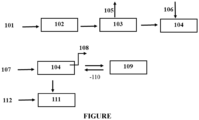
- FIGURE a non-limiting schematic representation of a method of making and using a composition disclosed herein.
- compositions including ammonium sulfate ((NH 4 ) 2 SO 4 ) impregnated acid modified and activated carbon black.
- the composition may act as a sorbent for CO 2 adsorption.
- these compositions may be used to adsorb CO 2 from a CO 2 containing mixed gas stream.
- these compositions are capable of releasing the adsorbed carbon dioxide when heated to regenerate the CO 2 absorbing capacity of the composition.
- these compositions can be used as fertilizer once, or before, the CO 2 absorbing capacity of the composition decreases to a certain threshold.
- the fertilizer composition comprises an ammonium sulfate ((NH 4 ) 2 SO 4 ), acid modified and activated carbon black, potassium sulfate (K 2 SO 4 ), carbon dioxide, and/or live microorganisms, which may be one composition and/or one homogenous mixture.
- the ammonium sulfate may act as a binder for the other components in the fertilizer.
- the fertilizer my include a spent composition comprising ammonium sulfate ((NH 4 ) 2 SO 4 ) and acid modified and activated carbon black used in CO 2 adsorption-desorption cycles.
- the composition comprises an acid modified and activated carbon black embedded with ammonium sulfate.
- the acid modified and activated carbon black comprises carbon black produced from a hydrogen production processes.
- the acid modified and activated carbon black comprises carbon black produced from a hydrocarbon pyrolysis process other than a hydrogen production process.
- the acid modified and activated carbon black comprises carbon black produced from a hydrocarbon cracking process.
- the acid modified and activated carbon black comprises carbon black produced from a waste polymer cracking process.
- the acid modified and activated carbon black comprises methane pyrolysis produced carbon black.
- the acid modified and activated carbon black comprises carbon black produced from a chemical reaction such as decomposition of methane to carbon black and hydrogen as depicted in equation (1). CH 4 ⁇ C + 2H 2 (1)
- the acid modified and activated carbon black comprises carbon black that is produced from biomass. In some aspects, the acid modified and activated carbon black comprises carbon black derived from a natural gas and/or a shale gas.
- the acid modified and activated carbon black is acid modified by sulfuric acid, nitric acid, and/or phosphoric acid.
- the acid modified and activated carbon black is acid modified by sulfuric acid (H 2 SO 4 ).
- the acid modified and activated carbon black is acid modified by nitric acid (HNO 3 ).
- the acid modified and activated carbon black is acid modified by phosphoric acid (H 3 PO 4 ).
- the ammonium sulfate ((NH 4 ) 2 SO 4 ) at least partially binds and/or at least partially surrounds the acid modified and activated carbon black. In some aspects, the ammonium sulfate forms a continuous phase in the composition. In some aspects, at least a portion of the ammonium sulfate ((NH 4 ) 2 SO 4 ) is absorbed on the surface of the acid modified and activated carbon black. In some aspects, the ammonium sulfate is distributed uniformly within pores of the acid modified and activated carbon black. In some aspects, the composition comprises at least a sufficient amount of ammonium sulfate to provide 6 to 20 wt. % of nitrogen.
- the sufficient amount of ammonium sulfate in the composition may be an amount that provides at least any one of, at most any one of, equal to any one of, or between any two of 5, 6, 7, 8, 9, 10, 11, 12, 13, 14, 15, 16, 17, 18, 19, 20, 21, 22, 23, 24, or 25 wt. % of nitrogen.
- the composition forms pores having a pore volume of 100-300 cm 3 /g, or at least any one of, at most any one of, equal to any one of, or between any two of pore volume of 80, 90, 100, 110, 120, 130, 140, 150, 160, 170, 180, 190, 200, 210, 220, 230, 240, 250, 260, 270, 280, 290, 300, 310, 320, 330, 340, or 350 cm 3 /g.
- the composition comprises 10 to 50 wt. % of the acid modified and activated carbon black, or at least any one of, at most any one of, equal to any one of, or between any two of 5, 6, 7, 8, 9, 10, 11, 12, 13, 14, 15, 16, 17, 18, 19, 20, 21, 22, 23, 24, 25, 26, 27, 28, 29, 30, 31, 32, 33, 34, 35, 36, 37, 38, 39, 40, 41, 42, 43, 44, 45, 46, 47, 48, 49, 50, 51, 52, 53, 54, 55, 56, 57, 58, 59, or 60 wt. % of the acid modified and activated carbon black based on the total weight of the composition, or any range or number therein.
- the acid modified and activated carbon black comprises carbon black having a median particle diameter of 10 to 500 nanometers, or at least any one of, at most any one of, equal to any one of, or between any two of median particle diameter of 5, 6, 7, 8, 9, 10, 20, 30, 40, 50, 60, 70, 80, 90, 100, 110, 120, 130, 140, 150, 160, 170, 180, 190, 200, 210, 220, 230, 240, 250, 260, 270, 280, 290, 300, 310, 320, 330, 340, 350, 360, 370, 380, 390, 400, 410, 420, 430, 440, 450, 460, 470, 480, 490, 500, 510, 520, 530, 540, or 550 nanometers, or any range or number therein.
- the composition further comprises 5 to 10 wt. % of potassium sulfate, or at least any one of, at most any one of, equal to any one of, or between any two of 5, 6, 7, 8, 9, 10, 11, 12, 13, 14, or 15 wt. % of potassium sulfate based on the total weight of the composition, or any range or number therein.
- the composition further comprising 5 to 10 wt. % of microelements, or at least any one of, at most any one of, equal to any one of, or between any two of 5, 6, 7, 8, 9, 10, 11, 12, 13, 14, or 15 wt. % of microelements based on the total weight of the composition, or any range or number therein.
- the microelements comprise Mn, Zn, and/or Mg.
- the composition is a powder. In some aspects, the composition is a pellet. In some aspects, the composition has a pellet size of 1-10 mm in diameter, or at least any one of, at most any one of, equal to any one of, or between any two of 1, 2, 3, 4, 5,6, 7, 8, 9, or 10 mm, or any range or number therein.
- a fertilizer comprises: a nitrogen and sulfur compound such as an ammonium sulfate ((NH 4 ) 2 SO 4 ); a porous material such as acid modified and activated carbon black produced from a hydrogen production processes, a hydrocarbon pyrolysis process other than a hydrogen production process, and/or a hydrocarbon and/or waste polymer cracking process; optionally a potassium compound such as potassium sulfate (K 2 SO 4 ); and/or optionally a live microorganism.
- the fertilizer comprises spent compositions for CO 2 adsorption-desorption cycles described herein.
- the fertilizer further comprises microelements, such as Mn, Zn, and/or Mg. In some aspects, the fertilizer further comprises live microorganisms. In some aspects, the fertilizer is a mixture that is a homogeneous mixture. In some aspects, the fertilizer is a multiphase complex. In some aspects, the fertilizer comprises amorphous phases made of components of the fertilizer. In certain aspects, the fertilizer further comprises a binder.
- the fertilizer which may be a fertilizer granule, can contain a mixture containing sulfur (S) present as a sulfate, nitrogen (N) present as an ammonium and/or ammonium sulfate compound, carbon (C) present as carbon black.
- S sulfur
- N nitrogen
- C ammonium and/or ammonium sulfate compound
- the ratio of elements present in the fertilizer may be tailored to specific applications.
- At least a portion of N and S can be present as ammonium sulfate. In some aspects, at least 15 wt. %, or at least 20 wt. %, or at least 25 wt. %, or at least 30 wt. %, or at least 35 wt. %, or at least 40 wt. %, or at least 45 wt. %, or at least 50 wt. %, or at least 55 wt. %, or at least 60 wt. %, or at least 65 wt. %, or at least 70 wt. %, or at least 75 wt. %, or at least 80 wt. %, or at least 85 wt.
- the sufficient amount of ammonium sulfate in the composition may be an amount that provides at least any one of, at most any one of, equal to any one of, or between any two of 10, 11, 12, 13, 14, 15, 16, 17, 18, 19, 20, 21, 22, 23, 24, or 25 wt. % of nitrogen.
- the composition comprises 10 to 50 wt. % of the acid modified and activated carbon black, or at least any one of, at most any one of, equal to any one of, or between any two of 5, 6, 7, 8, 9, 10, 11, 12, 13, 14, 15, 16, 17, 18, 19, 20, 21, 22, 23, 24, 25, 26, 27, 28, 29, 30, 31, 32, 33, 34, 35, 36, 37, 38, 39, 40, 41, 42, 43, 44, 45, 46, 47, 48, 49, 50, 51, 52, 53, 54, 55, 56, 57, 58, 59, or 60 wt. % of the acid modified and activated carbon black based on the total weight of the composition, or any range or number therein.
- the acid modified and activated carbon black comprises carbon black having a median particle diameter of 0 to 100 nanometers, or at least any one of, at most any one of, equal to any one of, or between any two of median particle diameter of 0, 1, 2, 3, 4, 5, 6, 7, 8, 9, 10, 11, 12, 13, 14, 15, 16, 17, 18, 19, 20, 21, 22, 23, 24, 25, 26, 27, 28, 29, 30, 31, 32, 33, 34, 35, 36, 37, 38, 39, 40, 41, 42, 43, 44, 45, 46, 47, 48, 49, 50, 51, 52, 53, 54, 55, 56, 57, 58, 59, 60, 61, 62, 63, 64, 65, 66, 67, 68, 69, 70, 71, 72, 73, 74, 75, 76, 77, 78, 79, 80, 81, 82, 83, 84, 85, 86, 87, 88, 89, 90, 91, 92, 93, 94, 95, 96, 97, 98
- the fertilizer can contain i) potassium sulfate (K 2 SO 4 ) in an amount providing at least any one of, at most any one of, equal to any one of, or between any two of 1, 2, 3, 4, 5, 6, 7, 8, 9, 10, 11, 12, 13, 14, and 15 wt. % based on the total weight of the mixture and/or the fertilizer granule; ii) micronutrients in an amount providing at least any one of, at most any one of, equal to any one of, or between any two of 1, 2, 3, 4, 5, 6, 7, 8, 9, 10, 11, 12, 13, 14, and 15 wt.
- K 2 SO 4 potassium sulfate
- micronutrients in an amount providing at least any one of, at most any one of, equal to any one of, or between any two of 1, 2, 3, 4, 5, 6, 7, 8, 9, 10, 11, 12, 13, 14, and 15 wt.
- live microorganisms in an amount providing at least any one of, at most any one of, equal to any one of, or between any two of 0.001, 0.01, 0.1, 0.2, 0.3, 0.4, 0.5, 0.6, 0.7, 0.8, 0.9, 1, 1.1, 1.2, 1.3, 1.4, 1.5, 1.6, 1.7, 1.8, 1.9, 2, 3, 4, or 5 wt. %, or any range thereof, based on the weight of the fertilizer granule.
- the mixture comprises C, N, K, and/or S wherein i) the C content of the mixture can be at least any one of, at most any one of, equal to any one of, or between any two of 1, 2, 3, 4, 5, 6, 7, 8, 9, 10, 11, 12, 13, 14, 15, 16, 17, 18, 19, 20, 21, 22, 23, 24, 25, 26, 27, 28, 29, 30, 31, 32, 33, 34, 35, 36, 37, 38, 39, 40, 41, 42, 43, 44, 45, 46, 47, 48, 49, 50, 51, 52, 53, 54, 55, 56, 57, 58, 59, 60, 61, 62, 63, 64, 65, 66, 67, 68, 69, 70, 71, 72, 73, 74, 75, 76, 77, 78, 79, 80, 81, 82, 83, 84, 85, 86, 87, 88, 89, 90, 91, 92, 93, 94, 95, 96, 97, 98, 99, 99.5,
- the N content of the mixture can be at least any one of, at most any one of, equal to any one of, or between any two of 1, 2, 3, 4, 5, 6, 7, 8, 9, 10, 11, 12, 13, 14, 15, 16, 17, 18, 19, 20, 21, 22, 23, 24, 25, 26, 27, 28, 29, 30, 31, 32, 33, 34, 35, 36, 37, 38, 39, 40, 41, 42, 43, 44, 45, 46, 47, 48, 49, 50, 51, 52, 53, 54, 55, 56, 57, 58, 59, 60, 61, 62, 63, 64, 65, 66, 67, 68, 69, 70, 71, 72, 73, 74, 75, 76, 77, 78, 79, 80, 81, 82, 83, 84, 85, 86, 87, 88, 89, 90, 91, 92, 93, 94, 95, 96, 97, 98, 99, 99.5, and 100 wt.
- the K content of the mixture can be at least any one of, at most any one of, equal to any one of, or between any two of 1, 2, 3, 4, 5, 6, 7, 8, 9, 10, 11, 12, 13, 14, 15, 16, 17, 18, 19, 20, 21, 22, 23, 24, 25, 26, 27, 28, 29, 30, 31, 32, 33, 34, 35, 36, 37, 38, 39, 40, 41, 42, 43, 44, 45, 46, 47, 48, 49, 50, 51, 52, 53, 54, 55, 56, 57, 58, 59, 60, 61, 62, 63, 64, 65, 66, 67, 68, 69, 70, 71, 72, 73, 74, 75, 76, 77, 78, 79, 80, 81, 82, 83, 84, 85, 86, 87, 88, 89, 90, 91, 92, 93, 94, 95, 96, 97, 98, 99, 99.5, and 100 wt.
- the S content of the mixture can be at least any one of, at most any one of, equal to any one of, or between any two of 1, 2, 3, 4, 5, 6, 7, 8, 9, 10, 11, 12, 13, 14, 15, 16, 17, 18, 19, 20, 21, 22, 23, 24, 25, 26, 27, 28, 29, 30, 31, 32, 33, 34, 35, 36, 37, 38, 39, 40, 41, 42, 43, 44, 45, 46, 47, 48, 49, 50, 51, 52, 53, 54, 55, 56, 57, 58, 59, 60, 61, 62, 63, 64, 65, 66, 67, 68, 69, 70, 71, 72, 73, 74, 75, 76, 77, 78, 79, 80, 81, 82, 83, 84, 85, 86, 87, 88, 89, 90, 91, 92, 93, 94, 95, 96, 97, 98, 99, 99.5, and 100 wt. based on the total weight of the mixture
- the C, N, K, and/or S can be present as and/or sourced as a water soluble compound or a water insoluble compound.
- the C, N, K, and/or S can be present as a salt.
- the C, N, K, and/or S can be present as a water soluble salt.
- the water soluble N and S can be (NH 4 ) 2 SO 4 .
- the water soluble K and S can be K 2 SO 4 .
- the C, N, K, and/or S salt can be in a non-hydrate and/or one or more hydrate form.
- Moisture content of the dried composition can be less than 1 wt. %, such as 0.1 wt. % to 0.9 wt. %, or any one of or between any two of 0.1, 0.2, 0.3, 0.4, 0.5, 0.6, 0.7, 0.8, 0.9, or 1 wt. %, or any range thereof, based on the weight of the composition.
- the moisture content can be measured by drying the sample at 50° C for 25 min and measuring the amount of mass lost by the fertilizer after being dried.
- the fertilizer can be of any suitable shape.
- Non-limiting shapes include spherical, cuboidal, cylindrical, puck shape, oval, and oblong shapes.
- the fertilizer granule can be of cylindrical shape with a circular, elliptical, ovular, triangular, square, rectangular, pentagonal, or hexagonal cross section, although cylindrical shaped core having a cross-section of other shapes can also be made.
- the fertilizer granule at its widest dimension can be 0.5 mm to 6 mm, or 0.5 mm to 5 mm, preferably 1 mm to 4 mm, or at least any one of, at most any one of, equal to any one of, or between any two of 0.5 mm, 1 mm, 1.5 mm, 2 mm, 2.5 mm, 3 mm, 3.5 mm, 4 mm, 4.5 mm, 5 mm, 5.5 mm, and 6 mm.
- the fertilizer granule can have a substantially spherical shape with an average diameter 0.5 mm to 6 mm, or 0.5 mm to 5 mm, preferably 1 mm to 4 mm, or at least any one of, at most any one of, equal to any one of, or between any two of 0.5 mm, 1 mm, 1.5 mm, 2 mm, 2.5 mm, 3 mm, 3.5 mm, 4 mm, 4.5 mm, 5 mm, 5.5 mm, and 6 mm.
- the fertilizer can be water and/or soil dispersible.
- a fertilizer granule having a size of 2 mm to 4 mm prior to adding to water can disintegrate into particles having sizes less than 1 mm, less than 0.9 mm, less than 0.8 mm, less than 0.7 mm, less than 0.6 mm, less than 0.5 mm, less than 0.4 mm, or less than 0.3 mm, within 1 minute of adding the granule to water at a pH 7, under stirring at a rate 90 rpm to 110 rpm, at an ambient temperature.
- a fertilizer granule having a size of 2 mm to 4 mm prior to adding to water does not disintegrate into only particles having sizes less than 1 mm, less than 0.9 mm, less than 0.8 mm, less than 0.7 mm, less than 0.6 mm, less than 0.5 mm, less than 0.4 mm, or less than 0.3 mm, before 10 minutes, 15 minutes, 20 minutes, 25 minutes, 30 minutes, 35 minutes, 40 minutes, 45 minutes, 50 minutes, 55 minutes, 60 minutes, 2 hours, 3 hours, 4 hours, 5 hours, 6 hours, 7 hours, 8 hours, 9 hours, 10 hours, or greater than 10 hours of adding the granule to water at a pH 7, under stirring at a rate 90 rpm to 110 rpm, at an ambient temperature.
- the mixture can have a compositional make-up that is substantially homogeneous.
- a compositional make-up for a 1 mm ⁇ 1 mm ⁇ 1 mm cube at any position of the mixture can be similar (within ⁇ 20 %, or ⁇ 10 %, or ⁇ 5 %, or ⁇ 3 %, ⁇ 2 %, or ⁇ 1 %, or ⁇ 0.5 %) to that of a 1 mm ⁇ 1 mm ⁇ 1 mm cube at any other position of the mixture.
- the fertilizer granule can contain an homogeneous mixture.
- the homogeneous mixture can have compositions as described above.
- the homogenous mixture can have an optional coating on the outer surface of the homogenous mixture.
- the (NH 4 ) 2 SO4 forms an amorphous phase, a continuous phase, and/or encapsulates other ingredients in the fertilizer.
- the fertilizer comprises a matrix of (NH 4 ) 2 SO4 that it at least partially binds and/or encapsulates and/or surrounds at least a portion of the acid modified and activated carbon black and/or potassium sulfate.
- the fertilizer comprises acid modified and activated carbon black that at least partially binds and/or encapsulates and/or surrounds at least a portion of the (NH 4 ) 2 SO4 and/or potassium sulfate. In some instances, the fertilizer comprises particles of the (NH 4 ) 2 SO 4 , potassium sulfate, and/or of acid modified and activated carbon black. In some aspects, the fertilizer is a multiphase complex. In some aspects, the fertilizer comprises amorphous phases made of components of the fertilizer.
- additional fertilizer substances can be included or excluded in the fertilizer. If included, additional fertilizers can be chosen based on the particular needs of certain types of soil, climate, or other growing conditions to maximize the efficacy of the fertilizer in enhancing plant growth and crop yield. Additional additives may also be included or excluded in the fertilizer. Non-limiting examples of additives that can be included or excluded from the fertilizer of the present invention include additional nitrogen nutrients, additional phosphorus nutrients, additional potassium nutrients, additional micronutrients, additional secondary nutrients, inhibitors, pH buffers, etc.
- the micronutrient can be copper, iron, chloride, manganese, molybdenum, or nickel, or any combinations thereof.
- the nitrogen nutrient can be urea, ammonium nitrate, ammonium sulfate, diammonium phosphate, monoammonium phosphate, urea-formaldehyde, ammonium chloride, and potassium nitrate.
- the additional secondary nutrients may include lime and/or superphosphate.
- the additional fertilizer substances and/or the additional additives are contained in the optional coating of the fertilizer.
- the inhibitors include nitrification inhibitors and/or urease inhibitors.
- Suitable nitrification inhibitors include, but are not limited to, 3,4-dimethylpyrazole phosphate (DMPP), dicyandiamide (DCD), thiourea (TU), 2-chloro-6-(trichloromethyl)-pyridine (Nitrapyrin), 5-ethoxy-3-trichloromethyl-1,2,4-thiadiazol, which is sold under the tradename Terrazole ® , by OHP Inc., USA, 2-amino 4-chloro 6-methyl pyrimidine (AM), 2-mercaptobenzothiazole (MBT), or 2-sulfanilamidothiazole (ST), and any combination thereof.
- DMPP 3,4-dimethylpyrazole phosphate
- DCD dicyandiamide
- TU thiourea
- 2-chloro-6-(trichloromethyl)-pyridine Natrapyrin
- a nitrification inhibitor can comprise DMPP, DCD, TU, nitrapyrin, 5-ethoxy-3-trichloromethyl-1,2,4-thiadiazol, AM, MBT, or ST, or a combination thereof.
- the urease inhibitor may include, but are not limited to, triamide, such as N-(n-butyl) thiophosphoric triamide (NBTPT) and N-(n-propyl) thiophosphoric triamide.
- a fertilizer composition can comprise NBTPT, DMPP, TU, DCD, PPDA, nitrapyrin, 5-ethoxy-3-trichloromethyl-1,2,4-thiadiazol, AM, MBT, ST, or a combination thereof.
- the pH buffers include MgO, KH 2 PO 4 , NaHCO 3 , chalk powder, aluminum, magnesium hydroxide, aluminum hydroxide/magnesium hydroxide co-precipitate, aluminum hydroxide/sodium bicarbonate co-precipitate, calcium acetate, calcium bicarbonate, calcium borate, calcium carbonate, calcium bicarbonate, calcium citrate, calcium gluconate, calcium hydroxide, dibasic sodium phosphate, dipotassium hydrogen phosphate, dipotassium phosphate, disodium hydrogen phosphate, magnesium acetate, magnesium borate, magnesium bicarbonate, magnesium carbonate, magnesium hydroxide, magnesium lactate, magnesium oxide, magnesium phosphate, magnesium silicate, magnesium succinate, magnesium tartrate, potassium acetate, potassium carbonate, potassium bicarbonate, potassium borate, potassium citrate, potassium metaphosphate, potassium phthalate, potassium phosphate, potassium polyphosphate, potassium pyrophosphate, potassium succinate, potassium tartrate, sodium acetate, sodium bicarbonate,
- the fertilizer described herein can be comprised in a composition useful for application to soil.
- the composition may include other fertilizer compounds, micronutrients, primary nutrients, urea, additional nitrogen nutrients, insecticides, herbicides, or fungicides, or combinations thereof.
- the fertilizer described herein can also be included in a blended composition comprising other fertilizers.
- the other fertilizer can be urea, monoammonium phosphate (MAP), diammonium phosphate (DAP), muriate of potash (MOP), monopotassium phosphate (MKP), triple super phosphate (TSP), rock phosphate, single super phosphate (SSP), ammonium sulfate, and the like.
- a composition formed into a granule can have desirable physical properties such as desired levels of abrasion resistance, granule strength, pelletizability, hygroscopicity, granule shape, and size distribution.
- the granule can have a crush strength above 1.5 kgf, such as above 1.8 kgf, such as 2 kgf to 6 kgf, or at least any one of, equal to any one of, or between any two of 2, 2.5, 3, 3.5, 4, 4.5, 5, 5.5, and 6 kgf.
- Bulk density of the granules can be 1 g/cc to 1.2 g/cc, or at least any one of, at most any one of, equal to any one of, or between any two of 1, 1.02, 1.04, 1.06, 1.08, 1.1, 1.12, 1.14, 1.16, 1.18, and 1.2 g/cc.
- 10 mg or more, such as 10 mg to 40 mg, or at least any one of, at most any one of, equal to any one of, or between any two of 10, 11, 12, 13, 14, 15, 16, 17, 18, 19, 20, 21, 22, 23, 24, 25, 26, 27, 28, 29, 30, 31, 32, 33, 34, 35, 36, 37, 38, 39, and 40 mg of the granule can dissolve in 1 ml of water at a pH 7, under stirring at a rate 90 to 110 rpm, and at an ambient temperature, within 5 minutes of adding 100 mg of the granules to the water or only after 10 minutes, 20 minutes, 30 minutes, 40 minutes, 50 minutes, 60 minutes, 2 hours, 4 hours, 6 hours, 8 hours, 10 hours, 15 hours, or 24 hours of adding 100 mg of the granules to the water.
- the granule is capable of losing less than 0.13 wt. %, such as 0.02 % to 0.12 wt. %, or at most any one of, equal to any one of, or between any two of 0.02, 0.03, 0.04, 0.05, 0.06, 0.07, 0.08, 0.09, 0.1, 0.11, and 0.12 wt. % in an attrition loss test.
- Attrition loss can be measured using the following attrition loss test.
- a method of producing a composition described herein may comprise impregnating acid modified and activated carbon black with ammonium sulfate to produce a product comprising 6 to 20 wt. % of nitrogen.
- the feed mixture ingredients to produce the composition can include i) an acid modified and activated carbon black source, e.g., carbon black from methane pyrolysis and/or carbon black from a refinery process, ii) a N source, e.g., ammonium sulfate, nitric acid, and/or ammonia, iii) a S source, e.g., ammonium sulfate, potassium sulfate, and/or sulfuric acid.
- a mixture ingredient provides more than one of carbon black, N, and/or S sources.
- a mixture ingredient further provides a K source, e.g., potassium sulfate.
- a mixture ingredient further provides micronutrients, such as Mn, Zn, and/or Mg. In some instances, a mixture ingredient further provides a live microorganisms.
- one or more ingredients can be added as a water solution. In some instances, the mixture ingredients are provided as a powder. In some instances, one or more ingredients can be added as a liquid. In some instances, one or more ingredients can be added as a gas. In some instances, a portion of the mixture of ingredients is provided as a powder.
- the ammonium sulfate ((NH 4 ) 2 SO 4 ) and acid modified and activated carbon black are contacted at a temperature of at least, at most, equal to, or between any two of 20, 21, 22, 23, 24, 25, 26, 27, 28, 29, 30, 31, 32, 33, 34, 35, 36, 37, 38, 39, 40, 41, 42, 43, 44, 45, 46, 47, 48, 49, 50, 51, 52, 53, 54, 55, 56, 57, 58, 59, 60, 61, 62, 63, 64, 65, 66, 67, 68, 69, 70, 71, 72, 73, 74, 75, 76, 77, 78, 79, 80, 81, 82, 83, 84, 85, 86, 87, 88, 89, 90, 91, 92, 93, 94, 95, 96, 97, 98, 99, 100, 101, 102, 103, 104, 105, 106, 107
- the desired size of a final composition product can have a diameter of 0.5 to 5 mm, or 1 to 4 mm, have a size lower than 0.5 mm or 1 mm, and/or have a size bigger than 4 mm or 5 mm.
- FIGURE shows a method of making an activated carbon black and ammonium sulfate composition (104), and using the same composition for CO2 capture (109) as well as a fertilizer (111) according to an example of the present invention.
- an acid modified activated carbon black (103) is prepared from a carbon black, which is produced in a pyrolysis reactor (102) through methane (101) decomposition and H 2 gas (105) release.
- An ammonium sulfate solution (106) can be contacted with the produced acid modified activated carbon black (103) to generate a sorbent composition comprising an activated carbon black and ammonium sulfate (104).
- CO 2 comprising gaseous mixture (107) purged through the sorbent composition (104), may form a sorbent composition with captured CO 2 (109) and separate out other gases (108), such as nitrogen.
- the sorbent composition with captured CO 2 (109) may releases CO 2 (110), and regenerate the sorbent composition (104).
- the regenerated composition (104) may be use as a fertilizer (111) by combining with other ingredients (112), such as potassium sulfate, microelements, and/or microorganisms.
- the composition including the ammonium sulfate ((NH 4 ) 2 SO 4 ) and acid modified and activated carbon black pellets can be used for CO 2 capture.
- a method of capturing CO 2 can comprise contacting CO 2 with any of the compositions described hereinto produce a CO 2 adsorbed composition. In some instances, the CO 2 is adsorbed on the composition. In some aspects, the method further comprises desorption of the CO 2 .
- Both adsorption, and/or desorption steps may occur at approximately 20° C to 110° C, such as 15, 16, 17, 18, 19, 20, 21, 22, 23, 24, 25, 26, 27, 28, 29, 30, 31, 32, 33, 34, 35, 36, 37, 38, 39, 40, 41, 42, 43, 44, 45, 46, 47, 48, 49, 50, 51, 52, 53, 54, 55, 56, 57, 58, 59, 60, 61, 62, 63, 64, 65, 66, 67, 68, 69, 70, 71, 72, 73, 74, 75, 76, 77, 78, 79, 80, 81, 82, 83, 84, 85, 86, 87, 88, 89, 90, 91, 92, 93, 94, 95, 96, 97, 98, 99, 100, 101, 102, 103, 104, 105, 106, 107, 108, 109, 110, 111, 112, 113, 114, 115
- adsorption may occur at 10 to 50° C or 10, 20, 21, 22, 23, 24, 25, 26, 27, 28, 29, 30, 31, 32, 33, 34, 35, 36, 37, 38, 39, 40, 41, 42, 43, 44, 45, 46, 47, 48, 49, or 50° C or any temperature or range therein.
- desorption may occur at 50 to 110° C or 51, 52, 53, 54, 55, 56, 57, 58, 59, 60, 61, 62, 63, 64, 65, 66, 67, 68, 69, 70, 71, 72, 73, 74, 75, 76, 77, 78, 79, 80, 81, 82, 83, 84, 85, 86, 87, 88, 89, 90, 91, 92, 93, 94, 95, 96, 97, 98, 99, 100, 101, 102, 103, 104, 105, 106, 107, 108, 109, 110, 111, 112, 113, 114, and 115° C or any temperature or range therein.
- the compositions which were used as a CO 2 adsorbent may have been used for at least one or more CO 2 adsorption-desorption cycles.
- compositions containing the fertilizer, and fertilizer blends containing the fertilizer of the present disclosure can be used in methods of increasing the amount of one or more plant nutrients in soil and of enhancing plant growth.
- Such methods can include applying to the soil, a crop, and/or water an effective amount of a composition and/or blend containing the fertilizer of the present invention.
- the method may include increasing the growth and yield of crops, trees, ornamentals, etc., such as, for example, palm, coconut, rice, wheat, corn, barley, oats, and/or soybeans.
- the method can include applying the fertilizer blend of the present invention to at least one of a soil, an organism, a liquid carrier, a liquid solvent, etc.
- the composition(s) and/or fertilizer blends(s) containing the fertilizer can be applied to plants and/or soil as a top dressing fertilizer, basal fertilizer, and/or through any suitable method of application.
- Non-limiting examples of plants that can benefit from the fertilizer of the present invention include vines, trees, shrubs, stalked plants, ferns, etc.
- the plants may include orchard crops, vines, ornamental plants, food crops, timber, and harvested plants.
- the plants may include Gymnosperms, Angiosperms, and/or Pteridophytes.
- the ammonium sulfate (NH 4 ) 2 SO 4 ) impregnated carbon black composition samples can be tested for CO 2 adsorption at different temperature ranges from 25° C to 35° C and pressures up to 30 bar.
- the CO 2 adsorption capacity of these compositions may be in the range of 10 to 25 mmol/g at 25° C and 30 bar.
- the energy consumption requirement for these compositions are in the range of 1000-2000 kJ/kg CO 2 , which is significantly lower than of MEA.
- CO 2 adsorption on porous (NH 4 ) 2 SO4 impregnated carbon black may depend in part on the pore volume and particle size of the carbon black.
- Pore volume and particle size of impregnated carbon black may be optimize by varying the wt.% of (NH 4 ) 2 SO4 in the composition.
- the effect of temperature on the CO 2 adsorption capacity of these compositions can be evaluated by recording the CO 2 adsorption isotherms at various temperatures and 30 bar pressure. Anticipated temperature needed to strip CO 2 (desorption) in these compositions are less than 110° C, (where as MEA usually needs to be heated about 110-140° C to strip CO 2 ).
Landscapes
- Chemical & Material Sciences (AREA)
- Analytical Chemistry (AREA)
- Organic Chemistry (AREA)
- Chemical Kinetics & Catalysis (AREA)
- Inorganic Chemistry (AREA)
- Physics & Mathematics (AREA)
- Thermal Sciences (AREA)
- Fertilizers (AREA)
Priority Applications (1)
| Application Number | Priority Date | Filing Date | Title |
|---|---|---|---|
| EP23217191.8A EP4570372A1 (fr) | 2023-12-15 | 2023-12-15 | Noir de carbone imprégné de sulfate d'ammonium en tant qu'adsorbant de co2 |
Applications Claiming Priority (1)
| Application Number | Priority Date | Filing Date | Title |
|---|---|---|---|
| EP23217191.8A EP4570372A1 (fr) | 2023-12-15 | 2023-12-15 | Noir de carbone imprégné de sulfate d'ammonium en tant qu'adsorbant de co2 |
Publications (1)
| Publication Number | Publication Date |
|---|---|
| EP4570372A1 true EP4570372A1 (fr) | 2025-06-18 |
Family
ID=89223740
Family Applications (1)
| Application Number | Title | Priority Date | Filing Date |
|---|---|---|---|
| EP23217191.8A Withdrawn EP4570372A1 (fr) | 2023-12-15 | 2023-12-15 | Noir de carbone imprégné de sulfate d'ammonium en tant qu'adsorbant de co2 |
Country Status (1)
| Country | Link |
|---|---|
| EP (1) | EP4570372A1 (fr) |
Citations (3)
| Publication number | Priority date | Publication date | Assignee | Title |
|---|---|---|---|---|
| US20100209988A1 (en) * | 2005-11-08 | 2010-08-19 | The University of Surrey The Forrestry Commission | Bioremediation Materials |
| US20160296908A1 (en) * | 2015-04-07 | 2016-10-13 | Ada Carbon Solutions, Llc | Activated carbon sorbent composition with reduced auto-ignition properties |
| WO2016187161A1 (fr) * | 2015-05-15 | 2016-11-24 | Cool Planet Energy Systems, Inc. | Biocharbon amélioré |
-
2023
- 2023-12-15 EP EP23217191.8A patent/EP4570372A1/fr not_active Withdrawn
Patent Citations (3)
| Publication number | Priority date | Publication date | Assignee | Title |
|---|---|---|---|---|
| US20100209988A1 (en) * | 2005-11-08 | 2010-08-19 | The University of Surrey The Forrestry Commission | Bioremediation Materials |
| US20160296908A1 (en) * | 2015-04-07 | 2016-10-13 | Ada Carbon Solutions, Llc | Activated carbon sorbent composition with reduced auto-ignition properties |
| WO2016187161A1 (fr) * | 2015-05-15 | 2016-11-24 | Cool Planet Energy Systems, Inc. | Biocharbon amélioré |
Non-Patent Citations (2)
| Title |
|---|
| GAYATRI YADAVALLI: "Carbon dioxide capture using ammonium sulfate surface modified activated biomass carbon", BIOMASS AND BIOENERGY, vol. 98, 1 March 2017 (2017-03-01), AMSTERDAM, NL, pages 53 - 60, XP093166549, ISSN: 0961-9534, DOI: 10.1016/j.biombioe.2017.01.015 * |
| MOHD AZMI NURADILA ZAHIRAH ET AL: "Recent advances in biomass based activated carbon for carbon dioxide capture - A review", JOURNAL OF INDUSTRIAL AND ENGINEERING CHEMISTRY, THE KOREAN SOCIETY OF INDUSTRIAL AND ENGINEERING CHEMISTRY, KOREA, vol. 116, 20 August 2022 (2022-08-20), pages 1 - 20, XP087217631, ISSN: 1226-086X, [retrieved on 20220820], DOI: 10.1016/J.JIEC.2022.08.021 * |
Similar Documents
| Publication | Publication Date | Title |
|---|---|---|
| US11254622B2 (en) | NPK-Si-humate fertilizer, method for production and use thereof | |
| EP4299553A1 (fr) | Production de nutriments d'azote, de potassium et de soufre par la dé-carbonisation et l'utilisation de sulfate de calcium | |
| TWI787397B (zh) | NPK-Si肥料、其製造方法及用途 | |
| Jayarathna et al. | Biochar based slow-release urea fertilizer: Production and assessing the effects on growth of lowland rice and nitrogen dynamics in an Alfisol | |
| AU2018444436B2 (en) | Method for obtaining a granulated phosphate fertiliser and phosphate fertiliser obtained | |
| CN105732127A (zh) | 一种纳米磷铵磷复肥制备方法 | |
| WO2024028835A1 (fr) | Engrais complexe comprenant de l'azote, du phosphore et du soufre encapsulé dans des nutriments secondaires de calcium et de magnésium | |
| EP4299554A1 (fr) | Procédés de préparation d'un nutriment ca pour soutenir la neutralité carbone | |
| EP4613726A1 (fr) | Production d'un nutriment à base d'azote, de potassium, de soufre par décarbonisation et utilisation de sulfate de calcium | |
| EP4317117A1 (fr) | Nutriment complexe n-p-ca-mg revêtu de sio2 | |
| US20240182374A1 (en) | Cocrystal fertilizers | |
| CN112110767A (zh) | 一种含活性因子有机无机复混肥料及其制备与应用 | |
| EP4299523A1 (fr) | Engrais knh4so4, caco3, cacl2 | |
| WO2025229577A1 (fr) | Compositions pour photosynthèse améliorée | |
| WO2024105568A1 (fr) | Engrais comprenant du laitier métallique et du coke | |
| Grant | Report on Physical, Chemical and Biological Methods to Improve P Uptake by Crops | |
| WO2024105561A1 (fr) | Composition d'engrais obtenue à partir de scories métalliques d'acide nitrique | |
| EP4619362A1 (fr) | Intégration de nitrate d'ammonium et de calcium et de sulfate d'ammonium pour un complexe nutritif sûr et stable | |
| WO2025141411A1 (fr) | Engrais à base de calcium, d'azote, de potassium et de soufre complexe et durable à libération lente | |
| CN120329125A (zh) | 一种用于盐碱地治理含矿源硝基腐植酸复合肥及制备方法 | |
| Fan | Sulphur and Enhanced Efficiency Fertilizers |
Legal Events
| Date | Code | Title | Description |
|---|---|---|---|
| PUAI | Public reference made under article 153(3) epc to a published international application that has entered the european phase |
Free format text: ORIGINAL CODE: 0009012 |
|
| STAA | Information on the status of an ep patent application or granted ep patent |
Free format text: STATUS: THE APPLICATION HAS BEEN PUBLISHED |
|
| AK | Designated contracting states |
Kind code of ref document: A1 Designated state(s): AL AT BE BG CH CY CZ DE DK EE ES FI FR GB GR HR HU IE IS IT LI LT LU LV MC ME MK MT NL NO PL PT RO RS SE SI SK SM TR |
|
| STAA | Information on the status of an ep patent application or granted ep patent |
Free format text: STATUS: REQUEST FOR EXAMINATION WAS MADE |
|
| 17P | Request for examination filed |
Effective date: 20251216 |
|
| STAA | Information on the status of an ep patent application or granted ep patent |
Free format text: STATUS: THE APPLICATION HAS BEEN WITHDRAWN |
|
| 18W | Application withdrawn |
Effective date: 20260226 |