EP4570599A1 - Stossfängerstruktur für ein kraftfahrzeug - Google Patents
Stossfängerstruktur für ein kraftfahrzeug Download PDFInfo
- Publication number
- EP4570599A1 EP4570599A1 EP23217255.1A EP23217255A EP4570599A1 EP 4570599 A1 EP4570599 A1 EP 4570599A1 EP 23217255 A EP23217255 A EP 23217255A EP 4570599 A1 EP4570599 A1 EP 4570599A1
- Authority
- EP
- European Patent Office
- Prior art keywords
- bumper
- face
- bumper beam
- pin
- motor vehicle
- Prior art date
- Legal status (The legal status is an assumption and is not a legal conclusion. Google has not performed a legal analysis and makes no representation as to the accuracy of the status listed.)
- Pending
Links
Images



Classifications
-
- B—PERFORMING OPERATIONS; TRANSPORTING
- B60—VEHICLES IN GENERAL
- B60R—VEHICLES, VEHICLE FITTINGS, OR VEHICLE PARTS, NOT OTHERWISE PROVIDED FOR
- B60R19/00—Wheel guards; Radiator guards, e.g. grilles; Obstruction removers; Fittings damping bouncing force in collisions
- B60R19/02—Bumpers, i.e. impact receiving or absorbing members for protecting vehicles or fending off blows from other vehicles or objects
- B60R19/24—Arrangements for mounting bumpers on vehicles
-
- B—PERFORMING OPERATIONS; TRANSPORTING
- B60—VEHICLES IN GENERAL
- B60R—VEHICLES, VEHICLE FITTINGS, OR VEHICLE PARTS, NOT OTHERWISE PROVIDED FOR
- B60R19/00—Wheel guards; Radiator guards, e.g. grilles; Obstruction removers; Fittings damping bouncing force in collisions
- B60R19/02—Bumpers, i.e. impact receiving or absorbing members for protecting vehicles or fending off blows from other vehicles or objects
- B60R19/18—Bumpers, i.e. impact receiving or absorbing members for protecting vehicles or fending off blows from other vehicles or objects characterised by the cross-section; Means within the bumper to absorb impact
- B60R2019/1886—Bumper fascias and fastening means therefor
-
- B—PERFORMING OPERATIONS; TRANSPORTING
- B60—VEHICLES IN GENERAL
- B60R—VEHICLES, VEHICLE FITTINGS, OR VEHICLE PARTS, NOT OTHERWISE PROVIDED FOR
- B60R19/00—Wheel guards; Radiator guards, e.g. grilles; Obstruction removers; Fittings damping bouncing force in collisions
- B60R19/02—Bumpers, i.e. impact receiving or absorbing members for protecting vehicles or fending off blows from other vehicles or objects
- B60R19/24—Arrangements for mounting bumpers on vehicles
- B60R2019/247—Fastening of bumpers' side ends
Definitions
- the disclosure relates generally to a bumper structure for a motor vehicle and more particularly to a system for positioning a bumper face with respect to a bumper beam and for locking the bumper face to the bumper beam.
- the disclosure also relates to a method for locking a bumper face to a bumper beam.
- the disclosure can be applied in heavy-duty vehicles, such as trucks, buses, and construction equipment. Although the disclosure may be described with respect to a particular vehicle, the disclosure is not restricted to any particular vehicle.
- a bumper is mounted to both front and rear ends of a vehicle body.
- the bumper protects the vehicle body and functional devices such as lamp by absorbing collision energy when the vehicle collides with another vehicle or an object. Further, the bumper affects an aerodynamic performance of the vehicle and plays an important role in design parts.
- the bumper has a bumper assembly structure constructed by a bumper beam of the vehicle body, a mechanism for absorbing the collision energy, and a bumper face covering the bumper beam.
- the bumper beam can be formed from a high strength steel member in many cases to limit the increase in weight caused by the strengthened bumper.
- the bumper face is not arranged as a strengthening member, but is used to cover the bumper beam and make the bumper look more attractive.
- the bumper face is typically formed by a lightweight resin member that is easily deformed during a collision.
- the bumper face is attached to the bumper beam using conventional bolts and these bolts must be accessible from outside the bumper face, as the vehicle hood is closed.
- end covers of the bumper face usually have to be removed. The use of end covers limits the freedom of style and design of the bumper and makes the attachment of the bumper face to the bumper beam particularly complex.
- a bumper structure for a motor vehicle comprises:
- the first aspect of the disclosure may seek to use an automatic locking and unlocking system that eliminates the need for manual docking.
- the retractable projection comes in contact with the bumper beam, causing the projection to retract.
- the projection comes out when the projection is aligned with the positioning hole which ensure that the bumper face locks onto the bumper beam.
- the bumper face is self guided in relation to the bumper beam, simply by contacting the positioning projections along the side members of the bumper beam.
- end covers are no longer necessary, different styles of bumper faces can be designed.
- the bumper face is configured to be locked to the bumper beam by a movement of the bumper face from a position in which each positioning projection contacts in a retracted position with a side part of the bumper beam to a locking position in which each positioning projection extends in a non-retracted position at least partially inside a positioning hole.
- the side members of the bumper beam are connected to a vehicle body.
- each retractable positioning projection is a positioning pin associated with a spring and configured to retract during contact of the side part of the bumper face with the side member of the bumper beam and to come out by spring force when the positioning pin extends in a non-retracted position at least partially inside the positioning hole.
- a U-shaped bracket including two holes receiving the pin is mounted on each side part of the bumper face.
- an abutment of the pin makes it possible to limit the movement of the pin in the direction of the axis passing through the two holes.
- the pin is a beveled or a tapered pin.
- the bumper structure comprises bolts for attaching the bumper face to the bumper beam.
- the bumper structure is a front bumper structure.
- a motor vehicle comprises a bumper structure described above.
- the motor vehicle is a truck.
- a method for locking a bumper face to a bumper beam of a motor vehicle implements a bumper structure described above.
- the method comprises:
- the method further comprises:
- the motor vehicle is a truck and the bumper structure is a front bumper structure.
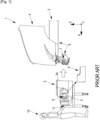
- FIG. 1 is a schematic side view of a bumper structure of a motor vehicle 1 of the prior art, during a first step of attaching a bumper face 2 to a bumper beam 3.
- the bumper structure extends generally in a longitudinal direction X corresponding to the longitudinal axis of the vehicle.
- the spatial representation of the bumper structure is supplemented by a transverse direction Y and a vertical direction Z.
- FIG. 1 shows the front part of a vehicle 1, typically a truck, and illustrates one example of a conventional device for attaching a bumper face 2 made typically of resin to a bumper beam 3 connected to a vehicle body 3.
- the bumper beam 3 is horizontally mounted and can include left-hand and right-hand side members 9 that are connected on the rear side to a vehicle body of the motor vehicle 1 and on the front side to a horizontal transverse front member of the bumper beam 3.
- the side members 9 may each comprise an upper part which is connected to the vehicle body and a lower part which is connected to the front member of the bumper beam 3.
- the bumper face 2 is fixedly mounted to the bumper beam 3 such that the bumper face 2 covers a front face of this bumper beam 3.
- a hood 4 covers the bumper assembly.
- the bumper face 2 has left-hand and right-hand bumper face side parts 2a.
- the bumper face 2 has a side opening 5 on each side part 2a.
- Each opening 5 provides access to side bolts to secure the bumper face 2 laterally to the bumper beam 3 via mounting holes 6 of the bumper face 2 and corresponding mounting holes 7 of the bumper beam 3, typically mounting holes 7 of left-hand and right-hand side members 9.
- Each opening side 5 is covered by a side cover 8.
- the cover 8 is, for example, a fog lamp cover.
- the bumper face 2 in placed on a docking device 11 mounted on wheels.
- a first operator 10 removes each cover 8 so as to leave the openings 5 visible and moves the bumper face 2 longitudinally towards the bumper beam 3 in order to align the mounting holes 6 of the bumper face 2 with the corresponding mounting holes 7 of the bumper beam 3.
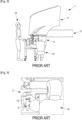
- FIG. 2 is a schematic side view of the bumper structure of the prior art, during a second step of attaching the bumper face 2 to the bumper beam 3.
- a second operator 10 manually installs bolts 12 for attaching the bumper face 2 to the side members 9 of the bumper beam 3.
- FIG. 3 is a detail view of FIG. 2 and shows how the bumper face 2 is attached to the bumper beam 3 by the second operator 10 using the bolts 12.
- FIG. 4 is a schematic side view of the bumper structure of the prior art, during a third step of attaching the bumper face 2 to the bumper beam 3.
- the second operator 10 puts the side covers 8 back in place and the first operator 10 removes the docking device 11.
- the remaining bolts are then installed by opening the hood 4.
- the remaining bolts are used to fix a front upper flange of the bumper face 2 to a face of the bumper beam 3.
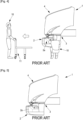
- FIG. 5 is a schematic side view of the bumper assembly structure of the prior art, once the bumper face 2 has been attached to the bumper beam 3.
- This attaching device requires the presence of side covers on the bumper face and that a lot of time is needed to align the bumper face with the bumper beam and to lock the bumper face on the bumper beam. Additionally, two operators are needed.
- FIG. 6 is a schematic side view of a bumper structure of the invention, during a first step of attaching the bumper face 2 to the bumper beam 3.
- the bumper face 2 is placed on a docking device 11 mounted on wheels.
- the bumper face 2 includes on each side part 2a a retractable positioning projection 13.
- a first operator 10 moves the bumper face 2 longitudinally towards the bumper beam 3 in order to align the retractable positioning projections 13 of the bumper face 2 with corresponding mounting holes 14 of the bumper beam 3.
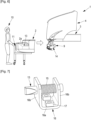
- FIG. 7 is a first detail view of FIG. 6 showing the retractable positioning projection 13.
- the retractable positioning projection 13 is typically a positioning pin 13 associated with a spring 15 and configured to retract during contact of the bumper face 2 with the bumper beam 3 and to come out by spring force when the positioning pin 13 is aligned with a positioning hole 14 of the bumper beam 3.
- the pin 13 is advantageously a beveled pin 13 or a tapered pin 13.
- a bracket 16 including two holes for the passage of the pin 14 is mounted on the bumper face 2.
- the bracket is a U-shaped bracket 16 including a bottom face 16a that is mounted on the bumper face 2 with for instance two flanged screws 17 and two faces 16b orthogonal to the bottom face 16a, each face 16b including a hole receiving the pin 13.
- An abutment 13a of the pin 13 makes it possible to limit the movement of the pin 13 in the direction of the axis passing through the two holes.
- the positioning pin 13 may be circular or square in cross-section.
- the figures illustrate the use of one pin 13 on each side member 9 with one corresponding positioning hole 14. However, a different number of pins 13 could be used, for example two pins on each side member 9 associated each with one positioning hole.
- the spring 15 is optional and could be replaced by manual action.
- FIG. 8 is a second detail view of FIG. 6 showing the positioning hole 14 of each side member 9 of the bumper beam 3.
- Each positioning hole 14 is intended to receive one positioning pin 13.
- the projection 13 can be in contact with the side member 9 along a guiding zone 18 of the side member 9 located at the front of the orifice 14.
- FIG. 9 is a schematic side view of the bumper structure of the invention, during a second step of attaching the bumper face 2 to the bumper beam 3, whereas FIG. 10 is a cross-sectional view taken along an arrow line A-A of FIG. 9 .
- the pin 13 is in its initial position, in which the pin 13 is uncompressed. Indeed, the spring 15 exerts pressure on the abutment 13a which is thus brought into contact with the face 16b located on the side of the bumper beam 3.
- the pin 13 is oriented transversely. In the initial position, the pin 13 is at the beginning of the guide zone 18 that advantageously includes a longitudinal stop 18a on which the non-retracted pin 13 rests.
- FIG. 11 is a schematic side view of the bumper structure of the invention, during a third step of attaching the bumper face 2 to the bumper beam 3, whereas FIG. 12 is a cross-sectional view taken along an arrow line A-A of FIG. 11 .
- the operator 10 pushes the bumper face 2 longitudinally towards the bumper beam 3.
- Each pin 13 passes the stop 18a and thus switches to a retracted configuration and comes into contact with the side member 9 of the vehicle body 3 along the guiding zone 18.
- the pin 13 is in an intermediate position, in which the pin 13 is pushed by the external surface of the side member 9 and compresses the spring 15 which keeps the pin 13 in contact with the side member 9.
- FIG. 13 is a schematic side view of the bumper structure of the invention, during a fourth step of attaching the bumper face 2 to the bumper beam 3, whereas FIG. 14 is a cross-sectional view taken along an arrow line A-A of FIG. 13 .
- Each pin 13 continues to slide against the side member 9 along the guiding zone 18 until the transverse pin axis coincides with the axis of the positioning hole 14 of the bumper beam 3.
- the spring 15 exerts pressure on the pin 13 which is pushed towards the inside of the positioning hole 14. Inserting the pin 13 inside the positioning hole 14 ensures locking of the bumper face 2 to the side member 9 of the bumper beam 3.
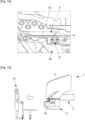
- FIG. 15 is a schematic side view of the bumper structure of the invention, once the bumper face 2 has been locked to the bumper beam 3. The operator 10 removes the docking device 11.
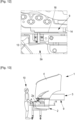
- FIG. 16 is a schematic side view of a bumper structure of the invention, during a fifth step of attaching the bumper face 2 to the bumper beam 3.
- the remaining bolts 19 are then installed by opening the hood 4.
- the remaining bolts 19 are used to fix a front upper flange of the bumper face 2 to a face of the bumper beam 3.
- Relative terms such as “below” or “above” or “upper” or “lower” or “horizontal” or “vertical” may be used herein to describe a relationship of one element to another element as illustrated in the Figures. It will be understood that these terms and those discussed above are intended to encompass different orientations of the device in addition to the orientation depicted in the Figures. It will be understood that when an element is referred to as being “connected” or “coupled” to another element, it can be directly connected or coupled to the other element, or intervening elements may be present. In contrast, when an element is referred to as being “directly connected” or “directly coupled” to another element, there are no intervening elements present.
Landscapes
- Engineering & Computer Science (AREA)
- Mechanical Engineering (AREA)
- Body Structure For Vehicles (AREA)
Priority Applications (1)
| Application Number | Priority Date | Filing Date | Title |
|---|---|---|---|
| EP23217255.1A EP4570599A1 (de) | 2023-12-15 | 2023-12-15 | Stossfängerstruktur für ein kraftfahrzeug |
Applications Claiming Priority (1)
| Application Number | Priority Date | Filing Date | Title |
|---|---|---|---|
| EP23217255.1A EP4570599A1 (de) | 2023-12-15 | 2023-12-15 | Stossfängerstruktur für ein kraftfahrzeug |
Publications (1)
| Publication Number | Publication Date |
|---|---|
| EP4570599A1 true EP4570599A1 (de) | 2025-06-18 |
Family
ID=89223477
Family Applications (1)
| Application Number | Title | Priority Date | Filing Date |
|---|---|---|---|
| EP23217255.1A Pending EP4570599A1 (de) | 2023-12-15 | 2023-12-15 | Stossfängerstruktur für ein kraftfahrzeug |
Country Status (1)
| Country | Link |
|---|---|
| EP (1) | EP4570599A1 (de) |
Citations (4)
| Publication number | Priority date | Publication date | Assignee | Title |
|---|---|---|---|---|
| JPS5784152U (de) * | 1980-11-14 | 1982-05-24 | ||
| FR2744966A1 (fr) * | 1996-02-16 | 1997-08-22 | Renault | Dispositif d'immobilisation d'un element pare-chocs sur une structure de carrosserie de vehicule automobile |
| EP0720935B1 (de) * | 1995-01-03 | 1999-09-29 | Compagnie Plastic Omnium | Vorrichtung zur präzisen Positionierung eines Stossfängers zu einem Kotflügelteil eines Fahrzeuges |
| CN213442430U (zh) * | 2020-09-27 | 2021-06-15 | 广西玉柴新能源汽车有限公司 | 前保险杠的支架结构 |
-
2023
- 2023-12-15 EP EP23217255.1A patent/EP4570599A1/de active Pending
Patent Citations (4)
| Publication number | Priority date | Publication date | Assignee | Title |
|---|---|---|---|---|
| JPS5784152U (de) * | 1980-11-14 | 1982-05-24 | ||
| EP0720935B1 (de) * | 1995-01-03 | 1999-09-29 | Compagnie Plastic Omnium | Vorrichtung zur präzisen Positionierung eines Stossfängers zu einem Kotflügelteil eines Fahrzeuges |
| FR2744966A1 (fr) * | 1996-02-16 | 1997-08-22 | Renault | Dispositif d'immobilisation d'un element pare-chocs sur une structure de carrosserie de vehicule automobile |
| CN213442430U (zh) * | 2020-09-27 | 2021-06-15 | 广西玉柴新能源汽车有限公司 | 前保险杠的支架结构 |
Similar Documents
| Publication | Publication Date | Title |
|---|---|---|
| EP0098560B1 (de) | Einrichtung zum Verriegeln einer Fahrzeugschiebetür | |
| US6808225B2 (en) | Double door construction for vehicle | |
| DE102012105268B4 (de) | Aktive Motorhaubenvorrichtung für ein Fahrzeug | |
| EP2024201B2 (de) | Stossstangenträger | |
| CN108657094B (zh) | 一种防碰撞装置 | |
| US20130134690A1 (en) | Hitch receiver apparatus for vehicle | |
| JP6177772B2 (ja) | 自動車のための側部保護デバイスおよび関連する自動車 | |
| EP4570599A1 (de) | Stossfängerstruktur für ein kraftfahrzeug | |
| US7390054B2 (en) | Vehicle slide door apparatus | |
| CN103781646A (zh) | 具有滑动车门系统的车辆 | |
| US6868930B2 (en) | Automobile vehicle including associated body parts with reduced clearance | |
| CN214396658U (zh) | 一种主动式防撞梁、防撞系统及汽车 | |
| US10894565B2 (en) | Vehicle front structure having hood lock cable routing structure | |
| US12330484B2 (en) | Vehicle door system and a method for improving durability of a door system | |
| KR101316110B1 (ko) | 글로브박스 결합형 카울크로스맴버 | |
| CN214740624U (zh) | 锁扣组件和车辆 | |
| US10488301B2 (en) | Jig for strength test of side door of motor vehicle | |
| CN212990481U (zh) | 重模块安装组件 | |
| CN115792959B (zh) | 一种激光雷达碰撞保护装置及汽车 | |
| CN113994060A (zh) | 包括用于在碰撞情况下阻止车门打开的装置的车门 | |
| KR102447127B1 (ko) | 내부격실문 열림 방지 구조로 형성된 차량용 글로브 박스 | |
| KR101076614B1 (ko) | 캐리어 | |
| KR100704592B1 (ko) | 도어 모듈 | |
| CN214325049U (zh) | 安全带锁扣 | |
| US20250162388A1 (en) | Door module of a vehicle door and vehicle door having the door module |
Legal Events
| Date | Code | Title | Description |
|---|---|---|---|
| PUAI | Public reference made under article 153(3) epc to a published international application that has entered the european phase |
Free format text: ORIGINAL CODE: 0009012 |
|
| STAA | Information on the status of an ep patent application or granted ep patent |
Free format text: STATUS: THE APPLICATION HAS BEEN PUBLISHED |
|
| AK | Designated contracting states |
Kind code of ref document: A1 Designated state(s): AL AT BE BG CH CY CZ DE DK EE ES FI FR GB GR HR HU IE IS IT LI LT LU LV MC ME MK MT NL NO PL PT RO RS SE SI SK SM TR |
|
| STAA | Information on the status of an ep patent application or granted ep patent |
Free format text: STATUS: REQUEST FOR EXAMINATION WAS MADE |
|
| 17P | Request for examination filed |
Effective date: 20251218 |
|
| GRAP | Despatch of communication of intention to grant a patent |
Free format text: ORIGINAL CODE: EPIDOSNIGR1 |
|
| STAA | Information on the status of an ep patent application or granted ep patent |
Free format text: STATUS: GRANT OF PATENT IS INTENDED |
|
| INTG | Intention to grant announced |
Effective date: 20260129 |
|
| GRAS | Grant fee paid |
Free format text: ORIGINAL CODE: EPIDOSNIGR3 |
|
| GRAA | (expected) grant |
Free format text: ORIGINAL CODE: 0009210 |
|
| STAA | Information on the status of an ep patent application or granted ep patent |
Free format text: STATUS: THE PATENT HAS BEEN GRANTED |