EP4570664A1 - Flugzeugkabinenbelüftungssystem mit verbesserter belüftung - Google Patents
Flugzeugkabinenbelüftungssystem mit verbesserter belüftung Download PDFInfo
- Publication number
- EP4570664A1 EP4570664A1 EP24162642.3A EP24162642A EP4570664A1 EP 4570664 A1 EP4570664 A1 EP 4570664A1 EP 24162642 A EP24162642 A EP 24162642A EP 4570664 A1 EP4570664 A1 EP 4570664A1
- Authority
- EP
- European Patent Office
- Prior art keywords
- aircraft
- vanes
- air
- cabin
- ventilation system
- Prior art date
- Legal status (The legal status is an assumption and is not a legal conclusion. Google has not performed a legal analysis and makes no representation as to the accuracy of the status listed.)
- Pending
Links
Images


Classifications
-
- B—PERFORMING OPERATIONS; TRANSPORTING
- B64—AIRCRAFT; AVIATION; COSMONAUTICS
- B64D—EQUIPMENT FOR FITTING IN OR TO AIRCRAFT; FLIGHT SUITS; PARACHUTES; ARRANGEMENT OR MOUNTING OF POWER PLANTS OR PROPULSION TRANSMISSIONS IN AIRCRAFT
- B64D13/00—Arrangements or adaptations of air-treatment apparatus for aircraft crew or passengers, or freight space
- B64D13/06—Arrangements or adaptations of air-treatment apparatus for aircraft crew or passengers, or freight space the air being conditioned
-
- B—PERFORMING OPERATIONS; TRANSPORTING
- B64—AIRCRAFT; AVIATION; COSMONAUTICS
- B64D—EQUIPMENT FOR FITTING IN OR TO AIRCRAFT; FLIGHT SUITS; PARACHUTES; ARRANGEMENT OR MOUNTING OF POWER PLANTS OR PROPULSION TRANSMISSIONS IN AIRCRAFT
- B64D13/00—Arrangements or adaptations of air-treatment apparatus for aircraft crew or passengers, or freight space
-
- B—PERFORMING OPERATIONS; TRANSPORTING
- B64—AIRCRAFT; AVIATION; COSMONAUTICS
- B64D—EQUIPMENT FOR FITTING IN OR TO AIRCRAFT; FLIGHT SUITS; PARACHUTES; ARRANGEMENT OR MOUNTING OF POWER PLANTS OR PROPULSION TRANSMISSIONS IN AIRCRAFT
- B64D13/00—Arrangements or adaptations of air-treatment apparatus for aircraft crew or passengers, or freight space
- B64D2013/003—Cabin ventilation nozzles
-
- B—PERFORMING OPERATIONS; TRANSPORTING
- B64—AIRCRAFT; AVIATION; COSMONAUTICS
- B64D—EQUIPMENT FOR FITTING IN OR TO AIRCRAFT; FLIGHT SUITS; PARACHUTES; ARRANGEMENT OR MOUNTING OF POWER PLANTS OR PROPULSION TRANSMISSIONS IN AIRCRAFT
- B64D13/00—Arrangements or adaptations of air-treatment apparatus for aircraft crew or passengers, or freight space
- B64D13/06—Arrangements or adaptations of air-treatment apparatus for aircraft crew or passengers, or freight space the air being conditioned
- B64D2013/0603—Environmental Control Systems
- B64D2013/0625—Environmental Control Systems comprising means for distribution effusion of conditioned air in the cabin
Definitions
- the present disclosure generally relates to a cabin air ventilation system, an aircraft section having such ventilation system associated with seat rows, and a corresponding aircraft.
- the present disclosure relates to a cabin air ventilation system with a plurality of vanes in an air outlet, wherein some of the vanes are oriented in a different direction than the remaining vanes.
- the present disclosure further relates to an aircraft section with such a cabin air ventilation system and seat rows spatially arranged in relationship to the ventilation system, and a corresponding aircraft having such ventilation system and/or aircraft section.
- a conventional aircraft is equipped with an air ventilation system that provides general air supply into an aircraft cabin, such as a lateral air outlet (LAO) and a ceiling air outlet (CAO), as well as individual nozzles in a personal service unit (PSU). While the personal service units (PSU) are arranged above and in association with the seat rows in the aircraft, the LAO and CAO respectively provide air supply in a lateral region of the aircraft cabin, e.g., above the windows in a region of overhead storage compartments, and in a ceiling region of the aircraft cabin.
- LAO lateral air outlet
- CAO ceiling air outlet
- PSU personal service unit
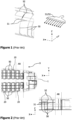
- FIG. 1 schematically illustrates a portion of a conventional ventilation system comprising riser ducts 50 (for example connected to a main air supply duct in a floor region).
- riser ducts 50 can be arranged between an outer skin of the aircraft and an inner lining of the aircraft cabin.
- the riser ducts 50 are arranged in the vicinity of and/or parallel to a frame of the primary structure of the aircraft.
- Connected to such riser ducts 50 are lateral air outlets, LAO 51 and ceiling air outlets, CAO 52.
- one LAO 51 and one CAO 52 can be fluidly coupled to the same riser duct 50.
- each of the LAO 51 and CAO 52 are configured to generate a straight stream of air supplied by the riser duct 50.
- the straight air stream (along the Y-axis) is provided along the entire aircraft (in an X-Y-plane).
- a width of each LAO 51 and CAO 52 can be substantially the same as the distance between two adjacent riser ducts 50 (viewing in the X-axis (longitudinal) direction), so that adjacent LAOs 51 and adjacent CAOs 52 can abut against one another or are at least very close to one another.
- the entire aircraft cabin can be supplied with fresh air, which will stream from the lateral side of the aircraft cabin and the ceiling region to a centre of the aircraft cabin. Since usually air is removed from the aircraft cabin at so-called Dado-panels arranged at a sidewall and floor of the aircraft cabin, the air supply circulates through the aircraft cabin substantially in a cross-sectional plane (Y-Z-axes).
- a cabin air ventilation system for a plurality of seat rows in an aircraft cabin comprises a riser duct arranged along a lateral side of the aircraft cabin and configured to conduct fresh air to the aircraft cabin, and an air outlet connected to an upper end of the riser duct and distributing the conducted air from the riser duct in an area associated with the riser duct.
- the air outlet of the present disclosure comprises an inlet fluidly connected to the riser duct, a main body extending from the inlet and having an outlet opening with a larger cross-section than the inlet, and a plurality of vanes arranged in the outlet opening, wherein a first number of vanes of the plurality of vanes is oriented in a first direction and a second number of vanes of the plurality of vanes is oriented in a second direction forming an angle with the first direction.
- fresh air to be distributed in the aircraft cabin can include or be recirculated air, i.e. a mixture of air taken from the ambient environment of the aircraft and air removed from the aircraft cabin.
- the air outlet can be a lateral air outlet (LAO) or a ceiling air outlet (CAO), so that conventional riser ducts and conventional LAOs and CAOs can be employed, but being additionally equipped with the plurality of vanes as disclosed herein.
- LAO lateral air outlet
- CAO ceiling air outlet
- the air outlet can further comprise an actuator configured to move the second number of vanes to change the second direction.
- the second direction into which a portion of the air provided by the riser duct can be guided
- the actuator can move the second number of vanes in a manner that the second number of vanes point in the first direction
- the actuator is configured to move the second number of vanes in directions deviating from the first direction, so that the second direction forms an angle with the first direction.
- the air outlet can further comprise a coupling rod connected to the actuator, wherein the actuator moves the coupling rod.
- the air outlet can comprise connecting means pivotally connecting the coupling rod to each of the second number of vanes, wherein the connecting means translate a back and forth movement of the coupling rod into a pivotal movement of the second number of vanes.
- the connecting means can be or at least include hinges between the coupling rod and each of the second number of vanes.
- each of the second number of vanes can be pivotally mounted to the main body of the air outlet having a different axis of rotation than the connecting means.
- each of the second number of vanes can be supported in a manner allowing a three-dimensional (rotational) movement.
- each of the second number of vanes cannot only change position rotationally (in a plane), but can change position three-dimensionally.
- the plurality of vanes can form a baffle, a wave, a cylinder, and/or a cuboid.
- each of the plurality of vanes can be a sheet-like element (straight or curved in wave-form) or a three-dimensional object.
- each vane has at least one surface, along which an air stream of air supplied by the riser duct streams. This at least one surface is oriented in the second direction, so that at least a portion of the air stream is guided/directed into the second direction.
- an aircraft section comprises a cabin air ventilation system of the first aspect or one or more of its variants.
- the aircraft section can further comprise at least one first seat row arranged in an area of the aircraft section where the riser duct (of the cabin air ventilation system) is installed, and at least one second seat row arranged in an area of the aircraft section without a riser duct and adjacent to the first seat row.
- the aircraft section can be arranged in an area of the aircraft that was not intended to have a conventional fresh air supply via LAOs and/or CAOs.
- the first direction can point to the first seat row and the second direction can point to the second seat row.
- the air outlet of the cabin air ventilation system is arranged in such a manner in the aircraft section that a conventionally not ventilated area or only indirectly ventilated area can be provided with fresh air via the second number of vanes directing/guiding air from the riser duct towards the second seat row. This increases comfort of passengers sitting in this area.
- the aircraft section can further comprise a temperature sensor configured to measure an air temperature in the aircraft section.
- the first direction and/or the second direction can point away from the temperature sensor.
- the temperature sensor can be arranged in an area of an overhead stowage compartment, i.e., an area close to a LAO and/or CAO, such as the air outlet of the cabin air ventilation system.
- the temperature sensor can be arranged on top of an overhead stowage compartment, between two adjacent overhead stowage compartments, behind a lining (sidewall and/or ceiling lining) of the aircraft cabin or a similar area of the aircraft cabin.
- an air stream output by the air outlet close to the temperature sensor can create or can be caught by a swirl that touches or roams the temperature sensor.
- an air stream output by the air outlet on a lateral opposite side of the temperature sensor can flow (e.g., by the first plurality of vanes oriented in the first direction) directly towards the temperature sensor.
- the fresh air supplied to the aircraft section which is usually colder than the desired air temperature, may be directed to the temperature sensor in a "short circuit" (swirl) and/or over only a short distance (opposite arrangement).
- the measured temperature may not reflect the actual temperature in the aircraft section.
- the accuracy of the measurement of the temperature can be increased, as a direct hit of cold air onto the temperature sensor can be avoided.
- the first or second direction can be substantially perpendicular to a longitudinal direction of the aircraft section and a vertical direction.
- the longitudinal direction of the aircraft section corresponds to the longitudinal direction of the aircraft, such as the X-axis direction of the aircraft from nose to tail.
- the vertical direction is perpendicular thereto, such as a Z-axis direction.
- an aircraft comprises at least one cabin air ventilation system of the first aspect or one or more of its variants.
- the aircraft can comprise at least one aircraft section of the second aspect or one or more of its variants.
- FIGs 1 and 2 schematically illustrate a portion of a conventional ventilation system of an aircraft 1, and a conventional aircraft section 5 in a plan view and partial side view.
- riser ducts 50 may have a lateral and/or ceiling air outlet 51, 52 connected thereto, so that air is distributed/vented in the aircraft section 5.
- a plurality of seat rows 20 may be provided in the aircraft section 5, wherein the air outlets 51, 52 are arranged above the seat rows 20 at a sidewall (in case of lateral air outlet 51) and a ceiling (in case of ceiling air outlet 52).
- the riser ducts 50 may be provided behind a sidewall lining of the aircraft cabin 10, i.e., close to the aircraft outer skin (cf. Figure 2 ).
- the conventional LAO 51 and CAO 52 as illustrated in Figure 1 provides a uniform air flow substantially perpendicularly from the outlet opening of the LAO 51 and CAO 52, i.e., in the Y-axis direction substantially perpendicular to the longitudinal direction (X-axis) of the aircraft 1.
- Such uniform and substantially perpendicular airflow is desired, as the width of each LAO 51 and CAO 52 is approximately as wide as the distance between two adjacent riser ducts 50.
- a row of LAOs 51 and a row of CAOs 52 are formed, which respectively provide a continuous air flow along the longitudinal direction of the aircraft 1.
- the riser ducts 50 may not be present, since such areas are usually used for monuments, such as galleys or toilets, which would block an LAO 51 or CAO 52.
- additional seat rows 20 may be provided in such area indicated as "AR" (for "additional rows") in Figure 2 .
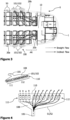
- FIG 3 schematically illustrates a plan view of an aircraft section 5, according to the present disclosure, where additional seat rows 20b are provided in the area AR.
- at least one first seat row 20a is arranged in an area of the aircraft section 5 where the riser ducts 50 are installed.
- the passengers sitting in this first seat row 20a will experience the supply of fresh air through one or more lateral air outlets 101 and/or one or more ceiling air outlets 102.
- the LAO 101 and the CAO 102 can be connected to a riser duct 50 and can be arranged in the same manner as LAO 51 and CAO 52 illustrated in Figure 1 . Thus, their detailed description is not repeated.
- the at least one second seat row 20b are arranged in an area AR of the aircraft section 10 without a riser duct 50, and hence without dedicated LAO 101 and/or CAO 102.
- a cabin air ventilation system 100 of the present disclosure is provided in the aircraft cabin 10.
- such cabin air ventilation system 100 comprises a riser duct 50 and one or more air outlets 101, 102 connected to (an upper end of) the riser duct 50.
- LAO 101 and/or CAO 102 comprises an inlet 105 connected to the riser duct 50, and a main body 108 extending from the inlet and having an outlet opening 110 with a larger cross-section than the inlet 105.
- a plurality of vanes 111, 112 is arranged in the outlet opening 110.
- a first number of vanes 111 is oriented in a first direction and a second number of vanes is oriented in a second direction forming an angle with respect to the first direction.
- the first number of vanes 111 (4 vanes in Figure 4 ) can be oriented substantially perpendicular to a longitudinal direction, i.e. can be oriented in the Y-axis direction.
- these vanes 111 form a straight airflow as illustrated in Figure 3 by dashed arrows. This straight airflow allows providing fresh air from the riser duct 50 to the first seat row(s) 20a.
- the second number of vanes 112 (8 in Figure 4 ) can be oriented in a different direction, so that an inclined air flow is created, illustrated by solid arrows in Figure 3 .
- Such vanes 112 can be oriented towards the second seat row(s) 20b, so that passengers sitting in this area AR are provided with fresh air, too. Due to the inclined air flow, a better mixture of air in the area comprising the first and second seat rows 20a, 20b can be achieved, so that the overall quality of the air in this area is increased.
- Figure 5 schematically illustrates a plurality of vanes 112 of an air outlet 101, 102, particularly a second number of vanes 112.
- the second vanes 112 may be fixedly arranged in the air outlet opening 110, the position of the second vanes 112 may, alternatively, be controlled.
- Figure 6 schematically illustrates a vane control device 125, which can be installed in the air outlet opening 110.
- the vanes 111, 112 of the present disclosure can be retrofitted into existing LAOs 51/101 and CAOs 52/102.
- An actuator 120 can be provided that is configured to move the second number of vanes 112 to change the second direction.
- Figure 5 exemplarily illustrates three states of the second number of vanes 112. In the upper state the vanes 112 are directed substantially perpendicular to the air outlet opening 110 (and hence substantially perpendicular to the longitudinal direction of the aircraft 1), in the middle state, the vanes 112 are swung to the right, while in the lower state the vanes 112 are swung to the left.
- Such movement and change of the second direction can be achieved by providing a coupling rod 121 connected to the actuator 112, wherein the actuator 112 move the coupling rod 121, for example back and forth as illustrated by the arrows shown in Figure 5 .
- a connecting means 122, 123 pivotally connects the coupling rod 121 to each of the second number of vanes 112.
- Such connecting means 122, 123 translate the back-and-forth movement of the coupling rod 121 into a pivotal movement of the second number of vanes 112.
- each vane can be pivotally mounted to the vane control device 125 and/or the main body 108 of the air outlet 101, 102.
- each vane 112 pivots around such mounting (hinge) while the rod 121 moves back and forth.
- each vane 112 may be coupled to a motor (not illustrated), so that each vane 112 can be rotated to change the second direction.
- each vane 112 may be associated with its own motor, so that each vane 112 can the moved individually. This facilitates a mixture of the air released by the air outlet 101, 102.
- each vane 112 can be achieved by a different type of hinge or more hinges holding the vane 112.
- a further coupling rod (not illustrated) can be provided to achieve a movement of the vanes 112 in a direction different from the back-and-forth movement of coupling rod 121.
- the orientation of the vanes 112 can be modified three-dimensionally.
- Figure 7 schematically illustrates an interior side view of an aircraft section 10.
- the LAOs 101 can be arranged underneath an overhead stowage compartment 180, while the CAOs 102 are arranged above the overhead stowage compartment 180.
- the LAOs 101 and the CAOs 102 are provided along the longitudinal direction of the aircraft and above a plurality of seat rows 20.
- the temperature of the air in the aircraft cabin 10 can be measured.
- a temperature sensor 150 can be arranged above the overhead stowage compartments 180, such as above a gap between two adjacent overhead stowage compartments 180.
- Such temperature sensor 150 is schematically illustrated in Figure 7 by a solid line.
- the temperature sensor 150 can be installed between two adjacent overhead stowage compartments 180, as schematically illustrated in Figure 7 by a dashed line.
- air exiting the CAO 102 may swirl and reach the temperature sensor 150 closely after leaving the air outlet opening 110 and/or vanes 111, 112.
- the usually cold air provided through the riser duct 50 may be short-circuited to the temperature sensor 150, so that the measured temperature is inaccurate.
- air leaving the air outlet opening 110 of the LAO 101 may reach the gap between two adjacent overhead stowage compartments 180, where a temperature sensor 150 can likewise be arranged.
- the LAO 101 and the CAO 102 are arranged pairwise opposite to one another, an air flow leaving straight from the LAO 101 and the CAO 102 may hit a temperature sensor 150 on the opposite side of the aircraft cabin 10. In this case, the measured temperature can be inaccurate, too.
- FIG. 8 schematically illustrates exemplary configurations of air outlets 101, 102 having a plurality of vanes 111, 112.
- the vanes 111, 112 are provided in such a manner that the air flow leaving the air outlets 101, 102 point away from the temperature sensor 150, i.e. the first and second direction point away from the temperature sensor 150.
- a plan view of oppositely arranged outlets 101, 102, or vane control devices 125, is provided, which show vanes 112 pointing in the second direction, each facing away from the temperature sensor 150.
- an air outlet 101, 102, or vane control devices 125 can be provided that includes only vanes 112 pointing in a direction different from a substantially perpendicular direction, i.e. pointing in the direction different from the Y-axis.
- FIG. 8 a plan view of another air outlet 101, 102 is shown, where a first number of vanes 111 provide a straight airflow, while a second number of vanes 112 provide an inclined airflow pointing in a direction away from the temperature sensor 150.
- vanes 111, 112 as cylinders, through which the air can be guided, it is to be understood that any form of vane allowing to guide air can be provided.
- the vanes 111, 112 can be or can be formed by a baffle, a sheet having a wave-form, a cylinder, and/or a cuboid or the like.
Landscapes
- Health & Medical Sciences (AREA)
- General Health & Medical Sciences (AREA)
- Pulmonology (AREA)
- Engineering & Computer Science (AREA)
- Aviation & Aerospace Engineering (AREA)
- Duct Arrangements (AREA)
- Air-Flow Control Members (AREA)
Priority Applications (2)
| Application Number | Priority Date | Filing Date | Title |
|---|---|---|---|
| US18/968,500 US20250197012A1 (en) | 2023-12-14 | 2024-12-04 | Aircraft cabin air ventilation system with improved ventilation |
| CN202411828830.3A CN120156691A (zh) | 2023-12-14 | 2024-12-12 | 用于飞行器机舱的机舱空气通风系统、飞行器部段和飞行器 |
Applications Claiming Priority (1)
| Application Number | Priority Date | Filing Date | Title |
|---|---|---|---|
| IN202311085364 | 2023-12-14 |
Publications (1)
| Publication Number | Publication Date |
|---|---|
| EP4570664A1 true EP4570664A1 (de) | 2025-06-18 |
Family
ID=90364842
Family Applications (1)
| Application Number | Title | Priority Date | Filing Date |
|---|---|---|---|
| EP24162642.3A Pending EP4570664A1 (de) | 2023-12-14 | 2024-03-11 | Flugzeugkabinenbelüftungssystem mit verbesserter belüftung |
Country Status (3)
| Country | Link |
|---|---|
| US (1) | US20250197012A1 (de) |
| EP (1) | EP4570664A1 (de) |
| CN (1) | CN120156691A (de) |
Citations (6)
| Publication number | Priority date | Publication date | Assignee | Title |
|---|---|---|---|---|
| US3203473A (en) * | 1960-10-05 | 1965-08-31 | Lockheed Aircraft Corp | Aircraft heating system |
| US4726285A (en) * | 1985-10-16 | 1988-02-23 | Kelley Winfield L | Dimpled air distribution device |
| EP0257500B1 (de) * | 1986-08-21 | 1989-10-25 | Gebr. Happich GmbH | Luftleitvorrichtung |
| US20050230488A1 (en) * | 2003-12-29 | 2005-10-20 | Michael Markwart | Air dispersion system |
| DE102007019538A1 (de) * | 2007-04-25 | 2008-10-30 | Airbus Deutschland Gmbh | Luftführungselement für eine Flugzeugklimaanlage |
| DE102017119751A1 (de) * | 2017-08-29 | 2019-02-28 | Airbus Operations Gmbh | Kabinendeckenverkleidungspaneel für eine Flugzeugkabine |
-
2024
- 2024-03-11 EP EP24162642.3A patent/EP4570664A1/de active Pending
- 2024-12-04 US US18/968,500 patent/US20250197012A1/en active Pending
- 2024-12-12 CN CN202411828830.3A patent/CN120156691A/zh active Pending
Patent Citations (6)
| Publication number | Priority date | Publication date | Assignee | Title |
|---|---|---|---|---|
| US3203473A (en) * | 1960-10-05 | 1965-08-31 | Lockheed Aircraft Corp | Aircraft heating system |
| US4726285A (en) * | 1985-10-16 | 1988-02-23 | Kelley Winfield L | Dimpled air distribution device |
| EP0257500B1 (de) * | 1986-08-21 | 1989-10-25 | Gebr. Happich GmbH | Luftleitvorrichtung |
| US20050230488A1 (en) * | 2003-12-29 | 2005-10-20 | Michael Markwart | Air dispersion system |
| DE102007019538A1 (de) * | 2007-04-25 | 2008-10-30 | Airbus Deutschland Gmbh | Luftführungselement für eine Flugzeugklimaanlage |
| DE102017119751A1 (de) * | 2017-08-29 | 2019-02-28 | Airbus Operations Gmbh | Kabinendeckenverkleidungspaneel für eine Flugzeugkabine |
Also Published As
| Publication number | Publication date |
|---|---|
| US20250197012A1 (en) | 2025-06-19 |
| CN120156691A (zh) | 2025-06-17 |
Similar Documents
| Publication | Publication Date | Title |
|---|---|---|
| US11999490B2 (en) | Air curtain systems and methods for vehicle cabins | |
| US9561855B2 (en) | Alternate directional momentum ventilation nozzle for passenger cabins | |
| JP2019507703A (ja) | 高アスペクト比通気口を有する熱システム | |
| RU2588698C2 (ru) | Форсунка воздуховода для вентиляции салона автомобиля | |
| US20130005231A1 (en) | Incoming air supply system for passengers in aircraft | |
| EP3728036B1 (de) | Luftverteilungsanordnung für eine flugzeugkabine | |
| EP2657132B1 (de) | Fahrgastservicesystem mit verbesserter Luftführung | |
| EP4570664A1 (de) | Flugzeugkabinenbelüftungssystem mit verbesserter belüftung | |
| CN111231624A (zh) | 空气流出器 | |
| CN113508044A (zh) | 具有带有多个单独出风口的通风装置的机动车 | |
| CN205588938U (zh) | 用于机动车的暖风和通风或空调设备的空气排出装置 | |
| RU2616490C2 (ru) | Система кондиционирования воздуха транспортного средства и оснащенное этой системой железнодорожное транспортное средство | |
| US9505498B2 (en) | Aircraft cabin airflow nozzles and associated systems and methods | |
| US9011216B1 (en) | Diversion directional nozzle | |
| JP7726683B2 (ja) | ビークルの内部キャビン用のエアカーテンシステム及び方法 | |
| EP3741678A1 (de) | Regelventil für ein wärmetauschersystem eines flugzeugantriebssystems | |
| US11376947B2 (en) | Ventilation device with a plurality of zones and associated vehicle | |
| US11548647B2 (en) | Air-conditioning duct structure of aircraft, aircraft, and method of manufacturing aircraft | |
| EP3766781B1 (de) | Fahrgastsitzüberdachung | |
| US11643214B2 (en) | Cold regulating valve for a heat exchanger system of an aircraft propulsion system | |
| US11215118B2 (en) | Aircraft propulsion system including a heat exchanger system | |
| US20240359799A1 (en) | Air ventilation system for an aircraft and corresponding aircraft section | |
| JP2023087318A (ja) | 車両用空調装置 | |
| CZ307411B6 (cs) | Vzduchotechnická vyústka pro vozidla a vozidlo se vzduchotechnickou vyústkou | |
| CN110920340A (zh) | 车辆座舱出风结构 |
Legal Events
| Date | Code | Title | Description |
|---|---|---|---|
| PUAI | Public reference made under article 153(3) epc to a published international application that has entered the european phase |
Free format text: ORIGINAL CODE: 0009012 |
|
| STAA | Information on the status of an ep patent application or granted ep patent |
Free format text: STATUS: THE APPLICATION HAS BEEN PUBLISHED |
|
| AK | Designated contracting states |
Kind code of ref document: A1 Designated state(s): AL AT BE BG CH CY CZ DE DK EE ES FI FR GB GR HR HU IE IS IT LI LT LU LV MC ME MK MT NL NO PL PT RO RS SE SI SK SM TR |
|
| STAA | Information on the status of an ep patent application or granted ep patent |
Free format text: STATUS: REQUEST FOR EXAMINATION WAS MADE |
|
| 17P | Request for examination filed |
Effective date: 20251208 |