EP4570683A1 - Emballage de produit - Google Patents
Emballage de produit Download PDFInfo
- Publication number
- EP4570683A1 EP4570683A1 EP24217578.4A EP24217578A EP4570683A1 EP 4570683 A1 EP4570683 A1 EP 4570683A1 EP 24217578 A EP24217578 A EP 24217578A EP 4570683 A1 EP4570683 A1 EP 4570683A1
- Authority
- EP
- European Patent Office
- Prior art keywords
- side panel
- product packaging
- upper wall
- structural configuration
- wall
- Prior art date
- Legal status (The legal status is an assumption and is not a legal conclusion. Google has not performed a legal analysis and makes no representation as to the accuracy of the status listed.)
- Pending
Links
Images




Classifications
-
- B—PERFORMING OPERATIONS; TRANSPORTING
- B65—CONVEYING; PACKING; STORING; HANDLING THIN OR FILAMENTARY MATERIAL
- B65D—CONTAINERS FOR STORAGE OR TRANSPORT OF ARTICLES OR MATERIALS, e.g. BAGS, BARRELS, BOTTLES, BOXES, CANS, CARTONS, CRATES, DRUMS, JARS, TANKS, HOPPERS, FORWARDING CONTAINERS; ACCESSORIES, CLOSURES, OR FITTINGS THEREFOR; PACKAGING ELEMENTS; PACKAGES
- B65D5/00—Rigid or semi-rigid containers of polygonal cross-section, e.g. boxes, cartons or trays, formed by folding or erecting one or more blanks made of paper
- B65D5/20—Rigid or semi-rigid containers of polygonal cross-section, e.g. boxes, cartons or trays, formed by folding or erecting one or more blanks made of paper by folding-up portions connected to a central panel from all sides to form a container body, e.g. of tray-like form
- B65D5/2052—Rigid or semi-rigid containers of polygonal cross-section, e.g. boxes, cartons or trays, formed by folding or erecting one or more blanks made of paper by folding-up portions connected to a central panel from all sides to form a container body, e.g. of tray-like form characterised by integral closure-flaps
-
- B—PERFORMING OPERATIONS; TRANSPORTING
- B65—CONVEYING; PACKING; STORING; HANDLING THIN OR FILAMENTARY MATERIAL
- B65D—CONTAINERS FOR STORAGE OR TRANSPORT OF ARTICLES OR MATERIALS, e.g. BAGS, BARRELS, BOTTLES, BOXES, CANS, CARTONS, CRATES, DRUMS, JARS, TANKS, HOPPERS, FORWARDING CONTAINERS; ACCESSORIES, CLOSURES, OR FITTINGS THEREFOR; PACKAGING ELEMENTS; PACKAGES
- B65D5/00—Rigid or semi-rigid containers of polygonal cross-section, e.g. boxes, cartons or trays, formed by folding or erecting one or more blanks made of paper
- B65D5/20—Rigid or semi-rigid containers of polygonal cross-section, e.g. boxes, cartons or trays, formed by folding or erecting one or more blanks made of paper by folding-up portions connected to a central panel from all sides to form a container body, e.g. of tray-like form
- B65D5/2052—Rigid or semi-rigid containers of polygonal cross-section, e.g. boxes, cartons or trays, formed by folding or erecting one or more blanks made of paper by folding-up portions connected to a central panel from all sides to form a container body, e.g. of tray-like form characterised by integral closure-flaps
- B65D5/2057—Inter-engaging self-locking flaps
-
- B—PERFORMING OPERATIONS; TRANSPORTING
- B65—CONVEYING; PACKING; STORING; HANDLING THIN OR FILAMENTARY MATERIAL
- B65D—CONTAINERS FOR STORAGE OR TRANSPORT OF ARTICLES OR MATERIALS, e.g. BAGS, BARRELS, BOTTLES, BOXES, CANS, CARTONS, CRATES, DRUMS, JARS, TANKS, HOPPERS, FORWARDING CONTAINERS; ACCESSORIES, CLOSURES, OR FITTINGS THEREFOR; PACKAGING ELEMENTS; PACKAGES
- B65D5/00—Rigid or semi-rigid containers of polygonal cross-section, e.g. boxes, cartons or trays, formed by folding or erecting one or more blanks made of paper
- B65D5/20—Rigid or semi-rigid containers of polygonal cross-section, e.g. boxes, cartons or trays, formed by folding or erecting one or more blanks made of paper by folding-up portions connected to a central panel from all sides to form a container body, e.g. of tray-like form
- B65D5/30—Rigid or semi-rigid containers of polygonal cross-section, e.g. boxes, cartons or trays, formed by folding or erecting one or more blanks made of paper by folding-up portions connected to a central panel from all sides to form a container body, e.g. of tray-like form with tongue-and-slot or like connections between sides and extensions of other sides
- B65D5/301—Rigid or semi-rigid containers of polygonal cross-section, e.g. boxes, cartons or trays, formed by folding or erecting one or more blanks made of paper by folding-up portions connected to a central panel from all sides to form a container body, e.g. of tray-like form with tongue-and-slot or like connections between sides and extensions of other sides the tongue being a part of a lateral extension of a side wall
- B65D5/302—Rigid or semi-rigid containers of polygonal cross-section, e.g. boxes, cartons or trays, formed by folding or erecting one or more blanks made of paper by folding-up portions connected to a central panel from all sides to form a container body, e.g. of tray-like form with tongue-and-slot or like connections between sides and extensions of other sides the tongue being a part of a lateral extension of a side wall combined with a slot provided in an adjacent side wall
-
- B—PERFORMING OPERATIONS; TRANSPORTING
- B65—CONVEYING; PACKING; STORING; HANDLING THIN OR FILAMENTARY MATERIAL
- B65D—CONTAINERS FOR STORAGE OR TRANSPORT OF ARTICLES OR MATERIALS, e.g. BAGS, BARRELS, BOTTLES, BOXES, CANS, CARTONS, CRATES, DRUMS, JARS, TANKS, HOPPERS, FORWARDING CONTAINERS; ACCESSORIES, CLOSURES, OR FITTINGS THEREFOR; PACKAGING ELEMENTS; PACKAGES
- B65D5/00—Rigid or semi-rigid containers of polygonal cross-section, e.g. boxes, cartons or trays, formed by folding or erecting one or more blanks made of paper
- B65D5/38—Drawer-and-shell type containers
-
- B—PERFORMING OPERATIONS; TRANSPORTING
- B65—CONVEYING; PACKING; STORING; HANDLING THIN OR FILAMENTARY MATERIAL
- B65D—CONTAINERS FOR STORAGE OR TRANSPORT OF ARTICLES OR MATERIALS, e.g. BAGS, BARRELS, BOTTLES, BOXES, CANS, CARTONS, CRATES, DRUMS, JARS, TANKS, HOPPERS, FORWARDING CONTAINERS; ACCESSORIES, CLOSURES, OR FITTINGS THEREFOR; PACKAGING ELEMENTS; PACKAGES
- B65D5/00—Rigid or semi-rigid containers of polygonal cross-section, e.g. boxes, cartons or trays, formed by folding or erecting one or more blanks made of paper
- B65D5/42—Details of containers or of foldable or erectable container blanks
-
- B—PERFORMING OPERATIONS; TRANSPORTING
- B65—CONVEYING; PACKING; STORING; HANDLING THIN OR FILAMENTARY MATERIAL
- B65D—CONTAINERS FOR STORAGE OR TRANSPORT OF ARTICLES OR MATERIALS, e.g. BAGS, BARRELS, BOTTLES, BOXES, CANS, CARTONS, CRATES, DRUMS, JARS, TANKS, HOPPERS, FORWARDING CONTAINERS; ACCESSORIES, CLOSURES, OR FITTINGS THEREFOR; PACKAGING ELEMENTS; PACKAGES
- B65D5/00—Rigid or semi-rigid containers of polygonal cross-section, e.g. boxes, cartons or trays, formed by folding or erecting one or more blanks made of paper
- B65D5/42—Details of containers or of foldable or erectable container blanks
- B65D5/44—Integral, inserted or attached portions forming internal or external fittings
-
- B—PERFORMING OPERATIONS; TRANSPORTING
- B65—CONVEYING; PACKING; STORING; HANDLING THIN OR FILAMENTARY MATERIAL
- B65D—CONTAINERS FOR STORAGE OR TRANSPORT OF ARTICLES OR MATERIALS, e.g. BAGS, BARRELS, BOTTLES, BOXES, CANS, CARTONS, CRATES, DRUMS, JARS, TANKS, HOPPERS, FORWARDING CONTAINERS; ACCESSORIES, CLOSURES, OR FITTINGS THEREFOR; PACKAGING ELEMENTS; PACKAGES
- B65D5/00—Rigid or semi-rigid containers of polygonal cross-section, e.g. boxes, cartons or trays, formed by folding or erecting one or more blanks made of paper
- B65D5/42—Details of containers or of foldable or erectable container blanks
- B65D5/44—Integral, inserted or attached portions forming internal or external fittings
- B65D5/50—Internal supporting or protecting elements for contents
- B65D5/5028—Elements formed separately from the container body
-
- B—PERFORMING OPERATIONS; TRANSPORTING
- B65—CONVEYING; PACKING; STORING; HANDLING THIN OR FILAMENTARY MATERIAL
- B65D—CONTAINERS FOR STORAGE OR TRANSPORT OF ARTICLES OR MATERIALS, e.g. BAGS, BARRELS, BOTTLES, BOXES, CANS, CARTONS, CRATES, DRUMS, JARS, TANKS, HOPPERS, FORWARDING CONTAINERS; ACCESSORIES, CLOSURES, OR FITTINGS THEREFOR; PACKAGING ELEMENTS; PACKAGES
- B65D5/00—Rigid or semi-rigid containers of polygonal cross-section, e.g. boxes, cartons or trays, formed by folding or erecting one or more blanks made of paper
- B65D5/42—Details of containers or of foldable or erectable container blanks
- B65D5/64—Lids
- B65D5/66—Hinged lids
- B65D5/6626—Hinged lids formed by folding extensions of a side panel of a container body formed by erecting a "cross-like" blank
- B65D5/6629—Hinged lids formed by folding extensions of a side panel of a container body formed by erecting a "cross-like" blank the lid being formed by two mating halves joined to opposite edges of the container body
- B65D5/6632—Hinged lids formed by folding extensions of a side panel of a container body formed by erecting a "cross-like" blank the lid being formed by two mating halves joined to opposite edges of the container body the lid-halves being held in closed position by flaps or tabs provided at their side edges only
-
- B—PERFORMING OPERATIONS; TRANSPORTING
- B65—CONVEYING; PACKING; STORING; HANDLING THIN OR FILAMENTARY MATERIAL
- B65D—CONTAINERS FOR STORAGE OR TRANSPORT OF ARTICLES OR MATERIALS, e.g. BAGS, BARRELS, BOTTLES, BOXES, CANS, CARTONS, CRATES, DRUMS, JARS, TANKS, HOPPERS, FORWARDING CONTAINERS; ACCESSORIES, CLOSURES, OR FITTINGS THEREFOR; PACKAGING ELEMENTS; PACKAGES
- B65D5/00—Rigid or semi-rigid containers of polygonal cross-section, e.g. boxes, cartons or trays, formed by folding or erecting one or more blanks made of paper
- B65D5/42—Details of containers or of foldable or erectable container blanks
- B65D5/70—Break-in flaps, or members adapted to be torn-off, to provide pouring openings
-
- B—PERFORMING OPERATIONS; TRANSPORTING
- B65—CONVEYING; PACKING; STORING; HANDLING THIN OR FILAMENTARY MATERIAL
- B65D—CONTAINERS FOR STORAGE OR TRANSPORT OF ARTICLES OR MATERIALS, e.g. BAGS, BARRELS, BOTTLES, BOXES, CANS, CARTONS, CRATES, DRUMS, JARS, TANKS, HOPPERS, FORWARDING CONTAINERS; ACCESSORIES, CLOSURES, OR FITTINGS THEREFOR; PACKAGING ELEMENTS; PACKAGES
- B65D75/00—Packages comprising articles or materials partially or wholly enclosed in strips, sheets, blanks, tubes or webs of flexible sheet material, e.g. in folded wrappers
- B65D75/04—Articles or materials wholly enclosed in single sheets or wrapper blanks
- B65D75/14—Articles or materials wholly enclosed in single sheets or wrapper blanks in sheets or blanks folded-up around all sides of the contents from a portion on which the contents are placed
-
- B—PERFORMING OPERATIONS; TRANSPORTING
- B65—CONVEYING; PACKING; STORING; HANDLING THIN OR FILAMENTARY MATERIAL
- B65D—CONTAINERS FOR STORAGE OR TRANSPORT OF ARTICLES OR MATERIALS, e.g. BAGS, BARRELS, BOTTLES, BOXES, CANS, CARTONS, CRATES, DRUMS, JARS, TANKS, HOPPERS, FORWARDING CONTAINERS; ACCESSORIES, CLOSURES, OR FITTINGS THEREFOR; PACKAGING ELEMENTS; PACKAGES
- B65D77/00—Packages formed by enclosing articles or materials in preformed containers, e.g. boxes, cartons, sacks or bags
- B65D77/22—Details
- B65D77/24—Inserts or accessories added or incorporated during filling of containers
- B65D77/26—Elements or devices for locating or protecting articles
-
- B—PERFORMING OPERATIONS; TRANSPORTING
- B65—CONVEYING; PACKING; STORING; HANDLING THIN OR FILAMENTARY MATERIAL
- B65D—CONTAINERS FOR STORAGE OR TRANSPORT OF ARTICLES OR MATERIALS, e.g. BAGS, BARRELS, BOTTLES, BOXES, CANS, CARTONS, CRATES, DRUMS, JARS, TANKS, HOPPERS, FORWARDING CONTAINERS; ACCESSORIES, CLOSURES, OR FITTINGS THEREFOR; PACKAGING ELEMENTS; PACKAGES
- B65D77/00—Packages formed by enclosing articles or materials in preformed containers, e.g. boxes, cartons, sacks or bags
- B65D77/22—Details
- B65D77/30—Opening or contents-removing devices added or incorporated during filling or closing of containers
Definitions
- the present disclosure relates generally to a product packaging system for a consumer product, and a product packaging for such a product packaging system.
- Packaging protects the consumer product during transportation and sale.
- Packaging may be sealed with an adhesive, coated in a plastic film, or otherwise secured in a closed position. The act of opening the packaging typically damages the seal irreversibly.
- a product packaging comprising: a plurality of walls including a base wall, a front wall, a rear wall, opposing sidewalls, a first upper wall, and a second upper wall adjacent to the first upper wall in a closed structural configuration; a releasable locking system moveable between a disengaged state and an engaged state which locks and maintains the plurality of walls in a closed structural configuration; and a pull-tab member to disengage the releasable locking system and transform the plurality of walls from the closed structural configuration to an open structural configuration.
- the product packaging may formed from a material blank that is operable movement between an unfolded state/open structural configuration and a folded state/closed structural configuration forming the product packaging.
- the product packaging In the folded state/closed structural configuration, the product packaging may define a cavity that is operable to receive the consumer product.
- the product packaging may include a releasable locking system that is selectively moveable between a disengaged state and an engaged state which locks and maintains the product packaging in the folded state/closed structural configuration.
- the pull-tab member may include an upper pull-tab member section and a lower pull-tab member section.
- the upper pull-tab member section may project outwardly between a seam between the first upper wall and the second upper wall and the lower pull-tab member section may be arranged under the first upper wall in the cavity.
- Engagement of the upper pull-tab member section by a user may cause concurrent rotation of the first upper wall and the second upper wall to disengage the releasable locking system.
- Engagement of the upper pull-tab member section by a user may cause the lower pull-tab member section to apply an upwardly directed force on the first upper wall which initiates rotation of the first upper wall. Rotation of the first upper wall may be to an open position.
- the releasable locking system may include a first left side panel closure tab and a second left side panel closure tab arranged on the first upper wall.
- the releasable locking system may include a first right side panel closure tab and a second right side panel closure tab arranged on the second upper wall.
- the releasable locking system may include one or more closure slits arranged in the front wall and the rear wall.
- first left side panel closure tab and the second left side panel closure tab may be received in the one or more closure slits to connect the first upper wall to the front wall and the rear wall.
- first right side panel closure tab and the second right side panel closure tab may be received in the one or more closure slits to connect the second upper wall to the front wall and the rear wall.
- the interior upper wall may comprise an internal cavity operable to receive one or more product accessories PC and/or product documentation.
- the interior upper wall may engage and maintains the consumer product in a seated position in the cavity of the product packaging.
- the interior upper wall may be formed of a material having a thickness that dampens effects of an impact force or external load applied to the product packaging in the closed structural configuration.
- a product packaging system comprising: the product packaging of the first aspect, wherein the plurality of walls define a cavity to receive a consumer product.
- the consumer product support member may be supported on the base wall to support the consumer product in the cavity.
- the consumer product support member may include one or more charging ports to facilitate wired charging of the consumer product.
- the rear wall may have a cavity oriented laterally for receipt of one or more consumer product accessories PC and/or consumer product documentation, an outer left side panel forming a first upper wall, and an outer right side panel forming a second upper wall.
- the front panel may comprise a first elongated closure slit/opening oriented at least partially across an upper peripheral surface of the front panel.
- the outer right side panel may comprise a first right side panel closure tab aligned with the second elongated closure slit/opening for receipt therein in the folded position of the front panel and the outer right side panel.
- the rear panel may comprise a first elongated closure slit/opening oriented at least partially across the width of an upper peripheral surface of the rear panel.
- the outer left side panel may comprise a second left side panel closure tab aligned with the first elongated closure slit/opening for receipt therein in the folded position of the rear panel and the outer left side panel.
- the rear panel may comprise a second elongated closure slit/opening, spaced from the first elongated closure slit/opening, oriented at least partially across the width of the upper peripheral surface of the rear panel.
- the outer right side panel may comprise a second right side panel closure tab aligned with the second elongated closure slit/opening for receipt therein in the folded position of the rear panel and the outer right side panel.
- the outer left side panel may comprise an outer left side panel contact/bumper member oriented orthogonally to the internal surface of the outer left side panel and operable to engage and maintain the product in a seated position in the cavity of the product container body.
- the outer right side panel may comprise an outer right side panel contact/bumper member oriented orthogonally to the internal surface of the outer right side panel and operable to engage and maintain the product in a seated position in the cavity of the product container body.
- a left sidewall may be formed by an inner left side panel that is moveably connected to the bottom panel via an inner left fold line between a folded position and an unfolded position.
- a right sidewall may be formed by an inner right side panel that is moveably connected to the bottom panel via an inner right fold line between a folded position and an unfolded position.
- a front wall may be formed by a front panel that is moveably connected to the bottom panel via a front fold line between a folded position and an unfolded position. The front panel may include a recess to receive one or more consumer product accessories.
- a rear wall may be formed by a rear panel that is moveably connected to the bottom panel via a rear fold line between a folded position and an unfolded position.
- the rear panel may include a cavity oriented laterally for receipt of one or more consumer product accessories and/or product documentation (user manual, CP literature, etc.).
- a first upper wall may be formed by an outer left side panel that is moveably connected to the inner left side panel via an outer left fold line between a folded position and an unfolded position.
- a second upper wall may be formed by an outer right side panel that is moveably connected to the inner right side panel via an outer right fold line between a folded position and an unfolded position.
- the consumer product support member may comprise a charging station for the consumer product.
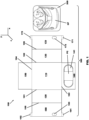
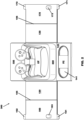
- FIGS. 1 through 8 illustrate an example foldable product packaging system 300 for a consumer product CP.
- a material blank 100 is operable for movement between an unfolded state/open structural configuration and a folded state/closed structural configuration which forms a product packaging 310 for a foldable product packaging system 300.
- the material blank 100 comprises a plurality of contiguous panels that includes a bottom panel 110, inner side panels 120, 130, a front panel 140, a back panel 150, and outer side panels 160, 170.
- the material blank 100 is formed in whole or in-part of a durable and/or rigid sheet or web of material. Such a material may have, in whole or in-part, insulative properties, and may be recyclable.
- the material blank 100 is formed from corrugated cardboard or paperboard. Examples, however, are not limited thereto, and thus, this disclosure contemplates forming the material blank 100 from any suitable material that falls within the scope of the principles of this disclosure.
- the bottom panel 110, inner side panels 120, 130, front panel 140, back panel 150, and outer side panels 160, 170 collectively form a substantially planar two-dimensional (2D) structural configuration.
- the material blank 100 is in condition for storage or transport without a consumer product CP.
- the material blank 100 may be transformed from the unfolded state to the folded state through the selective manipulation of the plurality of contiguous panels along a plurality of fold lines 101-106 to form the product packaging 310 that is to receive a consumer product CP.
- the product packaging 300 containing the consumer product CP, may be in condition for storage or transport.
- the product packaging 310 may be formed having a substantially rectangular geometric three-dimensional (3D) structural configuration. Examples, however, are not limited thereto, and thus, this disclosure contemplates forming the product packaging 310 as any suitable three-dimensional (3D) structural configuration that falls within the scope of the principles of this disclosure.
- a cover or sleeve 320 may be provided to cover or shroud the product packaging 310.
- the product packaging 310 is defined by a plurality of walls defining a cavity operable to receive the consumer product CP.
- the consumer product CP comprises an electronic device, such as, for example, a virtual reality (VR) headset. Examples, however, are not limited thereto. Thus, this disclosure contemplates the consumer product CP comprising any suitable product that falls within the scope of the principles of this disclosure.
- VR virtual reality
- the plurality of walls include, but are not limited to, a base wall 317 formed by the bottom panel 110, opposing sidewalls that include a left sidewall 313 formed by the inner left side panel 120 and a right sidewall 314 formed by the inner right side panel 130, opposing walls that include a front wall 315 formed by the front panel 140 and a rear wall 316 formed by the rear panel 150, and bordering, adjacent, or otherwise adjoining upper walls that include a first upper wall 311 formed by the outer left side panel 160 and a second upper wall 312 formed by the outer right side panel 170.
- the surface of the bottom panel 110 is to facilitate support of the consumer product support member 200, which itself stably supports the consumer product CP.
- the consumer product support member 200 may be multifunctional in serving to stably support the consumer product CP in the cavity, while also serving one or more additional functions.
- the consumer product support member 200 may additionally serve as a wired or wireless charging station for the consumer product CP.
- the consumer product support member 200 may include one or more charging ports to facilitate the wired charging of the consumer product CP.
- the left sidewall 313 is formed through the manipulation of the inner left side panel 120 along the inner left fold line 101 from an unfolded state or structural configuration to a folded state or structural configuration.
- the right sidewall 314 is formed through the manipulation of the inner right side panel 130 along the inner right fold line 102 from an unfolded state or structural configuration to a folded state or structural configuration.
- the front wall 315 is formed through the manipulation of the front panel 140 along front fold line 103 from an unfolded state or structural configuration to a folded state or structural configuration.
- the inner surface of the front panel 140 includes a recess 141 having a depth that facilitates receipt of one or more consumer product accessories PC.
- the recess 141 is formed having a substantially elliptical geometric configuration. Examples, however, are not limited thereto, and thus, this disclosure contemplates forming the recess 141 using any suitable configuration that falls within the scope of the principles of this disclosure.
- the rear wall 316 is formed through the manipulation of the rear panel 150 along the rear fold line 104 from an unfolded state or structural configuration to a folded state or structural configuration.
- One peripheral wall of the rear panel 150 may be exposed to form an internal cavity that extends laterally throughout the width of the rear panel 150.
- the internal cavity is to receive one or more product accessories PC and/or product documentation (e.g., user manual, CP literature, etc.).
- the internal cavity is revealed to allow user access by manipulation of the rear panel 150 along the rear fold line 104 from the folded state or structural configuration to the unfolded state or structural configuration.
- the rear panel 150 may comprise a first elongated closure slit/opening oriented at least partially across the width of an upper peripheral surface of the rear panel 150 and a second elongated closure slit/opening spaced from the first elongated closure slit/opening to extend at least partially across the width of the upper peripheral surface of the rear panel 150.
- the first upper wall 311 is formed through the manipulation of the outer left side panel 160 along the outer left fold line 105 from an unfolded state or structural configuration to a folded state or structural configuration.
- the outer left side panel 160 comprises a first left side panel closure tab 161.
- the first left side panel closure tab 161 When manipulated downwardly (along the z-axis) in an orientation that is substantially orthogonal to the outer left side panel 160, the first left side panel closure tab 161 becomes spatially aligned with the first elongated closure slit/opening 142 of the front panel 140 for receipt therein in the folded state or structural configuration of the front panel 140 and the outer left side panel 160.
- the outer left side panel 160 further comprises a second left side panel closure tab 162.
- the second left side panel closure tab 162 When manipulated downwardly (along the z-axis) in an orientation that is substantially orthogonal to the outer left side panel 160, the second left side panel closure tab 162 is spatially aligned with the first elongated closure slit/opening 152 of the rear panel 150 for receipt therein in the folded state or structural configuration of the rear panel 150 and the outer left side panel 160.
- the first upper wall 311 may be securely locked into position to prevent premature opening of the product packaging 310.
- the outer left side panel 160 further comprises an outer left side panel contact/bumper member 163 oriented (along the z-axis) orthogonally to the internal surface of the outer left side panel 160.
- the outer left side panel contact/bumper member 163 is multifunctional in being operable to engage and maintain the product CP in a seated position in the cavity of the product container body, while also dampening the effects of an impact force or external load applied to the product packaging 310. In that way, damage to the consumer product CP is prevented.
- the outer left side panel 160 and the outer left side panel contact/bumper member 163 may be integrated as a single, unitary component, or alternatively, be separate as independent components that are connected via an adhesive.
- the outer left side panel contact/bumper member 163 may be formed of a durable, lightweight material having high impact resistance.
- the upper wall (rear) 312 is formed through the manipulation of the outer right side panel 170 along the outer right fold line 106 from an unfolded state or structural configuration to a folded state or structural configuration.
- the first upper wall 311 and the upper wall (rear) 312 are substantially coplanar to form an upper wall of the product packaging 310.
- the outer right side panel 170 comprises a first right side panel closure tab 171.
- the first right side panel closure tab 171 When manipulated downwardly (along the z-axis) in an orientation that is substantially orthogonal to the outer right side panel 170, the first right side panel closure tab 171 is spatially aligned with the second elongated closure slit/opening 143 of the front panel 140 for receipt therein in the folded state or structural configuration of the front panel 140 and the outer right side panel 170.
- the outer right side panel 170 further comprises a second right side panel closure tab 172.
- the second right side panel closure tab 172 When manipulated downwardly (along the z-axis) in an orientation that is substantially orthogonal to the outer right side panel 170, the second right side panel closure tab 172 is spatially aligned with aligned with the second elongated closure slit/opening 153 for receipt therein in the folded position of the rear panel 150 and the outer right side panel 170.
- the upper wall (rear) 312 may be securely locked into position to prevent premature opening of the product packaging 310.
- the outer right side panel 170 further comprises an outer right side panel contact/bumper member 173 oriented (along the z-axis) orthogonally to the internal surface of the outer right side panel 170.
- the outer right side panel contact/bumper member 173 is multifunctional in serving to engage and maintain the product CP in a seated position in the cavity of the product container body, while also dampening the effects of an impact force or external load applied to the product packaging 310. In that way, damage to the consumer product CP is prevented.
- the outer right side panel 170 and the outer right side panel contact/bumper member 173 may be integrated as a single, unitary component, or alternatively, be separate as independent components that are connected via an adhesive.
- the outer right side panel contact/bumper member 173 may be formed of a durable, lightweight material having high impact resistance.
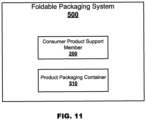
- FIGS. 9 through 12 illustrate an example foldable product packaging system 500 for a consumer product CP.
- a material blank 400 is operable for movement between an unfolded state/open structural configuration and a folded state/closed structural configuration which forms a product packaging 510 for a foldable product packaging system 500.
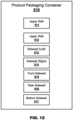
- the material blank 400 comprises a plurality of contiguous panels that includes a bottom panel 410, an inner left side panel 420, an inner right side panel 430, an inner front panel 440, a back panel 450, an outer left side panel 460, an outer right side panel 470, and an outer front panel 451.
- the material blank 400 is formed in whole or in-part of a durable and/or rigid sheet or web of material. Such a material may have, in whole or in-part, insulative properties, and may be recyclable.
- the material blank 400 is formed from corrugated cardboard or paperboard. Examples, however, are not limited thereto, and thus, this disclosure contemplates forming the material blank 400 from any suitable material that falls within the scope of the principles of this disclosure.
- the bottom panel 410, the inner left side panel 420, the inner ride side panel 430, the inner front panel 440, the back panel 450, the outer left side panel 460, and the outer right side panel 470 collectively form a substantially planar two-dimensional (2D) structural configuration.
- the material blank 100 is in condition for storage or transport without a consumer product CP.
- the inner left side panel 420, the inner ride side panel 430, the inner front panel 440, the back panel 450, the outer left side panel 460, and the outer right side panel 470 are respectively formed to have a corresponding substantially planar substrate 420a, 430a, 440a, 450a, 460a, and 470a that projects above corresponding recessed edge region 420b, 430b, 440b, 450b, 460b, and 470b and into the cavity in the folded state.
- Each substantially planar substrate 420a, 430a, 440a, 450a, 460a, and 470a has a thickness value that is greater than the thickness value of the corresponding recessed edge region 420b, 430b, 440b, 450b, 460b, and 470b.
- a structural configuration provides an interlocking connection when the material blank 400 is transformed from the unfolded state to the folded state.
- the material blank 400 may be transformed from the unfolded state to the folded state through the selective manipulation of the plurality of contiguous panels along a plurality of fold lines 401-407 to form the product packaging 510 that is to receive at least one consumer product CP.
- the product packaging 510 containing the consumer product CP, may be in condition for storage or transport.
- the product packaging 510 may be formed having a substantially rectangular geometric three-dimensional (3D) structural configuration. Examples, however, are not limited thereto, and thus, this disclosure contemplates forming the product packaging 510 as any suitable three-dimensional (3D) structural configuration that falls within the scope of the principles of this disclosure.
- the product packaging 510 is defined by a plurality of walls defining a cavity operable to receive at least one consumer product CP.
- the consumer product CP comprises an electronic device, such as, for example, a virtual reality (VR) headset. Examples, however, are not limited thereto, and thus, this disclosure contemplates the consumer product CP comprising any suitable product that falls within the scope of the principles of this disclosure.
- VR virtual reality
- the plurality of walls that define the cavity include a base wall 517 formed by the bottom panel 410, opposing sidewalls that include a left sidewall 513 formed by the inner left side panel 420 and a right sidewall 514 formed by the inner right side panel 430, opposing walls that include a front wall 515 formed by the inner front panel 440 and a rear wall 516 formed by the rear panel 450, and bordering, adjacent, or otherwise adjoining upper walls that include a first upper wall 511 formed by the outer left side panel 460 and a second upper wall 512 formed by the outer right side panel 470.
- An interior upper wall 518, formed by the outer front panel 451, extends from the front wall 515 to at least partially cover the consumer product CP.
- the surface of the bottom panel 410 is to facilitate the support of the consumer product support member 200, which itself stably supports the consumer product CP.
- the consumer product support member 200 may be multifunctional in serving to stably support the consumer product CP in the cavity, while also serving one or more additional functions.
- the consumer product support member 200 may additionally serve as a wired or wireless charging station for the consumer product CP.
- the consumer product support member 200 may include one or more charging ports to facilitate the wired charging of the consumer product CP.
- the left sidewall 513 is formed through the rotation of the inner left side panel 420 about a hinge axis defined by the inner left fold line 401 from an unfolded state or structural configuration to a folded state or structural configuration.
- the right sidewall 514 is formed through the rotation of the inner right side panel 430 about a hinge axis defined by the inner right fold line 402 from an unfolded state or structural configuration to a folded state or structural configuration.
- the front wall 515 is formed through the rotation of the front panel 440 about a hinge axis defined by the front fold line 403 from an unfolded state or structural configuration to a folded state or structural configuration.
- the inner surface of the front panel 440 may include a recess having a depth that facilitates receipt of one or more consumer product accessories.
- the front wall 515 may also comprise one or more elongated closure slits/openings 475 oriented at least partially across the length of an upper peripheral surface thereof.
- the rear wall 516 is formed through the rotation of the rear panel 450 about a hinge axis defined by the rear fold line 404 from an unfolded state or structural configuration to a folded state or structural configuration.
- the rear wall 516 may also comprise one or more closure slits/openings 475 oriented at least partially across the length of an upper peripheral surface thereof.
- the first upper wall 511 is formed through the manipulation of the outer left side panel 460 along the outer left fold line 405 from an unfolded state or structural configuration to a folded state or structural configuration.
- the first upper wall 511 comprises a first left side panel closure tab 461 and a second left side panel closure tab 462.
- the first left side panel closure tab 461 When manipulated downwardly (along the z-axis) in an orientation that is substantially orthogonal to the first upper wall 511, the first left side panel closure tab 461 becomes spatially aligned with a first elongated closure slit/opening 474 of the front panel 440 for receipt therein to facilitate placement of the product packaging 510 in the folded state or structural configuration.
- Such a structural configuration facilitates the releasable and secure locking of the second upper wall 512 in position in a manner that prevents premature opening of the product packaging 510, particularly during transport and/or storage.
- the second left side panel closure tab 462 When manipulated downwardly (along the z-axis) in an orientation that is substantially orthogonal to the first upper wall 511, the second left side panel closure tab 462 is spatially aligned with the second elongated closure slit/opening 475 of the rear panel 450 for receipt therein to facilitate placement of the product packaging 510 in the folded state or structural configuration.
- Such a structural configuration facilitates the releasable and secure locking of the first upper wall 511 in position in a manner that prevents premature opening of the product packaging 510, particularly during transport and/or storage.
- the outer front panel 451 may be rotated about a rotational axis in an anti-clockwise direction to form the interior upper wall 518 that at least partially covers the consumer product CP.
- the interior upper wall 518 has a multifunctional purpose.
- the interior upper wall 518 is operable to engage and maintain the consumer product CP in a seated position in the cavity of the product packaging 510.
- the interior upper wall 518 may have a thickness and material composition that protects and minimizes or otherwise eliminates damage to the consumer product CP by dampening the effects of an impact force or external load applied to the product packaging 510.
- the interior upper wall 518 may be formed with an internal cavity sized to receive one or more product accessories PC and/or product documentation (user manual, CP literature, etc.).
- the second upper wall 512 is formed through the manipulation of the outer right side panel 470 along the outer right fold line 406 from an unfolded state or structural configuration to a folded state or structural configuration.
- the first upper wall 511 and the second upper wall 512 are substantially coplanar to form an upper wall of the product packaging 510.
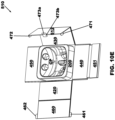
- the outer right side panel 470 comprises a first right side panel closure tab 471, a second right side panel closure tab 472, and a pull-tab member 473.
- the pull-tab member 473 arranged on a peripheral edge of the outer right side panel 470, comprises an upper pull-tab member section 473a and a lower pull-tab member section 473b.
- the upper pull-tab member section 473a includes a surface area enabling a user to grip the pull-tab member 473 and selectively initiate the automatic opening of the product packaging 510 to at least partially expose the consumer product CP.
- the first right side panel closure tab 471 When manipulated downwardly (along the z-axis) in an orientation that is substantially orthogonal to the outer right side panel 470, the first right side panel closure tab 471 becomes spatially aligned with the first elongated closure slit/opening 474 of the front panel 440 for receipt therein to facilitate placement of the product packaging 510 in the folded state or structural configuration.
- Such a structural configuration facilitates the releasable and secure locking of the second upper wall 512 in position in a manner that prevents premature opening of the product packaging 510, particularly during transport and/or storage.
- the second left right panel closure tab 472 When manipulated downwardly (along the z-axis) in an orientation that is substantially orthogonal to the outer right side panel 470, the second left right panel closure tab 472 is spatially aligned with the second elongated closure slit/opening 475 of the rear panel 450 for receipt therein to facilitate placement of the product packaging 510 in the folded state or structural configuration.
- Such a structural configuration facilitates the releasable and secure locking of the first upper wall 511 in position in a manner that prevents premature opening of the product packaging 510, particularly during transport and/or storage.
- the left sidewall 513 forms an interlocking connection with the front wall 515 and the rear wall 516 by virtue of the direct contact, frictional engagement, and/or physical engagement between the planar substrate 420a and the planar substrates 440a, 450a and also the direct contact, frictional engagement, and/or physical engagement between the recessed edge region 420b and the recessed edge regions 440b, 450b.
- the right sidewall 514 forms an interlocking connection with the front wall 515 and the rear wall 516 by virtue of the direct contact, frictional engagement, and/or physical engagement between the planar substrate 430a and the planar substrates 440a, 450a and also the direct contact, frictional engagement, and/or physical engagement between the recessed edge region 430b and the recessed edge regions 440b, 450b.
- the first supper wall 511 forms an interlocking connection with the front wall 515 and the rear wall 516 by virtue of the direct contact, frictional engagement, and/or physical engagement between the planar substrate 460a and the planar substrates 440a, 450a and also the direct contact, frictional engagement, and/or physical engagement between the recessed edge region 460b and the recessed edge regions 440b, 450b.
- the second supper wall 512 forms an interlocking connection with the front wall 515 and the rear wall 516 by virtue of the direct contact, frictional engagement, and/or physical engagement between the planar substrate 470a and the planar substrates 440a, 450a, and also the direct contact, frictional engagement, and/or physical engagement between the recessed edge region 470b and the recessed edge regions 440b, 450b.
- the product packaging 510 includes a releasable locking system that is selectively moveable between a disengaged state and an engaged state which locks and maintains the plurality of walls in a closed structural configuration.
- the releasable locking system includes the first left side panel closure tab 461 and the opposing second left side panel closure tab 462 that are arranged on the first upper wall 511, the first right side panel closure tab 471 and the opposing second right side panel closure tab 472 that are arranged on the second upper wall 512, and the one or more closure slits/openings 474, 475 that are respectively arranged in the front wall 515 and the rear wall 516.
- the front wall 515 and the rear wall 516 are placed in position by selectively rotating the front panel 440 about a hinge axis defined by the fold line 403 and the rear panel 450 about a hinge axis defined by the fold line 404, respectively.
- the interior upper wall 518 is then placed in position by selectively rotating the outer front panel 451 about a hinge axis defined by the fold line 407.
- the left sidewall 513 and the right sidewall 514 are placed in position by selectively rotating the inner left side panel 420 about a hinge axis defined by the fold line 401 and the inner right side panel 430 about a hinge axis defined by the fold line 402, respectively.
- the first upper wall 511 and the second upper wall 512 are then placed in position by selectively rotating the outer left side panel 460 about a hinge axis defined by the fold line 405 and the outer right side panel 470 about a hinge axis defined by the fold line 406, respectively.
- the first, left side panel closure tab 461 and the first left right panel closure tab 462 are placed in the first elongated closure slit/opening 474 of the front panel 440 and the second elongated closure slit/opening 475 of the rear panel 450, respectively.
- the first, right side panel closure tab 471 and the second left right panel closure tab 472 are placed in the first elongated closure slit/opening 474 of the front panel 440 and the second elongated closure slit/opening 475 of the rear panel 450, respectively.
- the left sidewall 513 is interlocked with the front wall 515 and the rear wall 516 by virtue of the direct contact, frictional engagement, and/or physical engagement between the planar substrate 420a and the planar substrates 440a, 450a and also the direct contact, frictional engagement, and/or physical engagement between the recessed edge region 420b and the recessed edge regions 440b, 450b.
- the right sidewall 514 is interlocked with the front wall 515 and the rear wall 516 by virtue of the direct contact, frictional engagement, and/or physical engagement between the planar substrate 430a and the planar substrates 440a, 450a and also the direct contact, frictional engagement, and/or physical engagement between the recessed edge region 430b and the recessed edge regions 440b, 450b.
- the first supper wall 511 is interlocked with the front wall 515 and the rear wall 516 by virtue of the direct contact, frictional engagement, and/or physical engagement between the planar substrate 460a and the planar substrates 440a, 450a and also the direct contact, frictional engagement, and/or physical engagement between the recessed edge region 460b and the recessed edge regions 440b, 450b.
- the second supper wall 512 is interlocked with the front wall 515 and the rear wall 516 by virtue of the direct contact, frictional engagement, and/or physical engagement between the planar substrate 470a and the planar substrates 440a, 450a, and also the direct contact, frictional engagement, and/or physical engagement between the recessed edge region 470b and the recessed edge regions 440b, 450b.
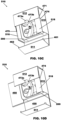
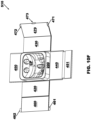
- FIGS. 10A through 10F illustrates a sequence which causes the selective transformation of the product packaging 510 from the folded state/closed structural configuration to the unfolded state/open structural configuration which partially or fully exposes the consumer product CP.
- the product packaging 510 is in an initial, folded state/closed structural configuration.
- the upper pull-tab member section 473a is arranged between a seam or gap between the first upper wall 511 and the second upper wall 512. In this position, at least a portion of the upper pull-tab member section 473a projects upwardly from the second upper wall 512 to enable a user to grip the pull-tab member 473 to selectively initiate the automatic opening of the product packaging 510 to at least partially expose the consumer product CP.
- the upper pull-tab member section 473a, in the folded state of the product packaging 510 is oriented in a plane that is substantially orthogonal to the second upper wall 512.
- the lower pull-tab member section 473b is hidden from view in the cavity, and is oriented in a plane that is substantially orthogonal to the upper pull-tab member section 473a.
- the lower pull-tab member section 473b is oriented in a plane that is parallel to the second upper wall 512 for positioning under the planar substrate 460a and/or the recessed edge region 460b that faces the cavity. In this position, the lower pull-tab member section 473b is in direct physical contact or engagement with the planar substrate 460a and/or the recessed edge region 460b.
- a user may pull the upper pull-tab member section 473a to urge rotation of the second upper wall 512 (e.g., in a clockwise direction).
- Such rotation by the second upper wall 512 causes the release of the direct contact, frictional engagement, and/or physical engagement between the planar substrate 470a and the planar substrates 440a, 450a, and also release of the direct contact, frictional engagement, and/or physical engagement between the recessed edge region 470b and the recessed edge regions 440b, 450b.
- These actions thereby cause release of the interlocking connection of the second supper wall 512 with the front wall 515 and the rear wall 516.
- Rotation by the second upper wall 512 also causes the release of the direct contact, frictional engagement, and/or physical engagement between the planar substrate 420a and the planar substrates 440a, 450a and also the release of the direct contact, frictional engagement, and/or physical engagement between the recessed edge region 420b and the recessed edge regions 440b, 450b. These actions thereby cause release of the interlocking connection of the left sidewall 513 with the front wall 515 and the rear wall 516.
- the lower pull-tab member section 473b applies a force to the planar substrate 460a and/or the recessed edge region 460b to urge (e.g., via application of a force) the first upper wall 511 to rotate (e.g., in an anti-clockwise direction).
- Such rotation by the first upper wall 511 causes the release of the direct contact, frictional engagement, and/or physical engagement between the planar substrate 460a and the planar substrates 440a, 450a, and also release of the direct contact, frictional engagement, and/or physical engagement between the recessed edge region 460b and the recessed edge regions 440b, 450b.
- both the first upper wall 511 and the second upper wall 512 are caused to rotate substantially concurrently with each other to an unfolded state/open structural configuration in a substantially symmetrically manner.
- Rotation of the first upper wall 511 also causes the first left side panel closure tab 461 to move out of the first elongated closure slit/opening 474 and the second left side panel closure tab 462 to move out of the second elongated closure slit/opening 475 ( FIGS. 10B through 10D ).
- Rotation of the second upper wall 512 also causes the first right side panel closure tab 471 to move out of the first elongated closure slit/opening 474 and the second right side panel closure tab 472 to move out of the second elongated closure slit/opening 475 ( FIGS. 10E and 10F ).
- the walls may be selectively caused to rotate symmetrically in a manner which transforms the product packaging 510 from a folded state/closed structural configuration to an unfolded state/open structural configuration.
- Examples are not limited to symmetrical opening of the walls and sidewalls of the product packaging 510.
- This disclosure contemplates opening the walls and sidewalls of the product packaging 510 in any suitable manner that falls within the scope of the principles of this disclosure.
- the walls and sidewalls of the product packaging 510 may be opened asymmetrically.
- Coupled may be used herein to refer to any type of relationship, direct or indirect, between the components in question, and may apply to electrical, mechanical, fluid, optical, electromagnetic, electro-mechanical or other connections. Additionally, the terms “first,” “second,” etc. are used herein only to facilitate discussion, and carry no particular temporal or chronological significance unless otherwise indicated.
- cause or “causing” means to make, force, compel, direct, command, instruct, and/or enable an event or action to occur or at least be in a state where such event or action may occur, either in a direct or indirect manner.
Landscapes
- Engineering & Computer Science (AREA)
- Mechanical Engineering (AREA)
- Cartons (AREA)
Applications Claiming Priority (2)
| Application Number | Priority Date | Filing Date | Title |
|---|---|---|---|
| US202363610794P | 2023-12-15 | 2023-12-15 | |
| US18/914,655 US20250197051A1 (en) | 2023-12-15 | 2024-10-14 | Product packaging |
Publications (1)
| Publication Number | Publication Date |
|---|---|
| EP4570683A1 true EP4570683A1 (fr) | 2025-06-18 |
Family
ID=93799546
Family Applications (1)
| Application Number | Title | Priority Date | Filing Date |
|---|---|---|---|
| EP24217578.4A Pending EP4570683A1 (fr) | 2023-12-15 | 2024-12-04 | Emballage de produit |
Country Status (3)
| Country | Link |
|---|---|
| US (1) | US20250197051A1 (fr) |
| EP (1) | EP4570683A1 (fr) |
| CN (2) | CN120156761A (fr) |
Citations (4)
| Publication number | Priority date | Publication date | Assignee | Title |
|---|---|---|---|---|
| GB536719A (en) * | 1940-06-19 | 1941-05-23 | Robinson & Sons Ltd | Improvements in or relating to collapsible boxes |
| US2727675A (en) * | 1951-11-09 | 1955-12-20 | Waldorf Paper Prod Co | Shipping container |
| JPH0364212U (fr) * | 1989-10-24 | 1991-06-24 | ||
| US20210130062A1 (en) * | 2019-10-30 | 2021-05-06 | Media Fast, Lc | Systems and apparatuses for an interactive media package |
Family Cites Families (2)
| Publication number | Priority date | Publication date | Assignee | Title |
|---|---|---|---|---|
| US3013711A (en) * | 1960-09-21 | 1961-12-19 | Wagner Fotung Box Corp | Receptacle closure |
| JP2019094115A (ja) * | 2017-11-27 | 2019-06-20 | シャープ株式会社 | 包装用箱体 |
-
2024
- 2024-10-14 US US18/914,655 patent/US20250197051A1/en active Pending
- 2024-11-18 CN CN202411647387.XA patent/CN120156761A/zh active Pending
- 2024-11-18 CN CN202422814094.8U patent/CN223495004U/zh active Active
- 2024-12-04 EP EP24217578.4A patent/EP4570683A1/fr active Pending
Patent Citations (4)
| Publication number | Priority date | Publication date | Assignee | Title |
|---|---|---|---|---|
| GB536719A (en) * | 1940-06-19 | 1941-05-23 | Robinson & Sons Ltd | Improvements in or relating to collapsible boxes |
| US2727675A (en) * | 1951-11-09 | 1955-12-20 | Waldorf Paper Prod Co | Shipping container |
| JPH0364212U (fr) * | 1989-10-24 | 1991-06-24 | ||
| US20210130062A1 (en) * | 2019-10-30 | 2021-05-06 | Media Fast, Lc | Systems and apparatuses for an interactive media package |
Also Published As
| Publication number | Publication date |
|---|---|
| CN120156761A (zh) | 2025-06-17 |
| US20250197051A1 (en) | 2025-06-19 |
| CN223495004U (zh) | 2025-10-31 |
Similar Documents
| Publication | Publication Date | Title |
|---|---|---|
| US8006893B2 (en) | Container having tab identifiers and method for constructing the same | |
| US4232816A (en) | Clamshell type carton | |
| US5161733A (en) | Hinge lid cigarette carton with innerframe, and blank and method therefor | |
| US4951865A (en) | Paperboard carton with gusset lock | |
| US5944183A (en) | Carton with glued liner incorporating an integral cell | |
| US20170313464A1 (en) | Container having a lid lock assembly and methods of making same from a blank | |
| US20070267468A1 (en) | Container having tab identifiers and method for constructing the same | |
| EP4570683A1 (fr) | Emballage de produit | |
| US11560252B2 (en) | Folding carton | |
| JP2017197217A (ja) | 蓋付き容器 | |
| CN218594776U (zh) | 一种包装容器 | |
| JP4847113B2 (ja) | 組立て紙箱 | |
| CN217101117U (zh) | 包装盒 | |
| CA2613633C (fr) | Appareil et methode pour poignees integrees a des contenants de produits | |
| CN114455167B (zh) | 包装盒和电子产品 | |
| CN108455011B (zh) | 可折叠箱及可折叠保温箱 | |
| JP2003205938A (ja) | 折り畳み式運搬用容器 | |
| JP2022100899A (ja) | 運搬体 | |
| JP2000168773A (ja) | 蓋付き折り畳みコンテナ | |
| CN221189503U (zh) | 相机包装盒 | |
| JPH08169436A (ja) | ボトムロック式紙箱 | |
| JPH0630657Y2 (ja) | 包装用箱体 | |
| US12168552B2 (en) | Packaging for an input device | |
| CN221317119U (zh) | 纸盒 | |
| EP3759026B1 (fr) | Carton |
Legal Events
| Date | Code | Title | Description |
|---|---|---|---|
| PUAI | Public reference made under article 153(3) epc to a published international application that has entered the european phase |
Free format text: ORIGINAL CODE: 0009012 |
|
| STAA | Information on the status of an ep patent application or granted ep patent |
Free format text: STATUS: THE APPLICATION HAS BEEN PUBLISHED |
|
| AK | Designated contracting states |
Kind code of ref document: A1 Designated state(s): AL AT BE BG CH CY CZ DE DK EE ES FI FR GB GR HR HU IE IS IT LI LT LU LV MC ME MK MT NL NO PL PT RO RS SE SI SK SM TR |
|
| STAA | Information on the status of an ep patent application or granted ep patent |
Free format text: STATUS: REQUEST FOR EXAMINATION WAS MADE |
|
| 17P | Request for examination filed |
Effective date: 20250730 |