EP4570810A1 - Silane compound - Google Patents
Silane compound Download PDFInfo
- Publication number
- EP4570810A1 EP4570810A1 EP23852631.3A EP23852631A EP4570810A1 EP 4570810 A1 EP4570810 A1 EP 4570810A1 EP 23852631 A EP23852631 A EP 23852631A EP 4570810 A1 EP4570810 A1 EP 4570810A1
- Authority
- EP
- European Patent Office
- Prior art keywords
- group
- independently
- integer
- sir
- compound
- Prior art date
- Legal status (The legal status is an assumption and is not a legal conclusion. Google has not performed a legal analysis and makes no representation as to the accuracy of the status listed.)
- Pending
Links
Classifications
-
- G—PHYSICS
- G02—OPTICS
- G02B—OPTICAL ELEMENTS, SYSTEMS OR APPARATUS
- G02B1/00—Optical elements characterised by the material of which they are made; Optical coatings for optical elements
- G02B1/10—Optical coatings produced by application to, or surface treatment of, optical elements
- G02B1/14—Protective coatings, e.g. hard coatings
-
- C—CHEMISTRY; METALLURGY
- C07—ORGANIC CHEMISTRY
- C07F—ACYCLIC, CARBOCYCLIC OR HETEROCYCLIC COMPOUNDS CONTAINING ELEMENTS OTHER THAN CARBON, HYDROGEN, HALOGEN, OXYGEN, NITROGEN, SULFUR, SELENIUM OR TELLURIUM
- C07F7/00—Compounds containing elements of Groups 4 or 14 of the Periodic Table
- C07F7/02—Silicon compounds
- C07F7/08—Compounds having one or more C—Si linkages
- C07F7/0834—Compounds having one or more O-Si linkage
- C07F7/0838—Compounds with one or more Si-O-Si sequences
-
- C—CHEMISTRY; METALLURGY
- C07—ORGANIC CHEMISTRY
- C07F—ACYCLIC, CARBOCYCLIC OR HETEROCYCLIC COMPOUNDS CONTAINING ELEMENTS OTHER THAN CARBON, HYDROGEN, HALOGEN, OXYGEN, NITROGEN, SULFUR, SELENIUM OR TELLURIUM
- C07F7/00—Compounds containing elements of Groups 4 or 14 of the Periodic Table
- C07F7/02—Silicon compounds
- C07F7/08—Compounds having one or more C—Si linkages
- C07F7/0896—Compounds with a Si-H linkage
-
- C—CHEMISTRY; METALLURGY
- C07—ORGANIC CHEMISTRY
- C07F—ACYCLIC, CARBOCYCLIC OR HETEROCYCLIC COMPOUNDS CONTAINING ELEMENTS OTHER THAN CARBON, HYDROGEN, HALOGEN, OXYGEN, NITROGEN, SULFUR, SELENIUM OR TELLURIUM
- C07F7/00—Compounds containing elements of Groups 4 or 14 of the Periodic Table
- C07F7/02—Silicon compounds
- C07F7/08—Compounds having one or more C—Si linkages
- C07F7/18—Compounds having one or more C—Si linkages as well as one or more C—O—Si linkages
- C07F7/1804—Compounds having Si-O-C linkages
-
- C—CHEMISTRY; METALLURGY
- C07—ORGANIC CHEMISTRY
- C07F—ACYCLIC, CARBOCYCLIC OR HETEROCYCLIC COMPOUNDS CONTAINING ELEMENTS OTHER THAN CARBON, HYDROGEN, HALOGEN, OXYGEN, NITROGEN, SULFUR, SELENIUM OR TELLURIUM
- C07F7/00—Compounds containing elements of Groups 4 or 14 of the Periodic Table
- C07F7/02—Silicon compounds
- C07F7/21—Cyclic compounds having at least one ring containing silicon, but no carbon in the ring
-
- C—CHEMISTRY; METALLURGY
- C08—ORGANIC MACROMOLECULAR COMPOUNDS; THEIR PREPARATION OR CHEMICAL WORKING-UP; COMPOSITIONS BASED THEREON
- C08G—MACROMOLECULAR COMPOUNDS OBTAINED OTHERWISE THAN BY REACTIONS ONLY INVOLVING UNSATURATED CARBON-TO-CARBON BONDS
- C08G77/00—Macromolecular compounds obtained by reactions forming a linkage containing silicon with or without sulfur, nitrogen, oxygen or carbon in the main chain of the macromolecule
- C08G77/04—Polysiloxanes
- C08G77/045—Polysiloxanes containing less than 25 silicon atoms
-
- C—CHEMISTRY; METALLURGY
- C08—ORGANIC MACROMOLECULAR COMPOUNDS; THEIR PREPARATION OR CHEMICAL WORKING-UP; COMPOSITIONS BASED THEREON
- C08G—MACROMOLECULAR COMPOUNDS OBTAINED OTHERWISE THAN BY REACTIONS ONLY INVOLVING UNSATURATED CARBON-TO-CARBON BONDS
- C08G77/00—Macromolecular compounds obtained by reactions forming a linkage containing silicon with or without sulfur, nitrogen, oxygen or carbon in the main chain of the macromolecule
- C08G77/04—Polysiloxanes
- C08G77/38—Polysiloxanes modified by chemical after-treatment
-
- C—CHEMISTRY; METALLURGY
- C08—ORGANIC MACROMOLECULAR COMPOUNDS; THEIR PREPARATION OR CHEMICAL WORKING-UP; COMPOSITIONS BASED THEREON
- C08G—MACROMOLECULAR COMPOUNDS OBTAINED OTHERWISE THAN BY REACTIONS ONLY INVOLVING UNSATURATED CARBON-TO-CARBON BONDS
- C08G77/00—Macromolecular compounds obtained by reactions forming a linkage containing silicon with or without sulfur, nitrogen, oxygen or carbon in the main chain of the macromolecule
- C08G77/04—Polysiloxanes
- C08G77/38—Polysiloxanes modified by chemical after-treatment
- C08G77/382—Polysiloxanes modified by chemical after-treatment containing atoms other than carbon, hydrogen, oxygen or silicon
- C08G77/388—Polysiloxanes modified by chemical after-treatment containing atoms other than carbon, hydrogen, oxygen or silicon containing nitrogen
-
- C—CHEMISTRY; METALLURGY
- C08—ORGANIC MACROMOLECULAR COMPOUNDS; THEIR PREPARATION OR CHEMICAL WORKING-UP; COMPOSITIONS BASED THEREON
- C08G—MACROMOLECULAR COMPOUNDS OBTAINED OTHERWISE THAN BY REACTIONS ONLY INVOLVING UNSATURATED CARBON-TO-CARBON BONDS
- C08G77/00—Macromolecular compounds obtained by reactions forming a linkage containing silicon with or without sulfur, nitrogen, oxygen or carbon in the main chain of the macromolecule
- C08G77/48—Macromolecular compounds obtained by reactions forming a linkage containing silicon with or without sulfur, nitrogen, oxygen or carbon in the main chain of the macromolecule in which at least two but not all the silicon atoms are connected by linkages other than oxygen atoms
- C08G77/54—Nitrogen-containing linkages
-
- C—CHEMISTRY; METALLURGY
- C08—ORGANIC MACROMOLECULAR COMPOUNDS; THEIR PREPARATION OR CHEMICAL WORKING-UP; COMPOSITIONS BASED THEREON
- C08L—COMPOSITIONS OF MACROMOLECULAR COMPOUNDS
- C08L83/00—Compositions of macromolecular compounds obtained by reactions forming in the main chain of the macromolecule a linkage containing silicon with or without sulfur, nitrogen, oxygen or carbon only; Compositions of derivatives of such polymers
- C08L83/14—Compositions of macromolecular compounds obtained by reactions forming in the main chain of the macromolecule a linkage containing silicon with or without sulfur, nitrogen, oxygen or carbon only; Compositions of derivatives of such polymers in which at least two but not all the silicon atoms are connected by linkages other than oxygen atoms
-
- G—PHYSICS
- G02—OPTICS
- G02B—OPTICAL ELEMENTS, SYSTEMS OR APPARATUS
- G02B1/00—Optical elements characterised by the material of which they are made; Optical coatings for optical elements
- G02B1/10—Optical coatings produced by application to, or surface treatment of, optical elements
- G02B1/11—Anti-reflection coatings
Definitions
- the present disclosure relates to a silane compound.
- Certain types of silane compounds are known to be capable of providing excellent water- and oil-repellency when used in surface treatment of a substrate (Patent Literature 1).
- Patent Literature 1 JP 2019-44179 A
- An object of the present disclosure is to provide a compound capable of forming a surface-treating layer having both abrasion durability and fingerprint removability by wiping in a well-balanced manner.
- the present disclosure includes the following embodiments.
- the present disclosure can provide a compound capable of forming a surface-treating layer having both abrasion durability and fingerprint removability by wiping in a well-balanced manner.
- the term "monovalent organic group” as used herein refers to a carbon-containing monovalent group.
- the monovalent organic group is not limited, and may be a hydrocarbon group or a derivative thereof.
- the derivative of a hydrocarbon group refers to a group that has one or more of N, O, S, Si, amide, sulfonyl, siloxane, carbonyl, carbonyloxy, and the like at the terminal or in the molecular chain of the hydrocarbon group.
- the term simply referred to as an "organic group” means a monovalent organic group.
- the term "divalent organic group” refers to a carbon-containing divalent group.
- the divalent organic group may be, for example, a divalent group obtained by further removing one hydrogen atom from an organic group.
- an organic group having a valence of 3 or more refers to a group obtained by removing a predetermined number of hydrogen atoms from an organic group.
- hydrocarbon group refers to a group containing carbon and hydrogen and a group in which a hydrogen atom is removed from the hydrocarbon.
- examples of the hydrocarbon group include, but are not limited to, C 1-20 hydrocarbon groups, such as an aliphatic hydrocarbon group and an aromatic hydrocarbon group.
- the "aliphatic hydrocarbon group” may be either linear, branched, or cyclic, and may be either saturated or unsaturated.
- the hydrocarbon group may contain one or more ring structures.
- the hydrocarbon group may be substituted with one or more substituents.
- Examples of the substituent of the "hydrocarbon group" as used herein include, but are not limited to, a halogen atom; and one or more groups selected from a C 1-6 alkyl group, a C 2-6 alkenyl group, a C 2-6 alkynyl group, a C 3-10 cycloalkyl group, a C 3-10 unsaturated cycloalkyl group, a 5- to 10-membered heterocyclyl group, a 5- to 10-membered unsaturated heterocyclyl group, a C 6-10 aryl group, and a 5- to 10-membered heteroaryl group each optionally substituted with one or more halogen atoms.
- hydrolyzable group refers to a group that can undergo a hydrolysis reaction, i.e., refers to a group that can be removed from the main backbone of the compound by a hydrolysis reaction.
- R h examples include unsubstituted alkyl groups such as a methyl group, an ethyl group, a propyl group, an isopropyl group, a n-butyl group, and an isobutyl group; and substituted alkyl groups such as a chloromethyl group.
- an alkyl group in particular an unsubstituted alkyl group, is preferable, and a methyl group or an ethyl group is more preferable.
- the silane compound of the present disclosure is a compound represented by the following formula (1): [Formula 6] R 1 -X 1 - R Si (1) wherein
- R 1 is a monovalent group containing one or more Si atoms to which neither a hydroxyl group nor a hydrolyzable group is directly bonded.
- the monovalent group containing one or more Si atoms to which neither a hydroxyl group nor a hydrolyzable group is directly bonded may contain a Si atom to which a hydroxyl group or a hydrolyzable group is directly bonded.
- the monovalent group containing one or more Si atoms to which neither a hydroxyl group nor a hydrolyzable group is bonded does not contain a Si atom to which a hydroxyl group or a hydrolyzable group is directly bonded.
- the monovalent group containing one or more Si atoms to which neither a hydroxyl group nor a hydrolyzable group is bonded contains one or more Si atoms to which a hydroxyl group or a hydrolyzable group is directly bonded.
- R 1 is a group represented by the following formula: R 3 - (SiR 4 2 O) n -SiR 4 2 - wherein R 3 is a C 1-12 alkyl group or a group represented by the following group A or group B: wherein
- R 1 is a group represented by the group A or group B: wherein
- R 3 is a C 1-12 alkyl group.
- the C 1-12 alkyl group in R 3 may be linear or may be branched. In one embodiment, the C 1-12 alkyl group is linear. In another embodiment, the C 1-12 alkyl group is branched.
- the C 1-12 alkyl group is preferably a C 1-6 alkyl group, more preferably a C 1-3 alkyl group, even more preferably a methyl group or an ethyl group, and particularly preferably a methyl group.
- R 3 is a group A or a group B.
- R 51 is each independently a group represented by -(R 61 -SiR 53 2 ) ma -R 53 .
- R 61 is each independently an oxygen atom or a C 1-6 alkylene group.
- the C 1-6 alkylene group in R 61 may be linear or may be branched.
- the C 1-6 alkylene group is preferably a C 1-4 alkylene group, and more preferably a C 2-4 alkylene group.
- R 61 is O.
- R 61 groups are O, and other R 61 groups are C 1-6 alkylene groups.
- R 53 is each independently a hydrocarbon group or R 51' .
- the hydrocarbon group in R 53 may preferably be an alkyl group or an aryl group.
- the alkyl group may be linear or may be branched.
- the alkyl group is preferably an alkyl group having 1 to 6 carbon atoms, and more preferably an alkyl group having 1 to 4 carbon atoms.
- the alkyl group is particularly preferably a methyl group, an ethyl group, a n-propyl group, an iso-propyl group, or a tert-butyl group.
- the aryl group may be monocyclic or polycyclic.
- the aryl group is preferably an aryl group having 6 to 20 carbon atoms, and more preferably an aryl group having 6 to 10 carbon atoms.
- the aryl group is particularly preferably a phenyl group.
- R 53 is preferably an alkyl group, and more preferably an alkyl group having 1 to 4 carbon atoms.
- R 51' has the same meaning as R 51 . That is to say, R 51' is -(OSiR 53 2 ) ma -R 53 , provided that, in R 51 , the number of R 51' is 20 or less, preferably 10 or less, more preferably 6 or less, and even more preferably 3 or less.
- R 53 is each independently a hydrocarbon group or R 51' .
- R 53 is each independently a hydrocarbon group.
- R 3 is -(R 4' -SiR 3' 2 ) ma' -R 3' wherein
- R 53 is -(R 61' -SiR 53' 2 ) ma' -R 53' wherein
- ma is each independently an integer of 1 to 5, and preferably 1 or 2.
- R 52 is each independently a hydrocarbon group.
- the hydrocarbon group in R 52 may preferably be an alkyl group or an aryl group.
- the alkyl group may be linear or may be branched.
- the alkyl group is preferably an alkyl group having 1 to 6 carbon atoms, and more preferably an alkyl group having 1 to 4 carbon atoms.
- the alkyl group is particularly preferably a methyl group, an ethyl group, a n-propyl group, an iso-propyl group, or a tert-butyl group.
- the aryl group may be monocyclic or polycyclic.
- the aryl group is preferably an aryl group having 6 to 20 carbon atoms, and more preferably an aryl group having 6 to 10 carbon atoms.
- the aryl group is particularly preferably a phenyl group.
- R 52 is preferably an alkyl group, and more preferably an alkyl group having 1 to 4 carbon atoms.
- na is an integer of 1 to 3. In one embodiment, na is 2. In another embodiment, na is 3. Note that na, when R 51' is present, is independently selected for (R 61 -SiR 53 2 ) ma .
- z is 0 or 1. In one embodiment, z is 0. In another embodiment, z is 1.
- Examples of the group A include, but are not limited to, the following groups.
- R 54 is each independently a hydrocarbon group.
- the hydrocarbon group in R 54 may preferably be an alkyl group or an aryl group.
- the alkyl group may be linear or may be branched.
- the alkyl group is preferably an alkyl group having 1 to 6 carbon atoms, and more preferably an alkyl group having 1 to 4 carbon atoms.
- the alkyl group is particularly preferably a methyl group, an ethyl group, a n-propyl group, an iso-propyl group, or a tert-butyl group.
- the aryl group may be monocyclic or polycyclic.
- the aryl group is preferably an aryl group having 6 to 20 carbon atoms, and more preferably an aryl group having 6 to 10 carbon atoms.
- the aryl group is particularly preferably a phenyl group.
- R 54 is preferably an alkyl group, and more preferably an alkyl group having 1 to 4 carbon atoms.
- nb is an integer of 1 to 5, and preferably 2 or 3.
- Examples of the group B include, but are not limited to, the following groups.
- the C 1-12 alkyl group in R 4 may be linear or may be branched. In one embodiment, the C 1-12 alkyl group is linear. In another embodiment, the C 1-12 alkyl group is branched.
- the C 1-12 alkyl group is preferably a C 1-6 alkyl group, more preferably a C 1-3 alkyl group, even more preferably a methyl group or an ethyl group, and particularly preferably a methyl group.
- n may be 0 to 1,500, preferably 0 to 1,500, more preferably 0 to 500, and even more preferably 0 to 10. In one embodiment, n may be preferably 1 to 1,500, more preferably 1 to 500, and even more preferably 1 to 10. n is yet more preferably 0, 1, or 2.
- n is 10 to 500, and more preferably 10 to 100.
- R 3 is methyl
- R 4 is methyl
- n is 1 or 2.
- R 1 is a monovalent organic group containing one or more Si atoms to which neither a hydroxyl group nor a hydrolyzable group is directly bonded and not containing a siloxane bond.
- R 1 is a group represented by the following formula: -SiR 5 3 wherein
- the C 1-6 alkyl group in R 5 may be linear or may be branched. In one embodiment, the C 1-6 alkyl group is linear. In another embodiment, the C 1-6 alkyl group is branched. The C 1-6 alkyl group is preferably a C 1-4 alkyl group.
- the C 1-12 alkyl group in R 6 may be linear or may be branched. In one embodiment, the C 1-12 alkyl group is linear. In another embodiment, the C 1-12 alkyl group is branched.
- the C 1-12 alkyl group is preferably a C 1-6 alkyl group, more preferably a C 1-3 alkyl group, even more preferably a methyl group or an ethyl group, and particularly preferably a methyl group.
- SiR 5 3 may preferably be -Si(CH 3 ) 3 , -Si(CH 2 CH 3 ) 3 , - Si(CH(CH 3 ) 2 ) 3 , -Si(CH 3 )(CH 3 )(C(CH 3 ) 3 )), -Si(Si (CH 3 ) 3 , or - Si(Si (CH 2 CH 3 ) 3 .
- X 1 is a divalent organic group including an alkylene group having 11 or more carbon atoms.
- X 1 is, in addition to an alkylene group having 11 or more carbon atoms, a divalent organic group further including -CO-, -COO-, -NR 2 -, -CONR 2 -, -OCONR 2 -, -NR 2 -CO-NR 2 -, -O-, -S-, -O- (CH 2 ) x -CONR 2 -, or -O-(CH 2 ) x -CO-;
- R 2 is a hydrogen atom or a C 1-6 alkyl group; and x is an integer of 1 to 20.
- X 1 is preferably a group represented by the following formula: -X 21 -X 10 -X 11 -X 12 - wherein
- X 1 is preferably a group represented by the following formula: -X 10 -X 11 -X 12 - wherein
- X 21 is R 61 b1 R 62 3-b1 C-, R 63 b2 R 64 3-b2 Si-, or R 65 2 N-.
- R 61 is a divalent organic group.
- R 61 is preferably a C 1-6 alkylene group, -(CH 2 ) f1 -O-(CH 2 ) f2 - (wherein f1 is an integer of 0 to 6, such as an integer of 1 to 6, and f2 is an integer of 0 to 6, such as an integer of 1 to 6), or - (CH 2 ) f3 -phenylene- (CH 2 ) f4 - (wherein f3 is an integer of 0 to 6, such as an integer of 1 to 6, and f4 is an integer of 0 to 6, such as an integer of 1 to 6).
- Such a C 1-6 alkylene group may be linear or may be branched, and is preferably linear.
- These groups may be substituted with, for example, one or more substituents selected from a fluorine atom, a C 1-6 alkyl group, a C 2-6 alkenyl group, and a C 2-6 alkynyl group, and are preferably unsubstituted.
- R 61 is a C 1-6 alkylene group or - (CH 2 ) f3 -phenylene- (CH 2 ) f4 -, and preferably -phenylene-(CH 2 ) f4 -.
- R 61 is a C 1-3 alkylene group. In one embodiment, R 61 may be -CH 2 CH 2 CH 2 -. In another embodiment, R 61 may be -CH 2 CH 2 -.
- R 62 is a hydrogen atom or a monovalent organic group.
- R 62 is a hydrogen atom.
- R 62 is a monovalent organic group.
- the monovalent organic group is preferably a C 1-20 alkyl group, more preferably a C 1-6 alkyl group, and even more preferably a methyl group.
- b1 is 2 or 3. In one embodiment, b1 is 2. In another embodiment, b1 is 3.
- R 63 is a divalent organic group.
- R 63 is preferably a C 1-6 alkylene group, - (CH 2 ) g1 -O-(CH 2 ) g2 - (wherein g1 is an integer of 0 to 6, such as an integer of 1 to 6, and g2 is an integer of 0 to 6, such as an integer of 1 to 6), or - (CH 2 ) g3 -phenylene- (CH 2 ) g4 - (wherein g3 is an integer of 0 to 6, such as an integer of 1 to 6, and g4 is an integer of 0 to 6, such as an integer of 1 to 6).
- Such a C 1-6 alkylene group may be linear or may be branched, and is preferably linear.
- These groups may be substituted with, for example, one or more substituents selected from a fluorine atom, a C 1-6 alkyl group, a C 2-6 alkenyl group, and a C 2-6 alkynyl group, and are preferably unsubstituted.
- R 63 is a C 1-6 alkylene group or - (CH 2 ) g3 -phenylene- (CH 2 ) g4 -, and preferably -phenylene-(CH 2 ) g4 -.
- R 63 is a C 1-3 alkylene group. In one embodiment, R 63 may be -CH 2 CH 2 CH 2 -. In another embodiment, R 63 may be -CH 2 CH 2 -.
- R 64 is a hydrogen atom or a monovalent organic group.
- R 64 is a hydrogen atom.
- R 64 is a monovalent organic group.
- the monovalent organic group is preferably a C 1-20 alkyl group, more preferably a C 1-6 alkyl group, and even more preferably a methyl group.
- b2 is 2 or 3. In one embodiment, b2 is 2. In another embodiment, b2 is 3.
- R 65 is a divalent organic group.
- R 65 is preferably a C 1-6 alkylene group, - (CH 2 ) h1 -O-(CH 2 ) h2 - (wherein h1 is an integer of 0 to 6, such as an integer of 1 to 6, and h2 is an integer of 0 to 6, such as an integer of 1 to 6), or - (CH 2 ) h3 -phenylene- (CH 2 ) h4 - (wherein h3 is an integer of 0 to 6, such as an integer of 1 to 6, and h4 is an integer of 0 to 6, such as an integer of 1 to 6).
- Such a C 1-6 alkylene group may be linear or may be branched, and is preferably linear.
- These groups may be substituted with, for example, one or more substituents selected from a fluorine atom, a C 1-6 alkyl group, a C 2-6 alkenyl group, and a C 2-6 alkynyl group, and are preferably unsubstituted.
- R 65 is a C 1-6 alkylene group or -(CH 2 ) h3 -phenylene-(CH 2 ) h4 -, and preferably -phenylene-(CH 2 ) h4 -.
- R 65 is a C 1-3 alkylene group. In one embodiment, R 65 may be -CH 2 CH 2 CH 2 -. In another embodiment, R 65 may be -CH 2 CH 2 -.
- X 21 is R 61 b1 R 62 3-b1 C-.
- X 21 is R 63 b2 R 64 3-b2 Si-.
- X 21 is R 65 2 N-.
- X 21 is -O-.
- the number of carbon atoms of the alkylene group in X 1 and X 10 may preferably be 12 or more, more preferably 16 or more, even more preferably 18 or more, and yet more preferably 22 or more.
- the number of carbon atoms of the alkylene group in X 1 and X 10 may preferably be 60 or less, more preferably 40 or less, even more preferably 30 or less, and yet more preferably 24 or less.
- the number of carbon atoms of the alkylene group in X 1 and X 10 may preferably be 11 to 60, more preferably 12 to 40, and even more preferably 18 to 30.
- the alkylene group in X 1 and X 10 may be linear or may be branched.
- the alkylene group is preferably linear.
- X 11 is preferably -CO-, -COO-, -NR 2 -, -CONR 2 -, -OCONR 2 -, -NR 2 -CO-NR 2 -, -O-, -S-, -O-(CH 2 ) x -CONR 2 -, or -O- (CH 2 ) x -CO-, more preferably -CO-, -CONR 2 -, or -OCONR 2 -, and even more preferably -CONR 2 -.
- R 2 is preferably a hydrogen atom, and x is an integer of 1 to 20.
- X 12 is a single bond.
- X 12 is a C 1-6 alkylene group.
- the C 1-6 alkylene group in X 12 may be linear or may be branched. In one embodiment, the C 1-6 alkylene group is linear. In another embodiment, the C 1-6 alkylene group is branched.
- the C 1-6 alkylene group is preferably a C 1-4 alkylene group, and more preferably a C 1-3 alkylene group.
- the number of carbon atoms of the alkylene group in X 1 is greater than the number of Si atoms in R 1 . Causing the number of carbon atoms of the alkylene group in X 1 to be greater than the number of Si atoms in R 1 enables the abrasion durability of the resulting surface-treating layer to be increased.
- the number of carbon atoms of the alkylene group in X 1 may be not less than 2.5 times, preferably not less than 3.0 times, and more preferably not less than 3.5 times the number of Si atoms in R 1 . Also, the number of carbon atoms of the alkylene group in X 1 may preferably be not more than 50 times, such as not more than 30 times, not more than 20 times, or not more than 10 times the number of Si atoms in R 1 .
- the number of carbon atoms of the alkylene group in X 1 is greater than the number of atoms of the main chain in R 1 . Causing the number of carbon atoms of the alkylene group in X 1 to be greater than the number of atoms of the main chain in R 1 enables the abrasion durability of the resulting surface-treating layer to be increased.
- the number of carbon atoms of the alkylene group in X 1 may be not less than 2.0 times, preferably not less than 2.5 times, more preferably not less than 3.0 times, and even more preferably not less than 4.0 times the number of atoms of the main chain in R 1 . Also, the number of carbon atoms of the alkylene group in X 1 may preferably be not more than 30 times, such as not more than 20 times, not more than 10 times, or not more than 6.0 times the number of atoms of the main chain in R 1 .
- the main chain in R 1 means an atomic chain having the largest number of atoms (excluding hydrogen atoms) from the Si atom in R 1 bonded to X 1 .
- the number of atoms of the main chain in R 1 is 4 in the case of Si(CH 3 ) 3 OSi(CH 3 ) 2 -
- the number of atoms of the main chain in R 1 is 6 in the case of Si(CH 3 ) 3 OSi(CH 3 ) 3 OSi(CH 3 ) 2 -
- 3 in the case of Si(Si(CH 3 ) 3 ) 3 -.
- R Si is a monovalent group containing a Si atom to which a hydroxyl group or a hydrolyzable group is bonded.
- R Si is preferably a group represented by the following formula (S1), (S2), (S3), or (S4): [Formula 14] - SiR 11 n1 R 12 3-n1 (S1) - SiR a1 k1 R b1 l1 R c1 m1 (S2) - CR d1 k2 R e1 l2 R f1 m2 (S3) - NR g1 R h1 (S4) wherein
- R 11 is each independently a hydroxyl group or a hydrolyzable group.
- R 11 is preferably, each independently, a hydrolyzable group.
- R h include unsubstituted alkyl groups such as a methyl group, an ethyl group, a propyl group, an isopropyl group, a n-butyl group, and an isobutyl group; and substituted alkyl groups such as a chloromethyl group.
- an alkyl group in particular an unsubstituted alkyl group, is preferable, and a methyl group or an ethyl group is more preferable.
- R h is a methyl group, and in another embodiment, R h is an ethyl group.
- R 12 is each independently a monovalent organic group.
- a monovalent organic group is a monovalent organic group excluding the hydrolyzable group.
- the monovalent organic group is preferably a C 1-20 alkyl group, more preferably a C 1-6 alkyl group, and even more preferably a methyl group.
- n1 is an integer of 1 to 3, preferably an integer of 2 to 3, and more preferably 3.
- R a1 is each independently -Z 1 -SiR 21 p1 R 22 q1 R 23 r1 .
- Z 1 is each independently an oxygen atom or a divalent organic group. Below, the right side of the structure denoted as Z 1 binds to (SiR 21 p1 R 22 q1 R 23 r1 ).
- Z 1 is a divalent organic group.
- Z 1 does not form a siloxane bond with the Si atom to which Z 1 binds.
- Si-Z 1 -Si does not contain a siloxane bond.
- Z 1 is preferably a C 1-6 alkylene group, - (CH 2 ) z1 -O- (CH 2 ) z2 -(wherein z1 is an integer of 0 to 6, such as an integer of 1 to 6, and z2 is an integer of 0 to 6, such as an integer of 1 to 6), or - (CH 2 ) z3 -phenylene- (CH 2 ) z4 - (wherein z3 is an integer of 0 to 6, such as an integer of 1 to 6, and z4 is an integer of 0 to 6, such as an integer of 1 to 6).
- Such a C 1-6 alkylene group may be linear or may be branched, and is preferably linear.
- These groups may be substituted with, for example, one or more substituents selected from a fluorine atom, a C 1-6 alkyl group, a C 2-6 alkenyl group, and a C 2-6 alkynyl group, and are preferably unsubstituted.
- Z 1 is a C 1-6 alkylene group or - (CH 2 ) z3 -phenylene- (CH 2 ) z4 -, and preferably -phenylene-(CH 2 ) z4 -.
- Z 1 is a C 1-3 alkylene group. In one embodiment, Z 1 may be -CH 2 CH 2 CH 2 -. In another embodiment, Z 1 may be -CH 2 CH 2 -.
- R 21 is each independently -Z 1' -SiR 21' p1' R 22' q1' R 23' r1' .
- Z 1' is each independently an oxygen atom or a divalent organic group. Below, the right side of the structure denoted as Z 1' binds to (SiR 21' p1' R 22' q1' R 23' r1' ).
- Z 1' is a divalent organic group.
- Z 1' does not form a siloxane bond with the Si atom to which Z 1' binds.
- (Si-Z 1' -Si) does not contain a siloxane bond.
- Z 1' is preferably a C 1-6 alkylene group, -(CH 2 ) z1' -O-(CH 2 ) z2' - (wherein z1' is an integer of 0 to 6, such as an integer of 1 to 6, and z2' is an integer of 0 to 6, such as an integer of 1 to 6), or -(CH 2 ) z3' -phenylene- (CH 2 ) z4' -(wherein z3' is an integer of 0 to 6, such as an integer of 1 to 6, and z4' is an integer of 0 to 6, such as an integer of 1 to 6).
- Such a C 1-6 alkylene group may be linear or may be branched, and is preferably linear.
- These groups may be substituted with, for example, one or more substituents selected from a fluorine atom, a C 1-6 alkyl group, a C 2-6 alkenyl group, and a C 2-6 alkynyl group, and are preferably unsubstituted.
- Z 1' is a C 1-6 alkylene group or -(CH 2 ) z3' -phenylene- (CH 2 ) z4' -, and preferably -phenylene-(CH2) z4' -.
- Z 1' is a C 1-3 alkylene group. In one embodiment, Z 1' may be -CH 2 CH 2 CH 2 -. In another embodiment, Z 1' may be -CH 2 CH 2 -.
- R 21' is each independently -Z 1" -SiR 22" q1" R 23" r1" .
- Z 1" is each independently an oxygen atom or a divalent organic group. Below, the right side of the structure denoted as Z 1" binds to (SiR 22" q1" R 23" r1" ).
- Z 1" is a divalent organic group.
- Z 1" does not form a siloxane bond with the Si atom to which Z 1" is bonded.
- (Si-Z 1" -Si) does not contain a siloxane bond.
- Z 1" is preferably a C 1-6 alkylene group, -(CH 2 ) z1" -O-(CH 2 ) z2" - (wherein z1" is an integer of 0 to 6, such as an integer of 1 to 6, and z2" is an integer of 0 to 6, such as an integer of 1 to 6), or - (CH 2 ) z3" -phenylene- (CH 2 ) z4" -(wherein z3" is an integer of 0 to 6, such as an integer of 1 to 6, and z4" is an integer of 0 to 6, such as an integer of 1 to 6).
- Such a C 1-6 alkylene group may be linear or may be branched, and is preferably linear.
- These groups may be substituted with, for example, one or more substituents selected from a fluorine atom, a C 1-6 alkyl group, a C 2-6 alkenyl group, and a C 2-6 alkynyl group, and are preferably unsubstituted.
- Z 1" is a C 1-6 alkylene group or -(CH 2 ) z3" -phenylene- (CH 2 ) z4" -, and preferably -phenylene-(CH 2 ) z4" -.
- Z 1" is such a group, light resistance, in particular ultraviolet resistance, can be more increased.
- Z 1" is a C 1-3 alkylene group. In one embodiment, Z 1" may be -CH 2 CH 2 CH 2 -. In another embodiment, Z 1" may be -CH 2 CH 2 -.
- R 22" is each independently a hydroxyl group or a hydrolyzable group.
- R 22" is preferably, each independently, a hydrolyzable group.
- R h include unsubstituted alkyl groups such as a methyl group, an ethyl group, a propyl group, an isopropyl group, a n-butyl group, and an isobutyl group; and substituted alkyl groups such as a chloromethyl group.
- an alkyl group in particular an unsubstituted alkyl group, is preferable, and a methyl group or an ethyl group is more preferable.
- R h is a methyl group, and in another embodiment, R h is an ethyl group.
- R 23" is each independently a monovalent organic group.
- Such a monovalent organic group is a monovalent organic group excluding the above hydrolyzable group.
- the monovalent organic group is preferably a C 1-20 alkyl group, more preferably a C 1-6 alkyl group, and even more preferably a methyl group.
- q1" is each independently an integer of 0 to 3
- r1" is each independently an integer of 0 to 3.
- the sum of q1" and r1" is 3 in the (SiR 22" q1" R 23 " r1" ) unit.
- q1" is preferably, each independently, an integer of 1 to 3, more preferably 2 to 3, and even more preferably 3 for each (SiR 22" q1" R 23" r1" ) unit .
- R 22' is each independently a hydroxyl group or a hydrolyzable group.
- R 22' is preferably, each independently, a hydrolyzable group.
- R h include unsubstituted alkyl groups such as a methyl group, an ethyl group, a propyl group, an isopropyl group, a n-butyl group, and an isobutyl group; and substituted alkyl groups such as a chloromethyl group.
- an alkyl group in particular an unsubstituted alkyl group, is preferable, and a methyl group or an ethyl group is more preferable.
- R h is a methyl group, and in another embodiment, R h is an ethyl group.
- R 23' is each independently a monovalent organic group.
- a monovalent organic group is a monovalent organic group excluding the above hydrolyzable group.
- the monovalent organic group is preferably a C 1-20 alkyl group, more preferably a C 1-6 alkyl group, and even more preferably a methyl group.
- p1' is each independently an integer of 0 to 3
- q1' is each independently an integer of 0 to 3
- r1' is each independently an integer of 0 to 3.
- the sum of p', q1', and r1' is 3 in the (SiR 21' p1' R 22' q1' R 23' r1' ) unit.
- p1' is 0.
- p1' may be each independently an integer of 1 to 3, an integer of 2 to 3, or 3 for each (SiR 21' p1' R 22' q1' R 23' r1' ) unit. In a preferable embodiment, p1' is 3.
- q1' is each independently an integer of 1 to 3, preferably an integer of 2 to 3, and more preferably 3 for each (SiR 21' p1' R 22' q1' R 23' r1' ) unit.
- p1' is 0, and q1' is each independently an integer of 1 to 3, preferably an integer of 2 to 3, and even more preferably 3 for each (SiR 21' p1' R 22' q1' R 23' r1' ) unit.
- R 22 is each independently a hydroxyl group or a hydrolyzable group.
- R 22 is preferably, each independently, a hydrolyzable group.
- R h include unsubstituted alkyl groups such as a methyl group, an ethyl group, a propyl group, an isopropyl group, a n-butyl group, and an isobutyl group; and substituted alkyl groups such as a chloromethyl group.
- an alkyl group in particular an unsubstituted alkyl group, is preferable, and a methyl group or an ethyl group is more preferable.
- R h is a methyl group, and in another embodiment, R h is an ethyl group.
- R 23 is each independently a monovalent organic group.
- a monovalent organic group is a monovalent organic group excluding the hydrolyzable group.
- the monovalent organic group is preferably a C 1-20 alkyl group, more preferably a C 1-6 alkyl group, and even more preferably a methyl group.
- p1 is each independently an integer of 0 to 3
- q1 is each independently an integer of 0 to 3
- r1 is each independently an integer of 0 to 3.
- the sum of p1, q1, and r1 is 3 in the (SiR 21 p1 R 22 q1 R 23 r1 ) unit.
- p1 is 0.
- p1 may be each independently an integer of 1 to 3, an integer of 2 to 3, or 3 for each (SiR 21 p1 R 22 q1 R 23 r1 ) unit. In a preferable embodiment, p1 is 3.
- q1 is each independently an integer of 1 to 3, preferably an integer of 2 to 3, and more preferably 3 for each (SiR 21 p1 R 22 q1 R 23 r1 ) unit.
- p1 is 0, and q1 is each independently an integer of 1 to 3, preferably an integer of 2 to 3, and even more preferably 3 for each (SiR 21 p1 R 22 q1 R 23 r1 ) unit.
- R b1 is each independently a hydroxyl group or a hydrolyzable group.
- R b1 is preferably, each independently, a hydrolyzable group.
- R h include unsubstituted alkyl groups such as a methyl group, an ethyl group, a propyl group, an isopropyl group, a n-butyl group, and an isobutyl group; and substituted alkyl groups such as a chloromethyl group.
- an alkyl group in particular an unsubstituted alkyl group, is preferable, and a methyl group or an ethyl group is more preferable.
- R h is a methyl group, and in another embodiment, R h is an ethyl group.
- R c1 is each independently a monovalent organic group.
- Such a monovalent organic group is a monovalent organic group excluding the above hydrolyzable group.
- the monovalent organic group is preferably a C 1-20 alkyl group, more preferably a C 1-6 alkyl group, and even more preferably a methyl group.
- k1 is each independently an integer of 0 to 3
- l1 is each independently an integer of 0 to 3
- m1 is each independently an integer of 0 to 3.
- the sum of k1, l1, and m1 is 3 in the (SiR a1 k1 R b1 l1 R c1 m1 ) unit.
- k1 is each independently an integer of 1 to 3, preferably 2 or 3, and more preferably 3 for each (SiR a1 k1 R b1 l1 R c1 m1 ) unit. In a preferable embodiment, k1 is 3.
- the terminal moiety of the formula (S2) at least two Si atoms to which a hydroxyl group or a hydrolyzable group is bonded are present.
- the group represented by the formula (S2) has any one of -Z 1 -SiR 22 q1 R 23 r1 (wherein q1 is an integer of 1 to 3, preferably 2 or 3, and more preferably 3, and r1 is an integer of 0 to 2), -Z 1' -SiR 22' q1 -R 23' r1' (wherein q1' is an integer of 1 to 3, preferably 2 or 3, and more preferably 3, and r1' is an integer of 0 to 2), or -Z 1 "-SiR 22" q1" R 23" r1" (wherein q1" is an integer of 1 to 3, preferably 2 or 3, and more preferably 3, and r1" is an integer of 0 to 2).
- Z 1 , Z 1' , Z 1" , R 22 , R 23 , R 22' , R 23' , R 22" , and R 23" have the same meanings as those described above.
- q1" is an integer of 1 to 3, preferably 2 or 3, and more preferably 3 in at least one, preferably all of R 21' groups.
- R 21 when R 21 is present in the formula (S2), p1' is 0, and q1' is an integer of 1 to 3, preferably 2 or 3, and more preferably 3 in at least one, preferably all of R 21 groups.
- R a1 when R a1 is present in the formula (S2), p1 is 0, and q1 is an integer of 1 to 3, preferably 2 or 3, and more preferably 3 in at least one, preferably all of R a1 groups.
- k1 is 2 or 3 and preferably 3
- p1 is 0,
- q1 is 2 or 3 and preferably 3.
- R d1 is each independently -Z 2 -CR 31 p2 R 32 q2 R 33 r2 .
- Z 2 is each independently a single bond, an oxygen atom, or a divalent organic group. Below, the right side of the structure denoted as Z 2 is bonded to (CR 31 p2 R 32 q2 R 33 r2 ).
- Z 2 is a divalent organic group.
- Z 2 does not contain a siloxane bond.
- Z 2 is preferably a C 1-6 alkylene group, -(CH 2 ) z5 -O-(CH 2 ) z6 -(wherein z5 is an integer of 0 to 6, such as an integer of 1 to 6, and z6 is an integer of 0 to 6, such as an integer of 1 to 6), or -(CH 2 ) z7 -phenylene-(CH 2 ) z8 - (wherein z7 is an integer of 0 to 6, such as an integer of 1 to 6, and z8 is an integer of 0 to 6, such as an integer of 1 to 6).
- Such a C 1-6 alkylene group may be linear or may be branched, and is preferably linear.
- These groups may be substituted with, for example, one or more substituents selected from a fluorine atom, a C 1-6 alkyl group, a C 2-6 alkenyl group, and a C 2-6 alkynyl group, and are preferably unsubstituted.
- Z 2 is a C 1-6 alkylene group or -(CH 2 ) z7 -phenylene-(CH 2 ) z8 -, and preferably -phenylene-(CH 2 ) z8 -.
- Z 2 is such a group, light resistance, in particular ultraviolet resistance, can be more increased.
- Z 2 is a C 1-3 alkylene group. In one embodiment, Z 2 may be -CH 2 CH 2 CH 2 -. In another embodiment, Z 2 may be -CH 2 CH 2 -.
- R 31 is each independently -Z 2' -CR 32' q2' R 33' r2' .
- Z 2' is each independently a single bond, an oxygen atom, or a divalent organic group.
- Z 2' binds to (CR 32' q2' R 33' r2' ).
- Z 2' does not contain a siloxane bond.
- Z 2' is preferably a C 1-6 alkylene group, -(CH 2 ) z5' -O-(CH 2 ) z6' - (wherein z5' is an integer of 0 to 6, such as an integer of 1 to 6, and z6' is an integer of 0 to 6, such as an integer of 1 to 6), or -(CH 2 ) z7' -phenylene-(CH 2 ) z8' -(wherein z7' is an integer of 0 to 6, such as an integer of 1 to 6, and z8' is an integer of 0 to 6, such as an integer of 1 to 6).
- Such a C 1-6 alkylene group may be linear or may be branched, and is preferably linear.
- These groups may be substituted with, for example, one or more substituents selected from a fluorine atom, a C 1-6 alkyl group, a C 2-6 alkenyl group, and a C 2-6 alkynyl group, and are preferably unsubstituted.
- Z 2' is a C 1-6 alkylene group or -(CH 2 ) z7' -phenylene-(CH 2 ) z8' -, and preferably -phenylene-(CH 2 ) z8' -.
- Z 2' is such a group, light resistance, in particular ultraviolet resistance, can be more increased.
- Z 2' is a C 1-3 alkylene group. In one embodiment, Z 2' may be -CH 2 CH 2 CH 2 -. In another embodiment, Z 2' may be -CH 2 CH 2 -.
- R 32' is each independently -Z 3 -SiR 34 n2 R 35 3-n2 .
- Z 3 is each independently a single bond, an oxygen atom, or a divalent organic group. Below, the right side of the structure denoted as Z 3 binds to (SiR 34 n2 R 35 3-n2 .
- Z 3 is an oxygen atom.
- Z 3 is a divalent organic group.
- Z 3 does not contain a siloxane bond.
- Z 3 is preferably a C 1-6 alkylene group, - (CH 2 ) z5" -O-(CH 2 ) z6" - (wherein z5" is an integer of 0 to 6, such as an integer of 1 to 6, and z6" is an integer of 0 to 6, such as an integer of 1 to 6), or - (CH 2 ) z7" -phenylene-(CH 2 ) z8" -(wherein z7" is an integer of 0 to 6, such as an integer of 1 to 6, and z8" is an integer of 0 to 6, such as an integer of 1 to 6).
- Such a C 1-6 alkylene group may be linear or may be branched, and is preferably linear.
- These groups may be substituted with, for example, one or more substituents selected from a fluorine atom, a C 1-6 alkyl group, a C 2-6 alkenyl group, and a C 2-6 alkynyl group, and are preferably unsubstituted.
- Z 3 is a C 1-6 alkylene group or - (CH 2 ) z7 -phenylene-(CH 2 ) z8" -, and preferably -phenylene-(CH 2 ) z8" -.
- Z 3 is such a group, light resistance, in particular ultraviolet resistance, can be more increased.
- Z 3 is a C 1-3 alkylene group. In one embodiment, Z 3 may be -CH 2 CH 2 CH 2 -. In another embodiment, Z 3 may be -CH 2 CH 2 -.
- R 34 is each independently a hydroxyl group or a hydrolyzable group.
- R 34 is preferably, each independently, a hydrolyzable group.
- R h include unsubstituted alkyl groups such as a methyl group, an ethyl group, a propyl group, an isopropyl group, a n-butyl group, and an isobutyl group; and substituted alkyl groups such as a chloromethyl group.
- an alkyl group in particular an unsubstituted alkyl group, is preferable, and a methyl group or an ethyl group is more preferable.
- R h is a methyl group, and in another embodiment, R h is an ethyl group.
- R 35 is each independently a monovalent organic group.
- a monovalent organic group is a monovalent organic group excluding the above hydrolyzable group.
- the monovalent organic group is preferably a C 1-20 alkyl group, more preferably a C 1-6 alkyl group, and even more preferably a methyl group.
- n2 is each independently an integer of 0 to 3 for each (SiR 34 n2 R 35 3-n2 ) unit, provided that, in the terminal moiety of the formula (S3), at least two (SiR 34 n2 R 35 3-n2 ) units wherein n2 is 1 to 3 are present. In other words, in the terminal moiety of the formula (S3), at least two Si atoms to which a hydroxyl group or a hydrolyzable group is bonded are present.
- n2 is each independently an integer of preferably 1 to 3, more preferably 2 to 3, and even more preferably 3 for each (SiR 34 n2 R 35 3-n2 ) unit.
- R 33' is each independently a hydrogen atom, a hydroxyl group, or a monovalent organic group.
- a monovalent organic group is a monovalent organic group excluding the hydrolyzable group.
- the monovalent organic group is preferably a C 1-20 alkyl group or -(C s H 2s ) t1 -(O-C s H 2s ) t2 (wherein s is an integer of 1 to 6, preferably an integer of 2 to 4, t1 is 1 or 0, preferably 0, and t2 is an integer of 1 to 20, preferably an integer of 2 to 10, and more preferably an integer of 2 to 6), more preferably a C 1-20 alkyl group, even more preferably a C 1-6 alkyl group, and particularly preferably a methyl group.
- R 33' is a hydroxyl group.
- R 33' is a monovalent organic group, preferably a C 1-20 alkyl group, and more preferably a C 1-6 alkyl group.
- q2' is each independently an integer of 0 to 3
- r2' is each independently an integer of 0 to 3.
- the sum of q2' and r2' is 3 in the (CR 32' q2' R 33' r2' ) unit.
- q2' is each independently an integer of preferably 1 to 3, more preferably 2 to 3, and even more preferably 3 for each (CR 32' q2' R 33' r2' ) unit.
- R 32 is each independently -Z 3 -SiR 34 n2 R 35 3-n2 .
- Such -Z 3 -SiR 34 n2 R 35 3-n2 has the same meanings as those described for R 32' .
- R 33 is each independently a hydrogen atom, a hydroxyl group, or a monovalent organic group.
- a monovalent organic group is a monovalent organic group excluding the above hydrolyzable group.
- the monovalent organic group is preferably a C 1-20 alkyl group or -(C s H 2s ) t1 -(O-C s H 2s ) t2 (wherein s is an integer of 1 to 6, preferably an integer of 2 to 4, t1 is 1 or 0, preferably 0, and t2 is an integer of 1 to 20, preferably an integer of 2 to 10, and more preferably an integer of 2 to 6), more preferably a C 1-20 alkyl group, even more preferably a C 1-6 alkyl group, and particularly preferably a methyl group.
- R 33 is a hydroxyl group.
- R 33 is a monovalent organic group, preferably a C 1-20 alkyl group, and more preferably a C 1-6 alkyl group.
- p2 is each independently an integer of 0 to 3
- q2 is each independently an integer of 0 to 3
- r2 is each independently an integer of 0 to 3.
- the sum of p2, q2, and r2 is 3 in the (CR 31 p2 R 32 q2 R 33 r2 ) unit.
- p2 is 0.
- p2 may be each independently an integer of 1 to 3, an integer of 2 to 3, or 3 for each (CR 31 p2 R 32 q2 R 33 r2 ) unit. In a preferable embodiment, p2 is 3.
- q2 is each independently an integer of 1 to 3, preferably an integer of 2 to 3, and more preferably 3 for each (CR 31 p2 R 32 q2 R 33 r2 ) unit.
- p2 is 0, and q2 is each independently an integer of 1 to 3, preferably an integer of 2 to 3, and even more preferably 3 for each (CR 31 p2 R 32 q2 R 33 r2 ) unit.
- R e1 is each independently -Z 3 -SiR 34 n2 R 35 3-n2 .
- Such -Z 3 -SiR 34 n2 R 35 3-n2 has the same meanings as those described for R 32' .
- R f1 is each independently a hydrogen atom, a hydroxyl group, or a monovalent organic group.
- a monovalent organic group is a monovalent organic group excluding the above hydrolyzable group.
- the monovalent organic group is preferably a C 1-20 alkyl group or - (C s H 2s ) t1 -(O-C s H 2s ) t2 (wherein s is an integer of 1 to 6, preferably an integer of 2 to 4, t1 is 1 or 0, preferably 0, and t2 is an integer of 1 to 20, preferably an integer of 2 to 10, and more preferably an integer of 2 to 6), more preferably a C 1-20 alkyl group, even more preferably a C 1-6 alkyl group, and particularly preferably a methyl group.
- R f1 is a hydroxyl group.
- R f1 is a monovalent organic group, preferably a C 1-20 alkyl group, and more preferably a C 1-6 alkyl group.
- k2 is each independently an integer of 0 to 3
- l2 is each independently an integer of 0 to 3
- m2 is each independently an integer of 0 to 3.
- the sum of k2, l2, and m2 is 3 in the (CR d1 k2 R e1 l2 R f1 m2 ) unit.
- n2 is an integer of 1 to 3, preferably 2 or 3, and more preferably 3 in at least one, preferably all of R 32' groups.
- n2 is an integer of 1 to 3, preferably 2 or 3, and more preferably 3 in at least one, preferably all of R 32 groups.
- n2 is an integer of 1 to 3, preferably 2 or 3, and more preferably 3 in at least one, preferably all of R a1 groups.
- k2 is 0, l2 is 2 or 3 and preferably 3, and n2 is 2 or 3 and preferably 3 in the formula (S3).
- R g1 and R h1 are each independently -Z 4 -SiR 11 n1 R 12 3-n1 , -Z 4 -SiR a1 k1 R b1 l1 R c1 m1 , or -Z 4 -CR d1 k2 R e1 l2 R f1 m2 .
- R 11 , R 12 , R a1 , R b2 , R c1 , R d1 , R e1 , R f1 , n1, k1, l1, m1, k2, l2, and m2 have the same meanings as those described above.
- R g1 and R h1 are each independently -Z 4 -SiR 11 n1 R 12 3-n1 .
- Z 4 is each independently a single bond, an oxygen atom, or a divalent organic group. Below, the right side of the structure denoted as Z 4 binds to (SiR 11 n1 R 12 3-n1 ).
- Z 4 is an oxygen atom.
- Z 4 is a divalent organic group.
- Z 4 does not contain a siloxane bond.
- Z 4 is preferably a C 1-6 alkylene group, - (CH 2 ) z5" -O-(CH 2 ) z6" - (wherein z5" is an integer of 0 to 6, such as an integer of 1 to 6, and z6" is an integer of 0 to 6, such as an integer of 1 to 6), or - (CH 2 ) z7" -phenylene- (CH 2 ) z8" -(wherein z7" is an integer of 0 to 6, such as an integer of 1 to 6, and z8" is an integer of 0 to 6, such as an integer of 1 to 6).
- Such a C 1-6 alkylene group may be linear or may be branched, and is preferably linear.
- These groups may be substituted with, for example, one or more substituents selected from a fluorine atom, a C 1-6 alkyl group, a C 2-6 alkenyl group, and a C 2-6 alkynyl group, and are preferably unsubstituted.
- Z 4 is a C 1-6 alkylene group or -(CH 2 ) z7" -phenylene-(CH 2 ) z8" -, and preferably -phenylene-(CH 2 ) z8" -.
- Z 3 is such a group, light resistance, in particular ultraviolet resistance, can be more increased.
- Z 4 is a C 1-3 alkylene group. In one embodiment, Z 4 may be -CH 2 CH 2 CH 2 -. In another embodiment, Z 4 may be -CH 2 CH 2 -.
- the formulae (S1), (S2), (S3), and (S4) do not contain a siloxane bond.
- R Si is a group represented by the formula (S2), (S3), or (S4).
- R Si is a group represented by the formula (S3), (S4), or (S5).
- R Si is a group represented by the formula (S1).
- n1 is 1 to 3, preferably 2 to 3, and even more preferably 3.
- R Si is a group represented by the formula (S2).
- the formula (S2) is -SiR a1 2 R c1 or -SiR a1 3
- R a1 is -Z 1 -SiR 22 q1 R 23 r1
- Z 1 is a C 1-6 alkylene group, -(CH 2 ) z1 -O-(CH 2 ) z2 - (wherein z1 is an integer of 0 to 6, such as an integer of 1 to 6, and z2 is an integer of 0 to 6, such as an integer of 1 to 6), or -(CH 2 ) z3 -phenylene-(CH 2 ) z4 - (wherein z3 is an integer of 0 to 6, such as an integer of 1 to 6, and z4 is an integer of 0 to 6, such as an integer of 1 to 6), preferably a C 1-6 alkylene group, and q1 is 1 to 3, preferably 2 to 3,
- R Si is a group represented by the formula (S3).
- the formula (S3) is -CR e1 2 R f1 or -CR e1 3
- R e1 is -Z 3 -SiR 34 n2 R 35 3-n2
- Z 3 is a C 1-6 alkylene group, - (CH 2 ) z5" -O- (CH 2 ) z6" - (wherein z5" is an integer of 0 to 6, such as an integer of 1 to 6, and z6" is an integer of 0 to 6, such as an integer of 1 to 6), or - (CH 2 ) z7" -phenylene-(CH 2 ) z8" - (wherein z7" is an integer of 0 to 6, such as an integer of 1 to 6, and z8" is an integer of 0 to 6, such as an integer of 1 to 6), preferably a C 1-6 alkylene group, and n2 is 1 to 3, preferably a C 1-6 alkylene
- R Si is a group represented by the formula (S4).
- R g1 and R h1 are - Z 4 -SiR 11 n1 R 12 3-n1
- Z 4 is a C 1-6 alkylene group, - (CH 2 ) z5" -O-(CH 2 ) z6" - (wherein z5" is an integer of 0 to 6, such as an integer of 1 to 6, and z6" is an integer of 0 to 6, such as an integer of 1 to 6), or - (CH 2 ) z7" -phenylene-(CH 2 ) z8" -(wherein z7" is an integer of 0 to 6, such as an integer of 1 to 6, and z8" is an integer of 0 to 6, such as an integer of 1 to 6), preferably a C 1-6 alkylene group, and n1 is 1 to 3, preferably 2 to 3, and even more preferably 3.
- the compound represented by the formula (1) can be produced by the following method.
- the surface-treating agent of the present disclosure contains at least one compound represented by the formula (1).
- the surface-treating agent of the present disclosure is at least one compound itself that is represented by the formula (1).
- the content of the compound represented by the formula (1) is preferably 0.1 to 50.0% by mass, more preferably 1.0 to 30.0% by mass, even more preferably 5.0 to 25.0% by mass, and particularly preferably 10.0 to 20.0% by mass based on the entirety of the surface-treating agent.
- the content of the compound represented by the formula (1) is preferably 0.001 to 30% by mass, more preferably 0.01 to 10% by mass, even more preferably 0.05 to 5% by mass, and particularly preferably 0.05 to 2% by mass based on the entirety of the surface-treating agent.
- the surface-treating agent of the present disclosure may contain at least one of the compound of the present disclosure and a condensate obtained by at least partially condensing the compound of the present disclosure.
- the content of the condensate may be preferably 40% by mass or less and more preferably 30% by mass or less based on the sum of the silane compound and the condensate.
- the content of the condensate can be determined from, for example, the abundance ratio of the peak position to the area in GPC (gel permeation chromatography).
- the surface-treating agent of the present disclosure may contain a solvent, a (non-reactive) silicone compound that may be understood as a silicone oil (hereinafter, referred to as "silicone oil”), an amine compound, an alcohol, a catalyst, a surfactant, a polymerization inhibitor, a sensitizer, and the like.
- the surface-treating agent of the present disclosure contains a compound represented by R 90 -OH.
- R 90 is a monovalent organic group and is preferably a C 1-20 alkyl group or a C 3-20 alkylene group, and these groups may be substituted with one or more substituents.
- substituents include a hydroxyl group and -OR 91 wherein R 91 is a C 1-10 alkyl group, preferably a C 1-3 alkyl group, such as a methyl group.
- the surface-treating agent of the present disclosure may contain a solvent selected from compounds represented by R 81 OR 82 , R 83 n8 C 6 H 6-n8 , R 84 R 85 R 86 Si-(O-SiR 87 R 88 ) m8 -R 89 , and (OSiR 87 R 88 ) m9 , wherein
- the monovalent organic group having 1 to 10 carbon atoms may be linear or branched, and may further contain a cyclic structure.
- the monovalent organic group having 1 to 10 carbon atoms may contain an oxygen atom, a nitrogen atom, or a halogen atom.
- the monovalent organic group having 1 to 10 carbon atoms does not contain a halogen atom.
- the monovalent organic group having 1 to 10 carbon atoms is a hydrocarbon group optionally substituted with a halogen atom, and preferably a hydrocarbon group not substituted with a halogen atom.
- the hydrocarbon group is linear.
- the hydrocarbon group is branched.
- the hydrocarbon group contains a cyclic structure.
- the solvent is R 81 OR 82 .
- R 81 and R 82 may be, each independently, preferably a hydrocarbon group having 1 to 8 carbon atoms, and more preferably a C 1-6 alkyl group or a C 5-8 cycloalkyl group.
- the solvent is R 83 n8 C 6 H 6-n8 .
- C 6 H 6-n8 is an n8-valent benzene ring. That is, R 83 n8 C 6 H 6 - n8 is benzene substituted with n8 R 83 .
- R 83 may be each independently a halogen atom, or a C 1-6 alkyl group optionally substituted with a halogen atom.
- n8 is preferably an integer of 1 to 3.
- the solvent is R 84 R 85 R 86 Si-(O-SiR 87 R 88 ) m8 -R 89 .
- the solvent is (OSiR 87 R 88 ) 9 .
- (OSiR 87 R 88 ) m9 is a cyclic siloxane formed by multiple OSiR 87 R 88 units bonded in a cyclic form.
- R 84 to R 89 are each independently a hydrogen atom or a C 1-6 alkyl group, preferably a C 1-6 alkyl group, more preferably a C 1-3 alkyl group, and even more preferably a methyl group.
- m8 is preferably an integer of 1 to 6, more preferably an integer of 1 to 5, and even more preferably 1 to 2.
- m9 is preferably an integer of 3 to 6, and more preferably an integer of 3 to 5.
- examples of the solvent include aliphatic hydrocarbons such as hexane, cyclohexane, heptane, octane, nonane, decane, undecane, dodecane, and mineral spirits; aromatic hydrocarbons such as benzene, toluene, xylene, naphthalene, and solvent naphtha; esters such as methyl acetate, ethyl acetate, propyl acetate, n-butyl acetate, isopropyl acetate, isobutyl acetate, cellosolve acetate, propylene glycol methyl ether acetate, carbitol acetate, diethyl oxalate, ethyl pyruvate, ethyl 2-hydroxybutyrate, ethyl acetoacetate, amyl acetate, methyl lactate, ethyl lactate, methyl 3-methoxyprop
- the solvent may be a mixed solvent of two or more of such solvents.
- preferable are aliphatic hydrocarbons, esters, glycol ethers, alcohols, ether alcohols, and siloxanes.
- preferable are hexane, cyclohexane, heptane, octane, nonane, decane, undecane, dodecane, mineral spirits, methyl acetate, ethyl acetate, propyl acetate, n-butyl acetate, isopropyl acetate, isobutyl acetate, propylene glycol monomethyl ether, propylene glycol monoethyl ether, propylene glycol monobutyl ether, methanol, ethanol, iso-propanol, n-butanol, isobutanol, tert-butanol, sec-butanol, diethylene glycol monomethyl ether, hexamethyl
- diethylene glycol monoethyl ether diethylene glycol monomethyl ether, diethylene glycol dimethyl ether, diethylene glycol ethyl methyl ether, diethylene glycol diethyl ether, 2-ethoxyethanol, 1,2-diethoxyethane, 2-methoxyethanol, tetraethylene glycol dimethyl ether, diethylene glycol dibutyl ether, diethylene glycol monohexyl ether, and methoxycyclopentane.
- silicone oil examples include, but are not limited to, compounds represented by the following general formula (3a): R 1a -(SiR 3a 2 -O) a1 -SiR 3a 2 -R 1a (3a) wherein
- R 3a is each independently a hydrogen atom or a hydrocarbon group. Such a hydrocarbon group may be substituted.
- R 3a is, each independently, preferably an unsubstituted hydrocarbon group or a hydrocarbon group substituted with a halogen atom.
- a halogen atom is preferably a fluorine atom.
- R 3a is, each independently, preferably a C 1-6 alkyl group or aryl group optionally substituted with a halogen atom, and more preferably a C 1-6 alkyl group or aryl group.
- the C 1-6 alkyl group may be linear or may be branched, and is preferably linear.
- the C 1-6 alkyl group is preferably a C 1-3 alkyl group, and more preferably a methyl group.
- the aryl group is preferably a phenyl group.
- R 3a is each independently a C 1-6 alkyl group, preferably a C 1-3 alkyl group, and more preferably a methyl group.
- R 3a is a phenyl group.
- R 3a is a methyl group or a phenyl group, and preferably a methyl group.
- R 1a is each independently a hydrogen atom or a hydrocarbon group, and has the same meanings as those described for R 3a .
- R 1a is, each independently, preferably a C 1-6 alkyl group or aryl group optionally substituted with a halogen atom, and more preferably a C 1-6 alkyl group or aryl group.
- R 1a is each independently a C 1-6 alkyl group, preferably a C 1-3 alkyl group, and more preferably a methyl group.
- R 1a is a phenyl group.
- R 1a is a methyl group or a phenyl group, and preferably a methyl group.
- a1 is 2 to 1,500.
- a1 may be preferably 5 or more, more preferably 10 or more, and even more preferably 15 or more, such as 30 or more or 50 or more.
- a1 may be preferably 1,000 or less, more preferably 500 or less, even more preferably 200 or less, and even more preferably 150 or less, such as 100 or less or 80 or less.
- a1 may be preferably 5 to 1,000, more preferably 10 to 500, even more preferably 15 to 200, and even more preferably 15 to 150.
- silicone oil examples include compounds represented by (3b) below: R 1a -R S2 -R 3a (3b) wherein
- the silicone oil may have an average molecular weight of 500 to 1,000,000, and preferably 1,000 to 100,000.
- the molecular weight of the silicone oil may be measured using GPC.
- the silicone oil may be, for example, a linear or cyclic silicone oil in which a1 in -(SiR 3a 2 -O) a1 - is 30 or less.
- the linear silicone oil may be a so-called straight silicone oil or modified silicone oil.
- the straight silicone oil include dimethyl silicone oil, methyl phenyl silicone oil, and methyl hydrogen silicone oil.
- the modified silicone oil include those obtained by modifying a straight silicone oil with alkyl, aralkyl, polyether, higher fatty acid ester, fluoroalkyl, amino, epoxy, carboxyl, alcohol, or the like.
- Examples of the cyclic silicone oil include cyclic dimethylsiloxane oil.
- the silicone oil may be contained in an amount of, for example, 0 to 50% by mass, preferably 0.001 to 30% by mass, and more preferably 0.1 to 5% by mass based on the surface-treating agent of the present disclosure.
- the silicone oil may be contained in an amount of, for example, 0 to 300 parts by mass, preferably 0 to 100 parts by mass, more preferably 0 to 50 parts by mass, and even more preferably 0 to 10 parts by mass, based on total 100 parts by mass of the compound of the present disclosure (in the case of two or more kinds, the total thereof, and the same applies below).
- the silicone oil contributes to increasing the surface lubricity of the surface-treating layer.
- Examples of the alcohol include methanol, ethanol, iso-propanol, n-butanol, isobutanol, tert-butanol, sec-butanol, 3-pentanol, octyl alcohol, 3-methyl-3-methoxybutanol, and tert-amyl alcohol.
- Such an alcohol added to the surface-treating agent increases the stability of the surface-treating agent.
- the catalyst examples include acids (for example, acetic acid, hydrochloric acid, nitric acid, sulfuric acid, phosphoric acid, sulfonic acid, p-toluenesulfonic acid, trifluoroacetic acid, and the like), bases (for example, sodium hydroxide, potassium hydroxide, ammonia, triethylamine, diethylamine, and the like), transition metals (for example, Ti, Ni, Sn, Zr, Al, B, Si, Ta, Nb, Mo, W, Cr, Hf, V, and the like), and sulfur-containing compounds or nitrogen-containing compounds having an unshared electron pair in the molecular structure (for example, sulfoxide compounds, aliphatic amine compounds, aromatic amine compounds, phosphoric acid amide compounds, amide compounds, and urea compounds).
- acids for example, acetic acid, hydrochloric acid, nitric acid, sulfuric acid, phosphoric acid, sulfonic acid, p-
- Examples of the aliphatic amine compound include diethylamine and triethylamine.
- Examples of the aromatic amine compound include aniline and pyridine.
- the transition metal is contained as a transition metal compound represented by M-R, wherein M is a transition metal atom and R is a hydrolyzable group.
- M is a transition metal atom
- R is a hydrolyzable group.
- the hydrolyzable group means a group that can undergo a hydrolysis reaction in the same manner as the hydrolyzable group concerning the above compound, i.e., means a group that can be removed from the transition metal atom by a hydrolysis reaction.
- the hydrolyzable group is -OR m , and preferably methoxy or ethoxy.
- the transition metal atom can be contained in the surface-treating layer more efficiently, and the abrasion durability and the chemical resistance of the surface-treating layer can be more increased.
- the hydrolyzable group may be the same as the hydrolyzable group contained in the above compound.
- the hydrolyzable group may be different from the hydrolyzable group contained in the above compound.
- the above hydrolyzable group and the hydrolyzable group contained in the above compound may be mutually exchanged in the surface-treating agent.
- the transition metal compound may be Ta(OR m ) 5 (wherein R m is a substituted or unsubstituted C 1-4 alkyl group), preferably Ta(OCH 2 CH 3 ) 5 or Si(OR m ) 1-m1 R m' m1 (wherein R m is a substituted or unsubstituted C 1-4 alkyl group, R m' is a C 1-4 alkyl group, and m1 is 0 or 1), and preferably tetraethoxysilane, methyltrimethoxysilane, methyltriethoxysilane, tetraisopropoxysilane, dimethyldiethoxysilane, or dimethyldimethoxysilane.
- the catalyst may be contained in an amount of, for example, 0.0002% by mass or more based on the entirety of the surface-treating agent.
- the catalyst may be contained in an amount of preferably 0.02% by mass or more, and more preferably 0.04% by mass or more, based on the entirety of the surface-treating agent.
- the catalyst may be contained in an amount of, for example, 10% by mass or less based on the entirety of the surface-treating agent, and in particular, is contained in an amount of 1% by mass or less.
- the surface-treating agent of the present disclosure can contribute to the formation of a surface-treating layer having better durability when the catalyst is contained in the concentration as described above.
- the content of the catalyst is preferably 0 to 10% by mass, more preferably 0 to 5% by mass, and particularly preferably 0 to 1% by mass, based on the compound of the present disclosure.
- the catalyst promotes hydrolysis and dehydrative condensation of the compound of the present disclosure, and promotes formation of a layer formed of the surface-treating agent of the present disclosure.
- Examples of other components include, in addition to those described above, tetraethoxysilane, methyltrimethoxysilane, 3-aminopropyltrimethoxysilane, 3-glycidoxypropyltrimethoxysilane, and methyltriacetoxysilane.
- the surface-treating agent of the present disclosure may contain, in addition to the components described above, trace amounts of Pt, Rh, Ru, 1,3-divinyltetramethyldisiloxane, triphenylphosphine, NaCl, KCl, silane condensates, and the like as impurities.
- the surface-treating agent of the present disclosure is for a dry coating method, preferably for vacuum deposition.
- the surface-treating agent of the present disclosure is for a wet coating method, preferably for dip coating.
- the surface-treating agent of the present disclosure can be formed into pellets by impregnating a porous material such as a porous ceramic material or a metal fiber such as a fiber obtained by, for example, solidifying steel wool in a cotton-like form with the surface-treating agent.
- a porous material such as a porous ceramic material or a metal fiber such as a fiber obtained by, for example, solidifying steel wool in a cotton-like form
- Such pellets can be used in, for example, vacuum deposition.
- the article of the present disclosure includes a substrate and a layer (a surface-treating layer) on the substrate surface, the layer being formed of the surface-treating agent of the present disclosure.
- the substrate usable in the present disclosure may be composed of any suitable material such as glass, resin (which may be natural or synthetic resin such as a commonly used plastic material), metal, ceramics, semiconductors (such as silicon and germanium), fiber (such as woven fabric and nonwoven fabric), fur, leather, wood, pottery, stone, building materials, and sanitary articles.
- resin which may be natural or synthetic resin such as a commonly used plastic material
- metal ceramics
- semiconductors such as silicon and germanium
- fiber such as woven fabric and nonwoven fabric
- fur leather, wood, pottery, stone, building materials, and sanitary articles.
- the material constituting the surface of the substrate may be a material for an optical member, such as glass or a transparent plastic.
- some layer (or film), such as a hard coat layer or an antireflection layer may be formed on the surface (the outermost layer) of the substrate.
- the antireflection layer may be any of a single-layer antireflection layer and a multi-layer antireflection layer.
- Examples of inorganic substances usable in the antireflection layer include SiO 2 , SiO, ZrO 2 , TiO 2 , TiO, Ti 2 O 3 , Ti 2 O 3 , Al 2 O 3 , Ta 2 O 3 , Ta 3 O 3 , Nb 2 O 3 , HfO 2 , Si 3 N 4 , CeO 2 , MgO, Y 2 O 3 , SnO 2 , MgF 2 , and WO 3 .
- One of these inorganic substances may be used singly, or two or more kinds thereof may be used in combination (for example, as a mixture).
- SiO 2 and/or SiO is preferably used in the outermost layer thereof.
- a part of the surface of the substrate may have a transparent electrode such as a thin film in which indium tin oxide (ITO), indium zinc oxide, or the like is used.
- the substrate may have an insulating layer, an adhesive layer, a protecting layer, a decorated frame layer (I-CON), an atomizing film layer, a hard coating layer, a polarizing film, a phase difference film, a liquid crystal display module, or the like.
- the form of the substrate is not limited, and may be, for example, a plate, a film, or the like.
- the surface region of the substrate on which a surface-treating layer is to be formed may be at least a portion of the substrate surface, and may be suitably determined according to the application, specific configuration, and the like of an article to be produced.
- the substrate may be composed of a material originally having a hydroxyl group.
- the material include glass, as well as metal (in particular, base metal) that forms a natural oxidized film or a thermal oxidized film on its surface, ceramics, and semiconductors.
- a pre-treatment may be performed on the substrate to thereby introduce or increase hydroxyl groups on the surface of the substrate. Examples of such a pre-treatment include a plasma treatment (for example, corona discharge) and ion beam irradiation.
- the plasma treatment can be suitably utilized to not only introduce or increase hydroxyl groups on the substrate surface, but also clean the substrate surface (remove foreign matter and the like).
- Another example of such a pre-treatment is a method wherein a monolayer of a surface adsorbent having a carbon-carbon unsaturated bonding group is formed on the surface of the substrate by a LB method (a Langmuir-Blodgett method), a chemical adsorption method, or the like beforehand, and thereafter cleaving the unsaturated bond under an atmosphere containing oxygen, nitrogen, or the like.
- the substrate may be composed of a material comprising another reactive group such as a silicone compound having one or more Si-H groups or alkoxysilane.
- the substrate is glass.
- glass is preferably sapphire glass, soda-lime glass, alkali aluminosilicate glass, borosilicate glass, alkali-free glass, crystal glass, or quartz glass, and is particularly preferably chemically strengthened soda-lime glass, chemically strengthened alkali aluminosilicate glass, or chemically bonded borosilicate glass.
- the article of the present disclosure may include a silicon oxide-containing intermediate layer between glass and the surface-treating layer.
- a silicon oxide-containing intermediate layer between glass and the surface-treating layer.
- the intermediate layer may contain an alkali metal in addition to silicon oxide.
- alkali metal examples include lithium, sodium, and potassium.
- the alkali metal is preferably sodium.
- the thickness of the intermediate layer is not limited, and is preferably 1 to 200 nm and particularly preferably 1 to 20 nm. By causing the thickness of the intermediate layer to be at the lower limit of the above range or greater, the effect of increasing adhesion provided by the intermediate layer is more increased.
- the concentration of alkali metal atoms in the intermediate layer can be measured by various surface analysis apparatuses such as TOF-SIMS, XPS, and XRF.
- the proportion of alkali metal atoms to all atoms in the entirety of the intermediate layer can be obtained by XPS depth profile analysis using ion sputtering, wherein measurement by XPS and surface etching by ion sputtering using an ion gun provided in an XPS apparatus are alternately performed.
- the average alkali metal concentration in a region having a depth of 1 nm or less from the surface that is in contact with the surface-treating layer is determined by obtaining a depth profile of the alkali metal atom concentration by TOF-SIMS (time-of-flight secondary ion mass spectrometry) depth analysis using ion sputtering, and then calculating the average alkali metal atom concentration in the profile.
- TOF-SIMS depth profile analysis by ion sputtering is performed by alternately repeating measurement by TOF-SIMS and surface etching by ion sputtering using an ion gun provided in a TOF-SIMS apparatus.
- the article of the present disclosure can be produced by forming a layer of the surface-treating agent of the present disclosure on the surface of the substrate and post-treating this layer as necessary, thereby forming a layer from the surface-treating agent of the present disclosure.
- the layer of the surface-treating agent of the present disclosure can be formed by applying the surface-treating agent to the surface of the substrate so as to coat the surface.
- the coating method is not limited. For example, a wet coating method and a dry coating method can be used.
- wet coating method examples include dip coating, spin coating, flow coating, spray coating, roll coating, gravure coating, wipe coating, squeegee coat method, die coat, inkjet, cast method, Langmuir-Blodgett method, and similar methods.
- Examples of the dry coating method include deposition (usually, vacuum deposition), sputtering, CVD, and similar methods.
- Specific examples of the deposition method include resistive heating, highfrequency heating using electron beam, microwave, or the like, ion beam, and similar methods.
- Specific examples of the CVD method include plasma-CVD, optical CVD, thermal CVD, and similar methods.
- coating by an atmospheric pressure plasma method can be performed.
- the surface-treating agent of the present disclosure can be applied to the substrate surface after being diluted with a solvent.
- the following solvents are preferably used: aliphatic hydrocarbons such as hexane, cyclohexane, heptane, octane, nonane, decane, undecane, dodecane, and mineral spirits; aromatic hydrocarbons such as benzene, toluene, xylene, naphthalene, and solvent naphtha; esters such as methyl acetate, ethyl acetate, propyl acetate, n-butyl acetate, isopropyl acetate, isobutyl acetate, cellosolve acetate, propylene glycol methyl ether acetate, carbitol acetate, diethyl oxalate, ethyl
- solvents may be used singly, or two or more may be used as a mixture.
- preferable are aliphatic hydrocarbons, esters, glycol ethers, alcohols, ether alcohols, and siloxanes.
- particularly preferable are hexane, cyclohexane, heptane, octane, nonane, decane, undecane, dodecane, mineral spirits, methyl acetate, ethyl acetate, propyl acetate, n-butyl acetate, isopropyl acetate, isobutyl acetate, propylene glycol monomethyl ether, propylene glycol monoethyl ether, propylene glycol monobutyl ether, methanol, ethanol, iso-propanol, n-butanol, isobutanol, tert-butanol, sec-butanol, diethylene glycol monomethyl ether,
- diethylene glycol monoethyl ether diethylene glycol monomethyl ether, diethylene glycol dimethyl ether, diethylene glycol ethyl methyl ether, diethylene glycol diethyl ether, 2-ethoxyethanol, 1,2-diethoxyethane, 2-methoxyethanol, tetraethylene glycol dimethyl ether, diethylene glycol dibutyl ether, diethylene glycol monohexyl ether, and methoxycyclopentane.
- the surface-treating agent of the present disclosure may be directly subjected to the dry coating method, or may be diluted with the solvent before being subjected to the dry coating method.
- a layer of the surface-treating agent is preferably formed such that the surface-treating agent of the present disclosure coexists in the layer with a catalyst for hydrolysis and dehydrative condensation.
- the surface-treating agent of the present disclosure is diluted with a solvent, and then, immediately before application to the substrate surface, a catalyst may be added to the diluted solution of the surface-treating agent of the present disclosure.
- the surface-treating agent of the present disclosure to which a catalyst has been added is directly used in a deposition (usually vacuum deposition) treatment, or a pellet-like material may be used in a deposition (usually vacuum deposition) treatment, wherein pellets are obtained by impregnating a porous body of metal such as iron or copper with the surface-treating agent of the present disclosure to which the catalyst has been added.
- the catalyst may be any suitable acid or base, transition metal (such as Ti, Ni, Sn, Zr, Al, or B), sulfurcontaining compound or nitrogen-containing compound having an unshared electron pair in the molecular structure (such as a sulfoxide compound, an aliphatic amine compound, an aromatic amine compound, a phosphoric acid amide compound, an amide compound, or an urea compound), or the like.
- the acid catalyst may be, for example, acetic acid, formic acid, trifluoroacetic acid, hydrochloric acid, nitric acid, sulfuric acid, phosphoric acid, sulfonic acid, methanesulfonic acid, or p-toluenesulfonic acid.
- the base catalyst may be, for example, ammonia, sodium hydroxide, potassium hydroxide, or an organic amine such as triethylamine or diethylamine.
- the transition metals aliphatic amine compound, and aromatic amine compound include the same as those described above.
- the surface-treating layer included in the article of the present disclosure has both high abrasion durability and fingerprint removability by wiping.
- the surface-treating layer may have not only high abrasion durability but also have, depending on the composition of the surface-treating agent used, water-repellency, oil-repellency, antifouling properties (e.g., preventing grime such as fingerprints from adhering), waterproof properties (preventing water from entering electronic components and the like), surface lubricity (or lubricity, for example, such as removability by wiping of grime such as fingerprints, and excellent tactile sensations to the fingers), chemical resistance, and the like, and may be suitably used as a functional thin film.
- the present disclosure further relates to an optical material having the surface-treating layer as the outermost layer.
- the optical material preferably includes a wide variety of optical materials, in addition to optical materials relating to displays and the like as exemplified below: for example, displays such as cathode ray tubes (CRTs; for example, PC monitors), liquid crystal displays, plasma displays, organic EL displays, inorganic thin-film EL dot matrix displays, rear projection displays, vacuum fluorescent displays (VFDs), field emission displays (FEDs); protective plates for such displays; and those obtained by performing an antireflection film treatment on their surfaces.
- displays such as cathode ray tubes (CRTs; for example, PC monitors), liquid crystal displays, plasma displays, organic EL displays, inorganic thin-film EL dot matrix displays, rear projection displays, vacuum fluorescent displays (VFDs), field emission displays (FEDs); protective plates for such displays; and those obtained by performing an antireflection film treatment on their surfaces.
- CTRs cathode ray tubes
- LCDs organic EL displays
- FEDs field emission displays
- the article of the present disclosure may be, but is not limited to, an optical member.
- the optical member include lenses of glasses or the like; front surface protective plates, antireflection plates, polarizing plates, and anti-glare plates for displays such as PDPs and LCDs; touch panel sheets for equipment such as cell phones and portable information terminals; disc surfaces of optical discs such as Blu-ray(R) discs, DVD discs, CD-Rs, and MOs; optical fibers; and display surfaces of watches and clocks.
- the article of the present disclosure may be medical equipment or a medical material.
- the article having a layer that is obtained according to the present disclosure may be an automobile interior or exterior member.
- Examples of the exterior material are as follows: windows, light covers, and external camera covers.
- Examples of the interior material include the following: instrument panel covers, navigation system touch panels, and decorative interior materials.
- the thickness of the layer is not limited.
- the thickness of the layer in the case of an optical member is in the range of 1 to 50 nm, 1 to 30 nm, and preferably 1 to 15 nm, from the viewpoint of optical performance, abrasion durability, and antifouling properties.
- the apparatus for performing X-ray photoelectron spectroscopy for measuring the atomic composition and the ratio of constitutional atoms of the surface-treating layer may be XPS or PHI 5000 VersaProbe II manufactured by ULVAC-PHI, Inc.
- Usable measurement conditions for XPS analysis may be an X-ray source of 25 W monochromatic AlK ⁇ radiation, a photoelectron detection surface of 1,400 ⁇ m ⁇ 300 ⁇ m, a photoelectron detection angle in a range of 20° to 90° (for example, 20°, 45°, 90°), a pass energy of 23.5 eV, and sputtering with a gas cluster ion beam or Ar ions.
- the compositions of the surface-treating layer and the intermediate layer can be determined by observing the peak areas of C1s, O1s, and Si2p under the above apparatus and measurement conditions, and calculating the atomic ratio of carbon, oxygen, and silicon.
- Usable measurement conditions for XPS analysis may be an X-ray source of 25 W monochromatic AlK ⁇ radiation, a photoelectron detection surface of 1,400 ⁇ m ⁇ 300 ⁇ m, a photoelectron detection angle in a range of 20° to 90° (for example, 20°, 45°, 90°), a pass energy of 23.5 eV, and Ar ions, gas cluster ions, C60 ions, or the like as sputtering ions. Etching may be performed to 1 to 100 nm by sputtering, and the composition in the coating film at each etching depth may be obtained as well.
- the detection depth can be suitably adjusted. For example, a shallow angle close to 20 degrees allows a detection depth of about 3 nm, while a deep angle close to 90 degrees allows a detection depth of about 10 and several nanometers.
- the silicon oxide-containing intermediate layer described above can be formed by applying a silicon oxide precursor to the substrate surface.
- the intermediate layer contains an alkali metal
- the intermediate layer can be formed by applying a composition containing a silicon oxide precursor and an alkali metal source to the substrate surface.
- Examples of the silicon oxide precursor include silicic acid, a partial condensate of silicic acid, an alkali metal silicate, a silane compound having a hydrolyzable group that is bonded to a silicon atom, and a partially hydrolyzed condensate of such a silane compound.
- Silicic acid and a partial condensate thereof can be converted to silicon oxide by dehydrative condensation, and an alkali metal silicate can be converted to silicon oxide by being converted first to silicic acid or a partial condensate thereof with an acid or a cation exchange resin and then dehydratively condensing the resulting silicic acid or partial condensate thereof.
- Examples of the hydrolyzable group in the silane compound having a hydrolyzable group that is bonded to a silicon atom include an alkoxy group and a chlorine atom.
- the hydrolyzable group of the silane compound can be hydrolyzed to give a hydroxyl group, and the resulting silanol compound can be dehydratively condensed to give silicon oxide.
- Examples of the silane compound having a hydrolyzable group that is bonded to a silicon atom include alkoxysilanes such as tetraalkoxysilane and alkyltrialkoxysilane, and tetrachlorosilane.
- the alkali metal source includes alkali metal hydroxides, water-soluble alkali metal salts, and the like.
- water-soluble alkali metal salts include alkali metal carbonates, alkali metal hydrogen carbonates, alkali metal hydrochlorides, and alkali metal nitrates.
- the alkali metal source is preferably an alkali metal hydroxide and an alkali metal carbonate.
- the alkali metal silicate can be used as a silicon oxide precursor and an alkali metal source.
- the alkali metal silicate can be converted to silicon oxide via silicic acid, and in this process, a small amount of alkali metal may remain in the produced silicon oxide. Accordingly, regulating the amount of the remaining alkali metal enables silicon oxide containing a predetermined amount of alkali metal atoms to be obtained.
- the thickness of the intermediate layer is not limited, and is in the range of, for example, 1 to 50 nm, preferably 1 to 30 nm, more preferably 2 to 15 nm, and even more preferably 3 to 10 nm.
- Compound 4 obtained above was diluted so as to be a 20 wt% ethanol solution, and thus a surface-treating agent 1 was obtained.
- the compound 6 obtained above was used as a surface-treating agent 2 without being diluted with a solvent.
- Compound 9 obtained above was diluted so as to be a 20 wt% hexamethyldisiloxane solution, and thus a surface-treating agent 3 was obtained.
- Compound 12 obtained above was diluted so as to be a 20 wt% hexamethyldisiloxane solution, and thus a surface-treating agent 4 was obtained.
- Compound 16 obtained above was diluted so as to be a 20 wt% ethanol solution, and thus a surface-treating agent 4 was obtained.
- Compound 19 obtained above was diluted so as to be a 20 wt% ethanol solution, and thus a surface-treating agent 6 was obtained.
- Compound 22 obtained above was diluted so as to be a 20 wt% ethanol solution, and thus a surface-treating agent 7 was obtained.
- Compound 24 obtained above was diluted so as to be a 20 wt% ethanol solution, and thus a surface-treating agent 8 was obtained.
- Compound 26 obtained above was diluted so as to be a 20 wt% ethanol solution, and thus a surface-treating agent 9 was obtained.
- a glass flask was charged with a stirrer tip, 2.0 g of 16-hydroxyhexadecanoic acid, 3.6 g of potassium carbonate, 1.5 g of methyl iodide, and 10 mL of dimethyl sulfoxide and immersed in an oil bath at 60°C, and the mixture was stirred with a magnetic stirrer for 18 hours. Thereafter, toluene and water were added to the flask, the mixture was stirred, the liquid in the flask was transferred to a separatory funnel and allowed to stand still for separation, and the lower layer (the aqueous layer) was removed.
- a glass flask was charged with a stirrer tip, 0.93 g of methyl 16-hydroxyhexadecanoate obtained in Synthetic Example 27, 0.46 g of 1,5,7-triazabicyclo[4.4.0]dec-5-ene, and 2.5 mL of allylamine, and the mixture was stirred at room temperature for 2 hours with a magnetic stirrer. Thereafter, chloroform and an aqueous hydrochloric acid solution were added to the flask, the mixture was stirred, the liquid in the flask was transferred to a separatory funnel and allowed to stand still for separation, and the upper layer (the aqueous layer) was removed.
- a glass flask was charged with a stirrer tip, 0.77 g of N-allyl-16-hydroxyhexadecanamide obtained in Synthetic Example 28, 0.5 g of 1,1,1,3,5,5,5-heptamethyltrisiloxane, 0.11 g of tris(pentafluorophenyl)borane, and 14 mL of toluene, and immersed in an oil bath at 70°C, and the mixture was stirred with a magnetic stirrer for 2 hours. Then, 5 g of silica gel was added to the flask, the mixture was stirred at room temperature and then subjected to filtration, the filtrate was concentrated under reduced pressure to give 0.86 g of compound (29) as a white solid.
- Compound (30) obtained above was diluted so as to be a 20 wt% ethanol solution, and thus a surface-treating agent 10 was obtained.
- Compound (38) obtained above was diluted so as to be a 20 wt% ethanol solution, and thus a surface-treating agent 11 was obtained.
- Compound (40) obtained above was diluted so as to be a 20 wt% ethanol solution, and thus a surface-treating agent 12 was obtained.
- the surface-treating agents 1 to 14 prepared above were vacuum-deposited onto chemically tempered glass (Gorilla Glass, manufactured by Corning Incorporated, thickness 0.7 mm). Specifically, a molybdenum boat in a vacuum deposition system was filled with 0.1 g of a surface-treating agent, and the vacuum deposition system was evacuated to a pressure of 3.0 ⁇ 10 -3 Pa or lower. Thereafter, a silicon dioxide film having a thickness of 7 nm was formed, followed by heating the boat by the resistance heating scheme to form a surface-treating layer. Thereafter, heat treatment was performed in an oven at 150°C for 2 hours to give a surface-treating layer.
- chemically tempered glass Gorilla Glass, manufactured by Corning Incorporated, thickness 0.7 mm.
- the surface-treating agents 1 to 3 and 5 to 14 prepared above were vacuum-deposited onto chemically tempered glass (Gorilla Glass, manufactured by Corning Incorporated, thickness 0.7 mm). Specifically, a molybdenum boat in a vacuum deposition system was filled with 0.1 g of a surface-treating agent, and the vacuum deposition system was evacuated to a pressure of 3.0 ⁇ 10 -3 Pa or lower. Thereafter, vapor deposition by the electron beam deposition scheme was performed using the formed article 1 to form a Na-containing silicon dioxide film having a thickness of 7 nm, followed by heating the boat by the resistance heating scheme to form a surface-treating layer. Thereafter, heat treatment was performed in an oven at 150°C for 2 hours to give a surface-treating layer.
- chemically tempered glass Gorilla Glass, manufactured by Corning Incorporated, thickness 0.7 mm.
- the static water contact angle was measured after forming the surface-treating layer and wiping off excessive matter on the surface.
- a fully automatic contact angle meter DropMaster 700 manufactured by Kyowa Interface Science Co., Ltd.
- the substrate having the measurement target i.e., the surface-treating layer
- water was dripped from a microsyringe onto the surface
- a static image was taken with a video microscope one second after the dripping water to thereby measure the static contact angle.
- the static contact angle was measured at five different points on the surface-treating layer of the substrate, and the average value calculated therefrom was used.
- a friction block as described below was brought into contact with the formed surface-treating layer, a 5 N load was applied thereto, and the friction block was moved back and forth at a speed of 40 mm/sec, with the load being applied. After predetermined times of abrasion, the static water contact angle was measured. The results are shown in (Table 1).
- composition of artificial sweat is a composition of artificial sweat
- the surface-treating agent of the present disclosure can be suitably utilized in a variety of applications.
Landscapes
- Chemical & Material Sciences (AREA)
- Organic Chemistry (AREA)
- Chemical Kinetics & Catalysis (AREA)
- Medicinal Chemistry (AREA)
- Polymers & Plastics (AREA)
- Health & Medical Sciences (AREA)
- Physics & Mathematics (AREA)
- General Physics & Mathematics (AREA)
- Optics & Photonics (AREA)
- General Chemical & Material Sciences (AREA)
- Materials Applied To Surfaces To Minimize Adherence Of Mist Or Water (AREA)
- Engineering & Computer Science (AREA)
- Silicon Polymers (AREA)
- Surface Treatment Of Optical Elements (AREA)
- Theoretical Computer Science (AREA)
- Combustion & Propulsion (AREA)
- Materials Engineering (AREA)
Abstract
R1-X1-RSi (1)
Description
- The present disclosure relates to a silane compound.
- Certain types of silane compounds are known to be capable of providing excellent water- and oil-repellency when used in surface treatment of a substrate (Patent Literature 1).
- Patent Literature 1:
JP 2019-44179 A - An object of the present disclosure is to provide a compound capable of forming a surface-treating layer having both abrasion durability and fingerprint removability by wiping in a well-balanced manner.
- The present disclosure includes the following embodiments.
- [1] A compound represented by the following formula (1):
[Formula 1]
R1-X1-RSi (1)
wherein- R1 is a monovalent group containing one or more Si atoms to which neither a hydroxyl group nor a hydrolyzable group is directly bonded,
- X1 is a divalent organic group including an alkylene group having 11 or more carbon atoms, and
- RSi is a monovalent group containing a Si atom to which a hydroxyl group or a hydrolyzable group is bonded.
- [2] The compound according to [1], wherein
- R1 is R3-(SiR4 2O)n-SiR4 2-,
- R3 is a C1-12 alkyl group,
- R4 is each independently a C1-12 alkyl group, and
- n is 0 to 1,500.
- [3] The compound according to [2], wherein R3 is a methyl group.
- [4] The compound according to [1], wherein
- R1 is R3-(SiR4 2O)-SiR4 2-;
- R3 is a group represented by the following group A or group B:

- R51 is each independently a group represented by - (R61-SiR53 2)ma-R53,
- R61 is each independently an oxygen atom or a C1-6 alkylene group,
- R53 is each independently a hydrocarbon group or R51',
R51' has the same meaning as R51, - ma is each independently an integer of 1 to 5,
- provided that the number of R51' in R51 is 20 or less,
- R52 is each independently a hydrocarbon group,
- na is an integer of 1 to 3,
- R54 is each independently a hydrocarbon group,
- nb is an integer of 1 to 5, and
- z is 0 or 1;
- R54 is each independently a C1-12 alkyl group; and
- n is 0 to 1,500.
- R51 is each independently a group represented by - (R61-SiR53 2)ma-R53,
- [5] The compound according to any one of [2] to [4], wherein R4 is a methyl group.
- [6] The compound according to any one of [2] to [5], wherein n is 1 or 2.
- [7] The compound according to any one of [1] to [6], wherein
- R1 is -SiR5 3,
- R5 is each independently a C1-6 alkyl group or -SiR6 3, and
- R6 is each independently a C1-6 alkyl group.
- [8] The compound according to any one of [1] to [7], wherein
R1 is a group represented by the following group A or group B:
- R51 is each independently a group represented by -(R61-SiR53 2)ma-R53,
- R61 is each independently an oxygen atom or a C1-6 alkylene group,
- R53 is each independently a hydrocarbon group or R51',
R51' has the same meaning as R51, - ma is each independently an integer of 1 to 5,
- provided that the number of R1' in R1 is 20 or less,
- R52 is each independently a hydrocarbon group,
- na is an integer of 1 to 3,
- R54 is each independently a hydrocarbon group,
- nb is an integer of 1 to 5, and
- z is 0 or 1.
- R51 is each independently a group represented by -(R61-SiR53 2)ma-R53,
- [9] The compound according to any one of [1] to [8], wherein
- X1 is a divalent organic group further including -CO-, -COO-, -NR2-, -CONR2-, -OCONR2-, -NR2-CO-NR2-, -O-, -S-, -O-(CH2)x-CONR2-, or -O-(CH2)x-CO-,
- R2 is a hydrogen atom or a C1-6 alkyl group, and
- x is an integer of 1 to 20.
- [10] The compound according to any one of [1] to [9], wherein X1 is a group represented by the following formula:
-X21-X10-X11-X12-
wherein- X21 is -O-, R61 b1R62 3-b1C-, R63 b2R64 3-b2Si-, or R65 2N-,
- R61 is a divalent organic group,
- R62 is a hydrogen atom or a monovalent organic group,
- R63 is a divalent organic group,
- R64 is a hydrogen atom or a monovalent organic group,
- R65 is a divalent organic group,
- b1 is 2 or 3,
- b2 is 2 or 3,
- X10 is an alkylene group having 11 or more carbon atoms,
- X11 is a single bond, -CO-, -COO-, -NR2-, -CONR2-, - OCONR2-, -NR2-CO-NR2-, -O-, -S-, -O-(CH2)x-CONR2-, or -O-(CH2)x-CO-,
- R2 is a hydrogen atom or a C1-6 alkyl group,
- x is an integer of 1 to 20, and
- X12 is a single bond or a C1-6 alkylene group.
- X21 is -O-, R61 b1R62 3-b1C-, R63 b2R64 3-b2Si-, or R65 2N-,
- [11] The compound according to any one of [1] to [10], wherein the number of carbon atoms of the alkylene group in X1 is greater than the number of Si atoms in R1.
- [12] The compound according to any one of [1] to [11], wherein the number of carbon atoms of the alkylene group in X1 is not less than 2.5 times the number of Si atoms in R1.
- [13] The compound according to any one of [1] to [12], wherein the number of carbon atoms of the alkylene group in X1 is greater than the number of atoms of the main chain in R1.
- [14] The compound according to any one of [1] to [13], wherein the number of carbon atoms of the alkylene group in X1 is not less than 2.0 times the number of atoms of the main chain in R1.
- [15] The compound according to any one of [1] to [14], wherein
RSi is a group represented by the following formula (S1), (S2), (S3), or (S4):
[Formula 4]
- SiR11 n1R12 3-n1 (S1)
- SiRa1 k1Rb1 l1Rc1 m1 (S2)
- CRd1 k2Re1 l2Rf1 m2 (S3)
- NRg1Rh1 (S4)
wherein- R11 is each independently a hydroxyl group or a hydrolyzable group,
- R12 is each independently a hydrogen atom or a monovalent organic group,
- n1 is an integer of 1 to 3,
- Ra1 is each independently -Z1-SiR21 p1R22 q1R23 r1,
- Z1 is each independently an oxygen atom or a divalent organic group,
- R21 is each independently -Z1'-SiR21' p1'R22' q1'R23' r1',
- R22 is each independently a hydroxyl group or a hydrolyzable group,
- R23 is each independently a hydrogen atom or a monovalent organic group,
- p1 is each independently an integer of 0 to 3,
- q1 is each independently an integer of 0 to 3,
- r1 is each independently an integer of 0 to 3,
- Z1' is each independently an oxygen atom or a divalent organic group,
- R21' is each independently -Z1"-SiR22" q1"R23" r1",
- R22' is each independently a hydroxyl group or a hydrolyzable group,
- R23' is each independently a hydrogen atom or a monovalent organic group,
- p1' is each independently an integer of 0 to 3,
- q1' is each independently an integer of 0 to 3,
- r1' is each independently an integer of 0 to 3,
- Z1" is each independently an oxygen atom or a divalent organic group,
- R22" is each independently a hydroxyl group or a hydrolyzable group,
- R23" is each independently a hydrogen atom or a monovalent organic group,
- q1" is each independently an integer of 0 to 3,
- r1" is each independently an integer of 0 to 3,
- Rb1 is each independently a hydroxyl group or a hydrolyzable group,
- Rc1 is each independently a hydrogen atom or a monovalent organic group,
- k1 is each independently an integer of 0 to 3,
- l1 is each independently an integer of 0 to 3,
- m1 is each independently an integer of 0 to 3,
- Rd1 is each independently -Z2-CR31 p2R32 q2R33 r2,
- Z2 is each independently a single bond, an oxygen atom, or a divalent organic group,
- R31 is each independently -Z2'-CR32' q2'R33' r2',
- R32 is each independently -Z3-SiR34 n2R35 3-n2,
- R33 is each independently a hydrogen atom, a hydroxyl group, or a monovalent organic group,
- p2 is each independently an integer of 0 to 3,
- q2 is each independently an integer of 0 to 3,
- r2 is each independently an integer of 0 to 3,
- Z2' is each independently a single bond, an oxygen atom, or a divalent organic group,
- R32' is each independently -Z3-SiR34 n2R35 3-n2,
- R33' is each independently a hydrogen atom, a hydroxyl group, or a monovalent organic group,
- q2' is each independently an integer of 0 to 3,
- r2' is each independently an integer of 0 to 3,
- Z3 is each independently a single bond, an oxygen atom, or a divalent organic group,
- R34 is each independently a hydroxyl group or a hydrolyzable group,
- R35 is each independently a hydrogen atom or a monovalent organic group,
- n2 is each independently an integer of 0 to 3,
- Re1 is each independently -Z3-SiR34 n2R35 3-n2,
- Rf1 is each independently a hydrogen atom, a hydroxyl group, or a monovalent organic group,
- k2 is each independently an integer of 0 to 3,
- l2 is each independently an integer of 0 to 3,
- m2 is each independently an integer of 0 to 3,
- Rg1 and Rh1 are each independently -Z4-SiR11 n1R12 3-n1, -Z4-SiRa1 k1Rb1 11Rc1 m1, or -Z4-CRd1 k2Re1 12Rf1 m2, and
- Z4 is each independently a single bond, an oxygen atom, or a divalent organic group,
- provided that, in the formulae (S2), (S3), and (S4), at least one Si atom to which a hydroxyl group or a hydrolyzable group is bonded is present.
- [16] A compound represented by the following formula (1a):
[Formula 5]
R1-X2-Ri (1a)
wherein- R1 is a monovalent group containing one or more Si atoms to which neither a hydroxyl group nor a hydrolyzable group is directly bonded,
- X2 is an alkylene group having 11 or more carbon atoms,
- Ri is -COOR7, -CONR8 2, or -CONR7-CR8 3
- R7 is a hydrogen atom or a C1-6 alkyl group, and
- R8 is a C2-6 alkenyl group having a double bond at a terminal.
- [17] A surface-treating agent comprising the compound according to any one of [1] to [15].
- [18] The surface-treating agent according to [17], further comprising a condensate of the compound according to any one of [1] to [15].
- [19] The surface-treating agent according to [17] or [18], further comprising a solvent selected from compounds represented by R81OR82, R83 n8C6H6-n8, R84R85R86Si-(O-SiR87R88) m8-R89, and (OSiR87R88)m9
wherein- R81 to R89 are each independently a monovalent organic group having 1 to 10 carbon atoms,
- m8 is an integer of 1 to 6,
- m9 is an integer of 4 to 8, and
- n8 is an integer of 0 to 6.
- [20] The surface-treating agent according to [19], wherein the solvent is R84R85R86 Si-(O-SiR87R88)m8-R89.
- [21] The surface-treating agent according to [19] or [20], wherein the solvent is hexamethyldisiloxane, hexaethyldisiloxane, octamethyltrisiloxane, octamethylcyclotetrasiloxane, or decamethylcyclopentasiloxane.
- [22] The surface-treating agent according to any one of [17] to [21], which is for vacuum deposition.
- [23] The surface-treating agent according to any one of [17] to [21], which is for wet coating.
- [24] A pellet comprising the surface-treating agent according to any one of [17] to [21].
- [25] An article comprising a substrate and a layer on the substrate, wherein the layer is formed from the compound according to any one of [1] to [15].
- [26] The article according to [25], comprising, between the substrate and the aforementioned layer, a silicon oxidecontaining intermediate layer.
- [27] The article according to [26], wherein the intermediate layer comprises an alkali metal atom.
- [28] The article according to [27], wherein the alkali metal atom is at least partially a sodium atom.
- [29] The article according to any one of [25] to [28], which is an optical member.
- [30] The article according to any one of [25] to [28], which is a display.
- The present disclosure can provide a compound capable of forming a surface-treating layer having both abrasion durability and fingerprint removability by wiping in a well-balanced manner.
- The term "monovalent organic group" as used herein refers to a carbon-containing monovalent group. The monovalent organic group is not limited, and may be a hydrocarbon group or a derivative thereof. The derivative of a hydrocarbon group refers to a group that has one or more of N, O, S, Si, amide, sulfonyl, siloxane, carbonyl, carbonyloxy, and the like at the terminal or in the molecular chain of the hydrocarbon group. The term simply referred to as an "organic group" means a monovalent organic group. The term "divalent organic group" refers to a carbon-containing divalent group. The divalent organic group may be, for example, a divalent group obtained by further removing one hydrogen atom from an organic group. Similarly, an organic group having a valence of 3 or more refers to a group obtained by removing a predetermined number of hydrogen atoms from an organic group.
- The "hydrocarbon group" as used herein refers to a group containing carbon and hydrogen and a group in which a hydrogen atom is removed from the hydrocarbon. Examples of the hydrocarbon group include, but are not limited to, C1-20 hydrocarbon groups, such as an aliphatic hydrocarbon group and an aromatic hydrocarbon group. The "aliphatic hydrocarbon group" may be either linear, branched, or cyclic, and may be either saturated or unsaturated. The hydrocarbon group may contain one or more ring structures. The hydrocarbon group may be substituted with one or more substituents.
- Examples of the substituent of the "hydrocarbon group" as used herein include, but are not limited to, a halogen atom; and one or more groups selected from a C1-6 alkyl group, a C2-6 alkenyl group, a C2-6 alkynyl group, a C3-10 cycloalkyl group, a C3-10 unsaturated cycloalkyl group, a 5- to 10-membered heterocyclyl group, a 5- to 10-membered unsaturated heterocyclyl group, a C6-10 aryl group, and a 5- to 10-membered heteroaryl group each optionally substituted with one or more halogen atoms.
- The "hydrolyzable group" as used herein refers to a group that can undergo a hydrolysis reaction, i.e., refers to a group that can be removed from the main backbone of the compound by a hydrolysis reaction. Examples of the hydrolyzable group include -ORh, -OCORh, -O-N=CRh 2, -NRh 2, - NHRh, -NCO, and a halogen (in these formulae, Rh represents a substituted or unsubstituted alkyl group having 1 to 4 carbon atoms), and -ORh (i.e., an alkoxy group) is preferable. Examples of Rh include unsubstituted alkyl groups such as a methyl group, an ethyl group, a propyl group, an isopropyl group, a n-butyl group, and an isobutyl group; and substituted alkyl groups such as a chloromethyl group. Among such groups, an alkyl group, in particular an unsubstituted alkyl group, is preferable, and a methyl group or an ethyl group is more preferable.
- The silane compound of the present disclosure is a compound represented by the following formula (1):
[Formula 6]
R1 -X1- RSi (1)
wherein - R1 is a monovalent group containing one or more Si atoms to which neither a hydroxyl group nor a hydrolyzable group is directly bonded,
- X1 is a divalent organic group including an alkylene group having 11 or more carbon atoms, and
- RSi is a monovalent group containing a Si atom to which a hydroxyl group or a hydrolyzable group is bonded.
- R1 is a monovalent group containing one or more Si atoms to which neither a hydroxyl group nor a hydrolyzable group is directly bonded.
- The monovalent group containing one or more Si atoms to which neither a hydroxyl group nor a hydrolyzable group is directly bonded may contain a Si atom to which a hydroxyl group or a hydrolyzable group is directly bonded.
- In one embodiment, the monovalent group containing one or more Si atoms to which neither a hydroxyl group nor a hydrolyzable group is bonded does not contain a Si atom to which a hydroxyl group or a hydrolyzable group is directly bonded.
- In another embodiment, the monovalent group containing one or more Si atoms to which neither a hydroxyl group nor a hydrolyzable group is bonded contains one or more Si atoms to which a hydroxyl group or a hydrolyzable group is directly bonded.
- In one embodiment, R1 is a group represented by the following formula:
R3- (SiR4 2O)n-SiR4 2-
wherein
R3 is a C1-12 alkyl group or a group represented by the following group A or group B:
- R51 is each independently a group represented by -(R61-SiR53 2)ma-R53,
- R61 is each independently an oxygen atom or a C1-6 alkylene group,
- R53 is each independently a hydrocarbon group or R51'
R51' has the same meaning as R51, - ma is each independently an integer of 1 to 5,
- provided that the number of R51' in R51 is 20 or less,
- R52 is each independently a hydrocarbon group,
- na is an integer of 1 to 3,
- R54 is each independently a hydrocarbon group,
- nb is an integer of 1 to 5, and
- z is 0 or 1;
- R4 is each independently a C1-12 alkyl group; and
- n is 0 to 1,500.
- In another embodiment, R1 is a group represented by the group A or group B:

- R51 is each independently a group represented by -(R61-SiR53 2)ma-R53,
- R61 is each independently an oxygen atom or a C1-6 alkylene group,
- R53 is each independently a hydrocarbon group or R51' ,
R51' has the same meaning as R51, - ma is each independently an integer of 1 to 5,
- provided that the number of R1' in R1 is 20 or less,
- R52 is each independently a hydrocarbon group,
- na is an integer of 1 to 3,
- R54 is each independently a hydrocarbon group,
- nb is an integer of 1 to 5, and
- z is 0 or 1.
- In one embodiment, R3 is a C1-12 alkyl group.
- The C1-12 alkyl group in R3 may be linear or may be branched. In one embodiment, the C1-12 alkyl group is linear. In another embodiment, the C1-12 alkyl group is branched. The C1-12 alkyl group is preferably a C1-6 alkyl group, more preferably a C1-3 alkyl group, even more preferably a methyl group or an ethyl group, and particularly preferably a methyl group.
- In one embodiment, R3 is a group A or a group B.

- R51 is each independently a group represented by -(R61-SiR53 2)ma-R53.
- R61 is each independently an oxygen atom or a C1-6 alkylene group.
- The C1-6 alkylene group in R61 may be linear or may be branched. The C1-6 alkylene group is preferably a C1-4 alkylene group, and more preferably a C2-4 alkylene group.
- In one embodiment, R61 is O.
- In one embodiment, some R61 groups are O, and other R61 groups are C1-6 alkylene groups.
- R53 is each independently a hydrocarbon group or R51'.
- The hydrocarbon group in R53 may preferably be an alkyl group or an aryl group.
- The alkyl group may be linear or may be branched. The alkyl group is preferably an alkyl group having 1 to 6 carbon atoms, and more preferably an alkyl group having 1 to 4 carbon atoms. The alkyl group is particularly preferably a methyl group, an ethyl group, a n-propyl group, an iso-propyl group, or a tert-butyl group.
- The aryl group may be monocyclic or polycyclic. The aryl group is preferably an aryl group having 6 to 20 carbon atoms, and more preferably an aryl group having 6 to 10 carbon atoms. The aryl group is particularly preferably a phenyl group.
- R53 is preferably an alkyl group, and more preferably an alkyl group having 1 to 4 carbon atoms.
- R51' has the same meaning as R51. That is to say, R51' is -(OSiR53 2)ma-R53, provided that, in R51, the number of R51' is 20 or less, preferably 10 or less, more preferably 6 or less, and even more preferably 3 or less.
- In one embodiment, R53 is each independently a hydrocarbon group or R51'.
- In a preferable embodiment, R53 is each independently a hydrocarbon group.
- In one embodiment, R3 is -(R4'-SiR3' 2)ma'-R3'
wherein - R3' is each independently a hydrocarbon group or -(R4-SiR32)ma-R3,
- at least one R3' is -(R4-SiR3 2)ma-R3,
- R3 is each independently a hydrocarbon group,
- R4 is each independently an oxygen atom or a C1-6 alkylene group,
ma is each independently an integer of 1 to 5,
- R4' is each independently an oxygen atom or a C1-6 alkylene group, and
- ma' is each independently an integer of 1 to 5.
- In another embodiment, R53 is -(R61'-SiR53' 2)ma'-R53' wherein
- R53' is each independently a hydrocarbon group or -(R61"-SiR53" 2)ma"-R3",
- at least one R53' is - (R61"-SiR53" 2)ma"-R53",
- R53" is each independently a hydrocarbon group or -(R61-SiR53 2)ma-R53,
- at least one R53" is -(R61-SiR52 2)ma-R53,
- R53 is each independently a hydrocarbon group,
- R61 is each independently an oxygen atom or a C1-6 alkylene group,
- ma is each independently an integer of 1 to 5,
- R61" is each independently an oxygen atom or a C1-6 alkylene group,
- ma" is each independently an integer of 1 to 5,
- R61' is each independently an oxygen atom or a C1-6 alkylene group, and
- ma' is each independently an integer of 1 to 5.
- ma is each independently an integer of 1 to 5, and preferably 1 or 2.
- R52 is each independently a hydrocarbon group.
- The hydrocarbon group in R52 may preferably be an alkyl group or an aryl group.
- The alkyl group may be linear or may be branched. The alkyl group is preferably an alkyl group having 1 to 6 carbon atoms, and more preferably an alkyl group having 1 to 4 carbon atoms. The alkyl group is particularly preferably a methyl group, an ethyl group, a n-propyl group, an iso-propyl group, or a tert-butyl group.
- The aryl group may be monocyclic or polycyclic. The aryl group is preferably an aryl group having 6 to 20 carbon atoms, and more preferably an aryl group having 6 to 10 carbon atoms. The aryl group is particularly preferably a phenyl group.
- R52 is preferably an alkyl group, and more preferably an alkyl group having 1 to 4 carbon atoms.
- na is an integer of 1 to 3. In one embodiment, na is 2. In another embodiment, na is 3. Note that na, when R51' is present, is independently selected for (R61-SiR53 2)ma.
- z is 0 or 1. In one embodiment, z is 0. In another embodiment, z is 1.
- In a preferable embodiment, in the group A,
- R51 is each independently a group represented by -(R61-SiR53 2)ma-R53,
- R61 is each independently an oxygen atom or a C1-6 alkylene group,
- R53 is each independently a hydrocarbon group and preferably an alkyl group having 1 to 4 carbon atoms,
- ma is 1 or 2,
- R52 is each independently a hydrocarbon group and preferably an alkyl group having 1 to 4 carbon atoms, and
- na is 1 or 2.
- Examples of the group A include, but are not limited to, the following groups.


- R54 is each independently a hydrocarbon group.
- The hydrocarbon group in R54 may preferably be an alkyl group or an aryl group.
- The alkyl group may be linear or may be branched. The alkyl group is preferably an alkyl group having 1 to 6 carbon atoms, and more preferably an alkyl group having 1 to 4 carbon atoms. The alkyl group is particularly preferably a methyl group, an ethyl group, a n-propyl group, an iso-propyl group, or a tert-butyl group.
- The aryl group may be monocyclic or polycyclic. The aryl group is preferably an aryl group having 6 to 20 carbon atoms, and more preferably an aryl group having 6 to 10 carbon atoms. The aryl group is particularly preferably a phenyl group.
- R54 is preferably an alkyl group, and more preferably an alkyl group having 1 to 4 carbon atoms.
- nb is an integer of 1 to 5, and preferably 2 or 3.
- In a preferable embodiment, in the group B,
- R54 is each independently a hydrocarbon group and preferably an alkyl group having 1 to 4 carbon atoms, and
- nb is 2 or 3.
- Examples of the group B include, but are not limited to, the following groups.

- The C1-12 alkyl group in R4 may be linear or may be branched. In one embodiment, the C1-12 alkyl group is linear. In another embodiment, the C1-12 alkyl group is branched. The C1-12 alkyl group is preferably a C1-6 alkyl group, more preferably a C1-3 alkyl group, even more preferably a methyl group or an ethyl group, and particularly preferably a methyl group.
- n may be 0 to 1,500, preferably 0 to 1,500, more preferably 0 to 500, and even more preferably 0 to 10. In one embodiment, n may be preferably 1 to 1,500, more preferably 1 to 500, and even more preferably 1 to 10. n is yet more preferably 0, 1, or 2.
- In one embodiment, n is 10 to 500, and more preferably 10 to 100.
- In a preferable embodiment, R3 is methyl, R4 is methyl, and n is 1 or 2.
- In one embodiment, R1 is a monovalent organic group containing one or more Si atoms to which neither a hydroxyl group nor a hydrolyzable group is directly bonded and not containing a siloxane bond.
- In one embodiment, R1 is a group represented by the following formula:
-SiR5 3
wherein - R5 is each independently a C1-6 alkyl group or -SiR6 3, and
- R6 is each independently a C1-6 alkyl group.
- The C1-6 alkyl group in R5 may be linear or may be branched. In one embodiment, the C1-6 alkyl group is linear. In another embodiment, the C1-6 alkyl group is branched. The C1-6 alkyl group is preferably a C1-4 alkyl group.
- The C1-12 alkyl group in R6 may be linear or may be branched. In one embodiment, the C1-12 alkyl group is linear. In another embodiment, the C1-12 alkyl group is branched. The C1-12 alkyl group is preferably a C1-6 alkyl group, more preferably a C1-3 alkyl group, even more preferably a methyl group or an ethyl group, and particularly preferably a methyl group.
- SiR5 3 may preferably be -Si(CH3)3, -Si(CH2CH3)3, - Si(CH(CH3)2)3, -Si(CH3)(CH3)(C(CH3)3)), -Si(Si (CH3)3, or - Si(Si (CH2CH3)3.
- X1 is a divalent organic group including an alkylene group having 11 or more carbon atoms.
- X1 is, in addition to an alkylene group having 11 or more carbon atoms, a divalent organic group further including -CO-, -COO-, -NR2-, -CONR2-, -OCONR2-, -NR2-CO-NR2-, -O-, -S-, -O- (CH2)x-CONR2-, or -O-(CH2)x-CO-; R2 is a hydrogen atom or a C1-6 alkyl group; and x is an integer of 1 to 20.
- In one embodiment, X1 is preferably a group represented by the following formula:
-X21-X10-X11-X12-
wherein - X21 is -O-, R61 b1R62 3-b1C-, R63 b2R64 3-b2Si-, or R65 2N-,
- R61 is a divalent organic group,
- R62 is a hydrogen atom or a monovalent organic group,
- R63 is a divalent organic group,
- R64 is a hydrogen atom or a monovalent organic group,
- R65 is a divalent organic group,
- b1 is 2 or 3,
- b2 is 2 or 3,
- X10 is an alkylene group having 11 or more carbon atoms,
- X11 is a single bond, -CO-, -COO-, -NR2-, -CONR2-, - OCONR2-, -NR2-CO-NR2-, -O-, -S-, -O- (CH2)x-CONR2-, or -O-(CH2)x-CO-,
- R2 is a hydrogen atom or a C1-6 alkyl group,
- x is an integer of 1 to 20, and
- X12 is a single bond or a C1-6 alkylene group.
- In one embodiment, X1 is preferably a group represented by the following formula:
-X10-X11-X12-
wherein - X10 is an alkylene group having 11 or more carbon atoms,
- X11 is a single bond, -CO-, -COO-, -NR2-, -CONR2-, - OCONR2-, -NR2-CO-NR2-, -O-, -S-, -O-(CH2)x-CONR2, or -O-(CH2)x-CO-,
- R2 is a hydrogen atom or a C1-6 alkyl group,
- x is an integer of 1 to 20, and
- X12 is a single bond or a C1-6 alkylene group.
- X21 is R61 b1R62 3-b1C-, R63 b2R64 3-b2Si-, or R65 2N-.
- R61 is a divalent organic group.
- R61 is preferably a C1-6 alkylene group, -(CH2)f1-O-(CH2)f2- (wherein f1 is an integer of 0 to 6, such as an integer of 1 to 6, and f2 is an integer of 0 to 6, such as an integer of 1 to 6), or - (CH2)f3-phenylene- (CH2)f4- (wherein f3 is an integer of 0 to 6, such as an integer of 1 to 6, and f4 is an integer of 0 to 6, such as an integer of 1 to 6). Such a C1-6 alkylene group may be linear or may be branched, and is preferably linear. These groups may be substituted with, for example, one or more substituents selected from a fluorine atom, a C1-6 alkyl group, a C2-6 alkenyl group, and a C2-6 alkynyl group, and are preferably unsubstituted.
- In a preferable embodiment, R61 is a C1-6 alkylene group or - (CH2)f3-phenylene- (CH2)f4-, and preferably -phenylene-(CH2)f4-.
- In another preferable embodiment, R61 is a C1-3 alkylene group. In one embodiment, R61 may be -CH2CH2CH2-. In another embodiment, R61 may be -CH2CH2-.
- R62 is a hydrogen atom or a monovalent organic group.
- In one embodiment, R62 is a hydrogen atom.
- In another embodiment, R62 is a monovalent organic group.
- In R62, the monovalent organic group is preferably a C1-20 alkyl group, more preferably a C1-6 alkyl group, and even more preferably a methyl group.
- b1 is 2 or 3. In one embodiment, b1 is 2. In another embodiment, b1 is 3.
- R63 is a divalent organic group.
- R63 is preferably a C1-6 alkylene group, - (CH2)g1-O-(CH2)g2- (wherein g1 is an integer of 0 to 6, such as an integer of 1 to 6, and g2 is an integer of 0 to 6, such as an integer of 1 to 6), or - (CH2)g3-phenylene- (CH2) g4- (wherein g3 is an integer of 0 to 6, such as an integer of 1 to 6, and g4 is an integer of 0 to 6, such as an integer of 1 to 6). Such a C1-6 alkylene group may be linear or may be branched, and is preferably linear. These groups may be substituted with, for example, one or more substituents selected from a fluorine atom, a C1-6 alkyl group, a C2-6 alkenyl group, and a C2-6 alkynyl group, and are preferably unsubstituted.
- In a preferable embodiment, R63 is a C1-6 alkylene group or - (CH2)g3-phenylene- (CH2)g4-, and preferably -phenylene-(CH2)g4-.
- In another preferable embodiment, R63 is a C1-3 alkylene group. In one embodiment, R63 may be -CH2CH2CH2-. In another embodiment, R63 may be -CH2CH2-.
- R64 is a hydrogen atom or a monovalent organic group.
- In one embodiment, R64 is a hydrogen atom.
- In another embodiment, R64 is a monovalent organic group.
- In R64, the monovalent organic group is preferably a C1-20 alkyl group, more preferably a C1-6 alkyl group, and even more preferably a methyl group.
- b2 is 2 or 3. In one embodiment, b2 is 2. In another embodiment, b2 is 3.
- R65 is a divalent organic group.
- R65 is preferably a C1-6 alkylene group, - (CH2)h1-O-(CH2)h2- (wherein h1 is an integer of 0 to 6, such as an integer of 1 to 6, and h2 is an integer of 0 to 6, such as an integer of 1 to 6), or - (CH2)h3-phenylene- (CH2)h4- (wherein h3 is an integer of 0 to 6, such as an integer of 1 to 6, and h4 is an integer of 0 to 6, such as an integer of 1 to 6). Such a C1-6 alkylene group may be linear or may be branched, and is preferably linear. These groups may be substituted with, for example, one or more substituents selected from a fluorine atom, a C1-6 alkyl group, a C2-6 alkenyl group, and a C2-6 alkynyl group, and are preferably unsubstituted.
- In a preferable embodiment, R65 is a C1-6 alkylene group or -(CH2)h3-phenylene-(CH2)h4-, and preferably -phenylene-(CH2)h4-.
- In another preferable embodiment, R65 is a C1-3 alkylene group. In one embodiment, R65 may be -CH2CH2CH2-. In another embodiment, R65 may be -CH2CH2-.
- In one embodiment, X21 is R61 b1R62 3-b1C-.
- In one embodiment, X21 is R63 b2R64 3-b2Si-.
- In one embodiment, X21 is R65 2N-.
- In one embodiment, X21 is -O-.
- The number of carbon atoms of the alkylene group in X1 and X10 may preferably be 12 or more, more preferably 16 or more, even more preferably 18 or more, and yet more preferably 22 or more. The number of carbon atoms of the alkylene group in X1 and X10 may preferably be 60 or less, more preferably 40 or less, even more preferably 30 or less, and yet more preferably 24 or less. The number of carbon atoms of the alkylene group in X1 and X10 may preferably be 11 to 60, more preferably 12 to 40, and even more preferably 18 to 30.
- The alkylene group in X1 and X10 may be linear or may be branched. The alkylene group is preferably linear.
- X11 is preferably -CO-, -COO-, -NR2-, -CONR2-, -OCONR2-, -NR2-CO-NR2-, -O-, -S-, -O-(CH2)x-CONR2-, or -O- (CH2)x-CO-, more preferably -CO-, -CONR2-, or -OCONR2-, and even more preferably -CONR2-. R2 is preferably a hydrogen atom, and x is an integer of 1 to 20.
- In one embodiment, X12 is a single bond.
- In another embodiment, X12 is a C1-6 alkylene group.
- The C1-6 alkylene group in X12 may be linear or may be branched. In one embodiment, the C1-6 alkylene group is linear. In another embodiment, the C1-6 alkylene group is branched. The C1-6 alkylene group is preferably a C1-4 alkylene group, and more preferably a C1-3 alkylene group.
- In one embodiment, the number of carbon atoms of the alkylene group in X1 is greater than the number of Si atoms in R1. Causing the number of carbon atoms of the alkylene group in X1 to be greater than the number of Si atoms in R1 enables the abrasion durability of the resulting surface-treating layer to be increased.
- In a preferable embodiment, the number of carbon atoms of the alkylene group in X1 may be not less than 2.5 times, preferably not less than 3.0 times, and more preferably not less than 3.5 times the number of Si atoms in R1. Also, the number of carbon atoms of the alkylene group in X1 may preferably be not more than 50 times, such as not more than 30 times, not more than 20 times, or not more than 10 times the number of Si atoms in R1.
- In one embodiment, the number of carbon atoms of the alkylene group in X1 is greater than the number of atoms of the main chain in R1. Causing the number of carbon atoms of the alkylene group in X1 to be greater than the number of atoms of the main chain in R1 enables the abrasion durability of the resulting surface-treating layer to be increased.
- In a preferable embodiment, the number of carbon atoms of the alkylene group in X1 may be not less than 2.0 times, preferably not less than 2.5 times, more preferably not less than 3.0 times, and even more preferably not less than 4.0 times the number of atoms of the main chain in R1. Also, the number of carbon atoms of the alkylene group in X1 may preferably be not more than 30 times, such as not more than 20 times, not more than 10 times, or not more than 6.0 times the number of atoms of the main chain in R1.
- Here, the main chain in R1 means an atomic chain having the largest number of atoms (excluding hydrogen atoms) from the Si atom in R1 bonded to X1. For example, the number of atoms of the main chain in R1 is 4 in the case of Si(CH3)3OSi(CH3)2-, the number of atoms of the main chain in R1 is 6 in the case of Si(CH3)3OSi(CH3)3OSi(CH3)2-, and 3 in the case of Si(Si(CH3)3)3-.
- RSi is a monovalent group containing a Si atom to which a hydroxyl group or a hydrolyzable group is bonded.
- RSi is preferably a group represented by the following formula (S1), (S2), (S3), or (S4):
[Formula 14]
- SiR11 n1R12 3-n1 (S1)
- SiRa1 k1Rb1 l1Rc1 m1 (S2)
- CRd1 k2Re1 l2Rf1 m2 (S3)
- NRg1Rh1 (S4)
wherein - R11 is each independently a hydroxyl group or a hydrolyzable group,
- R12 is each independently a hydrogen atom or a monovalent organic group,
- n1 is an integer of 1 to 3,
- Ra1 is each independently -Z1-SiR21 p1R22 q1R23 r1,
- Z1 is each independently an oxygen atom or a divalent organic group,
- R21 is each independently -Z1'-SiR21' p1'R22' q1'R23' r1',
- R22 is each independently a hydroxyl group or a hydrolyzable group,
- R23 is each independently a hydrogen atom or a monovalent organic group,
- p1 is each independently an integer of 0 to 3,
- q1 is each independently an integer of 0 to 3,
- r1 is each independently an integer of 0 to 3,
- Z1' is each independently an oxygen atom or a divalent organic group,
- R21' is each independently -Z1"-SiR22" q1"R23" r1",
- R22' is each independently a hydroxyl group or a hydrolyzable group,
- R23' is each independently a hydrogen atom or a monovalent organic group,
- p1' is each independently an integer of 0 to 3,
- q1' is each independently an integer of 0 to 3,
- r1' is each independently an integer of 0 to 3,
- Z1" is each independently an oxygen atom or a divalent organic group,
- R22" is each independently a hydroxyl group or a hydrolyzable group,
- R23" is each independently a hydrogen atom or a monovalent organic group,
- q1" is each independently an integer of 0 to 3,
- r1" is each independently an integer of 0 to 3,
- Rb1 is each independently a hydroxyl group or a hydrolyzable group,
- Rc1 is each independently a hydrogen atom or a monovalent organic group,
- k1 is each independently an integer of 0 to 3,
- l1 is each independently an integer of 0 to 3,
- m1 is each independently an integer of 0 to 3,
- Rd1 is each independently -Z2-CR31 p2R32 q2R33 r2,
- Z2 is each independently a single bond, an oxygen atom, or a divalent organic group,
- R31 is each independently -Z2'-CR32' q2'R33' r2',
- R32 is each independently -Z3-SiR34 n2R35 3-n2,
- R33 is each independently a hydrogen atom, a hydroxyl group, or a monovalent organic group,
- p2 is each independently an integer of 0 to 3,
- q2 is each independently an integer of 0 to 3,
- r2 is each independently an integer of 0 to 3,
- Z2' is each independently a single bond, an oxygen atom, or a divalent organic group,
- R32' is each independently -Z3-SiR34 n2R35 3-n2,
- R33' is each independently a hydrogen atom, a hydroxyl group, or a monovalent organic group,
- q2' is each independently an integer of 0 to 3,
- r2' is each independently an integer of 0 to 3,
- Z3 is each independently a single bond, an oxygen atom, or a divalent organic group,
- R34 is each independently a hydroxyl group or a hydrolyzable group,
- R35 is each independently a hydrogen atom or a monovalent organic group,
- n2 is each independently an integer of 0 to 3,
- Re1 is each independently -Z3-SiR34 n2R35 3-n2,
- Rf1 is each independently a hydrogen atom, a hydroxyl group, or a monovalent organic group,
- k2 is each independently an integer of 0 to 3,
- l2 is each independently an integer of 0 to 3,
- m2 is each independently an integer of 0 to 3,
- Rg1 and Rh1 are each independently -Z4-SiR11 n1R12 3-n1, -Z4-SiRa1 k1Rb1 11Rc1 m1, or -Z4-CRd1 k2Re1 12Rf1 m2, and
- Z4 is each independently a single bond, an oxygen atom, or a divalent organic group,
- provided that, in the formulae (S2), (S3), and (S4), at least one Si atom to which a hydroxyl group or a hydrolyzable group is bonded is present.
- R11 is each independently a hydroxyl group or a hydrolyzable group.
- R11 is preferably, each independently, a hydrolyzable group.
- R11 is preferably, each independently, -ORh, -OCORh, -ON=CRh 2, -NRh 2, -NHRh, or -NCO (in these formulae, Rh represents a substituted or unsubstituted C1-4 alkyl group), and more preferably -ORh (i.e., an alkoxy group). Examples of Rh include unsubstituted alkyl groups such as a methyl group, an ethyl group, a propyl group, an isopropyl group, a n-butyl group, and an isobutyl group; and substituted alkyl groups such as a chloromethyl group. Among such groups, an alkyl group, in particular an unsubstituted alkyl group, is preferable, and a methyl group or an ethyl group is more preferable. In one embodiment, Rh is a methyl group, and in another embodiment, Rh is an ethyl group.
- R12 is each independently a monovalent organic group. Such a monovalent organic group is a monovalent organic group excluding the hydrolyzable group.
- In R12, the monovalent organic group is preferably a C1-20 alkyl group, more preferably a C1-6 alkyl group, and even more preferably a methyl group.
- In the formulae, n1 is an integer of 1 to 3, preferably an integer of 2 to 3, and more preferably 3.
- Ra1 is each independently -Z1-SiR21 p1R22 q1R23 r1.
- Z1 is each independently an oxygen atom or a divalent organic group. Below, the right side of the structure denoted as Z1 binds to (SiR21 p1R22 q1R23 r1).
- In a preferable embodiment, Z1 is a divalent organic group.
- In a preferable embodiment, Z1 does not form a siloxane bond with the Si atom to which Z1 binds. Preferably, in the formula (S2), (Si-Z1-Si) does not contain a siloxane bond.
- Z1 is preferably a C1-6 alkylene group, - (CH2)z1-O- (CH2)z2-(wherein z1 is an integer of 0 to 6, such as an integer of 1 to 6, and z2 is an integer of 0 to 6, such as an integer of 1 to 6), or - (CH2)z3-phenylene- (CH2)z4- (wherein z3 is an integer of 0 to 6, such as an integer of 1 to 6, and z4 is an integer of 0 to 6, such as an integer of 1 to 6). Such a C1-6 alkylene group may be linear or may be branched, and is preferably linear. These groups may be substituted with, for example, one or more substituents selected from a fluorine atom, a C1-6 alkyl group, a C2-6 alkenyl group, and a C2-6 alkynyl group, and are preferably unsubstituted.
- In a preferable embodiment, Z1 is a C1-6 alkylene group or - (CH2)z3-phenylene- (CH2)z4-, and preferably -phenylene-(CH2)z4-.
- In another preferable embodiment, Z1 is a C1-3 alkylene group. In one embodiment, Z1 may be -CH2CH2CH2-. In another embodiment, Z1 may be -CH2CH2-.
- R21 is each independently -Z1'-SiR21' p1'R22' q1'R23' r1'.
- Z1' is each independently an oxygen atom or a divalent organic group. Below, the right side of the structure denoted as Z1' binds to (SiR21' p1'R22' q1'R23' r1').
- In a preferable embodiment, Z1' is a divalent organic group.
- In a preferable embodiment, Z1' does not form a siloxane bond with the Si atom to which Z1' binds. Preferably, in the formula (S2), (Si-Z1'-Si) does not contain a siloxane bond.
- Z1' is preferably a C1-6 alkylene group, -(CH2)z1'-O-(CH2)z2'- (wherein z1' is an integer of 0 to 6, such as an integer of 1 to 6, and z2' is an integer of 0 to 6, such as an integer of 1 to 6), or -(CH2)z3'-phenylene- (CH2)z4'-(wherein z3' is an integer of 0 to 6, such as an integer of 1 to 6, and z4' is an integer of 0 to 6, such as an integer of 1 to 6). Such a C1-6 alkylene group may be linear or may be branched, and is preferably linear. These groups may be substituted with, for example, one or more substituents selected from a fluorine atom, a C1-6 alkyl group, a C2-6 alkenyl group, and a C2-6 alkynyl group, and are preferably unsubstituted.
- In a preferable embodiment, Z1' is a C1-6 alkylene group or -(CH2)z3'-phenylene- (CH2)z4'-, and preferably -phenylene-(CH2) z4'-.
- In another preferable embodiment, Z1' is a C1-3 alkylene group. In one embodiment, Z1' may be -CH2CH2CH2-. In another embodiment, Z1' may be -CH2CH2-.
- R21' is each independently -Z1"-SiR22" q1"R23" r1".
- Z1" is each independently an oxygen atom or a divalent organic group. Below, the right side of the structure denoted as Z1" binds to (SiR22" q1"R23" r1").
- In a preferable embodiment, Z1" is a divalent organic group.
- In a preferable embodiment, Z1" does not form a siloxane bond with the Si atom to which Z1" is bonded. Preferably, in the formula (S2), (Si-Z1"-Si) does not contain a siloxane bond.
- Z1" is preferably a C1-6 alkylene group, -(CH2)z1"-O-(CH2)z2"- (wherein z1" is an integer of 0 to 6, such as an integer of 1 to 6, and z2" is an integer of 0 to 6, such as an integer of 1 to 6), or - (CH2)z3"-phenylene- (CH2)z4"-(wherein z3" is an integer of 0 to 6, such as an integer of 1 to 6, and z4" is an integer of 0 to 6, such as an integer of 1 to 6). Such a C1-6 alkylene group may be linear or may be branched, and is preferably linear. These groups may be substituted with, for example, one or more substituents selected from a fluorine atom, a C1-6 alkyl group, a C2-6 alkenyl group, and a C2-6 alkynyl group, and are preferably unsubstituted.
- In a preferable embodiment, Z1" is a C1-6 alkylene group or -(CH2)z3"-phenylene- (CH2)z4"-, and preferably -phenylene-(CH2)z4"-. When Z1" is such a group, light resistance, in particular ultraviolet resistance, can be more increased.
- In another preferable embodiment, Z1" is a C1-3 alkylene group. In one embodiment, Z1" may be -CH2CH2CH2-. In another embodiment, Z1" may be -CH2CH2-.
- R22" is each independently a hydroxyl group or a hydrolyzable group.
- R22" is preferably, each independently, a hydrolyzable group.
- R22" is preferably, each independently, -ORh, -OCORh, - O-N=CRh 2, -NRh 2, -NHRh, or -NCO (in these formulae, Rh represents a substituted or unsubstituted C1-4 alkyl group), and more preferably -ORh (i.e., an alkoxy group). Examples of Rh include unsubstituted alkyl groups such as a methyl group, an ethyl group, a propyl group, an isopropyl group, a n-butyl group, and an isobutyl group; and substituted alkyl groups such as a chloromethyl group. Among such groups, an alkyl group, in particular an unsubstituted alkyl group, is preferable, and a methyl group or an ethyl group is more preferable. In one embodiment, Rh is a methyl group, and in another embodiment, Rh is an ethyl group.
- R23" is each independently a monovalent organic group. Such a monovalent organic group is a monovalent organic group excluding the above hydrolyzable group.
- In R23", the monovalent organic group is preferably a C1-20 alkyl group, more preferably a C1-6 alkyl group, and even more preferably a methyl group.
- q1" is each independently an integer of 0 to 3, and r1" is each independently an integer of 0 to 3. The sum of q1" and r1" is 3 in the (SiR22" q1"R23"r1") unit.
- q1" is preferably, each independently, an integer of 1 to 3, more preferably 2 to 3, and even more preferably 3 for each (SiR22" q1"R23" r1") unit .
- R22' is each independently a hydroxyl group or a hydrolyzable group.
- R22' is preferably, each independently, a hydrolyzable group.
- R22' is preferably, each independently, -ORh, -OCORh, - O-N=CRh 2, -NRh 2, -NHRh, or -NCO (in these formulae, Rh represents a substituted or unsubstituted C1-4 alkyl group), and more preferably -ORh (i.e., an alkoxy group). Examples of Rh include unsubstituted alkyl groups such as a methyl group, an ethyl group, a propyl group, an isopropyl group, a n-butyl group, and an isobutyl group; and substituted alkyl groups such as a chloromethyl group. Among such groups, an alkyl group, in particular an unsubstituted alkyl group, is preferable, and a methyl group or an ethyl group is more preferable. In one embodiment, Rh is a methyl group, and in another embodiment, Rh is an ethyl group.
- R23' is each independently a monovalent organic group. Such a monovalent organic group is a monovalent organic group excluding the above hydrolyzable group.
- In R23', the monovalent organic group is preferably a C1-20 alkyl group, more preferably a C1-6 alkyl group, and even more preferably a methyl group.
- p1' is each independently an integer of 0 to 3, q1' is each independently an integer of 0 to 3, and r1' is each independently an integer of 0 to 3. The sum of p', q1', and r1' is 3 in the (SiR21' p1'R22' q1'R23' r1') unit.
- In one embodiment, p1' is 0.
- In one embodiment, p1' may be each independently an integer of 1 to 3, an integer of 2 to 3, or 3 for each (SiR21' p1'R22' q1'R23' r1') unit. In a preferable embodiment, p1' is 3.
- In one embodiment, q1' is each independently an integer of 1 to 3, preferably an integer of 2 to 3, and more preferably 3 for each (SiR21' p1'R22' q1'R23' r1') unit.
- In one embodiment, p1' is 0, and q1' is each independently an integer of 1 to 3, preferably an integer of 2 to 3, and even more preferably 3 for each (SiR21' p1'R22' q1'R23' r1') unit.
- R22 is each independently a hydroxyl group or a hydrolyzable group.
- R22 is preferably, each independently, a hydrolyzable group.
- R22 is preferably, each independently, -ORh, -OCORh, -ON=CRh 2, -NRh 2, -NHRh, or -NCO (in these formulae, Rh represents a substituted or unsubstituted C1-4 alkyl group), and more preferably -ORh (i.e., an alkoxy group). Examples of Rh include unsubstituted alkyl groups such as a methyl group, an ethyl group, a propyl group, an isopropyl group, a n-butyl group, and an isobutyl group; and substituted alkyl groups such as a chloromethyl group. Among such groups, an alkyl group, in particular an unsubstituted alkyl group, is preferable, and a methyl group or an ethyl group is more preferable. In one embodiment, Rh is a methyl group, and in another embodiment, Rh is an ethyl group.
- R23 is each independently a monovalent organic group. Such a monovalent organic group is a monovalent organic group excluding the hydrolyzable group.
- In R23, the monovalent organic group is preferably a C1-20 alkyl group, more preferably a C1-6 alkyl group, and even more preferably a methyl group.
- p1 is each independently an integer of 0 to 3, q1 is each independently an integer of 0 to 3, and r1 is each independently an integer of 0 to 3. The sum of p1, q1, and r1 is 3 in the (SiR21 p1R22 q1R23 r1) unit.
- In one embodiment, p1 is 0.
- In one embodiment, p1 may be each independently an integer of 1 to 3, an integer of 2 to 3, or 3 for each (SiR21 p1R22 q1R23 r1) unit. In a preferable embodiment, p1 is 3.
- In one embodiment, q1 is each independently an integer of 1 to 3, preferably an integer of 2 to 3, and more preferably 3 for each (SiR21 p1R22 q1R23 r1) unit.
- In one embodiment, p1 is 0, and q1 is each independently an integer of 1 to 3, preferably an integer of 2 to 3, and even more preferably 3 for each (SiR21 p1R22 q1R23 r1) unit.
- In the formula, Rb1 is each independently a hydroxyl group or a hydrolyzable group.
- Rb1 is preferably, each independently, a hydrolyzable group.
- Rb1 is preferably, each independently, -ORh, -OCORh, -ON=CRH 2, -NRh 2, -NHRh, or -NCO (in these formulae, Rh represents a substituted or unsubstituted C1-4 alkyl group), and more preferably -ORh (i.e., an alkoxy group). Examples of Rh include unsubstituted alkyl groups such as a methyl group, an ethyl group, a propyl group, an isopropyl group, a n-butyl group, and an isobutyl group; and substituted alkyl groups such as a chloromethyl group. Among such groups, an alkyl group, in particular an unsubstituted alkyl group, is preferable, and a methyl group or an ethyl group is more preferable. In one embodiment, Rh is a methyl group, and in another embodiment, Rh is an ethyl group.
- In the formula, Rc1 is each independently a monovalent organic group. Such a monovalent organic group is a monovalent organic group excluding the above hydrolyzable group.
- In Rc1, the monovalent organic group is preferably a C1-20 alkyl group, more preferably a C1-6 alkyl group, and even more preferably a methyl group.
- k1 is each independently an integer of 0 to 3, l1 is each independently an integer of 0 to 3, and m1 is each independently an integer of 0 to 3. The sum of k1, l1, and m1 is 3 in the (SiRa1 k1Rb1 l1Rc1 m1) unit.
- In one embodiment, k1 is each independently an integer of 1 to 3, preferably 2 or 3, and more preferably 3 for each (SiRa1 k1Rb1 l1Rc1 m1) unit. In a preferable embodiment, k1 is 3.
- In the formula (S2), at least two Si atoms to which a hydroxyl group or a hydrolyzable group is bonded are present.
- In a preferable embodiment, in the terminal moiety of the formula (S2), at least two Si atoms to which a hydroxyl group or a hydrolyzable group is bonded are present.
- In a preferable embodiment, the group represented by the formula (S2) has any one of -Z1-SiR22 q1R23 r1 (wherein q1 is an integer of 1 to 3, preferably 2 or 3, and more preferably 3, and r1 is an integer of 0 to 2), -Z1'-SiR22' q1-R23' r1' (wherein q1' is an integer of 1 to 3, preferably 2 or 3, and more preferably 3, and r1' is an integer of 0 to 2), or -Z1"-SiR22" q1"R23" r1" (wherein q1" is an integer of 1 to 3, preferably 2 or 3, and more preferably 3, and r1" is an integer of 0 to 2). Z1, Z1', Z1", R22, R23, R22', R23', R22", and R23" have the same meanings as those described above.
- In a preferable embodiment, when R21' is present in the formula (S2), q1" is an integer of 1 to 3, preferably 2 or 3, and more preferably 3 in at least one, preferably all of R21' groups.
- In a preferable embodiment, when R21 is present in the formula (S2), p1' is 0, and q1' is an integer of 1 to 3, preferably 2 or 3, and more preferably 3 in at least one, preferably all of R21 groups.
- In a preferable embodiment, when Ra1 is present in the formula (S2), p1 is 0, and q1 is an integer of 1 to 3, preferably 2 or 3, and more preferably 3 in at least one, preferably all of Ra1 groups.
- In a preferable embodiment, in the formula (S2), k1 is 2 or 3 and preferably 3, p1 is 0, q1 is 2 or 3 and preferably 3.
- Rd1 is each independently -Z2-CR31 p2R32 q2R33 r2.
- Z2 is each independently a single bond, an oxygen atom, or a divalent organic group. Below, the right side of the structure denoted as Z2 is bonded to (CR31 p2R32 q2R33 r2).
- In a preferable embodiment, Z2 is a divalent organic group.
- In a preferable embodiment, Z2 does not contain a siloxane bond.
- Z2 is preferably a C1-6 alkylene group, -(CH2)z5-O-(CH2)z6-(wherein z5 is an integer of 0 to 6, such as an integer of 1 to 6, and z6 is an integer of 0 to 6, such as an integer of 1 to 6), or -(CH2)z7-phenylene-(CH2)z8- (wherein z7 is an integer of 0 to 6, such as an integer of 1 to 6, and z8 is an integer of 0 to 6, such as an integer of 1 to 6). Such a C1-6 alkylene group may be linear or may be branched, and is preferably linear. These groups may be substituted with, for example, one or more substituents selected from a fluorine atom, a C1-6 alkyl group, a C2-6 alkenyl group, and a C2-6 alkynyl group, and are preferably unsubstituted.
- In a preferable embodiment, Z2 is a C1-6 alkylene group or -(CH2)z7-phenylene-(CH2)z8-, and preferably -phenylene-(CH2)z8-. When Z2 is such a group, light resistance, in particular ultraviolet resistance, can be more increased.
- In another preferable embodiment, Z2 is a C1-3 alkylene group. In one embodiment, Z2 may be -CH2CH2CH2-. In another embodiment, Z2 may be -CH2CH2-.
- R31 is each independently -Z2'-CR32' q2'R33' r2'.
- Z2' is each independently a single bond, an oxygen atom, or a divalent organic group. Below, the right side of the structure denoted as Z2' binds to (CR32' q2'R33' r2').
- In a preferable embodiment, Z2' does not contain a siloxane bond.
- Z2' is preferably a C1-6 alkylene group, -(CH2)z5'-O-(CH2)z6'- (wherein z5' is an integer of 0 to 6, such as an integer of 1 to 6, and z6' is an integer of 0 to 6, such as an integer of 1 to 6), or -(CH2)z7'-phenylene-(CH2)z8'-(wherein z7' is an integer of 0 to 6, such as an integer of 1 to 6, and z8' is an integer of 0 to 6, such as an integer of 1 to 6). Such a C1-6 alkylene group may be linear or may be branched, and is preferably linear. These groups may be substituted with, for example, one or more substituents selected from a fluorine atom, a C1-6 alkyl group, a C2-6 alkenyl group, and a C2-6 alkynyl group, and are preferably unsubstituted.
- In a preferable embodiment, Z2' is a C1-6 alkylene group or -(CH2)z7'-phenylene-(CH2)z8'-, and preferably -phenylene-(CH2)z8'-. When Z2' is such a group, light resistance, in particular ultraviolet resistance, can be more increased.
- In another preferable embodiment, Z2' is a C1-3 alkylene group. In one embodiment, Z2' may be -CH2CH2CH2-. In another embodiment, Z2' may be -CH2CH2-.
- R32' is each independently -Z3-SiR34 n2R35 3-n2.
- Z3 is each independently a single bond, an oxygen atom, or a divalent organic group. Below, the right side of the structure denoted as Z3 binds to (SiR34 n2R35 3-n2 .
- In one embodiment, Z3 is an oxygen atom.
- In one embodiment, Z3 is a divalent organic group.
- In a preferable embodiment, Z3 does not contain a siloxane bond.
- Z3 is preferably a C1-6 alkylene group, - (CH2)z5"-O-(CH2)z6"- (wherein z5" is an integer of 0 to 6, such as an integer of 1 to 6, and z6" is an integer of 0 to 6, such as an integer of 1 to 6), or - (CH2)z7"-phenylene-(CH2)z8"-(wherein z7" is an integer of 0 to 6, such as an integer of 1 to 6, and z8" is an integer of 0 to 6, such as an integer of 1 to 6). Such a C1-6 alkylene group may be linear or may be branched, and is preferably linear. These groups may be substituted with, for example, one or more substituents selected from a fluorine atom, a C1-6 alkyl group, a C2-6 alkenyl group, and a C2-6 alkynyl group, and are preferably unsubstituted.
- In a preferable embodiment, Z3 is a C1-6 alkylene group or - (CH2)z7-phenylene-(CH2)z8"-, and preferably -phenylene-(CH2)z8"-. When Z3 is such a group, light resistance, in particular ultraviolet resistance, can be more increased.
- In another preferable embodiment, Z3 is a C1-3 alkylene group. In one embodiment, Z3 may be -CH2CH2CH2-. In another embodiment, Z3 may be -CH2CH2-.
- R34 is each independently a hydroxyl group or a hydrolyzable group.
- R34 is preferably, each independently, a hydrolyzable group.
- R34 is preferably, each independently, -ORh, -OCORH, -ON=CRh 2, -NRh 2, -NHRh, -NCO, or a halogen (in these formulae, Rh represents a substituted or unsubstituted C1-4 alkyl group), and more preferably -ORh (i.e., an alkoxy group). Examples of Rh include unsubstituted alkyl groups such as a methyl group, an ethyl group, a propyl group, an isopropyl group, a n-butyl group, and an isobutyl group; and substituted alkyl groups such as a chloromethyl group. Among such groups, an alkyl group, in particular an unsubstituted alkyl group, is preferable, and a methyl group or an ethyl group is more preferable. In one embodiment, Rh is a methyl group, and in another embodiment, Rh is an ethyl group.
- R35 is each independently a monovalent organic group. Such a monovalent organic group is a monovalent organic group excluding the above hydrolyzable group.
- In R35, the monovalent organic group is preferably a C1-20 alkyl group, more preferably a C1-6 alkyl group, and even more preferably a methyl group.
- n2 is each independently an integer of 0 to 3 for each (SiR34 n2R35 3-n2) unit, provided that, in the terminal moiety of the formula (S3), at least two (SiR34 n2R35 3-n2) units wherein n2 is 1 to 3 are present. In other words, in the terminal moiety of the formula (S3), at least two Si atoms to which a hydroxyl group or a hydrolyzable group is bonded are present.
- n2 is each independently an integer of preferably 1 to 3, more preferably 2 to 3, and even more preferably 3 for each (SiR34 n2R35 3-n2) unit.
- R33' is each independently a hydrogen atom, a hydroxyl group, or a monovalent organic group. Such a monovalent organic group is a monovalent organic group excluding the hydrolyzable group.
- In R33', the monovalent organic group is preferably a C1-20 alkyl group or -(CsH2s)t1-(O-CsH2s)t2 (wherein s is an integer of 1 to 6, preferably an integer of 2 to 4, t1 is 1 or 0, preferably 0, and t2 is an integer of 1 to 20, preferably an integer of 2 to 10, and more preferably an integer of 2 to 6), more preferably a C1-20 alkyl group, even more preferably a C1-6 alkyl group, and particularly preferably a methyl group.
- In one embodiment, R33' is a hydroxyl group.
- In another embodiment, R33' is a monovalent organic group, preferably a C1-20 alkyl group, and more preferably a C1-6 alkyl group.
- q2' is each independently an integer of 0 to 3, and r2' is each independently an integer of 0 to 3. The sum of q2' and r2' is 3 in the (CR32' q2'R33' r2') unit.
- q2' is each independently an integer of preferably 1 to 3, more preferably 2 to 3, and even more preferably 3 for each (CR32' q2'R33' r2') unit.
- R32 is each independently -Z3-SiR34 n2R35 3-n2. Such -Z3-SiR34 n2R35 3-n2 has the same meanings as those described for R32'.
- R33 is each independently a hydrogen atom, a hydroxyl group, or a monovalent organic group. Such a monovalent organic group is a monovalent organic group excluding the above hydrolyzable group.
- In R33, the monovalent organic group is preferably a C1-20 alkyl group or -(CsH2s)t1-(O-CsH2s)t2 (wherein s is an integer of 1 to 6, preferably an integer of 2 to 4, t1 is 1 or 0, preferably 0, and t2 is an integer of 1 to 20, preferably an integer of 2 to 10, and more preferably an integer of 2 to 6), more preferably a C1-20 alkyl group, even more preferably a C1-6 alkyl group, and particularly preferably a methyl group.
- In one embodiment, R33 is a hydroxyl group.
- In another embodiment, R33 is a monovalent organic group, preferably a C1-20 alkyl group, and more preferably a C1-6 alkyl group.
- p2 is each independently an integer of 0 to 3, q2 is each independently an integer of 0 to 3, and r2 is each independently an integer of 0 to 3. The sum of p2, q2, and r2 is 3 in the (CR31 p2R32 q2R33 r2) unit.
- In one embodiment, p2 is 0.
- In one embodiment, p2 may be each independently an integer of 1 to 3, an integer of 2 to 3, or 3 for each (CR31 p2R32 q2R33 r2) unit. In a preferable embodiment, p2 is 3.
- In one embodiment, q2 is each independently an integer of 1 to 3, preferably an integer of 2 to 3, and more preferably 3 for each (CR31 p2R32 q2R33 r2) unit.
- In one embodiment, p2 is 0, and q2 is each independently an integer of 1 to 3, preferably an integer of 2 to 3, and even more preferably 3 for each (CR31 p2R32 q2R33 r2) unit.
- Re1 is each independently -Z3-SiR34 n2R35 3-n2. Such -Z3-SiR34 n2R35 3-n2 has the same meanings as those described for R32'.
- Rf1 is each independently a hydrogen atom, a hydroxyl group, or a monovalent organic group. Such a monovalent organic group is a monovalent organic group excluding the above hydrolyzable group.
- In Rf1, the monovalent organic group is preferably a C1-20 alkyl group or - (CsH2s)t1-(O-CsH2s)t2 (wherein s is an integer of 1 to 6, preferably an integer of 2 to 4, t1 is 1 or 0, preferably 0, and t2 is an integer of 1 to 20, preferably an integer of 2 to 10, and more preferably an integer of 2 to 6), more preferably a C1-20 alkyl group, even more preferably a C1-6 alkyl group, and particularly preferably a methyl group.
- In one embodiment, Rf1 is a hydroxyl group.
- In another embodiment, Rf1 is a monovalent organic group, preferably a C1-20 alkyl group, and more preferably a C1-6 alkyl group.
- k2 is each independently an integer of 0 to 3, l2 is each independently an integer of 0 to 3, and m2 is each independently an integer of 0 to 3. The sum of k2, l2, and m2 is 3 in the (CRd1 k2Re1 l2Rf1 m2) unit.
- In one embodiment, two or more, such as 2 to 27, preferably 2 to 9, more preferably 2 to 6, even more preferably 2 to 3, and particularly preferably 3 (SiR34 n2R35 3-n2) units in which n2 is 1 to 3, preferably 2 or 3, and more preferably 3 are present in each terminal moiety of the formula (S3).
- In a preferable embodiment, when R32' is present in the formula (S3), n2 is an integer of 1 to 3, preferably 2 or 3, and more preferably 3 in at least one, preferably all of R32' groups.
- In a preferable embodiment, when R32 is present in the formula (S3), n2 is an integer of 1 to 3, preferably 2 or 3, and more preferably 3 in at least one, preferably all of R32 groups.
- In a preferable embodiment, when Re1 is present in the formula (S3), n2 is an integer of 1 to 3, preferably 2 or 3, and more preferably 3 in at least one, preferably all of Ra1 groups.
- In a preferable embodiment, k2 is 0, l2 is 2 or 3 and preferably 3, and n2 is 2 or 3 and preferably 3 in the formula (S3).
- Rg1 and Rh1 are each independently -Z4-SiR11 n1R12 3-n1, -Z4-SiRa1 k1Rb1 l1Rc1 m1, or -Z4-CRd1 k2Re1 l2Rf1 m2. Here, R11, R12, Ra1, Rb2, Rc1, Rd1, Re1, Rf1, n1, k1, l1, m1, k2, l2, and m2 have the same meanings as those described above.
- In a preferable embodiment, Rg1 and Rh1 are each independently -Z4-SiR11 n1R12 3-n1.
- Z4 is each independently a single bond, an oxygen atom, or a divalent organic group. Below, the right side of the structure denoted as Z4 binds to (SiR11 n1R12 3-n1).
- In one embodiment, Z4 is an oxygen atom.
- In one embodiment, Z4 is a divalent organic group.
- In a preferable embodiment, Z4 does not contain a siloxane bond.
- Z4 is preferably a C1-6 alkylene group, - (CH2)z5"-O-(CH2)z6"- (wherein z5" is an integer of 0 to 6, such as an integer of 1 to 6, and z6" is an integer of 0 to 6, such as an integer of 1 to 6), or - (CH2)z7"-phenylene- (CH2)z8"-(wherein z7" is an integer of 0 to 6, such as an integer of 1 to 6, and z8" is an integer of 0 to 6, such as an integer of 1 to 6). Such a C1-6 alkylene group may be linear or may be branched, and is preferably linear. These groups may be substituted with, for example, one or more substituents selected from a fluorine atom, a C1-6 alkyl group, a C2-6 alkenyl group, and a C2-6 alkynyl group, and are preferably unsubstituted.
- In a preferable embodiment, Z4 is a C1-6 alkylene group or -(CH2)z7"-phenylene-(CH2)z8"-, and preferably -phenylene-(CH2)z8"-. When Z3 is such a group, light resistance, in particular ultraviolet resistance, can be more increased.
- In another preferable embodiment, Z4 is a C1-3 alkylene group. In one embodiment, Z4 may be -CH2CH2CH2-. In another embodiment, Z4 may be -CH2CH2-.
- In one embodiment, the formulae (S1), (S2), (S3), and (S4) do not contain a siloxane bond.
- In one embodiment, RSi is a group represented by the formula (S2), (S3), or (S4).
- In one embodiment, RSi is a group represented by the formula (S3), (S4), or (S5).
- In one embodiment, RSi is a group represented by the formula (S1). In a preferable embodiment, n1 is 1 to 3, preferably 2 to 3, and even more preferably 3.
- In one embodiment, RSi is a group represented by the formula (S2). In a preferable embodiment, the formula (S2) is -SiRa1 2Rc1 or -SiRa1 3, Ra1 is -Z1-SiR22 q1R23 r1, Z1 is a C1-6 alkylene group, -(CH2)z1-O-(CH2)z2- (wherein z1 is an integer of 0 to 6, such as an integer of 1 to 6, and z2 is an integer of 0 to 6, such as an integer of 1 to 6), or -(CH2)z3-phenylene-(CH2)z4- (wherein z3 is an integer of 0 to 6, such as an integer of 1 to 6, and z4 is an integer of 0 to 6, such as an integer of 1 to 6), preferably a C1-6 alkylene group, and q1 is 1 to 3, preferably 2 to 3, and even more preferably 3.
- In one embodiment, RSi is a group represented by the formula (S3). In a preferable embodiment, the formula (S3) is -CRe1 2Rf1 or -CRe1 3, Re1 is -Z3-SiR34 n2R35 3-n2, Z3 is a C1-6 alkylene group, - (CH2)z5"-O- (CH2)z6"- (wherein z5" is an integer of 0 to 6, such as an integer of 1 to 6, and z6" is an integer of 0 to 6, such as an integer of 1 to 6), or - (CH2)z7"-phenylene-(CH2)z8"- (wherein z7" is an integer of 0 to 6, such as an integer of 1 to 6, and z8" is an integer of 0 to 6, such as an integer of 1 to 6), preferably a C1-6 alkylene group, and n2 is 1 to 3, preferably 2 to 3, and even more preferably 3.
- In one embodiment, RSi is a group represented by the formula (S4). In a preferable embodiment, Rg1 and Rh1 are - Z4-SiR11 n1R12 3-n1, Z4 is a C1-6 alkylene group, - (CH2)z5"-O-(CH2)z6"- (wherein z5" is an integer of 0 to 6, such as an integer of 1 to 6, and z6" is an integer of 0 to 6, such as an integer of 1 to 6), or - (CH2)z7"-phenylene-(CH2)z8"-(wherein z7" is an integer of 0 to 6, such as an integer of 1 to 6, and z8" is an integer of 0 to 6, such as an integer of 1 to 6), preferably a C1-6 alkylene group, and n1 is 1 to 3, preferably 2 to 3, and even more preferably 3.
- The compound represented by the formula (1) can be produced by the following method.
- First, an unsaturated carboxylic acid or an unsaturated carboxylic acid ester such as a compound represented by the formula:
CH2=CH-R71-COOR72
[wherein - R71 is an alkylene group having 9 or more carbon atoms, and
- R72 is a hydrogen atom or a C1-6 alkyl group]
- is reacted with a silane compound such as a compound represented by the formula:
R3-(SiR4 2O)-SiR4 2-H
[wherein- R3 is a C1-12 alkyl group,
- R4 is each independently a C1-12 alkyl group, and
- n is 0 to 1,500]
- to give a compound represented by the formula:
R3-(SiR4 2O)n-SiR4 2-CH2CH2-R71-COOR72. Then, the resulting compound is reacted with an amine derivative having a carbon-carbon double bond at a terminal, such as a compound represented by the formula:
NH2-R73
[wherein- R73 is -R74-CH=CH2 or -R75(-R74-CH=CH2)3,
- R74 is a single bond or a C1-6 alkylene group,
- R75 is -R76-C, and
- R76 is a single bond or a C1-6 alkylene group,
- to give a compound represented by:
- R3-(SiR4 2O)n-SiR4 2-CH2CH2-R71-CONH2-R74-CH=CH2, or
- R3-(SiR4 2O)n-SiR4 2-CH2CH2-R71-CONH2-R75(-R74-CH=CH2)3. Eventually, the compound obtained above is reacted with, for example, a compound represented by the formula HSi(R77)3 [wherein R77 is a hydrolyzable group],
- and thus the compound represented by the formula (1) can be obtained.
- Next, the surface-treating agent of the present invention will now be described.
- The surface-treating agent of the present disclosure contains at least one compound represented by the formula (1).
- In one embodiment, the surface-treating agent of the present disclosure is at least one compound itself that is represented by the formula (1).
- In one embodiment, the content of the compound represented by the formula (1) is preferably 0.1 to 50.0% by mass, more preferably 1.0 to 30.0% by mass, even more preferably 5.0 to 25.0% by mass, and particularly preferably 10.0 to 20.0% by mass based on the entirety of the surface-treating agent.
- In another embodiment, the content of the compound represented by the formula (1) is preferably 0.001 to 30% by mass, more preferably 0.01 to 10% by mass, even more preferably 0.05 to 5% by mass, and particularly preferably 0.05 to 2% by mass based on the entirety of the surface-treating agent.
- In one embodiment, the surface-treating agent of the present disclosure may contain at least one of the compound of the present disclosure and a condensate obtained by at least partially condensing the compound of the present disclosure.
- In the above embodiment, the content of the condensate may be preferably 40% by mass or less and more preferably 30% by mass or less based on the sum of the silane compound and the condensate. Here, the content of the condensate can be determined from, for example, the abundance ratio of the peak position to the area in GPC (gel permeation chromatography).
- The surface-treating agent of the present disclosure may contain a solvent, a (non-reactive) silicone compound that may be understood as a silicone oil (hereinafter, referred to as "silicone oil"), an amine compound, an alcohol, a catalyst, a surfactant, a polymerization inhibitor, a sensitizer, and the like.
- In one embodiment, the surface-treating agent of the present disclosure contains a compound represented by R90-OH.
- R90 is a monovalent organic group and is preferably a C1-20 alkyl group or a C3-20 alkylene group, and these groups may be substituted with one or more substituents. Examples of substituents include a hydroxyl group and -OR91 wherein R91 is a C1-10 alkyl group, preferably a C1-3 alkyl group, such as a methyl group.
- In one embodiment, the surface-treating agent of the present disclosure may contain a solvent selected from compounds represented by R81OR82, R83 n8C6H6-n8, R84R85R86Si-(O-SiR87R88)m8-R89, and (OSiR87R88)m9, wherein
- R81 to R89 are each independently a monovalent organic group having 1 to 10 carbon atoms,
- m8 is an integer of 1 to 6,
- m9 is an integer of 3 to 8, and
- n8 is an integer of 0 to 6.
- The monovalent organic group having 1 to 10 carbon atoms may be linear or branched, and may further contain a cyclic structure.
- In one embodiment, the monovalent organic group having 1 to 10 carbon atoms may contain an oxygen atom, a nitrogen atom, or a halogen atom.
- In another embodiment, the monovalent organic group having 1 to 10 carbon atoms does not contain a halogen atom.
- In a preferable embodiment, the monovalent organic group having 1 to 10 carbon atoms is a hydrocarbon group optionally substituted with a halogen atom, and preferably a hydrocarbon group not substituted with a halogen atom.
- In one embodiment, the hydrocarbon group is linear.
- In another embodiment, the hydrocarbon group is branched.
- In another embodiment, the hydrocarbon group contains a cyclic structure.
- In one embodiment, the solvent is R81OR82.
- R81 and R82 may be, each independently, preferably a hydrocarbon group having 1 to 8 carbon atoms, and more preferably a C1-6 alkyl group or a C5-8 cycloalkyl group.
- In one embodiment, the solvent is R83 n8C6H6-n8.
- C6H6-n8 is an n8-valent benzene ring. That is, R83 n8C6H6-n8 is benzene substituted with n8 R83.
- R83 may be each independently a halogen atom, or a C1-6 alkyl group optionally substituted with a halogen atom.
- n8 is preferably an integer of 1 to 3.
- In one embodiment, the solvent is R84R85R86Si-(O-SiR87R88)m8-R89.
- In one embodiment, the solvent is (OSiR87R88)9. (OSiR87R88)m9 is a cyclic siloxane formed by multiple OSiR87R88 units bonded in a cyclic form.
- R84 to R89 are each independently a hydrogen atom or a C1-6 alkyl group, preferably a C1-6 alkyl group, more preferably a C1-3 alkyl group, and even more preferably a methyl group.
- m8 is preferably an integer of 1 to 6, more preferably an integer of 1 to 5, and even more preferably 1 to 2.
- m9 is preferably an integer of 3 to 6, and more preferably an integer of 3 to 5.
- In one embodiment, examples of the solvent include aliphatic hydrocarbons such as hexane, cyclohexane, heptane, octane, nonane, decane, undecane, dodecane, and mineral spirits; aromatic hydrocarbons such as benzene, toluene, xylene, naphthalene, and solvent naphtha; esters such as methyl acetate, ethyl acetate, propyl acetate, n-butyl acetate, isopropyl acetate, isobutyl acetate, cellosolve acetate, propylene glycol methyl ether acetate, carbitol acetate, diethyl oxalate, ethyl pyruvate, ethyl 2-hydroxybutyrate, ethyl acetoacetate, amyl acetate, methyl lactate, ethyl lactate, methyl 3-methoxypropionate, ethyl 3-methoxypropionate, methyl 2-hydroxyisobutyrate, and ethyl 2-hydroxyisobutyrate; ketones such as acetone, methyl ethyl ketone, methyl isobutyl ketone, 2-hexanone, cyclohexanone, methyl amino ketone, and 2-heptanone; glycol ethers such as ethyl cellosolve, methyl cellosolve, methyl cellosolve acetate, ethyl cellosolve acetate, propylene glycol monomethyl ether, propylene glycol monoethyl ether, propylene glycol monobutyl ether, propylene glycol monomethyl ether acetate, propylene glycol monoethyl ether acetate, propylene glycol monobutyl ether acetate, dipropylene glycol dimethyl ether, and ethylene glycol monoalkyl ether; alcohols such as methanol, ethanol, iso-propanol, n-butanol, isobutanol, tert-butanol, sec-butanol, 3-pentanol, octyl alcohol, 3-methyl-3-methoxybutanol, and tert-amyl alcohol; glycols such as ethylene glycol and propylene glycol; cyclic ethers such as tetrahydrofuran, tetrahydropyran, and dioxane; amides such as N,N-dimethylformamide, N,N-dimethylacetamide, and N-methylpyrrolidone; ether alcohols such as methyl cellosolve, cellosolve, isopropyl cellosolve, butyl cellosolve, and diethylene glycol monomethyl ether; diethylene glycol monoethyl ether acetate; polyfluoroaromatic hydrocarbons (for example, 1,3-bis(trifluoromethyl)benzene); polyfluoroaliphatic hydrocarbons (for example, C6F13CH2CH3 (for example, ASAHIKLIN(R) AC-6000 manufactured by AGC Inc.), C6F13H (for example, ASAHIKLIN(R) AC-2000 manufactured by AGC Inc.), and 1,1,2,2,3,3,4-heptafluorocyclopentane (for example, Zeorolla(R) H manufactured by ZEON Corporation); fluorine-containing hydrocarbons such as 1,1,2-trichloro-1,2,2-trifluoroethane, 1,2-dichloro-1,1,2,2-tetrafluoroethane, 1,1-dichloro-1,2,2,3,3-pentafluoropropane (HCFC 225), and 1,3-bis(trifluoromethyl)benzene; fluorine-containing alcohols such as CF3CH2OH, CF3CF2CH2OH, and (CF3)2CHOH; alkyl perfluoroalkyl ethers (the perfluoroalkyl group and the alkyl group may be linear or branched) such as hydrofluoroethers (HFE) (for example, perfluoropropyl methyl ether (C3F7OCH3) (for example, Novec(TM) 7000 manufactured by SUMITOMO 3M), perfluorobutyl methyl ether (C4F9OCH3) (for example, Novec(TM) 7100 manufactured by SUMITOMO 3M), perfluorobutyl ethyl ether (C4F9OC2H5) (for example, Novec(TM) 7200 manufactured by SUMITOMO 3M), and perfluorohexyl methyl ether (C2F5CF(OCH3)C3F7) (for example, Novec (TM) 7300 manufactured by SUMITOMO 3M), or CF3CH2OCF2CHF2 (for example, ASAHIKLIN(R) AE-3000 manufactured by AGC Inc.)), hydrofluoroolefins; ethers such as CF3CH=CHCl (for example, CELEFIN(R) 1233Z manufactured by Central Glass Co., Ltd.), CHF2CF=CHCl (for example, AMOLEA(R) AS-300 manufactured by AGC Inc.), and cyclopentyl methyl ether; siloxanes such as hexamethyldisiloxane, hexaethyldisiloxane, octamethyltrisiloxane, octamethylcyclotetrasiloxane, octamethylcyclopentasiloxane, decamethylcyclopentasiloxane, decamethyltetrasiloxane, dodecamethylpentasiloxane, and tetradecamethylhexasiloxane; and dimethylsulfoxide. Alternatively, the solvent may be a mixed solvent of two or more of such solvents. In particular, preferable are aliphatic hydrocarbons, esters, glycol ethers, alcohols, ether alcohols, and siloxanes. For example, preferable are hexane, cyclohexane, heptane, octane, nonane, decane, undecane, dodecane, mineral spirits, methyl acetate, ethyl acetate, propyl acetate, n-butyl acetate, isopropyl acetate, isobutyl acetate, propylene glycol monomethyl ether, propylene glycol monoethyl ether, propylene glycol monobutyl ether, methanol, ethanol, iso-propanol, n-butanol, isobutanol, tert-butanol, sec-butanol, diethylene glycol monomethyl ether, hexamethyldisiloxane, hexaethyldisiloxane, octamethyltrisiloxane, decamethyltetrasiloxane, dodecamethylpentasiloxane, tetradecamethylhexasiloxane, octamethylcyclotetrasiloxane, and octamethylcyclopentasiloxane. Moreover, particularly preferable are diethylene glycol monoethyl ether, diethylene glycol monomethyl ether, diethylene glycol dimethyl ether, diethylene glycol ethyl methyl ether, diethylene glycol diethyl ether, 2-ethoxyethanol, 1,2-diethoxyethane, 2-methoxyethanol, tetraethylene glycol dimethyl ether, diethylene glycol dibutyl ether, diethylene glycol monohexyl ether, and methoxycyclopentane.
- Examples of the silicone oil include, but are not limited to, compounds represented by the following general formula (3a):
R1a-(SiR3a 2-O)a1-SiR3a 2-R1a (3a)
wherein - R1a is each independently a hydrogen atom or a hydrocarbon group,
- R3a is each independently a hydrogen atom or a hydrocarbon group, and
- a1 is 2 to 3,000.
- R3a is each independently a hydrogen atom or a hydrocarbon group. Such a hydrocarbon group may be substituted.
- R3a is, each independently, preferably an unsubstituted hydrocarbon group or a hydrocarbon group substituted with a halogen atom. Such a halogen atom is preferably a fluorine atom.
- R3a is, each independently, preferably a C1-6 alkyl group or aryl group optionally substituted with a halogen atom, and more preferably a C1-6 alkyl group or aryl group.
- The C1-6 alkyl group may be linear or may be branched, and is preferably linear. The C1-6 alkyl group is preferably a C1-3 alkyl group, and more preferably a methyl group.
- The aryl group is preferably a phenyl group.
- In one embodiment, R3a is each independently a C1-6 alkyl group, preferably a C1-3 alkyl group, and more preferably a methyl group.
- In another embodiment, R3a is a phenyl group.
- In another embodiment, R3a is a methyl group or a phenyl group, and preferably a methyl group.
- R1a is each independently a hydrogen atom or a hydrocarbon group, and has the same meanings as those described for R3a.
- R1a is, each independently, preferably a C1-6 alkyl group or aryl group optionally substituted with a halogen atom, and more preferably a C1-6 alkyl group or aryl group.
- In one embodiment, R1a is each independently a C1-6 alkyl group, preferably a C1-3 alkyl group, and more preferably a methyl group.
- In another embodiment, R1a is a phenyl group.
- In another embodiment, R1a is a methyl group or a phenyl group, and preferably a methyl group.
- a1 is 2 to 1,500. a1 may be preferably 5 or more, more preferably 10 or more, and even more preferably 15 or more, such as 30 or more or 50 or more. a1 may be preferably 1,000 or less, more preferably 500 or less, even more preferably 200 or less, and even more preferably 150 or less, such as 100 or less or 80 or less.
- a1 may be preferably 5 to 1,000, more preferably 10 to 500, even more preferably 15 to 200, and even more preferably 15 to 150.
- Other examples of the silicone oil include compounds represented by (3b) below:
R1a-RS2-R3a (3b)
wherein - R1a is each independently a hydrocarbon group,
- R3a is each independently a hydrocarbon group,
- RS2 is -RSO-SiR5 2-,
- RSO is each independently a group represented by the following formula:

- R3 is each independently a C1-12 alkylene group, -R6-OR6-, -R8-R7-R8-, -R8-R7-R9-R7-R8-, -R8-R7-R9-R6-R9-R7-R8-, or - R9-R6-R9-R7-R9-R6-R9-,
- R4 is each independently a C1-12 alkylene group, -R6-OR6-, -R8-R7-R8-, -R8-R7-R9-R7-R8-, -R8-R7-R9-R6-R9-R7-R8-, or - R9-R6-R9-R7-R9-R6-R9-,
- R6 is each independently a C1-6 alkylene group,
- R7 is each independently an optionally substituted phenylene group or naphthylene group,
- R8 is each independently a single bond or a C1-6 alkylene group,
- R9 is each independently a single bond or an oxygen atom,
R5 is each independently a hydrocarbon group, - x is an integer of 0 to 200,
- y is an integer of 0 to 200,
- z is an integer of 0 to 200,
- x + y + z is 1 or more, and
- the respective repeating units enclosed in parentheses provided with x, y, or z occur in any order in the formula.
- The silicone oil may have an average molecular weight of 500 to 1,000,000, and preferably 1,000 to 100,000. The molecular weight of the silicone oil may be measured using GPC.
- The silicone oil may be, for example, a linear or cyclic silicone oil in which a1 in -(SiR3a 2-O)a1- is 30 or less. The linear silicone oil may be a so-called straight silicone oil or modified silicone oil. Examples of the straight silicone oil include dimethyl silicone oil, methyl phenyl silicone oil, and methyl hydrogen silicone oil. Examples of the modified silicone oil include those obtained by modifying a straight silicone oil with alkyl, aralkyl, polyether, higher fatty acid ester, fluoroalkyl, amino, epoxy, carboxyl, alcohol, or the like. Examples of the cyclic silicone oil include cyclic dimethylsiloxane oil.
- The silicone oil may be contained in an amount of, for example, 0 to 50% by mass, preferably 0.001 to 30% by mass, and more preferably 0.1 to 5% by mass based on the surface-treating agent of the present disclosure.
- In the surface-treating agent of the present disclosure, the silicone oil may be contained in an amount of, for example, 0 to 300 parts by mass, preferably 0 to 100 parts by mass, more preferably 0 to 50 parts by mass, and even more preferably 0 to 10 parts by mass, based on total 100 parts by mass of the compound of the present disclosure (in the case of two or more kinds, the total thereof, and the same applies below).
- The silicone oil contributes to increasing the surface lubricity of the surface-treating layer.
- Examples of the alcohol include methanol, ethanol, iso-propanol, n-butanol, isobutanol, tert-butanol, sec-butanol, 3-pentanol, octyl alcohol, 3-methyl-3-methoxybutanol, and tert-amyl alcohol. Such an alcohol added to the surface-treating agent increases the stability of the surface-treating agent.
- Examples of the catalyst include acids (for example, acetic acid, hydrochloric acid, nitric acid, sulfuric acid, phosphoric acid, sulfonic acid, p-toluenesulfonic acid, trifluoroacetic acid, and the like), bases (for example, sodium hydroxide, potassium hydroxide, ammonia, triethylamine, diethylamine, and the like), transition metals (for example, Ti, Ni, Sn, Zr, Al, B, Si, Ta, Nb, Mo, W, Cr, Hf, V, and the like), and sulfur-containing compounds or nitrogen-containing compounds having an unshared electron pair in the molecular structure (for example, sulfoxide compounds, aliphatic amine compounds, aromatic amine compounds, phosphoric acid amide compounds, amide compounds, and urea compounds).
- Examples of the aliphatic amine compound include diethylamine and triethylamine. Examples of the aromatic amine compound include aniline and pyridine.
- In a preferable embodiment, the transition metal is contained as a transition metal compound represented by M-R, wherein M is a transition metal atom and R is a hydrolyzable group. By using a compound obtained by bonding a transition metal and a hydrolyzable group as the transition metal compound, the transition metal atom can be contained in the surface-treating layer more efficiently, and the abrasion durability and the chemical resistance of the surface-treating layer can be more increased.
- The hydrolyzable group means a group that can undergo a hydrolysis reaction in the same manner as the hydrolyzable group concerning the above compound, i.e., means a group that can be removed from the transition metal atom by a hydrolysis reaction. Examples of the hydrolyzable group include -ORm, -OCORm, -O-N=CRm 2, -NRm 2, -NHRm, -NCO, and a halogen (in these formulae, Rm represents a substituted or unsubstituted C1-4 alkyl group).
- In a preferable embodiment, the hydrolyzable group is -ORm, and preferably methoxy or ethoxy. By using an alkoxy group as the hydrolyzable group, the transition metal atom can be contained in the surface-treating layer more efficiently, and the abrasion durability and the chemical resistance of the surface-treating layer can be more increased.
- In one embodiment, the hydrolyzable group may be the same as the hydrolyzable group contained in the above compound. By causing the hydrolyzable groups in the compound and in the transition metal compound to be the same group, the influence of such hydrolyzable groups being mutually exchanged, if ever, can be minimized.
- In another embodiment, the hydrolyzable group may be different from the hydrolyzable group contained in the above compound. By causing the hydrolyzable groups in the above compound and in the transition metal compound to be different, the reactivity of hydrolysis can be controlled.
- In one embodiment, the above hydrolyzable group and the hydrolyzable group contained in the above compound may be mutually exchanged in the surface-treating agent.
- In a preferable embodiment, the transition metal compound may be Ta(ORm)5 (wherein Rm is a substituted or unsubstituted C1-4 alkyl group), preferably Ta(OCH2CH3)5 or Si(ORm)1-m1Rm' m1 (wherein Rm is a substituted or unsubstituted C1-4 alkyl group, Rm' is a C1-4 alkyl group, and m1 is 0 or 1), and preferably tetraethoxysilane, methyltrimethoxysilane, methyltriethoxysilane, tetraisopropoxysilane, dimethyldiethoxysilane, or dimethyldimethoxysilane.
- The catalyst may be contained in an amount of, for example, 0.0002% by mass or more based on the entirety of the surface-treating agent. The catalyst may be contained in an amount of preferably 0.02% by mass or more, and more preferably 0.04% by mass or more, based on the entirety of the surface-treating agent. The catalyst may be contained in an amount of, for example, 10% by mass or less based on the entirety of the surface-treating agent, and in particular, is contained in an amount of 1% by mass or less. The surface-treating agent of the present disclosure can contribute to the formation of a surface-treating layer having better durability when the catalyst is contained in the concentration as described above.
- The content of the catalyst is preferably 0 to 10% by mass, more preferably 0 to 5% by mass, and particularly preferably 0 to 1% by mass, based on the compound of the present disclosure.
- The catalyst promotes hydrolysis and dehydrative condensation of the compound of the present disclosure, and promotes formation of a layer formed of the surface-treating agent of the present disclosure.
- Examples of other components include, in addition to those described above, tetraethoxysilane, methyltrimethoxysilane, 3-aminopropyltrimethoxysilane, 3-glycidoxypropyltrimethoxysilane, and methyltriacetoxysilane.
- The surface-treating agent of the present disclosure may contain, in addition to the components described above, trace amounts of Pt, Rh, Ru, 1,3-divinyltetramethyldisiloxane, triphenylphosphine, NaCl, KCl, silane condensates, and the like as impurities.
- In one embodiment, the surface-treating agent of the present disclosure is for a dry coating method, preferably for vacuum deposition.
- In one embodiment, the surface-treating agent of the present disclosure is for a wet coating method, preferably for dip coating.
- The surface-treating agent of the present disclosure can be formed into pellets by impregnating a porous material such as a porous ceramic material or a metal fiber such as a fiber obtained by, for example, solidifying steel wool in a cotton-like form with the surface-treating agent. Such pellets can be used in, for example, vacuum deposition.
- Below, the article of the present disclosure will now be described.
- The article of the present disclosure includes a substrate and a layer (a surface-treating layer) on the substrate surface, the layer being formed of the surface-treating agent of the present disclosure.
- The substrate usable in the present disclosure may be composed of any suitable material such as glass, resin (which may be natural or synthetic resin such as a commonly used plastic material), metal, ceramics, semiconductors (such as silicon and germanium), fiber (such as woven fabric and nonwoven fabric), fur, leather, wood, pottery, stone, building materials, and sanitary articles.
- For example, when the article to be produced is an optical member, the material constituting the surface of the substrate may be a material for an optical member, such as glass or a transparent plastic. When the article to be produced is an optical member, some layer (or film), such as a hard coat layer or an antireflection layer, may be formed on the surface (the outermost layer) of the substrate. The antireflection layer may be any of a single-layer antireflection layer and a multi-layer antireflection layer. Examples of inorganic substances usable in the antireflection layer include SiO2, SiO, ZrO2, TiO2, TiO, Ti2O3, Ti2O3, Al2O3, Ta2O3, Ta3O3, Nb2O3, HfO2, Si3N4, CeO2, MgO, Y2O3, SnO2, MgF2, and WO3. One of these inorganic substances may be used singly, or two or more kinds thereof may be used in combination (for example, as a mixture). In the case of a multi-layer antireflection layer, SiO2 and/or SiO is preferably used in the outermost layer thereof. When the article to be produced is an optical glass component for a touch panel, a part of the surface of the substrate (glass) may have a transparent electrode such as a thin film in which indium tin oxide (ITO), indium zinc oxide, or the like is used. The substrate, according to its specific configuration or the like, may have an insulating layer, an adhesive layer, a protecting layer, a decorated frame layer (I-CON), an atomizing film layer, a hard coating layer, a polarizing film, a phase difference film, a liquid crystal display module, or the like.
- The form of the substrate is not limited, and may be, for example, a plate, a film, or the like. The surface region of the substrate on which a surface-treating layer is to be formed may be at least a portion of the substrate surface, and may be suitably determined according to the application, specific configuration, and the like of an article to be produced.
- In one embodiment, the substrate, or at least the surface portion thereof, may be composed of a material originally having a hydroxyl group. Examples of the material include glass, as well as metal (in particular, base metal) that forms a natural oxidized film or a thermal oxidized film on its surface, ceramics, and semiconductors. Alternatively, when the substrate has an insufficient amount of hydroxyl groups or when the substrate originally has no hydroxyl group as in resin and the like, a pre-treatment may be performed on the substrate to thereby introduce or increase hydroxyl groups on the surface of the substrate. Examples of such a pre-treatment include a plasma treatment (for example, corona discharge) and ion beam irradiation. The plasma treatment can be suitably utilized to not only introduce or increase hydroxyl groups on the substrate surface, but also clean the substrate surface (remove foreign matter and the like). Another example of such a pre-treatment is a method wherein a monolayer of a surface adsorbent having a carbon-carbon unsaturated bonding group is formed on the surface of the substrate by a LB method (a Langmuir-Blodgett method), a chemical adsorption method, or the like beforehand, and thereafter cleaving the unsaturated bond under an atmosphere containing oxygen, nitrogen, or the like.
- In another embodiment, the substrate, or at least the surface portion thereof, may be composed of a material comprising another reactive group such as a silicone compound having one or more Si-H groups or alkoxysilane.
- In a preferable embodiment, the substrate is glass. Such glass is preferably sapphire glass, soda-lime glass, alkali aluminosilicate glass, borosilicate glass, alkali-free glass, crystal glass, or quartz glass, and is particularly preferably chemically strengthened soda-lime glass, chemically strengthened alkali aluminosilicate glass, or chemically bonded borosilicate glass.
- In one embodiment, the article of the present disclosure may include a silicon oxide-containing intermediate layer between glass and the surface-treating layer. By providing such an intermediate layer, adhesion between glass and the surface-treating layer is increased, and durability is increased.
- In a preferable embodiment, the intermediate layer may contain an alkali metal in addition to silicon oxide.
- Examples of the alkali metal include lithium, sodium, and potassium. The alkali metal is preferably sodium.
- The thickness of the intermediate layer is not limited, and is preferably 1 to 200 nm and particularly preferably 1 to 20 nm. By causing the thickness of the intermediate layer to be at the lower limit of the above range or greater, the effect of increasing adhesion provided by the intermediate layer is more increased.
- The concentration of alkali metal atoms in the intermediate layer can be measured by various surface analysis apparatuses such as TOF-SIMS, XPS, and XRF.
- The proportion of alkali metal atoms to all atoms in the entirety of the intermediate layer can be obtained by XPS depth profile analysis using ion sputtering, wherein measurement by XPS and surface etching by ion sputtering using an ion gun provided in an XPS apparatus are alternately performed.
- In the intermediate layer, the average alkali metal concentration in a region having a depth of 1 nm or less from the surface that is in contact with the surface-treating layer is determined by obtaining a depth profile of the alkali metal atom concentration by TOF-SIMS (time-of-flight secondary ion mass spectrometry) depth analysis using ion sputtering, and then calculating the average alkali metal atom concentration in the profile. TOF-SIMS depth profile analysis by ion sputtering is performed by alternately repeating measurement by TOF-SIMS and surface etching by ion sputtering using an ion gun provided in a TOF-SIMS apparatus.
- The article of the present disclosure can be produced by forming a layer of the surface-treating agent of the present disclosure on the surface of the substrate and post-treating this layer as necessary, thereby forming a layer from the surface-treating agent of the present disclosure.
- The layer of the surface-treating agent of the present disclosure can be formed by applying the surface-treating agent to the surface of the substrate so as to coat the surface. The coating method is not limited. For example, a wet coating method and a dry coating method can be used.
- Examples of the wet coating method include dip coating, spin coating, flow coating, spray coating, roll coating, gravure coating, wipe coating, squeegee coat method, die coat, inkjet, cast method, Langmuir-Blodgett method, and similar methods.
- Examples of the dry coating method include deposition (usually, vacuum deposition), sputtering, CVD, and similar methods. Specific examples of the deposition method (usually, a vacuum deposition method) include resistive heating, highfrequency heating using electron beam, microwave, or the like, ion beam, and similar methods. Specific examples of the CVD method include plasma-CVD, optical CVD, thermal CVD, and similar methods.
- Furthermore, coating by an atmospheric pressure plasma method can be performed.
- When using the wet coating method, the surface-treating agent of the present disclosure can be applied to the substrate surface after being diluted with a solvent. From the viewpoint of the stability of the composition of the present disclosure and the volatility of the solvent, the following solvents are preferably used: aliphatic hydrocarbons such as hexane, cyclohexane, heptane, octane, nonane, decane, undecane, dodecane, and mineral spirits; aromatic hydrocarbons such as benzene, toluene, xylene, naphthalene, and solvent naphtha; esters such as methyl acetate, ethyl acetate, propyl acetate, n-butyl acetate, isopropyl acetate, isobutyl acetate, cellosolve acetate, propylene glycol methyl ether acetate, carbitol acetate, diethyl oxalate, ethyl pyruvate, ethyl 2-hydroxybutyrate, ethyl acetoacetate, amyl acetate, methyl lactate, ethyl lactate, methyl 3-methoxypropionate, ethyl 3-methoxypropionate, methyl 2-hydroxyisobutyrate, and ethyl 2-hydroxyisobutyrate; ketones such as acetone, methyl ethyl ketone, methyl isobutyl ketone, 2-hexanone, cyclohexanone, methyl amino ketone, and 2-heptanone; glycol ethers such as ethyl cellosolve, methyl cellosolve, methyl cellosolve acetate, ethyl cellosolve acetate, propylene glycol monomethyl ether, propylene glycol monoethyl ether, propylene glycol monobutyl ether, propylene glycol monomethyl ether acetate, propylene glycol monoethyl ether acetate, propylene glycol monobutyl ether acetate, dipropylene glycol dimethyl ether, and ethylene glycol monoalkyl ether; alcohols such as methanol, ethanol, iso-propanol, n-butanol, isobutanol, tert-butanol, sec-butanol, 3-pentanol, octyl alcohol, 3-methyl-3-methoxybutanol, and tert-amyl alcohol; glycols such as ethylene glycol and propylene glycol; cyclic ethers such as tetrahydrofuran, tetrahydropyran, and dioxane; amides such as N,N-dimethylformamide, N,N-dimethylacetamide, and N-methylpyrrolidone; ether alcohols such as methyl cellosolve, cellosolve, isopropyl cellosolve, butyl cellosolve, and diethylene glycol monomethyl ether; diethylene glycol monoethyl ether acetate; polyfluoroaromatic hydrocarbons (for example, 1,3-bis(trifluoromethyl)benzene); polyfluoroaliphatic hydrocarbons (for example, C6F13CH2CH3 (for example, ASAHIKLIN(R) AC-6000 manufactured by AGC Inc.), C6F13H (for example, ASAHIKLIN(R) AC-2000 manufactured by AGC Inc.), and 1,1,2,2,3,3,4-heptafluorocyclopentane (for example, Zeorolla(R) H manufactured by ZEON Corporation); fluorine-containing hydrocarbons such as 1,1,2-trichloro-1,2,2-trifluoroethane, 1,2-dichloro-1,1,2,2-tetrafluoroethane, 1,1-dichloro-1,2,2,3,3-pentafluoropropane (HCFC 225), and 1,3-bis(trifluoromethyl)benzene; fluorine-containing alcohols such as CF3CH2OH, CF3CF2CH2OH, and (CF3)2CHOH; alkyl perfluoroalkyl ethers (the perfluoroalkyl group and the alkyl group may be linear or branched) such as hydrofluoroethers (HFE) (for example, perfluoropropyl methyl ether (C3F7OCH3) (for example, Novec(TM) 7000 manufactured by SUMITOMO 3M), perfluorobutyl methyl ether (C4F9OCH3) (for example, Novec(TM) 7100 manufactured by SUMITOMO 3M), perfluorobutyl ethyl ether (C4F9OC2H5) (for example, Novec(TM) 7200 manufactured by SUMITOMO 3M), and perfluorohexyl methyl ether (C2F5CF(OCH3)C3F7) (for example, Novec (TM) 7300 manufactured by SUMITOMO 3M), or CF3CH2OCF2CHF2 (for example, ASAHIKLIN(R) AE-3000 manufactured by AGC Inc.)), hydrofluoroolefins; ethers such as CF3CH=CHCl (for example, CELEFIN(R) 1233Z manufactured by Central Glass Co., Ltd.), CHF2CF=CHCl (for example, AMOLEA(R) AS-300 manufactured by AGC Inc.), and cyclopentyl methyl ether; siloxanes such as hexamethyldisiloxane, hexaethyldisiloxane, octamethyltrisiloxane, octamethylcyclotetrasiloxane, octamethylcyclopentasiloxane, decamethylcyclopentasiloxane, decamethyltetrasiloxane, dodecamethylpentasiloxane, and tetradecamethylhexasiloxane; and dimethylsulfoxide. One of these solvents may be used singly, or two or more may be used as a mixture. In particular, preferable are aliphatic hydrocarbons, esters, glycol ethers, alcohols, ether alcohols, and siloxanes. For example, particularly preferable are hexane, cyclohexane, heptane, octane, nonane, decane, undecane, dodecane, mineral spirits, methyl acetate, ethyl acetate, propyl acetate, n-butyl acetate, isopropyl acetate, isobutyl acetate, propylene glycol monomethyl ether, propylene glycol monoethyl ether, propylene glycol monobutyl ether, methanol, ethanol, iso-propanol, n-butanol, isobutanol, tert-butanol, sec-butanol, diethylene glycol monomethyl ether, hexamethyldisiloxane, hexaethyldisiloxane, octamethyltrisiloxane, decamethyltetrasiloxane, dodecamethylpentasiloxane, tetradecamethylhexasiloxane, octamethylcyclotetrasiloxane, and octamethylcyclopentasiloxane. Moreover, particularly preferable are diethylene glycol monoethyl ether, diethylene glycol monomethyl ether, diethylene glycol dimethyl ether, diethylene glycol ethyl methyl ether, diethylene glycol diethyl ether, 2-ethoxyethanol, 1,2-diethoxyethane, 2-methoxyethanol, tetraethylene glycol dimethyl ether, diethylene glycol dibutyl ether, diethylene glycol monohexyl ether, and methoxycyclopentane.
- When using the dry coating method, the surface-treating agent of the present disclosure may be directly subjected to the dry coating method, or may be diluted with the solvent before being subjected to the dry coating method.
- A layer of the surface-treating agent is preferably formed such that the surface-treating agent of the present disclosure coexists in the layer with a catalyst for hydrolysis and dehydrative condensation. Conveniently, in the case of a wet coating method, the surface-treating agent of the present disclosure is diluted with a solvent, and then, immediately before application to the substrate surface, a catalyst may be added to the diluted solution of the surface-treating agent of the present disclosure. In the case of a dry coating method, the surface-treating agent of the present disclosure to which a catalyst has been added is directly used in a deposition (usually vacuum deposition) treatment, or a pellet-like material may be used in a deposition (usually vacuum deposition) treatment, wherein pellets are obtained by impregnating a porous body of metal such as iron or copper with the surface-treating agent of the present disclosure to which the catalyst has been added.
- The catalyst may be any suitable acid or base, transition metal (such as Ti, Ni, Sn, Zr, Al, or B), sulfurcontaining compound or nitrogen-containing compound having an unshared electron pair in the molecular structure (such as a sulfoxide compound, an aliphatic amine compound, an aromatic amine compound, a phosphoric acid amide compound, an amide compound, or an urea compound), or the like. The acid catalyst may be, for example, acetic acid, formic acid, trifluoroacetic acid, hydrochloric acid, nitric acid, sulfuric acid, phosphoric acid, sulfonic acid, methanesulfonic acid, or p-toluenesulfonic acid. Also, the base catalyst may be, for example, ammonia, sodium hydroxide, potassium hydroxide, or an organic amine such as triethylamine or diethylamine. Examples of the transition metals aliphatic amine compound, and aromatic amine compound include the same as those described above.
- The surface-treating layer included in the article of the present disclosure has both high abrasion durability and fingerprint removability by wiping. Moreover, the surface-treating layer may have not only high abrasion durability but also have, depending on the composition of the surface-treating agent used, water-repellency, oil-repellency, antifouling properties (e.g., preventing grime such as fingerprints from adhering), waterproof properties (preventing water from entering electronic components and the like), surface lubricity (or lubricity, for example, such as removability by wiping of grime such as fingerprints, and excellent tactile sensations to the fingers), chemical resistance, and the like, and may be suitably used as a functional thin film.
- Accordingly, the present disclosure further relates to an optical material having the surface-treating layer as the outermost layer.
- The optical material preferably includes a wide variety of optical materials, in addition to optical materials relating to displays and the like as exemplified below: for example, displays such as cathode ray tubes (CRTs; for example, PC monitors), liquid crystal displays, plasma displays, organic EL displays, inorganic thin-film EL dot matrix displays, rear projection displays, vacuum fluorescent displays (VFDs), field emission displays (FEDs); protective plates for such displays; and those obtained by performing an antireflection film treatment on their surfaces.
- The article of the present disclosure may be, but is not limited to, an optical member. Examples of the optical member include lenses of glasses or the like; front surface protective plates, antireflection plates, polarizing plates, and anti-glare plates for displays such as PDPs and LCDs; touch panel sheets for equipment such as cell phones and portable information terminals; disc surfaces of optical discs such as Blu-ray(R) discs, DVD discs, CD-Rs, and MOs; optical fibers; and display surfaces of watches and clocks.
- The article of the present disclosure may be medical equipment or a medical material. The article having a layer that is obtained according to the present disclosure may be an automobile interior or exterior member. Examples of the exterior material are as follows: windows, light covers, and external camera covers. Examples of the interior material include the following: instrument panel covers, navigation system touch panels, and decorative interior materials.
- The thickness of the layer is not limited. The thickness of the layer in the case of an optical member is in the range of 1 to 50 nm, 1 to 30 nm, and preferably 1 to 15 nm, from the viewpoint of optical performance, abrasion durability, and antifouling properties.
- The apparatus for performing X-ray photoelectron spectroscopy for measuring the atomic composition and the ratio of constitutional atoms of the surface-treating layer may be XPS or PHI 5000 VersaProbe II manufactured by ULVAC-PHI, Inc. Usable measurement conditions for XPS analysis may be an X-ray source of 25 W monochromatic AlKα radiation, a photoelectron detection surface of 1,400 µm × 300 µm, a photoelectron detection angle in a range of 20° to 90° (for example, 20°, 45°, 90°), a pass energy of 23.5 eV, and sputtering with a gas cluster ion beam or Ar ions. The compositions of the surface-treating layer and the intermediate layer can be determined by observing the peak areas of C1s, O1s, and Si2p under the above apparatus and measurement conditions, and calculating the atomic ratio of carbon, oxygen, and silicon.
- Also, depth profile analysis may be performed as well. Usable measurement conditions for XPS analysis may be an X-ray source of 25 W monochromatic AlKα radiation, a photoelectron detection surface of 1,400 µm × 300 µm, a photoelectron detection angle in a range of 20° to 90° (for example, 20°, 45°, 90°), a pass energy of 23.5 eV, and Ar ions, gas cluster ions, C60 ions, or the like as sputtering ions. Etching may be performed to 1 to 100 nm by sputtering, and the composition in the coating film at each etching depth may be obtained as well.
- By adjusting the photoelectron detection angle of the XPS analysis, the detection depth can be suitably adjusted. For example, a shallow angle close to 20 degrees allows a detection depth of about 3 nm, while a deep angle close to 90 degrees allows a detection depth of about 10 and several nanometers.
- The silicon oxide-containing intermediate layer described above can be formed by applying a silicon oxide precursor to the substrate surface. When the intermediate layer contains an alkali metal, the intermediate layer can be formed by applying a composition containing a silicon oxide precursor and an alkali metal source to the substrate surface.
- Examples of the silicon oxide precursor include silicic acid, a partial condensate of silicic acid, an alkali metal silicate, a silane compound having a hydrolyzable group that is bonded to a silicon atom, and a partially hydrolyzed condensate of such a silane compound. Silicic acid and a partial condensate thereof can be converted to silicon oxide by dehydrative condensation, and an alkali metal silicate can be converted to silicon oxide by being converted first to silicic acid or a partial condensate thereof with an acid or a cation exchange resin and then dehydratively condensing the resulting silicic acid or partial condensate thereof. Examples of the hydrolyzable group in the silane compound having a hydrolyzable group that is bonded to a silicon atom include an alkoxy group and a chlorine atom. The hydrolyzable group of the silane compound can be hydrolyzed to give a hydroxyl group, and the resulting silanol compound can be dehydratively condensed to give silicon oxide. Examples of the silane compound having a hydrolyzable group that is bonded to a silicon atom include alkoxysilanes such as tetraalkoxysilane and alkyltrialkoxysilane, and tetrachlorosilane.
- The alkali metal source includes alkali metal hydroxides, water-soluble alkali metal salts, and the like. Examples of the water-soluble alkali metal salts include alkali metal carbonates, alkali metal hydrogen carbonates, alkali metal hydrochlorides, and alkali metal nitrates. The alkali metal source is preferably an alkali metal hydroxide and an alkali metal carbonate.
- Note that the alkali metal silicate can be used as a silicon oxide precursor and an alkali metal source. The alkali metal silicate can be converted to silicon oxide via silicic acid, and in this process, a small amount of alkali metal may remain in the produced silicon oxide. Accordingly, regulating the amount of the remaining alkali metal enables silicon oxide containing a predetermined amount of alkali metal atoms to be obtained.
- The thickness of the intermediate layer is not limited, and is in the range of, for example, 1 to 50 nm, preferably 1 to 30 nm, more preferably 2 to 15 nm, and even more preferably 3 to 10 nm.
- So far, the compound, the composition, and the article of the present disclosure have been described in detail. The compound, the composition, the article, and the like of the present disclosure are not limited to those exemplified above.
- Hereinafter, the present disclosure will now be described by way of Examples, but the present disclosure is not limited to the following Examples.
- First, 3.02 g of 22-tricosenoic acid, 26 mL of toluene, and 17 mL of methanol were added, then 20 mL of trimethylsilyldiazomethane was added dropwise, and the mixture was then stirred at room temperature for 3 hours. Thereafter, the mixture was concentrated under reduced pressure to give 3.11 g of compound (1).
1H NMR (CDCl3, 400 MHz) δ [ppm]: 1.249-1.649 (m), 2.005-2.061 (m), 2.279-2.316 (t), 1.567-1.622 (m), 3.662 (s), 4.904-5.015 (m), 5.760-5.862 (m)
- First, 0.897 g of compound (1) obtained in Synthetic Example 1, 5.0 mL of toluene, and 0.158 g of a xylene solution containing a 2% Pt complex of 1,3-divinyl-1,1,3,3-tetramethyldisiloxane were added, the mixture was then cooled in an ice bath, and 0.7 mL of 1,1,1,3,3-pentamethyldisiloxane was added dropwise. After being stirred at 60°C for 7 hours, the mixture was purified to give 1.17 g of the following compound (2).
1H NMR (CDCl3, 400 MHz) δ [ppm]: 0.028-0.120 (m), 0.483-0.522 (t), 1.229-1.258 (m), 1.256-1.285 (m), 1.601-1.638 (m), 2.267-2.322 (t), 3.667 (s)
- First, 1.10 g of compound (2) obtained in Synthetic Example 2, 1.0 mL of toluene, 1.83 g of 4-[2,2-di(2-propylenyl)]pentenylamine, and 0.568 g of 1,5,7-triazabicyclo[4.4.0]dec-5-ene were added, and the mixture was then stirred at 125°C for 24 hours. Thereafter, the mixture was washed with an aqueous hydrochloric acid solution, dehydrated over magnesium sulfate, and concentrated under reduced pressure to give 1.18 g of compound (3).
1H NMR (CDCl3, 400 MHz) δ [ppm]: 0.010-0.088 (m), 0.491-0.509 (m), 1.249-1.287 (m), 1.570-1.642 (m), 2.021-2.041 (d), 2.139-2.177 (t), 3.186-3.202(d), 5.070-5.116(m), 5.535 (s), 5.812-5.917 (m)
- First, 1.18 g of compound (3) obtained in Synthetic Example 3, 18.2 mL of toluene, 0.1 mL of pyridine, and 0.6 mL of a xylene solution containing a 2% Pt complex of 1,3-divinyl-1,1,3,3-tetramethyldisiloxane were added, then 1.8 mL of trimethoxysilane was added, and the mixture was stirred at room temperature overnight. Thereafter, the mixture was purified to give 1.63 g of the following compound having terminal trimethoxysilyl groups (4).
1H NMR (CDCl3, 400 MHz) δ [ppm]: 0.033-0.137 (m), 0.465-0.613 (m), 1.150-1.423 (m), 1.598-1.633 (m), 2.131-2.169 (t), 3.535-3.618 (m)
- Compound 4 obtained above was diluted so as to be a 20 wt% ethanol solution, and thus a surface-treating agent 1 was obtained.
- First, 0.86 g of compound (2) obtained in Synthetic Example 2, 1.0 mL of toluene, 0.60 g of allylamine, and 0.252 g of 1,5,7-triazabicyclo[4.4.0]dec-5-ene were added, and the mixture was then stirred at 75°C for 6 hours. Thereafter, the mixture was washed with an aqueous hydrochloric acid solution, dehydrated over magnesium sulfate, and concentrated under reduced pressure to give 0.791 g of compound (5).
1H NMR (CDCl3, 400 MHz) δ [ppm]: 0.011-0.123 (m), 0.478-0.517 (m), 1.203-1.368 (m), 1.598-1.671 (m), 2.168-2.206 (t), 3.872-3.901 (t), 5.115-5.205(m), 5.479(s), 5.792-5.889 (m)
- First, 0.79 g of compound (5) obtained in Synthetic Example 5, 15.0 mL of toluene, 0.05 mL of pyridine, and 0.6 mL of a xylene solution containing a 2% Pt complex of 1,3-divinyl-1,1,3,3-tetramethyldisiloxane were added, then 1.0 mL of trimethoxysilane was added, and the mixture was stirred at room temperature overnight. Thereafter, the mixture was purified to give 0.912 g of the following compound having a terminal trimethoxysilyl group (6).
1H NMR (CDCl3, 400 MHz) δ [ppm]: 0.005-0.202 (m), 0.472-0.591 (m), 0.623-0.664 (m), 1.245-1.282 (m), 1.576-1.669 (m), 2.119-2.158 (t), 3.216-3.265 (m), 3.534-3.614 (m)
- The compound 6 obtained above was used as a surface-treating agent 2 without being diluted with a solvent.
- First, 0.41 g of compound (1) obtained in Synthetic Example 1, 1.0 g of toluene, 0.1 mL of pyridine, and 0.1 mL of a xylene solution containing a 2% Pt complex of 1,3-divinyl-1,1,3,3-tetramethyldisiloxane were added, then 8.95 g of CH3CH2CH2CH2(Si(CH3)2O)nSi(CH3)2H was added, and the mixture was stirred at room temperature overnight. Thereafter, the mixture was purified to give 8.36 g of the following polydimethylsiloxane group-containing compound (7).
1H NMR (CDCl3, 400 MHz) δ [ppm]: -0.085-0.299 (m), 0.509-0.558 (m), 0.866-0.901 (t), 1.256-1.329 (m), 1.601-1.638 (m), 2.283-2.321 (t), 3.666 (s)
- First, 3.01 g of the polydimethylsiloxane group-containing compound (7) obtained in Synthetic Example 7, 3.16 g of toluene, 0.247 g of allylamine, and 0.0452 g of 1,5,7-triazabicyclo[4.4.0]dec-5-ene were added, and the mixture was then stirred at 75°C for 20 hours. Thereafter, the mixture was washed with an aqueous hydrochloric acid solution, dehydrated over magnesium sulfate, and concentrated under reduced pressure to give 2.181 g of compound (8).
1H NMR (CDCl3, 400 MHz) δ [ppm]: -0.090-0.295 (m), 0.504-0.553 (m), 0.862-0.898 (t), 1.208-1.324 (m), 1.589-1.673 (m), 2.169-2.208 (t), 3.876-3.904 (m), 5.117-5.214 (m), 5.451 (s), 5.755-5.896 (m)

- First, 2.00 g of compound (8) obtained in Synthetic Example 8, 2.00 g of toluene, 0.1 mL of pyridine, and 0.2 mL of a xylene solution containing a 2% Pt complex of 1,3-divinyl-1,1,3,3-tetramethyldisiloxane were added, then 1.5 mL of trimethoxysilane was added, and the mixture was stirred at room temperature overnight. Thereafter, the mixture was purified to give 2.09 g of the following compound having a terminal trimethoxysilyl group (9).
1H NMR (CDCl3, 400 MHz) δ [ppm]: -0.006-0.295 (m), 0.504-0.556 (m), 0.630-0.670 (m), 0.862-0.896 (m), 1.250-1.347 (m), 1.590-1.672 (m), 2.108-2.164 (t), 3.213-3.281 (m), 3.542-3.621 (m)
- Compound 9 obtained above was diluted so as to be a 20 wt% hexamethyldisiloxane solution, and thus a surface-treating agent 3 was obtained.
- First, 5.02 g of methyl 10-undecenoate, 7.5 mL of toluene, 0.3 mL of a xylene solution containing a 2% Pt complex of 1,3-divinyl-1,1,3,3-tetramethyldisiloxane, and 0.1 mL of pyridine were added, the mixture was then cooled to 5°C or lower in an ice bath, 20 mL of 1,1,1,3,3-pentamethyldisiloxane was added, and the mixture was stirred at 60°C for 3 hours. Thereafter, the mixture was purified to give 8.62 g of compound (10).
1H NMR (CDCl3, 400 MHz) δ [ppm] : 0.017-0.077 (m), 0.465-0.504 (t), 1.250-1.268 (m), 1.567-1.622 (m), 2.264-2.301 (t), 3.643 (s)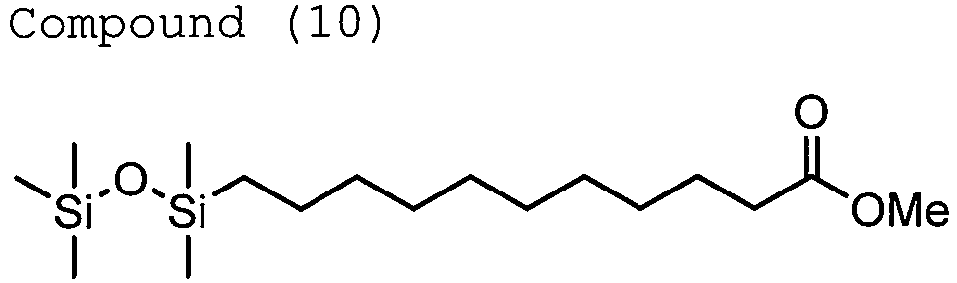
- First, 3.01 g of compound (10) obtained in Synthetic Example 10, 8.7 mL of toluene, 0.140 g of 1,5,7-triazabicyclo[4.4.0]dec-5-ene, and 5.52 g of allylamine were added, and the mixture was then stirred at 75°C for 24 hours. Thereafter, the mixture was diluted with toluene and washed with an aqueous hydrochloric acid solution. Subsequently, the mixture was dehydrated over magnesium sulfate and concentrated under reduced pressure to give 2.74 g of compound (12).
1H NMR (CDCl3, 400 MHz) δ [ppm]: -0.004-0.036 (m), 0.448-0.487 (m), 1.229-1.258 (m), 1.562-1.636 (m), 2.154-2.193 (t), 3.815-3.847 (m), 5.053-5.162 (m), 5.745-5.841 (m), 6.237 (s)
- First, 2.07 g of compound (11) obtained in Synthetic Example 11, 2.0 g of toluene, 0.1 mL of pyridine, and 0.2 mL of a xylene solution containing a 2% Pt complex of 1,3-divinyl-1,1,3,3-tetramethyldisiloxane were added, then 6.2 mL of trimethoxysilane was added, and the mixture was stirred at room temperature overnight. Thereafter, the mixture was purified to give 2.53 g of the following compound having a terminal trimethoxysilyl group (12).
1H NMR (CDCl3, 400 MHz) δ [ppm]: -0.136-0.046 (m), 0.464-0.503 (t), 0.618-0.658 (m), 1.247-1.272 (m), 1.571-1.663 (m), 1.796 (s), 2.117-2.155(t), 3.209-3.258(m), 3.562 (s)
- Compound 12 obtained above was diluted so as to be a 20 wt% hexamethyldisiloxane solution, and thus a surface-treating agent 4 was obtained.
- First, 0.50 g of compound (1) obtained in Synthetic Example 1, 10.0 mL of toluene, 0.05 mL of pyridine, and 0.3 mL of a xylene solution containing a 2% Pt complex of 1,3-divinyl-1,1,3,3-tetramethyldisiloxane were added, and then 1.2 mL of 1,1,1,3,5,5,5-heptamethyltrisiloxane was added dropwise. After being stirred at room temperature for 17 hours, the mixture was purified to give 0.87 g of the following compound (14).
1H NMR (CDCl3, 400 MHz) δ [ppm]: 0.033-0.241 (m), 0.438-0.550 (m), 1.191-1.413 (m), 1.607-1.642 (m), 2.242-2.325 (m), 3.669 (s)
- First, 0.86 g of compound (14) obtained in Synthetic Example 14, 5.0 mL of allylamine, and 0.20 g of 1,5,7-triazabicyclo[4.4.0]dec-5-ene were added, and the mixture was then stirred at 75°C for 3 hours. Thereafter, the mixture was washed with an aqueous hydrochloric acid solution, dehydrated over magnesium sulfate, and concentrated under reduced pressure to give 0.72 g of compound (15).
1H NMR (CDCl3, 400 MHz) δ [ppm]: 0.076-0.128 (m), 0.413-0.465 (t), 1.183-1.1.404 (m), 1.604-1.677 (m), 2.173-2.248 (t), 3.841-3.942(m), 5.122-5.210(m), 5.809-5.877 (m)
- First, 0.72 g of compound (15) obtained in Synthetic Example 15, 6.0 mL of toluene, 0.04 mL of pyridine, and 0.26 mL of a xylene solution containing a 2% Pt complex of 1,3-divinyl-1,1,3,3-tetramethyldisiloxane were added, then 1.4 mL of trimethoxysilane was added, and the mixture was stirred at room temperature overnight. Thereafter, the mixture was purified to give 0.48 g of the following compound having a terminal trimethoxysilyl group (16).
1H NMR (CDCl3, 400 MHz) δ [ppm]: 0.054-0.149 (m), 0.425-0.464 (t), 0.628-0.681 (m), 1.181-1.402 (m), 1.544-1.768(m), 2.125-2.164 (t), 3.558-3.646 (m)
- Compound 16 obtained above was diluted so as to be a 20 wt% ethanol solution, and thus a surface-treating agent 4 was obtained.
- First, 0.93 g of compound (1) obtained in Synthetic Example 1, 15.0 mL of toluene, 0.09 mL of pyridine, and 0.6 mL of a xylene solution containing a 2% Pt complex of 1,3-divinyl-1,1,3,3-tetramethyldisiloxane were added, and then 1.1 g of heptamethylcyclotetrasiloxane was added dropwise. After being stirred at room temperature for 6 hours, the mixture was purified to give 2.1 g of the following compound (17).
1H NMR (CDCl3, 400 MHz) δ [ppm]: 0.029-0.219 (m), 0.507-0.546 (t), 1.221-1.407 (m), 1.569-1.640 (m), 2.269-2.322 (m), 3.669 (s)
- First, 1.10 g of compound (17) obtained in Synthetic Example 17, 9.0 mL of allylamine, and 0.39 g of 1,5,7-triazabicyclo[4.4.0]dec-5-ene were added, and the mixture was then stirred at 75°C for 6 hours. Thereafter, the mixture was washed with an aqueous hydrochloric acid solution, dehydrated over magnesium sulfate, and concentrated under reduced pressure to give 2.43 g of compound (18).
1H NMR (CDCl3, 400 MHz) δ [ppm]: 0.025-0.172 (m), 0.447-0.570 (m), 1.108-1.435 (m), 1.604-1.677 (quin), 2.175-2.214 (t), 3.879-3.904(m), 5.121-5.206(m), 5.796-5.893 (m)
- First, 2.40 g of compound (18) obtained in Synthetic Example 18, 20 mL of toluene, 0.1 mL of pyridine, and 0.8 mL of a xylene solution containing a 2% Pt complex of 1,3-divinyl-1,1,3,3-tetramethyldisiloxane were added, then 4.0 mL of trimethoxysilane was added, and the mixture was stirred at room temperature overnight. Thereafter, the mixture was purified to give 2.4 g of the following compound having a terminal trimethoxysilyl group (19).
1H NMR (CDCl3, 400 MHz) δ [ppm]: 0.024-0.169 (m), 0.504-0.569 (m), 0.631-0.672 (t), 1.183-1.403 (m), 1.586-1.676 (quin), 2.127-2.166 (t), 3.192-3.273 (quin), 3.492-3.612 (m)
- Compound 19 obtained above was diluted so as to be a 20 wt% ethanol solution, and thus a surface-treating agent 6 was obtained.
- First, 1.0 g of compound (1) obtained in Synthetic Example 1, 5.5 mL of toluene, 0.9 mL of chlorodimethylsilane, and 0.14 mL of a xylene solution containing a 2% Pt complex of 1,3-divinyl-1,1,3,3-tetramethyldisiloxane were added, and the mixture was then stirred at 40°C for 4 hours. Thereafter, the mixture was purified to give 1.12 g of a compound having a chlorodimethylsilyl group at a terminal (101). Subsequently, in a different flask, 3 g of palladium/carbon (Pd 10%) (an approximately 55% product wet with water), 44 mL of tetrahydrofuran, 9 mL of water, and 10 mL of 1,1,1,3,5,5,5-heptamethyltrisiloxane were added, and the mixture was stirred at 70°C for 2 hours. Thereafter, the mixture was purified to give 2.2 g of a compound having terminal silanol groups (102). Compound (101) and compound (102) were dissolved in toluene and stirred at room temperature overnight, pyridine was added, and the mixture was further stirred for 1 hour. Thereafter, the mixture was subjected to purification by liquid separation and purification by silica gel column to give 0.401 g of compound (20).
1H NMR (CDCl3, 400 MHz) δ [ppm]: 0.359-0.477 (m), 0.790-0.830 (m), 1.251-1.439 (m), 1.578-1.632 (t), 2.277-2.315 (t), 3.659 (s)
- First, 0.401 g of compound (20) obtained in Synthetic Example 20, 0.085 g of 1,5,7-triazabicyclo[4.4.0]dec-5-ene, and 1.55 g of allylamine were added, and the mixture was then stirred at 75°C for 4 hours. Thereafter, the mixture was diluted with diethyl ether and washed with an aqueous hydrochloric acid solution. Subsequently, the mixture was dehydrated over magnesium sulfate and concentrated under reduced pressure to give 0.374 g of compound (21).
1H NMR (CDCl3, 400 MHz) δ [ppm]: 0.057-0.269 (m), 0.512-0.552 (m), 1.150-1.431 (m), 1.599-1.672 (m), 2.173-2.211 (m), 3.889 (s), 5.115-5.125(m), 5.482(bs), 5.792-5.889 (m)
- First, 0.374 g of compound (21) obtained in Synthetic Example 21, 3.6 mL of toluene, 13.5 µL of aniline, and 28 µL of a xylene solution containing a 2% Pt complex of 1,3-divinyl-1,1,3,3-tetramethyldisiloxane were added, then 0.13 mL of trimethoxysilane was added, and the mixture was stirred at 45°C for 4 hours. Thereafter, the mixture was purified to give 0.384 g of the following compound having a terminal trimethoxysilyl group (22).
1H NMR (CDCl3, 400 MHz) δ [ppm]: 0.010-0.209 (m), 0.450-0.560 (m), 0.628-0.668 (m), 1.180-1.367 (m), 1.581-1.674 (m), 2.123-2.162(t), 3.220-3.269(q), 3.561-3.618(m), 5.636 (bs)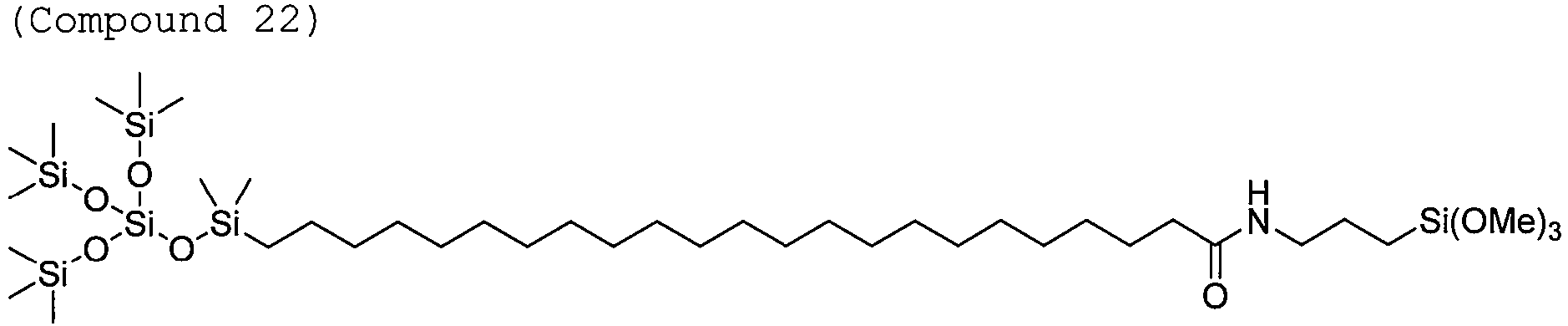
- Compound 22 obtained above was diluted so as to be a 20 wt% ethanol solution, and thus a surface-treating agent 7 was obtained.
- A flask was charged with tris(trimethylsilyloxy)silane (0.7 g), 18-octadecen-1-ol (1.0 g), tris(pentafluorophenyl)borane (0.24 g), and toluene (10 mL), and the solution was heated in an oil bath (set at 70°C) for 2 hours while being stirred with a magnetic stirrer. Thereafter, the reaction solution was subjected to filtration through a silica gel column, and
the filtrate was concentrated to give 1.2 g of a terminal olefin compound (23) as a colorless oil.
1H-NMR (400 MHz, chloroform-D) δ 5.87-5.76 (m, 1H), 5.02-4.91 (m, 2H), 3.64 (t, J = 6.6 Hz, 2H), 2.07-2.01 (m, 2H), 1.55-1.50 (m, 2H), 1.41-1.26 (m, 26H), 0.15-0.07 (m, 18H), 0.03 (s, 3H)
- A flask was charged with the terminal olefin compound (23) (1.0 g), Karstedt's catalyst (0.13 g, a xylene solution containing 2% platinum), trimethoxysilane (0.75 g), pyridine (22 mg), and toluene (10 mL) and the mixture was stirred at room temperature for 4 hours and then concentrated under reduced pressure to give 1.09 g of compound (24) as a slightly yellow oil.
1H-NMR (400 MHz, chloroform-D) δ 3.74-3.53 (m, 11H), 1.56-1.50 (m, 2H), 1.43-1.25 (m, 30H), 0.67-0.62 (m, 2H), 0.26-0.07 (m, 18H), 0.04 (q, J = 4.4 Hz, 3H)
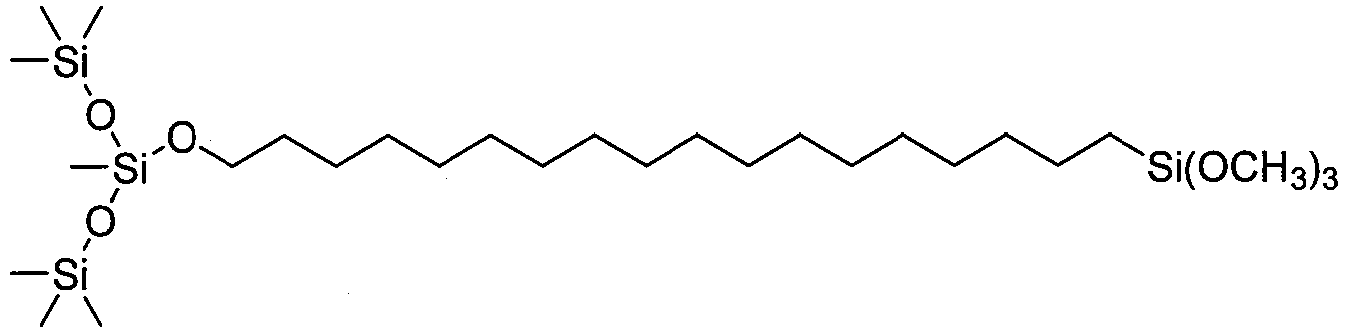
- Compound 24 obtained above was diluted so as to be a 20 wt% ethanol solution, and thus a surface-treating agent 8 was obtained.
- First, 1.8 g of compound (14) obtained in Synthetic Example 14, 2.01 mL of 2-allylpent-4-en-1-amine, and 0.43 g of 1,5,7-triazabicyclo[4.4.0]dec-5-ene were added, and the mixture was then stirred at 75°C for 3 hours. Thereafter, the mixture was washed with an aqueous hydrochloric acid solution, dehydrated over magnesium sulfate, and concentrated under reduced pressure to give 1.92 g of compound (25).
1H NMR (CDCl3, 400 MHz) δ [ppm]: 0.076-0.128 (m), 0.413-0.465 (t), 1.183-1.1.404 (m), 1.604-1.677 (m),1.704-1.769 (m), 1.994-2.093 (m), 2.103-2.285 (m), 3.161-3.328(t), 4.997-5.195(m), 5.397-5.595 (s), 5.708-5.975 (m)
- First, 0.47 g of compound (25) obtained in Synthetic Example 25, 3.5 mL of toluene, 0.014 mL of pyridine, and 0.1 mL of a xylene solution containing a 2% Pt complex of 1,3-divinyl-1,1,3,3-tetramethyldisiloxane were added, then 0.52 mL of trimethoxysilane was added, and the mixture was stirred at room temperature for 3 hours. Thereafter, the mixture was purified to give 0.48 g of the following compound having terminal trimethoxysilyl groups (26).
1H NMR (CDCl3, 400 MHz) δ [ppm]: 0.054-0.149 (m), 0.425-0.464 (t), 0.628-0.681 (t), 1.181-1.402 (m), 1.544-1.768(m), 2.125-2.164 (t), 3.135-3.203 (t), 3.558-3.646 (m), 5.449-5.528 (s)

- Compound 26 obtained above was diluted so as to be a 20 wt% ethanol solution, and thus a surface-treating agent 9 was obtained.
- A glass flask was charged with a stirrer tip, 2.0 g of 16-hydroxyhexadecanoic acid, 3.6 g of potassium carbonate, 1.5 g of methyl iodide, and 10 mL of dimethyl sulfoxide and immersed in an oil bath at 60°C, and the mixture was stirred with a magnetic stirrer for 18 hours. Thereafter, toluene and water were added to the flask, the mixture was stirred, the liquid in the flask was transferred to a separatory funnel and allowed to stand still for separation, and the lower layer (the aqueous layer) was removed. Toluene and water were similarly added, the organic layer was washed twice with water, dried over magnesium sulfate, and then concentrated under reduced pressure to give 1.9 g of methyl 16-hydroxyhexadecanoate as a colorless oil.
1H-NMR (400 MHz, chloroform-D) δ 3.66-3.62 (m, 5H), 2.36-2.28 (m, 2H), 1.65-1.53 (m, 4H), 1.33-1.25 (m, 22H) -

- A glass flask was charged with a stirrer tip, 0.93 g of methyl 16-hydroxyhexadecanoate obtained in Synthetic Example 27, 0.46 g of 1,5,7-triazabicyclo[4.4.0]dec-5-ene, and 2.5 mL of allylamine, and the mixture was stirred at room temperature for 2 hours with a magnetic stirrer. Thereafter, chloroform and an aqueous hydrochloric acid solution were added to the flask, the mixture was stirred, the liquid in the flask was transferred to a separatory funnel and allowed to stand still for separation, and the upper layer (the aqueous layer) was removed. Chloroform and an aqueous hydrochloric acid solution were similarly added, the organic layer was washed twice with water, dried over magnesium sulfate, and then concentrated under reduced pressure to give 0.88 g of N-allyl-16-hydroxyhexadecanamide as a white solid.
1H-NMR (400 MHz, chloroform-D) δ 5.89-5.79 (m, 1H), 5.49 (s, 1H), 5.20-5.12 (m, 2H), 3.89 (td, J = 5.7, 1.4 Hz, 2H), 3.64 (dd, J = 12.1, 5.3 Hz, 2H), 2.21-2.17 (m, 2H), 1.65-1.53 (m, 4H), 1.40-1.25 (m, 22H) -

- A glass flask was charged with a stirrer tip, 0.77 g of N-allyl-16-hydroxyhexadecanamide obtained in Synthetic Example 28, 0.5 g of 1,1,1,3,5,5,5-heptamethyltrisiloxane, 0.11 g of tris(pentafluorophenyl)borane, and 14 mL of toluene, and immersed in an oil bath at 70°C, and the mixture was stirred with a magnetic stirrer for 2 hours. Then, 5 g of silica gel was added to the flask, the mixture was stirred at room temperature and then subjected to filtration, the filtrate was concentrated under reduced pressure to give 0.86 g of compound (29) as a white solid.
1H-NMR (400 MHz, chloroform-D) δ 5.89-5.79 (m, 1H), 5.45 (s, 1H), 5.21-5.12 (m, 2H), 3.89 (tt, J = 5.7, 1.4 Hz, 2H), 3.65 (q, J = 6.9 Hz, 2H), 2.18 (q, J = 7.3 Hz, 2H), 1.67-1.50 (m, 4H), 1.29-1.25 (m, 22H), 0.16-0.09 (m, 18H), 0.03 (s, 3H)
- A glass flask was charged with a stirrer tip, 0.86 g of compound (29) obtained in Synthetic Example 29, 0.1 mL of a xylene solution containing a 2% Pt complex of 1,3-divinyl-1,1,3,3-tetramethyldisiloxane, 14 µL of pyridine, 0.50 mL of trimethoxysilane, and 10 mL of toluene, and the mixture was stirred at room temperature for 4 hours with a magnetic stirrer. Thereafter, the mixture was concentrated under reduced pressure to give 0.94 g of compound (30) as a light yellow oil.
1H-NMR (400 MHz, chloroform-D) δ 5.62 (s, 1H), 3.65-3.54 (m, 11H), 3.25 (q, J = 6.7 Hz, 2H), 2.20-2.12 (m, 2H), 1.68-1.50 (m, 6H), 1.27 (d, J = 12.8 Hz, 22H), 0.67-0.63 (m, 2H), 0.15-0.07 (m, 18H), 0.01 (s, 3H)
- Compound (30) obtained above was diluted so as to be a 20 wt% ethanol solution, and thus a surface-treating agent 10 was obtained.
- First, 7.01 g of methyl 12-aminolaurate H2N(CH2)11COOCH3, 40.0 ml of dichloromethane, 0.73 g of 4-dimethylaminopyridine, and 8.77 g of 1-(3-dimethylaminopropyl)-3-ethylcarbodiimide hydrochloride were added, 6.20 g of 10-undecenoic acid was added in an ice bath, and the mixture was stirred at room temperature overnight. Thereafter, the mixture was purified to give 11.34 g of the following amide group-containing methyl ester compound (31) CH2=CH(CH2)3CONH(CH2)11COOCH3.
1H NMR (CDCl3, 400 MHz) δ [ppm]: 1.251-1.375 (m), 1.456-1.490 (m), 1.573-1.644 (m), 1.998-2.061 (m), 2.121-2.158 (t), 2.275-2.313 (t), 3.201-3.251 (m), 3.658 (s), 4.903-5.007 (m), 5.397 (br s), 5.747-5.849 (m) -

- First, 4.00 g of the amide group-containing methyl ester compound (31) CH2=CH(CH2)8CONH(CH2)11COOCH3 obtained in Synthetic Example 31, 46.0 ml of toluene, 0.33 ml of pyridine, 0.52 ml of a xylene solution containing a 2% Pt complex of 1,3-divinyl-1,1,3,3-tetramethyldisiloxane, and 6.86 ml of 1,1,1,3,5,5,5-heptamethyltrisiloxane were added, and the mixture was stirred at 60°C for 8 hours. Thereafter, the mixture was purified to give 5.09 g of the following terminal siloxane compound (32) ((CH3)3SiO)2SiCH3(CH2)10CONH(CH2)11COOCH3.
1H NMR (CDCl3, 400 MHz) δ [ppm]: 0.014-0.013 (m), 0.415-0.453 (t), 1.250-1.271 (m), 1.998-2.061 (m), 2.121-2.158 (t), 2.275-2.313 (t), 3.201-3.251 (m), 3.658 (s), 4.903-5.007 (m), 5.397 (br s), 5.747-5.849 (m) -

- First, 1.27 g of the terminal siloxane compound (32) ((CH3)3SiO)2SiCH3(CH2)10CONH(CH2)11COOCH3 obtained in Synthetic Example 32, 0.34 g of 1,5,7-triazabicyclo[4.4.0]dec-5-ene, and 3.52 g of allylamine were added, and the mixture was heated to 65°C and stirred for 6 hours. Thereafter, the mixture was purified to give 1.05 g of the terminal siloxane compound (33) ((CH3)3SiO)2SiCH3(CH2)10CONH(CH2)11CONHCH2CH=CH2.
1H NMR (CDCl3, 400 MHz) δ [ppm]: 0.072-0.104 (m), 0.418-0.457 (t), 1.255-1.287 (m), 1.459-1.494 (m), 1.597-1.631 (m), 2.124-2.206 (m), 3.204-3.254 (m), 3.871-3.903 (m), 5.112-5.199 (m), 5.791-5.887 (m) -

- First, 1.00 g of the terminal siloxane compound (33) ((CH3)3SiO)2SiCH3(CH2)10CONH(CH2)11CONHCH2CH=CH2 obtained in Synthetic Example 33, 10.0 g of toluene, 0.01 g of triacetoxymethylsilane, and 0.08 ml of a xylene solution containing a 2% Pt complex of 1,3-divinyl-1,1,3,3-tetramethyldisiloxane were added, then 0.40 mL of trichlorosilane was added, and the mixture was heated to 60°C and stirred for 3 hours. Thereafter, volatiles were distilled off under reduced pressure, then a mixed solution of 0.15 g of methanol and 3.40 ml of trimethyl orthoformate was added, and the mixture was then heated to 65°C and stirred for 2 hours. Thereafter, the mixture was purified to give 0.60 g of the following terminal trimethoxysilyl group-containing compound (34) ((CH3)3SiO)2SiCH3(CH2)10CONH(CH2)11CONH(CH2)3Si(OCH3)3.
1H NMR (CDCl3, 400 MHz) δ [ppm]: 0.081-0.154 (m), 0.521-0.668 (m), 1.253 (br s), 1.463-1.495 (m), 1.581-1.698 (m), 2.124-2.163 (t), 3.204-3.251 (m), 3.570 (s) -

- First, 1.00 g of 16-heptadecenoic acid, 11.2 mL of toluene, and 7.50 mL of methanol were added, then 7.60 mL of trimethylsilyldiazomethane was added dropwise, and the mixture was stirred at room temperature for 1 hour. Thereafter, the mixture was concentrated under reduced pressure to give 1.15 g of compound (35).
1H NMR (CDCl3, 400 MHz) δ [ppm]: 1.252-1.371 (m),1.597-1.615 (m), 2.010-2.061 (m), 2.279-2.316 (t), 3.662 (s), 4.910-5.012(dd), 5.777-5.846 (m 
- First, 1.06 g of compound (35) obtained in Synthetic Example 35, 18.8 mL of toluene, 0.12 mL of pyridine, and 0.43 mL of a xylene solution containing a 2% Pt complex of 1,3-divinyl-1,1,3,3-tetramethyldisiloxane were added, then 3.06 mL of 1,1,1,3,5,5,5-heptamethyltrisiloxane was added dropwise, and the mixture was stirred at room temperature for 6 hours. Thereafter, the mixture was concentrated under reduced pressure to give 2.07 g of compound (36).
1H NMR (CDCl3, 400 MHz) δ [ppm]: -0.001-0.130 (m),0.434-0.472 (m), 1.176-1.288 (m), 1.582-1.640 (m), 2.269-2.323 (m), 3.670(s)

- First, 0.80 g of compound (36) obtained in Synthetic Example 36, 5.96 mL of allylamine, and 0.22 g of 1,5,7-triazabicyclo[4.4.0]dec-5-ene were added, and the mixture was then stirred at 75°C for 3 hours. Thereafter, the mixture was washed with an aqueous hydrochloric acid solution, dehydrated over magnesium sulfate, and concentrated under reduced pressure to give 0.62 g of compound (37).
1H NMR (CDCl3, 400 MHz) δ [ppm]: -0.012-0.123 (m),0.423-0.461 (m), 1.250-1.289 (m), 1.615-1.660 (m),2.166-2.204 (t), 3.122-2.228(m), 3.876-3.902 (m), 5.108-5.202 (m),5.778-5.886(m)°
- First, 0.5 g of compound (37) obtained in Synthetic Example 37, 2.0 mL of toluene, 0.054 mL of a xylene solution containing a 2% Pt complex of 1,3-divinyl-1,1,3,3-tetramethyldisiloxane, and 0.026 mL of aniline were added, then 0.24 mL of trimethoxysilane was added, and the mixture was stirred at 45°C for 2 hours. Thereafter, the mixture was purified to give 0.46 g of the following compound having a terminal trimethoxysilyl group (38).
1H NMR (CDCl3, 400 MHz) δ [ppm]: -0.064-0.0.231 (m), 0.446 (t), 0.652 (t), 1.109-1.404 (m), 1.529-1.676 (m), 2.148 (t), 3.249 (q), 3.493-3.667 (m), 5.630 (br)
- Compound (38) obtained above was diluted so as to be a 20 wt% ethanol solution, and thus a surface-treating agent 11 was obtained.
- First, 1.00 g of compound (36) obtained in the same manner as Synthetic Example 36, 2.41 mL of 2-allylpent-4-en-1-amine, and 0.28 g of 1,5,7-triazabicyclo[4.4.0]dec-5-ene were added, and the mixture was then stirred at 75°C for 3 hours. Thereafter, the mixture was washed with an aqueous hydrochloric acid solution, dehydrated over magnesium sulfate, and concentrated under reduced pressure to give 1.03 g of compound (39).
1H NMR (CDCl3, 400 MHz) δ [ppm]: -0.012-0.123 (m),0.423-0.561 (m), 1.178-1.279 (m), 1.610-1.629 (m),1.716-1.749 (m),2.042-2.352(m), 3.122-2.228(m), 3.663-3.744 (m), 5.031-5.157 (m),5.734-5.838(m)°
- First, 0.82 g of compound (39) obtained in Synthetic Example 39, 2.0 mL of toluene, 0.078 mL of a xylene solution containing a 2% Pt complex of 1,3-divinyl-1,1,3,3-tetramethyldisiloxane, and 0.038 mL of aniline were added, then 0.70 mL of trimethoxysilane was added, and the mixture was stirred at 45°C for 2 hours. Thereafter, the mixture was purified to give 1.08 g of the following compound having terminal trimethoxysilyl groups (40).
1H NMR (CDCl3, 400 MHz) δ [ppm]: -0.001-0.166 (m), 0.453 (t), 0.635 (t), 1.190-1.327 (m), 1.398-1.546 (m), 1.627(quin), 2.159(t), 3.189(t), 3.489-3.685 (m), 5.510(t)
- Compound (40) obtained above was diluted so as to be a 20 wt% ethanol solution, and thus a surface-treating agent 12 was obtained.
- First, 1.04 g of compound (1) obtained in the same manner as Synthetic Example 1, 15 mL of toluene, 0.08 mL of pyridine, and 0.6 mL of a xylene solution containing a 2% Pt complex of 1,3-divinyl-1,1,3,3-tetramethyldisiloxane were added, and then 3.68 mL of MCR-H07 manufactured by Gelest was added dropwise. After being stirred at room temperature for 2 days, the mixture was purified to give 4.15 g of the following compound (41). The average number n of repeating units is 10.
1H NMR (CDCl3, 400 MHz) δ [ppm]: 0.019-0.115 (m), 0.511 (t), 0.858(t), 1.200-1.325 (m), 1.592 (quin), 2.276-2.293 (m), 3.641(s)
- First, 3.85 g of compound (41) obtained in Synthetic Example 41, 10 mL of allylamine, and 0.40 g of 1,5,7-triazabicyclo[4.4.0]dec-5-ene were added, and the mixture was then stirred at 75°C for 3 hours. Thereafter, the mixture was washed with an aqueous hydrochloric acid solution, dehydrated over magnesium sulfate, and concentrated under reduced pressure to give 3.09 g of compound (42). The average number n of repeating units is 10.
1H NMR (CDCl3, 400 MHz) δ [ppm]: 0.018-0.113 (m), 0.509 (t), 0.858 (t), 1.165-1.376 (m), 1.613 (quin), 2.162(t), 3.852-3.877(m), 5.093-5.175 (m), 5.412 (br), 5.7770-5.864(m)
- First, 3.09 g of compound (42) obtained in Synthetic Example 42, 10 mL of toluene, 0.065 mL of pyridine, and 0.47 mL of a xylene solution containing a 2% Pt complex of 1,3-divinyl-1,1,3,3-tetramethyldisiloxane were added, then 2.4 mL of trimethoxysilane was added, and the mixture was stirred at room temperature overnight. Thereafter, the mixture was purified to give 2.96 g of the following compound having a terminal trimethoxysilyl group (43). The average number n of repeating units is 10.
1H NMR (CDCl3, 400 MHz) δ [ppm]: 0.019-0.086 (m), 0.482-0.541 (m), 0.625 (t), 0.858 (t), 1.259-1.325(m), 1.520-1.649 (m), 2.121 (t), 3.223(q), 3.519-3.590(m), 5.599(br)
- Compound (43) obtained above was diluted so as to be a 20 wt% ethanol solution, and thus a surface-treating agent 13 was obtained.
- First, 1.04 g of compound (1) obtained in the same manner as Synthetic Example 1, 15 mL of toluene, 0.08 mL of pyridine, and 0.6 mL of a xylene solution containing a 2% Pt complex of 1,3-divinyl-1,1,3,3-tetramethyldisiloxane were added, and then 4.0 g of MCR-H11 manufactured by Gelest was added dropwise. After being stirred at room temperature for 2 days, the mixture was purified to give 4.36 g of the following compound (44). The average number n of repeating units is 13.
1H NMR (CDCl3, 400 MHz) δ [ppm]: 0.019-0.115 (m), 0.490-0.530 (m), 0.858 (t), 1.200-1.378 (m), 1.592 (quin), 2.276-2.293 (m), 3.640 (s)
- First, 4.36 g of compound (44) obtained in Synthetic Example 44, 10 mL of allylamine, and 0.37 g of 1,5,7-triazabicyclo[4.4.0]dec-5-ene were added, and the mixture was then stirred at 75°C for 3 hours. Thereafter, the mixture was washed with an aqueous hydrochloric acid solution, dehydrated over magnesium sulfate, and concentrated under reduced pressure to give 3.55 g of compound (45). The average number n of repeating units is 13.
1H NMR (CDCl3, 400 MHz) δ [ppm]: 0.018-0.131 (m), 0.490-0.528 (t), 0.858 (t), 1.182-1.377 (m), 1.613 (quin), 2.162 (t), 3.852-3.880 (m), 5.093-5.175(m), 5.401 (br), 5.770-5.868 (m)
- First, 3.55 g of compound (45) obtained in Synthetic Example 45, 15 mL of toluene, 0.08 mL of pyridine, and 0.6 mL of a xylene solution containing a 2% Pt complex of 1,3-divinyl-1,1,3,3-tetramethyldisiloxane were added, then 3.0 mL of trimethoxysilane was added, and the mixture was stirred at room temperature overnight. Thereafter, the mixture was purified to give 3.43 g of the following compound having a terminal trimethoxysilyl group (46). The average number n of repeating units is 13.
1H NMR (CDCl3, 400 MHz) δ [ppm]: 0.019-0.100 (m), 0.491-0.531 (m), 0.626 (t), 0.859 (t), 1.184-1.327(m), 1.578-1.653 (m), 2.122 (t), 3.225 (q), 3.520-3.626 (m), 5.600 (br)
- Compound (46) obtained above was diluted so as to be a 20 wt% ethanol solution, and thus a surface-treating agent 14 was obtained.
- First, 1.25 g of compound (1) obtained in the same manner as Synthetic Example 1, 20.0 mL of toluene, 0.1 mL of pyridine, and 0.65 mL of a xylene solution containing a 2% Pt complex of 1,3-divinyl-1,1,3,3-tetramethyldisiloxane were added, and then 1.01 g of tris(trimethylsilyloxy)silane was added dropwise. After being stirred at room temperature overnight, the mixture was purified to give 1.36 g of the following compound (47).
1H NMR (CDCl3, 400 MHz) δ [ppm]: 0.013-0.142 (m), 0.408 (t), 1.137-1.378 (m), 1.591 (quin), 2.275 (t), 3.639 (s)
- First, 0.64 g of compound (47) obtained in Synthetic Example 47, 2.8 mL of allylamine, and 0.12 g of 1,5,7-triazabicyclo[4.4.0]dec-5-ene were added, and the mixture was then stirred at 75°C for 3 hours. Thereafter, the mixture was washed with an aqueous hydrochloric acid solution, dehydrated over magnesium sulfate, and concentrated under reduced pressure to give 0.68 g of compound (48).
1H NMR (CDCl3, 400 MHz) δ [ppm]: 0.011-0.217 (m), 0.407 (t), 1.153-1.378 (m), 1.612 (quin),2.163 (t), 3.865(tt), 5.090-5.182 (m), 5.409 (br), 5.770-5.866 (m)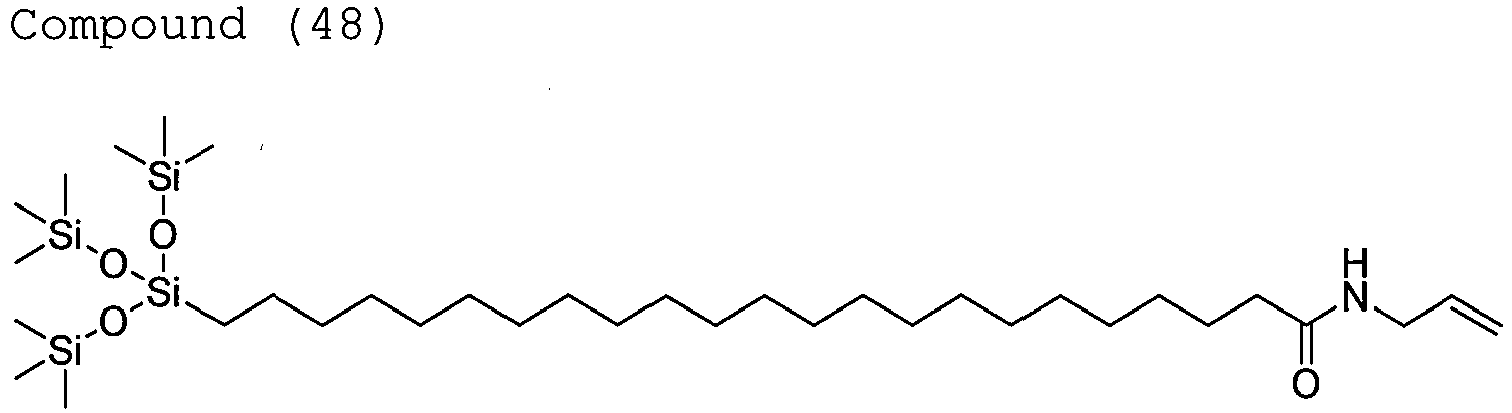
- First, 0.56 g of compound (48) obtained in Synthetic Example 48, 10.0 mL of toluene, 0.022 mL of aniline, and 0.46 mL of a xylene solution containing a 2% Pt complex of 1,3-divinyl-1,1,3,3-tetramethyldisiloxane were added, then 0.2 mL of trimethoxysilane was added, and the mixture was stirred at 45°C for 2 hours. Thereafter, the mixture was purified to give 0.57 g of the following compound having a terminal trimethoxysilyl group (49).
1H NMR (CDCl3, 400 MHz) δ [ppm]: 0.010-0.141 (m), 0.408 (t), 0.629 (t), 1.150-1.376 (m), 1.519-1.652(m), 2.121 (t), 3.172 (q), 3.516-3.589 (m), 5.607 (br)
- Compound (49) obtained above was diluted so as to be a 20 wt% ethanol solution, and thus a surface-treating agent 15 was obtained.
- First, 4.00 g of 11-bromo-1-undecene CH2=CH(CH2)9Br, 23.0 ml of toluene, 0.11 g of triacetoxymethylsilane, 0.76 ml of a xylene solution containing a 2% Pt complex of 1,3-divinyl-1,1,3,3-tetramethyldisiloxane, and 6.98 ml of 1,1,1,3,5,5,5-heptamethyltrisiloxane were added, and the mixture was stirred at room temperature for 6 hours. Thereafter, the mixture was purified to give 7.02 g of the following terminal siloxane compound (50) ((CH3)3SiO)2SiCH3(CH2)11Br.
1H NMR (CDCl3, 400 MHz) δ [ppm]: 0.002 (s), 0.050-0.100 (m), 0.427-0.465 (t), 1.266-1.281 (m), 1.404-1.440 (m), 1.816-1.888 (m), 3.387-3.421 (t) -

- First, 2.50 g of the terminal siloxane compound (50) ((CH3)3SiO)2SiCH3(CH2)11Br obtained in Synthetic Example 50, 5.5 ml of tetrahydrofuran, 0.14 g of magnesium, and 0.02 g of iodine were added, and the mixture was stirred at 65°C for 2 hours. Subsequently, 0.89 ml of chlorodimethylsilane was added in an ice bath, and the mixture was stirred at room temperature overnight. Thereafter, the mixture was purified to give 2.14 g of the following terminal siloxane compound (51) (CH3)3SiO)2SiCH3(CH2)11Si(CH3)2H.
1H NMR (CDCl3, 400 MHz) δ [ppm]: 0.052 (s), 0.061 (s), 0.077-0.101 (m), 0.428-0.467 (t), 0.551-0.597 (m), 1.261-1.311 (m), 3.817-3.853 (m) -

- First, 1.51 g of the terminal siloxane compound (51) (CH3)3SiO)2SiCH3(CH2)11Si(CH3)2H obtained in Synthetic Example 51, 7.6 g of toluene, 0.01 g of pyridine, and 0.08 ml of a xylene solution containing a 2% Pt complex of 1,3-divinyl-1,1,3,3-tetramethyldisiloxane were added, then 0.70 mL of trimethoxy(7-octen-1-yl)silane was added, and the mixture was heated to 50°C and stirred for 6 hours. Thereafter, the mixture was purified to give 1.97 g of the following terminal siloxane compound (52) ((CH3)3SiO)2SiCH3(CH2)11Si(CH3)2(CH2)8Si(OCH3)3.
1H NMR (CDCl3, 400 MHz) δ [ppm]: 0.082 (s), 0.426-0.480 (m), 0.625-0.665 (m), 1.231-1.349 (m), 1.370-1.1.409 (m), 3.566 (s) -

- First, 2.2 g of sodium hydroxide (manufactured by Fujifilm Wako Pure Chemical Corporation) was dissolved in 24 g of distilled water to give a 8.4% by mass aqueous sodium hydroxide solution. Then, 24 g of this 8.4% by mass aqueous sodium hydroxide solution and 20 g of MS gel (M.S. GEL D-100-60A (manufactured by AGC Si-Tech Co., Ltd.)) were mixed so that the aqueous sodium hydroxide solution was absorbed into the MS gel. The MS gel that had absorbed the aqueous sodium hydroxide solution was dried at 25°C for 8 hours, then molded with a tableting machine (4 MPa for 1 minute), and fired at 1,000°C for 1 hour to give a formed article 1 (pellets).
- The surface-treating agents 1 to 14 prepared above were vacuum-deposited onto chemically tempered glass (Gorilla Glass, manufactured by Corning Incorporated, thickness 0.7 mm). Specifically, a molybdenum boat in a vacuum deposition system was filled with 0.1 g of a surface-treating agent, and the vacuum deposition system was evacuated to a pressure of 3.0 × 10⁻³ Pa or lower. Thereafter, a silicon dioxide film having a thickness of 7 nm was formed, followed by heating the boat by the resistance heating scheme to form a surface-treating layer. Thereafter, heat treatment was performed in an oven at 150°C for 2 hours to give a surface-treating layer.
- The surface-treating agents 1 to 3 and 5 to 14 prepared above were vacuum-deposited onto chemically tempered glass (Gorilla Glass, manufactured by Corning Incorporated, thickness 0.7 mm). Specifically, a molybdenum boat in a vacuum deposition system was filled with 0.1 g of a surface-treating agent, and the vacuum deposition system was evacuated to a pressure of 3.0 × 10⁻³ Pa or lower. Thereafter, vapor deposition by the electron beam deposition scheme was performed using the formed article 1 to form a Na-containing silicon dioxide film having a thickness of 7 nm, followed by heating the boat by the resistance heating scheme to form a surface-treating layer. Thereafter, heat treatment was performed in an oven at 150°C for 2 hours to give a surface-treating layer.
- As initial evaluation (0 times of abrasion), the static water contact angle was measured after forming the surface-treating layer and wiping off excessive matter on the surface. For contact angle measurement, a fully automatic contact angle meter DropMaster 700 (manufactured by Kyowa Interface Science Co., Ltd.) was used under an environment of 25°C. Specifically, the substrate having the measurement target, i.e., the surface-treating layer, was placed horizontally, water was dripped from a microsyringe onto the surface, and a static image was taken with a video microscope one second after the dripping water to thereby measure the static contact angle. The static contact angle was measured at five different points on the surface-treating layer of the substrate, and the average value calculated therefrom was used.
- A friction block as described below was brought into contact with the formed surface-treating layer, a 5 N load was applied thereto, and the friction block was moved back and forth at a speed of 40 mm/sec, with the load being applied. After predetermined times of abrasion, the static water contact angle was measured. The results are shown in (Table 1).
- The surfaces of an article obtained by processing silicone rubber as described below were covered with cotton soaked with artificial sweat having the following composition, and the article was used as a friction block.
- Composition of artificial sweat:
- Anhydrous disodium hydrogen phosphate: 2 g
- Sodium chloride: 20 g
- 85% Lactic acid: 2 g
- Histidine hydrochloride: 5 g
- Distilled water: 1 kg
- Article obtained by processing silicone rubber:
Obtained by processing Silicone Rubber Stopper SR-51 manufactured by Tigers Polymer Corporation into a cylinder having a diameter of 1 cm and a thickness of 1 cm.[Table 1] Example Surface-treating agent Underlayer Water contact angle (degree) Rate of retaining initial angle (%) Initial After 100 times of abrasion Example 1 Surface-treating agent 1 Silicon dioxide film 96.1 68.9 72 Example 2 Surface-treating agent 1 Sodium-containing silicon dioxide film 95.2 79.9 84 Example 3 Surface-treating agent 2 Silicon dioxide film 100.5 73.1 73 Example 4 Surface-treating agent 2 Sodium-containing silicon dioxide film 100.8 86.1 85 Example 5 Surface-treating agent 3 Silicon dioxide film 104.5 57.2 55 Example 6 Surface-treating agent 3 Sodium-containing silicon dioxide film 99.1 57.0 57 Example 7 Surface-treating agent 5 Silicon dioxide film 104.2 80.6 77 Example 8 Surface-treating agent 5 Sodium-containing silicon dioxide film 104.0 83.5 80 Example 9 Surface-treating agent 6 Silicon dioxide film 99.5 68.1 68 Example 10 Surface-treating agent 6 Sodium-containing silicon dioxide film 98.5 76.3 77 Example 11 Surface-treating agent 7 Silicon dioxide film 106.3 72.6 68 Example 12 Surface-treating agent 7 v 106.8 81.4 68 Example 13 Surface-treating agent 8 Silicon dioxide film 97.7 67.4 69 Example 14 Surface-treating agent 8 Sodium-containing silicon dioxide film 101.5 84.9 84 Example 15 Surface-treating agent 9 Silicon dioxide film 101.3 77.6 77 Example 16 Surface-treating agent 9 Sodium-containing silicon dioxide film 101.5 93.2 92 Example 17 Surface-treating agent 10 Silicon dioxide film 100.1 58.4 58 Example 18 Surface-treating agent 10 Sodium-containing silicon dioxide film 99.5 71.9 72 Example 19 Surface-treating agent 11 Silicon dioxide film 103.2 68.3 66 Example 20 Surface-treating agent 11 Sodium-containing silicon dioxide film 105.6 71.1 67 Example 21 Surface-treating agent 12 Silicon dioxide film 99.7 77.3 78 Example 22 Surface-treating agent 12 Sodium-containing silicon dioxide film 102.3 88.4 86 Example 23 Surface-treating agent 13 Silicon dioxide film 104.9 71.1 68 Example 24 Surface-treating agent 13 Sodium-containing silicon dioxide film 103.7 89.5 86 Example 25 Surface-treating agent 14 Silicon dioxide film 104.2 70.1 67 Example 26 Surface-treating agent 14 Sodium-containing silicon dioxide film 104.1 87.2 84 Example 28 Surface-treating agent 15 Sodium-containing silicon dioxide film 104.5 76.1 73 Comparative Example 1 Surface-treating agent 4 Silicon dioxide film 96.1 48.2 50 - The surface-treating agent of the present disclosure can be suitably utilized in a variety of applications.
Claims (30)
- A compound represented by the following formula (1):
[Formula 1]
R1-X1-RSi (1)
whereinR1 is a monovalent group containing one or more Si atoms to which neither a hydroxyl group nor a hydrolyzable group is directly bonded,X1 is a divalent organic group including an alkylene group having 11 or more carbon atoms, andRSi is a monovalent group containing a Si atom to which a hydroxyl group or a hydrolyzable group is bonded. - The compound according to claim 1, whereinR1 is R3-(SiR4 2O)n-SiR4 2-,R3 is a C1-12 alkyl group,R4 is each independently a C1-12 alkyl group, andn is 0 to 1,500.
- The compound according to claim 2, wherein R3 is a methyl group.
- The compound according to any one of claims 1 to 3, whereinR1 is R3-(SiR4 2O)n-SiR4 2-;R3 is a group represented by the following group A or group B:
 R51 is each independently a group represented by -(R61-SiR53 2)ma-R53,R61 is each independently an oxygen atom or a C1-6 alkylene group,R53 is each independently a hydrocarbon group or R51',
R51' has the same meaning as R51,ma is each independently an integer of 1 to 5,provided that the number of R51' in R51 is 20 or less,R52 is each independently a hydrocarbon group,na is an integer of 1 to 3,R54 is each independently a hydrocarbon group,nb is an integer of 1 to 5, andz is 0 or 1;R54 is each independently a C1-12 alkyl group; andn is 0 to 1,500. - The compound according to any one of claims 2 to 4, wherein R4 is a methyl group.
- The compound according to any one of claims 2 to 5, wherein n is 1 or 2.
- The compound according to any one of claims 1 to 6, whereinR1 is -SiR5 3,R5 is each independently a C1-6 alkyl group or -SiR6 3, andR6 is each independently a C1-6 alkyl group.
- The compound according to any one of claims 1 to 7, wherein
R1 is a group represented by the following group A or group B:
 R51 is each independently a group represented by -(R61-SiR53 2)ma-R53,R61 is each independently an oxygen atom or a C1-6 alkylene group,R53 is each independently a hydrocarbon group or R51',
R51' has the same meaning as R51,ma is each independently an integer of 1 to 5,provided that the number of R1' in R1 is 20 or less,R52 is each independently a hydrocarbon group,na is an integer of 1 to 3,R54 is each independently a hydrocarbon group,nb is an integer of 1 to 5, andz is 0 or 1. - The compound according to any one of claims 1 to 8, whereinX1 is a divalent organic group further including -CO-, -COO-, -NR2-, -CONR2-, -OCONR2-, -NR2-CO-NR2-, -O-, -S-, -O-(CH2)x-CONR2-, or -O-(CH2)x-CO-,R2 is a hydrogen atom or a C1-6 alkyl group, andx is an integer of 1 to 20.
- The compound according to any one of claims 1 to 9, wherein X1 is a group represented by the following formula:
-X21-X10-X11-X12-
whereinX21 is -O-, R61 b1R62 3-b1C-, R63 b2R64 3-b2Si-, or R65 2N-,R61 is a divalent organic group,R62 is a hydrogen atom or a monovalent organic group,R63 is a divalent organic group,R64 is a hydrogen atom or a monovalent organic group,R65 is a divalent organic group,b1 is 2 or 3,b2 is 2 or 3,X10 is an alkylene group having 11 or more carbon atoms,X11 is a single bond, -CO-, -COO-, -NR2-, -CONR2-, - OCONR2-, -NR2-CO-NR2-, -O-, -S-, -O-(CH2)x-CONR2-, or -O-(CH2)x-CO-,R2 is a hydrogen atom or a C1-6 alkyl group,x is an integer of 1 to 20, andX12 is a single bond or a C1-6 alkylene group. - The compound according to claim 1, wherein the number of carbon atoms of the alkylene group in X1 is greater than the number of Si atoms in R1.
- The compound according to any one of claims 1 to 11, wherein the number of carbon atoms of the alkylene group in X1 is not less than 2.5 times the number of Si atoms in R1.
- The compound according to any one of claims 1 to 12, wherein the number of carbon atoms of the alkylene group in X1 is greater than the number of atoms of the main chain in R1.
- The compound according to any one of claims 1 to 13, wherein the number of carbon atoms of the alkylene group in X1 is not less than 2.0 times the number of atoms of the main chain in R1.
- The compound according to any one of claims 1 to 14, wherein
RSi is a group represented by the following formula (S1), (S2), (S3), or (S4):
[Formula 4]
- SiR11 n1R12 3-n1 (S1)
- SiRa1 k1Rb1 l1Rc1 m1 (S2)
- CRd1 k2Re1 l2Rf1 m2 (S3)
- NRg1Rh1 (S4)
whereinR11 is each independently a hydroxyl group or a hydrolyzable group,R12 is each independently a hydrogen atom or a monovalent organic group,n1 is an integer of 1 to 3,Ra1 is each independently -Z1-SiR21 p1R22 q1R23 r1,Z1 is each independently an oxygen atom or a divalent organic group,R21 is each independently -Z1'-SiR21' p1'R22' q1'R23' r1',R22 is each independently a hydroxyl group or a hydrolyzable group,R23 is each independently a hydrogen atom or a monovalent organic group,p1 is each independently an integer of 0 to 3,q1 is each independently an integer of 0 to 3,r1 is each independently an integer of 0 to 3,Z1' is each independently an oxygen atom or a divalent organic group,R21' is each independently -Z1"-SiR22" q1"R23" r1",R22' is each independently a hydroxyl group or a hydrolyzable group,R23' is each independently a hydrogen atom or a monovalent organic group,p1' is each independently an integer of 0 to 3,q1' is each independently an integer of 0 to 3,r1' is each independently an integer of 0 to 3,Z1" is each independently an oxygen atom or a divalent organic group,R22" is each independently a hydroxyl group or a hydrolyzable group,R23" is each independently a hydrogen atom or a monovalent organic group,q1" is each independently an integer of 0 to 3,r1" is each independently an integer of 0 to 3,Rb1 is each independently a hydroxyl group or a hydrolyzable group,Rc1 is each independently a hydrogen atom or a monovalent organic group,k1 is each independently an integer of 0 to 3,l1 is each independently an integer of 0 to 3,m1 is each independently an integer of 0 to 3,Rd1 is each independently -Z2-CR31 p2R32 q2R33 r2,Z2 is each independently a single bond, an oxygen atom, or a divalent organic group,R31 is each independently -Z2'-CR32' q2'R33' r2',R32 is each independently -Z3-SiR34 n2R35 3-n2,R33 is each independently a hydrogen atom, a hydroxyl group, or a monovalent organic group,p2 is each independently an integer of 0 to 3,q2 is each independently an integer of 0 to 3,r2 is each independently an integer of 0 to 3,Z2' is each independently a single bond, an oxygen atom, or a divalent organic group,R32' is each independently -Z3-SiR34 n2R35 3-n2,R33' is each independently a hydrogen atom, a hydroxyl group, or a monovalent organic group,q2' is each independently an integer of 0 to 3,r2' is each independently an integer of 0 to 3,Z3 is each independently a single bond, an oxygen atom, or a divalent organic group,R34 is each independently a hydroxyl group or a hydrolyzable group,R35 is each independently a hydrogen atom or a monovalent organic group,n2 is each independently an integer of 0 to 3,Re1 is each independently -Z3-SiR34 n2R35 3-n2,Rf1 is each independently a hydrogen atom, a hydroxyl group, or a monovalent organic group,k2 is each independently an integer of 0 to 3,l2 is each independently an integer of 0 to 3,m2 is each independently an integer of 0 to 3,Rg1 and Rh1 are each independently -Z4-SiR11 n1R12 3-n1, -Z4-SiRa1 k1Rb1 l1Rc1 m1, or -Z4-CRd1 k2Re1 12Rf1 m2, andZ4 is each independently a single bond, an oxygen atom, or a divalent organic group,provided that, in the formulae (S2), (S3), and (S4), at least one Si atom to which a hydroxyl group or a hydrolyzable group is bonded is present. - A compound represented by the following formula (1a):
[Formula 5]
R1-X2-Ri (1a)
whereinR1 is a monovalent group containing one or more Si atoms to which neither a hydroxyl group nor a hydrolyzable group is directly bonded,X2 is an alkylene group having 11 or more carbon atoms,Ri is -COOR7, -CONR8 2, or -CONR7-CR8 3,R7 is a hydrogen atom or a C1-6 alkyl group, andR8 is a C2-6 alkenyl group having a double bond at a terminal. - A surface-treating agent comprising the compound according to any one of claims 1 to 15.
- The surface-treating agent according to claim 17, further comprising a condensate of the compound according to any one of claims 1 to 15.
- The surface-treating agent according to claim 17 or 18, further comprising a solvent selected from compounds represented by R81OR82, R83 n8C6H6-n8, R84R85R86Si-(O-SiR87R88)m8-R89, and (OSiR87R88)m9
whereinR81 to R89 are each independently a monovalent organic group having 1 to 10 carbon atoms,m8 is an integer of 1 to 6,m9 is an integer of 4 to 8, andn8 is an integer of 0 to 6. - The surface-treating agent according to claim 19, wherein the solvent is R84R85R86Si-(O-SiR87R88)m8-R89.
- The surface-treating agent according to claim 19 or 20, wherein the solvent is hexamethyldisiloxane, hexaethyldisiloxane, octamethyltrisiloxane, octamethylcyclotetrasiloxane, or decamethylcyclopentasiloxane.
- The surface-treating agent according to any one of claims 17 to 21, which is for vacuum deposition.
- The surface-treating agent according to any one of claims 17 to 21, which is for wet coating.
- A pellet comprising the surface-treating agent according to any one of claims 17 to 23.
- An article comprising a substrate and a layer on the substrate, wherein the layer is formed from the compound according to any one of claims 1 to 15.
- The article according to claim 25, comprising, between the substrate and the aforementioned layer, a silicon oxide-containing intermediate layer.
- The article according to claim 26, wherein the intermediate layer comprises an alkali metal atom.
- The article according to claim 27, wherein the alkali metal atom is at least partially a sodium atom.
- The article according to any one of claims 25 to 28, which is an optical member.
- The article according to any one of claims 25 to 29, which is a display.
Applications Claiming Priority (3)
| Application Number | Priority Date | Filing Date | Title |
|---|---|---|---|
| JP2022128448 | 2022-08-10 | ||
| JP2023063753 | 2023-04-10 | ||
| PCT/JP2023/029317 WO2024034669A1 (en) | 2022-08-10 | 2023-08-10 | Silane compound |
Publications (2)
| Publication Number | Publication Date |
|---|---|
| EP4570810A1 true EP4570810A1 (en) | 2025-06-18 |
| EP4570810A4 EP4570810A4 (en) | 2025-10-15 |
Family
ID=89851655
Family Applications (1)
| Application Number | Title | Priority Date | Filing Date |
|---|---|---|---|
| EP23852631.3A Pending EP4570810A4 (en) | 2022-08-10 | 2023-08-10 | Silane compound |
Country Status (6)
| Country | Link |
|---|---|
| EP (1) | EP4570810A4 (en) |
| JP (3) | JP7633329B2 (en) |
| KR (1) | KR20250036870A (en) |
| CN (1) | CN119836427A (en) |
| TW (1) | TW202423937A (en) |
| WO (1) | WO2024034669A1 (en) |
Families Citing this family (13)
| Publication number | Priority date | Publication date | Assignee | Title |
|---|---|---|---|---|
| JP7626961B2 (en) * | 2023-02-15 | 2025-02-05 | ダイキン工業株式会社 | Silane Compounds |
| EP4678645A1 (en) * | 2023-04-10 | 2026-01-14 | Daikin Industries, Ltd. | Silane compound |
| JPWO2024262627A1 (en) * | 2023-06-23 | 2024-12-26 | ||
| CN121969694A (en) * | 2023-10-06 | 2026-05-01 | Agc株式会社 | Compositions, surface treatment agents, articles, and methods for manufacturing articles |
| JP2025123195A (en) * | 2024-02-09 | 2025-08-22 | ダイキン工業株式会社 | Composition containing a silane compound |
| JP2025123196A (en) * | 2024-02-09 | 2025-08-22 | ダイキン工業株式会社 | Laminate having a surface treatment layer |
| JP2025123191A (en) * | 2024-02-09 | 2025-08-22 | ダイキン工業株式会社 | Composition containing a silane compound |
| JP2025123189A (en) * | 2024-02-09 | 2025-08-22 | ダイキン工業株式会社 | Laminate |
| JP2025123197A (en) * | 2024-02-09 | 2025-08-22 | ダイキン工業株式会社 | Composition containing a silane compound |
| WO2025211106A1 (en) * | 2024-04-02 | 2025-10-09 | 信越化学工業株式会社 | Hydrocarbon-terminal-group-containing compound, surface treatment agent, and article |
| WO2026009930A1 (en) * | 2024-07-03 | 2026-01-08 | Agc株式会社 | Composition, surface treatment agent, article, method for producing article, and compound |
| WO2026009926A1 (en) * | 2024-07-03 | 2026-01-08 | Agc株式会社 | Article and method for manufacturing article |
| JP2026047263A (en) * | 2024-08-28 | 2026-03-13 | ダイキン工業株式会社 | composition |
Family Cites Families (11)
| Publication number | Priority date | Publication date | Assignee | Title |
|---|---|---|---|---|
| US5359109A (en) * | 1993-06-16 | 1994-10-25 | Osi Specialties, Inc. | Surface-active siloxane coating compounds and their use in coatings |
| JP3228085B2 (en) * | 1994-08-12 | 2001-11-12 | 信越化学工業株式会社 | Water repellent agent |
| JPH08157483A (en) * | 1994-11-30 | 1996-06-18 | Toray Dow Corning Silicone Co Ltd | Organosilicon compound and method for producing the same |
| JP4469063B2 (en) * | 2000-06-08 | 2010-05-26 | 東レ・ダウコーニング株式会社 | Surface treatment agent for alumina powder |
| WO2006112408A1 (en) | 2005-04-15 | 2006-10-26 | National University Corporation Nagoya University | Method of forming self-organizing monomolecular film and utilization of the same |
| JP2007332104A (en) * | 2006-06-16 | 2007-12-27 | Shin Etsu Chem Co Ltd | Organosilicon compound |
| JP2008105965A (en) * | 2006-10-24 | 2008-05-08 | Dow Corning Toray Co Ltd | Method for producing organodisiloxane |
| JP6642309B2 (en) * | 2016-07-05 | 2020-02-05 | 信越化学工業株式会社 | Organosilicon compound and surface treatment composition |
| JP6690675B2 (en) | 2017-09-05 | 2020-04-28 | Agc株式会社 | Compound, composition, surface treatment agent, article and method for producing compound |
| KR20250025774A (en) * | 2018-02-13 | 2025-02-24 | 신에쓰 가가꾸 고교 가부시끼가이샤 | Organosiloxane compound and surface treatment agent |
| WO2023181863A1 (en) * | 2022-03-24 | 2023-09-28 | Agc株式会社 | Compound, composition, surface treatment agent, article and method for producing article |
-
2023
- 2023-08-10 JP JP2023130942A patent/JP7633329B2/en active Active
- 2023-08-10 CN CN202380058483.8A patent/CN119836427A/en active Pending
- 2023-08-10 EP EP23852631.3A patent/EP4570810A4/en active Pending
- 2023-08-10 KR KR1020257004228A patent/KR20250036870A/en active Pending
- 2023-08-10 TW TW112130178A patent/TW202423937A/en unknown
- 2023-08-10 WO PCT/JP2023/029317 patent/WO2024034669A1/en not_active Ceased
-
2024
- 2024-08-27 JP JP2024145075A patent/JP2024161119A/en active Pending
- 2024-12-04 JP JP2024210903A patent/JP2025026509A/en active Pending
Also Published As
| Publication number | Publication date |
|---|---|
| JP2025026509A (en) | 2025-02-21 |
| TW202423937A (en) | 2024-06-16 |
| CN119836427A (en) | 2025-04-15 |
| JP2024161119A (en) | 2024-11-15 |
| KR20250036870A (en) | 2025-03-14 |
| WO2024034669A1 (en) | 2024-02-15 |
| JP7633329B2 (en) | 2025-02-19 |
| JP2024025757A (en) | 2024-02-26 |
| EP4570810A4 (en) | 2025-10-15 |
Similar Documents
| Publication | Publication Date | Title |
|---|---|---|
| JP7633329B2 (en) | Silane Compounds | |
| EP4570877A1 (en) | Surface treatment agent | |
| EP4509551A1 (en) | Surface treatment agent | |
| EP4678645A1 (en) | Silane compound | |
| EP4663644A1 (en) | Silane compound | |
| WO2025170043A1 (en) | Laminate | |
| WO2025028568A1 (en) | Surface treatment agent | |
| WO2025170053A1 (en) | Article having surface treatment layer | |
| EP4700068A1 (en) | Silane compound | |
| JP7817641B2 (en) | Composition containing a silane compound | |
| JP7727252B1 (en) | Composition containing a silane compound | |
| JP7751246B2 (en) | Composition containing a silane compound | |
| WO2026048892A1 (en) | Composition | |
| WO2026048891A1 (en) | Article and method for manufacturing article | |
| JP2026074058A (en) | Laminate having a surface treatment layer | |
| JP2025123197A (en) | Composition containing a silane compound | |
| WO2025170064A1 (en) | Composition | |
| JP2025123191A (en) | Composition containing a silane compound | |
| JP2025159031A (en) | Silane Compounds |
Legal Events
| Date | Code | Title | Description |
|---|---|---|---|
| STAA | Information on the status of an ep patent application or granted ep patent |
Free format text: STATUS: THE INTERNATIONAL PUBLICATION HAS BEEN MADE |
|
| PUAI | Public reference made under article 153(3) epc to a published international application that has entered the european phase |
Free format text: ORIGINAL CODE: 0009012 |
|
| STAA | Information on the status of an ep patent application or granted ep patent |
Free format text: STATUS: REQUEST FOR EXAMINATION WAS MADE |
|
| 17P | Request for examination filed |
Effective date: 20250310 |
|
| AK | Designated contracting states |
Kind code of ref document: A1 Designated state(s): AL AT BE BG CH CY CZ DE DK EE ES FI FR GB GR HR HU IE IS IT LI LT LU LV MC ME MK MT NL NO PL PT RO RS SE SI SK SM TR |
|
| P01 | Opt-out of the competence of the unified patent court (upc) registered |
Free format text: CASE NUMBER: UPC_APP_3796_4570810/2025 Effective date: 20250820 |
|
| A4 | Supplementary search report drawn up and despatched |
Effective date: 20250915 |
|
| RIC1 | Information provided on ipc code assigned before grant |
Ipc: C07F 7/18 20060101AFI20250909BHEP Ipc: G02B 1/11 20150101ALI20250909BHEP Ipc: G02B 1/18 20150101ALI20250909BHEP Ipc: G02B 5/30 20060101ALI20250909BHEP Ipc: C07F 7/08 20060101ALI20250909BHEP Ipc: C07F 7/21 20060101ALI20250909BHEP Ipc: C08G 77/38 20060101ALI20250909BHEP |
|
| DAV | Request for validation of the european patent (deleted) | ||
| DAX | Request for extension of the european patent (deleted) |