EP4571103A1 - Procédé et système de commande prédictive d'une éolienne - Google Patents
Procédé et système de commande prédictive d'une éolienne Download PDFInfo
- Publication number
- EP4571103A1 EP4571103A1 EP23383299.7A EP23383299A EP4571103A1 EP 4571103 A1 EP4571103 A1 EP 4571103A1 EP 23383299 A EP23383299 A EP 23383299A EP 4571103 A1 EP4571103 A1 EP 4571103A1
- Authority
- EP
- European Patent Office
- Prior art keywords
- wind turbine
- secondary load
- load parameters
- constraints
- blade
- Prior art date
- Legal status (The legal status is an assumption and is not a legal conclusion. Google has not performed a legal analysis and makes no representation as to the accuracy of the status listed.)
- Pending
Links
Images




Classifications
-
- F—MECHANICAL ENGINEERING; LIGHTING; HEATING; WEAPONS; BLASTING
- F03—MACHINES OR ENGINES FOR LIQUIDS; WIND, SPRING, OR WEIGHT MOTORS; PRODUCING MECHANICAL POWER OR A REACTIVE PROPULSIVE THRUST, NOT OTHERWISE PROVIDED FOR
- F03D—WIND MOTORS
- F03D7/00—Controlling wind motors
- F03D7/02—Controlling wind motors the wind motors having rotation axis substantially parallel to the air flow entering the rotor
- F03D7/022—Adjusting aerodynamic properties of the blades
- F03D7/0224—Adjusting blade pitch
-
- F—MECHANICAL ENGINEERING; LIGHTING; HEATING; WEAPONS; BLASTING
- F03—MACHINES OR ENGINES FOR LIQUIDS; WIND, SPRING, OR WEIGHT MOTORS; PRODUCING MECHANICAL POWER OR A REACTIVE PROPULSIVE THRUST, NOT OTHERWISE PROVIDED FOR
- F03D—WIND MOTORS
- F03D7/00—Controlling wind motors
- F03D7/02—Controlling wind motors the wind motors having rotation axis substantially parallel to the air flow entering the rotor
-
- F—MECHANICAL ENGINEERING; LIGHTING; HEATING; WEAPONS; BLASTING
- F03—MACHINES OR ENGINES FOR LIQUIDS; WIND, SPRING, OR WEIGHT MOTORS; PRODUCING MECHANICAL POWER OR A REACTIVE PROPULSIVE THRUST, NOT OTHERWISE PROVIDED FOR
- F03D—WIND MOTORS
- F03D7/00—Controlling wind motors
- F03D7/02—Controlling wind motors the wind motors having rotation axis substantially parallel to the air flow entering the rotor
- F03D7/028—Controlling wind motors the wind motors having rotation axis substantially parallel to the air flow entering the rotor controlling wind motor output power
-
- F—MECHANICAL ENGINEERING; LIGHTING; HEATING; WEAPONS; BLASTING
- F03—MACHINES OR ENGINES FOR LIQUIDS; WIND, SPRING, OR WEIGHT MOTORS; PRODUCING MECHANICAL POWER OR A REACTIVE PROPULSIVE THRUST, NOT OTHERWISE PROVIDED FOR
- F03D—WIND MOTORS
- F03D7/00—Controlling wind motors
- F03D7/02—Controlling wind motors the wind motors having rotation axis substantially parallel to the air flow entering the rotor
- F03D7/04—Automatic control; Regulation
- F03D7/042—Automatic control; Regulation by means of an electrical or electronic controller
- F03D7/043—Automatic control; Regulation by means of an electrical or electronic controller characterised by the type of control logic
- F03D7/045—Automatic control; Regulation by means of an electrical or electronic controller characterised by the type of control logic with model-based controls
-
- F—MECHANICAL ENGINEERING; LIGHTING; HEATING; WEAPONS; BLASTING
- F03—MACHINES OR ENGINES FOR LIQUIDS; WIND, SPRING, OR WEIGHT MOTORS; PRODUCING MECHANICAL POWER OR A REACTIVE PROPULSIVE THRUST, NOT OTHERWISE PROVIDED FOR
- F03D—WIND MOTORS
- F03D7/00—Controlling wind motors
- F03D7/02—Controlling wind motors the wind motors having rotation axis substantially parallel to the air flow entering the rotor
- F03D7/028—Controlling wind motors the wind motors having rotation axis substantially parallel to the air flow entering the rotor controlling wind motor output power
- F03D7/0292—Controlling wind motors the wind motors having rotation axis substantially parallel to the air flow entering the rotor controlling wind motor output power to reduce fatigue
-
- F—MECHANICAL ENGINEERING; LIGHTING; HEATING; WEAPONS; BLASTING
- F05—INDEXING SCHEMES RELATING TO ENGINES OR PUMPS IN VARIOUS SUBCLASSES OF CLASSES F01-F04
- F05B—INDEXING SCHEME RELATING TO WIND, SPRING, WEIGHT, INERTIA OR LIKE MOTORS, TO MACHINES OR ENGINES FOR LIQUIDS COVERED BY SUBCLASSES F03B, F03D AND F03G
- F05B2220/00—Application
- F05B2220/30—Application in turbines
-
- F—MECHANICAL ENGINEERING; LIGHTING; HEATING; WEAPONS; BLASTING
- F05—INDEXING SCHEMES RELATING TO ENGINES OR PUMPS IN VARIOUS SUBCLASSES OF CLASSES F01-F04
- F05B—INDEXING SCHEME RELATING TO WIND, SPRING, WEIGHT, INERTIA OR LIKE MOTORS, TO MACHINES OR ENGINES FOR LIQUIDS COVERED BY SUBCLASSES F03B, F03D AND F03G
- F05B2260/00—Function
- F05B2260/70—Adjusting of angle of incidence or attack of rotating blades
- F05B2260/74—Adjusting of angle of incidence or attack of rotating blades by turning around an axis perpendicular the rotor centre line
-
- F—MECHANICAL ENGINEERING; LIGHTING; HEATING; WEAPONS; BLASTING
- F05—INDEXING SCHEMES RELATING TO ENGINES OR PUMPS IN VARIOUS SUBCLASSES OF CLASSES F01-F04
- F05B—INDEXING SCHEME RELATING TO WIND, SPRING, WEIGHT, INERTIA OR LIKE MOTORS, TO MACHINES OR ENGINES FOR LIQUIDS COVERED BY SUBCLASSES F03B, F03D AND F03G
- F05B2260/00—Function
- F05B2260/70—Adjusting of angle of incidence or attack of rotating blades
- F05B2260/79—Bearing, support or actuation arrangements therefor
-
- F—MECHANICAL ENGINEERING; LIGHTING; HEATING; WEAPONS; BLASTING
- F05—INDEXING SCHEMES RELATING TO ENGINES OR PUMPS IN VARIOUS SUBCLASSES OF CLASSES F01-F04
- F05B—INDEXING SCHEME RELATING TO WIND, SPRING, WEIGHT, INERTIA OR LIKE MOTORS, TO MACHINES OR ENGINES FOR LIQUIDS COVERED BY SUBCLASSES F03B, F03D AND F03G
- F05B2270/00—Control
- F05B2270/10—Purpose of the control system
- F05B2270/103—Purpose of the control system to affect the output of the engine
- F05B2270/1032—Torque
-
- F—MECHANICAL ENGINEERING; LIGHTING; HEATING; WEAPONS; BLASTING
- F05—INDEXING SCHEMES RELATING TO ENGINES OR PUMPS IN VARIOUS SUBCLASSES OF CLASSES F01-F04
- F05B—INDEXING SCHEME RELATING TO WIND, SPRING, WEIGHT, INERTIA OR LIKE MOTORS, TO MACHINES OR ENGINES FOR LIQUIDS COVERED BY SUBCLASSES F03B, F03D AND F03G
- F05B2270/00—Control
- F05B2270/10—Purpose of the control system
- F05B2270/103—Purpose of the control system to affect the output of the engine
- F05B2270/1033—Power (if explicitly mentioned)
-
- F—MECHANICAL ENGINEERING; LIGHTING; HEATING; WEAPONS; BLASTING
- F05—INDEXING SCHEMES RELATING TO ENGINES OR PUMPS IN VARIOUS SUBCLASSES OF CLASSES F01-F04
- F05B—INDEXING SCHEME RELATING TO WIND, SPRING, WEIGHT, INERTIA OR LIKE MOTORS, TO MACHINES OR ENGINES FOR LIQUIDS COVERED BY SUBCLASSES F03B, F03D AND F03G
- F05B2270/00—Control
- F05B2270/30—Control parameters, e.g. input parameters
- F05B2270/331—Mechanical loads
-
- F—MECHANICAL ENGINEERING; LIGHTING; HEATING; WEAPONS; BLASTING
- F05—INDEXING SCHEMES RELATING TO ENGINES OR PUMPS IN VARIOUS SUBCLASSES OF CLASSES F01-F04
- F05B—INDEXING SCHEME RELATING TO WIND, SPRING, WEIGHT, INERTIA OR LIKE MOTORS, TO MACHINES OR ENGINES FOR LIQUIDS COVERED BY SUBCLASSES F03B, F03D AND F03G
- F05B2270/00—Control
- F05B2270/40—Type of control system
- F05B2270/404—Type of control system active, predictive, or anticipative
-
- F—MECHANICAL ENGINEERING; LIGHTING; HEATING; WEAPONS; BLASTING
- F05—INDEXING SCHEMES RELATING TO ENGINES OR PUMPS IN VARIOUS SUBCLASSES OF CLASSES F01-F04
- F05B—INDEXING SCHEME RELATING TO WIND, SPRING, WEIGHT, INERTIA OR LIKE MOTORS, TO MACHINES OR ENGINES FOR LIQUIDS COVERED BY SUBCLASSES F03B, F03D AND F03G
- F05B2270/00—Control
- F05B2270/70—Type of control algorithm
- F05B2270/706—Type of control algorithm proportional-integral-differential
-
- Y—GENERAL TAGGING OF NEW TECHNOLOGICAL DEVELOPMENTS; GENERAL TAGGING OF CROSS-SECTIONAL TECHNOLOGIES SPANNING OVER SEVERAL SECTIONS OF THE IPC; TECHNICAL SUBJECTS COVERED BY FORMER USPC CROSS-REFERENCE ART COLLECTIONS [XRACs] AND DIGESTS
- Y02—TECHNOLOGIES OR APPLICATIONS FOR MITIGATION OR ADAPTATION AGAINST CLIMATE CHANGE
- Y02E—REDUCTION OF GREENHOUSE GAS [GHG] EMISSIONS, RELATED TO ENERGY GENERATION, TRANSMISSION OR DISTRIBUTION
- Y02E10/00—Energy generation through renewable energy sources
- Y02E10/70—Wind energy
- Y02E10/72—Wind turbines with rotation axis in wind direction
Definitions
- the present disclosure relates to wind turbines, and more particularly, to methods and systems for controlling wind turbines with a predictive controller.
- Wind turbines are commonly used to supply electricity into the electrical grid.
- Wind turbines of this kind generally comprise a tower and a rotor arranged on the tower.
- the rotor which typically comprises a hub and a plurality of blades, is set into rotation under the influence of the wind on the blades. Said rotation generates a moment that is normally transmitted through a rotor shaft to a generator, either directly (“directly driven” or “gearless”) or through the use of a gearbox. This way, the generator produces electricity which can be supplied to the electrical grid.
- Variable speed wind turbines are commonly controlled by varying the generator torque and the pitch angle of the blades.
- one or more control systems are arranged to determine actuator signals to vary generator torque and pitch angle.
- wind turbines are controlled so as to capture maximum power from the wind so that maximum output power, for the prevailing wind conditions, is generated.
- the controller or control system is an essential part of a wind turbine system, as the ability to capture energy from the wind and the cost of the wind turbine are highly dependent on the ability of the controller to mitigate loads in wind turbine components such as, but not limited to, blades, hub, tower or bearing structures.
- Different control strategies have been used for the control of wind turbines. These include classical feedback controllers of the PID type, which have been extensively used and have provided reliable operation. Nevertheless, wind turbines are increasingly complex systems that operate in a varying environment, so advanced control strategies enabling control of systems with multiple control variables are also proposed.
- Model Predictive Control (MPC) methods are particularly well suited for wind turbines because they can handle multivariable control problems while accounting for process constraints.
- MPC controllers can manage input (e.g. blade pitch angle or generator torque) constraints and output or operability constraints (e.g., rotational speed, generated electrical power) while taking structural loads (e.g. blade root moments, tower base moments) into account so as to maintain stability of the system while optimizing output power.
- input e.g. blade pitch angle or generator torque
- operability constraints e.g., rotational speed, generated electrical power
- structural loads e.g. blade root moments, tower base moments
- MPC uses a mathematical model of the wind turbine to predict the future behavior, i.e. the output variables, of the wind turbine over a certain time horizon after considering the current state of the wind turbine.
- the predicted behavior of the wind turbine is not only dependent on the current state of the wind turbine but also on the evolution of the controllable variables and of the environmental conditions over the prediction period.
- the MPC controller provides optimal control actions for the actuators of the wind turbine as an output, which ensure that the wind turbine tracks the desired references.
- the MPC controller comprises an optimizer that solves an online optimization problem at each control step.
- the optimization problem comprises the minimization of a cost function, J, over the prediction horizon subject to some constraints.
- the cost function penalizes deviations of the output (also referred to as dependent or controlled) variables from reference values, e.g. output power or speed references. It also penalizes excessive activity or changes on the input (also referred to as independent or controllable) variables. As recognized by those skilled in the art, both the cost function and the constraints can be defined in dependence of specific objectives and/or requirements of the control problem.
- this known approach may suffer from at least two limitations.
- a safety problem may arise if a certain loading condition is reached which exceeds the strength limit of a certain component that is not considered in the specific components and secondary load parameters considered. In such case, the controller may be unable to react and take the corresponding action to mitigate loads so as to keep the wind turbine within its operational limits.
- a derived second limitation of this known approach relates to the use of excessive, i.e. too large, safety margins to prevent the previously mentioned problem.
- safety margins may be used to account for the uncertainty in the strength limits resulting from, e.g. not considering the most critical component or the most critical load condition in the simplified approach.
- the present disclosure seeks to provide improved methods for controlling a wind turbine with a predictive controller so as to reduce at least some of the aforementioned limitations.
- a method for controlling a wind turbine having a plurality of wind turbine actuators comprises the following steps. First, the method comprises receiving operational data of the wind turbine. Based on the received operational data, an operational state of the wind turbine is estimated. The method further comprises using a control model to predict potential operational states of the wind turbine depending on operation of the wind turbine actuators over a finite period of time.
- the control model comprises a predictive aeroelastic module to determine primary loads based on the received operational data.
- the control model further comprises a strength calculation module to calculate one or more secondary load parameters based on the primary loads, constraints being defined for the secondary load parameters.
- the method comprises optimizing a cost function over a finite optimization period of time, subject to the constraints, to determine an optimum trajectory comprising commands for the wind turbine actuators. Then, the method comprises using the first commands of the determined optimum trajectory to control the wind turbine actuators.
- a method is provided that allows an improved control of a wind turbine. Operational limits of the wind turbine are not exceeded and output power is optimized. By using a control model of the wind turbine, use is made of the predictive capability of the model to optimize future control actions.
- the method optimizes a cost function over an optimization period of time so that optimal actions for the wind turbine actuators are defined.
- the optimization period may coincide with the period of time used for the prediction of the potential operational states of the wind turbine.
- different periods of time may be used for the optimization and for the prediction.
- the cost function allows combination and achievement of multiple objectives. More particularly, optimization of the cost function is subject to constraints, which are representative of different system limits.
- the model comprises a strength calculation module that allows calculating secondary load parameters based, at least in part, on the primary loads determined by a predictive aeroelastic model.
- the secondary load parameters correspond to the most relevant loads that truly determine the limiting conditions of the wind turbine.
- the primary loads are provided by the predictive aeroelastic model and they correspond to basic loads obtained from simplified calculations, which may be given by, e.g. bending moments at selected interfaces between different selected components of the wind turbine and/or forces at selected locations of specific components. In some cases, basic loads may be expressed as deflections of certain components.
- Constraints are defined for the secondary load parameters.
- the calculated values of the secondary load parameters as well as the corresponding constraints are then used in combination with the cost function to conform the optimization problem to be solved by the MPC controller.
- At least some of the constraints used in the optimization process are related to secondary load parameters calculated in the strength calculation module.
- Said relevant loads are characterized by the detailed secondary load parameters calculated by the strength calculation module.
- the set of specific loads at specific locations may correspond to a set of basic loads such as those provided by a simplified predictive aeroelastic model.
- Those basic loads may be aligned with, e.g. design load cases derived from applicable standards in the field. Nevertheless, those basic loads may not be representative of the true system limits. For this reason, control systems based on such basic loads typically require using highly conservative safety margins.
- more accurate safety information is used in the control of the wind turbine as secondary load parameters, indicative of the true limiting conditions, are calculated and used by the controller. As a result, improved load handling is obtained and less conservative wind turbine designs are enabled.
- a controller for a wind turbine is provided.
- the control system is characterized in that it is configured to carry out a method according to the previously mentioned aspect.
- a controller or control system can be arranged in a wind turbine.
- the control system comprises the hardware needed to run the method for controlling a wind turbine. More particularly, the control system includes the hardware to store the model of the wind turbine, including the strength calculation module, and the optimization algorithm including the cost function and the constraints.
- the control system allows optimum control of a wind turbine by enabling the execution of the previously mentioned method. Accordingly, the controller is such that improved load handling is obtained and violations of design limits of wind turbines components during operation are avoided.
- An improved load handling enables increased annual energy production (AEP) by taking into account the true limiting factors. Indeed, by using more accurate constraints, the controller may not need to add conservative limits to account for the uncertainty.
- AEP annual energy production
- the wind turbine may, e.g. temporarily use lower pitch angles or larger generator torque to capture additional energy than otherwise possible.
- a wind turbine incorporating a control system according to this aspect of the disclosure may be designed in a more competitive manner by avoiding costs incurred when applying excessively conservative limits to the different components.
- secondary load parameter is interpreted as referring to any detailed magnitude, obtained by the strength calculation module, and representative of a true limiting load suffered by one or more wind turbine components.
- a secondary load parameter may refer to a force or a moment experienced by a wind turbine component but it may also refer to a derived parameter, such as a stress or a strain, in a wind turbine component.
- Secondary load parameters may also be defined after combination of other secondary load parameters. Secondary load parameters are obtained with a strength calculation module after taking into account primary loads.
- primary loads refer to the basic loads obtainable from simplified load calculations in a predictive aeroelastic control model.
- Primary loads may include e.g. bending moments at the interface of selected wind turbine components or forces at selected locations of specific components. Specifically, examples of such primary loads may include blade root flap-wise and edge-wise moments or tower base nodding moment.
- Primary loads may also be expressed as deflections of certain components.
- Figure 1 is a perspective view of an example of a wind turbine 10.
- the wind turbine 10 is a horizontal-axis wind turbine.
- the wind turbine 10 may be a vertical-axis wind turbine.
- the wind turbine 10 includes a tower 15 that extends from a support system 14 on a ground 12, a nacelle 16 mounted on tower 15, and a rotor 18 that is coupled to nacelle 16.
- the rotor 18 includes a rotatable hub 20 and at least one rotor blade 22 coupled to and extending outward from the hub 20.
- the rotor 18 has three rotor blades 22.
- the rotor 18 includes more or less than three rotor blades 22.
- the tower 15 may be fabricated from tubular steel to define a cavity (not shown in figure 1 ) between a support system 14 and the nacelle 16.
- the tower 15 is any suitable type of a tower having any suitable height.
- the tower can be a hybrid tower comprising a portion made of concrete and a tubular steel portion.
- the tower can be a partial or full lattice tower.
- the rotor blades 22 are spaced about the hub 20 to facilitate rotating the rotor 18 to enable kinetic energy to be transferred from the wind into usable mechanical energy, and subsequently, electrical energy.
- the rotor blades 22 are mated to the hub 20 by coupling a blade root area 24 to the hub 20 at a plurality of load transfer regions 26.
- the load transfer regions 26 may have a hub load transfer region and a blade load transfer region (both not shown in figure 1 ). Loads induced to the rotor blades 22 are transferred to the hub 20 via the load transfer regions 26.
- the rotor blades 22 may have a length ranging from about 15 meters (m) to about 90 m or more.
- Rotor blades 22 may have any suitable length that enables the wind turbine 10 to function as described herein.
- blade lengths include 20 m or less, 37 m, 48.7 m, 50.2m, 52.2 m or a length that is greater than 91 m.
- the rotor 18 is rotated about a rotor axis 30.
- the rotor blades 22 are also subjected to various forces and moments. As such, the rotor blades 22 may deflect and/or rotate from a neutral, or non-deflected, position to a deflected position.
- a pitch angle of the rotor blades 22, i.e., an angle that determines an orientation of the rotor blades 22 with respect to the wind direction, may be changed by a pitch system 32 to control the load and power output by the wind turbine 10 by adjusting an angular position of at least one rotor blade 22 relative to wind vectors. Pitch axes 34 of rotor blades 22 are shown.
- the pitch system 32 may particularly change a pitch angle of the rotor blades 22 such that the angle of attack of (portions of) the rotor blades are reduced, which facilitates reducing a rotational speed and/or facilitates a stall of the rotor 18.
- a blade pitch of each rotor blade 22 is controlled individually by a wind turbine controller 36 or by a pitch control system 80.
- the blade pitch for all rotor blades 22 may be controlled simultaneously by said control systems.
- a nacelle 16 may be rotated about the longitudinal axis of the tower, i.e. about a yaw axis 38 to position the rotor blades 22 with respect to wind direction 28.
- the wind turbine controller 36 is shown as being centralized within the nacelle 16, however, the wind turbine controller 36 may be a distributed system throughout the wind turbine 10, on the support system 14, within a wind farm, and/or at a remote-control center.
- the wind turbine controller 36 may include a processor 40 configured to perform some of the methods and/or steps described herein. Further, many of the other components described herein include a processor.
- processor is not limited to integrated circuits referred to in the art as a computer, but broadly refers to a controller, a microcontroller, a microcomputer, a programmable logic controller (PLC), an application specific, integrated circuit, and other programmable circuits, and these terms are used interchangeably herein. It should be understood that a processor and/or a control system can also include memory, input channels, and/or output channels.
- PLC programmable logic controller
- a control system 36 may also include a memory, e.g. one or more memory devices.
- a memory may comprise memory element(s) including, but not limited to, a computer readable medium (e.g., random access memory (RAM)), a computer readable non-volatile medium (e.g., a flash memory), a floppy disk, a compact disc-read only memory (CD-ROM), a magnetooptical disk (MOD), a digital versatile disc (DVD) and/or other suitable memory elements.
- RAM random access memory
- a computer readable non-volatile medium e.g., a flash memory
- CD-ROM compact disc-read only memory
- MOD magnetooptical disk
- DVD digital versatile disc
- Such memory device(s) may generally be configured to store suitable computer-readable instructions that, when implemented by the processor(s) 40, configure the controller 36 to perform, or trigger the performance of, various steps disclosed herein.
- a memory may also be configured to store data, e.g. from measurements and
- Figure 2 is an enlarged sectional view of a portion of the wind turbine 10.
- the wind turbine 10 includes the nacelle 16 and the rotor 18 that is rotatably coupled to the nacelle 16. More specifically, the hub 20 of the rotor 18 is rotatably coupled to an electric generator 42 positioned within the nacelle 16 by the main shaft 44, a gearbox 46, a high-speed shaft 48, and a coupling 50.
- the main shaft 44 is disposed at least partially coaxial to a longitudinal axis (not shown) of the nacelle 16.
- a rotation of the main shaft 44 drives the gearbox 46 that subsequently drives the high-speed shaft 48 by translating the relatively slow rotational movement of the rotor 18 and of the main shaft 44 into a relatively fast rotational movement of the high-speed shaft 48.
- the latter is connected to the generator 42 for generating electrical energy with the help of a coupling 50.
- a transformer 90 and/or suitable electronics, switches, and/or inverters may be arranged in the nacelle 16 in order to transform electrical energy generated by the generator 42 having a voltage between 400V to 1000 V into electrical energy having medium voltage (e.g. 10 - 35 KV). Said electrical energy is conducted via power cables from the nacelle 16 into the tower 15.
- the gearbox 46, generator 42 and transformer 90 may be supported by a main support structure frame of the nacelle 16, optionally embodied as a main frame 52.
- the gearbox 46 may include a gearbox housing that is connected to the main frame 52 by one or more torque arms 55.
- the nacelle 16 also includes a main forward support bearing 60 and a main aft support bearing 62.
- the generator 42 can be mounted to the main frame 52 by decoupling support means 54, in particular in order to prevent vibrations of the generator 42 to be introduced into the main frame 52 and thereby causing a noise emission source.
- the main frame 52 is configured to carry the entire load caused by the weight of the rotor 18 and components of the nacelle 16 and by the wind and rotational loads, and furthermore, to introduce these loads into the tower 15 of the wind turbine 10.
- the rotor shaft 44, generator 42, gearbox 46, high-speed shaft 48, coupling 50, and any associated fastening, support, and/or securing device including, but not limited to, support frame 52, and forward support bearing 60 and aft support bearing 62, are sometimes referred to as a drive train 64.
- the wind turbine may be a direct drive wind turbine without gearbox 46.
- Generator 42 operate at the same rotational speed as the rotor 18 in direct drive wind turbines. They therefore generally have a much larger diameter than generators used in wind turbines having a gearbox 46 for providing a similar amount of power than a wind turbine with a gearbox.
- the nacelle 16 also may include a yaw system which comprises a yaw bearing (not visible in figure 2 ) having two bearing components configured to rotate with respect to the other.
- the tower 15 is coupled to one of the bearing components and the bedplate or support frame 52 of the nacelle 16 is coupled to the other bearing component.
- the yaw system may comprise an annular gear 31 and a yaw drive mechanism 56 that may be used to rotate the nacelle 16 and thereby also the rotor 18 about the longitudinal axis of the tower, i.e. about a yaw axis 38 to control the perspective of the rotor blades 22 with respect to the wind direction 28.
- the yaw drive mechanism 56 may comprise a plurality of yaw drives 35 with a motor 33, a gearbox 37 and a pinion 39 for meshing with the annular gear 31 for rotating one of the bearing components with respect to the other.
- the annular gear 31 may comprise a plurality of teeth which engage with the teeth of the pinion 39.
- the yaw drives 35 and the annular gear 31 are placed outside the external diameter of the tower.
- the teeth of the annular gear are outwardly orientated, but in other examples, the annular gear and yaw drives may be arranged at the inside of the tower.
- one of the yaw drives may be a "master", and the other drives may be “slaves" following the instructions of the master or adapting their operation to adapt to the master drive.
- the wind turbine controller 36 may be communicatively coupled to the yaw drive mechanism 56 of the wind turbine 10 for controlling and/or altering the yaw direction of the nacelle 16 relative to the wind direction 28. As the direction of the wind 28 changes, the wind turbine controller 36 may be configured to control a yaw angle of the nacelle 16 about the longitudinal axis of the tower or yaw axis 38 to position the rotor blades 22, and therefore the rotor 18, with respect to the direction 28 of the wind, thereby controlling the loads acting on the wind turbine 10.
- the wind turbine controller 36 may be configured to transmit control signals or commands to the yaw drive mechanism 56 of the wind turbine 10, via a yaw controller or direct transmission, such that the nacelle 16 may be rotated about the longitudinal axis of the tower or yaw axis 38 via a yaw bearing.
- the nacelle 16 may also include at least one meteorological measurement system which may include a wind vane and anemometer.
- the meteorological measurement system 58 can provide information to the wind turbine controller 36 that may include wind direction 28 and/or wind speed.
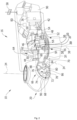
- the pitch system 32 is at least partially arranged as a pitch assembly 66 in the hub 20.
- the pitch assembly 66 includes one or more pitch drive systems 68 and at least one sensor 70.
- Each pitch drive system 68 is coupled to a respective rotor blade 22 (shown in figure 1 ) for modulating the pitch angel of a rotor blade 22 along the pitch axis 34. Only one of three pitch drive systems 68 is shown in figure 2 .
- the pitch assembly 66 includes at least one pitch bearing 72 coupled to hub 20 and to a respective rotor blade 22 (shown in figure 1 ) for rotating the respective rotor blade 22 about the pitch axis 34.
- the pitch drive system 68 includes a pitch drive motor 74, a pitch drive gearbox 76, and a pitch drive pinion 78.
- the pitch drive motor 74 is coupled to the pitch drive gearbox 76 such that the pitch drive motor 74 imparts mechanical force to the pitch drive gearbox 76.
- the pitch drive gearbox 76 is coupled to the pitch drive pinion 78 such that the pitch drive pinion 78 is rotated by the pitch drive gearbox 76.
- the pitch bearing 72 is coupled to pitch drive pinion 78 such that the rotation of the pitch drive pinion 78 causes a rotation of the pitch bearing 72.
- Pitch drive system 68 is coupled to the wind turbine controller 36 for adjusting the pitch angle of a rotor blade 22 upon receipt of one or more signals from the wind turbine controller 36.
- the pitch drive motor 74 is any suitable motor driven by electrical power and/or a hydraulic system that enables pitch assembly 66 to function as described herein.
- the pitch assembly 66 may include any suitable structure, configuration, arrangement, and/or components such as, but not limited to, hydraulic cylinders, springs, and/or servomechanisms.
- the pitch drive motor 74 is driven by energy extracted from a rotational inertia of hub 20 and/or a stored energy source (not shown) that supplies energy to components of the wind turbine 10.
- the pitch assembly 66 may also include one or more pitch control systems 80 for controlling the pitch drive system 68 according to control signals from the wind turbine controller 36, in case of specific prioritized situations and/or during rotor 18 overspeed.
- the pitch assembly 66 includes at least one pitch control system 80 communicatively coupled to a respective pitch drive system 68 for controlling pitch drive system 68 independently from the wind turbine controller 36.
- the pitch control system 80 is coupled to the pitch drive system 68 and to a sensor 70.
- the wind turbine controller 36 may control the pitch drive system 68 to adjust a pitch angle of rotor blades 22.
- a power generator 84 for example comprising a battery and electric capacitors, is arranged at or within the hub 20 and is coupled to the sensor 70, the pitch control system 80, and to the pitch drive system 68 to provide a source of power to these components.
- the power generator 84 provides a continuing source of power to the pitch assembly 66 during operation of the wind turbine 10.
- power generator 84 provides power to the pitch assembly 66 only during an electrical power loss event of the wind turbine 10.
- the electrical power loss event may include power grid loss or dip, malfunctioning of an electrical system of the wind turbine 10, and/or failure of the wind turbine controller 36.
- the power generator 84 operates to provide electrical power to the pitch assembly 66 such that pitch assembly 66 can operate during the electrical power loss event.
- the pitch drive system 68, the sensor 70, the pitch control system 80, cables, and the power generator 84 are each positioned in a cavity 86 defined by an inner surface 88 of hub 20.
- said components are positioned with respect to an outer surface of hub 20 and may be coupled, directly or indirectly, to the outer surface.
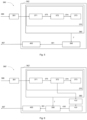
- Figure 3 illustrates a system comprising a wind turbine 10, a controller 360 and a wind turbine actuator system 364
- the wind turbine actuator system 364 comprises a plurality of actuators, such as the above mentioned blade pitch systems 32, yaw drive mechanism 56 or electronics converter enabling torque control. Although depicted separately in Figure 3 for illustration and explanation purposes, those actuators are physically arranged in the wind turbine 10 as is well understood by those skilled in the art.
- the controller 360 in this example comprises an estimator 361 and an MPC (Model Predictive Control) module 362.
- the controller 360 controls the wind turbine 10 so that the wind turbine 10 operates according to the one or more received reference signals 365, e.g. power output, while maintaining system limits.
- the controller 360 generates commands or commands 367 to control one or more wind turbine actuators in the wind turbine actuator system 364.
- Multiple wind turbine actuators may be present in the wind turbine 10.
- actuator commands may comprise at least one of a blade pitch angle and a generator torque, which may be sent to the corresponding blade pitch drive systems 68 and power converter.
- the controller 360 may receive operational data 366 from the wind turbine 10.
- the operational data 366 may be used to determine the operational state of the wind turbine 10.
- operational data may include the value of the blade pitch angles, output power, electrical torque, rotational speed of the wind turbine rotor, rotational speed of the electrical generator, tower top position, etc.
- Operational data 366 may be obtained via direct measurements with sensors. Nevertheless, in examples of the disclosure, operational data 366 may be obtained via virtual sensors. Thus, in examples of the disclosure, no direct measurement may be required.
- a virtual sensing system comprising a proper model may be used to calculate the value of the operational variable when no direct measurement of the same is available.
- sensor measurements may be fed to a signal treatment module (not shown in Figure 3 ), where they may be filtered and conditioned.
- An estimator 361 may be provided.
- the estimator 361 may comprise filter equations (e.g. extended Kalman filters) that may be used to calculate the most probable operational state of the wind turbine 10 based on the received operational data 366.
- the operational state may be dynamically determined at each control step.
- the determined operational state may then be used by the MPC module 362.
- the MPC module 362 is responsible for defining the actuator commands based on the current operational state of the wind turbine 10 and on the control requirements. To this end, the MPC module 362 uses a model of the wind turbine 10. Details of the MPC module 362 will be provided with reference to Figures 5 and 6 .
- FIG 4 shows a flowchart of an example of a method 100 for controlling a wind turbine 10 having a plurality of wind turbine actuators 364.
- the method 100 comprises steps 110-150.
- Step 110 comprises receiving operational data 366 of the wind turbine 10.
- step 120 comprises estimating an operational state of the wind turbine 10.
- step 130 comprises using a control model (370, in Figures 5 and 6 ) to predict potential operational states of the wind turbine depending on operation of the wind turbine actuators 364 over a finite period of time.
- the control model 370 comprises a predictive aeroelastic control model (371 in Figures 5 and 6 ) to determine primary loads (375 in Figures 5 and 6 ) based on the received operation data 366.
- the control model 370 further comprises a strength calculation module (372, in Figures 5 and 6 ) to calculate one or more secondary load parameters (374 in Figures 5 and 6 ) based on the primary loads 375 determined by the predictive aeroelastic control model 371, constraints being defined for the secondary load parameters 374.
- An optimum trajectory comprising commands for the wind turbine actuators is determined by optimizing a cost function over a finite period of time, subject to the constraints, in step 140.
- step 150 comprises using the first commands of the determined optimum trajectory to control the wind turbine actuators 364.
- the method may comprise repeating the above mentioned steps 110-150 at consecutive control intervals. More specifically, steps 110-150 may be carried out at each control interval. In this manner, optimum control of the wind turbine 10 may be carried out in real-time so as to better react and adapt to varying environmental conditions and7or varying operating conditions of the wind turbine 10.
- the method may comprise defining constraints not only for the secondary load parameters but also for one or more of the primary loads. Consequently, optimizing the cost function over a finite optimization period of time in these examples may also be subjected to the constraints defined for the primary loads.
- constraints may be employed to better capture the behavior of the wind turbine.
- secondary load parameters may be related to extreme loads.
- fatigue loads may also be considered in the definition of the secondary load parameters.
- the operational state of the wind turbine 10, which is defined in step 120 of the method 100, may be defined by a plurality of variables referring to operational parameters of the wind turbine 10. Said variables may be expressed as a vector. As explained with reference to Figure 3 , the operational state may be obtained after taking into account direct sensor measurements or virtual sensor information. Furthermore, an estimator 361 may be used to determine the current operational state, thus reducing uncertainties associated to, e.g. noise. Different variables, i.e. different operational parameters, may be selected to define the operational state of the wind turbine 10.
- ⁇ is the blade pitch angle
- ⁇ is the rotational speed of the wind turbine rotor
- T is the electromagnetic torque of the generator
- b is the blade deflection
- t is the tower deflection. Time derivates for each of those parameters may also be included in the definition of the operational state.
- the optimum trajectory to control the wind turbine actuators 364 comprises a time series of commands which may be described as a vector comprising the commands for the wind turbine actuators 364.
- the first value of the trajectory is directly provided to the wind turbine actuators 364.
- different trajectories may be envisaged in examples of the disclosure depending on the specific wind turbine actuators 364 (and on the specific parameters of those actuators) being considered. Specifically, the trajectories provide the list of controllable or independent variables that are used to dynamically control the behavior of the wind turbine 10.
- the optimum trajectory may comprise commands for the rate of change of the blade pitch angles and for the generator torque.
- Step 130 of the method comprises using a model of the wind turbine 10 to predict potential operational states of the wind turbine 10 depending on operation of the wind turbine actuators 364.
- a model is used to predict future trajectories, or time evolutions, of the operational state of wind turbine 10, which may be defined according to output or dependent variables as shown above. Said trajectories are dependent on the current operational state (as determined in step 120) and on the actuation on the controllable or independent variables (e.g. blade pitch or torque). Apart from controllable variables, the effect of uncontrollable independent variables may also be considered by the model in the form of disturbances.
- the determination of the potential trajectories includes the calculation of certain secondary load parameters 374, indicative of the predicted loading of selected components of the wind turbine 10.
- the control model 370 comprises a predictive aeroelastic model 371 which is used to determine primary loads 375.
- the control model 370 comprises a further module, the strength calculation module 372, which is used to calculate the truly relevant secondary load parameters 374 determining the behavior of the wind turbine 10. By adding the strength calculation module 372, secondary load parameters 374 beyond those typically provided by the predictive aeroelastic model 371 can be calculated and used for the optimization problem.
- the strength calculation module 372 corresponds to a code used to calculate the secondary load parameters 374. It may be implemented as a separate or specific block or it may be included with other parts of the code. In other words, the strength calculation module 372 is depicted as an independent module in Figures 5 and 6 for illustrative purposes but the functionality of the strength calculation module 372 may be integrated with other parts of the code.
- an optimum trajectory is obtained in step 140.
- a cost function is minimized, subject to a number of constraints. At least some of the constraints used in the optimization problem relate to the calculated secondary load parameters 374.
- N dependent or output variables, x i are defined for the operational state of the wind turbine 10 and M independent or manipulated variables, u i , are defined for the wind turbine actuators.
- the first term in the cost function, J corresponds to the output or dependent variables and it ensures that the resultant operational state of the wind turbine 10 tracks the desired references for the output variables.
- the second term corresponds to the variations of the controllable or independent variables, i.e., the commands controlling the wind turbine actuators. This term is used to avoid excessive activity of the actuators.
- Individual weights, W i are used to prioritize the performance goals of the controller by adjusting the cost function tuning weights. As a general rule, larger weight on the output variables provides aggressive reference tracking performance whereas larger weights on the controllable or independent variables provides a smooth control with improved robustness.
- this cost function is presented just as an example as different output variables may be used to characterize the operational state of the wind turbine 10 and different controllable variables may be used for different wind turbine actuators.
- the secondary load parameters may be included in the cost function, specifically the secondary load parameters may be included with a corresponding weight indicative of the relative importance of the secondary load parameter.
- the constraints defined for the secondary load parameters may comprise at least an upper bound and a slack variable, the slack variables being penalized in the cost function.
- constraints associated to the secondary load parameters may be included as soft constraints in the optimization problem.
- constraints set on secondary load parameters may result in unsolvable optimization problems if included in the problem as hard constraints.
- constraints may be included as soft constraints by using a slack variable.
- the corresponding constraints may be implemented by defining an inequality constraint including the slack variable in the problem and by adding a term in the cost function to penalize the slack variable.
- the size of the slack variable may correspond to the size of the associated constraint violation.
- a constraint for secondary load parameter, LP may be defined by an inequality constraint as follows: LP ⁇ UB + ⁇
- the respective value of the upper bound, UB, and the slack, ⁇ may be adjusted to achieve the desired behavior of the controller.
- the secondary load parameters may be added in the cost function as one of the tracking members of the cost function.
- a certain value may be defined for a specific secondary load parameters and a term equivalent to those listed above for output power or rotor speed may be included in the cost function for a secondary load parameter.
- the constraints defined for the secondary load parameters may be based on material limits of one or more wind turbine components. Indeed, material limits of the wind turbine components may be used as constraints in the optimization problem as they should not be exceeded. As shown below, secondary load parameters indicative of materials limits may be given in terms of different magnitudes: forces, moments, stress, strain, etc.
- a wind turbine 10 is a complex system with a very large number of components.
- Each of those components may be manufactured with different materials and may be subjected to different operating loads. Consequently, the material limits may be given in different form for different components.
- the components may include blades, tower, hub, bedplate, foundation, etc.
- the secondary load parameters may be predetermined, more specifically, the secondary load parameters may be predetermined on the basis of a finite element method analysis of selected components of the wind turbine 10.
- the decision on which secondary load parameters are used as constraints for the optimization problem may take place a priori.
- the strength calculation module 732 may be programmed and it may include expressions to calculate the value of the selected secondary load parameters.
- the determination of the value of the secondary load parameters may comprise a calculation and a linearization of said calculation.
- the linearization may allow online calculation so that the secondary load parameters may be used by the optimization algorithm in an efficient manner during real time operation of the wind turbine 10. This may be particularly the case for especially complex secondary load parameters.
- simulations may be carried out during the design phase of the wind turbine 10 for each of the most relevant components. More specifically, simulations may be carried out with Finite Element Method (FEM) models. In this manner, the secondary load parameters defining the true mechanical limits of the respective components of the wind turbine 10 may be identified.
- FEM Finite Element Method
- the predetermined secondary load parameters may comprise at least one of a force, a moment, a stress, a strain or a buckling load. More specifically, the secondary load parameters may comprise a stress at a wind turbine component derived by means of a stress tensor or a strain of a wind turbine component derived by means of a strain tensor.
- Design limits may by defined by a secondary load parameter referring only to a force or a moment at a certain location of a wind turbine component.
- a soft constraint may be defined as: Force or Moment x ⁇ UB + ⁇ where "Force or Moment x " simply represents the value of a selected force or moment for a component "x" of the wind turbine 10.
- more elaborate secondary load parameters may be envisaged to capture the limiting loads of a certain component. In such cases, a function of multiple components of the forces or moments may be used.
- the secondary load parameters derived from the resultants, R may be given in terms of stresses or strains.
- a wind turbine component may be subject to normal forces, shear forces, bending and torsional moments.
- F ⁇ F cr F represents a secondary load parameter that is a function of stress, strain or other loading factors of a component at a specific location of its geometry.
- F cr Several criteria may be used to express the limit value, F cr , which may depend on the limiting state for a given material. Some of these options include that F cr corresponds to a maximum principal stress, a maximum shear stress, a maximum principal strain, a maximum strain energy or a maximum shear strain energy.
- This general formulation may provide enhanced flexibility to handle limiting conditions corresponding to different types of materials in different wind turbine components.
- composite materials may be considered. This may be the case when handling blade delamination limits in blade composites.
- the secondary load parameters, F may correspond to the complementary strain energies.
- FIG. 5 provides a more detailed view of an example of a controller 360 to carry out a method like the one described above.
- the control system 360 may be implemented by using a model predictive control (MPC) module 362.
- MPC model predictive control
- an estimator 361 may be used to characterize the operational state of the wind turbine 10.
- the operational state of the wind turbine 10 is fed to the control model 370 in the MPC module 362.
- a predictive aeroelastic control model 371 is used to determine certain primary loads 375 for selected components and locations of the wind turbine 10.
- the primary loads 375 may be expressed in some cases as deflections of certain components of the wind turbine 10.
- the strength calculation module 372 uses the primary loads 375 from the predictive aeroelastic control model 371 to calculate the value of the secondary load parameters 374.
- Said secondary load parameters 374 may be associated to corresponding constraints for the optimization problem, which may be defined in a corresponding constraints module 373.
- the secondary load parameters 374 calculated at the strength calculation module 372, together with the corresponding constraints obtained from constraints module 373, may be used by an optimization problem builder 380 to create the cost function, J.
- the optimization problem builder 380 is understood as an algorithm that builds a cost function, J, by taking into account the penalty terms for the different constraints, their relative relevance (i.e. the weights of each constraint in the cost function) and the corresponding values.
- an optimization problem solver 390 may be used to find the optimum trajectory 391.
- An optimization algorithm may be used to find the optimum solution, i.e. the optimum set of independent or controllable variables that minimizes the cost function, J, at the corresponding control step.
- the optimum trajectory 391 resulting from the optimization may then be fed to block 400, which may take the first value of the calculated optimum trajectory 391 for each of the wind turbine actuator to generate the commands 367 to control one or more wind turbine actuators in the wind turbine actuator system 364.
- Figure 5 is just an example of an architecture to implement a method according to the disclosure.
- the details of the controller 360 may differ in other variants. For instance, as a non-limiting example, some of the actions defined for the different modules may be combined in a single module.
- the predicted values of the secondary load parameters 374 and/or the determined primary loads 375 may be stored and compared with actually measured values so as to evaluate a quality of the prediction.
- the quality of the prediction may be characterized by, e.g. a mean prediction error, E m , between the predicted values and the actually measured values.
- E m mean prediction error
- E v variation of the prediction error
- Both E m and E v may be evaluated over a certain time interval.
- FIG. 6 provides an overview of an example of a further controller 360' wherein said functionality may be provided.
- a modified MPC module 362' may incorporate a strength calculation module monitoring block 410, which may be employed to determine the quality of the prediction, e.g. to determine E m and E v for one or more of the secondary load parameters 374 or primary loads 375
- the evolution of the prediction error, E over a time interval may be calculated as the predicted value minus the actually measured value.
- the obtained E values may be processed to derive E m and E v .
- the mean prediction error, E m may be obtained by, e.g. averaging E over the time interval or by applying a low-pass filter to the obtained E values.
- the variation of the prediction error, E v this may take different forms, e.g. maximum absolute error or standard deviation of E.
- a strength adaptation module 420 may be provided to adjust different parameters of the optimization problem based on the results of the quality assessment conducted in block 410.
- Said modified parameters 430 may be provided to the optimization problem solver 390.
- the quality of the prediction may be used to adjust or correct the value of the secondary load parameters 374.
- the cost function may include terms for the slack of the constraints associated with the secondary load parameters 374.
- the weight for each constraint may be indicative of the relative importance of the respective secondary load parameters 374.
- the evaluation of the quality of the prediction may be used to update the weight of the slack components associated to the corresponding secondary load parameters 374.
- the modified parameters 430, resulting from the adaptation module 420 may correspond to modified weights of said slack components in the cost function
- the relative importance of a secondary load parameter 374 may be adjusted, not only on the basis of the effect of that particular load on a certain wind turbine component, but also on the basis of the reliability of the own controller to properly account for that secondary load parameter 374.
- the quality of the prediction may also be used to adjust a constraint, i.e. to adjust the value of a bound of a constraint, defined for a secondary load parameter 374.
- the bounds may be adjusted based on the mean prediction error, E m , and/or the variation of the prediction error, E v .
- the bounds for the respective constraints may also be adjusted depending on the distance between the actually measured value and the currently defined bound value. Consequently, in such examples, the modified parameters 430 may comprise the modified values for the bounds (either upper, UB, or lower, LB) of the constraints defined for secondary load parameters 374.
- a constrained secondary load parameter, LP i may be limited with an original upper bound, UB i : LP i ⁇ UB i
- Said constraint may be adjusted with a modified upper bound, UB i *: LP i ⁇ UB i ⁇
- the original constraint may be included in the cost function, J, with a certain weight, W LPi , which may be adjusted to a modified weight, W* LPi .
- the function f is non-decreasing with respect to E v and non-increasing with respect to UB i .- LP i .
- the function g may be a non-negative function that modifies the original slack penalty weight based on a variation of the prediction error, E v .
- an equivalent process to the one described for secondary load parameters 374 may be carried out for primary loads 375.
- the predicted and actual values for primary loads 375 may be used to evaluate the quality of the prediction and to adjust the corresponding constraints.
- the bounds of the constraints defined for different secondary load parameters 374 may be adjusted selectively in dependence of at least one of an operational state of the wind turbine 10, an operating mode of the wind turbine 10 or an environmental condition.
- certain constraints may be more relevant during startup, or shutdown, or at a particular wind regime such as a wind gust, extreme turbulence or large wind direction changes. This example of the disclosure may then be better adapted to handle such situations.
- a supervisory module may be included which may be configured to provide the information on, e.g. the operating mode of the wind turbine 10, so as to adjust the different constraints.
- the constraints defined for different secondary load parameters 374 may be selectively activated or deactivated according to at least one of the operational state of the wind turbine 10, an operating mode of the wind turbine 10 or an environmental condition.
- the constraints may be adjusted to the conditions but they may be removed.
- a supervisory module may be configured to add or remove constraints adaptively, i.e. based on the identification of the current operational state of the wind turbine 10 or its operating mode. This may be particularly advantageous in those operating modes wherein certain constraints may not play a significant role, e.g. constraints related to power output while in idling operating mode. By removing unnecessary constraints from the optimization problem, a more efficient operation of the controller may be achieved.
- the blades 22 One of the most critical components in a wind turbine 10 are the blades 22. Specifically, the blade root area 24 is known to suffer significant loads during wind turbine operation. For that reason, typical controllers have been known to handle blade loads by adding a constraint on the blade flap moment, M flap . However, inventors have identified that using the blade flap moment may not be representative of the true limiting conditions for the blade 22 as the maximum stress may be better characterized by a different secondary load parameter.
- Figure 7 schematically illustrates the resultant moment, M resultant 510, acting at the blade root 24 of a wind turbine blade 22 in the absence of other forces or moments.
- the blade cross-section ad mid-span 221 is also presented (dash line).
- M resultant M x 2 + M y 2 .
- the points of maximum tensile stress 511 and maximum compression stress 512 at the blade root 24 are represented in Figure 7 .
- Figure 8 illustrates a typical scenario of the edgewise moment, M edge 520, the flap moment, M flap 530, and the resultant moment, M resultant 510, at the blade root 24 of a wind turbine blade 22.
- the maximum stresses calculated at the times when M flap 530 is maximum are lower than the maximum stresses calculated when the M resultant 510 is maximum.. Consequently, a constraint based on M flap 530 may not ensure that worst-case scenarios are contained within limits so that it may leave the blade 22 exposed to failure.
- a controller based on M flap 530 may indicate that loads are within limits even when, in reality, they are not and the true constraint (M resultant 510) is not being considered.
- the method may be such that one of the secondary load parameters may comprise a resultant moment at a blade root 24 of at least a wind turbine blade 22.
- blade loads may be more complex, so secondary load parameters may be defined in further examples of the disclosure to capture true limiting loads in a more accurate manner.
- M resultant 510 may influence the stress at the blade root 24, but also axial force at blade root, F x 513, shear force at blade root, S hear 514, and torsional moment at blade root, M x 515, may be taken into account.
- one or more of the secondary load parameters may be derived as a function of a collection of three-dimensional forces (F x , F y , F z ) and three-dimensional moments (M x , M y , M z ) at one or more locations of a wind turbine blade 22. More specifically, the one or more secondary load parameters may comprise at least one of a combination of a resultant blade moment 510 at the blade root 24 and an axial force 513 at the blade root 24, or a combination of a normal force, a shear force, a torsional moment, an edge moment and a flap moment at a specific blade section.
- a combination of a resultant blade moment, M resultant 510, and an axial force, F x 513, may be used to account for the maximum stress at the blade root 24 of the wind turbine blade 22.
- a secondary load parameter may be derived by combining these two different inputs.
- a corresponding constraint may be formulated as follows: LB ⁇ ⁇ ⁇ K 1 M resultant + K 2 F x ⁇ UB + ⁇ where both an upper bound, UB, and a lower bound, LB, are defined.
- a slack ( ⁇ ) is given to both bounds to provide some softening to the constraint.
- different weights (K 1 , K 2 ) may be provided to the resultant moment, M resultant 510, and to the axial force, F x 513, to reflect their relative importance on the stress at the blade root 24.
- the limiting load for the blade 22 in another example of the disclosure may be a maximum stress in the spar cap at a specific blade section.
- a combination of the normal force, a shear force, a torsional moment and a flap moment may be determined at such specific blade section to account for a maximum stress at a spar cap of a wind turbine blade 22.
- examples of the disclosure may comprise determining the resultant, i.e. the collection of three-dimensional forces and three-dimensional moments, at multiple sections of the blade 22.
- Figure 10 shows a schematic representation of a blade 22 wherein two sections are indicated.
- a secondary load parameter may be derived for the blade 22 as a function of the corresponding resultants.
- a constraint may be included for the associated secondary load parameter.
- a wind turbine 10 comprises a very large number of mechanical and structural components. All such components exhibit mechanical limits and, consequently, examples of a method may be envisaged to account for secondary load parameters affecting other components.
- Figure 11 schematically illustrates an example of a wind turbine tower 15 comprising multiple sections 151-15n with forces and moments applied at each section.
- the secondary load parameters may comprise a combination of compression, bending and torsional loads at one or more sections of a wind turbine tower 15.
- the load for combined compression, bending and torsion of wind turbine tower sections 151-15n can also be a limiting factor for the design and operation of a wind turbine 10.
- Each section of the tower 15 may have different diameter, thickness, stiffeners, bolted joints or materials.
- the loading condition of each section 151-15n may also be different. Accordingly, critical loads for different tower sections may differ.
- the limiting loads for each section may be a combination of maximum stress, maximum deformation or buckling loads. Therefore, in an example of the disclosure, the tower constraints may be defined based on a plurality of secondary load parameters defined for the limiting loads at each section. Said secondary load parameters may be calculated in the strength calculation module 372 so that an accurate representation of the strength of the tower 15 during operation may be obtained.
- secondary load parameters may comprise at least one of a maximum tensile stress, a maximum shear stress or a maximum shear deformation energy at one or more locations of a wind turbine hub 20. More specifically, the maximum tensile stress, the maximum shear stress and the maximum shear deformation energy may be calculated with a stress tensor after considering three-dimensional forces and moments from each wind turbine blade 22 connected the hub 20 and from the connection to a main shaft 44 of the wind turbine 10.
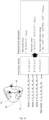
- Figure 12 shows a schematic image of wind turbine hub 20 and the corresponding loading.
- External forces and moments may be exerted on the hub 20 by each of the three pitch bearings 72 and by the connection to the main shaft 44.
- the resultants comprising three-dimensional forces and moments for each of these locations, may be obtained.
- the strength calculation module 372 may then calculate a corresponding secondary load parameter at specific locations of the hub 20. Said locations may correspond to the locations of the hub 20 that are subjected to the most significant loads. These locations may be predetermined by means of an analysis by, e.g. FEM.
- a secondary load parameter may be derived and a corresponding constraint may be defined as: F R blade 1 R blade 2 R blade 3 R MainShaft ⁇ F cr where R bladei is the resultant of three-dimensional forces and moments at the corresponding pitch bearing connection to the hub 20 and R MainShaft is the resultant of three-dimensional forces and moments for the connection to the main shaft 44. Said forces and moments may be obtained with a basic aeroelastic model.
- the strength calculation module 372 in this case may calculate the limiting condition for the hub material at selected locations: a, b and c in Figure 12 .
- the resultants for the three blades 22 and the main shaft 44 may be fed to the strength calculation module 372.
- the strength calculation module 372 may comprise the local stress tensors at the selected predetermined locations. From the resultants, R, and the stress tensors, the limiting condition may be derived. In examples of the disclosure, different limiting conditions may be selected to account for the different characteristics of the material. Thus, the maximum tensile stress, the maximum shear stress or the maximum shear deformation energy may be selected. In all cases, a maximum stress, ⁇ max , may be defined as an upper bound for the selected stress.
- ⁇ max may correspond to the yield strength, ⁇ yield . This is the case in the example shown in Figures 12 , in which this maximum tension corresponds to the yield stress limit, ⁇ yield , of the hub material, which may then be used to define the corresponding constraint. As understood by those skilled in the art, different limit conditions may be defined for different components based on the corresponding materials.
- a controller 360 for a wind turbine 10 is provided.
- the controller 360 is configured to carry out method for controlling a wind turbine 10 according to previously explained method examples or any further equivalent examples.
- the control system 360 may be implemented as part of the wind turbine controller 36.
- a wind turbine 10 comprising a tower 15, a nacelle 16 rotatably mounted on top of the tower 15, a wind turbine rotor 18 including a plurality of wind turbine blades 22 and a yaw system
- the wind turbine may comprise a control system 360 configured to perform the methods as described throughout this disclosure or any equivalent examples (including combinations).
Landscapes
- Engineering & Computer Science (AREA)
- Life Sciences & Earth Sciences (AREA)
- Sustainable Development (AREA)
- Sustainable Energy (AREA)
- Chemical & Material Sciences (AREA)
- Combustion & Propulsion (AREA)
- Mechanical Engineering (AREA)
- General Engineering & Computer Science (AREA)
- Physics & Mathematics (AREA)
- Fluid Mechanics (AREA)
- Wind Motors (AREA)
Priority Applications (5)
| Application Number | Priority Date | Filing Date | Title |
|---|---|---|---|
| EP23383299.7A EP4571103A1 (fr) | 2023-12-14 | 2023-12-14 | Procédé et système de commande prédictive d'une éolienne |
| JP2024171918A JP2025108348A (ja) | 2023-12-14 | 2024-10-01 | 風力タービンの予測制御のための方法及びシステム |
| KR1020240183617A KR20250092100A (ko) | 2023-12-14 | 2024-12-11 | 풍력 터빈의 예측 제어를 위한 방법 및 시스템 |
| US18/978,062 US12571371B2 (en) | 2023-12-14 | 2024-12-12 | Method and system for predictive control of a wind turbine |
| CN202411826922.8A CN120159695A (zh) | 2023-12-14 | 2024-12-12 | 用于风力涡轮的预测控制的方法和系统 |
Applications Claiming Priority (1)
| Application Number | Priority Date | Filing Date | Title |
|---|---|---|---|
| EP23383299.7A EP4571103A1 (fr) | 2023-12-14 | 2023-12-14 | Procédé et système de commande prédictive d'une éolienne |
Publications (1)
| Publication Number | Publication Date |
|---|---|
| EP4571103A1 true EP4571103A1 (fr) | 2025-06-18 |
Family
ID=89223103
Family Applications (1)
| Application Number | Title | Priority Date | Filing Date |
|---|---|---|---|
| EP23383299.7A Pending EP4571103A1 (fr) | 2023-12-14 | 2023-12-14 | Procédé et système de commande prédictive d'une éolienne |
Country Status (5)
| Country | Link |
|---|---|
| US (1) | US12571371B2 (fr) |
| EP (1) | EP4571103A1 (fr) |
| JP (1) | JP2025108348A (fr) |
| KR (1) | KR20250092100A (fr) |
| CN (1) | CN120159695A (fr) |
Families Citing this family (1)
| Publication number | Priority date | Publication date | Assignee | Title |
|---|---|---|---|---|
| US12510052B1 (en) * | 2024-06-27 | 2025-12-30 | GE Vernova Renovables Espana, S.L. | System and method for optimizing control of a wind turbine |
Citations (1)
| Publication number | Priority date | Publication date | Assignee | Title |
|---|---|---|---|---|
| EP1911968A1 (fr) * | 2006-10-10 | 2008-04-16 | Ecotecnia Energias Renovables S.L. | Système de réglage pour une turbine éolienne et procédé de réglage |
Family Cites Families (10)
| Publication number | Priority date | Publication date | Assignee | Title |
|---|---|---|---|---|
| DK2878809T3 (en) | 2013-11-29 | 2017-09-25 | Alstom Renovables Espana Sl | Methods of operating a wind turbine, wind turbines and wind farms |
| DE202015000665U1 (de) * | 2015-01-24 | 2015-06-26 | Dieter Röhm | Vorrichtung eines Sicherheitssystems und/oder Ressourcen-/Energieeffizienz-Verbesserungs - Systems zur Stömungsbeeinflussung eines Aero- oder Hydrodynamischen Körpers (3), nach dem Prinzip einer Rückstromklappe (4) |
| US10461540B2 (en) | 2017-03-17 | 2019-10-29 | General Electric Technology Gmbh | Scalable flexibility control of distributed loads in a power grid |
| US10691087B2 (en) | 2017-11-30 | 2020-06-23 | General Electric Company | Systems and methods for building a model-based control solution |
| EP3744973B1 (fr) | 2019-05-31 | 2023-10-04 | Vestas Wind Systems A/S | Commande de chargement de volet sur une pale d'éolienne sur la base du chargement de volet prévu |
| US11629694B2 (en) | 2019-10-22 | 2023-04-18 | General Electric Company | Wind turbine model based control and estimation with accurate online models |
| PL4093967T3 (pl) | 2020-01-24 | 2026-03-09 | General Electric Renovables España, S.L. | System i sposób sterowania turbiną wiatrową |
| US11790081B2 (en) | 2021-04-14 | 2023-10-17 | General Electric Company | Systems and methods for controlling an industrial asset in the presence of a cyber-attack |
| US12034741B2 (en) | 2021-04-21 | 2024-07-09 | Ge Infrastructure Technology Llc | System and method for cyberattack detection in a wind turbine control system |
| US12560150B2 (en) | 2021-10-07 | 2026-02-24 | GE Vernova Renovables Espana, S.L. | Systems and methods for controlling a wind turbine |
-
2023
- 2023-12-14 EP EP23383299.7A patent/EP4571103A1/fr active Pending
-
2024
- 2024-10-01 JP JP2024171918A patent/JP2025108348A/ja active Pending
- 2024-12-11 KR KR1020240183617A patent/KR20250092100A/ko active Pending
- 2024-12-12 CN CN202411826922.8A patent/CN120159695A/zh active Pending
- 2024-12-12 US US18/978,062 patent/US12571371B2/en active Active
Patent Citations (1)
| Publication number | Priority date | Publication date | Assignee | Title |
|---|---|---|---|---|
| EP1911968A1 (fr) * | 2006-10-10 | 2008-04-16 | Ecotecnia Energias Renovables S.L. | Système de réglage pour une turbine éolienne et procédé de réglage |
Non-Patent Citations (3)
| Title |
|---|
| FRIIS J ET AL: "Repetitive Model Predictive Approach to Individual Pitch Control of Wind Turbines", 1 January 2011 (2011-01-01), pages 1 - 7, XP007920250, Retrieved from the Internet <URL:www.control.aau.dk/~jakob/.../cdcecc_2011_3.pdf> * |
| HECTOR ELOY SANCHEZ ET AL: "Health-aware model predictive control of wind turbines using fatigue prognosis", INTERNATIONAL JOURNAL OF ADAPTIVE CONTROL AND SIGNALPROCESSING, WILEY, CHICHESTER, GB, vol. 32, no. 4, 11 May 2017 (2017-05-11), pages 614 - 627, XP071735251, ISSN: 0890-6327, DOI: 10.1002/ACS.2784 * |
| HUSSAIN R ET AL: "Model predictive control of wind turbine with aero-elastically tailored blades", JOURNAL OF PHYSICS: CONFERENCE SERIES, INSTITUTE OF PHYSICS PUBLISHING, GB, vol. 2265, no. 3, 1 May 2022 (2022-05-01), XP020424625, ISSN: 1742-6588, [retrieved on 20220501], DOI: 10.1088/1742-6596/2265/3/032084 * |
Also Published As
| Publication number | Publication date |
|---|---|
| US12571371B2 (en) | 2026-03-10 |
| JP2025108348A (ja) | 2025-07-23 |
| KR20250092100A (ko) | 2025-06-23 |
| US20250198379A1 (en) | 2025-06-19 |
| CN120159695A (zh) | 2025-06-17 |
Similar Documents
| Publication | Publication Date | Title |
|---|---|---|
| Azizi et al. | Fault tolerant control of wind turbines with an adaptive output feedback sliding mode controller | |
| Bossanyi et al. | Validation of individual pitch control by field tests on two-and three-bladed wind turbines | |
| EP2292928B1 (fr) | Procédés de contrôle d'éolienne et systèmes | |
| EP2067988B1 (fr) | Appareil et procédé de réduction des charges de rotor asymétriques dans l'arrêt d'une éolienne | |
| EP2500562A2 (fr) | Procédés et systèmes pour atténuer les charges générées dans les éoliennes par asymétries du vent | |
| EP2169219B1 (fr) | Système et procédé de contrôle d'une éolienne lors de la perte du réseau électrique et de changement des conditions de vent | |
| JP6494514B2 (ja) | 入力風速の予測値を使用した風力タービン制御方法 | |
| EP4116582B1 (fr) | Capteurs d'azimut dans des éoliennes | |
| US12571371B2 (en) | Method and system for predictive control of a wind turbine | |
| Jiang et al. | Load mitigation method for wind turbines during emergency shutdowns | |
| Bay et al. | Design and testing of a scaled demonstrator turbine at the national wind technology center | |
| EP2636895B1 (fr) | Procédés et systèmes pour atténuer des charges dans des turbines éoliennes en mer | |
| EP3892850B1 (fr) | Système et procédé pour atténuer les charges agissant sur une pale de rotor d'une éolienne | |
| Peeringa et al. | Upwind 20 MW wind turbine pre-design | |
| Requate et al. | Active control of the reliability of wind turbines | |
| US12560150B2 (en) | Systems and methods for controlling a wind turbine | |
| WO2025247483A1 (fr) | Commande en ligne d'une distance de sécurité pale-tour dans des éoliennes | |
| US12510052B1 (en) | System and method for optimizing control of a wind turbine | |
| van Wingerden et al. | Smart Dynamic Rotor Control: Part3, advanced controller design | |
| Li | Optimization of Torsional Vibration Control of Wind Turbine Transmission Chain | |
| Prinsen | Investigation into reduction of the Cost-Of-Energy of the Upwind 5.0 MW Wind Turbine using Higher-Harmonic Individual Pitch Control | |
| Yuan | Advanced Control Design for Power Capture Enhancement and Load Mitigation of Wind Turbines | |
| Stiesdal et al. | 1MW Adaptable Wind Turbine | |
| Bossanyi et al. | Project UpWind |
Legal Events
| Date | Code | Title | Description |
|---|---|---|---|
| PUAI | Public reference made under article 153(3) epc to a published international application that has entered the european phase |
Free format text: ORIGINAL CODE: 0009012 |
|
| STAA | Information on the status of an ep patent application or granted ep patent |
Free format text: STATUS: THE APPLICATION HAS BEEN PUBLISHED |
|
| AK | Designated contracting states |
Kind code of ref document: A1 Designated state(s): AL AT BE BG CH CY CZ DE DK EE ES FI FR GB GR HR HU IE IS IT LI LT LU LV MC ME MK MT NL NO PL PT RO RS SE SI SK SM TR |
|
| STAA | Information on the status of an ep patent application or granted ep patent |
Free format text: STATUS: REQUEST FOR EXAMINATION WAS MADE |
|
| 17P | Request for examination filed |
Effective date: 20251218 |
|
| RAP3 | Party data changed (applicant data changed or rights of an application transferred) |
Owner name: GE VERNOVA RENOVABLES ESPANA, S.L. |
|
| RAP3 | Party data changed (applicant data changed or rights of an application transferred) |
Owner name: GE VERNOVA RENOVABLES ESPANA, S.L. |