EP4571278A2 - Ensemble pour une sonde sans fil et interrogateur - Google Patents
Ensemble pour une sonde sans fil et interrogateur Download PDFInfo
- Publication number
- EP4571278A2 EP4571278A2 EP25165423.2A EP25165423A EP4571278A2 EP 4571278 A2 EP4571278 A2 EP 4571278A2 EP 25165423 A EP25165423 A EP 25165423A EP 4571278 A2 EP4571278 A2 EP 4571278A2
- Authority
- EP
- European Patent Office
- Prior art keywords
- probe
- temperature data
- interrogator
- assembly
- bath
- Prior art date
- Legal status (The legal status is an assumption and is not a legal conclusion. Google has not performed a legal analysis and makes no representation as to the accuracy of the status listed.)
- Pending
Links
Images




Classifications
-
- G—PHYSICS
- G01—MEASURING; TESTING
- G01K—MEASURING TEMPERATURE; MEASURING QUANTITY OF HEAT; THERMALLY-SENSITIVE ELEMENTS NOT OTHERWISE PROVIDED FOR
- G01K1/00—Details of thermometers not specially adapted for particular types of thermometer
- G01K1/02—Means for indicating or recording specially adapted for thermometers
- G01K1/024—Means for indicating or recording specially adapted for thermometers for remote indication
-
- G—PHYSICS
- G01—MEASURING; TESTING
- G01K—MEASURING TEMPERATURE; MEASURING QUANTITY OF HEAT; THERMALLY-SENSITIVE ELEMENTS NOT OTHERWISE PROVIDED FOR
- G01K1/00—Details of thermometers not specially adapted for particular types of thermometer
- G01K1/02—Means for indicating or recording specially adapted for thermometers
- G01K1/026—Means for indicating or recording specially adapted for thermometers arrangements for monitoring a plurality of temperatures, e.g. by multiplexing
-
- G—PHYSICS
- G01—MEASURING; TESTING
- G01K—MEASURING TEMPERATURE; MEASURING QUANTITY OF HEAT; THERMALLY-SENSITIVE ELEMENTS NOT OTHERWISE PROVIDED FOR
- G01K13/00—Thermometers specially adapted for specific purposes
-
- G—PHYSICS
- G01—MEASURING; TESTING
- G01K—MEASURING TEMPERATURE; MEASURING QUANTITY OF HEAT; THERMALLY-SENSITIVE ELEMENTS NOT OTHERWISE PROVIDED FOR
- G01K2207/00—Application of thermometers in household appliances
- G01K2207/02—Application of thermometers in household appliances for measuring food temperature
- G01K2207/06—Application of thermometers in household appliances for measuring food temperature for preparation purposes
-
- G—PHYSICS
- G01—MEASURING; TESTING
- G01K—MEASURING TEMPERATURE; MEASURING QUANTITY OF HEAT; THERMALLY-SENSITIVE ELEMENTS NOT OTHERWISE PROVIDED FOR
- G01K2215/00—Details concerning sensor power supply
Definitions
- the present disclosure relates generally to a method and system for the wireless interrogation of the state of a body immersed in a circulatory bath or tank for heating and/or cooling. More specifically, the present disclosure is directed towards a sensing probe having multiple thermal sensors for data enabling the determination of the core and surface temperatures associated with the immersed body in combination with one or more wireless connections leading to a controller (on a laboratory or kitchen thermal circulator device or via some intermediary means, itself connected to said controller) such that the user or the algorithm embedded within the controller can determine temperature information (e.g., core temperature) of the body being immersed and, optionally act upon this 'closed-loop' information.
- a controller on a laboratory or kitchen thermal circulator device or via some intermediary means, itself connected to said controller
- thermometers e.g., meat thermometers
- meat thermometers have been used to help provide enhanced information in order for users to be enabled to obtain more consistent results for cooking and laboratory applications.
- the use of a meat thermometer can provide a visual indication on whether the meat is still undercooked or if the meat is in danger of being overcooked.
- these conventional types of food thermometers provide a passive indication of temperature and generally rely on the cook to remember to check the temperature and to act upon this additional information. This creates problems insofar as cook or laboratory personnel may lack the requisite experience, discipline, be distracted or the sample or food being processed may be unfamiliar, or the style of food preparation may be new to the cook.
- thermometer may prove unusable for certain cooking or laboratory environments, such as sous vide style cooking and similar heated baths for laboratory environments where the food or materials are not accessible to a piercing-type probe because using one to materials contained in a bag would pierce the bag and elevate pathogen risk to the food.
- wireless food thermometers have been introduced to provide a more convenient display of the temperature.
- such wireless food thermometers generally provide only a passive display of the temperature and may not provide sufficiently accurate or detailed information during cooking, such as a completion time, when to adjust a temperature, when to start or finish a particular cooking stage such as searing, or how long to let the food rest after removing it from heat.
- such wireless food thermometers do not provide machine-readable versions of this information such that a controller associated with applying heat to the bath could use to "steer" the cooking.
- such wireless food thermometers have a limited range for transmitting information, especially in light of the challenges to conserve space, provide a waterproof enclosure, and withstand elevated cooking or process temperatures.
- Such products may have limited transmitting capability due to the composition of the cookware or lab hardware being used.
- such approaches may require an "on board" power source, such as a battery, to enable such wireless communication.
- Such an approach is undesirable and even dangerous for a food application such as sous vide, and may prove infeasible for a body (whether a lab sample or food source) that must be refrigerated prior to being placed in a heated bath.
- thermometer, communication and interrogation systems which provide a battery-free wireless system for readily measuring temperature and deriving cook or heating time information to a machine intelligence contained in a circulator, to the cook or for a laboratory technician to control an experiment or process variable.
- thermometer and interrogator system for using with a sample or foodstuff in a circulating water bath with a reliable antenna or other wireless data transmitting and receiving device and a transmitter for querying and a receiver for receiving a variety of temperature data and providing an accurate summary of processed temperature information (e.g., core temperature, remaining cook time) therefrom.
- a very low frequency signal is a radio signal having a frequency below 1 MHz and preferably on the order of less than 500 KHz, in the event of a non-conductive pot or bath container, and preferably on the order of 500KHz-1MHz in the event of a conductive pot or bath container.
- a very high frequency (GHz-THz) signal are electromagnetic signals in the infrared or visible light spectrum, in the case of infrared this signal can occupy frequencies from 300GHz to 430THz and in the case of visible light, this signal can occupy frequencies from 430-790THz.
- the equivalent structure to an RF Antenna in these frequency regimes for transmitting a signal is a photo emitter, such as an LED and for receiving a signal is a photo detector, such as a solar cell or PIN diode, etc.
- a light transmitter is an infrared or visible light transmitter (such as a LED with suitable emission characteristics)
- a probe array is a structure for placing in a body that includes multiple temperature sensors and a transmitter or an antenna.
- a body is the protein or sample being measured by a probe and is placed in a container for immersion in a bath.
- the present invention relates to one or more of the following features, elements or combinations thereof.
- the Applicants have invented a probe assembly for providing body temperature data for a body immersed in a bath (either in a laboratory setting or kitchen, such as sous vide) to a remote interrogator outside of the bath.
- the probe most preferably includes a rigid member (for ease of insertion), though variants of the present invention may incorporate non- and semi-rigid members also (e.g., reminiscent in rigidity of a coffee stirrer or soda straw).
- the probe array includes a first end and a second end, and a shaft extending between the two ends.
- the first end of the probe is inserted into a body (whether a protein for cooking purposes or a laboratory sample) and the second end of the probe includes for low frequency RF signals an antenna and transmitter and receiver (or for very high, THz signals, an emitter and detector) and an electronic chip.
- the probe further includes multiple temperature sensors disposed along the length of the shaft, with at least one near the first end and one at the most distal end.
- the on-board controller IC receives temperature data from the sensors and stores the temperature data to provide to the antenna in response to interrogation from an interrogating signal.
- the probe array includes a capacitor and a light energy harvester (photodetector) electrically for receiving light energy from a remote light source (whether solar powered or via another light source) to power the transmitter and chip and to an infrared or visible light transmitter (photoemitter) for sending temperature data back to the interrogating device .
- a transmitter sends a very high frequency electromagnetic (infrared or visible light) signal from one or more probes to an interrogating transponder.
- the light enabled transponder or circulator requires a physical "window" embedded in its housing that is transparent to electromagnetic energy in the infrared or visible wavelength ranges, and this window can be embedded in the circulator, heated bath, the temperature controlled bath or an attachment.
- the transponder further optionally includes an LED whose light energy can be harvested by the probes working with the transponder.
- the signal from the probe(s) is transmitted preferably through a infrared transmitter (emitter, such as an IR LED), preferably by means of a modulated signal using a carrier frequency, similar to a television remote control (though a visible light wavelength may be used as well).
- the signal can also be sent using infrared with a serial protocol similar to IRDA.
- power can also be harvested by the probe from ordinary ambient illumination.
- the very low frequency antenna on the probe bi-directionally communicates with and receives power transmitted from one or more interrogator antennas.
- the chip receives power via the carrier envelope associated with the interrogation signal, so as to avoid the need for a battery that would otherwise be required to power the circuit, though the probe may also include a capacitor for storing energy received from the interrogating signal.
- This interrogator antenna or antennas can be integral to or added to the body of the bath (e.g., one or more surfaces of a pot, sous vide cooker or laboratory beaker or the like).
- the interrogator antenna(s) comprises one or more conductive loops surrounding the bath so as to ensure uninterrupted interrogation of the probe.
- the interrogator antenna further connects - either wirelessly via relay coils or via a "hard” electrical connection - to an interrogator that takes the multiple temperature sensor readings and interprets their values to determine: 1) what the core temperature is; and 2) what the remaining time is for cooking or remaining in the bath.
- one object of the disclosed invention is to provide a probe and interrogatory system that wirelessly provides a substantially continuous temperature analysis for a sous vide cooker.
- a further object of the present invention is to provide a probe and interrogatory system that wirelessly provides a substantially continuous temperature analysis for laboratory samples in a liquid circulator, heated bath, or temperature controlled bath.
- Still another object of the present invention is to provide a probe and interrogatory system that can be used to accurately determine core temperature of a body without concern for a precise probe placement.
- Yet another object of the present invention is to provide a probe and interrogatory system that can be used wirelessly in an elevated temperature liquid bath environment.
- Still another object of the present invention is to provide a probe and interrogatory system that can be used wirelessly without an on-board battery power source.
- Another object of the present invention is to provide a probe and interrogatory system that can be retrofitted to existing cookware and/or laboratory equipment.
- Yet another object of the present invention is to reduce a chef's workload from having to determine a protein type, thickness, starting temperature, shape, to merely requiring the chef know the type of protein involved.
- the assembly includes a tank 20 or cooker, a probe 30, a circulator 40 (which can alternatively comprise a heated bath, or temperature controlled bath) and an interrogator 50.
- the tank 20 is preferably a non-conductive material so as to eliminate any type of "Faraday cage” effect, though this can be offset, among other means, by changing the frequency of the radio communication used with the probe 30 or by judicial placement of the interrogating antenna to be within the bounds of the "Faraday cage". That is, applicant believes that the use of a non-conductive tank permits a much lower frequency (e.g., around 300-400KHz, such as very low frequency RFID signals) for communicating effectively with the probe, while the use of a conductive tank would require a higher frequency range (e.g., 500KHz to 1MHz), while still staying below higher frequency signals that would not work sufficiently in water to interrogate the probe 20.
- a non-conductive tank permits a much lower frequency (e.g., around 300-400KHz, such as very low frequency RFID signals) for communicating effectively with the probe, while the use of a conductive tank would require a higher frequency range (e.g., 500KHz to 1MHz), while still staying below higher frequency signals that
- the tank 20 includes a bottom 22 and sides 24, each of which has located thereon adhesives 26 with antenna loops 28 located thereon so as to provide antennas in defining a multiplicity of planes so as to ensure proper communication with the probe 30.
- antenna loops could be painted on, etched on, affixed decal or applique-like, or molded to the tank.
- the tank 20 could include a lid (not shown) with an additional antenna loop.
- the probe 30 is comprised of a first end 32 or tip and a second end 34 or head.
- the second end 34 has an antenna 35 and a chip or microcontroller 36 located thereon for communication with and receiving power supply from the antenna loops 28.
- the probe also contains multiple sensors 38 which are linearly displaced along the length or axis of the shaft 39. The probe thus enables readings of different points inside the protein or body upon insertion.
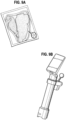
- an alternative version of the probe 130 can include a head 134 with an antenna 135, and a microcontroller 136 on the shaft 139, as well as a flexible portion 137 (pronounced of the joint in a bendable straw) for permitting the head 134 to lay flat on the protein after the probe 130 is inserted.
- the antenna 135 coil preferably comprises approximately 300 turns of @41 enameled wire with an OD of 40mm and an ID of roughly 30mm and a thickness of around 1mm. This iteration of coil can be placed (for instance) on either a microcontroller 136 such as a polyester flexi circuit or a very thin (0.1mm) FR4.
- a microcontroller 136 such as a polyester flexi circuit or a very thin (0.1mm) FR4.
- a microcontroller 236 that is preferably a very low power 32 bit microcontroller, a diode 236a and small capacitor 236b (for energy harvesting from the signals being received) and a plurality of thermal sensors 238 placed in a linear spaced-apart fashion, each being read upon every query from the interrogator 50-all cooperatively providing a thermal cross-section that includes surface and core temperatures to the querying device.
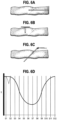
- FIGURES 6a-c Some of the advantages and uses of the probe is shown in FIGURES 6a-c . That is, the probe can be used by the interrogator 50 to determine the core temperature for cooking purposes without concern for precise placement of the probe within the body of the protein. This capability is enabled through the array of sensors 38, each of which has its own associated temperature. Such information, as shown in a prophetic example graphed in FIGURE 6d , is shown with each sensor corresponding to an "S" value on the graph.
- This data is processed by a controller (not shown) in the interrogator 50 whereby the inverse of the temperature (i.e., the coolest temperature) will be interpreted to be the "core" temperature for calculating the remaining time for cooking.
- the use of such data processing by the controller reduces a chef's workload from having to determine a protein type, thickness, starting temperature, shape, to merely requiring the chef know the type of protein involved.
- the present invention can, therefore, enable virtually automated cooking, avoiding the requirement for the cook to enter the type and shape of protein, the thickness, done-ness temperature, etc. with the only user input settings being: a) identification of foodstuff (i.e.: steak, chicken, carrots, etc.) and b) time past Pasteurization (otherwise known as” tenderness time”) because as a rule of thumb: connective tissues break-down during prolonged low-temperature cooking times and given sufficient cooking time: even the toughest proteins can become tender.
- the circulator 40 is of any standard type of circulator, heated bath, or temperature controlled bath known to be used in laboratory or cooking equipment, and is further electrically connected to a controller 50 or interrogator for taking the data from the probe to provide to a user.
- the interrogator 50 includes a microcontroller which (in the radio frequency embodiments) scans a band of frequencies (e.g., from about 300-400kHz) and then calibrates itself to the resonance of the interrogated probe, thus making the system auto-calibrating vis-a-vis "best" frequency.
- the circulator 40 further includes a multi loop metallic relay coil 42 disposed therein, wherein the coil 42 is in close proximity and communicates wirelessly with a reciprocal relay coil antenna 44 on adhesive 26.
- This coil may be coupled with the coil of the circulator 40.
- the circulator generates a very low frequency RFID signal that both powers the probe and receives data from the probe.
- the circulator in alternative embodiments, may be physically connected to the relay coil antenna 44 for providing only a single wireless connection to the probe 30.
- the probe 230 can include a multidimensional or 3D antenna 236 comprising multiple coils that define multiple planes for superior communication with the interrogator 50.
- the tank it may be possible for the tank to comprise just a single antenna loop 28 surrounding the tank 20.
- the probe array of the present invention may involve an infrared or light based probe 330.
- an infrared or light based probe 330 may involve an infrared or light based probe 330.
- a window of transparent material e.g., glass
- the probe 330 is preferably comprised of a transmitter 336 which is preferably a visible light or infrared light transmitter which sends very high frequency light signals (>700THz) to a transponder 352 such as a photo transistor/photo detector on the interrogator 350.
- a transmitter 336 which is preferably a visible light or infrared light transmitter which sends very high frequency light signals (>700THz) to a transponder 352 such as a photo transistor/photo detector on the interrogator 350.
- this embodiment of the probe 330 involves a first end 332 or tip and a second end 334 or head and a number of sensors 337 on the axis defined therebetween.
- the probe 330 is in a sealed pouch and the first end 332 is inserted in a foodstuff or protein such that only the second end 334 is exposed from the body of the protein but still within the confines of the sealed pouch.
- the second end 334 has an energy harvester 335 such as a solar cell, panel or PIN Photodiodes and a chip or microcontroller 338 attached thereto for communication with and receiving power supply from the either ambient light and/or a interrogator window 354 containing a light source (such a LED light) as well as the photo detector or transponder 352 on the interrogator 350.
- an energy harvester 335 such as a solar cell, panel or PIN Photodiodes and a chip or microcontroller 338 attached thereto for communication with and receiving power supply from the either ambient light and/or a interrogator window 354 containing a light source (such a LED light) as well as the photo detector or transponder 352 on the interrogator 350.
- the transponder 352 receives temperature related data from the chip 338 via the transmitter 336 which is sent preferably through a infrared signal, most preferably through a modulated IR signal using a carrier frequency, similar to a television remote control (though a visible light wavelength may be used as well).
- the signal can also be sent using infrared with a serial protocol similar to IRDA so as to avoid unwanted interference from other sources.
- the temperature data may be processed in essentially the same fashion as described with other embodiments above for processing in the control head 356 and providing information to the user via the user interface 358.
Landscapes
- Physics & Mathematics (AREA)
- General Physics & Mathematics (AREA)
- Arrangements For Transmission Of Measured Signals (AREA)
- Measuring Temperature Or Quantity Of Heat (AREA)
Applications Claiming Priority (3)
| Application Number | Priority Date | Filing Date | Title |
|---|---|---|---|
| US15/670,762 US20190041271A1 (en) | 2017-08-07 | 2017-08-07 | Method And Assembly For A Wireless Probe And Interrogator |
| EP18843489.8A EP3665455A4 (fr) | 2017-08-07 | 2018-08-06 | Procédé et ensemble pour une sonde sans fil et interrogateur |
| PCT/US2018/045376 WO2019032454A1 (fr) | 2017-08-07 | 2018-08-06 | Procédé et ensemble pour une sonde sans fil et interrogateur |
Related Parent Applications (1)
| Application Number | Title | Priority Date | Filing Date |
|---|---|---|---|
| EP18843489.8A Division EP3665455A4 (fr) | 2017-08-07 | 2018-08-06 | Procédé et ensemble pour une sonde sans fil et interrogateur |
Publications (2)
| Publication Number | Publication Date |
|---|---|
| EP4571278A2 true EP4571278A2 (fr) | 2025-06-18 |
| EP4571278A3 EP4571278A3 (fr) | 2025-08-27 |
Family
ID=65229406
Family Applications (2)
| Application Number | Title | Priority Date | Filing Date |
|---|---|---|---|
| EP25165423.2A Pending EP4571278A3 (fr) | 2017-08-07 | 2018-08-06 | Ensemble pour une sonde sans fil et interrogateur |
| EP18843489.8A Withdrawn EP3665455A4 (fr) | 2017-08-07 | 2018-08-06 | Procédé et ensemble pour une sonde sans fil et interrogateur |
Family Applications After (1)
| Application Number | Title | Priority Date | Filing Date |
|---|---|---|---|
| EP18843489.8A Withdrawn EP3665455A4 (fr) | 2017-08-07 | 2018-08-06 | Procédé et ensemble pour une sonde sans fil et interrogateur |
Country Status (4)
| Country | Link |
|---|---|
| US (1) | US20190041271A1 (fr) |
| EP (2) | EP4571278A3 (fr) |
| CN (1) | CN110998262A (fr) |
| WO (1) | WO2019032454A1 (fr) |
Families Citing this family (11)
| Publication number | Priority date | Publication date | Assignee | Title |
|---|---|---|---|---|
| US10883883B2 (en) * | 2018-02-13 | 2021-01-05 | Manford Development Limited | Wireless probe for food, and system and method for wireless food temperature real-time monitoring |
| CN112217291A (zh) * | 2019-07-11 | 2021-01-12 | 泰科电子(上海)有限公司 | 传感设备和包括其的电磁设备系统 |
| US11579019B2 (en) | 2019-08-15 | 2023-02-14 | Te Connectivity Solutions Gmbh | Wireless energy-harvesting sensor probe |
| EP4063810A1 (fr) * | 2021-03-22 | 2022-09-28 | Tyco Electronics (Shanghai) Co., Ltd. | Sonde de capteur de récupération d'énergie sans fil utilisant l'orientation de faisceau pour le prélèvement d'alimentation dans un four |
| EP4163610A1 (fr) * | 2021-10-05 | 2023-04-12 | Versuni Holding B.V. | Sonde et système de détection de température |
| CN114370953B (zh) * | 2021-12-29 | 2025-10-31 | 广东美的厨房电器制造有限公司 | 测温装置、终端及其控制方法、装置和可读存储介质 |
| EP4212840B1 (fr) * | 2022-01-17 | 2025-03-05 | Vorwerk & Co. Interholding GmbH | Système comprenant un dispositif de commande et un thermomètre alimentaire |
| US20230262128A1 (en) * | 2022-02-15 | 2023-08-17 | Saudi Arabian Oil Company | Intelligent environmental health device |
| TWM637469U (zh) * | 2022-09-07 | 2023-02-11 | 睿生光電股份有限公司 | 光偵測器 |
| WO2024187782A1 (fr) * | 2023-03-16 | 2024-09-19 | 珠海美佳音科技有限公司 | Thermomètre pour aliments, répéteur et ensemble thermomètre pour aliments |
| USD1101580S1 (en) | 2024-01-31 | 2025-11-11 | Sharkninja Operating Llc | Temperature probe holder |
Family Cites Families (13)
| Publication number | Priority date | Publication date | Assignee | Title |
|---|---|---|---|---|
| US4297557A (en) * | 1976-05-03 | 1981-10-27 | Robertshaw Controls Company | Microwave oven temperature indicator and control means |
| US6330091B1 (en) * | 1998-05-15 | 2001-12-11 | Universal Electronics Inc. | IR receiver using IR transmitting diode |
| US6538616B1 (en) * | 2001-12-18 | 2003-03-25 | The United States Of America As Represented By The National Security Agency | Cubic antenna |
| US20060045167A1 (en) * | 2004-08-27 | 2006-03-02 | Ivan Pawlenko | Self-contained temperature monitor |
| US20080043809A1 (en) * | 2006-08-18 | 2008-02-21 | Herbert Curtis B | Thermometer |
| ATE554347T1 (de) * | 2006-11-24 | 2012-05-15 | Electrolux Home Prod Corp | Verfahren und vorrichtung zur bestimmung der restzeit in einem garvorgang |
| CN105531571A (zh) * | 2013-05-14 | 2016-04-27 | W.C.布拉德利公司 | 冷点肉探头 |
| US9341518B2 (en) * | 2013-08-27 | 2016-05-17 | Innovative Control Technologies, LLC | Method and apparatus for remotely monitoring liquid food products |
| CN104218320B (zh) * | 2014-08-04 | 2017-03-22 | 中国传媒大学 | 一种3极化磁偶极子mimo天线系统 |
| CN105987772A (zh) * | 2015-02-15 | 2016-10-05 | 无锡汇尔科技有限公司 | 带有光能供电系统的开关柜测温装置 |
| US10429251B2 (en) * | 2015-09-30 | 2019-10-01 | Anova Applied Electronics, Inc. | Wireless temperature sensor for sous vide cooking |
| ES2572614B1 (es) * | 2016-01-22 | 2017-03-23 | Cata Corporación 2000, S.L. | Aparato y método de cocción |
| CN106821017A (zh) * | 2017-02-24 | 2017-06-13 | 广东美的厨房电器制造有限公司 | 温度探针、烹饪器具及加热控制方法 |
-
2017
- 2017-08-07 US US15/670,762 patent/US20190041271A1/en not_active Abandoned
-
2018
- 2018-08-06 EP EP25165423.2A patent/EP4571278A3/fr active Pending
- 2018-08-06 CN CN201880050397.1A patent/CN110998262A/zh active Pending
- 2018-08-06 EP EP18843489.8A patent/EP3665455A4/fr not_active Withdrawn
- 2018-08-06 WO PCT/US2018/045376 patent/WO2019032454A1/fr not_active Ceased
Also Published As
| Publication number | Publication date |
|---|---|
| EP4571278A3 (fr) | 2025-08-27 |
| US20190041271A1 (en) | 2019-02-07 |
| EP3665455A4 (fr) | 2021-04-28 |
| WO2019032454A1 (fr) | 2019-02-14 |
| EP3665455A1 (fr) | 2020-06-17 |
| CN110998262A (zh) | 2020-04-10 |
Similar Documents
| Publication | Publication Date | Title |
|---|---|---|
| EP4571278A2 (fr) | Ensemble pour une sonde sans fil et interrogateur | |
| US20240167885A1 (en) | Method and assembly for a wireless probe and interrogator | |
| EP3281494B1 (fr) | Ensemble de détection alimenté par micro-ondes pour fours à micro-ondes | |
| US11650105B2 (en) | Temperature probe systems and methods | |
| AU2017201994B2 (en) | A Temperature Detection Assembly and a Corresponding Lid for a Cooking Pot | |
| US7142114B2 (en) | Non-contact patient temperature measurement | |
| US20130305933A1 (en) | Electronic module for temperature-monitored preparation of food in a cooking vessel | |
| EP3166485A1 (fr) | Détecteur d'ondes électromagnétiques de 300 mhz à 3 thz permettant de déterminer un paramètre de liquide interstitiel in vivo | |
| EP3527042B1 (fr) | Ensemble capteur pour une enceinte de cuisson d'un four à micro-ondes et procédé de contrôle de la consommation d'énergie d'un tel ensemble capteur | |
| EP3764069B1 (fr) | Dispositif de détection et système de dispositif électromagnétique le comprenant | |
| US20110089162A1 (en) | Induction-Based Heating Appliances Employing Long Wave Magnetic Communication | |
| US10765132B2 (en) | Systems and methods for utilizing a sonication probe to cook rice | |
| US20240004408A1 (en) | System for recording a physical property and cooker hood | |
| US20200182703A1 (en) | Methods, Devices, and Systems for Monitoring Temperatures | |
| JP6184448B2 (ja) | 成分検知装置 | |
| RU2808057C1 (ru) | Зонд и система измерения температуры | |
| CN208206338U (zh) | 用于电烹饪器具的温度测量设备及电烹饪器具 | |
| HK1187506A (en) | Electronic module for temperature-monitored preparation of food in a cooking vessel |
Legal Events
| Date | Code | Title | Description |
|---|---|---|---|
| PUAI | Public reference made under article 153(3) epc to a published international application that has entered the european phase |
Free format text: ORIGINAL CODE: 0009012 |
|
| STAA | Information on the status of an ep patent application or granted ep patent |
Free format text: STATUS: THE APPLICATION HAS BEEN PUBLISHED |
|
| AC | Divisional application: reference to earlier application |
Ref document number: 3665455 Country of ref document: EP Kind code of ref document: P |
|
| AK | Designated contracting states |
Kind code of ref document: A2 Designated state(s): AL AT BE BG CH CY CZ DE DK EE ES FI FR GB GR HR HU IE IS IT LI LT LU LV MC MK MT NL NO PL PT RO RS SE SI SK SM TR |
|
| PUAL | Search report despatched |
Free format text: ORIGINAL CODE: 0009013 |
|
| AK | Designated contracting states |
Kind code of ref document: A3 Designated state(s): AL AT BE BG CH CY CZ DE DK EE ES FI FR GB GR HR HU IE IS IT LI LT LU LV MC MK MT NL NO PL PT RO RS SE SI SK SM TR |
|
| RIC1 | Information provided on ipc code assigned before grant |
Ipc: G01K 1/02 20210101AFI20250722BHEP |
|
| STAA | Information on the status of an ep patent application or granted ep patent |
Free format text: STATUS: REQUEST FOR EXAMINATION WAS MADE |
|
| 17P | Request for examination filed |
Effective date: 20260227 |