EP4571336A1 - Vorrichtung und verfahren zur schätzung des batterie-soh - Google Patents
Vorrichtung und verfahren zur schätzung des batterie-soh Download PDFInfo
- Publication number
- EP4571336A1 EP4571336A1 EP23886187.6A EP23886187A EP4571336A1 EP 4571336 A1 EP4571336 A1 EP 4571336A1 EP 23886187 A EP23886187 A EP 23886187A EP 4571336 A1 EP4571336 A1 EP 4571336A1
- Authority
- EP
- European Patent Office
- Prior art keywords
- battery
- soh
- information
- deterioration
- control unit
- Prior art date
- Legal status (The legal status is an assumption and is not a legal conclusion. Google has not performed a legal analysis and makes no representation as to the accuracy of the status listed.)
- Pending
Links
Images



Classifications
-
- G—PHYSICS
- G01—MEASURING; TESTING
- G01R—MEASURING ELECTRIC VARIABLES; MEASURING MAGNETIC VARIABLES
- G01R31/00—Arrangements for testing electric properties; Arrangements for locating electric faults; Arrangements for electrical testing characterised by what is being tested not provided for elsewhere
- G01R31/36—Arrangements for testing, measuring or monitoring the electrical condition of accumulators or electric batteries, e.g. capacity or state of charge [SoC]
- G01R31/367—Software therefor, e.g. for battery testing using modelling or look-up tables
-
- G—PHYSICS
- G01—MEASURING; TESTING
- G01R—MEASURING ELECTRIC VARIABLES; MEASURING MAGNETIC VARIABLES
- G01R31/00—Arrangements for testing electric properties; Arrangements for locating electric faults; Arrangements for electrical testing characterised by what is being tested not provided for elsewhere
- G01R31/36—Arrangements for testing, measuring or monitoring the electrical condition of accumulators or electric batteries, e.g. capacity or state of charge [SoC]
- G01R31/392—Determining battery ageing or deterioration, e.g. state of health
-
- G—PHYSICS
- G01—MEASURING; TESTING
- G01R—MEASURING ELECTRIC VARIABLES; MEASURING MAGNETIC VARIABLES
- G01R31/00—Arrangements for testing electric properties; Arrangements for locating electric faults; Arrangements for electrical testing characterised by what is being tested not provided for elsewhere
- G01R31/36—Arrangements for testing, measuring or monitoring the electrical condition of accumulators or electric batteries, e.g. capacity or state of charge [SoC]
- G01R31/3644—Constructional arrangements
- G01R31/3648—Constructional arrangements comprising digital calculation means, e.g. for performing an algorithm
-
- H—ELECTRICITY
- H01—ELECTRIC ELEMENTS
- H01M—PROCESSES OR MEANS, e.g. BATTERIES, FOR THE DIRECT CONVERSION OF CHEMICAL ENERGY INTO ELECTRICAL ENERGY
- H01M10/00—Secondary cells; Manufacture thereof
- H01M10/42—Methods or arrangements for servicing or maintenance of secondary cells or secondary half-cells
-
- H—ELECTRICITY
- H01—ELECTRIC ELEMENTS
- H01M—PROCESSES OR MEANS, e.g. BATTERIES, FOR THE DIRECT CONVERSION OF CHEMICAL ENERGY INTO ELECTRICAL ENERGY
- H01M10/00—Secondary cells; Manufacture thereof
- H01M10/42—Methods or arrangements for servicing or maintenance of secondary cells or secondary half-cells
- H01M10/48—Accumulators combined with arrangements for measuring, testing or indicating the condition of cells, e.g. the level or density of the electrolyte
-
- H—ELECTRICITY
- H01—ELECTRIC ELEMENTS
- H01M—PROCESSES OR MEANS, e.g. BATTERIES, FOR THE DIRECT CONVERSION OF CHEMICAL ENERGY INTO ELECTRICAL ENERGY
- H01M10/00—Secondary cells; Manufacture thereof
- H01M10/42—Methods or arrangements for servicing or maintenance of secondary cells or secondary half-cells
- H01M10/48—Accumulators combined with arrangements for measuring, testing or indicating the condition of cells, e.g. the level or density of the electrolyte
- H01M10/486—Accumulators combined with arrangements for measuring, testing or indicating the condition of cells, e.g. the level or density of the electrolyte for measuring temperature
-
- Y—GENERAL TAGGING OF NEW TECHNOLOGICAL DEVELOPMENTS; GENERAL TAGGING OF CROSS-SECTIONAL TECHNOLOGIES SPANNING OVER SEVERAL SECTIONS OF THE IPC; TECHNICAL SUBJECTS COVERED BY FORMER USPC CROSS-REFERENCE ART COLLECTIONS [XRACs] AND DIGESTS
- Y02—TECHNOLOGIES OR APPLICATIONS FOR MITIGATION OR ADAPTATION AGAINST CLIMATE CHANGE
- Y02E—REDUCTION OF GREENHOUSE GAS [GHG] EMISSIONS, RELATED TO ENERGY GENERATION, TRANSMISSION OR DISTRIBUTION
- Y02E60/00—Enabling technologies; Technologies with a potential or indirect contribution to GHG emissions mitigation
- Y02E60/10—Energy storage using batteries
Definitions
- the present disclosure relates to a battery SOH estimating apparatus and method, and more particularly, to a battery SOH estimating apparatus and method capable of effectively estimating a SOH of a battery.
- Batteries commercially available at present include nickel-cadmium batteries, nickel hydrogen batteries, nickel-zinc batteries, lithium batteries and the like.
- the lithium batteries are in the limelight since they have almost no memory effect compared to nickel-based batteries and also have very low self-discharging rate and high energy density.
- a representative technique is to estimate the degree of deterioration of the battery by estimating SOH (state of health) based on capacity deterioration, based on the OCV (open circuit voltage) of the battery.
- SOH state of health
- OCV open circuit voltage
- this conventional technique estimates the degree of deterioration of the battery through comparison between the initial capacity of the battery and the current capacity, but there is a limit in obtaining information about what factors cause battery deterioration. For example, since battery deterioration may be affected by non-linear factors such as negative electrode side reaction, positive electrode side reaction, and transition metal dissolution, it is difficult to identify the deterioration factors using the conventional technique of estimating the degree of deterioration estimation.
- the residual value of the battery may vary depending on factors affecting the degree of deterioration.
- the present disclosure is designed to solve the problems of the related art, and therefore the present disclosure is directed to providing a battery SOH estimating apparatus and method that may estimate the state of a battery by considering various factors that affect deterioration of the battery.
- a battery SOH estimating apparatus may comprise a battery information obtaining unit configured to obtain battery information including at least one of voltage, current, temperature, and SOC; and a control unit configured to calculate deterioration information for the battery from the battery information and preset reference information based on a preset deterioration model, and estimate SOH for the battery from the deterioration information based on a preset non-linear estimation model.
- the control unit may be configured to estimate a reference SOH from the battery information based on a preset linear estimation model and set the reference information based on the SOH and the reference SOH.
- the control unit may be configured to calculate a weight based on the SOH and the reference SOH, and set the value obtained by adding the weight to the deterioration information as the reference information.
- the non-linear estimation model may be configured using a non-linear Kalman filter.
- the linear estimation model may be configured using a linear Kalman filter.
- the control unit may be configured to calculate a Kalman gain based on the SOH and the reference SOH as the weight, and set the value obtained by adding the Kalman gain to the deterioration information as the reference information.
- the control unit may be configured to update the reference information based on the deterioration information, the SOH, and the reference SOH each time the SOH is estimated.
- control unit When calculating the deterioration information for the first time, the control unit may be configured to set a criterion value preset to correspond to the deterioration information of the battery in a BOL state as the reference information.
- the control unit may be configured to calculate at least one of a negative electrode side reaction amount, a positive electrode side reaction amount, and a transition metal dissolution amount as the deterioration information.
- a battery pack according to another aspect of the present disclosure may comprise the battery SOH estimating apparatus according to an aspect of the present disclosure.
- a server may comprise the battery SOH estimating apparatus according to an aspect of the present disclosure.
- a battery SOH estimating method may comprise: a battery information obtaining step of obtaining battery information including at least one of voltage, current, temperature, and SOC; a deterioration information calculating step of calculating deterioration information for the battery from the battery information and preset reference information based on a preset deterioration model; and a SOH estimating step of estimating SOH for the battery from the deterioration information based on a preset non-linear estimation model.
- a battery SOH estimating method may further comprise: a reference SOH estimating step of estimating a reference SOH from the battery information based on a preset linear estimation model, after the SOH estimating step; and a reference information setting step of setting the reference information based on the SOH and the reference SOH.
- the SOH of the battery may be estimated based on various factors that affect the deterioration of the battery.
- the SOH of the battery may be estimated based on non-linear information about the battery.
- FIG. 1 is a diagram schematically showing a battery SOH estimating apparatus 100 according to an embodiment of the present disclosure.
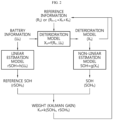
- FIG. 2 is a diagram schematically showing the operation configuration of the battery SOH estimating apparatus 100 to estimate SOH of a battery according to an embodiment of the present disclosure.
- the battery refers to one physically separable independent cell having a negative electrode terminal and a positive electrode terminal.
- a lithium-ion battery or a lithium polymer cell may be regarded as the battery.
- the battery may refer to a battery module or a battery pack in which a plurality of cells are connected in series and/or in parallel.
- the battery will be described as meaning one independent cell.
- the battery SOH estimating apparatus 100 may include a battery information obtaining unit 110 and a control unit 120.
- the battery information obtaining unit 110 may be configured to obtain battery information including at least one of voltage, current, temperature, and SOC (state of charge).
- the voltage, current, and temperature may be information measured from the battery, and the SOC may be information estimated based on the measured information.
- the battery information obtaining unit 110 may receive and obtain battery information periodically or aperiodically.
- the battery information obtaining unit 110 may directly measure the voltage, current, and temperature of the battery periodically or aperiodically and estimate SOC based on the measured information.
- the control unit 120 may be configured to calculate deterioration information about the battery from the battery information and preset reference information based on a preset deterioration model.
- the deterioration information is information that may be calculated based on the battery information and the preset reference information, and may include information that may indicate a state of the battery that is changed electrochemically as the battery is deteriorated.
- the deterioration information may include information that may quantitatively indicate a state change between a battery in a BOL (Beginning of Life) state and the current battery.
- control unit 120 may be configured to calculate at least one of a negative electrode side reaction amount, a positive electrode side reaction amount, and a transition metal dissolution amount as the deterioration information.
- the deterioration model may include a first model for calculating the negative electrode side reaction amount, a second model for calculating the positive electrode side reaction amount, and a third model for calculating the transition metal dissolution amount.
- the negative electrode side reaction amount may be the amount of side reaction generated when the negative electrode is reduced.
- side reactions that may occur due to reduction of the negative electrode include electrolyte decomposition or the like in a graphite-based metal.
- the control unit 120 may be configured to calculate the negative electrode side reaction amount of the battery from the battery information and the reference information using the first model. That is, the control unit may calculate an electrolyte decomposition amount (i.e., negative electrode side reaction amount) in the graphite material metal using the battery information and the reference information.
- the positive electrode side reaction amount may be the amount of side reaction generated when the positive electrode is oxygenated.
- side reactions that may occur due to reduction of the positive electrode include electrolyte decomposition or the like in NCM (Ni, Co, Mn) materials.
- the control unit 120 may be configured to calculate the positive electrode side reaction amount of the battery from the battery information and the reference information using the second model. That is, the control unit may calculate the electrolyte decomposition amount (i.e., positive electrode side reaction amount) in the NCM material using the battery information and the reference information.
- the transition metal dissolution amount may be the amount of dissolved transition metal.
- the transition metal dissolution amount may mean the amount of precipitation of lithium metal.
- the control unit 120 may be configured to calculate the transition metal dissolution amount of the battery from the battery information and the reference information using the third model. That is, the control unit may calculate the lithium metal precipitation amount (i.e., transition metal dissolution amount) using the battery information and the reference information.
- the reference information may be information corresponding to the deterioration information.
- the reference information may be a preset criterion value or a correction value of previously calculated deterioration information. A detailed description of the reference information will be described later.
- n means a time point and is assumed to have a value of 1 or more.
- the control unit 120 may input battery information (U n ) and reference information (R n ) into the deterioration model.
- the control unit 120 may calculate deterioration information (X n ) from the battery information (U n ) and the reference information (R n ) using a deterioration model.
- a number of reference information corresponding to the number of deterioration information may be input to the deterioration model. That is, the reference information may be set in advance to correspond to the deterioration information to be output from the deterioration model.
- the deterioration information output through the deterioration model includes a negative electrode side reaction amount, a positive electrode side reaction amount, and a transition metal dissolution amount
- each reference information corresponding to the negative electrode side reaction amount, the positive electrode side reaction amount, and the transition metal dissolution amount may be input into the deterioration model.
- the control unit 120 may be configured to estimate the SOH for the battery from the deterioration information based on a preset non-linear estimation model.
- the non-linear estimation model may be configured using a non-linear Kalman filter.
- the non-linear estimation model may be a non-linear Kalman filter such as an extended Kalman filter (EKF) or a sigma point Kalman filter (SPKF).
- EKF extended Kalman filter
- SPKF sigma point Kalman filter
- control unit 120 may estimate the SOH of the battery by inputting deterioration information calculated using the deterioration model into a non-linear estimation model. That is, the control unit 120 may estimate the battery SOH using the non-linear estimation model in order to estimate the battery SOH by considering the non-linearity of the deterioration information.
- the control unit 120 may input deterioration information (X n ) into the non-linear estimation model.
- the control unit 120 may estimate the SOH (SOH n ) of the battery from the deterioration information (X n ) using the non-linear estimation model.
- batteries may be deteriorated due to various factors, and the main deterioration pattern may also appear differently for each battery.
- the first battery may have a negative electrode side reaction as the main deterioration pattern
- the second battery may have a positive electrode side reaction as the main deterioration pattern.
- the deterioration information of the battery may be non-linear information.
- the battery SOH estimating apparatus 100 has the advantage of calculating deterioration information closely related to the degree of deterioration of the battery from the battery information and estimating the SOH of the battery considering the non-linearity of the calculated deterioration information. That is, because the SOH estimated by the battery SOH estimating apparatus 100 is estimated based on non-linear deterioration information, it may better represent the current state of the battery than the SOH estimated directly from the battery information.
- control unit 120 included in the battery SOH estimating apparatus may optionally include processors, application-specific integrated circuits (ASICs), other chipsets, logic circuits, registers, communication modems, data processing devices, etc. known in the art to execute various control logics performed in the present disclosure.
- control logic when the control logic is implemented as software, the control unit 120 may be implemented as a set of program modules.
- the program module may be stored in the memory and executed by the control unit 120.
- the memory may be inside or outside the control unit 120 and may be connected to the control unit 120 by various well-known means.
- the battery SOH estimating apparatus 100 may further include a storage unit 130.
- the storage unit 130 may store data necessary for operation and function of each component of the battery SOH estimating apparatus 100, data generated in the process of performing the operation or function, or the like.
- the storage unit 130 is not particularly limited in its kind as long as it is a known information storage means that can record, erase, update and read data.
- the information storage means may include RAM, flash memory, ROM, EEPROM, registers, and the like.
- the storage unit 130 may store program codes in which processes executable by the control unit 120 are defined.
- the storage unit 130 may store the battery information obtained by the battery information obtaining unit 110. Additionally, the storage unit 130 may store the deterioration information, the reference information, the SOH, and the reference SOH calculated by the control unit 120.
- control unit 120 sets reference information
- the control unit 120 may be configured to estimate a reference SOH from the battery information based on a preset linear estimation model.
- the linear estimation model may be configured using a linear Kalman filter.
- the linear estimation model may be a linear Kalman filter such as a Kalman filter (KF).
- KF Kalman filter
- the control unit 120 may input battery information (U n ) into the linear estimation model.
- the control unit 120 may estimate the reference SOH (rSOH n ) of the battery from the battery information (U n ) using the linear estimation model.
- the reference SOH (rSOH n ) is a value calculated from the battery information (U n ) using a linear estimation model
- the SOH (SOH n ) is a value calculated from the deterioration information (X n ) using a non-linear estimation model.
- the reference SOH (rSOH n ) and the SOH (SOH n ) have a difference in terms of the factors to be considered (battery information and deterioration information), the nature of the factors to be considered (linearity and non-linearity), and the type of estimation models (linear estimation model and non-linear estimation model).
- control unit 120 may be configured to set reference information based on the SOH and the reference SOH.
- the reference information may be a preset criterion value or a correction value of previously calculated deterioration information.
- the reference information may be R 1 or R n+1 .
- control unit 120 may be configured to set a criterion value preset to correspond to the deterioration information of the battery in the BOL state as the reference information.
- R 1 may represent a criterion value preset to correspond to the deterioration information of the battery in the BOL state.
- the preset criterion value (R 1 ) may be input to the deterioration model as the reference information.
- control unit 120 may be configured to update the reference information based on the deterioration information, the SOH, and the reference SOH each time the SOH is estimated.
- the reference information calculated at a previous time point may be used to calculate deterioration information at a next time point. In other words, the reference information may be used to calculate deterioration information at the next time point through a recursive structure.
- control unit 120 may be configured to calculate a weight based on the SOH and the reference SOH.
- the control unit 120 may be configured to set a value obtained by adding the weight to the deterioration information as the reference information.
- the control unit 120 may be configured to calculate a Kalman gain based on the SOH and the reference SOH as the weight. Additionally, the control unit 120 may be configured to set a value obtained by adding the Kalman gain to the deterioration information as the reference information.
- the Kalman gain may be calculated based on the SOH calculated from the non-linear Kalman filter and the reference SOH calculated from the linear Kalman filter. That is, the Kalman gain may be calculated based on the SOH and the reference SOH obtained from different estimation models. Also, the reference information may be updated by adding the Kalman gain calculated in this way to the deterioration information.
- the battery SOH estimating apparatus 100 may update the reference information for calculating the deterioration information each time the SOH of the battery is estimated. That is, since the battery SOH estimating apparatus 100 not only updates the reference information to correspond to the current state of the battery, but also estimates the SOH of the battery using the updated reference information, the SOH of the battery may be estimated with high accuracy.
- the battery SOH estimating apparatus 100 may be applied to a battery management system (BMS). That is, the BMS according to the present disclosure may include the battery SOH estimating apparatus 100 described above. In this configuration, at least some of components of the battery SOH estimating apparatus 100 may be implemented by supplementing or adding functions of the components included in a conventional BMS. For example, the battery information obtaining unit 110, the control unit 120 and the storage unit 130 of the battery SOH estimating apparatus 100 may be implemented as components of the BMS.
- the battery SOH estimating apparatus 100 may be provided to a battery pack. That is, the battery pack according to the present disclosure may include the above-described battery SOH estimating apparatus 100 and one or more battery cells. In addition, the battery pack may further include electrical components (a relay, a fuse and the like) and a case.
- FIG. 3 is a diagram schematically showing a battery pack according to still another embodiment of the present disclosure.
- the positive electrode terminal of the battery 31 may be connected to the positive electrode terminal P+ of the battery pack 3, and the negative electrode terminal of the battery 31 may be connected to the negative electrode terminal P- of the battery pack 3.
- the measuring unit 32 may be connected to the first sensing line SL1, the second sensing line SL2, the third sensing line SL3 and the fourth sensing line SL4.
- the measuring unit 32 may be connected to the positive electrode terminal of the battery 31 through the first sensing line SL1, and may be connected to the negative electrode terminal of the battery 31 through the second sensing line SL2.
- the measuring unit 32 may measure the voltage of the battery 31 based on the voltage measured at each of the first sensing line SL1 and the second sensing line SL2.
- the measuring unit 32 may be connected to the current measuring unit A through the third sensing line SL3.
- the current measuring unit A may be an ammeter or a shunt resistor capable of measuring the charging current and the discharging current of the battery 31.
- the measuring unit 32 may calculate the charge amount by measuring the charging current of the battery 31 through the third sensing line SL3. Also, the measuring unit 32 may calculate the discharge amount by measuring the discharging current of the battery 31 through the third sensing line SL3.
- the measuring unit 32 may measure the temperature of the battery 31 through the fourth sensing line SL4.
- An external device may be connected to the positive electrode terminal P+ and the negative electrode terminal P- of the battery pack 3.
- the external device may be a charging device or a load that receives power from the battery 31.
- the battery information obtaining unit 110 may obtain battery information about the voltage, current, and temperature of the battery 31 from the measuring unit 32. Additionally, the measuring unit 32 may estimate the SOC of the battery 31 based on the measured information and transmit the estimated SOC to the battery information obtaining unit 110.
- the battery information obtaining unit 110 may be directly connected to the first to fourth sensing lines SL1, SL2, SL3, SL4 to directly measure the voltage, current, and temperature of the battery 31.
- the battery information obtaining unit 110 may directly estimate the SOC of the battery 31 based on the measured information.
- FIG. 4 is a diagram schematically showing a battery system according to still another embodiment of the present disclosure.
- the battery system may include at least one BMS 42 and a server 41.
- the server 41 may include the battery SOH estimating apparatus 100.
- the server 41 may be a cloud server.
- the server 41 may be connected to communicate with at least one BMS 42.
- the server 41 may be connected to the BMS 42 to enable wired and/or wireless communication.
- Each BMS 42 may collect battery information of the connected battery and transmit the collected battery information to the server 41. Afterwards, the server 41 may estimate the SOH of the battery connected to each BMS 42 based on the received battery information.
- each BMS 42 is a BMS provided in a different vehicle.
- the first BMS 42_1, the second BMS 42_2, and the n th BMS (42_n) may each collect battery information about the corresponding battery and transmit the collected battery information to the server 41 through wireless communication.
- the server 41 may estimate the SOH of the first battery included in a first vehicle corresponding to the first BMS 42_1 based on the battery information received from the first BMS 42_1.
- the server 41 may estimate the SOH of the second battery included in a second vehicle corresponding to the second BMS 42_2 based on the battery information received from the second BMS 42_2.
- the server 41 may estimate the SOH of the n th battery included in an n th vehicle corresponding to the n th BMS 42_n based on the battery information received from the n th BMS 42_n.
- FIGS. 5 and 6 are diagrams schematically showing a battery SOH estimating method according to still another embodiment of the present disclosure.
- each step of the battery SOH estimating method may be performed by the battery SOH estimating apparatus 100.
- the content overlapping with the previously described content will be omitted or briefly described.
- the battery SOH estimating method may include a battery information obtaining step (S100), a deterioration information calculating step (S200), and a SOH estimating step (S300).
- the battery information obtaining step (S100) is a step of obtaining battery information including at least one of voltage, current, temperature, and SOC, and may be performed by the battery information obtaining unit 110.
- the battery information obtaining unit 110 may obtain the battery information by receiving it through a communication network.
- the battery information obtaining unit 110 may directly measure and estimate battery information.
- the deterioration information calculating step (S200) is a step of calculating deterioration information for the battery from the battery information and preset reference information based on a preset deterioration model, and may be performed by the control unit 120.
- control unit 120 may calculate the deterioration information about the battery by inputting the battery information and the reference information into a preset deterioration model.
- the deterioration information may include information that may quantitatively compare and determine the degree of deterioration of the battery, such as a negative electrode side reaction amount, a positive electrode side reaction amount, and a transition metal dissolution amount.
- the SOH estimating step (S300) is a step of estimating SOH for the battery from the deterioration information based on a preset non-linear estimation model, and may be performed by the control unit 120.
- control unit 120 may estimate the SOH for the battery by inputting the deterioration information into a preset non-linear estimation model.
- the non-linear estimation model may be a model preset to estimate the SOH of the battery from the deterioration information with non-linearity.
- the non-linear estimation model may be a non-linear Kalman filter such as EKF or SPKF.
- the battery SOH estimating method may further include a reference SOH estimating step (S400) and a reference information setting step (S500).
- the reference SOH estimating step (S400) is a step of estimating a reference SOH from the battery information based on a preset linear estimation model after the SOH estimating step (S300), and may be performed by the control unit 120.
- control unit 120 may estimate the reference SOH for the battery by inputting the battery information into a linear estimation model.
- the linear estimation model may be a model preset to estimate the reference SOH of the battery from the battery information having linearity.
- the linear estimation model may be a linear Kalman filter such as KF.
- the reference information setting step (S500) is a step of setting reference information based on the SOH and the reference SOH, and may be performed by the control unit 120.
- control unit 120 may calculate a Kalman gain between the estimated SOH and the estimated reference SOH. Additionally, the control unit 120 may set reference information by adding the Kalman gain to the deterioration information. The reference information set in this way may be used to calculate the deterioration information of the battery at the next time point. In other words, the reference information set at the current time point may be input into the deterioration model at the next time point.
- the embodiments of the present disclosure described above may not be implemented only through an apparatus and method, but may be implemented through a program that realizes a function corresponding to the configuration of the embodiments of the present disclosure or a recording medium on which the program is recorded.
- the program or recording medium may be easily implemented by those skilled in the art from the above description of the embodiments.
Landscapes
- Physics & Mathematics (AREA)
- General Physics & Mathematics (AREA)
- Engineering & Computer Science (AREA)
- Manufacturing & Machinery (AREA)
- Chemical & Material Sciences (AREA)
- Chemical Kinetics & Catalysis (AREA)
- Electrochemistry (AREA)
- General Chemical & Material Sciences (AREA)
- Secondary Cells (AREA)
- Tests Of Electric Status Of Batteries (AREA)
Applications Claiming Priority (2)
| Application Number | Priority Date | Filing Date | Title |
|---|---|---|---|
| KR1020220142745A KR102960363B1 (ko) | 2022-10-31 | 배터리 soh 추정 장치 및 방법 | |
| PCT/KR2023/017033 WO2024096491A1 (ko) | 2022-10-31 | 2023-10-30 | 배터리 soh 추정 장치 및 방법 |
Publications (2)
| Publication Number | Publication Date |
|---|---|
| EP4571336A1 true EP4571336A1 (de) | 2025-06-18 |
| EP4571336A4 EP4571336A4 (de) | 2025-12-31 |
Family
ID=90930980
Family Applications (1)
| Application Number | Title | Priority Date | Filing Date |
|---|---|---|---|
| EP23886187.6A Pending EP4571336A4 (de) | 2022-10-31 | 2023-10-30 | Vorrichtung und verfahren zur schätzung des batterie-soh |
Country Status (4)
| Country | Link |
|---|---|
| EP (1) | EP4571336A4 (de) |
| JP (1) | JP2026503878A (de) |
| CN (1) | CN119213324A (de) |
| WO (1) | WO2024096491A1 (de) |
Family Cites Families (9)
| Publication number | Priority date | Publication date | Assignee | Title |
|---|---|---|---|---|
| AT512003A3 (de) * | 2013-01-23 | 2014-05-15 | Avl List Gmbh | Verfahren zur Ermittlung eines regelungstechnischen Beobachters für den SoC |
| WO2019053557A1 (ja) * | 2017-09-14 | 2019-03-21 | 株式会社半導体エネルギー研究所 | 二次電池の異常検知システム及び二次電池の異常検出方法 |
| CN111656643B (zh) * | 2017-12-07 | 2024-11-15 | 雅扎米Ip私人有限公司 | 用于对电池快速充电的自适应充电协议和实现该协议的快速充电系统 |
| KR102771102B1 (ko) * | 2018-11-15 | 2025-02-20 | 주식회사 엘지에너지솔루션 | 배터리 soh 산출 시스템 및 방법 |
| US11899069B2 (en) * | 2018-12-21 | 2024-02-13 | Cummins Inc. | SOC and SOH co-estimation systems and methods for electric vehicles |
| EP3736587B1 (de) * | 2019-05-08 | 2023-11-01 | Tata Consultancy Services Limited | Verfahren und system zur abschätzung der restnutzungsdauer von lithiumbatterien |
| KR102818308B1 (ko) * | 2019-07-29 | 2025-06-10 | 주식회사 엘지에너지솔루션 | 배터리 관리 장치 및 배터리 관리 방법 |
| CN112305440B (zh) * | 2020-09-27 | 2024-05-14 | 精进电动科技股份有限公司 | 一种电池剩余电量和健康状态联合估计方法 |
| KR102467790B1 (ko) | 2021-04-15 | 2022-11-16 | 에쓰대시오일 주식회사 | 고충격 폴리프로필렌 수지 조성물 및 이에 의해 제조된 성형품 |
-
2023
- 2023-10-30 EP EP23886187.6A patent/EP4571336A4/de active Pending
- 2023-10-30 WO PCT/KR2023/017033 patent/WO2024096491A1/ko not_active Ceased
- 2023-10-30 JP JP2025525000A patent/JP2026503878A/ja active Pending
- 2023-10-30 CN CN202380040323.0A patent/CN119213324A/zh active Pending
Also Published As
| Publication number | Publication date |
|---|---|
| KR20240061261A (ko) | 2024-05-08 |
| EP4571336A4 (de) | 2025-12-31 |
| CN119213324A (zh) | 2024-12-27 |
| JP2026503878A (ja) | 2026-02-02 |
| WO2024096491A1 (ko) | 2024-05-10 |
Similar Documents
| Publication | Publication Date | Title |
|---|---|---|
| EP4131571B1 (de) | Batterieverwaltungsvorrichtung und -verfahren | |
| CN115516695B (zh) | 电池管理装置、电池组及电池管理方法 | |
| EP4198537A1 (de) | Vorrichtung und verfahren zur schätzung des batterie-soh | |
| EP4199182B1 (de) | Batteriediagnosevorrichtung und -verfahren | |
| EP3674730A1 (de) | Vorrichtung und verfahren zur batteriediagnose | |
| EP3611525A1 (de) | Vorrichtung zur kalkulation der batteriereservekapazität | |
| EP4198536A1 (de) | Batterieverwaltungsvorrichtung und -verfahren | |
| EP4376161A1 (de) | Vorrichtung und verfahren zur verwaltung einer batterie | |
| EP3998489B1 (de) | Vorrichtung und verfahren zur dod diagnose einer batterie | |
| EP3992649B1 (de) | Vorrichtung und verfahren zur einstellung von batterieparametern | |
| EP3637120B1 (de) | Vorrichtung und verfahren zur schätzung des ladezustandes (soc) einer batterie | |
| EP4481416A1 (de) | Vorrichtung und verfahren zur schätzung des gesundheitszustands einer batterie | |
| CN115667957B (zh) | 电池管理设备、电池检测装置及电池管理方法 | |
| EP4141461A1 (de) | Vorrichtung, verfahren und system zur batteriediagnose | |
| EP4382935A1 (de) | Batterieverwaltungsvorrichtung und -verfahren | |
| EP4571336A1 (de) | Vorrichtung und verfahren zur schätzung des batterie-soh | |
| KR20220134391A (ko) | 배터리 진단 장치 및 방법 | |
| EP4549972A1 (de) | Vorrichtung und verfahren zur schätzung des gesundheitszustands einer batterie | |
| EP4318005B1 (de) | Vorrichtung und verfahren zur schätzung des batteriezustands | |
| EP4191747A1 (de) | Vorrichtung und verfahren zur detektion von lithiumfällung | |
| KR102960363B1 (ko) | 배터리 soh 추정 장치 및 방법 | |
| EP4556924A1 (de) | Vorrichtung und verfahren zur verwaltung einer batterie |
Legal Events
| Date | Code | Title | Description |
|---|---|---|---|
| STAA | Information on the status of an ep patent application or granted ep patent |
Free format text: STATUS: THE INTERNATIONAL PUBLICATION HAS BEEN MADE |
|
| PUAI | Public reference made under article 153(3) epc to a published international application that has entered the european phase |
Free format text: ORIGINAL CODE: 0009012 |
|
| STAA | Information on the status of an ep patent application or granted ep patent |
Free format text: STATUS: REQUEST FOR EXAMINATION WAS MADE |
|
| 17P | Request for examination filed |
Effective date: 20250312 |
|
| AK | Designated contracting states |
Kind code of ref document: A1 Designated state(s): AL AT BE BG CH CY CZ DE DK EE ES FI FR GB GR HR HU IE IS IT LI LT LU LV MC ME MK MT NL NO PL PT RO RS SE SI SK SM TR |
|
| A4 | Supplementary search report drawn up and despatched |
Effective date: 20251203 |
|
| RIC1 | Information provided on ipc code assigned before grant |
Ipc: G01R 31/367 20190101AFI20251127BHEP Ipc: G01R 31/392 20190101ALI20251127BHEP Ipc: G01R 31/36 20200101ALI20251127BHEP Ipc: H01M 10/48 20060101ALI20251127BHEP |
|
| DAV | Request for validation of the european patent (deleted) | ||
| DAX | Request for extension of the european patent (deleted) |