EP4571665A2 - Modèle linéaire multi-personnes en peau - Google Patents
Modèle linéaire multi-personnes en peau Download PDFInfo
- Publication number
- EP4571665A2 EP4571665A2 EP25153835.1A EP25153835A EP4571665A2 EP 4571665 A2 EP4571665 A2 EP 4571665A2 EP 25153835 A EP25153835 A EP 25153835A EP 4571665 A2 EP4571665 A2 EP 4571665A2
- Authority
- EP
- European Patent Office
- Prior art keywords
- pose
- shape
- blend
- dependent
- model
- Prior art date
- Legal status (The legal status is an assumption and is not a legal conclusion. Google has not performed a legal analysis and makes no representation as to the accuracy of the status listed.)
- Pending
Links
Images






Classifications
-
- G—PHYSICS
- G06—COMPUTING OR CALCULATING; COUNTING
- G06T—IMAGE DATA PROCESSING OR GENERATION, IN GENERAL
- G06T13/00—Animation
- G06T13/20—Three-dimensional [3D] animation
- G06T13/40—Three-dimensional [3D] animation of characters, e.g. humans, animals or virtual beings
-
- G—PHYSICS
- G06—COMPUTING OR CALCULATING; COUNTING
- G06T—IMAGE DATA PROCESSING OR GENERATION, IN GENERAL
- G06T17/00—Three-dimensional [3D] modelling for computer graphics
-
- G—PHYSICS
- G06—COMPUTING OR CALCULATING; COUNTING
- G06T—IMAGE DATA PROCESSING OR GENERATION, IN GENERAL
- G06T19/00—Manipulating three-dimensional [3D] models or images for computer graphics
- G06T19/20—Editing of three-dimensional [3D] images, e.g. changing shapes or colours, aligning objects or positioning parts
-
- G—PHYSICS
- G06—COMPUTING OR CALCULATING; COUNTING
- G06T—IMAGE DATA PROCESSING OR GENERATION, IN GENERAL
- G06T7/00—Image analysis
- G06T7/70—Determining position or orientation of objects or cameras
- G06T7/73—Determining position or orientation of objects or cameras using feature-based methods
- G06T7/75—Determining position or orientation of objects or cameras using feature-based methods involving models
-
- G—PHYSICS
- G06—COMPUTING OR CALCULATING; COUNTING
- G06T—IMAGE DATA PROCESSING OR GENERATION, IN GENERAL
- G06T2207/00—Indexing scheme for image analysis or image enhancement
- G06T2207/30—Subject of image; Context of image processing
- G06T2207/30196—Human being; Person
-
- G—PHYSICS
- G06—COMPUTING OR CALCULATING; COUNTING
- G06T—IMAGE DATA PROCESSING OR GENERATION, IN GENERAL
- G06T2219/00—Indexing scheme for manipulating 3D models or images for computer graphics
- G06T2219/20—Indexing scheme for editing of 3D models
- G06T2219/2021—Shape modification
Definitions
- the present invention relates to realistic digital models of animated human bodies that can represent different body shapes, deform naturally with pose, and exhibit soft-tissue motions like those of real humans.
- Linear blend skinning and blend shapes are widely used throughout the animation industry.
- the commercial approach commonly involves hand rigging a mesh and manually sculpting blend shapes to correct problems with traditional skinning methods.
- Many blend shapes are typically needed and the manual effort required to build them is large.
- Blend Skinning Skeleton subspace deformation methods also known as blend skinning, attach the surface of a mesh to an underlying skeletal structure. Each vertex in the mesh surface is transformed using a weighted influence of its neighboring bones. This influence can be defined linearly as in Linear Blend Skinning (LBS).
- LBS Linear Blend Skinning
- the problems of LBS have been widely published and the literature is dense with generic methods that attempt to fix these, such as quaternion or dual-quaternion skinning, spherical skinning, etc. (e.g. [Wang and Phillips 2002; Kavan and ⁇ ára 2005; Kavan et al. 2008; Le and Deng 2012; Wang et al. 2007]).
- Generic methods however, often produce unnatural results.
- Blend shapes To address the shortcomings of basic blend skinning, the pose space deformation model (PSD) [Lewis et al. 2000] defines deformations (as vertex displacements) relative to a base shape, where these deformations are a function of articulated pose. This is largely followed by later approaches and is referred to as scattered data interpolation and corrective enveloping [Rouet and Lewis 1999]. Another approach is weighted pose-space deformation (WPSD) [Kurihara and Miyata 2004; Rhee et al. 2006], which defines the corrections in a rest pose and then applies a standard skinning equation (e.g. LBS).
- WPSD weighted pose-space deformation
- the idea is to define corrective shapes (sculpts) for specific key poses, so that when added to the base shape and transformed by blend skinning, produce the right shape.
- a function e.g. a Radial Basis (RBF) kernel [Lewis et al. 2000]
- RBF Radial Basis
- the sculpted blend shapes are then weighted and linearly combined.
- a large number of poses might be needed to cover the pose space well. This makes animation slow since the closest key poses have to be found at run time.
- Kry et al. [2002] learn a low-dimensional PCA basis for each joints deformations. Pose-dependent deformations are described in terms of the coefficients of the basis vectors.
- Kavan et al. [2009] use example meshes generated using a non-linear skinning method to construct linear approximations.
- James and Twigg [2005] combine the idea of learning the bones (non-rigid, affine bones) and skinning weights directly from registered meshes. For blend shapes, they use an approach similar to [Kry et al. 2002].
- MWE multi-weight enveloping
- Hasler et al. [2010] learn two linear blend rigs: one for pose and one for body shape. To represent shape change, they introduce abstract bones that control the shape change of the vertices. Animating a character of a particular shape involves manipulating the shape and pose bones. They learn a base mesh and blend weights but not blend shapes. Consequently, the model lacks realism.
- Allen et al. [2006] formulate a vertex-based model that has the expressive power of the triangle deformation models so that it can capture a whole range of natural shapes and poses.
- they define a standard LBS model with scattered/exemplar PSD to model pose deformations, using radial basis functions for scattered data interpolation, shape-dependent pose deformations, and a fixed set of carrying angles. Consequently training it is also complex and requires a good initialization.
- They greedily define key angles at which to represent corrective blend shapes and they hold these fixed across all body shapes.
- a given body shape is parameterized by the vertices of the rest pose, corrective blend shapes (at the key angles), and bone lengths; these comprise a character vector.
- the invention comprises a Skinned Multi-Person Linear (SMPL) model of the human body that can realistically represent a wide range of human body shapes, can be posed with natural pose-dependent deformations, exhibits soft-tissue dynamics, is efficient to animate, and is compatible with existing rendering engines.
- SMPL Skinned Multi-Person Linear
- the invention provides a human body model that captures body shape and pose variation as well as, or better than, the best previous models while being compatible with existing graphics pipelines and software.
- the invention uses standard skinning equations, defines body shape and pose blend shapes that modify the base mesh.
- the pose blend shapes depend o the elements of body part rotation matrices.
- the model may be trained on thousands of aligned scans of different people in different poses. The form of the model makes it possible to learn the parameters from large amounts of data while directly minimizing vertex reconstruction error.
- the rest template, joint regressor, body shape model, pose blend shapes, and dynamic blend shapes are learned.
- SMPL may also be extended to model dynamic soft-tissue deformations as a function of poses over time using an autoregressive model.
- SMPL can be exported as an FBX file
- blend shapes may be learned to correct for the limitations of standard skinning.
- Different blend shapes for identity, pose, and soft-tissue dynamics may be additively combined with a rest template before being transformed by blend skinning.
- the pose blend shapes may be formulated as a linear function of the pose, in particular as linear function of elements of the part rotation matrices. This formulation is different from previous methods [Allen et al. 2006; Merry et al. 2006; Wang and Phillips 2002] and makes training and animating with the blend shapes simple. Because the elements of rotation matrices are bounded, so are the resulting deformations, helping the invention model to generalize better.
- the model admits an objective function that penalizes the per vertex disparities between registered meshes and our model, enabling training from data.
- 1786 high-resolution 3D scans of different subjects may be used in a wide variety of poses.
- the template mesh is aligned to each scan to create a training set.
- the blend weights, pose-dependent blend shapes, the mean template shape (rest pose), and a regressor from shape to joint locations are optimized to minimize the vertex error of the model on the training set.
- This joint regressor predicts the location of the joints as a function of the body shape and is critical to animating realistic pose-dependent deformations for any body shape. All parameters are estimated automatically from the aligned scans.
- Linear models of male and female body shape may be learned from the CAESAR dataset [Robinette et al. 2002] (approximately 2000 scans per gender) using principal component analysis (PCA).
- PCA principal component analysis
- a template mesh is registered to each scan and the data is pose normalized, which is critical when learning a vertex-based shape model.
- the resulting principal components become body shape blend shapes.
- the SMPL model may be extended to capture soft-tissue dynamics by adapting the Dyna model [Pons-Moll et al. 2015].
- the resulting Dynamic-SMPL, or DMPL model is trained from the same dataset of 4D meshes as Dyna. DMPL, however, is based on vertices instead of triangle deformations. Vertex errors are computed between SMPL and Dyna training meshes, transformed into the rest pose, and use PCA to reduce the dimensionality, producing dynamic blend shapes.
- a soft-tissue model is then trained based on angular velocities and accelerations of the parts and the history of dynamic deformations as in [Pons-Moll et al. 2015].
- DMPL may be trained using bodies of varying body mass index and a model of dynamic deformations may be learned that depends of body shape.
- BlendSCAPE and the inventive model are trained on exactly the same data, the vertex-based model is more accurate and significantly more efficient to render than the deformation based model.
- a relatively small set of learned blend shapes do as good a job of correcting the errors of LBS as they do for DQBS.
- Animating soft-tissue dynamics in a standard rendering engine only requires computing the dynamic linear blend shape coefficients from the sequence of poses.
- Side-by-side animations of Dyna and DMPL reveal that DMPL is more realistic.
- This extension of SMPL illustrates the generality of the inventive additive blend shape approach, shows how deformations can depend on body shape, and demonstrates how the approach provides a extensible foundation for modeling body shape.
- SMPL models can be animated significantly faster than real time on a CPU using standard rendering engines. Consequently, the invention addresses an open problem in the field; it makes a realistic learned model accessible to animators.
- the inventive base template is designed with animation in mind; it has a low-polygon count, a simple vertex topology, clean quad structure, a standard rig, and reasonable face and hand detail (though the hands or face are not rigged here).
- Models according to the invention can be represented as an Autodesk Filmbox (FBX) file that can be imported into animation systems.
- FBX Autodesk Filmbox
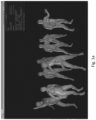
- Figure 1 shows a realistic learned model of human body shape and pose according to a first embodiment of the invention that is compatible with existing rendering engines and allows animator control using standard graphics tools.
- SMPL model range
- 3D meshes gray
- Unity 5.0 game engine screenshot showing bodies from the CAESAR dataset animated in real time.
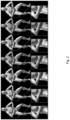
- Figure 2 compares models with ground truth. More particularly, the inventive model is trained in various forms and compared quantitatively to a BlendSCAPE model [Hirshberg et al. 2012], trained with exactly the same data. The models are both evaluated qualitatively with animations and quantitatively using meshes that were not used for training. SMPL and BlendSCAPE are fit to these meshes and then the vertex errors are compared. Two main variants of SMPL are explored, one using linear blend skinning (LBS) and the other with Dual-Quaternion blend skinning (DQBS).
- LBS linear blend skinning
- DQBS Dual-Quaternion blend skinning
- the far right (light gray) mesh is a 3D scan.
- Next to it (dark gray) is a registered mesh with the same topology as the inventive model.
- the comparison shows how well different models can approximate this registration. From left to right: (light green) Linear blend skinning (LBS), (dark green) Dual-Quaternion blend skinning (DQBS), (blue) BlendSCAPE, (red) SMPL-LBS, (orange) SMPL-DQBS.
- LBS and DQBS produce serious artifacts at the knees, elbows, shoulders and hips.
- BlendSCAPE and both SMPL models do similarly well at fitting the data.
- vertex-based, skinned, model according to the invention is actually more accurate than a deformation-based model like BlendSCAPE trained on the same data.
- Figure 3 shows an illustration of the skinned multi-person linear model according to the invention.
- the SMPL model decomposes body shape into identity-dependent shape and non-rigid pose-dependent shape; unlike SCAPE, the invention takes a vertex-based skinning approach that uses corrective blend shapes.
- a single blend shape is represented as a vector of concatenated vertex offsets.
- the mesh has the same topology for men and women, spatially varying resolution, a clean quad structure, a segmentation into parts, initial blend weights, and a skeletal rig.
- the part segmentation and initial blend weights are shown in figure 6 .
- the model is defined by a mean template shape represented by a vector of N concatenated vertices T ⁇ in the zero pose, ⁇ * ; a set of blend weights, W ⁇ , ( Fig. 3(a) ); a blend shape function, B S ( ⁇ ): ⁇ , that takes as input a vector of shape parameters, ⁇ , ( Fig. 3(b) ) and outputs a blend shape sculpting the subject identity; a function to predict K joint locations (white dots in Fig.
- J ( ⁇ ) ⁇ as a function of shape parameters, ⁇ ; and a pose-dependent blend shape function, B p ( ⁇ ) : ⁇ , that takes as input a vector of pose parameters, ⁇ , and accounts for the effects of pose-dependent deformations ( Fig. 3(c) ).
- the corrective blend shapes of these functions are added together in the rest pose as illustrated in ( Fig. 3(c) ).
- W ( ⁇ ) linear or dual-quaternion
- W ( ⁇ ) linear or dual-quaternion) is applied to rotate the vertices around the estimated joint centers with smoothing defined by the blend weights.
- the result is a model, M ( ⁇ , ⁇ ; ⁇ ): ⁇ , that maps shape and pose parameters to vertices ( Fig. 3(d) ).
- ⁇ represents the learned model parameters described below.
- the skinning method can be thought of as a generic black box. Given a particular skinning method our goal is to learn ⁇ to correct for limitations of the method so as to model training meshes. Note that the learned pose blend shapes both correct errors caused by the blend skinning function and static soft-tissue deformations caused by changes in pose.
- Blend skinning To fix ideas and define notation, the LBS version is presented as it makes exposition clear (the DQBS version of SMPL only requires changing the skinning equation).
- Meshes and blend shapes are vectors of vertices represented by bold capital letters (e.g. X) and lowercase bold letters (e.g. x i ⁇ ) are vectors representing a particular vertex. The vertices are sometimes represented in homogeneous coordinates. The same notation is used for a vertex whether it is in standard or homogeneous coordinates as it should always be clear from the context which form is needed.
- the pose of the body is defined by a standard skeletal rig, where w k ⁇ denotes the axis-angle representation of the relative rotation of part k with respect to its parent in the kinematic tree.
- w ⁇ w ⁇ w ⁇ denote the unit norm axis of rotation. Then the axis angle for every joint j is transformed to a rotation matrix using the Rodrigues formula.
- w k,i is an element of the blend weight matrix W, representing how much the rotation of part k effects the vertex i
- exp( ⁇ j ) is the local 3 x 3 rotation matrix corresponding to joint j
- G' k ( ⁇ ,J ) is the world transformation of joint k
- G' k ( ⁇ ,J ) is the same transformation after removing the transformation due to the rest pose, ⁇ *.
- Each 3-element vector in J corresponding to a single joint center, j is denoted j j .
- A(k) denotes the ordered set of joint ancestors of joint k. Note, for compatibility with existing rendering engines, it is assumed that W is sparse and at most four parts are allowed to influence a vertex.
- the basic skinning function may be kept and instead the template may be modified in an additive way and a function is learned to predict joint locations.
- b S , i ( ⁇ ), b P,i ( ⁇ ) are vertices in B S ( ⁇ ) and B P ( ⁇ ) respectively and represent the shape and pose blend shape offsets for the vertex t i .
- S [ S 1 ,..., S
- the linear function B S ( ⁇ ; S ) is fully defined by the matrix S, which is learned from registered training meshes.
- the values to the right of a semicolon represent learned parameters, while those on the left are parameters set by an animator.
- the learned parameters are often omitted when they are not explicitly being optimized in training.
- Figure 3(b) illustrates the application of these shape blend shapes to the template T to produce a new body shape.
- Joint locations Different body shapes have different joint locations. Each joint is represented by its 3D location in the rest pose. It is critical that these are accurate, otherwise there will be artifacts when the model is posed using the skinning equation.
- the regression matrix, is learned from examples of different people in many poses. This matrix models which mesh vertices are important and how to combine them to estimate the joint locations.
- SMPL-LBS and SMPL-DQBS
- SMPL-DQBS is the default model
- SMPL is used as shorthand to mean SMPL-DQBS.
- the SMPL model parameters are trained to minimize reconstruction error on two datasets.
- Each dataset contains meshes with the same topology as our template that have been aligned to high-resolution 3D scans using [Bogo et al. 2014]; these aligned meshes are called "registrations";
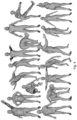
- the multi-pose dataset consists of 1786 registrations of 40 individuals (891 registrations spanning 20 females, and 895 registrations spanning 20 males); a sampling is shown in figure 4 .
- the multi-shape dataset consists of registrations to the CAESAR dataset [Robinette et al. 2002], totaling 1700 registrations for males and 2100 for females; a few examples are shown in figure 5 .
- the j th mesh in the multi-pose dataset is denoted as V J P and the j th mesh in the multi-shape dataset as V j S .
- the parameters ⁇ ⁇ T ,W,S,J,P ⁇ are trained to minimize a vertex reconstruction error on the datasets. Because the model decomposes shape and pose, these are trained separately, simplifying optimization. First, ⁇ , ⁇ , P ⁇ is trained using a multi-pose dataset and then ⁇ T , S ⁇ is trained using our multi-shape dataset. Separate models are trained for men and women (i.e. ⁇ m and ⁇ f )
- the multi-pose dataset is used to train ⁇ , ⁇ , P ⁇ .
- the matrix, is learned to regress from subject-specific vertex locations, T ⁇ i P , to subject-specific joint locations, J ⁇ i P .
- an objective function consisting of a data term, E D , and several regularization terms ⁇ E J , Ey, E P , E W ⁇ defined below.
- ⁇ ⁇ ⁇ 1 ,..., ⁇ P reg ⁇ , s ( j ) is the subject index corresponding to registration j
- P reg are the number of meshes in the pose trainings set
- P subj is the number of subjects in the pose training set.
- a symmetry regularization term, E Y penalizes left-right asymmetry for ⁇ P and T ⁇ P .
- the initial weights are computed by simply diffusing the segmentation.
- the shape space is defined by a mean and principal shape directions ⁇ T ,S ⁇ . It is computed by running PCA on shape registrations from our multi-shape database after pose normalization.
- Pose normalization transforms a raw registration V j S into a registration, T ⁇ j S , in the rest pose, ⁇ *. This normalization is critical to ensure that pose and shape are modeled separately.
- T ⁇ ⁇ P and J ⁇ ⁇ P denote the mean shape and mean joint locations from the multi-pose database respectively.
- W e T ⁇ ⁇ P J ⁇ ⁇ P ⁇ ⁇ W , V j , e S ⁇ R 3 denote an edge of the model and of the registration respectively. An edge is obtained by subtracting a pair of neighboring vertices.
- ⁇ j arg min ⁇ ⁇ ⁇ e W e T ⁇ ⁇ P + B P ⁇ ⁇ P , J ⁇ ⁇ P , ⁇ ⁇ , W ⁇ V j , e S 2 where the sum is taken over all edges in the mesh. This allows us to get a good estimate of the pose without knowing the subject specific shape.
- T ⁇ j S arg min T ⁇ W T ⁇ + B P ⁇ ⁇ j P , I T ⁇ , ⁇ ⁇ j , W ⁇ V j S 2
- This shape is the pose-normalized shape.
- Figure 8 visualizes the first three shape components. The figure also shows how the joint locations change with the changes in body shape. The joint positions are shown by the spheres and are computed from the surface meshes using the learned joint regression function. The lines connecting the joints across the standard deviations illustrate how the joint positions vary linearly with shape.
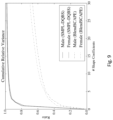
- Figure 9 shows the relative cumulative variance of SMPL and BlendSCAPE. While SMPL requires many fewer PCs to account for the same percentage of overall variance, the variance is different in the two cases: one is variance in vertex locations and the other is variance in triangle deformations. Explained variance in deformations does not directly translate into explained variance in vertex locations. While this makes the two models difficult to compare precisely, triangle deformations have many more degrees of freedom and it is likely that there are many deformations that produce visually similar shapes. A model requiring fewer components is generally preferable.
- Model generalization is the ability of the model to fit to meshes of new people and poses; this tests both shape and pose blend shapes.
- Pose generalization is the ability to generalize a shape of an individual to new poses of the same person; this primarily tests how well pose blend shapes correct skinning artifacts and pose-dependent deformations. Both are measured by mean absolute vertex-to-vertex distance between the model and test registrations. For this evaluation we use 120 registered meshes of four women and two men from the public Dyna dataset [Dyn 2015]. These meshes contain a variety of body shapes and poses. All meshes are in alignment with our template and none were used to train our models. Figure 10 (gray) shows four examples of these registered meshes.
- SMPL-LBS and SMPL-DQBS are evaluated and compared with a BlendSCAPE model [Hirshberg et al. 2012] trained from exactly the same data as the SMPL models.
- the kinematic tree structure for SMPL and the BlendSCAPE model are the same: therefore the same number of pose parameters is used.
- the models are also compared using the same number of shape parameters.
- each model is first fit to each registered mesh, optimizing over shape ⁇ and pose ⁇ to find the best fit in terms of squared vertex distances.
- Figure 10 shows fits of the SMPL-LBS (red) and BlendSCAPE (blue) models to the registered meshes. Both do a good job of fitting the data. The figure also shows how the model works. Illustrated are the estimated body shape, T + B S ( ⁇ ) and the effect of applying the pose blend shapes, T P ( ⁇ , ⁇ ) .
- pose generalization for each individual, one of the estimated body shapes from the generalization task is selected, and then the pose, ⁇ is optimal for each of the other meshes of that subject, keeping the body shape fixed.
- the assumption behind pose generalization is that, if a model is properly decomposed into pose and shape, then the model should be able to fit the same subject in a different pose, without readjusting shape parameters.
- the pose blend shapes are trained to fit observed registrations. As such, they correct for problems of blend skinning and try to capture pose-dependent deformations. Since the pose blend shapes are not dependent on body shape, they capture something about the average deformations in the training set.
- Figures 11 and 12 show the error of the SMPL models and BlendSCAPE as a function of the number of body shape coefficients used.
- the differences between SMPL and BlendSCAPE are small (on the order of 0.5mm) but SMPL is more accurate on average.
- SMPL-LBS and SMPL-DQBS are essentially identical in model generalization and SMPL-LBS is actually slightly better at pose generalization. This is surprising because the pose blend shapes have much more to correct with LBS. Possibly the simplicity of LBS helps with generalization to new poses.
- the plots also show how well standard LBS fits the test data. This corresponds to the SMPL-LBS model with no pose blend shapes. Not surprisingly, LBS produces much higher error than either BlendSCAPE or SMPL. LBS is not as bad in Fig. 11 because here the model can vary body shape parameters, effectively using changes in identity to try to explain deformations due to pose.
- Figure 12 uses a fixed body shape and consequently illustrates how LBS does not model pose-dependent deformations realistically. Note that here one does not retrain a model specifically for LBS and expect such a model would be marginally more accurate.
- the pose blend shapes in SMPL are not sparse in the sense that a rotation of a part can influence any vertex of the mesh. With sufficient training data sparsity may emerge from data; e.g. the shoulder corrections will not be influenced by ankle motions. To make hand animation more intuitive, and to regularize the model to prevent long-range influences of joints, one can manually enforce sparsity. To this end, one may train a sparse version of SMPL by using the same sparsity pattern used for blend weights. In particular, a vertex deviation is allowed to be influenced by at most 4 joints. Since every joint corresponds to a rotation matrix, the pose blend shape corresponding to any given vertex will be driven by 9 x 4 numbers as opposed to 9 x 23.
- SMPL-LBS-Sparse This model is referred to as SMPL-LBS-Sparse in Figs. 11 and 12 . It is consistently less accurate than the regular SMPL-LBS model but may still be useful to animators. This suggests that SMPL-LBS is not overfit to the training data and that sparseness reduces the capacity of the model. The sparse model sometimes produces slight discontinuities at boundaries were vertices are influenced by different joint angles. Other strategies to enforce sparsity could be adopted, such as using an L1 prior or enforcing smoothness in the pose blend shapes. These approaches, however, complicate the training process.
- Figure 13 illustrates the decomposition of shape parameters ⁇ and pose parameters ⁇ in SMPL.
- Pose is held constant from left to right across each row while varying the shape.
- the shape of each person is held constant while varying the pose from top to bottom in each column.
- the bodies are reposed using poses from the CMU mocap database [CMU 2000].
- the pose-dependent deformations look natural through a wide range of poses, despite very different body shapes. This illustrates that the joint regression works well and that the blend shapes are general.
- the run-time cost of SMPL is dominated by skinning and blendshape multiplication. Performance of a CPU based implementation of the invention model, and a comparison against BlendSCAPE, is shown in Fig. 14 .
- the plot shows the time needed to generate the vertices.
- the BlendSCAPE rendering makes use of multiple cores, while the SMPL rendering does not; this is why the system time for BlendSCAPE is higher than the wall-clock time. Shown is the cost of changing body shape. For most applications, this is done once and the shape is then held fixed. The cost of animating the mesh then comes from only the pose blend shapes; this cost corresponds to 0 shape coefficients.
- each blend shape is of size 3 N, requiring that many multiplications per shape.
- SCAPE uses triangle deformations with 9 elements per triangle and there are roughly twice as many triangles as vertices. This results in roughly a factor of 6 difference between SMPL and SCAPE in terms of basic multiplications.
- SMPL is built on standard skinning, it is compatible with existing 3D animation software.
- FBX Autodesk's Filmbox
- the model loads as a typical rigged mesh and can be animated as usual in standard 3D animation software.
- Pose blend weights can be precomputed, baked into the model, and exported as an animated FBX file. This kind of file can be loaded into animation packages and played directly.
- the animated FBX files were tested in Maya, Unity, and Blender.
- Pose blend weights can also be computed on the fly given the pose, ⁇ t , at time t. To enable this, scripts may be provided that take the joint angles and compute the pose blend weights. Loading and animating SMPL was tested in Maya 2013, 2014 and 2015. The animator can animate the model using any of the conventional animation methods typically used in Maya. The pose blend shape values can be viewed and/or edited manually within Maya if desired. SMPL was also tested in Unity. In SMPL, the blend weights range from -1 to +1 while in Unity they range form 0 to 1. Consequently, the weights are scaled and recentered for compatibility. For Unity, each blend shapes can be split into two - one positive and one negative. If the SMPL blend shape should be positive, then a script tells unity that the negative blend shape has zero weight (and vice versa for negative values). To speed computation for real-time graphics, blend shape weights that are close to zero can be set to zero and not used.
- SMPL models static soft-tissue deformations with pose it does not model dynamic deformations that occur due to body movement and impact forces with the ground.
- a further embodiment of the invention introduces a new set of additive blend shapes called dynamic blend shapes. These additional displacements are correlated with velocities and accelerations of the body and limbs rather than with pose.
- ⁇ t [ ⁇ t , ⁇ t , ⁇ t ,a t , ⁇ t- 1 , ⁇ t- 2 ] denote the dynamic control vector at time t. It is composed of pose velocities and accelerations ⁇ ⁇ ⁇ t , ⁇ ⁇ ⁇ t ⁇ R ⁇ ⁇ , root joint velocities and accelerations v t ,a t ⁇ and a history of two vectors of predicted dynamic coefficients ⁇ t- 1 , ⁇ t- 2 ⁇ , describes below.
- the previous linear formulation is extended by adding the dynamic blend shape function, B D ( ⁇ t , ⁇ ), to the other blend shapes in the rest pose before applying the skinning function.
- B D ( ⁇ t , ⁇ ) takes as input the dynamic control vector at time t, and shape coefficients ⁇ , and predicts vertex offsets in the rest pose.
- DMPL models deformations in vertex space.
- the method according to the present embodiment of the invention build male and female models using roughly 40, 000 registered male and female meshes from [Dyn 2015].
- the pose in each frame and the displacements between SMPL and the registration are computed.
- PCA one obtains a mean and the dynamic blend shapes, ⁇ D ⁇ and D ⁇ respectively.
- 300 principal components as in Dyna.
- Dynamic deformations vary significantly between subjects based on their body shape and fat distribution. To capture this, we train a model that depends on the body shape parameters ⁇ as in Dyna.
- the DMPL model produces soft-tissue dynamics that appear more realistic than those of Dyna.
- the pose training data spans a range of body shapes enabling to learn a good predictor of joint locations.
- training all the parameters (template shape, blend weights, joint regressor, shape/pose/dynamic blend shapes) to minimize vertex reconstruction error is important to obtain a good model.
- the simplicity of the model is an advantage as it enables training everything with large amounts of data.
- the blend shapes are learned from a large set of training meshes covering the space of possible poses and learn a simpler function relating pose to blend-shape weights.
- the inventive function is linear in the elements of the part rotation matrices.
- the larger support of the learned linear functions as opposed to radial basis functions allows the model to generalize to arbitrary poses; in addition the simple linear form makes it fast to animate in a game engine without baking in the weights. Because elements of a rotation matrix are constrained, the model cannot "blow up"; when generalizing outside the training set.
- SMPL is an additive model in vertex space.
- SCAPE also factors deformations into shape and pose deformations, SCAPE multiplies the triangle deformations.
- SCAPE a bigger person will have bigger pose-dependent deformations even though these deformations are not learned for different body shapes.
- the experiments show that, the SCAPE approach is less accurate at generalizing to new shapes. Ideally one would have enough pose data from enough different people to learn a true body-shape dependent pose deformation space.
- DMPL where deformations depend on body shape, shows that this is possible.
- the key to SMPL's performance is to make the blend shapes a linear function of the elements of R *( ⁇ ). This formulation, sufficient training data, and a good optimization strategy make it possible to learn the model.
- pose blend shapes may be driven linearly from other features, such as raw ⁇ , simple polynomials of ⁇ , and trigonometric functions (sin, cos) of ⁇ .
- raw ⁇ has limitations because the values vary between - ⁇ and ⁇ .
- Standard LBS will cause the neck to shrink as it rotates in either direction.
- a blend shape is required that increases the neck volume no matter which direction it rotates.
- raw rotations may be replaced with any functions of rotations and used to weight the blend shapes; for example, normalized quaternions.
- the pose-dependent offsets of the basic SMPL model are not dependent on body shape. It is surprising how well SMPL works without this, but the general approach would likely not work if a space of nonrealistic animated characters were modeled, in which body part scales vary widely, or a space of humans that includes infants and adults. However, this limitation may be addressed by training a more general function that takes elements of R* ( ⁇ ) together with ⁇ to predict the blend shape coefficients.
- the dynamic blend shape coefficients of DMPL already depend on body shape and therefore the same approach can be used to make the pose blend shapes depend on body shape. This does not significantly complicate the model or run-time behavior, but may only require more training data.
- the basic SMPL model is a function of joint angles and shape parameters only: it does not model breathing, facial motion, muscle tension, or any changes independent of skeletal joint angles and overall shape. These can be learned as additional additive blend shapes (as with DMPL) if the appropriate factored data is available (cf. [Tsoli et al. 2014]).
- SMPL uses 207 pose blend shapes. In same cases, this may be reduced by performing PCA on the blend shapes, reducing the number of multiplications and consequently increasing rendering speed. Also, the dynamic model uses PCA to learn the dynamic blend shapes but one may also learn the elements of these blend shapes directly as done for the pose blend shapes. Finally, instead of fitting the model to registered meshes one may also fit it to mocap marker data (cf. MoSh [Loper et al. 2014]), depth data, or video data.
- mocap marker data cf. MoSh [Loper et al. 2014]
Landscapes
- Engineering & Computer Science (AREA)
- Physics & Mathematics (AREA)
- Theoretical Computer Science (AREA)
- General Physics & Mathematics (AREA)
- Computer Graphics (AREA)
- Software Systems (AREA)
- General Engineering & Computer Science (AREA)
- Architecture (AREA)
- Computer Hardware Design (AREA)
- Geometry (AREA)
- Computer Vision & Pattern Recognition (AREA)
- Processing Or Creating Images (AREA)
- Image Generation (AREA)
- Image Analysis (AREA)
Applications Claiming Priority (3)
| Application Number | Priority Date | Filing Date | Title |
|---|---|---|---|
| US201562183853P | 2015-06-24 | 2015-06-24 | |
| PCT/EP2016/064610 WO2016207311A1 (fr) | 2015-06-24 | 2016-06-23 | Modèle linéaire multi-personne revêtu |
| EP16731900.3A EP3314577B8 (fr) | 2015-06-24 | 2016-06-23 | Modèle linéaire multi-personne revêtu de peau |
Related Parent Applications (2)
| Application Number | Title | Priority Date | Filing Date |
|---|---|---|---|
| EP16731900.3A Division-Into EP3314577B8 (fr) | 2015-06-24 | 2016-06-23 | Modèle linéaire multi-personne revêtu de peau |
| EP16731900.3A Division EP3314577B8 (fr) | 2015-06-24 | 2016-06-23 | Modèle linéaire multi-personne revêtu de peau |
Publications (2)
| Publication Number | Publication Date |
|---|---|
| EP4571665A2 true EP4571665A2 (fr) | 2025-06-18 |
| EP4571665A3 EP4571665A3 (fr) | 2025-08-27 |
Family
ID=56203388
Family Applications (2)
| Application Number | Title | Priority Date | Filing Date |
|---|---|---|---|
| EP16731900.3A Active EP3314577B8 (fr) | 2015-06-24 | 2016-06-23 | Modèle linéaire multi-personne revêtu de peau |
| EP25153835.1A Pending EP4571665A3 (fr) | 2015-06-24 | 2016-06-23 | Modèle linéaire multi-personnes en peau |
Family Applications Before (1)
| Application Number | Title | Priority Date | Filing Date |
|---|---|---|---|
| EP16731900.3A Active EP3314577B8 (fr) | 2015-06-24 | 2016-06-23 | Modèle linéaire multi-personne revêtu de peau |
Country Status (3)
| Country | Link |
|---|---|
| US (2) | US10395411B2 (fr) |
| EP (2) | EP3314577B8 (fr) |
| WO (1) | WO2016207311A1 (fr) |
Families Citing this family (59)
| Publication number | Priority date | Publication date | Assignee | Title |
|---|---|---|---|---|
| US10474927B2 (en) * | 2015-09-03 | 2019-11-12 | Stc. Unm | Accelerated precomputation of reduced deformable models |
| US11461630B1 (en) | 2017-03-06 | 2022-10-04 | Max-Planck-Gesellschaft zur Förderung der Wisenschaften e.V. | Machine learning systems and methods for extracting user body shape from behavioral data |
| US10410431B2 (en) | 2017-07-11 | 2019-09-10 | Nvidia Corporation | Skinning a cluster based simulation with a visual mesh using interpolated orientation and position |
| US11393168B2 (en) | 2017-11-14 | 2022-07-19 | Ziva Dynamics Inc. | Generating an anatomy based on weights of selected template anatomies |
| EP3511904B1 (fr) * | 2018-01-11 | 2020-05-27 | Siemens Aktiengesellschaft | Procédé de détermination d'une pose d'un objet dans un environnement de l'objet au moyen de l'apprentissage multi-tâches ainsi que dispositif de commande |
| CN108320326A (zh) * | 2018-01-12 | 2018-07-24 | 东南大学 | 一种针对人手部的三维建模方法 |
| CN108549844B (zh) * | 2018-03-22 | 2021-10-26 | 华侨大学 | 一种基于分形网络和关节亲属模式的多人姿态估计方法 |
| WO2019207176A1 (fr) * | 2018-04-25 | 2019-10-31 | Seddi, Inc. | Modélisation de la dynamique de tissu mou non linéaire pour des avatars interactifs |
| US11308673B2 (en) * | 2018-05-03 | 2022-04-19 | Magic Leap, Inc. | Using three-dimensional scans of a physical subject to determine positions and/or orientations of skeletal joints in the rigging for a virtual character |
| US10713850B2 (en) * | 2018-09-24 | 2020-07-14 | Sony Corporation | System for reconstructing three-dimensional (3D) human body model using depth data from single viewpoint |
| US10867395B2 (en) * | 2018-09-28 | 2020-12-15 | Glo Big Boss Ltd. | Systems and methods for real-time rigid body motion prediction |
| CA3115027A1 (fr) | 2018-10-31 | 2020-05-07 | Soul Machines Limited | Animation de cible bimorphe |
| EP3671660B1 (fr) * | 2018-12-20 | 2025-06-18 | Dassault Systèmes | Conception d'un objet modélisé 3d par l'intermédiaire d'une interaction de l'utilisateur |
| US10839586B1 (en) * | 2019-06-07 | 2020-11-17 | Snap Inc. | Single image-based real-time body animation |
| CN109859296B (zh) * | 2019-02-01 | 2022-11-29 | 腾讯科技(深圳)有限公司 | Smpl参数预测模型的训练方法、服务器及存储介质 |
| US12333760B1 (en) * | 2019-03-22 | 2025-06-17 | Bertec Corporation | System for estimating a three dimensional pose of one or more persons in a scene |
| CN110148209B (zh) * | 2019-04-30 | 2023-09-15 | 深圳市重投华讯太赫兹科技有限公司 | 人体模型生成方法、图像处理设备及具有存储功能的装置 |
| CN110147847B (zh) * | 2019-05-24 | 2020-11-20 | 徐州医科大学 | 基于星座图聚类的膝关节形态分类方法 |
| US11430168B2 (en) * | 2019-08-16 | 2022-08-30 | Samsung Electronics Co., Ltd. | Method and apparatus for rigging 3D scanned human models |
| CN112419419B (zh) * | 2019-11-27 | 2025-05-16 | 上海联影智能医疗科技有限公司 | 用于人体姿势和形状估计的系统和方法 |
| KR102338491B1 (ko) * | 2019-12-11 | 2021-12-13 | 한국전자기술연구원 | 영상 기반 사람의 3차원 자세 및 형상 모델 복원 장치 및 방법 |
| US11393148B2 (en) * | 2019-12-19 | 2022-07-19 | Microsoft Technology Licensing, Llc | Automatic weight determination for unassigned variables |
| CN111260774B (zh) * | 2020-01-20 | 2023-06-23 | 北京百度网讯科技有限公司 | 生成3d关节点回归模型的方法和装置 |
| CN111476901B (zh) * | 2020-04-10 | 2023-04-07 | 中国科学技术大学 | 一种三维人体形状表示方法 |
| DE102020205434A1 (de) | 2020-04-29 | 2021-11-04 | Fraunhofer-Gesellschaft zur Förderung der angewandten Forschung eingetragener Verein | Verfahren zur Ermittlung einer Entwicklung oder eines Entwicklungsstands eines Kleinkinds oder Säuglings |
| US11593869B2 (en) | 2020-04-30 | 2023-02-28 | Clothing Tech LLC | Visualization of garments on a body model of a human |
| US12249030B2 (en) * | 2020-04-30 | 2025-03-11 | Google Llc | Generative nonlinear human shape models |
| US11403800B1 (en) | 2020-07-13 | 2022-08-02 | Amazon Technologies, Inc. | Image generation from 3D model using neural network |
| CN112085105B (zh) * | 2020-09-10 | 2024-07-12 | 上海创屹科技有限公司 | 一种基于人体形状与姿态估计的动作相似度评价方法 |
| US12020374B2 (en) * | 2020-09-29 | 2024-06-25 | Samsung Electronics Co., Ltd. | Body shape and pose estimation via volumetric regressor for raw three dimensional scan models |
| KR20230079256A (ko) | 2020-10-02 | 2023-06-05 | 프라운호퍼 게젤샤프트 쭈르 푀르데룽 데어 안겐반텐 포르슝 에. 베. | 볼류메트릭 비디오 데이터를 위한 데이터 스트림, 장치 및 방법 |
| CN112330813A (zh) * | 2020-11-12 | 2021-02-05 | 首都师范大学 | 一种基于单目深度摄像头的着装下三维人体模型重建方法 |
| CN112509099B (zh) * | 2020-11-30 | 2024-02-06 | 北京百度网讯科技有限公司 | 虚拟形象驱动方法、装置、设备和存储介质 |
| KR20220083166A (ko) | 2020-12-11 | 2022-06-20 | 삼성전자주식회사 | 인체 추정 방법 및 장치 |
| CN112652057B (zh) * | 2020-12-30 | 2024-05-07 | 北京百度网讯科技有限公司 | 生成人体三维模型的方法、装置、设备以及存储介质 |
| CN112819849B (zh) * | 2021-01-14 | 2021-12-03 | 电子科技大学 | 一种基于三目的无标记点视觉运动捕捉方法 |
| WO2022222011A1 (fr) * | 2021-04-19 | 2022-10-27 | 浙江大学 | Procédé de représentation de corps humain tridimensionnel implicite pouvant être entraîné |
| CN112991502B (zh) * | 2021-04-22 | 2021-07-16 | 腾讯科技(深圳)有限公司 | 一种模型训练方法、装置、设备及存储介质 |
| CN113536598B (zh) * | 2021-08-13 | 2022-04-26 | 谢军 | 一种基于CAESAR-Lisflood模型的流域泥沙溯源模拟方法 |
| US11869163B1 (en) | 2021-09-17 | 2024-01-09 | Amazon Technologies, Inc. | Virtual garment draping using machine learning |
| CN114140515B (zh) * | 2021-11-29 | 2024-07-16 | 新拓三维技术(深圳)有限公司 | 三维人体尺寸测量方法、系统及计算机可读存储介质 |
| JP7120532B1 (ja) | 2021-12-17 | 2022-08-17 | 株式会社ワコール | スキンモデルから肉付きに基づく体形を統計的に分析するプログラム、装置及び方法 |
| KR102818753B1 (ko) * | 2021-12-21 | 2025-06-11 | 한국전자기술연구원 | 수신호 및 제스처의 효율적 인식을 위한 행동 인식 인공지능 네트워크 시스템 및 방법 |
| US11803997B2 (en) | 2022-02-15 | 2023-10-31 | Electronic Arts Inc. | Automatic head pose neutralization and blend shape generation |
| US12086931B2 (en) * | 2022-03-01 | 2024-09-10 | Tencent America LLC | Methods of 3D clothed human reconstruction and animation from monocular image |
| US12070093B1 (en) | 2022-03-11 | 2024-08-27 | Amazon Technologies, Inc. | Custom garment pattern blending based on body data |
| US20230306699A1 (en) | 2022-03-22 | 2023-09-28 | Amazon Technologies, Inc. | Virtual garment wrapping for draping simulation |
| US11954801B2 (en) | 2022-04-11 | 2024-04-09 | Microsoft Technology Licensing, Llc | Concurrent human pose estimates for virtual representation |
| CN114842140A (zh) * | 2022-04-20 | 2022-08-02 | 浙江工业大学 | 基于身高体重数据的三维人体重建方法 |
| EP4327902A1 (fr) | 2022-08-25 | 2024-02-28 | Sporttotal Technology GmbH | Métavers sportif |
| US20240257470A1 (en) * | 2023-01-30 | 2024-08-01 | Meta Platforms Technologies, Llc | Avatar personalization using image generation |
| US20240331295A1 (en) * | 2023-03-31 | 2024-10-03 | Sony Group Corporation | Parts-based decomposition of human body for blend shape pipeline integration and muscle prior creation |
| CN116137050B (zh) * | 2023-04-19 | 2023-09-01 | 北京大学 | 三维真人模型处理方法、处理装置、电子设备及存储介质 |
| CN116468831B (zh) * | 2023-06-20 | 2023-08-22 | 腾讯科技(深圳)有限公司 | 模型处理方法、装置、设备及存储介质 |
| CN116486108B (zh) * | 2023-06-20 | 2023-09-01 | 腾讯科技(深圳)有限公司 | 一种图像处理方法、装置、设备及存储介质 |
| CN117137481A (zh) * | 2023-09-14 | 2023-12-01 | 吉林大学 | 一种膝、踝、肘关节功能转动轴的定位方法 |
| US12524893B2 (en) * | 2023-09-19 | 2026-01-13 | Adobe Inc. | Shape space generation via progressive correspondence estimation |
| CN118864202B (zh) * | 2024-07-08 | 2025-06-20 | 哈尔滨工业大学 | 一种基于混合现实技术的高层住宅火灾疏散婴儿照护行为数据收集实验方法 |
| US20260094370A1 (en) * | 2024-09-30 | 2026-04-02 | Beijing Zitiao Network Technology Co., Ltd. | Creating three-dimensional (3d) avatars |
Citations (2)
| Publication number | Priority date | Publication date | Assignee | Title |
|---|---|---|---|---|
| US5883638A (en) | 1995-12-01 | 1999-03-16 | Lucas Digital, Ltd. | Method and apparatus for creating lifelike digital representations of computer animated objects by providing corrective enveloping |
| US8797328B2 (en) | 2010-07-23 | 2014-08-05 | Mixamo, Inc. | Automatic generation of 3D character animation from 3D meshes |
Family Cites Families (4)
| Publication number | Priority date | Publication date | Assignee | Title |
|---|---|---|---|---|
| US8139067B2 (en) * | 2006-07-25 | 2012-03-20 | The Board Of Trustees Of The Leland Stanford Junior University | Shape completion, animation and marker-less motion capture of people, animals or characters |
| KR101911133B1 (ko) * | 2012-06-21 | 2018-10-23 | 마이크로소프트 테크놀로지 라이센싱, 엘엘씨 | 깊이 카메라를 이용한 아바타 구성 |
| GB2515343B (en) * | 2013-06-21 | 2018-02-07 | Toshiba Res Europe Limited | Methods and systems for generating a three dimensional representation of a subject |
| US9325936B2 (en) * | 2013-08-09 | 2016-04-26 | Samsung Electronics Co., Ltd. | Hybrid visual communication |
-
2016
- 2016-06-23 WO PCT/EP2016/064610 patent/WO2016207311A1/fr not_active Ceased
- 2016-06-23 EP EP16731900.3A patent/EP3314577B8/fr active Active
- 2016-06-23 EP EP25153835.1A patent/EP4571665A3/fr active Pending
- 2016-06-23 US US15/739,658 patent/US10395411B2/en active Active
-
2019
- 2019-08-14 US US16/540,967 patent/US11017577B2/en active Active
Patent Citations (2)
| Publication number | Priority date | Publication date | Assignee | Title |
|---|---|---|---|---|
| US5883638A (en) | 1995-12-01 | 1999-03-16 | Lucas Digital, Ltd. | Method and apparatus for creating lifelike digital representations of computer animated objects by providing corrective enveloping |
| US8797328B2 (en) | 2010-07-23 | 2014-08-05 | Mixamo, Inc. | Automatic generation of 3D character animation from 3D meshes |
Non-Patent Citations (38)
| Title |
|---|
| ALLEN, B.CURLESS, B.POPOVI' C, Z.HERTZMANN, A.: "In Proceedings of the 2006 ACM SIG GRAPH/Eurographics Symposium on Computer Animation", 2006, EUROGRAPHICS ASSOCIATION, article "Learning a correlated model of identity and posedependent body shape variation for real-time synthesis", pages: 147 - 156 |
| ALLEN, B.CURLESS, B.POPOVI'C , Z.: "Articulated body deformation from range scan data.", ACM TRANS. GRAPH., vol. 21, no. 3, July 2002 (2002-07-01), pages 612 - 619 |
| ALLEN, B.CURLESS, B.POPOVI'C, Z.: "The space of human body shapes: Reconstruction and parameterization from range scans.", ACM TRANS. GRAPH. (PROC. SIGGRAPH, vol. 22, no. 3, 2003, pages 587 - 594, XP059141756, DOI: 10.1145/1201775.882311 |
| ANGUELOV, D., SRINIVASAN, P., KOLLER, D., THRUN, S., RODGERS, J.,DAVIS, J.: "SCAPE: Shape Completion and Animation of PEople", ACM TRANS. GRAPH., vol. 24, no. 3, 2005, pages 408 - 416, XP002751124, DOI: 10.1145/1186822.1073207 |
| BARAN, I.POPOVI' C , J.: "Automatic rigging and animation of 3D characters.", ACM TRANS. GRAPH., vol. 26, 2007, pages 3 |
| BOGO, F.ROMERO, J.LOPER, M.BLACK, M. J.: "FAUST: Dataset and evaluation for 3D mesh registration", IN PROC. IEEE CONF. ON COMPUTER VISION AND PATTERN RECOGNITION (CVPR, 2014, pages 3794 - 3801, XP032649382, DOI: 10.1109/CVPR.2014.491 |
| CHANG, W.ZWICKER, M.: "Range scan registration using reduced deformable models.", COMPUTER GRAPHICS FORUM, vol. 28, no. 2, 2009, pages 447 - 456, XP071487376, DOI: 10.1111/j.1467-8659.2009.01384.x |
| CHEN, Y.LIU, Z.ZHANG, Z.: "Tensor-based human body modeling.", IN IEEE CONF. ON COMPUTER VISION AND PATTERN RECOGNITION (CVPR), 105-112. 2000. CMU GRAPHICS LAB MOTION CAPTURE DATABASE, 11 December 2012 (2012-12-11), Retrieved from the Internet <URL:http://mocap.cs.cmu.edu> |
| CORAZZA, S.GAMBARETTO, E., AUTOMATIC GENERATION OF 3D CHARACTER ANIMATION FROM 3D MESHES, 5 August 2014 (2014-08-05) |
| DE AGUIAR, E.THEOBALT, C.THRUN, S.SEIDEL, H.-P.: "Automatic conversion of mesh animations into skeletonbased animations.", COMPUTER GRAPHICS FORUM, vol. 27, no. 2, 2008, pages 389 - 397, XP071487226, DOI: 10.1111/j.1467-8659.2008.01136.x |
| DYNA DATASET, 2015, Retrieved from the Internet <URL:http://dyna.is.tue.mpg.de> |
| HASLER, N., STOLL, C., SUNKEL, M., ROSENHAHN, B., SEIDEL, H.: "A statistical model of human pose and body shape.", COMPUTER GRAPHICS FORUM, vol. 28, no. 2, 2009, pages 337 - 346, XP071487366, DOI: 10.1111/j.1467-8659.2009.01373.x |
| HASLER, N., STOLL, C., SUNKEL, M., ROSENHAHN, B., SEIDEL, H.: "In Proceedings of the 2010 ACM SIGGRAPH Symposium on Interactive 3D Graphics and Games", vol. 10, 2010, ACM, article "Frankenrigs: Building character rigs from multiple sources.", pages: 31 - 38 |
| HIRSHBERG, D.LOPER, M.RACHLIN, E.BLACK, M. ET AL.: "In European Conf. on Computer Vision (ECCV", vol. 7572, 2012, SPRINGER-VERLAG, article "Coregis-tration: Simultaneous alignment and modeling of articulated 3D shape.", pages: 242 - 255 |
| JAMES, D. L.TWIGG, C. D.: "Skinning mesh animations.", ACM TRANS. GRAPH., vol. 24, no. 3, 2005, pages 399 - 407 |
| KAVAN, L.COLLINS, S.O'SULLIVAN, C.: "In Proceedings of the 2009 Symposium on Interactive D Graphics and Games", vol. 09, 2009, ACM, article "Automatic linearization of nonlinear skinning.", pages: 49 - 56 |
| KAVAN, L.COLLINS, S.Z ''ARA, J.O'SULLIVAN, C.: "Geometric skinning with approximate dual quaternion blending.", ACM TRANSACTIONS ON GRAPHICS (TOG, vol. 27, no. 4, 2008, pages 1 - 23, XP058098859, DOI: 10.1145/1409625.1409627 |
| KAVAN, L.Z ''ARA, J.: "In Proceedings of the 2005 Symposium on Interactive 3D Graphics and Games", vol. 05, 2005, ACM, article "Spherical blend skinning: Areal-time deformation of articulated models.", pages: 9 - 16 |
| KRY, P. G.JAMES, D. L.PAI, D. K.: "In Proceedings of the 2002 ACM SIGGRAPH/Eurographics Symposium on Computer Animation", vol. 02, 2002, ACM, article "EigenSkin: Real time large deformation character skinning in hardware.", pages: 153 - 159 |
| KURIHARA, T.MIYATA, N.: "In Proceedings of the 2004 ACM SIGGRAPH/Eurographics Symposium on Computer Animation", vol. 04, 2004, EUROGRAPHICS ASSOCIATION, article "Modeling deformable human hands from medical images.", pages: 355 - 363 |
| LAWSON, C. L.HANSON, R. J.: "Solving least squares problems. Classics in applied mathematics.", SIAM, PHILADELPHIA, PA. SIAM : SOCIETY OF INDUSTRIAL AND APPLIED MATHEMATICS, 1995 |
| LE, B. H.DENG, Z.: "Robust and accurate skeletal rigging from mesh sequences.", ACM TRANS. GRAPH., vol. 33, no. 4, 2014, pages 1 - 10, XP059140082, DOI: 10.1145/2601097.2601161 |
| LE, B. H.DENG, Z.: "Smooth skinning decomposition with rigid bones.", ACM TRANS. GRAPH., vol. 31, no. 6, November 2012 (2012-11-01), pages 1 - 10 |
| LEWIS, J. P.CORDNER, M.FONG, N.: "In Proceedings of the 27th Annual Conference on Computer Graphics and Interactive Techniques", 2000, ACM PRESS/ADDISON-WESLEY PUBLISHING CO., article "Pose space deformation: A unified approach to shape interpolation and skeleton-driven deformation.", pages: 165 - 172 |
| LOPER, M. M.BLACK, M. J.: "In Computer Vision - ECCV 2014", vol. 8695, 2014, SPRINGER, article "OpenDR: An approximate differenti-able renderer.", pages: 154 - 169 |
| LOPER, M.M.MAHMOOD, N.BLACK, M. J.: "MoSh: Motion and shape capture from sparse markers.", ACM TRANS. GRAPH., vol. 33, no. 6, 2014, pages 1 - 13, XP055862859, DOI: 10.1145/2661229.2661273 |
| MERRY, B.MARAIS, P.GAIN, J.: "Animation space: A truly linear framework for character animation.", ACM TRANS. GRAPH., vol. 25, no. 4, October 2006 (2006-10-01), pages 1400 - 1423 |
| MOHR, A.GLEICHER, M.: "Building efficient, accurate character skins from examples.", ACM TRANS. GRAPH., 2003, pages 562 - 568 |
| PONS-MOLL, G.ROMERO, J.MAHMOOD, N.BLACK, M. J.: "Dyna: A model of dynamic human shape in motion.", ACM TRANSACTIONS ON GRAPHICS, vol. 34, no. 4, July 2015 (2015-07-01), pages 1 - 14 |
| RHEE, T.LEWIS, J.NEUMANN, U.: "Real-time weighted pose-space deformation on the GPU.", EUROGRAPHICS, vol. 25, 2006, pages 3 |
| ROBINETTE, K., BLACKWELL, S., DAANEN, H., BOEHMER, M., FLEMING,S., BRILL, T., HOEFERLIN, D., AND BURNSIDES, D.: "Tech. Rep. AFRL-HEWP-TR-2002-0169", 2002, US AIR FORCE RESEARCH LABORATORY, article "Civilian American and European Surface Anthropometry Resource (CAESAR) final report." |
| ROUET, C.LEWIS, J., METHOD AND APPARATUS FOR CREATING LIFELIKE DIGITAL REPRESENTATIONS OF COMPUTER ANIMATED OBJECTS BY PROVIDING CORRECTIVE ENVELOPING, 16 March 1999 (1999-03-16) |
| SCHAEFER, S.YUKSEL, C.: "In Proceedings of the Fifth Eurographics Symposium on Geometry Processing", vol. 07, 2007, EUROGRAPHICS ASSOCIATION, article "Example-based skeleton extraction", pages: 153 - 162 |
| SEO, H.CORDIER, F.MAGNENAT-THALMANN, N.: "In Proceedings of the 2003 ACM SIGGRAPH/Eurographics Symposium on Computer Animation", vol. o3, 2003, EUROGRAPHICS ASSOCIATION, article "Synthesizing animatable body models with parameterized shape modifications.", pages: 120 - 125 |
| TSOLI, A.MAHMOOD, N.BLACK, M. J., BREATHING LIFE INTO SHAPE: CAPTURING, MODELING AND ANIMATING 3D HUMAN, vol. 52, no. 1-52, 2014, pages 11 |
| WANG, R. Y.PULLI, K.POPOVI'C, J.: "Real-time enveloping with rotational regression.", ACM TRANS. GRAPH., vol. 26, no. 3, July 2007 (2007-07-01), XP059141914, DOI: 10.1145/1276377.1276468 |
| WANG, X. C.PHILLIPS, C.: "In Proceedings of the", vol. 2, 2002, ACM, article "Multi-weight enveloping: Least-squares approximation techniques for skin animation.", pages: 129 - 138 |
| WEBER, O.SORKINE, O.LIPMAN, Y.GOTSMAN, C.: "Context-aware skeletal shape deformation.", COMPUTER GRAPHICS FORUM, vol. 26, no. 3, September 2007 (2007-09-01), pages 265 - 274, XP055234401, DOI: 10.1111/j.1467-8659.2007.01048.x |
Also Published As
| Publication number | Publication date |
|---|---|
| US10395411B2 (en) | 2019-08-27 |
| EP3314577B1 (fr) | 2025-01-29 |
| EP3314577B8 (fr) | 2025-03-05 |
| US20180315230A1 (en) | 2018-11-01 |
| US11017577B2 (en) | 2021-05-25 |
| US20190392626A1 (en) | 2019-12-26 |
| EP4571665A3 (fr) | 2025-08-27 |
| EP3314577A1 (fr) | 2018-05-02 |
| WO2016207311A1 (fr) | 2016-12-29 |
Similar Documents
| Publication | Publication Date | Title |
|---|---|---|
| EP3314577B1 (fr) | Modèle linéaire multi-personne revêtu de peau | |
| US11127163B2 (en) | Skinned multi-infant linear body model | |
| US8139067B2 (en) | Shape completion, animation and marker-less motion capture of people, animals or characters | |
| Pishchulin et al. | Building statistical shape spaces for 3d human modeling | |
| Kadleček et al. | Reconstructing personalized anatomical models for physics-based body animation | |
| Kim et al. | Feature detection of triangular meshes based on tensor voting theory | |
| Schaefer et al. | Image deformation using moving least squares | |
| US7944449B2 (en) | Methods and apparatus for export of animation data to non-native articulation schemes | |
| Merry et al. | Animation space: A truly linear framework for character animation | |
| US7570264B2 (en) | Rig baking | |
| Romero et al. | Modeling and estimation of nonlinear skin mechanics for animated avatars | |
| Chen et al. | Parametric 3D modeling of a symmetric human body | |
| US12530848B2 (en) | Detailed 3D object reconstruction method and apparatus using Laplacian coordinates | |
| Fratarcangeli | Position‐based facial animation synthesis | |
| Muralikrishnan et al. | Temporal residual jacobians for rig-free motion transfer | |
| Parrilla et al. | Capture and automatic production of digital humans in real motion with a temporal 3D scanner | |
| Mao et al. | A sketch-based approach to human body modelling | |
| Zhu et al. | A facial motion retargeting pipeline for appearance agnostic 3d characters | |
| Capell et al. | Physically based rigging for deformable characters | |
| CN110349268B (zh) | 一种三维人体姿态、表情及手势的重构方法 | |
| Zhan | Application of Skeletal Skinned Mesh Algorithm Based on 3D Virtual Human Model in Computer Animation Design. | |
| Kadleček | Inverse Anatomical Modeling and Simulation of Virtual Humans | |
| Salamah | NaturalWalk: An Anatomy-based Synthesizer for Human Walking Motions | |
| Park et al. | PMM: A Parametric Musculoskeletal Model Aligned With Human Body Shape | |
| Bian et al. | Recent Developments in Skin Deformation for Character Animation. |
Legal Events
| Date | Code | Title | Description |
|---|---|---|---|
| PUAI | Public reference made under article 153(3) epc to a published international application that has entered the european phase |
Free format text: ORIGINAL CODE: 0009012 |
|
| STAA | Information on the status of an ep patent application or granted ep patent |
Free format text: STATUS: THE APPLICATION HAS BEEN PUBLISHED |
|
| AC | Divisional application: reference to earlier application |
Ref document number: 3314577 Country of ref document: EP Kind code of ref document: P |
|
| AK | Designated contracting states |
Kind code of ref document: A2 Designated state(s): AL AT BE BG CH CY CZ DE DK EE ES FI FR GB GR HR HU IE IS IT LI LT LU LV MC MK MT NL NO PL PT RO RS SE SI SK SM TR |
|
| REG | Reference to a national code |
Ref country code: DE Ref legal event code: R079 Free format text: PREVIOUS MAIN CLASS: G06T0019200000 Ipc: G06T0013400000 |
|
| PUAL | Search report despatched |
Free format text: ORIGINAL CODE: 0009013 |
|
| AK | Designated contracting states |
Kind code of ref document: A3 Designated state(s): AL AT BE BG CH CY CZ DE DK EE ES FI FR GB GR HR HU IE IS IT LI LT LU LV MC MK MT NL NO PL PT RO RS SE SI SK SM TR |
|
| RIC1 | Information provided on ipc code assigned before grant |
Ipc: G06T 13/40 20110101AFI20250721BHEP Ipc: G06T 19/20 20110101ALI20250721BHEP |
|
| STAA | Information on the status of an ep patent application or granted ep patent |
Free format text: STATUS: REQUEST FOR EXAMINATION WAS MADE |
|
| 17P | Request for examination filed |
Effective date: 20260227 |