EP4571880A1 - Positivelektrodenaktivmaterial, positivelektrodenaktivmaterialschlamm, positivelektrode, lithium-ionen-sekundärbatterie und verfahren zur herstellung eines positivelektrodenaktivmaterials - Google Patents
Positivelektrodenaktivmaterial, positivelektrodenaktivmaterialschlamm, positivelektrode, lithium-ionen-sekundärbatterie und verfahren zur herstellung eines positivelektrodenaktivmaterials Download PDFInfo
- Publication number
- EP4571880A1 EP4571880A1 EP24738715.2A EP24738715A EP4571880A1 EP 4571880 A1 EP4571880 A1 EP 4571880A1 EP 24738715 A EP24738715 A EP 24738715A EP 4571880 A1 EP4571880 A1 EP 4571880A1
- Authority
- EP
- European Patent Office
- Prior art keywords
- positive electrode
- active material
- electrode active
- transition metal
- metal oxide
- Prior art date
- Legal status (The legal status is an assumption and is not a legal conclusion. Google has not performed a legal analysis and makes no representation as to the accuracy of the status listed.)
- Pending
Links
Images

Classifications
-
- H—ELECTRICITY
- H01—ELECTRIC ELEMENTS
- H01M—PROCESSES OR MEANS, e.g. BATTERIES, FOR THE DIRECT CONVERSION OF CHEMICAL ENERGY INTO ELECTRICAL ENERGY
- H01M4/00—Electrodes
- H01M4/02—Electrodes composed of, or comprising, active material
- H01M4/36—Selection of substances as active materials, active masses, active liquids
- H01M4/48—Selection of substances as active materials, active masses, active liquids of inorganic oxides or hydroxides
- H01M4/52—Selection of substances as active materials, active masses, active liquids of inorganic oxides or hydroxides of nickel, cobalt or iron
- H01M4/525—Selection of substances as active materials, active masses, active liquids of inorganic oxides or hydroxides of nickel, cobalt or iron of mixed oxides or hydroxides containing iron, cobalt or nickel for inserting or intercalating light metals, e.g. LiNiO2, LiCoO2 or LiCoOxFy
-
- C—CHEMISTRY; METALLURGY
- C01—INORGANIC CHEMISTRY
- C01G—COMPOUNDS CONTAINING METALS NOT COVERED BY SUBCLASSES C01D OR C01F
- C01G53/00—Compounds of nickel
-
- H—ELECTRICITY
- H01—ELECTRIC ELEMENTS
- H01M—PROCESSES OR MEANS, e.g. BATTERIES, FOR THE DIRECT CONVERSION OF CHEMICAL ENERGY INTO ELECTRICAL ENERGY
- H01M10/00—Secondary cells; Manufacture thereof
- H01M10/05—Accumulators with non-aqueous electrolyte
- H01M10/052—Li-accumulators
- H01M10/0525—Rocking-chair batteries, i.e. batteries with lithium insertion or intercalation in both electrodes; Lithium-ion batteries
-
- H—ELECTRICITY
- H01—ELECTRIC ELEMENTS
- H01M—PROCESSES OR MEANS, e.g. BATTERIES, FOR THE DIRECT CONVERSION OF CHEMICAL ENERGY INTO ELECTRICAL ENERGY
- H01M4/00—Electrodes
- H01M4/02—Electrodes composed of, or comprising, active material
- H01M4/13—Electrodes for accumulators with non-aqueous electrolyte, e.g. for lithium-accumulators; Processes of manufacture thereof
- H01M4/131—Electrodes based on mixed oxides or hydroxides, or on mixtures of oxides or hydroxides, e.g. LiCoOx
-
- H—ELECTRICITY
- H01—ELECTRIC ELEMENTS
- H01M—PROCESSES OR MEANS, e.g. BATTERIES, FOR THE DIRECT CONVERSION OF CHEMICAL ENERGY INTO ELECTRICAL ENERGY
- H01M4/00—Electrodes
- H01M4/02—Electrodes composed of, or comprising, active material
- H01M4/13—Electrodes for accumulators with non-aqueous electrolyte, e.g. for lithium-accumulators; Processes of manufacture thereof
- H01M4/133—Electrodes based on carbonaceous material, e.g. graphite-intercalation compounds or CFx
-
- H—ELECTRICITY
- H01—ELECTRIC ELEMENTS
- H01M—PROCESSES OR MEANS, e.g. BATTERIES, FOR THE DIRECT CONVERSION OF CHEMICAL ENERGY INTO ELECTRICAL ENERGY
- H01M4/00—Electrodes
- H01M4/02—Electrodes composed of, or comprising, active material
- H01M4/36—Selection of substances as active materials, active masses, active liquids
- H01M4/362—Composites
- H01M4/364—Composites as mixtures
-
- H—ELECTRICITY
- H01—ELECTRIC ELEMENTS
- H01M—PROCESSES OR MEANS, e.g. BATTERIES, FOR THE DIRECT CONVERSION OF CHEMICAL ENERGY INTO ELECTRICAL ENERGY
- H01M4/00—Electrodes
- H01M4/02—Electrodes composed of, or comprising, active material
- H01M4/36—Selection of substances as active materials, active masses, active liquids
- H01M4/48—Selection of substances as active materials, active masses, active liquids of inorganic oxides or hydroxides
- H01M4/50—Selection of substances as active materials, active masses, active liquids of inorganic oxides or hydroxides of manganese
- H01M4/505—Selection of substances as active materials, active masses, active liquids of inorganic oxides or hydroxides of manganese of mixed oxides or hydroxides containing manganese for inserting or intercalating light metals, e.g. LiMn2O4 or LiMn2OxFy
-
- H—ELECTRICITY
- H01—ELECTRIC ELEMENTS
- H01M—PROCESSES OR MEANS, e.g. BATTERIES, FOR THE DIRECT CONVERSION OF CHEMICAL ENERGY INTO ELECTRICAL ENERGY
- H01M4/00—Electrodes
- H01M4/02—Electrodes composed of, or comprising, active material
- H01M4/36—Selection of substances as active materials, active masses, active liquids
- H01M4/58—Selection of substances as active materials, active masses, active liquids of inorganic compounds other than oxides or hydroxides, e.g. sulfides, selenides, tellurides, halogenides or LiCoFy; of polyanionic structures, e.g. phosphates, silicates or borates
- H01M4/583—Carbonaceous material, e.g. graphite-intercalation compounds or CFx
- H01M4/587—Carbonaceous material, e.g. graphite-intercalation compounds or CFx for inserting or intercalating light metals
-
- H—ELECTRICITY
- H01—ELECTRIC ELEMENTS
- H01M—PROCESSES OR MEANS, e.g. BATTERIES, FOR THE DIRECT CONVERSION OF CHEMICAL ENERGY INTO ELECTRICAL ENERGY
- H01M4/00—Electrodes
- H01M4/02—Electrodes composed of, or comprising, active material
- H01M4/62—Selection of inactive substances as ingredients for active masses, e.g. binders, fillers
- H01M4/621—Binders
- H01M4/622—Binders being polymers
- H01M4/623—Binders being polymers fluorinated polymers
-
- H—ELECTRICITY
- H01—ELECTRIC ELEMENTS
- H01M—PROCESSES OR MEANS, e.g. BATTERIES, FOR THE DIRECT CONVERSION OF CHEMICAL ENERGY INTO ELECTRICAL ENERGY
- H01M4/00—Electrodes
- H01M4/02—Electrodes composed of, or comprising, active material
- H01M4/62—Selection of inactive substances as ingredients for active masses, e.g. binders, fillers
- H01M4/624—Electric conductive fillers
- H01M4/625—Carbon or graphite
-
- H—ELECTRICITY
- H01—ELECTRIC ELEMENTS
- H01M—PROCESSES OR MEANS, e.g. BATTERIES, FOR THE DIRECT CONVERSION OF CHEMICAL ENERGY INTO ELECTRICAL ENERGY
- H01M4/00—Electrodes
- H01M4/02—Electrodes composed of, or comprising, active material
- H01M4/62—Selection of inactive substances as ingredients for active masses, e.g. binders, fillers
- H01M4/628—Inhibitors, e.g. gassing inhibitors, corrosion inhibitors
-
- H—ELECTRICITY
- H01—ELECTRIC ELEMENTS
- H01M—PROCESSES OR MEANS, e.g. BATTERIES, FOR THE DIRECT CONVERSION OF CHEMICAL ENERGY INTO ELECTRICAL ENERGY
- H01M4/00—Electrodes
- H01M4/02—Electrodes composed of, or comprising, active material
- H01M2004/021—Physical characteristics, e.g. porosity, surface area
-
- H—ELECTRICITY
- H01—ELECTRIC ELEMENTS
- H01M—PROCESSES OR MEANS, e.g. BATTERIES, FOR THE DIRECT CONVERSION OF CHEMICAL ENERGY INTO ELECTRICAL ENERGY
- H01M4/00—Electrodes
- H01M4/02—Electrodes composed of, or comprising, active material
- H01M2004/026—Electrodes composed of, or comprising, active material characterised by the polarity
- H01M2004/028—Positive electrodes
-
- Y—GENERAL TAGGING OF NEW TECHNOLOGICAL DEVELOPMENTS; GENERAL TAGGING OF CROSS-SECTIONAL TECHNOLOGIES SPANNING OVER SEVERAL SECTIONS OF THE IPC; TECHNICAL SUBJECTS COVERED BY FORMER USPC CROSS-REFERENCE ART COLLECTIONS [XRACs] AND DIGESTS
- Y02—TECHNOLOGIES OR APPLICATIONS FOR MITIGATION OR ADAPTATION AGAINST CLIMATE CHANGE
- Y02E—REDUCTION OF GREENHOUSE GAS [GHG] EMISSIONS, RELATED TO ENERGY GENERATION, TRANSMISSION OR DISTRIBUTION
- Y02E60/00—Enabling technologies; Technologies with a potential or indirect contribution to GHG emissions mitigation
- Y02E60/10—Energy storage using batteries
Definitions
- Embodiments of the present disclosure relate to a positive electrode active material, a positive electrode active material slurry, a positive electrode, a lithium ion secondary battery and a method for preparing a positive electrode active material.
- lithium ion secondary batteries having high energy density and voltage, long cycle life and low self-discharge rate are commercialized and widely used.
- Patent Literature 1 Japanese Patent Publication No. 2018-063835
- the electrode resistance characteristics may degrade (i.e., the electrode resistance may increase) by the thin film having low conductivity. Accordingly, both the outstanding cycling characteristics and electrode resistance characteristics are required.
- the present disclosure is directed to providing a positive electrode active material, a positive electrode active material slurry, a positive electrode, a lithium ion secondary battery and a method for preparing a positive electrode active material with the outstanding cycling characteristics and electrode resistance characteristics.
- the present disclosure may include the following embodiments.
- the positive electrode active material it may be possible to provide the positive electrode active material, the positive electrode active material slurry, the positive electrode, the lithium ion secondary battery and the method for preparing the positive electrode active material with the outstanding cycling characteristics and electrode resistance characteristics.
- a positive electrode active material a positive electrode active material slurry, a positive electrode, a lithium ion secondary battery and a method for preparing a positive electrode active material according to embodiments will be described.
- the following embodiment represents an embodiment of the present disclosure and is not intended to limit the present disclosure, and may be arbitrarily changed within the scope of technical aspect of the present disclosure.
- Each element and each feature of the embodiment may be arbitrarily combined.
- upper and lower limits of each numerical range may be arbitrarily combined.
- lithium nickel cobalt manganese three-component positive electrode active material such as LiaNixCoyMnzO2
- LiaNixCoyMnzO2 lithium nickel cobalt manganese three-component positive electrode active material
- problems occur, for example, gases generation at high temperature or low stability in charged state with the increasing Ni content. The use in battery applications is challenging.
- Patent Literature 1 discloses forming a fluoride-based thin film on the surface of Li-excess layered rocksalt-type positive electrode active material.
- the surface of the Ni rich positive electrode material is easily influenced by ionic conductivity or electron conduction. For this reason, the Ni rich positive electrode active material is greatly influenced by the increase in resistance component resulting from the thin film formation.
- lithium ion secondary batteries having the outstanding cycling characteristics and electrode resistance characteristics are obtained by using the positive electrode active material including a mixture of lithium transition metal oxide particles and magnesium fluoride particles, and completed the present disclosure.
- a positive electrode active material including a mixture of lithium transition metal oxide particles and magnesium fluoride particles, wherein a 1s electron spectrum for fluorine observed by X-ray photoelectron spectroscopy analysis has a peak at 685 eV or more and 687 eV or less.
- the positive electrode active material is a positive electrode active material for a lithium ion secondary battery.
- the 'lithium transition metal oxide' as used herein refers to a compound including lithium and transition metal, and having transition metal-oxygen bonds, and includes those including a metal such as aluminum or a nonmetal such as iodine other than oxygen.
- the 'mixture' as used herein refers to two or more materials simply mixed together, wherein the majority of the two or more materials (for example, 50 mass% or more) does not change in chemical state by chemical reaction between the two or more materials or sintering.
- the positive electrode active material includes lithium transition metal oxide capable of intercalating and deintercalating lithium and magnesium fluoride.
- the positive electrode active material may be a physical mixture of lithium transition metal oxide particles and magnesium fluoride particles.
- the positive electrode active material may include lithium transition metal oxide and any material other than magnesium fluoride.
- the positive electrode active material may or may not include a fluorine-containing material other than magnesium fluoride, such as lithium fluoride, aluminum fluoride.
- the lithium transition metal oxide particles may exist as primary particles, or agglomerates of primary particles.
- the particle size may be, for example, 10 nm or more and 100 ⁇ m or less, 0.1 ⁇ m or more and 10 ⁇ m or less, but is not limited thereto.
- the lithium transition metal oxide includes, for example, nickel.
- the lithium transition metal oxide may be a nickel-rich lithium transition metal oxide.
- 'nickel-rich' refers to 50 mol% or more of nickel based on the total amount of transition metal.
- the nickel-rich lithium transition metal oxide including, for example, 50 mol% or more of nickel requires improved stability (i.e., cycling characteristics) during charging. For this reason, improvement in cycling characteristics using the positive electrode active material according to this embodiment may contribute to high capacity and improved cycling characteristics of the lithium ion secondary battery.
- the lithium transition metal oxide may include 60 mol% or more, 70 mol% or more, 80 mol% or more, or 90 mol% or more of nickel based on the total amount of transition metal.
- lithium transition metal oxide may include lithium-manganese oxide (for example, LiMnO 2 , LiMnO 3 , LiMn 2 O 3 , LiMn 2 O 4 ); lithium-cobalt oxide (for example, LiCoO 2 ); lithium-nickel oxide (for example, LiNiO 2 ); lithium-copper oxide (for example, Li 2 CuO 2 ); lithium-vanadium oxide (for example, LiV 3 O 8 ); lithium-nickel-manganese oxide (for example, LiNi 1-z Mn z O 2 (0 ⁇ z ⁇ 1), LiMn 2-z Ni z O 4 (0 ⁇ z ⁇ 2)); lithium-nickel-cobalt oxide (for example, LiNi 1-y Co y O 2 ( 0 ⁇ y ⁇ 1)); lithium-manganese-cobalt oxide (for example, LiCo 1-z Mn z O 2 (0 ⁇ z ⁇ 1), LiMn 2-y Co y O 4 (0 ⁇ y y
- the positive electrode active material may include at least one of them, but is not limited thereto. Additionally, even in the same particle, there may be a distribution in substitution concentration between inside and surface. Additionally, the particle surface may have coating. For example, the surface may be coated with metal oxide, lithium transition metal oxide or polymer, but is not limited thereto.
- LiNiO 2 Li(Ni 0.5 Mn 0.3 Co 0.2 )O 2 , Li(Ni 0.6 Mn 0.2 Co 0.2 )O 2 , Li(Ni 0.7 Mn 0.15 Co 0.15 )O 2 , Li(Ni 0.8 Mn 0.1 Co 0.1 )O 2 , Li(Ni 0.8 Co 0.15 Al 0.05 )O 2 , Li(Ni 0.8 Co 0.1 Mn 0.05 Al 0.05 )O 2 , Li(Ni 0.85 Co 0.10 Mn 0.05 )O 2 , Li(Ni 0.85 Co 0.10 Mn 0.03 Al 0.02 )O 2 , Li(Ni 0.9 CO 0.05 Mn 0.05 )O 2 , Li(Ni 0.9 Co 0.05 Al 0.05 )O 2 , Li(Ni 0.95 Co 0.03 Mn 0.02 )O 2 or Li(Ni 0.95 Co 0.03 Al 0.02 )O; is preferred.
- the magnesium fluoride included in the positive electrode active material exists in the form of particles in at least part.
- the magnesium fluoride is in the form of particles that are independent from the lithium transition metal oxide particles, but not a thin film that covers the lithium transition metal oxide particles.
- the magnesium fluoride particles are in contact with the surface of the lithium transition metal oxide particles. That is, the surface of the lithium transition metal oxide particles is exposed and come into contact with the magnesium fluoride particles that are independent from the lithium transition metal oxide particles.
- the thin film of magnesium fluoride is not formed on the surface of the lithium transition metal oxide particles to suppress the increase in surface resistance of the lithium transition metal oxide particles due to the thin film.
- the magnesium fluoride particles are not sintered with the lithium transition metal oxide particles.
- 'sinter' refers to heating at least one material to lower temperature than the melting point of the material in a state that the particles of the material are in contact with each other, in order to hold the adjacent particles together.
- the magnesium fluoride particles may exist as primary particles, or secondary particles, i.e., agglomerates of primary particles.
- the particle size may be, for example, 1 nm or more and 100 ⁇ m or less, 10 nm or more and 10 ⁇ m or less, 100 nm or more and 1 ⁇ m or less, but is not limited thereto.
- the amount of the magnesium fluoride is, for example, 0.02 parts by mass or more and 1 part by mass or less based on 100 parts by mass of the lithium transition metal oxide.
- the amount of the magnesium fluoride is equal to or more than 0.02 parts by mass, improved cycling characteristics by the magnesium fluoride are expected.
- the amount of the magnesium fluoride is equal to or less than 1 part by mass, the increase in electrode resistance will be suppressed by excess magnesium fluoride covering the surface of the lithium transition metal oxide particles.
- the amount of the magnesium fluoride is preferably 0.03 parts by mass or more and 0.5 parts by mass or less, more preferably 0.04 parts by mass or more and 0.3 parts by mass or less, and more preferably 0.05 parts by mass or more and 0.2 parts by mass or less, based on 100 parts by mass of the lithium transition metal oxide.
- XPS analysis is the technique that detects photoelectrons emitted from the sample surface using an analyzer by soft X-ray irradiation onto the surface in an ultrahigh vacuum. From the fact that the length (the mean free path) of travel of a photoelectron in the material is a few nm, the detection depth of the analysis method is a few nm.
- the element information of surface is obtained from the binding energy value of a bound electron in the material, and information associated with valence or coupled state is obtained from the energy shift of each peak.
- the ratio of elements (composition) may be quantitatively evaluated from the peak area ratio.
- the spectrum observed by X-ray photoelectron spectroscopy analysis (XPS) of the positive electrode active material has a peak derived from F1s electron of fluorine.
- the F1s electron spectrum for fluorine has the peak at 685 eV or more and 687 eV or less.
- the peak position is preferably 685.2 eV or more and 686 eV or less, and more preferably 685.3 eV or more and 685.7 eV or less.
- This peak is derived from 1s electron of fluoride ions in magnesium fluoride.
- the 'peak position' refers to maximum peak position (energy).
- the spectrum observed by X-ray photoelectron spectroscopy analysis (XPS) of the positive electrode active material has a peak derived from 2p electron of magnesium.
- the 2p electron spectrum for magnesium has the peak at 50 eV or more and 52 eV or less.
- the peak position is preferably 50.5 eV or more and 51.5 eV or less, and more preferably 50.8 eV or more and 51.2 eV or less. This peak is derived from 2p electron of magnesium ions in magnesium fluoride.
- the capacity fading suppression refers to improvement in cycling characteristics
- the electrode resistance rise suppression refers to improvement in electrode resistance characteristics
- the first lithium ion secondary battery when comparing the first lithium ion secondary battery manufactured using a positive electrode having the positive electrode active material layer including 96.5 parts by mass of the above-described positive electrode active material, 1.5 parts by mass of carbon black and 2 parts by mass of polyvinylidene fluoride on a current collector, and a negative electrode including graphite with the second lithium ion secondary battery manufactured in the same condition as the first lithium ion secondary battery except that the positive electrode active material obtained by sintering the positive electrode active material at 350°C for 5 hours was used instead of the above-described positive electrode active material, the first lithium ion secondary battery has a larger value obtained by dividing the discharge capacity in the 100th charge/discharge cycle by the discharge capacity in the first charge/discharge cycle than the second lithium ion secondary battery. Additionally, the first lithium ion secondary battery has a smaller value obtained by dividing direct current resistance in the 100th charge/discharge cycle by direct current resistance in the first charge/discharge cycle than the second lithium ion secondary
- the following mechanism may be one of the causes of this tendency.
- the cycling characteristics there is a likelihood that at least part of the function of improve the cycling characteristics of the magnesium fluoride may disappear by decomposition of the magnesium fluoride by sintering, or reaction with the lithium transition metal oxide or the components in air.
- the electrode resistance characteristics when the magnesium fluoride-derived thin film is formed on at least part of the surface of the lithium transition metal oxide particles by sintering, there is a likelihood that the surface resistance the lithium transition metal oxide particles may increase, compared to non-sintering.
- Li residue such as lithium hydroxide present on the surface of the lithium transition metal oxide particles is changed to the resistance component such as lithium carbonate by sintering, which may adversely affect the characteristics, compared to non-sintering. Additionally, when the sintering process is not performed, side reaction in the sintering does not occur, and the cost does not increase.
- a method for preparing a positive electrode active material including the step of mixing lithium transition metal oxide particles with magnesium fluoride particles (a mixing step), wherein a 1s electron spectrum for fluorine observed by X-ray photoelectron spectroscopy analysis of the positive electrode active material has a peak at 685 eV or more and 687 eV or less.
- the 1s electron spectrum for fluorine observed by X-ray photoelectron spectroscopy analysis of the obtained positive electrode active material has the peak at 685 eV or more and 687 eV or less.
- the obtained positive electrode active material includes a mixture of lithium transition metal oxide particles and magnesium fluoride particles.
- the mixture including at least one type of lithium transition metal oxide and magnesium fluoride is prepared.
- the lithium transition metal oxide and the magnesium fluoride may be all mixed in solid state.
- the mixing process may be performed in a straightforward and convenient manner, it is possible to reduce the cost, and it is suitable for mass production.
- the mixing method is not limited to a particular one, and may include any existing method.
- Examples of the mixing method may include hand-operated mixing, a mortar (manual or automatic), a ball mill, a planetary mill, a vibration mill, a rotor mill, a hammer mill, a dispermill, a mixer, a homogenizer.
- the mixing step may be performed in air, and may be performed in any other atmosphere, for example, an inert atmosphere.
- the lithium transition metal oxide and any material other than the magnesium fluoride may be added.
- any fluorine-containing material other than magnesium fluoride such as lithium fluoride or aluminum fluoride may be added, or may not be added.
- the amount of the lithium transition metal oxide added in the mixing process is, for example, 85 parts by mass or more and 99.98 parts by mass or less, preferably 90 parts by mass or more and 99.9 parts by mass or less, and more preferably 95 parts by mass or more and 99.5 parts by mass or less, when the total mass of the mixture is 100 parts by mass.
- the amount of the magnesium fluoride added is, for example, 0.02 parts by mass or more and 1 part by mass or less, preferably 0.03 parts by mass or more and 0.5 parts by mass or less, more preferably 0.04 parts by mass or more and 0.3 parts by mass or less, and more preferably 0.05 parts by mass or more and 0.2 parts by mass or less.
- the method does not include the step of sintering the mixture of the lithium transition metal oxide particles and the magnesium fluoride particles.
- the method does not include the step of heating the mixture of the lithium transition metal oxide particles and the magnesium fluoride particles at or above a predetermined temperature.
- the predetermined temperature is lower than the temperature at which the sintering of the lithium transition metal oxide particles or the remaining elements on the surface such as lithium hydroxide LiOH or lithium carbonate Li 2 O 3 and the magnesium fluoride particles takes place.
- the predetermined temperature is 150°C or 200°C.
- the positive electrode material is a positive electrode material for a lithium ion secondary battery.
- the positive electrode material includes, for example, the above-described positive electrode active material, optionally a conductive material, and optionally a binder.
- the positive electrode material may be provided as a mixture powder of powder of the above-described positive electrode active material and powder of the conductive material, and may be provided as high viscosity composition in which the mixture powder is mixed with the binder.
- the amount of the positive electrode active material included in the positive electrode material may be 80 mass% or more and 99.5 mass% or less based on the total mass of the positive electrode material.
- the amount of the positive electrode active material may be preferably 85 mass% or more and 98.5 mass% or less.
- the amount of the positive electrode active material is within the aforementioned range, it may be possible to achieve the outstanding capacity characteristics.
- the amount of the positive electrode active material is less than the aforementioned range, the coating amount of the positive electrode increases and the thickness increases, failing to achieve sufficient volumetric energy density, and when the amount of the positive electrode active material is more than the aforementioned range, the binder and the conductive material are insufficient, resulting in low conductivity and adhesion strength of the electrode and poor battery performance.
- the conductive material may include any electrically conductive material that does not cause a chemical change without limitation.
- Examples of the conductive material may include any one of carbon-based materials such as artificial graphite, natural graphite, carbon black, acetylene black, Ketjen black, Denka black, thermal black, channel black, furnace black, lamp black, carbon nanotubes or carbon fibers; metal powder or metal fibers of aluminum, tin, bismuth, silicon, antimony, nickel, copper, titanium, vanadium, chrome, manganese, iron, cobalt, zinc, molybdenum, tungsten, silver, gold, lanthanum, ruthenium, platinum or iridium; conductive whiskers of zinc oxide or potassium titanate; conductive metal oxide such as titanium oxide; conductive polymer such as polyaniline, polythiophene, polyacetylene, polypyrrole or polyphenylene derivatives, or a mixture thereof, but is not limited thereto.
- the positive electrode material includes at least one of carbon black or carbon nano
- the amount of the conductive material may be 0.1 mass% or more and 30 mass% or less based on the total mass of the positive electrode material.
- the amount of the conductive material may be preferably 0.5 mass% or more and 15 mass% or less, and more preferably 0.5 mass% or more and 5 mass% or less.
- the binder is added as the component that promotes the bonding between the active material and the conductive material or the bonding to the current collector.
- the binder may include any one of polyvinylidene fluoride (PVDF), polyvinyl alcohol (PVA), polyacrylonitrile, carboxymethyl cellulose (CMC), starch, hydroxypropyl cellulose, regenerated cellulose, polyvinyl pyrrolidone, tetrafluoro ethylene, polyethylene, polypropylene, ethylene-propylene-diene polymer (EPDM), sulfonated EPDM, styrene butadiene rubber (SBR), fluoro rubber, their copolymers or a mixture thereof, but is not limited thereto.
- PVDF polyvinylidene fluoride
- PVA polyvinyl alcohol
- CMC carboxymethyl cellulose
- EPDM ethylene-propylene-diene polymer
- SBR styrene butadiene rubber
- the amount of the binder may be 0.1 mass% or more and 30 mass% or less based on the total mass of the positive electrode material.
- the amount of the binder may be preferably 0.5 mass% or more and 15 mass% or less, and more preferably 0.5 mass% or more and 5 mass% or less.
- the positive electrode material may be obtained by adding the conductive material and the binder to the above-described positive electrode active material and mixing together.
- any other additive may be added.
- a positive electrode active material slurry including the above-described positive electrode active material.
- the positive electrode active material slurry is a positive electrode active material slurry for a lithium ion secondary battery.
- the positive electrode active material slurry includes, for example, the positive electrode active material, the conductive material, the binder and a solvent.
- the positive electrode active material slurry may be coated on the current collector, followed by volatilization or evaporation of the solvent to form a positive electrode active material layer on the current collector.
- the amounts of the positive electrode active material, the conductive material and the binder in the positive electrode active material layer are the same as the foregoing description of the positive electrode material.
- the solvent used in the positive electrode active material slurry may include those commonly used to manufacture the positive electrode without limitation.
- the solvent may include any one of amine-based solvents such as N,N-dimethyl amino propyl amine, diethylene triamine or N,N-dimethyl formamide (DMF), ether-based solvents such as tetrahydrofuran, ketone-based solvents such as methyl ethyl ketone, ester-based solvents such as methyl acetate, amide-based solvents such as dimethylacetamide or 1-methyl-2-pyrrolidone (NMP), dimethylsulfoxide (DMSO) and water or a mixture thereof, but is not limited thereto.
- amine-based solvents such as N,N-dimethyl amino propyl amine, diethylene triamine or N,N-dimethyl formamide (DMF)
- ether-based solvents such as tetrahydrofuran
- ketone-based solvents such as methyl ethy
- the amount of the solvent may be such that the viscosity is enough to dissolve or disperse the positive electrode active material, the conductive material and the binder and ensure high thickness uniformity when coating on the positive electrode current collector, taking into account the coating thickness of the slurry or the manufacturing yield.
- the positive electrode active material slurry is obtained by adding the conductive material, the binder and the solvent to the above-described positive electrode active material and mixing together.
- any other additive such as a dispersing agent or a thickening agent may be added.
- a positive electrode including a current collector, and a positive electrode active material layer including the above-described positive electrode active material on the current collector. That is, the positive electrode includes the positive electrode current collector and the positive electrode active material layer on one or two surfaces of the positive electrode current collector.
- the positive electrode active material layer may be formed on all or part of the surface of the positive electrode current collector.
- the positive electrode is a positive electrode for a lithium ion secondary battery including an electrolyte solution.
- the positive electrode current collector used in the positive electrode may include those having electrical and chemical stability and conductivity without limitation.
- the positive electrode current collector may include any one of stainless steel; aluminum; nickel; titanium; or an alloy thereof, or a mixture thereof.
- the positive electrode current collector may include sintered carbon, or aluminum or stainless steel treated with carbon, nickel, titanium or silver on the surface.
- the positive electrode current collector may be 3 ⁇ m or more and 500 ⁇ m or less in thickness.
- the positive electrode current collector may have microtexture on the surface to increase the adhesion strength with the positive electrode active material.
- the positive electrode current collector may come in various forms, for example, film, sheet, foil, net, porous body, foam or nonwoven.
- the positive electrode active material layer includes the above-described positive electrode active material, the conductive material and the binder.
- the positive electrode active material layer may be, for example, 1 nm or more and 100 ⁇ m or less, 10 nm or more and 10 ⁇ m or less, or 100 nm or more and 1 ⁇ m or less in thickness.
- the positive electrode active material layer may be directly formed on the positive electrode current collector, or may be formed with another layer interposed between. Additionally, another layer such as a protective layer may be formed on the positive electrode active material layer.
- the positive electrode active material layer may include the conductive material including carbon nanotubes. Accordingly, it may be possible to notably reduce the electrode resistance, thereby improving the electrode resistance characteristics.
- the positive electrode having the positive electrode active material layer on the positive electrode current collector may be manufactured by coating the positive electrode active material slurry on the positive electrode current collector, drying and rolling.
- the positive electrode may be manufactured by casting the positive electrode active material slurry on a support, peeling a film from the support, and laminating the film onto the positive electrode current collector. Additionally, any other method may be used to form the positive electrode active material layer on the positive electrode current collector.
- a lithium ion secondary battery including the above-described positive electrode.
- the lithium ion secondary battery includes the above-described positive electrode, a negative electrode, a separator between the positive electrode and the negative electrode and a nonaqueous electrolyte.
- the separator may be omitted.
- the lithium ion secondary battery may include a battery case accommodating an electrode assembly including the positive electrode, the negative electrode and the separator, and optionally a sealing member that seals the battery case.
- the lithium ion secondary battery when the lithium ion secondary battery is charged and discharged to 4.2V (or 4.25V on the basis of metal lithium) for graphite as a counter electrode for one cycle, electrolyte decomposition does not occur.
- the thickness of the corresponding lithium ion secondary battery when the lithium ion secondary battery is charged and discharged to 4.2V for one cycle, the thickness of the corresponding lithium ion secondary battery remains substantially unchanged except for volume expansion of a negative electrode active material.
- the negative electrode includes a negative electrode current collector and a negative electrode active material layer on one or two surfaces of the negative electrode current collector.
- the negative electrode active material layer may be formed on all or part of the surface of the negative electrode current collector.
- the negative electrode current collector used in the negative electrode may include those having electrical and chemical stability and conductivity without limitation.
- the negative electrode current collector may include copper; stainless steel; aluminum; nickel; titanium; sintered carbon; copper or stainless steel treated with carbon, nickel, titanium or silver on the surface; an aluminum-cadmium alloy.
- the negative electrode current collector may be 3 ⁇ m or more and 500 ⁇ m or less in thickness.
- the negative electrode current collector may have microtexture on the surface to increase the adhesion strength with the negative electrode active material.
- the negative electrode current collector may come in various forms, for example, film, sheet, foil, net, porous body, foam or nonwoven.
- the negative electrode active material layer includes the negative electrode active material, a binder and a conductive material.
- the negative electrode active material layer may be, for example, 1 nm or more and 100 ⁇ m or less, 10 nm or more and 10 ⁇ m or less, or 100 nm or more and 1 ⁇ m or less in thickness.
- the negative electrode active material layer may be directly formed on the negative electrode current collector, or may be formed with another layer interposed between. Additionally, another layer such as a protective layer may be formed on the negative electrode active material layer.
- the negative electrode active material layer may be, for example, formed by coating a negative electrode active material slurry on the negative electrode current collector, the negative electrode active material slurry is obtained by dissolving or dispersing a mixture of the negative electrode active material, the binder and the conductive material in a solvent, followed by drying and rolling.
- the mixture may further include a dispersing agent, fillers or any other additive, if necessary.
- the negative electrode active material may include compounds capable of reversible intercalation and deintercalation of lithium.
- Examples of the negative electrode active material may include any one of carbon-containing materials such as artificial graphite, natural graphite, graphitizing carbon fibers or amorphous carbon; silicon-containing materials such as silicon powder, amorphous silicon, silicon nanofibers or silicon nanowires; silicon compounds such as silicon alloys, silicon oxide, silicon oxide doped with alkali metal or alkaline earth metal (lithium or magnesium); metallic materials that can form alloys with lithium such as Al, Sn, Pb, Zn, Bi, In, Mg, Ga, Cd, Sn alloys, Al alloys; metal oxide capable of lithium doping and dedoping such as SnO2, vanadium oxide or lithium vanadium oxide; composites of silicon-containing materials and carbon-containing materials or Sn-C composites, or a mixture thereof, but is not limited thereto.
- the carbon-containing material may include any one of low-crystallinity carbon or high-crystallinity carbon.
- the low-crystallinity carbon may typically include soft carbon and hard carbon
- the high-crystallinity carbon may typically include high temperature sintered carbon such as amorphous, platy, flaky, spherical or fibrous natural graphite or artificial graphite, Kish graphite, pyrolytic carbon, mesophase pitch-based carbon fibers, mesocarbon microbeads, mesophase pitch or petroleum ⁇ coal-based coke.
- the negative electrode active material may be included in an amount of 80 mass% or more and 99 mass% or less based on the total mass of the negative electrode active material layer.
- the type and amount of the binder and the conductive material used in the negative electrode active material slurry are the same as the description of the positive electrode.
- the solvent used in the negative electrode active material slurry may include those commonly used to manufacture the negative electrode without limitation.
- Examples of the solvent may include any one of N-methyl-2-pyrrolidone (NMP), dimethylsulfoxide (DMSO), isopropyl alcohol, acetone and water or a mixture thereof, but is not limited thereto.
- a method for manufacturing the negative electrode for the lithium ion secondary battery may include the steps of dissolving or dispersing the negative electrode active material, and optionally the binder and the conductive material in the solvent to obtain the negative electrode active material slurry, and in the same way as the method for manufacturing the positive electrode, coating the negative electrode active material slurry on the negative electrode current collector to form the negative electrode active material layer on the negative electrode current collector in order to obtain the negative electrode.
- the separator separates the negative electrode from the positive electrode and provides a movement passage of lithium ions, and may include those commonly used as separators in lithium ion secondary batteries without limitation.
- separators having low resistance to migration of electrolyte ions and high electrolyte wettability are preferred.
- the separator may include porous polymer films made from polyolefin-based polymer such as ethylene homopolymer, propylene homopolymer, ethylene/butane copolymer, ethylene/hexane copolymer, ethylene/methacrylate copolymer or a stack structure of two or more layers of them.
- commonly used porous nonwoven fabrics for example, nonwoven fabrics made of high melting point glass fibers or polyethylene terephthalate fibers may be used.
- separators coated with ceramics or polymer materials may be used.
- the nonaqueous electrolyte may include an organic liquid electrolyte or an inorganic liquid electrolyte that may be used to manufacture the lithium ion secondary battery, but is not limited thereto.
- a solid electrolyte may be also used.
- the nonaqueous electrolyte may include an organic solvent and a lithium salt, and optionally, may further include an electrolyte additive.
- the liquid electrolyte is referred to as an 'electrolyte solution'.
- the organic solvent may include those that may act as a medium for the movement of ions involved in the electrochemical reaction of the battery without limitation.
- Examples of the organic solvent may include any one of ester-based solvents such as methyl acetate, ethyl acetate, ⁇ -butyrolactone or ⁇ -caprolactone; ether-based solvents such as dibutyl ether or tetrahydrofuran; ketone-based solvents such as cyclohexanone; aromatic hydrocarbon-based solvents such as benzene or fluorobenzene; carbonate-based solvents such as dimethyl carbonate (DMC), diethyl carbonate (DEC), methyl ethyl carbonate (MEC), ethyl methyl carbonate (EMC), ethylene carbonate (EC) or propylene carbonate (PC); alcohol-based solvents such as ethyl alcohol or isopropyl alcohol; nitrile-based solvents of R-CN (R is C2-C20 straight
- the carbonate-based solvent may be preferred, and more preferably, the cyclic carbonate (for example, ethylene carbonate or propylene carbonate) having high ionic conductivity and high dielectric constant, contributing to the improved charge/discharge performance of the battery may be mixed with the low viscosity straight-chain carbonate-based compound (for example, ethyl methyl carbonate, dimethyl carbonate or diethyl carbonate).
- the cyclic carbonate and the straight-chain carbonate may be mixed at a volume ratio of about 1:1 to 1:9 to further increase the electrolyte performance.
- the lithium salt may include any compound that can provide lithium ions used in the lithium ion secondary battery without limitation.
- Examples of the lithium salt may include any one of LiPF 6 , LiClO 4 , LiAsF 6 , LiBF 4 , LiSbF 6 , LiAlO 4 , LiAlCl 4 , LiCF 3 SO 3 , LiC 4 F 9 SO 3 , LiN(C 2 F 5 SO 3 ) 2 , LiN(C 2 F 5 SO 2 ) 2 , LiN(CF 3 SO 2 ) 2 , LiCl, LiI or LiB(C 2 O 4 ) 2 or a mixture thereof, but is not limited thereto.
- the lithium salt may be, for example, included in the electrolyte at the concentration of 0.1 mol/L or more and 2 mol/L or less.
- concentration of the lithium salt is included in the aforementioned range, the electrolyte has the optimum conductivity and viscosity, leading to the outstanding electrolyte performance and effective movement of lithium ions.
- the electrolyte additive may be optionally used to improve battery life characteristics, suppress battery capacity reduction and improve battery discharge capacity.
- Examples of the electrolyte additive may include any one of haloalkylene carbonate-based compounds such as vinylene carbonate (VC), fluoro ethylene carbonate (FEC) or difluoro ethylene carbonate (DFEC), pyridine, triethylphosphite, triethanol amine, cyclic ether, ethylene diamine, n-glyme, hexa phosphoric triamide, nitrobenzene derivatives, sulfur, quinoneimine dyes, N-substituted oxazolidinone, N,N-substituted imidazolidine, ethyleneglycol dialkylether, ammonium salts, pyrrole, 2-methoxy ethanol or aluminum trichloride or a mixture thereof, but is not limited thereto.
- the electrolyte additive may be, for example, included in an amount of 0.1 mass% or
- the lithium ion secondary battery according to an embodiment may be manufactured by placing the separator (for example, a separation membrane) and the electrolyte solution between the positive electrode manufactured as described above and the negative electrode manufactured as described above. More specifically, the lithium ion secondary battery may be manufactured by forming the electrode assembly including the positive electrode and the negative electrode and the separator between the positive electrode and the negative electrode, placing the electrode assembly in the battery case, for example, a cylindrical or prismatic battery case and injecting the electrolyte. Alternatively, the lithium ion secondary battery may be manufactured by stacking the electrode assembly, filling it with the electrolyte, placing the obtained resultant product in the battery case and sealing the battery case.
- the separator for example, a separation membrane
- the battery case may include those commonly used in the art.
- the battery case may have, for example, a cylindrical, prismatic, pouch-like or coin-like shape using a can.
- the lithium ion secondary battery according to an embodiment may be used as a power source of small devices as well as a unit battery of a medium- and large-scale battery module including a plurality of battery cells.
- Preferred examples of the medium- and large-scale device may include electric vehicles, hybrid electric vehicles, plug-in hybrid electric vehicles and energy storage systems, but is not limited thereto.
- LiNi 0.8 Co 0.1 Mn 0.1 O 2 (hereinafter, referred to as 'lithium transition metal oxide') powder
- 0.1 parts by mass of magnesium fluoride (MgF 2 ; Stella Chemifa) powder was added and filled in a plastic bottle.
- the powders were mixed at 700 rpm for about 30 minutes using a rocking mill (Seiwa Giken, RM-01) to obtain a mixture of lithium transition metal oxide and magnesium fluoride as a positive electrode active material. From the observation of the powder particles of the raw materials and the powder particles of the mixture with a scanning electron microscope (SEM), it was confirmed that secondary particle form such as grain size or cracks was common in them.
- SEM scanning electron microscope
- the positive electrode active material 96.5 parts by mass of the positive electrode active material, 1.5 parts by mass of carbon black as a conductive material, 2.0 parts by mass of polyvinylidene fluoride (PVDF) as a binder and N-methyl-2-pyrrolidone (NMP) as a solvent were mixed together to obtain a positive electrode active material slurry.
- PVDF polyvinylidene fluoride
- NMP N-methyl-2-pyrrolidone
- the obtained positive electrode active material slurry was coated on a 20 ⁇ m thick aluminum foil to a thickness of about 70 ⁇ m, and dried at 130°C to obtain a positive electrode sheet.
- Ethylene carbonate, dimethyl carbonate and diethyl carbonate were mixed at a volume ratio of 1:2:1, 1 mol/L of LiPF 6 was dissolved in the mixture and 2.0 mass% of vinylene carbonate (VC) was added to obtain an electrolyte solution.
- VC vinylene carbonate
- the obtained positive electrode sheet was punched into a circular shape having a diameter of 13 mm to obtain a positive electrode for a coin cell.
- the obtained positive electrode, a 0.3 mm thick metal lithium negative electrode and the electrolyte solution were used to manufacture a CR2016 type coin cell battery.
- the obtained positive electrode sheet was punched into a rectangular shape having a size of 30mm ⁇ 42mm to obtain a positive electrode for a monocell, a graphite negative electrode of 31mm ⁇ 43mm and the electrolyte solution were used to manufacture a monocell battery.
- a monocell battery was manufactured in the same way as Example 1-1, except that a mixture of carbon black and carbon nanotubes (CNT) (1.5 parts by mass) was used as the conductive material rather than carbon black.
- CNT carbon nanotubes
- a coin cell battery was manufactured in the same way as Example 1-1, except that the amount of magnesium fluoride added was 0.25 mass%.
- a coin cell battery was manufactured in the same way as Example 1-1, except that the amount of magnesium fluoride added was 1.0 mass%.
- a coin cell battery and a monocell battery were manufactured in the same way as Example 1-1, except that the process of adding magnesium fluoride was omitted. That is, magnesium fluoride was not added, and LiNi 0.8 Co 0.1 Mn 0.1 O 2 as it stands was used as the positive electrode active material.
- a monocell battery was manufactured in the same way as Example 1-2, except that the process of adding magnesium fluoride was omitted.
- a monocell battery was manufactured in the same way as Example 1-1, except that lithium transition metal oxide was mixed with magnesium fluoride, after increasing the temperature to 350°C, the obtained mixture was sintered at 350°C for 5 hours in air, and the temperature reduced down to room temperature. That is, a sintered product obtained by sintering the positive electrode active material of Example 1-1 was used as the positive electrode active material.
- a monocell battery was manufactured in the same way as Example 1-2, except that the same sintering process as Comparative Example 2-1 was added.
- Example 1-1 Magnesium fluoride Sintering Conductive material
- Example 1-1 added - carbon black 1-2 added - carbon black+CNT
- 5h carbon black 2-2 added 350°C
- the positive electrode active materials obtained in Example 1-1, Comparative Example 1-1 and Comparative Example 2-1 were measured using X-ray photoelectron spectroscopy (XPS).
- the sample to be analyzed is the positive electrode active material in solid state before preparing the positive electrode active material slurry, after sintering. Below are detailed conditions.
- the positive electrode active material powder fixed to an indium foil was measured.
- the process from powder sampling to transfer to the machine was performed under an argon atmosphere.
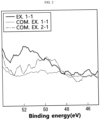
- FIG. 1 shows 1s electron XPS spectra for fluorine of the positive electrode active materials according to Example 1-1, Comparative Example 1-1 and Comparative Example 2-1.
- FIG. 2 shows 2p electron XPS spectra for magnesium of the positive electrode active materials according to Example 1-1, Comparative Example 1-1 and Comparative Example 2-1.
- a 2p electron derived peak of magnesium having the peak top near 51.0 eV in a range between 50 eV and 52 eV was observed.
- a 2p electron derived peak of magnesium having the peak top near 49.3 eV in a range between 48 eV and 50 eV was observed.
- a 2p electron derived peak of magnesium was not observed.
- the peak position near 685.5 eV observed in Example 1-1 corresponds to 1s electron peak position of fluorine in the raw material, magnesium fluoride MgF2.
- the peak position near 684.3 eV observed in Comparative Example 2-1 is close to the 1s electron peak position of fluorine in the other compound such as sodium fluoride NaF.
- the peak position near 51.0 eV observed in Example 1-1 corresponds to the 2p electron peak position of magnesium in the raw material, magnesium fluoride MgF2.
- the peak position near 49.3 eV observed in Comparative Example 2-1 is close to the 2p electron peak position of magnesium in the other compound such as magnesium hydroxide Mg(OH)2.
- Example 1-1 in which the lithium transition metal oxide and the magnesium fluoride were simply mixed, the electron state and chemical state of the raw material, magnesium fluoride did not change.
- Comparative Example 2-1 in which the mixture of lithium transition metal oxide and magnesium fluoride was sintered, the chemical state was changed by the decomposition of the raw material, magnesium fluoride.
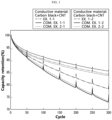
- FIG. 3 is a diagram showing a trend of battery capacity change during first to 300th charging and discharging by plotting the above-defined capacity retention as a function of the number of charge/discharge cycles for each monocell battery of each Example and each Comparative Example. For each Example and each Comparative Example, capacity retention in the first cycle was 100%.
- Example 1-1 when comparing Example 1-1, Comparative Example 1-1 and Comparative Example 2-1 using only carbon black as the conductive material, it was confirmed that battery capacity fading in Example 1-1 was significantly suppressed. It was confirmed from the comparison of Example 1-1 with Comparative Example 1-1 that the addition of magnesium fluoride (without sintering) improved the cycling characteristics. From the comparison of Example 1-1 with Comparative Example 2-1, it was confirmed that the non-sintered mixture of lithium transition metal oxide and magnesium fluoride as the positive electrode active material (Example 1-1) had the improved cycling characteristics than the sintered mixture of the lithium transition metal oxide and the magnesium fluoride (Comparative Example 2-1). The cycling characteristics of Comparative Example 2-1 in which sintering was performed were slightly better than Comparative Example 1-1 in which magnesium fluoride was not added.
- Example 1-1 When comparing the capacity at the charge and discharge current rate of 0.1C every 50 cycles with the capacity at the current rate 0.3C in the common charge and discharge cycles, a capacity difference (i.e., in FIG. 3 , the height of spike-shaped peak found every 50 cycles) was smallest in Example 1-1, and largest in Comparative Example 1-1. That is, the positive electrode active material obtained by adding magnesium fluoride and non-sintering was found as effective even in high rate cycles, compared to the positive electrode active material in which magnesium fluoride was not added or magnesium fluoride was added and sintering was performed.
- Example 1-2, Comparative Example 1-2 and Comparative Example 2-2 using carbon black and carbon nanotubes (CNT) as the conductive material had a significant improvement in cycling characteristics, compared to the use of only carbon black as the conductive material.
- CNT carbon black and carbon nanotubes
- DCR direct current resistance
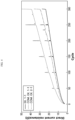
- FIG. 4 is a diagram showing a trend of direct current resistance of the battery over the first to 300th charge/discharge cycles, by plotting the direct current resistance in Example 1-1, Comparative Example 1-1 and Comparative Example 2-1 as a function of the number of charge/discharge cycles.
- Example 1-1 and Comparative Example 2-1 in which magnesium fluoride was added, the increase in direct current resistance over the repeated charge and discharge was suppressed, compared with Comparative Example 1-1 in which magnesium fluoride was not added.
- Example 1-1 with Comparative Example 2-1 it was confirmed that in Example 1-1 in which sintering was not performed, the increase in direct current resistance was suppressed, compared to Comparative Example 2-1.
- Example 1-1 For each coin cell battery manufactured in Example 1-1, Example 1-3, Example 1-4 and Comparative Example 1-1, the trend of capacity retention was investigated in the same way as Evaluation example 2. Specifically, when initial discharge capacity (mAh/g; the mass of magnesium fluoride was ignored when calculating), i.e., discharge capacity in the first charge/discharge cycle is 100%, capacity retention in the 30th charge/discharge cycle and 50th charge/discharge cycle was calculated. In both 30th cycle and 50th cycle, all the capacity retention of Example 1-1, Example 1-3 and Example 1-4 was greater than the capacity retention of Comparative Example 1-1.
- TABLE 2 summarizes differences obtained by subtracting the capacity retention of Comparative Example 1-1 from the capacity retention of each of Example 1-1, Example 1-3 and Example 1-4.
Landscapes
- Chemical & Material Sciences (AREA)
- Chemical Kinetics & Catalysis (AREA)
- Electrochemistry (AREA)
- General Chemical & Material Sciences (AREA)
- Engineering & Computer Science (AREA)
- Inorganic Chemistry (AREA)
- Materials Engineering (AREA)
- Organic Chemistry (AREA)
- Manufacturing & Machinery (AREA)
- Composite Materials (AREA)
- Battery Electrode And Active Subsutance (AREA)
- Inorganic Compounds Of Heavy Metals (AREA)
Applications Claiming Priority (2)
| Application Number | Priority Date | Filing Date | Title |
|---|---|---|---|
| JP2023001342A JP2024097693A (ja) | 2023-01-06 | 2023-01-06 | 正極活物質、正極活物質スラリー、正極、リチウムイオン二次電池、および正極活物質の製造方法 |
| PCT/KR2024/000143 WO2024147645A1 (ko) | 2023-01-06 | 2024-01-03 | 양극 활물질, 양극 활물질 슬러리, 양극, 리튬 이온 이차전지 및 양극 활물질의 제조 방법 |
Publications (2)
| Publication Number | Publication Date |
|---|---|
| EP4571880A1 true EP4571880A1 (de) | 2025-06-18 |
| EP4571880A4 EP4571880A4 (de) | 2026-03-25 |
Family
ID=91803884
Family Applications (1)
| Application Number | Title | Priority Date | Filing Date |
|---|---|---|---|
| EP24738715.2A Pending EP4571880A4 (de) | 2023-01-06 | 2024-01-03 | Positivelektrodenaktivmaterial, positivelektrodenaktivmaterialschlamm, positivelektrode, lithium-ionen-sekundärbatterie und verfahren zur herstellung eines positivelektrodenaktivmaterials |
Country Status (5)
| Country | Link |
|---|---|
| EP (1) | EP4571880A4 (de) |
| JP (1) | JP2024097693A (de) |
| KR (1) | KR20250130680A (de) |
| CN (1) | CN119585881A (de) |
| WO (1) | WO2024147645A1 (de) |
Families Citing this family (1)
| Publication number | Priority date | Publication date | Assignee | Title |
|---|---|---|---|---|
| JP7713121B1 (ja) * | 2024-06-17 | 2025-07-24 | 住友化学株式会社 | 熱可塑性エラストマー組成物、およびその製造方法 |
Family Cites Families (10)
| Publication number | Priority date | Publication date | Assignee | Title |
|---|---|---|---|---|
| JP3959333B2 (ja) * | 2001-11-20 | 2007-08-15 | 日本化学工業株式会社 | リチウムコバルト系複合酸化物、その製造方法、リチウム二次電池正極活物質及びリチウム二次電池 |
| KR100701532B1 (ko) * | 2005-06-21 | 2007-03-29 | 대정화금주식회사 | 불소화합물이 첨가된 리튬이차전지 양극 활물질 및 그제조방법 |
| WO2015083901A1 (ko) * | 2013-12-02 | 2015-06-11 | 주식회사 엘앤에프신소재 | 리튬 이차 전지용 양극 활물질, 이의 제조방법 및 이를 포함하는 리튬 이차 전지 |
| KR102307907B1 (ko) * | 2014-11-04 | 2021-10-01 | 삼성에스디아이 주식회사 | 양극 활물질, 이를 채용한 양극과 리튬 전지 및 이의 제조 방법 |
| KR102530225B1 (ko) * | 2016-10-12 | 2023-05-08 | 가부시키가이샤 한도오따이 에네루기 켄큐쇼 | 양극 활물질 입자 및 양극 활물질 입자의 제작 방법 |
| JP6800417B2 (ja) | 2016-10-12 | 2020-12-16 | 日本電気株式会社 | リチウムイオン二次電池用正極材料、リチウムイオン二次電池用正極およびリチウムイオン二次電池 |
| EP3343223A1 (de) | 2016-12-30 | 2018-07-04 | Blink AG | Vorgefertigtes mikropartikel zur durchführung einer digitalen detektion eines analyten |
| KR102529616B1 (ko) * | 2017-06-26 | 2023-05-04 | 가부시키가이샤 한도오따이 에네루기 켄큐쇼 | 양극 활물질의 제작 방법 및 이차 전지 |
| JP7389598B2 (ja) * | 2019-09-20 | 2023-11-30 | 太平洋セメント株式会社 | リチウムイオン二次電池用混合型正極活物質及びリチウムイオン二次電池用正極の製造方法 |
| CN111740087A (zh) * | 2020-06-29 | 2020-10-02 | 深圳澳睿新能源科技有限公司 | 用于锂离子电池正极材料及其制备方法 |
-
2023
- 2023-01-06 JP JP2023001342A patent/JP2024097693A/ja active Pending
-
2024
- 2024-01-03 EP EP24738715.2A patent/EP4571880A4/de active Pending
- 2024-01-03 CN CN202480003465.4A patent/CN119585881A/zh active Pending
- 2024-01-03 WO PCT/KR2024/000143 patent/WO2024147645A1/ko not_active Ceased
- 2024-01-03 KR KR1020257026405A patent/KR20250130680A/ko active Pending
Also Published As
| Publication number | Publication date |
|---|---|
| EP4571880A4 (de) | 2026-03-25 |
| JP2024097693A (ja) | 2024-07-19 |
| WO2024147645A1 (ko) | 2024-07-11 |
| KR20250130680A (ko) | 2025-09-02 |
| CN119585881A (zh) | 2025-03-07 |
Similar Documents
| Publication | Publication Date | Title |
|---|---|---|
| EP3678230B1 (de) | Anodenaktivmaterial, anode damit und lithiumsekundärbatterie | |
| EP3754763B1 (de) | Negativelektrodenaktivmaterial für lithiumsekundärbatterie, herstellungsverfahren dafür, negativelektrode einer lithiumsekundärbatterie damit und lithiumsekundärbatterie | |
| EP3503267B1 (de) | Negativelektrodenaktivmaterial für lithiumsekundärbatterie, negativelektrode damit und lithiumsekundärbatterie mit der negativelektrode | |
| EP3567661B1 (de) | Kathodenaktivmaterial für sekundärbatterie und lithiumsekundärbatterie damit | |
| EP4080615B1 (de) | Positivelektrodenaktivmaterial für eine sekundärbatterie und lithiumsekundärbatterie damit | |
| EP2437337B1 (de) | Kathode, Herstellungsverfahren dafür und Lithiumbatterie mit der Kathode | |
| EP2741350A1 (de) | Negativelektroden- Aktivmaterial, Verfahren zur Herstellung davon, Negativelektrode und Lithiumsekundärbatterie mit der Elektrode mit einer fotoelektrischen Vorrichtung dem Negativelektroden-Aktivmaterial | |
| US20230073433A1 (en) | Positive Electrode Material for Lithium Secondary Battery, and Positive Electrode and Lithium Secondary Battery Which Include the Same | |
| EP4451387A1 (de) | Kathodenaktivmaterial, herstellungsverfahren dafür sowie kathode und lithiumsekundärbatterie damit | |
| US12255336B2 (en) | Negative electrode and lithium secondary battery including same | |
| CN114651347B (zh) | 负极活性材料和包含所述负极活性材料的负极和二次电池 | |
| EP4415072A1 (de) | Kathodenaktivmaterial, herstellungsverfahren dafür und lithiumsekundärbatterie damit | |
| EP4207380B1 (de) | Aktivmaterial für positive elektroden, suspensionen von aktimaterial für positive elektroden, positive elektroden, lithium-ionen-batterie und verahren zur hestellung von aktivmaterial für positive elektroden | |
| EP4632843A1 (de) | Kathodenaktivmaterial und kathode und lithiumsekundärbatterie damit | |
| EP4742324A1 (de) | Positivelektrodenaktivmaterial, verfahren zur herstellung davon und positivelektrode und lithiumsekundärbatterie damit | |
| EP4718527A1 (de) | Positivelektrodenaktivmaterial und herstellungsverfahren dafür | |
| EP4329005A1 (de) | Kathodenaktivmaterial, kathodenaktivmaterialaufschlämmung, kathode, lithium-ionen-sekundärbatterie und verfahren zur herstellung eines kathodenaktivmaterials | |
| EP4293751A1 (de) | Kathodenaktivmaterial, kathodenaktivmaterialaufschlämmung, kathode, lithium-ionen-sekundärbatterie und verfahren zur herstellung eines kathodenaktivmaterials | |
| US20240120468A1 (en) | Positive Electrode Active Material For Lithium Secondary Battery, Method Of Preparing The Same, And Lithium Secondary Battery Comprising The Same | |
| KR20170067082A (ko) | 리튬 이차전지용 양극 첨가제 및 이를 포함하는 이차전지 | |
| EP4668361A1 (de) | Kathodenaktivmaterial, herstellungsverfahren dafür sowie kathode und lithiumsekundärbatterie damit | |
| KR20250130680A (ko) | 양극 활물질, 양극 활물질 슬러리, 양극, 리튬 이온 이차전지 및 양극 활물질의 제조 방법 | |
| EP4273955B1 (de) | Positivelektrode und lithiumsekundärbatterie damit | |
| KR102916281B1 (ko) | 양극 활물질, 이의 제조방법, 및 이를 포함하는 양극 및 리튬 이차전지 | |
| EP4708398A1 (de) | Positivelektrodenaktivmaterial, verfahren zur herstellung davon, positivelektrode mit positivelektrodenaktivmaterial und lithiumsekundärbatterie mit positivelektrodenaktivmaterial |
Legal Events
| Date | Code | Title | Description |
|---|---|---|---|
| STAA | Information on the status of an ep patent application or granted ep patent |
Free format text: STATUS: THE INTERNATIONAL PUBLICATION HAS BEEN MADE |
|
| PUAI | Public reference made under article 153(3) epc to a published international application that has entered the european phase |
Free format text: ORIGINAL CODE: 0009012 |
|
| STAA | Information on the status of an ep patent application or granted ep patent |
Free format text: STATUS: REQUEST FOR EXAMINATION WAS MADE |
|
| 17P | Request for examination filed |
Effective date: 20250314 |
|
| AK | Designated contracting states |
Kind code of ref document: A1 Designated state(s): AL AT BE BG CH CY CZ DE DK EE ES FI FR GB GR HR HU IE IS IT LI LT LU LV MC ME MK MT NL NO PL PT RO RS SE SI SK SM TR |
|
| A4 | Supplementary search report drawn up and despatched |
Effective date: 20260219 |
|
| RIC1 | Information provided on ipc code assigned before grant |
Ipc: H01M 4/36 20060101AFI20260213BHEP Ipc: H01M 4/525 20100101ALI20260213BHEP Ipc: H01M 10/052 20100101ALI20260213BHEP Ipc: H01M 4/02 20060101ALI20260213BHEP Ipc: H01M 4/62 20060101ALI20260213BHEP Ipc: H01M 10/0525 20100101ALI20260213BHEP |
|
| DAV | Request for validation of the european patent (deleted) | ||
| DAX | Request for extension of the european patent (deleted) |