EP4572396A1 - Procédé exécuté par un équipement utilisateur et équipement utilisateur - Google Patents
Procédé exécuté par un équipement utilisateur et équipement utilisateur Download PDFInfo
- Publication number
- EP4572396A1 EP4572396A1 EP23851725.4A EP23851725A EP4572396A1 EP 4572396 A1 EP4572396 A1 EP 4572396A1 EP 23851725 A EP23851725 A EP 23851725A EP 4572396 A1 EP4572396 A1 EP 4572396A1
- Authority
- EP
- European Patent Office
- Prior art keywords
- resource
- sidelink
- user equipment
- lte
- subframe
- Prior art date
- Legal status (The legal status is an assumption and is not a legal conclusion. Google has not performed a legal analysis and makes no representation as to the accuracy of the status listed.)
- Pending
Links
Images


Classifications
-
- H—ELECTRICITY
- H04—ELECTRIC COMMUNICATION TECHNIQUE
- H04W—WIRELESS COMMUNICATION NETWORKS
- H04W72/00—Local resource management
- H04W72/12—Wireless traffic scheduling
- H04W72/1215—Wireless traffic scheduling for collaboration of different radio technologies
-
- H—ELECTRICITY
- H04—ELECTRIC COMMUNICATION TECHNIQUE
- H04W—WIRELESS COMMUNICATION NETWORKS
- H04W72/00—Local resource management
- H04W72/12—Wireless traffic scheduling
-
- H—ELECTRICITY
- H04—ELECTRIC COMMUNICATION TECHNIQUE
- H04W—WIRELESS COMMUNICATION NETWORKS
- H04W28/00—Network traffic management; Network resource management
- H04W28/16—Central resource management; Negotiation of resources or communication parameters, e.g. negotiating bandwidth or QoS [Quality of Service]
-
- H—ELECTRICITY
- H04—ELECTRIC COMMUNICATION TECHNIQUE
- H04W—WIRELESS COMMUNICATION NETWORKS
- H04W28/00—Network traffic management; Network resource management
- H04W28/16—Central resource management; Negotiation of resources or communication parameters, e.g. negotiating bandwidth or QoS [Quality of Service]
- H04W28/26—Resource reservation
-
- H—ELECTRICITY
- H04—ELECTRIC COMMUNICATION TECHNIQUE
- H04W—WIRELESS COMMUNICATION NETWORKS
- H04W72/00—Local resource management
- H04W72/02—Selection of wireless resources by user or terminal
-
- H—ELECTRICITY
- H04—ELECTRIC COMMUNICATION TECHNIQUE
- H04W—WIRELESS COMMUNICATION NETWORKS
- H04W72/00—Local resource management
- H04W72/04—Wireless resource allocation
-
- H—ELECTRICITY
- H04—ELECTRIC COMMUNICATION TECHNIQUE
- H04W—WIRELESS COMMUNICATION NETWORKS
- H04W72/00—Local resource management
- H04W72/12—Wireless traffic scheduling
- H04W72/1263—Mapping of traffic onto schedule, e.g. scheduled allocation or multiplexing of flows
-
- H—ELECTRICITY
- H04—ELECTRIC COMMUNICATION TECHNIQUE
- H04W—WIRELESS COMMUNICATION NETWORKS
- H04W72/00—Local resource management
- H04W72/20—Control channels or signalling for resource management
-
- H—ELECTRICITY
- H04—ELECTRIC COMMUNICATION TECHNIQUE
- H04W—WIRELESS COMMUNICATION NETWORKS
- H04W72/00—Local resource management
- H04W72/50—Allocation or scheduling criteria for wireless resources
Definitions
- the present invention relates to the technical field of wireless communications, and in particular to a method performed by user equipment, and corresponding user equipment.
- D2D communication device-to-device communication
- 3GPP 3rd Generation Partnership Project
- V2X Vehicle to Everything
- Application scenarios of V2X mainly include four aspects:
- V2X stage 1 introduces a new D2D communication interface referred to as a PC5 interface.
- the PC5 interface is mainly used to address the issue of cellular Internet of Vehicle (IoV) communication in high-speed (up to 250 km/h) and high-node density environments. Vehicles can exchange information such as position, speed, and direction through the PC5 interface, that is, the vehicles can communicate directly through the PC5 interface.
- the functions introduced in LTE Release 14 V2X mainly include:
- the second stage of the V2X research project belongs to the LTE Release 15 research category (see Non-Patent Document 4).
- the main features introduced include high-order 64QAM modulation, V2X carrier aggregation, short TTI transmission, as well as feasibility study of transmit diversity.
- the 5G NR V2X project supports user equipment sensing-based resource allocation mode 2, or referred to as transmission mode 2.
- the physical layer of the user equipment senses transmission resources in a resource pool, which means that the user equipment, according to indication information in received SCI transmitted by another user equipment, determines whether to exclude a resource that is in a candidate resource set and that overlaps with a resource indicated by the indication information, and resources that are not excluded from the candidate resource set are reported to a higher layer.
- a pre-emption check mechanism is supported.
- the pre-emption check means that after the MAC layer selects a resource for sidelink transmission, sensing is performed again on the selected transmission resource at a certain future moment, so as to determine whether the resource has been reserved or pre-empted by another user equipment. If the transmission resource has been reserved or pre-empted by the other user equipment, the MAC layer may trigger resource re-selection to re-select a resource in place of the transmission resource pre-empted by the other user equipment.
- NR SL evo A standardization study project based on standardized NR sidelink evolution (abbreviated as NR SL evo) was approved at the 3GPP RAN#95e plenary meeting in March 2022 (see Non-Patent Document 6).
- the research objectives of NR SL evo include the following aspect:
- the solution of the present patent mainly includes a method for reporting pre-emption of a transmission resource to a MAC layer by the physical layer of NR sidelink user equipment, or a method for performing resource re-selection by NR sidelink user equipment, in a scenario in which LTE sidelink and NR sidelink co-channel is present.
- the solution of the present patent is also included in inter-UE coordination scheme 1, and relates to a method for reporting pre-emption of a transmission resource to a MAC layer by the physical layer of NR sidelink user equipment, or a method for performing resource re-selection by NR sidelink user equipment.
- the present invention provides a method performed by user equipment, and user equipment.
- a method performed by user equipment comprises: requesting or triggering, by a higher layer, the user equipment to determine a resource subset for a physical sidelink shared channel (PSSCH)/physical sidelink control channel (PSCCH) transmission; The user equipment reports pre-emption of a resource to the higher layer.
- PSSCH physical sidelink shared channel
- PSCCH physical sidelink control channel
- the higher layer selects, from the resource subset, a sidelink resource for the PSSCH/PSCCH transmission, and/or the higher layer requests, in a slot n, the user equipment to determine the resource subset for the PSSCH/PSCCH transmission.
- the higher layer provides a resource set ( r 0 ', r 1 ', r 2 '... ) in the slot n.
- resources of the resource set ( r' 0 , r' 1 , r' 2 , ... ) are subject to pre-emption.
- the user equipment reports, to the higher layer, pre-emption of one resource r i ' in the resource set ( r' 0 , r' 1 , r' 2 ,).
- the user equipment reporting, to the higher layer, pre-emption of one resource r i ' in the resource set ( r' 0 , r' 1 , r' 2 , ...) comprises: if the resource r i ' overlaps with a resource indicated by an LTE sidelink module, the user equipment reports pre-emption of the resource r i ' to the higher layer; or the LTE sidelink module of the user equipment indicates a first resource set to an NR sidelink module, and/or the LTE sidelink module of the user equipment indicates a second resource set to the NR sidelink module.
- the first resource set represents reserved resources in LTE sidelink communication
- the second resource set represents all candidate resources corresponding to a subframe that is not monitored by the LTE sidelink module.
- the user equipment reports the pre-emption of the resource r i ' to the higher layer.
- User equipment comprises: a processor; and a memory storing instructions, wherein the instructions, when run by the processor, perform the method according to the first aspect.
- the solution of the present patent in a scenario of LTE sidelink and NR sidelink co-channel coexistence, it can be ensured that a resource overlapping with a reserved resource indicated by an LTE sidelink module and reported to a MAC layer by a physical layer of an NR sidelink user equipment is a preempted resource.
- the solution of the present patent can ensure that an NR sidelink communication device performs resource re-selection with respect to overlapping resources.
- the above solution avoids the problem of resource conflict in NR sidelink and LTE sidelink co-channel coexistence, and can effectively improve the reliability of NR sidelink.
- a 5G mobile communication system and later evolved versions thereof are used as exemplary application environments to set forth a plurality of embodiments according to the present invention in detail.
- the present invention is not limited to the following embodiments, but is applicable to many other wireless communication systems, such as a communication system after 5G and a 4G mobile communication system before 5G.
- V2X and sidelink mentioned in the description of the present invention have the same meaning.
- the V2X herein can also mean sidelink; similarly, the sidelink herein can also mean V2X, and no specific distinction and limitation will be made in the following text.
- the resource allocation mode of V2X (sidelink) communication and the transmission mode of V2X (sidelink) communication in the description of the present invention can equivalently replace each other.
- the resource allocation mode involved in the description can mean a transmission mode, and the transmission mode involved herein can mean a resource allocation mode.
- transmission mode 1 represents a base station scheduling-based transmission mode (resource allocation mode)
- transmission mode 2 represents a user equipment sensing-based and resource selection-based transmission mode (resource allocation mode).
- the PSCCH in the description of the present invention is used to carry SCI.
- the PSSCH associated with or relevant to or corresponding to or scheduled by PSCCH involved in the description of the present invention has the same meaning, and all refer to an associated PSSCH or a corresponding PSSCH.
- the SCI (including first stage SCI and second stage SCI) associated with or relevant to or corresponding to PSSCH involved in the description has the same meaning, and all refer to associated SCI or corresponding SCI.
- the first stage SCI referred to as 1st stage SCI or SCI format 1-A
- the second stage SCI referred to as 2nd stage SCI or SCI format 2-A (or, SCI format 2-B)
- 2nd stage SCI or SCI format 2-A is transmitted on resources of the corresponding PSSCH.
- a numerology includes two aspects: a subcarrier spacing and a cyclic prefix (CP) length.
- each slot includes 14 OFDM symbols; for the extended CP, each slot includes 12 OFDM symbols.
- NR and LTE have the same definition for a subframe, which denotes 1 ms.
- a slot index in one subframe (1 ms) may be expressed as n s ⁇ , and ranges from 0 to N slot subframe , ⁇ ⁇ 1 .
- a slot index in one system frame (a duration of 10 ms) may be expressed as n s , f ⁇ , and ranges from 0 to N slot frame , ⁇ ⁇ 1 .
- Definitions of N slot subframe , ⁇ and N slot frame , ⁇ for different subcarrier spacings ⁇ are shown in the tables below.
- Table 4.3.2-1 the number of symbols included in each slot, the number of slots included in each system frame, and the number of slots included in each subframe for the normal CP P N symb slot N slot frame , ⁇ N slot subframe , ⁇ 0 14 10 1 1 14 20 2 2 14 40 4 3 14 80 8 4 14 160 16
- Table 4.3.2-2 the number of symbols included in each slot, the number of slots included in each system frame, and the number of slots included in each subframe for the extended CP (60 kHz) P N symb slot N slot frame , ⁇ N slot subframe , ⁇ 2 12 40 4
- a system frame (or simply referred to as frame) number ranges from 0 to 1023.
- the concept of a direct system frame number (DFN) is introduced to sidelink, and the number thereof likewise ranges from 0 to 1023.
- the above description of the relationship between the system frame and numerology can also be applied to a direct system frame.
- the duration of one direct system frame is likewise equal to 10 ms; for a 15 kHz subcarrier spacing, one direct system frame includes 10 slots, and so on.
- the DFN is applied to timing on a sidelink carrier.
- the LTE only supports a 15 kHz subcarrier spacing. Both the extended CP and the normal CP are supported in the LTE.
- the subframe has a duration of 1 ms and includes two slots. Each slot has a duration of 0.5 ms.
- each subframe For a normal CP, each subframe includes 14 OFDM symbols, and each slot in the subframe includes 7 OFDM symbols; for an extended CP, each subframe includes 12 OFDM symbols, and each slot in the subframe includes 6 OFDM symbols.
- the UE From the perspective of the UE side, the UE only has two scenarios, out-of-coverage and in-coverage. Partial-coverage is described from the perspective of sidelink communication.
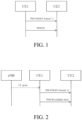
- FIG. 1 is a schematic diagram showing LTE V2X UE sidelink communication.
- UE1 transmits to UE2 sidelink control information (SCI format 1), which is carried by a physical layer channel PSCCH.
- SCI format 1 includes scheduling information of a PSSCH, such as frequency domain resources and the like of the PSSCH.
- UE1 transmits to UE2 sidelink data, which is carried by the physical layer channel PSSCH.
- the PSCCH and the corresponding PSSCH are frequency division multiplexed, that is, the PSCCH and the corresponding PSSCH are located in the same subframe in the time domain but are located on different RBs in the frequency domain.
- one transport block (TB) may include only one initial transmission, or include one initial transmission and one blind retransmission (indicating a retransmission not based on HARQ feedback).
- LTE V2X resource allocation modes transmission mode 3/transmission mode 4
- FIG. 2 shows two LTE V2X resource allocation modes, which are referred to as base station scheduling-based resource allocation (transmission mode 3) and UE sensing-based resource allocation (transmission mode 4), respectively.
- transmission mode 3 in LTE V2X corresponds to transmission mode 1 in NR V2X, and is a base station scheduling-based transmission mode
- transmission mode 4 in LTE V2X corresponds to transmission mode 2 in NR V2X, and is a UE sensing-based transmission mode.
- a base station can configure, through UE-level dedicated RRC signaling SL-V2X-ConfigDedicated, a resource allocation mode of UE, alternatively referred to as a transmission mode of the UE, which is specifically as follows:
- a method for determining a subframe resource pool is based on all subframes in a range of SFN#0 to SFN#1023, a total of 10240 subframes.
- a subframe set that may belong to a PSSCH subframe resource pool transmitted by V2X UE is represented as ( t 0 SL , t 1 SL , ... , t T max SL ), which meets the conditions:
- P rsvp_TX' P step ⁇ P rsvp _ TX /100.
- Table 1 Determination of P step P step TDD UL/DL configuration information 0 60 TDD UL/DL configuration information 1 40 TDD UL/DL configuration information 2 20 TDD UL/DL configuration information 3 30 TDD UL/DL configuration information 4 20 TDD UL/DL configuration information 5 10 TDD UL/DL configuration information 6 50 Other 100
- P rsvp_TX represents a resource reservation interval indicated by a higher layer.
- a resource reservation interval indicated by higher layers is represented as P rsvp_TX .
- Table 2 Resource reservation indication field in SCI X Specific description '0001', '0010', ..., '1010' Value of indication field in SCI 1 ⁇ X ⁇ 10.
- an upper layer requests in subframe #n that sidelink data needs to be transmitted.
- subframe t n ′ ⁇ 10 ⁇ P step SL
- t n ′ ⁇ 10 ⁇ P step + 1 SL
- t n ′ ⁇ 1 SL
- the UE monitors SCI format 1 transmitted by another UE, and the UE determines, according to the successfully decoded SCI format 1, an available resource in a candidate resource set between subframe #(n + T1) and subframe #(n + T2), and reports the determined available resource to the upper layer.
- t n ′ SL n
- t n ′ SL indicates the first subframe belonging to the subframe set ( t 0 SL , t 1 SL , ... , t T max SL ) after subframe #n.
- T1 and T2 depend on a specific implementation of the UE.
- Each element in the candidate resource set between subframe #(n + T1) and subframe #(n + T2), namely, each candidate resource, can be referred to as a candidate single subframe resource, which is represented using R x,y .
- the specific definition of R x,y is:
- the UE assumes that between subframe #(n + T1) and subframe #(n + T2), any L subCH consecutive sub-channels belonging to a PSSCH resource pool correspond to one candidate single subframe resource.
- the candidate resource set is represented using S A .
- the UE after the UE performs the sensing, the UE reports candidate single subframe resources that are not excluded to higher layers, so that the higher layers (e.g., the MAC layer) perform sidelink resource selection.
- the higher layers e.g., the MAC layer
- the user equipment In LTE sidelink communication, the user equipment is limited to half-duplex. That is, when the user equipment performs sidelink communication transmission in a subframe, the user equipment cannot perform sidelink communication reception in the subframe; similarly, when the user equipment performs sidelink communication reception in a subframe, the user equipment cannot perform sidelink communication transmission in the subframe.
- the LTE sidelink user equipment excludes all candidate resources in the resource selection window corresponding to these non-monitored subframes.
- the higher layer parameter restrictResourceReservationPeriod indicates the reservation interval of all resources supported in the resource pool.
- all excluded candidate single subframe resources R x , y are referred to as all candidate resources corresponding to non-monitored subframes.
- resources transmitted and received by UE all belong to resource pools. For example, for a base station scheduling-based transmission mode in sidelink, the base station schedules transmission resources for sidelink UE in a resource pool; alternatively, for a UE sensing-based transmission mode in sidelink, the UE determines a transmission resource in a resource pool.
- sidelink user equipment selects a candidate resource within one time window, determines, according to a reserved resource indicated by a PSCCH transmitted by another user equipment in a monitoring slot, candidate resources overlapping with the reserved resource, and excludes the foregoing candidate resources overlapping with the reserved resource.
- the physical layer reports, to the MAC layer, a set of candidate resources that are not excluded, and the MAC layer selects transmission resources for the PSSCH/PSCCH.
- a set of transmission resources selected by the MAC layer is referred to as a selected sidelink grant.
- the resource allocation mode based on sensing means that the set of slots monitored by the user equipment is consecutive slots in a monitoring window (sensing window).
- the resource allocation mode based on partial sensing includes two parts, i.e., periodic-based partial sensing (PBPS) and contiguous partial sensing.
- PBPS periodic-based partial sensing
- the PBPS means that a candidate slot corresponds to one or a plurality of periodic monitoring slots.
- the CPS means that continuous slot monitoring is performed within a particular monitoring window.
- a higher layer requests or triggers, in a slot n, the physical layer to determine a resource for PSSCH/PSCCH transmission (to perform sensing or partial sensing).
- the resource selection window is defined as [n + T1, n + T2]. That is, user equipment selects a transmission resource within the foregoing window.
- T1 satisfies the condition 0 ⁇ T 1 ⁇ T proc , 1 SL , and the selection of T1 is up to user equipment implementation.
- RRC configuration information includes a resource selection window configuration list sl-SelectionWindowList, and an element on the list and corresponding to a given priority prio TX (the priority of transmitting the PSSCH) is represented by T 2min . If T 2min is less than a remaining packet delay budget (PDB), T2 satisfies the condition T 2min ⁇ T2 ⁇ remaining PDB, and the selection of T2 is up to user equipment implementation; otherwise, T2 is set to the remaining PDB.
- T proc , 1 SL is defined as follows ( ⁇ SL represents a sidelink subcarrier spacing parameter, that is, the subcarrier spacing is 2 ⁇ SL ⁇ 15kHz): Table 8.1.4-2: Values of T proc , 1 SL .
- an LTE sidelink module may share (or indicate) information to an NR sidelink module, wherein the information may be resource reservation information of the LTE sidelink, sensing information, or the like.
- the NR sidelink module may also acquire resource pool configuration information of the LTE sidelink, configuration information of the LTE sidelink SLSS, etc., i.e., including, but not limited to, the above information, without the need for sharing (or indicating) by the LTE sidelink module.
- the pre-emption check means that after the MAC layer selects a resource for sidelink transmission, sensing is performed again on the selected transmission resource at a certain future moment, so as to determine whether the resource has been reserved or pre-empted by another user equipment. If the transmission resource has been reserved or pre-empted by the other user equipment, the MAC layer may trigger resource re-selection to re-select a resource in place of the transmission resource reserved or pre-empted by the other user equipment.
- Inter-UE coordination supports the following two schemes:
- UE A transmitting the coordination message and UE B receiving the coordination message are both referred to as sidelink user equipment.
- FIG. 3 is a schematic diagram showing a basic procedure of a method performed by user equipment according to Embodiment 1 of the present invention.
- Embodiment 1 of the present invention The method performed by user equipment according to Embodiment 1 of the present invention is described in detail below in conjunction with the basic procedure diagram shown in FIG. 3 .
- the steps performed by the user equipment include: in step S101, a higher layer (or an upper layer) requests (or triggers) sidelink user equipment (the physical layer) to determine a resource subset for a PSSCH/PSCCH transmission.
- the higher layer selects a sidelink resource for the PSSCH/PSCCH transmission from the resource subset.
- the higher layer requests, in a slot n, the user equipment to determine the resource subset for the PSSCH/PSCCH transmission.
- the higher layer provides a resource set ( r 0 ', r 1 ', r 2 ' ,...) on the slot n.
- resources of the resource set are subject to the pre-emption (check).
- step S102 the sidelink user equipment reports to the higher layer (MAC layer) that one resource r i ' in the resource set ( r 0 ', r 1 ', r 2 ' ,...) is preempted.
- MAC layer MAC layer
- the sidelink user equipment reports to a higher layer (MAC layer) that the resource r i ' is pre-empted
- the LTE sidelink module of the sidelink user equipment indicates to (or shares with) an NR sidelink module a first resource set.
- the first resource set represents reserved resources in the LTE sidelink communication (by other LTE sidelink user equipments).
- the LTE sidelink module of the sidelink user equipment indicates to (or shares with) the NR sidelink module a second resource set.
- the second resource set represents all candidate resources corresponding to a subframe that is not monitored by the LTE sidelink module. If the resource r i ' overlaps with the second resource set, then the sidelink user equipment reports to the higher layer (MAC layer) that the resource r i ' is pre-empted.
- MAC layer MAC layer
- FIG. 4 is a schematic diagram showing a basic procedure of a method performed by user equipment according to Embodiment 2 of the present invention.
- Embodiment 2 of the present invention A method performed by user equipment according to Embodiment 2 of the present invention will be described in detail below with reference to the basic procedure diagram shown in FIG. 4 .
- steps performed by the user equipment include: In step 201, an LTE sidelink module of a sidelink user equipment indicates to (or shares with) an NR sidelink module a first resource set and/or a second resource set.
- the first resource set represents reserved resources in LTE sidelink communication (by other LTE sidelink user equipments).
- the second resource set represents all candidate resources corresponding to a subframe that is not monitored by the LTE sidelink module.
- step S202 the sidelink user equipment performs resource re-selection with respect to a resource r in a selected sidelink grant.
- step S202 at least satisfies the following: If the resource r overlaps with the first resource set and/or the second resource set, then, optionally, the user equipment removes the resource r from the selected sidelink grant, and, optionally, selects a time-frequency sidelink resource (from the resource set indicated by the physical layer), and, optionally, replaces the removed resource r with the selected time-frequency sidelink resource.
- the steps performed by user equipment include: In step 1, a higher layer (or an upper layer) requests (or triggers) a sidelink user equipment (the physical layer) to determine a resource subset for a PSSCH/PSCCH transmission.
- the higher layer selects, from the resource subset, a sidelink resource for the PSSCH/PSCCH transmission.
- the higher layer requests, in a slot n, the user equipment to determine the resource subset for the PSSCH/PSCCH transmission.
- the higher layer provides a resource set ( r 0 ', r 1 ', r 2 ' ,...) on the slot n.
- resources of the resource set are subject to the pre-emption (check).
- step 2 the sidelink user equipment reports to the higher layer (MAC layer) that one resource r i ' in the resource set ( r 0 ', r 1 ', r 2 ' ,..) is preempted.
- MAC layer MAC layer
- the sidelink user equipment reports to the higher layer (MAC layer) that the resource r i ' is pre-empted.
- the steps performed by a user equipment include: In step 1, a sidelink user equipment receives a non-preferred resource set for transmission.
- step 2 the sidelink user equipment performs resource re-selection with respect to a resource r in a selected sidelink grant.
- step 2 at least satisfies the following: If the resource r overlaps with the non-preferred resource set for transmission, then, optionally, the user equipment removes the resource r from the selected sidelink grant, and, optionally, selects a time-frequency sidelink resource (from the resource set indicated by the physical layer), and, optionally, replaces the removed resource r with the selected time-frequency sidelink resource.
- FIG. 5 is a block diagram showing user equipment (UE) involved in the present invention.
- the user equipment (UE) 80 includes a processor 801 and a memory 802.
- the processor 801 may include, for example, a microprocessor, a microcontroller, an embedded processor, and the like.
- the memory 802 may include, for example, a volatile memory (such as a random access memory (RAM)), a hard disk drive (HDD), a non-volatile memory (such as a flash memory), or other memories, etc.
- the memory 802 has program instructions stored thereon. The instructions, when run by the processor 801, can perform the method executed by the user equipment described in detail in the present invention.
- the method and related equipment according to the present invention have been described above in combination with preferred embodiments. It should be understood by those skilled in the art that the method shown above is only exemplary, and the above embodiments can be combined with one another as long as no contradiction arises.
- the method of the present invention is not limited to the steps or sequences illustrated above.
- the network node and user equipment illustrated above may include more modules.
- the network node and user equipment may further include modules that can be developed or will be developed in the future to be applied to a base station, an MME, or UE, and the like.
- Various identifiers shown above are only exemplary, and are not meant for limiting the present invention.
- the present invention is not limited to specific information elements serving as examples of these identifiers. A person skilled in the art could make various alterations and modifications according to the teachings of the illustrated embodiments.
- various components in the base station and user equipment in the above embodiments can be implemented by multiple devices, and these devices include, but are not limited to: an analog circuit device, a digital circuit device, a digital signal processing (DSP) circuit, a programmable processor, an application-specific integrated circuit (ASIC), a field-programmable gate array (FPGA), a complex programmable logic device (CPLD), and the like.
- DSP digital signal processing
- ASIC application-specific integrated circuit
- FPGA field-programmable gate array
- CPLD complex programmable logic device
- the "base station” may refer to a mobile communication data and control exchange center having large transmission power and a wide coverage area, including functions such as resource allocation and scheduling and data reception and transmission.
- “User equipment” may refer to user mobile terminals, such as terminal devices that can communicate with a base station or a micro base station wirelessly, including a mobile phone, a laptop computer, and the like.
- the embodiments of the present invention disclosed herein may be implemented on a computer program product.
- the computer program product is a product provided with a computer-readable medium having computer program logic encoded thereon.
- the computer program logic When executed on a computing device, the computer program logic provides related operations to implement the above technical solutions of the present invention.
- the computer program logic When executed on at least one processor of a computing system, the computer program logic causes the processor to perform the operations (the method) described in the embodiments of the present invention.
- Such setting of the present invention is typically provided as software, codes and/or other data structures provided or encoded on the computer-readable medium, e.g., an optical medium (e.g., compact disc read-only memory (CD-ROM)), a flexible disk or a hard disk and the like, or other media such as firmware or micro codes on one or more read-only memory (ROM) or random access memory (RAM) or programmable read-only memory (PROM) chips, or a downloadable software image, a shared database and the like in one or more modules.
- Software or firmware or such configuration may be installed on a computing device such that one or more processors in the computing device perform the technical solutions described in the embodiments of the present invention.
- each functional module or each feature of the base station device and the terminal device used in each of the above embodiments may be implemented or executed by circuits, which are usually one or more integrated circuits. Circuits designed to execute various functions described in this description may include general-purpose processors, digital signal processors (DSPs), application-specific integrated circuits (ASICs) or general-purpose integrated circuits, field-programmable gate arrays (FPGAs) or other programmable logic devices, discrete gates or transistor logic, or discrete hardware components, or any combination of the above.
- the general-purpose processor may be a microprocessor, or the processor may be an existing processor, a controller, a microcontroller, or a state machine.
- the aforementioned general-purpose processor or each circuit may be configured by a digital circuit or may be configured by a logic circuit. Furthermore, when advanced technology capable of replacing current integrated circuits emerges due to advances in semiconductor technology, the present invention can also use integrated circuits obtained using this advanced technology.
Landscapes
- Engineering & Computer Science (AREA)
- Computer Networks & Wireless Communication (AREA)
- Signal Processing (AREA)
- Quality & Reliability (AREA)
- Mobile Radio Communication Systems (AREA)
Applications Claiming Priority (2)
| Application Number | Priority Date | Filing Date | Title |
|---|---|---|---|
| CN202210946670.7A CN117596636A (zh) | 2022-08-08 | 2022-08-08 | 由用户设备执行的方法以及用户设备 |
| PCT/CN2023/111248 WO2024032504A1 (fr) | 2022-08-08 | 2023-08-04 | Procédé exécuté par un équipement utilisateur et équipement utilisateur |
Publications (2)
| Publication Number | Publication Date |
|---|---|
| EP4572396A1 true EP4572396A1 (fr) | 2025-06-18 |
| EP4572396A4 EP4572396A4 (fr) | 2026-03-04 |
Family
ID=89850825
Family Applications (1)
| Application Number | Title | Priority Date | Filing Date |
|---|---|---|---|
| EP23851725.4A Pending EP4572396A4 (fr) | 2022-08-08 | 2023-08-04 | Procédé exécuté par un équipement utilisateur et équipement utilisateur |
Country Status (4)
| Country | Link |
|---|---|
| US (1) | US20260052527A1 (fr) |
| EP (1) | EP4572396A4 (fr) |
| CN (1) | CN117596636A (fr) |
| WO (1) | WO2024032504A1 (fr) |
Families Citing this family (2)
| Publication number | Priority date | Publication date | Assignee | Title |
|---|---|---|---|---|
| CN118741687A (zh) * | 2023-03-29 | 2024-10-01 | 夏普株式会社 | 由用户设备执行的方法以及用户设备 |
| CN119496593A (zh) * | 2023-08-16 | 2025-02-21 | 夏普株式会社 | 由用户设备执行的方法以及用户设备 |
Family Cites Families (4)
| Publication number | Priority date | Publication date | Assignee | Title |
|---|---|---|---|---|
| EP4042790A4 (fr) * | 2019-11-20 | 2022-11-02 | Guangdong Oppo Mobile Telecommunications Corp., Ltd. | Communication de liaison latérale à préemption de ressources |
| CN114071734A (zh) * | 2020-08-05 | 2022-02-18 | 夏普株式会社 | 由用户设备执行的方法以及用户设备 |
| CN114205863B (zh) * | 2020-09-17 | 2024-05-31 | 华硕电脑股份有限公司 | 无线通信系统中处置侧链路通信装置间协调的方法和设备 |
| CN114697922B (zh) * | 2020-12-31 | 2025-03-25 | 夏普株式会社 | 由用户设备执行的方法以及用户设备 |
-
2022
- 2022-08-08 CN CN202210946670.7A patent/CN117596636A/zh active Pending
-
2023
- 2023-08-04 WO PCT/CN2023/111248 patent/WO2024032504A1/fr not_active Ceased
- 2023-08-04 EP EP23851725.4A patent/EP4572396A4/fr active Pending
- 2023-08-04 US US19/101,275 patent/US20260052527A1/en active Pending
Also Published As
| Publication number | Publication date |
|---|---|
| CN117596636A (zh) | 2024-02-23 |
| US20260052527A1 (en) | 2026-02-19 |
| WO2024032504A1 (fr) | 2024-02-15 |
| EP4572396A4 (fr) | 2026-03-04 |
Similar Documents
| Publication | Publication Date | Title |
|---|---|---|
| EP4187999B1 (fr) | Procédé exécuté par un équipement utilisateur, et équipement utilisateur | |
| EP4404600A1 (fr) | Procédé exécuté par un équipement utilisateur, et équipement utilisateur | |
| EP4597899A1 (fr) | Procédé mis en oeuvre par un équipement utilisateur et équipement utilisateur | |
| EP4376448A1 (fr) | Procédé exécuté par un équipement utilisateur, et équipement utilisateur | |
| EP4572396A1 (fr) | Procédé exécuté par un équipement utilisateur et équipement utilisateur | |
| EP4546913A1 (fr) | Procédé exécuté par un équipement utilisateur et équipement utilisateur | |
| EP4131826B1 (fr) | Procédé exécuté par un équipement utilisateur et équipement utilisateur | |
| WO2024001957A1 (fr) | Procédé exécuté par un équipement utilisateur, et équipement utilisateur | |
| EP4514003A1 (fr) | Procédé exécuté par un équipement utilisateur, et équipement utilisateur | |
| CN115334655A (zh) | 由用户设备执行的方法以及用户设备 | |
| WO2024149091A1 (fr) | Procédé mis en œuvre par un équipement utilisateur et équipement utilisateur | |
| US12395989B2 (en) | Method performed by user equipment, and user equipment | |
| CN115580907A (zh) | 由用户设备执行的方法以及用户设备 | |
| EP4319221A1 (fr) | Procédé mis en oeuvre par un équipement utilisateur, et équipement utilisateur | |
| US20250016803A1 (en) | Method performed by user equipment, and user equipment | |
| WO2025036324A1 (fr) | Procédé exécuté par un équipement utilisateur et équipement utilisateur | |
| CN120417089A (zh) | 由用户设备执行的方法以及用户设备 | |
| CN119316961A (zh) | 由用户设备执行的方法以及用户设备 | |
| CN121665352A (zh) | 由用户设备执行的方法以及用户设备 | |
| CN120676463A (zh) | 由用户设备执行的方法以及用户设备 | |
| CN119946836A (zh) | 由用户设备执行的方法以及用户设备 | |
| CN118283576A (zh) | 由用户设备执行的方法以及用户设备 | |
| CN116234015A (zh) | 由用户设备执行的方法以及用户设备 | |
| CN118741687A (zh) | 由用户设备执行的方法以及用户设备 | |
| CN116887436A (zh) | 由用户设备执行的方法以及用户设备 |
Legal Events
| Date | Code | Title | Description |
|---|---|---|---|
| STAA | Information on the status of an ep patent application or granted ep patent |
Free format text: STATUS: THE INTERNATIONAL PUBLICATION HAS BEEN MADE |
|
| PUAI | Public reference made under article 153(3) epc to a published international application that has entered the european phase |
Free format text: ORIGINAL CODE: 0009012 |
|
| STAA | Information on the status of an ep patent application or granted ep patent |
Free format text: STATUS: REQUEST FOR EXAMINATION WAS MADE |
|
| 17P | Request for examination filed |
Effective date: 20250219 |
|
| AK | Designated contracting states |
Kind code of ref document: A1 Designated state(s): AL AT BE BG CH CY CZ DE DK EE ES FI FR GB GR HR HU IE IS IT LI LT LU LV MC ME MK MT NL NO PL PT RO RS SE SI SK SM TR |
|
| DAV | Request for validation of the european patent (deleted) | ||
| DAX | Request for extension of the european patent (deleted) | ||
| A4 | Supplementary search report drawn up and despatched |
Effective date: 20260202 |
|
| RIC1 | Information provided on ipc code assigned before grant |
Ipc: H04W 28/26 20090101AFI20260127BHEP |