EP4573961A1 - Procédé et dispositif de fabrication d'une pièce de fermeture adhésive et pièce de fermeture adhésive - Google Patents
Procédé et dispositif de fabrication d'une pièce de fermeture adhésive et pièce de fermeture adhésive Download PDFInfo
- Publication number
- EP4573961A1 EP4573961A1 EP24219890.1A EP24219890A EP4573961A1 EP 4573961 A1 EP4573961 A1 EP 4573961A1 EP 24219890 A EP24219890 A EP 24219890A EP 4573961 A1 EP4573961 A1 EP 4573961A1
- Authority
- EP
- European Patent Office
- Prior art keywords
- carrier web
- coating material
- adhesive
- adhesive elements
- web
- Prior art date
- Legal status (The legal status is an assumption and is not a legal conclusion. Google has not performed a legal analysis and makes no representation as to the accuracy of the status listed.)
- Pending
Links
Images
Classifications
-
- B—PERFORMING OPERATIONS; TRANSPORTING
- B29—WORKING OF PLASTICS; WORKING OF SUBSTANCES IN A PLASTIC STATE IN GENERAL
- B29C—SHAPING OR JOINING OF PLASTICS; SHAPING OF MATERIAL IN A PLASTIC STATE, NOT OTHERWISE PROVIDED FOR; AFTER-TREATMENT OF THE SHAPED PRODUCTS, e.g. REPAIRING
- B29C41/00—Shaping by coating a mould, core or other substrate, i.e. by depositing material and stripping-off the shaped article; Apparatus therefor
- B29C41/24—Shaping by coating a mould, core or other substrate, i.e. by depositing material and stripping-off the shaped article; Apparatus therefor for making articles of indefinite length
-
- A—HUMAN NECESSITIES
- A44—HABERDASHERY; JEWELLERY
- A44B—BUTTONS, PINS, BUCKLES, SLIDE FASTENERS, OR THE LIKE
- A44B18/00—Fasteners of the touch-and-close type; Making such fasteners
- A44B18/0046—Fasteners made integrally of plastics
- A44B18/0049—Fasteners made integrally of plastics obtained by moulding processes
-
- A—HUMAN NECESSITIES
- A44—HABERDASHERY; JEWELLERY
- A44B—BUTTONS, PINS, BUCKLES, SLIDE FASTENERS, OR THE LIKE
- A44B18/00—Fasteners of the touch-and-close type; Making such fasteners
- A44B18/0046—Fasteners made integrally of plastics
- A44B18/0053—Fasteners made integrally of plastics in which each part has similar elements
-
- A—HUMAN NECESSITIES
- A44—HABERDASHERY; JEWELLERY
- A44B—BUTTONS, PINS, BUCKLES, SLIDE FASTENERS, OR THE LIKE
- A44B18/00—Fasteners of the touch-and-close type; Making such fasteners
- A44B18/0069—Details
- A44B18/0073—Attaching means
-
- B—PERFORMING OPERATIONS; TRANSPORTING
- B29—WORKING OF PLASTICS; WORKING OF SUBSTANCES IN A PLASTIC STATE IN GENERAL
- B29C—SHAPING OR JOINING OF PLASTICS; SHAPING OF MATERIAL IN A PLASTIC STATE, NOT OTHERWISE PROVIDED FOR; AFTER-TREATMENT OF THE SHAPED PRODUCTS, e.g. REPAIRING
- B29C35/00—Heating, cooling or curing, e.g. crosslinking or vulcanising; Apparatus therefor
- B29C35/02—Heating or curing, e.g. crosslinking or vulcanizing during moulding, e.g. in a mould
- B29C35/08—Heating or curing, e.g. crosslinking or vulcanizing during moulding, e.g. in a mould by wave energy or particle radiation
- B29C35/0805—Heating or curing, e.g. crosslinking or vulcanizing during moulding, e.g. in a mould by wave energy or particle radiation using electromagnetic radiation
-
- B—PERFORMING OPERATIONS; TRANSPORTING
- B29—WORKING OF PLASTICS; WORKING OF SUBSTANCES IN A PLASTIC STATE IN GENERAL
- B29C—SHAPING OR JOINING OF PLASTICS; SHAPING OF MATERIAL IN A PLASTIC STATE, NOT OTHERWISE PROVIDED FOR; AFTER-TREATMENT OF THE SHAPED PRODUCTS, e.g. REPAIRING
- B29C35/00—Heating, cooling or curing, e.g. crosslinking or vulcanising; Apparatus therefor
- B29C35/02—Heating or curing, e.g. crosslinking or vulcanizing during moulding, e.g. in a mould
- B29C35/08—Heating or curing, e.g. crosslinking or vulcanizing during moulding, e.g. in a mould by wave energy or particle radiation
- B29C35/10—Heating or curing, e.g. crosslinking or vulcanizing during moulding, e.g. in a mould by wave energy or particle radiation for articles of indefinite length
-
- B—PERFORMING OPERATIONS; TRANSPORTING
- B29—WORKING OF PLASTICS; WORKING OF SUBSTANCES IN A PLASTIC STATE IN GENERAL
- B29C—SHAPING OR JOINING OF PLASTICS; SHAPING OF MATERIAL IN A PLASTIC STATE, NOT OTHERWISE PROVIDED FOR; AFTER-TREATMENT OF THE SHAPED PRODUCTS, e.g. REPAIRING
- B29C41/00—Shaping by coating a mould, core or other substrate, i.e. by depositing material and stripping-off the shaped article; Apparatus therefor
- B29C41/34—Component parts, details or accessories; Auxiliary operations
- B29C41/36—Feeding the material on to the mould, core or other substrate
-
- B—PERFORMING OPERATIONS; TRANSPORTING
- B29—WORKING OF PLASTICS; WORKING OF SUBSTANCES IN A PLASTIC STATE IN GENERAL
- B29C—SHAPING OR JOINING OF PLASTICS; SHAPING OF MATERIAL IN A PLASTIC STATE, NOT OTHERWISE PROVIDED FOR; AFTER-TREATMENT OF THE SHAPED PRODUCTS, e.g. REPAIRING
- B29C41/00—Shaping by coating a mould, core or other substrate, i.e. by depositing material and stripping-off the shaped article; Apparatus therefor
- B29C41/34—Component parts, details or accessories; Auxiliary operations
- B29C41/38—Moulds, cores or other substrates
-
- B—PERFORMING OPERATIONS; TRANSPORTING
- B29—WORKING OF PLASTICS; WORKING OF SUBSTANCES IN A PLASTIC STATE IN GENERAL
- B29C—SHAPING OR JOINING OF PLASTICS; SHAPING OF MATERIAL IN A PLASTIC STATE, NOT OTHERWISE PROVIDED FOR; AFTER-TREATMENT OF THE SHAPED PRODUCTS, e.g. REPAIRING
- B29C41/00—Shaping by coating a mould, core or other substrate, i.e. by depositing material and stripping-off the shaped article; Apparatus therefor
- B29C41/34—Component parts, details or accessories; Auxiliary operations
- B29C41/46—Heating or cooling
-
- B—PERFORMING OPERATIONS; TRANSPORTING
- B29—WORKING OF PLASTICS; WORKING OF SUBSTANCES IN A PLASTIC STATE IN GENERAL
- B29C—SHAPING OR JOINING OF PLASTICS; SHAPING OF MATERIAL IN A PLASTIC STATE, NOT OTHERWISE PROVIDED FOR; AFTER-TREATMENT OF THE SHAPED PRODUCTS, e.g. REPAIRING
- B29C43/00—Compression moulding, i.e. applying external pressure to flow the moulding material; Apparatus therefor
- B29C43/22—Compression moulding, i.e. applying external pressure to flow the moulding material; Apparatus therefor of articles of indefinite length
- B29C43/222—Compression moulding, i.e. applying external pressure to flow the moulding material; Apparatus therefor of articles of indefinite length characterised by the shape of the surface
-
- B—PERFORMING OPERATIONS; TRANSPORTING
- B29—WORKING OF PLASTICS; WORKING OF SUBSTANCES IN A PLASTIC STATE IN GENERAL
- B29C—SHAPING OR JOINING OF PLASTICS; SHAPING OF MATERIAL IN A PLASTIC STATE, NOT OTHERWISE PROVIDED FOR; AFTER-TREATMENT OF THE SHAPED PRODUCTS, e.g. REPAIRING
- B29C59/00—Surface shaping of articles, e.g. embossing; Apparatus therefor
- B29C59/02—Surface shaping of articles, e.g. embossing; Apparatus therefor by mechanical means, e.g. pressing
- B29C59/026—Surface shaping of articles, e.g. embossing; Apparatus therefor by mechanical means, e.g. pressing of layered or coated substantially flat surfaces
-
- B—PERFORMING OPERATIONS; TRANSPORTING
- B29—WORKING OF PLASTICS; WORKING OF SUBSTANCES IN A PLASTIC STATE IN GENERAL
- B29C—SHAPING OR JOINING OF PLASTICS; SHAPING OF MATERIAL IN A PLASTIC STATE, NOT OTHERWISE PROVIDED FOR; AFTER-TREATMENT OF THE SHAPED PRODUCTS, e.g. REPAIRING
- B29C59/00—Surface shaping of articles, e.g. embossing; Apparatus therefor
- B29C59/02—Surface shaping of articles, e.g. embossing; Apparatus therefor by mechanical means, e.g. pressing
- B29C59/04—Surface shaping of articles, e.g. embossing; Apparatus therefor by mechanical means, e.g. pressing using rollers or endless belts
- B29C59/046—Surface shaping of articles, e.g. embossing; Apparatus therefor by mechanical means, e.g. pressing using rollers or endless belts for layered or coated substantially flat surfaces
-
- B—PERFORMING OPERATIONS; TRANSPORTING
- B29—WORKING OF PLASTICS; WORKING OF SUBSTANCES IN A PLASTIC STATE IN GENERAL
- B29L—INDEXING SCHEME ASSOCIATED WITH SUBCLASS B29C, RELATING TO PARTICULAR ARTICLES
- B29L2031/00—Other particular articles
- B29L2031/727—Fastening elements
- B29L2031/729—Hook and loop-type fasteners
Definitions
- the invention relates to a method for producing a touch-and-close fastener part comprising a plurality of adhesive elements with end-face contact surfaces for releasable adhesion to other components by means of adhesive force.
- the adhesive elements are formed from a coating material in mold cavities of a molding screen of a molding tool.
- the invention further relates to an apparatus for producing a touch-and-close fastener part, comprising: a molding tool with a molding screen in which mold cavities are formed, and a feed device for feeding a coating material to the mold cavities of the molding tool, which are designed to form a plurality of adhesive elements with end-face contact surfaces for releasable adhesion to other components by means of adhesive force.
- the invention also relates to a touch-and-close fastener part comprising: a plurality of adhesive elements made of a coating material with end-face contact surfaces for releasable adhesion to other components by means of adhesive force.
- a touch-and-close fastener part is described with a carrier part and closure parts arranged upright thereon, each of which has a head part that has at least one contact surface on its free end face for releasable adhesion to another component by means of adhesive force.
- the closure parts are formed in the mold cavities of a metallic forming screen by pressing a coating material or plastic material into the mold cavities of the forming screen and forming the closure parts from the coating material on a side of the carrier part associated with a forming roller.
- the adhesion mechanism used for releasable attachment to (at least) one other component is the so-called van der Waals interaction, which is classically regarded as a subgroup of adhesion.
- Adhesion enables reliable adhesion of the adhesive elements even to components with smooth surfaces, such as window glass. Adhesion is made possible, among other things, by the fact that the contact surfaces have a comparatively small surface area of, for example, approximately 0.2 ⁇ m 2 to approximately 0.5 ⁇ m 2 .
- a method for producing a carrier web from a predeterminable amount of plastic material comprising a plurality of shaped elements formed in the mold cavities of a molding tool and configured as mushroom-shaped interlocking means.
- a cavity is formed in a portion of the mold cavities inside the shaped element.
- the respective cavity in the shaped element can be closed at least on one side by a closure web.
- the interlocking means are intended to engage with other interlocking means, for example, with fleece or hook material.
- a microfiber array which has a plurality of fibers with roughened tips which are brought into contact with a surface of a smooth, flat object.
- the microfiber array is intended to They allow friction to resist horizontal movement and controllable adhesion for easy separation from the object's surface in the vertical direction.
- the microfiber array is formed from a thermosetting polymer using a mold.
- a potting material can be used to create a negative cast of the microfiber array with the roughened tips, and the negative cast can be used to mold additional microfiber arrays.
- the strip of holding elements is formed by distributing a molding material in a molding device.
- the substrate is applied to an underside of a base of the strip facing away from the holding elements before the underside of the base of the strip solidifies.
- the object of the invention is to provide a robustly implementable method and a corresponding device that allows material savings during the production of the adhesive fastener part. It is also an object of the invention to provide a corresponding adhesive fastener part.
- a carrier web is fed to the coating material, and the adhesive elements are formed on a side of the carrier web facing the coating material in the mold cavities of the molding tool, wherein the carrier web is preferably bonded to the coating material before the adhesive elements are formed.
- the terms "plastic material” and “coating material” as well as the terms “plastic web” and “coating web” are used synonymously.
- a carrier web is fed to the coating material, to which the coating material is bonded during the formation of the adhesive elements.
- This increases the robustness of the manufacturing process, as it becomes less sensitive to the rheology of the coating material.
- the carrier web bonded to the coating material can prevent tearing of the coating material during the manufacturing process, for example, during demolding from the mold, or the coating material can be made thinner than would be the case in a manufacturing process without the use of the carrier web.
- the coating material can be drawn into the molding tool by capillary forces.
- connection between the carrier web and the coating material takes place before the adhesive elements are formed.
- the coating material can, for example, be connected to the carrier web in the manner of a coating.
- the connection can be achieved, for example, by the (band-shaped) coating material and the carrier web being fed together to the forming tool and resting against one another during or before feeding to the forming tool. It is also possible for the coating material and the carrier web to be pressed against one another during feeding in order to facilitate the connection of the carrier web to the coating material.
- the connection between the coating material and the carrier web is thus established before the carrier web and the coating material reach the forming tool.
- a coating web is formed from the coating material between the carrier web and the adhesive elements, said coating web having a thickness of 2 mm or less, preferably 300 ⁇ m or less, particularly preferably 200 ⁇ m or less, very particularly preferably 50 ⁇ m or less, extraordinarily preferably 30 ⁇ m or less, in particular 10 ⁇ m or less.
- the adhesive elements are formed on the side of the one-piece coating web facing away from the carrier web by the coating material being pressed into the mold cavities of the mold or flowing into them. Due to the carrier web to which it is connected, the thickness of the coating web can be significantly lower than when producing the adhesive fastener part without the use of the carrier web.
- coating material can be saved during production of the adhesive fastener part, as well as energy during polymerization of the coating material, i.e., a more sustainable adhesive fastener part can be produced with the same functionality. Due to the reduced thickness of the coating layer, the flexibility of the adhesive fastener part is increased, which can have a positive effect on the adhesion properties of the adhesive fastener part, e.g. on components with curved surfaces.
- the carrier web is separated from the coating web after the adhesive elements have been removed from the mold cavities of the mold.
- the carrier web is a sacrificial web that is only used to make the manufacturing process more robust, but is no longer used on the touch-and-close fastener part itself.
- the carrier web it is also possible for the carrier web to have an adhesive layer or an adhesive coating on the side facing the coating material, which remains on the coating web with the adhesive elements after the carrier web has been separated from the coating web.
- the separation of the carrier web from the coating web is typically carried out by an operator immediately before the touch-and-close fastener part is used, e.g. to attach it to a rigid component using the adhesive layer.
- the carrier web can be permanently or permanently bonded to the coating web and form part of the touch-and-close fastener.
- the permanent bond between the carrier web and the coating web can be created, in particular, without the use of a joining agent in the form of an adhesive.
- the carrier web can have an adhesion promoter layer or be subjected to a surface treatment to create the permanent bond (see below).
- the forming screen of the forming tool is band-shaped and, in order to form the adhesive elements in the mold cavities of the band-shaped forming screen, the carrier web is brought into contact with the band-shaped forming screen with the side facing the coating material, preferably guided along the band-shaped forming screen.
- a band-shaped Typically, a metallic forming screen is used, which typically rotates around two rollers. The coating material is typically brought into contact with the belt-shaped forming screen in the area of one of the two rollers, typically placed onto the belt-shaped forming screen, whereby the coating material penetrates or flows into the mold cavities through capillary forces, generally without the need for additional pressure to be applied to the coating material or the carrier web.
- the device can comprise a curing device for curing the coating material after forming the adhesive elements, wherein the curing device is preferably designed for curing the coating material after demolding the adhesive elements from the mold or before demolding.
- curing can occur, for example, by heat, light, and/or humidity.
- the curing device can comprise one or more heating elements, one or more heat radiators, light sources, and/or a device for increasing the humidity in the environment of the adhesive closure part.
- the material of the carrier web can, for example, be selected from the group comprising: textile, nonwoven, foam, in particular acrylate foam, polyurethane, thermoplastics.
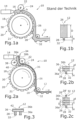
- the coating web 26 of the adhesive closure part 12 can be made significantly thinner, as can be seen from a comparison of Fig. 2b which is connected to the device 10 of Fig. 2a or with the one below in connection with Fig. 4 described device 10, with which in Fig. 1b
- the thickness D of the coating web 26 is that shown in Fig. 2b 50 ⁇ m or less, e.g. 30 ⁇ m or less or approx. 10 ⁇ m or less, but can also be greater and be 2 mm or less, 300 ⁇ m or less, 200 ⁇ m or less or 100 ⁇ m or less.
- the thickness d of the carrier web 36 is also comparatively small and is approx.
- the carrier web 36 is designed as a film, i.e. the carrier web 36 forms a carrier film.
- the carrier film can carry information, but this is not absolutely necessary.
- the carrier web 36 can also be designed as a rigid component.
- the material of the carrier web 36 can be a textile, a nonwoven, a net, a foam, for example acrylate foam, polyurethane, elastomers, thermoplastic elastomers, thermosets or adhesives.
- the carrier web 36 can be made of a thermoplastic material, e.g. polyethylene terephthalate (PET).
- PET polyethylene terephthalate
- the carrier web 36 can be thermoformed, e.g. by a deep-drawing process, which enables the adhesive elements 28 to extend in different directions and adhere in different directions.
- the carrier web 36 can be provided with an adhesion promoter, e.g., an adhesion promoter layer, on its first side 36a facing the coating material 16, or the first side 36a of the carrier web 36 can be subjected to a surface treatment. It is also possible, in principle, to detachably bond the carrier web 36 to the coating material 16, in particular in a peelable manner, so that the carrier web 36 can be separated or peeled off from the carrier web 36 after the adhesive elements 28 have been removed from the mold cavities 18 of the molding tool 20. In this case, the carrier web 36 serves only to prevent tearing of the coating material 16 during the manufacture of the adhesive closure part 12, so that the coating web 26 can be produced with a smaller thickness D than is possible in connection with Fig. 1a,b described.
- an adhesion promoter e.g., an adhesion promoter layer
- the height h of the conveying gap 24 essentially corresponds to the thickness d of the carrier web 36.
- the holding elements 28 are formed directly and individually on the carrier web 36, as shown in Fig. 3
- a connecting means for example in the form of an adhesive layer 42, can be applied to the carrier web 36, as is also shown in Fig. 3
- the adhesive layer 42 enables a permanent connection of the adhesive closure part 12 with another component which is Fig. 3 is not shown pictorially.
- the adhesive elements 28 of the Fig. 2b and in Fig. 3 shown adhesive fastener parts 12 to another component, also not shown, which has a smooth surface, by means of adhesive force.
- the adhesive elements 28 of Fig. 2b and Fig. 3 a surface density of at least 10000 / cm 2 and not more than 100000 / cm 2 , typically at least 25000 / cm 2 and not more than 50000 / cm 2 , on the carrier web 36.
- the further adhesive elements 28' of the adhesive closure part 12 of Fig. 2c have an areal density of at least 15000 / cm 2 and not more than 20000 / cm 2 .
- the production of the adhesive fastener part 12 can also be carried out in a manner other than that described above.
- a forming tool 20 having one forming roller 21 instead of a forming tool 20 having one forming roller 21, a forming tool having two or more forming rollers can be used.
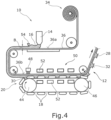
- Fig. 4 shows a device 10 for producing the adhesive fastener part 12, which differs from the device shown in Fig. 2a shown device 10, among other things, in that the metallic forming screen 30 is band-shaped and rotates around a first roller 44 and a second roller 46.
- the distance between the two rollers 44, 46 is selected such that the forming screen 30 is tensioned, so that a straight section of the forming screen 30 is formed between the two rollers 44, 46, which section faces the coating material 16.
- the carrier web 36, with its side 36a facing the coating material 16 is brought into contact with the band-shaped forming screen 30 in the region of the first roller 44, or more precisely, is placed onto the band-shaped forming screen 30.
- the coating material 16 flows into the mold cavities 18 of the band-shaped forming screen 30 by capillary forces, whereby the adhesive elements 28 are formed in the mold cavities 18.
- the carrier web 36 is fed to the forming screen 30 parallel to the straight section which forms the upper side of the forming tool 20.
- a brush 48 presses on the side 36b of the carrier web 36 facing away from the coating material 16 in order to smooth it or to compensate for its waviness.
- the carrier web 36 and thus the coating material 16 is guided along the rectilinear section of the belt-shaped forming screen 30, and the coating material 16 is demolded from the forming screen 30 in the region of the second roller 46, forming the belt-shaped adhesive fastener part 12.
- the coating material 16 is cured as it is guided along the carrier web 36 by a curing device 50.
- the curing device 50 has a plurality of heat radiators 52 arranged in the region of the rectilinear section of the forming screen 30 on both sides 36a, 36b of the carrier web 36.
- the heat radiators 52 introduce IR radiation into the coating material 16 to cure it.
- the device 10 shown is as shown in Fig. 2a
- the coating material 16 is fed to the forming tool 20 by means of a feed device in the form of an extruder head 14.
- the carrier web 36 is coated with the coating material 16, wherein a coating height B is determined by a doctor blade 54 , which serves to smooth the coating material 16.
- the coating height B of the coating material 16 is in the order of magnitude between approximately 50 ⁇ m and 150 ⁇ m. It is possible for the coating material 16 to be structured during coating or for the coating material 16 to be structured after coating, before the coating material 16 is fed to the forming tool 20.
Landscapes
- Engineering & Computer Science (AREA)
- Mechanical Engineering (AREA)
- Health & Medical Sciences (AREA)
- Physics & Mathematics (AREA)
- Toxicology (AREA)
- Oral & Maxillofacial Surgery (AREA)
- Thermal Sciences (AREA)
- Electromagnetism (AREA)
- Slide Fasteners, Snap Fasteners, And Hook Fasteners (AREA)
- Adhesive Tapes (AREA)
Applications Claiming Priority (2)
| Application Number | Priority Date | Filing Date | Title |
|---|---|---|---|
| DE102023213266 | 2023-12-22 | ||
| DE102024205551.4A DE102024205551A1 (de) | 2023-12-22 | 2024-06-17 | Verfahren und Vorrichtung zum Herstellen eines Haftverschlussteils und Haftverschlussteil |
Publications (1)
| Publication Number | Publication Date |
|---|---|
| EP4573961A1 true EP4573961A1 (fr) | 2025-06-25 |
Family
ID=93923862
Family Applications (1)
| Application Number | Title | Priority Date | Filing Date |
|---|---|---|---|
| EP24219890.1A Pending EP4573961A1 (fr) | 2023-12-22 | 2024-12-13 | Procédé et dispositif de fabrication d'une pièce de fermeture adhésive et pièce de fermeture adhésive |
Country Status (3)
| Country | Link |
|---|---|
| US (1) | US20250204648A1 (fr) |
| EP (1) | EP4573961A1 (fr) |
| CN (1) | CN120190944A (fr) |
Citations (15)
| Publication number | Priority date | Publication date | Assignee | Title |
|---|---|---|---|---|
| US6669884B1 (en) * | 1998-11-02 | 2003-12-30 | Gottlieb Binder Gmbh & Co. | Method for producing an adhesive closing element |
| US7008589B1 (en) * | 1999-02-15 | 2006-03-07 | Binder Kletten-Haftverschluss-Systeme Gmbh | Method and device for producing fastener parts from radiation cured plastic materials |
| EP1827795B1 (fr) | 2004-12-03 | 2008-11-26 | Gottlieb Binder GmbH & Co. KG | Procede de production d'une bande support et bande support correspondante |
| US7461437B2 (en) * | 2004-11-15 | 2008-12-09 | Velcro Industries B.V. | Articles and methods of their formation |
| US8079995B2 (en) * | 2003-11-06 | 2011-12-20 | Velcro Industries B.V. | Composite fastener products |
| WO2012031658A1 (fr) | 2010-09-08 | 2012-03-15 | Gottlieb Binder Gmbh & Co. Kg | Élément de fermeture par contact |
| US9399333B2 (en) * | 2012-04-18 | 2016-07-26 | Velcro BVBA | Forming laminated touch fasteners |
| FR3050623A1 (fr) * | 2016-04-29 | 2017-11-03 | Aplix Sa | Procede et appareillage ameliores pour la formation d'elements de retenue |
| US20200352800A1 (en) * | 2018-01-26 | 2020-11-12 | Aplix | Retention device and tape for retention device |
| FR3104387A1 (fr) * | 2019-12-11 | 2021-06-18 | Aplix | Bande de moulage et procédé de formation amélioré. |
| FR3104388A1 (fr) * | 2019-12-11 | 2021-06-18 | Aplix | Dispositif auto-agrippant amélioré et dispositif de moulage associé. |
| US11161283B2 (en) * | 2018-12-20 | 2021-11-02 | Velcro Ip Holdings Llc | Molding fastener products |
| DE102020004438A1 (de) | 2020-07-23 | 2022-01-27 | Gottlieb Binder Gmbh & Co. Kg | Befestigungssystem |
| US20240034912A1 (en) | 2020-12-22 | 2024-02-01 | Setex Technologies, Inc. | Microfiber array having roughened tips for handling of semiconductor devices |
| EP3448671B1 (fr) | 2016-04-29 | 2024-10-23 | Aplix | Appareillage et procede pour la solidarisation d'un substrat a un ruban plastique, et dispositifs de retenue susceptibles d'être obtenus par ledit procede |
-
2024
- 2024-12-13 EP EP24219890.1A patent/EP4573961A1/fr active Pending
- 2024-12-20 US US18/991,157 patent/US20250204648A1/en active Pending
- 2024-12-20 CN CN202411889141.3A patent/CN120190944A/zh active Pending
Patent Citations (16)
| Publication number | Priority date | Publication date | Assignee | Title |
|---|---|---|---|---|
| US6669884B1 (en) * | 1998-11-02 | 2003-12-30 | Gottlieb Binder Gmbh & Co. | Method for producing an adhesive closing element |
| US7008589B1 (en) * | 1999-02-15 | 2006-03-07 | Binder Kletten-Haftverschluss-Systeme Gmbh | Method and device for producing fastener parts from radiation cured plastic materials |
| US8079995B2 (en) * | 2003-11-06 | 2011-12-20 | Velcro Industries B.V. | Composite fastener products |
| US7461437B2 (en) * | 2004-11-15 | 2008-12-09 | Velcro Industries B.V. | Articles and methods of their formation |
| EP1827795B1 (fr) | 2004-12-03 | 2008-11-26 | Gottlieb Binder GmbH & Co. KG | Procede de production d'une bande support et bande support correspondante |
| US7807081B2 (en) * | 2004-12-03 | 2010-10-05 | Gottlieb Binder Gmbh & Co. Kg | Method for producing a supporting web, and supporting web |
| WO2012031658A1 (fr) | 2010-09-08 | 2012-03-15 | Gottlieb Binder Gmbh & Co. Kg | Élément de fermeture par contact |
| US9399333B2 (en) * | 2012-04-18 | 2016-07-26 | Velcro BVBA | Forming laminated touch fasteners |
| FR3050623A1 (fr) * | 2016-04-29 | 2017-11-03 | Aplix Sa | Procede et appareillage ameliores pour la formation d'elements de retenue |
| EP3448671B1 (fr) | 2016-04-29 | 2024-10-23 | Aplix | Appareillage et procede pour la solidarisation d'un substrat a un ruban plastique, et dispositifs de retenue susceptibles d'être obtenus par ledit procede |
| US20200352800A1 (en) * | 2018-01-26 | 2020-11-12 | Aplix | Retention device and tape for retention device |
| US11161283B2 (en) * | 2018-12-20 | 2021-11-02 | Velcro Ip Holdings Llc | Molding fastener products |
| FR3104387A1 (fr) * | 2019-12-11 | 2021-06-18 | Aplix | Bande de moulage et procédé de formation amélioré. |
| FR3104388A1 (fr) * | 2019-12-11 | 2021-06-18 | Aplix | Dispositif auto-agrippant amélioré et dispositif de moulage associé. |
| DE102020004438A1 (de) | 2020-07-23 | 2022-01-27 | Gottlieb Binder Gmbh & Co. Kg | Befestigungssystem |
| US20240034912A1 (en) | 2020-12-22 | 2024-02-01 | Setex Technologies, Inc. | Microfiber array having roughened tips for handling of semiconductor devices |
Non-Patent Citations (1)
| Title |
|---|
| J.-K. KIM ET AL., ADV. MATER., vol. 35, 2023, pages 2207257 |
Also Published As
| Publication number | Publication date |
|---|---|
| US20250204648A1 (en) | 2025-06-26 |
| CN120190944A (zh) | 2025-06-24 |
Similar Documents
| Publication | Publication Date | Title |
|---|---|---|
| DE3643717C2 (de) | Verfahren zum Herstellen einer Kunststoff-Profilierform | |
| DE60218660T2 (de) | Herstellung von diskreten regionen mit verschlusselementen | |
| EP0932346B1 (fr) | Procede et dispositif pour produire une piece de fermeture adhesive en thermoplastique | |
| DE69230288T2 (de) | Verfahren zur herstellung eines geschichteten hakenverschlusses | |
| DE60312993T2 (de) | Umreifungsband | |
| DE69816123T2 (de) | Selbstklebender verschluss; artikel mit diesem verschluss; verfahren zur herstellung und anwendung | |
| AT391899B (de) | Verfahren zum auftrag von partiellen oberflaechenbeschichtungen auf textile substrate und eine vorrichtung zur durchfuehrung des verfahrens | |
| EP1961545B1 (fr) | Procédé de production de surfaces nano et/ou microstructurées dans une couche collante, en particulier autoadhésive | |
| EP2802233B1 (fr) | Procede de fabrication d'un produit en matiere plastique, dispositif permettant la mise en uvre dudit procede | |
| DE1063112B (de) | Verfahren zum Herstellen von Kunstleder | |
| EP2129254A1 (fr) | Procédé pour la fabrication d'un élément de fermeture adhésive ainsi que dispositif et élément de fermeture adhésive fabriqué selon celui-ci | |
| WO1997002128A1 (fr) | Procede et dispositif permettant de produire un produit semi-fini thermoplastique, pelliculaire, a surface structuree | |
| EP2911881A1 (fr) | Dispositif d'estampage à chaud | |
| DE2166968B2 (de) | Verfahren zum Herstellen einer Verbundbahn | |
| EP1827795B1 (fr) | Procede de production d'une bande support et bande support correspondante | |
| EP1223826B1 (fr) | Procede de production d'une partie de fermeture adhesive | |
| DE102020113705B4 (de) | Verfahren zum Herstellen eines Bauteils | |
| EP3261843B1 (fr) | Dispositif pour l'application des éléments décoratifs sur récipients | |
| EP4573961A1 (fr) | Procédé et dispositif de fabrication d'une pièce de fermeture adhésive et pièce de fermeture adhésive | |
| DE102024205551A1 (de) | Verfahren und Vorrichtung zum Herstellen eines Haftverschlussteils und Haftverschlussteil | |
| DE2027836C3 (de) | Schichtkörper aus thermoplastischem Kunststoff, Verfahren zu dessen Herstellung und Vorrichtung zur DurcHerstellungsverfahrens | |
| DE10001148A1 (de) | Flächengebilde mit strukturierter Oberfläche und Verfahren zu dessen Herstellung | |
| EP2516069A2 (fr) | Procédé de fabrication d'une feuille de plastique en forme de bande | |
| DE202018006061U1 (de) | Vorrichtung für die Nachbehandlung eines homogenen Bodenbelags | |
| DE1935904C3 (de) | Vorrichtung zur Herstellung einer Wellpappe aus Kunststoffolie |
Legal Events
| Date | Code | Title | Description |
|---|---|---|---|
| PUAI | Public reference made under article 153(3) epc to a published international application that has entered the european phase |
Free format text: ORIGINAL CODE: 0009012 |
|
| STAA | Information on the status of an ep patent application or granted ep patent |
Free format text: STATUS: THE APPLICATION HAS BEEN PUBLISHED |
|
| AK | Designated contracting states |
Kind code of ref document: A1 Designated state(s): AL AT BE BG CH CY CZ DE DK EE ES FI FR GB GR HR HU IE IS IT LI LT LU LV MC ME MK MT NL NO PL PT RO RS SE SI SK SM TR |
|
| STAA | Information on the status of an ep patent application or granted ep patent |
Free format text: STATUS: REQUEST FOR EXAMINATION WAS MADE |
|
| 17P | Request for examination filed |
Effective date: 20251217 |