EP4574006A1 - Datenverarbeitungsvorrichtung, computerimplementiertes verfahren und medizinische beobachtungsvorrichtung - Google Patents
Datenverarbeitungsvorrichtung, computerimplementiertes verfahren und medizinische beobachtungsvorrichtung Download PDFInfo
- Publication number
- EP4574006A1 EP4574006A1 EP23220032.9A EP23220032A EP4574006A1 EP 4574006 A1 EP4574006 A1 EP 4574006A1 EP 23220032 A EP23220032 A EP 23220032A EP 4574006 A1 EP4574006 A1 EP 4574006A1
- Authority
- EP
- European Patent Office
- Prior art keywords
- spectrum
- color
- digital
- fluorescence
- signal
- Prior art date
- Legal status (The legal status is an assumption and is not a legal conclusion. Google has not performed a legal analysis and makes no representation as to the accuracy of the status listed.)
- Pending
Links
Images


Classifications
-
- A—HUMAN NECESSITIES
- A61—MEDICAL OR VETERINARY SCIENCE; HYGIENE
- A61B—DIAGNOSIS; SURGERY; IDENTIFICATION
- A61B1/00—Instruments for performing medical examinations of the interior of cavities or tubes of the body by visual or photographical inspection, e.g. endoscopes; Illuminating arrangements therefor
- A61B1/04—Instruments for performing medical examinations of the interior of cavities or tubes of the body by visual or photographical inspection, e.g. endoscopes; Illuminating arrangements therefor combined with photographic or television appliances
- A61B1/043—Instruments for performing medical examinations of the interior of cavities or tubes of the body by visual or photographical inspection, e.g. endoscopes; Illuminating arrangements therefor combined with photographic or television appliances for fluorescence imaging
-
- A—HUMAN NECESSITIES
- A61—MEDICAL OR VETERINARY SCIENCE; HYGIENE
- A61B—DIAGNOSIS; SURGERY; IDENTIFICATION
- A61B1/00—Instruments for performing medical examinations of the interior of cavities or tubes of the body by visual or photographical inspection, e.g. endoscopes; Illuminating arrangements therefor
- A61B1/00002—Operational features of endoscopes
- A61B1/00004—Operational features of endoscopes characterised by electronic signal processing
- A61B1/00009—Operational features of endoscopes characterised by electronic signal processing of image signals during a use of endoscope
-
- A—HUMAN NECESSITIES
- A61—MEDICAL OR VETERINARY SCIENCE; HYGIENE
- A61B—DIAGNOSIS; SURGERY; IDENTIFICATION
- A61B5/00—Measuring for diagnostic purposes; Identification of persons
- A61B5/0059—Measuring for diagnostic purposes; Identification of persons using light, e.g. diagnosis by transillumination, diascopy, fluorescence
- A61B5/0071—Measuring for diagnostic purposes; Identification of persons using light, e.g. diagnosis by transillumination, diascopy, fluorescence by measuring fluorescence emission
-
- G—PHYSICS
- G02—OPTICS
- G02B—OPTICAL ELEMENTS, SYSTEMS OR APPARATUS
- G02B21/00—Microscopes
- G02B21/36—Microscopes arranged for photographic purposes or projection purposes or digital imaging or video purposes including associated control and data processing arrangements
- G02B21/365—Control or image processing arrangements for digital or video microscopes
- G02B21/367—Control or image processing arrangements for digital or video microscopes providing an output produced by processing a plurality of individual source images, e.g. image tiling, montage, composite images, depth sectioning, image comparison
-
- A—HUMAN NECESSITIES
- A61—MEDICAL OR VETERINARY SCIENCE; HYGIENE
- A61B—DIAGNOSIS; SURGERY; IDENTIFICATION
- A61B1/00—Instruments for performing medical examinations of the interior of cavities or tubes of the body by visual or photographical inspection, e.g. endoscopes; Illuminating arrangements therefor
- A61B1/00163—Optical arrangements
- A61B1/00186—Optical arrangements with imaging filters
-
- G—PHYSICS
- G01—MEASURING; TESTING
- G01N—INVESTIGATING OR ANALYSING MATERIALS BY DETERMINING THEIR CHEMICAL OR PHYSICAL PROPERTIES
- G01N21/00—Investigating or analysing materials by the use of optical means, i.e. using sub-millimetre waves, infrared, visible or ultraviolet light
- G01N21/62—Systems in which the material investigated is excited whereby it emits light or causes a change in wavelength of the incident light
- G01N21/63—Systems in which the material investigated is excited whereby it emits light or causes a change in wavelength of the incident light optically excited
- G01N21/64—Fluorescence; Phosphorescence
- G01N2021/6417—Spectrofluorimetric devices
- G01N2021/6421—Measuring at two or more wavelengths
-
- G—PHYSICS
- G01—MEASURING; TESTING
- G01N—INVESTIGATING OR ANALYSING MATERIALS BY DETERMINING THEIR CHEMICAL OR PHYSICAL PROPERTIES
- G01N21/00—Investigating or analysing materials by the use of optical means, i.e. using sub-millimetre waves, infrared, visible or ultraviolet light
- G01N21/62—Systems in which the material investigated is excited whereby it emits light or causes a change in wavelength of the incident light
- G01N21/63—Systems in which the material investigated is excited whereby it emits light or causes a change in wavelength of the incident light optically excited
- G01N21/64—Fluorescence; Phosphorescence
- G01N21/645—Specially adapted constructive features of fluorimeters
- G01N21/6456—Spatial resolved fluorescence measurements; Imaging
- G01N21/6458—Fluorescence microscopy
Definitions
- the invention relates to a data processing device and a computer-implemented method for a medical observation device, such as a microscope or endoscope.
- the medical observation device is configured to observe an object containing at least one fluorophore that emits fluorescence.
- the invention further relates to a medical observation device comprising such a digital processing device and to a method for using such a medical observation device, wherein the method comprises the computer-implemented method.
- Medical observation devices such as endoscopes and microscopes are used in surgery and biopsy.
- the object thus generally may contain biological tissue or materials.
- the fluorescence emission of at least one fluorophore is used to provide additional information over the mere reflectance image of the object.
- the at least one fluorophore may be already present in autofluorescent parts of the object or it may be artificially added to the object.
- Autofluorescent tissue may be used to highlight the tissue type even without artificial addition of a fluorophore.
- Other fluorophores are injected into a patient's body or into a cell in order to mark specific regions of interest. If an injected fluorophore stays within the blood stream, it may be used to highlight the location of blood vessels and the direction of flow, i.e. mark anatomical features of the object.
- Other fluorophores are metabolized in certain chemical or biological environments.
- Such fluorophores may be used to indicate the functional or metabolic states of regions of the object.
- 5-ALA is metabolized intracellularly to PpIX in tumorous cells. Accumulations of fluorescing 5-ALA/PpIX may be used to identify the location and extent of tumors by fluorescence emissions.
- typical fluorophores that are used to highlight different aspects of biological tissue are ICG, fluorescein and 5-ALA/PplX.
- the fluorescence emission of the at least one fluorophore in the object allows data about the object to be obtained, which would not be obtainable from the reflectance image alone, or only be obtainable after extensive image processing.
- an accurate processing of the fluorescence emitted by the object is important for surgery and laboratory applications such as biopsy.
- the present invention strives to improve this processing in order to provide more accurate data for evaluating the properties of the object.
- a data processing device for a medical observation device, such as a microscope or endoscope, for observing an object containing at least one fluorophore that emits fluorescence
- the data processing device is configured: to obtain a first color input pixel of a first digital color input image recorded in a first spectrum and containing a first part of a fluorescence emission signal, the fluorescence emission signal being representative of the fluorescence emitted by the at least one fluorophore; to obtain a second color input pixel of a second digital color input image recorded in a second spectrum and containing a second part of the fluorescence emission signal, the second spectrum being different from the first spectrum; to obtain a first set of signal descriptors representative of the first part of the fluorescence emission signal; to obtain a second set of signal descriptors representative of the second part of the fluorescence emission signal; and to assign a value to an output pixel in a digital output color image depending on the first set of signal descriptors, the value being
- a computer-implemented method for a medical observation device for observing an object containing at least one fluorophore such as microscope or endoscope
- the computer-implemented method comprises the following steps: obtaining a first color input pixel of a first digital color input image recorded in a first spectrum and containing a first part of a fluorescence emission signal, the fluorescence emission signal being representative of the fluorescence emitted by the at least one fluorophore; obtaining a second color input pixel of a second digital color input image recorded in a second spectrum and containing a second part of the fluorescence emission signal, the second spectrum being different from the first spectrum; obtaining a first set of signal descriptors representative of the first part of the fluorescence emission signal; obtaining a second set of signal descriptors representative of the second part of the fluorescence emission signal; and assigning a value to an output pixel in a digital output image depending on the first set of signal descriptors and the second set
- the above data processing device and computer-implemented method use two input color images, each recording the fluorescence emission with a different spectrum. Thus more data are available for classifying the fluorescence emission signal compared to just using a single digital color input image. The additional data allow a more accurate distinction between different fluorescence spectra that correspond to different states of the fluorophore.
- the fluorescence spectrum of a fluorophore may change depending on its chemical environment. Changes in the fluorescence emission signal are reflected in the set of signal descriptors that represent the fluorescence emission signal or, equivalently, the fluorescence emission spectrum, i.e. the spectrum of the fluorescence emission signal.
- the set is then mapped to a value, such as an integer value, a float value or a set containing integer and/or float values. The value is thus an indication of the environment of the fluorophore and may be processed further.
- the value is dependent on the fluorescing fluorophore, additional information can be gained over just noting the fluorescence of the at least one fluorophore.
- the value is indicative of the environmental influence on the fluorophore and thus to the processes at the location of the fluorescing fluorophore.
- the digital output image may be any data array where a datum is assigned to a certain location of the object, i.e. a datum corresponding to a pixel.
- the digital output image does not need to have a standardized image format, such as JPG, GIF or MPG.
- the above-identified device and method may be further improved by any one of the following features, which may be arbitrarily combined with one another, each feature having a technical effect of its own.
- Each of the following features may be used in connection with both the data processing device and the computer-implemented method, independent of whether the particular feature has been described in the context of the data processing device or the computer-implemented method. If, for example, a feature has been described in the context of the computer-implemented method, the data processing device may be likewise configured to execute the feature. If a feature has been described in the context of the data processing device, it may be executed as a step in the computer-implemented method.
- Any of the digital input images may contain a plurality of input pixels. Each input pixel represents the light received from a specific location on the object. Each input pixel corresponds to a specific location on the object. If the input image data contain more than one digital input image, a specific location on the object may be represented by more than one input pixel. Input pixels that represent the same location on the object are termed "corresponding pixels" as is usual in the art.
- An input pixel may be a color pixel or a monochrome pixel.
- a color input pixel comprises color space coordinates that define the color of the input pixel in a color space.
- the color space coordinates represent at least some of the color appearance parameters, which include hue, lightness, brightness, chroma, colorfulness and saturation. If a tristimulus color space such as RGB is used, each input pixel comprises three color space coordinates R, G, B.
- the color space coordinate R defines the intensity of the red color band
- the color space coordinate G defines the intensity of the green color band
- the color space coordinate B defines the intensity of the blue color band.
- Other color spaces such as HSV, CIELAB or CIELUV, use other color space coordinates.
- a monochrome input pixel just indicates light intensity in the spectral band where the light is recorded. It thus has only a single color space coordinate.
- a digital input image is a color image, it is termed a "digital color input image”.
- a multispectral or hyperspectral image is considered a color image.
- a digital input image is a monochrome image, it is termed “digital monochrome input image”.
- digital input image may thus be a "digital color input image” or a "digital monochrome input image”. The same terminology is used for the digital output image.
- any of the digital input images may contain one or more signals, such as the fluorescence emission signal or part thereof.
- a "signal" in this context represents a recorded quantity that is generated by a physical phenomenon.
- the fluorescence emission signal is thus a record of the light generated by the fluorescence emission and recorded as a video or image signal.
- a reflectance signal in contrast, is a recorded video or image signal that is generated by the reflection of light off a body.
- the first and second spectrum are preferably non-overlapping. An overlap which is solely due to unavoidable filter leakage may be allowed.
- the first and the second spectrum are complementary.
- the first and the second spectrum may complement each other to continuously cover the entire visible range of the spectrum.
- at least one of the first and the second spectrum may include a passband which covers or is contained in the NIR region.
- the visible light range comprises or consists of light having wavelengths longer than about 380 nm and shorter than about 750 nm.
- the NIR range of light extends from about 750 nm to about 1400 nm or to about 2500 nm.
- the value assigned to an output pixel should be representative of the chemical environment at the location of the object, which is imaged onto the output pixel and in which the at least one fluorescence-emitting fluorophore is located.
- the chemical environment may alter the fluorescence emission spectrum of the fluorophore and thus change the set of signal descriptors.
- the chemical environment may be represented or described by a chemical parameter which e.g. corresponds to the concentration of a specific ion or macromolecule.
- the set of signal descriptors and the value are, via the dependency of the fluorescence emission spectrum on the chemical parameter, representative of the chemical parameter.
- An example of such a chemical parameter is the pH level.
- the change in the fluorescence emission spectrum depending on the chemical parameter may manifest itself in different aspects of the shape of the spectrum.
- the number and/or wavelengths and/or relative intensities of one or more peaks of the fluorescence emission spectrum may change depending on the chemical parameter.
- the energy contained in the off-peak areas of the fluorescence emission spectrum may alter depending on the chemical parameter.
- the width of the one or more peaks of the fluorescence emission spectrum may depend on the chemical parameter.
- the shape of secondary peaks in the fluorescence emission spectrum may change depending on the chemical parameter.
- 5-ALA/PpIX exhibits a pH-dependent fluorescence spectrum, where the shape, e.g. the wavelength of the peak emission frequency depends on the acidity of the environment.
- Different types and/or gradings of tumors have different chemical environments, which cause any of the above-described changes to the fluorescence emission spectrum of a fluorophore, such as 5-ALA/PplX, in the tumor.
- the different spectra are represented by different sets of signal descriptors and thus by different values assigned to the output pixel onto which the tumor is imaged.
- the acidity-depending fluorescence emission spectrum of 5-ALA/PpIX may be used to determine the grading of tumorous tissue.
- the data processing device may be configured to map the set of signal descriptors to a predefined range of values, e.g. using linear mapping.
- the predefined range of values may correspond to an upper and a lower bound of the chemical parameter.
- the upper bound may correspond to a maximum pH level and the lower bound may correspond to a minimum pH level.
- the upper and lower bounds are each represented by a different set of signal descriptors.
- the set of signal descriptors that is representative of (a fluorescence emission spectrum at) the upper bound is mapped to a first value and the set of signal descriptors that is representative of (a fluorescence emission spectrum at) the lower bound is mapped to a second value.
- a set of signal descriptors that is representative of (a fluorescence emission spectrum at) a chemical parameter which is located between the upper and the lower bound is mapped onto a value which is located between the first and the second value.
- the value assigned to the output pixel may be a color.
- the value may correspond, in particular, to at least one color appearance parameter.
- the state of the at least one fluorescing fluorophore or the chemical environment is color-coded.
- the color may be represented in color space coordinates of the color space, in which the digital output image is represented.
- Using a color as the value is a quick way to code the state of the fluorophore and present it in an output image. If the value is not represented as a color in a color space, it may be contained in the metadata of the digital output image or the respective output pixel.
- the first color input pixel may comprise first color space coordinates and the second color output pixel may comprise second color space coordinates
- the first set of signal descriptors may comprise or correspond to the first color space coordinates
- the second set of signal descriptors may comprise or correspond to the second color space coordinates.
- the signal descriptors may simply correspond to the colors recorded at the first and second input pixel. This is accurate if there are no or only negligible additional signals other than the fluorescence emission signal recorded at the first and second input pixel or by the first and second digital input image.
- spectral unmixing may be used to extract the fluorescence emission signal from the first and/or the second digital input image.
- the set of signal descriptors may be obtained directly as a result of the spectral unmixing.
- the data processing device may be configured to apply spectral unmixing to the first color input pixel to obtain the first set of signal descriptors; and to apply spectrum unmixing to the second color input pixel to obtain the second set of signal descriptors.
- the data processing device may comprise a spectral unmixing routine.
- the color of an input pixel results from the sum of a plurality of known spectra.
- the known spectra are termed "endmembers".
- the color of an input pixel is computed as a sum of the endmembers.
- the contributions or, equivalently, coefficients of the endmembers that result in the color of the input pixel may be used as the set of signal descriptors.
- the (known or assumed) fluorescence emission spectra of the at least one fluorophore in predetermined chemical environments or at predetermined chemical parameters, such as the pH level may be used.
- one endmember may represent the fluorescence emission spectrum of 5-ALA/PpIX in an acidic environment at a predetermined pH level, such as a pH level of about 4 or about 5 or less.
- Another endmember may represent the fluorescence emission spectrum of 5-ALA/PpIX in an alkaline environment at a predetermined pH level, such as a pH level of about 8 or about 9 or more.
- the respective passbands of the first and second spectrum may be used as endmembers.
- the first spectrum may comprise at least one, preferably at least two passbands.
- the second spectrum may comprise at least one passband, which may be located between two passbands of the first spectrum. Another passband of the second spectrum may be located in the NIR range. At least one passband of the second spectrum overlaps, contains or is contained within the fluorescence emission spectrum of the at least one fluorophore, for example 5-ALA/PplX.
- This passband may, for example, comprise at least one peak emission frequency of the fluorescence emission spectrum of the at least one fluorophore.
- the data processing device may be configured to assign a color to the color output pixel by e.g. applying a mapping routine to a union set of the first set and the second set of signal descriptors.
- the union set of the first set and the second set corresponds to a tuple formed by all the signal descriptors of the fluorescence emission signal.
- the mapping routine may be a linear transformation function and in particular comprise a color conversion matrix.
- the union set of the first and second set of signal descriptors may be treated as a vector (or matrix) which is multiplied with the color conversion matrix.
- the color coordinates of the output pixel may be obtained directly from this multiplication.
- the mapping routine and/or the color conversion matrix may be stored in a memory of the data processing device.
- the mapping routine and/or the color conversion matrix may be determined experimentally in a calibration process. In this calibration process, at least some sets of signal descriptors are computed for known fluorescence emission spectra.
- the known fluorescence emission spectra preferably correspond to known chemical parameters.
- the mapping routine and/or the color conversion matrix may then be determined by assigning specific colors to these known sets of signal descriptors in the calibration process.
- the data processing device may be configured to map the first and second set of signal descriptors, or the union set, to a first value, if the first and second sets, or the union set, are representative of the fluorescence emission spectrum of the at least one fluorophore in a first chemical environment.
- the first chemical environment is preferably represented by a first figure of a chemical parameter such as the pH level.
- the data processing device may be configured to map the first and second set of signal descriptors, or the union set, to a second value, if the first and second sets, or the union set, are representative of the fluorescence emission spectrum of the at least one fluorophore in a second chemical environment.
- the second chemical environment is preferably represented by a second figure of the chemical parameter such as the pH level.
- the data processing device may further be configured to map the first and second set of signal descriptors, or the union set, to a third value or color if the first and second signal descriptors, or the union set, are representative of a third chemical environment.
- the third chemical environment is preferably represented by a third figure of the chemical parameter that lies between the first and the second figure. For this mapping, the mapping routine may be used.
- the position of the third value relative to the first and/or second value or color may correspond to position of the third figure relative to the first and/or second figure.
- the first value may correspond to a first, predetermined color and the second value may correspond to a second, predetermined color.
- Each color may be defined by at least one color appearance parameter depending on the sets of signal descriptors. When a color is assigned to the output pixel, any color appearance parameter may be assigned to the output pixel depending on the set of signal descriptors.
- All third colors may be mapped onto a curve which connects the first and the second color in a color space.
- the chemical parameter may be indicative of the tumor grade.
- an acidic pH may be indicative of a high-grade tumor, e.g. a high-grade glioma, and an alkaline pH of a low-grade tumor, e.g. a low-grade glioma.
- the third value or color may be indicative of the tumor or glioma grading between the highest and lowest tumor grade. The larger the difference of the third value or color from the first value or color, the lower the tumor or glioma grade.
- the sets of the first and second signal descriptors, or the union set are mapped to the first value or color if the first and second set of signal descriptors, or the union set, is representative of a fluorescence emission spectrum having a peak at a first wavelength.
- the first wavelength may be around 634 nm.
- the first and second set of signal descriptors, or the union set may be mapped to the second value or color, if the first and second set of signal descriptors, or the union set, are representative of a fluorescence emission spectrum having a peak at a second wavelength.
- the second wavelength may be around 620 nm.
- the third value or color may be representative of a first and second set of signal descriptors, or of a union set, that is representative of a fluorescence emission spectrum having at least one peak between 620 and 634 nm.
- the color that is assigned to the output pixel may be a pseudocolor or a false color.
- a pseudocolor a different hue may be assigned to the output pixel depending on the set of signal descriptors.
- a false color the same hue, but at a different intensity may be assigned to the output pixel depending on the set of signal descriptors.
- the observation stopband and the fluorescence passband may be non-overlapping. More particularly, the observation stopband may correspond to the fluorescence passband.
- the fluorescence passband may be located between two observation passbands as described above.
- the invention is also concerned with a computer program product and/or a computer-readable medium comprising instructions, which when executed by a computer causes the computer to carry out the computer implemented method in any of the above configurations.
- aspects have been described in the context of an apparatus, it is clear that these aspects also represent a description of the corresponding method, where a block or device corresponds to a method step or a feature of a method step. Analogously, aspects described in the context of a method step also represent a description of a corresponding block or item or feature of a corresponding apparatus.
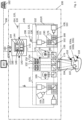
- Fig. 1 shows schematically a medical observation device 100.
- the medical observation device 100 may be a microscope or an endoscope, the difference between a microscope and an endoscope being primarily that, in an endoscope (not shown), an object 106 is viewed through optical fibers that are brought into vicinity of the object 106 to be investigated, e.g. by insertion into a body containing the object, whereas, in a microscope, an objective 174 is directed onto the object.
- the medical observation device of Fig. 1 is a microscope, the following description also applies to an endoscope.
- the medical observation device 100 may be a medical observation device used in surgery.
- the medical observation device 100 may also be a medical observation device used in a laboratory, such as a laboratory microscope.
- the object 106 to be investigated may consist of or comprise biological tissue 107.
- the object 106 may be a part of a patient's body that is located within the field of view of the medical observation device 100.
- the object 106 may contain one or more fluorophores 116, 118.
- At least one fluorophore 116 may be a fluorophore that is naturally contained in the object.
- At least one fluorophore 118 may be artificially added to the object 106, e.g. by injecting it into the biological tissue 107.
- fluorophores 118 that may be artificially added to the object 106 are ICG, fluorescein and/or 5-ALA.
- the medical observation device 100 as shown may be a fluorescence-imaging device.
- the medical observation device may be configured to view and preferably excite the fluorescence of the one or more fluorophores 116, 118.
- the medical observation device 100 may be a stereoscopic device as is exemplarily shown in Fig. 1 . It may thus comprise two identical subassemblies 101L and 101R for each of the two stereoscopic channels. As the two subassemblies 101L, 101R are identical with respect to function and structure, the following description focuses on the right subassembly 101R, but applies identically to the left stereoscopic channel 101L.
- the medical observation device 100 may alternatively be a monoscopic device. In this case, only one of the two subassemblies 101L, 101R may be present. For a monoscopic medical observation device 100, the following description therefore applies as well.
- the medical observation device 100 in operation provides input image data 120.
- the input image data 120 are representative of an imaged scene, i.e. the part of the object that is within the field of view 184 of the medical observation device 100.
- the input image data 120 may comprise one or more different digital input images 130.
- the digital input images may be digital color input images 130, digital monochrome input images 130 or a combination of at least one digital color input image 130 and at least one digital monochrome input image 130.
- each digital input image 130 of the input image data may be recorded at different wavelengths, preferably with no spectral overlap, where unavoidable filter leakage is not considered as overlap.
- the imaged spectra, in which the different digital input images 130 of the input image data 120 are recorded are non-overlapping.
- the imaged spectra are complementary. In this case, the stopbands and passbands of the imaged spectra complete each other to form seamlessly or at least almost seamlessly a continuous input spectrum, which is split into the imaged spectra.
- the digital imaging system 102 may comprise one or more digital cameras 108, which are preferably digital color cameras.
- the number of digital input images 130 contained in the input image data 120 may depend on, in particular be equal to the number of cameras 108 used for generating the input image data 120.
- a digital input image 130 may be a color image or a monochrome image.
- the medical observation device 100 may be configured to record in the input image data 120 the (auto)fluorescence of the fluorophore 116 that occurs naturally in the object, and the fluorescence of at least one fluorophore 116, 118 that has been added artificially.
- the one or more fluorophores 116, 118 may have been injected into a patient's body to mark specific areas of interest, such as tumors.
- For recording a fluorescing fluorophore at least one of the digital cameras 108, a digital fluorescence-light camera 111, has an imaged spectrum that comprises or is contained in the (known) fluorescence emission spectrum of the fluorophore of which fluorescence is to be recorded.
- the medical observation device 100 may also be configured to record the light reflected off the object in the input image data 120. This may be done simultaneously or sequentially to recording the fluorescence emission of the fluorophore.
- another digital camera may be used other than the one used for recording the at least one fluorescing fluorophore 116, 118.
- This digital camera 108, a digital reflectance camera 110 may be used to provide a preferably white-light reflectance image of the object 106 in particular in the wavelengths excluding the wavelengths recorded by the other digital camera 108, i.e. the fluorescence emission spectrum or part thereof.
- the medical observation device 100 is configured to use both the digital camera that is used for recording the fluorescence emission of the at least one fluorophore, and the digital camera that is used for recording the reflectance image, to record a fluorescence image of the object.
- the fluorescence image recorded by the two or more cameras 108 has additional spectral information over a reflectance image recorded by just one camera 108.
- Each of the two or more cameras 108 records a separate digital input color image 130.
- the medical observation device 100 may be configured to generate a digital multispectral reflectance input image from the plurality of digital input images 130, which are preferably registered with respect to one another.
- the digital imaging system 102 may comprise digital cameras 108, a digital reflectance camera 110, and one or more digital fluorescence-light cameras 111, 111a.
- a second (or third) digital fluorescence-light camera 111a is optional.
- Each fluorescence-light camera should record light in a different, preferably non-overlapping imaged spectrum that is preferably complementary to all other imaged spectra.
- the camera 110 is configured to record a first digital input color image 114 containing first input pixels and at least one of the cameras 111, 111a is configured to record a second digital input color image 112 containing second input pixels.
- the first and the second digital color input images 112, 114 are preferably registered relative to one another.
- the first and second input pixels are preferably corresponding pixels.
- the second digital fluorescence-light camera 111a is only shown in the left stereoscopic channel 101L, but of course may also be present in the right stereoscopic channel 101R.
- the digital fluorescence-light camera of one stereoscopic channel may be used as the (first) digital fluorescence-light color camera 111 and the digital fluorescence-light camera of the other stereoscopic channel may be used as the second fluorescence-light camera 111a.
- the cameras 110, 111, 111a may each be a color camera or a monochrome camera. A multispectral camera or a hyperspectral camera is considered a color camera.
- the digital reflectance camera 110 is configured to record a digital reflectance input image 114 as the first digital input image.
- the digital reflectance input image 114 is representative of the reflectance of the object 106.
- the digital reflectance camera 110 is preferably configured to record a digital input image 130 in a wide spectral range within the visible light spectrum. Thus, the digital input image 130 recorded by the digital reflectance camera represents closely the natural colors of the object 106. This is important if the digital reflectance camera 110 is used to provide the user with an image of the object which comes as close as possible to the human perception of the object.
- the digital reflectance camera 110 may be a CCD, CMOS or multispectral or hyperspectral camera.
- the digital reflectance camera 110 may also be used to record the fluorescence emission of a fluorophore.
- Each of the at least one digital fluorescence-light camera 111, 111a is configured to record a different digital fluorescence-light input image, i.e. a digital input image 130, which is recorded in the fluorescence spectrum or the fluorescence spectra of the at least one fluorophore 116, 118.
- Each fluorescence-light camera 111, 111a may be configured to record the fluorescence of a different fluorophore.
- Each digital fluorescence-light image 112 or the combination of digital fluorescence-light input images may correspond to the second digital input image 112.
- the fluorescence-light camera 111 may be configured to record the digital fluorescence-light image only in one or more narrow bands of light. These narrow bands should overlap the fluorescence spectrum or spectra of the one or more fluorophores 116, 118 of which fluorescence is to be recorded.
- the fluorescence spectra of the different fluorophores 116, 118 are at least partly separate, preferably completely separate, i.e. non-overlapping, so that the fluorescence-light camera 111 may record a digital color input image 130 representing two separate fluorescence bands that are spaced from one another.
- each fluorescence-light camera 111, 111a preferably captures the fluorescence emission of a different fluorophore.
- the at least one fluorescence-light camera 111, 111a may be a monochrome camera, a CCD, CMOS or multispectral or hyperspectral camera.
- the white-light color camera 110 and the at least one fluorescence-light color camera 111 are of the same type, although this is not necessary.
- the digital reflectance camera 110 and the at least one fluorescence-light camera 111, 111a may be used to record a reflectance input image of the object 106.
- any combination of the cameras 110, 111 and 111a may be combined into a single multispectral or hyperspectral camera either virtually, in that the separate images recorded by the cameras 110, 111, 111a are processed as a single multispectral image, or as a single real multispectral camera which performs the functions of the different cameras 110, 111, 111a.
- the respective fields of view 184 of the cameras 110, 111, and if present 111a, are preferably aligned or even coinciding and coaxial. It is preferred that the cameras 110, 111 provide the identical field of view 184 with the identical perspective and focal length. This results in identical representations of the object 106 in the images 112, 114 generated by the different cameras 110, 111. Both cameras 110, 111 may use the same objective 174.
- a match of the perspectives and field of view cannot be generated optically, it may be generated by image processing by applying a matching or registering routine to the digital input images 130, as is explained further below.
- the cameras 110, 111, and, if present, 111a are operated synchronously. Specifically, the exposure times may be synchronized.
- the medical observation device 100 may be configured to generate the digital input images 130 at the same time.
- the gain of the at least two cameras 110, 111, 111a is synchronized, i.e. adjusted in the at least two cameras 110, 111, 111a at the same time.
- the ratio of the gain applied in camera 110 to the gain applied in camera 111 and, if present, in camera 111a may be constant, even if the gain is changed.
- the gamma correction and color adjustment or white balance may be switched off or kept constant.
- an optical color-separation assembly 176 may be provided.
- the color-separation assembly 176 may comprise optical elements such as a beam splitter 192, which may be dichroic.
- the color separation assembly 176 may further or alternatively comprise an optical observation filter set 188 and/or an optical fluorescence filter set 190.
- the fluorescence filter set 190 is preferably configured to transmit light in the fluorescence spectrum or spectra of the one or more fluorophores 116, 118 and to block light outside the fluorescence spectrum or spectra.
- the fluorescence filter set 190 may comprise one or more optical band-pass filters comprising one or more passbands. Each passband should overlap the fluorescence emission spectrum of a respective fluorophore 116, 118 of which the fluorescence is to be recorded. As the fluorescence-light filter set 190 is in the light path between the beam splitter 192 and the fluorescence-light color camera 111, only the wavelengths in the passbands of the fluorescence-light filter set 190 are transmitted to the fluorescence-light color camera 111.
- the fluorescence filter set 190 may comprise a different optical band-pass filter in front of each of the fluorescence-light color cameras 111, 111a.
- the passband of one band-pass filter may be contained in the fluorescence-emission spectrum of one fluorophore 116, whereas the passband of the other band-pass filter may be contained in the fluorescence-emission spectrum of another fluorophore 116, 118 in the object 106.
- the observation filter set 188 is preferably configured to block light in the fluorescence spectrum or spectra of the one or more fluorophores 116, 118.
- the observation filter set 188 may also be configured to block light in the fluorescence-excitation spectrum.
- the observation filter set 188 is preferably configured as a band-stop filter, of which the stopbands correspond to or at least contain the passbands of the fluorescence-light filter set 190.
- the observation filter set 188 is located in the light path between the beam splitter 192 and the white-light camera 110.
- white-light camera 110 records only wavelengths that are outside the stopbands of the observation filter set 188 and therefore also outside of the passbands of the fluorescence-light filter set 190.
- Any one of the observation filter set 188 and the fluorescence filter set 190 may be a tunable filter.
- the beam splitter 192 is a dichroic beam splitter
- at least one of the filter sets 188, 190 may be omitted as the optical spectral filtering in this case is already integrated in the dichroic beam splitter.
- the above description of the passbands and stopbands then should apply mutatis mutandis to the dichroic beam splitter 192.
- the illumination assembly 178 may be configured to generate illumination light simultaneously in one or a plurality of discrete, in particular narrow-band, wavelength bands. These wavelength bands may comprise any or any combination of the following wavelength bands.
- One such discrete wavelength band may be entirely located in the fluorescence-excitation spectrum of a fluorophore 116.
- Another such wavelength band may be entirely located in the fluorescence-emission spectrum of another fluorophore 118.
- Another such wavelength band may be limited to wavelengths larger than 700 nm and be entirely located in the NIR range.
- the simultaneous illumination of the object with any of the discrete wavelength bands as described above may be accomplished by a light source 199, e.g. a tunable light source such as a light source comprising a plurality of LEDs in different colors, in particular in different primary colors, which is configured to generate light in these wavelength bands simultaneously.
- the wavelength bands may be generated by using an illumination filter 179 having multiple passbands, wherein the passbands preferably correspond to the above wavelength bands. If such an illumination filter 179 is used, the light source 199 may generate white-light, which is then filtered by the illumination filter 179 so that only the light in the passbands illuminates the object 106.
- the illumination filter 179 may be provided depending on the at least one fluorophore, of which fluorescence is to be triggered, and its specific excitation spectrum. For example, if 5-ALA is used as a fluorophore, the illumination filter may have a transmission of 90 % to 98 % up to wavelengths of 425 nm, a transmission between 0.5 % and 0.7 % in wavelengths between 450 nm and 460 nm, a transmission of not more than 0.1 % between 460 nm and 535 nm and of practically zero for wavelengths above 535 nm.
- the illumination filter 179 may be configured for pass-through of NIR light.
- the illumination filter 179 may comprise a passband in the NIR.
- the illumination filter 179 may further comprise a passband, which is preferably entirely located in the fluorescence-excitation spectrum of another fluorophore.
- the medical observation device 100 may be adjusted to a different fluorophore or set of fluorophores by re-configuring the color-separation assembly 176, e.g. by exchanging its optical elements, such as the filters set 190 and/or 188, or the dichroic beam splitter 192.
- the medical observation device 100 is configured to record the fluorescence emission signal, i.e. the light emitted from the fluorescing fluorophore 116, 118 in two digital color input images 130, e.g. the digital fluorescence-light image 112 and the digital white-light color image 114. Both images 112, 114 then contain a part of the fluorescence emission signal.
- the fluorescence emission signal i.e. the light emitted from the fluorescing fluorophore 116, 118 in two digital color input images 130, e.g. the digital fluorescence-light image 112 and the digital white-light color image 114. Both images 112, 114 then contain a part of the fluorescence emission signal.
- the camera 110 is primarily used to record the anatomical background, i.e. a white-light reflectance image of the object 106, it may also be used to record part of the fluorescence emission of the at least one fluorophore 116, 118 if parts of the fluorescence emission spectrum leak into the passbands of the camera 110.
- the input image data 120 are processed by a data processing device 170.
- the data processing device 170 may be an integral part of the medical observation device 100.
- the data processing device may be a processor, which is embedded in the medical observation device and also used as a controller for controlling the hardware of the medical observation device 100, such as the brightness and/or spectral emission of the light source 199 and/or any objective of the medical observation device 100 and/or any actuators of the medical observation device 100.
- the data processing device 170 is part of a general computer, which is connected to the medical observation device for unidirectional or bidirectional data transfer by wire or wirelessly.
- the data processing device 170 may be a hardware module, such as a microprocessor, or a software module.
- the data processing device 170 may also be a combination of both a hardware module and a software module, for example by using software modules that are configured to be run on a specific processor, such as a vector processor, a floating point graphics processor, a parallel processor and/or on multiple processors.
- the data processing device 170 may be part of a general-purpose computer 186, such as a PC.
- the data processing device 170 is an embedded system or embedded processor of the medical observation device 100.
- the data processing device 170 is further configured to compute a digital output image 160 from the input image data 120.
- the digital output image 160 is a color image, which is represented in a color space.
- the color space of the digital output image may be different from the color space of any digital color input image that is contained in the input image data 120.
- the color space of the digital output image 160 is the same color space as that of any of the digital color input images 130.
- a color space comprises at least three of such color channels.
- each color channel is represented by a different color space coordinate.
- color space transformations may be used.
- the same color is represented in different color space coordinates.
- Each pixel of the digital color input images 130 comprises a set of color space coordinates that together represent the color of the respective pixel.
- Each color band thus may be regarded as representing a color space axis and each color may be regarded as a point in color space, which is defined by the vector-i.e. the color space coordinates-pointing to this color.
- adding two colors corresponds to a vector addition.
- the digital color input images 130 or, more generally the input image data 120 may be recorded in RGB color space using the three primary colors or color bands-or color space coordinates-R, G, B.
- the digital color input image 130 may be recorded in different color spaces, respectively, and/or represent multispectral or hyperspectral color input images.
- the digital input images 130 of a set of digital input images, such as the digital white-light color input image 114 and the digital fluorescence color input image 112 need not be recorded in the same color space, although this is preferred.
- RGB color space each color is represented by a triple of three color space coordinates in the form of integer numbers, wherein each integer number indicates the intensity of one of the primary colors R, G, B.
- each integer number indicates the intensity of one of the primary colors R, G, B.
- the most intense red is indicated by the triple [255 ,0, 0].
- the most intense green color is indicated by [0, 255, 0], and the most intense blue by [0, 0, 255].
- RGB color space is a three-dimensional space
- CMYK color space would be a four-dimensional space.
- a color can be considered as a point in color space to which a vector such as [0, 0, 255] points.
- a multispectral or hyperspectral color space having n color bands would correspondingly result in an n-dimensional color space, in which each color is represented by an n-tuple of color space coordinates.
- the digital output image 160 may be displayed on a display 132, which is integral with the medical observation device 100.
- the display 132 may be integrated in an ocular or eyepiece 104 of the medical observation device 100.
- the digital output image 160 is preferably generated in real-time, i.e. a digital output image 160 is generated from a set of digital color input images 130 before the next set is generated by the at least two cameras 110, 111, 111a.
- the medical observation device 100 may comprise a direct optical path 134 from the object 106 through the objective 174 to the eyepiece 104.
- the display may be a translucent display 132 located in the direct optical path 134 or the display may be projected into the direct optical path 134.
- a beam splitter 136 may be provided to split the light between the optical eyepiece 104 and the digital imaging system 102. In one embodiment, up to 80 % of the light may be directed to the eyepiece 104.
- the medical observation device 100 may not have a direct optical path 134 but only display images from the integral display 132.
- the medical observation device may not have any display at all.
- the medical observation device 100 may comprise an output interface 172 to which one or more (external) displays 182 may be connected.
- the output interface 172 may comprise standardized connectors and data transmission protocols, such as USB, HDMI, DVI, DisplayPort, Bluetooth and/or others.
- An external display may be a monitor, 3D goggles, oculars and the like. Any combination of external displays may be connected to output interface 172.
- the computer 186 and/or the data processing device 170 is connected to the digital imaging system 102 using one or more data transmission lines 196.
- a data transmission line may be wired or wireless, or partly wired and partly wireless.
- the computer 186 and/or the data processing device 170 may not be bodily integrated in the medical observation device 100 but be physically located remote from the digital imaging system 102.
- the digital imaging system 102 and the computer 186 and/or the data processing device 170 may be connected to a network, such as a LAN, a WLAN or a WAN, to which also at least one display 182 is connected.
- the data processing device 170 may comprise a routine 140 for obtaining a set of signal descriptors that are representative of the (part of the) fluorescence emission signal contained in a digital color input image 130, 112, 114.
- the routine 140 simply extracts the set of color space coordinates of an input pixel of the digital input image as the set of signal descriptors. This variant is useful if no other signals than the fluorescence emission signal are contained in the respective digital input image, or if the other signals are negligible.
- the routine 140 may comprise spectral unmixing, which is then applied to a digital input image or an input pixel thereof, to obtain the set of signal descriptors. If spectral unmixing is used, the signal descriptors may be coefficients of endmembers.
- the routine 140 will obtain a separate set of signal descriptors for any digital input image 130 that is input to the routine 140. For example, if the routine 140 is presented with two digital input images 130, e.g. images 112, 114, it will obtain two separate sets of signal descriptors for each of the two digital input images.
- the mapping routine 144 may use a linear transformation of the signal descriptors and e.g. use a color conversion matrix 146
- routines 140 to 146 may be a software routine, a routine implemented in hardware, or a routine in which software and hardware components are combined. Any of the routines 140 to 146 may be stored in a memory 194 of the data processing device 170 or the medical observation device 100.
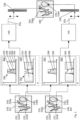
- Fig. 2 shows how the digital output image 160 is generated from two digital color input images 130.
- a first digital color input image 130 may be recorded by camera 110 and thus contain the wavelengths that are used to represent the digital reflectance input image 114.
- a second digital color input image 130 may be recorded by one of the cameras 111, 111a and thus contain the wavelengths in which the at least one fluorophore 116, 118 fluoresces, such as the digital fluorescence input image 112.
- any two cameras of a medical observation device 100 may be used for recording the two digital color input images 130.
- Each of the first and second digital color input images 130, 112, 114 contains a fluorescence emission signal 222, i.e. a component that is representative of the fluorescence emission of the at least one fluorophore 116, 118.
- the object 106 contains just one fluorophore 116 such as 5-ALA/PplX.
- the fluorescence emission signal 222 contained in both digital color input images 130, 112, 114 corresponds to the fluorescence emitted by 5-ALA/PplX.
- the data processing device 170 is preferably configured to identify and/or extract the fluorescence emission signal 222 in any of the first and second digital input images 130, 112, 114. This may be useful, if other signals such as a reflectance signal representative of light reflected off the object 106 is contained in any of the first and second digital input images 130, 112, 114 in addition to the fluorescence emission signal 222.
- the fluorescence emission signal 222 may e.g. be extracted from any of the first and/or second digital input image 130, 112, 114 by spectral unmixing.
- the fluorescence emission spectrum of the at least one fluorophore may be used as an endmember of the spectral unmixing.
- the first spectrum 250 comprises at least one passband 290 and at least one stopband 221. As shown, the first spectrum 250 may comprise two passbands 290 that are separated by a single stopband 221.
- the second spectrum 252 comprises at least one passband 220.
- the passband 220 may comprise, be limited to or consist of the spectrum 262 of the fluorescence emission signal 222, i.e. the fluorescence emission spectrum of the at least one fluorophore 116, 118.
- the second spectrum 252 may comprise a NIR passband 264 that comprises, consists of or is limited to wavelengths in the NIR range of light.
- the NIR range of light extends from about 750 nm to about 1400 nm or to about 2500 nm.
- the passbands 220, 264 of the second spectrum 252 may be narrower than the at least one passband of the first spectrum 250. This allows rendering the reflectance spectrum of the object 106 more accurately and recording a more faithful white-light image in other operating modes of the medical observation device 100.
- the fluorescence emission spectrum 262 preferably overlaps at least one passband 220 of the first spectrum 290 and at least one passband 220 of the second spectrum 252.
- more than one passband 290 of the first spectrum 250 overlaps the fluorescence emission spectrum 262.
- the NIR passband 264 may also overlap the fluorescence emission spectrum 262.
- the spectral resolution of the fluorescence emission signal 222 is increased. This allows for a more accurate analysis of the fluorescence emission spectrum 262 compared to a single digital color input image or to two or more digital color input images that are recorded in identical spectra.
- the fluorescence emission spectrum 262 of the at least one fluorophore 116, 118 may depend on the environment.
- the fluorescence emission spectrum 262 may depend on the presence of certain ions and molecules in the environment of the at least one fluorophore 116, 118.
- the fluorescence spectrum of the at least one fluorophore 116, 118 in an alkaline environment may be different from the fluorescence emission spectrum in an acid environment.
- the chemical environment of tumorous biological tissue in turn may depend on the state of the biological tissue 107 in the object 106.
- the fluorescence emission spectrum of the at least one fluorophore may depend on the characteristics of a tumor, in particular its grading, as different tumor types may create different chemical environments.
- the fluorescence emission spectrum 262 may be representative of the characteristics of the tumor for specific fluorophores, such as 5-ALA/PplX.
- the environment-dependent change in the fluorescence emission spectrum 262 may involve at least one of a shift in a peak emission wavelength, wherein, if more than one peak is present, any peak may be affected; the emergence of secondary or tertiary (or more) peaks in the fluorescence emission spectrum; the width of the fluorescence spectrum 262, its symmetry, the intensity in the off-peak wavelengths and/or other geometrical characteristics of the fluorescence emission spectrum 262.
- the fluorescence spectrum 262 of the fluorescence emission signal 222 may vary at different locations of the object 106 depending on the chemical environment at this location.
- the fluorescence emission spectrum 262 may vary depending on the location of the pair of corresponding input pixels 230, 232 in the first and second digital color input image 112, 114.
- the fluorescence emission signal 222 in one area 222a of a digital input image 130, 112, 114 and thus of the object 106 differs from the fluorescence emission signal 222 in another area 222b.
- area 222a may represent an area of the object 106 where the chemical environment has different characteristics than in the area of the object 106 that is mapped to area 222b.
- a chemical parameter such as the pH level may be different in area 222a and in area 222b.
- the area 222a may comprise tumorous tissue having a higher tumor grade than the tumorous tissue in area 222b. The higher tumor grade may correspond to a higher pH level.
- Box a in Fig. 2 shows a sample fluorescence spectrum 262 at a first input pixel 230a and a corresponding second input pixel 232a that are located both in the area 222a.
- Box b shows a sample fluorescence spectrum 262 of a first input pixel 230b and a corresponding second input pixel 232b in the area 222b.
- the data processing device 170 obtains at least one set ⁇ S ⁇ of signal descriptors S that is representative of the fluorescence emission signal 222 recorded in that pair.
- a different set of signal descriptors S may be obtained for each part 296, 298 of the fluorescence emission signal 222 at a pixel 230, 232 respectively.
- a single set of signal descriptors S may be obtained for each pair of corresponding pixels 230, 232, respectively.
- the signal descriptors S may be scalar values such as coefficients of polynomials or any other orthogonal set of functions, color space coordinates or coefficients of endmembers in spectral unmixing.
- the set ⁇ S ⁇ of signal descriptors may be a vector or a matrix.
- a set ⁇ S ⁇ a of signal descriptors may be obtained that is representative of the fluorescence emission spectrum 262 in this area.
- a different set ⁇ S ⁇ b of signal descriptors may be obtained that is representative of the fluorescence emission spectrum in this area.
- the set of signal descriptors may thus be used to differentiate between the different environments of the at least one fluorescing fluorophore 116, 118, e.g. between different tumor types and/or grades.
- Each set of signal descriptors may be assigned a different value.
- the value is assigned to an output pixel in the digital output image 160 either as a color or in the metadata of this pixel.
- the mapping of a set ⁇ S ⁇ to a value preferably is bijective.
- the color of an output pixel 234 of the digital output image 160 thus depends on the set of signal descriptors derived from the pair of corresponding input pixels 230, 232.
- the output pixel 234 is a corresponding pixel to the pair 230, 232.
- an output pixel 234a corresponding to input pixels 230a, 232a in the area 222a may be assigned a different hue than the output pixel 234b corresponding to input pixels 230b, 232b in area 222b.
- the intensity of the hue at an output pixel 234 may correspond to the intensity of the fluorescence emission signal 222 at the corresponding pair of input pixels 230, 232.
- the fluorescence emission signal 222 in area 222a is assigned a reddish hue
- the fluorescence emission signal 222 in area 222b is assigned a bluish hue
- output pixel 234a is red
- output pixel 234b is blue.
- the set ⁇ S ⁇ may be mapped to any color appearance parameter or combination of color appearance parameters.
- the fluorescence emission spectrum 262 may take the form as shown at 302.
- the peak emission frequency ⁇ 2 may have shifted to 634 nm and the sideband at lower frequency may contain more energy, leading to a less marked secondary peak 304.
- Each of the different sets ⁇ S ⁇ may be mapped to a different value, in particular color 235, using the mapping routine 144 as explained above.
- the value is selected from a range of values that extends from a first value to a second value. If the value corresponds to a color, the color 235 is selected from a range of colors that extend from a first color 310 to a second color 312.
- the passbands 220, 290 may be used as endmembers.
- the value for a spectrum 301 may be obtained by linearly mapping the set ⁇ S ⁇ of signal descriptors onto the predetermined range of values.
- the value may directly correspond to a color in the predetermined color range; by alpha blending the first and second color 310, 312 using a transparency value for one of the first and second color that depends on the set ⁇ S ⁇ ; by weighted vector addition of the first and second color 310, 312; or by providing a look-up table or an analytical function that maps a set ⁇ S ⁇ to a color 235.
- a set ⁇ S ⁇ containing any number of signal descriptors S may be obtained from the two digital input images 112, 114, or their spectra 250, 252, respectively.
- a set ⁇ S 2 ⁇ of signal descriptors S 2 which is representative of the second part 298 of the fluorescence emission signal at a second input pixel 232 may simply contain the color space coordinates of the second input pixel 232. If the second input image 130, 112 is represented in RGB color space, the set ⁇ S 2 ⁇ may thus correspond to ⁇ r 2 , g 2 , b 2 ⁇ .
- the set ⁇ S 2 ⁇ may correspond to the coefficients of the endmembers at the second input pixel 232.
- the signal descriptor S 2 may correspond to the coefficient that represents the contribution of the fluorescence emission spectrum 262 of 5-ALA/PpIX in an alkaline or in an acid environment.
- the same may apply to a first input pixel 230 in the first digital input image 130, 114.
- the set of color coordinates of the first input pixel 230 may be used as a set ⁇ S 1 ⁇ of signal descriptors of the fluorescence emission signal at the first input pixel.
- ⁇ S 1 ⁇ thus may simply correspond to ⁇ r 1 , g 1 , b 1 ⁇ .
- ⁇ S 1 ⁇ is representative for both parts 296 of the fluorescence emission signal in the first and second passbands 290.
- each of the passbands 220 itself may be used as an endmember, resulting in a set ⁇ S 1 ⁇ , which contains two signal descriptors, one signal descriptor representing the content of spectrum 250 in the low-frequency passband 290 and the other signal descriptor representing the content of spectrum 250 in the high-frequency passband 290.
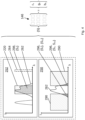
- Fig. 5 presents an overview of a method for obtaining a digital output image 160.
- a second digital color input image 130 is obtained, e.g. the digital fluorescence input image 112, which contains another part of the fluorescence emission signal 222.
- the two parts of the fluorescence emission signal 222 as contained in the first and second digital color input image 130 are complementary. Together, they may represent the entire or at least a major part of the spectrum 262 of the fluorescence emission signal 222 in the visible light range and optionally also the NIR range.
- the first and/or second digital input image 130 may be obtained from a storage device, such as a computer memory or a hard disk, or directly from a camera 108.
- the fluorescence emission signal 222 may be extracted from the first and/or second digital color input image 130, 112, 114. This may be necessary to separate the fluorescence emission signal 222 from other signals that may be present in a digital color input image, such as parts of the fluorescence excitation spectrum.
- a set ⁇ S 1 ⁇ of signal descriptors is obtained from the first digital input image 130, 114.
- a value or a color of an output pixel 234 of the digital output image 160 is assigned to the set of signal descriptors, either the union set ⁇ S 1 , S 2 ⁇ or the set ⁇ S ⁇ .
- the digital output image 160 may then be displayed at step 512, e.g. using a display 182.
- Some embodiments relate to a microscope comprising a system as described in connection with one or more of the Figs. 1 to 5 .
- a microscope may be part of or connected to a system as described in connection with one or more of the Figs. 1 to 5 .
- the computer system 620 may be a local computer device (e.g. personal computer, laptop, tablet computer or mobile phone) with one or more processors and one or more storage devices or may be a distributed computer system (e.g. a cloud computing system with one or more processors and one or more storage devices distributed at various locations, for example, at a local client and/or one or more remote server farms and/or data centers).
- the computer system 620 may comprise any circuit or combination of circuits.
- the computer system 620 may include one or more processors which can be of any type.
- processor may mean any type of computational circuit, such as but not limited to a microprocessor, a microcontroller, a complex instruction set computing (CISC) microprocessor, a reduced instruction set computing (RISC) microprocessor, a very long instruction word (VLIW) microprocessor, a graphics processor, a digital signal processor (DSP), multiple core processor, a field programmable gate array (FPGA), for example, of a microscope or a microscope component (e.g. camera) or any other type of processor or processing circuit.
- CISC complex instruction set computing
- RISC reduced instruction set computing
- VLIW very long instruction word
- DSP digital signal processor
- FPGA field programmable gate array
- circuits may be a custom circuit, an application-specific integrated circuit (ASIC), or the like, such as, for example, one or more circuits (such as a communication circuit) for use in wireless devices like mobile telephones, tablet computers, laptop computers, two-way radios, and similar electronic systems.
- the computer system 620 may include one or more storage devices, which may include one or more memory elements suitable to the particular application, such as a main memory in the form of random access memory (RAM), one or more hard drives, and/or one or more drives that handle removable media such as compact disks (CD), flash memory cards, digital video disk (DVD), and the like.
- RAM random access memory
- CD compact disks
- DVD digital video disk
- the computer system 620 may also include a display device, one or more speakers, and a keyboard and/or controller, which can include a mouse, trackball, touch screen, voice-recognition device, or any other device that permits a system user to input information into and receive information from the computer system 620.
- a display device one or more speakers
- a keyboard and/or controller which can include a mouse, trackball, touch screen, voice-recognition device, or any other device that permits a system user to input information into and receive information from the computer system 620.
- Some or all of the method steps may be executed by (or using) a hardware apparatus, like for example, a processor, a microprocessor, a programmable computer or an electronic circuit. In some embodiments, some one or more of the most important method steps may be executed by such an apparatus.
- embodiments of the invention can be implemented in hardware or in software.
- the implementation can be performed using a non-transitory storage medium such as a digital storage medium, for example a floppy disc, a DVD, a Blu-Ray, a CD, a ROM, a PROM, and EPROM, an EEPROM or a FLASH memory, having electronically readable control signals stored thereon, which cooperate (or are capable of cooperating) with a programmable computer system such that the respective method is performed. Therefore, the digital storage medium may be computer readable.
- Some embodiments according to the invention comprise a data carrier having electronically readable control signals, which are capable of cooperating with a programmable computer system, such that one of the methods described herein is performed.
- embodiments of the present invention can be implemented as a computer program product with a program code, the program code being operative for performing one of the methods when the computer program product runs on a computer.
- the program code may, for example, be stored on a machine readable carrier.
- inventions comprise the computer program for performing one of the methods described herein, stored on a machine readable carrier.
- an embodiment of the present invention is, therefore, a computer program having a program code for performing one of the methods described herein, when the computer program runs on a computer.
- a further embodiment of the present invention is, therefore, a storage medium (or a data carrier, or a computer-readable medium) comprising, stored thereon, the computer program for performing one of the methods described herein when it is performed by a processor.
- the data carrier, the digital storage medium or the recorded medium are typically tangible and/or non-transitionary.
- a further embodiment of the present invention is an apparatus as described herein comprising a processor and the storage medium.
- a further embodiment of the invention is, therefore, a data stream or a sequence of signals representing the computer program for performing one of the methods described herein.
- the data stream or the sequence of signals may, for example, be configured to be transferred via a data communication connection, for example, via the internet.
- a further embodiment comprises a processing means, for example, a computer or a programmable logic device, configured to, or adapted to, perform one of the methods described herein.
- a processing means for example, a computer or a programmable logic device, configured to, or adapted to, perform one of the methods described herein.
- a further embodiment according to the invention comprises an apparatus or a system configured to transfer (for example, electronically or optically) a computer program for performing one of the methods described herein to a receiver.
- the receiver may, for example, be a computer, a mobile device, a memory device or the like.
- the apparatus or system may, for example, comprise a file server for transferring the computer program to the receiver.
Landscapes
- Life Sciences & Earth Sciences (AREA)
- Health & Medical Sciences (AREA)
- Engineering & Computer Science (AREA)
- Physics & Mathematics (AREA)
- Surgery (AREA)
- Animal Behavior & Ethology (AREA)
- Molecular Biology (AREA)
- Optics & Photonics (AREA)
- Medical Informatics (AREA)
- Biomedical Technology (AREA)
- General Health & Medical Sciences (AREA)
- Biophysics (AREA)
- Public Health (AREA)
- Pathology (AREA)
- Heart & Thoracic Surgery (AREA)
- Veterinary Medicine (AREA)
- Nuclear Medicine, Radiotherapy & Molecular Imaging (AREA)
- Radiology & Medical Imaging (AREA)
- Multimedia (AREA)
- Signal Processing (AREA)
- General Physics & Mathematics (AREA)
- Analytical Chemistry (AREA)
- Chemical & Material Sciences (AREA)
- Computer Vision & Pattern Recognition (AREA)
- Investigating, Analyzing Materials By Fluorescence Or Luminescence (AREA)
Priority Applications (2)
| Application Number | Priority Date | Filing Date | Title |
|---|---|---|---|
| EP23220032.9A EP4574006A1 (de) | 2023-12-22 | 2023-12-22 | Datenverarbeitungsvorrichtung, computerimplementiertes verfahren und medizinische beobachtungsvorrichtung |
| PCT/EP2024/087172 WO2025132626A1 (en) | 2023-12-22 | 2024-12-18 | Data processing device, computer-implemented method and medical observation device |
Applications Claiming Priority (1)
| Application Number | Priority Date | Filing Date | Title |
|---|---|---|---|
| EP23220032.9A EP4574006A1 (de) | 2023-12-22 | 2023-12-22 | Datenverarbeitungsvorrichtung, computerimplementiertes verfahren und medizinische beobachtungsvorrichtung |
Publications (1)
| Publication Number | Publication Date |
|---|---|
| EP4574006A1 true EP4574006A1 (de) | 2025-06-25 |
Family
ID=89321600
Family Applications (1)
| Application Number | Title | Priority Date | Filing Date |
|---|---|---|---|
| EP23220032.9A Pending EP4574006A1 (de) | 2023-12-22 | 2023-12-22 | Datenverarbeitungsvorrichtung, computerimplementiertes verfahren und medizinische beobachtungsvorrichtung |
Country Status (2)
| Country | Link |
|---|---|
| EP (1) | EP4574006A1 (de) |
| WO (1) | WO2025132626A1 (de) |
Citations (5)
| Publication number | Priority date | Publication date | Assignee | Title |
|---|---|---|---|---|
| US20140378843A1 (en) * | 2012-01-20 | 2014-12-25 | The Trustees Of Dartmouth College | Method And Apparatus For Quantitative Hyperspectral Fluorescence And Reflectance Imaging For Surgical Guidance |
| US20170280029A1 (en) * | 2016-03-23 | 2017-09-28 | Karl Storz Imaging, Inc. | Image transformation and display for fluorescent and visible imaging |
| US20230316521A1 (en) * | 2020-07-20 | 2023-10-05 | Intuitive Surgical Operations, Inc. | Image-based determination of a property of a fluorescing substance |
| EP4275579A1 (de) * | 2022-05-13 | 2023-11-15 | Leica Instruments (Singapore) Pte. Ltd. | Verfahren, prozessor und medizinisches beobachtungsgerät unter verwendung von zwei farbbildern und farbkameras für fluoreszenz und weisslicht |
| EP4277256A1 (de) * | 2022-05-13 | 2023-11-15 | Leica Instruments (Singapore) Pte Ltd | Bildprozessor und computerimplementiertes verfahren für ein medizinisches beobachtungsgerät unter verwendung einer ortsabhängigen farbumwandlungsfunktion |
-
2023
- 2023-12-22 EP EP23220032.9A patent/EP4574006A1/de active Pending
-
2024
- 2024-12-18 WO PCT/EP2024/087172 patent/WO2025132626A1/en active Pending
Patent Citations (5)
| Publication number | Priority date | Publication date | Assignee | Title |
|---|---|---|---|---|
| US20140378843A1 (en) * | 2012-01-20 | 2014-12-25 | The Trustees Of Dartmouth College | Method And Apparatus For Quantitative Hyperspectral Fluorescence And Reflectance Imaging For Surgical Guidance |
| US20170280029A1 (en) * | 2016-03-23 | 2017-09-28 | Karl Storz Imaging, Inc. | Image transformation and display for fluorescent and visible imaging |
| US20230316521A1 (en) * | 2020-07-20 | 2023-10-05 | Intuitive Surgical Operations, Inc. | Image-based determination of a property of a fluorescing substance |
| EP4275579A1 (de) * | 2022-05-13 | 2023-11-15 | Leica Instruments (Singapore) Pte. Ltd. | Verfahren, prozessor und medizinisches beobachtungsgerät unter verwendung von zwei farbbildern und farbkameras für fluoreszenz und weisslicht |
| EP4277256A1 (de) * | 2022-05-13 | 2023-11-15 | Leica Instruments (Singapore) Pte Ltd | Bildprozessor und computerimplementiertes verfahren für ein medizinisches beobachtungsgerät unter verwendung einer ortsabhängigen farbumwandlungsfunktion |
Non-Patent Citations (1)
| Title |
|---|
| MONTCEL, B. ET AL.: "Two-peaked 5-ALA-induced PpIX fluorescence emission spectrum distinguishes glioblastomas from low grade gli-omas an infiltrative component of glioblastomas", BIOMEDICAL OPTICS EXPRESS, vol. 4, no. 4, 2013, pages 550 - 558 |
Also Published As
| Publication number | Publication date |
|---|---|
| WO2025132626A1 (en) | 2025-06-26 |
Similar Documents
| Publication | Publication Date | Title |
|---|---|---|
| US20250350700A1 (en) | Image processor and computer-implemented method for a medical observation device, using a location-dependent color conversion function | |
| US20250143652A1 (en) | Method, processor, and medical observation device using two color images and color cameras for fluorescence and white-light | |
| EP4574006A1 (de) | Datenverarbeitungsvorrichtung, computerimplementiertes verfahren und medizinische beobachtungsvorrichtung | |
| WO2025056578A1 (en) | Data processing device and computer-implemented method for displaying blood oxygenation and concentration values in a medical observation device and medical observation device and method for its use | |
| WO2025027024A1 (en) | Data processing device and computer implemented invention for a medical observation device, for visualization of an autofluorescence signal and a fluorescence emission signal | |
| US12349863B2 (en) | Data processing device and computer-implemented method combining two images and an overlay color using a uniform color space | |
| EP4502578A1 (de) | Datenverarbeitungsvorrichtung und computerimplementiertes verfahren zur kombination eines fluoreszenzemissionssignals mit einem spiegelreflexionssignal in einer medizinischen beobachtungsvorrichtung | |
| EP4501203A1 (de) | Datenverarbeitungsvorrichtung und computerimplementiertes verfahren zum kombinieren eines fluoreszenzemissionssignals mit einem kantendetektionssignal in einer medizinischen beobachtungsvorrichtung | |
| US20250331722A1 (en) | Method, processor, and medical fluorescence observation device using two color images and color cameras for fluorescence and white-light | |
| US20250331709A1 (en) | Method, processor, and medical fluorescence observation device for toggling images | |
| US20250331746A1 (en) | Method, processor, and medical fluorescence observation device using a color-dependent color conversion function | |
| EP4480385A1 (de) | Datenverarbeitungsvorrichtung für ein medizinisches beobachtungsgerät wie mikroskop oder endoskop und computerimplementiertes verfahren zur erzeugung eines digitalen reflektanzfarbausgabebildes | |
| US20250302276A1 (en) | Method, processor, and medical fluorescence observation device using two color images to record fluorescence |
Legal Events
| Date | Code | Title | Description |
|---|---|---|---|
| PUAI | Public reference made under article 153(3) epc to a published international application that has entered the european phase |
Free format text: ORIGINAL CODE: 0009012 |
|
| STAA | Information on the status of an ep patent application or granted ep patent |
Free format text: STATUS: THE APPLICATION HAS BEEN PUBLISHED |
|
| AK | Designated contracting states |
Kind code of ref document: A1 Designated state(s): AL AT BE BG CH CY CZ DE DK EE ES FI FR GB GR HR HU IE IS IT LI LT LU LV MC ME MK MT NL NO PL PT RO RS SE SI SK SM TR |
|
| STAA | Information on the status of an ep patent application or granted ep patent |
Free format text: STATUS: THE APPLICATION IS DEEMED TO BE WITHDRAWN |