EP4574018A1 - Procédé d'apprentissage automatique pour diagnostiquer automatiquement un comportement anormal de pupille - Google Patents
Procédé d'apprentissage automatique pour diagnostiquer automatiquement un comportement anormal de pupille Download PDFInfo
- Publication number
- EP4574018A1 EP4574018A1 EP23461699.3A EP23461699A EP4574018A1 EP 4574018 A1 EP4574018 A1 EP 4574018A1 EP 23461699 A EP23461699 A EP 23461699A EP 4574018 A1 EP4574018 A1 EP 4574018A1
- Authority
- EP
- European Patent Office
- Prior art keywords
- light
- mes
- corr
- parameters
- corrected
- Prior art date
- Legal status (The legal status is an assumption and is not a legal conclusion. Google has not performed a legal analysis and makes no representation as to the accuracy of the status listed.)
- Pending
Links
Images



Classifications
-
- A—HUMAN NECESSITIES
- A61—MEDICAL OR VETERINARY SCIENCE; HYGIENE
- A61B—DIAGNOSIS; SURGERY; IDENTIFICATION
- A61B3/00—Apparatus for testing the eyes; Instruments for examining the eyes
- A61B3/10—Objective types, i.e. instruments for examining the eyes independent of the patients' perceptions or reactions
- A61B3/11—Objective types, i.e. instruments for examining the eyes independent of the patients' perceptions or reactions for measuring interpupillary distance or diameter of pupils
- A61B3/112—Objective types, i.e. instruments for examining the eyes independent of the patients' perceptions or reactions for measuring interpupillary distance or diameter of pupils for measuring diameter of pupils
-
- A—HUMAN NECESSITIES
- A61—MEDICAL OR VETERINARY SCIENCE; HYGIENE
- A61B—DIAGNOSIS; SURGERY; IDENTIFICATION
- A61B3/00—Apparatus for testing the eyes; Instruments for examining the eyes
- A61B3/0016—Operational features thereof
- A61B3/0025—Operational features thereof characterised by electronic signal processing, e.g. eye models
-
- A—HUMAN NECESSITIES
- A61—MEDICAL OR VETERINARY SCIENCE; HYGIENE
- A61B—DIAGNOSIS; SURGERY; IDENTIFICATION
- A61B3/00—Apparatus for testing the eyes; Instruments for examining the eyes
- A61B3/02—Subjective types, i.e. testing apparatus requiring the active assistance of the patient
- A61B3/06—Subjective types, i.e. testing apparatus requiring the active assistance of the patient for testing light sensitivity, e.g. adaptation; for testing colour vision
- A61B3/063—Subjective types, i.e. testing apparatus requiring the active assistance of the patient for testing light sensitivity, e.g. adaptation; for testing colour vision for testing light sensitivity, i.e. adaptation
-
- A—HUMAN NECESSITIES
- A61—MEDICAL OR VETERINARY SCIENCE; HYGIENE
- A61B—DIAGNOSIS; SURGERY; IDENTIFICATION
- A61B5/00—Measuring for diagnostic purposes; Identification of persons
- A61B5/16—Devices for psychotechnics; Testing reaction times ; Devices for evaluating the psychological state
- A61B5/163—Devices for psychotechnics; Testing reaction times ; Devices for evaluating the psychological state by tracking eye movement, gaze, or pupil change
-
- A—HUMAN NECESSITIES
- A61—MEDICAL OR VETERINARY SCIENCE; HYGIENE
- A61B—DIAGNOSIS; SURGERY; IDENTIFICATION
- A61B5/00—Measuring for diagnostic purposes; Identification of persons
- A61B5/72—Signal processing specially adapted for physiological signals or for diagnostic purposes
- A61B5/7235—Details of waveform analysis
- A61B5/7264—Classification of physiological signals or data, e.g. using neural networks, statistical classifiers, expert systems or fuzzy systems
- A61B5/7267—Classification of physiological signals or data, e.g. using neural networks, statistical classifiers, expert systems or fuzzy systems involving training the classification device
-
- G—PHYSICS
- G16—INFORMATION AND COMMUNICATION TECHNOLOGY [ICT] SPECIALLY ADAPTED FOR SPECIFIC APPLICATION FIELDS
- G16H—HEALTHCARE INFORMATICS, i.e. INFORMATION AND COMMUNICATION TECHNOLOGY [ICT] SPECIALLY ADAPTED FOR THE HANDLING OR PROCESSING OF MEDICAL OR HEALTHCARE DATA
- G16H30/00—ICT specially adapted for the handling or processing of medical images
- G16H30/40—ICT specially adapted for the handling or processing of medical images for processing medical images, e.g. editing
-
- G—PHYSICS
- G16—INFORMATION AND COMMUNICATION TECHNOLOGY [ICT] SPECIALLY ADAPTED FOR SPECIFIC APPLICATION FIELDS
- G16H—HEALTHCARE INFORMATICS, i.e. INFORMATION AND COMMUNICATION TECHNOLOGY [ICT] SPECIALLY ADAPTED FOR THE HANDLING OR PROCESSING OF MEDICAL OR HEALTHCARE DATA
- G16H50/00—ICT specially adapted for medical diagnosis, medical simulation or medical data mining; ICT specially adapted for detecting, monitoring or modelling epidemics or pandemics
- G16H50/20—ICT specially adapted for medical diagnosis, medical simulation or medical data mining; ICT specially adapted for detecting, monitoring or modelling epidemics or pandemics for computer-aided diagnosis, e.g. based on medical expert systems
-
- G—PHYSICS
- G16—INFORMATION AND COMMUNICATION TECHNOLOGY [ICT] SPECIALLY ADAPTED FOR SPECIFIC APPLICATION FIELDS
- G16H—HEALTHCARE INFORMATICS, i.e. INFORMATION AND COMMUNICATION TECHNOLOGY [ICT] SPECIALLY ADAPTED FOR THE HANDLING OR PROCESSING OF MEDICAL OR HEALTHCARE DATA
- G16H50/00—ICT specially adapted for medical diagnosis, medical simulation or medical data mining; ICT specially adapted for detecting, monitoring or modelling epidemics or pandemics
- G16H50/30—ICT specially adapted for medical diagnosis, medical simulation or medical data mining; ICT specially adapted for detecting, monitoring or modelling epidemics or pandemics for calculating health indices; for individual health risk assessment
-
- G—PHYSICS
- G16—INFORMATION AND COMMUNICATION TECHNOLOGY [ICT] SPECIALLY ADAPTED FOR SPECIFIC APPLICATION FIELDS
- G16H—HEALTHCARE INFORMATICS, i.e. INFORMATION AND COMMUNICATION TECHNOLOGY [ICT] SPECIALLY ADAPTED FOR THE HANDLING OR PROCESSING OF MEDICAL OR HEALTHCARE DATA
- G16H50/00—ICT specially adapted for medical diagnosis, medical simulation or medical data mining; ICT specially adapted for detecting, monitoring or modelling epidemics or pandemics
- G16H50/70—ICT specially adapted for medical diagnosis, medical simulation or medical data mining; ICT specially adapted for detecting, monitoring or modelling epidemics or pandemics for mining of medical data, e.g. analysing previous cases of other patients
Definitions
- the present disclosure relates to the field of medicine, ophthalmology, neuro-ophthalmology with a subfield of pupillometry.
- the subject matter of the invention relates to a method of assessing pupil reactivity insusceptible to external illumination conditions, a method of performing pupil reactivity measurements and a method for assessing neurological health of a subject.
- Typical pupillary evaluation during the medical examination involves the assessment of two components -pupil size and pupil reactivity to light.
- Pupil size is traditionally measured using a pupil gauge to estimate the diameter in millimeters of the pupil at rest state before any light is shone into the eye. Manual measurement is subjective and prone to subjective error of a medical personel performing the examination.
- Pupil light reactivity is evaluated by shining a light into a patient's eye to make the pupil constrict in reaction to the light. The pupil should dilate (expand its diameter) again when the light is moved away or turned off.
- TM Nuerological Pupil Index
- NPi Neurological pupil index
- the pupil's reaction is numerically graded, typically using a range spanning the range 1-3 i.e. reactive, sluggish, non-reactive (these terms are subjective and applied without a standard clinical protocol or definition) or 0-4.9 as in a case of NPi.
- NPi Neurological Pupil index
- GCS Glasgow Coma Scale
- mRS modified Rankin Scale
- a prior art patent document [ WO2009137614A2 ] describes a use of scalar value to assess neurological status of a patient. It decribes a methods, systems and devices for determining whether a patient has an abnormally high level of intracranial pressure.
- the method includes a pupillometer to obtain pupillary response data from the patient.
- the method further includes a data analysis system comprising a microprocessor that is in communication with the pupillometer.
- the microprocessor includes an algorithm that converts the pupillary response data to a scalar value that is indicative of the patient's level of intracranial pressure.
- the microprocessor can be a stand-alone computer connected to the pupillometer or it can be integral with the pupillometer.
- the scalar value can be represented by a numerical value, graphical depiction, color, sound, or other visual or audio means that indicates a value.
- the scalar value indicates that the patient's pupillary response characteristics is within a normal range, an abnormal range, or that the pupil is nonresponsive.
- a reactivity index is constructed as a machine learning model realised in the form of linear combination of numeric constant and light corrected parameters with a particular set of coefficient values optimized (model training) to ensure external light invariance as well as high discriminability between two groups in dataset D2 consisting e.g. of the measurements of reactive and non-reactive pupils.
- An invention relates to a method for training a machine learning model for automatically diagnosing abnormal pupil behaviour through assigning a numerical scale to pupil reactivity, comprising the following steps:
- At least one static pupillometric parameters selected from parameters: INIT, END, CAMP, DELTA, FIN, LAT, FT75, DAMP are only considered, and none of the dynamic parameters are used.
- At least one dynamic pupillometric parameters selected from parameters: PDV, ACV, MCV, ADV are only considered, and none of the static parameters are used.
- image intensity in the video recording are taken into account as predictors instead of ISO and ⁇ .
- the diagnostic device is a smartphone.
- datasets D1 and D2 are supplemented with additional data after each measurement result in order to retrain predictive models X i pred mentioned in claim 1 steps (e) and (f) as well as improve a set of coefficients mentioned in claim 1 step (j).
- the parameter values are in the range C ⁇ [-50,50] and A i ⁇ [-10,10],
- the second invention relates to a computer program comprising instructions which, when the program is executed on a computer, cause the computer to carry out the method according to the first invention.
- the third invention relates to a computer-readable medium comprising the computer program according to the second invention.
- the fourth invention relates to a system implementing the machine learning model according to any claims 1-8 for automatically diagnosing abnormal pupil behaviour based on assessing a pupil reactivity of a patient by assigning a numerical scale, said system comprising a memory, a processor, a camera, a light source, a light sensor and a digital display, wherein the system is configured and programmed for assessing pupil reactivity of the patient by the following steps:
- step (e) X i mes parameters are used instead of X i corr .
- the parameter values are in the range C ⁇ [-50,50] and A i ⁇ [-10,10],
- the fifth invention relates to a computer program comprising instructions which, when the program is executed in the system according to any one of the preceding claims, enable the system to automatically diagnose condition of a patient in a numerical scale from 0 to 5 by carrying out the steps specified in the fourth invention.
- the seventh invention relates to a method for generating the Neuro-Pupillary index (NPx) using the dataset D2 acquired during pharmacological intervention, comprising:
- the eight invention relates to a method for measuring the NPx by measuring ambient light conditions, PLR responses, and utilizing light-corrected parameters to calculate the index, followed by its display on a mobile device.
- the invention according to the present patent specification has numerous advantages over the existing solutions.
- the use of pupil reactivity assessment according to the machine learning approach implemented in the invention is likely to be more useful than the state-of-the-art thanks to its significantly reduced external light variability. This allows for a more reliable separation between two patient groups based on their pupil reactivy measured within uncontrolled external light conditions.
- a machine learning approach allows for constantly improving the precision of reactivity assessment and group separation by expanding the traning datasets (D1 and D2). Widespread adoption of disclosed light-corrected pupil reactivity index is an important step towards the standarization of PLR measurements performed accross clinics and research groups.
- the present patent documentation discloses a full mathematical apparatus used for a practical application of Neuro-Pupillary index (NPx) on a mobile device such as smartphone.
- NPx Neuro-Pupillary index
- This machine-learning approach presents fully reliable tool that is useful for medics to quickly assess patient condition using numerical range.
- the invention can be simply implemented on any mobile device (including a smartphone), without need of buying any additional stand-alone medical hardware device (such as US9402542B2 or WO2010062400A1 ).
- the present invention finds a primary use in a broad field of pupillometry, ophthalmology and neurological studies.
- a pupillary light response is nowadays studied within the context of other technological fields, such as medicine, automotive, virtual reality, gaming, education, drug development, quick drug detection in law enforcement etc.
- the visible light pupillometry is prone to the variability resulting from non-controlled light measurements conditions.
- the construction of light pupil reactivity invulnerable to external light might play a crucial role in increasing a sensitivity of prospective algorithms designed for neurodegenerative disorders diagnostics and tracking their progress. It might also find a use in ICU and critical care environment where the pupil reactivity assessment is a crucial part of the diagnostics and triage procedures.
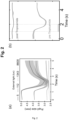
- a training of machine learning model for assessing pupil reactivity invulnerable to external light conditions is realised by performing a series of pupillary light reaction measurements for various external light conditions spanning 5-10000 lux on the cohort of 9 subjects. These measurements are forming the dataset D1.
- the averaged pupillary light reactions measured under various external light conditions are presented in the Figure 2 (a) .
- the influence of external light on the observed pupillogram is clearly visible, for instance the amplitude of pupil contraction is heavily reduced for increased external light intensity.
- a second series of pupillary light reaction measurements is performed on another cohort of 15 subjects with each subject undergoing the administration of tropicamide.
- the reactivity measurements are performed before and after the drug administration forming the dataset D2 which is presented in the Figure 2 (b) .
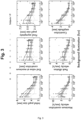
- Some of extracted pupillometric parameters are presented in the Figure 3 .
- the dependence of pupillometric parameters on the external light intensity is especially pronounced for parameters INIT, CAMP and MCV - all of them significantly decreasing under increasing external light intensity.
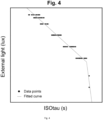
- ISOtau is read out from the camera settings.
- the dependence of ISOtau on the external light is presented in Figure 4 , with a clear anti-correlation visible between ISOtau and external light level.
- CAMP X 3 X 3 avg 0.844 mm
- MCV X 6 X 6 avg 1.986 mm / s
- the selection of the best model for each pupillometry parameter X i (predicting its behaviour in a most reliable manner) is realised by selecting the model with the lowest Bayesian information criterion (BIC).
- the value of pre-corrected parameter is equal to the population average.
- this step might involve another form of factor ⁇ ⁇ [0,1] .
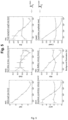
- Selected light corrected parameters are presented in Fig. 5 .
- pupil reactivity index RI is found, one might calculate the rescaled version of the index that spans the numerical range 0-5 by feeding a sigmoid function with reactivity index RI .
- a piecewise linear sigmoid function has been used of the form presented in Figure 9 .
- This index shall be refered as NPx (Neuro-Pupillary Index).
- NPx Neuro-Pupillary Index
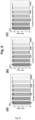
- Figure 6 (a) we present the values of NPx calculated under various external light conditions for the measurements of the cohort of 9 individuals forming a dataset D1. It is clearly visible that the assessment of pupil reactivity remains stable across the entire range of external light.
- a training of machine learning model for assessing pupil reactivity invulnerable to external light conditions is realised by performing a series of pupillary light reaction measurements for various external light conditions spanning 5-10000 lux on the cohort of 9 subjects. These measurements are forming the dataset D1.
- the averaged pupillary light reactions measured under various external light conditions are presented in the Figure 2 (a) .
- the influence of external light on the observed pupillogram is clearly visible, for instance the amplitude of pupil contraction is heavily reduced for increased external light intensity.
- a second series of pupillary light reaction measurements is performed on another cohort of 15 subjects with each subject undergoing the administration of tropicamide.
- the reactivity measurements are performed before and after the drug administration forming the dataset D2 which is presented in the Figure 2 (b) .
- Some of extracted pupillometric parameters are presented in the Figure 3 .
- the dependence of pupillometric parameters on the external light intensity is especially pronounced for parameters INIT, CAMP - all of them significantly decreasing under increasing external light intensity.
- ISOtau is read out from the camera settings.
- the dependence of ISOtau on the external light is presented in Figure 4 , with a clear anti-correlation visible between ISOtau and external light level.
- the selection of the best model for each pupillometry parameter X i (predicting its behaviour in a most reliable manner) is realised by selecting the model with the lowest Bayesian information criterion (BIC).
- the value of pre-corrected parameter is equal to the population average.
- this step might involve another form of factor ⁇ ⁇ [0,1].
- Selected light corrected parameters are presented in Fig. 5 .
- pupil reactivity index RI is found, one might calculate the rescaled version of the index that spans the numerical range 0-5 by feeding a sigmoid function with reactivity index RI .
- a piecewise linear sigmoid function has been used of the form presented in Figure 9 .
- This index shall be refered as NPx (Neuro-Pupillary Index).
- NPx Neuro-Pupillary Index
- Figure 6 (b) we present the values of NPx calculated under various external light conditions for the measurements of the cohort of 9 individuals forming a dataset D1. It is clearly visible that the assessment of pupil reactivity remains stable across the entire range of external light.
- a training of machine learning model for assessing pupil reactivity invulnerable to external light conditions is realised by performing a series of pupillary light reaction measurements for various external light conditions spanning 5-10000 lux on the cohort of 9 subjects. These measurements are forming the dataset D1.
- the averaged pupillary light reactions measured under various external light conditions are presented in the Figure 2 (a) .
- the influence of external light on the observed pupillogram is clearly visible, for instance the amplitude of pupil contraction is heavily reduced for increased external light intensity.
- a second series of pupillary light reaction measurements is performed on another cohort of 15 subjects with each subject undergoing the administration of tropicamide.
- the reactivity measurements are performed before and after the drug administration forming the dataset D2 which is presented in the Figure 2 (b) .
- Some of extracted pupillometric parameters are presented in the Figure 3 .
- the dependence of pupillometric parameters on the external light intensity is especially pronounced for parameters MCV, PDV - all of them significantly decreasing under increasing external light intensity.
- ISOtau is read out from the camera settings.
- the dependence of ISOtau on the external light is presented in Figure 4 , with a clear anti-correlation visible between ISOtau and external light level.
- Parameter Variable name Cohort average value INIT X 1 Not applicable
- MCV X 6 X 6 avg 1.986 mm / s
- PDV X 7 X 7 avg 0.839 mm / s
- the selection of the best model for each pupillometry parameter X i (predicting its behaviour in a most reliable manner) is realised by selecting the model with the lowest Bayesian information criterion (BIC).
- the value of pre-corrected parameter is equal to the population average.
- this step might involve another form of factor ⁇ ⁇ [0,1] .
- Selected light corrected parameters are presented in Fig. 5 .
- pupil reactivity index RI is found, one might calculate the rescaled version of the index that spans the numerical range 0-5 by feeding a sigmoid function with reactivity index RI .
- a piecewise linear sigmoid function has been used of the form presented in Figure 9 .
- This index shall be refered as NPx (Neuro-Pupillary Index).
- NPx Neuro-Pupillary Index
- Figure 6 (c) we present the values of NPx calculated under various external light conditions for the measurements of the cohort of 9 individuals forming a dataset D1. It is clearly visible that the assessment of pupil reactivity remains stable across the entire range of external light.
- pupil reactivity index is found, one might calculate the rescaled version of the index that spans the numerical range 0-5 by feeding a sigmoid function with reactivity index RI .
- a piecewise linear sigmoid function has been used of the form presented in Figure 9 . This index shall be refered as NPx (Neuro-Pupillary Index).
- Fig. 8 we present the assessement of pupil reactivity performed by a system revealing the pupil reactivity loss induced by the administration of tropcamide.
- each subject has been measured before (pre) and after (post) the administration of the tropicamide modifying the reactivity of the pupil. It is clearly visible that the reactivity dropped down sharply following the expected influence of the drug.
Landscapes
- Health & Medical Sciences (AREA)
- Engineering & Computer Science (AREA)
- Life Sciences & Earth Sciences (AREA)
- Medical Informatics (AREA)
- Public Health (AREA)
- General Health & Medical Sciences (AREA)
- Biomedical Technology (AREA)
- Physics & Mathematics (AREA)
- Molecular Biology (AREA)
- Veterinary Medicine (AREA)
- Pathology (AREA)
- Animal Behavior & Ethology (AREA)
- Biophysics (AREA)
- Surgery (AREA)
- Heart & Thoracic Surgery (AREA)
- Data Mining & Analysis (AREA)
- Primary Health Care (AREA)
- Epidemiology (AREA)
- Artificial Intelligence (AREA)
- Ophthalmology & Optometry (AREA)
- Databases & Information Systems (AREA)
- Psychiatry (AREA)
- Signal Processing (AREA)
- Computer Vision & Pattern Recognition (AREA)
- Child & Adolescent Psychology (AREA)
- Fuzzy Systems (AREA)
- Mathematical Physics (AREA)
- Nuclear Medicine, Radiotherapy & Molecular Imaging (AREA)
- Physiology (AREA)
- Radiology & Medical Imaging (AREA)
- Evolutionary Computation (AREA)
- Developmental Disabilities (AREA)
- Educational Technology (AREA)
- Hospice & Palliative Care (AREA)
- Psychology (AREA)
- Social Psychology (AREA)
- Eye Examination Apparatus (AREA)
Priority Applications (2)
| Application Number | Priority Date | Filing Date | Title |
|---|---|---|---|
| EP23461699.3A EP4574018A1 (fr) | 2023-12-22 | 2023-12-22 | Procédé d'apprentissage automatique pour diagnostiquer automatiquement un comportement anormal de pupille |
| PCT/EP2024/088428 WO2025133409A1 (fr) | 2023-12-22 | 2024-12-23 | Procédé d'entraînement d'un modèle d'apprentissage automatique pour détecter automatiquement un comportement de pupille anormal sur la base de l'évaluation de la réactivité de pupille insensible à des conditions de lumière externe, programme informatique comprenant des instructions associées, et système mettant en œuvre le modèle |
Applications Claiming Priority (1)
| Application Number | Priority Date | Filing Date | Title |
|---|---|---|---|
| EP23461699.3A EP4574018A1 (fr) | 2023-12-22 | 2023-12-22 | Procédé d'apprentissage automatique pour diagnostiquer automatiquement un comportement anormal de pupille |
Publications (1)
| Publication Number | Publication Date |
|---|---|
| EP4574018A1 true EP4574018A1 (fr) | 2025-06-25 |
Family
ID=89430474
Family Applications (1)
| Application Number | Title | Priority Date | Filing Date |
|---|---|---|---|
| EP23461699.3A Pending EP4574018A1 (fr) | 2023-12-22 | 2023-12-22 | Procédé d'apprentissage automatique pour diagnostiquer automatiquement un comportement anormal de pupille |
Country Status (1)
| Country | Link |
|---|---|
| EP (1) | EP4574018A1 (fr) |
Citations (4)
| Publication number | Priority date | Publication date | Assignee | Title |
|---|---|---|---|---|
| WO2009137614A2 (fr) | 2008-05-06 | 2009-11-12 | Neuroptics, Inc. | Utilisation d'une valeur scalaire pour évaluer un statut neurologique |
| WO2010062400A1 (fr) | 2008-11-28 | 2010-06-03 | Neuroptics, Inc. | Procédés, systèmes et dispositifs de contrôle d’anisocorie et d’asymétrie d’une réaction de la pupille à un stimulus |
| US9402542B2 (en) | 1999-04-23 | 2016-08-02 | Neuroptics, Inc. | Pupilometer with pupil irregularity detection, pupil tracking, and pupil response detection capability, glaucoma screening capability, intracranial pressure detection capability, and ocular aberration measurement capability |
| WO2023059325A1 (fr) | 2021-10-07 | 2023-04-13 | Neuroptics, Inc. | Procédés, systèmes, programmes et dispositifs pour prédire une évolution de maladie d'un patient à l'aide d'un différentiel d'index pupillaire |
-
2023
- 2023-12-22 EP EP23461699.3A patent/EP4574018A1/fr active Pending
Patent Citations (5)
| Publication number | Priority date | Publication date | Assignee | Title |
|---|---|---|---|---|
| US9402542B2 (en) | 1999-04-23 | 2016-08-02 | Neuroptics, Inc. | Pupilometer with pupil irregularity detection, pupil tracking, and pupil response detection capability, glaucoma screening capability, intracranial pressure detection capability, and ocular aberration measurement capability |
| WO2009137614A2 (fr) | 2008-05-06 | 2009-11-12 | Neuroptics, Inc. | Utilisation d'une valeur scalaire pour évaluer un statut neurologique |
| WO2010062400A1 (fr) | 2008-11-28 | 2010-06-03 | Neuroptics, Inc. | Procédés, systèmes et dispositifs de contrôle d’anisocorie et d’asymétrie d’une réaction de la pupille à un stimulus |
| US20190159671A1 (en) | 2008-11-28 | 2019-05-30 | Neuroptics, Inc. | Methods, systems, and devices for monitoring anisocoria and asymmetry of pupillary reaction to stimulus |
| WO2023059325A1 (fr) | 2021-10-07 | 2023-04-13 | Neuroptics, Inc. | Procédés, systèmes, programmes et dispositifs pour prédire une évolution de maladie d'un patient à l'aide d'un différentiel d'index pupillaire |
Non-Patent Citations (5)
| Title |
|---|
| AGARWAL SACHIN ET AL: "The Influence of Therapeutics on Prognostication After Cardiac Arrest", CURRENT TREATMENT OPTIONS IN NEUROLOGY, SPRINGER US, NEW YORK, vol. 21, no. 12, 25 November 2019 (2019-11-25), XP036952507, ISSN: 1092-8480, [retrieved on 20191125], DOI: 10.1007/S11940-019-0602-1 * |
| HAWKES MAXIMILIANO A ET AL: "Neurological Prognostication After Cardiac Arrest in the Era of Target Temperature Management", CURRENT NEUROLOGY AND NEUROSCIENCE REPORTS, SPRINGER US, NEW YORK, vol. 19, no. 2, 9 February 2019 (2019-02-09), pages 1 - 8, XP036698160, ISSN: 1528-4042, [retrieved on 20190209], DOI: 10.1007/S11910-019-0922-2 * |
| ONG C ET AL: "The Effect of Ambient Light Conditions on Quantitative Pupillometry", NEUROCRITICAL CARE, SPRINGER US, NEW YORK, vol. 30, no. 2, 14 September 2018 (2018-09-14), pages 316 - 321, XP036728172, ISSN: 1541-6933, [retrieved on 20180914], DOI: 10.1007/S12028-018-0607-8 * |
| ONG CHUTCH MSMIRNAKIS S.: "The Effect of Ambient Light Conditions on Quantitative Pupillometry.", NEUROCRIT CARE., vol. 30, no. 2, April 2019 (2019-04-01), pages 316 - 321, XP036728172, DOI: 10.1007/s12028-018-0607-8 |
| VV. TAYLOR ET AL.: "Quantitative pupillometry, a new technology: normative data and preliminary observations in patients with acute head injury. Technical note", JOURNAL OF NEUROSURGERY, vol. 98, no. 1, 2003, pages 200301, XP002559199, DOI: 10.3171/jns.2003.98.1.0205 |
Similar Documents
| Publication | Publication Date | Title |
|---|---|---|
| Issarti et al. | Computer aided diagnosis for suspect keratoconus detection | |
| CN111587365B (zh) | 用于量化组织的生物标志物的方法和系统 | |
| CN117877692B (zh) | 一种视网膜病变个性化差异分析方法 | |
| Crossland et al. | Evaluation of a new quantitative technique to assess the number and extent of preferred retinal loci in macular disease | |
| CN111295129B (zh) | 视敏度检查 | |
| JP6672529B2 (ja) | 予測自覚屈折データまたは予測矯正値を確定するための装置およびコンピュータプログラム | |
| US7427135B2 (en) | Adaptive photoscreening system | |
| US20140364761A1 (en) | An apparatus and method for psychiatric evaluation | |
| CN111970958A (zh) | 用于检测神经障碍和测量一般认知能力的系统和方法 | |
| Vianna et al. | How to detect progression in glaucoma | |
| Lai et al. | Measuring saccade latency using smartphone cameras | |
| TWI742782B (zh) | 視網膜分層厚度檢測模型之建立方法、視網膜分層厚度檢測系統、眼部照護裝置、視網膜分層厚度檢測方法及失智症評估和預測方法 | |
| CN111344222A (zh) | 执行眼睛检查测试的方法 | |
| Rakhmetulayeva et al. | IMPLEMENTATION OF CONVOLUTIONAL NEURAL NETWORK FOR PREDICTING GLAUCOMA FROM FUNDUS IMAGES. | |
| US20240225443A9 (en) | System and method to obtain intraocular pressure measurements and other ocular parameters | |
| EP4574018A1 (fr) | Procédé d'apprentissage automatique pour diagnostiquer automatiquement un comportement anormal de pupille | |
| US20210068650A1 (en) | Assessing visual function | |
| US12564321B2 (en) | Method to monitor accommodation state during visual testing | |
| WO2020178826A1 (fr) | Procédé et dispositif de mesure non invasive d'une pression intraoculaire | |
| Rimayanti et al. | Ocular surface displacement with and without contact lenses during non-contact tonometry | |
| WO2025133409A1 (fr) | Procédé d'entraînement d'un modèle d'apprentissage automatique pour détecter automatiquement un comportement de pupille anormal sur la base de l'évaluation de la réactivité de pupille insensible à des conditions de lumière externe, programme informatique comprenant des instructions associées, et système mettant en œuvre le modèle | |
| Pérez–Bartolomé et al. | Agreement between anterior segment swept source-OCT and Scheimpflug imaging corneal aberration measurements in healthy eyes | |
| JP5955349B2 (ja) | 分析方法 | |
| US20240277224A1 (en) | Optical coherence tomography (oct) self-testing system, optical coherence tomography method, and eye disease monitoring system | |
| WO2024182683A1 (fr) | Criblage rapide, précis et reproductible de la morphologie de cellules endothéliales dans des cornées malades et saines |
Legal Events
| Date | Code | Title | Description |
|---|---|---|---|
| PUAI | Public reference made under article 153(3) epc to a published international application that has entered the european phase |
Free format text: ORIGINAL CODE: 0009012 |
|
| STAA | Information on the status of an ep patent application or granted ep patent |
Free format text: STATUS: THE APPLICATION HAS BEEN PUBLISHED |
|
| AK | Designated contracting states |
Kind code of ref document: A1 Designated state(s): AL AT BE BG CH CY CZ DE DK EE ES FI FR GB GR HR HU IE IS IT LI LT LU LV MC ME MK MT NL NO PL PT RO RS SE SI SK SM TR |
|
| STAA | Information on the status of an ep patent application or granted ep patent |
Free format text: STATUS: THE APPLICATION IS DEEMED TO BE WITHDRAWN |