EP4574088A1 - Dentalfräsrohling, verfahren zu seiner herstellung und verwendungen davon - Google Patents
Dentalfräsrohling, verfahren zu seiner herstellung und verwendungen davon Download PDFInfo
- Publication number
- EP4574088A1 EP4574088A1 EP23218110.7A EP23218110A EP4574088A1 EP 4574088 A1 EP4574088 A1 EP 4574088A1 EP 23218110 A EP23218110 A EP 23218110A EP 4574088 A1 EP4574088 A1 EP 4574088A1
- Authority
- EP
- European Patent Office
- Prior art keywords
- yttria
- mpa
- containing zirconia
- mill blank
- dental
- Prior art date
- Legal status (The legal status is an assumption and is not a legal conclusion. Google has not performed a legal analysis and makes no representation as to the accuracy of the status listed.)
- Pending
Links
Images


Classifications
-
- A—HUMAN NECESSITIES
- A61—MEDICAL OR VETERINARY SCIENCE; HYGIENE
- A61C—DENTISTRY; APPARATUS OR METHODS FOR ORAL OR DENTAL HYGIENE
- A61C5/00—Filling or capping teeth
- A61C5/20—Repairing attrition damage, e.g. facets
-
- A—HUMAN NECESSITIES
- A61—MEDICAL OR VETERINARY SCIENCE; HYGIENE
- A61C—DENTISTRY; APPARATUS OR METHODS FOR ORAL OR DENTAL HYGIENE
- A61C13/00—Dental prostheses; Making same
- A61C13/0003—Making bridge-work, inlays, implants or the like
- A61C13/0022—Blanks or green, unfinished dental restoration parts
-
- C—CHEMISTRY; METALLURGY
- C04—CEMENTS; CONCRETE; ARTIFICIAL STONE; CERAMICS; REFRACTORIES
- C04B—LIME, MAGNESIA; SLAG; CEMENTS; COMPOSITIONS THEREOF, e.g. MORTARS, CONCRETE OR LIKE BUILDING MATERIALS; ARTIFICIAL STONE; CERAMICS; REFRACTORIES; TREATMENT OF NATURAL STONE
- C04B35/00—Shaped ceramic products characterised by their composition; Ceramics compositions; Processing powders of inorganic compounds preparatory to the manufacturing of ceramic products
- C04B35/01—Shaped ceramic products characterised by their composition; Ceramics compositions; Processing powders of inorganic compounds preparatory to the manufacturing of ceramic products based on oxide ceramics
- C04B35/48—Shaped ceramic products characterised by their composition; Ceramics compositions; Processing powders of inorganic compounds preparatory to the manufacturing of ceramic products based on oxide ceramics based on zirconium or hafnium oxides, zirconates, zircon or hafnates
- C04B35/486—Fine ceramics
- C04B35/488—Composites
-
- A—HUMAN NECESSITIES
- A61—MEDICAL OR VETERINARY SCIENCE; HYGIENE
- A61C—DENTISTRY; APPARATUS OR METHODS FOR ORAL OR DENTAL HYGIENE
- A61C13/00—Dental prostheses; Making same
- A61C13/08—Artificial teeth; Making same
- A61C13/083—Porcelain or ceramic teeth
-
- A—HUMAN NECESSITIES
- A61—MEDICAL OR VETERINARY SCIENCE; HYGIENE
- A61C—DENTISTRY; APPARATUS OR METHODS FOR ORAL OR DENTAL HYGIENE
- A61C5/00—Filling or capping teeth
- A61C5/70—Tooth crowns; Making thereof
- A61C5/77—Methods or devices for making crowns
-
- A—HUMAN NECESSITIES
- A61—MEDICAL OR VETERINARY SCIENCE; HYGIENE
- A61K—PREPARATIONS FOR MEDICAL, DENTAL OR TOILETRY PURPOSES
- A61K6/00—Preparations for dentistry
- A61K6/15—Compositions characterised by their physical properties
-
- A—HUMAN NECESSITIES
- A61—MEDICAL OR VETERINARY SCIENCE; HYGIENE
- A61K—PREPARATIONS FOR MEDICAL, DENTAL OR TOILETRY PURPOSES
- A61K6/00—Preparations for dentistry
- A61K6/15—Compositions characterised by their physical properties
- A61K6/17—Particle size
-
- A—HUMAN NECESSITIES
- A61—MEDICAL OR VETERINARY SCIENCE; HYGIENE
- A61K—PREPARATIONS FOR MEDICAL, DENTAL OR TOILETRY PURPOSES
- A61K6/00—Preparations for dentistry
- A61K6/80—Preparations for artificial teeth, for filling teeth or for capping teeth
- A61K6/802—Preparations for artificial teeth, for filling teeth or for capping teeth comprising ceramics
-
- A—HUMAN NECESSITIES
- A61—MEDICAL OR VETERINARY SCIENCE; HYGIENE
- A61K—PREPARATIONS FOR MEDICAL, DENTAL OR TOILETRY PURPOSES
- A61K6/00—Preparations for dentistry
- A61K6/80—Preparations for artificial teeth, for filling teeth or for capping teeth
- A61K6/802—Preparations for artificial teeth, for filling teeth or for capping teeth comprising ceramics
- A61K6/804—Preparations for artificial teeth, for filling teeth or for capping teeth comprising ceramics comprising manganese oxide
-
- A—HUMAN NECESSITIES
- A61—MEDICAL OR VETERINARY SCIENCE; HYGIENE
- A61K—PREPARATIONS FOR MEDICAL, DENTAL OR TOILETRY PURPOSES
- A61K6/00—Preparations for dentistry
- A61K6/80—Preparations for artificial teeth, for filling teeth or for capping teeth
- A61K6/802—Preparations for artificial teeth, for filling teeth or for capping teeth comprising ceramics
- A61K6/811—Preparations for artificial teeth, for filling teeth or for capping teeth comprising ceramics comprising chromium oxide
-
- A—HUMAN NECESSITIES
- A61—MEDICAL OR VETERINARY SCIENCE; HYGIENE
- A61K—PREPARATIONS FOR MEDICAL, DENTAL OR TOILETRY PURPOSES
- A61K6/00—Preparations for dentistry
- A61K6/80—Preparations for artificial teeth, for filling teeth or for capping teeth
- A61K6/802—Preparations for artificial teeth, for filling teeth or for capping teeth comprising ceramics
- A61K6/813—Preparations for artificial teeth, for filling teeth or for capping teeth comprising ceramics comprising iron oxide
-
- A—HUMAN NECESSITIES
- A61—MEDICAL OR VETERINARY SCIENCE; HYGIENE
- A61K—PREPARATIONS FOR MEDICAL, DENTAL OR TOILETRY PURPOSES
- A61K6/00—Preparations for dentistry
- A61K6/80—Preparations for artificial teeth, for filling teeth or for capping teeth
- A61K6/802—Preparations for artificial teeth, for filling teeth or for capping teeth comprising ceramics
- A61K6/816—Preparations for artificial teeth, for filling teeth or for capping teeth comprising ceramics comprising titanium oxide
-
- A—HUMAN NECESSITIES
- A61—MEDICAL OR VETERINARY SCIENCE; HYGIENE
- A61K—PREPARATIONS FOR MEDICAL, DENTAL OR TOILETRY PURPOSES
- A61K6/00—Preparations for dentistry
- A61K6/80—Preparations for artificial teeth, for filling teeth or for capping teeth
- A61K6/802—Preparations for artificial teeth, for filling teeth or for capping teeth comprising ceramics
- A61K6/818—Preparations for artificial teeth, for filling teeth or for capping teeth comprising ceramics comprising zirconium oxide
-
- A—HUMAN NECESSITIES
- A61—MEDICAL OR VETERINARY SCIENCE; HYGIENE
- A61K—PREPARATIONS FOR MEDICAL, DENTAL OR TOILETRY PURPOSES
- A61K6/00—Preparations for dentistry
- A61K6/80—Preparations for artificial teeth, for filling teeth or for capping teeth
- A61K6/802—Preparations for artificial teeth, for filling teeth or for capping teeth comprising ceramics
- A61K6/82—Preparations for artificial teeth, for filling teeth or for capping teeth comprising ceramics comprising hafnium oxide
-
- A—HUMAN NECESSITIES
- A61—MEDICAL OR VETERINARY SCIENCE; HYGIENE
- A61K—PREPARATIONS FOR MEDICAL, DENTAL OR TOILETRY PURPOSES
- A61K6/00—Preparations for dentistry
- A61K6/80—Preparations for artificial teeth, for filling teeth or for capping teeth
- A61K6/802—Preparations for artificial teeth, for filling teeth or for capping teeth comprising ceramics
- A61K6/822—Preparations for artificial teeth, for filling teeth or for capping teeth comprising ceramics comprising rare earth metal oxides
-
- A—HUMAN NECESSITIES
- A61—MEDICAL OR VETERINARY SCIENCE; HYGIENE
- A61K—PREPARATIONS FOR MEDICAL, DENTAL OR TOILETRY PURPOSES
- A61K6/00—Preparations for dentistry
- A61K6/80—Preparations for artificial teeth, for filling teeth or for capping teeth
- A61K6/802—Preparations for artificial teeth, for filling teeth or for capping teeth comprising ceramics
- A61K6/824—Preparations for artificial teeth, for filling teeth or for capping teeth comprising ceramics comprising transition metal oxides
-
- A—HUMAN NECESSITIES
- A61—MEDICAL OR VETERINARY SCIENCE; HYGIENE
- A61K—PREPARATIONS FOR MEDICAL, DENTAL OR TOILETRY PURPOSES
- A61K6/00—Preparations for dentistry
- A61K6/80—Preparations for artificial teeth, for filling teeth or for capping teeth
- A61K6/831—Preparations for artificial teeth, for filling teeth or for capping teeth comprising non-metallic elements or compounds thereof, e.g. carbon
-
- A—HUMAN NECESSITIES
- A61—MEDICAL OR VETERINARY SCIENCE; HYGIENE
- A61K—PREPARATIONS FOR MEDICAL, DENTAL OR TOILETRY PURPOSES
- A61K6/00—Preparations for dentistry
- A61K6/80—Preparations for artificial teeth, for filling teeth or for capping teeth
- A61K6/831—Preparations for artificial teeth, for filling teeth or for capping teeth comprising non-metallic elements or compounds thereof, e.g. carbon
- A61K6/833—Glass-ceramic composites
-
- C—CHEMISTRY; METALLURGY
- C04—CEMENTS; CONCRETE; ARTIFICIAL STONE; CERAMICS; REFRACTORIES
- C04B—LIME, MAGNESIA; SLAG; CEMENTS; COMPOSITIONS THEREOF, e.g. MORTARS, CONCRETE OR LIKE BUILDING MATERIALS; ARTIFICIAL STONE; CERAMICS; REFRACTORIES; TREATMENT OF NATURAL STONE
- C04B35/00—Shaped ceramic products characterised by their composition; Ceramics compositions; Processing powders of inorganic compounds preparatory to the manufacturing of ceramic products
- C04B35/01—Shaped ceramic products characterised by their composition; Ceramics compositions; Processing powders of inorganic compounds preparatory to the manufacturing of ceramic products based on oxide ceramics
- C04B35/48—Shaped ceramic products characterised by their composition; Ceramics compositions; Processing powders of inorganic compounds preparatory to the manufacturing of ceramic products based on oxide ceramics based on zirconium or hafnium oxides, zirconates, zircon or hafnates
- C04B35/486—Fine ceramics
-
- C—CHEMISTRY; METALLURGY
- C04—CEMENTS; CONCRETE; ARTIFICIAL STONE; CERAMICS; REFRACTORIES
- C04B—LIME, MAGNESIA; SLAG; CEMENTS; COMPOSITIONS THEREOF, e.g. MORTARS, CONCRETE OR LIKE BUILDING MATERIALS; ARTIFICIAL STONE; CERAMICS; REFRACTORIES; TREATMENT OF NATURAL STONE
- C04B35/00—Shaped ceramic products characterised by their composition; Ceramics compositions; Processing powders of inorganic compounds preparatory to the manufacturing of ceramic products
- C04B35/01—Shaped ceramic products characterised by their composition; Ceramics compositions; Processing powders of inorganic compounds preparatory to the manufacturing of ceramic products based on oxide ceramics
- C04B35/48—Shaped ceramic products characterised by their composition; Ceramics compositions; Processing powders of inorganic compounds preparatory to the manufacturing of ceramic products based on oxide ceramics based on zirconium or hafnium oxides, zirconates, zircon or hafnates
- C04B35/486—Fine ceramics
- C04B35/488—Composites
- C04B35/4885—Composites with aluminium oxide
-
- C—CHEMISTRY; METALLURGY
- C04—CEMENTS; CONCRETE; ARTIFICIAL STONE; CERAMICS; REFRACTORIES
- C04B—LIME, MAGNESIA; SLAG; CEMENTS; COMPOSITIONS THEREOF, e.g. MORTARS, CONCRETE OR LIKE BUILDING MATERIALS; ARTIFICIAL STONE; CERAMICS; REFRACTORIES; TREATMENT OF NATURAL STONE
- C04B35/00—Shaped ceramic products characterised by their composition; Ceramics compositions; Processing powders of inorganic compounds preparatory to the manufacturing of ceramic products
- C04B35/622—Forming processes; Processing powders of inorganic compounds preparatory to the manufacturing of ceramic products
- C04B35/626—Preparing or treating the powders individually or as batches ; preparing or treating macroscopic reinforcing agents for ceramic products, e.g. fibres; mechanical aspects section B
- C04B35/62605—Treating the starting powders individually or as mixtures
- C04B35/62645—Thermal treatment of powders or mixtures thereof other than sintering
-
- C—CHEMISTRY; METALLURGY
- C04—CEMENTS; CONCRETE; ARTIFICIAL STONE; CERAMICS; REFRACTORIES
- C04B—LIME, MAGNESIA; SLAG; CEMENTS; COMPOSITIONS THEREOF, e.g. MORTARS, CONCRETE OR LIKE BUILDING MATERIALS; ARTIFICIAL STONE; CERAMICS; REFRACTORIES; TREATMENT OF NATURAL STONE
- C04B35/00—Shaped ceramic products characterised by their composition; Ceramics compositions; Processing powders of inorganic compounds preparatory to the manufacturing of ceramic products
- C04B35/622—Forming processes; Processing powders of inorganic compounds preparatory to the manufacturing of ceramic products
- C04B35/64—Burning or sintering processes
-
- C—CHEMISTRY; METALLURGY
- C04—CEMENTS; CONCRETE; ARTIFICIAL STONE; CERAMICS; REFRACTORIES
- C04B—LIME, MAGNESIA; SLAG; CEMENTS; COMPOSITIONS THEREOF, e.g. MORTARS, CONCRETE OR LIKE BUILDING MATERIALS; ARTIFICIAL STONE; CERAMICS; REFRACTORIES; TREATMENT OF NATURAL STONE
- C04B38/00—Porous mortars, concrete, artificial stone or ceramic ware; Preparation thereof
- C04B38/0067—Porous mortars, concrete, artificial stone or ceramic ware; Preparation thereof characterised by the density of the end product
-
- A—HUMAN NECESSITIES
- A61—MEDICAL OR VETERINARY SCIENCE; HYGIENE
- A61C—DENTISTRY; APPARATUS OR METHODS FOR ORAL OR DENTAL HYGIENE
- A61C2201/00—Material properties
-
- C—CHEMISTRY; METALLURGY
- C04—CEMENTS; CONCRETE; ARTIFICIAL STONE; CERAMICS; REFRACTORIES
- C04B—LIME, MAGNESIA; SLAG; CEMENTS; COMPOSITIONS THEREOF, e.g. MORTARS, CONCRETE OR LIKE BUILDING MATERIALS; ARTIFICIAL STONE; CERAMICS; REFRACTORIES; TREATMENT OF NATURAL STONE
- C04B2111/00—Mortars, concrete or artificial stone or mixtures to prepare them, characterised by specific function, property or use
- C04B2111/00474—Uses not provided for elsewhere in C04B2111/00
- C04B2111/00836—Uses not provided for elsewhere in C04B2111/00 for medical or dental applications
-
- C—CHEMISTRY; METALLURGY
- C04—CEMENTS; CONCRETE; ARTIFICIAL STONE; CERAMICS; REFRACTORIES
- C04B—LIME, MAGNESIA; SLAG; CEMENTS; COMPOSITIONS THEREOF, e.g. MORTARS, CONCRETE OR LIKE BUILDING MATERIALS; ARTIFICIAL STONE; CERAMICS; REFRACTORIES; TREATMENT OF NATURAL STONE
- C04B2201/00—Mortars, concrete or artificial stone characterised by specific physical values
- C04B2201/20—Mortars, concrete or artificial stone characterised by specific physical values for the density
-
- C—CHEMISTRY; METALLURGY
- C04—CEMENTS; CONCRETE; ARTIFICIAL STONE; CERAMICS; REFRACTORIES
- C04B—LIME, MAGNESIA; SLAG; CEMENTS; COMPOSITIONS THEREOF, e.g. MORTARS, CONCRETE OR LIKE BUILDING MATERIALS; ARTIFICIAL STONE; CERAMICS; REFRACTORIES; TREATMENT OF NATURAL STONE
- C04B2201/00—Mortars, concrete or artificial stone characterised by specific physical values
- C04B2201/50—Mortars, concrete or artificial stone characterised by specific physical values for the mechanical strength
- C04B2201/52—High compression strength concretes, i.e. with a compression strength higher than about 55 N/mm2, e.g. reactive powder concrete [RPC]
-
- C—CHEMISTRY; METALLURGY
- C04—CEMENTS; CONCRETE; ARTIFICIAL STONE; CERAMICS; REFRACTORIES
- C04B—LIME, MAGNESIA; SLAG; CEMENTS; COMPOSITIONS THEREOF, e.g. MORTARS, CONCRETE OR LIKE BUILDING MATERIALS; ARTIFICIAL STONE; CERAMICS; REFRACTORIES; TREATMENT OF NATURAL STONE
- C04B2235/00—Aspects relating to ceramic starting mixtures or sintered ceramic products
- C04B2235/02—Composition of constituents of the starting material or of secondary phases of the final product
- C04B2235/30—Constituents and secondary phases not being of a fibrous nature
- C04B2235/32—Metal oxides, mixed metal oxides, or oxide-forming salts thereof, e.g. carbonates, nitrates, (oxy)hydroxides, chlorides
- C04B2235/3217—Aluminum oxide or oxide forming salts thereof, e.g. bauxite, alpha-alumina
-
- C—CHEMISTRY; METALLURGY
- C04—CEMENTS; CONCRETE; ARTIFICIAL STONE; CERAMICS; REFRACTORIES
- C04B—LIME, MAGNESIA; SLAG; CEMENTS; COMPOSITIONS THEREOF, e.g. MORTARS, CONCRETE OR LIKE BUILDING MATERIALS; ARTIFICIAL STONE; CERAMICS; REFRACTORIES; TREATMENT OF NATURAL STONE
- C04B2235/00—Aspects relating to ceramic starting mixtures or sintered ceramic products
- C04B2235/02—Composition of constituents of the starting material or of secondary phases of the final product
- C04B2235/30—Constituents and secondary phases not being of a fibrous nature
- C04B2235/32—Metal oxides, mixed metal oxides, or oxide-forming salts thereof, e.g. carbonates, nitrates, (oxy)hydroxides, chlorides
- C04B2235/3224—Rare earth oxide or oxide forming salts thereof, e.g. scandium oxide
- C04B2235/3225—Yttrium oxide or oxide-forming salts thereof
-
- C—CHEMISTRY; METALLURGY
- C04—CEMENTS; CONCRETE; ARTIFICIAL STONE; CERAMICS; REFRACTORIES
- C04B—LIME, MAGNESIA; SLAG; CEMENTS; COMPOSITIONS THEREOF, e.g. MORTARS, CONCRETE OR LIKE BUILDING MATERIALS; ARTIFICIAL STONE; CERAMICS; REFRACTORIES; TREATMENT OF NATURAL STONE
- C04B2235/00—Aspects relating to ceramic starting mixtures or sintered ceramic products
- C04B2235/02—Composition of constituents of the starting material or of secondary phases of the final product
- C04B2235/30—Constituents and secondary phases not being of a fibrous nature
- C04B2235/32—Metal oxides, mixed metal oxides, or oxide-forming salts thereof, e.g. carbonates, nitrates, (oxy)hydroxides, chlorides
- C04B2235/3231—Refractory metal oxides, their mixed metal oxides, or oxide-forming salts thereof
- C04B2235/3244—Zirconium oxides, zirconates, hafnium oxides, hafnates, or oxide-forming salts thereof
- C04B2235/3246—Stabilised zirconias, e.g. YSZ or cerium stabilised zirconia
-
- C—CHEMISTRY; METALLURGY
- C04—CEMENTS; CONCRETE; ARTIFICIAL STONE; CERAMICS; REFRACTORIES
- C04B—LIME, MAGNESIA; SLAG; CEMENTS; COMPOSITIONS THEREOF, e.g. MORTARS, CONCRETE OR LIKE BUILDING MATERIALS; ARTIFICIAL STONE; CERAMICS; REFRACTORIES; TREATMENT OF NATURAL STONE
- C04B2235/00—Aspects relating to ceramic starting mixtures or sintered ceramic products
- C04B2235/60—Aspects relating to the preparation, properties or mechanical treatment of green bodies or pre-forms
- C04B2235/612—Machining
-
- C—CHEMISTRY; METALLURGY
- C04—CEMENTS; CONCRETE; ARTIFICIAL STONE; CERAMICS; REFRACTORIES
- C04B—LIME, MAGNESIA; SLAG; CEMENTS; COMPOSITIONS THEREOF, e.g. MORTARS, CONCRETE OR LIKE BUILDING MATERIALS; ARTIFICIAL STONE; CERAMICS; REFRACTORIES; TREATMENT OF NATURAL STONE
- C04B2235/00—Aspects relating to ceramic starting mixtures or sintered ceramic products
- C04B2235/65—Aspects relating to heat treatments of ceramic bodies such as green ceramics or pre-sintered ceramics, e.g. burning, sintering or melting processes
- C04B2235/656—Aspects relating to heat treatments of ceramic bodies such as green ceramics or pre-sintered ceramics, e.g. burning, sintering or melting processes characterised by specific heating conditions during heat treatment
-
- C—CHEMISTRY; METALLURGY
- C04—CEMENTS; CONCRETE; ARTIFICIAL STONE; CERAMICS; REFRACTORIES
- C04B—LIME, MAGNESIA; SLAG; CEMENTS; COMPOSITIONS THEREOF, e.g. MORTARS, CONCRETE OR LIKE BUILDING MATERIALS; ARTIFICIAL STONE; CERAMICS; REFRACTORIES; TREATMENT OF NATURAL STONE
- C04B2235/00—Aspects relating to ceramic starting mixtures or sintered ceramic products
- C04B2235/65—Aspects relating to heat treatments of ceramic bodies such as green ceramics or pre-sintered ceramics, e.g. burning, sintering or melting processes
- C04B2235/656—Aspects relating to heat treatments of ceramic bodies such as green ceramics or pre-sintered ceramics, e.g. burning, sintering or melting processes characterised by specific heating conditions during heat treatment
- C04B2235/6562—Heating rate
-
- C—CHEMISTRY; METALLURGY
- C04—CEMENTS; CONCRETE; ARTIFICIAL STONE; CERAMICS; REFRACTORIES
- C04B—LIME, MAGNESIA; SLAG; CEMENTS; COMPOSITIONS THEREOF, e.g. MORTARS, CONCRETE OR LIKE BUILDING MATERIALS; ARTIFICIAL STONE; CERAMICS; REFRACTORIES; TREATMENT OF NATURAL STONE
- C04B2235/00—Aspects relating to ceramic starting mixtures or sintered ceramic products
- C04B2235/65—Aspects relating to heat treatments of ceramic bodies such as green ceramics or pre-sintered ceramics, e.g. burning, sintering or melting processes
- C04B2235/656—Aspects relating to heat treatments of ceramic bodies such as green ceramics or pre-sintered ceramics, e.g. burning, sintering or melting processes characterised by specific heating conditions during heat treatment
- C04B2235/6567—Treatment time
-
- C—CHEMISTRY; METALLURGY
- C04—CEMENTS; CONCRETE; ARTIFICIAL STONE; CERAMICS; REFRACTORIES
- C04B—LIME, MAGNESIA; SLAG; CEMENTS; COMPOSITIONS THEREOF, e.g. MORTARS, CONCRETE OR LIKE BUILDING MATERIALS; ARTIFICIAL STONE; CERAMICS; REFRACTORIES; TREATMENT OF NATURAL STONE
- C04B2235/00—Aspects relating to ceramic starting mixtures or sintered ceramic products
- C04B2235/65—Aspects relating to heat treatments of ceramic bodies such as green ceramics or pre-sintered ceramics, e.g. burning, sintering or melting processes
- C04B2235/66—Specific sintering techniques, e.g. centrifugal sintering
- C04B2235/661—Multi-step sintering
-
- C—CHEMISTRY; METALLURGY
- C04—CEMENTS; CONCRETE; ARTIFICIAL STONE; CERAMICS; REFRACTORIES
- C04B—LIME, MAGNESIA; SLAG; CEMENTS; COMPOSITIONS THEREOF, e.g. MORTARS, CONCRETE OR LIKE BUILDING MATERIALS; ARTIFICIAL STONE; CERAMICS; REFRACTORIES; TREATMENT OF NATURAL STONE
- C04B2235/00—Aspects relating to ceramic starting mixtures or sintered ceramic products
- C04B2235/70—Aspects relating to sintered or melt-casted ceramic products
- C04B2235/72—Products characterised by the absence or the low content of specific components, e.g. alkali metal free alumina ceramics
-
- C—CHEMISTRY; METALLURGY
- C04—CEMENTS; CONCRETE; ARTIFICIAL STONE; CERAMICS; REFRACTORIES
- C04B—LIME, MAGNESIA; SLAG; CEMENTS; COMPOSITIONS THEREOF, e.g. MORTARS, CONCRETE OR LIKE BUILDING MATERIALS; ARTIFICIAL STONE; CERAMICS; REFRACTORIES; TREATMENT OF NATURAL STONE
- C04B2235/00—Aspects relating to ceramic starting mixtures or sintered ceramic products
- C04B2235/70—Aspects relating to sintered or melt-casted ceramic products
- C04B2235/74—Physical characteristics
- C04B2235/77—Density
-
- C—CHEMISTRY; METALLURGY
- C04—CEMENTS; CONCRETE; ARTIFICIAL STONE; CERAMICS; REFRACTORIES
- C04B—LIME, MAGNESIA; SLAG; CEMENTS; COMPOSITIONS THEREOF, e.g. MORTARS, CONCRETE OR LIKE BUILDING MATERIALS; ARTIFICIAL STONE; CERAMICS; REFRACTORIES; TREATMENT OF NATURAL STONE
- C04B2235/00—Aspects relating to ceramic starting mixtures or sintered ceramic products
- C04B2235/70—Aspects relating to sintered or melt-casted ceramic products
- C04B2235/74—Physical characteristics
- C04B2235/78—Grain sizes and shapes, product microstructures, e.g. acicular grains, equiaxed grains, platelet-structures
- C04B2235/785—Submicron sized grains, i.e. from 0,1 to 1 micron
-
- C—CHEMISTRY; METALLURGY
- C04—CEMENTS; CONCRETE; ARTIFICIAL STONE; CERAMICS; REFRACTORIES
- C04B—LIME, MAGNESIA; SLAG; CEMENTS; COMPOSITIONS THEREOF, e.g. MORTARS, CONCRETE OR LIKE BUILDING MATERIALS; ARTIFICIAL STONE; CERAMICS; REFRACTORIES; TREATMENT OF NATURAL STONE
- C04B2235/00—Aspects relating to ceramic starting mixtures or sintered ceramic products
- C04B2235/70—Aspects relating to sintered or melt-casted ceramic products
- C04B2235/95—Products characterised by their size, e.g. microceramics
-
- C—CHEMISTRY; METALLURGY
- C04—CEMENTS; CONCRETE; ARTIFICIAL STONE; CERAMICS; REFRACTORIES
- C04B—LIME, MAGNESIA; SLAG; CEMENTS; COMPOSITIONS THEREOF, e.g. MORTARS, CONCRETE OR LIKE BUILDING MATERIALS; ARTIFICIAL STONE; CERAMICS; REFRACTORIES; TREATMENT OF NATURAL STONE
- C04B2235/00—Aspects relating to ceramic starting mixtures or sintered ceramic products
- C04B2235/70—Aspects relating to sintered or melt-casted ceramic products
- C04B2235/96—Properties of ceramic products, e.g. mechanical properties such as strength, toughness, wear resistance
-
- C—CHEMISTRY; METALLURGY
- C04—CEMENTS; CONCRETE; ARTIFICIAL STONE; CERAMICS; REFRACTORIES
- C04B—LIME, MAGNESIA; SLAG; CEMENTS; COMPOSITIONS THEREOF, e.g. MORTARS, CONCRETE OR LIKE BUILDING MATERIALS; ARTIFICIAL STONE; CERAMICS; REFRACTORIES; TREATMENT OF NATURAL STONE
- C04B2235/00—Aspects relating to ceramic starting mixtures or sintered ceramic products
- C04B2235/70—Aspects relating to sintered or melt-casted ceramic products
- C04B2235/96—Properties of ceramic products, e.g. mechanical properties such as strength, toughness, wear resistance
- C04B2235/963—Surface properties, e.g. surface roughness
-
- C—CHEMISTRY; METALLURGY
- C04—CEMENTS; CONCRETE; ARTIFICIAL STONE; CERAMICS; REFRACTORIES
- C04B—LIME, MAGNESIA; SLAG; CEMENTS; COMPOSITIONS THEREOF, e.g. MORTARS, CONCRETE OR LIKE BUILDING MATERIALS; ARTIFICIAL STONE; CERAMICS; REFRACTORIES; TREATMENT OF NATURAL STONE
- C04B2235/00—Aspects relating to ceramic starting mixtures or sintered ceramic products
- C04B2235/70—Aspects relating to sintered or melt-casted ceramic products
- C04B2235/96—Properties of ceramic products, e.g. mechanical properties such as strength, toughness, wear resistance
- C04B2235/9646—Optical properties
- C04B2235/9653—Translucent or transparent ceramics other than alumina
-
- C—CHEMISTRY; METALLURGY
- C04—CEMENTS; CONCRETE; ARTIFICIAL STONE; CERAMICS; REFRACTORIES
- C04B—LIME, MAGNESIA; SLAG; CEMENTS; COMPOSITIONS THEREOF, e.g. MORTARS, CONCRETE OR LIKE BUILDING MATERIALS; ARTIFICIAL STONE; CERAMICS; REFRACTORIES; TREATMENT OF NATURAL STONE
- C04B2235/00—Aspects relating to ceramic starting mixtures or sintered ceramic products
- C04B2235/70—Aspects relating to sintered or melt-casted ceramic products
- C04B2235/96—Properties of ceramic products, e.g. mechanical properties such as strength, toughness, wear resistance
- C04B2235/9646—Optical properties
- C04B2235/9661—Colour
Definitions
- the present invention relates to a dental mill blank and to a process for preparing the dental mill blank.
- the present invention further relates to a dental restoration which is obtainable using the dental mill blank and to a dental restoration as such.
- the present invention further relates to a use of a zirconia powder for preparing a dental mill blank.
- Ceramic dental restorations are typically prepared from dental mill blanks.
- a dental mill blank is usually a porous and not perfectly sintered block or disc that is based on a ceramic material, like zirconia.
- the dental mill blank can be machined in a CAD/CAM process to prepare a ceramic dental restoration precursor.
- This dental restoration precursor has a shape of the final ceramic dental restoration but not yet its final density, and therefore not yet its final dimensions.
- the dental restoration precursor is then subjected to a sintering process to provide the ceramic dental restoration in its final density and dimensions.
- dental mill blanks are based on yttria-stabilized zirconia materials.
- dental mill blanks are available on the market that are based on 3 mol%-, 4 mol%-, or 5 mol%-yttria-stabilized zirconia materials (also referred to as 3Y-, 4Y-, and 5Y-TZP).
- 3Y-, 4Y-, and 5Y-TZP 3 mol%-yttria-stabilized zirconia materials
- these materials, and especially 3Y-TZP can be used to provide a dental restoration with a comparatively high flexural strength.
- the fracture toughness or fracture resistance of said materials is not always satisfactory, especially for more challenging application of dental restorations such as multi-unit bridges or minimal-invasive restorations.
- a dental mill blank which is suitable for preparing a dental restoration which has improved mechanical properties, and especially which has an increased fracture toughness or fracture resistance. It is further desirable that the dental mill blank is suitable for preparing a dental restoration which provides appreciable color and translucency characteristics.
- One object of the present invention is to provide a dental mill blank which is suitable for preparing a dental restoration having improved mechanical properties, compared to a prior art dental mill blank.
- One object of the present invention is to provide a dental mill blank which is suitable for preparing a dental restoration having a high flexural strength and a high fracture toughness or fracture resistance.
- One object of the present invention is to provide a dental mill blank which is suitable for preparing a dental restoration having a good balance of mechanical properties, like flexural strength and fracture toughness or fracture resistance, and optical properties, like color or translucency.
- One or more of the above objects is solved by the dental mill blank, the process for preparing the dental restoration, the dental restoration according to the present invention, and/or the use according to the present invention.
- One aspect of the present invention provides a dental mill blank comprising an yttria-containing zirconia material.
- One embodiment of the present invention provides a dental mill blank comprising an yttria-containing zirconia material, wherein the yttria-containing zirconia material has:
- One embodiment of the present invention provides a dental mill blank comprising an yttria-containing zirconia material, wherein the yttria-containing zirconia material comprises yttria in an amount of at most 4.0 wt.%, based on the total weight of the yttria-containing zirconia material.
- Another aspect of the present invention provides a use of a zirconia powder for preparing a dental mill blank, wherein the zirconia powder comprises
- a “dental restoration precursor” as used herein refers to a work piece machined from a dental mill blank that already has the shape of a dental restoration but that has not yet been densely sintered, and therefore not yet its final dimensions.
- Dental restoration refers to an article that is useful in the dental or orthodontic field for restoring, remodeling, supporting and/or restructuring a tooth or parts thereof or a group of teeth or parts thereof.
- a dental restoration may be, but is not limited to, a crown, a partial crown, an abutment, an abutment crown, an inlay, an onlay, a veneer, a shell or a bridge.
- a "green body” is a molded body of ceramic powder that has not been subjected to a sintering or pre-sintering step, and that may contain an organic binder, an inorganic binder, or other additives.
- the molded body is usually prepared by compacting (e.g., pressing) the ceramic powder.
- Porous as used herein means that a material has pores and is meant to comprise open-porous materials and closed-porous materials.
- An "open-porous” material is a material that has pores that are at least partially interconnected and that are at least partially accessible from the outside by, e.g., a flow of gas or liquid.
- An open-porous material as defined herein may also have pores that are not accessible from the outside by, e.g., a flow of gas or liquid.
- a “closed-porous” material is a material that is not open-porous and that has pores that are closed, i.e., pores that are not accessible from the outside by, e.g., by a flow of gas or liquid.
- “Porosity” is a measure of the void spaces, like pores, in a solid material, and is a fraction of the volume of the void spaces over the total volume of the solid material. It may be expressed as a percentage from 0 to 100%.
- Interconnecting means the densification of a porous inorganic material to a less porous inorganic material having a higher density by subjecting the material to heat at an appropriate temperature for densification. The temperature is below the melting point of the main components of the inorganic material.
- Debinding as used herein means subjecting a green body to heat in order to partially or fully remove or decompose organic binders, inorganic binders or thermally unstable components. Debinding can be carried out before or as part of a pre-sintering step.
- the density of pre-sintered materials may be in the range of 45 to 70% relative to the theoretical density of the ceramic material.
- the temperature with which a material has been pre-sintered can be determined by the skilled person, e.g., by measuring the thermal expansion using a dilatometer.
- “Densely sintered” or “densely sintering” as used herein means that a ceramic material has been sintered to a density of at least 98.5%, like at least 99.5% or at least 99.8%, of the theoretical density of the ceramic material.
- the density of the material can be determined by the Archimedes' method according to DIN EN 623-2, or by weighing the material and determining its volume geometrically.
- the theoretical density of a densely sintered material can be determined by the skilled person, e.g., based on the chemical composition of the material. Additionally or alternatively, the theoretical density of the ceramic material may be determined by grinding the ceramic material to a powder, e.g., having a volume-based median particle size in the range of 10 to 30 ⁇ m (e.g. 20 ⁇ m), and determining the density of the powder by pycnometry.
- the volume-based median particle size may be determined by laser diffraction, e.g., according to ISO 13320 (2009).
- Yttria-stabilized zirconia as used herein means zirconia (ZrO 2 ) that is at least partially present in a tetragonal crystal phase or a cubic crystal phase and which has an amount of yttria (Y 2 O 3 ) incorporated into its crystal lattice that is sufficient to at least partially prevent a transition of the tetragonal crystal phase and cubic crystal phase, respectively, into the monoclinic crystal phase during cooling down to room temperature.
- ZrO 2 zirconia
- Y 2 O 3 yttria
- the monoclinic crystal phase transforms into the tetragonal crystal phase, and subsequently the tetragonal phase transform into the cubic crystal phase at approx. 2370°C.
- the incorporation of an appropriate amount of yttria into the crystal lattice of the zirconia at least partially stabilizes the tetragonal or cubic crystal phase of the zirconia, i.e., at least partially prevents a transition of the tetragonal crystal phase and cubic crystal phase, respectively, into the (at room temperature) more stable monoclinic crystal phase of zirconia.
- the term “comprising” is used herein, it does not exclude that further non-specified elements are present.
- the term “essentially consisting of” is used herein, it is does not exclude that further non-specified elements are present that are not materially affecting the essential characteristics of the defined subject-matter.
- the material may contain unavoidable trace impurities (e.g., SiO 2 , CaO, and/or Na 2 O) in a sum of ⁇ 0.1 wt.%, even if this is not explicitly defined.
- the terms “essentially consisting of” and “consisting of” are considered to be specific embodiments of the term “comprising of”. Whenever the terms “including” or “having” are used, these terms are meant to be equivalent to “comprising” as defined above.
- the section may be densely sintered at a maximum sintering temperature between 1250 and 1350°C, for example, at a maximum sintering temperature of 1250°C or 1300°C.
- the maximum sintering temperature may be hold for 2 hours. Further details for determining the fracture resistance of the yttria-containing zirconia material are described herein in section "Measuring methods".
- the yttria-containing zirconia material may have a fracture resistance of at least 8.0 MPa*m -1/2 , and preferably at least 10.0 MPa*m -1/2 , like at least 12.0 MPa*m -1/2 , at least 13.0 MPa*m -1/2 , or at least 14.0 MPa*m -1/2 .
- the yttria-containing zirconia material may have a fracture resistance of at most 23.0 MPa*m -1/2 , at most 22.0 MPa*m -1/2 , at most 20.0 MPa*m -1/2 , or at most 19.0 MPa*m -1/2 .
- the yttria-containing zirconia material may have a fracture resistance, determined according to ISO14627 (particularly ISO14627:2012), "Method A" as described herein, of at most 23.0 MPa*m -1/2 , at most 22.0 MPa*m -1/2 , at most 20.0 MPa*m -1/2 , at most 19.0 MPa*m -1/2 .
- the yttria-containing zirconia material may have a fracture resistance, determined according to ISO14627 (particularly ISO14627:2012), "Method A" as described herein, in the range of 11.0 to 23.0 MPa*m -1/2 , preferably in the range of 13.0 to 22.0 MPa*m -1/2 , and more preferably in a range of 14.0 to 20.0 MPa*m -1/2 , like in a range of 15.0 to 19.5 MPa*m -1/2 or 15.5 to 19.0 MPa*m -1/2 .
- the yttria-containing zirconia material has a fracture resistance, determined according to ISO14627 (particularly ISO14627:2012), "Method A” as described herein, of in the range of 16.0 to 20.5 MPa*m -1/2 , like in a range of 17.0 to 20.0 MPa*m -1/2 , like in a range of 17.5 to 19.5 MPa*m -1/2 , and optionally wherein the yttria-containing zirconia material is an yttria-containing zirconia material according to "Embodiment P2" as described herein below.
- the yttria-containing zirconia material has a fracture resistance, determined according to ISO14627 (particularly ISO14627:2012), "Method B" as described herein, of in the range of 13.5 to 18.5 MPa*m -1/2 , like in a range of 14.0 to 18.0 MPa*m -1/2 , like in a range of 14.5 to 17.5 MPa*m -1/2 , and optionally wherein the yttria-containing zirconia material is an yttria-containing zirconia material according to "Embodiment P2" as described herein below.
- the yttria-containing zirconia material may have a biaxial flexural strength of at least 1300 MPa, and preferably at least 1350 MPa, like at least 1400 MPa or at least 1500 MPa.
- the yttria-containing zirconia material may have a biaxial flexural strength of at most 2200 MPa, at most 2150 MPa, at most 2000, or at most 1900 MPa.
- the yttria-containing zirconia material may have a biaxial flexural strength in the range of 1200 to 2200 MPa, preferably 1300 to 2200 MPa, and more preferably 1350 to 2200 MPa, like in a range of 1400 to 2150 MPa.
- the yttria-containing zirconia material has a biaxial flexural strength in the range of the range of 1700 to 2200 MPa, like in a range of 1750 to 2150 MPa, and optionally wherein the yttria-containing zirconia material is an yttria-containing zirconia material according to "Embodiment P2" as described herein below.
- the yttria-containing zirconia material may be further characterized by its hardness in a densely sintered state.
- Vickers hardness VH refers to the hardness of the yttria-containing zirconia material, determined on a densely sintered test body of the yttria-containing zirconia material as described herein below.
- the Vickers hardness VH may be determined according to ISO14705, and particularly ISO14705:2008, using a test load of 196.1 N (HV20). The measuring method is carried out using a densely sintered test body of the yttria-containing zirconia material.
- the densely sintered test body is typically obtained by cutting (e.g., milling) a section from the dental mill blank, densely sintering the section, and lapping and/or polishing the surface of the densely sintered section.
- the lapping and/or polishing may be carried out according to DIN EN 843-1, and particularly DIN EN 843-1:2008-08.
- the section may be densely sintered at a maximum sintering temperature between 1250 and 1350°C, for example, at a maximum sintering temperature of 1250°C or 1300°C. The maximum sintering temperature may be hold for 2 hours. Further details for determining the Vickers hardness VH of the yttria-containing zirconia material are described herein in section "Measuring methods".
- the yttria-containing zirconia material may be characterized by a Vickers hardness VH of at least 9 000 MPa, and preferably at least 10 000 MPa, like at least 11 000 MPa or at least 11 250 MPa.
- the yttria-containing zirconia material may have a Vickers hardness VH of at most 14 500 MPa, at most 13 500 MPa, or at most 12 750 MPa.
- the yttria-containing zirconia material may have a Vickers hardness VH in the range of 9 000 to 14 500 MPa, preferably at least 10 000 to 13 500 MPa, like in a range of 11 000 to 12 750 MPa or 11 250 to 12 750 MPa.
- the yttria-containing zirconia material has a Vickers hardness VH in the range of 11 500 to 12 750 MPa, and optionally wherein the yttria-containing zirconia material is an yttria-containing zirconia material according to "Embodiment P1" as described herein below. In one embodiment, the yttria-containing zirconia material has a Vickers hardness VH in the range of 11 000 to 12 250 MPa, and optionally wherein the yttria-containing zirconia material is an yttria-containing zirconia material according to "Embodiment P2" as described herein below.
- the yttria-containing zirconia material may have a contrast ratio of less than 90%, and preferably less than 88%, like less than 86%.
- the yttria-containing zirconia material may have a contrast ratio in the range of 70 to 90%, and preferably 72 to 88%, like in a range of 74 to 86%.
- the yttria-containing zirconia material has a contrast ratio in the range of 82 to 88%, and optionally wherein the yttria-containing zirconia material is an yttria-containing zirconia material according to "Embodiment P2" as described herein below.
- the contrast ratio may be determined according to BS 5612, and particularly BS 5612:1978.
- the contrast ratio can be used to characterize the translucency of a material, i.e. the light transmission of a material expressed as the ratio of transmitted to incident light intensity.
- a contrast ratio of close to 0% may indicate that a given material is almost fully transparent, while a contrast ratio of 100% may indicate that a material is fully opaque.
- the yttria-containing zirconia material may have CIE L*a*b* color values of: L* in range of 76 to 96, a* in a range of (-2) to 6, b* in a range of 0 to 25.
- the yttria-containing zirconia material has CIE L*a*b* color values of:
- the yttria-containing zirconia material is preferably further characterized by its chemical properties as described in the following section.
- the yttria-containing zirconia material is typically an yttria-stabilized zirconia material.
- the yttria-stabilized zirconia material may have a monoclinic ratio of crystal phases of less than 20%, less than 15% or less than 10%, based on the entire crystal phases of the material.
- the monoclinic ratio of crystal phases may be determined using quantitative X-ray diffractometry. The measuring method is known to the person of skill.
- the monoclinic ratio may be determined following DIN EN ISO 13356, (with reference to ASTM C1499).
- the yttria-containing zirconia material may have a theoretical density of about 6.1 g/cm 3 , like about 6.11 g/cm 3 .
- the yttria-containing zirconia material comprises yttria.
- the yttria-containing zirconia material preferably comprises yttria in an amount of at most 4.0 wt.%, more preferably in a range of 1.5 to 4.0 wt.%, and even more preferably in a range of 2.0 to 3.8 wt.%, like in a range of 2.2 to 3.4 wt.%, based on the total weight of the yttria-containing zirconia material.
- the yttria-containing zirconia material may comprise zirconia in an amount in a range of 82.0 to 98.5 wt.%, preferably in a range of 84.0 to 98.5 wt.%, more preferably in a range of 86.0 to 98.0 wt.%, like in a range of 88.0 to 98.0 wt.%, in a range of 90.0 to 98.0 wt.%, in a range of 92.0 to 97.0 wt.% or in a range of 94.0 to 96.0 wt.%, based on the total weight of the yttria-containing zirconia material.
- the yttria-containing zirconia material may comprise hafnia (HfO 2 ).
- the yttria-containing zirconia material may comprise hafnia in a weight ratio to zirconia in the range of 0:100 to 5:95, 1:99 to 4:96, 2:98 to 3:97, based on the total weight of the combined amount of hafnia and zirconia being present in the material.
- the yttria-containing zirconia material may comprise hafnia in an amount of at most 5.0 wt.%, preferably at most 4.0 wt.%, like in a range of 0.5 to 4.0 wt.%, 1.0 to 3.0 wt.% or 1.5 to 2.5 wt.%, based on the total weight of the yttria-containing zirconia material.
- the yttria-containing zirconia material may comprise aluminum oxide (Al 2 O 3 ).
- the material may comprise aluminum oxide in an amount of at most 2.0 wt.%, preferably in a range of 0.0 to 1.5 wt.%, more preferably in a range of 0.0 to 1.0 wt.%, and even more preferably in a range of 0.0 to 0.7 wt.%, like in a range of 0.0 to 0.5 wt.%, 0.1 to 0.7 wt.% or 0.1 to 0.5 wt.%, based on the total weight of the yttria-containing zirconia material.
- the yttria-containing zirconia material comprises aluminum oxide in an amount of 0.1 to 0.4 wt.%, based on the total weight of the yttria-containing zirconia material. In one embodiment, the yttria-containing zirconia material comprises aluminum oxide in an amount of 0.4 to 0.7 wt.%, based on the total weight of the yttria-containing zirconia material.
- the yttria-containing zirconia material may comprise oxides other than zirconia, yttria, hafnia and aluminum oxide. These other oxides may comprise coloring metal oxides and/or traces of metal oxides originating from the production process and/or raw material of the yttria-containing zirconia material. The amount of the other oxides may vary depending on whether or not the dental mill blank is a pre-colored dental mill blank.
- the amount and types of coloring metal oxides may depend on a color (e.g., a color matching a natural color of tooth and/or matching a tooth color by VITA classical A1-D4 ® shade guide with VITA Bleached Shades manufactured by Vita Zahnfabrik or a similar dental shade guide system) that is intended to be achieved for a dental restoration prepared using the dental mill blank.
- the dental mill blank may be pre-colored or may not be pre-colored.
- the yttria-containing zirconia material may comprise one or more coloring metal oxides.
- Suitable coloring metal oxides may be, but are not limited to, the oxides of Fe, Mn, Cr, Pr, Tb, Er, Yb, Ce, Co, Ni, Nd, Cu, Bi, and any mixture thereof.
- the one or more coloring metal oxides may comprise iron oxide, erbium oxide, chromium oxide, manganese oxide, terbium oxide, praseodymium oxide, or any combination thereof, and optionally one or more additional coloring metal oxides.
- the yttria-containing zirconia material may comprise one or more coloring metal oxides in an amount of at least 0.02 wt.%, at least 0.1 wt.%, at least 0.2 wt.%, at most 2.0 wt.%, at most 1.5 wt.%, or at most 1.0 wt.%, at most 0.5 wt.%, based on the total weight of the yttria-containing zirconia material.
- the yttria-containing zirconia material may comprise one or more coloring metal oxides in an amount in the range of 0.02 to 2.0 wt.%, 0.1 to 1.5 wt.%, 0.2 to 1.0 wt.%, 0.1 to 1.0 wt.%, or 0.2 to 1.0 wt.%, based on the total weight of the yttria-containing zirconia material. It is also possible that the yttria-containing zirconia material comprises coloring metal oxides in an amount of less than 0.02 wt.%, based on the yttria-containing zirconia material. This is preferably the case when the dental mill blank is not pre-colored.
- Traces of metal oxides originating from the production process and/or raw material of the yttria-containing zirconia material may be, but are not limited to, Fe 2 O 3 , TiO 2 , SiO 2 , CaO, or Na 2 O.
- the yttria-containing zirconia material may be characterized by a chemical composition as described in the following paragraphs. Unless explicitly stated otherwise, the weight amount of the indicated components are to be selected to add up to 100.0 wt.%. The indicated weight amounts of the components of the yttria-containing zirconia material are based on the total weight of the yttria-containing zirconia material. When the dental mill blank is composed of the yttria-containing zirconia material, the total weight of the yttria-containing material may be equated with the total weight of the dental mill blank.
- the yttria-containing zirconia material may comprise
- the yttria-containing zirconia material may comprise
- the yttria-containing zirconia material may comprise
- the yttria-containing zirconia material comprises
- the yttria-containing zirconia material comprises
- the yttria-containing zirconia material comprises
- the yttria-containing zirconia material comprises
- the yttria-containing zirconia material comprises
- the dental mill blank is porous.
- the dental mill blank is typically open-porous or may have an open-porous structure.
- the density of the dental mill blank may be at least 45%, like in a range of 45 to 70%, 45 to 60%, or 45 to 55%.
- the theoretical density of the dental mill blank may be about 6.1 g/cm 3 , like about 6.11 g/cm 3 .
- the density of the dental mill blank may be in a range of 2.5 to 4.2 g/cm 3 , 2.6 to 3.8 g/cm 3 , or 2.7 to 3.4 g/cm 3 .
- the dental mill blank may comprise the yttria-containing zirconia material in an amount of at least 98 wt.%, at least 99 wt.%, or at least 99.8 wt.%, based on the total weight of the dental mill blank.
- the dental mill blank may be composed of, essentially consist of or consist of the yttria-containing zirconia material. In one embodiment of the present invention, the dental mill blank is composed of the yttria-containing zirconia material.
- the dental mill blank may comprise the yttria-containing zirconia material in form of a subsection of the dental mill blank.
- the subsection is composed of the yttria-containing zirconia material.
- the test bodies as described herein are prepared from the subsection.
- the subsection of the dental mill blank may be useful to prepare a subsection of a dental restoration precursor.
- the remaining part of the dental mill blank may be composed of other materials to prepare other subsections of a dental restoration precursor.
- the dental mill blank may be characterized by its hardness, like its white hardness.
- the "white hardness” as used herein refers to the hardness of the porous dental mill blank in a pre-sintered state. Thus, when the white hardness is defined herein, this refers to a porous, pre-sintered dental mill blank according to an embodiment of the invention.
- the white hardness of a dental mill blank is relevant for its machinability and/or millability.
- the white hardness may be determined according to ISO14705, and particularly ISO14705:2008, using a test load of 24.5 N (HV2.5).
- the measuring method is carried out using a test body which is obtained by cutting (e.g., milling) a section from the dental mill blank. The test body is not subjected to a densely sintering but is tested in its porous state. Further details for determining the white hardness of the dental mill blank are described herein in section "Measuring methods".
- the dental mill blank may have a white hardness of at least 250 MPa, and preferably at least 300 MPa, like at least 350 MPa or at least 400 MPa.
- the dental mill blank may have a white hardness of at most 1 000 MPa, at most 900 MPa, or at most 850 MPa.
- the dental mill blank may have a white hardness in the range of 250 to 1 000 MPa, preferably in a range 300 to 900 MPa, like in a range of 350 to 850 MPa or in a range 400 to 850 MPa.
- the dental mill blank has a white hardness in the range of 250 to 550 MPa, like in a range 300 to 550 MPa, like in a range of 350 to 500 MPa.
- the dental mill blank has a white hardness in the range of 600 to 1 000 MPa, like in a range 650 to 950 MPa, like in a range of 700 to 900 MPa.
- the dental mill blank may be, but is not limited to, a disc with a height in the range of 8 to 30 mm (e.g., about 10 mm, 12 mm, 14 mm, 16 mm, 18 mm, 20 mm, 25 mm), like in the range of 10 to 20 mm, and a diameter in the range of 40 to 150 mm.
- the dental mill blank may have a diameter of about 40 mm and a height in a range of 10 to 20 mm. Other dimensions are also possible.
- the dental mill blank is typically a pre-sintered dental mill blank.
- the dental mill blank may be obtained by pre-sintering a green body of the dental mill blank at a maximum pre-sintering temperature of at least 600°C, at least 650°C, or at least 675°C, like in a range of 600 to 800°C, in a range of 650 to 750°C or in a range of 675 to 725°C.
- the maximum pre-sintering temperature may be held for a time period in the range of 1 to 5 hours, like in the range of 2 to 3 hours.
- the green body may be a compacted green body that is obtainable using a compacting pressure (e.g., applied by cold isostatic pressing) in the range of 200 to 400 MPa, like in a range of 300 to 400 MPa.
- the dental mill blank is obtainable by the process for preparing a dental mill blank according to the present invention. The process is described in further detail in the following section.
- One aspect of the present invention provides a process for preparing a dental mill blank according to an embodiment of the present invention.
- the process comprises the steps of (carried out in that order):
- the process comprises the step of providing a zirconia powder.
- the zirconia powder may be characterized by its chemical composition as described in the following. Unless explicitly stated otherwise, the indicated weight amounts are to be selected to add up to 100.0 wt.% and are based on the total weight of the zirconia powder.
- the zirconia powder may comprise
- the zirconia powder may comprise
- the zirconia powder comprises
- the zirconia powder comprises
- the zirconia powder may be obtained as a commercial product, e.g., from Tosoh Corporation, Japan.
- the zirconia powder may be provided in combination with a binder, in particular an organic binder. However, it is also possible to provide the zirconia powder without an organic binder or a binder.
- the zirconia powder may also be provided in form of an aqueous suspension.
- the process may comprise a step of treating the zirconia powder with one or more colorants. Treating the zirconia powder with one or more colorants is optional. In one embodiment, the process does not comprise a step of treating the zirconia powder with one or more colorants and/or one or more sintering additives before a compacting step.
- the process may comprise treating the zirconia powder with one or more colorants.
- the colorants may be added in form of a solution, like an aqueous solution.
- a treatment step is known in the art and is described in, e.g., EP2707342 B1 .
- Suitable colorants may be, but are not limited to, polyvalent ions of 3d- and/of 4f-elements in different valence states, like e.g. Fe 3+ , Mn 2+ , Pr 3+ , Tb 3+ , Cr 3+ , and Er 3+ , like salts of those compounds (e.g., nitrate salts).
- the process comprises the treating of the zirconia powder with one or more colorants before a compacting step
- it may be dispensed with coloring the dental mill blank towards the end of the process and as described further below.
- it is also possible to combine the two steps, if needed.
- the process further comprises a step of compacting the zirconia powder to provide a green body.
- the optionally treated zirconia powder may be charged in a mold followed by a compacting of the powder.
- the compacting may be a pressing, like an uniaxial pressing, a cold isostatic pressing, or a combination of both.
- the compacting may comprise two or more pressing steps.
- the compacting comprises an uniaxial pressing, followed by a cold isostatic pressing.
- the zirconia powder is provided in form of an aqueous suspension
- the compacting may be carried out by a suitable wet-pressing technique, like silt casting and/or pressure filtration.
- the process may further comprise the pre-coloring of the dental mill blank.
- the pre-coloring may be carried out by treating, e.g., soaking or painting, the dental mill blank with one or more colorants.
- the one or more colorants may be provided in form of a solution, like an aqueous solution.
- Suitable colorants may be, but are not limited to, polyvalent ions of 3d- and/of 4f-elements in different valence states, like e.g. Fe 3+ , Mn 2+ , Pr 3+ , Tb 3+ , Cr 3+ , and Er 3+ , like salts of those compounds (e.g., nitrate salts).
- the process comprises the pre-coloring of the dental mill blank after pre-sintering, it may be dispensed with treating the zirconia powder with colorants in a previous process step. However, both steps may also be combined.
- the dental mill blank according to the present invention is useful for preparing a dental restoration.
- One aspect of the present invention relates to the use of the dental mill blank according to the present invention for preparing a dental restoration.
- One aspect relates to a process for preparing a dental restoration using a dental mill blank according to the present invention.
- the sintering may be carried out at a maximum sintering temperature of at most 1350°C, like in a range of 1200 to 1350°C. It has been found that a dental restoration with good mechanical and optical properties may be obtained using a comparatively low maximum sintering temperature of at most 1350°C, like in a range of 1200 to 1350°C. This is advantageous in terms of energy consumption and may also shorten the overall sintering time.
- a dental restoration comprising (or essentially consisting of) an yttria-containing zirconia ceramic.
- the dental restoration may have a desirable color.
- the dental restoration may have a color that matches a shade of by the VITA classical A1-D4 ® shade guide with VITA Bleached Shades manufactured by Vita Zahnfabrik.
- a shade may be, but is not limited to, A1, A2, A3, A3.5, A4, B1, B2, B3, B4, C1, C2, C3, C4, D1, D2, D3, D4, BL1 or BL2.
- the yttria-containing zirconia ceramic may have specific optical properties such as CIE L*a*b* color values, opacity or translucency.
- the optical properties can be determined according to BS 5612 (e.g., for determining contrast ratio) and/or according to DIN 6174 (e.g. for determining CIE L*a*b* color values) using specimen having a thickness of 1.00 ⁇ 0.05 mm.
- the yttria-containing zirconia ceramic may have CIE L*a*b* color values of: L* in range of 76 to 96, a* in a range of (-2) to 6, b* in a range of 0 to 25.
- the yttria-containing zirconia ceramic may have a contrast ratio in the range of 70 to 90%, and preferably 72 to 88%, like in a range of 74 to 86%.
- the yttria-containing zirconia ceramic preferably comprises yttria in an amount of at most 4.0 wt.%, more preferably in an range of 1.5 to 4.0 wt.%, and even more preferably in a range of 2.0 to 3.8 wt.%, like in a range of 2.2 to 3.4 wt.%, based on the total weight of the yttria-containing zirconia ceramic.
- the yttria-containing zirconia ceramic preferably comprises zirconia in an amount in a range of 82.0 to 98.5 wt.%, preferably in a range of 84.0 to 98.5 wt.%, more preferably in a range of 86.0 to 98.0 wt.%, like in a range of 88.0 to 98.0 wt.%, in a range of 90.0 to 98.0 wt.%, in a range of 92.0 to 97.0 wt.% or in a range of 94.0 to 96.0 wt.%, based on the total weight of the yttria-containing zirconia ceramic.
- the yttria-containing zirconia ceramic may comprise hafnia in a weight ratio to zirconia in the range of 0:100 to 5:95, 1:99 to 4:96, 2:98 to 3:97, based on the total weight of the combined amount of hafnia and zirconia in the yttria-containing zirconia ceramic.
- the yttria-containing zirconia ceramic may comprise aluminum oxide in an amount of at most 2.0 wt.%, preferably in a range of 0.0 to 1.5 wt.%, more preferably in a range of 0.0 to 1.0 wt.%, and even more preferably in a range of 0.0 to 0.7 wt.%, like in a range of 0.0 to 0.5 wt.%, 0.1 to 0.7 wt.% or 0.1 to 0.5 wt.%, based on the total weight of the yttria-containing zirconia ceramic.
- the yttria-containing zirconia ceramic typically comprises coloring metal oxides.
- Suitable coloring metal oxides may be, but are not limited to, the oxides of Fe, Mn, Cr, Pr, Tb, Er, Yb, Ce, Co, Ni, Nd, Cu, Bi, and any mixture thereof.
- the one or more coloring metal oxides may comprise iron oxide, erbium oxide, chromium oxide, manganese oxide, terbium oxide, praseodymium oxide, or any combination thereof, and optionally one or more additional coloring metal oxides.
- the yttria-containing zirconia ceramic may comprise from 90.0 to 98.5 wt.%, preferably from 91.0 to 98.0 wt.% (e.g., from 93.0 to 97.7 wt.%), of a combined amount of zirconia and hafnia, from 1.5 to 4.0 wt.%, preferably from 2.0 to 3.8 wt.%, (e.g., from 2.2 to 3.4 wt.%, of yttria), from 0.0 to 1.0 wt.%, preferably from 0.0 to 0.7 wt.% (e.g., from 0.1 to 0.4 wt.% or from 0.4 to 0.7 wt.%), and from 0.0 to 5.0 wt.%, preferably from 0.0 to 4.5 wt.% (e.g., from 0.0 to 3.0 wt.%), of other oxides, optionally comprising one or more coloring metal oxides optionally comprising iron oxide, erbium
- the weight amount of the indicated components are to be selected to add up to 100.0 wt.%.
- the indicated weight amounts of the components of the yttria-containing zirconia ceramic are based on the total weight of the yttria-containing zirconia ceramic.
- the dental restoration may be, but is not limited to, a crown, a partial crown, an abutment, an abutment crown, an inlay, an onlay, a veneer, a shell, or a multi-unit framework, or a bridge (e.g., 2-, 3- or 4- unit bridge) an implant bridge, and the like.
- a bridge e.g., 2-, 3- or 4- unit bridge
- Another aspect of the present invention provides a use of a zirconia powder for preparing a dental mill blank, wherein the zirconia powder comprises
- the zirconia powder may comprise
- the zirconia powder comprises
- the zirconia powder comprises
- the zirconia powder may be used to prepare a dental mill blank according to an embodiment of the present invention.
- Biaxial flexural strength was determined according to ISO 6872:2008.
- Each one of the test bodies was prepared by milling a section from the dental mill blank, followed by densely sintering the section in a sinter oven, and surface-polishing of the sintered section to provide the test body.
- the sintering was carried out in a commercial sinter oven (Programat S1 1600) using the sinter program as described in table 1 with a maximum sintering temperature T(max) of 1250°C or 1300°C.
- the sintered section had the following dimensions: 13 mm (d), 1.2 mm (h) with a 0.12 mm chamfer.
- the surface polishing was done in two steps: (1) polishing with diamond disc (35 ⁇ m grain size; 20 N) until surface is free of milling grooves; (2) polishing with cloth using diamond suspension (15 ⁇ m grain size; 10 N; 3 x 6 min).
- Table 1 sintering program Step T(start) [°C] T(end) [°C] Rate [K/min] Holding time of T(end) [min] S1 25 900 10 30 S2 900 T(max) 3 120 S3 T(max) 900 -10 - S4 900 300 -8 - Opening of sinter oven (15 min)
- the Vickers hardness was determined according to ISO14705:2008 with test load of 196.1 N (HV20).
- Each one of the test bodies was prepared by milling a section from the dental mill blank, followed by densely sintering the section in a sinter oven, and surface preparation of the sintered section to provide the test body.
- the sintering was carried out in a commercial sinter oven (Programat S1 1600) using the sinter program as described in table 1 with a maximum sintering temperature T(max) of 1250°C or 1300°C.
- the surface of the sintered section was lapped /polished according to DIN EN 843-1:2008-08.
- the test body had a thickness of 2.0 mm.
- inventive dental mill blanks comprises an yttria-containing zirconia material that, when densely sintered, provides high fracture resistance in combination with a high biaxial flexural strength and desirable color properties. Therefore, the inventive dental mill blanks are suitable for preparing a dental restoration which has a high fracture resistance in combination with a high biaxial flexural strength and desirable color properties.
- inventive dental mill blanks are suitable for providing a dental restoration with improved mechanical properties.
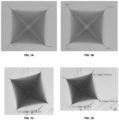
- the increased fracture resistance of test bodies prepared from the inventive dental mill blanks are also indicated by the lower crack length after Vickers indentation shown in the exemplary light microscopic images provided in FIGS. 1A-1D , when compared to the crack length for test bodies prepared from the prior art dental mill blanks shown in the exemplary light microscopic images provided in FIGS. 2A-2D .
- Dental restorations were obtained by milling dental restoration precursors from the inventive dental mill blanks using a CAD/CAM process.
- the dental restoration precursors were densely sintered at a maximum sintering temperature of 1250°C or 1300°C. Images of the dental restoration precursors and dental restorations are shown in FIGS. 3 to 5 . In some instances, the dental restoration precursor was colored using a brush infiltration technique with a commercial coloring liquid (see FIG. 5 ).
Landscapes
- Health & Medical Sciences (AREA)
- Chemical & Material Sciences (AREA)
- Oral & Maxillofacial Surgery (AREA)
- Engineering & Computer Science (AREA)
- Ceramic Engineering (AREA)
- Life Sciences & Earth Sciences (AREA)
- Public Health (AREA)
- Veterinary Medicine (AREA)
- General Health & Medical Sciences (AREA)
- Animal Behavior & Ethology (AREA)
- Epidemiology (AREA)
- Plastic & Reconstructive Surgery (AREA)
- Manufacturing & Machinery (AREA)
- Dentistry (AREA)
- Materials Engineering (AREA)
- Structural Engineering (AREA)
- Organic Chemistry (AREA)
- Composite Materials (AREA)
- Inorganic Chemistry (AREA)
- Crystallography & Structural Chemistry (AREA)
- Physics & Mathematics (AREA)
- Thermal Sciences (AREA)
- Compositions Of Oxide Ceramics (AREA)
- Dental Prosthetics (AREA)
- Dental Preparations (AREA)
Priority Applications (5)
| Application Number | Priority Date | Filing Date | Title |
|---|---|---|---|
| EP23218110.7A EP4574088A1 (de) | 2023-12-19 | 2023-12-19 | Dentalfräsrohling, verfahren zu seiner herstellung und verwendungen davon |
| US18/983,577 US20250195185A1 (en) | 2023-12-19 | 2024-12-17 | Dental mill blank, process for preparing the same, and uses thereof |
| CN202411881496.8A CN120168344A (zh) | 2023-12-19 | 2024-12-19 | 牙科铣削坯料、其制备方法及其用途 |
| KR1020240190825A KR20250095555A (ko) | 2023-12-19 | 2024-12-19 | 치과용 밀 블랭크, 이를 제조하는 방법, 및 그의 용도 |
| JP2024223745A JP2025097970A (ja) | 2023-12-19 | 2024-12-19 | 歯科用ミルブランク、その作製方法、並びにその使用 |
Applications Claiming Priority (1)
| Application Number | Priority Date | Filing Date | Title |
|---|---|---|---|
| EP23218110.7A EP4574088A1 (de) | 2023-12-19 | 2023-12-19 | Dentalfräsrohling, verfahren zu seiner herstellung und verwendungen davon |
Publications (1)
| Publication Number | Publication Date |
|---|---|
| EP4574088A1 true EP4574088A1 (de) | 2025-06-25 |
Family
ID=89224524
Family Applications (1)
| Application Number | Title | Priority Date | Filing Date |
|---|---|---|---|
| EP23218110.7A Pending EP4574088A1 (de) | 2023-12-19 | 2023-12-19 | Dentalfräsrohling, verfahren zu seiner herstellung und verwendungen davon |
Country Status (5)
| Country | Link |
|---|---|
| US (1) | US20250195185A1 (de) |
| EP (1) | EP4574088A1 (de) |
| JP (1) | JP2025097970A (de) |
| KR (1) | KR20250095555A (de) |
| CN (1) | CN120168344A (de) |
Citations (5)
| Publication number | Priority date | Publication date | Assignee | Title |
|---|---|---|---|---|
| EP2707342B1 (de) | 2011-05-13 | 2019-07-03 | Ivoclar Vivadent AG | Verfahren zur dotierung oder zum einfärben von keramik, glaskeramik oder glas |
| US20200405586A1 (en) * | 2018-02-28 | 2020-12-31 | 3M Innovative Properties Company | Kit of parts and process for fast firing a porous zirconia article in combination with a surface treating agent containing a glass powder |
| US11180417B2 (en) * | 2017-02-15 | 2021-11-23 | 3M Innovative Properties Company | Zirconia article with high alumina content, process of production and use thereof |
| US20220081369A1 (en) * | 2020-09-14 | 2022-03-17 | James R. Glidewell Dental Ceramics, Inc. | Method For Enhancing Mechanical Properties In Sintered Ceramic Bodies Having Applications In Dental Restorations |
| US20230338123A1 (en) * | 2020-10-09 | 2023-10-26 | 3M Innovative Properties Company | Set of colored porous zirconia dental mill blanks and process of production |
-
2023
- 2023-12-19 EP EP23218110.7A patent/EP4574088A1/de active Pending
-
2024
- 2024-12-17 US US18/983,577 patent/US20250195185A1/en active Pending
- 2024-12-19 KR KR1020240190825A patent/KR20250095555A/ko active Pending
- 2024-12-19 JP JP2024223745A patent/JP2025097970A/ja active Pending
- 2024-12-19 CN CN202411881496.8A patent/CN120168344A/zh active Pending
Patent Citations (5)
| Publication number | Priority date | Publication date | Assignee | Title |
|---|---|---|---|---|
| EP2707342B1 (de) | 2011-05-13 | 2019-07-03 | Ivoclar Vivadent AG | Verfahren zur dotierung oder zum einfärben von keramik, glaskeramik oder glas |
| US11180417B2 (en) * | 2017-02-15 | 2021-11-23 | 3M Innovative Properties Company | Zirconia article with high alumina content, process of production and use thereof |
| US20200405586A1 (en) * | 2018-02-28 | 2020-12-31 | 3M Innovative Properties Company | Kit of parts and process for fast firing a porous zirconia article in combination with a surface treating agent containing a glass powder |
| US20220081369A1 (en) * | 2020-09-14 | 2022-03-17 | James R. Glidewell Dental Ceramics, Inc. | Method For Enhancing Mechanical Properties In Sintered Ceramic Bodies Having Applications In Dental Restorations |
| US20230338123A1 (en) * | 2020-10-09 | 2023-10-26 | 3M Innovative Properties Company | Set of colored porous zirconia dental mill blanks and process of production |
Also Published As
| Publication number | Publication date |
|---|---|
| JP2025097970A (ja) | 2025-07-01 |
| CN120168344A (zh) | 2025-06-20 |
| US20250195185A1 (en) | 2025-06-19 |
| KR20250095555A (ko) | 2025-06-26 |
Similar Documents
| Publication | Publication Date | Title |
|---|---|---|
| US12208147B2 (en) | High strength and translucency dental ceramic materials, devices, and methods | |
| US11413122B2 (en) | Controlling of sintering kinetics of oxide ceramics | |
| Kaya | Production and characterization of self-colored dental zirconia blocks | |
| CN104334506B (zh) | 用于牙科目的的预烧结坯料 | |
| EP3903761A1 (de) | Kalzinierter zirkoniumoxidgegenstand für die zahnheilkunde | |
| CN108455983B (zh) | 暗化的氧化锆陶瓷材料和由其制造的可机械加工的经烧结的陶瓷体 | |
| EP3733630A1 (de) | Halbgesinterter zirkoniumoxidkörper für dentale verwendung | |
| EP4177234A1 (de) | Kalzinierter zirkonoxidkörper zur zahnärztlichen verwendung | |
| EP4082991A1 (de) | Produktionsverfahren für bearbeitbare zirkoniumdioxid-komposit-sinterkörper, rohstoffzusammensetzung für bearbeitbare zirkoniumdioxid-komposit-sinterkörper und bearbeitbarer zirkoniumdioxid-komposit-kalzinierter körper | |
| EP4219425B1 (de) | Verfahren zur herstellung eines gesinterten zirkonoxidpresslings | |
| EP4218665A1 (de) | Zu bearbeitender körper für die zahnmedizin | |
| JPWO2021100876A1 (ja) | ジルコニア組成物、ジルコニア仮焼体及びジルコニア焼結体、並びにそれらの製造方法 | |
| US20220347060A1 (en) | Gradient composition zirconia dental materials | |
| EP4534507A1 (de) | Zirkoniumoxidverbundsinterkörper und verfahren zur herstellung davon | |
| EP4574088A1 (de) | Dentalfräsrohling, verfahren zu seiner herstellung und verwendungen davon | |
| CN114514211A (zh) | 适合于牙科用途的氧化锆成形体 | |
| EP4112581B1 (de) | Sinterverfahren für kalzinierten dentalzirkoniakörper | |
| EP4417414B1 (de) | Vorgesinterter, mehrschichtiger dentalfräsrohling, verfahren zu seiner herstellung und verwendung davon | |
| EP4245286A1 (de) | Dentaler zirkonoxidfräsrohling, herstellungsverfahren dafür, verfahren zur herstellung einer dentalen zirkonoxidkeramikprothese und verfahren zur herstellung eines artikels aus zirkonoxidverbundkeramik | |
| US12239500B2 (en) | Pre-sintered multi-layered dental mill blank, process for preparing the same, and uses thereof, and a sintering process | |
| EP4534506A1 (de) | Gesinterter zirkonoxidverbundgegenstand und herstellungsverfahren dafür |
Legal Events
| Date | Code | Title | Description |
|---|---|---|---|
| PUAI | Public reference made under article 153(3) epc to a published international application that has entered the european phase |
Free format text: ORIGINAL CODE: 0009012 |
|
| STAA | Information on the status of an ep patent application or granted ep patent |
Free format text: STATUS: THE APPLICATION HAS BEEN PUBLISHED |
|
| AK | Designated contracting states |
Kind code of ref document: A1 Designated state(s): AL AT BE BG CH CY CZ DE DK EE ES FI FR GB GR HR HU IE IS IT LI LT LU LV MC ME MK MT NL NO PL PT RO RS SE SI SK SM TR |
|
| STAA | Information on the status of an ep patent application or granted ep patent |
Free format text: STATUS: REQUEST FOR EXAMINATION WAS MADE |
|
| 17P | Request for examination filed |
Effective date: 20251211 |