EP4574419A1 - Matériau d'emballage stratifié comprenant un substrat à base de cellulose revêtu d'une barrière, son procédé de fabrication et récipient d'emballage - Google Patents
Matériau d'emballage stratifié comprenant un substrat à base de cellulose revêtu d'une barrière, son procédé de fabrication et récipient d'emballage Download PDFInfo
- Publication number
- EP4574419A1 EP4574419A1 EP24221920.2A EP24221920A EP4574419A1 EP 4574419 A1 EP4574419 A1 EP 4574419A1 EP 24221920 A EP24221920 A EP 24221920A EP 4574419 A1 EP4574419 A1 EP 4574419A1
- Authority
- EP
- European Patent Office
- Prior art keywords
- layer
- barrier
- coating
- packaging material
- cellulose
- Prior art date
- Legal status (The legal status is an assumption and is not a legal conclusion. Google has not performed a legal analysis and makes no representation as to the accuracy of the status listed.)
- Pending
Links
Images






Classifications
-
- B—PERFORMING OPERATIONS; TRANSPORTING
- B32—LAYERED PRODUCTS
- B32B—LAYERED PRODUCTS, i.e. PRODUCTS BUILT-UP OF STRATA OF FLAT OR NON-FLAT, e.g. CELLULAR OR HONEYCOMB, FORM
- B32B27/00—Layered products comprising a layer of synthetic resin
- B32B27/06—Layered products comprising a layer of synthetic resin as the main or only constituent of a layer, which is next to another layer of the same or of a different material
- B32B27/10—Layered products comprising a layer of synthetic resin as the main or only constituent of a layer, which is next to another layer of the same or of a different material of paper or cardboard
-
- B—PERFORMING OPERATIONS; TRANSPORTING
- B32—LAYERED PRODUCTS
- B32B—LAYERED PRODUCTS, i.e. PRODUCTS BUILT-UP OF STRATA OF FLAT OR NON-FLAT, e.g. CELLULAR OR HONEYCOMB, FORM
- B32B27/00—Layered products comprising a layer of synthetic resin
- B32B27/06—Layered products comprising a layer of synthetic resin as the main or only constituent of a layer, which is next to another layer of the same or of a different material
- B32B27/08—Layered products comprising a layer of synthetic resin as the main or only constituent of a layer, which is next to another layer of the same or of a different material of synthetic resin
-
- B—PERFORMING OPERATIONS; TRANSPORTING
- B32—LAYERED PRODUCTS
- B32B—LAYERED PRODUCTS, i.e. PRODUCTS BUILT-UP OF STRATA OF FLAT OR NON-FLAT, e.g. CELLULAR OR HONEYCOMB, FORM
- B32B27/00—Layered products comprising a layer of synthetic resin
- B32B27/32—Layered products comprising a layer of synthetic resin comprising polyolefins
-
- B—PERFORMING OPERATIONS; TRANSPORTING
- B32—LAYERED PRODUCTS
- B32B—LAYERED PRODUCTS, i.e. PRODUCTS BUILT-UP OF STRATA OF FLAT OR NON-FLAT, e.g. CELLULAR OR HONEYCOMB, FORM
- B32B27/00—Layered products comprising a layer of synthetic resin
- B32B27/32—Layered products comprising a layer of synthetic resin comprising polyolefins
- B32B27/327—Layered products comprising a layer of synthetic resin comprising polyolefins comprising polyolefins obtained by a metallocene or single-site catalyst
-
- B—PERFORMING OPERATIONS; TRANSPORTING
- B32—LAYERED PRODUCTS
- B32B—LAYERED PRODUCTS, i.e. PRODUCTS BUILT-UP OF STRATA OF FLAT OR NON-FLAT, e.g. CELLULAR OR HONEYCOMB, FORM
- B32B7/00—Layered products characterised by the relation between layers; Layered products characterised by the relative orientation of features between layers, or by the relative values of a measurable parameter between layers, i.e. products comprising layers having different physical, chemical or physicochemical properties; Layered products characterised by the interconnection of layers
- B32B7/04—Interconnection of layers
- B32B7/12—Interconnection of layers using interposed adhesives or interposed materials with bonding properties
-
- B—PERFORMING OPERATIONS; TRANSPORTING
- B65—CONVEYING; PACKING; STORING; HANDLING THIN OR FILAMENTARY MATERIAL
- B65D—CONTAINERS FOR STORAGE OR TRANSPORT OF ARTICLES OR MATERIALS, e.g. BAGS, BARRELS, BOTTLES, BOXES, CANS, CARTONS, CRATES, DRUMS, JARS, TANKS, HOPPERS, FORWARDING CONTAINERS; ACCESSORIES, CLOSURES, OR FITTINGS THEREFOR; PACKAGING ELEMENTS; PACKAGES
- B65D15/00—Containers having bodies formed by interconnecting or uniting two or more rigid, or substantially rigid, sections made of different materials
- B65D15/02—Containers having bodies formed by interconnecting or uniting two or more rigid, or substantially rigid, sections made of different materials of curved, or partially curved, cross-section, e.g. cans, drums
-
- B—PERFORMING OPERATIONS; TRANSPORTING
- B65—CONVEYING; PACKING; STORING; HANDLING THIN OR FILAMENTARY MATERIAL
- B65D—CONTAINERS FOR STORAGE OR TRANSPORT OF ARTICLES OR MATERIALS, e.g. BAGS, BARRELS, BOTTLES, BOXES, CANS, CARTONS, CRATES, DRUMS, JARS, TANKS, HOPPERS, FORWARDING CONTAINERS; ACCESSORIES, CLOSURES, OR FITTINGS THEREFOR; PACKAGING ELEMENTS; PACKAGES
- B65D5/00—Rigid or semi-rigid containers of polygonal cross-section, e.g. boxes, cartons or trays, formed by folding or erecting one or more blanks made of paper
- B65D5/02—Rigid or semi-rigid containers of polygonal cross-section, e.g. boxes, cartons or trays, formed by folding or erecting one or more blanks made of paper by folding or erecting a single blank to form a tubular body with or without subsequent folding operations, or the addition of separate elements, to close the ends of the body
- B65D5/06—Rigid or semi-rigid containers of polygonal cross-section, e.g. boxes, cartons or trays, formed by folding or erecting one or more blanks made of paper by folding or erecting a single blank to form a tubular body with or without subsequent folding operations, or the addition of separate elements, to close the ends of the body with end-closing or contents-supporting elements formed by folding inwardly a wall extending from, and continuously around, an end of the tubular body
- B65D5/064—Rectangular containers having a body with gusset-flaps folded outwardly or adhered to the side or the top of the container
- B65D5/065—Rectangular containers having a body with gusset-flaps folded outwardly or adhered to the side or the top of the container with supplemental means facilitating the opening, e.g. tear lines, tear tabs
-
- B—PERFORMING OPERATIONS; TRANSPORTING
- B65—CONVEYING; PACKING; STORING; HANDLING THIN OR FILAMENTARY MATERIAL
- B65D—CONTAINERS FOR STORAGE OR TRANSPORT OF ARTICLES OR MATERIALS, e.g. BAGS, BARRELS, BOTTLES, BOXES, CANS, CARTONS, CRATES, DRUMS, JARS, TANKS, HOPPERS, FORWARDING CONTAINERS; ACCESSORIES, CLOSURES, OR FITTINGS THEREFOR; PACKAGING ELEMENTS; PACKAGES
- B65D5/00—Rigid or semi-rigid containers of polygonal cross-section, e.g. boxes, cartons or trays, formed by folding or erecting one or more blanks made of paper
- B65D5/02—Rigid or semi-rigid containers of polygonal cross-section, e.g. boxes, cartons or trays, formed by folding or erecting one or more blanks made of paper by folding or erecting a single blank to form a tubular body with or without subsequent folding operations, or the addition of separate elements, to close the ends of the body
- B65D5/06—Rigid or semi-rigid containers of polygonal cross-section, e.g. boxes, cartons or trays, formed by folding or erecting one or more blanks made of paper by folding or erecting a single blank to form a tubular body with or without subsequent folding operations, or the addition of separate elements, to close the ends of the body with end-closing or contents-supporting elements formed by folding inwardly a wall extending from, and continuously around, an end of the tubular body
- B65D5/067—Gable-top containers
-
- B—PERFORMING OPERATIONS; TRANSPORTING
- B65—CONVEYING; PACKING; STORING; HANDLING THIN OR FILAMENTARY MATERIAL
- B65D—CONTAINERS FOR STORAGE OR TRANSPORT OF ARTICLES OR MATERIALS, e.g. BAGS, BARRELS, BOTTLES, BOXES, CANS, CARTONS, CRATES, DRUMS, JARS, TANKS, HOPPERS, FORWARDING CONTAINERS; ACCESSORIES, CLOSURES, OR FITTINGS THEREFOR; PACKAGING ELEMENTS; PACKAGES
- B65D75/00—Packages comprising articles or materials partially or wholly enclosed in strips, sheets, blanks, tubes or webs of flexible sheet material, e.g. in folded wrappers
- B65D75/40—Packages formed by enclosing successive articles, or increments of material, in webs, e.g. folded or tubular webs, or by subdividing tubes filled with liquid, semi-liquid, or plastic materials
- B65D75/44—Individual packages cut from webs or tubes
- B65D75/48—Individual packages cut from webs or tubes containing liquids, semiliquids, or pastes, e.g. cushion-shaped packages
-
- B—PERFORMING OPERATIONS; TRANSPORTING
- B32—LAYERED PRODUCTS
- B32B—LAYERED PRODUCTS, i.e. PRODUCTS BUILT-UP OF STRATA OF FLAT OR NON-FLAT, e.g. CELLULAR OR HONEYCOMB, FORM
- B32B2255/00—Coating on the layer surface
- B32B2255/12—Coating on the layer surface on paper layer
-
- B—PERFORMING OPERATIONS; TRANSPORTING
- B32—LAYERED PRODUCTS
- B32B—LAYERED PRODUCTS, i.e. PRODUCTS BUILT-UP OF STRATA OF FLAT OR NON-FLAT, e.g. CELLULAR OR HONEYCOMB, FORM
- B32B2255/00—Coating on the layer surface
- B32B2255/26—Polymeric coating
-
- B—PERFORMING OPERATIONS; TRANSPORTING
- B32—LAYERED PRODUCTS
- B32B—LAYERED PRODUCTS, i.e. PRODUCTS BUILT-UP OF STRATA OF FLAT OR NON-FLAT, e.g. CELLULAR OR HONEYCOMB, FORM
- B32B2255/00—Coating on the layer surface
- B32B2255/28—Multiple coating on one surface
-
- B—PERFORMING OPERATIONS; TRANSPORTING
- B32—LAYERED PRODUCTS
- B32B—LAYERED PRODUCTS, i.e. PRODUCTS BUILT-UP OF STRATA OF FLAT OR NON-FLAT, e.g. CELLULAR OR HONEYCOMB, FORM
- B32B2270/00—Resin or rubber layer containing a blend of at least two different polymers
-
- B—PERFORMING OPERATIONS; TRANSPORTING
- B32—LAYERED PRODUCTS
- B32B—LAYERED PRODUCTS, i.e. PRODUCTS BUILT-UP OF STRATA OF FLAT OR NON-FLAT, e.g. CELLULAR OR HONEYCOMB, FORM
- B32B2307/00—Properties of the layers or laminate
- B32B2307/30—Properties of the layers or laminate having particular thermal properties
-
- B—PERFORMING OPERATIONS; TRANSPORTING
- B32—LAYERED PRODUCTS
- B32B—LAYERED PRODUCTS, i.e. PRODUCTS BUILT-UP OF STRATA OF FLAT OR NON-FLAT, e.g. CELLULAR OR HONEYCOMB, FORM
- B32B2307/00—Properties of the layers or laminate
- B32B2307/30—Properties of the layers or laminate having particular thermal properties
- B32B2307/31—Heat sealable
-
- B—PERFORMING OPERATIONS; TRANSPORTING
- B32—LAYERED PRODUCTS
- B32B—LAYERED PRODUCTS, i.e. PRODUCTS BUILT-UP OF STRATA OF FLAT OR NON-FLAT, e.g. CELLULAR OR HONEYCOMB, FORM
- B32B2307/00—Properties of the layers or laminate
- B32B2307/70—Other properties
- B32B2307/718—Weight, e.g. weight per square meter
-
- B—PERFORMING OPERATIONS; TRANSPORTING
- B32—LAYERED PRODUCTS
- B32B—LAYERED PRODUCTS, i.e. PRODUCTS BUILT-UP OF STRATA OF FLAT OR NON-FLAT, e.g. CELLULAR OR HONEYCOMB, FORM
- B32B2307/00—Properties of the layers or laminate
- B32B2307/70—Other properties
- B32B2307/724—Permeability to gases, adsorption
- B32B2307/7242—Non-permeable
- B32B2307/7244—Oxygen barrier
-
- B—PERFORMING OPERATIONS; TRANSPORTING
- B32—LAYERED PRODUCTS
- B32B—LAYERED PRODUCTS, i.e. PRODUCTS BUILT-UP OF STRATA OF FLAT OR NON-FLAT, e.g. CELLULAR OR HONEYCOMB, FORM
- B32B2439/00—Containers; Receptacles
- B32B2439/70—Food packaging
Definitions
- the present invention relates to a laminated packaging material for oxygen-sensitive products, such as liquid, semi-liquid or viscous food products, comprising a bulk layer of paper or paperboard and a barrier-coated cellulose-based substrate, as well as to a method for manufacturing of the laminated packaging material.
- the invention further relates to a packaging container manufactured from the laminated packaging material.
- Packaging containers of the single use, disposable type for oxygen-sensitive and liquid or viscous foods are often produced from a packaging laminate based on paperboard or carton.
- One such commonly occurring packaging container is marketed under the trademark Tetra Brik Aseptic ® and is principally employed for aseptic packaging of liquid foods such as milk, fruit juices etc, sold for long term ambient storage.
- the packaging material in this known packaging container is typically a laminate comprising a bulk or core layer, of paper, paperboard or other cellulose-based material, and outer, liquid-tight layers of thermoplastics.
- the laminate in these packaging containers normally comprises at least one additional layer, most commonly an aluminium (Al) foil.
- innermost layer On the inside of the laminate, i.e. the side intended to face the filled food contents of a container produced from the laminate, there is an innermost layer, applied onto the aluminium foil, which innermost, inside layer may be composed of one or several part layers, comprising heat sealable thermoplastic polymers, such as adhesive polymers and/or polyolefins. Also on the outside of the bulk layer, there is an outermost heat sealable polymer layer.
- the packaging containers are generally produced by means of modern, high-speed packaging machines of the type that form, fill, and seal packages from a web or from prefabricated blanks of packaging material in a continuous process.
- Packaging containers may thus be produced by reforming a web of the laminated packaging material into a tube by both longitudinal edges of the web being united to each other in an overlap joint by welding together the inner- and outermost heat sealable thermoplastic polymer layers.
- the tube is filled with the intended liquid food product and is thereafter divided into individual packages by repeated transversal seals of the tube at a predetermined distance from each other below the level of the contents in the tube.
- the packages are separated from the tube by incisions along the transversal seals and are given the desired geometric configuration, normally cuboid shape, such as parallelepipedal, by fold formation along prepared crease lines in the packaging material.
- the main advantage of this continuous tube-forming, filling and sealing packaging method concept is that the web may be sterilised continuously just before tube-forming, thus providing for the possibility of an aseptic packaging method, i.e. a method wherein the liquid content to be filled as well as the packaging material itself are efficiently reduced from bacteria and the filled packaging container is produced under clean conditions such that the filled package may be stored for a long time even at ambient temperature, without the risk of growth of micro-organisms in the filled product.
- an aseptic packaging method i.e. a method wherein the liquid content to be filled as well as the packaging material itself are efficiently reduced from bacteria and the filled packaging container is produced under clean conditions such that the filled package may be stored for a long time even at ambient temperature, without the risk of growth of micro-organisms in the filled product.
- Tetra Brik ® -type packaging method is, as stated above, the possibility of continuous high-speed packaging, which has considerable impact on cost efficiency.
- Packaging containers for sensitive liquid food can also be produced from sheet-like blanks or prefabricated blanks of the laminated packaging material of the invention.
- packages are produced by first of all building the blank up to form an open tubular container capsule, of which one open end is closed off by means of folding and heat-sealing of integral end panels.
- the thus closed container capsule is filled with the food product in question, e.g. juice, through its open end, which is thereafter closed off by means of further folding and heat-sealing of corresponding integral end panels.
- An example of a packaging container produced from sheet-like and tubular blanks is the conventional so-called gable-top package.
- packages of this type which have a moulded top and/or screw cap made of plastic.
- Aluminium foil barriers for liquid carton food packaging are normally from 5 to 9 ⁇ m, such as most commonly about 6 ⁇ m.
- a layer of an aluminium foil in the packaging laminate provides gas barrier properties quite superior to most other gas barrier materials.
- the conventional aluminium-foil based packaging laminate for liquid food aseptic packaging is still the most cost-efficient packaging material, at its level of performance, available on the market today.
- Any other material to compete with the foil-based materials should be cost-efficient regarding raw materials, have comparable food preserving properties and have a comparably low complexity in the converting of materials into a finished packaging laminate.
- aqueous dispersion coatings and vapour deposition coatings are applied on substrates which do not typically provide significant barrier properties themselves.
- the thickness of a dispersion coated polymer is around 1-2 ⁇ m, while vapour deposited barrier coatings are as thin as below 0.5 ⁇ m, such as from 10 to 100 nm, such as from 15 to 80 nm, such as from 20 to 50 nm.
- aqueous polymer compositions suitable for dispersion and/or solution coating of thin layers such as PVOH, starch and the like.
- the common difficulty with this type of polymer binders is that they are sensitive to high moisture conditions and lose their inherent oxygen barrier properties with increasing exposure to, and content of, moisture, i.e. conditions in laminated packaging materials of filled, liquid carton packaging containers. It has been concluded that such thin, dispersion coated polymer layers need to be supplemented with further materials to improve gas barrier properties, either in the form of additional compounds in the dispersion composition, such as crosslinkers or inorganic particles, or in the form of additional material layers acting as barriers to water vapour.
- WO2011/003565A1 discloses a non-aluminium-foil packaging material comprising a gas-barrier coated and metallised Kraft paper substrate for the purpose of induction heat sealing.
- WO2017/089508A1 discloses that improved barrier properties may be obtained from a metallised paper in a similar packaging laminate, by selecting a paper substrate providing optimal properties.
- a metallised paper substrate provided not only improved gas barrier properties, but also indicated better stability of the metallised layer for induction heat sealing purposes.
- EP4008548A1 discloses that a base coating may improve the quality of a subsequent gas barrier dispersion coating and a metallisation coating on similar paper substrates.
- a laminated packaging material for packaging of oxygen-sensitive food products such as liquid, semi-liquid or viscous food products, comprising as layers of a sequence
- a method for manufacturing of a laminated packaging material as described in the first aspect comprising the steps of laminating the barrier-coated cellulose-based substrate to the bulk layer of paper or paperboard or other cellulose-based material, melt extrusion coating the first outermost protective material layer or coating, to be directed towards the outside of a packaging container formed from the laminated packaging material, onto the outer side of the bulk layer, extrusion coating the inside polymer multilayer portion comprising a second innermost liquid tight, heat sealable material layer to be in direct contact with a product to be filled into a packaging container made from the packaging material, and an interjacent load-bearing and load-distributing layer comprising a linear low-density polyethylene, LLDPE having a melt flow ratio, MFR, from 4 to 20 g/10 min (190 °C/ 2.16 kg) and a melting temperature above 115 degrees C, onto the inner side of the barrier-coated cellulose-based substrate, the second innermost liquid tight, heat sealable material
- the load-bearing and load-distributing layer substantially comprises the linear low-density polyethylene, LLDPE, having a melt flow ratio, MFR, from 4 to 20 g/10 min (190 °C/ 2.16 kg) and a melting temperature above 115 degrees C.
- LLDPE linear low-density polyethylene
- the inside polymer multilayer portion may be applied in at least two consecutive steps as separate layers, by means of melt extrusion coating, with at least partial solidification of the prior, melt-extrusion applied layer before the next melt-extrusion layer is applied onto the prior layer.
- the inside polymer multilayer portion may further comprise a tie layer comprising an adhesive polymer adjacent and in contact with the barrier-coated, inner side of the cellulose-based, fibrous substrate.
- the load-bearing layer may have a surface weight from 8 to 25 g/m 2 , such as from 10 to 25 g/m 2 , such as from 12 to 25 g/m 2 , such as from 15 to 25, such as from 15 to 20 g/m 2 .
- a packaging container comprising the laminated packaging material described above.
- the packaging container is manufactured at least partly from the laminated packaging material of the invention, and according to a further embodiment it is made in its entirety of the laminated packaging material.
- the packaging container should be able to preserve the qualities of the packed food product, i.e. nutritional value, hygienic safety, and taste, at ambient conditions for at least 1 or 2 months, such as at least 3 months, preferably longer, such as 6 months, such as 12 months, or more.
- package integrity is generally meant the package tightness, i.e. the resistance to leakage or breakage of a packaging container.
- the term encompasses the resistance of the package to intrusion of microbes, such as bacteria, dirt, and other substances, that may deteriorate the filled food product and shorten the expected shelf-life of the package.
- One main contribution to the integrity of a package from a laminated packaging material is provided by good internal adhesion between adjacent layers of the laminated material. Another contribution comes from the material resistance to defects, such as pinholes, ruptures, and the like within each material layer itself. A local thin area or point, a so-called “thinning", may lead to a pinhole or a rupture in a polymer layer. Yet another contribution comes from the strength of the sealing joints, by which the material is sealed together at the formation of a packaging container. Regarding the laminated packaging material itself, the integrity property is thus generally focused on the ability to withstand thermal- and mechanical loads e.g., during folding and sealing, without fracturing.
- the integrity is mainly focussed on the quality of the sealing joints, which is ensured by well-functioning and robust sealing operations in the filling machines, which in turn is ensured by adequately adapted heat-sealing properties of the laminated packaging material.
- liquid or semi-liquid food generally refers to food products having a flowing content, i.e. including food products having a high viscosity, like sauces, pastes and soups, and food products that optionally may contain pieces of food.
- Dairy and milk, soy, rice, grains and seed drinks, juice, nectar, still drinks, energy drinks, sport drinks, coffee or tea drinks, coconut water, wine, soups, tomatoes, sauce (such as pasta sauce) and olive oil are some non-limiting example of food products contemplated.
- an aseptic process is used when a product is aseptically packed in a packaging container.
- the package integrity properties are of course very important.
- the package may furthermore be important that the package has barrier properties towards gases and vapours, such as towards oxygen gas, to keep its original taste and nutritional value, such as for example its vitamin C content.
- bulk layer is normally meant the thickest layer or the layer containing the most material in a multilayer laminate, i.e. the layer which contributes most to the mechanical properties and the dimensional stability of the laminate and of packaging containers folded from the laminate, such as paperboard or carton.
- non-foil packaging material a laminated packaging material, which does not comprise an aluminium foil of a thickness in the micrometer-scale, such as conventional aluminium foils for liquid carton packaging which are normally from 6 to 9 ⁇ m thick.
- a "non-foil” packaging material may comprise a metallisation layer, however, as the thickness of e.g. an aluminium metallisation layer is in the nano-meter scale. The amount of aluminium material employed in such a metallisation coating is very low, and have, in comparison to aluminium foils, a significantly reduced impact on recycling and exploitation of material resources.
- dispenser coating herein relates to a coating technique in which an aqueous or substantially aqueous dispersion, suspension, emulsion or solution of a polymer is applied to the surface of a substrate layer, usually in the form of a continuous web, to form a solid, substantially non-porous film after drying.
- the term “dispersion” covers thus also any suspension, emulsion or solution or mixes thereof, that would be capable of providing such a coating after drying.
- Polyvinyl alcohols (PVOH, PVAL) are typical polymers suitable for dispersion coating, but may for example at high saponification degrees in practice rather be polymer solutions, or mixes of dispersed and dissolved PVOH.
- a dispersion-coated barrier layer or coating is formed by a dispersion coating, also called “liquid-film coating", techniques.
- An aqueous dispersion may comprise fine polymer-based particles and thus be a "latex".
- latex refers to a composition comprising an aqueous suspension or dispersion or emulsion of polymer particles, which can be natural polymers, synthetic polymers, synthetic polymers derived from biomasses or combinations thereof.
- polyethylene refers to a polymer comprising ethylene monomers at from about 90 to 100 mol%. There are various types of polyethylene, as explained below.
- Low density polyethylene has a density of 917 to 930 kg/m 3 . It is typically polymerised from ethylene monomers alone and has a branched polymer chain structure with long chain branches, leading to a more branched and less tightly packed molecular arrangement, and a lower overall density than for medium density polyethylene, MDPE, and high density polyethylene, HDPE.
- linear low density polyethylene covers all linear low density polyethylenes, including "ZN-LLDPE” polymerised by means of Ziegler-Natta type catalysts as well as “m-LLDPE” polymerised by catalysts of so-called “constrained geometry", or “single-site” catalysts, such as “metallocene” catalysts, and other linear low density polyethylenes.
- ZN-LLDPE and m-LLDPE are typically produced by copolymerising an ethylene monomer with a C 4 -C 8 , more preferably a C 6 -C 8 , alpha-olefin alkylene monomer, the latter in the presence of a metallocene catalyst.
- LLDPE low-density polyethylene
- LDPE low-density polyethylene
- LLDPE polymers typically have a narrower molecular weight distribution than conventional LDPE (this is true for m-LLDPE especially) and significantly different properties.
- a higher number of short chain branches will lead to a lower degree of crystallinity, because the crystallisation is suppressed in the polymer and therefore its density becomes lower than for MDPE and HDPE.
- mPE a polymer blend for a heat sealable innermost layer, comprising at least 50 wt% mLLDPE and up to 50 wt% LDPE, preferably comprising about 70 weight-% of mLLDPE and about 30 weight-% of LDPE.
- High density polyethylene, HDPE, and medium density polyethylene, MDPE suitable for the inside polymer multilayer portion in the laminated packaging material of the invention has a density of 930 to 970 kg/m 3 . Up to 2 mol% comonomer content is typical in these polymers of linear type polymer molecules.
- catalyst e.g. ZN catalysts
- MDPE may have a medium level of density, typically ranging from 0.926 to 0.940 g/cm 3
- HDPE may have a higher density, typically ranging from 0.941 to 0.965 g/cm 3 .
- a comparative load-bearing layer to be included in the inside polymer multilayer portion and subject to a co-pending patent application filed at the same time as the present application, comprises an HDPE or MDPE polymer. It may comprise a polymer blend composition including from 30 to 90 weight-% of HDPE or MDPE and from 10 to 70 weight-% of LDPE or a linear low density polyethylene, preferably from 50 to 80 weight-% HDPE or MDPE and from 20 to 50 weight-% LDPE.
- LDPE adds some load-distributing properties to the load-bearing properties of most pure HDPE or MDPE polymers, such that they become easier to melt process and also such that they substantially maintain their thermomechanical properties, while the tensile properties upon mechanical strain and stress are improved and their anisotropic behaviour is reduced. This is advantageous at fold-forming, when used as a material layer in a laminated carton material.
- HDPE and MDPE polymers suitable for the inside polymer multilayer portion in the present invention preferably have a density from 0.93 to 0.965 kg/m 3 .
- a load-bearing and load-distributing layer to be included in the inside polymer multilayer portion, which comprises a linear low-density polyethylene, LLDPE, having melt flow ratio, MFR, from 4 to 20 g/10 min (190 °C/ 2.16 kg) and a melting temperature above 115 degrees C.
- LLDPE linear low-density polyethylene
- MFR melt flow ratio
- MFR melt flow ratio
- Tm high melting temperature
- Tm melting temperature
- it has a melting temperature above 118 °C, more preferably above 120 °C.
- LLDPE has an MFR from 6 to 15, such as 8-12 such as 8-10 g/10 min (190 °C/ 2.16 kg).
- LLDPE polymers fulfilling these conditions may thus be suitable for the invention.
- suitable LLDPE polymers may include ZN-LLDPE polymers and m-LLDPE polymers, blends thereof and also suitable bimodal LLDPE polymers.
- the load-bearing and load-distributing layer comprises a polymer blend including a major portion, i.e. at least 50 wt%, of the LLDPE having a melt flow ratio, MFR, from 4 to 20 g/10 min (190 °C/ 2.16 kg) and a melting temperature above 115 degrees C, and an LDPE, HDPE or MDPE, preferably an HDPE or MDPE.
- the load-bearing and load-distributing layer comprises a polymer blend including from 50 to 95, such as from 80 to 95 weight-% of the LLDPE having a melt flow ratio, MFR, from 4 to 20 g/10 min (190 °C/ 2.16 kg) and a melting temperature above 115 degrees C and from 5 to 50, such as from 5 to 20 weight-% of an HDPE or MDPE.
- the load-bearing and load-distributing layer thus comprises in the majority, such as at least 80 weight-% of the linear low-density polyethylene, LLDPE, having a melt flow ratio, MFR, from 4 to 20 g/10 min (190 °C/ 2.16 kg) and a melting temperature above 115 degrees C.
- LLDPE linear low-density polyethylene
- the inside polymer multilayer portion may be applied in two consecutive steps as separate layers, by means of extrusion coating.
- the inside polymer multilayer portion may be applied in at least two consecutive steps as separate layers, by means of melt extrusion coating, with at least partial solidification of a prior, melt-extrusion applied layer before a next melt-extrusion layer is applied onto the prior layer.
- the first melt extrusion coating operation applies the layer of an adhesive, functionalised polyethylene, such as ethylene acrylic acid, EAA, together with the load-bearing and load-distributing layer of the LLDPE, having a melt flow ratio, MFR, from 4 to 20 g/10 min (190 °C/ 2.16 kg) and a melting temperature above 115 degrees C, in a first step by coextrusion coating and allows the thus coated layers to solidify at least partly before the innermost liquid tight, heat sealable material layer comprising a polyethylene polymer having a low density, is subsequently applied in the second step of extrusion coating.
- an adhesive functionalised polyethylene
- EAA ethylene acrylic acid
- MFR melt flow ratio
- a first step of coextrusion coating applies the adhesive, functionalised polyethylene layer together with a first, thinner layer of the LLDPE onto the barrier coatings of the barrier-coated cellulose-based substrate, and subsequently applies, in a second step, a second coextrusion coating of a further, thin layer of the same LLDPE, adhering to the first, solidified, thinner LLDPE layer, together with the innermost liquid tight, heat sealable material layer comprising a polyethylene polymer having a low density.
- the three layers may be applied together in a first coextrusion coating step, however with a part thickness only of the innermost layer of the liquid tight, heat sealable material comprising a polyethylene polymer having a low density, and subsequently, in a second step, a second extrusion coating of a further, thinner layer of the innermost liquid tight, heat sealable material comprising a polyethylene polymer having a low density, may be applied.
- the two extrusion-coating steps are performed in different lamination stations, each with a lamination roller nip and melt extrusion film die, such that the first extrusion-coated layer entirely solidifies before the second extrusion-coating step is performed in the second lamination station.
- the step-wise extrusion coated layers within the inside polymer multilayer portion can be understood from studying the polymer interfaces with microscopy techniques.
- the layer interface will follow a straight and more distinct line, since the first applied layer will have solidified, by contact to a chilled metal roller, before the next layer was applied, rather than an uneven and more fuzzy and co-melted and co-solidifed line, and the layers will have more even thicknesses.
- the total surface weight of the load-bearing layer, or layers may suitably be from 8 to 25 g/m 2 , such as from 10 to 25 g/m 2 , such as from 12 to 25 g/m 2 , such as from 15 to 25, such as from 15 to 22 g/m 2 .
- the laminated packaging material thus comprises a bulk layer of paper or paperboard or other cellulose-based material and a barrier-coated cellulose-based substrate.
- a paper or paperboard bulk layer for use in the invention may have a thickness from about 70 ⁇ m up to about 600 ⁇ m, and a surface weight of approximately 70 to 500 g/m 2 , preferably about 200 to 300 g/m 2 , and may be a conventional paper or paperboard of suitable packaging quality.
- the purpose of the bulk layer in the laminated packaging materials of the present invention is to provide dimensional stability, rigidity, and stiffness to packaging containers, e.g. for use in wet and humid conditions and/or for storage of liquids and wet (heavy) food products.
- Clay-coated duplex paperboard is preferred.
- For larger packages a paperboard of 400 to 500 ⁇ m and higher bending stiffness is preferred, such as 260 mN. For portion packs of 150 to 250 mL size, a bending stiffness of 80 mN is preferred.
- a thinner packaging laminate may be used, having a thinner paper core layer.
- the packaging containers made from such packaging laminates are not fold-formed and more similar to pillow-shaped flexible pouches.
- a suitable paper for such pouch-packages usually has a surface weight from about 50 to about 140 g/m 2 , preferably from about 70 to about 120 g/m 2 , more preferably from 70 to 110 g/m 2 .
- the barrier-coated substrate in this invention in itself may contribute with some stability to the laminated material, the paper layer corresponding to a "bulk" layer may be even thinner, and interact with the barrier cellulose-based substrate in a sandwich interaction to still produce a laminated packaging material having the desired mechanical properties altogether.
- Barrier-coated cellulose-based substrates or so-called "paper-barriers” pose special challenges.
- the barrier substrate of a paper or cellulose sheet in its interior may essentially comprise organic material from virgin cellulose fibres. Even if the cellulose fibres are as clean as possible, being cooked and chemically treated during paper manufacturing and thus thoroughly treated, they are not as clean as the interior of polymer material layers or inorganic foils or deposition coatings.
- the barrier coatings that are applied on the inside of the cellulose sheet will be heated as they are applied, in drying and deposition processes, respectively, and will thus be clean materials in the laminated material.
- the barrier coatings will thus, insofar as they are of good quality, protect the inside of the package from the interior cellulose sheet fibres, as long as the coatings are unbroken.
- the coatings are thin and sensitive, however, relative to an aluminium foil, which has a thickness from 5-10 ⁇ m.
- inside polymer layers which are thermoplastic polymers coated or laminated onto the barrier coatings of the paper barrier, to protect them, as well as the filled food product, in a packaging container fold formed from a laminated material comprising the paper barrier.
- the polymer inside layers need to be applied as homogenous coatings or as pre-manufactured films and they have multiple purposes.
- the inside polymer multilayer portion needs to be heat sealable, i.e. thermo-weldable, at high-speed in filling and packaging machines, and needs to keep the formed packaging containers liquid tight both towards the inside of the package and towards the outside.
- the inside polymer layers need to help protect the barrier coatings from being destroyed during fold-forming and filling processes, as well as maintaining good integrity, should that still happen, towards migration of microbes through the package and the materials into the filled food product.
- Adding thicker and stronger such polymer layers may help to some extent, but such measures weigh against the requirements that we for environmental sustainability must reduce the use of polymer materials in carton liquid packaging materials, and that the packaging materials need to be reasonably easy to open for the end-consumer.
- the oxygen barrier loss is an indication that the thin and sensitive barrier coatings are to some extent damaged upon fold-forming and reshaping into filled packaging containers. Therefore, it is especially regarding paper barrier materials relevant to measure and understand the resulting Package-OTR rather than the OTR on flat material.
- the Package-OTR has by late developments been well improved, based on improvements in the cellulose-based substrate as such.
- a laminate having a pre-manufactured, cast film of LLDPE polymers, is thus currently developed, which adds toughness and good integrity to the laminate, while it does at least not detrimentally prevent openability of the full material.
- Such a film is, however, expensive and requires a more difficult lamination operation in the laminate production, while the openability is unfortunately significantly reduced, even if not to an impossible extent.
- a suitable cellulose-based substrate for the invention is not limited to a certain type of paper or cellulose, but includes cellulose-based substrates based on any type of native fibrous or fibrillar cellulose.
- the invention is not applicable, however, to substrates from plastics or homogeneous polymers, such as films made from regenerated cellulose, which is not in fibrous, i.e. native, or fibrillar cellulose form any longer.
- a cellulose-based substrate may be designed to have a high density, and substantially less porosity, by application of high pressure during its manufacturing process.
- densification may take place by calendering, preferably super-calendering.
- Densities above 850 kg/m 3 preferably from 900 to 1400 kg/m 3 , more preferably from 1000 to 1400 kg/m 3 , can be obtained by such high-pressure, multi-roller treatment.
- Such a high-density cellulose-based substrate may consitute a good substrate for subsequently applied, thin gas barrier coatings of uniform quality, thanks to its obtained lower porosity. Depending on how it is made, it may contribute with further advantageous properties for the use in laminated packaging materials.
- the substrate is a paper impregnated with a water soluble or water dispersible polymer.
- a cellulose-based substrate may for example first be impregnated with a water-soluble polymer and subsequently be treated in a super-calendering treatment.
- the fibre matrix impregnated with polymer may be compressed and densified, such that an interlocked fibre-composite without, or with significantly reduced, porosity is obtained.
- such a cellulose-based substrate can obtain a higher density to avoid air-filled pockets and cavities in the substrate. This may be advantageous in subsequent processes of vapour deposition coating of barrier coatings on the substrate.
- the top surface i.e. the surface to be barrier-coated
- the top surface may be first pre-coated with a base layer and subsequently be treated in a super-calendering treatment, to compress and densify the surface of the cellulose-based substrate.
- the cellulose-based substrate may be highly compacted to obtain a high-density substrate with a density above 900 kg/m 3 , preferably above 1000 kg/m 3 .
- the fibrous part of a paper substrate needs to be thin and have a low grammage weight of 70 g/m 2 or below, preferably 60 g/m 2 or below, such as 50 g/m 2 or below, preferably 45 g/m 2 or below, for reasons of efficiency and production economy.
- fibrous cellulose substrates thinner or with a lower grammage than 30 g/m 2 may be mechanically too weak and/or less dimension stable, when they are coated with wet dispersions and subsequently dried, thus exhibiting shrinkage or curling problems or even web breaks.
- cellulose-based substrates having a grammage of from 30 to 70 g/m 2 , such as from 30 to 65 g/m 2 , such as from 35 to 60 g/m 2 , such as from 35 to 55 g/m 2 .
- the thickness of the cellulose-based substrate may be from 35 to 70 ⁇ m, such as from 35 to 65 ⁇ m, such as from 40 to 60 ⁇ m, such as from 40 to 50 ⁇ m.
- the cellulose substrate for use according to the invention may be formed from cellulose fibres comprising at least 50% by dry weight of chemical pulp, such as sulphate or sulphite pulp. Chemical pulp is used to obtain toughness in a paper for high-speed coating and converting processes and for use in final packages.
- chemical pulp such as sulphate or sulphite pulp.
- Sulphate or "Kraft" pulp may be advantageous for improved repulping in recycling, and general dewatering of the fibres.
- the fibres of the cellulose-based substrate may have a Canadian Standard Freeness (CSF) higher than 300 ml, such as higher than 350 ml, such as higher than 400 ml, as measured by ISO 5267-2:2001.
- CSF Canadian Standard Freeness
- the fibres of the cellulose-based substrate may have a Schopper-Riegler value lower than 40 degrees SR, such as lower than 36 degrees SR, such as lower than 32 degrees SR, as measured according to ISO 5267-1:1999.
- Softwood pulp may provide strength/toughness properties in the resulting paper, and may be comprised in the pulp by at least 50 wt%.
- the cellulose-based substrate comprises at least 50 wt%, such as from 60 to 100 wt%, such as from 70 to 100 wt% Kraft cellulose, such as bleached Kraft cellulose.
- a suitable cellulose-based substrate for carrying i.a. at least one gas barrier coating is made essentially of cellulose fibres laid together to form a fibrous sheet or paper of lower density, meaning that in between the fibres there will normally be cavities, pockets or porosities filled by air.
- a fibrous, porous, cellulose substrate may have a relatively low density from 700 to 850 kg/m 3 , more preferably from 700 to 830 kg/m 3 , most preferably from 700 to 800 kg/m 3 .
- Such a relatively low density is normally achieved by not compressing the cellulose fibres together too much in the substrate and by using fibrous cellulose, as distinguished from fibril or crystal variants of cellulose, i.e.
- a different type of cellulose-based substrates suitable for use in the invention may comprise low molecular celluloses such as microfibrillar cellulose, MFC, nanofibrillar cellulose, NFC, or nanocrystalline celluloses, NCC, within its fibrous structure.
- low molecular celluloses such as microfibrillar cellulose, MFC, nanofibrillar cellulose, NFC, or nanocrystalline celluloses, NCC.
- the inclusion of such low-molecular cellulose would fill the voids and pores in the fibrous cellulose, to densify the structure, rather than preserving its porosity.
- binders for smoothening base layers may be aqueous compositions of starch, starch derivatives or modified start, or cellulose-ethers, such as carboxy-methyl cellulose (CMC) or hydroxyethyl cellulose (HEC).
- CMC carboxy-methyl cellulose
- HEC hydroxyethyl cellulose
- the base layer may be applied by means of aqueous dispersion coating at an amount of from 5 to 25 g/m 2 , such as from 7 to 22 g/m 2 , such as from 7 to 20 g/m 2 , such as from 7 to 19 g/m 2 , such as from 10 to 20 g/m 2 , such as from 10 to 19 g/m 2 , dry weight.
- the thus coated surface of the base-coated, fibrous cellulose substrate is smoothened and compacted, such as by calendering, or such as by supercalendering to provide a higher density substrate, to obtain the optimal surface properties, i.e. smoothness and low porosity, for receiving further coatings of gas barrier materials.
- the polymer of the base layer may be selected to exhibit a glass transition temperature from -30 to +30 degrees Celsius, such as from -30 to +20 degrees Celsius, to provide inherent flexibility to a paper.
- the free, uncoated surface of the base layer applied on the base-coated cellulose-based substrate also, in turn, has a low porosity, measured as a Gurley air resistance above 1500 s /100 ml, such as above 3000 s/100 ml.
- the low porosity further improves the film formation of subsequently applied gas barrier coatings, in that no or very low amounts of the oxygen gas barrier composition liquid is absorbed into the fibrous molecules at the surface of the substrate.
- the cellulose-based substrate may further have a second base layer on its opposite side, which may be of the same type as the base layer precoating on the first side of the substrate.
- the base layer may be applied by means of suitable dispersion coating techniques, such as blade coating, rod coating, bar coating, smooth roll coating, reverse roll coating, lip coating, air knife coating, curtain flow coating, dip coating and slot die coating methods, and subsequent drying to evaporate the dispersion medium, normally water, by forced convection drying.
- a base layer having high content of inorganic particles is suitably applied by blade coating, roll coating or rod coating technology and subsequent drying.
- aqueous dispersion coating includes thus coating of aqueous compositions of binder polymer emulsions, dispersions, suspensions, solutions, and latex formulations, further comprising a substantial amount, such as more than 50 weight-% of more of pigments, inorganic particles, or other filler material.
- the cellulose-based substrate of the barrier-coated cellulose-based substrate has a strain at break in the machine direction in the range of 3.5% - 9.0%, such as 4.0% - 8.0%, as measured according to ISO 1924-3:2005. It may be base-coated or impregnated with a polymer and subsequently calendered to compress and lock the cellulose-based substrate in the state of high density, as described in a co-pending application.
- the at least one gas barrier layer may be a dispersion coated layer of an aqueous oxygen gas barrier composition, i.e., applied by means of aqueous dispersion or solution coating.
- the aqueous oxygen gas barrier composition may comprise a polymer selected from the group consisting of vinyl alcohol polymers and copolymers, such as from the group consisting of polyvinyl alcohol, PVOH, and ethylene vinyl alcohol, EVOH, starch and starch derivatives, xylan, xylan derivatives, nanofibrillar cellulose/ microfibrillar cellulose, NFC/ MFC, and blends of two or more thereof.
- a polymer selected from the group consisting of vinyl alcohol polymers and copolymers, such as from the group consisting of polyvinyl alcohol, PVOH, and ethylene vinyl alcohol, EVOH, starch and starch derivatives, xylan, xylan derivatives, nanofibrillar cellulose/ microfibrillar cellulose, NFC/ MFC, and blends of two or more thereof.
- the aqueous oxygen gas barrier composition of the at least one gas barrier layer comprises a polymer selected from the group consisting of starch and vinyl alcohol polymers and copolymers, such as a polymer selected from the group consisting of polyvinyl alcohol, PVOH, ethylene vinyl alcohol, EVOH and starch.
- the aqueous oxygen gas barrier composition of the at least one gas barrier layer comprises a polymer selected from the group consisting of vinyl alcohol polymers and copolymers, such as a polymer selected from the group consisting of polyvinyl alcohol, PVOH, and ethylene vinyl alcohol, EVOH.
- the at least one gas barrier layer may suitably be applied by means of aqueous dispersion or solution coating at a total grammage from 0.5 to 4 g/m 2 , such as from 0.5 to 3 g/m 2 , such as from 0.5 to 2 g/m 2 dry weight.
- Higher grammages also generally require higher drying capacity, or processing at lower coating speed, to remove more water from the aqueous coating compositions.
- Lower grammages are insufficient for providing a gas barrier and higher grammages normally make the coatings more brittle and prone to cracking, upon fold-forming of the substrate and the laminated packaging material.
- Processes suitable for coating of low dry-content gas-barrier polymer dispersion/ solution compositions are broadly any suitable wet coating methods, such as gravure roll coating, smooth roll coating, reverse roll coating, wire bar coating, blade coating, lip coating, air knife coating, and curtain flow coating methods.
- the coating applied is evenly coated, forming a continuous and coherent film on the surface and furthermore being defect-free, i.e. substantially without pinholes, blisters or coating misses. Even if a very small defect, its effect on the barrier properties may be negative, which is not desirable.
- non-foil packaging materials i.e. materials without a thick metal foil that can ensure good barrier properties in general, it is very important to reduce the defects of the very thin and more sustainable material coatings to a minimum. It is advantageous to apply at least two coatings on top of each other, to cover and overlap any defects in the separate, thin coating layers.
- the oxygen barrier dispersion coating compositions are based on the two most common types of polymers and copolymers suitable for dispersion coating, based on on vinyl alcohol monomers, i.e. polyvinyl alcohol (PVOH) and ethylene vinyl alchol (EVOH).
- PVH polyvinyl alcohol
- EVOH ethylene vinyl alchol
- the oxygen gas barrier polymer may preferably be PVOH, because it provides good film formation properties, gas barrier properties, cost efficiency, food compatibility and odour barrier properties.
- a PVOH-based oxygen gas barrier composition performs best when the PVOH has a degree of saponification of at least 98 %, preferably at least 99 %, although also PVOH with lower degrees of saponification will provide oxygen barrier properties.
- Nano-crystalline cellulose is a form of nano-cellulose but is not the same as "microfibrillar cellulose”, “MFC” (CMF) or “nanofibrillar cellulose”, NFC (CNF)".
- MFC microfibrillar cellulose
- CNF nanofibrillar cellulose
- MFC/ NFC may thus contain longer particles, so-called “fibrils” having a width of 10-1000 nm, and a length of at least 1 ⁇ m, such as up to 10 ⁇ m, such as up to 100 ⁇ m.
- Both MFC and NFC have an aspect ratio of 50 or above, while NCC/ CNC may be defined to have an aspect ratio below 50, e.g. in accordance with ISO/TS 20477:2017 and the draft TAPPI norm WI3021.
- NCC is used for shorter particles and "rod-like" particles, having a width of 3-100 nm, and a length from 100 too above 1000 nm, such as from 100 to 3000 nm, such as from 100 to 1000 nm, such as from 100 to 500 nm.
- the majority of the NCC particles in the composition should have this dimension, may be from 100 to 500 nm length, such as from 100 to 200 nm and with a small width of from 3 to 100 nm.
- the oxygen barrier dispersion coating composition may further comprise from about 1 to about 30 weight %, of an inorganic laminar compound based on dry coating weight, such as exfoliated nanoclay particles, such as bentonite.
- the barrier layer may include from about 99 to about 80 weight % of the polymer based on the dry coating weight.
- An additive such as a dispersion stabiliser, defoamer or the like, may also be included in the oxygen gas barrier composition, preferably in an amount of not more than about 1 weight % based on the dry coating.
- the total dry content of the composition is preferably from 5 to 20 weight-%, such as from 7 to 15 weight-%.
- the gas barrier dispersion layer may be applied in two, three or even four consecutive steps with intermediate drying, as part-layers.
- each coating may suitably be applied in amounts from 0.2 to 2.5 g/m 2 , preferably from 0.5 to 1.5 g/m 2 , and allows a higher quality total layer from a lower amount of liquid oxygen gas barrier composition. More preferably, the two part-layers may be applied at an amount of from 0.5 to 1.5 g/m 2 each.
- the at least one gas barrier layer is a barrier deposition coating, applied by means of a vapour deposition method.
- the laminated packaging material comprises the at least one gas barrier layer, being a first gas barrier layer, being applied by means of aqueous dispersion or solution coating, and the laminated packaging material comprises at least one further gas barrier coating, applied onto the at least one, or first, gas barrier layer, the at least one further gas barrier coating being a barrier deposition coating, applied by means of a vapour deposition method, the barrier-coated cellulose substrate thus providing gas barrier properties as well as water vapour barrier properties in the laminated packaging material.
- such a barrier-coated cellulose-based substrate provides low oxygen transmission and low water vapour transmission in a laminated packaging material and further provides good such barrier properties after fold-forming and heat sealing of the laminated material into packaging containers.
- the at least one further gas barrier coating includes thus at least one barrier deposition coating, applied by means of a vapour deposition method, but may also include a further dispersion coating of an aqueous barrier composition, which may be applied by means of dispersion or solution coating, before or after the barrier deposition coating.
- the barrier deposition coating may be a vapour deposition coating of a material selected from metals, metal oxides, inorganic oxides, and carbon coatings, such as aluminium metallisation, aluminium oxide, silicon oxide and diamond-like carbon coatings.
- the barrier deposition coating is a vapour deposition coating selected from the group consisting of an aluminium metallisation coating and aluminium oxide, AlOx, and preferably it is an aluminium metallisation coating.
- An aluminium metallization coating, or combined aluminium and aluminium-oxide coating provides not only oxygen gas and water vapour barrier properties to a heat sealable laminated packaging material, but also barrier properties towards incoming light from outside the package.
- a base-coated and subsequently gas barrier dispersion coated cellulose-based substrate may have on the surface of its first, gas-barrier coated side, a further vapour deposition coating of a gas barrier material selected from metals, metal oxides, inorganic oxides and amorphous diamond-like carbon coatings, as a further gas barrier coating.
- the vapour deposition coating may for example be applied by means of physical vapour deposition (PVD) or chemical vapour deposition (CVD), such as by plasma enhanced chemical vapour deposition (PECVD). It may more specifically be selected from the group consisting of an aluminium metallisation coating and aluminium oxide, AlOx. Preferably it is an aluminium metallisation coating.
- the barrier-coated cellulose-based substrate may thus be coated with a gas barrier material by means of vapour deposition coating onto its top-side surface to a thickness of from 2 to 100 nm, such as from 2 to 80 nm, such as from 2 to 50 nm, such as from 2 to 45 nm.
- SiOx Silicon oxide coatings
- DLC defines a class of amorphous carbon material (diamond-like carbon) that displays some of the typical properties of diamond.
- a hydrocarbon gas such as e.g. acetylene or methane
- a plasma for producing a coating of amorphous hydrogenated carbon barrier layer applied by a PECVD vacuum process, i.e. a DLC.
- DLC coatings applied by PECVD under vacuum provide good adhesion to subsequently laminated, adjacent polymer or adhesive layers in a laminated packaging material. Particularly good adhesion to adjacent polymer layers, are obtained with polyolefins and in particular polyethylene and polyethylene-based co-polymers.
- suitable bonding or tie layers in the interior of the laminated material may also be so-called adhesive thermoplastic polymers, such as modified polyolefins, which are mostly based on LDPE or LLDPE co-polymers or, graft co-polymers with functional-group containing monomer units, such as carboxylic or glycidyl functional groups, e.g. (meth)acrylic acid monomers or maleic anhydride (MAH) monomers, (i.e.
- the barrier-coated cellulose-based substrate is laminated to the bulk layer by an intermediate bonding layer from a composition comprising a water-dispersible binder, such as selected from the group consisting of acrylic polymers and copolymers, polymers and copolymers of vinyl acetate and/or vinyl alcohol, biobased binders, such as starch-based binders, binders based on cellulose or cellulose derivatives and binders based on other polysaccharide derivatives, applied, at an amount from 1 to 6 g/m 2 , dry weight.
- a water-dispersible binder such as selected from the group consisting of acrylic polymers and copolymers, polymers and copolymers of vinyl acetate and/or vinyl alcohol, biobased binders, such as starch-based binders, binders based on cellulose or cellulose derivatives and binders based on other polysaccharide derivatives, applied, at an amount from 1 to 6 g/m 2 , dry weight.
- the barrier-coated cellulose-based substrate may thus alternatively be laminated to the bulk layer by wet application of a dispersion of an aqueous adhesive composition comprising an adhesive polymer binder onto one of the web surfaces to be laminated and pressing the two paper webs together while they are forwarded through a lamination roller nip, thus providing a laminated structure by wet lamination.
- the moisture of the aqueous adhesive composition is absorbed into the fibrous cellulose network of the two paper layers, and partly evaporating with time, during the subsequent lamination processes. There would thus be no need for a forced drying step.
- the barrier-coated cellulose-based substrate may thus be laminated to the bulk layer by from 0.5 to 6 g/m 2 , such as from 1 to 6 g/m 2 , such as from 1 to 5 g/m 2 , dry weight, of an interjacent bonding composition comprising a binder selected from the group consisting of acrylic polymers and copolymers, starch, starch derivatives, cellulose derivatives, polymers and copolymers of vinyl acetate, polymers and copolymers of vinyl alcohol, copolymers of styrene-acrylic latex or styrene-butadiene latex or adhesive bio-latexes.
- adhesive binders originating from plants or non-fossil sources are preferred.
- Such a low amount of an interjacent bonding composition is only possible to apply by aqueous dispersion or solution coating of a polymer binder, and is not possible to apply by extrusion coating or extrusion lamination of a single-layer polymer melt due to the nature of the molten-layer extrusion process. Since the surfaces of the layers to be laminated together are both made of cellulose, aqueous wet lamination is made by the absorption of the aqueous medium into the respective cellulose layers, and thus a thin and dry bonding layer at the interface between the two layers may be formed.
- Suitable materials for the outermost and innermost liquid-tight layers may be thermoplastic polymers, such as polyolefins such as polyethylene and polypropylene homo- or co-polymers, preferably polyethylenes and more preferably polyethylenes selected from the group consisting of low density polyethylene (LDPE), linear LDPE (LLDPE), single site catalyst metallocene polyethylenes (m-LLDPE) and blends or copolymers thereof.
- LDPE low density polyethylene
- LLDPE linear LDPE
- m-LLDPE single site catalyst metallocene polyethylenes
- the outermost heat sealable and liquid-tight layer may be an LDPE
- the innermost heat sealable, liquid-tight layer may be a blend composition of m-LLDPE and LDPE for optimal lamination and heat sealing properties.
- the outermost layer may be merely protective towards liquid and dirt, such that any sealing of the outside surface to another surface or item, such as an opening device or the like, will be carried out by an additional glue or hot melt.
- the first outermost protective material layer or coating may thus be a polethylene-based polymer, applied at from 1 to 12, such as from 1 to 10, preferably at a low amount from 1 to 8, such as from 1 to 6 g/m 2 , dry weight. It may be applied as a dispersion coating layer.
- thermoplastic materials may also be suitable in bonding layers in the interior of the laminated material, i.e. between a bulk or core layer, such as paper or paperboard, and the barrier-coated cellulose substrate.
- the thermoplastic bonding layer may for example preferably be a polyethylene layer, such as a low density polyethylene (LDPE) layer.
- LDPE low density polyethylene
- the second innermost layer of the liquid tight, heat sealable material may thus be a polyolefin, preferably a blend of low density polyethylene, LDPE, and metallocene-catalysed (using a single-site or constrained-geometry catalyst), linear low density polyethylene, m-LLDPE.
- LDPE low density polyethylene
- metallocene-catalysed using a single-site or constrained-geometry catalyst
- linear low density polyethylene m-LLDPE.
- the second innermost liquid tight, heat sealable material layer comprises a polyethylene polymer which has group consisting of low density polyethylene, LDPE, linear low density polyethylene, LLDPE, and blends thereof.
- the second innermost liquid tight, heat sealable material layer has a density lower than 0.93 g/cm 3 , such as lower than 0.92 g/cm 3 , such as lower than 0.915 g/cm 3 .
- the second innermost liquid tight, heat sealable material layer comprises a blend of from 50-90 weight-% of a linear low density polyethylene catalysed by a metallocene-type catalyst, m-LLDPE, with from 10 to 50 weight-% of a low density polyethylene, LDPE.
- m-LLDPE metallocene-type catalyst
- the outer- and innermost, liquid-tight layers and the lamination layers in the interior of the laminate structure do not normally and inherently add high barrier properties to migrating gas molecules or small molecules. Their purpose is to provide a direct barrier to water in liquid form from penetrating through to the cellulose-based bulk material and other paper layers.
- the liquid barrier layers also prevent water vapour from migrating to the cellulose to the extent that it gets wet, but are not capable of keeping the moisture content of the laminated structure at zero or at the low level of "dry" paper (which is at about 7-8 % in an environment at ambient temperature, i.e. at 23 deg C, and 50 % relative humidity, RH).
- the moisture content in the laminated carton material of a packaging container filled with liquid is usually rather high and migration through the material occurs, unless there is a further water vapour barrier included, such as an aluminium foil, a vapour deposited metallisation layer, other vapour deposition coating, inorganic material layer or other polymer material layer.
- the load-bearing and load-distributing layer is adjacent and in direct contact with the second innermost liquid tight, heat sealable material layer.
- the inside polymer multilayer portion further comprises a tie layer comprising an adhesive polymer adjacent and in contact with the barrier-coated, inner side of the cellulose-based substrate.
- a tie layer comprising an adhesive polymer adjacent and in contact with the barrier-coated, inner side of the cellulose-based substrate.
- the laminated packaging material comprises at least one laminated opening hole in which a hole in the bulk layer is covered by the other layers of the laminated packaging material.
- the configuration of the inside polymer multilayer portion supports the membrane of the pre-cut, laminated hole better in heated operations, such as in lamination of the material and in heat sterilization in a filing machine, by its better thermomechanical resistance by including the load-bearing and load-distributing layer of LLDPE.
- the method of making the laminated packaging material comprises lamination of the bulk layer, barrier layer, outermost layer, and innermost layers, and may also comprising coating of the barrier layer substrate layer with one or more of the barrier coatings.
- the layers of the laminated packaging material may be joined in any order.
- the bulk layer and barrier layer are laminated, followed by application of the innermost layer and then the outermost layer (or less preferably followed by application of the outermost layer and then the innermost layer).
- LID lamination of paperboard to barrier layer by intermediate bonding layer
- I application of innermost layer to barrier layer
- D (décor) application of outermost layer onto paperboard.
- LID lamination of paperboard to barrier layer by intermediate bonding layer
- I application of innermost layer to barrier layer
- D (décor) application of outermost layer onto paperboard.
- LPI lamination of paperboard to barrier layer by intermediate bonding layer
- I application of innermost layer to barrier layer
- D (décor) application of outermost layer onto paperboard.
- LI lamination of paperboard to barrier layer by intermediate bonding layer
- I application
- the bulk layer may be initially joined to the outermost layer.
- This order is referred to as "DLI".
- This order is particularly suitable when the outermost layer is a dispersion coated thin layer.
- dispersion coating may follow printing of the bulk layer, as printing and dispersion coating are similar coating processes. Extrusion coating of the outermost layer is also possible.
- DLI is further suitable to protect the printed décor on the paperboard, such that it will not be scratched or scuffed or in the following lamination stations.
- a packaging container formed from a described laminated packaging material may be partly sealed, filled with liquid or semi-liquid food and subsequently sealed, by sealing of the packaging material to itself, optionally in combination with a plastic opening or top part of the package.
- the package is mounted on a special holder; inside the package nitrogen is purged; the outside of the package is exposed to the environment surrounding the instrument.
- oxygen permeates through the package into the nitrogen carrier gas, it is transported to the coulometric sensor.
- the sensor reads how much oxygen leaks into the nitrogen gas inside the package.
- the tested laminated materials were provided during manufacturing and converting operations with pre-cut, laminated straw holes, one per package unit.
- the bulk layer of paper or paperboard was pre-cut at intervals to obtain one small hole per package unit, having a diameter of 6 mm, suitable for an opening for a drinking straw.
- these straw holes were overlaminated, i.e. covered by all the other layers of the laminate.
- the outermost LDPE layer was adhered to the LDPE intermediate bonding layer to form a laminated membrane together with the barrier layer and innermost layer.
- a standard compression testing machine Zwick Roell was used to evaluate the maximum force required for opening the membrane by penetration with a slant-cut paper straw of diameter about 5 mm.
- Such polymer layers are positioned on the inside of the metallic layer in a packaging laminate, i.e. towards the direction of the interior of a packaging container formed from the laminated material. At this position, it is important that the layers are of good quality, i.e. have even thickness over the full area of the laminated material at all positions, and fulfil a specified minimal thickness.
- a small defect initiation, in the polymer layers, such as a thinner coated area or point, or a pinhole may be seen as a potential risk at later stress at exposure to severe conditions, and may be detected according to this method as a voltage breakthrough occuring earlier at the position of the initiation than elsewhere on the laminate.
- Thickness measurements of coated polymer layers on paper and in laminate strcutures may be measured and estimated by taking sliced section samples of the structure and studying them in a SEM microscope. The slicing may be done using e.g. a cryo microtome.
- Gurley porosity is measured according to Tappi T460 om-02.
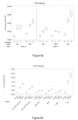
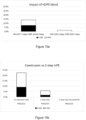
- Fig. 7a the OTR of three comparable packaging laminates, differing only by comprising different paper barriers A, B and C, are shown. Each of these laminates further had different inside polymer layer configurations as shown.
- the barrier-coated papers of B and C had better total oxygen barrier materials than the one of barrier-coated paper A and provide thus altogether a better performance, i.e. a lower level of Package-OTR.
- the "mPE” layer was made from a blend grade Elite 5800 from Dow, corresponding to a blend of about 70 wt-% mLLDPE and about 30 wt-% LDPE.
- the EAA grade used was Primacor 3540 from Dow.
- the LLDPE film was a cast bi-oriented LLDPE film of 18 ⁇ m thickness and had a surface weight of 17 g/m 2 .
- the HDPE grade was Dowlex 2006G from DOW.
- barrier-coated paper substrates A and B in Figure 7a were coated with barrier coatings according to the following.
- the barrier-coated paper substrate C was instead 4 times consecutively coated with 0.7 g/m 2 of the same PVOH (Poval TM 6-98 from Kuraray at about 10 weight-% of solid matter) with intermediate and final drying steps at a substrate surface maintained below 90 °C.
- the thus PVOH-coated paper substrates were subsequently PVD coated with a thin metallisation coating to an optical density of about 3.5.
- Lamination of the materials was carried out in a pilot-scale lamination line.
- the lamination speed was about 100 m/min.
- the Duplex CLC paperboard was a clay-coated paperboard of a conventional type.
- the barrier-coated side of the paper substrate was directed in the laminated structure towards the inside, i.e. corresponding to the inside of a packaging container to be manufactured from the laminated material.
- Laminated packaging materials were produced by means of melt extrusion lamination at 310 °C, with about 15 g/m 2 of an interjacent bonding layer of a conventional low-density polyethylene, LDPE, thus laminating the paperboard to the back side of the respective barrier-coated paper.
- the outside of the paperboard was melt extrusion coated with about 12 g/m 2 of LDPE.
- the gas-barrier coated paper substrates were thus melt extrusion coated or laminated on their opposite, barrier-coated, inner side with the different inside polymer multilayer configurations.
- Packaging containers were made from the respective laminated materials in a Filling Machine of the type Tetra Brik ® A3/CF and the package size was 200 ml "Slim" (200S).
- the filled packages were emptied, purged with nitrogen and the transmission rate of oxygen entering into the individual packages was measured according to ASTM F1307-14, at 0.2 atm.
- the OTR of packaging containers made from comparable laminates having a same barrier-coated paper is thus well maintained at a similar low and good level, regardless whether using inside a pre-manufactured cast LLDPE film, or a coextrusion-coated inside comprising a blend of metallocene-catalysed m-LLDPE and LDPE, as the heat sealable innermost layer.
- a pre-manufactured cast LLDPE film or a coextrusion-coated inside comprising a blend of metallocene-catalysed m-LLDPE and LDPE, as the heat sealable innermost layer.
- the load-bearing inside polymer multilayer portion including a load-bearing layer comprising HDPE or MDPE is subject to a co-pending application.
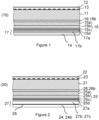
- Fig. 1 shows a laminated packaging material 10 for liquid carton packages of portion pack format (such as to contain from 200 to 400 ml, in which the laminated material comprises a bulk layer 11 of paperboard, having a bending force of 80 mN and a grammage weight of about 200 g/m 2 , and further comprising an outer liquid tight and heat sealable layer 12 of low density polyethylene applied on the outside of the bulk layer 11, which side is to be directed towards the outside of a packaging container produced from the packaging laminate.
- the layer 12 is transparent to show the printed décor pattern 13, applied onto the bulk layer of paper or paperboard, to the outside, thus informing about the contents of the package, the packaging brand and other information targeting consumers in retail facilities and food shops.
- the polyethylene of the outer layer 12 is a conventional low-density polyethylene (LDPE) of a heat sealable quality, but could also include further similar polymers, including LLDPE polymers. It is applied at an amount of about 12 g/m 2 .
- LDPE low-density
- the intermediate bonding layer 16 of LDPE is formed by means of melt extruding it in the form of a thin polymer melt curtain between the two paper webs and thus laminating the bulk layer and the barrier-coated paper substrate to each other, as all three layers pass through a cooled press roller nip.
- the amount applied of the intermediate bonding layer 16 may be from 10 to 20 g/m 2 , such as from 10 to 15 g/m 2 .
- the thus barrier-coated paper substrate is covered on its inner, coated side with an inside polymer multilayer portion 17.
- the inside polymer multilayer portion has three layers of different polymers, i.e. an innermost heat sealable layer 13 comprising in this example a blend of 70 weight-% mLLDPE and 30 weight-% LDPE, a tie layer 17a, applied onto the metallized surface of the barrier-coated paper at an amount of about 6 g/m 2 , e.g.
- EAA ethylene acrylic acid copolymer
- an intermediate load-bearing and load-distributing layer 17b comprising a linear low-density polyethylene, LLDPE having a melt flow ratio, MFR, from 4 to 20 g/10 min (190 °C/ 2.16 kg) and a melting temperature above 115 °C , applied between the tie layer and the innermost heat sealable layer 14.
- MFR melt flow ratio
- MFR melt flow ratio
- the intermediate load-bearing and load-distributing layer 17b is a blend comprises a polymer blend including from 50 to 95 weight-% of the LLDPE having a melt flow ratio from 4 to 20 g/10 min (190 °C/ 2.16 kg) and a melting temperature above 115 °C and from 5 to 50 weight-% of an HDPE or MDPE.
- Such configuration of the inside polymer multilayer portion 17 provides for a surprising improvement of both a of strong load-bearing effect and high durability and robustness upon fold forming of the laminated packaging material.
- the bulk layer 11 is laminated to the uncoated side of the thin, barrier-coated paper substrate 15, by an intermediate bonding layer 16b of an aqueous adhesive composition of a starch-based adhesive at from 2-7 g/m 2 , solid matter.
- the outer liquid tight and heat sealable layer 12 is applied in the form of an aqueous dispersion coating of an acrylic-functional or acrylic acid-functional, polyolefin-based polymer, at a dry matter content from 6 to 8 g/m 2 .
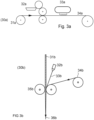
- the inside polymer multilayer portion 27 has thus the corresponding three principal layers of different polymers, i.e. an innermost heat sealable layer 24 comprising a blend of 70 weight-% mLLDPE and 30 weight-% LDPE, a tie or adhesive layer 27a, applied onto the metallized surface of the barrier-coated paper at an amount of about 6 g/m 2 , i.e.
- a laminated packaging material 20c is provided by the only difference, from what is described in Fig. 2 above, residing in how the inside polymer multilayer portion 27 is applied onto the barrier-coated paper 25.
- the inside polymer multilayer portion 27 has also in this embodiment three principal layers of different polymers, i.e. an innermost heat sealable layer 24b comprising a blend of 70 weight-% mLLDPE and 30 weight-% LDPE, a tie layer 27a, applied onto the metallized surface of the barrier-coated paper at an amount of about 6 g/m 2 , i.e.
- EAA ethylene acrylic acid copolymer
- EMAA ethylene methacrylic acid copolymer
- MFR melt flow ratio
- first co-extrusion coating step applying the tie layer 27a, the load-bearing and load-distributing layer 27b, and a first part thickness of the innermost heat sealable layer 24b
- second extrusion-coating step applying the second, remaining part thickness of the innermost heat sealable layer 24b.
- the first part thickness was co-extruded at about 5 g/m 2 to balance the intermediate load-bearing and load-distributing layer 27b also on its other, inner side and to provide symmetry in that extrusion coating step together with the EAA tie layer 27a, while the remaining part thickness was applied at about 10 g/m 2 .
- the two steps of extrusion coating were performed in separate lamination stations with intermediate cooling and solidification of the first applied, melt coated polymer layers at the interface 28.
- aqueous dispersion coating 30a is shown, which may be used for applying a first gas barrier layer 15c from an aqueous oxygen gas barrier composition onto a paper substrate 15a, or for applying an optional base coating 15b beneath the first gas barrier layer 15c (however requiring different equipment and settings).
- an aqueous dispersion coating process may be used for applying an aqueous adhesive composition for wet laminating of two webs together, of which at least one web has a fibrous cellulose surface.
- the roller application of the aqueous composition may differ depending on the purpose, i.e. the set up of the rollers and the application method may be different for a coating roller station, than for an adhesive application roller station.
- there will be no drying step needed for the application of an aqueous adhesive composition as described in connection with an embodiment of the present invention there will be no drying step needed.
- a web of a paper substrate 31a; 15a; 25a, (or an optionally base-coated paper substrate 15ab; 25ab) is thus forwarded to a dispersion coating station 32a, where an aqueous dispersion composition is applied by means of roller application onto the top surface of the substrate 31a.
- the aqueous dispersion composition may have an aqueous content of from 80 to 99 weight-%, in the case of gas barrier compositions, thus there may be be a lot of water on the wet coated substrate that needs to be dried by heat, and evaporated off, to form a continuous, homogenous coating, having an even quality with respect to barrier properties and surface properties, i.e. evenness and wettability.
- the drying is carried out by a hot air dryer 33a, which also allows the moisture to evaporate and be ventilated away from the surface of the substrate.
- the substrate temperature as it travels through the dryer may be kept constant at a temperature of below 100 °C, such as below 90 °C, such as from 70 to 90 °C, in order to avoid defects in the coating. Drying may be partly assisted by irradiation heat from infrared IR-lamps, in combination with hot air convection drying.
- a resulting web of a thus base-coated and dried paper substrate 34a may be smoothened by passing through at least one calender nip (not shown).
- the base-coated paper substrate may be smoothened and densified by passage through a super-calender of multiple high-pressure nips, in particular to produce a paper substrate of high density above 800, such as above 900 kg/m3.
- the finished, base-coated paper substrate may then be forwarded and further wound onto a reel for intermediate storage and later further subjected to gas barrier coating operations.
- Further coating operations may be further dispersion coating operations of a gas barrier composition 15c to provide a barrier-coated cellulose-based substrate, as described above, and/or vapour deposition coating of a barrier deposition coating 15d as described below, i.e. in a PVD coating process.
- Fig. 3b shows a first lamination process step in the manufacturing of the packaging laminate 10, 20, as the bulk layer 31b; 11, 21 is laminated to the barrier-coated substrate material web 34b (34a from fig. 3a ); 15, 25.
- the bulk layer paperboard 11, 21 may be laminated to the barrier-coated substrate material 15; 25 by means of melt extrusion lamination as shown in this figure, or by means of wet, cold dispersion adhesive lamination, the latter method however not shown.
- a molten polymer curtain 33b of e.g. LDPE is fed from a heated extruder and extrusion die 32b into a nip of lamination rollers 35b, as the two webs 31a and 34b are also forwarded to the same lamination nip and joined to each other by the intermediate, extruded bonding layer 33b of LDPE.
- the three layers are thus pressed together and joined at the nip 35b, which is formed between a press roller and a chill roller, thus cooling the laminated material to properly solidify the extruded bonding layer of LDPE.
- the resulting laminated material 36b is forwarded to be wound up on a reel for intermediate storage, or directly forwarded to subsequent lamination operations.
- Fig. 3c shows a process 30c for the remaining and final lamination steps in the manufacturing of the packaging laminate 10, 20, of Fig. 1 and 2 , respectively, after that the bulk layer 11, 21 has first been laminated to the barrier-coated cellulose-based substrate 15, 25.
- the resulting "pre-laminate" may have been laminated either by wet lamination as mentioned in connection to Fig. 3a above, or by polymer melt extrusion lamination in a lamination roller nip, as described in Fig. 3b .
- the bulk layer paperboard 11 may thus be laminated to the barrier-coated paper substrate 15 by means of wet, cold dispersion adhesive lamination, or by means of melt extrusion lamination of an intermediate bonding layer 16.
- An aqueous adhesive composition may be applied by means of a same or similar method as described in connection to Fig. 3a , however not requiring drying, or very little heating.
- the resulting bulk, paperboard-to-barrier pre-laminated web 31c is then forwarded from an intermediate storage reel, or directly from the lamination station for laminating the paper pre-laminated web.
- the barrier side of the pre-laminated bulk-barrier web 11-15; 21-15, i.e. its inner side, is joined at a cooled roller nip 34c to a molten polymer curtain 33c of the inside multilayer portion polymers 17; 27, being co-extruded together from an extruder feedblock and die 32c, i.e.
- the innermost heat sealable layer 14; 24 is coextrusion coated together with the other layers of the inside polymer mutilayer portion 17; 27, onto the inner side of the pre-laminate web in this illustrated embodiment.
- the paperboard pre-laminated web now having the inside polymer multilayer portion applied on its inside, is melt extrusion coated on its outer, non-laminated, printed side of the bulk layer, i.e.
- the inside polymer multilayer portion is applied in two co-extrusion coating steps, thus adding a further polymer extruder and a further lamination roller nip, for the melt extrusion coating of the inside polymer multilayer portion 27.
- the innermost layer 24 may for example be separately extrusion coated onto a previously applied, solidified co-extrusion coating of the inside polymer layers 27a (tie layer) and 27b (load-bearing and load-distributing layer).
- Fig. 4 is a diagrammatic view of an example of a plant 40 for physical vapour deposition, PVD, of e.g. an aluminium metal coating, onto a web substrate of the invention.
- the base-coated and first gas-barrier coated, i.e. dispersion-coated paper substrate 43 is subjected, on its coated side, to continuous evaporation deposition 40, of evaporised aluminium, to form a metallised layer of aluminium or, alternatively to a mixture of oxygen with aluminium vapour, to form a deposited coating of aluminium oxide.
- the coating is provided at a thickness from 5 to 100 nm, preferably from 10 to 50 nm, to form the barrier-coated paper substrate 44; 15 of the invention, as employed in the laminated packaging material of Figures 1 and 2 .
- the aluminium vapour is formed from ion bombardment of an evaporation source of a solid piece of aluminium 41.
- some oxygen gas may be injected into the plasma chamber via inlet ports.
- Fig. 5a shows an example of a packaging container 50a produced from the packaging laminate of the present invention.
- the packaging container is particularly suitable for beverages, sauces, soups or the like. Typically, such a package has a volume of about 100 to 1000 ml. It may be of any configuration, but is preferably brick-shaped, having longitudinal and transversal seals 51a and 52a, respectively, and optionally an opening device 53. In another embodiment, not shown, the packaging container may be shaped as a wedge. To obtain such a "wedge-shape", only the bottom part of the package is fold formed such that the transversal heat seal of the bottom is hidden under the triangular corner flaps, which are folded and sealed against the bottom of the package. The top section transversal seal is left unfolded. In this way the only partly folded packaging container is still easy to handle and dimensionally stable enough to put on a shelf in the food store or on any flat surface.
- Fig. 5b shows an alternative example of a packaging container 50b produced from an alternative packaging laminate of the invention.
- the alternative packaging laminate is thinner by having a thinner paper bulk layer, and thus it is not dimensionally stable enough to form a parallelepipedal or wedge-shaped packaging container, and is not fold formed after transversal sealing 52b.
- the packaging container will remain a pillow-shaped pouch-like container and be distributed and sold in this form.
- Fig. 5c shows a gable top package 50c, which is fold-formed from a pre-cut sheet or blank, from the laminated packaging material comprising a bulk layer of paperboard and the barrier-coated paper substrate of the invention. Also flat top packages may be formed from similar blanks of material.
- the integrity of the inside polymer multilayer portion is also generally further enhanced, within the full, in-the plane extension of the laminated packaging material.
Landscapes
- Engineering & Computer Science (AREA)
- Mechanical Engineering (AREA)
- Chemical & Material Sciences (AREA)
- Chemical Kinetics & Catalysis (AREA)
- Wrappers (AREA)
- Laminated Bodies (AREA)
Applications Claiming Priority (1)
| Application Number | Priority Date | Filing Date | Title |
|---|---|---|---|
| EP23219288 | 2023-12-21 |
Publications (1)
| Publication Number | Publication Date |
|---|---|
| EP4574419A1 true EP4574419A1 (fr) | 2025-06-25 |
Family
ID=89308023
Family Applications (1)
| Application Number | Title | Priority Date | Filing Date |
|---|---|---|---|
| EP24221920.2A Pending EP4574419A1 (fr) | 2023-12-21 | 2024-12-19 | Matériau d'emballage stratifié comprenant un substrat à base de cellulose revêtu d'une barrière, son procédé de fabrication et récipient d'emballage |
Country Status (2)
| Country | Link |
|---|---|
| EP (1) | EP4574419A1 (fr) |
| WO (1) | WO2025133015A1 (fr) |
Citations (6)
| Publication number | Priority date | Publication date | Assignee | Title |
|---|---|---|---|---|
| WO2011003565A2 (fr) | 2009-07-08 | 2011-01-13 | Tetra Laval Holdings & Finance S.A. | Matériau d'emballage stratifié sans feuil d'aluminium, procédé de fabrication du matériau d'emballage stratifié et récipient d'emballage fait avec ce matériau |
| WO2017089508A1 (fr) | 2015-11-27 | 2017-06-01 | Tetra Laval Holdings & Finance S.A. | Matériau d'emballage stratifié et récipients d'emballage fabriqués à partir de celui-ci |
| EP4008548A1 (fr) | 2020-12-01 | 2022-06-08 | Tetra Laval Holdings & Finance S.A. | Substrat à base de cellulose à revêtement barrière, matériau d'emballage stratifié et récipient d'emballage comprenant le substrat à base de cellulose |
| WO2022219056A1 (fr) | 2021-04-13 | 2022-10-20 | Tetra Laval Holdings & Finance S.A. | Utilisation d'un substrat en papier haute densité, substrat haute densité revêtu, et matériau d'emballage stratifié et contenant d'emballage le comprenant |
| WO2023084122A1 (fr) | 2021-11-15 | 2023-05-19 | Tetra Laval Holdings & Finance S.A. | Matériau d'emballage stratifié et récipient d'emballage comprenant un substrat à base de cellulose revêtu d'une barrière |
| EP4253047A1 (fr) * | 2022-03-29 | 2023-10-04 | Tetra Laval Holdings & Finance S.A. | Matériau d'emballage stratifié et récipient d'emballage fabriqué à partir de celui-ci |
-
2024
- 2024-12-19 EP EP24221920.2A patent/EP4574419A1/fr active Pending
- 2024-12-19 WO PCT/EP2024/087748 patent/WO2025133015A1/fr active Pending
Patent Citations (7)
| Publication number | Priority date | Publication date | Assignee | Title |
|---|---|---|---|---|
| WO2011003565A2 (fr) | 2009-07-08 | 2011-01-13 | Tetra Laval Holdings & Finance S.A. | Matériau d'emballage stratifié sans feuil d'aluminium, procédé de fabrication du matériau d'emballage stratifié et récipient d'emballage fait avec ce matériau |
| WO2017089508A1 (fr) | 2015-11-27 | 2017-06-01 | Tetra Laval Holdings & Finance S.A. | Matériau d'emballage stratifié et récipients d'emballage fabriqués à partir de celui-ci |
| EP4008548A1 (fr) | 2020-12-01 | 2022-06-08 | Tetra Laval Holdings & Finance S.A. | Substrat à base de cellulose à revêtement barrière, matériau d'emballage stratifié et récipient d'emballage comprenant le substrat à base de cellulose |
| WO2022219056A1 (fr) | 2021-04-13 | 2022-10-20 | Tetra Laval Holdings & Finance S.A. | Utilisation d'un substrat en papier haute densité, substrat haute densité revêtu, et matériau d'emballage stratifié et contenant d'emballage le comprenant |
| EP4074892B1 (fr) * | 2021-04-13 | 2023-12-20 | Tetra Laval Holdings & Finance S.A. | Utilisation d'un substrat de papier à haute densité, substrat revêtu à haute densité et un matériau d'emballage stratifié et récipient d'emballage le comprenant |
| WO2023084122A1 (fr) | 2021-11-15 | 2023-05-19 | Tetra Laval Holdings & Finance S.A. | Matériau d'emballage stratifié et récipient d'emballage comprenant un substrat à base de cellulose revêtu d'une barrière |
| EP4253047A1 (fr) * | 2022-03-29 | 2023-10-04 | Tetra Laval Holdings & Finance S.A. | Matériau d'emballage stratifié et récipient d'emballage fabriqué à partir de celui-ci |
Also Published As
| Publication number | Publication date |
|---|---|
| WO2025133015A1 (fr) | 2025-06-26 |
Similar Documents
| Publication | Publication Date | Title |
|---|---|---|
| ES2974244T3 (es) | Uso de un sustrato de papel de alta densidad, el sustrato de alta densidad revestido y un material de envasado estratificado y recipiente de envasado que lo comprende | |
| EP4180576B1 (fr) | Matériau d'emballage stratifié et récipient d'emballage comprenant un substrat à base de cellulose revêtu d'une barrière | |
| EP4245915A1 (fr) | Procédé de fabrication d'un substrat à base de cellulose revêtu d'une barrière, matériau d'emballage stratifié et récipient d'emballage comprenant le substrat à base de cellulose ainsi fabriqué | |
| EP4310250A1 (fr) | Substrat à base de cellulose revêtu d'une barrière, matériau d'emballage stratifié et récipient d'emballage comprenant le substrat à base de cellulose | |
| US20250034812A1 (en) | Barrier-coated cellulose-based substrate | |
| EP4371754B1 (fr) | Matériau d'emballage stratifié, procédé pour sa fabrication et récipients d'emballage le comprenant | |
| EP4180574B1 (fr) | Substrat à base de cellulose revêtu d'une barrière pour matériau d'emballage stratifié | |
| EP4653189A1 (fr) | Matériau d'emballage stratifié, procédé pour sa fabrication et récipients d'emballage le comprenant | |
| EP4574419A1 (fr) | Matériau d'emballage stratifié comprenant un substrat à base de cellulose revêtu d'une barrière, son procédé de fabrication et récipient d'emballage | |
| EP4574420A1 (fr) | Matériau d'emballage stratifié comprenant un substrat à base de cellulose revêtu d'une barrière, son procédé de fabrication et récipient d'emballage | |
| EP4461873A1 (fr) | Substrat de cellulose fibreux revêtu d'une barrière et matériau d'emballage stratifié | |
| WO2026082694A1 (fr) | Substrat à base de cellulose revêtu d'une barrière et procédé de production du substrat revêtu d'une barrière | |
| WO2026082690A1 (fr) | Matériau d'emballage stratifié comprenant un substrat à revêtement barrière et récipient d'emballage | |
| WO2026082691A1 (fr) | Matériau d'emballage stratifié comprenant un substrat à base de cellulose revêtu d'une barrière et contenant d'emballage | |
| WO2026082678A1 (fr) | Substrat à base de cellulose revêtu d'une couche barrière et son procédé de fabrication | |
| EP4653190A1 (fr) | Matériau d'emballage stratifié et récipients d'emballage fabriqués à partir de celui-ci | |
| TW202528140A (zh) | 層壓包裝材料,包含該層壓包裝材料的包裝容器,以及製造該材料和該容器之方法 |
Legal Events
| Date | Code | Title | Description |
|---|---|---|---|
| PUAI | Public reference made under article 153(3) epc to a published international application that has entered the european phase |
Free format text: ORIGINAL CODE: 0009012 |
|
| STAA | Information on the status of an ep patent application or granted ep patent |
Free format text: STATUS: THE APPLICATION HAS BEEN PUBLISHED |
|
| AK | Designated contracting states |
Kind code of ref document: A1 Designated state(s): AL AT BE BG CH CY CZ DE DK EE ES FI FR GB GR HR HU IE IS IT LI LT LU LV MC ME MK MT NL NO PL PT RO RS SE SI SK SM TR |
|
| STAA | Information on the status of an ep patent application or granted ep patent |
Free format text: STATUS: REQUEST FOR EXAMINATION WAS MADE |
|
| 17P | Request for examination filed |
Effective date: 20260102 |