EP4574810A1 - Mélangeurs statiques dans la préparation d'acides carboxyliques alicycliques et de leurs esters - Google Patents
Mélangeurs statiques dans la préparation d'acides carboxyliques alicycliques et de leurs esters Download PDFInfo
- Publication number
- EP4574810A1 EP4574810A1 EP24218171.7A EP24218171A EP4574810A1 EP 4574810 A1 EP4574810 A1 EP 4574810A1 EP 24218171 A EP24218171 A EP 24218171A EP 4574810 A1 EP4574810 A1 EP 4574810A1
- Authority
- EP
- European Patent Office
- Prior art keywords
- hydrogenation
- mixer
- ester
- ethylhexyl
- isononyl
- Prior art date
- Legal status (The legal status is an assumption and is not a legal conclusion. Google has not performed a legal analysis and makes no representation as to the accuracy of the status listed.)
- Pending
Links
Images
Classifications
-
- C—CHEMISTRY; METALLURGY
- C07—ORGANIC CHEMISTRY
- C07C—ACYCLIC OR CARBOCYCLIC COMPOUNDS
- C07C5/00—Preparation of hydrocarbons from hydrocarbons containing the same number of carbon atoms
- C07C5/02—Preparation of hydrocarbons from hydrocarbons containing the same number of carbon atoms by hydrogenation
- C07C5/10—Preparation of hydrocarbons from hydrocarbons containing the same number of carbon atoms by hydrogenation of aromatic six-membered rings
-
- C—CHEMISTRY; METALLURGY
- C07—ORGANIC CHEMISTRY
- C07C—ACYCLIC OR CARBOCYCLIC COMPOUNDS
- C07C67/00—Preparation of carboxylic acid esters
- C07C67/30—Preparation of carboxylic acid esters by modifying the acid moiety of the ester, such modification not being an introduction of an ester group
- C07C67/303—Preparation of carboxylic acid esters by modifying the acid moiety of the ester, such modification not being an introduction of an ester group by hydrogenation of unsaturated carbon-to-carbon bonds
-
- B—PERFORMING OPERATIONS; TRANSPORTING
- B01—PHYSICAL OR CHEMICAL PROCESSES OR APPARATUS IN GENERAL
- B01F—MIXING, e.g. DISSOLVING, EMULSIFYING OR DISPERSING
- B01F25/00—Flow mixers; Mixers for falling materials, e.g. solid particles
- B01F25/40—Static mixers
-
- B—PERFORMING OPERATIONS; TRANSPORTING
- B01—PHYSICAL OR CHEMICAL PROCESSES OR APPARATUS IN GENERAL
- B01F—MIXING, e.g. DISSOLVING, EMULSIFYING OR DISPERSING
- B01F25/00—Flow mixers; Mixers for falling materials, e.g. solid particles
- B01F25/40—Static mixers
- B01F25/42—Static mixers in which the mixing is affected by moving the components jointly in changing directions, e.g. in tubes provided with baffles or obstructions
- B01F25/421—Static mixers in which the mixing is affected by moving the components jointly in changing directions, e.g. in tubes provided with baffles or obstructions by moving the components in a convoluted or labyrinthine path
-
- B—PERFORMING OPERATIONS; TRANSPORTING
- B01—PHYSICAL OR CHEMICAL PROCESSES OR APPARATUS IN GENERAL
- B01J—CHEMICAL OR PHYSICAL PROCESSES, e.g. CATALYSIS OR COLLOID CHEMISTRY; THEIR RELEVANT APPARATUS
- B01J23/00—Catalysts comprising metals or metal oxides or hydroxides, not provided for in group B01J21/00
- B01J23/38—Catalysts comprising metals or metal oxides or hydroxides, not provided for in group B01J21/00 of noble metals
- B01J23/40—Catalysts comprising metals or metal oxides or hydroxides, not provided for in group B01J21/00 of noble metals of the platinum group metals
- B01J23/46—Ruthenium, rhodium, osmium or iridium
- B01J23/462—Ruthenium
-
- B—PERFORMING OPERATIONS; TRANSPORTING
- B01—PHYSICAL OR CHEMICAL PROCESSES OR APPARATUS IN GENERAL
- B01J—CHEMICAL OR PHYSICAL PROCESSES, e.g. CATALYSIS OR COLLOID CHEMISTRY; THEIR RELEVANT APPARATUS
- B01J8/00—Chemical or physical processes in general, conducted in the presence of fluids and solid particles; Apparatus for such processes
- B01J8/02—Chemical or physical processes in general, conducted in the presence of fluids and solid particles; Apparatus for such processes with stationary particles, e.g. in fixed beds
-
- B—PERFORMING OPERATIONS; TRANSPORTING
- B01—PHYSICAL OR CHEMICAL PROCESSES OR APPARATUS IN GENERAL
- B01J—CHEMICAL OR PHYSICAL PROCESSES, e.g. CATALYSIS OR COLLOID CHEMISTRY; THEIR RELEVANT APPARATUS
- B01J8/00—Chemical or physical processes in general, conducted in the presence of fluids and solid particles; Apparatus for such processes
- B01J8/02—Chemical or physical processes in general, conducted in the presence of fluids and solid particles; Apparatus for such processes with stationary particles, e.g. in fixed beds
- B01J8/0278—Feeding reactive fluids
-
- C—CHEMISTRY; METALLURGY
- C07—ORGANIC CHEMISTRY
- C07C—ACYCLIC OR CARBOCYCLIC COMPOUNDS
- C07C69/00—Esters of carboxylic acids; Esters of carbonic or haloformic acids
- C07C69/74—Esters of carboxylic acids having an esterified carboxyl group bound to a carbon atom of a ring other than a six-membered aromatic ring
- C07C69/75—Esters of carboxylic acids having an esterified carboxyl group bound to a carbon atom of a ring other than a six-membered aromatic ring of acids with a six-membered ring
-
- B—PERFORMING OPERATIONS; TRANSPORTING
- B01—PHYSICAL OR CHEMICAL PROCESSES OR APPARATUS IN GENERAL
- B01F—MIXING, e.g. DISSOLVING, EMULSIFYING OR DISPERSING
- B01F2101/00—Mixing characterised by the nature of the mixed materials or by the application field
- B01F2101/2204—Mixing chemical components in generals in order to improve chemical treatment or reactions, independently from the specific application
-
- B—PERFORMING OPERATIONS; TRANSPORTING
- B01—PHYSICAL OR CHEMICAL PROCESSES OR APPARATUS IN GENERAL
- B01J—CHEMICAL OR PHYSICAL PROCESSES, e.g. CATALYSIS OR COLLOID CHEMISTRY; THEIR RELEVANT APPARATUS
- B01J2208/00—Processes carried out in the presence of solid particles; Reactors therefor
- B01J2208/00796—Details of the reactor or of the particulate material
- B01J2208/00823—Mixing elements
- B01J2208/00831—Stationary elements
- B01J2208/00849—Stationary elements outside the bed, e.g. baffles
-
- C—CHEMISTRY; METALLURGY
- C07—ORGANIC CHEMISTRY
- C07C—ACYCLIC OR CARBOCYCLIC COMPOUNDS
- C07C2601/00—Systems containing only non-condensed rings
- C07C2601/12—Systems containing only non-condensed rings with a six-membered ring
- C07C2601/14—The ring being saturated
Definitions
- the invention relates to the production of alicyclic compounds by ring hydrogenation of aromatic compounds.
- processes for producing alicyclic compounds, preferably alicyclic carboxylic acids and their esters, using a static mixer are provided, as well as apparatus for carrying out this process.
- Alicyclic polycarboxylic acid esters such as cyclohexane-1,2-dicarboxylic acid esters, are used as lubricating oil components and as aids in metal processing. They are also used as plasticizers for polyolefins and PVC.
- Aromatic carboxylic acid esters are hydrogenated on supported Ni, Ru, Rh and/or Pd catalysts to the corresponding alicyclic carboxylic acid esters at 70 to 250 °C and 30 to 200 bar.
- the primary object of the present invention was therefore to provide a process for the preparation of alicyclic compounds, preferably alicyclic carboxylic acids and their esters, which enables an approximately constant space-time yield over the entire length of the hydrogenation unit.
- a static mixer is a mixing element whose internal geometry enables it to mix two or more input streams.
- a static mixer consists of a tube containing flow elements or internal components. Mixing occurs when the input streams are guided over the flow elements in the tube, thereby creating turbulent flows.
- Static mixers are capable of mixing material systems consisting of two or more components with gaseous, liquid, supercritical, or particulate phases.
- a static mixer comprises a tube into which the two streams A and B are fed via a common inlet. At least one and preferably several stream elements are arranged in the tube. The desired mixing of the two streams A and B is achieved by the stream element(s), producing stream C.
- aromatic compounds are understood to mean compounds that possess at least one ring system containing, according to the Hückel rule, a number of 4n+2 delocalized electrons in conjugated double bonds, lone electron pairs, or unoccupied p-orbitals.
- the aromatic compounds used as starting materials in the present invention preferably possess a benzene ring.
- a "hydrogen-containing hydrogenation gas” is a gas that contains hydrogen. Hydrogen is used as a further reactant in the reaction underlying the present invention, in addition to the aromatic compounds. During the hydrogenation reaction, the double bonds in the ring of the aromatic compounds used, preferably the benzene ring, are hydrogenated and thereby dissolved by a hydrogen addition reaction. The reaction takes place in the presence of a solid catalyst. The hydrogen molecule on the hydrogen-containing hydrogenation gas binds intermediately to the metal atom of the catalyst, and the bond between the two hydrogen atoms in the hydrogen molecule is weakened and can interact with an electron-rich multiple bond (double bond). Hydrogenation occurs when two hydrogen atoms are formally transferred to each double bond. This dissolves the double bonds in the aromatic compounds, and alicyclic compounds are obtained.
- any hydrogen-containing gas mixtures that do not contain harmful amounts of catalyst poisons, such as carbon monoxide or hydrogen sulfide, can be used as hydrogenation gases.
- the use of inert gases is optional; hydrogen with a purity of greater than 95%, in particular greater than 98%, is preferred.
- Inert gas components can be, for example, nitrogen or methane.
- the hydrogen present in the hydrogenation units is sufficient to produce an excess, in particular an excess of 1 to 200%, preferably an excess of 3 to 100%, and particularly preferably an excess of 5 to 50%, based on the stoichiometric amount required to achieve the possible or desired conversion in the hydrogenation unit. Establishing a sufficient excess of hydrogen can have a beneficial effect on the complete hydrogenation of the aromatic bonds.
- the individual hydrogenation units can be fed with fresh hydrogen.
- the offgas from a hydrogenation unit can be reused as fresh hydrogen after processing.
- the reactant and hydrogenation gas can flow through the hydrogenation units in opposite order or, for example, be mixed beforehand using a static mixer. In this process configuration, it is advantageous to keep the excess hydrogen, based on the stoichiometrically required amount, below 30%, in particular below 20%.
- a static mixer is provided in each feed line to the individual hydrogenation units.
- one hydrogenation unit operated in a loop mode and one hydrogenation unit operated in a straight line mode are used.
- solvents straight-chain or cyclic ethers, such as tetrahydrofuran or dioxane, as well as aliphatic alcohols in which the alkyl radical has 1 to 13 carbon atoms.
- Preferred alcohols to be used as solvents are isopropanol, n-butanol, isobutanol, n-pentanol, 2-ethylhexanol, nonanols, technical nonanol mixtures, decanol, technical decanol mixtures, tridecanols.
- alcohols when using alcohols as solvents, it may be advantageous to use the alcohol or alcohol mixture that would be produced during saponification of the product. This would eliminate the formation of byproducts due to transesterification.
- Another preferred solvent is the hydrogenation product itself.
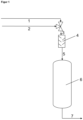
- the reactants are fed to the static mixer via at least two pipelines (1, 2), which are optionally combined into a single stream (3).
- one of the two pipelines contains a hydrogen-containing hydrogenation gas and aromatic compounds in liquid form.
- These are then introduced into the static mixer (4) and fed via pipeline (5) as a homogeneous mixture into the hydrogenation unit (6), where the hydrogenation reaction takes place.
- the product stream (7) contains a mixture of alicyclic compounds as product and a remaining residual concentration of the reactant.
- the product stream (7) at the outlet of the hydrogenation unit contains less than 0.3% by weight, preferably less than 0.1% by weight, in particular less than 0.05% by mass, particularly preferably 0.005% by mass of aromatic compounds used as starting material.
- the static mixer has a geometry which mediates a flow with a Reynolds number of greater than 100, preferably greater than 200, in particular greater than 500, particularly preferably greater than 900 in the static mixer.
- a person skilled in the art is able to determine the Reynolds number based on the geometry of a static mixer.
- the general formula for the Reynolds number is known to those skilled in the art.
- the static mixer has a geometry that facilitates mixing of the hydrogenation gas provided in step i. and the aromatic compounds provided in a liquid phase such that the hydrogen from the hydrogen-containing hydrogenation gas is present in the liquid phase at approximately a saturation concentration at the end of the static mixer.
- the skilled person is able to determine the saturation concentration in a liquid phase.
- “approximately at saturation concentration” means that the hydrogen concentration in the liquid phase is at most 15%, preferably at most 10%, particularly preferably at most 5%, and most preferably at most 1% below the saturation concentration. This means, for example, that if the saturation concentration of hydrogen in the liquid phase is 1 g/L, then a concentration of 0.85 g/L of hydrogen in the liquid phase also means that a saturation concentration is present.
- a Kenics mixer features a geometry that directs the inlet stream radially toward the pipe walls and back toward the center through a spiral-shaped mixing element. Additional flow reversal and flow splitting are achieved by combining elements that alternately rotate left and right. These flow profiles mix the inlet streams.
- step i. one or more aromatic carboxylic acid esters with an alcohol component selected from the group consisting of branched or unbranched alkoxyalkyl, cycloalkyl and/or alkyl groups having 1 to 25 carbon atoms, preferably C 8 -C 10 phthalate, C 8 -C 10 terephthalate, C 8 -C 10 isophthalate and C 8 -C 10 trimellitate, particularly preferably di-2-ethylhexyl phthalate, di-isononyl phthalate, di-2-ethylhexyl terephthalate, di-isononyl terephthalate, di-2-ethylhexyl isophthalate, di-isononyl isophthalate, di-2-ethylhexyl trimellitate and tri-isononyl trimellitate, are provided.
- an alcohol component selected from the group consisting of branched or unbranched alkoxyalkyl, cycloalkyl
- C 8 preferably represents 2-ethylhexyl or n-octyl
- C 9 represents isononyl
- C 10 represents isodecyl or 2-propylheptyl.
- esters of the following aromatic carboxylic acids can be used: 1,2-naphthalenedicarboxylic acid, 1,3-naphthalenedicarboxylic acid, 1,4-naphthalenedicarboxylic acid, 1,5-naphthalenedicarboxylic acid, 1,6-naphthalenedicarboxylic acid, 1,7-naphthalenedicarboxylic acid, 1,8-naphthalenedicarboxylic acid, phthalic acid (benzene-1,2-dicarboxylic acid), isophthalic acid (benzene-1,3-dicarboxylic acid), terephthalic acid (benzene-1,4-dicarboxylic acid), benzene-1,2,3-tricarboxylic acid, Benzene-1,2,4-tricarboxylic acid (trimellitic acid), benzene-1,3,5-tricarboxylic acid (trimesic acid), benzene-1,2,3,4-tetracarboxylic acid
- alkyl, cycloalkyl, and alkoxyalkyl esters for example, of the above-mentioned acids, wherein these radicals independently comprise 1 to 25, in particular 3 to 15, very particularly 8 to 13, and especially 9, carbon atoms.
- These radicals can be linear or branched. If a reactant has more than one ester group, these radicals can be identical or different.
- esters of an aromatic polycarboxylic acid terephthalic acid monomethyl ester, terephthalic acid dimethyl ester, terephthalic acid diethyl ester, terephthalic acid di-n-propyl ester, terephthalic acid dibutyl ester, terephthalic acid diisobutyl ester, terephthalic acid di-tert-butyl ester, terephthalic acid dipentyl ester, terephthalic acid monoglycol ester, terephthalic acid diglycol ester, terephthalic acid n-octyl ester, terephthalic acid diisooctyl ester, terephthalic acid di-2-ethylhexyl ester, terephthalic acid di-n-nonyl ester, terephthalic acid diisononyl ester, terephthalic acid di-2
- Isophthalic acid diglycol ester isophthalic acid di-n-octyl ester, isophthalic acid diisooctyl ester, isophthalic acid di-2-ethylhexyl ester, isophthalic acid di-n-nonyl ester, isophthalic acid diisononyl ester, isophthalic acid di-n-decyl ester, isophthalic acid diisodecyl ester, isophthalic acid di-n-undecyl ester, isophthalic acid diisododecyl ester, isophthalic acid di-n-dodecyl ester, isophthalic acid ditridecyl ester, isophthalic acid di-n-octadecyl ester, isophthalic acid diisooctadecyl ester, isophthalic acid di-n-eicosyl ester, isophthalic acid monocyclohe
- the process according to the invention is also applicable in principle to benzoic acid and its esters.
- benzoic acid and its esters include, in addition to alkyl benzoates, benzoates of diols, such as glycol dibenzoate, diethylene glycol benzoate, triethylene glycol dibenzoate, or propylene glycol dibenzoate.
- the alcohol component of the alkyl benzoates can consist of 1 to 25, preferably 8 to 13, carbon atoms, each linear or branched.
- alcohol mixtures On an industrial scale, aromatic esters, particularly full esters, are often produced from alcohol mixtures.
- corresponding alcohol mixtures include: C5 alcohol mixtures produced from linear butenes by hydroformylation followed by hydrogenation; C5 alcohol mixtures produced from butene mixtures containing linear butenes and isobutene by hydroformylation followed by hydrogenation; C6 alcohol mixtures produced from a pentene or from a mixture of two or more pentenes by hydroformylation followed by hydrogenation; C7 alcohol mixtures produced from the trimerization of ethylene or dimerization of propylene or a hexene isomer or another mixture of hexene isomers by hydroformylation followed by hydrogenation; Ca alcohol mixtures, such as 2-ethylhexanol (2 isomers), produced by aldol condensation of n-butyraldehyde followed by hydrogenation; Cs-alcohol mixtures, produced from C4 -olefins by dimerization, hydroformy
- the Cs-alcohols can be produced starting from isobutene, a mixture of linear butenes, or mixtures of linear butenes and isobutene.
- the C4 -olefins can be dimerized using various catalysts, such as protic acids, zeolites, organometallic nickel compounds, or solid nickel-containing catalysts.
- the hydroformylation of the Ca-olefin mixtures can be carried out using rhodium or cobalt catalysts; C10 -alcohol mixtures, produced from tripropylene by hydroformylation followed by hydrogenation; 2-propylheptanol (2 isomers), produced by aldol condensation of valeraldehyde followed by hydrogenation; C10 alcohol mixtures prepared from a mixture of at least two C5 aldehydes by aldol condensation followed by hydrogenation; C13 alcohol mixtures prepared from hexaethylene, tetrapropylene or tributene by hydroformylation followed by hydrogenation.
- alcohol mixtures can be obtained by hydroformylation and subsequent hydrogenation from olefins or olefin mixtures, which arise, for example, in Fischer-Tropsch syntheses, in dehydrogenations of hydrocarbons, metathesis reactions, in the polygas process or other technical processes.
- olefin mixtures with olefins of different carbon numbers can also be used for the production of alcohol mixtures.
- esters prepared from aromatic polycarboxylic acids and the above-mentioned alcohol mixtures can be used in the process according to the invention.
- esters prepared from phthalic acid or phthalic anhydride and a mixture of isomeric alcohols having 4 to 13 carbon atoms are preferably used.
- the resulting product depends on the starting material used.
- diisononyl 1,2-cyclohexanedicarboxylate is obtained as the product when diisononyl phthalate is used as the starting material.
- Di-2-ethylhexyl 1,2-cyclohexanedicarboxylate is obtained from di-2-ethylhexyl phthalate.
- 1,2,4-cyclohexanetricarboxylic acid triisononyl ester is obtained as a product when trimellitic acid triisononyl ester is used as the starting material.
- 1,2,4-cyclohexanetricarboxylic acid tri-2-ethylhexyl ester is accordingly obtained from trimellitic acid tri-2-ethylhexyl ester.
- the process according to the invention is preferably carried out under the following conditions: A Kenics mixer is installed in the feed to a hydrogenation unit, which imparts a Reynolds number of over 100 in the mixer.
- the concentration of aromatic compounds as reactant is between 5 and 30 mass%, particularly between 8 and 15 mass%.
- the reactant concentration is between 0.3 and 8 mass%, particularly between 1.5 and 4 mass%.
- the average hydrogenation temperatures in the hydrogenation unit are 70 to 150 °C, especially 80 to 120 °C.
- a further aspect of the present invention is the provision of an apparatus for carrying out the process according to the invention comprising at least one hydrogenation unit (6), a static mixer (4) and one or more feed streams (1, 2), wherein the static mixer is configured such that the feed streams A and B (1, 2) are brought into contact with one another and are then introduced into the hydrogenation unit (6) via a stream C (5).
- the device according to the invention comprises two, three, four or more feed streams to the static mixer.
- the hydrogenation unit (6) comprises one or more solid catalysts, preferably wherein the solid catalyst comprises at least one metal of the eighth subgroup of the Periodic Table of the Elements, particularly preferably ruthenium.
- the statements made herein for the catalysts used apply accordingly.
- a mixture of aromatic compounds and corresponding alicyclic compounds preferably a mixture of aromatic carboxylic acid esters and their corresponding alicyclic compounds with an alcohol component selected from the group consisting of branched or unbranched alkoxyalkyl, cycloalkyl and/or alkyl groups having 1 to 25 carbon atoms, preferably from C 8 -C 10 phthalate, C 8 -C 10 terephthalate, C 8 -C 10 isophthalate and C 8 -C 10 trimellitate, particularly preferably di-2-ethylhexyl phthalate, di-isononyl phthalate, di-2-ethylhexyl terephthalate, di-isononyl terephthalate, di-2-ethylhexyl isophthalate, di-isononyl isophthalate, di-2-ethylhexyl trimellitate and tri-isononyl trimellitate, di
- a further aspect of the present invention is the use of a static mixer for contacting two or more feed streams prior to introduction into one or more hydrogenation units, preferably for contacting aromatic compounds and hydrogen-containing hydrogenation gas, preferably wherein the mixer has a Kenics mixer design.
- the static mixer has a geometry which mediates a flow with a Reynolds number of greater than 100, preferably greater than 200, in particular greater than 500, particularly preferably greater than 900 in the static mixer.
- the static mixer has a geometry which mediates mixing of the hydrogenation gas provided in step i. and the aromatic compounds provided in a liquid phase such that the hydrogen from the hydrogen-containing hydrogenation gas is present in the liquid phase at approximately saturation concentration at the end of the static mixer.
- plasticizers Preferred within the scope of the present invention is the use of the alicyclic polycarboxylic acid esters prepared according to the invention as plasticizers in plastics.
- Preferred plastics are PVC, homopolymers and copolymers based on ethylene, propylene, butadiene, vinyl acetate, glycidyl acrylate, glycidyl methacrylate, acrylates, acrylates with alkyl radicals of branched or unbranched alcohols having one to ten carbon atoms bonded to the oxygen atom of the ester group, styrene, acrylonitrile, and homopolymers or copolymers of cyclic olefins.
- plastics are examples of representatives of the above groups: Polyacrylates with identical or different alkyl radicals having 4 to 8 C atoms, bonded to the oxygen atom of the ester group, in particular with the n-butyl, n-hexyl, n-octyl and 2-ethylhexyl radical, and isononyl radical, polymethacrylate, polymethyl methacrylate, methyl acrylate-butyl acrylate copolymers, methyl methacrylate-butyl methacrylate copolymers, ethylene-vinyl acetate copolymers, chlorinated Polyethylene, nitrile rubber, acrylonitrile-butadiene-styrene copolymers, ethylene-propylene copolymers, ethylene-propylene-diene copolymers, styrene-acrylonitrile copolymers, acrylonitrile-butadiene rubber, styrene-butadiene
- alicyclic polycarboxylic acid esters prepared according to the invention can be used to modify plastic mixtures, for example the mixture of a polyolefin with a polyamide.
- the alicyclic polycarboxylic acid esters prepared according to the invention can be used as lubricating oil components, as components of cooling fluids, and metalworking fluids. They can also be used as components in paints, varnishes, inks, and adhesives.
Landscapes
- Chemical & Material Sciences (AREA)
- Organic Chemistry (AREA)
- Chemical Kinetics & Catalysis (AREA)
- Dispersion Chemistry (AREA)
- Engineering & Computer Science (AREA)
- Materials Engineering (AREA)
- Organic Low-Molecular-Weight Compounds And Preparation Thereof (AREA)
- Catalysts (AREA)
- Low-Molecular Organic Synthesis Reactions Using Catalysts (AREA)
Applications Claiming Priority (1)
| Application Number | Priority Date | Filing Date | Title |
|---|---|---|---|
| EP23217548 | 2023-12-18 |
Publications (1)
| Publication Number | Publication Date |
|---|---|
| EP4574810A1 true EP4574810A1 (fr) | 2025-06-25 |
Family
ID=89223948
Family Applications (1)
| Application Number | Title | Priority Date | Filing Date |
|---|---|---|---|
| EP24218171.7A Pending EP4574810A1 (fr) | 2023-12-18 | 2024-12-06 | Mélangeurs statiques dans la préparation d'acides carboxyliques alicycliques et de leurs esters |
Country Status (7)
| Country | Link |
|---|---|
| US (1) | US20250197320A1 (fr) |
| EP (1) | EP4574810A1 (fr) |
| JP (1) | JP2025097308A (fr) |
| KR (1) | KR20250094590A (fr) |
| CN (1) | CN120172847A (fr) |
| CA (1) | CA3259143A1 (fr) |
| TW (1) | TW202535826A (fr) |
Citations (7)
| Publication number | Priority date | Publication date | Assignee | Title |
|---|---|---|---|---|
| US3027398A (en) | 1960-02-01 | 1962-03-27 | Du Pont | Process for preparing dimethyl 1, 4-cyclohexanedicarboxylate |
| DE2823165A1 (de) | 1978-05-26 | 1979-11-29 | Bayer Ag | Verfahren zur herstellung von cycloaliphatischen carbonsaeureestern |
| WO1999032427A1 (fr) | 1997-12-19 | 1999-07-01 | Basf Aktiengesellschaft | Procede d'hydrogenation d'acides polycarboxyliques de benzene ou de leurs derives a l'aide d'un catalyseur a macropores |
| WO2000078704A1 (fr) | 1999-06-18 | 2000-12-28 | Basf Aktiengesellschaft | Esters d'acide 1,3- et 1,4-dicarboxylique cyclohexane selectionnes |
| US20050256281A1 (en) * | 2004-04-29 | 2005-11-17 | Oxeno Olefinchemie Gmbh | Apparatus and process for the continuous reaction of a liquid with a gas over a solid catalyst |
| CN106554278A (zh) * | 2015-09-29 | 2017-04-05 | 湖南长岭石化科技开发有限公司 | 一种环己烷-1,2-二甲酸二元酯的制备方法 |
| CN107774257A (zh) * | 2016-08-31 | 2018-03-09 | 湖南长岭石化科技开发有限公司 | 一种加氢催化剂及其应用以及一种环己烷‑1,2‑二甲酸二元酯的制备方法 |
-
2024
- 2024-12-06 EP EP24218171.7A patent/EP4574810A1/fr active Pending
- 2024-12-11 US US18/976,545 patent/US20250197320A1/en active Pending
- 2024-12-11 CA CA3259143A patent/CA3259143A1/en active Pending
- 2024-12-13 TW TW113148655A patent/TW202535826A/zh unknown
- 2024-12-16 CN CN202411850614.9A patent/CN120172847A/zh active Pending
- 2024-12-17 KR KR1020240188370A patent/KR20250094590A/ko active Pending
- 2024-12-17 JP JP2024220520A patent/JP2025097308A/ja active Pending
Patent Citations (7)
| Publication number | Priority date | Publication date | Assignee | Title |
|---|---|---|---|---|
| US3027398A (en) | 1960-02-01 | 1962-03-27 | Du Pont | Process for preparing dimethyl 1, 4-cyclohexanedicarboxylate |
| DE2823165A1 (de) | 1978-05-26 | 1979-11-29 | Bayer Ag | Verfahren zur herstellung von cycloaliphatischen carbonsaeureestern |
| WO1999032427A1 (fr) | 1997-12-19 | 1999-07-01 | Basf Aktiengesellschaft | Procede d'hydrogenation d'acides polycarboxyliques de benzene ou de leurs derives a l'aide d'un catalyseur a macropores |
| WO2000078704A1 (fr) | 1999-06-18 | 2000-12-28 | Basf Aktiengesellschaft | Esters d'acide 1,3- et 1,4-dicarboxylique cyclohexane selectionnes |
| US20050256281A1 (en) * | 2004-04-29 | 2005-11-17 | Oxeno Olefinchemie Gmbh | Apparatus and process for the continuous reaction of a liquid with a gas over a solid catalyst |
| CN106554278A (zh) * | 2015-09-29 | 2017-04-05 | 湖南长岭石化科技开发有限公司 | 一种环己烷-1,2-二甲酸二元酯的制备方法 |
| CN107774257A (zh) * | 2016-08-31 | 2018-03-09 | 湖南长岭石化科技开发有限公司 | 一种加氢催化剂及其应用以及一种环己烷‑1,2‑二甲酸二元酯的制备方法 |
Also Published As
| Publication number | Publication date |
|---|---|
| TW202535826A (zh) | 2025-09-16 |
| JP2025097308A (ja) | 2025-06-30 |
| CN120172847A (zh) | 2025-06-20 |
| KR20250094590A (ko) | 2025-06-25 |
| US20250197320A1 (en) | 2025-06-19 |
| CA3259143A1 (en) | 2026-03-01 |
Similar Documents
| Publication | Publication Date | Title |
|---|---|---|
| EP1676829B1 (fr) | Procédé continu d'hydrogénation catalytique | |
| EP1676828B1 (fr) | Procédé de préparation d'acides carboxyliques alicycliques ou de leur derivés | |
| EP1465848B1 (fr) | Melange d'esters d'acide polycarboxylique alicycliques a haute teneur en isomeres cis | |
| EP1511562B1 (fr) | Procede d'hydrogenation de composes aromatiques | |
| EP1549603B1 (fr) | Catalyseur a micropores et procede d'hydrogenation de composes aromatiques | |
| EP1463710B1 (fr) | Melanges d'esters d'acides polycarboxyliques alicycliques a fraction trans elevee et procede de fabrication | |
| EP1430015B1 (fr) | Procede de production d'esters d'acides polycarboxyliques alicycliques a partir d'esters partiels d'acides polycarboxyliques aromatiques | |
| EP2903959B1 (fr) | Procédé de fabrication de dérivés polycarboxylés du cyclohexane menant a des produits secondaires en faibles quantités | |
| EP1363868A1 (fr) | Procede de production d'acides cyclohexanedicarboxyliques et leurs derives | |
| EP4588909A1 (fr) | Regulation de la temperature dans la production d'acides polycarboxyliques alicycliques et de leurs esters | |
| EP4588558A1 (fr) | Regulation de la temperature dans la production d'acides polycarboxyliques alicycliques et de leurs esters | |
| US20250197320A1 (en) | Static mixers in the preparation of alicyclic carboxylic acids and esters thereof | |
| DE20121541U1 (de) | Gemisch alicyclischer Polycarbonsäureester mit hohem cis-Anteil | |
| BR102024026236A2 (pt) | Processo para preparar um ou mais compostos alicíclicos, aparelho para realizar o dito processo e uso de um misturador estático | |
| CA3261501A1 (fr) | Régulation de température dans la préparation d’acides polycarboxyliques alicycliques et d’esters de ceux-ci | |
| DE10131260A1 (de) | Verfahren zur Herstellung von Cyclohexandicarbonsäuren deren Derivaten | |
| DE10161010A1 (de) | Verfahren zur Herstellung von Cyclohexandicarbonsäuren und deren Derivaten |
Legal Events
| Date | Code | Title | Description |
|---|---|---|---|
| PUAI | Public reference made under article 153(3) epc to a published international application that has entered the european phase |
Free format text: ORIGINAL CODE: 0009012 |
|
| STAA | Information on the status of an ep patent application or granted ep patent |
Free format text: STATUS: REQUEST FOR EXAMINATION WAS MADE |
|
| 17P | Request for examination filed |
Effective date: 20241206 |
|
| AK | Designated contracting states |
Kind code of ref document: A1 Designated state(s): AL AT BE BG CH CY CZ DE DK EE ES FI FR GB GR HR HU IE IS IT LI LT LU LV MC ME MK MT NL NO PL PT RO RS SE SI SK SM TR |