EP4574888A1 - Verfahren zur wiederverwertung von vinylhalogenidpolymerzusammensetzungen und verwendung davon - Google Patents
Verfahren zur wiederverwertung von vinylhalogenidpolymerzusammensetzungen und verwendung davon Download PDFInfo
- Publication number
- EP4574888A1 EP4574888A1 EP23218930.8A EP23218930A EP4574888A1 EP 4574888 A1 EP4574888 A1 EP 4574888A1 EP 23218930 A EP23218930 A EP 23218930A EP 4574888 A1 EP4574888 A1 EP 4574888A1
- Authority
- EP
- European Patent Office
- Prior art keywords
- vinyl halide
- composition
- organic phase
- halide polymer
- polymer
- Prior art date
- Legal status (The legal status is an assumption and is not a legal conclusion. Google has not performed a legal analysis and makes no representation as to the accuracy of the status listed.)
- Pending
Links
Images
Classifications
-
- C—CHEMISTRY; METALLURGY
- C08—ORGANIC MACROMOLECULAR COMPOUNDS; THEIR PREPARATION OR CHEMICAL WORKING-UP; COMPOSITIONS BASED THEREON
- C08J—WORKING-UP; GENERAL PROCESSES OF COMPOUNDING; AFTER-TREATMENT NOT COVERED BY SUBCLASSES C08B, C08C, C08F, C08G or C08H
- C08J11/00—Recovery or working-up of waste materials
- C08J11/04—Recovery or working-up of waste materials of polymers
- C08J11/06—Recovery or working-up of waste materials of polymers without chemical reactions
- C08J11/08—Recovery or working-up of waste materials of polymers without chemical reactions using selective solvents for polymer components
-
- C—CHEMISTRY; METALLURGY
- C08—ORGANIC MACROMOLECULAR COMPOUNDS; THEIR PREPARATION OR CHEMICAL WORKING-UP; COMPOSITIONS BASED THEREON
- C08F—MACROMOLECULAR COMPOUNDS OBTAINED BY REACTIONS ONLY INVOLVING CARBON-TO-CARBON UNSATURATED BONDS
- C08F114/00—Homopolymers of compounds having one or more unsaturated aliphatic radicals, each having only one carbon-to-carbon double bond, and at least one being terminated by a halogen
- C08F114/02—Monomers containing chlorine
- C08F114/04—Monomers containing two carbon atoms
- C08F114/06—Vinyl chloride
-
- C—CHEMISTRY; METALLURGY
- C08—ORGANIC MACROMOLECULAR COMPOUNDS; THEIR PREPARATION OR CHEMICAL WORKING-UP; COMPOSITIONS BASED THEREON
- C08J—WORKING-UP; GENERAL PROCESSES OF COMPOUNDING; AFTER-TREATMENT NOT COVERED BY SUBCLASSES C08B, C08C, C08F, C08G or C08H
- C08J2327/00—Characterised by the use of homopolymers or copolymers of compounds having one or more unsaturated aliphatic radicals, each having only one carbon-to-carbon double bond, and at least one being terminated by a halogen; Derivatives of such polymers
- C08J2327/02—Characterised by the use of homopolymers or copolymers of compounds having one or more unsaturated aliphatic radicals, each having only one carbon-to-carbon double bond, and at least one being terminated by a halogen; Derivatives of such polymers not modified by chemical after-treatment
- C08J2327/04—Characterised by the use of homopolymers or copolymers of compounds having one or more unsaturated aliphatic radicals, each having only one carbon-to-carbon double bond, and at least one being terminated by a halogen; Derivatives of such polymers not modified by chemical after-treatment containing chlorine atoms
- C08J2327/06—Homopolymers or copolymers of vinyl chloride
Definitions
- This invention relates to process of making a vinyl halide polymer comprising at least these steps: i) Providing: a plastic composition, wherein the plastic composition comprises the vinyl halide polymer and one or more additives; and a liquid organic phase; ii) Forming a base composition by dissolving the plastic composition at least partially in the liquid organic phase; iii) Dividing the base composition into a first composition and a second composition; wherein the first composition has a higher content of additives than the second composition; and wherein the second composition has a higher content of the vinyl halide polymer than the first composition; iv) splitting the second composition into a raw product and a recovered organic phase, wherein at least a part of the splitting in step iv) is made by membrane separation; v) Removing further organic phase from the raw product, wherein a solid phase comprising the vinyl halide polymer is obtained; wherein at least a part of the removing in step v) is performed by stripping, for example steam stripping or gas
- the present invention relates to a recovery of vinyl halide polymers such as PVC from plastic waste which is mixtures, composites of various polymers and possibly further materials or polymer blends.
- Solvent-based purification is an interesting intermediate solution, as it allows to produce a near-virgin quality polymer, without the energy need of cracking the polymer. Moreover, the additives and the polymer remain intact, so creating a whole range of by-products is avoided which is quite common when chemically recycling the polymer.
- Creasolv ® process developed by Fraunhofer IW in Germany. This process is designed for the recycling of a variety of different material components of films, plastics, textiles, with a special focus on the recycling of polystyrenes, polyesters, and recently also polyolefins, e. g., to recover polyethylene from multilayers.
- the overall process is typically based on (1) the dissolution of the waste polymeric material (containing the additives) in a solvent, and (2) recovering the purified polymer by the addition of an anti-solvent for the polymer, thus inducing its precipitation while keeping the unwanted additives in solution.
- the process is claimed to be ecologically friendly, but the details of the solvent/antisolvent are kept trade secret.
- a Creasolv ® process has been designed for the removal of the flame retardant hexabromocyclododecane (HBCD), a persistent organic pollutant and banned since 2015, from polystyrene.
- HBCD hexabromocyclododecane
- This flame retardant is especially present in expandable polystyrene foam applications for insulation (“Styrofoam”), hampering their mechanical recycling.
- An object of the invention is to overcome at least one of the above challenges at least partially.
- An object of the invention is to provide a process for the recycling of vinyl halide polymers which is compliant also with strict regulations, such as REACH.
- An object of the invention is to provide a process for the recycling of vinyl halide polymers in a compliant way, though the vinyl halide polymer comprises regulated additives.
- An object of the invention is to provide process more efficient to remove additives from plastic compositions comprising vinyl halide polymers, e.g., like poly vinyl chloride.
- Another object of the invention is to provide a modified or alternative process more efficient to remove legacy additives, e.g. phthalates of low molecular weight, tin salts, Bisphenol-A and lead salts, from plastic compositions comprising vinyl halide polymers, e.g., like poly vinyl chloride.
- legacy additives e.g. phthalates of low molecular weight, tin salts, Bisphenol-A and lead salts
- Another object of the invention is a process for the recycling of soft vinyl halide polymers.
- Another object of the invention is a process for the recycling of rigid vinyl halide polymers.
- Another object of the invention is a versatile process for the recycling of vinyl halide polymers.
- Another object of the invention is a process for the recycling of vinyl halide polymers which can be used with a wide range of vinyl halide polymers.
- Another object of the invention is a process for the recycling of vinyl halide polymers which can be used with vinyl halide polymers having a broad range of additives.
- Another object of the invention is a process for the recycling of vinyl halide polymers in which the vinyl halide polymers come from a wide range of origins.
- Another object of the invention is a process for the recycling of vinyl halide polymers in which organic additives to the vinyl halide polymer are effectively removed.
- Another object of the invention is a process for the recycling of vinyl halide polymers in which inorganic additives to the vinyl halide polymer are effectively removed.
- Another object of the invention is a process for the recycling of vinyl halide polymers in which organic and inorganic additives to the vinyl halide polymer are effectively removed.
- Another object of the invention is a process for the purification of vinyl halide polymers in which additives to the vinyl halide polymer are removed to content of less than 1 '000 ppm per additive.
- Another object of the invention is a process for the recycling of vinyl halide polymers in which organic and inorganic additives to the vinyl halide polymer are effectively and simultaneously removed.
- Another object of the invention is a process for the recycling of vinyl halide polymers in which organic and inorganic additives to the vinyl halide polymer are both removed in a single process step.
- Another object of the invention is a process for the recycling of vinyl halide polymers in which highly purified vinyl halide polymers are obtained.
- Another object of the invention is a process for the recycling of vinyl halide polymers in which the recycling gives highly purified vinyl halide polymers.
- Another object of the invention is a process for the recycling of vinyl halide polymer from waste in a way that the additives comprised in the waste vinyl halide polymer are preserved in the recycled vinyl halide polymer.
- Another object of the invention is a process for the recycling of vinyl halide polymer from waste so that the vinyl halide polymer is separated from other polymers in the waste.
- Another object of the invention is a process for the recycling of vinyl halide polymer from waste so that the vinyl halide polymer is separated from other polymers in the waste, and that additives are preserved in the recycled vinyl halide polymer that were already additives to the vinyl halide polymer in the waste.
- Another object of the invention is a process for the recycling of vinyl halide polymers which comprises a closed solvent loop.
- Another object of the invention is a process for the recycling of vinyl halide polymers suited to process high volumes of vinyl halide polymer comprising materials.
- Another object of the invention is a process for the recycling of wire insulation, pipes, flooring, siding, roller shutter, cable and window frames and all other plastic material made of vinyl halide polymer from buildings.
- Another object of the present invention is to provide a method of continuously removing the vinyl halide insulation from insulated wire scrap.
- Another object of the present invention is to provide a method for the selective recovery of vinyl halide insulation from insulated wire scrap wherein the insulated wire scrap contains numerous other organic insulation materials.
- Another object of the present invention is to provide a method for the selective recovery of vinyl halide insulation from building parts wherein the building parts contains numerous other organic insulation materials.
- Another object of the present invention is to provide a method of selectively recovering vinyl halide insulation suitable to be reused as electrical insulation from insulated wire scrap containing a combination of vinyl halide, polyolefins, rubber and other organic insulating materials.
- Another object of the present invention is to provide a method of selectively recovering vinyl halide polymer suitable to be reused as window frames and the like from worn window frames etc. containing a combination of vinyl halide, polyolefins, rubber and other organic insulating materials.
- Another object of the invention is a process for the recycling and/or purification of recycled vinyl halide polymer which consumes less energy during solvent removal.
- Another object of the invention is a membrane suited for purifying a vinyl halide polymer from additives.
- range specifications also include the values mentioned as limits.
- a specification of the type "in the range from X to Y" with respect to a quantity A consequently means that A can assume the values X, Y and values between X and Y.
- One-sided limited ranges of the kind "up to Y" for a size A mean accordingly as values Y and smaller than Y.
- the term "has less lead” refers to the presence of lead in elemental form or as an ion. Usually, it is present as an ion of a lead salt or lead containing additive.
- a first aspect of the invention is a process of making a poly vinyl halide polymer comprising at least these steps:
- the plastic composition can be of any kind known to a skilled person and considered potentially useful for providing in the present process.
- the plastic composition is often composed of materials and items which were disposed as waste before. So, the present process could be seen as a recycling of vinyl halide polymers and items comprising one or more vinyl halide polymers.
- the plastic composition is usually composed of solid components. Prior use of these items can be packaging of food, beverages, non-food, liquids, solids and all kinds of other tradable goods. Also, these items can be packaging of construction materials and even construction materials itself, like windows and doors with plastic frames, pipe, flooring, rigid films, profile, sidings, ceilings, medical and food film, medical articles, tubes, bottles, fittings, shoe soles, cables, and so on.
- the plastic composition comprises at least 10 wt.% of vinyl halide polymer, i.e. of one, or a combination of two or more vinyl halide polymers.
- vinyl halide polymer used throughout this description refers to a single vinyl halide polymer, as well as to a combination of two or more vinyl halide polymers. This simplification is made to enhance the legibility of the present text.
- the plastic composition comprises vinyl halide polymer at least 15, 20, 25, 30, 35, 40, 45, 50, 55, 60, 65, 70, 75, 80, 85 or 90 wt.%, the wt.% with respect to the total plastic composition.
- the plastic composition may comprises vinyl halide polymer in a range from 15 to 99, 20 to 99, 25 to 99, 30 to 99, 35 to 99, 40 to 99, 45 to 99, 50 to 99, 55 to 99, 60 to 99, 65 to 99, 70 to 99, 75 to 99, 80 to 99, 85 to 99, or 90 to 99, or in a range from 15 to 95, 20 to 95, 25 to 95, 30 to 95, 35 to 95, 40 to 95, 45 to 95, 50 to 95, 55 to 95, 60 to 95, 65 to 95, 70 to 95, 75 to 95, 80 to 95, 85 to 95, or 90 to 95, or in a range from 15 to 90, 20 to 90, 25 to 90, 30 to 90, 35 to 90, 40 to 90, 45 to 90, 50 to 90, 55 to 95
- the vinyl halide polymer can be of any kind known to and considered suited to be employed in the present invention.
- the vinyl halide polymers include the homopolymers and copolymers of vinyl halides including, for example, vinyl chloride and vinyl bromide.
- alpha, beta-olefinically unsaturated carboxylic acids such as acrylic acid, methacrylic acid, ethacrylic acid, alpha-cyanoacrylic acid, etc.
- esters of acrylic acid such as methyl acrylate, ethyl acrylate, butyl acrylate, octyl acrylate, cyanoethyl acrylate, etc.
- esters of methacrylic acid such as methyl methacrylate, butyl methacrylate, etc.
- nitrile such as acrylonitrile, methacrylonitrile, etc.
- acrylamides such as methylacryl-amide, N-methylol acrylamide, N-butoxy methylacrylamide, etc.
- vinyl ethers such as ethyl vinyl ether, chloroethyl vinyl ether, etc.
- the vinyl ketones such as styrene and styrene derivatives such as methyl st
- PVC polyvinylchloride
- PVC-copolymers such as PVC-co-vinyl acetate polymer, chlorinated PVC, polyvinylidene-co-PVC-polymer, impact modified PVC, and more complex copolymers like PVC/PCTFE-PVDC (sold as Aclar by Honeywell or Kel-F by 3M, Inc.).
- the vinyl halide polymers particularly useful in the present invention are homopolymers and copolymers made by the polymerization of vinyl chloride alone or in admixture with one or more polymerizable olefinic monomers copolymerizable therewith.
- the most preferred vinyl polymer, or resin is polyvinylchloride (PVC) homopolymer produced by mass polymerization or suspension polymerization.
- PVC polyvinylchloride
- the invention may be applied to others of the above-described polymers, and is not limited in any way.
- the plastic composition comprises at least 10 wt.%, for example at least 15, 20, 25, 30, 35, 40, 45, 50, 55, 60, 65, 70, 75, 80, 85 or at least 90 wt. %, the wt.% with respect to the total plastic composition, of PVC and/or a PVC-copolymer.
- the plastic composition comprises polymer in a range from 15 to 99, 20 to 99, 25 to 99, 30 to 99, 35 to 99, 40 to 99, 45 to 99, 50 to 99, 55 to 99, 60 to 99, 65 to 99, 70 to 99, 75 to 99, 80 to 99, 85 to 99, or 90 to 99 wt.%, or in a range from 15 to 95, 20 to 95, 25 to 95, 30 to 95, 35 to 95, 40 to 95, 45 to 95, 50 to 95, 55 to 95, 60 to 95, 65 to 95, 70 to 95, 75 to 95, 80 to 95, 85 to 95, or 90 to 95 wt.%, or in a range from 15 to 90, 20 to 90, 25 to 90, 30 to 90, 35 to 90, 40 to 90, 45 to 90, 50 to 90, 55 to 90, 60 to 90, 65 to 90, 70 to 90, 75 to 90, 80 to 90 or 85 to 90 wt.%, the wt.% with respect to the total plastic
- a vinyl halide polymer useful in the process of the invention may have a number-averaged molecular weight of at least 5 kDa.
- the vinyl halide polymer has a molecular weight of at least 7 kDa, or at least 10 kDa, or at least 15 kDa, or at least 20 kDa, or at least 25 kDa, or at least 50 kDa.
- the vinyl halide polymer has a molecular weight in the range of 5 kDa to 200 kDa, or from 5 kDa to 120 kDa, or from 10 kDa to 100 kDa, or from 10 kDa to 80 kDa.
- the molecular weight of the vinyl halide polymer in this context is the so-called number-averaged molecular weight, also identified as M n or simply M n .
- M n number-averaged molecular weight
- the values of M n mentioned here are determined with GPC according to and under observation of the further conditions detailed in the section "test methods". It is common knowledge that the molecular weight information given here is relative to the calibration standard and test conditions employed. Other analytical methods and/or deviation from the testing protocol given in the test method are likely to result in other values for molecular weight. Further it is known that this GPC usually has a cut-off around 500 Da. Constituents of less than this molecular weight cannot be analyzed.
- plastic composition polymers different from vinyl halide polymers, additives, contamination or dirt, or a combination of two or more thereof.
- the further constituents to the base composition have a molecular weight of less than 5 kDa.
- the further constituents have a molecular weight of less than 4kDa, less than 3kDa, less than 2kDa or less than 1kDa.
- the further constituents have a molecular weight of at least 80 Da.
- the molecular weight of the further constituents can be calculated based on the molecular weight of the composing atoms.
- additives can be categorized by structural features as well as by function.
- additives is applied in the present context to these components, which were used as additives in and with the vinyl halide polymer, which is provided as part of the plastic composition in step i) of the process.
- Compounds used with and in other polymers, which may be present in the plastic composition, which compounds could be considered “additives” to those polymers, are not named “additives” in the present context. However, also these compounds could be sorted out using the present process.
- additives of vinyl halide polymers present in the plastic composition can be antioxidants like UV stabilizers and flame retardants; rheological modifiers like softeners and plasticizers for the manufacturing of items or for the vinyl halide polymer after manufacture, e.g. during use; antioxidants; antistatic agents; heat stabilizers; lubricants and slipping agents; fillers; colorants, pigments and dyes; impact modifier like e.g. polyacrylate core shell impact modifiers and chlorinated polyethylene impact modifier; processing aids, e.g. chlorinated paraffine polyacrylates; blowing agents; antifog agents and biocides.
- antioxidants like UV stabilizers and flame retardants
- rheological modifiers like softeners and plasticizers for the manufacturing of items or for the vinyl halide polymer after manufacture, e.g. during use
- antioxidants antioxidants
- antistatic agents heat stabilizers
- lubricants and slipping agents fillers
- colorants, pigments and dyes e.g. poly
- additives can be organic, inorganic or hybrid; hybrid means having features of both organic and inorganic.
- a group of more focused inorganic additives are lead compounds, i.e. salts and/or complexes comprising lead (Pb). Some of these are heat stabilizers and/or flame retardants. Examples of inorganic additives possibly present in vinyl halide polymer containing compositions are salts of Pb, Cd, Ca, Zn, Ba, and Sn, Ti and combinations thereof. These inorganic additives are often used as heat stabilizers, UV stabilizers, and fillers.
- the organic additives can serve a wide range of duties, for example, as plasticizers and heat stabilizers.
- organic additives are carboxylates of heavy metals, such stearates of lead, cadmium, calcium, barium and zinc; octoates of calcium, barium and zinc; dialkyltin laurate, - maleate and bis(isooctylthioglycollate); lead phthalate; lead maleate; dialkylphthalates and mixed aliphatic-aromatic phthalates; trialkyl mellitates; dialkyl adipates and sebacates.
- Two of the most known additives from this group are Di(2-ethylhexyl)-phthalate and normal and dibasic lead stearate, tribasic lead phthalate.
- the liquid organic phase can be of any kind known to and considered possibly useful by a skilled person to dissolve the plastic composition.
- the liquid organic phase comprises at least one, optionally a combination of two or more constituents.
- Main constituents of the liquid organic phase are organic solvents.
- the organic solvents forming the combination are miscible in each other, by preference.
- the liquid organic phase may contain further constituents, different from aforementioned organic solvents.
- the liquid organic phase comprises at least one solvent selected from a group of solvent types consisting of ketones, ethers, aromatics, halogenated solvents, dimethylformamide (DMF) and Dimethyl sulfoxide (DMSO), or a combination of two or more solvents, either from the same or different solvent types.
- solvent types consisting of ketones, ethers, aromatics, halogenated solvents, dimethylformamide (DMF) and Dimethyl sulfoxide (DMSO), or a combination of two or more solvents, either from the same or different solvent types.
- Examples of preferred solvent types are ketones and ethers.
- Solvents of the solvent types ketones, ethers and halogenated solvents can be either aliphatic or aromatic.
- the aliphatic ones can be acyclic or cyclic.
- the solvent may comprise more than a single carbon cycle.
- a cyclic solvent may have one or more heteroatoms in its cycle, i.e. an atom or atoms which are structural part of the cycle but not carbon (-C-).
- acyclic ketones are ethyl methyl ketone, diethyl ketone, methyl isobutyl ketone, methyl isoamyl ketone and di-(isobutyl) ketone.
- cyclic ketones are cyclopentanone, cyclohexanone, cycloheptanone and isophorone.
- cyclic ethers are tetrahydrofuran, 2-methyl tetrahydrofurane and 1,4 dioxane.
- aromatics are Toluene and xylene.
- Chlorinated solvents are usually another choice when thinking of halogenated solvents.
- Some examples of halogenated solvents are dichloromethane, methylene chloride, 1,1-dichloreoethylene, Ethylene dichloride, chloroform, 1,1-dichloroethane, trichloroethylene, carbon tetrachloride, chlorobenzene, o-dichlorobenzene.
- an amount of a co-solvent can be added to the liquid organic phase.
- the co-solvent is an organic or inorganic solvent in which vinyl halide polymers such as PVC are not fully soluble, or even insoluble.
- co-solvents are alcohols, alkanes & water.
- the alcohols can be aliphatic, and further monovalent or polyvalent, such as di- or trivalent. They can also be acyclic and cyclic, linear or branched.
- Examples of monovalent alcohols C1 - C20, or C1 - C10, such as methanol, ethanol, propanol, butanol, pentanol, hexanol, heptanol, octanol, decanol, dodecanol, iso- and neo-alcohols thereof;
- alkanes are C5 - C40, or C6 - C20, or C6 - C12, such as pentane, hexane, heptane, octane, nonane, decane, undecane, dodecane, tridecane, tetradecane, pentadecane, hexadecane, heptadecane, octadecane, nonade-cane, icosane, triacontane and tetracontane.
- the alkanes are preferably linear, branched or contain or form one or more cycles, i.e. be cyclic.
- the liquid organic phase comprises at least 50 wt.% of methyl ether ketone (MEK).
- MEK methyl ether ketone
- step i) is providing both, the plastic composition and the liquid organic phase.
- Providing may be accomplished by any means and techniques known to and considered suited in the present process by a skilled person. For example, providing may be placing both, the plastic composition and the liquid organic phase, in a vessel, like a beaker, a pot, a round bottom flask, a mixer and the like.
- both components i.e. the plastic composition and the liquid organic phase can be placed at the same time or one after another, or the first at once, and the second component in multiple portions.
- providing of [1] may be a placing a plastic composition in a vessel, like a beaker, a pot, a round bottom flask, a mixer, a feeder, a tank and the like.
- Providing of [2] can be an addition of liquid organic phase in a vessel.
- liquid organic phase is fed into a vessel, e.g. by pouring or through a pipe, and [1] is added from top, e.g. by direct pouring or through a sluice.
- the providing of plastic composition comprises a reducing in size, e.g, a grinding, of larger pieces of the plastic composition into particles, i.e. reducing the size of larger items of plastic composition into to smaller items of plastic composition.
- the plastic composition's origin can be, amongst others, post-consumer and post-industrial waste as already mentioned but also originate from buildings and other construction, automotive, transportation or industrial uses, as well as cut-offs from production of items related thereto.
- the plastic composition can comprise large items or parts of items. Then, the plastic compositions' item size can be disadvantageous to run the process of the invention.
- the providing in step i) comprises a grinding of the plastic composition, wherein at least 75 % of the resulting particles have a size of 5 cm or less, based on the total number of the particles ground.
- At least 80, 90, 95 or 97 % of the resulting particles of the plastic composition have a size of about 5 cm or less. Often, they have a size of at least 0.2 cm, or at least 0.5 cm.
- at least 80, 90, 95 or 97 % of the resulting particles have a size of about 4 cm or less. Often, they have a size of at least 0.2 cm, or at least 0.5 cm.
- at least 80, 90, 95 or 97 % of the resulting particles have a size of about 3 cm or less. Often, they have a size of at least 0.2 cm, or at least 0.5 cm.
- At least 80, 90, 95 or 97 % of the resulting particles have a size of about 2 cm or less. Often, they have a size of at least 0.2 cm, or at least 0.5 cm. Preferably, at least 80, 90, 95 or 97 % of the resulting particles of plastic composition have a size of about 1 cm or less. Often, the pareticles have a size of at least 0.2 cm, or at least 0.5 cm.
- the grinding is made using at least one of the techniques selected from universal milling, roller milling, cut milling, single shaft shredder, pulverizer and crusher machine.
- a base composition is formed by dissolving the plastic composition in the liquid organic phase at least partially.
- Agitation can be used to speed up and/or assist the dissolving in step ii). Agitation may be made by all means and techniques known to and considered suited in the present process by a skilled person. For example, a mechanical stirrer can be used in order to stir the plastic composition and the liquid organic phase during step ii). Another way to accomplish agitation may be applying a stream of gas. For example, air could be bubbled from the bottom of a vessel used in step ii) and through the mix of liquid organic phase and plastic composition. Or a jet of air could be pressed through a nozzle in the vessel's wall.
- the plastic composition is ground prior to or during dissolution to speed up and/or assist the dissolving in step ii).
- the plastic composition is ground prior to or during dissolution and agitated during the dissolving in step ii) to speed up and/or assist the dissolving in step ii).
- the base composition obtained from step ii) can be homogenous and purely liquid, or heterogenous, i.e. a liquid with some undissolved yet solid remainder. Ideally, all of the vinyl halide polymer originally present in the plastic composition has dissolved into the liquid organic phase at this stage. In case of being heterogeneous, it might be advantageous to remove the solid remainder from the base composition to obtain a homogenous base composition. Removal of the solid remainder can be accomplished by any means and techniques known to and considered suited in the present process by a skilled person. For example, by passing the base composition through a filter or a sieve. One might also remove the solid remainder by decantation provided that the solid remainder swims on the surface or sinks to the bottom of the base composition, i.e. the density of the solid remainder is less or larger than the density of the base composition.
- the base composition comprises at least these constituents:
- the base composition comprises at least 5 wt.%, for example 5 to 50 wt.%, or 5 to 40 wt.%, or 5 to 30 wt.%, 5 to 20 wt.%, 5 to 15 wt.% or 5 to 13 wt.%, or 5 to 10 wt.% of plastic composition, the wt.% based on the total base composition.
- the base composition comprises in a range from 5 to 50 wt.% plastic composition and in a range from 50 to 95 wt.% liquid organic phase, the wt.% based on the total base composition.
- step ii) is performed at a temperature in the range from 20 °C to 150 °C, for example at a temperature in the range from 35 to 55°C, from 60 to 90 °C, or from 100 to 120 °C.
- the temperature depends on the constituents of the liquid organic phase. The temperature may be chosen not to exceed the boiling point bp min of the constituent in the liquid organic phase, which is lowest, amongst all the constituents composing the liquid organic phase. It is preferred to choose the temperature for step ii) in the range from 60 to 90 %, or from 70 to 95%, the % in all cases relative to bp min .
- step ii) is preferably performed at a temperature in the range from 0,6*bp min to 0,9*bp min , which is in the range from 47,8 and 71,6 °C.
- step ii) is to perform step ii) at a temperature above the boiling point of the liquid organic phase, and in case of a solvent mixture above the boiling point bp min of the constituent to the liquid organic phase which has the lowest boiling point amongst all constituents composing the liquid phase.
- the temperature in step ii), and optionally step iii) could be up to 50 °C higher than the boiling point, or up to 40, 30, 20, or 10 to 50, 15 to 50, 20 to 50, or 20 to 45, 20 to 40 °C higher than the boiling point.
- step ii), and optionally step iii) may be operated under pressure.
- pressure For example, between 1 and 50 bars above ambient pressure, or 1 to 40, 1 to 35, 1 to 30, 1 to 25, 1 to 20, or 5 to 40, 5 to 35, 5 to 30, 5 to 25, or 10 to 40, 10 to 35, or 15 to 40, 15 to 35, or 20 to 50, 20 to 45, 20 to 40 bars above ambient pressure.
- the dividing in step iii) is dividing of the base composition into a first composition and a second composition; wherein the first composition has a higher content of additives than the second composition; and wherein the second composition has a higher content of the vinyl halide polymer than the first composition.
- the base composition is divided into a first composition and a second composition, wherein the first composition has a higher content of additives than the second composition; and wherein the second composition has a higher content of the vinyl halide polymer than the first composition;
- this can be seen as a purification step, in which some components found in the base composition are removed from the liquid organic phase containing the vinyl halide polymer.
- the dividing in step iii) is made using a technique selected from one of these: filtration, membrane separation, deep filtration, centrifugation, decantation, rotating decanter, flotation, cycloning.
- a membrane in the present context is a selective barrier. That is, it allows some constituents to pass through but stops others.
- Such constituents of the base composition may be molecules, ions, or other small particles.
- a membrane can be used as a selective barrier for a polymer, here vinyl halide polymer, in a liquid organic phase.
- the vinyl halide polymer can be retained at least partially in at least a part of the liquid organic phase while other constituents of the liquid organic phase and another part of the liquid phase may pass through the membrane.
- this membrane separates polymers from low-molecular weight additives, for example those described below.
- the part of the liquid organic phase which is retained by the membrane is described as the "second composition" for the purpose of the present invention. This is also referred to as "concentration step", from the view of retaining the vinyl halide polymer.
- a filter is a device including a porous layer. It is designed to separate solid constituents from a liquid which are present in the liquid. The solids are retained by the filter while the liquid passes through. Typical solids present in the liquid are impurities like particles, fibres etc. Usually, the solids swim on, be sunken and/or suspended in the liquid.
- a common way to prepare a filter in chemistry is to provide a funnel or so, and to put a sheet of paper in it.
- Another variant comprises a porous plate or a glass frit.
- a membrane and a filter are not the same.
- membranes are used to separate components which are dissolved in a liquid or a gas mixture, while filters are used to separate solid matter present in a liquid.
- no solid parts are involved in a feed solution of a membrane separation, because a membrane would be blocked by solid parts. Accordingly, a composition must be filtered prior to a membrane separation, in case a base composition or the second composition comprises solid parts.
- the process of the invention further comprises step iv), which is splitting the second composition into a raw product and a recovered organic phase; wherein at least a part, preferably all of the splitting in step iv) is made by membrane separation, i.e., by using a membrane.
- the raw product has a lower content of organic phase than the second composition.
- the aim of this step is to concentrate the vinyl halide polymer in the second composition, which is thus named from now on to contain the "raw product”.
- a characteristic feature of a membrane to retain polymers is the so-called molecular weight cut-off (MWCO).
- MWCO molecular weight cut-off
- the MWCO value is, at which 90 %, by weight, of certain oligomers or polymers having the indicated M n or above are retained by the membrane.
- the MWCO value of a polymer can vary depending on the solvent employed for dissolving the polymer, and temperature and external pressure applied to the solution. Accordingly, the MWCO is determined with regard to a reference polymer dissolved in a reference solvent and under further standardized conditions.
- membranes are useful to retain solute polymer in one part of solvent, in which the concentration of the polymer increases.
- the MWCO is usually indicated with regard to a model polymer-solvent system, such as polystyrene in THF. Accordingly, a membrane with MWCO of 500 does not necessarily separate molecules of above and below molecular weight for another polymer and even for polystyrene, when in another solvent than in the model system. So, it has always to be determined to what a specific membrane is suited, and there may be a need to either modify on the solvent side or the membrane side to achieve satisfactory separation results.
- the splitting in step iv) can be achieved by a single splitting step, or by a sequence of multiple splitting steps. That is, when another splitting follows to a first splitting, and so on. In this event, it is preferred to combine all portions of vinyl halide polymer obtained in these splitting steps on the one side, and all organic phase portions to a combined recovered organic phase.
- the splitting in step iv) might be considered satisfactory, when a maximum of 5 to 50 wt.%, for example 5 to 40 wt.% or 5 to 30 wt.% of liquid organic phase remains with the vinyl halide polymer.
- the membrane is used as a selective barrier for a polymer, here a vinyl halide polymer, which is dissolved in a liquid organic phase.
- the vinyl halide polymer is retained at least partially in at least a part of the liquid organic phase while another part of the liquid phase is supposed to pass through the membrane.
- this membrane concentrates a polymer by removal of parts of the liquid organic phase.
- the part of the liquid organic phase which is retained by the membrane is described as the "raw” for the purpose of the present invention. This is also referred to as "concentration step", from the view of retaining the vinyl halide polymer.
- the splitting in step iv) can be achieved by a single membrane separation step, or by a sequence of multiple membrane separation steps. That is, when another splitting of the second composition with a further membrane into a sub-second and a sub-first composition and so on is made. In this event, it is preferred to combine all second compositions in the end to form a "final" second composition, and to combine all first compositions in the end to form a "final” first composition. Accordingly, the second composition has concentrated the vinyl halide polymer while the first composition has concentrated the further constituents.
- the splitting in step iv) is characterized by at least one of these features:
- Preferred embodiments of with combinations of the above features are: (I), (II), (I)+(II), (III), (I)+(III), (II)+(III), (I)+(II)+(III), (I)+(II)+(III), (IV), (I)+(IV), (II)+(IV), (I)+(II)+(IV), (III)+(IV), (I)+(III)+(IV), (II)+(III)+(IV), (I)+(II)+(III)+(IV), (V), (I)+(V), (II)+(V), (I)+(II)+(V), (III)+(V), (I)+(III)+(V), (II)+(III)+(V), (II)+(III)+(V), (II)+(III)+(V), (II)+(III)+(V), (II)+(III)+(V),
- the MWCO of the membrane is 5 kDa or less, for example 3 kDa or less or 1.5 kDa or less.
- the MWCO of the membrane is in the range from 100 to 5 kDa, or from 100 to 3 kDa, 100 to 1.5 kDa, or from 100 to 1.2 kDa, from 200 to 3 kDa, or from 200 to 1000 Da, or from 400 to 5 kDa, from 400 to 3 kDa, from 400 to 1.2 kDa, or from 400 to 1000 Da.
- the second composition is during the splitting under a pressure of 2 bar or more, for example 5 bar or more, 10 bar or more, 15 bar or more, 20 bar or more, 30 bar or more, 40 bar or more, 50 bar or more, 60 bar or more, or 70 bar or more, wherein the pressure in each case is given as gauge pressure.
- the second composition is during the splitting under a pressure of up to 100 bar at most, for example up to 80 bar at most, or 75 bar at most, 70 bar at most, 60 bar at most, 50 bar at most, 40 bar at most, or up to 30 bar at most, wherein the pressure in each case is given as gauge pressure.
- the second composition is during the splitting under a pressure in the range from 2 to 80 bar.
- the pressure could be from 2 to 100 bar, from 2 to 80 bar, or from 2 to 70 bar, from 2 to 60 bar, from 2 to 20 bar, from 2 to 40 bar, from 2 to 30 bar, from 2 to 20 bar; for example, the pressure could be from 5 to 100 bar, or from 5 to 80 bar, from 5 to 70 bar, from 5 to 60 bar, from 5 to 50 bar, from 5 to 40 bar, from 5 to 30 bar, from 5 to 20 bar; for example, the pressure could be from 10 to 100 bar, or from 10 to 80 bar, from 10 to 70 bar, from 10 to 60 bar, from 10 to 50 bar, from 10 to 40 bar, from 10 to 30 bar; for example, the pressure could be from 20 to 100 bar, or 20 to 80 bar, from 20 to 70 bar, from 20 to 60 bar, from 20 to 50 bar, or from 20 to 40 bar; for example, the pressure could be from 20 to 100 bar, or from 20 to 80 bar, from 20 to 70 bar, from 20 to
- Gauge pressure is defined to be the pressure difference between the pressure applied and atmospheric pressure. For the sake of completeness, the gauge pressure equals to the absolute pressure - 1 bar. Absolute pressure is the pressure above of having no matter inside a space, i.e. a perfect vacuum.
- the splitting in step iv) is performed at a temperature of 120 °C or less, e.g., 110 °C or less, 100 °C or less, 90 °C or less, 80 °C or less, 70 °C or less, 60 °C or less, 50 °C or less, 40 °C or less.
- the second composition is characterized in step iv) by an amount of recovered organic phase at least 5 Vol.%, e.g., at least 10 Vol.%, or 20, 30, 40, 50, 60, 70 or at least 80 Vol.%, the Vol.% based on the total volume of the second composition.
- the second composition is characterized in step iv) by an amount of recovered organic phase at most 90 Vol.%, e.g., at most 85 Vol.%, or 80, 70, 60, 50, 40, 30 or at most 20 Vol.%, the Vol.% based on the total volume of the second composition.
- the process of the present invention may have a throughput in step iv) of at least 0.5 L/m 2 /h/bar, for example in a range from 0.5 to 100 L/m 2 /h/bar, or from 0.5 to 70 L/m 2 /h/bar, or from 0.5 to 50 L/m 2 /h/bar, or from 1 to 70 L/m 2 /h/bar, or from 1 to 50 L/m 2 /h/bar, or from 1 to 40 L/m 2 /h/bar, or from 1 to 30 L/m 2 /h/bar, or from 1 to 25 L/m 2 /h/bar, or from 1 to 20 L/m 2 /h/bar, or from 1 to 15 L/m 2 /h/bar, or from 1 to 10 L/m 2 /h/bar, or from 1 to 7 L/m 2 /h/bar, or from 1 to 5 L/m 2 /h/bar, or from 1 to 3 L/m 2 /h/bar.
- permeate flux describes the quantity of the permeate produced during membrane separation per unit of time and membrane area. The flux is measured in volume per square meters per hour per bar.
- the base composition as well as the second composition each of them may, independently from the other, be under a pressure in the range from 2 to 100 bar to improve speed of step ii), step iii) and/or step iv), or steps ii) & iii), steps iii) and iv), or all the three steps ii) - iv).
- the pressure could be from 40 to 100 bar, for example from 40 to 90 bar, from 40 to 80 bar from 40 to 70 bar, from 50 to 100 bar, from 50 to 90 bar, from 50 to 80 bar, from 50 to 70 bar, or from 60 to 100 bar, from 60 to 90 bar or from 60 to 80 bar, or from 70 to 100 bar, or from 70 to 90 bar, the pressure in each case given as gauge pressure.
- step iv), or step iii), or both step iii) and step iv) are operated under such a pressure.
- the gauge pressure is defined to be the pressure difference between the pressure applied and atmospheric pressure. For the sake of completeness, the gauge pressure equals to the absolute pressure - 1 bar. Absolute pressure is the pressure above of having no matter inside a space, i.e. a perfect vacuum.
- step iv) in which the second composition is split into a raw product and a recovered organic phase using a membrane, is a so-called pressure drop.
- Pressure drop is defined as the difference of pressure between both sides of a membrane in proper working conditions.
- the pressure drop of a membrane used with the invention can be in the range from 1 to 50 bar, 1 to 40 bar, 5 to 40 bar, 10 to 40 bar, 20 to 40 bar or 10 to 30 bar, 10 to 35 bar, 10 to 40 bar.
- the pressure drop cannot exceed the pressure of the second composition.
- one side of the membrane is under ambient pressure during operation.
- the membrane employed in step iv) can be of any kind known to and considered for use in the present invention by a skilled person.
- the membrane may comprise at least one polymer selected from the group consisting of polyolefine, polysulfone, polyethersulfone, fluoro polymer, polystyrene (PS), polyimide (PI), poly(vinylidene fluoride) (PVDF), cellulose, cellulose nitrate, cellulose acetate, poly(acrylonitrile) (PAN), poly(vinyl alcohol) (PVA), poly (methacrylic acid), poly (methacrylic acid ester), poly(arylene ether ketone), poly(ether imide) (PEI), polyvinyl chloride (PVC); polyaniline nanoparticles, poly(arylene ether sulfone) Polyether ether ketone (PEEK), fluoro polymer, polypiperazinamide and polyethersulfonamide, and combinations thereof, such as, e.g.,
- the membrane may comprise a ceramic.
- These membranes are more from metal oxides such as alumina, zirconia, titania or mixed oxides.
- a top layer of a polymer with hydrophobic groups may be grafted on the ceramic membrane to enhance organic solvent flux.
- TFC membranes may be used. These membranes have an ultrathin separating layer coated onto a support membrane layer and/or a supporting structure.
- the support membrane provides mechanical stability.
- support membrane are polysulfones (PSf), poly(ether sulfone) (PES), polyacrylonitrile (PAN), poly(vinylidene fluoride) (PVDF), polypropylene (PP), polyimide (PI) and polybenzimidazole (PBI), as well as inorganic membranes.
- the ultrathin separating layer can be formed, e.g., by casting an ultrathin film first and then laminating it to the support; interfacial polymerization at the surface of a support, dip coating a polymer solution onto a support, dip coating a reactive monomer or prepolymer onto a support followed by a curing step, and by plasma deposition from the gas phase of a monomer.
- integrally skinned asymmetric (ISA) membranes can be used.
- ISA membranes have a skin layer on top of a more porous sublayer of the same composition.
- the membrane forming polymer may be pre-conditioned. It is quite common to condition a membrane prior to deployment.
- a membrane When delivered, a membrane is often stored in a storage liquid, e.g., water.
- the storage liquid is usually a non-solvent to the membrane. It often contains stabilizers, fungicides and the like. So, a membrane is often pre-conditioned in order to avoid contamination of product with water, fungicides and the like.
- the membrane is transferred from the storage liquid to an organic solvent, herein called conditioning solvent, which is at least to an extent compatible with both the storage solvent and the liquid organic phase.
- Common conditioning solvents are polar organic solvents, e.g., single- or polyvalent alcohols like ethanol, diethylene glycol, glycerol and so on, and combinations thereof.
- Pre-conditioning may comprise multiple steps, for example to prepare a membrane for purely aprotic solvents.
- Membranes of the invention may have a thickness in the range from 5 to 100, or 10 to 100, or 20 to 80, 30 to 70, 40 to 80, 40 to 90, or 40 to 100 ⁇ m, by preference.
- the thickness of a membrane can be determined using Scanning electron microscopy (SEM).
- Preferred membranes of the invention may be made from crosslinked polymers, such as polyimide (PI), polyacrylonitrile (PAN), silicone-coated PAN, poly-dimethyl siloxane (PDMS), crosslinked polyaniline (PANI) and modified poly(ether ether ketone) (PEEK).
- crosslinked polymers such as polyimide (PI), polyacrylonitrile (PAN), silicone-coated PAN, poly-dimethyl siloxane (PDMS), crosslinked polyaniline (PANI) and modified poly(ether ether ketone) (PEEK).
- membranes for separating additives from solvent may have a MWCO between 150 and 1000 Da.
- Duramem membranes are also suited, available from EvonikResource Efficiency GmbH, Marl (Germany).
- MWCO can be selected from 150 to 900 Da. It is crosslinked polyimide. Puramem membranes of the same manufacturer with MWCO of 280 - 600 Da are also useful.
- Koch SelRO membranes are suited. They consist of a PDMS layer coated on top of a PAN support which is crosslinked. These membranes have a MWCO of either 200 or 1000 Da.
- Some ceramic membranes are also suited. They have a MWCO from around 200 to about 1000 Da. Commercial examples are Inopor membranes, available from Rauschert Distribution GmbH, Schesslitz (Germany).
- the membrane in step iv) is surrounded at least on one, or on its both sides by the liquid organic phase.
- a part of the membrane in step iv) may be at least partially not in contact with the liquid phase on at least one, or both sides. For example, up to 10 %, based on the passable membrane surface, is not in contact with the liquid organic phase on at least on side of the membrane.
- step v) organic phase remained in the raw product is removed from the raw product.
- a solid phase comprising the vinyl halide polymer is obtained thereby.
- step v) is performed by stripping.
- any stripping method known to and considered applicable to the present process by a skilled person can be employed. Of these, some preference is given to application of stripping media selected from vapor stripping, steam stripping and gas stripping. Yet more preferred is steam stripping. Vapor, steam or gas employed in a stripper are also referred to as "stripping media".
- the vinyl halide polymer obtained from step v) may have a lower content of additives than the plastic composition used for providing in step i).
- the content of additives in the vinyl halide polymer obtained from step v) is substantially equal to the content of additives in the plastic composition used for providing in step i).
- substantially equal in this context means that the content of additives in the vinyl halide polymer obtained in step v) is not more than 5, 10, 15, 20, 30 or 40 % less than in the vinyl halide polymer provided in step i), the % referred to as relation of the amounts of additives in the respective vinyl halide polymer.
- a stripper is an apparatus comprising a tank, in which solvent is removed from a solution or solid, here referred-to as "raw product” by contacting the raw product with the stripping media, thereby evaporating the solvent.
- the stripping is carried out by injecting a stripping media, such as steam, vapor or gas generally from the bottom of a tank to bring the solvent in contact with steam.
- a stripping media such as steam, vapor or gas generally from the bottom of a tank to bring the solvent in contact with steam.
- the tank is equipped with inlets for steam and raw product, outlets for the treated raw product, here referred to as "vinyl halide polymer", and depleted stripping media, which is formed by the injected stripping media and removed solvent.
- the depleted stripping media is a mixture of steam and /solvent.
- combinations of two or more of the above features [i] to [x] may be preferred, e.g.: [viii] and [ix]; [viii], [ix] and [iv]; [ii], [viii] and [ix]; [ii], [viii], [ix] and [iv].
- the raw product has a concentration of vinyl halide polymer of at least 10, 15, 20, 25, 30, 40, 50, 60, 70 or 80 wt.%, the wt.% with respect to the total amount of the raw product.
- the raw product has a viscosity at a temperature of 79 °C in the range from 0.1 to 10 Pa s, for example from 0.1 to 8 Pa s, from 0.1 to 6 Pa s, from 0.1 to 4 Pa s, from 0.1 to 2 Pa s, from 0.3 to 8 Pa s, from 0.3 to 6 Pa s, from 0.3 to 4 Pa s, from 0.3 to 2 Pa s, from 0.5 to 8 Pa s, from 0.5 to 6 Pa s, from 0.5 to 4 Pa s, from 0.5 to 2 Pa s, from 0.8 to 8 Pa s, from 0.8 to 6 Pa s, from 0.8 to 4 Pa s, from 0.8 to 2 Pa s.
- the pressure in the stripper has a pressure in the range from 0.3 to 3 bar for example from 0.3 to 1 bar, or from 0.3 to 0.7 bar, from 0.3 to 2 bar, or from 0.5 to 2 bar, or from 1 to 3 bar, for example from 1.5 to 2.5 bar.
- the stripping media for example steam, vapor or gas
- the stripping in step v) can be conducted in a continuous manner or a batch manner.
- continuous operation see above.
- the stripping media is injected into a closed reactor in which the raw product has been provided.
- the vinyl halide polymer produced by the process is removed batchwise.
- the process is designed and/or operated as a continuous process.
- the plastic composition which comprises at least 10 wt.% of the vinyl halide polymer and one or more additives, the wt.% based on the total plastic composition, and the liquid organic phase are provided in step i) in form of two feed streams. These two feed streams are combined to dissolve the plastic composition in step ii) at least partially in the liquid organic phase, whereby a single stream of a base composition is formed, also referred to as base stream.
- This base stream is divided in step iii) into a first sub-stream comprising a first composition and a second sub-stream comprising a second composition, wherein the second sub-stream has a higher content of the vinyl halide polymer than the first sub-stream.
- the dividing can be repeated with the second sub-stream of the same kind as before, wherein a resulting sub 2 -stream having an even higher content of the vinyl halide polymer etc. is obtained.
- the resulting second sub-stream comprising the vinyl halide polymer can be subjected to a splitting step iv), in which a solid phase comprising the vinyl halide polymer and a recovered organic phase are obtained, wherein the vinyl halide polymer has a lower content of additives that the initial plastic composition.
- the first composition can be further split into a phase (solid or liquid) comprising the additives and a recovered organic phase. Further description regarding the dividing in step iii), and the splitting of step iv) and v) and the compositions obtained thereby can be transferred in analogy to the streams and products obtained in the continuous process. Similarly, the same membranes as described before can be used.
- the recovered organic phase is at least partially reused after performing the process by providing the recovered organic phase again as liquid organic phase in step i).
- the liquid organic phase in step i) comprises an amount of at least 90, or 95 Vol.% of recovered organic phase.
- the liquid organic phase in step i) is composed about fully, or 99 to 100 Vol% by recovered organic phase. This is also referred to as a "closed loop process". The Vol% in this context referring to the total amount of liquid organic phase present in step i).
- the process of the invention may further comprise these steps:
- step ⁇ b ⁇ can be performed by any means or separation technique known to and considered suited in the context of the present invention by a skilled person.
- suited separation techniques may be selected from distillation, separation by membrane and so on.
- suited membranes are those described previously with regard to step iv).
- step ⁇ b ⁇ is performed at least in part at a temperature in the range from 20 to 120 °C and/or a pressure in the range from 2 to 80 bar, or both.
- the same conditions as in step iv) can be selected in step ⁇ b ⁇ , for which reason reference is made thereto. Nevertheless, the conditions in step ⁇ b ⁇ and step iv) are selected independently from each other.
- the liquid organic phase in step i) comprises virgin organic solvent in an amount of at most 90, or at most 70, 60, 50, 40, 30, 20, or at most 10 wt.%, for example at most 5 wt.% of virgin organic solvent, based on the total amount of liquid organic phase. Ideally, once started, the process does not require any virgin organic solvent beyond an initial amount.
- the vinyl halide polymer obtained in the process comprises less than 1 wt.%, for example less than 0.5 wt.%, less than 0.2 wt.%, less than 0.1 wt.%, or less than 0.05 wt.% of organic solvent, the wt.% based on the total amount of the vinyl halide polymer.
- the vinyl halide polymer made by the process according to the first aspect of the invention comprises less than 1'000 ppm of per additive.
- the amount of additive with respect to the total amount of vinyl halide polymer is not limited.
- the vinyl halide polymer comprises 0.001 to 0.5 wt.%, for example 0.001 to 0.3 wt.%, or 0.01 to 0.5 wt.%, or 0.01 to 0.3 wt.% of organic solvent.
- the organic solvent can be any one of those described with respect to the first aspect of the invention, for example methyl ethyl ketone.
- the organic solvent is the one provided in the first aspect of the invention, i.e. the one used to form the base composition.
- a third aspect of the invention is an article comprising a vinyl halide polymer obtainable by the process according to the first aspect of the invention or any one of its embodiments.
- Features and description relating to the first aspect of the invention and its embodiments are also applicable to the second aspect.
- the article can be of any kind known to and considered suited by a skilled person.
- the article may be selected from the group consisting of a fiber, a filament, a textile, a film and a formed body, such as pipe, tube or profile, or an object of more complex geometrical shape.
- Another aspect of the invention is a method of manufacturing an article comprising a vinyl halide polymer obtainable by the first aspect of the invention.
- This method may include a providing of the vinyl halide polymer as a result from the process of the first aspect, and forming the vinyl halide polymer wherein the article is obtained.
- a fourth aspect of the invention is a use of the vinyl halide polymer in an article, wherein the vinyl halide polymer is obtained by the process according to the first aspect of the invention or any one of its embodiments.
- the first aspect of the invention and its embodiments are also applicable to the fourth aspect.
- a fifth aspect of the invention is a use of a combined membrane separation and stripping process to remove volatile organic solvents from a vinyl halide polymer during recovery. This use may exhibit an improved energy efficiency compared with conventional processes for the removal of solvent from a product. Combined in this context refers to a two-step process.
- a sixth aspect of the invention is a use of a membrane-stripper combination for the purification of a vinyl halide polymer, for example, for improving the purity of at least one vinyl halide polymer.
- This may be achieved conducting the process of the first aspect. Accordingly, description regarding the first aspect, in particular description related to the membrane and the process is also applicable to the fifth aspect.
- This aspect includes also a use of a membrane in a process of making a poly vinyl halide polymer whereby the purity of the vinyl halide polymer is improved. The process may be the one described in the first aspect and its embodiments. Again, features and description relating to the first aspect of the invention and its embodiments are also applicable to this aspect.
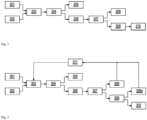
- Fig. 1 shows a schematic presentation of the process of the invention 200.
- an organic phase 202 and milled scrap plastic composition incl. additives 201 such as PVC waste from electrical wire insulation or construction materials like window frames, are provided in step i) and dissolved to give a base composition (no reference) in a step ii) 203.
- the base composition is divided in step iii) 204 to give a 1 st composition 205 including organic phase and additives and a 2 nd composition 206 comprising organic phase and purified vinyl halide polymer.
- 2 nd composition 206 is split in step iv) 207 into a raw product phase of vinyl halide polymer 209 and recovered organic phase 208 using a membrane. Further organic phase is removed from the raw product phase 209 using a stripper, wherein solid vinyl halide polymer 210 is obtained.
- Fig. 2 shows a schematic presentation of a variant of the process of the invention 300.
- an organic phase 302 and comminuted scrap plastic composition incl. additives 301 such as PVC waste from electrical wire insulation or construction materials like window frames, are provided in step i) and dissolved to give a base composition (no reference) in a step ii) 303.
- the base composition is divided in step iii) 304 to give a 1 st composition 305 including organic phase and additives and a 2 nd composition 306 comprising organic phase and purified vinyl halide polymer.
- 2 nd composition 306 is split in step iv) 307 into a raw product phase of vinyl halide polymer 309 and recovered organic phase 308 using a membrane.
- Further organic phase 308a is removed from the raw product phase 309 using a stripper, wherein solid vinyl halide polymer 310 is obtained.
- the recovered phases 308 and further organic phase 308a are fed via line 311 and optional solvent purification steps (not shown here) back into dissolution step ii) 303.
- the number averaged molecular weight of a sample of a vinyl halide polymer is determined using a calibrated GPC (gel permeation chromatography), running THF as mobile phase at a flux of 0.4 ml/min at 40 °C.
- the eluate signal was recorded using a refractive index analyzer.
- the technical equipment used was an EcoSEC Ambient Temperature System, equipped with one TSKgel SuperH4000 and a SUPERH3000 column with 6.0 mm ID ⁇ 15 cm L, 3 ⁇ m particle size. Detector, pump oven and column oven were maintained at 40 °C. Calibration was made against polystyrene of narrow polydispersity, using a GPC calibration kit available from PSS GmbH, Mainz (Germany).
- the solute retentate from this step which comprises the PVC and the PVC profile specific additives was precipitated by adding steam to the vessel, whereby solid r-PVC powder was obtained.
- MEK and (condensed steam) were recovered.
- Last traces of MEK in the solid r-PVC powder were removed in a fluid bed at 60°C during 20 minutes to reach residual MEK levels below 0.2 wt%.
Landscapes
- Chemical & Material Sciences (AREA)
- Health & Medical Sciences (AREA)
- Chemical Kinetics & Catalysis (AREA)
- Medicinal Chemistry (AREA)
- Polymers & Plastics (AREA)
- Organic Chemistry (AREA)
- Life Sciences & Earth Sciences (AREA)
- Sustainable Development (AREA)
- Separation, Recovery Or Treatment Of Waste Materials Containing Plastics (AREA)
Priority Applications (1)
| Application Number | Priority Date | Filing Date | Title |
|---|---|---|---|
| EP23218930.8A EP4574888A1 (de) | 2023-12-20 | 2023-12-20 | Verfahren zur wiederverwertung von vinylhalogenidpolymerzusammensetzungen und verwendung davon |
Applications Claiming Priority (1)
| Application Number | Priority Date | Filing Date | Title |
|---|---|---|---|
| EP23218930.8A EP4574888A1 (de) | 2023-12-20 | 2023-12-20 | Verfahren zur wiederverwertung von vinylhalogenidpolymerzusammensetzungen und verwendung davon |
Publications (1)
| Publication Number | Publication Date |
|---|---|
| EP4574888A1 true EP4574888A1 (de) | 2025-06-25 |
Family
ID=89224698
Family Applications (1)
| Application Number | Title | Priority Date | Filing Date |
|---|---|---|---|
| EP23218930.8A Pending EP4574888A1 (de) | 2023-12-20 | 2023-12-20 | Verfahren zur wiederverwertung von vinylhalogenidpolymerzusammensetzungen und verwendung davon |
Country Status (1)
| Country | Link |
|---|---|
| EP (1) | EP4574888A1 (de) |
Citations (10)
| Publication number | Priority date | Publication date | Assignee | Title |
|---|---|---|---|---|
| US3912664A (en) * | 1974-08-23 | 1975-10-14 | Horizons Inc | Recovery of flexible and rigid materials from scrap polyvinylchloride, its copolymers and cogeners |
| US4038219A (en) * | 1976-03-25 | 1977-07-26 | Western Electric Company, Inc. | Reclamation processing of polyvinyl chloride-scrap materials and products produced thereby |
| AU503398B2 (en) * | 1974-07-17 | 1979-09-06 | Hafner Industries, Inc | Recovery of vinyl chloride polymers |
| US6172125B1 (en) * | 1998-03-26 | 2001-01-09 | Solvay S.A. (Societe Anonyme) | Process for recycling articles based on vinyl chloride polymers |
| JP2005232314A (ja) * | 2004-02-19 | 2005-09-02 | Mitsubishi Chemicals Corp | 廃塩化ビニル樹脂組成物からのポリ塩化ビニルの回収方法 |
| JP2007070383A (ja) * | 2005-09-02 | 2007-03-22 | Kobelco Eco-Solutions Co Ltd | 塩化ビニル系樹脂製品の処理方法及び前記処理方法により得られる塩化ビニル系樹脂組成物 |
| JP2007284531A (ja) * | 2006-04-14 | 2007-11-01 | Mitsubishi Chemicals Corp | ポリ塩化ビニル樹脂溶解液からの不溶物の除去方法 |
| JP2018053176A (ja) * | 2016-09-30 | 2018-04-05 | 日立化成株式会社 | 樹脂の分離方法 |
| CN113861505A (zh) * | 2020-06-30 | 2021-12-31 | 中国石油化工股份有限公司 | 一种从混合废塑料中分离pvc、ps的方法 |
| KR20230049671A (ko) * | 2020-08-07 | 2023-04-13 | 아페카 아게 | 플라스틱 압출기에서 통합된 크기 분류 및 압출에 의해 중합체 용액으로부터 용매를 제거하기 위한 방법 |
-
2023
- 2023-12-20 EP EP23218930.8A patent/EP4574888A1/de active Pending
Patent Citations (10)
| Publication number | Priority date | Publication date | Assignee | Title |
|---|---|---|---|---|
| AU503398B2 (en) * | 1974-07-17 | 1979-09-06 | Hafner Industries, Inc | Recovery of vinyl chloride polymers |
| US3912664A (en) * | 1974-08-23 | 1975-10-14 | Horizons Inc | Recovery of flexible and rigid materials from scrap polyvinylchloride, its copolymers and cogeners |
| US4038219A (en) * | 1976-03-25 | 1977-07-26 | Western Electric Company, Inc. | Reclamation processing of polyvinyl chloride-scrap materials and products produced thereby |
| US6172125B1 (en) * | 1998-03-26 | 2001-01-09 | Solvay S.A. (Societe Anonyme) | Process for recycling articles based on vinyl chloride polymers |
| JP2005232314A (ja) * | 2004-02-19 | 2005-09-02 | Mitsubishi Chemicals Corp | 廃塩化ビニル樹脂組成物からのポリ塩化ビニルの回収方法 |
| JP2007070383A (ja) * | 2005-09-02 | 2007-03-22 | Kobelco Eco-Solutions Co Ltd | 塩化ビニル系樹脂製品の処理方法及び前記処理方法により得られる塩化ビニル系樹脂組成物 |
| JP2007284531A (ja) * | 2006-04-14 | 2007-11-01 | Mitsubishi Chemicals Corp | ポリ塩化ビニル樹脂溶解液からの不溶物の除去方法 |
| JP2018053176A (ja) * | 2016-09-30 | 2018-04-05 | 日立化成株式会社 | 樹脂の分離方法 |
| CN113861505A (zh) * | 2020-06-30 | 2021-12-31 | 中国石油化工股份有限公司 | 一种从混合废塑料中分离pvc、ps的方法 |
| KR20230049671A (ko) * | 2020-08-07 | 2023-04-13 | 아페카 아게 | 플라스틱 압출기에서 통합된 크기 분류 및 압출에 의해 중합체 용액으로부터 용매를 제거하기 위한 방법 |
Non-Patent Citations (4)
| Title |
|---|
| JAMES SHERWOOD: "Closed-Loop Recycling of Polymers Using Solvents : Remaking plastics for a circular economy", JOHNSON MATTHEY TECHNOLOGY REVIEW, vol. 64, no. 1, 1 January 2020 (2020-01-01), pages 4 - 15, XP055745186, ISSN: 2056-5135, DOI: 10.1595/205651319X15574756736831 * |
| JOURNAL OF MEMBRANE SCIENCE, vol. 602, pages 117972, Retrieved from the Internet <URL:https://doi.org/10.1016/j.memsci.2020.117972> |
| P. MARCHETTI ET AL.: "Molecular Separation with Organic solvent Nanofiltration: A critical review", CHEMICAL REVIEWS, vol. 114, 2014, pages 10735 - 10806, XP055618006, DOI: 10.1021/cr500006j |
| SUPER USER: "Vinyloop - The VinyLoop process", 6 October 2018 (2018-10-06), pages 1 - 4, XP093174151, Retrieved from the Internet <URL:https://web.archive.org/web/20181006111612/http://www.vinyloop.com/en/the-vinyloop-process-en.html> [retrieved on 20240613] * |
Similar Documents
| Publication | Publication Date | Title |
|---|---|---|
| EP3523366B1 (de) | Verfahren zur wiederverwertung von polyolefinhaltigem abfallmaterial | |
| US20220040886A1 (en) | Method for solvent removal from a polymer solution by integrated size classification and extrusion in a plastic extruder | |
| MX2010011776A (es) | Procedimiento para reciclar elementos fabricados a base de un polimero reforzado con fibras. | |
| CN116457109A (zh) | 用于塑料预处理和基于溶剂的塑料回收的方法 | |
| EP3950799A1 (de) | Lösungsmittelbasiertes recycling mit einem rolle-zu-rolle verarbeitungsschritt | |
| JP2008520791A (ja) | 塩化ビニルポリマー(pvc)の重金属からの精製方法 | |
| KR101409098B1 (ko) | 미립 중합체에 고체 입자를 분산시키는 방법 | |
| JP4716986B2 (ja) | 溶解しているポリマーの回収方法 | |
| Zhou et al. | Preparation of ECTFE membranes with bicontinuous structure via TIPS method by a binary diluent | |
| EP4574888A1 (de) | Verfahren zur wiederverwertung von vinylhalogenidpolymerzusammensetzungen und verwendung davon | |
| KR101791215B1 (ko) | 환경친화형 열수축 필름 | |
| EP4299270A1 (de) | Verfahren zum recycling von vinylhalogenid-polymer-zusammensetzungen und verwendungen davon | |
| US20060194913A1 (en) | Method for production of a blend made with pvc | |
| CN116249739A (zh) | 塑料回收或与其相关的改进 | |
| EP3523369B1 (de) | Recycelte polymerzusammensetzung | |
| EP4461497A1 (de) | Wiedergewinnung von pvc aus abfallstoffen durch trennung unter doppelter schwerkraft | |
| EP4450246A1 (de) | Abtrennung von pvc aus feststoffen bei der rückgewinnung von pvc aus abfällen | |
| KR20230040542A (ko) | 재생 폴리염화비닐의 제조방법, 재생 폴리염화비닐 및 재생 폴리염화비닐 제조장치 | |
| Mahdavi et al. | Towards cost-effective and sustainable PET recycling through glycolysis: Ethylene glycol recovery using solution-processable nanocomposite membranes | |
| CN121511269A (zh) | 用于纯化再生聚合物的方法 | |
| Hwang et al. | Biodegradable membranes using PBAT (polybutylene adipate-co-terephthalate) and PBS (polybutylene succinate) biopolymer blends | |
| HK1125393B (en) | Process for dispersing solid particles in particulate polymers | |
| CN118613536A (zh) | 用于纯化再生聚合物的方法 | |
| JP2026500135A (ja) | サイズ排除擬似移動床においてポリマークレインを抽出するためのデバイスを実装する、pvcプラスチックに基づいて廃棄物をリサイクルするための方法 | |
| KR20260040453A (ko) | 재생 중합체의 정제 방법 |
Legal Events
| Date | Code | Title | Description |
|---|---|---|---|
| PUAI | Public reference made under article 153(3) epc to a published international application that has entered the european phase |
Free format text: ORIGINAL CODE: 0009012 |
|
| STAA | Information on the status of an ep patent application or granted ep patent |
Free format text: STATUS: THE APPLICATION HAS BEEN PUBLISHED |
|
| AK | Designated contracting states |
Kind code of ref document: A1 Designated state(s): AL AT BE BG CH CY CZ DE DK EE ES FI FR GB GR HR HU IE IS IT LI LT LU LV MC ME MK MT NL NO PL PT RO RS SE SI SK SM TR |
|
| STAA | Information on the status of an ep patent application or granted ep patent |
Free format text: STATUS: REQUEST FOR EXAMINATION WAS MADE |
|
| 17P | Request for examination filed |
Effective date: 20251217 |