EP4574927A1 - Verfahren und vorrichtung zur herstellung von nadelkoks mit batch-zuführung - Google Patents
Verfahren und vorrichtung zur herstellung von nadelkoks mit batch-zuführung Download PDFInfo
- Publication number
- EP4574927A1 EP4574927A1 EP23866981.6A EP23866981A EP4574927A1 EP 4574927 A1 EP4574927 A1 EP 4574927A1 EP 23866981 A EP23866981 A EP 23866981A EP 4574927 A1 EP4574927 A1 EP 4574927A1
- Authority
- EP
- European Patent Office
- Prior art keywords
- oil
- reaction
- feedstock
- coking
- feedstock oil
- Prior art date
- Legal status (The legal status is an assumption and is not a legal conclusion. Google has not performed a legal analysis and makes no representation as to the accuracy of the status listed.)
- Pending
Links
Images
Classifications
-
- C—CHEMISTRY; METALLURGY
- C10—PETROLEUM, GAS OR COKE INDUSTRIES; TECHNICAL GASES CONTAINING CARBON MONOXIDE; FUELS; LUBRICANTS; PEAT
- C10G—CRACKING HYDROCARBON OILS; PRODUCTION OF LIQUID HYDROCARBON MIXTURES, e.g. BY DESTRUCTIVE HYDROGENATION, OLIGOMERISATION, POLYMERISATION; RECOVERY OF HYDROCARBON OILS FROM OIL-SHALE, OIL-SAND, OR GASES; REFINING MIXTURES MAINLY CONSISTING OF HYDROCARBONS; REFORMING OF NAPHTHA; MINERAL WAXES
- C10G9/00—Thermal non-catalytic cracking, in the absence of hydrogen, of hydrocarbon oils
- C10G9/005—Coking (in order to produce liquid products mainly)
-
- C—CHEMISTRY; METALLURGY
- C10—PETROLEUM, GAS OR COKE INDUSTRIES; TECHNICAL GASES CONTAINING CARBON MONOXIDE; FUELS; LUBRICANTS; PEAT
- C10B—DESTRUCTIVE DISTILLATION OF CARBONACEOUS MATERIALS FOR PRODUCTION OF GAS, COKE, TAR, OR SIMILAR MATERIALS
- C10B55/00—Coking mineral oils, bitumen, tar, and the like or mixtures thereof with solid carbonaceous material
-
- C—CHEMISTRY; METALLURGY
- C10—PETROLEUM, GAS OR COKE INDUSTRIES; TECHNICAL GASES CONTAINING CARBON MONOXIDE; FUELS; LUBRICANTS; PEAT
- C10B—DESTRUCTIVE DISTILLATION OF CARBONACEOUS MATERIALS FOR PRODUCTION OF GAS, COKE, TAR, OR SIMILAR MATERIALS
- C10B57/00—Other carbonising or coking processes; Features of destructive distillation processes in general
- C10B57/04—Other carbonising or coking processes; Features of destructive distillation processes in general using charges of special composition
- C10B57/045—Other carbonising or coking processes; Features of destructive distillation processes in general using charges of special composition containing mineral oils, bitumen, tar or the like or mixtures thereof
-
- C—CHEMISTRY; METALLURGY
- C10—PETROLEUM, GAS OR COKE INDUSTRIES; TECHNICAL GASES CONTAINING CARBON MONOXIDE; FUELS; LUBRICANTS; PEAT
- C10G—CRACKING HYDROCARBON OILS; PRODUCTION OF LIQUID HYDROCARBON MIXTURES, e.g. BY DESTRUCTIVE HYDROGENATION, OLIGOMERISATION, POLYMERISATION; RECOVERY OF HYDROCARBON OILS FROM OIL-SHALE, OIL-SAND, OR GASES; REFINING MIXTURES MAINLY CONSISTING OF HYDROCARBONS; REFORMING OF NAPHTHA; MINERAL WAXES
- C10G69/00—Treatment of hydrocarbon oils by at least one hydrotreatment process and at least one other conversion process
- C10G69/02—Treatment of hydrocarbon oils by at least one hydrotreatment process and at least one other conversion process plural serial stages only
- C10G69/06—Treatment of hydrocarbon oils by at least one hydrotreatment process and at least one other conversion process plural serial stages only including at least one step of thermal cracking in the absence of hydrogen
Definitions
- the invention belongs to the technical field of petrochemical industry, and particularly relates to a method and device for producing needle coke in batch feeding mode.
- needle coke production technology has developed rapidly.
- needle coke production are usually operated under pressure, at variable temperatures, and at large circulation ratio. That is to say, in one reaction period, feedstocks are continuously fed into the coking tower, and needle coke products are obtained by adjusting parameters such as pressure, temperature, and circulation ratio.
- CN113004924A discloses a needle coke production process, wherein a feedstockoil is mixed with vacuum residue oil and then sent to a coking tower for coking reaction, during which the circulation ratio is controlled to be 0.15-0.20, so that needle coke with a high particle strength coefficient can be obtained.
- CN103184057A discloses a method for producing needle coke, comprising three steps: (1) feeding fresh feedstocks into a coking tower at a relatively low temperature; ( 2) after the first step is completed, increasing the outlet temperature of the heating furnace, mixing the fresh feedstocks and coking heavy distillate oil and sending them to the coking tower; (3) when the solidification and coke-formation temperature is reached in the coking tower, sending the coking intermediate distillate oil generated in the first step to the coking tower at a higher temperature.
- This method can improve the uniformity of the properties of the needle coke in different parts of the coking tower.
- the inventors of the present invention have found that the time required for the coking reaction to complete is different for coking feedstocks with different aromatic carbon ratios or different polymerization abilities. Therefore, needle coke with uniform product quality can be produced by making the feedstocks with different aromatic carbon ratios or different polymerization abilities stay in the coking tower for different times. According to the present invention, the microstructure of the needle coke product can be improved, the generation of short fibers, small pieces and other structures can be reduced, and high-quality needle coke can be obtained. The present invention has been completed on the basis of these discoveries.
- the present invention relates to a method for producing a needle coke, comprising a step of sequentially adding n feedstock oils (n is an integer equal to or greater than 2, preferably 2-15 or 3-5) to a coking reaction at predetermined time intervals, assuming that an i-th (n-1 ⁇ i ⁇ 1) feedstock oil has an aromatic carbon ratio of A (in mol%), an i+1-th feedstock oil has an aromatic carbon ratio of B (in mol%), a first feedstock oil has an aromatic carbon ratio of A1 (in mol%), and a n-th feedstock oil has an aromatic carbon ratio of B1 (in mol%), then B ⁇ A (preferably B-A ⁇ 5mol% or B-A ⁇ 10mol%), and B1>A1 (preferably B1-A1 ⁇ 10mol% or B1-A1 ⁇ 20mol%).
- n feedstock oils n is an integer equal to or greater than 2, preferably 2-15 or 3-5
- the present invention relates to a device for producing a needle coke, comprising the following units:
- the present invention may have one or a combination of several or all of the following advantages:
- the objects introduced by the prefix include those conventionally used in the field when this application is filed, but also include those that are not commonly used at present but will become generally recognized in the field to be suitable for similar purposes.
- spatial relative terms such as “lower”, “bottom”, “below”, “under”, “upper”, “top”, “above”, “on”, etc. may be used to describe the relationship between one element or feature and another element or feature in the accompanying drawings. It should be understood that the spatial relative terms are intended to include different orientations of the object in use or operation in addition to the orientation depicted in figures. For example, if the object in the figure is turned over, the element described as being “below” or “under” another elements or features will be oriented “above” or “on” the other element or feature. Therefore, the exemplary term “below” can include two directions “below” and “above”. Objects may also have other orientations (e.g., rotated 90 degrees or other orientations) and the spatial relative terms used herein should be interpreted accordingly.
- first”, second, etc. are used to distinguish two different elements or parts, but are not used to limit specific positions or relative relationships. In other words, in some embodiments, the terms “first”, “second”, etc. can also be interchangeable.
- the catalytic slurry oil refers to a heavy distillate oil produced in the catalytic cracking reaction.
- the polarized light microstructure (coarse fiber, fine fiber, short fiber, large leaflet, small leaflet, mosaic) is determined by the YB/T 077 method.
- the ash content of the oil product is determined by the GB/T 508 method; the sulfur content of the oil product is determined by the SH/T 0689 method; the aromatic carbon ratio of the oil product is determined by the SH/T 0793 method; and the aromatic hydrocarbon content of the oil product is determined by the SH/T 0659 method.
- the ash content of the coke is determined by the GB/T 1429 method, and the sulfur content of the coke is determined by the GB/T 24526 method.
- a method for producing a needle coke is provided.
- the method for producing a needle coke is carried out in the device for producing a needle coke described below.
- the contents not described in detail in the preparation method section can be directly referred to the relevant contents described below for the device for producing a needle coke.
- the method for producing needle coke includes a step of sequentially adding (feeding) n feedstock oils to a coking reaction at a predetermined time interval.
- the order of feeding these feedstock oils is very critical for achieving the expected technical effect of the present invention and cannot be adjusted at will.
- the feeding can be carried out in an intermittent or continuous manner, preferably in a continuous manner.
- the so-called predetermined time interval refers to feeding feedstock oil a period time after feeding the other feedstock oil, and the difference in the feeding timing of the two is the time interval.
- the moment when one feedstock oil starts to be fed is the moment when the feeding of other feedstock oils (if any) is stopped.
- said n feedstock oils are preferably added to the coking reaction separately at different times, and the feedings are basically not overlapped.
- the present invention does not particularly limit the specific value of the predetermined time interval, as long as the time interval can effectively separate the feeding timings of said n feedstock oils, but its preferred situation is described in detail below.
- n is an integer equal to or greater than 2, preferably 2-15 or 3-5.
- an i-th (n-1 ⁇ i ⁇ 1) feedstock oil has an aromatic carbon ratio of A(in mol%)
- an i+1-th feedstock oil has an aromatic carbon ratio of B (in mol%)
- B ⁇ A Preferably, B-A ⁇ 5mol% or B-A ⁇ 10mol%. If B ⁇ A, particularly if B-A ⁇ 5 mol%, then the aromatic carbon contents of the two are similar, and the cracking/polymerization abilities are likely to be similar.
- a first feedstock oil has an aromatic carbon ratio of A1 (in mol%)
- a n-th feedstock oil has an aromatic carbon ratio of B1 (in mol%)
- B1>A1 Preferably, B1-A1 ⁇ 10mol% or B1-A1 ⁇ 20mol%.
- said first feedstock oil has an aromatic carbon ratio of 40mol%-80mol% (preferably 55mol%-75mol%).
- the m-th feedstock oil has an aromatic carbon ratio of 60mol%-90mol% (preferably 70mol%-85mol%).
- m is any integer greater than 1 and less than n.
- said n-th feedstock oil has an aromatic carbon ratio of greater than 75mol% (preferably 80mol%-95mol%).
- said i-th (n-1 ⁇ i ⁇ 1) feedstock oil has a sulfur content of not greater than 0.45wt% (preferably not greater than 0.37wt%), an ash content of not greater than 0.05wt% (preferably not greater than 0.01wt%), a 5% distillation temperature of 330°C-430°C (preferably 360°C-400°C), and a 95% distillation temperature of 470°C-530°C (preferably 485°C-510°C).
- said n-th feedstock oil has a sulfur content of not greater than 0.55wt% (preferably not greater than 0.5wt%), an ash content of not greater than 0.05wt% (preferably not greater than 0.01wt%), a 5% distillation temperature of 280°C-380°C (preferably 310°C-360°C), and a 95% distillation temperature of not greater than 480°C.
- said coking reaction has a reaction period of T (in hours), the predetermined time interval divides the coking reaction into n reaction sections.
- T in hours
- the feedstock oil corresponding to the reaction section is continuously or intermittently added.
- no feedstock oil other than that corresponding to the reaction section is added.
- said coking reaction has a reaction period of T (in hours), the predetermined time interval divides the coking reaction into n reaction sections.
- the first reaction section has a reaction time of T1 (in hours)
- the m-th reaction section (m is any integer greater than 1 and less than n) has a reaction time of Tm (in hours)
- the n-th reaction section has a reaction time of Tn (in hours)
- T1/T 5%-40% (preferably 10%-25%)
- Tm/T 15%-85% (preferably 25%-70%)
- Tn/T 15%-80% (preferably 25%-55%).
- said first feedstock oil is a hydrogenated product of the catalytic slurry oil
- said n-th feedstock oil is a heavier fraction of the coker oil gas
- any one of the other feedstock oils is a cracked product of the hydrogenation product of the catalytic slurry oil.
- n 3.
- the number of the feedstock oils is 3, namely the first feedstock oil, the second feedstock oil and the third feedstock oil.
- the reaction period T of said coking reaction is divided into three reaction sections, namely the first reaction section, the second reaction section and the third reaction section, wherein in the first reaction section, the first feedstock oil is added to the coking reaction, in the second reaction section, the second feedstock oil is added to the coking reaction, and in the third reaction section, the third feedstock oil is added to the coking reaction.
- the method for producing the first feedstock oil comprises: the catalytic slurry oil is purified to obtain a purified slurry oil, which is sent to a hydrotreating system, a hydrogenation reaction is carried out in the presence of hydrogen and a hydrogenation catalyst, a gas phase stream and a liquid phase stream are obtained after separation of the hydrogenation product, the liquid phase stream is sent to a first separation system to obtain a first lighter oil and a first heavier oil, wherein the first heavier oil is used as the first feedstock oil.
- the catalytic slurry oil has an ash content of generally higher than 0.01wt%, a sulfur content of generally higher than 0.5wt%, sometimes higher than 0.8wt%. To this end, if the ash and sulfur content in the catalytic slurry oil cannot meet the requirements for the needle coke feedstock, it needs to be processed.
- said purified slurry oil has an ash content of ⁇ 0.008wt%, preferably ⁇ 0.005wt%.
- said purification treatment is generally solid removing treatment.
- the solid removing treatment can be carried out by any one or more of the treament manners such as filtration, centrifugal sedimentation, and flocculation sedimentation, preferably by filtration.
- the core equipment of the filtration treatment is a filter
- the filter element can be one of or a combination of some of sintered metal powder filter element, metal mesh filter element, ceramic membrane filter element, etc., preferably ceramic membrane filter element.
- the hydrogenation reaction is carried out in a hydrotreating system.
- said hydrotreating system includes a reaction unit and a separation unit.
- the reaction unit is provided with at least one hydrogenation reactor.
- the hydrogenation reactor can be selected from one of or a combination of some of ebullated bed reactor, suspended bed reactor, slurry bed reactor, fixed bed reactor, preferably fixed bed reactor;
- the separation unit includes a high-temperature & high-pressure separator, a low-temperature & high-pressure separator, a high-temperature & low-pressure separator, a low-temperature & low-pressure separator, and can also comprise a stripping column, a fractionation column and the like.
- the hydrogenation catalyst can be prepared by existing methods in the art, or by using existing commercial catalysts, such as the FZC series hydrogenation catalysts developed by Dalian Petroleum&Chemical Research Institute of SINOPEC.
- alumina is generally used as support
- the active component is an oxide of a metal of Group VIB and/or Group VIII, such as one of or a combination of some of oxides of metals such as Mo, W, Co and Ni.
- the operation conditions of said hydrogenation reaction are as follows: the reaction temperature is 310°C-450°C, preferably 340°C-390°C, the reaction pressure is 2MPa-20MPa, preferably 4MPa-8MPa, the hydrogen/oil volume ratio is 100-2500, preferably 800-1800, the LHSV by volume is 0.1h -1 -2.0h -1 , preferably 0.6h -1 -1.2h -1 .
- the liquid phase stream is a liquid phase stream from which non-condensable gas is separated, preferably a liquid phase stream from which non-condensable gas and a naphtha fraction are separated.
- said liquid phase stream has a sulfur content of ⁇ 0.4wt%, preferably ⁇ 0.35wt%.
- said first heavier oil has a 5% distillation temperature of 330°C-420°C, preferably 360°C-400°C.
- said first lighter oil has a 95% distillation temperature of 310°C-420°C, preferably 340°C-400°C.
- said first lighter oil is discharged from the device, or sent to a condensation reaction system for treatment, or a part thereof is discharged from the device, and a part thereof is sent to the condensation reaction system for treatment.
- the operation conditions of said condensation reaction system are: the reaction temperature is 350°C-530°C, preferably 380°C-450°C, the reaction pressure is 0.01MPa-5MPa, preferably 1MPa-3MPa, the residence time is 0.1h-15h, preferably 0.5h-6h.
- said condensation reaction system is provided with at least one fixed bed reactor, the reactor includes at least one feeding inlet and one discharging outlet.
- the reaction time of said first reaction section comprises 5%-40%, preferably 10%-25% of said reaction period T. That is, in the first stage, the coking system feed is said first feedstock oil, and its feeding time comprises 5%-40%, preferably 10%-25% of said reaction period.
- the reaction time of said second reaction section comprises 15%-85%, preferably 25%-70% of said reaction period T. That is, in the second stage, the coking system feed is said second feedstock oil, and its feeding time comprises 15%-85%, preferably 25%-70% of said reaction period.
- the coking system feed is said third feedstock oil, and its feeding time comprises the balance of said reaction period.
- the reaction period of said coking reaction is 24-92 hrs (preferably 36-60 hrs).
- the method for producing the second feedstock oil comprises: the first feedstock oil (e.g., the first heavier oil) is sent to a cracking reaction system, a cracking reaction is carried out in the presence of a carrier gas, and the obtained cracked product is sent to a second separation system, and after separation, a second lighter oil, an intermediate distillate oil and a second heavier oil are obtained, wherein the intermediate distillate oil is used as the second feedstock oil.
- the first feedstock oil e.g., the first heavier oil
- a cracking reaction is carried out in the presence of a carrier gas
- the obtained cracked product is sent to a second separation system
- a second lighter oil, an intermediate distillate oil and a second heavier oil are obtained, wherein the intermediate distillate oil is used as the second feedstock oil.
- the cracking reaction is carried out in a cracking reaction system.
- the cracking reaction system is provided with at least one reactor, and the reactor type can be one of or a combination of some of tubular reactor, column reactor, tank reactor, preferably column reactor.
- the reactor comprises at least two feeding inlets and one discharging outlet, wherein one feeding inlet is used to feed the first heavier oil, and the other feeding inlet is used to feed the carrier gas.
- said carrier gas can be one or more of water vapor, nitrogen gas, inert gas (e.g., helium gas, neon gas, argon gas and the like), preferably water vapor.
- inert gas e.g., helium gas, neon gas, argon gas and the like
- the operation conditions of the cracking reaction are as follows: the reaction temperature is 380°C-520°C, preferably 420°C-490°C, the reaction pressure is 0.1MPa-5MPa, preferably 0.2MPa-1.0MPa, the residence time 0.01h-30h, preferably 0.1h-3h, the oil-to-steam mass ratio is 100:0.1-100:20, preferably 100:1-100:8.
- said intermediate distillate oil has a 5% distillation temperature of 340°C-430°C, preferably 360°C-400°C, a 95% distillation temperature of 470°C-530°C, preferably 485°C-510°C, a sulfur content of ⁇ 0.43wt%, preferably ⁇ 0.37wt%, an ash content of ⁇ 0.006wt%, preferably ⁇ 0.004wt%.
- said second lighter oil has a 95% distillation temperature of 330°C-430°C, preferably 350°C-400°C, or said second heavier oil has a 5% distillation temperature of 470°C-540°C, preferably 485°C-520°C.
- said first feedstock oil is sent together with the first auxiliary feedstock oil to said cracking reaction system.
- said first auxiliary feedstock oil has an ash content of not greater than 0.02wt%, preferably not greater than 0.01wt%, a sulfur content of not greater than 0.4wt%, preferably not greater than 0.35wt%, a three-ring and higher aromatic hydrocarbon content of not less than 40wt%, an aromatic carbon ratio of not less than 40mol%, preferably 55mol%-80 mol%, and a distillation range of 300°C-550°C, preferably 330°C-510°C.
- said first auxiliary feedstock oil is one or more of catalytic slurry oil, ethylene tar, vacuum gas oil, coker gas oil, deasphalted oil, and hydrogenated oil.
- the mass ratio of said first auxiliary feedstock oil to said first feedstock oil is 0:100-50:100, preferably 5:100-20:100.
- said cracked product is sent together with the second auxiliary feedstock oil to said second separation system.
- said second auxiliary feedstock oil has an ash content of not greater than 0.02wt%, preferably not greater than 0.01wt%, a sulfur content of not greater than 0.4wt%, preferably not greater than 0.35wt%, an aromatic hydrocarbon content of 50wt%-95wt%, preferably 65wt%-90wt%, a three-ring and higher aromatic hydrocarbon content of not less than 40wt%, an aromatic carbon ratio of not less than 50mol%, preferably not less than 75 mol%.
- said second auxiliary feedstock oil is one or more of catalytic slurry oil, ethylene tar, vacuum gas oil, coker gas oil, and deasphalted oil.
- the mass ratio of said second auxiliary feedstock oil to said cracked product is 0:100-100:10, preferably 5:100-20:100.
- said cracked product is sent together with a condensation reaction product of said first lighter oil to said second separation system for separation.
- the mass ratio of said cracked product to a condensation reaction product of said first lighter oil is 100:0-100:20, preferably 100:0-100:5.
- the method for producing the third feedstock oil comprises: the coker oil gas generated by the coking reaction is sent to a third separation system, and after separation, a coker gas, a third lighter oil and a third heavier oil are obtained, wherein said third heavier oil is used as said third feedstock oil.
- said third heavier oil has a 5% distillation temperature of 280°C-380°C, preferably 310°C-360°C.
- said third lighter oil has a 95% distillation temperature of 270°C-380°C, preferably 300°C-360°C.
- the operation conditions of said coking reaction include: the outlet temperature of the heating furnace is 420°C-560°C, preferably 440°C-530°C, the heating rate is 0.5°C/h-30°C/h, preferably 3°C/h-7°C/h; the coking tower top pressure is 0.01MPa-2.5MPa, preferably 0.2MPa-1.3MPa.
- the coking reaction can be carried out under a constant pressure or a changing pressure. If the changing pressure operation is adopted, the changing pressure rate is 0.1MPa/h-5MPa/h.
- the reaction period of the coking reaction is generally 24h-92h, preferably 36h-60h.
- said coking reaction is carried out in a coking system.
- the coking system generally includes at least one heating furnace and two coking towers. At least one of the coking towers is always in a reaction stage and at least one is in a purge and decoking stage.
- the reaction conditions of the coking system are: the outlet temperature of the heating furnace is 420°C-560°C, preferably 440°C-530°C, the heating rate is 0.5°C/h-30°C/h, preferably 3°C/h-7°C/h; the coking tower top pressure is 0.01MPa-2.5MPa, preferably 0.2MPa-1.3MPa, and it can be carried out under a constant pressure or a changing pressure, if the changing pressure operation is adopted, the changing pressure rate is 0.1MPa/h-5MPa/h; the reaction period is 10h-72h, preferably 32h-54h; the needle coke generated by the reaction is deposited at the bottom of the coking tower, and the generated coker oil gas is discharged from the top of the coking tower.
- the aforementioned condensation reaction is carried out in a condensation reaction system.
- the reaction conditions of said condensation reaction system include: the reaction temperature is 350°C-530°C, preferably 380°C-450°C, the reaction pressure is 0.01MPa-5MPa, preferably 1MPa-3MPa, the residence time is 0.1h-15h, preferably 0.5h-6h.
- said condensation reaction system is provided with at least one fixed bed reactor, the reactor includes at least one feeding inlet and one discharging outlet.
- the condensation reaction can be carried out in the presence of a condensation catalyst.
- the condensation catalyst comprises a support and an active component, wherein the support is one of or a combination of two or more of kaolin, montmorillonite, alumina, silicon-containing alumina, preferably alumina, and the active component is at least one of the oxides of Group IVB and/or Group VIB metals, e.g. the oxide of metal such as zirconium, tungsten, and molybdenum.
- the content of the active component is 0.1wt%-50wt%, preferably 5wt%-25wt%.
- the shape of the condensation catalyst can be one of or a combination of some of spheres, cylinders, three-leaf clover, four-leaf clover, Raschig rings, etc.
- a device for producing a needle coke is also provided.
- the device for producing a needle coke is specifically used to implement the needle coke preparation method described above. For this reason, the contents not described in detail in the section of the device for producing a needle coke can be directly referred to the relevant contents described in the full text for the preparation method.
- said device for producing a needle coke comprises the following units:
- the device for producing a needle coke also includes a condensation reaction system, which is used to receive the first lighter oil from the first separation system.
- the first lighter oil is sent to the condensation reaction system and undergoes a condensation reaction in the presence of a condensation catalyst.
- the reaction effluent obtained from the condensation reaction is sent to the second fractionation unit and is separated together with the cracking reaction effluent.
- said first separation system can be one of or a combination of some of stripping column, flash column, fractionation column and the like, preferably fractionation column.
- said condensation reaction system is provided with at least one fixed bed reactor, and the reactor includes at least one feeding inlet and one discharging outlet.
- the purification system uses any one or more of filtration device, centrigual sedimentation device, flocculation sedimentation device, and the like, preferably filtration device;
- the core equipment of filtration device is a filter, and the filter element can be one of or a combination of some of sintered metal powder filter element, metal mesh filter element, ceramic membrane filter element, etc., preferably ceramic membrane filter element.
- the hydrotreating system in the device for producing a needle coke, includes a reaction unit and a separation unit, and the reaction unit is provided with at least one hydrogenation reactor.
- the hydrogenation reactor can be selected from one of or a combination of some of ebullated bed reactor, suspended bed reactor, slurry bed reactor, fixed bed reactor, and the like, preferably fixed bed reactor.
- the separation unit includes a high-temperature & high-pressure separator, a low-temperature & high-pressure separator, a high-temperature & low-pressure separator, a low-temperature & low-pressure separator, and can also comprise a stripping column, a fractionation column and the like.
- the first separation system in the device for producing a needle coke, can be one of or a combination of some of stripping column, flash column, fractionation column and the like, preferably fractionation column.
- the cracking reaction system in the device for producing a needle coke, is provided with at least one reactor.
- the reactor can be at least one of tubular reactor, column reactor, and tank reactor, preferably column reactor.
- the reactor includes at least two feeding inlets and one discharging outlet, wherein one feeding inlet is used for feeding the first heavier oil, and the other feeding inlet is used for feeding the carrier gas.
- said second separation system in the device for producing a needle coke, can be one of or a combination of some of stripping column, flash column, fractionation column and the like, preferably fractionation column.
- the coking system in the device for producing a needle coke, includes at least one heating furnace, two coking towers, and one fractionation column.
- At least one of the coking towers is always in a reaction stage and at least one is in a purge and decoking stage.
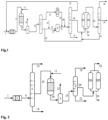
- a catalytic slurry oil 1 is firstly sent to a purification system 2 for purification treatment for removing solids.
- the resulting purified slurry oil 9 is mixed with a hydrogen gas 11 and the mixture is sent to a hydrotreating system 3 to react in the presence of the hydrogenation catalyst;
- the resulting hydrogenation product 10 is sent to a hydrogenation separation unit 4 for separation, and after separation, a gas phase stream 12 and a liquid phase stream 13 are obtained.
- the liquid phase stream 13 is sent to a first separation system 5, and after separation, a first lighter oil 14 and a first heavier oil 15 are obtained; wherein the first lighter oil 14 can be directly discharged from the device, or sent to a condensation reaction system 7 for condensation reaction, and the resulting condensation reaction product 16 is sent to a second separation system 6; in the first stage of the coking reaction, the first heavier oil 15 is sent to the coking system 22A/22B as the first feedstock 25, and in the remaining stages of the coking reaction, the first heavier oil 15 and optionally a first auxiliary feedstock oil 27 are sent to a cracking reaction system 8, and a cracking reaction is carried out in the presence of a carrier gas 17, and the resulting reaction effluent 18 from the cracking reaction and optionally a second auxiliary feedstock oil 26 are sent to a second separation system 6, and after separation, a second lighter oil 19, an intermediate distillate oil 20 and a second heavier oil 21 are obtained, wherein the second lighter oil 19 is discharged from the device, or is sent to the purification system
- the intermediate distillate oil 20 is sent to the coking system 22A/22B as the second feedstock for producing a needle coke, and after the reaction, a coker oil gas 23 and a needle coke product 24 are obtained, wherein the coker oil gas 23 is sent to the third separation system 30, and after separation, coker gas 28, third lighter oil 29 and third heavier oil 30 are obtained.
- the third heavier oil 30 is sent to the coking system 22A/22B as the third feedstock for producing a needle coke.
- the feedstock properties of the catalytic slurry oil, the first auxiliary feedstock oil, and the second auxiliary feedstock oil used in the examples of the present invention and the comparative examples are shown in Table 1.
- the hydrogenation catalyst used is the FZC-34BT hydrogenation catalyst developed by Dalian Petroleum&Chemical Research Institute of SINOPEC.
- the purification system uses a filter, and water vapor is used as carrier gas.
- the catalytic slurry oil was sent to the hydrotreating system.
- a liquid phase stream obtained by separating the hydrogenation product was sent to the first separation system, and a first lighter oil and a first heavier oil were obtained by separation.
- a part of the first heavier oil was used as the first feedstock oil and sent to the coking tower in the first stage of the coking reaction; a part of the first heavier oil was sent to the cracking reaction system, and the resulting cracking reaction effluent was sent to the second separation system, and a second lighter oil, an intermediate distillate oil and a second heavier oil were obtained by separation.
- the intermediate distillate oil was used as the second feedstock oil and sent to the coking tower in the second stage of the coking reaction; the needle coke generated in the coking reaction deposited at the bottom of the drum; and the coker oil gas was sent to the third separation system, and a coker gas, a third lighter oil and a third heavier oil were obtained by separation.
- the third heavier oil was used as the third feedstock oil and sent to the coking tower in the third stage of the coking reaction.
- the conditions of the hydrogenation reaction, cracking reaction and coking reaction were listed in Table 2, and the feed properties of the three-stage coking system were listed in Table 3.
- the needle coke yields based on the catalytic slurry oil were listed in Table 4.
- Example 2 was carried out in the same manner as in Example 1 except that the first feedstock oil was sent to the coking tower throughout the entire coking reaction period, the second feedstock oil was sent to the coking tower in the second stage of the coking reaction, and the third feedstock oil was sent to the coking tower in the third stage of the coking reaction.
- the conditions of the hydrogenation reaction, cracking reaction and coking reaction were listed in Table 2, and the feed properties of the three-stage coking system were listed in Table 6.
- the needle coke yields based on the catalytic slurry oil were listed in Table 4.
- Example 3 was carried out in the same manner as in Example 1 except for some operation parameters.
- the conditions of the hydrogenation reaction, cracking reaction and coking reaction were listed in Table 2, and the feed properties of the three-stage coking system were listed in Table 7.
- the needle coke yields based on the catalytic slurry oil were listed in Table 4.
- Example 4 was carried out in the same manner as in Example 1 except for some operation parameters.
- the conditions of the hydrogenation reaction, cracking reaction and coking reaction were listed in Table 2, and the feed properties of the three-stage coking system were listed in Table 8.
- the needle coke yields based on the catalytic slurry oil were listed in Table 4.
- Example 5 was carried out in the same manner as in Example 4 except that the first lighter oil was sent to the condensation reaction system, the condensation reaction conditions included: the reaction temperature was 405°C, the reaction pressure was 1.2MPa, the residence time 2.5h; the condensation catalyst: alumina as support, 8wt%ZrO2-3.5wt%MoO2 as active component, three-leaf clover structure.
- the condensation reaction product was sent to the second separation system, the mass ratio of the cracked product to the condensation reaction product was 100:9.
- the conditions of the hydrogenation reaction, cracking reaction and coking reaction were listed in Table 2, and the feed properties of the three-stage coking system were listed in Table 9.
- the needle coke yields based on the catalytic slurry oil were listed in Table 4.
- Example 6 was carried out in the same manner as in Example 1 except that the first auxiliary feedstock and the first heavier oil at a mass ratio of 7:100 were sent to the cracking reaction system.
- the conditions of the hydrogenation reaction, cracking reaction and coking reaction were listed in Table 2, and the feed properties of the three-stage coking system were listed in Table 10.
- the needle coke yields based on the catalytic slurry oil and the first auxiliary feedstock were listed in Table 4.
- Example 7 was carried out in the same manner as in Example 1 except that the second auxiliary feedstock and the cracked product at a mass ratio of 9:100 were sent to the cracking reaction system.
- the conditions of the hydrogenation reaction, cracking reaction and coking reaction were listed in Table 2, and the feed properties of the three-stage coking system were listed in Table 11.
- the needle coke yields based on the catalytic slurry oil and the second auxiliary feedstock were listed in Table 4.
- the catalytic slurry oil was sent to the vacuum distillation device, and a first intermediate distillate oil was obtained by separation.
- the first intermediate distillate oil was sent to the hydrotreating system, and the resulting hydrogenation product was separated to obtain a liquid phase stream, which was sent to the hydrogenation separation system to obtain a second intermediate distillate oil by separation.
- the second intermediate distillate oil was sent to the coking tower as the first feedstock oil, and the needle coke generated by the reaction deposited at the bottom of the drum.
- the resulting coker oil gas was sent to the coking separation system, and the separated coking heavier oil was used as the second feedstock oil.
- the second feedstock oil and the first feedstock oil at a mass ratio of 1:1 returned to the coking tower.
- the conditions of the hydrogenation reaction and the coking reaction were listed in Table 12, and the feed properties of the coking system were listed in Table 13.
- the needle coke yields based on the catalytic slurry oil were listed in Table 14.
- the catalytic slurry oil was sent to the hydrotreating system.
- the hydrogenation product was separated to obtain a liquid phase stream, which was sent to the first separation system, in which a first lighter oil and a first heavier oil were obtained by separation.
- a part of the first heavier oil was used as the first feedstock oil; and a part of the first heavier oil was sent to the cracking reaction system.
- the resulting cracking reaction effluent was sent to the second separation system, in which a second lighter oil, an intermediate distillate oil and a second heavier oil were obtained by separation.
- the intermediate distillate oil was used as the second feedstock oil.
- the coker oil gas generated by the coking reaction was sent to the third separation system, in which a coker gas, a third lighter oil and a third heavier oil were obtained by separation.
- the third heavier oil was used as the third feedstock oil.
- the first feedstock oil, the second feedstock oil and the third feedstock oil were sent to the coking tower at a mass ratio of 2:4:4, and the needle coke generated by the coking reaction deposited at the bottom of the drum.
- the conditions of the hydrogenation reaction, the cracking reaction and the coking reaction were listed in Table 12, and the feed properties of the coking system were listed in Table 16.
- the needle coke yields based on the catalytic slurry oil were listed in Table 14.
- Three feedstock oils were obtained in the same way as those in Comparative Example 2 except for the stages of feeding to the coking tower, wherein the third feedstock oil was sent to the coking tower in the first stage of the coking reaction, the second feedstock oil was sent to the coking tower in the second stage of the coking reaction, and the first feedstock oil was sent to the coking tower in the third stage of the coking reaction.
- the needle coke yields based on the catalytic slurry oil were listed in Table 14.
Landscapes
- Chemical & Material Sciences (AREA)
- Oil, Petroleum & Natural Gas (AREA)
- Engineering & Computer Science (AREA)
- Organic Chemistry (AREA)
- Physics & Mathematics (AREA)
- Thermal Sciences (AREA)
- Chemical Kinetics & Catalysis (AREA)
- General Chemical & Material Sciences (AREA)
- Materials Engineering (AREA)
- Production Of Liquid Hydrocarbon Mixture For Refining Petroleum (AREA)
- Working-Up Tar And Pitch (AREA)
- Coke Industry (AREA)
Applications Claiming Priority (2)
| Application Number | Priority Date | Filing Date | Title |
|---|---|---|---|
| CN202211146194.7A CN117778039A (zh) | 2022-09-20 | 2022-09-20 | 一种批次进料方式制造针状焦的方法和装置 |
| PCT/CN2023/098774 WO2024060685A1 (zh) | 2022-09-20 | 2023-06-07 | 一种批次进料方式制造针状焦的方法和装置 |
Publications (2)
| Publication Number | Publication Date |
|---|---|
| EP4574927A1 true EP4574927A1 (de) | 2025-06-25 |
| EP4574927A4 EP4574927A4 (de) | 2025-12-17 |
Family
ID=90387614
Family Applications (1)
| Application Number | Title | Priority Date | Filing Date |
|---|---|---|---|
| EP23866981.6A Pending EP4574927A4 (de) | 2022-09-20 | 2023-06-07 | Verfahren und vorrichtung zur herstellung von nadelkoks mit batch-zuführung |
Country Status (6)
| Country | Link |
|---|---|
| EP (1) | EP4574927A4 (de) |
| JP (1) | JP2025529532A (de) |
| KR (1) | KR20250073281A (de) |
| CN (1) | CN117778039A (de) |
| TW (1) | TW202419613A (de) |
| WO (1) | WO2024060685A1 (de) |
Family Cites Families (8)
| Publication number | Priority date | Publication date | Assignee | Title |
|---|---|---|---|---|
| CN103184057B (zh) | 2011-12-29 | 2014-12-31 | 中国石油化工股份有限公司 | 一种生产均质石油针状焦的方法 |
| KR101559027B1 (ko) * | 2012-11-30 | 2015-10-13 | 세메스 주식회사 | 기판 처리 설비 및 방법 |
| CN107987880B (zh) * | 2016-10-26 | 2020-09-22 | 中国石油化工股份有限公司 | 一种制备针状焦原料的方法和设备 |
| CN111320167B (zh) * | 2018-12-13 | 2023-09-01 | 中国石油化工股份有限公司 | 一种生产高端石墨炭材料的组合工艺方法 |
| CN111892952B (zh) * | 2019-05-05 | 2021-10-08 | 中国石油化工股份有限公司 | 一种生产炭材料的方法 |
| CN112745916B (zh) * | 2019-10-31 | 2023-04-11 | 中国石油化工股份有限公司 | 一种制备针状焦原料的方法和设备 |
| CN114479906B (zh) * | 2020-10-27 | 2023-08-08 | 中国石油化工股份有限公司 | 一种制备优质石油焦的方法 |
| CN113004924B (zh) | 2021-04-15 | 2023-05-12 | 山东京阳科技股份有限公司 | 超高功率石墨电极接头用针状焦生产工艺 |
-
2022
- 2022-09-20 CN CN202211146194.7A patent/CN117778039A/zh active Pending
-
2023
- 2023-06-07 JP JP2025516110A patent/JP2025529532A/ja active Pending
- 2023-06-07 WO PCT/CN2023/098774 patent/WO2024060685A1/zh not_active Ceased
- 2023-06-07 EP EP23866981.6A patent/EP4574927A4/de active Pending
- 2023-06-07 KR KR1020257012957A patent/KR20250073281A/ko active Pending
- 2023-07-03 TW TW112124684A patent/TW202419613A/zh unknown
Also Published As
| Publication number | Publication date |
|---|---|
| TW202419613A (zh) | 2024-05-16 |
| JP2025529532A (ja) | 2025-09-04 |
| CN117778039A (zh) | 2024-03-29 |
| EP4574927A4 (de) | 2025-12-17 |
| KR20250073281A (ko) | 2025-05-27 |
| WO2024060685A1 (zh) | 2024-03-28 |
Similar Documents
| Publication | Publication Date | Title |
|---|---|---|
| EP2828356B1 (de) | Integriertes hydroprocessing und dampfpyrolyse von rohöl zur erzeugung von leichten olefinen und koks | |
| CN113122330B (zh) | 催化油浆和乙烯焦油制备石油焦的方法和系统 | |
| EP3950887A1 (de) | Verfahren zur herstellung von graphitkoks aus einem gemisch aus kohle und kohlenwasserstoffen auf erdölbasis | |
| US20230272284A1 (en) | Coking system and coking process | |
| CN109072098A (zh) | 利用混合溶剂脱沥青在延迟焦化器中生产高质量焦炭的方法 | |
| CN113122303A (zh) | 一种提高针状焦生产过程稳定性的方法和系统 | |
| EP4574927A1 (de) | Verfahren und vorrichtung zur herstellung von nadelkoks mit batch-zuführung | |
| CN111320167B (zh) | 一种生产高端石墨炭材料的组合工艺方法 | |
| CN112725031B (zh) | 适用于生产针状焦的油质物料及其制备方法和系统 | |
| CN113755211A (zh) | 一种利用优化含乙烯焦油的原料生产针状焦的方法 | |
| CN117778040B (en) | Method and system for producing needle coke raw material by catalytic slurry oil and method and system for producing needle coke | |
| CN116064138B (zh) | 最大量生产重整原料的组合加氢工艺及系统 | |
| CN111320169B (zh) | 一种生产高端石墨炭材料的工艺方法 | |
| EP4570881A1 (de) | Verfahren und vorrichtung zur herstellung von nadelkoks unter verwendung von gemischtem einsatzöl | |
| CN110697676A (zh) | 一种中空碳微球及其制备方法 | |
| CN117778040A (zh) | 一种催化油浆生产针状焦原料的方法和系统及生产针状焦的方法和系统 | |
| CN117778042B (en) | Combined production process and production system for co-producing needle coke and low-sulfur petroleum coke | |
| CN116064084B (zh) | 一种多产化工原料的两段加氢裂化方法 | |
| CN116064136B (zh) | 蜡油加氢裂化与柴油加氢精制组合工艺及系统 | |
| CN118440739B (zh) | 一种焦化和加氢裂化联合生产化工原料的方法 | |
| CN118620645B (en) | Production method of needle coke as negative electrode material | |
| CN109181762A (zh) | 一种劣质油的多级悬浮床加氢装置及方法 | |
| CN117778042A (zh) | 一种联产针状焦和低硫石油焦的组合生产工艺和生产系统 | |
| WO2026091280A1 (zh) | 一种重油分段加氢制备碳材料原料的方法和系统 | |
| CN117778043A (zh) | 一种催化油浆综合利用方法和利用系统 |
Legal Events
| Date | Code | Title | Description |
|---|---|---|---|
| STAA | Information on the status of an ep patent application or granted ep patent |
Free format text: STATUS: THE INTERNATIONAL PUBLICATION HAS BEEN MADE |
|
| PUAI | Public reference made under article 153(3) epc to a published international application that has entered the european phase |
Free format text: ORIGINAL CODE: 0009012 |
|
| STAA | Information on the status of an ep patent application or granted ep patent |
Free format text: STATUS: REQUEST FOR EXAMINATION WAS MADE |
|
| 17P | Request for examination filed |
Effective date: 20250319 |
|
| AK | Designated contracting states |
Kind code of ref document: A1 Designated state(s): AL AT BE BG CH CY CZ DE DK EE ES FI FR GB GR HR HU IE IS IT LI LT LU LV MC ME MK MT NL NO PL PT RO RS SE SI SK SM TR |
|
| A4 | Supplementary search report drawn up and despatched |
Effective date: 20251117 |
|
| RIC1 | Information provided on ipc code assigned before grant |
Ipc: C10B 55/00 20060101AFI20251111BHEP Ipc: C10B 57/04 20060101ALI20251111BHEP Ipc: C10G 9/00 20060101ALI20251111BHEP Ipc: C10G 69/06 20060101ALI20251111BHEP |
|
| DAV | Request for validation of the european patent (deleted) | ||
| DAX | Request for extension of the european patent (deleted) |