EP4574939A1 - Détergents liquides contenant des ingrédients stabilisants - Google Patents
Détergents liquides contenant des ingrédients stabilisants Download PDFInfo
- Publication number
- EP4574939A1 EP4574939A1 EP23218518.1A EP23218518A EP4574939A1 EP 4574939 A1 EP4574939 A1 EP 4574939A1 EP 23218518 A EP23218518 A EP 23218518A EP 4574939 A1 EP4574939 A1 EP 4574939A1
- Authority
- EP
- European Patent Office
- Prior art keywords
- acid
- agents
- weight
- inhibitors
- mixtures
- Prior art date
- Legal status (The legal status is an assumption and is not a legal conclusion. Google has not performed a legal analysis and makes no representation as to the accuracy of the status listed.)
- Pending
Links
Images
Classifications
-
- C—CHEMISTRY; METALLURGY
- C11—ANIMAL OR VEGETABLE OILS, FATS, FATTY SUBSTANCES OR WAXES; FATTY ACIDS THEREFROM; DETERGENTS; CANDLES
- C11D—DETERGENT COMPOSITIONS; USE OF SINGLE SUBSTANCES AS DETERGENTS; SOAP OR SOAP-MAKING; RESIN SOAPS; RECOVERY OF GLYCEROL
- C11D1/00—Detergent compositions based essentially on surface-active compounds; Use of these compounds as a detergent
-
- C—CHEMISTRY; METALLURGY
- C11—ANIMAL OR VEGETABLE OILS, FATS, FATTY SUBSTANCES OR WAXES; FATTY ACIDS THEREFROM; DETERGENTS; CANDLES
- C11D—DETERGENT COMPOSITIONS; USE OF SINGLE SUBSTANCES AS DETERGENTS; SOAP OR SOAP-MAKING; RESIN SOAPS; RECOVERY OF GLYCEROL
- C11D3/00—Other compounding ingredients of detergent compositions covered in group C11D1/00
- C11D3/02—Inorganic compounds ; Elemental compounds
- C11D3/04—Water-soluble compounds
- C11D3/046—Salts
-
- C—CHEMISTRY; METALLURGY
- C11—ANIMAL OR VEGETABLE OILS, FATS, FATTY SUBSTANCES OR WAXES; FATTY ACIDS THEREFROM; DETERGENTS; CANDLES
- C11D—DETERGENT COMPOSITIONS; USE OF SINGLE SUBSTANCES AS DETERGENTS; SOAP OR SOAP-MAKING; RESIN SOAPS; RECOVERY OF GLYCEROL
- C11D3/00—Other compounding ingredients of detergent compositions covered in group C11D1/00
- C11D3/16—Organic compounds
- C11D3/26—Organic compounds containing nitrogen
- C11D3/30—Amines; Substituted amines ; Quaternized amines
-
- C—CHEMISTRY; METALLURGY
- C11—ANIMAL OR VEGETABLE OILS, FATS, FATTY SUBSTANCES OR WAXES; FATTY ACIDS THEREFROM; DETERGENTS; CANDLES
- C11D—DETERGENT COMPOSITIONS; USE OF SINGLE SUBSTANCES AS DETERGENTS; SOAP OR SOAP-MAKING; RESIN SOAPS; RECOVERY OF GLYCEROL
- C11D2111/00—Cleaning compositions characterised by the objects to be cleaned; Cleaning compositions characterised by non-standard cleaning or washing processes
- C11D2111/10—Objects to be cleaned
- C11D2111/12—Soft surfaces, e.g. textile
Definitions
- Liquid detergents are widely used and recognized by consumers for their convenient dosing and handling.
- the sensitive skin segment in Europe is constantly growing, as consumers increasingly feel they have sensitive skin. They have a heightened awareness of the ingredients used in detergents. Consumers with sensitive skin or those with allergies, in particular, are focusing on products with hypoallergenic formulas or formulas with low or no sensitizing potential. Common sensitizing ingredients fall into the categories of perfumes and preservatives. But also other ingredients, for example, those considered CMR substances in the new regulations and regulated via maximum concentrations, or those that raise socioeconomic concerns, especially among sensitive consumers, despite having no negative impact on the toxicological profile of the final product.
- One of these substances is boric acid. There is a high demand for the removal of boric acid from formulations.
- boric acid Due to its buffering capacity, boric acid stabilizes enzyme compositions in liquid detergents, among other things, and also has a preservative effect. At the same time, it is comparatively inexpensive in relation to the overall cost of a liquid detergent formulation.
- the product For the consumer to accept a composition, it is also crucial that the product has an appealing appearance and is free of visual defects.
- the object of the present invention was therefore to provide a liquid textile detergent that does not require boric acid to stabilize the composition, especially with regard to pH and preservation, and that simultaneously meets the aesthetic requirements. Furthermore, the detergent should exhibit high washing power while avoiding sensitizing ingredients, while simultaneously maintaining the physicochemical and microbiological stability of the liquid detergent.
- the agent can be used for textile washing.
- This application therefore also relates to a method for cleaning and/or caring for textiles using this agent.
- At least one refers to 1, 2, 3, 4, 5, 6, 7, 8, 9, or more. In the context of components of the compositions described herein, this statement does not refer to the absolute amount of molecules but to the type of component. "At least one anionic surfactant” therefore means, for example, one or more different anionic surfactants, i.e., one or more different types of anionic surfactants. When used in conjunction with quantities, the quantities refer to the total amount of the correspondingly designated type of component.
- the composition according to the invention has a pH of 7.0 to 9.5 at 20°C.
- the pH of the composition is important both for the stability of the composition or the individual ingredients and for the washing or cleaning effect of the agent.
- the pH of the liquid textile detergent at 20°C is preferably 7.2 to 9.2, particularly preferably 7.8 to 8.8.
- system- and environmentally compatible acids in particular citric acid, acetic acid, tartaric acid, malic acid, lactic acid, amino acids such as glycine, glutamic acid, arginine and/or aspartic acid, glycolic acid, maleic acid, fumaric acid, salicylic acid, succinic acid, glutaric acid and/or adipic acid, but optionally also mineral acids, in particular sulfuric acid, or bases, in particular ammonium or alkali hydroxides, may be added.
- acids such as glycine, glutamic acid, arginine and/or aspartic acid
- glycolic acid maleic acid, fumaric acid, salicylic acid, succinic acid, glutaric acid and/or adipic acid
- mineral acids in particular sulfuric acid, or bases, in particular ammonium or alkali hydroxides
- the composition according to the invention comprises monoethanolamine (also 2-aminoethanol or MEA for short) in an amount of 0.01 to 10 wt.%.
- monoethanolamine also 2-aminoethanol or MEA for short
- monoethanolamine is preferably present in the liquid textile detergent in an amount of 0.05 to 5 wt.%, particularly preferably 0.1 to 3 wt.%, and especially preferably 0.5 to 2.5 wt.%.
- the composition according to the invention comprises sodium disulfite (Na 2 S 2 O 5 ) in an amount of 0.001 to 0.5 wt.%.
- sodium disulfite Na 2 S 2 O 5
- the use of sodium disulfite in the agent according to the invention surprisingly leads to increased stability, in particular color stability, of the composition.
- composition according to the invention comprises at least one surfactant in an amount of 10 to 35 wt.%.
- One or more surfactants are used.
- the surfactants are preferably selected from the group consisting of anionic surfactants, nonionic surfactants, amphoteric or zwitterionic surfactants, and mixtures thereof.
- anionic surfactants that can be used within the meaning of this application are linear or branched alkylbenzenesulfonates, fatty alcohol sulfates, alkyl ether sulfates, ether carboxylates, secondary alkanesulfonates, sulfosuccinates, taurides, isethionates, rhamnolipids or soaps.
- Sulfonate-type surfactants are particularly preferred as anionic surfactants. These include preferably C 9-13 alkylbenzenesulfonates, olefinsulfonates, ie mixtures of alkene and hydroxyalkanesulfonates, and disulfonates, such as those obtained, for example, from C 12-18 monoolefins with terminal or internal double bonds by sulfonation with gaseous sulfur trioxide. and subsequent alkaline or acidic hydrolysis of the sulfonation products.
- esters of ⁇ -sulfofatty acids for example, the ⁇ -sulfonated methyl esters of hydrogenated coconut, palm kernel, or tallow fatty acids.
- anionic surfactants are fatty alcohol sulfates (also known as alk(en)yl sulfates).
- Preferred anionic surfactants are the alkali metal salts, and especially the sodium salts, of the sulfuric acid semiesters of C 12 -C 18 fatty alcohols, for example, coconut fatty alcohol, tallow fatty alcohol, lauryl, myristyl, cetyl, or stearyl alcohol, or of C 10 -C 20 oxo alcohols, and those semiesters of secondary alcohols with these chain lengths.
- C 12 -C 16 alkyl sulfates, C 12 -C 15 alkyl sulfates, and C 14 -C 15 alkyl sulfates are preferred.
- 2,3-Alkyl sulfates are also suitable anionic surfactants.
- Suitable anionic surfactants also include alkyl ether sulfates of the formula R 1 -O-(AO) n -SO 3 - X +
- R 1 represents a linear or branched, substituted or unsubstituted alkyl radical, preferably a fatty alcohol radical.
- Preferred R 1 radicals are selected from decyl, undecyl, dodecyl, tridecyl, tetradecyl, pentadecyl, hexadecyl, heptadecyl, octadecyl, nonadecyl, eicosyl radicals, and mixtures thereof, with preference being given to those having an even number of carbon atoms.
- R 1 radicals are derived from C 8 -C 18 fatty alcohols, for example from coconut fatty alcohol, tallow fatty alcohol, lauryl, myristyl, cetyl, or stearyl alcohol; C 12-14 fatty alcohols are particularly preferred.
- AO represents an ethylene oxide (EO) or propylene oxide (PO) moiety, preferably an ethylene oxide moiety.
- the index n represents an integer from 1 to 50, preferably from 1 to 20, and in particular from 2 to 10. Most preferably, n represents the numbers 2, 3, 4, 5, 6, 7, or 8.
- X represents a monovalent cation or the nth part of an n-valent cation, preferably alkali metal ions, including Na + or K + , with Na + being extremely preferred. Particular preference is given to using a C12-14 alkyl ether sulfate with 2 EO.
- Suitable anionic surfactants are soaps, i.e. salts of linear or branched, saturated or mono- or polyunsaturated C 8-22 carboxylic acids.
- this is a linear, saturated or mono- or polyunsaturated C 8-22 carboxylic acid, particularly preferably a linear, saturated or mono- or polyunsaturated C 8-18 carboxylic acid, in particular a linear, saturated or mono- or polyunsaturated C 12-18 carboxylic acid.
- saturated and unsaturated fatty acid soaps are the salts of lauric acid, myristic acid, palmitic acid, stearic acid, (hydrogenated) erucic acid and behenic acid, and in particular soap mixtures derived from natural fatty acids, for example coconut, palm kernel, olive oil or tallow fatty acids.
- the anionic surfactants can be present in the form of their sodium, potassium, magnesium, or ammonium salts.
- the protonated forms of choline, triethylamine, monoethanolamine, or methylethylamine are also suitable as counterions for the anionic surfactants.
- the liquid textile detergent preferably contains anionic surfactants in an amount of 1 to 20 wt.%, preferably 3 to 15 wt.%, in particular 5 to 10 wt.%.
- Suitable non-ionic surfactants include, for example, fatty alcohol alkoxylates, alkoxylated fatty acid alkyl esters, fatty acid amides, alkoxylated fatty acid amides, polyhydroxy fatty acid amides, alkylphenol polyglycol ethers, amine oxides, alkyl polyglycosides, sophorolipids, mannosylerythritol lipids and mixtures thereof.
- Nonionic surfactants used are preferably alkoxylated, advantageously ethoxylated and/or propoxylated, preferably ethoxylated, especially primary alcohols with preferably 8 to 22 carbon atoms and an average of 1 to 12 moles of ethylene oxide (EO) per mole of alcohol, in which the alcohol radical can be linear or preferably methyl-branched in the 2-position, or can contain linear and methyl-branched radicals in a mixture, as is usually the case in oxo alcohol radicals.
- EO ethylene oxide
- R' radicals are selected from decyl, undecyl, dodecyl, tridecyl, tetradecyl, pentadecyl, hexadecyl, heptadecyl, octadecyl, and nonadecyl radicals, and mixtures thereof, with preference given to those with an even number of carbon atoms.
- Particularly preferred R' radicals are derived from fatty alcohols having 12 to 19 carbon atoms, for example from coconut fatty alcohol, tallow fatty alcohol, lauryl, myristyl, cetyl, or stearyl alcohol, or from oxo alcohols having 10 to 19 carbon atoms.
- fatty alcohol ethoxylates with different alkyl chain lengths and degrees of ethoxylation can also be used. Particularly preferred representatives are fatty alcohols with 10 to 18 carbon atoms and 7 EO. Such fatty alcohol ethoxylates are available under the sales names Dehydol ® LT7 (BASF), Lutensol ® AO7 (BASF), Lutensol ® M7 (BASF) and Neodol ® 45-7 (Shell Chemicals).
- nonionic surfactants are alkoxylated, preferably ethoxylated or ethoxylated and propoxylated fatty acid alkyl esters, preferably with 1 to 4 carbon atoms in the alkyl chain.
- MEL mannosyl erythritol lipids
- Cationic surfactants can also be used, such as quaternary ammonium compounds, especially esterquats.
- the liquid textile detergent is free of cationic surfactants.
- the at least one surfactant preferably a mixture of two or more surfactants, is present in the liquid textile detergent in an amount of 15 to 30 wt.%.
- a mixture of anionic and nonionic surfactants is preferably used, particularly preferably in a total amount of 15 to 30 wt.%.
- the liquid textile detergent contains boric acid only in a limited amount. It is preferred that the detergent according to the invention contains less than 0.5% by weight, particularly preferably less than 0.1% by weight, of boric acid. It is particularly preferred that the liquid textile detergent contains no boric acid or is free of boric acid. In the context of this invention, this means that boric acid is neither added as a separate ingredient nor introduced into the claimed detergent via preparations of other ingredients, for example in amounts of up to 0.01 or up to 0.001% by weight, based on the total mass of the detergent.
- a preferred subject matter is accordingly a liquid textile detergent as described in this application, which contains less than 0.5% by weight, particularly preferably less than 0.1% by weight, of boric acid, even more preferably which is in particular free of boric acid.
- the liquid textile detergent may further contain one or more enzymes.
- all enzymes established in the prior art for this purpose can be used.
- Preferred hydrolytic enzymes include, in particular, proteases, amylases, in particular ⁇ -amylases, cellulases, lipases, hemicellulases, in particular pectinases, mannanases, ⁇ -glucanases, and mixtures thereof.
- Particularly preferred enzymes are those selected from the group comprising amylases, proteases, cellulases, mannanases, and lipases, as well as mixtures thereof.
- These enzymes are essentially of natural origin; based on the natural molecules, improved variants are available for use in detergents. Available, which are used preferentially.
- the enzymes can be adsorbed on carriers and/or embedded in coating substances to protect them against premature inactivation.
- the enzymes to be used can also be formulated together with accompanying substances, such as those from fermentation, or with stabilizers.
- the liquid textile detergent comprises at least one enzyme, particularly preferably one or more enzymes preferably selected from the group comprising amylases, proteases, cellulases, mannanases, lipases and mixtures thereof.
- a preferred subject matter is accordingly a liquid textile detergent as described in this application, which contains one or more enzymes, preferably selected from the group comprising amylases, proteases, cellulases, mannanases, lipases, and mixtures thereof.
- a particularly preferred subject matter is accordingly a liquid textile detergent as described in this application, which has less than 0.5% by weight, particularly preferably less than 0.1% by weight, of boric acid, even more preferably which is in particular free of boric acid, and which contains one or more enzymes, preferably selected from the group comprising amylases, proteases, cellulases, mannanases, lipases, and mixtures thereof.
- Cellulose ethers such as carboxymethylcellulose (sodium salt), methylcellulose, hydroxyalkylcellulose, and mixed ethers such as methylhydroxyethylcellulose, methylhydroxypropylcellulose, methylcarboxymethylcellulose, and mixtures thereof are preferred.
- soil release polymers or soil release polymers can be included.
- Particularly suitable SRPs are oligoesters obtainable from, preferably, terephthalic acid, isophthalic acid, sulfoisophthalic acid and/or their methyl esters, aliphatic dicarboxylic acids (saturated and/or unsaturated), for example adipic acid, and/or their anhydrides, aliphatic substituted dicarboxylic acids, for example nonylsuccinic acid, alkylene glycols (ethylene, 1,2-propylene, 1,2-butylene glycol), polyethylene glycols, alkylpolyethylene glycols, polyethylene glycol benzoic acid esters, polyethylene glycol sulfobenzoic acid esters, and optionally alkanolamines.
- Polymers based on terephthalate-PEG such as those commercially available under the trade name Texcare® , are preferred.
- (co)polymers based on polyethyleneimine, polyvinyl acetate and polyethylene glycol can also be used.
- Suitable soil-removing polymers are generally already known to a sufficient extent from the prior art. Therefore, all polymers known in the prior art for this purpose can be used.
- the composition according to the invention may contain a dye transfer inhibitor (DTI).
- DTI dye transfer inhibitor
- the dye transfer inhibitor is a polymer or copolymer of cyclic amines such as vinylpyrrolidone and/or vinylimidazole.
- Suitable Polymers include polyvinylpyrrolidone (PVP), polyvinylimidazole (PVI), copolymers of vinylpyrrolidone and vinylimidazole (PVP/PVI), polyvinylpyridine N-oxide, poly-N-carboxymethyl-4-vinylpyridium chloride, and mixtures thereof.
- Polyvinylpyrrolidone (PVP), polyvinylimidazole (PVI), or copolymers of vinylpyrrolidone and vinylimidazole (PVP/PVI) are particularly preferred as dye transfer inhibitors.
- Polycarboxylates are particularly suitable as anti-redeposition agents.
- Suitable materials can be prepared by the polymerization or copolymerization of unsaturated carboxylic acid monomers, such as acrylic acid, maleic acid (or anhydride), fumaric acid, itaconic acid, aconitic acid, mesaconic acid, citraconic acid, and methylmalonic acid.
- unsaturated carboxylic acid monomers such as acrylic acid, maleic acid (or anhydride), fumaric acid, itaconic acid, aconitic acid, mesaconic acid, citraconic acid, and methylmalonic acid.
- Acrylate polymers and acrylic/maleic acid copolymers are particularly preferred.
- textile detergents can contain, for example, derivatives of diaminostilbenedisulfonic acid or its alkali metal salts.
- color detergents are preferably free of optical brighteners.
- Suitable examples are salts of 4,4'-bis(2-anilino-4-morpholino-1,3,5-triazinyl-6-amino)stilbene-2,2'-disulfonic acid or similarly structured compounds that carry a diethanolamino group, a methylamino group, an anilino group, or a 2-methoxyethylamino group instead of the morpholino group.
- brighteners of the substituted diphenylstyryl type may be present, for example, the alkali metal salts of 4,4'-bis(2-sulfostyryl)diphenyl, 4,4'-bis(4-chloro-3-sulfostyryl)diphenyl, or 4-(4-chlorostyryl)-4'-(2-sulfostyryl)diphenyl.
- Mixtures of the aforementioned optical brighteners can also be used.
- Suitable foam inhibitors include, for example, soaps of natural or synthetic origin that have a high proportion of C 18 -C 24 fatty acids.
- Suitable non-surfactant foam inhibitors include, for example, organopolysiloxanes and mixtures thereof with microfine, optionally silanized silica, as well as paraffins, waxes, microcrystalline waxes and mixtures thereof with silanized silica or bisfatty acid alkylenediamides. Mixtures of different foam inhibitors, for example those made of silicones, paraffins, or waxes, are also advantageously used.
- the foam inhibitors, in particular silicone- and/or paraffin-containing foam inhibitors are preferably bound to a granular, water-soluble or water-dispersible carrier substance. Mixtures of paraffins and bistearylethylenediamide are particularly preferred.
- hydrotropes can be used in addition to the surfactant systems described herein.
- a second component i.e., the hydrotrope
- Such hydrotropes have hydrophilic and hydrophobic structural units (like surfactants) but without the tendency to form aggregates in water (unlike surfactants).
- the solvents are preferably selected from ethanol, n-propanol, i-propanol, butanols, glycol, propanediol, butanediol, methylpropanediol, glycerol, diglycol, propyl diglycol, butyl diglycol, hexylene glycol, ethylene glycol methyl ether, ethylene glycol ethyl ether, ethylene glycol propyl ether, ethylene glycol mono-n-butyl ether, diethylene glycol methyl ether, diethylene glycol ethyl ether, propylene glycol methyl ether, propylene glycol ethyl ether, propylene glycol propyl ether, dipropylene glycol monomethyl ether, dipropylene glycol monoethyl ether, methoxytriglycol, ethoxytriglycol, butoxytriglycol, 1-butoxyethoxy-2-propanol,
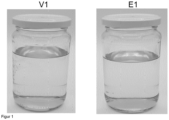
- the comparative composition V1 was transparent and showed a distinct yellow coloration.
- the inventive composition E1 was transparent and showed only a slight yellow coloration ( Figure 1 ).
Landscapes
- Chemical & Material Sciences (AREA)
- Life Sciences & Earth Sciences (AREA)
- Engineering & Computer Science (AREA)
- Chemical Kinetics & Catalysis (AREA)
- Oil, Petroleum & Natural Gas (AREA)
- Wood Science & Technology (AREA)
- Organic Chemistry (AREA)
- Inorganic Chemistry (AREA)
- Detergent Compositions (AREA)
Priority Applications (2)
| Application Number | Priority Date | Filing Date | Title |
|---|---|---|---|
| EP23218518.1A EP4574939A1 (fr) | 2023-12-20 | 2023-12-20 | Détergents liquides contenant des ingrédients stabilisants |
| PCT/EP2024/082904 WO2025131511A1 (fr) | 2023-12-20 | 2024-11-20 | Détergent liquide pour le linge contenant des ingrédients de stabilisation |
Applications Claiming Priority (1)
| Application Number | Priority Date | Filing Date | Title |
|---|---|---|---|
| EP23218518.1A EP4574939A1 (fr) | 2023-12-20 | 2023-12-20 | Détergents liquides contenant des ingrédients stabilisants |
Publications (1)
| Publication Number | Publication Date |
|---|---|
| EP4574939A1 true EP4574939A1 (fr) | 2025-06-25 |
Family
ID=89224534
Family Applications (1)
| Application Number | Title | Priority Date | Filing Date |
|---|---|---|---|
| EP23218518.1A Pending EP4574939A1 (fr) | 2023-12-20 | 2023-12-20 | Détergents liquides contenant des ingrédients stabilisants |
Country Status (2)
| Country | Link |
|---|---|
| EP (1) | EP4574939A1 (fr) |
| WO (1) | WO2025131511A1 (fr) |
Citations (3)
| Publication number | Priority date | Publication date | Assignee | Title |
|---|---|---|---|---|
| US5518644A (en) * | 1991-11-07 | 1996-05-21 | The Procter & Gamble Company | Aqueous built liquid detergents containing a sulfite salt to inhibit color alteration caused by mixture of alkanolamines and perfumes |
| US6387864B1 (en) * | 2000-12-15 | 2002-05-14 | Ecolab Inc. | Composition and method for prevention of discoloration of detergents using nonionic surfactants and an alkaline source |
| EP4039806A1 (fr) * | 2021-02-04 | 2022-08-10 | Henkel AG & Co. KGaA | Composition détergente comprenant des variants de xanthane lyase et d'endoglucanase à stabilité améliorée |
-
2023
- 2023-12-20 EP EP23218518.1A patent/EP4574939A1/fr active Pending
-
2024
- 2024-11-20 WO PCT/EP2024/082904 patent/WO2025131511A1/fr active Pending
Patent Citations (3)
| Publication number | Priority date | Publication date | Assignee | Title |
|---|---|---|---|---|
| US5518644A (en) * | 1991-11-07 | 1996-05-21 | The Procter & Gamble Company | Aqueous built liquid detergents containing a sulfite salt to inhibit color alteration caused by mixture of alkanolamines and perfumes |
| US6387864B1 (en) * | 2000-12-15 | 2002-05-14 | Ecolab Inc. | Composition and method for prevention of discoloration of detergents using nonionic surfactants and an alkaline source |
| EP4039806A1 (fr) * | 2021-02-04 | 2022-08-10 | Henkel AG & Co. KGaA | Composition détergente comprenant des variants de xanthane lyase et d'endoglucanase à stabilité améliorée |
Also Published As
| Publication number | Publication date |
|---|---|
| WO2025131511A1 (fr) | 2025-06-26 |
Similar Documents
| Publication | Publication Date | Title |
|---|---|---|
| EP3024917B1 (fr) | Détergent contenant de l'oxyde d'amine | |
| DE102017223459A1 (de) | Waschmittel enthaltend Aminoxid und Zuckertenside | |
| EP2711413A1 (fr) | Détergent et procédé de dosage d'un détergent | |
| EP3472290B1 (fr) | Détergents à lessive liquides isotropes concentrés contenant de polymères | |
| EP3472289B1 (fr) | Détergents à lessive liquides concentrés contenant des polymères | |
| DE102013226260A1 (de) | Waschmittel enthaltend Methylestersulfonate (MES) und Methylesterethoxylate (MEE) | |
| EP4574939A1 (fr) | Détergents liquides contenant des ingrédients stabilisants | |
| DE102023212239A1 (de) | Borsäurefreies Flüssigwaschmittel | |
| DE102023213044A1 (de) | Verstärkung der Waschleistung | |
| EP4567095A1 (fr) | Détergent liquide acide | |
| DE102023212238A1 (de) | Opake Flüssigwaschmittel | |
| DE102024207696B3 (de) | Tensidsystem mit Mannosylerythritollipiden, Waschmittel auf Basis des Tensidsystems und Verfahren unter Verwendung des Waschmittels | |
| EP4574947A1 (fr) | Composition détergente liquide antibactérienne | |
| DE102017209213A1 (de) | Konzentrierte isotrope Flüssigwaschmittel enthaltend Polymere | |
| DE102023205588A1 (de) | Biotensidhaltige Tensidmischungen | |
| DE102023212849A1 (de) | Tensidsystem für Waschmittel enthaltend Mannosylerythritollipide (MEL) und mindestens ein weiteres Tensid | |
| DE102013218225A1 (de) | Waschmittel enthaltend Alkylpyrrolidon | |
| EP2904084A1 (fr) | Détergents dotés d'agents complexants ii, de performance améliorée | |
| EP3472291B1 (fr) | Détergents à lessive liquides isotropes concentrés contenant des polymères | |
| DE102023212910A1 (de) | Konzentrierte flüssige Wäschewaschmittelzusammensetzungen | |
| DE102019219295A1 (de) | Verbesserte Waschleistung von Color Waschmitteln an bleichbaren Flecken ohne Farbschädigung | |
| DE102017206013A1 (de) | Wasch- oder Reinigungsmittel mit verbessertem Schaumverhalten | |
| DE102017209212A1 (de) | Konzentrierte isotrope Flüssigwaschmittel enthaltend Polymere | |
| DE102007036910A1 (de) | Verdicktes, flüssiges Wasch- oder Reinigungsmittel | |
| EP3578629A1 (fr) | Procédé de fabrication d'un agent de lavage ou de nettoyage liquide contenant une solution de substance colorante sans agent conservateur |
Legal Events
| Date | Code | Title | Description |
|---|---|---|---|
| PUAI | Public reference made under article 153(3) epc to a published international application that has entered the european phase |
Free format text: ORIGINAL CODE: 0009012 |
|
| STAA | Information on the status of an ep patent application or granted ep patent |
Free format text: STATUS: THE APPLICATION HAS BEEN PUBLISHED |
|
| AK | Designated contracting states |
Kind code of ref document: A1 Designated state(s): AL AT BE BG CH CY CZ DE DK EE ES FI FR GB GR HR HU IE IS IT LI LT LU LV MC ME MK MT NL NO PL PT RO RS SE SI SK SM TR |
|
| STAA | Information on the status of an ep patent application or granted ep patent |
Free format text: STATUS: REQUEST FOR EXAMINATION WAS MADE |
|
| 17P | Request for examination filed |
Effective date: 20251222 |