EP4574987A1 - Procédé de préparation d'acide 2,5-furandicarboxylique - Google Patents
Procédé de préparation d'acide 2,5-furandicarboxylique Download PDFInfo
- Publication number
- EP4574987A1 EP4574987A1 EP23220103.8A EP23220103A EP4574987A1 EP 4574987 A1 EP4574987 A1 EP 4574987A1 EP 23220103 A EP23220103 A EP 23220103A EP 4574987 A1 EP4574987 A1 EP 4574987A1
- Authority
- EP
- European Patent Office
- Prior art keywords
- seq
- nad
- acid sequence
- ffa
- amino acid
- Prior art date
- Legal status (The legal status is an assumption and is not a legal conclusion. Google has not performed a legal analysis and makes no representation as to the accuracy of the status listed.)
- Pending
Links
Images
Classifications
-
- C—CHEMISTRY; METALLURGY
- C12—BIOCHEMISTRY; BEER; SPIRITS; WINE; VINEGAR; MICROBIOLOGY; ENZYMOLOGY; MUTATION OR GENETIC ENGINEERING
- C12P—FERMENTATION OR ENZYME-USING PROCESSES TO SYNTHESISE A DESIRED CHEMICAL COMPOUND OR COMPOSITION OR TO SEPARATE OPTICAL ISOMERS FROM A RACEMIC MIXTURE
- C12P17/00—Preparation of heterocyclic carbon compounds with only O, N, S, Se or Te as ring hetero atoms
- C12P17/02—Oxygen as only ring hetero atoms
- C12P17/04—Oxygen as only ring hetero atoms containing a five-membered hetero ring, e.g. griseofulvin, vitamin C
-
- C—CHEMISTRY; METALLURGY
- C12—BIOCHEMISTRY; BEER; SPIRITS; WINE; VINEGAR; MICROBIOLOGY; ENZYMOLOGY; MUTATION OR GENETIC ENGINEERING
- C12Y—ENZYMES
- C12Y102/00—Oxidoreductases acting on the aldehyde or oxo group of donors (1.2)
- C12Y102/01—Oxidoreductases acting on the aldehyde or oxo group of donors (1.2) with NAD+ or NADP+ as acceptor (1.2.1)
-
- C—CHEMISTRY; METALLURGY
- C12—BIOCHEMISTRY; BEER; SPIRITS; WINE; VINEGAR; MICROBIOLOGY; ENZYMOLOGY; MUTATION OR GENETIC ENGINEERING
- C12Y—ENZYMES
- C12Y106/00—Oxidoreductases acting on NADH or NADPH (1.6)
- C12Y106/03—Oxidoreductases acting on NADH or NADPH (1.6) with oxygen as acceptor (1.6.3)
- C12Y106/03001—NAD(P)H oxidase (1.6.3.1), i.e. NOX1
Definitions
- the invention relates to a process for the preparation of 2,5-furandicarboxylic acid (FDCA) from 5-formyl-2-furancarboxylic acid (FFA).
- FDCA 2,5-furandicarboxylic acid
- FFA 5-formyl-2-furancarboxylic acid
- PET polyethylene terephthalate
- terephthalic acid 1,4-benzenedicarboxylic acid
- ethylene glycol ethane-1,2-diol
- Terephthalic acid is produced industrially by oxidation of p-xylene (1,4-dimethylbenzene) with atmospheric oxygen at approximately 200 °C in the presence of cobalt acetate, manganese acetate and HBr in acetic acid in the so-called AMOCO process (Tomäs et al., 2013).
- Ethylene glycol is produced by the hydrolysis of ethylene oxide (at 200 °C), which in turn is obtained by the oxidation of ethylene (derived from fossil raw materials) (Berger, 2016). Due to the fossil sources of the raw materials (p-xylene and ethylene), PET cannot generally be considered sustainable.
- ethylene glycol for example, there are processes based on renewable resources.
- ethylene can also be produced by dehydrating bioethanol obtained by fermentation from glucose or starch (e.g., Fan et al., 2013). Fermentative conversions of xylose and/or glucose to ethylene glycol using metabolically engineered microorganisms ( Escherichia coli or Saccharomyces cerevisiae ) are also known (Salusjärvi et al., 2019).
- the second building block of PET the aromatic compound terephthalic acid
- PET 2,5-furandicarboxylic acid
- PEF polyethylene furanoate
- PET polyethylene furanoate
- thermal higher glass transition temperature, lower melting temperature
- mechanical properties higher stiffness
- PEF PEF
- gases such as O 2 and CO 2 . This is particularly important for beverages, as it can extend the shelf life of beverages (preventing outgassing of carbonated beverages; preventing oxidation processes caused by diffused oxygen) (de Jong et al., 2022).
- HMF 5-(hydroxymethyl)furfural
- the direct precursor of FDCA is FFA (5-formyl-2-furancarboxylic acid), which can be produced, for example, by acid-catalyzed dehydration from the sugar acid derivatives 2-keto-D-gluconate (2KGA) or 5-keto-D-gluconate (5KGA).
- 2KGA can be dehydrated to FFA by treatment with HBr in an acetic acid/water mixture in a flow reactor at 80 °C.
- FFA can be oxidized to FDCA using either oxygen as the oxidant and metals (e.g., Pt-Ru/C) or metal salts (Co & Mn salts) as catalysts, or hydrogen peroxide ( US 10087161 B2 ).
- FFA can be produced by the enzymatic oxidation of HMF (predominantly with O2 as oxidant).
- the AAO-catalyzed oxidation of the aldehyde groups proceeds via the corresponding geminal diols (aldehyde hydrates).
- the aldehyde groups in FFA exhibit a lower degree of hydration (DFF: 53%, FFA: 8%) compared to the precursor 2,5- diformylfuran (DFF), which explains the preferential formation of FFA over FDCA.
- DFF 2,5- diformylfuran
- H2O2 which is formed as a byproduct of the AAO-catalyzed oxidations, chemically oxidizes FFA to FDCA (Carro et al., 2015). In a later study by Serrano et al. (2019) on the AAO of P.
- HMF can also be completely oxidized to FDCA when a catalase is used to remove H 2 O 2 , since the final oxidation step from FFA to FDCA is inhibited by H 2 O 2. In this way, 1.5 mM HMF could be oxidized to 1.6 mM FDCA in 6 d using an AAO mutant.
- US 10344307 B2 reveals further enzyme (systems) for the oxidation of HMF to FFA: 1) NAD(P)-dependent ketoreductase & NAD(P)H oxidase for cofactor regeneration, 2) NAD(P)-dependent aldehyde dehydrogenase & NAD(P)H oxidase and 3) xanthine oxidoreductase (such as the periplasmic aldehyde oxidoreductase (PaoABC) from E.
- systems for the oxidation of HMF to FFA: 1) NAD(P)-dependent ketoreductase & NAD(P)H oxidase for cofactor regeneration, 2) NAD(P)-dependent aldehyde dehydrogenase & NAD(P)H oxidase and 3) xanthine oxidoreductase (such as the periplasmic aldehyde oxidoreductas
- coli oxidizes HMF to 5-hydroxymethyl-2-furancarboxylic acid (HMFA) and DFF to FFA), galactose oxidase variant M 3-5 (GOase M 3-5 ; oxidizes HMF to DFF and HMFA to FFA) & horseradish peroxidase (HRP; for activation of GOase M 3-5 ).
- HMFA 5-hydroxymethyl-2-furancarboxylic acid
- HRP horseradish peroxidase
- 50 mM DFF can be completely oxidized to FFA in 2 h using PaoABC at pH 6. At pH 7 and 8, however, the oxidation proceeds completely to FDCA.
- the enzyme system mentioned under 3) has also been described in detail in journal articles (McKenna et al., 2015; McKenna et al., 2017).
- HLADH horse liver alcohol dehydrogenase
- human hemoglobin oxidized by H 2 O 2 NADH to NAD + ) to oxidize 96% of the substrate (10 mM FFA) to FDCA in 60 h.
- US 8183020 B2 describes the enzymatic oxidation of FFA to FDCA using a commercially available chloroperoxidase from Caldariomyces fumago (EC 1.11.1.10) with H 2 O 2 as oxidant.
- ALDHs Aldehyde dehydrogenases
- US 10344307 B2 A method for the oxidation of DFF using a commercially available ALDH (in combination with an NAD(P)H oxidase) is described, which, depending on the conditions (DFF concentrations from 10 to 100 mM), leads to FFA, FDCA, or mixtures. With increasing DFF concentration, more FFA than FDCA is obtained (10 mM substrate: 100% FDCA; 50 mM substrate: 80% FDCA, 20% FFA; 100 mM substrate: 20% FDCA, 80% FFA (conversion after 3 h in each case)). For the oxidations, US 10344307 B2 between 10 and 50 mol% cofactor (relative to the amount of substrate) is used.
- the methods presented here generally have disadvantages such as low substrate concentrations or uneconomically high amounts of added cofactor.
- FDCA can then be separated from the solution by crystallization.
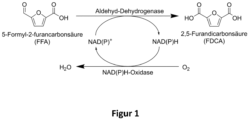
- the NAD(P) + -dependent oxidoreductase for the oxidation of FFA to FDCA is preferably an aldehyde dehydrogenase.
- the oxidoreductases mentioned here for the oxidation of FFA to FDCA preferably comprise an amino acid sequence which has an identity to SEQ ID No. 2, SEQ ID No. 4 or SEQ ID No. 6 of at least 80%, more preferably 85%, more preferably 90%, more preferably 95%, more preferably 98%, more preferably 99%, in particular 100%.
- the oxidoreductases for the oxidation of FFA to FDCA preferably comprise an amino acid sequence encoded by a nucleic acid having an identity to SEQ ID No. 1, SEQ ID No. 3, or SEQ ID No. 5 of at least 80%, more preferably 85%, more preferably 90%, more preferably 95%, more preferably 98%, more preferably 99%, in particular 100%.
- the nucleic acid encoding the oxidoreductase according to the invention for the oxidation of FFA to FDCA comprises or consists of the nucleic acid sequence SEQ ID No. 1, SEQ ID No. 3, or SEQ ID No. 5.
- identity refers to the percentage of identical nucleotide or amino acid matches between at least two nucleotide or amino acid sequences aligned using a standardized algorithm. Such an algorithm can, in a standardized and reproducible manner, introduce gaps into the compared sequences to optimize the alignment between two sequences, thus achieving a more meaningful comparison of the two sequences.
- the percentage identity between sequences can be determined using one or more computer algorithms or programs known in the art or described herein.
- the Basic Local Alignment Search Tool (BLAST) (Altschul et al.) provided by the National Center for Biotechnology Information (NCBI) is used to determine identity. al., 1990).
- the BLAST software suite includes various programs, including a tool called "BLAST 2 Sequences,” which is used for the direct pairwise comparison of two nucleotide or amino acid sequences. "BLAST 2 Sequences" can also be accessed and used interactively via the NCBI World Wide Web.
- W word length
- E expectation
- M amino acid sequence
- the oxidoreductases for oxidizing FFA to FDCA preferably comprise an amino acid sequence encoded by a nucleic acid that binds under stringent conditions to a nucleic acid molecule having the nucleic acid sequence SEQ ID NO: 1, SEQ ID NO: 3, or SEQ ID NO: 5.
- stringent conditions refer to conditions under which so-called specific hybrids, but not non-specific hybrids, are formed.
- the stringent conditions comprise hybridization in 6xSSC (sodium chloride/sodium citrate) at 45°C and then washing with 0.2 to 1xSSC, 0.1% SDS at 50 to 65°C; or such conditions may comprise hybridization in 1xSSC at 65 to 70°C and then washing with 0.3xSSC at 65 to 70°C.
- the hybridization may be carried out by conventionally known methods, such as those described by J. Sambrook et al. in Molecular Cloning, A Laboratory Manual, 2nd Ed., Cold Spring Harbor Laboratory (1989 ), as described.
- the NAD(P)H oxidase used for cofactor regeneration can be selected from one of the groups EC 1.6.3.1 (NAD(P)H oxidase (H 2 O 2 -forming)), EC 1.6.3.2 (NAD(P)H oxidase (H 2 O-forming)), EC 1.6.3.3 (NADH oxidase (H 2 O 2 -forming)) and EC 1.6.3.4 (NADH oxidase (H 2 O-forming)), with the H 2 O-forming classes being particularly preferred.
- the preferably used H2O -forming NAD(P)H oxidase preferably comprises or consists of an amino acid sequence which has an identity to SEQ ID No. 10 of at least 80%, even more preferably 85%, even more preferably 90%, even more preferably 95%, even more preferably 98%, even more preferably 99%, in particular 100%.
- the H2O -forming NAD(P)H oxidase comprises or consists of the amino acid sequence SEQ ID No. 8 or SEQ ID No. 10.
- the concentration of FFA in the aqueous solution is 5 - 100 g/l.
- the particularly preferred temperature range is between 15 and 40 °C.
- the most preferred pH range of the reaction is between pH 5 and pH 9.
- the enzymes are present in a suspension, in the homogenate and/or in the lysate of the corresponding cells forming them, with lysates being particularly preferred.
- suspension means a suspension of resting cells. These are harvested after cultivation (separated from the nutrient medium) and suspended in a suitable buffer system. In contrast to fermentative processes, which also work with whole cells, the resting cells can no longer grow due to the removal of carbon sources and nutrients; instead, they only serve to convert substrates (Lin & Tao, 2017).
- homogenate refers to a physically and/or chemically treated suspension (e.g., treated by pressure, lysozyme, or ultrasound), whereby the cellular components are released from the cells. A lysate is obtained when the insoluble cellular components of the homogenate are removed, for example, by filtration or centrifugation (see Enzyme Production & Lysate Preparation for details).
- the enzymes can also be modified at the N-terminus with a water-soluble polymer such as polyethylene glycol, immobilized in or on a solid matrix, or be part of a fusion protein.
- a water-soluble polymer such as polyethylene glycol
- the enzymes can be in powder form, in lyophilized or spray-dried form.
- FFA 5-Formyl-2-furancarboxylic acid
- FDCA 2,5-furandicarboxylic acid
- SDS sodium dodecyl sulfate
- NAD + NADH disodium salt
- NADP + disodium salt NADP + disodium salt
- acetonitrile purchased from PanReac AppliChem (ITW Reagents)
- triethanolamine was purchased from Chem-Lab NV.
- the gene to be expressed was first PCR-expressed using genomic DNA or its synthetic An equivalent adapted to the codon usage of E. coli was amplified as a template together with specific oligonucleotides that additionally carry recognition sequences for restriction endonucleases and isolated from the reaction mixture. After nucleic acid digestion with the restriction enzymes SphI and HindIII, the gene fragment encoding the target enzyme was ligated into the SphI and HindIII-cleaved backbone of the expression vector pQE70-Kan. The ligation product was transformed into chemically competent E. coli Top10F cells, and the resulting colonies were used for plasmid isolation and restriction analysis.
- the result of the cloning step was verified by restriction enzyme digestion and DNA sequencing.
- the resulting construct carries the target gene under the IPTG-inducible T5 promoter.
- the resulting expression plasmid was transformed into the competent expression cells RB791. After 24 h of incubation at 37 °C, the resulting colonies were inoculated into LB medium for expression assays.
- the cell pellet prepared according to the above procedure was weighed into a suitable container and mixed with buffer and lysozyme (final concentration 0.5 mg/ml) (e.g., triethanolamine (TEA) - HCl) and dissolved with stirring.
- the mass fraction of biomass is typically 20%, with the remainder being buffer.
- HPLC high-performance liquid chromatography
- Detection was performed using a UV detector.
- a Phenomenex Rezex ROA-Organic Acid H+ (8%) column with an appropriate precolumn was used for the measurement and eluted isocratically with 1 mM sulfuric acid.
- Enzyme activities in the lysates were determined using a Shimadzu UV-1900 spectrophotometer.
- the formation or consumption of NAD(P)H was monitored at a wavelength of 340 nm via the change in absorbance.
- the measurements were performed with 0.2 mM cofactor (NAD(P) + or NAD(P)H).
- 20 ⁇ l of a 10 mM stock solution of the cofactor were placed in a cuvette (Greiner bioone semi-micro cuvette made of polystyrene), and the desired pH value was adjusted with 100 mM TEA-HCl buffer (870 ⁇ l).
- the reactor contents were heated to 70 °C and stirred at this temperature for 1 h. After centrifuging off denatured protein, the supernatant was filtered through a fluted filter. This resulted in a clear solution, which was acidified to pH ⁇ 2 with 10 ml of a 12 MH 2 SO 4 solution. Cooling to 4 °C resulted in a precipitate of FDCA, which was filtered off and dried at 50 °C in a vacuum drying oven.
- the following components were mixed in a glass vial: 5.1 mg FFA, 325 ⁇ l deionized water, 35 ⁇ l ALDH III lysate, 100 ⁇ l of a 500 mM potassium phosphate buffer (pH 8), 30 ⁇ l NADH oxidase lysate, and 5 ⁇ l of a 10 mM NAD + solution.
- the mixture was incubated for a total of 24 h with continuous shaking (Eppendorf Thermomixer; 20 °C, 800 rpm).
Landscapes
- Organic Chemistry (AREA)
- Chemical & Material Sciences (AREA)
- Engineering & Computer Science (AREA)
- Zoology (AREA)
- Life Sciences & Earth Sciences (AREA)
- Wood Science & Technology (AREA)
- Chemical Kinetics & Catalysis (AREA)
- Microbiology (AREA)
- General Chemical & Material Sciences (AREA)
- Biotechnology (AREA)
- Health & Medical Sciences (AREA)
- Biochemistry (AREA)
- Bioinformatics & Cheminformatics (AREA)
- General Engineering & Computer Science (AREA)
- General Health & Medical Sciences (AREA)
- Genetics & Genomics (AREA)
- Enzymes And Modification Thereof (AREA)
- Preparation Of Compounds By Using Micro-Organisms (AREA)
Priority Applications (3)
| Application Number | Priority Date | Filing Date | Title |
|---|---|---|---|
| EP23220103.8A EP4574987A1 (fr) | 2023-12-22 | 2023-12-22 | Procédé de préparation d'acide 2,5-furandicarboxylique |
| CN202480047630.6A CN121712901A (zh) | 2023-12-22 | 2024-12-23 | 用于制备2,5-呋喃二甲酸的方法 |
| PCT/EP2024/088407 WO2025133402A1 (fr) | 2023-12-22 | 2024-12-23 | Procédé de production d'acide 2,5-furane dicarboxylique |
Applications Claiming Priority (1)
| Application Number | Priority Date | Filing Date | Title |
|---|---|---|---|
| EP23220103.8A EP4574987A1 (fr) | 2023-12-22 | 2023-12-22 | Procédé de préparation d'acide 2,5-furandicarboxylique |
Publications (1)
| Publication Number | Publication Date |
|---|---|
| EP4574987A1 true EP4574987A1 (fr) | 2025-06-25 |
Family
ID=89321783
Family Applications (1)
| Application Number | Title | Priority Date | Filing Date |
|---|---|---|---|
| EP23220103.8A Pending EP4574987A1 (fr) | 2023-12-22 | 2023-12-22 | Procédé de préparation d'acide 2,5-furandicarboxylique |
Country Status (3)
| Country | Link |
|---|---|
| EP (1) | EP4574987A1 (fr) |
| CN (1) | CN121712901A (fr) |
| WO (1) | WO2025133402A1 (fr) |
Families Citing this family (1)
| Publication number | Priority date | Publication date | Assignee | Title |
|---|---|---|---|---|
| EP4722355A1 (fr) * | 2024-10-02 | 2026-04-08 | Annikki GmbH | Procédé de préparation d'acide 2,5-furandicarboxylique |
Citations (6)
| Publication number | Priority date | Publication date | Assignee | Title |
|---|---|---|---|---|
| WO2012064195A2 (fr) * | 2011-03-08 | 2012-05-18 | Bird Engineering B.V. | Cellule modifiée génétiquement et procédé d'utilisation de cette cellule |
| US8183020B2 (en) | 2007-08-10 | 2012-05-22 | Archer Daniels Midland Company | Enzymatic oxidation of hydroxymethylfurfural |
| US9617234B1 (en) | 2015-12-18 | 2017-04-11 | Wisconsin Alumni Research Foundation | Method to produce furandicarboxylic acid (FDCA) from 5-hydroxymethylfurfural (HMF) |
| US10087161B2 (en) | 2015-08-20 | 2018-10-02 | Synthetic Genomics, Inc. | Synthesis of FDCA and FDCA precursors from gluconic acid derivatives |
| US10344307B2 (en) | 2015-06-15 | 2019-07-09 | Biome Bioplastics Limited | Processes for the formation of furandicarboxylic acid (FDCA) via a multistep biocatalytic oxidation reaction of 5-hydroxymethylfurfural (HMF) |
| EP3265450B1 (fr) | 2015-03-05 | 2020-08-05 | BP Corporation North America Inc. | Synthèse de furanes à partir de sucres via des céto intermediares |
Family Cites Families (1)
| Publication number | Priority date | Publication date | Assignee | Title |
|---|---|---|---|---|
| CN116024239A (zh) * | 2022-07-26 | 2023-04-28 | 南京科技职业学院 | 一种参与5-羟甲基-2-呋喃甲酸合成的醛脱氢酶及其应用 |
-
2023
- 2023-12-22 EP EP23220103.8A patent/EP4574987A1/fr active Pending
-
2024
- 2024-12-23 CN CN202480047630.6A patent/CN121712901A/zh active Pending
- 2024-12-23 WO PCT/EP2024/088407 patent/WO2025133402A1/fr active Pending
Patent Citations (6)
| Publication number | Priority date | Publication date | Assignee | Title |
|---|---|---|---|---|
| US8183020B2 (en) | 2007-08-10 | 2012-05-22 | Archer Daniels Midland Company | Enzymatic oxidation of hydroxymethylfurfural |
| WO2012064195A2 (fr) * | 2011-03-08 | 2012-05-18 | Bird Engineering B.V. | Cellule modifiée génétiquement et procédé d'utilisation de cette cellule |
| EP3265450B1 (fr) | 2015-03-05 | 2020-08-05 | BP Corporation North America Inc. | Synthèse de furanes à partir de sucres via des céto intermediares |
| US10344307B2 (en) | 2015-06-15 | 2019-07-09 | Biome Bioplastics Limited | Processes for the formation of furandicarboxylic acid (FDCA) via a multistep biocatalytic oxidation reaction of 5-hydroxymethylfurfural (HMF) |
| US10087161B2 (en) | 2015-08-20 | 2018-10-02 | Synthetic Genomics, Inc. | Synthesis of FDCA and FDCA precursors from gluconic acid derivatives |
| US9617234B1 (en) | 2015-12-18 | 2017-04-11 | Wisconsin Alumni Research Foundation | Method to produce furandicarboxylic acid (FDCA) from 5-hydroxymethylfurfural (HMF) |
Non-Patent Citations (41)
| Title |
|---|
| "National Center for Biotechnology Information", Database accession no. WP_015829138.1 |
| "National Library of Medicine (US), National Center for Biotechnology Information", Database accession no. WP_024766379.1 |
| ALTSCHUL, S. F.GISH, W.MILLER, W.MYERS, E. W.LIPMAN, D. J.: "Basic local alignment search tool", JOURNAL OF MOLECULAR BIOLOGY, vol. 215, no. 3, 1990, pages 403 - 410, XP002949123, DOI: 10.1006/jmbi.1990.9999 |
| BERGER, A.: "RÖMPP", 2016, GEORG THIEME VERLAG, article "Ethylenglycol, RD-05-01999" |
| BROUNS STAN J ET AL: "Identification of the Missing Links in Prokaryotic Pentose Oxidation Pathways", JOURNAL OF BIOLOGICAL CHEMISTRY, vol. 281, no. 37, 1 September 2006 (2006-09-01), pages 27378 - 27388, XP093171754, DOI: 10.1074/jbc.M605549200 * |
| CAJNKO, M. M.NOVAK, U.GRILC, M.LIKOZAR, B.: "Enzymatic conversion reactions of 5-hydroxymethylfurfural (HMF) to bio-based 2,5-diformylfuran (DFF) and 2,5-furandicarboxylic acid (FDCA) with air: mechanisms, pathways and synthesis selectivity", BIOTECHNOLOGY FOR BIOFUELS, vol. 13, 2020, pages 66 |
| CARRARO NICOLAS ET AL: "Insights into Mobile Genetic Elements of the Biocide-Degrading Bacterium Pseudomonas nitroreducens HBP-1", GENES, vol. 11, no. 8, 930, August 2020 (2020-08-01), pages 1 - 18 * |
| CARRO, J.FERREIRA, P.RODRIGUEZ, L.PRIETO, A.SERRANO, A.BALCELLS, B.ARDA, A.JIMENEZ-BARBERO, J.GUTIERREZ, A.ULLRICH, R.: "5-hydroxymethylfurfural conversion by fungal aryl-alcohol oxidase and unspecific peroxygenase", FEBS JOURNAL, vol. 282, no. 16, 2015, pages 3218 - 3229, XP055555047, DOI: 10.1111/febs.13177 |
| CARUS, M.DAMMER, L.RASCHKA, A.SKOCZINSKI, P.VOM BERG, C., RENEWABLE CARBON-KEY TO A SUSTAINABLE AND FUTURE-ORIENTED CHEMICAL AND PLASTIC INDUSTRY, 2020, Retrieved from the Internet <URL:https://renewable-carbon-initiative.com/wp-content/uploads/2020/09/20-09-21_Paper_12-on-Renewable-Carbon.pdf> |
| CONG, H.YUAN, H.TAO, Z.BAO, H.ZHANG, Z.JIANG, Y.HUANG, D.LIU, H.WANG, T.: "Recent Advances in Catalytic Conversion of Biomass to 2,5-Furandicarboxylic Acid", CATALYSTS, vol. 11, no. 9, 2021, pages 1113 |
| DATABASE Uniprot [online] 26 June 2001 (2001-06-26), SHE QUNXIN ET AL: "2,5-dioxopentanoate dehydrogenase, Saccharolobus solfataricus", XP093171753, Database accession no. Q97UA1 * |
| DATABASE Uniprot [online] 28 June 2023 (2023-06-28), SENTCHILO V. ET AL: "Aldehyde dehydrogenase family protein, Pseudomonas nitroreducens", XP093171751, Database accession no. A0A6G6IPC1 * |
| DATABASE Uniprot [online] 29 September 2015 (2015-09-29), SUN ZHIHONG: "NADH oxidase, Carnobacterium divergens DSM 20623", XP093171592, Database accession no. A0A0R2I3C9 * |
| DATABASE Uniprot [online] 3 May 2023 (2023-05-03), LUCAS S. ET AL: "Aldehyde Dehydrogenase, Methylovorus glucosetrophus", XP093171755, Database accession no. C6X891 * |
| DATABASE Uniprot [online] 3 May 2023 (2023-05-03), MATSUMOTO J. ET AL: "H2O-forming NADH Oxidase, Streptococcus mutans", XP093171756, Database accession no. Q54453 * |
| DE JONG, E.VISSER, H. A.DIAS, A. S.HARVEY, C.GRUTER, G.-J. M.: "The Road to Bring FDCA and PEF to the Market", POLYMERS, vol. 14, 2022, pages 943 |
| FAN, D.DAI, D.-J.WU, H.-S.: "Ethylene Formation by Catalytic Dehydration of Ethanol with Industrial Considerations", MATERIALS, vol. 6, no. 1, 2013, pages 101 - 115, XP055190432, DOI: 10.3390/ma6010101 |
| HAMILTON, L. A.FEIT, S.MUFFETT, C.KELSO, M.RUBRIGHT, S. M.BERNHARDT, C.SCHAEFFER, E.MOON, D.MORRIS, J.LABBE-BELLAS, R., PLASTIC & CLIMATE: THE HIDDEN COSTS OF A PLASTIC PLANET, 2019, Retrieved from the Internet <URL:https://www.ciel.org/wp-content/uploads/2019/05/Plastic-and-Climate-FINAL-2019.pdf> |
| HENIKOFF, S.HENIKOFF, J. G.: "Amino acid substitution matrices from protein blocks", PROCEEDINGS OF THE NATIONAL ACADEMY OF SCIENCES OF THE UNITED STATES OF AMERICA, vol. 89, no. 22, 1992, pages 10915 - 10919, XP002599751, DOI: 10.1073/pnas.89.22.10915 |
| HOSSAIN, G. S.YUAN, H.LI, J.SHIN, H.WANG, M.DU, G.CHEN, J.LIU, L.: "Metabolic Engineering of Raoultella ornithinolytic BF60 for Production of 2,5-Furandicarboxylic Acid from 5-Hydroxymethylfurfural", APPLIED AND ENVIRONMENTAL MICROBIOLOGY, vol. 83, no. 1, 2017, pages e02312 - 16 |
| JIA, H.-Y.ZONG, M.-H.YU, H.-L.LI, N.: "Dehydrogenase-Catalyzed Oxidation of Furanics: Exploitation of Hemoglobin Catalytic Promiscuity", CHEMSUSCHEM, vol. 10, no. 18, 2017, pages 3524 - 3528 |
| JIA, H.-Y.ZONG, M.-H.ZHENG, G.-W.LI, N.: "One-Pot Enzyme Cascade for Controlled Synthesis of Furancarboxylic Acids from 5-Hydroxymethylfurfural by H O Internal Recycling", CHEMSUSCHEM, vol. 12, no. 21, 2019, pages 4764 - 4768 |
| KNAUS TANJA ET AL: "A biocatalytic method for the chemoselective aerobic oxidation of aldehydes to carboxylic acids", GREEN CHEMISTRY, vol. 20, no. 17, 1 January 2018 (2018-01-01), GB, pages 3931 - 3943, XP093171438, ISSN: 1463-9262, DOI: 10.1039/C8GC01381K * |
| KNAUS TANJA ET AL: "Supporting Information for: A biocatalytic method for the chemoselective aerobic oxidation of aldehydes to carboxylic acids", GREEN CHEMISTRY (ONLINE), ELECTRONIC SUPPLEMENTARY MATERIAL (ESI), 1 July 2018 (2018-07-01), pages S1 - S22, XP093171645, Retrieved from the Internet <URL:https://www.rsc.org/suppdata/c8/gc/c8gc01381k/c8gc01381k1.pdf> * |
| LAPIDUS ALLA ET AL: "Genomes of three methylotrophs from a single niche reveal the genetic and metabolic divergence of the methylophilaceae", JOURNAL OF BACTERIOLOGY, vol. 193, no. 15, August 2011 (2011-08-01), pages 3757 - 3764, ISSN: 1098-5530 * |
| LAPPE, A.JANKOWSKI, N.ALBRECHT, A.KOSCHORRECK, K.: "Characterization of a thermotolerant aryl-alcohol oxidase from Moesziomyces antarcticus oxidizing 5-hydroxymethyl-2-furancarboxylic acid", APPLIED MICROBIOLOGY AND BIOTECHNOLOGY, vol. 105, 2021, pages 8313 - 8327, XP037604100, DOI: 10.1007/s00253-021-11557-8 |
| LIN, B.TAO, Y.: "Whole-cell biocatalysts by design", MICROBIAL CELL FACTORIES, vol. 16, 2017, pages 106 |
| MATSUMOTO ET AL: "Molecular Cloning and Sequence Analysis of the Gene Encoding the H20-forming NADH Oxidase from Streptococcus mutans", vol. 60, no. 1, 23 January 1996 (1996-01-23), pages 39 - 43, XP008162426, ISSN: 0916-8451, Retrieved from the Internet <URL:http://ci.nii.ac.jp/naid/110002677925/en> DOI: 10.1271/BBB.60.39 * |
| MATSUMOTO, J.HIGUCHI, M.SHIMADA, M.YAMAMOTO, Y.KAMIO, Y.: "Molecular Cloning and Sequence Analysis of the Gene Encoding the H O-forming NADH Oxidase from Streptococcus mutans", BIOSCIENCE, BIOTECHNOLOGY, AND BIOCHEMISTRY, vol. 60, no. 1, 1996, pages 39 - 43, XP008162426, DOI: 10.1271/bbb.60.39 |
| MCKENNA, S. M.LEIMKÜHLER, S.HERTER, S.TURNER, N. J.CARNELL, A. J.: "Enzyme cascade reactions: Synthesis of furandicarboxylic acid (FDCA) and carboxylic acids using oxidases in tandem", GREEN CHEMISTRY, vol. 17, 2015, pages 3271 - 3275, XP002761344, DOI: 10.1039/C5GC00707K |
| MCKENNA, S. M.MINES, P.LAW, P.KOVACS-SCHREINER, K.BIRMINGHAM, W. R.TURNER, N. J.LEIMKÜHLER, S.CARNELL, A. J.: "The continuous oxidation of HMF to FDCA and the immobilisation and stabilisation of periplasmic aldehyde oxidase (PaoABC", GREEN CHEMISTRY, vol. 19, 2017, pages 4660 - 4665, XP055596465, DOI: 10.1039/C7GC01696D |
| QIN, Y.-Z.LI, Y.-M.ZONG, M.-H.WU, H.LI, N.: "Enzyme-catalyzed selective oxidation of 5-hydroxymethylfurfural (HMF) and separation of HMF and 2,5-diformylfuran using deep eutectic solvents", GREEN CHEMISTRY, vol. 17, no. 7, 2015, pages 3718 - 3722, XP055357889, DOI: 10.1039/C5GC00788G |
| SALUSJÄRVI, L.HAVUKAINEN, S.KOIVISTOINEN, O.TOIVARI, M.: "Biotechnological production of glycolic acid and ethylene glycol: current state and perspectives", APPLIED MICROBIOLOGY AND BIOTECHNOLOGY, vol. 103, 2019, pages 2525 - 2535, XP036746619, DOI: 10.1007/s00253-019-09640-2 |
| SAMBROOK, J.FRITSCH, E. R.MANIATIS, T.: "Molecular Cloning: A Laboratory Manual", 1989, COLD SPRING HARBOR LABORATORY PRESS |
| SAYED, M.GABER, Y.JUNGHUS, F.MARTIN, E. V.PYO, S.-H.HATTI-KAUL, R.: "Oxidation of 5-hydroxymethylfurfural with a novel aryl alcohol oxidase from Mycobacterium sp. MS1601", MICROBIAL BIOTECHNOLOGY, vol. 15, no. 8, 2022, pages 2176 - 2190 |
| SERRANO, A.CALVINO, E.CARRO, J.SÄNCHEZ-RUIZ, M. I.CANADA, F. J.MARTINEZ, A. T.: "Complete oxidation of hydroxymethylfurfural to furandicarboxylic acid by aryl-alcohol oxidase", BIOTECHNOLOGY FOR BIOFUELS AND BIOPRODUCTS, vol. 12, 2019, pages 217 |
| SUN ZHIHONG ET AL: "Expanding the biotechnology potential of lactobacilli through comparative genomics of 213 strains and associated genera", NATURE COMMUNICATIONS, vol. 6, 8322, 29 September 2015 (2015-09-29), pages 1 - 13, XP002769022, ISSN: 2041-1723, DOI: 10.1038/ncomms9322 * |
| TOMAS, R. A. F.BORDADO, J. C. M.GOMES, J. F. P.: "p-Xylene Oxidation to Terephthalic Acid: A Literature Review Oriented toward Process Optimization and Development", CHEMICAL REVIEWS, vol. 113, no. 10, 2013, pages 7421 - 7469 |
| XUE-YING ZHANG ET AL: "Furan Carboxylic Acids Production with High Productivity by Cofactor-engineered Whole-cell Biocatalysts", CHEMCATCHEM, vol. 12, no. 12, 7 May 2020 (2020-05-07), pages 3257 - 3264, XP072435869, ISSN: 1867-3880, DOI: 10.1002/CCTC.202000259 * |
| YUAN HAIBO ET AL: "Enhanced 2,5-furandicarboxylic acid (FDCA) production in Raoultella ornithinolytica BF60 by manipulation of the key genes in FDCA biosynthesis pathway", JOURNAL OF MICROBIOLOGY AND BIOTECHNOLOGY, vol. 28, no. 12, 28 December 2018 (2018-12-28), Korea, pages 1999 - 2008, XP093170796, ISSN: 1017-7825, DOI: 10.4014/jmb.1808.08057 * |
| ZHANG, C.CHANG, X.ZHU, L.XING, Q.YOU, S.QI, W.SU, R.HE, Z.: "Highly efficient and selective production of FFCA from CotA-TJ102 laccase-catalyzed oxidation of 5-HMF", INTERNATIONAL JOURNAL OF BIOLOGICAL MACROMOLECULES, vol. 128, 2019, pages 132 - 139 |
Also Published As
| Publication number | Publication date |
|---|---|
| WO2025133402A1 (fr) | 2025-06-26 |
| CN121712901A (zh) | 2026-03-20 |
Similar Documents
| Publication | Publication Date | Title |
|---|---|---|
| Yankov | Fermentative lactic acid production from lignocellulosic feedstocks: from source to purified product | |
| Carly et al. | Enhancing erythritol productivity in Yarrowia lipolytica using metabolic engineering | |
| Abedinifar et al. | Ethanol production by Mucor indicus and Rhizopus oryzae from rice straw by separate hydrolysis and fermentation | |
| EP4680760A2 (fr) | Procédé de production d'une solution aqueuse contenant du d-psicose | |
| WO2025133402A1 (fr) | Procédé de production d'acide 2,5-furane dicarboxylique | |
| EP4695410A2 (fr) | Procédé de production d'allitol | |
| Teo et al. | Enhancing bioethanol production from rice straw through environmentally friendly delignification using versatile peroxidase | |
| WO2025133401A1 (fr) | Procédé de production d'acide 2,5-furane dicarboxylique | |
| Chen et al. | Identification of a novel alditol oxidase from Thermopolyspora flexuosa with potential application in D-glyceric acid production | |
| Chaves et al. | Enzymatic blend containing β-glucosidase from Penicillium roqueforti ATCC 10110 grown on cocoa pod husk: Characterization and utilization in rice husk saccharification | |
| EP4733406A1 (fr) | Procédé de préparation d'acide 2,5-furandicarboxylique | |
| EP4722355A1 (fr) | Procédé de préparation d'acide 2,5-furandicarboxylique | |
| Rattanapatpokin et al. | Newly isolated malic acid fermenting yeast Meyerozyma caribbica AY 33-1 for bioconversion of glucose and cassava pulp | |
| EP4545645A1 (fr) | Procédé de préparation d'une solution aqueuse contenant de l'acide glycolique | |
| KR101339960B1 (ko) | 그물말 과 조류 당화액으로부터의 유기산 제조방법 | |
| EP4653539A1 (fr) | Procédé de préparation de 2,5-diformylfurane | |
| US9382555B2 (en) | Polypetide with enhanced beta-glucosidase activity at low temperature | |
| EP4656731A1 (fr) | Procédé de préparation d'acide galactarique | |
| EP4678755A1 (fr) | Procédé de préparation d'une solution aqueuse contenant du d-mannitol | |
| WO2026013248A1 (fr) | Procédé de production d'une solution aqueuse contenant du d-mannitol | |
| EP4520839A2 (fr) | Procédé de préparation d'une solution aqueuse contenant de la d-psicose | |
| EP4574983A1 (fr) | Procédé de préparation d'allitol | |
| Kankarne et al. | Overview of Baker's Yeast as a Biocatalyst | |
| Liu | Microbial Production of Lignin-Degrading Enzymes from Genetically Engineered Aspergillus Nidulans and Enzymatic Depolymerization of Lignin | |
| Biko | Heterologous expression of a fungal lignin peroxidase in Pichia pastoris |
Legal Events
| Date | Code | Title | Description |
|---|---|---|---|
| PUAI | Public reference made under article 153(3) epc to a published international application that has entered the european phase |
Free format text: ORIGINAL CODE: 0009012 |
|
| STAA | Information on the status of an ep patent application or granted ep patent |
Free format text: STATUS: THE APPLICATION HAS BEEN PUBLISHED |
|
| AK | Designated contracting states |
Kind code of ref document: A1 Designated state(s): AL AT BE BG CH CY CZ DE DK EE ES FI FR GB GR HR HU IE IS IT LI LT LU LV MC ME MK MT NL NO PL PT RO RS SE SI SK SM TR |
|
| STAA | Information on the status of an ep patent application or granted ep patent |
Free format text: STATUS: THE APPLICATION IS DEEMED TO BE WITHDRAWN |