EP4575060A2 - Procédé de fabrication d'une bande de tissu non tissé composite et dispositif de fabrication d'une bande de tissu non tissé composite - Google Patents
Procédé de fabrication d'une bande de tissu non tissé composite et dispositif de fabrication d'une bande de tissu non tissé composite Download PDFInfo
- Publication number
- EP4575060A2 EP4575060A2 EP25174758.0A EP25174758A EP4575060A2 EP 4575060 A2 EP4575060 A2 EP 4575060A2 EP 25174758 A EP25174758 A EP 25174758A EP 4575060 A2 EP4575060 A2 EP 4575060A2
- Authority
- EP
- European Patent Office
- Prior art keywords
- layer
- screen belt
- fibers
- layers
- headbox
- Prior art date
- Legal status (The legal status is an assumption and is not a legal conclusion. Google has not performed a legal analysis and makes no representation as to the accuracy of the status listed.)
- Pending
Links
Images



Classifications
-
- D—TEXTILES; PAPER
- D04—BRAIDING; LACE-MAKING; KNITTING; TRIMMINGS; NON-WOVEN FABRICS
- D04H—MAKING TEXTILE FABRICS, e.g. FROM FIBRES OR FILAMENTARY MATERIAL; FABRICS MADE BY SUCH PROCESSES OR APPARATUS, e.g. FELTS, NON-WOVEN FABRICS; COTTON-WOOL; WADDING ; NON-WOVEN FABRICS FROM STAPLE FIBRES, FILAMENTS OR YARNS, BONDED WITH AT LEAST ONE WEB-LIKE MATERIAL DURING THEIR CONSOLIDATION
- D04H1/00—Non-woven fabrics formed wholly or mainly of staple fibres or like relatively short fibres
- D04H1/40—Non-woven fabrics formed wholly or mainly of staple fibres or like relatively short fibres from fleeces or layers composed of fibres without existing or potential cohesive properties
- D04H1/42—Non-woven fabrics formed wholly or mainly of staple fibres or like relatively short fibres from fleeces or layers composed of fibres without existing or potential cohesive properties characterised by the use of certain kinds of fibres insofar as this use has no preponderant influence on the consolidation of the fleece
- D04H1/4374—Non-woven fabrics formed wholly or mainly of staple fibres or like relatively short fibres from fleeces or layers composed of fibres without existing or potential cohesive properties characterised by the use of certain kinds of fibres insofar as this use has no preponderant influence on the consolidation of the fleece using different kinds of webs, e.g. by layering webs
-
- D—TEXTILES; PAPER
- D04—BRAIDING; LACE-MAKING; KNITTING; TRIMMINGS; NON-WOVEN FABRICS
- D04H—MAKING TEXTILE FABRICS, e.g. FROM FIBRES OR FILAMENTARY MATERIAL; FABRICS MADE BY SUCH PROCESSES OR APPARATUS, e.g. FELTS, NON-WOVEN FABRICS; COTTON-WOOL; WADDING ; NON-WOVEN FABRICS FROM STAPLE FIBRES, FILAMENTS OR YARNS, BONDED WITH AT LEAST ONE WEB-LIKE MATERIAL DURING THEIR CONSOLIDATION
- D04H1/00—Non-woven fabrics formed wholly or mainly of staple fibres or like relatively short fibres
- D04H1/40—Non-woven fabrics formed wholly or mainly of staple fibres or like relatively short fibres from fleeces or layers composed of fibres without existing or potential cohesive properties
- D04H1/44—Non-woven fabrics formed wholly or mainly of staple fibres or like relatively short fibres from fleeces or layers composed of fibres without existing or potential cohesive properties the fleeces or layers being consolidated by mechanical means, e.g. by rolling
- D04H1/46—Non-woven fabrics formed wholly or mainly of staple fibres or like relatively short fibres from fleeces or layers composed of fibres without existing or potential cohesive properties the fleeces or layers being consolidated by mechanical means, e.g. by rolling by needling or like operations to cause entanglement of fibres
- D04H1/492—Non-woven fabrics formed wholly or mainly of staple fibres or like relatively short fibres from fleeces or layers composed of fibres without existing or potential cohesive properties the fleeces or layers being consolidated by mechanical means, e.g. by rolling by needling or like operations to cause entanglement of fibres by fluid jet
-
- D—TEXTILES; PAPER
- D04—BRAIDING; LACE-MAKING; KNITTING; TRIMMINGS; NON-WOVEN FABRICS
- D04H—MAKING TEXTILE FABRICS, e.g. FROM FIBRES OR FILAMENTARY MATERIAL; FABRICS MADE BY SUCH PROCESSES OR APPARATUS, e.g. FELTS, NON-WOVEN FABRICS; COTTON-WOOL; WADDING ; NON-WOVEN FABRICS FROM STAPLE FIBRES, FILAMENTS OR YARNS, BONDED WITH AT LEAST ONE WEB-LIKE MATERIAL DURING THEIR CONSOLIDATION
- D04H1/00—Non-woven fabrics formed wholly or mainly of staple fibres or like relatively short fibres
- D04H1/40—Non-woven fabrics formed wholly or mainly of staple fibres or like relatively short fibres from fleeces or layers composed of fibres without existing or potential cohesive properties
- D04H1/44—Non-woven fabrics formed wholly or mainly of staple fibres or like relatively short fibres from fleeces or layers composed of fibres without existing or potential cohesive properties the fleeces or layers being consolidated by mechanical means, e.g. by rolling
- D04H1/46—Non-woven fabrics formed wholly or mainly of staple fibres or like relatively short fibres from fleeces or layers composed of fibres without existing or potential cohesive properties the fleeces or layers being consolidated by mechanical means, e.g. by rolling by needling or like operations to cause entanglement of fibres
- D04H1/498—Non-woven fabrics formed wholly or mainly of staple fibres or like relatively short fibres from fleeces or layers composed of fibres without existing or potential cohesive properties the fleeces or layers being consolidated by mechanical means, e.g. by rolling by needling or like operations to cause entanglement of fibres entanglement of layered webs
-
- D—TEXTILES; PAPER
- D04—BRAIDING; LACE-MAKING; KNITTING; TRIMMINGS; NON-WOVEN FABRICS
- D04H—MAKING TEXTILE FABRICS, e.g. FROM FIBRES OR FILAMENTARY MATERIAL; FABRICS MADE BY SUCH PROCESSES OR APPARATUS, e.g. FELTS, NON-WOVEN FABRICS; COTTON-WOOL; WADDING ; NON-WOVEN FABRICS FROM STAPLE FIBRES, FILAMENTS OR YARNS, BONDED WITH AT LEAST ONE WEB-LIKE MATERIAL DURING THEIR CONSOLIDATION
- D04H1/00—Non-woven fabrics formed wholly or mainly of staple fibres or like relatively short fibres
- D04H1/70—Non-woven fabrics formed wholly or mainly of staple fibres or like relatively short fibres characterised by the method of forming fleeces or layers, e.g. reorientation of fibres
- D04H1/72—Non-woven fabrics formed wholly or mainly of staple fibres or like relatively short fibres characterised by the method of forming fleeces or layers, e.g. reorientation of fibres the fibres being randomly arranged
- D04H1/732—Non-woven fabrics formed wholly or mainly of staple fibres or like relatively short fibres characterised by the method of forming fleeces or layers, e.g. reorientation of fibres the fibres being randomly arranged by fluid current, e.g. air-lay
-
- D—TEXTILES; PAPER
- D04—BRAIDING; LACE-MAKING; KNITTING; TRIMMINGS; NON-WOVEN FABRICS
- D04H—MAKING TEXTILE FABRICS, e.g. FROM FIBRES OR FILAMENTARY MATERIAL; FABRICS MADE BY SUCH PROCESSES OR APPARATUS, e.g. FELTS, NON-WOVEN FABRICS; COTTON-WOOL; WADDING ; NON-WOVEN FABRICS FROM STAPLE FIBRES, FILAMENTS OR YARNS, BONDED WITH AT LEAST ONE WEB-LIKE MATERIAL DURING THEIR CONSOLIDATION
- D04H18/00—Needling machines
- D04H18/04—Needling machines with water jets
-
- D—TEXTILES; PAPER
- D04—BRAIDING; LACE-MAKING; KNITTING; TRIMMINGS; NON-WOVEN FABRICS
- D04H—MAKING TEXTILE FABRICS, e.g. FROM FIBRES OR FILAMENTARY MATERIAL; FABRICS MADE BY SUCH PROCESSES OR APPARATUS, e.g. FELTS, NON-WOVEN FABRICS; COTTON-WOOL; WADDING ; NON-WOVEN FABRICS FROM STAPLE FIBRES, FILAMENTS OR YARNS, BONDED WITH AT LEAST ONE WEB-LIKE MATERIAL DURING THEIR CONSOLIDATION
- D04H3/00—Non-woven fabrics formed wholly or mainly of yarns or like filamentary material of substantial length
- D04H3/08—Non-woven fabrics formed wholly or mainly of yarns or like filamentary material of substantial length characterised by the method of strengthening or consolidating
- D04H3/10—Non-woven fabrics formed wholly or mainly of yarns or like filamentary material of substantial length characterised by the method of strengthening or consolidating with bonds between yarns or filaments made mechanically
- D04H3/105—Non-woven fabrics formed wholly or mainly of yarns or like filamentary material of substantial length characterised by the method of strengthening or consolidating with bonds between yarns or filaments made mechanically by needling
-
- D—TEXTILES; PAPER
- D04—BRAIDING; LACE-MAKING; KNITTING; TRIMMINGS; NON-WOVEN FABRICS
- D04H—MAKING TEXTILE FABRICS, e.g. FROM FIBRES OR FILAMENTARY MATERIAL; FABRICS MADE BY SUCH PROCESSES OR APPARATUS, e.g. FELTS, NON-WOVEN FABRICS; COTTON-WOOL; WADDING ; NON-WOVEN FABRICS FROM STAPLE FIBRES, FILAMENTS OR YARNS, BONDED WITH AT LEAST ONE WEB-LIKE MATERIAL DURING THEIR CONSOLIDATION
- D04H3/00—Non-woven fabrics formed wholly or mainly of yarns or like filamentary material of substantial length
- D04H3/08—Non-woven fabrics formed wholly or mainly of yarns or like filamentary material of substantial length characterised by the method of strengthening or consolidating
- D04H3/10—Non-woven fabrics formed wholly or mainly of yarns or like filamentary material of substantial length characterised by the method of strengthening or consolidating with bonds between yarns or filaments made mechanically
- D04H3/11—Non-woven fabrics formed wholly or mainly of yarns or like filamentary material of substantial length characterised by the method of strengthening or consolidating with bonds between yarns or filaments made mechanically by fluid jet
-
- D—TEXTILES; PAPER
- D04—BRAIDING; LACE-MAKING; KNITTING; TRIMMINGS; NON-WOVEN FABRICS
- D04H—MAKING TEXTILE FABRICS, e.g. FROM FIBRES OR FILAMENTARY MATERIAL; FABRICS MADE BY SUCH PROCESSES OR APPARATUS, e.g. FELTS, NON-WOVEN FABRICS; COTTON-WOOL; WADDING ; NON-WOVEN FABRICS FROM STAPLE FIBRES, FILAMENTS OR YARNS, BONDED WITH AT LEAST ONE WEB-LIKE MATERIAL DURING THEIR CONSOLIDATION
- D04H3/00—Non-woven fabrics formed wholly or mainly of yarns or like filamentary material of substantial length
- D04H3/08—Non-woven fabrics formed wholly or mainly of yarns or like filamentary material of substantial length characterised by the method of strengthening or consolidating
- D04H3/16—Non-woven fabrics formed wholly or mainly of yarns or like filamentary material of substantial length characterised by the method of strengthening or consolidating with bonds between thermoplastic filaments produced in association with filament formation, e.g. immediately following extrusion
-
- D—TEXTILES; PAPER
- D04—BRAIDING; LACE-MAKING; KNITTING; TRIMMINGS; NON-WOVEN FABRICS
- D04H—MAKING TEXTILE FABRICS, e.g. FROM FIBRES OR FILAMENTARY MATERIAL; FABRICS MADE BY SUCH PROCESSES OR APPARATUS, e.g. FELTS, NON-WOVEN FABRICS; COTTON-WOOL; WADDING ; NON-WOVEN FABRICS FROM STAPLE FIBRES, FILAMENTS OR YARNS, BONDED WITH AT LEAST ONE WEB-LIKE MATERIAL DURING THEIR CONSOLIDATION
- D04H5/00—Non woven fabrics formed of mixtures of relatively short fibres and yarns or like filamentary material of substantial length
- D04H5/02—Non woven fabrics formed of mixtures of relatively short fibres and yarns or like filamentary material of substantial length strengthened or consolidated by mechanical methods, e.g. needling
- D04H5/03—Non woven fabrics formed of mixtures of relatively short fibres and yarns or like filamentary material of substantial length strengthened or consolidated by mechanical methods, e.g. needling by fluid jet
-
- D—TEXTILES; PAPER
- D21—PAPER-MAKING; PRODUCTION OF CELLULOSE
- D21F—PAPER-MAKING MACHINES; METHODS OF PRODUCING PAPER THEREON
- D21F11/00—Processes for making continuous lengths of paper, or of cardboard, or of wet web for fibre board production, on paper-making machines
- D21F11/02—Processes for making continuous lengths of paper, or of cardboard, or of wet web for fibre board production, on paper-making machines of the Fourdrinier type
- D21F11/04—Processes for making continuous lengths of paper, or of cardboard, or of wet web for fibre board production, on paper-making machines of the Fourdrinier type paper or board consisting on two or more layers
Definitions
- Such composite nonwoven webs are used, for example, in the production of wet wipes.
- wet wipes are used today in a variety of areas, including as baby wipes, adult hygiene products, disinfectant wipes, and also cleaning wipes for surfaces, vehicles, and other products. Therefore, there are very different requirements not only with regard to quality but also with regard to the production costs of such wet wipes.
- care wipes and hygiene products should be particularly soft and high-quality, making medium to high production costs acceptable.
- wet wipes for cleaning purposes sometimes have significantly different requirements, primarily requiring low production costs.
- the second layer to be applied to the first layer is usually produced separately using a former and, in particular, as a pre-dewatered web with a dry content of generally more than 30%, is applied to the first layer, which is also a web and/or consists of long fibers, such as continuous spunbond-type threads. This is usually done in a dry or air process.
- a headbox is the inclined-wire headbox. Using such an inclined-wire headbox, an advantageous, wide-area distribution of the individual short fibers and, consequently, a particularly high degree of fiber entanglement can be achieved.
- long fiber is understood to mean, in particular, a fiber that is relatively long compared to the short fiber, in particular a man-made and/or synthetic fiber.
- Such long fibers can, for example, have a length between 10 and 150 mm, particularly preferably between 30 and 40 mm.
- continuous filaments can also be provided as long fibers, as in the case of spunbond-type threads.
- short fiber is understood to mean, in particular, a fiber that is relatively short compared to the long fiber.
- Such short fibers can, for example, have a length between 0.2 and 9 mm.
- the second layer can be formed from an aqueous dispersion comprising dispersed natural fibers, recycled fibers such as waste paper, artificially produced fibers, and mixtures of such fibers. Therefore, when short fibers are mentioned below, this can also be understood to mean an aqueous dispersion comprising the short fibers.
- the object of the present invention is therefore to improve the production of a composite nonwoven web to eliminate at least one of the above-mentioned disadvantages, in particular to reduce the production costs of such a web.
- the invention solves the stated problem by a method having the features of claim 1, by a method of claim 2 and by a device having the features of claim 10 and a device having the features of claim 11.
- Advantageous embodiments and further developments of the invention are disclosed in the subclaims, the description and the figures.
- the aqueous dispersion is applied to the first layer, water is removed from the resulting second layer by a screen belt and water is absorbed underneath by actively pumping or suctioning on the underside of the screen belt in order to apply an additional force component to the second layer acting towards the first layer.
- the layers are then first hydroentangled while they are in contact with the screen belt, followed by a second hydroentangled while they are in contact with a drum.
- water is extracted from the resulting second layer by a first screen belt, and water is absorbed underneath by actively pumping or sucking in water from the underside of the first screen belt to apply an additional force component to the second layer, acting toward the first layer.
- the layers are first hydroentangled while they are in contact with a second screen belt, followed by a second hydroentangled while they are in contact with a drum.
- a further object for solving the problem stated above is a method for producing composite nonwoven webs.
- the method provides that, in a production line, the short fibers are applied to the first layer in a wet-laying process through a headbox with a circular or cross-flow distributor in combination with a rotating and/or static turbulence generator.
- a headbox can, for example, be a so-called perforated roller headbox.
- the perforated roller in particular, can form a rotating turbulence generator.
- the headbox can have a static turbulence generator, in particular a diffuser block.
- the production of the second layer in particular the application of a second layer to the first layer, can be carried out in a particularly simple and efficient manner, so that the composite nonwoven web can be produced particularly cost-effectively.
- the headbox with rotating turbulence generator can, in particular, be designed as an open headbox.
- the short fibers to be applied in particular an aqueous dispersion comprising the short fibers, can be applied to the first layer via an outlet gap, wherein the first layer is preferably transported continuously in one conveying direction below the headbox, in particular the perforated roller headbox.
- a closed headbox can be provided, in particular with a static turbulence generator, whereby higher speeds can be achieved.
- a rotating turbulence generator is particularly suitable for use in the process according to the invention at production speeds of up to 100 m/min, and a static turbulence generator at production speeds above 100 m/min.
- the headbox can be flowed onto one side.
- the basis weight of the first layer can be between 10 and 80 g/ m2 .
- the first layer is particularly preferably transported on a screen belt, furthermore preferably on its surface, so that excess water of the dispersion of the second layer can be removed immediately below and/or in the direction of production after the headbox.
- the first layer can comprise between 20 and 80 percent by weight of the composite material.
- the second layer can also comprise between 20 and 80 percent by weight of the composite material.
- At least one first layer with a basis weight between 10 g/m 2 and 80 g/m 2 and at least one second layer with a basis weight between 5-100 g/m 2 can be brought together to form the composite nonwoven web in a very wide production speed range from 50 m/min up to 500 m/min if the lower edge of the outlet gap of the headbox of the wet-laying process is between a height level of the screen belt and a height level up to 150 mm above the screen belt and/or at a discharge angle of -20° to +20° to the direction perpendicular to the surface of the screen belt.
- the height and/or the delivery angle for example, the local area in which the second layer is applied to the first layer, as well as the momentum or energy introduced into the first layer, can be adapted to the respective process conditions and the first and second layers in such a way that the composite nonwoven fiber web produced using the process according to the invention has particularly uniform properties.
- the height and delivery angle of the wet-laying process can be adjusted so that a structural change in the first layer due to the impact of the second layer is prevented.
- suction devices can preferably be designed as gravity dewaterers, in which only gravity acts on the water, or as vacuum dewaterers, which extract the water with a vacuum of up to 800 mbar absolute pressure.
- the first layer may comprise a single layer of long fibers produced in a single process step.
- the first layer may also comprise two or more layers of long fibers produced in two or more separate process steps and subsequently bonded together.
- the first layer may comprise a first layer produced using a first carding process and a second layer applied to and bonded to the first layer using a second carding process.
- the short fibers forming the second layer can be applied to the first layer in a single layer or in two or more layers.
- the short fibers preferably pass through a gap in the headbox.
- This gap can, in particular, be formed or limited at least partially by a perforated roller. This enables a particularly simple and wide-area distribution of the short fibers.
- the first layer is produced by unwinding a nonwoven web or by a carding process before the second layer is applied.
- Carding of the first layer can, in particular, take place immediately before the second layer is applied, in particular online in the same production line.
- the first layer can therefore, in particular, be a carded nonwoven.
- the first layer comprises several layers, for example two, each can comprise a carded web. Each of these layers is then also referred to as a carded web ("C"). If the composite web comprises a single second layer, which also is referred to as pulp (“P”), the composite nonwoven web would also be referred to as "CCP”.
- the first layer is pre-consolidated—particularly immediately—before applying the second layer.
- Pre-consolidation can be carried out, in particular, on a screen belt.
- Pre-consolidation is carried out, in particular, by a water jet.
- a hydrodynamic needling or swirling process known per se for this application, in particular a water jet can be used.
- the short fibers are dispersed to form an aqueous dispersion prior to applying the second layer.
- This dispersion can impart plastic properties to the fibers over the course of several minutes, thereby optimizing the efficiency of entanglement by water jets when the dispersion is applied to the first layer.
- At least one compaction of the at least two layers takes place—particularly immediately—after the second layer has been applied.
- water can be removed from the second layer at the same time, in particular by filtering off the excess water through the lower layer.
- a step of entangling the natural fibers of the second layer takes place using a water jet device. The entangling of the fibers takes place on a screen belt.
- a water nozzle known per se for this application can be used.
- the second layer - after the application of the second layer - in particular immediately after compaction - at least one entanglement of the short fibers the second layer - particularly preferably exclusively - with each other and/or with the long fibers of the first layer by means of hydroentanglement.
- the hydroentanglement can occur when the at least one layer is resting on a screen belt or when at least one layer is resting against a drum.
- the invention provides for a first hydroentanglement of the layers to occur when the layers are resting against a screen belt, followed by a second hydroentanglement when the layers are resting against a drum.
- a water nozzle known per se for this application can be used.
- the first layer forms a lower layer and the second layer an upper layer, or the second layer forms a middle layer and the first layer each forms an upper and a lower layer.
- the second layer i.e., the short fibers
- the upper layer and the lower layer do not necessarily have to be of the same type, in particular do not have to be the same layer at a previous stage. Rather, the upper first layer and the lower first layer can be constructed differently and, in particular, manufactured separately.
- the long fibers can be selected from the group of artificial and/or synthetic fibers, in particular from viscose, polyester, polypropylene, polyamide, polyacrylic, polyvinyl alcohol, and polyethylene fibers, as such or as a mixture.
- Natural fibers can also be used, for example selected from the group of cotton, hemp, flax, jute, or bamboo fibers, as such or as a mixture, including with those from the group of artificial and/or synthetic fibers.
- fibers made from biopolymers e.g., polylactide or polyhydroxybutyrate https://de.wikipedia.org/wiki/Polyhydroxybutyrat
- biopolymers e.g., polylactide or polyhydroxybutyrate https://de.wikipedia.org/wiki/Polyhydroxybutyrat
- fibers made from biopolymers can also be used, as such or as a mixture, including with those from the group of artificial and/or synthetic fibers and/or natural fibers.
- the concentration of short fibers in the headbox with rotating or static turbulence generator is between 0.5 and 10 grams/liter.
- the pre-consolidation of the first layer, the wet-laying process of the second layer and the compression of the at least two layers on a common, first screen belt, and then a hydroentanglement - in a first embodiment of the invention also exclusively - takes place when the layers are in contact with a drum.
- the characteristics of forming and hydroentanglement fabrics can differ significantly. By separating these two steps, the process can be made more energy-efficient, particularly with less water and fiber loss, and more precisely controllable. In particular, the separation of the water circuits, especially those of the forming and hydroentanglement sections, enables individual operation of each circuit depending on requirements.
- an additional first layer is applied to the second layer by means of additional carding or unwinding a roll web.
- the second carding unit or unwinding device required for this purpose is integrated into the production line. This allows the second first layer to be applied continuously to the layers already produced. In this way, it is possible to produce composite nonwoven webs, for example with a CPC, SPC, or SPS structure.
- the carding process preferably includes an air bonding step before the second layer is applied to the first layer in a further step.
- air bonding the fibers of the first layer are exposed to heated air in such a way that the fibers fuse/bond together, at least partially, in areas where they are adjacent to one another.
- the further process step preferably comprises a hydroentanglement for compacting and/or bonding the second layer to the first layer.
- the process steps of carding, in particular air bonding, and compacting and joining, in particular hydroentangling, can be carried out inline, i.e. in a common production line.
- the first layer can be produced, for example, by means of through-bonding, rolled up, transported, and then unwound for application of the second layer.
- This process enables the production of particularly thick and highly absorbent, two-layer composite nonwoven webs, which are particularly suitable for the production of hygiene products.
- the device according to the invention for producing a composite nonwoven web is characterized in that at least one conveyor device for transporting at least the first layer in a conveying direction and a headbox arranged above this conveyor device with a rotating and/or static turbulence generator, in particular a perforated roller headbox or headbox with a diffuser block, for applying the short fibers or dispersion of short fibers to the first layer to produce the second layer are arranged in a production line.
- a headbox can significantly reduce the production costs of such a web.
- a relatively space-saving system can be provided that is relatively cost-effective both in terms of manufacture and assembly, as well as in operation.
- the conveyor device is particularly designed such that the composite nonwoven fabric strip can be transported from the beginning of the production line to the end of the production line.
- the device can comprise several conveyors, such as conveyor belts, drive rollers, deflection rollers, embossing rollers, and/or drums.
- the conveying device in question here, above which the headbox is arranged, can be designed, for example, as a sieve belt.
- water is removed from the resulting second layer in the conveying direction downstream of the headbox by a screen belt and a water intake located underneath it, by actively pumping or sucking in the water from the underside of the screen belt.
- a first hydroentanglement device for intertwining the short fibers of the second layer with each other and a second hydroentanglement device for intertwining the short fibers of the second layer with the long fibers of the first layer are arranged downstream.
- one or more carding units are arranged upstream and/or downstream of the headbox in the conveying direction to produce the first layer.
- the conveying device preferably comprises a first screen belt, with the headbox preferably being arranged above this first screen belt.
- the first screen belt can, in particular, be designed as a forming screen.
- the first screen belt serves, in particular, to ensure particularly effective dewatering of the suspension through the screen support. Furthermore, this can improve the overall water balance of the plant and consequently reduce the costs associated with operating the plant.
- the first screen belt extends with a section both below the headbox and below at least one hydroentanglement device.
- a first screen belt is provided downstream of the headbox in the conveying direction, on which the first layer is pre-consolidated, moistened, and fixed.
- a second screen belt is provided downstream in the production direction, on which the first and second layers are brought together and an initial hydrodynamic consolidation of both layers takes place before the two layers are transferred to further process steps.
- a second water jet device for compacting at least the first and second layers, a first hydroentanglement device for intertwining the short fibers of the second layer, and/or a second hydroentanglement device for intertwining the short fibers of the second layer with the long fibers of the first layer are arranged downstream of the headbox in the conveying direction.
- the second water jet device for compacting the layers is arranged above a first conveyor device for transporting the web, such as the first screen belt
- the first hydroentanglement device is arranged above a separate second conveyor device for transporting the web, such as a second screen belt.
- the headbox preferably comprises a turbulence generator in the form of perforated rollers or diffusers. In an alternative embodiment, such a turbulence generator is not provided.
- a further object for solving the problem posed at the outset is a device for carrying out the method according to the invention.
- the methods 100a, 100b, 100c shown serve in particular to produce a composite nonwoven web 7 with at least two layers 1, 2, 3, wherein a first layer 1, 3 is formed by long fibers 4, 6 and a second layer 2 is formed by short fibers 5.
- FIG. 1 a first embodiment of the device 30a according to the invention is shown, with which a Figure 2 illustrated first embodiment of the method 100a according to the invention can be operated.
- the device 30a comprises a production line 9, which, viewed in a conveying direction 8, comprises a first area 31 for forming the first layer 1, a second area 32 for forming the second layer 2, a third area 34 for consolidating the two layers 1, 2 and a fourth area 35 for finishing of the web 7.
- the web 7 is transported from the first area 31 to the fourth area 35 by means of a conveyor device 27 (not shown in full).
- a carding unit 10 is provided for producing, in particular carding 101, the first layer 1.
- the second area 32 comprises a pre-consolidation unit 11, a headbox 12 with a rotating or static turbulence generator, in particular a perforated roller headbox, and a compression unit 13. Furthermore, in this second area 32, as part of the conveyor device 27, a circulating screen belt 21 for transporting the web 7 and a water intake 20 are arranged.
- the pre-consolidation unit 11 comprises a first water jet device for pre-consolidating 102 the first layer 1.
- the headbox 12 in this case comprises a cross-flow or circular flow distributor 23 and a unit, such as a storage tank, that provides the short fibers 5 or an aqueous dispersion 5a comprising the short fibers 5.
- the headbox 12 is used for the application 103 of the second layer 2 to the first layer 1, also referred to as wet laying.
- the compression unit 13 in the present case comprises a second water jet device for compressing 104 at least the applied second layer 2.
- the water intake 20 is arranged for at least partially dewatering the second layer 2 applied to the first layer 1, in particular for filtering off the excess water through the lower layer.
- a consolidation unit 16 in particular a hydroentanglement device for hydroentanglement 107 of the two layers 1, 2, is arranged.
- the hydroentanglement 107 takes place in particular on both flat sides of the web 7.
- the web 7 rotates around a first drum 24 and a second drum 25.
- a Finishing unit 17 is arranged, in particular a further hydroentanglement device for one-sided forming or embossing 108 of the web 7.
- a third drum 26 is provided for this purpose.
- the web 7 is dried 109 by means of a drying drum 18 and the web 7 is rolled up 110 onto a winding roll 19.
- FIG 3 is a second embodiment of the device 30b according to the invention and in Figure 4 a third embodiment of the device 30c according to the invention is shown, wherein with both devices 30b, 30c each one in Figure 5 illustrated second embodiment of the method 100b according to the invention can be operated.
- the device 30b, 30c each comprises a production line 9, which, viewed in a conveying direction 8, has a first region 31 for forming the first layer 1, a second region 32 for forming the second layer 2, a third region 34 for consolidating the two layers 1, 2, and a fourth region 35 for finishing the web 7.
- the web 7 is transported from the first region 31 to the fourth region 35 by means of a conveyor device 27 (not shown in full).
- the devices 30b, 30c differ in particular in the arrangement and design of the conveyor device in the second and third regions 32, 34.
- a carding unit 10 is provided for producing, in particular carding 101, the first layer 1.
- the second area 32 comprises a pre-consolidation unit 11, again a headbox 12 with a rotating or static turbulence generator and a compression unit 13.
- the pre-consolidation unit 11 comprises in this case a first water jet device for pre-consolidating 102 the first layer 1.
- the headbox 12 comprises in this case a cross-flow or circular flow distributor 23 and a unit, such as a storage tank, providing the short fibers 5 or an aqueous dispersion 5a comprising the short fibers 5.
- the headbox 12 the application 103 of the second layer 2 onto the first layer 1.
- the compression unit 13 comprises a second water jet device for compressing 104 at least the applied second layer 2.
- a first consolidation unit 15, in particular a first hydroentanglement device for hydroentanglement 106, in particular of the second layer 2, and a second consolidation unit 16, in particular a hydroentanglement device for hydroentanglement 107 of the two layers 1, 2 are arranged.
- the hydroentanglement 107 takes place, in particular, exclusively on the upper flat side of the web 7, i.e., exclusively on the second layer 2.
- the web 7 rests on a conveyor device 27.
- the hydroentanglement 107 in turn takes place on both flat sides of the web 7.
- the web 7 rotates around a first drum 24 and a second drum 25.
- a forming unit 17 is arranged in the third area 34, in particular a further hydroentanglement device for one-sided forming or embossing 108 of the web 7.
- a third drum 26 is provided for this purpose.
- a first screen belt 21 is arranged in the second region 32 as a component of the conveyor device 27 for transporting the web 7, and a separately formed second screen belt 22 is arranged in the third region 34.
- the first screen belt 21 transports the web 7 up to behind the compression unit 13.
- the steps of pre-consolidation 102, wet laying 103 and compression 104 therefore take place again.
- the second screen belt 22, which takes over the web 7 after compression 104, transports the web 7 exclusively in the area of the first consolidation device 15. In the area of the second screen belt 22, the step of hydroentanglement 106 therefore takes place exclusively.
- the device 30c shown includes a screen belt 21 extending over the second region 32 and partially over the third region 34, in particular also below the first solidifying device 15.
- a separately formed second screen belt 22 is not provided in this device 30c.
- both devices 30b and 30c is again the fourth area 35, in which drying 109 of the web 7 by means of a dryer drum 18 and rolling 110 of the web 7 onto a winding roll 19 takes place.
- FIG. 6 a fourth embodiment of the device 30d according to the invention is shown, with which a Figure 7 illustrated third embodiment of the method 100c according to the invention can be operated.
- the device 30d comprises a production line 9, which, viewed in a conveying direction 8, has a first region 31 for forming the first layer 1, a second region 32 for forming the second layer 2, a third region 33 for forming an additional second first layer 3, a fourth region 34 for consolidating the three layers 1, 2, 3, and a fifth region 35 for finishing the web 7.
- the web 7 is transported from the first region 31 to the fifth region 35 by means of a conveyor device 27 (not shown in full).
- the device 30d differs from the Figure 1 shown device 30a in particular in the arrangement of a further carding unit 14 for carding 105 a further layer 3.
- a first carding unit 10 is provided for producing, in particular carding 101, the first layer 1.
- the second area 32 comprises a pre-consolidation unit 11, again a headbox 12 with rotating or static turbulence generator and a compression unit 13.
- the pre-consolidation unit 11 in turn comprises a first water jet device for pre-consolidating 102 the first layer 1.
- the Headbox 12 comprises a cross-flow or circular flow distributor 23 and a unit, such as a storage tank, that provides the short fibers 5 or an aqueous dispersion 5a comprising the short fibers 5.
- the headbox 12 is used to apply 103 the second layer 2 to the carded first layer 1.
- the compression unit 13 comprises a second water jet device for compressing 104 at least the applied second layer 2. Below the preconsolidation unit 11, the headbox 12, and/or the compression unit 13, the screen belt 21 and the water intake 20 are arranged for at least partially dewatering the second layer 2 applied to the first layer 1.
- the second carding unit 14 is arranged for carding 105 a further first layer 3.
- This additional first layer 3 also comprises long fibers 6, which, however, do not necessarily have to correspond to the long fibers 4 of the first layer 1 produced by the first carding unit 10.
- This additional first layer 3 results in a three-layer composite nonwoven fabric in which the outer flat sides are each formed by a first layer 1, 3, and the second layer 2 is arranged between the two first layers.
- a consolidation unit 16 in particular a hydroentanglement device for hydroentanglement 107 of the three layers 1, 2, 3, is arranged.
- the hydroentanglement 107 takes place in particular on the two outer flat sides of the web 7.
- the web 7 rotates around a first drum 24 and a second drum 25.
- a forming unit 17 is arranged in the third region 34, in particular a further hydroentanglement device for one-sided forming or embossing 108 of the web 7.
- a third drum 26 is provided for this purpose.
- the web 7 is dried 109 by means of a drying drum 18 and the web 7 is rolled up 110 onto a winding roll 19.
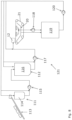
- FIG 8 an example of a supply system 121 is shown, in particular a water management system, with which the Figure 9 illustrated embodiment of a method 100d can be operated.
- the supply system 121 is concerned, on the one hand, with the provision of an aqueous dispersion 5a comprising the short fibers 5 for the headbox 12 and, on the other hand, with the provision, use and recirculation of water provided for in the aforementioned context.
- short fibers 5 are first conveyed by means of a bundle conveyor 113 to a dispersing unit 114 for dispersion 111 therein.
- the resulting purified mass is fed by a pump 115 to a mixer and/or container 116 for storage 112. Provision to the headbox 12 is achieved by pumping 117 the dispersion 5a from the container 116.
- water can be removed from the resulting second layer 2 by the screen belt 21 and the water absorption 20 located underneath.
- active pumping or suction 118 can take place on the underside of the screen belt 21. This allows liquid to be removed from the second layer 2 particularly effectively.
- the water obtained by the water intake 20 is fed to a water tank 119. From this water tank 119, water can be fed by a pump 120 to the headbox 12, the container 116, a conveying line for pumping 117 the dispersion 5a from the container 116, and/or a conveying line for pumping 115 the pasty mass from the dispersing unit 114.
- the last two options serve in particular to prevent blockages during pumping 115, 117.
- This water circuit enables particularly efficient and cost-effective operation of the system.
Landscapes
- Engineering & Computer Science (AREA)
- Textile Engineering (AREA)
- Mechanical Engineering (AREA)
- Nonwoven Fabrics (AREA)
- Manufacturing Of Multi-Layer Textile Fabrics (AREA)
Applications Claiming Priority (3)
| Application Number | Priority Date | Filing Date | Title |
|---|---|---|---|
| DE102020100472.9A DE102020100472A1 (de) | 2020-01-10 | 2020-01-10 | Verfahren zur Herstellung einer Verbundvlieswarenbahn und Vorrichtung zur Herstellung einer Verbundvlieswarenbahn |
| PCT/EP2020/085108 WO2021139945A1 (fr) | 2020-01-10 | 2020-12-08 | Procédé de fabrication d'une nappe de tissu non-tissé composite et dispositif pour la fabrication d'une nappe de tissu non-tissé composite |
| EP20824161.2A EP4087967B1 (fr) | 2020-01-10 | 2020-12-08 | Procédé de fabrication d'une nappe de tissu non-tissé composite et dispositif pour la fabrication d'une nappe de tissu non-tissé composite |
Related Parent Applications (2)
| Application Number | Title | Priority Date | Filing Date |
|---|---|---|---|
| EP20824161.2A Division EP4087967B1 (fr) | 2020-01-10 | 2020-12-08 | Procédé de fabrication d'une nappe de tissu non-tissé composite et dispositif pour la fabrication d'une nappe de tissu non-tissé composite |
| EP20824161.2A Division-Into EP4087967B1 (fr) | 2020-01-10 | 2020-12-08 | Procédé de fabrication d'une nappe de tissu non-tissé composite et dispositif pour la fabrication d'une nappe de tissu non-tissé composite |
Publications (2)
| Publication Number | Publication Date |
|---|---|
| EP4575060A2 true EP4575060A2 (fr) | 2025-06-25 |
| EP4575060A3 EP4575060A3 (fr) | 2025-09-03 |
Family
ID=73834481
Family Applications (2)
| Application Number | Title | Priority Date | Filing Date |
|---|---|---|---|
| EP25174758.0A Pending EP4575060A3 (fr) | 2020-01-10 | 2020-12-08 | Procédé de fabrication d'une bande de tissu non tissé composite et dispositif de fabrication d'une bande de tissu non tissé composite |
| EP20824161.2A Active EP4087967B1 (fr) | 2020-01-10 | 2020-12-08 | Procédé de fabrication d'une nappe de tissu non-tissé composite et dispositif pour la fabrication d'une nappe de tissu non-tissé composite |
Family Applications After (1)
| Application Number | Title | Priority Date | Filing Date |
|---|---|---|---|
| EP20824161.2A Active EP4087967B1 (fr) | 2020-01-10 | 2020-12-08 | Procédé de fabrication d'une nappe de tissu non-tissé composite et dispositif pour la fabrication d'une nappe de tissu non-tissé composite |
Country Status (6)
| Country | Link |
|---|---|
| US (1) | US12460329B2 (fr) |
| EP (2) | EP4575060A3 (fr) |
| CN (1) | CN114929959B (fr) |
| BR (1) | BR112022013381A2 (fr) |
| DE (1) | DE102020100472A1 (fr) |
| WO (1) | WO2021139945A1 (fr) |
Families Citing this family (4)
| Publication number | Priority date | Publication date | Assignee | Title |
|---|---|---|---|---|
| DE102020122864A1 (de) * | 2020-01-10 | 2021-07-15 | Trützschler GmbH & Co Kommanditgesellschaft | Anlage und Verfahren zur Herstellung eines ein- oder mehrlagigen Vlieses |
| DE102020113137A1 (de) * | 2020-05-14 | 2021-11-18 | Trützschler GmbH & Co Kommanditgesellschaft | Anlage und Verfahren zur Herstellung eines mehrlagigen Vlieses |
| DE102023106230A1 (de) * | 2023-03-13 | 2024-09-19 | Andritz Küsters Gmbh | Verfahren und Vorrichtung zum Herstellen einer Faserbahn |
| DE102024100755A1 (de) * | 2024-01-11 | 2025-07-17 | Trützschler Group SE | Verfahren und Anlage zur Herstellung eines zweilagigen Vlieses |
Family Cites Families (46)
| Publication number | Priority date | Publication date | Assignee | Title |
|---|---|---|---|---|
| FR1449996A (fr) | 1965-09-27 | 1966-08-19 | Fabrication en continu de feutres non-tissés armés avec ou sans charges | |
| US3817820A (en) * | 1972-01-28 | 1974-06-18 | Fiberwoven Corp | Needled textile fabric |
| US4376014A (en) * | 1979-04-12 | 1983-03-08 | Beloit Corporation | Headbox for forming multi-ply sheets |
| US4443297A (en) * | 1980-08-18 | 1984-04-17 | James River-Dixie/Northern, Inc. | Apparatus and method for the manufacture of a non-woven fibrous web |
| JPH08291453A (ja) | 1995-04-21 | 1996-11-05 | Mitsubishi Paper Mills Ltd | 抗ピル耐久性衣料用不織布およびその製造法、ならびに衣料 |
| US5587225A (en) * | 1995-04-27 | 1996-12-24 | Kimberly-Clark Corporation | Knit-like nonwoven composite fabric |
| US6022447A (en) * | 1996-08-30 | 2000-02-08 | Kimberly-Clark Corp. | Process for treating a fibrous material and article thereof |
| SE9703886L (sv) * | 1997-10-24 | 1999-04-25 | Sca Hygiene Paper Ab | Metod för framställning av ett nonwovenmaterial och framställt enligt metoden |
| US6387831B2 (en) | 1997-12-23 | 2002-05-14 | Kimberly-Clark Worldwide, Inc. | Compressed absorbent composites |
| US6110848A (en) * | 1998-10-09 | 2000-08-29 | Fort James Corporation | Hydroentangled three ply webs and products made therefrom |
| DE10006763A1 (de) * | 2000-02-15 | 2001-08-16 | Fleissner Gerold | Vorrichtung zum hydrodynamischen Beaufschlagen der Fasern einer Faserbahn mit einem Fluid |
| DE10008746A1 (de) * | 2000-02-24 | 2001-08-30 | Fleissner Maschf Gmbh Co | Verfahren und Vorrichtung zur Herstellung von Verbundvliesstoffen mittels hydrodynamischer Vernadelung |
| DE10060050C2 (de) | 2000-12-01 | 2002-11-14 | Pama Papiermaschinen Gmbh | Anordnung zur Einstellung des Flächengewichts-Querprofils mit Verdünnungswasser an Papiermaschinen |
| US6592713B2 (en) * | 2000-12-18 | 2003-07-15 | Sca Hygiene Products Ab | Method of producing a nonwoven material |
| DE10113862C1 (de) | 2001-03-21 | 2002-08-08 | Kuesters Eduard Maschf | Verfahren und Vorrichtung zur Ultraschallbearbeitung einer Warenbahn |
| FR2849869B1 (fr) * | 2003-01-14 | 2005-09-09 | Ahlstrom Brignoud | Procede de fabrication d'un non tisse composite et installation pour la mise en oeuvre dudit procede |
| SE0302874D0 (sv) * | 2003-10-31 | 2003-10-31 | Sca Hygiene Prod Ab | A hydroentangled nonwoven material |
| US20050091811A1 (en) * | 2003-10-31 | 2005-05-05 | Sca Hygiene Products Ab | Method of producing a nonwoven material |
| US7416638B2 (en) | 2003-11-18 | 2008-08-26 | Georgia-Pacific Consumer Products Lp | Apparatus and method for manufacturing a multi-layer web product |
| US20050159065A1 (en) * | 2003-12-18 | 2005-07-21 | Anders Stralin | Composite nonwoven material containing continuous filaments and short fibres |
| CA2554819A1 (fr) * | 2004-03-18 | 2005-09-22 | Sca Hygiene Products Ab | Procede pour produire un materiau non-tisse |
| US7278187B2 (en) * | 2004-08-27 | 2007-10-09 | Dan-Web Holding A/S | Manufacture of a multi-layer fabric |
| DE102004042477A1 (de) * | 2004-09-02 | 2006-03-30 | Eduard Küsters Maschinenfabrik GmbH & Co. KG | Verfahren und Vorrichtung zur Verfestigung einer ein Vlies umfassenden Warenbahn |
| WO2006118492A1 (fr) * | 2005-04-29 | 2006-11-09 | Sca Hygiene Products Ab | Materiau composite non tisse integre et hydroentremele |
| DE102007008423A1 (de) * | 2007-02-21 | 2008-08-28 | Johns Manville Europe Gmbh | Neue Verbundwerkstoffe, Verfahren zu deren Herstellung und deren Verwendung |
| DE102007060400B3 (de) * | 2007-12-14 | 2009-05-28 | Andritz Küsters Gmbh | Vorrichtung zum Bilden eines Langspalts |
| US20100159775A1 (en) * | 2008-12-19 | 2010-06-24 | Chambers Jr Leon Eugene | Nonwoven Composite And Method For Making The Same |
| DE102009048820A1 (de) | 2009-10-09 | 2011-04-14 | Andritz Küsters Gmbh | Vorhang-Auftragswerk |
| JP5520091B2 (ja) | 2010-03-10 | 2014-06-11 | ユニ・チャーム株式会社 | 積層体処理装置 |
| CN103597135B (zh) * | 2011-05-04 | 2016-01-06 | Sca卫生用品公司 | 制备水力缠结的非织造材料的方法 |
| CN102535009A (zh) | 2011-12-31 | 2012-07-04 | 山东俊富非织造材料有限公司 | 一次性尿片生产线及生产方法 |
| AU2012379139B2 (en) | 2012-05-03 | 2015-09-24 | Essity Hygiene And Health Aktiebolag | Method of producing a hydroentangled nonwoven material |
| RU2614602C2 (ru) * | 2012-12-27 | 2017-03-28 | Ска Хайджин Продактс Аб | Тисненый композитный нетканый рулонный материал |
| US20150322606A1 (en) * | 2012-12-27 | 2015-11-12 | Sca Hygiene Products Ab | Hydroformed composite nonwoven |
| DE102015112955A1 (de) * | 2015-04-13 | 2016-10-13 | TRüTZSCHLER GMBH & CO. KG | Anlage und Verfahren zur Verbindung bzw. Verfestigung einer Bahn von Faserstoff mit einem Vlies |
| DK3384078T3 (da) * | 2015-12-01 | 2020-02-24 | Essity Hygiene & Health Ab | Fremgangsmåde til at fremstille ikke-vævede materialer med forbedrede overfladeegenskaber |
| BR112018009919B1 (pt) * | 2015-12-02 | 2022-04-05 | Kimberly-Clark Worldwide, Inc | Camada de distribuição de captação não tecida, e, artigo absorvente |
| RU2711264C1 (ru) | 2016-09-01 | 2020-01-16 | Эссити Хайджин Энд Хелт Актиеболаг | Способ и устройство для влажной укладки нетканых материалов |
| EP3507408B1 (fr) * | 2016-09-01 | 2021-02-24 | Essity Hygiene And Health Aktiebolag | Procédé de production de nontissés |
| JP6902341B2 (ja) * | 2016-09-15 | 2021-07-14 | 日本製紙クレシア株式会社 | 複合型不織布の製造方法およびその製造装置 |
| CN106811866B (zh) | 2016-11-24 | 2019-03-08 | 浙江金三发非织造布有限公司 | 一种用于卫生巾的含棉无纺布的制备方法 |
| KR101919239B1 (ko) * | 2017-06-09 | 2018-11-15 | 한국섬유개발연구원 | 일체형 필터 제조용 다층구조의 습식복합부직포 제조장치 |
| CN107475893A (zh) | 2017-08-09 | 2017-12-15 | 大连瑞光非织造布集团有限公司 | 超柔婴幼儿用湿法水刺复合非织造布及生产方法 |
| EP3746591B1 (fr) * | 2018-02-02 | 2021-09-29 | Essity Hygiene and Health Aktiebolag | Matériau composite en feuille de non-tissé |
| DE202018104337U1 (de) * | 2018-07-27 | 2019-10-30 | McAirlaid's Vliesstoffe GmbH | Bahnenmaterial zur Verwendung in Lebensmittelverpackungen |
| BR112021025410A2 (pt) * | 2019-07-18 | 2022-02-01 | Essity Hygiene & Health Ab | Material de folha, processo de produção de material de folha, pano e uso de material de folha |
-
2020
- 2020-01-10 DE DE102020100472.9A patent/DE102020100472A1/de active Pending
- 2020-12-08 EP EP25174758.0A patent/EP4575060A3/fr active Pending
- 2020-12-08 EP EP20824161.2A patent/EP4087967B1/fr active Active
- 2020-12-08 US US17/791,214 patent/US12460329B2/en active Active
- 2020-12-08 CN CN202080092380.XA patent/CN114929959B/zh active Active
- 2020-12-08 BR BR112022013381A patent/BR112022013381A2/pt not_active Application Discontinuation
- 2020-12-08 WO PCT/EP2020/085108 patent/WO2021139945A1/fr not_active Ceased
Also Published As
| Publication number | Publication date |
|---|---|
| EP4575060A3 (fr) | 2025-09-03 |
| CN114929959B (zh) | 2023-11-21 |
| BR112022013381A2 (pt) | 2022-12-06 |
| DE102020100472A1 (de) | 2021-07-15 |
| CN114929959A (zh) | 2022-08-19 |
| EP4087967C0 (fr) | 2025-08-20 |
| US20230340709A1 (en) | 2023-10-26 |
| WO2021139945A1 (fr) | 2021-07-15 |
| EP4087967A1 (fr) | 2022-11-16 |
| EP4087967B1 (fr) | 2025-08-20 |
| US12460329B2 (en) | 2025-11-04 |
Similar Documents
| Publication | Publication Date | Title |
|---|---|---|
| EP4087967B1 (fr) | Procédé de fabrication d'une nappe de tissu non-tissé composite et dispositif pour la fabrication d'une nappe de tissu non-tissé composite | |
| EP2630287B1 (fr) | Procédé et dispositif de fabrication d'un non-tissé composite | |
| EP3118361B1 (fr) | Installation et procede de fabrication d'un voile multicouche a partir d'au moins un voile de carde non encolle | |
| EP3283679B1 (fr) | Système et procédé de liaison ou de consolidation d'une bande de matière fibreuse à un non-tissé | |
| EP4087966B1 (fr) | Installation et procédé de fabrication d'un non-tissé monocouche ou multicouche | |
| DE29521570U1 (de) | Vorrichtung zum Herstellen eines nicht-gewebten textilen Tuches mittels Druckwasserstrahlen | |
| EP4149751B1 (fr) | Système de production d'un non-tissé multicouche et procédé de production d'un non-tissé | |
| DE19511904B4 (de) | Anlage und Verfahren zur Herstellung von Vliesbahnen | |
| EP4067548B2 (fr) | Installation de consolidation des couches comprenant des fibres en une bande de non-tissée | |
| DE102009031635A1 (de) | Vliesstoff sowie Verfahren und Vorrichtung zur Herstellung eines solchen Vliesstoffes | |
| DE10329648B4 (de) | Vorrichtung zur Vliesbildung | |
| EP4461859B1 (fr) | Installation et procédé de liaison consolidation d'une bande de matière fibreuse avec un non-tissé | |
| WO2019243109A1 (fr) | Procédé de fabrication d'une bande de non tissé assemblée par voie humide et une bande fibreuse multicouche | |
| EP4444946B1 (fr) | Système et procédé de production de non-tissé monocouche ou multicouche | |
| DE102024130446B3 (de) | Verfahren und Maschine zur Herstellung einer luftgelegten Faserstoffbahn | |
| DE102024130444B3 (de) | Verfahren zur Herstellung einer luftgelegten Faserstoffbahn | |
| WO2025149196A1 (fr) | Procédé et installation de production d'un non-tissé à deux couches | |
| DE102024130472A1 (de) | Verfahren und Maschine zur Herstellung einer luftgelegten Faserstoffbahn | |
| DE102024127567A1 (de) | Verfahren und Maschine zur Herstellung einer trockengelegten Faserstoffbahn | |
| DE2542184A1 (de) | Papiermacherfilz sowie verfahren und vorrichtung zur herstellung desselben | |
| DE102024127565A1 (de) | Verfahren und Maschine zur Herstellung einer trockengelegten Faserstoffbahn | |
| WO2025021550A1 (fr) | Procédé et appareil de production de feutre | |
| EP4301919A1 (fr) | Assemblage d'un dispositif et procédé et dispositif de fabrication d'un non-tissé composite |
Legal Events
| Date | Code | Title | Description |
|---|---|---|---|
| PUAI | Public reference made under article 153(3) epc to a published international application that has entered the european phase |
Free format text: ORIGINAL CODE: 0009012 |
|
| STAA | Information on the status of an ep patent application or granted ep patent |
Free format text: STATUS: THE APPLICATION HAS BEEN PUBLISHED |
|
| AC | Divisional application: reference to earlier application |
Ref document number: 4087967 Country of ref document: EP Kind code of ref document: P |
|
| AK | Designated contracting states |
Kind code of ref document: A2 Designated state(s): AL AT BE BG CH CY CZ DE DK EE ES FI FR GB GR HR HU IE IS IT LI LT LU LV MC MK MT NL NO PL PT RO RS SE SI SK SM TR |
|
| REG | Reference to a national code |
Ref country code: DE Ref legal event code: R079 Free format text: PREVIOUS MAIN CLASS: D04H0003160000 Ipc: D04H0001437400 |
|
| PUAL | Search report despatched |
Free format text: ORIGINAL CODE: 0009013 |
|
| AK | Designated contracting states |
Kind code of ref document: A3 Designated state(s): AL AT BE BG CH CY CZ DE DK EE ES FI FR GB GR HR HU IE IS IT LI LT LU LV MC MK MT NL NO PL PT RO RS SE SI SK SM TR |
|
| RIC1 | Information provided on ipc code assigned before grant |
Ipc: D04H 1/4374 20120101AFI20250728BHEP Ipc: D04H 3/105 20120101ALI20250728BHEP Ipc: D04H 3/11 20120101ALI20250728BHEP Ipc: D04H 3/16 20060101ALI20250728BHEP Ipc: D04H 1/492 20120101ALI20250728BHEP Ipc: D04H 1/498 20120101ALI20250728BHEP Ipc: D04H 1/732 20120101ALI20250728BHEP Ipc: D21F 1/02 20060101ALI20250728BHEP Ipc: D21F 11/04 20060101ALI20250728BHEP |
|
| STAA | Information on the status of an ep patent application or granted ep patent |
Free format text: STATUS: REQUEST FOR EXAMINATION WAS MADE |
|
| 17P | Request for examination filed |
Effective date: 20260303 |