EP4575462A1 - Procédé de détermination de pigment blanc dans une couche de papier - Google Patents
Procédé de détermination de pigment blanc dans une couche de papier Download PDFInfo
- Publication number
- EP4575462A1 EP4575462A1 EP23218573.6A EP23218573A EP4575462A1 EP 4575462 A1 EP4575462 A1 EP 4575462A1 EP 23218573 A EP23218573 A EP 23218573A EP 4575462 A1 EP4575462 A1 EP 4575462A1
- Authority
- EP
- European Patent Office
- Prior art keywords
- white pigment
- paper layer
- nir
- impregnation
- reference samples
- Prior art date
- Legal status (The legal status is an assumption and is not a legal conclusion. Google has not performed a legal analysis and makes no representation as to the accuracy of the status listed.)
- Pending
Links
Images
Classifications
-
- G—PHYSICS
- G01—MEASURING; TESTING
- G01N—INVESTIGATING OR ANALYSING MATERIALS BY DETERMINING THEIR CHEMICAL OR PHYSICAL PROPERTIES
- G01N21/00—Investigating or analysing materials by the use of optical means, i.e. using sub-millimetre waves, infrared, visible or ultraviolet light
- G01N21/17—Systems in which incident light is modified in accordance with the properties of the material investigated
- G01N21/25—Colour; Spectral properties, i.e. comparison of effect of material on the light at two or more different wavelengths or wavelength bands
- G01N21/31—Investigating relative effect of material at wavelengths characteristic of specific elements or molecules, e.g. atomic absorption spectrometry
- G01N21/35—Investigating relative effect of material at wavelengths characteristic of specific elements or molecules, e.g. atomic absorption spectrometry using infrared light
- G01N21/359—Investigating relative effect of material at wavelengths characteristic of specific elements or molecules, e.g. atomic absorption spectrometry using infrared light using near infrared light
-
- G—PHYSICS
- G01—MEASURING; TESTING
- G01N—INVESTIGATING OR ANALYSING MATERIALS BY DETERMINING THEIR CHEMICAL OR PHYSICAL PROPERTIES
- G01N21/00—Investigating or analysing materials by the use of optical means, i.e. using sub-millimetre waves, infrared, visible or ultraviolet light
- G01N21/17—Systems in which incident light is modified in accordance with the properties of the material investigated
- G01N21/25—Colour; Spectral properties, i.e. comparison of effect of material on the light at two or more different wavelengths or wavelength bands
- G01N21/31—Investigating relative effect of material at wavelengths characteristic of specific elements or molecules, e.g. atomic absorption spectrometry
- G01N21/35—Investigating relative effect of material at wavelengths characteristic of specific elements or molecules, e.g. atomic absorption spectrometry using infrared light
- G01N21/3563—Investigating relative effect of material at wavelengths characteristic of specific elements or molecules, e.g. atomic absorption spectrometry using infrared light for analysing solids; Preparation of samples therefor
-
- G—PHYSICS
- G01—MEASURING; TESTING
- G01N—INVESTIGATING OR ANALYSING MATERIALS BY DETERMINING THEIR CHEMICAL OR PHYSICAL PROPERTIES
- G01N21/00—Investigating or analysing materials by the use of optical means, i.e. using sub-millimetre waves, infrared, visible or ultraviolet light
- G01N21/84—Systems specially adapted for particular applications
- G01N21/86—Investigating moving sheets
-
- G—PHYSICS
- G01—MEASURING; TESTING
- G01N—INVESTIGATING OR ANALYSING MATERIALS BY DETERMINING THEIR CHEMICAL OR PHYSICAL PROPERTIES
- G01N21/00—Investigating or analysing materials by the use of optical means, i.e. using sub-millimetre waves, infrared, visible or ultraviolet light
- G01N21/84—Systems specially adapted for particular applications
- G01N2021/8411—Application to online plant, process monitoring
- G01N2021/8416—Application to online plant, process monitoring and process controlling, not otherwise provided for
-
- G—PHYSICS
- G01—MEASURING; TESTING
- G01N—INVESTIGATING OR ANALYSING MATERIALS BY DETERMINING THEIR CHEMICAL OR PHYSICAL PROPERTIES
- G01N21/00—Investigating or analysing materials by the use of optical means, i.e. using sub-millimetre waves, infrared, visible or ultraviolet light
- G01N21/84—Systems specially adapted for particular applications
- G01N21/86—Investigating moving sheets
- G01N2021/8663—Paper, e.g. gloss, moisture content
-
- G—PHYSICS
- G01—MEASURING; TESTING
- G01N—INVESTIGATING OR ANALYSING MATERIALS BY DETERMINING THEIR CHEMICAL OR PHYSICAL PROPERTIES
- G01N2201/00—Features of devices classified in G01N21/00
- G01N2201/12—Circuits of general importance; Signal processing
- G01N2201/129—Using chemometrical methods
Definitions
- the present invention relates to a method for determining white pigment in a paper layer, in particular the type and amount of white pigment in a paper layer.
- impregnated papers are used extensively for the surface finishing of wood-based panels. These are essentially decorative papers, overlays, and counter-laminating papers that are pressed onto wood-based panels at high pressure and high temperatures. These coated panels are then used in a wide variety of applications (furniture, interior design, laminate flooring, etc.).
- the quality of the decorative paper used is particularly important when using such coated wood-based panels in the furniture industry. Even the smallest color deviations in the production of front elements can lead to a negative overall impression and thus to complaints.
- Decorative papers are specialty papers for surface finishing of wood-based materials, allowing for a wide variety of designs. In addition to the typical prints of various wood textures, more sophisticated prints featuring geometric shapes or artistic, decorative designs are available.
- the paper used as the printing base must be smooth and dimensional stable. Furthermore, the paper should be as light in color as possible to achieve the highest possible brilliance. For this reason, designs are preferably printed on light, preferably white, paper.
- white standard papers or base papers preferably low-gram papers for cost-saving reasons, are initially prepared with a base content of white pigmentation.
- the white pigments are incorporated into the base papers during the manufacturing process.
- Raw paper refers to paper that has not been subjected to sizing in the mass or to impregnation of the surface with a resin or glue.
- Base papers consist essentially of pulp, pigments (preferably white pigments), fillers, and common additives. Softwood pulp, hardwood pulp, or mixtures of both pulp types can be used to produce base papers.
- inorganic compounds are used as white pigments. However, the focus remains on titanium dioxide, as it achieves the highest increase in opacity relative to the applied quantity. Other inorganic compounds such as barium sulfate, zinc oxide, or calcium sulfate are sometimes added to reduce costs and/or to modify the color.
- these white standard papers or white base papers are treated with pigmented impregnating resins so that their whiteness is further increased by impregnation with resins containing white pigment.
- the resulting disadvantages are color variations, pigment losses and the resulting rising costs due to increasing waste and difficult quality control.
- the invention is therefore based on the technical problem of developing a method with which the white pigmentation, or the amount and type of white pigment, in or on a paper used as a printing base can be determined, in order to eliminate quality defects attributable to this parameter.
- the system technology should not require increased safety standards. Furthermore, the determination should yield the lowest possible error. The determination should be continuous and suitable for achieving automated system control based on this parameter.
- the present measurement method now makes it possible to determine the content and type of white pigment in a base paper layer.
- base paper refers to a paper layer that is not (yet) impregnated; i.e., a paper layer that is not impregnated with an impregnating resin, in particular a formaldehyde resin such as melamine, urea, and/or phenol-formaldehyde resin, or other resins such as melamine ether resins, acrylic resins, or epoxy resins, and thus consists solely of bonded pulp fibers and, if applicable, additives.
- the white pigment used in base paper layers is selected from titanium dioxide, barium sulfate, calcium sulfate, calcium carbonate, and/or zinc oxide, or a mixture thereof.
- the preferred white pigment is titanium dioxide.
- a base paper can be used that has a (basic) content of titanium dioxide.
- the amounts of titanium dioxide in such a white base paper are between 20 and 40 wt%, preferably between 25 and 35 wt% (based on the total paper weight).
- a first NIR spectrum is recorded for a raw paper layer without white pigment and a further NIR spectrum for a raw paper layer containing a white pigment and the amount and type of white pigment are determined from the difference.
- an NIR spectrum is first recorded for a base paper layer containing a first white pigment (e.g., TiO 2 ), and another NIR spectrum is recorded for a base paper layer containing a first (e.g., TiO 2 ) and a second white pigment (e.g., BaSO 4 or ZnO).
- the sum of the values for the paper with the first and second white pigments and the value for the paper with the first (single) white pigment ultimately yields the difference, from which the amount and type of the second white pigment can be determined.
- inferior quality (cheaper) pigments can also lead to poorer results in terms of lightfastness or to undesirable interactions when using surface-modifying chemicals in the resin formulation.
- the NIR measuring head determines the sum of the white pigment already contained in the base paper and the additional white pigment introduced into the base paper through impregnation. The difference is ultimately calculated from the sum and the value for the unpigmented paper.
- calibration grades are created for this process to establish a connection with the spectra determined via NIR. This makes it possible to determine unknown amounts of white pigment, such as titanium dioxide, in or on the paper layer. Furthermore, this calibration can be used to establish process monitoring. This can, for example, provide real-time quality data across the entire web width and enable rapid intervention in the event of deviations.
- the spectroscopic data can be used to analyze not only the order volume but also fluctuations within the order.
- the white pigment to be determined is introduced into the paper layer during a core impregnation (or pre-impregnation) of the paper layer.
- core impregnation or "pre-impregnation” refers to the impregnation of the paper core, whereby the impregnating resin penetrates the paper layer. In this case, the paper layer is completely or partially saturated with the impregnating resin.
- the "core impregnation" or “pre-impregnation” is carried out in the production of impregnates by applying the impregnating resin (in this case mixed with a white pigment) in a First impregnation tank, where, after immersion in the impregnation tank, the resin is scraped off to a defined resin layer using doctor blades or squeeze rollers.
- the pre-impregnated material is then dried in a flotation dryer with hot air (intermediate drying). This can be followed by surface impregnation of the pre-impregnated material with further drying.
- Each of these drying steps results in a reduction of the water content of the paper layer, preferably to 10-20 wt%.
- Equipment suitable for such impregnations is known.
- EP 3075906 B1 which describes an impregnation system consisting of a first impregnation station with a downstream drying station and a second impregnation station with a downstream drying station.
- the resin application for the surface impregnation of the paper layer is 30 to 50 wt%, preferably 35 to 45 wt%, particularly preferably 40 wt%.
- the present method for determining the amount of white pigment in a (raw) paper layer and/or impregnated paper layer can be carried out continuously and online in a production line, in particular in an impregnation plant.
- the NIR measuring head is preferably positioned so that the upper side of the impregnated paper layer is irradiated. However, it is generally possible to install additional NIR measuring heads in the Impregnation system for measuring the top and bottom of the impregnated paper layer.
- the NIR sensor head can be located after core impregnation, before or after the first dryer. Another option would be after the second dryer, before the clipper.
- the at least one NIR measuring head traverses the width of the paper layer and analyzes specific problem areas (e.g., in the edge or center area of the boards, etc.). Accordingly, the at least one NIR measuring head moves transversely to the direction of travel of the (pre)impregnated paper layer. Furthermore, the measured values are immediately available and allow immediate intervention in the process. This is not readily possible with other methods.
- a first drying station is provided after the first impregnation station, wherein the at least one NIR measuring head is arranged after the first drying station.
- the impregnation system comprises impregnation tanks or impregnation immersion baths (as impregnation stations), if necessary a breathing section, a doctor blade system/pair of squeeze rollers for removing excess resin, at least one dryer (e.g. a flotation dryer), optionally a screen unit and an optional second dryer, at least one cooling device (e.g. a cooling roller system).
- at least one dryer e.g. a flotation dryer
- a screen unit e.g. a screen unit
- at least one cooling device e.g. a cooling roller system.
- the amount of white pigment in a (pre)impregnated paper layer can be determined from an NIR spectrum, specifically by a non-contact measurement.
- the data acquired with the measuring head(s) are used directly for system control or regulation.
- the storage of data enables improved quality control.
- the stored data can also advantageously contribute to the evaluation of system tests, e.g., during commissioning of a system after a new installation or after maintenance or repair, or for in-situ testing of new production or measurement processes.
- the immediate availability of the measured values and the high measurement frequency enable very close monitoring, control, or regulation of the systems.
- This method enables the provision of measured values in a short time (online, preferably without disruptive time delays) compared to conventional (known) measurement methods.
- the measured data can be used for quality assurance, research and development, process control, process regulation, process control, etc.
- the measurement process does not reduce production speed, etc. Fundamentally, it improves production monitoring. Furthermore, downtimes due to quality control and system adjustments are reduced.
- the control system of the impregnation plant comprises at least one computer-assisted evaluation unit (or processor unit) and a database.
- the evaluation unit compares the NIR spectrum measured for the product (i.e., pressed porous coating material) with the calibration models created for the individual parameters. The parameter data thus determined is stored in the database.
- the data determined using this spectroscopic method can be used to control the impregnation system.
- the non-contact measured parameter values of the NIR multi-measuring head ("actual values") can, as previously described, be used directly and in real time to control or regulate the system in question. For example, by storing the measured actual values in a database, e.g., a relational database, and comparing them with the target values of these parameters. The resulting differences are then used to control or regulate the production line.
- a computer-implemented method and a computer program comprising instructions that, when executed by a computer, cause the computer to execute the computer-implemented method are provided.
- the computer program is stored in a memory unit of the control system of the impregnation system.
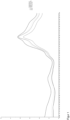
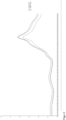
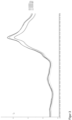
- a white (raw) decorative paper (paper weight: 65 g/m 2 ), which had a titanium dioxide content of approximately 25 wt%, was first impregnated with a urea resin (core impregnation) and then with a melamine resin (surface impregnation) (total resin application: 130 wt%, urea resin: 90 wt%, melamine resin: 40 wt%), dried in between and pressed onto a chipboard in a laboratory press (standard 65 g/m 2 ).
- an overlay without white pigment (paper weight: 35 g/m 2 ) was impregnated with the same resins.
- the resin application rate was 400 wt%.
- the resin distribution was similar to that of the white papers.
- the pigment-free overlay served as a reference sample or blank sample (OV without TiO 2 ). It was pressed onto a particle board under the same conditions.
Landscapes
- Physics & Mathematics (AREA)
- Spectroscopy & Molecular Physics (AREA)
- Health & Medical Sciences (AREA)
- Life Sciences & Earth Sciences (AREA)
- Chemical & Material Sciences (AREA)
- Analytical Chemistry (AREA)
- Biochemistry (AREA)
- General Health & Medical Sciences (AREA)
- General Physics & Mathematics (AREA)
- Immunology (AREA)
- Pathology (AREA)
- Paper (AREA)
Priority Applications (2)
| Application Number | Priority Date | Filing Date | Title |
|---|---|---|---|
| EP23218573.6A EP4575462A1 (fr) | 2023-12-20 | 2023-12-20 | Procédé de détermination de pigment blanc dans une couche de papier |
| PCT/EP2024/086641 WO2025132256A1 (fr) | 2023-12-20 | 2024-12-16 | Procédé de détermination de pigment blanc dans une couche de papier |
Applications Claiming Priority (1)
| Application Number | Priority Date | Filing Date | Title |
|---|---|---|---|
| EP23218573.6A EP4575462A1 (fr) | 2023-12-20 | 2023-12-20 | Procédé de détermination de pigment blanc dans une couche de papier |
Publications (1)
| Publication Number | Publication Date |
|---|---|
| EP4575462A1 true EP4575462A1 (fr) | 2025-06-25 |
Family
ID=89224330
Family Applications (1)
| Application Number | Title | Priority Date | Filing Date |
|---|---|---|---|
| EP23218573.6A Pending EP4575462A1 (fr) | 2023-12-20 | 2023-12-20 | Procédé de détermination de pigment blanc dans une couche de papier |
Country Status (2)
| Country | Link |
|---|---|
| EP (1) | EP4575462A1 (fr) |
| WO (1) | WO2025132256A1 (fr) |
Citations (5)
| Publication number | Priority date | Publication date | Assignee | Title |
|---|---|---|---|---|
| US4845730A (en) * | 1986-12-20 | 1989-07-04 | Paul Lippke Gmbh Und Co. Kg | Selective on-line measurement of filler components in paper |
| US5795394A (en) * | 1997-06-02 | 1998-08-18 | Honeywell-Measurex | Coating weight measuring and control apparatus |
| WO1999041590A1 (fr) * | 1998-02-12 | 1999-08-19 | Neles Paper Automation Oy | Procede et dispositif de mesure de la quantite de revetement sur un substrat en mouvement |
| US20070131862A1 (en) * | 2005-12-13 | 2007-06-14 | Huber Engineered Woods L.L.C. | Method using NIR spectroscopy to monitor components of engineered wood products |
| EP3075906B1 (fr) | 2015-04-01 | 2018-09-12 | Fritz Egger GmbH & Co. OG | Installation d'impregnation et son procede de surveillance |
Family Cites Families (1)
| Publication number | Priority date | Publication date | Assignee | Title |
|---|---|---|---|---|
| PL2915658T3 (pl) * | 2014-03-05 | 2018-01-31 | Flooring Technologies Ltd | Sposób określania zawartości wilgoci warstwy żywicy na płycie z tworzywa drzewnego pokrytej materiałem podłożowym zawierającym włókna |
-
2023
- 2023-12-20 EP EP23218573.6A patent/EP4575462A1/fr active Pending
-
2024
- 2024-12-16 WO PCT/EP2024/086641 patent/WO2025132256A1/fr active Pending
Patent Citations (5)
| Publication number | Priority date | Publication date | Assignee | Title |
|---|---|---|---|---|
| US4845730A (en) * | 1986-12-20 | 1989-07-04 | Paul Lippke Gmbh Und Co. Kg | Selective on-line measurement of filler components in paper |
| US5795394A (en) * | 1997-06-02 | 1998-08-18 | Honeywell-Measurex | Coating weight measuring and control apparatus |
| WO1999041590A1 (fr) * | 1998-02-12 | 1999-08-19 | Neles Paper Automation Oy | Procede et dispositif de mesure de la quantite de revetement sur un substrat en mouvement |
| US20070131862A1 (en) * | 2005-12-13 | 2007-06-14 | Huber Engineered Woods L.L.C. | Method using NIR spectroscopy to monitor components of engineered wood products |
| EP3075906B1 (fr) | 2015-04-01 | 2018-09-12 | Fritz Egger GmbH & Co. OG | Installation d'impregnation et son procede de surveillance |
Also Published As
| Publication number | Publication date |
|---|---|
| WO2025132256A1 (fr) | 2025-06-26 |
Similar Documents
| Publication | Publication Date | Title |
|---|---|---|
| EP3885740B1 (fr) | Procédé de détermination simultanée des paramètres d'au moins une couche de résine appliquée sur au moins une matière support | |
| EP2808636B1 (fr) | Procédé de détermination de la teneur en humidité d'une couche de résine sur une plaque de support | |
| EP3470823B1 (fr) | Procédé de détermination de la résistance à la friction d'au moins une couche d'usure disposée sur une plaque de support | |
| EP3238934B1 (fr) | Procédé de détermination du degré de durcissement d'au moins une couche thermodurcissable en résine contenant du formaldéhyde disposée sur un panneau à base de bois | |
| EP3327424B1 (fr) | Procédé de détermination du degré de réticulation d'au moins une couche de résine disposée sur une plaque support | |
| EP3428619B1 (fr) | Procédé de détermination de la quantité d'une couche de résine liquide appliquée sur une plaque de bois | |
| EP4298427B1 (fr) | Procédé de détermination de la pénétration de résine dans bois utlisant la spectroscopie infrarouge proche | |
| EP4575462A1 (fr) | Procédé de détermination de pigment blanc dans une couche de papier | |
| EP4080196B1 (fr) | Procédé de détermination du rapport quantitatif de résine mélamine-formaldéhyde et de résine urée-formaldéhyde dans au moins une couche de papier imprégnée d'un mélange desdites résines | |
| EP4517300B1 (fr) | Procédé de mesure en ligne d'une quantité de liant appliquée sur des particules de bois dans une installation de production pour la fabrication de panneaux en bois | |
| EP4303565B1 (fr) | Procédé de détermination de la quantité et/ou de la composition d'une couche de résine en forme de poudre appliquée sur une matière support | |
| EP4427919B1 (fr) | Procédé de commande d'une presse pour le pressage d'un matériau support comprenant au moins une couche de résine disposée sur le matériau support et ligne de production correspondante | |
| EP3757508B1 (fr) | Procédé de détermination de la quantité d'une couche appliquée sur une plaque porteuse, en particulier une couche d'apprêt | |
| WO2026093301A1 (fr) | Procédé de prédiction de l'aptitude au revêtement ou de la mouillabilité de la surface d'un panneau en bois | |
| EP4737884A1 (fr) | Procédé de prédiction de la capacité de mouillabilité de surface de plaque en bois | |
| EP4227668A1 (fr) | Procédé de détermination de la quantité d'application d'au moins une préparation isolante sur un bord latéral d'un panneau à base de matière dérivée du bois | |
| EP4303567A1 (fr) | Procédé de détermination de la quantité d'au moins un liant pulvérulent dans un mélange comportant des particules de bois | |
| EP3336521B1 (fr) | Procédé de détermination de la teneur en particules solides anorganiques dans une solution résineuse |
Legal Events
| Date | Code | Title | Description |
|---|---|---|---|
| PUAI | Public reference made under article 153(3) epc to a published international application that has entered the european phase |
Free format text: ORIGINAL CODE: 0009012 |
|
| STAA | Information on the status of an ep patent application or granted ep patent |
Free format text: STATUS: EXAMINATION IS IN PROGRESS |
|
| 17P | Request for examination filed |
Effective date: 20240828 |
|
| AK | Designated contracting states |
Kind code of ref document: A1 Designated state(s): AL AT BE BG CH CY CZ DE DK EE ES FI FR GB GR HR HU IE IS IT LI LT LU LV MC ME MK MT NL NO PL PT RO RS SE SI SK SM TR |
|
| GRAP | Despatch of communication of intention to grant a patent |
Free format text: ORIGINAL CODE: EPIDOSNIGR1 |
|
| STAA | Information on the status of an ep patent application or granted ep patent |
Free format text: STATUS: GRANT OF PATENT IS INTENDED |