EP4575509A1 - Probenlade-/-entladevorrichtung, automatischer analysator und betriebsverfahren dafür - Google Patents
Probenlade-/-entladevorrichtung, automatischer analysator und betriebsverfahren dafür Download PDFInfo
- Publication number
- EP4575509A1 EP4575509A1 EP23854112.2A EP23854112A EP4575509A1 EP 4575509 A1 EP4575509 A1 EP 4575509A1 EP 23854112 A EP23854112 A EP 23854112A EP 4575509 A1 EP4575509 A1 EP 4575509A1
- Authority
- EP
- European Patent Office
- Prior art keywords
- sample
- unloading apparatus
- sample loading
- loading
- automatic analyzer
- Prior art date
- Legal status (The legal status is an assumption and is not a legal conclusion. Google has not performed a legal analysis and makes no representation as to the accuracy of the status listed.)
- Pending
Links
Images






Classifications
-
- G—PHYSICS
- G01—MEASURING; TESTING
- G01N—INVESTIGATING OR ANALYSING MATERIALS BY DETERMINING THEIR CHEMICAL OR PHYSICAL PROPERTIES
- G01N35/00—Automatic analysis not limited to methods or materials provided for in any single one of groups G01N1/00 - G01N33/00; Handling materials therefor
- G01N35/02—Automatic analysis not limited to methods or materials provided for in any single one of groups G01N1/00 - G01N33/00; Handling materials therefor using a plurality of sample containers moved by a conveyor system past one or more treatment or analysis stations
- G01N35/04—Details of the conveyor system
-
- G—PHYSICS
- G01—MEASURING; TESTING
- G01N—INVESTIGATING OR ANALYSING MATERIALS BY DETERMINING THEIR CHEMICAL OR PHYSICAL PROPERTIES
- G01N35/00—Automatic analysis not limited to methods or materials provided for in any single one of groups G01N1/00 - G01N33/00; Handling materials therefor
- G01N35/00584—Control arrangements for automatic analysers
-
- G—PHYSICS
- G01—MEASURING; TESTING
- G01N—INVESTIGATING OR ANALYSING MATERIALS BY DETERMINING THEIR CHEMICAL OR PHYSICAL PROPERTIES
- G01N35/00—Automatic analysis not limited to methods or materials provided for in any single one of groups G01N1/00 - G01N33/00; Handling materials therefor
- G01N35/0099—Automatic analysis not limited to methods or materials provided for in any single one of groups G01N1/00 - G01N33/00; Handling materials therefor comprising robots or similar manipulators
-
- G—PHYSICS
- G01—MEASURING; TESTING
- G01N—INVESTIGATING OR ANALYSING MATERIALS BY DETERMINING THEIR CHEMICAL OR PHYSICAL PROPERTIES
- G01N35/00—Automatic analysis not limited to methods or materials provided for in any single one of groups G01N1/00 - G01N33/00; Handling materials therefor
- G01N35/10—Devices for transferring samples or any liquids to, in, or from, the analysis apparatus, e.g. suction devices, injection devices
-
- G—PHYSICS
- G01—MEASURING; TESTING
- G01N—INVESTIGATING OR ANALYSING MATERIALS BY DETERMINING THEIR CHEMICAL OR PHYSICAL PROPERTIES
- G01N35/00—Automatic analysis not limited to methods or materials provided for in any single one of groups G01N1/00 - G01N33/00; Handling materials therefor
- G01N35/02—Automatic analysis not limited to methods or materials provided for in any single one of groups G01N1/00 - G01N33/00; Handling materials therefor using a plurality of sample containers moved by a conveyor system past one or more treatment or analysis stations
- G01N35/04—Details of the conveyor system
- G01N2035/0401—Sample carriers, cuvettes or reaction vessels
- G01N2035/0412—Block or rack elements with a single row of samples
-
- G—PHYSICS
- G01—MEASURING; TESTING
- G01N—INVESTIGATING OR ANALYSING MATERIALS BY DETERMINING THEIR CHEMICAL OR PHYSICAL PROPERTIES
- G01N35/00—Automatic analysis not limited to methods or materials provided for in any single one of groups G01N1/00 - G01N33/00; Handling materials therefor
- G01N35/02—Automatic analysis not limited to methods or materials provided for in any single one of groups G01N1/00 - G01N33/00; Handling materials therefor using a plurality of sample containers moved by a conveyor system past one or more treatment or analysis stations
- G01N35/04—Details of the conveyor system
- G01N2035/046—General conveyor features
- G01N2035/0465—Loading or unloading the conveyor
Definitions
- the present application relates to the medical technical field. Specifically, the present application relates to a sample loading/unloading apparatus, an automatic analyzer including the sample loading/unloading apparatus, and an operation method thereof.
- the automatic analyzer typically uses sample racks to carry multiple sample containers, such as test tubes or cups, wherein each of the sample containers contains a sample to be detected or analyzed.
- sample racks For some known existing automatic analyzers, when loading/unloading the sample racks, a door of the automatic analyzer is opened, and the sample racks are directly placed into a loading/unloading area of the automatic analyzer one by one or directly taken out from the loading/unloading area one by one.
- the existing automatic analyzers described above have low efficiency because the sample racks are loaded/unloaded one-by-one.
- the sample racks are placed into or taken out from the loading/unloading area of the automatic analyzer, it is easy to cause contamination to the loading/unloading area, for example, by splashing out of the sample.
- the loading/unloading area of the automatic analyzer is not easy to clean.
- the sample racks are usually elongated, so that the sample racks are unstable and prone to toppling over.
- an object of the present application is to provide a sample loading/unloading apparatus, which can load or unload sample racks in batches. So the efficiency of the automatic analyzer can be significantly improved.
- Another object of the present application is to provide a sample loading/unloading apparatus which is easy to clean and/or can prevent sample racks from toppling over.
- a sample loading/unloading apparatus for an automatic analyzer.
- the sample loading/unloading apparatus includes: a tray configured to carry multiple sample racks on which sample containers are loaded, and to be placed in a sample loading/unloading area of the automatic analyzer; and a sample rack holder engaged with the tray and movable between a first position where the sample racks are held in place and a second position where the sample racks are allowed to be released within the sample loading/unloading area.
- the tray is provided with multiple parallel receiving channels for separating the sample racks from each other.
- the tray is provided with indicators for indicating whether the sample racks are loaded.
- the tray is provided with a handle for operation on each of two opposite sides of the tray, respectively.
- the sample rack holder is transverse to the multiple receiving channels and is located at an end of each of the multiple receiving channels.
- the sample rack holder is in the form of an elongated rod.
- the sample rack holder is provided with at least two convex structures, and the tray is provided with corresponding concave structures for receiving the convex structures respectively.
- each of the convex structures includes a first guide portion
- each of the concave structures includes a second guide portion for receiving the first guide portion to guide movement of the sample rack holder.
- each of the convex structures is in the form of a pin that extends from the sample rack holder.
- each of the concave structures extends downward from an upper surface of the tray such that the sample rack holder moves in a vertical direction.
- the sample rack holder has an inclined portion inclined in a movement direction of the sample rack holder for being pushed downward so that the sample rack holder moves from the first position to the second position.
- an elastic member is further included, and the elastic member is provided between the tray and the sample rack holder to apply an upward force to the sample rack holder.
- an automatic analyzer including the above sample loading/unloading apparatus.
- the automatic analyzer further includes: a housing, in which a sample loading/unloading area is defined; and an actuator, configured to move the sample rack holder between the first position and the second position.
- the actuator is attached to at least an inner sidewall of the housing.
- the actuator has a cylindrical outer peripheral surface which is configured to press down the inclined portion of the sample rack holder.
- the actuator is rotatable.
- the automatic analyzer further includes a drawer.
- the drawer is movable relative to the housing and on which the sample loading/unloading apparatus can be placed such that the sample loading/unloading apparatus moves with the movement of the drawer.
- an operation method of the automatic analyzer includes the steps of: placing at least one sample rack on the sample loading/unloading apparatus; placing the sample loading/unloading apparatus in the automatic analyzer; moving the sample loading/unloading apparatus from the first position to the second position within the sample loading/unloading area; analyzing samples in sample containers on the sample rack; returning the sample rack to the sample loading/unloading area after finishing analyzing; moving the sample loading/unloading apparatus from the second position to the first position; and taking out the sample loading/unloading apparatus from the automatic analyzer.
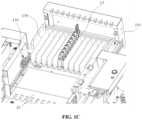
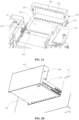
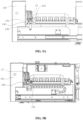
- An automatic analyzer 10 according to an embodiment of the present application will be described below with reference to FIG. 1A to FIG. 1C . It should be understood that the automatic analyzer 10 shown in the figures is merely illustrative and should not be limited to the specific examples shown in the figures.
- the automatic analyzer according to the present application may be any suitable automatic analyzer for testing or processing biological samples or other chemical samples, for example, a clinical chemical detector or an immunoassay detector.
- the automatic analyzer 10 includes a sample rack manipulation unit 11 and a sample processing unit 12.
- the sample rack manipulation unit 11 is configured to load or unload a sample rack 13 carrying sample containers, and to transport the sample rack 13 to a predetermined position in the automatic analyzer 10.
- the sample processing unit 12 is configured to collect samples in the sample containers and process the samples, for example, to detect the samples.
- the sample rack manipulation unit 11 and the sample processing unit 12 may be independent units, or may be integrated into one unit.
- the sample rack 13 is configured to receive, support, align, and hold one or more sample containers (not shown) containing samples.
- sample containers not shown
- multiple sample containers are arranged in a row on the sample rack 13.
- the sample rack 13 may be a universal sample rack for common sample containers such as test tubes or cups.
- the universal sample rack 13 may be purchased from Beckman Coulter, Inc. It should be understood that the automatic analyzer according to the present application may be adapted to load or unload multiple sample racks 13 at the same time, but it is not limited to the specific structure of the sample racks 13.
- the structure of the sample processing unit 12 may vary depending on the type of automatic analyzer.
- the sample processing unit 12 may have any known structure in the art for processing samples, which will not be described in detail herein.
- the sample rack manipulation unit 11 includes a housing 15, a drawer 110, and a sample loading/unloading apparatus 130.
- the housing 15 of the sample rack manipulation unit 11 and a housing 16 of the sample processing unit 12 constitute a housing of the automatic analyzer 10.
- a top cover 11a of the housing 15 is removed in order to clearly show an internal structure of the sample rack manipulation unit 11.
- a sample loading/unloading area 18 is defined in the housing 15.
- a shuttle (not shown) may engage with the sample racks 13 located in the sample loading/unloading area 18 and transport the sample racks 13 to a desired location, for example, a sample collection location.
- the shuttle (not shown) may send the sample racks 13 back to the sample loading/unloading area 18 so as the sample racks 13 may be taken out after the samples have been processed.
- the sample loading/unloading apparatus 130 is configured to carry multiple sample racks 13.
- the sample loading/unloading apparatus 130 is placed on the drawer 110 and can move together with the drawer 110 to reach the sample loading/unloading area 18 (i.e. loading the sample racks 13) or be far away from the sample loading/unloading area 18 (i.e. unloading the sample racks 13).
- the automatic analyzer 10 can easily load or unload the sample racks 13 in batches by means of the sample loading/unloading apparatus 130 and the drawer 110, thereby significantly improving the efficiency.
- the drawer 110 according to the present application will be described below with reference to FIG. 2A to FIG. 2D .
- the drawer 110 is configured to move between a closed position shown in FIG. 1A and FIG. 2D and an open position shown in FIG. 1B to FIG. 2B .
- the drawer 110 includes a substrate 111 for supporting the sample loading/unloading apparatus 130 and a front cover 112 located at a front end (the end facing an operator) of the substrate 111.
- the front cover 112 and the housing 15 form a closed space.
- the front cover 112 may be secured to the substrate 111 in any suitable manner known in the art.
- the substrate 111 may be coupled to the housing 15 in any suitable manner known in the art. As shown by way of the example in the figures, the substrate 111 may be coupled to the housing 15 by a guide rail. In addition, a chain may be provided between the substrate 111 and the housing 15, and the chain is electrically controlled to realize the automatic control and movement of the drawer 110.
- Positioning pins 114 may be provided on the substrate 111.
- the positioning pins 114 are engaged with the sample loading/unloading apparatus 130 to accurately position the sample loading/unloading apparatus 130.
- the structure and number of the positioning pins 114 may be changed as required, and should not be limited to the specific examples shown in the figures, as long as the functions described herein can be achieved.
- the positioning pins may be replaced by recess structures.
- a drawer state detection device 117 may be provided on the substrate 111.
- the drawer state detection device 117 is configured to detect whether the drawer 110 is normally closed. For example, before the automatic analyzer 10 is started, the drawer state detection device 117 first detects whether the drawer 110 is in a closed state. Accordingly, the housing 15 may be provided with a detection feature 11b corresponding to or matched with the drawer state detection device 117. When the drawer state detection device 117 is aligned with the detection feature 11b, it indicates that the drawer 110 is closed.
- Sample rack sensors 113 may be provided on the substrate 111.
- the sample rack sensors 113 are configured to sense whether the sample racks 13 are loaded.
- the front cover 112 may be provided with indicators, for example, indicator lights 116 shown in the figures.
- the indicator lights 116 may emit light of different colors based on the sensed result of the sample rack sensors 113. Whether the sample racks 13 have been loaded may be determined by the colors of the indicator lights 116.
- the front cover 112 may be provided with a magnetic attraction structure 115.
- the magnetic attraction structure 115 can magnetically attract the drawer 110 to the housing 15, thereby facilitating the closing of the drawer 110.
- a locking device 11c may be mounted in the housing 15, as shown in FIG. 2C and FIG. 2D .
- the locking device 11c is configured to lock the drawer 110 when the drawer 110 is closed, so as to prevent the drawer 110 from being accidentally opened when the automatic analyzer 10 is in operation.
- the locking device 11c includes a latch 119 and a cam 121.
- the latch 119 may be inserted into an aperture 118 in the front cover 112, so that the drawer 110 is locked. When the latch 119 exits the aperture 118, the drawer 110 is allowed to move.
- the cam 121 is configured to drive the latch 119.
- the cam 121 may be driven by, for example, a motor. It should be understood that the locking device should not be limited to the specific example shown in the figures, but may be varied as long as it can achieve the functions described herein.
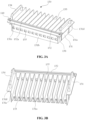
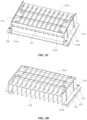
- the sample loading/unloading apparatus 130 includes a tray 131 and a sample rack holder 132.
- the tray 131 is configured to carry multiple sample racks 13.
- the tray 131 is placed in the sample loading/unloading area 18 of the automatic analyzer 10.
- the shuttle (not shown) may be engaged with the sample racks 13 on the tray 131 and transport the sample racks 113 to a predetermined position, for example, a sample collection position, or the shuttle (not shown) may transfer the sample racks 13 to the tray 131.
- the tray 131 includes a bottom plate 131a, a front plate 131b located at a front end (an end facing an operator) of the bottom plate 131a, and side plates 131c located on two opposite sides of the front plate 131b.
- the bottom plate 131a, the front plate 131b and the side plates 131c define a space for accommodating the sample racks 13.
- Partition plates may be provided in the space to form multiple parallel receiving channels 133 that separate the sample racks 13 from each other.
- the receiving channels 133 are configured to stably support the sample racks 13 to prevent the sample racks 13 from toppling over and the like.
- the tray 131 may be provided with a handle 134 for operation.
- a flange 131d may be provided at an upper end of each of the side plates 131c, and the handle 134 is mounted on the flange 131d.
- the handle 134 may be changed or omitted.
- the operator may directly handle the sample loading/unloading apparatus 130 by means of the flange 131d.
- the tray 131 may be provided with an indicator 135 for indicating whether the sample racks 13 are loaded.
- the indicator 135 may be in the form of a window or an opening.
- An indicator 135 may be provided for each of the receive channels 133. In this way, it may be observed that which receiving channel 133 has been loaded with the sample rack 13 through the indicators 135.
- the indicators 135 may correspond to the sample rack sensors 113 shown in FIG. 2A , respectively.
- the sample rack sensors 113 may be photoelectric sensors or any other suitable sensors.
- the structure of the indicators 135 may be designed according to the type of the sample rack sensors 113.
- the bottom plate 131a may be provided with positioning holes 136.
- the positioning holes 136 are configured to receive the positioning pins 114 shown in FIG. 2A .
- the sample rack holder 132 is configured to hold the sample racks 13 to prevent the sample racks 13 from moving.
- the sample rack holder 132 includes a body portion 132a.
- the body portion 132a has a substantially constant size.
- the body portion 132a may be engaged with a recess 13a of each of the sample racks 13, thereby achieving the positioning the sample racks 13.
- the recess 13a is formed below a grip portion 13b of each of the sample racks 13.
- the body portion 132a may be in the form of an elongated rod.
- the body portion 132a is transverse to the multiple receiving channels 133 and is located at an end of each of the multiple receiving channels 133. It should be understood that the structure of the body portion 132a may vary according to the structure of the sample racks, and is not necessarily limited to the specific example shown in the figures.
- the sample rack holder 132 is engaged with the tray 131 by means of a limiting structure 140.
- the limiting structure 140 is located at either end of the body portion 132a.
- the tray 131 further includes a flange 131e extending from an upper end of the front plate 131b.
- the limiting structure 140 is engaged in the flange 131e.
- the limiting structure 140 is configured to be movable between a first position and a second position. In the first position, the sample racks 13 are held in place as shown in FIG. 3E . In the second position, the body portion 132a exits the recesses 13a, i.e. the sample racks 13 in the sample loading/unloading area 18 are released, allowing the shuttle to operate the sample racks 13.
- FIG. 4 shows a limiting structure 140 according to the first embodiment of the present application.
- the limiting structure 140 includes an inclined portion 141, a convex structure 143 and an elastic member 145.
- the body portion 132a is fixed to the inclined portion 141 or integrated with the inclined portion 141.
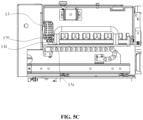
- the inclined portion 141 is configured to be pushed downward by an actuator 150 as the sample loading/unloading apparatus 130 is moved toward the sample loading/unloading area 18.
- the body portion 132a moves downward away from the recesses 13a, i.e. away from the sample racks 13, thereby allowing the sample racks 13 to displace.
- the inclined portion 141 has an inclined surface 141a that is inclined in a moving direction of the inclined portion (a vertical direction in the figure) (in other words, inclined in a moving direction (a horizontal direction in the figure) of the sample loading/unloading apparatus 130).
- the actuator 150 is attached to an inner side wall of the housing 15.
- the inclined portion 141 is away from the actuator 150 (not shown in FIG. 5A ).
- the inclined portion 141 approaches and contacts the actuator 150 (as shown in FIG. 5B ).
- the actuator 150 pushes the inclined surface 141a of the inclined portion 141 so that the inclined portion 141 moves downward (as shown in FIG. 5C ), that is, the sample rack holder 132 moves from the first position to the second position.
- the actuator 150 has a cylindrical outer peripheral surface 151 that presses the inclined portion 141 down.
- the actuator 150 is rotatable, thereby reducing the friction between the cylindrical outer peripheral surface 151 and the inclined surface 141a.
- the convex structure 143 is in the form of a pin.
- the tray 131 may further include a protrusion 138 extending downward from the flange 131e, in which a concave structure 138a for receiving the convex structure 143 is provided.
- the concave structure 138a is in the form of a through-hole extending through the protrusion 138 in a vertical direction.
- the convex structure 143 is prevented from moving upward and disengaging from the concave structure 138a by means of a gasket 161 at a free end of the convex structure 143.
- the protrusion 138 and the lower part of the pin may serve as guide portions that cooperate with each other to guide the movement of the limiting structure 140.
- the elastic member 145 is in the form of a spring.
- the elastic member 145 is provided between the tray 131 and the sample rack holder 132 (specifically the inclined portion 141) to apply an upward force to the sample rack holder.
- the actuator 150 does not actuate the sample rack holder 132, the elastic member 145 returns the sample rack holder 132 to the first position, i.e. the position where the displacement of the sample racks is limited.
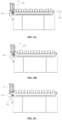
- FIG. 6A to FIG. 6C show a limiting structure 240 according to a second embodiment of the present application and show the movement of the limiting structure 240 from a limiting position (a first position) to a releasing position (a second position).
- the structure of the actuator and the structure of the inclined portion in FIG. 4 to FIG. 5C are interchanged.
- the actuator 250 is in the form of an inclined block
- the limiting structure 240 has a cylindrical portion 241 that cooperates with the actuator 250 in the form of the inclined block.
- the working principle and process of the example shown in FIG. 6A to FIG. 6C are similar to those of the example shown in FIG. 4 to FIG. 5C , and thus will not be described in detail.
- FIG. 7A to FIG. 7C show a limiting structure 340 according to a third embodiment of the present application and show the movement of the limiting structure 340 from a limit positioning (a first position) to a releasing position (a second position).
- the actuator and the inclined portion in FIG. 4 to FIG. 5C are replaced by a pair of magnets 350 and 341.
- the sample rack holder 132 is moved from the first position to the second position under the action of mutual repulsion between the magnets 350 and 341.
- FIG. 8A to FIG. 8B show a limiting structure 440 according to a fourth embodiment of the present application and show the movement of the limiting structure 440 from a limiting position to a releasing position.
- the limiting structure 440 includes a rotary block 441, which is rotatable relative to a shaft 443.
- the rotary block 441 has a substantially L shape, and includes a first supporting leg 441a connected to the body portion 132a and a second supporting leg 441b pushed by the actuator 450.
- the elastic member may be in the form of a torsion spring, applying elastic force to the rotary block 441 to restore the rotary block 441 to the state shown in FIG. 8A .
- the convex structure may be directly attached to the body portion 132a, or may be omitted.
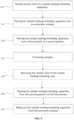
- FIG. 9 is a flowchart of an operation method of an automatic analyzer according to an embodiment of the present application.
- step S11 at least one sample rack 13 to be detected is placed on a sample loading/unloading apparatus 130.
- the sample loading/unloading apparatus 130 is handled into the automatic analyzer 10.
- step S15 the sample loading/unloading apparatus 130 is moved from a first position to a second position within a sample loading/unloading area 18.
- the samples in the sample containers on the sample rack are processed.
- the sample rack 13 is moved back to the sample loading/unloading area 18, see step S19.
- step S21 the sample loading/unloading apparatus 130 is moved back from the second position to the first position.
- step S23 the sample loading/unloading apparatus 130 is taken out from the automatic analyzer 10.
Landscapes
- Analytical Chemistry (AREA)
- Physics & Mathematics (AREA)
- Health & Medical Sciences (AREA)
- Life Sciences & Earth Sciences (AREA)
- Chemical & Material Sciences (AREA)
- Biochemistry (AREA)
- General Health & Medical Sciences (AREA)
- General Physics & Mathematics (AREA)
- Immunology (AREA)
- Pathology (AREA)
- Robotics (AREA)
- Engineering & Computer Science (AREA)
- Automatic Analysis And Handling Materials Therefor (AREA)
Applications Claiming Priority (2)
| Application Number | Priority Date | Filing Date | Title |
|---|---|---|---|
| CN202210993955.6A CN117590012A (zh) | 2022-08-18 | 2022-08-18 | 样本加载/卸载装置、自动分析仪及其操作方法 |
| PCT/CN2023/103677 WO2024037207A1 (zh) | 2022-08-18 | 2023-06-29 | 样本加载/卸载装置、自动分析仪及其操作方法 |
Publications (1)
| Publication Number | Publication Date |
|---|---|
| EP4575509A1 true EP4575509A1 (de) | 2025-06-25 |
Family
ID=89918887
Family Applications (1)
| Application Number | Title | Priority Date | Filing Date |
|---|---|---|---|
| EP23854112.2A Pending EP4575509A1 (de) | 2022-08-18 | 2023-06-29 | Probenlade-/-entladevorrichtung, automatischer analysator und betriebsverfahren dafür |
Country Status (4)
| Country | Link |
|---|---|
| US (1) | US20260050001A1 (de) |
| EP (1) | EP4575509A1 (de) |
| CN (1) | CN117590012A (de) |
| WO (1) | WO2024037207A1 (de) |
Family Cites Families (6)
| Publication number | Priority date | Publication date | Assignee | Title |
|---|---|---|---|---|
| JP2010091383A (ja) * | 2008-10-07 | 2010-04-22 | Olympus Corp | サンプルラック供給装置 |
| JP2010139370A (ja) * | 2008-12-11 | 2010-06-24 | Beckman Coulter Inc | ラックトレイ、ラックおよびラック搬送システム |
| CN110275034B (zh) * | 2018-03-16 | 2023-07-04 | 深圳迈瑞生物医疗电子股份有限公司 | 样本分析仪及样本架转运结构 |
| CN210037839U (zh) * | 2019-01-23 | 2020-02-07 | 贝克曼库尔特实验系统(苏州)有限公司 | 样本架操纵设备和自动检测系统 |
| CN213946459U (zh) * | 2020-11-06 | 2021-08-13 | 上海擎朗智能科技有限公司 | 一种智能托盘机器人 |
| CN216411321U (zh) * | 2021-11-22 | 2022-04-29 | 珠海丽珠试剂股份有限公司 | 一种用于放置样本架的托盘、进样装置、样本分析仪器 |
-
2022
- 2022-08-18 CN CN202210993955.6A patent/CN117590012A/zh active Pending
-
2023
- 2023-06-29 WO PCT/CN2023/103677 patent/WO2024037207A1/zh not_active Ceased
- 2023-06-29 EP EP23854112.2A patent/EP4575509A1/de active Pending
- 2023-06-29 US US19/102,846 patent/US20260050001A1/en active Pending
Also Published As
| Publication number | Publication date |
|---|---|
| US20260050001A1 (en) | 2026-02-19 |
| WO2024037207A1 (zh) | 2024-02-22 |
| CN117590012A (zh) | 2024-02-23 |
Similar Documents
| Publication | Publication Date | Title |
|---|---|---|
| US11353472B2 (en) | Automated sample diagnostic analyzer and method for its operation | |
| JP6454144B2 (ja) | チューブラック移送装置および診断機器 | |
| JP6050585B2 (ja) | 生体サンプルホルダをクランプするための装置および方法 | |
| CN110398605A (zh) | 一种血液细胞样本分析系统和分析系统控制方法 | |
| CN110494757A (zh) | 用于电容式流体水平检测和装卸容器的系统和方法 | |
| US20250199022A1 (en) | Calibration and design of an automated diagnostic analyzer | |
| US20260050001A1 (en) | Apparatus For Loading/Offloading Batch Racks | |
| CN114577795B (zh) | 染色体扫描装置 | |
| CN210037839U (zh) | 样本架操纵设备和自动检测系统 | |
| US11513134B2 (en) | Container for receiving vessels for use in an automated analyzer | |
| EP4667945A1 (de) | Kanalüberbrückungsvorrichtung, probenanalysator und probensammelverfahren | |
| US20240369587A1 (en) | Apparatus and method for inventory handling in an automated diagnostic analyzer | |
| US20250264489A1 (en) | Multiple lane extraction drawer | |
| RU2824196C1 (ru) | Устройство для подготовки подлежащего тестированию объекта и объединенная машина для тестирования нуклеиновых кислот с устройством для подготовки подлежащего тестированию объекта | |
| CN114577797B (zh) | 玻片篮及样本分析仪 | |
| US20250258190A1 (en) | Multiple lane extraction drawer and plate sealer | |
| RU2822429C1 (ru) | Установка для анализа образцов | |
| EP4667944A1 (de) | Probenrackmanipulationsvorrichtung, probenanalysator und verfahren zur probensammlung | |
| CN209656718U (zh) | 样本架操纵设备和自动检测系统 | |
| JP2007315870A (ja) | サンプルラック供給回収装置 |
Legal Events
| Date | Code | Title | Description |
|---|---|---|---|
| STAA | Information on the status of an ep patent application or granted ep patent |
Free format text: STATUS: THE INTERNATIONAL PUBLICATION HAS BEEN MADE |
|
| PUAI | Public reference made under article 153(3) epc to a published international application that has entered the european phase |
Free format text: ORIGINAL CODE: 0009012 |
|
| STAA | Information on the status of an ep patent application or granted ep patent |
Free format text: STATUS: REQUEST FOR EXAMINATION WAS MADE |
|
| 17P | Request for examination filed |
Effective date: 20250218 |
|
| AK | Designated contracting states |
Kind code of ref document: A1 Designated state(s): AL AT BE BG CH CY CZ DE DK EE ES FI FR GB GR HR HU IE IS IT LI LT LU LV MC ME MK MT NL NO PL PT RO RS SE SI SK SM TR |
|
| DAV | Request for validation of the european patent (deleted) | ||
| DAX | Request for extension of the european patent (deleted) |