EP4575862A1 - Distribution sécurisée décentralisée de mises à jour logicielles à des dispositifs médicaux - Google Patents
Distribution sécurisée décentralisée de mises à jour logicielles à des dispositifs médicaux Download PDFInfo
- Publication number
- EP4575862A1 EP4575862A1 EP24221358.5A EP24221358A EP4575862A1 EP 4575862 A1 EP4575862 A1 EP 4575862A1 EP 24221358 A EP24221358 A EP 24221358A EP 4575862 A1 EP4575862 A1 EP 4575862A1
- Authority
- EP
- European Patent Office
- Prior art keywords
- medical device
- software update
- device software
- medical
- update agent
- Prior art date
- Legal status (The legal status is an assumption and is not a legal conclusion. Google has not performed a legal analysis and makes no representation as to the accuracy of the status listed.)
- Granted
Links
Images




Classifications
-
- H—ELECTRICITY
- H04—ELECTRIC COMMUNICATION TECHNIQUE
- H04L—TRANSMISSION OF DIGITAL INFORMATION, e.g. TELEGRAPHIC COMMUNICATION
- H04L67/00—Network arrangements or protocols for supporting network services or applications
- H04L67/01—Protocols
- H04L67/12—Protocols specially adapted for proprietary or special-purpose networking environments, e.g. medical networks, sensor networks, networks in vehicles or remote metering networks
-
- G—PHYSICS
- G06—COMPUTING OR CALCULATING; COUNTING
- G06F—ELECTRIC DIGITAL DATA PROCESSING
- G06F8/00—Arrangements for software engineering
- G06F8/60—Software deployment
- G06F8/65—Updates
-
- G—PHYSICS
- G06—COMPUTING OR CALCULATING; COUNTING
- G06F—ELECTRIC DIGITAL DATA PROCESSING
- G06F21/00—Security arrangements for protecting computers, components thereof, programs or data against unauthorised activity
- G06F21/50—Monitoring users, programs or devices to maintain the integrity of platforms, e.g. of processors, firmware or operating systems
- G06F21/57—Certifying or maintaining trusted computer platforms, e.g. secure boots or power-downs, version controls, system software checks, secure updates or assessing vulnerabilities
- G06F21/572—Secure firmware programming, e.g. of basic input output system [BIOS]
-
- G—PHYSICS
- G06—COMPUTING OR CALCULATING; COUNTING
- G06F—ELECTRIC DIGITAL DATA PROCESSING
- G06F21/00—Security arrangements for protecting computers, components thereof, programs or data against unauthorised activity
- G06F21/50—Monitoring users, programs or devices to maintain the integrity of platforms, e.g. of processors, firmware or operating systems
- G06F21/57—Certifying or maintaining trusted computer platforms, e.g. secure boots or power-downs, version controls, system software checks, secure updates or assessing vulnerabilities
-
- G—PHYSICS
- G06—COMPUTING OR CALCULATING; COUNTING
- G06F—ELECTRIC DIGITAL DATA PROCESSING
- G06F21/00—Security arrangements for protecting computers, components thereof, programs or data against unauthorised activity
- G06F21/60—Protecting data
- G06F21/64—Protecting data integrity, e.g. using checksums, certificates or signatures
-
- G—PHYSICS
- G16—INFORMATION AND COMMUNICATION TECHNOLOGY [ICT] SPECIALLY ADAPTED FOR SPECIFIC APPLICATION FIELDS
- G16H—HEALTHCARE INFORMATICS, i.e. INFORMATION AND COMMUNICATION TECHNOLOGY [ICT] SPECIALLY ADAPTED FOR THE HANDLING OR PROCESSING OF MEDICAL OR HEALTHCARE DATA
- G16H40/00—ICT specially adapted for the management or administration of healthcare resources or facilities; ICT specially adapted for the management or operation of medical equipment or devices
- G16H40/40—ICT specially adapted for the management or administration of healthcare resources or facilities; ICT specially adapted for the management or operation of medical equipment or devices for the management of medical equipment or devices, e.g. scheduling maintenance or upgrades
-
- G—PHYSICS
- G16—INFORMATION AND COMMUNICATION TECHNOLOGY [ICT] SPECIALLY ADAPTED FOR SPECIFIC APPLICATION FIELDS
- G16H—HEALTHCARE INFORMATICS, i.e. INFORMATION AND COMMUNICATION TECHNOLOGY [ICT] SPECIALLY ADAPTED FOR THE HANDLING OR PROCESSING OF MEDICAL OR HEALTHCARE DATA
- G16H40/00—ICT specially adapted for the management or administration of healthcare resources or facilities; ICT specially adapted for the management or operation of medical equipment or devices
- G16H40/60—ICT specially adapted for the management or administration of healthcare resources or facilities; ICT specially adapted for the management or operation of medical equipment or devices for the operation of medical equipment or devices
- G16H40/67—ICT specially adapted for the management or administration of healthcare resources or facilities; ICT specially adapted for the management or operation of medical equipment or devices for the operation of medical equipment or devices for remote operation
-
- H—ELECTRICITY
- H04—ELECTRIC COMMUNICATION TECHNIQUE
- H04L—TRANSMISSION OF DIGITAL INFORMATION, e.g. TELEGRAPHIC COMMUNICATION
- H04L9/00—Cryptographic mechanisms or cryptographic arrangements for secret or secure communications; Network security protocols
- H04L9/32—Cryptographic mechanisms or cryptographic arrangements for secret or secure communications; Network security protocols including means for verifying the identity or authority of a user of the system or for message authentication, e.g. authorization, entity authentication, data integrity or data verification, non-repudiation, key authentication or verification of credentials
- H04L9/3247—Cryptographic mechanisms or cryptographic arrangements for secret or secure communications; Network security protocols including means for verifying the identity or authority of a user of the system or for message authentication, e.g. authorization, entity authentication, data integrity or data verification, non-repudiation, key authentication or verification of credentials involving digital signatures
Definitions
- exemplary modes of the present disclosure address some of these drawbacks by providing a system in which medical devices installed in a medical facility have agents which facilitate the transfer of software updates from one or more cloud software update agents to the medical devices.
- one or more of the medical devices may be connected to the Internet to receive the software updates from the cloud software update agent(s) on behalf of the medical devices which are not directly connected to the Internet.
- the medical devices which are not directly connected to the Internet are nevertheless connected (directly or indirectly) to the medical device(s) which is/(are) connected to the Internet via a suitable communication link such as a USB connection and/or an Ethernet connection, for example.
- the received software updates may then be distributed via the network of agents installed in the medical devices in the medical facility.
- the cloud software agent(s) may provide software updates for different manufacturers of the medical devices installed in the medical facility.
- the cloud software agents may include an agent for each manufacturer of the medical devices installed in the medical facility. For example, a cloud software agent for manufacturer A may be connected to a medical device of manufacturer A in the medical facility, and a cloud software agent for manufacturer B may be connected to a medical device of manufacturer B in the medical facility.
- the distribution of software updates may include a zero-trust method in which the medical devices installed in the medical facility do not need to trust each other which is especially important when the medical devices are produced by different manufacturers.
- the above method may also use existing data connections between the devices.
- An agent operating in a medical device may provide a received software update to be installed in that medical device, and forward other received software updates to other medical devices according to the destination addresses for the corresponding received software updates.
- An agent operating in a medical device may receive logs from that medical device or from other medical devices for forwarding to the cloud agent(s) via one or more medical devices installed in the medical facility. In some cases, when the medical device is directly connected to the Internet, that medical device may forward the logs to the cloud agent(s) via the Internet connection.
- Each agent may maintain and store a file delivery table (providing indications of files received for delivery such as file names, and corresponding destination information such as model and serial numbers), a routing table (providing identification information of assessable medical devices such as model and serial numbers, and corresponding routing information such as number of hops to the medical devices and via which neighbor(s)), and a direct neighbor table (providing a list of direct neighbors such as model and serial numbers, and corresponding address information such as IP address(es) of the direct neighbor(s)).
- a file delivery table providing indications of files received for delivery such as file names, and corresponding destination information such as model and serial numbers
- a routing table providing identification information of assessable medical devices such as model and serial numbers, and corresponding routing information such as number of hops to the medical devices and via which neighbor(s)
- a direct neighbor table providing a list of direct neighbors such as model and serial numbers, and corresponding address information such as IP address(es) of the direct neighbor(s)).
- the system may include various security features, described in more detail below.
- files such as software updates are signed by the manufacturer of the target medical device, for example, using a private key or certificate of the manufacturer.
- the signatures may be checked by the medical devices in which the software updates are to be installed, for example, using the public keys or certificates of the relevant manufacturers.
- the files may optionally be encrypted, for example, using the public keys of the corresponding medical devices for decryption with the private keys of the corresponding medical devices.
- the cloud agent may identify this behavior based on the target medical device not acknowledging installation of a software update and/or analyzing received log files to determine which medical device is not relaying the files. The operator may then block the medical device not relaying files (e.g., remove it from the routing tables) so that files automatically arrive at the destination without passing via the blocked medical device, if there is another available path.
- a log may be signed (e.g., with the private key of the medical device producing the log) and authenticated in the cloud using a corresponding public key.
- a tamper resistant chip e.g., trusted platform model (TMP) according to ISO/IEC 11889 standard, may be used to store the private key of the medical device.
- TMP trusted platform model
- the log may optionally be encrypted using the manufacture public key for decrypting by the cloud agent.
- the agents may limit the size of files allowed to be received in order to prevent an attacker trying to send a giant file to deplete disk space as signatures are generally checked at the end of transmission.
- files pending delivery in a medical device may be purged from a queue of files to be delivered if the files have been in the queue longer than a given time limit (e.g., number of days).
- files pending delivery in a medical device may be purged from the queue, e.g., on a first-in-first-out (FIFO) basis if a maximum queue size is reached.
- FIFO first-in-first-out
- the medical device may proactively send a message to its neighbors to ask to be removed from the paths in the routing tables. In some exemplary modes, if a medical device is sending too many files in a given time period, this medical device may be marked as suspect and may be blocked for a specific amount of time.
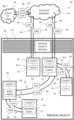
- FIG. 1 is a block diagram view of a computer system 10 in a medical facility 12 constructed and operative in accordance with an exemplary mode of the present disclosure.
- the system 10 includes a cloud medical device software update agent 14 and medical devices 16.
- the medical devices 16 are installed in the medical facility 12.
- the medical facility 12 includes a firewall 18 to provide protection to the medical devices 16 from external traffic.
- Each medical device 16 includes a medical device software update agent 20 and medical device software 22.
- the medical devices 16 in the medical facility 12 form a network and are connected via any suitable data connections 24, for example, USB connections and/or Ethernet connections, or any suitable combination thereof.
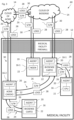
- FIG. 2 is a block diagram view of another computer system 50 in the medical facility 12 constructed and operative in accordance with another exemplary mode of the present disclosure.
- the computer system 50 is substantially the same as system 10 except for the following differences.
- Computer system 50 includes two cloud medical device software update agents 14 for two corresponding manufacturers.
- one of the cloud medical device software update agents 14 is for ACME, Inc.
- one of the cloud medical device software update agents 14 is for Biosense Webster, Inc.
- the cloud medical device software update agents 14 are configured to be connected to each other via another Internet connection 30.
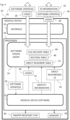
- Fig. 4 is a block diagram view of one of the medical devices 16 (e.g., medical device 16-3) in the system 10 of Fig. 1 .
- the medical device 16 includes an interface 34, a processor 36, a memory 38, and optionally a tamper resistant chip 40.
- the medical device software 22 may provide the agent 20 with identity information 42 such as model and serial number for forwarding to the cloud medical device software update agent 14, as described in more detail with reference to Fig. 11 .
- the medical device software 22 may provide the agent 20 with direct neighbor identification 44 as described in more detail below with reference to Fig. 5 .
- the agent 20 is configured to maintain tables, including a file delivery table 46, a routing table 48, and a direct neighbor table 52.
- the memory 38 is configured to stored tables 46, 48, 52, described in more detail below with reference to Fig. 5 .
- processor 36 may be combined in a single physical component or, alternatively, implemented using multiple physical components. These physical components may comprise hardwired or programmable devices, or a combination of the two. In some exemplary modes, at least some of the functions of the processor 36 may be carried out by a programmable processor under the control of suitable software. This software may be downloaded to a device in electronic form, over a network, for example. Alternatively, or additionally, the software may be stored in tangible, non-transitory computer-readable storage media, such as optical, magnetic, or electronic memory.
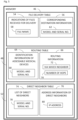
- Fig. 5 is a block diagram of memory 38 and stored tables in the device 16 of Fig. 4 .
- the file delivery table 46 includes indications 54 of one or more files received from cloud medical device software update agent 14 for delivery to one or more of the multiple medical devices 16 in the network, and corresponding destination information 56 of the file(s).
- the indications 54 may include a file name 58 and the destination information 56 may include a model and serial number 62 for each corresponding entry in the file delivery table 46.
- the routing table 48 includes identification information 64 of assessable ones of the medical devices 16 in the network, and corresponding routing information 66 of the assessable medical devices 16.
- the identification information 64 may include a model and serial number 68, and the routing information 66 may include a number of hops 70, and via which neighbor 72, for each entry in the table.
- the routing table 48 is described in more detail with reference to Figs. 6-10 .
- the direct neighbor table 52 includes a list 74 of one or more direct neighbors of the medical device 16 (in which the direct neighbor table 52 is stored), and address information 76 identifying the one or more direct neighbors in the network of medical devices 16.
- the list 74 may include a model and serial number 78 for each entry in the direct neighbor table 52.
- the address information 76 may include an IP address 80 for each corresponding entry in the table.
- a direct neighbor is one of the medical devices 16 connected directly to the medical device 16 in which the direct neighbor table 52 is stored, without an intervening medical device 16.
- the direct neighbor table 52 may be populated based on the direct neighbor identification(s) 44 ( Fig. 4 ) received from the medical device software 22.
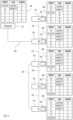
- Figs. 6-9 are views of routing tables 48 illustrating generation of routing tables 48 for use in the system 10 of Fig. 1 .
- Fig. 7 shows that each agent 14, 20 has added its direct neighbors to its own routing table 48 based on the direct neighbor table 52 of each agent 14. 20.
- the destination name of the direct neighbor is given (e.g., cloud, or A, or B etc.), "via” is set as “direct”, and hop value is set to 1.
- Fig. 8 shows the result of each agent 14, 20 providing its routing table 48 to its direct neighbor(s) and receiving the routing table(s) 48 from its direct neighbor(s).
- the received routing table(s) 48 is/(are) used by the receiving agent 14, 20 to update its own routing table 48, as now described in more detail.
- device C when device C receives the routing table 48 from device D, device C receives the following entries (as shown in Fig. 7 ):
- Device C also receives the routing table 48 from device B with the following entries (as shown in Fig. 7 ):
- Device C also receives the routing table 48 from device E with the following entries (as shown in Fig. 7 ):
- the following entries are candidates for adding to the routing table 48 of device C based on the above:
- the above 14 items may be analyzed for duplicates as follows.
- Items 1, 6, 11, and 14 provide routing information to device C. Item 1 has the lowest hop value. Therefore, item 1 is retained while items 6, 11, and 14 are removed.
- Items 2 and 8 provide routing information to device B.
- the entries are identical so either one may be removed.
- Items 3, 5, and 13 provide routing information to device D. Items 3 and 5 have the lowest hop value and item 3 is via "direct”. Therefore, item 3 is retained while items 5 and 13 are removed.
- Items 4, 7, and 12 provide routing information to device E. Items 4 and 12 have the lowest hop value and item 4 is via "direct”. Therefore, item 4 is retained while items 7 and 12 are removed.
- Item 10 provides the routing information to device A and is therefore retained.
- Item 9 provides the routing information to the cloud and is therefore retained.
- the above also corresponds to the entries shown in the routing table 48 of device C in Fig. 8 .
- the updated routing tables 48 are again shared with direct neighbors and processed as above to update the "via" and “hop” values as appropriate and remove duplicates based on retaining the entries with the shortest hops yielding the routing tables 48 shown in Fig. 9 .
- the routing table 48 may need to be shared multiple times and processed as described above until a steady state is reached.
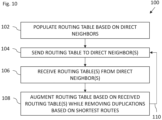
- Fig. 10 is a flowchart 100 including steps in a method of generating routing tables 48 for use in the system 10 of Fig. 1 .
- the agent 20 is configured to populate the routing table 48 (i.e., its local routing table 48) based on its own device and the list 74 of the one or more direct neighbors (block 102).
- the agent 20 is configured to send the routing table 48 (i.e., its local routing table 48) to the one or more direct neighbors (block 104) and receive routing table(s) 48 from the direct neighbor(s) (block 106).
- the agent 20 is configured to augment the routing table 48 (i.e., its local routing table 48) based on data included in the received routing table(s) (e.g., by updating the "via" value to the ID of the device sending the routing table 48 and by increasing the "hop" value by 1 for each entry in the received routing table(s) 48), while removing entries of one or more duplicate destination medical devices based on consideration of shortest routes to the duplicate destination medical devices (block 108) by retaining the entries with the shortest routes (i.e. lowest number of hops).
- the steps of blocks 104-108 may need to be repeated one or more times (arrow 110) until the routing table 48 of each medical device 16 and the cloud medical device software update agent(s) 14 are in steady state (i.e., do not change).
- Fig. 11 is a flowchart 200 including steps in a method of providing software updates to one of the devices 16 of Fig. 4 .
- the terms local agent 20, and local medical device software 22 are used to refer to the agent 20 and medical device software 22 running on the same local medical device 16.
- the local agent 20 running in the local medical device 16 is configured to receive identity information 42 about the local medical device 16 from the local medical device software 22 (block 202).
- the local agent 20 is configured to send the identity information 42 to the cloud medical device software update agent 14 via the local interface 34 and one or more other agents 20 installed in one or more other corresponding medical devices 16 (block 204).
- the cloud medical device software update agent 14 is configured to receive the identity information 42, sign the software update 26 with the private key of the manufacturer of the local medical device 16, optionally encrypt the software update 26 with the public key of the local medical device 16, and send the software update 26 and its signature to the local medical device 16 via the other agent(s) 20 (block 206).
- the local agent 20 is configured to receive, from the cloud medical device software update agent 14 via the other agent(s) 20 installed in the other medical device(s) 16, the medical device software update 26 and the digital signature of the medical device software update 26 signed by the manufacturer of local medical device 16 (block 208).
- the processor 36 or the agent 20 of the local medical device 16 is configured to authenticate the received medical device software update 26 based on the digital signature (e.g., public key of the manufacturer) (block 210).
- the processor 36 of the medical device 16 is configured to decrypt the medical device software update 26 using the private key of the local medical device 16 (e.g., stored in the tamper resistant chip 40 ( Fig. 4 )) (block 210).
- the processor 36 or the agent 20 of the local medical device 16 is configured to confirm if the software update 26 is authenticated. If the software updates 26 is authenticated, the processor 36 of the local medical device 16 is configured to install the authenticated medical device software update 26 (block 214).
- the medical device software 22 may notify the user of the local medical device 16, so the user will select an appropriate time to install the update.
- the update may be installed automatically when the device is idle.
- the local medical device 16 may offer an option to cancel the update. If there is an emergency and the hospital staff needs the device immediately, they can cancel the update during the installation and use the medical device. Alternatively, the update may be installed automatically during non-working hours. In this case, too, the local medical device 16 may offer an option to cancel the update.
- the local agent 20 may be configured to block files provided by the other medical device 16 based on a failure of the other medical device to identify lack of authentication of the medical device software update 26.
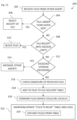
- Fig. 12 is a flowchart 300 including steps in a method of receiving and processing files in the local medical device 16 of Fig. 4 .
- the local agent 20 of the local medical device 16 is configured to receive files including one or more medical device software updates and one or more corresponding digital signatures, via one or more other agents 20, destined for one or more other medical devices or for the local medical device 16 (block 302).
- the local agent 20 is configured to check if the file is larger than a given size.
- the local agent 20 is configured to reject receipt of a file larger than a given size limit from other medical device software update agents 20 (block 306).
- the local agent 20 is configured to check if the file receipt rate exceeds a limit.
- the local agent 20 is configured to block files (e.g., for a period of time) provided by a given medical device 16 based on the given medical device providing more than a given number of files in a given time period (block 310).
- the local agent 20 is configured to check if the local medical device 16 has exceeded a storage criterion (e.g., disk full or exceeded limit or queue full).
- the local agent 20 is configured to send messages to the other medical device software update agents 20 to remove the local medical device 16 from active routing data (e.g., remove from the routing tables 48) in response to exceeding the storage criterion (block 314).
- the local agent 20 is configured to authenticate the received medical device software updates based on the received digital signatures (block 316) and delete files which fail the authentication process.
- the local agent 20 is configured to add the details of the received files to the file delivery table 46 (block 318).
- the local agent 20 is configured to forward some, or all, of the files received via the local agent 20 from the cloud medical device software update agent 14 to other medical device(s) 16 in the network based on the corresponding destination information 56 ( Fig. 5 ) of the files and the corresponding routing information 66 ( Fig. 5 ) of the assessable medical devices in the routing table 48 stored in the memory 38 (block 320).
- One or more of the files received may be forwarded to the local medical device software 22 for installation.
- the step of block 320 is performed based on the files (e.g., medical device software updates) being authenticated.
- the local agent 20 is configured to maintain a queue of stored files for forwarding to medical device(s) 16, for example, using the file delivery table 46 (block 322), and discard files from the medical device 16 according to a purging policy of the queue, for example, purging files older than a given value, or purging files on a FIFO basis when the queue size or total file size reaches a given value (block 324).
- the step of block 322 may include the local agent 20 generating a log to track received files, files forwarded to other medical devices 16, files forwarded to the local medical device software 22 for installation etc.
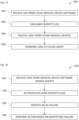
- Fig. 13 is a flowchart 400 including steps in a method of receiving and processing logs in the local medical device 16 of Fig. 4 .
- the local agent 20 is configured to receive a log of software installation and/or software update from the local medical device software 22 running on the local medical device 16 (block 402).
- the local agent 20 is configured to digitally sign the received log using a private key of the local medical device 16 for checking by the manufacturer of the local medical device 16 using a public key of the local medical device 16 (block 404).
- the local agent 20 is configured to optionally encrypt the log with a public key of the manufacturer of the medical device 16.
- the local agent 20 is configured to receive logs from one or more other medical devices for forwarding to the cloud medical device software update agent 14 (block 406).
- the local agent 20 is configured to forward the received logs to the cloud medical device software update agent 14 via the interface 34 and one or more agents 20 installed in one or more corresponding other medical devices 16 (block 408).
- the cloud medical device software update agent 14 is configured to: receive logs from the agents 20 of the medical devices 16 (block 502); authenticate (e.g., with corresponding public keys of the sending medical devices 16) and optionally decrypt the logs (e.g., with corresponding private keys of the manufacturers of the sending medical devices 16) (block 504); identify a failure of a given software update agent 20 to relay files from the cloud medical device software update agent 14 based on the received logs (block 506); and perform an action (such as removing the device of that agent from the routing tables 48 for a given time period) with respect to the given software update agent 20 responsively to identifying the failure (block 508).
- receive logs from the agents 20 of the medical devices 16 block 502
- authenticate e.g., with corresponding public keys of the sending medical devices 16
- optionally decrypt the logs e.g., with corresponding private keys of the manufacturers of the sending medical devices 16
- the terms “about” or “approximately” for any numerical values or ranges indicate a suitable dimensional tolerance that allows the part or collection of components to function for its intended purpose as described herein. More specifically, “about” or “approximately” may refer to the range of values ⁇ 20% of the recited value, e.g., “about 90%” may refer to the range of values from 72% to 108%.
- Example 1 A medical system, comprising a first medical device, including: an interface configured to connect the first medical device to a network of multiple medical devices; and a processor configured to: run medical device software; run a first medical device software update agent configured to: receive identity information about the first medical device from the medical device software; send the identity information to a cloud medical device software update agent via the interface and at least one second medical device software update agent installed in at least one second medical device of the multiple medical devices; and receive, from the cloud medical device software update agent via the at least one second medical device software update agent installed in the at least one second medical device, a medical device software update and a digital signature of the medical device software update signed by a manufacturer of the first medical device; authenticate the received medical device software update based on the digital signature; and install the authenticated medical device software update.
- a first medical device software update agent configured to: receive identity information about the first medical device from the medical device software; send the identity information to a cloud medical device software update agent via the interface and at least one second medical device software update agent installed in at least
- Example 2 The system according to example 1, further comprising the multiple medical devices, wherein: the first medical device and the multiple medical devices are installed in a medical facility; a given one of the multiple medical devices is configured to establish an internet connection with the cloud medical device software update agent; and the interface of the first medical device is configured to share data with the cloud medical device software update agent via the internet using the internet connection of the given medical device.
- Example 3 The system according to example 2, wherein the first medical device is a non-internet enabled device.
- Example 4 The system according to example 2 or 3, further comprising the cloud medical device software update agent of a first medical device manufacturer and another cloud medical device software update agent of a second medical device manufacturer, which is configured to connect to the cloud medical device software update agent of the first medical device manufacturer via another internet connection.
- Example 5 The system according to example 4, wherein the cloud medical device software update agent of the first medical device manufacturer and the other cloud medical device software update agent of the second medical device manufacturer are configured to be connected to a medical device of the first medical device manufacturer in the network of multiple medical devices via a first internet connection, and to a medical device of the second medical device manufacturer in the network of multiple medical devices via a second internet connection, respectively.
- Example 6 The system according to any of examples 2-5, further comprising the cloud medical device software update agent, which is configured to: receive logs from the first medical device software update agent and software update agents of the multiple medical devices; identify failure of a given one of the software update agents to relay files from the cloud medical device software update agent based on the received logs; and perform an action with respect to the given software update agent responsively to identifying the failure.
- the cloud medical device software update agent which is configured to: receive logs from the first medical device software update agent and software update agents of the multiple medical devices; identify failure of a given one of the software update agents to relay files from the cloud medical device software update agent based on the received logs; and perform an action with respect to the given software update agent responsively to identifying the failure.
- Example 7 The system according to any of examples 1-6, wherein the first medical device includes a memory configured to store: a file delivery table including: indications of one or more files received from the cloud medical device software update agent for delivery to one or more of the multiple medical devices in the network; and corresponding destination information of the one or more files; and a routing table including: identification information of assessable ones of the medical devices in the network; and corresponding routing information of the assessable medical devices.
- a file delivery table including: indications of one or more files received from the cloud medical device software update agent for delivery to one or more of the multiple medical devices in the network; and corresponding destination information of the one or more files
- a routing table including: identification information of assessable ones of the medical devices in the network; and corresponding routing information of the assessable medical devices.
- Example 8 The system according to example 7, wherein the first medical device software update agent is configured to forward the one or more files received via the at least one second medical device software update agent from the cloud medical device software update agent to the one or more multiple medical devices in the network based on the corresponding destination information of the one or more files and the corresponding routing information of the assessable medical devices in the routing table.
- Example 9 The system according to example 7 or 8, wherein the memory configured to store a direct neighbor table including: a list of one or more direct neighbors of the first medical device, and address information identifying the one or more direct neighbors in the network of medical devices.
- Example 11 The system according to any examples 1-11, wherein the medical device software update is encrypted by the manufacturer of the first medical device using a public key of the first medical device, the processor of the first medical device being configured to decrypt the medical device software update using a private key of the first medical device.
- Example 12 The system according to any of examples 1-11, wherein the first medical device software update agent is configured to reject receipt of a file larger than a given size limit from other medical device software update agents.
- Example 13 The system according to any of examples 1-12, wherein the first medical device software update agent is configured to receive, an additional medical device software update and an additional corresponding digital signature from a given medical device of the multiple medical devices, wherein: the processor is configured to check the additional digital signature and determine that the additional digital signature does not authenticate the additional medical device software update; and the first medical device software update agent is configured to block files provided by the given medical device based on a failure of the given medical device to identify lack of authentication of the additional medical device software update.
- Example 14 The system according to any of examples 1-12, wherein the first medical device software update agent is configured to: receive an additional medical device software update and an additional digital signature, via the at least one second medical device software update agent from the cloud medical device software update agent, destined for a given medical device of the multiple medical devices; authenticate the received additional medical device software update based on the additional digital signature; and forward the additional medical device software update to the given medical device responsively to authenticating the additional medical device software update based on the additional digital signature.
- the first medical device software update agent is configured to: receive an additional medical device software update and an additional digital signature, via the at least one second medical device software update agent from the cloud medical device software update agent, destined for a given medical device of the multiple medical devices; authenticate the received additional medical device software update based on the additional digital signature; and forward the additional medical device software update to the given medical device responsively to authenticating the additional medical device software update based on the additional digital signature.
- Example 15 The system according to any of examples 1-14, wherein the first medical device software update agent is configured to: maintain a queue of stored files for forwarding to one or more of the multiple medical devices; and discard files from the first medical device according to a purging policy of the queue.
- Example 16 The system according to any of examples 1-15, wherein the first medical device software update agent is configured to send messages to the other medical device software update agents to remove the first medical device from active routing data in response to exceeding a storage criterion.
- Example 17 The system according to any of examples 1-16, wherein the first medical device software update agent is configured to block files provided by a given medical device of the multiple medical devices based on the given medical device providing more than a given number of files in a given time period.
- Example 18 The system according to examples 1-17, wherein the first medical device software update agent is configured to: receive a log of software installation and/or software update from the medical device software running on the first medical device; and forward the received log to the cloud medical device software update agent via the interface and the at least one second medical device software update agent.
- Example 19 The system according to example 18, wherein first medical device software update agent is configured to digitally sign the log using a private key of the first medical device for checking by the manufacturer of the first medical device using a public key of the first medical device.
- Example 20 The system according to example 19, further comprising a tamper resistant chip configured to store the private key of the first medical device.
- Example 21 The system according to example 18, wherein the first medical device software update agent is configured to encrypt the log with a public key of the manufacturer of the first medical device.
- Example 22 The system according to example 1, wherein the first medical device software update agent is configured to: receive logs from at least one of the multiple medical devices; and forward the received logs to the cloud medical device software update agent via the at least one second medical device software update agent.
- Example 23 A medical method, comprising: connecting a first medical device to a network of multiple medical devices; running medical device software; running a first medical device software update agent; receiving, by first medical device software update agent, identity information about the first medical device from the medical device software; sending, by first medical device software update agent, the identity information to a cloud medical device software update agent via at least one second medical device software update agent installed in at least one second medical device of the multiple medical devices; receiving, by first medical device software update agent, from the cloud medical device software update agent via the at least one second medical device software update agent installed in the at least one second medical device, a medical device software update and a digital signature of the medical device software update signed by a manufacturer of the first medical device; authenticating the received medical device software update based on the digital signature; and installing the authenticated medical device software update.
- Example 24 A software product, comprising a non-transient computer-readable medium in which program instructions are stored, which instructions, when read by a central processing unit (CPU), cause the CPU to: run medical device software; run a first medical device software update agent configured to: receive identity information about the first medical device from the medical device software; send the identity information to a cloud medical device software update agent via at least one second medical device software update agent installed in at least one second medical device; and receive, from the cloud medical device software update agent via the at least one second medical device software update agent installed in the at least one second medical device, a medical device software update and a digital signature of the medical device software update signed by a manufacturer of the first medical device; authenticate the received medical device software update based on the digital signature; and install the authenticated medical device software update.
- CPU central processing unit
Landscapes
- Engineering & Computer Science (AREA)
- Health & Medical Sciences (AREA)
- Computer Security & Cryptography (AREA)
- Theoretical Computer Science (AREA)
- General Engineering & Computer Science (AREA)
- Software Systems (AREA)
- Biomedical Technology (AREA)
- General Business, Economics & Management (AREA)
- Business, Economics & Management (AREA)
- General Physics & Mathematics (AREA)
- Physics & Mathematics (AREA)
- General Health & Medical Sciences (AREA)
- Computer Hardware Design (AREA)
- Medical Informatics (AREA)
- Epidemiology (AREA)
- Primary Health Care (AREA)
- Public Health (AREA)
- Signal Processing (AREA)
- Computer Networks & Wireless Communication (AREA)
- Bioethics (AREA)
- Computing Systems (AREA)
- Information Transfer Between Computers (AREA)
- Stored Programmes (AREA)
Applications Claiming Priority (2)
| Application Number | Priority Date | Filing Date | Title |
|---|---|---|---|
| US202363612525P | 2023-12-20 | 2023-12-20 | |
| US18/976,519 US20250208853A1 (en) | 2023-12-20 | 2024-12-11 | Decentralized secure distribution of software updates to medical devices |
Publications (3)
| Publication Number | Publication Date |
|---|---|
| EP4575862A1 true EP4575862A1 (fr) | 2025-06-25 |
| EP4575862B1 EP4575862B1 (fr) | 2025-12-10 |
| EP4575862C0 EP4575862C0 (fr) | 2025-12-10 |
Family
ID=93925855
Family Applications (1)
| Application Number | Title | Priority Date | Filing Date |
|---|---|---|---|
| EP24221358.5A Active EP4575862B1 (fr) | 2023-12-20 | 2024-12-19 | Distribution sécurisée décentralisée de mises à jour logicielles à des dispositifs médicaux |
Country Status (5)
| Country | Link |
|---|---|
| US (1) | US20250208853A1 (fr) |
| EP (1) | EP4575862B1 (fr) |
| JP (1) | JP2025098986A (fr) |
| CN (1) | CN120180440A (fr) |
| IL (1) | IL317866A (fr) |
Citations (2)
| Publication number | Priority date | Publication date | Assignee | Title |
|---|---|---|---|---|
| US20200151335A1 (en) * | 2018-11-12 | 2020-05-14 | Thirdwayv, Inc | Secure over-the-air firmware upgrade |
| US20220270754A1 (en) * | 2018-09-12 | 2022-08-25 | Stryker Corporation | Patient support apparatus communication systems |
-
2024
- 2024-12-11 US US18/976,519 patent/US20250208853A1/en active Pending
- 2024-12-19 IL IL317866A patent/IL317866A/en unknown
- 2024-12-19 EP EP24221358.5A patent/EP4575862B1/fr active Active
- 2024-12-19 JP JP2024223928A patent/JP2025098986A/ja active Pending
- 2024-12-20 CN CN202411889970.1A patent/CN120180440A/zh active Pending
Patent Citations (2)
| Publication number | Priority date | Publication date | Assignee | Title |
|---|---|---|---|---|
| US20220270754A1 (en) * | 2018-09-12 | 2022-08-25 | Stryker Corporation | Patient support apparatus communication systems |
| US20200151335A1 (en) * | 2018-11-12 | 2020-05-14 | Thirdwayv, Inc | Secure over-the-air firmware upgrade |
Non-Patent Citations (2)
| Title |
|---|
| CYBERSECURITY IN MEDICAL DEVICES: QUALITY SYSTEM CONSIDERATIONS AND CONTENT OF PREMARKET SUBMISSIONS, 27 September 2023 (2023-09-27) |
| KEN FUCHS: "IEEE P2933/D3", vol. 2733, 23 October 2023 (2023-10-23), pages 1 - 250, XP068295793, Retrieved from the Internet <URL:https://ieee-sa.imeetcentral.com/p/aQAAAAAFEq53> [retrieved on 20231030] * |
Also Published As
| Publication number | Publication date |
|---|---|
| EP4575862B1 (fr) | 2025-12-10 |
| CN120180440A (zh) | 2025-06-20 |
| IL317866A (en) | 2025-07-01 |
| EP4575862C0 (fr) | 2025-12-10 |
| JP2025098986A (ja) | 2025-07-02 |
| US20250208853A1 (en) | 2025-06-26 |
Similar Documents
| Publication | Publication Date | Title |
|---|---|---|
| US12095812B2 (en) | Systems and methods for mitigating and/or preventing distributed denial-of-service attacks | |
| US10659434B1 (en) | Application whitelist using a controlled node flow | |
| US11381557B2 (en) | Secure data transmission using a controlled node flow | |
| EP3494682B1 (fr) | Architecture de sécurité à la demande | |
| CN107251509B (zh) | 通信网络系统之间的可信路由 | |
| US8631134B2 (en) | Network architecture for secure data communications | |
| US7877506B2 (en) | System, method and program for encryption during routing | |
| US10110580B2 (en) | Secure dynamic address resolution and communication system, method, and device | |
| US11451512B2 (en) | Secure dynamic address resolution and communication system, method, and device | |
| US10110552B2 (en) | Secure dynamic address resolution and communication system, method, and device | |
| AU2018304187B2 (en) | Systems and methods for mitigating and/or preventing distributed denial-of-service attacks | |
| JP6926734B2 (ja) | 経路制御装置および経路制御方法 | |
| EP4575862A1 (fr) | Distribution sécurisée décentralisée de mises à jour logicielles à des dispositifs médicaux | |
| CN113242268B (zh) | 用于数据安全传输的认证方法、数据安全传输方法和系统 | |
| JP4710889B2 (ja) | 攻撃パケット対策システム、攻撃パケット対策方法、攻撃パケット対策装置、及び攻撃パケット対策プログラム | |
| CN112839009A (zh) | 处理报文的方法、装置及系统 | |
| JP4158777B2 (ja) | ファイアウォールサーバにおけるフィルタリングルール変更方法、ファイアウォールサーバおよびプログラム | |
| WO2025059941A1 (fr) | Procédé et appareil de commutation d'entrée de table de sécurité, dispositif de réseau et support de stockage | |
| CN117792784A (zh) | 基于访问控制列表的通信连接方法、装置、设备及介质 | |
| JP2005295409A (ja) | 通信システム、通信方法および通信プログラム | |
| EP3180901A1 (fr) | Système, procédé et dispositif pour résolution et communication d'adresse dynamique sécurisées |
Legal Events
| Date | Code | Title | Description |
|---|---|---|---|
| PUAI | Public reference made under article 153(3) epc to a published international application that has entered the european phase |
Free format text: ORIGINAL CODE: 0009012 |
|
| STAA | Information on the status of an ep patent application or granted ep patent |
Free format text: STATUS: THE APPLICATION HAS BEEN PUBLISHED |
|
| AK | Designated contracting states |
Kind code of ref document: A1 Designated state(s): AL AT BE BG CH CY CZ DE DK EE ES FI FR GB GR HR HU IE IS IT LI LT LU LV MC ME MK MT NL NO PL PT RO RS SE SI SK SM TR |
|
| STAA | Information on the status of an ep patent application or granted ep patent |
Free format text: STATUS: REQUEST FOR EXAMINATION WAS MADE |
|
| REG | Reference to a national code |
Ref country code: DE Ref legal event code: R079 Free format text: PREVIOUS MAIN CLASS: G06F0021570000 Ipc: H04L0067120000 Ref country code: DE Ref legal event code: R079 Ref document number: 602024001637 Country of ref document: DE Free format text: PREVIOUS MAIN CLASS: G06F0021570000 Ipc: H04L0067120000 |
|
| GRAJ | Information related to disapproval of communication of intention to grant by the applicant or resumption of examination proceedings by the epo deleted |
Free format text: ORIGINAL CODE: EPIDOSDIGR1 |
|
| GRAP | Despatch of communication of intention to grant a patent |
Free format text: ORIGINAL CODE: EPIDOSNIGR1 |
|
| 17P | Request for examination filed |
Effective date: 20250722 |
|
| RIC1 | Information provided on ipc code assigned before grant |
Ipc: H04L 67/12 20220101AFI20250730BHEP Ipc: G16H 40/40 20180101ALI20250730BHEP Ipc: G06F 21/57 20130101ALI20250730BHEP Ipc: G06F 8/65 20180101ALI20250730BHEP Ipc: G16H 40/67 20180101ALI20250730BHEP |
|
| GRAP | Despatch of communication of intention to grant a patent |
Free format text: ORIGINAL CODE: EPIDOSNIGR1 |
|
| STAA | Information on the status of an ep patent application or granted ep patent |
Free format text: STATUS: GRANT OF PATENT IS INTENDED |
|
| INTG | Intention to grant announced |
Effective date: 20250909 |
|
| GRAS | Grant fee paid |
Free format text: ORIGINAL CODE: EPIDOSNIGR3 |
|
| GRAA | (expected) grant |
Free format text: ORIGINAL CODE: 0009210 |
|
| STAA | Information on the status of an ep patent application or granted ep patent |
Free format text: STATUS: THE PATENT HAS BEEN GRANTED |
|
| AK | Designated contracting states |
Kind code of ref document: B1 Designated state(s): AL AT BE BG CH CY CZ DE DK EE ES FI FR GB GR HR HU IE IS IT LI LT LU LV MC ME MK MT NL NO PL PT RO RS SE SI SK SM TR |
|
| REG | Reference to a national code |
Ref country code: CH Ref legal event code: F10 Free format text: ST27 STATUS EVENT CODE: U-0-0-F10-F00 (AS PROVIDED BY THE NATIONAL OFFICE) Effective date: 20251210 Ref country code: GB Ref legal event code: FG4D |
|
| REG | Reference to a national code |
Ref country code: DE Ref legal event code: R096 Ref document number: 602024001637 Country of ref document: DE |
|
| REG | Reference to a national code |
Ref country code: IE Ref legal event code: FG4D |
|
| U01 | Request for unitary effect filed |
Effective date: 20260107 |
|
| U07 | Unitary effect registered |
Designated state(s): AT BE BG DE DK EE FI FR IT LT LU LV MT NL PT RO SE SI Effective date: 20260114 |
|
| U20 | Renewal fee for the european patent with unitary effect paid |
Year of fee payment: 2 Effective date: 20260115 |
|
| PG25 | Lapsed in a contracting state [announced via postgrant information from national office to epo] |
Ref country code: ES Free format text: LAPSE BECAUSE OF FAILURE TO SUBMIT A TRANSLATION OF THE DESCRIPTION OR TO PAY THE FEE WITHIN THE PRESCRIBED TIME-LIMIT Effective date: 20251210 |
|
| PG25 | Lapsed in a contracting state [announced via postgrant information from national office to epo] |
Ref country code: NO Free format text: LAPSE BECAUSE OF FAILURE TO SUBMIT A TRANSLATION OF THE DESCRIPTION OR TO PAY THE FEE WITHIN THE PRESCRIBED TIME-LIMIT Effective date: 20260310 |
|
| PG25 | Lapsed in a contracting state [announced via postgrant information from national office to epo] |
Ref country code: HR Free format text: LAPSE BECAUSE OF FAILURE TO SUBMIT A TRANSLATION OF THE DESCRIPTION OR TO PAY THE FEE WITHIN THE PRESCRIBED TIME-LIMIT Effective date: 20251210 |
|
| PG25 | Lapsed in a contracting state [announced via postgrant information from national office to epo] |
Ref country code: RS Free format text: LAPSE BECAUSE OF FAILURE TO SUBMIT A TRANSLATION OF THE DESCRIPTION OR TO PAY THE FEE WITHIN THE PRESCRIBED TIME-LIMIT Effective date: 20260310 |