EP4575873A1 - Capteur de charge de choc virtuel - Google Patents
Capteur de charge de choc virtuel Download PDFInfo
- Publication number
- EP4575873A1 EP4575873A1 EP23218096.8A EP23218096A EP4575873A1 EP 4575873 A1 EP4575873 A1 EP 4575873A1 EP 23218096 A EP23218096 A EP 23218096A EP 4575873 A1 EP4575873 A1 EP 4575873A1
- Authority
- EP
- European Patent Office
- Prior art keywords
- vehicle
- virtual
- components
- data
- generic
- Prior art date
- Legal status (The legal status is an assumption and is not a legal conclusion. Google has not performed a legal analysis and makes no representation as to the accuracy of the status listed.)
- Pending
Links
Images


Classifications
-
- G—PHYSICS
- G06—COMPUTING OR CALCULATING; COUNTING
- G06F—ELECTRIC DIGITAL DATA PROCESSING
- G06F30/00—Computer-aided design [CAD]
- G06F30/10—Geometric CAD
- G06F30/15—Vehicle, aircraft or watercraft design
-
- G—PHYSICS
- G01—MEASURING; TESTING
- G01H—MEASUREMENT OF MECHANICAL VIBRATIONS OR ULTRASONIC, SONIC OR INFRASONIC WAVES
- G01H1/00—Measuring characteristics of vibrations in solids by using direct conduction to the detector
- G01H1/10—Measuring characteristics of vibrations in solids by using direct conduction to the detector of torsional vibrations
-
- G—PHYSICS
- G01—MEASURING; TESTING
- G01P—MEASURING LINEAR OR ANGULAR SPEED, ACCELERATION, DECELERATION, OR SHOCK; INDICATING PRESENCE, ABSENCE, OR DIRECTION, OF MOVEMENT
- G01P21/00—Testing or calibrating of apparatus or devices covered by the preceding groups
- G01P21/02—Testing or calibrating of apparatus or devices covered by the preceding groups of speedometers
-
- G—PHYSICS
- G06—COMPUTING OR CALCULATING; COUNTING
- G06F—ELECTRIC DIGITAL DATA PROCESSING
- G06F30/00—Computer-aided design [CAD]
- G06F30/20—Design optimisation, verification or simulation
- G06F30/27—Design optimisation, verification or simulation using machine learning, e.g. artificial intelligence, neural networks, support vector machines [SVM] or training a model
-
- G—PHYSICS
- G06—COMPUTING OR CALCULATING; COUNTING
- G06F—ELECTRIC DIGITAL DATA PROCESSING
- G06F2119/00—Details relating to the type or aim of the analysis or the optimisation
- G06F2119/04—Ageing analysis or optimisation against ageing
-
- G—PHYSICS
- G06—COMPUTING OR CALCULATING; COUNTING
- G06F—ELECTRIC DIGITAL DATA PROCESSING
- G06F2119/00—Details relating to the type or aim of the analysis or the optimisation
- G06F2119/14—Force analysis or force optimisation, e.g. static or dynamic forces
Definitions
- the present invention pertains to a method for determining, using a virtual sensor, shock loads in a vehicle, particularly in its drive system, and for predicting component failure due to these shock loads.
- shocks adversely affect the reliability of certain components and structures of machines. This is particularly relevant for vehicles. Although it is possible to mount respective sensors, such as strain gauges or accelerometers, at various relevant locations in the vehicle (e.g., on the driveshafts, around various locations in the vehicle) to directly measure mechanical shocks during operation of the vehicle, this is expensive for test vehicles and completely unfeasible for production vehicles.
- sensors such as strain gauges or accelerometers
- virtual sensors can be used for determining parameters that cannot be measured directly.
- a virtual sensor allows measuring a relevant parameter indirectly by measuring another parameter and then using a known relationship between the two parameters to derive the first parameter. For instance, instead of directly measuring the mass of an object, by measuring the deflection of a spring of known stiffness while the object pushes down on the spring a force exerted by gravity is determined and the mass of the object can be derived.
- test specimen e.g., a prototype
- additional sensors i.e. strain gauges, accelerometers
- training data can be generated comprising the simultaneous recording of the CAN data and the additional sensor data.
- regression analysis can be carried out to determine a relationship between the vehicle's regular sensors (providing data to the CAN bus) and the additional sensors (strain gauges, accelerometers) of the test specimen. Based on the determined relationship, parameters measured by the regular sensors on the production vehicles can be used to infer further parameters, including shock load, without the need to actually measure them directly.
- EP4 163 740 A1 discloses updating digital twins of a tooling machine based on measurements performed on workpieces produced by these tooling machines.
- Model updating is an example of where the properties of a Finite Element model are updated based on measurements obtained from testing a physical specimen.
- aspects of the invention comprise providing a virtual sensor inferring shock loads in a vehicle based on data from a Controller Area Network (CAN) that is recorded and available within the vehicle.
- CAN Controller Area Network
- a first aspect of the invention relates to computer-implemented method for predicting failure of one or more components of an individual vehicle, the vehicle comprising a plurality of generic sensors.
- the method comprises:
- the method further comprises:
- the plurality of generic sensors comprises at least two, particularly at least four, wheel speed sensors, each wheel speed sensor generating wheel speed data for one wheel of the vehicle, for instance with a frequency of at least 100 Hz.
- the one or more components comprise at least one of gears, bearings, suspension links, body panels, welds, and electronic components.
- the digital twin represents a physics-based model that also depicts dynamics and/or behaviour of the vehicle and describes changes to the vehicle and its components due to wear and/or fatigue damage during operation.
- updating the digital twin comprises updating each digital representation of the one or more components based on the estimated damage to and/or the estimated time of failure of the respective component.
- the vehicle does not comprise any shock load sensors - or more precisely does not comprise any shock load sensors at or assigned to the components.
- the method further comprises automatically scheduling a maintenance for the vehicle based on the estimated damage and/or time to failure.
- At least a damage to the one or more components is estimated, and the method further comprises estimating an influence of the estimated damage on a behaviour of the respective component and/or on the vehicle.
- performing the simulation comprises creating a surrogate model.
- the relationship between the virtual generic data and the virtual shock load data becomes the surrogate model.
- training data is created by means of the simulation using a physics-based model of the vehicle.
- This physics-based model includes vehicle properties, a shape of each surface of the plurality of different surfaces, and at least one speed of the motion of the digital twin over the plurality of different surfaces. At least a subset of the vehicle properties relates to the components.
- the vehicle properties comprise at least one of mass, stiffness and damping of the components.
- the virtual generic data and the virtual shock load data may then be the output variables of the simulation. For instance, a neural network can be used for deriving the relationship between the virtual generic data and the virtual shock load data. Alternatively, other methods of greater or lesser complexity can be used, including for example regression analysis.
- the simulation comprises simulating the motion of the digital twin over the plurality of different surfaces at a plurality of different speeds and/or with a plurality of different payloads.
- At least the steps of continuously monitoring the generic sensor data and inferring the actual shock loads are performed by a computing unit on the vehicle.
- a second aspect of the invention pertains to a method for predicting failure of one or more components of a plurality of individual vehicles of a fleet of same or similar vehicles, each individual vehicle of the fleet having a same set of components and a same set of generic sensors, the method comprising performing a method according to the first aspect of the invention for each of the plurality of individual vehicles.
- failures of the components of the plurality of individual vehicles are observed and estimating the damage and/or the time of failure is also based on the observed failures.
- observing the failures comprises observing a relationship between each failure with a respective estimated time of failure, and estimating the time of failure is based on the observed relationship.
- a third aspect of the invention relates to a computer program product comprising program code having computer-executable instructions for performing a method according to the first aspect of the invention or a method according to the second aspect of the invention.
- FIG. 1 shows an example of a vehicle 10.
- the depicted vehicle is a four-wheeled car comprising a set of components 11, 12, 13 that may be negatively affected (e.g., damaged) by shock loads.
- shock loads occur (which are in addition to the lower-bound fatigue loading due to operation along a smooth surface) when the vehicle 10 runs over obstacles, bumps or holes in the ground. Too many and/or too heavy shock loads may damage these components 11, 12, 13 and finally may lead to their premature failure.
- Vehicle components that typically are affected by shock loads include but are not limited to gears, bearings, suspension links, body panels, welds, and electronic components.
- the depicted vehicle 10 comprises a multitude of different sensors 15, 16 that provide their data to a Controller Area Network (CAN) of the vehicle for the purposes of the smooth and coordinated running of the vehicle. Since they are available in this communication network, they are also available for monitoring, processing and recording. These are generic sensors that measure parameters, such as accelerations or a vehicle speed, during operation of the vehicle for different purposes.
- these sensors 15, 16 comprise wheel speed sensors that generate wheel speed signals that are provided to an anti-lock braking system (ABS) of the vehicle 10.
- ABS anti-lock braking system
- the vehicle 10 does not comprise any shock load sensors, especially since shocks occur in different ways at different points in the vehicle and implementing corresponding sensors at every point in the vehicle would be very expensive.
- vehicle 10 is depicted here as a passenger car, the claimed invention may also be applied to other kinds of vehicles, e.g., buses, vans, lorries, trucks, construction vehicles, agricultural vehicles, motorcycles, airplanes etc.
- vehicle 10 may be a tracked vehicle, e.g. an armoured tracked vehicle or a bulldozer.
- Figure 2 shows a digital twin 20 of the vehicle of Figure 1 , the digital twin representing a physics-based model that also depicts dynamics and/or behaviour of the vehicle. It can also describe changes to the vehicle and its components during operation such as fatigue and wear.
- the digital twin 20 comprises virtual components 21, 22, 23 that are digital representations of the vehicle's components, as well as digital sensors 25, 26 that are digital representation of the vehicle's generic sensors and are configured for generating virtual generic data during a simulation. It also comprises the properties of the vehicle and specifically the path that the shock loads will take through the vehicle as they travel from the road surface, through the tyres, through the vehicle to the virtual components 21, 22, 23.
- a digital shock load sensor 31, 32, 33 is provided that is configured for generating virtual shock load data during a simulation.
- the digital shock load sensors 31, 32, 33 have no counterpart in the actual vehicle. Further digital sensors that have no counterpart in the actual vehicle may be added, for instance for measuring weld stresses.
- Figure 3 shows a flow chart illustrating an exemplary embodiment of a method 100 for predicting failure of a vehicle or of one of its components.
- a digital twin is used together with up-to-date operational data to predict faults, interruptions or operational errors, in particular due to shock loads acting on the transmission and other components of the vehicle and its drive train.
- Data from existing sensors is used, primarily the wheel sensors that detect the rotation.
- the change in the rotational frequency can indicate corresponding shocks or load changes, e.g. when driving over obstacles.
- a digital twin of an individual vehicle is provided.
- the digitaltwin is an up-to-date lifetime digital twin of the vehicle, i.e., it represents a physics-based model that also depicts the dynamics of the vehicle system or the corresponding behaviour and is not just a static structural description.
- the digital twin accounts for the response (in terms of deflections, i.e. strain and hence stress) of the vehicle to both static and dynamic loads.
- This digital twin may be based on the nominal dimensions and properties of the vehicle defined during the vehicle design process; it may be that the dimensions and properties are updated for each individual vehicle based on measurements taken during the manufacturing process; furthermore, it may be that the dimensions and properties are updated during vehicle operation based on changes due to operation, e.g. wear.
- the method comprises monitoring what can be monitored easily (i.e., the CAN signals) and then inferring values for the shock loads using a surrogate model that is created, which links the CAN signals to the shock loads of interest.
- the surrogate model is created using a simulation model of the vehicle, using Multi-Body Simulation (MBS) tools such as Adams or Simpack. They come in various forms, but in all cases the surrogate model aims to calculate data concerning the vehicle operation in a reduced timeframe and/or with reduced computational effort compared to the original Multi-Body Simulation Model.
- MBS Multi-Body Simulation
- a surrogate model is a data-based surrogate model. Some refer to this as a meta-model, and others assign the term Reduced Order Model, however no order reduction takes place in its creation.
- the virtual model (digital twin) is run over many different road and driving conditions. A record of the virtual CAN signals (wheel speeds, plus others as appropriate) is matched to a record of the virtual sensor values (gear shock loads, weld stresses etc.). Following this, the data-based surrogate model is made which provides a relationship between the CAN signals of interest and the virtual sensor values of interest.
- the process of creating this data-based surrogate model may be carried out by one or more of various related methods including machine learning and regression analysis.
- a surrogate model is a Reduced Order Model. Again, this model runs faster and with less computation than the full MBS model, but this is achieved through reducing the order of the equation used to solve the mathematical model. In contrast to a data-based surrogate model, the physics-based understanding of the vehicle behaviour is retained.
- the vehicle comprises a multitude of different generic sensors that provide their data to a Controller Area Network (CAN) of the vehicle so that they are recorded and available within in the vehicle. These sensors include wheel speed sensors. Since the digital twin is a copy of the individual vehicle, also the digital twin is equipped 120 with wheel speed sensors (and optionally also any other sensor the vehicle comprises.) In addition, virtual sensors (which the actual vehicle does not have) for calculating shock loads are provided 125 at the digital twin.
- CAN Controller Area Network
- Training data for a surrogate model is generated synthetically, using a physics-basd model, with sensor data serving as input variables which are linked by the model to the output variables of the shock load. This includes monitoring 130 the sensor signals of at least the wheel speed sensors and the shock load virtual sensors during a simulation in which the vehicle's digital twin is driven around different roads at different speeds with different weights etc., i.e., is exposed to different road conditions that effect shock loads to different degrees.
- the training data is created by this simulation and by the simultaneous recording of the CAN data (comprising at least the data from the wheel speed sensors) and the shock load virtual sensor data.
- the wheel speed sensors are of principal interest, since they generate wheel speed signals that are required to provide information to the ABS and therefore are monitored at moderately high frequency ( ⁇ 100 Hz).
- ⁇ 100 Hz moderately high frequency
- the wheels rotate at a constant speed.
- the simulation may also be used to predict the effect of the shock loads on the individual components.
- a relationship between the signals from the wheel speed sensors and the shock load sensors can be derived 140. For instance, this may include performing a regression analysis.
- the signals from the wheel speed signals can be monitored 150 continuously.
- shock load on the components of the actual vehicle may be inferred 160 continuously and without the need for the installation of actual sensors at multiple locations in the vehicle.
- the inferred shock loads may then be used to estimate 170 vehicle failure or damages to the components. For instance, for each of a multitude of vehicle components (in particular every component to which a shock load sensor has been provided in the digital twin), it can be estimated, whether and by what degree a reliability of the respective component is affected, and/or it can be predicted when the respective component is expected to fail. This may also comprise predicting a point of time at which the component needs to be replaced or fixed. Optionally, this allows scheduling a maintenance appointment for the vehicle.
- a physics-based simulation may be used to:
- failure prediction may be continuously updated so that observation and prediction match. This may involve using machine learning and/or adjusting input parameters for the physics-based simulation.
- the digital twin of the individual vehicle can be updated 180. Tying the shock loads from the vehicle to the digital twin allows insight into the loads on components. Based on failure data provided from in-service history of the vehicle type, existing failure models can be refined and optionally also used to develop and refine new physics models. Optionally, the simulation may be repeated with the updated digital twin. This also allows updating the relationship between the signals from the wheel speed sensors and the shock load sensors.
- the vehicle may be part of a fleet of same or similar vehicles, wherein each individual vehicle has a same set of components and a same set of generic sensors.
- the method 100 described above may be performed for each vehicle individually. This allows aggregation of data from the entire fleet. Specifically, predicted component failures and actually occurring component failures may be monitored centrally, so that the estimation 170 of damages and/or failures may be continuously adapted to facilitate the match of the prediction to the observation. Detecting relationships between estimated and observed failures and adapting the estimation 170 may involve using machine learning and/or adjusting input parameters for the physics-based simulation.
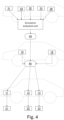
- Figure 4 illustrates a flow of data in an exemplary system according to the invention.
- all available digital sensors in the digital twin i.e., digital generic sensors 25, 26 (including the digital wheel drive sensors) and digital shock load sensors 31, 32, 33 generate virtual data and provide this to a simulation evaluation unit.
- This evaluation unit monitors the data during the simulation and derives a relationship 40 between the signals from the digital shock load sensors and the other digital sensors (in particular at least the digital wheel speed sensors). This becomes the surrogate model. For instance, a regression analysis may be performed for deriving the relationship 40.
- the surrogate model may be a reduced order model, consisting of a physics-based model but with the mathematical description of the physics simplified for the purposes of speed. If it is a statistical relationship, this can be achieved through simple look-up tables, linear regression, multi-variant regression, machine learning and artificial intelligence, which are all considered as similar methods of gradually increasing complexity. If it retains elements of physics, then this is achieved by reducing the order of the equation that describes the physics.
- CAN data input data
- most information is essentially obfuscated - no information can be inferred from the shock load data and the driver's personal privacy is protected.
- the frequency and magnitude of the shock loads being the information most important to the engineer, is recorded.
- the inferred shock load 50 at the respective components 11, 12, 13 may then be used for updating the digital twin by adding the respective information to the respective virtual components 21, 22, 23.
- every virtual component includes information about all past shock loads, plus stress values from regular vehicle operation, from which a statistical chance of damage or a potential for failure of the respective real component can be derived. This information may then be used for informing the driver or owner of the vehicle or for automatically scheduling a maintenance of the vehicle or the respective component.
- the synthetic training data may be generated by a physics-based model of the connection between the various parameters, which the individual system represents dynamically (Lifetime Digital Twin).
- the digital twin is therefore used twice, i.e., as a basis for prediction and as a model system for (synthetic) training data generation.
Landscapes
- Engineering & Computer Science (AREA)
- Physics & Mathematics (AREA)
- General Physics & Mathematics (AREA)
- Theoretical Computer Science (AREA)
- Geometry (AREA)
- Evolutionary Computation (AREA)
- Computer Hardware Design (AREA)
- General Engineering & Computer Science (AREA)
- Computer Vision & Pattern Recognition (AREA)
- Software Systems (AREA)
- Medical Informatics (AREA)
- Artificial Intelligence (AREA)
- Automation & Control Theory (AREA)
- Aviation & Aerospace Engineering (AREA)
- Computational Mathematics (AREA)
- Mathematical Analysis (AREA)
- Mathematical Optimization (AREA)
- Pure & Applied Mathematics (AREA)
- Testing Of Devices, Machine Parts, Or Other Structures Thereof (AREA)
Priority Applications (1)
| Application Number | Priority Date | Filing Date | Title |
|---|---|---|---|
| EP23218096.8A EP4575873A1 (fr) | 2023-12-19 | 2023-12-19 | Capteur de charge de choc virtuel |
Applications Claiming Priority (1)
| Application Number | Priority Date | Filing Date | Title |
|---|---|---|---|
| EP23218096.8A EP4575873A1 (fr) | 2023-12-19 | 2023-12-19 | Capteur de charge de choc virtuel |
Publications (1)
| Publication Number | Publication Date |
|---|---|
| EP4575873A1 true EP4575873A1 (fr) | 2025-06-25 |
Family
ID=89430489
Family Applications (1)
| Application Number | Title | Priority Date | Filing Date |
|---|---|---|---|
| EP23218096.8A Pending EP4575873A1 (fr) | 2023-12-19 | 2023-12-19 | Capteur de charge de choc virtuel |
Country Status (1)
| Country | Link |
|---|---|
| EP (1) | EP4575873A1 (fr) |
Citations (1)
| Publication number | Priority date | Publication date | Assignee | Title |
|---|---|---|---|---|
| EP4163740A1 (fr) | 2021-10-11 | 2023-04-12 | Hexagon Technology Center GmbH | Double numérique |
-
2023
- 2023-12-19 EP EP23218096.8A patent/EP4575873A1/fr active Pending
Patent Citations (1)
| Publication number | Priority date | Publication date | Assignee | Title |
|---|---|---|---|---|
| EP4163740A1 (fr) | 2021-10-11 | 2023-04-12 | Hexagon Technology Center GmbH | Double numérique |
Non-Patent Citations (3)
| Title |
|---|
| FABIO ARENA: "Predictive Maintenance in the Automotive Sector: A Literature Review", MATHEMATICAL AND COMPUTATIONAL APPLICATIONS, vol. 27, no. 1, 31 December 2021 (2021-12-31), pages 2, XP093169773, ISSN: 2297-8747, DOI: 10.3390/mca27010002 * |
| GORGES CHRISTIAN ET AL: "Impact detection using a machine learning approach and experimental road roughness classification", MECHANICAL SYSTEMS AND SIGNAL PROCESSING, vol. 117, 1 February 2019 (2019-02-01), AMSTERDAM, NL, pages 738 - 756, XP093025730, ISSN: 0888-3270, DOI: 10.1016/j.ymssp.2018.07.043 * |
| SEBASTIAN HUBER: "Wheel Speed Is All You Need: How to Efficiently Detect Automotive Damper Defects Using Frequency Analysis", 2022 IEEE INTELLIGENT VEHICLES SYMPOSIUM (IV), 5 June 2022 (2022-06-05), pages 1460 - 1465, XP093169792, ISBN: 978-1-6654-8821-1, Retrieved from the Internet <URL:https://ieeexplore.ieee.org/stamp/stamp.jsp?tp=&arnumber=9827269> DOI: 10.1109/IV51971.2022.9827269 * |
Similar Documents
| Publication | Publication Date | Title |
|---|---|---|
| US5531122A (en) | Fatigue analysis and warning system | |
| DE10257793A1 (de) | Modellbasierter Lebensdauerbeobachter | |
| US12124231B2 (en) | On-board machine component failure detection | |
| EP4074526B1 (fr) | Procédé de vérification de l'état d'usure d'une suspension | |
| JP2023548456A (ja) | 機械振動データに基づくシャーシの摩耗予測 | |
| Pimpale | Electric Axle Testing and Validation: Trade-off between Computer-Aided Simulation and Physical Testing | |
| Van Nguyen et al. | Modeling and prediction of remaining useful lifetime for maintenance scheduling optimization of a car fleet | |
| CN108228994B (zh) | 在越野道路随机激励下车辆及工作装置的应力计算方法 | |
| Stefaniak et al. | Methods of optimization of mining operations in a deep mine—Tracking the dynamic overloads using IoT sensor | |
| Manouchehrynia et al. | Reliability-based fatigue life assessment using random road load condition and local damage criteria | |
| Eddy et al. | Application of a digital twin virtual engineering tool for ground vehicle maintenance forecasting | |
| EP4575873A1 (fr) | Capteur de charge de choc virtuel | |
| Eddy et al. | Predictive Maintenance of a Ground Vehicle Using Digital Twin Technology | |
| Jang et al. | A feasible strain-history extraction method using machine learning for the durability evaluation of automotive parts | |
| Rosa et al. | Digital Twin-Enabled Fault Detection for Suspension Systems in Autonomous Mining Haulage Vehicles | |
| Revin et al. | Methods of monitoring the technical condition of the braking system of an autonomous vehicle during operation | |
| Veen | An analytical approach to dynamic irregular tyre wear | |
| US10890499B2 (en) | System and method for predicting strain power spectral densities of light machine structure | |
| EP4631815A1 (fr) | Procédé et système pour fournir un modèle de pneu adaptatif et véhicule | |
| Engel | Self-Excited Full-Vehicle Oscillations Caused by Tire–Road Interaction: Virtual and Real-World Experimental Investigation | |
| Eddy | Digital twin in military ground vehicles: Design and predictive maintenance | |
| Haerian et al. | Special and misuse events for motorcycles | |
| Sawa et al. | Fatigue life prediction on rough road using full vehicle co-simulation model with suspension control | |
| Habermehl et al. | Availability Increase of Mobile Machinery through Condition Prognosis | |
| Balakrishnan et al. | Accurate estimation of time histories for improved durability prediction using artificial neural networks |
Legal Events
| Date | Code | Title | Description |
|---|---|---|---|
| PUAI | Public reference made under article 153(3) epc to a published international application that has entered the european phase |
Free format text: ORIGINAL CODE: 0009012 |
|
| STAA | Information on the status of an ep patent application or granted ep patent |
Free format text: STATUS: THE APPLICATION HAS BEEN PUBLISHED |
|
| AK | Designated contracting states |
Kind code of ref document: A1 Designated state(s): AL AT BE BG CH CY CZ DE DK EE ES FI FR GB GR HR HU IE IS IT LI LT LU LV MC ME MK MT NL NO PL PT RO RS SE SI SK SM TR |
|
| STAA | Information on the status of an ep patent application or granted ep patent |
Free format text: STATUS: THE APPLICATION IS DEEMED TO BE WITHDRAWN |