EP4575946A1 - Procédé de mise en oeuvre d'un système de classement pour un réseautage social de dispositifs de l'internet des objets (ido) - Google Patents
Procédé de mise en oeuvre d'un système de classement pour un réseautage social de dispositifs de l'internet des objets (ido) Download PDFInfo
- Publication number
- EP4575946A1 EP4575946A1 EP23218280.8A EP23218280A EP4575946A1 EP 4575946 A1 EP4575946 A1 EP 4575946A1 EP 23218280 A EP23218280 A EP 23218280A EP 4575946 A1 EP4575946 A1 EP 4575946A1
- Authority
- EP
- European Patent Office
- Prior art keywords
- iot
- relationship
- devices
- ranking
- weightage
- Prior art date
- Legal status (The legal status is an assumption and is not a legal conclusion. Google has not performed a legal analysis and makes no representation as to the accuracy of the status listed.)
- Pending
Links
Images


Classifications
-
- G—PHYSICS
- G06—COMPUTING OR CALCULATING; COUNTING
- G06Q—INFORMATION AND COMMUNICATION TECHNOLOGY [ICT] SPECIALLY ADAPTED FOR ADMINISTRATIVE, COMMERCIAL, FINANCIAL, MANAGERIAL OR SUPERVISORY PURPOSES; SYSTEMS OR METHODS SPECIALLY ADAPTED FOR ADMINISTRATIVE, COMMERCIAL, FINANCIAL, MANAGERIAL OR SUPERVISORY PURPOSES, NOT OTHERWISE PROVIDED FOR
- G06Q10/00—Administration; Management
- G06Q10/06—Resources, workflows, human or project management; Enterprise or organisation planning; Enterprise or organisation modelling
- G06Q10/063—Operations research, analysis or management
- G06Q10/0631—Resource planning, allocation, distributing or scheduling for enterprises or organisations
- G06Q10/06312—Adjustment or analysis of established resource schedule, e.g. resource or task levelling, or dynamic rescheduling
-
- H—ELECTRICITY
- H04—ELECTRIC COMMUNICATION TECHNIQUE
- H04L—TRANSMISSION OF DIGITAL INFORMATION, e.g. TELEGRAPHIC COMMUNICATION
- H04L67/00—Network arrangements or protocols for supporting network services or applications
- H04L67/01—Protocols
- H04L67/12—Protocols specially adapted for proprietary or special-purpose networking environments, e.g. medical networks, sensor networks, networks in vehicles or remote metering networks
-
- H—ELECTRICITY
- H04—ELECTRIC COMMUNICATION TECHNIQUE
- H04L—TRANSMISSION OF DIGITAL INFORMATION, e.g. TELEGRAPHIC COMMUNICATION
- H04L67/00—Network arrangements or protocols for supporting network services or applications
- H04L67/50—Network services
- H04L67/60—Scheduling or organising the servicing of application requests, e.g. requests for application data transmissions using the analysis and optimisation of the required network resources
- H04L67/63—Routing a service request depending on the request content or context
-
- H—ELECTRICITY
- H04—ELECTRIC COMMUNICATION TECHNIQUE
- H04W—WIRELESS COMMUNICATION NETWORKS
- H04W4/00—Services specially adapted for wireless communication networks; Facilities therefor
- H04W4/02—Services making use of location information
-
- H—ELECTRICITY
- H04—ELECTRIC COMMUNICATION TECHNIQUE
- H04W—WIRELESS COMMUNICATION NETWORKS
- H04W4/00—Services specially adapted for wireless communication networks; Facilities therefor
- H04W4/70—Services for machine-to-machine communication [M2M] or machine type communication [MTC]
Definitions
- the present invention relates to a method for implementing a ranking system for social networking of Internet of Things (IoT) devices.
- the present invention also relates to a device for implementing a ranking system for social networking of Internet of Things (IoT) devices.
- the invention relates to a computer program as well as to a computer-readable data carrier with program code of a computer program.
- Social Internet of Vehicles: Architecture and Enabling Technologies demonstrates how social IoT devices, and social relationship types can be used to manage smart vehicles to avoid traffic jams and/or warn about accidents, and/or weather conditions, etc. However, it is not shown how such a general concept may be leveraged in an industrial scenario.
- Khelloufi et al. "A Social Relationships Based Service Recommendation System For SIoT Devices" demonstrates how social relationships between devices can be organized centrally using a graph-based system to automatically find the best service recommendation. However, these are recommendations to users and the devices are private devices like smartphones.
- the presented method is designed to be implemented through a computer system, indicating its reliance on software, algorithms, and digital processing.
- the primary focus is to establish a ranking system within a social networking framework specifically for IoT devices. This implies a system where IoT devices are assessed and/or ranked based on certain criteria within a network.
- the method may involve deploying a prediction agent, preferably in the form of a microservice, within an IoT platform that is part of the ranking system.
- a microservice may be a lightweight, independent service that performs a specific function.
- the prediction agent may be tasked with predicting the status of IoT devices, with a preference for determining their "upfront status", preferably referring to an initial assessment of the device's condition and/or capabilities.
- the prediction focuses on evaluating the capability of IoT devices to complete an assigned task, with a particular emphasis on their Remaining Useful Life (RLTL), which may refer to the expected operational lifespan left in the device.
- the method may apply a ranking system that is likely to be based on the importance and/or weightage of different factors.
- the IoT system preferably uses at least one criterion for ranking IoT devices. This criterion is used to ascertain the order in which IoT devices are ranked, based on their predicted capabilities and/or possibly other relevant factors.
- the method is able to identify other IoT devices that may replace a device whose capability has been predicted.
- the system determines which other IoT devices in the network can take over the task if the primary device is deemed incapable. After identifying potential replacements, the method involves selecting one of these IoT devices to pair with the initially evaluated device. The replacement is chosen to complete the task initially assigned to the capability-predicted device.
- the presented method relates to the field of IoT and enables IoT devices to make social relationships among themselves to offer better service to an external world.
- the prediction agent which may be deployed as a microservice in the platform, it may be possible to upfront predict the status of IoT devices to determine if a certain or several IoT devices may complete an assigned work or task. This helps to predict failure early. Also, it enables the application of a preferably weightage-based ranking system to get the best replacement of an IoT device, which is determined to not be able to complete a designated work or task, to continue the work of said IoT device with another replacement IoT device.
- the at least one ranking criterion defines one or more relationship types selected from the group comprising a co-location relationship, a co-owner relationship, a co-work relationship, a co-type relationship, and a co-protocol relationship.
- a colocation score has the highest priority and/or may override other relevant scores.
- the method comprises prioritizing the at least one ranking criterion based on at least one priority criterion, wherein the priority criterion is dynamically adjustable within the ranking system in accordance with at least one of a connection context, a connection situation and a connection solution.
- the step of prioritizing is preferably performed after the step of applying the ranking system. To exemplify, it may happen that IoT devices may establish more than one of the before-mentioned type of relationship among themselves.
- IoT device pairs having the highest priority may be chosen to rescue and/or replace the IoT device of the pair that is not able to complete an assigned work or task.
- a seamless service of the IoT devices can be offered or provided.
- Such a chosen pair of IoT devices may comprise the IoT device that is not able to complete an assigned work or task and another IoT device that is used as a replacement of the IoT device that is not able to complete an assigned work or task to take over the task or work in order to compensate said malfunction.
- a priority ranking among IoT device pairs is introduced. It is important to state that these priority rankings may not be fixed in their nature. Thus, the priority ranking may change with the context and/or situation and/or solution. Therefore, preferably, certain priority is assigned to different relationship types. Furthermore, such a priority selection may be implemented to be part of the IoT platform so that a solution builder can change the priorities accordingly. Furthermore, dynamic-based ranking may be implemented to avoid fixed ranks. Such a dynamic based ranking system is explained in detail in the detailed description of the drawing at the end of this specification, wherein reference to said section is made at this point.
- the IoT system may have given priority to different relationship types as follows: co-work: Ranked 1 (Highest priority) co-protocol: Ranked 2 co-type: Ranked 3 co-location: Ranked 4 co-owner: Ranked 5 (Lowest priority)
- the method further comprises enabling a solution builder to dynamically adjust the at least one priority criterion and/or a priority within the ranking system.
- the method includes the participation of a 'solution builder', which is likely a role or a component within the system. This could be a person, team, or a software module responsible for designing, configuring, or managing the ranking system.
- the solution builder may be enabled to make dynamic adjustments. This means it can alter and/or modify the IoT system's settings and/or parameters in real-time or as needed, without requiring significant downtime or restructuring of the entire system.
- the method allows the solution builder to change the 'at least one priority criterion'.
- These criteria may be the standards or rules based on which the ranking is determined within the system. Adjusting these criteria may refer to the solution builder can redefine what factors are considered important in the ranking process. Besides adjusting the criteria themselves, the solution builder can also alter the priority levels within the existing ranking system. This could involve changing how different criteria are weighted against each other or reordering the importance of various factors that determine the overall ranking. The feature of enabling dynamic adjustments by the solution builder may imply a high degree of flexibility and customization in the ranking system. It suggests that the system may be tailored to specific needs or preferences, and can adapt to changing requirements or conditions.
- the co-location relationship is defined based on a geographical distance threshold.
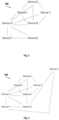
- the co-location (COL) relationship is based on at least one threshold set in the IoT system, wherein IoT devices are paired if they are geographically at a distance within the at least one set threshold.
- COL pairs of IoT devices may be determined in a way to give highest priority to the nearest ones of said pairs.
- different methods may be used to measure the shortest distances between IoT devices.
- An example for such a measurement method may be DBSCAN and/or a GN(Girvan-Newman) algorithm, etc.
- the co-owner relationship is established when the IoT devices have the same owner.
- the co-owner (COO) relationship may express that if the IoT devices have a same or a similar owner, then they are paired with or according to a co-owner type relationship.
- the co-type relationship is established when the IoT devices are of the same type or brand.
- COT co-type
- the IoT devices are of same type and/or of the same brand, then they are paired with according to said device-type relationship.
- the co-protocol (COP) relationship is established when the IoT devices communicate using the same protocol.
- the co-protocol (COP) relationship if the IoT devices can communicate using same or a similar protocol, they may be paired according to the co-protocol relationship.
- two LORA-protocol based IoT devices may be paired according to the COP relationship.
- a LORA-protocol based IoT device and a SIGFOX-protocol based IoT device may not be paired as no COP relationship can be determined.
- the method comprises dynamically adjusting at least one weightage of the weightage-based ranking system changing and/or recalculating and/or resetting the at least one weightage of the at least one ranking criterion based on a predefined weightage set criterion, wherein the weightage-based ranking system comprises a weightage matrix, in which for each pair of determined IoT devices the weightages for the ranking criteria are summed.
- a device for implementing a ranking system for social networking of Internet of Things (IoT) devices comprises a processing unit; a memory unit; and preferably a communication interface; wherein the processing unit is configured to execute instructions stored in the memory unit to perform the presented method according to any one of its aspects.
- IoT Internet of Things
- the processing unit further executes instructions to facilitate the preferably weightage-based ranking system to determine a replacement for an IoT device based on multiple relationship types.
- the processing unit is involved in executing the method.
- a processing unit may be a hardware or software component within a computer system, IoT device, or network, responsible for carrying out computational tasks.
- the processing unit may be tasked with executing specific instructions. These instructions may be part of the method and may be designed to enable and/or facilitate the functionality of the ranking system.
- the system may be described as being "preferably weightage-based," indicating that the ranking of IoT devices is determined by assigning different weights or importance to various factors or criteria.
- a key function of the system, as facilitated by the processing unit, is to identify a suitable replacement for an IoT device. This implies a scenario where an IoT device, for some reason, needs to be replaced by another device in the network.
- the replacement may be determined based on multiple relationship types. These relationships could be similar to those mentioned in previous claims, such as co-location, co-owner, co-work, co-type, and co-protocol relationships. The use of multiple types indicates a comprehensive approach to assessing the suit
- the processing unit further executes instructions to dynamically alter the weightage-based ranking system, prioritizing different IoT devices based on current conditions and defined relationship types.
- the processing unit may be integral to the method.
- This processing unit which could be a part of a computer system, server, or embedded within an IoT device, may be responsible for carrying out computational tasks.
- the processing unit may be tasked with executing certain instructions. These instructions may be designed to enable or modify the functionality of the weightage-based ranking system within the IoT context.
- the dynamic alteration of the ranking system may refer to that the processing unit can adjust the ranking algorithm and/or parameters in real-time or as conditions change. It suggests a system capable of adapting to evolving situations without manual intervention.
- the ranking system in question may be based on assigning different weights or levels of importance to various factors or criteria. This approach allows for a nuanced and/or flexible ranking of IoT devices, where the significance of certain factors can vary.
- the method may include the capability to prioritize IoT devices differently based on the current conditions. This implies that the ranking is not static but can change depending on situational factors such as device status, environmental conditions, or network demands.
- the system may prioritize IoT devices also based on defined relationship types. These could be similar to previously mentioned relationships like co-location, co-owner, or co-type relationships. The use of these relationship types in determining priority indicates a comprehensive and context-aware approach to ranking.
- the feature of dynamically altering the ranking based on current conditions and relationship types underscores the system's adaptability and responsiveness to real-time changes within the IoT environment.
- Also claimed according to the invention is a computer program comprising program code to execute at least parts of the method according to the invention in one of its aspects, when the computer program is executed on a computer.
- a computer program product comprising instructions which, when the program is executed by a computer, cause the computer to execute the method/steps of the method according to the invention in one of its aspects.
- a computer-readable medium comprising program code of a computer program is also proposed for executing at least parts of the method according to the invention in one of its aspects when the computer program is executed on a computer.
- the invention relates to a computer-readable (storage) medium comprising instructions which, when executed by a computer, cause the computer to execute the method/steps of the method according to the invention in one of its aspects.
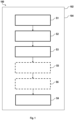
- Fig. 1 shows a schematic flowchart of an aspect of the computer-implemented method for implementing a ranking system for social networking of Internet of Things (IoT) devices.
- IoT Internet of Things
- a step S 1 there is performed deploying a prediction agent in an IoT platform of the ranking system.
- a step S2 there is performed predicting, by the prediction agent, a status of at least one IoT device to evaluate a capability of the at least one IoT device to complete an assigned task.
- step S6 there may be performed dynamically adjusting at least one weightage of the weightage-based ranking system changing and/or recalculating and/or resetting the at least one weightage of the at least one ranking criterion based on a predefined weightage set criterion, wherein the weightage-based ranking system comprises a weightage matrix, in which for each pair of determined IoT devices the weightages for the ranking criteria are summed.
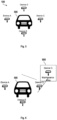
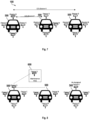
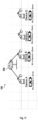
- the prediction agent which can be deployed as a microservice in the IoT platform, it may be possible to upfront predict the status of the IoT devices A-D to determine if they can complete an assigned work, such as painting the car 500.
- This prediction agent may use an amount of work left, an amount of work a certain device A-D can do, an IoT device battery life etc. to decide whether the certain IoT device A-D may be able to finish the work/task or not. For example, if the prediction agent has predicted that the IoT device C would fail or may be likely to fail to complete the assigned work/task, according to the method, all device pairing comprising the IoT device C may be checked. This may be indicated as the following:
- a weightage matrix can be derived.
- a workflow of the ranking based system may also and/or additionally be explained by the following steps:
- all onboarded devices may be centrally managed by a platform and continuously evaluated for the performance of the devices.
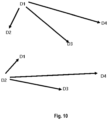
- one monitoring and prediction agent which determines if an IoT device may go to halt and/or has a malfunction. This may be done by calculating the remaining useful life of the respective IoT devices A-D and by calculating the work left for completing an assigned task, see Fig. 11 . Once the remaining useful life (RUL) of the IoT device is identified and if it is less than work left, necessary action can be taken that could be replacement of device ahead of time.
- RUL(device A) 30 mins
- RUL(device B) 2 hours
- RUL(device C) 2 hours
- RUL(device D) 3 hours.
- RUL of the device A is less than the work left, for example 2 hours
- device A may have to be replaced with another suitable device B-D (also named as target device).
- device C may be selected as target device.
- the target device is selected from the devices which has social relation with the current device Relationship-COT, Relationship-COW, Relationship-COP, Relationship-COO and it is selected based on the rank of the relationship type and attributes such as proximity, availability, RLTL of those devices, work left for those devices. Now using the ranking based approach, weights of all the attributes (proximity, availability, replaceability, relationship-COT, relationship-COW, relationship-COP, relationship-COO) of the device is calculated. Then, a certain target device is selected for offering the service. Once the target device the identified, an agreement is set between the source and the target device so that the source can be replaced by the target before it stops working so that there is continuation of the job.
Landscapes
- Business, Economics & Management (AREA)
- Engineering & Computer Science (AREA)
- Human Resources & Organizations (AREA)
- Strategic Management (AREA)
- Entrepreneurship & Innovation (AREA)
- Economics (AREA)
- Signal Processing (AREA)
- Marketing (AREA)
- Computer Networks & Wireless Communication (AREA)
- Development Economics (AREA)
- Medical Informatics (AREA)
- Educational Administration (AREA)
- General Health & Medical Sciences (AREA)
- Game Theory and Decision Science (AREA)
- Computing Systems (AREA)
- Health & Medical Sciences (AREA)
- Operations Research (AREA)
- Quality & Reliability (AREA)
- Tourism & Hospitality (AREA)
- Physics & Mathematics (AREA)
- General Business, Economics & Management (AREA)
- General Physics & Mathematics (AREA)
- Theoretical Computer Science (AREA)
- Management, Administration, Business Operations System, And Electronic Commerce (AREA)
Priority Applications (1)
| Application Number | Priority Date | Filing Date | Title |
|---|---|---|---|
| EP23218280.8A EP4575946A1 (fr) | 2023-12-19 | 2023-12-19 | Procédé de mise en oeuvre d'un système de classement pour un réseautage social de dispositifs de l'internet des objets (ido) |
Applications Claiming Priority (1)
| Application Number | Priority Date | Filing Date | Title |
|---|---|---|---|
| EP23218280.8A EP4575946A1 (fr) | 2023-12-19 | 2023-12-19 | Procédé de mise en oeuvre d'un système de classement pour un réseautage social de dispositifs de l'internet des objets (ido) |
Publications (1)
| Publication Number | Publication Date |
|---|---|
| EP4575946A1 true EP4575946A1 (fr) | 2025-06-25 |
Family
ID=89430039
Family Applications (1)
| Application Number | Title | Priority Date | Filing Date |
|---|---|---|---|
| EP23218280.8A Pending EP4575946A1 (fr) | 2023-12-19 | 2023-12-19 | Procédé de mise en oeuvre d'un système de classement pour un réseautage social de dispositifs de l'internet des objets (ido) |
Country Status (1)
| Country | Link |
|---|---|
| EP (1) | EP4575946A1 (fr) |
Citations (7)
| Publication number | Priority date | Publication date | Assignee | Title |
|---|---|---|---|---|
| US20190180218A1 (en) * | 2017-12-12 | 2019-06-13 | Einthusan Vigneswaran | Methods and systems for automated multi-user task scheduling |
| US20200050494A1 (en) * | 2017-02-05 | 2020-02-13 | Intel Corporation | Microservice provision and management |
| US20200267045A1 (en) * | 2019-02-18 | 2020-08-20 | Sap Se | Logical networking and affinity determination of iot devices using partitioned virtual space |
| CN112866358A (zh) * | 2021-01-05 | 2021-05-28 | 中国地质大学(北京) | 一种物联网服务重调度的方法、系统及装置 |
| CN114385359A (zh) * | 2022-01-07 | 2022-04-22 | 重庆邮电大学 | 一种物联网云边端任务时序协同方法 |
| US20220405149A1 (en) * | 2021-06-10 | 2022-12-22 | Sailion Inc. | Method and system for distributed workload processing |
| US20230130503A1 (en) * | 2021-10-25 | 2023-04-27 | Cerner Innovation, Inc. | Service Request Prioritization |
-
2023
- 2023-12-19 EP EP23218280.8A patent/EP4575946A1/fr active Pending
Patent Citations (7)
| Publication number | Priority date | Publication date | Assignee | Title |
|---|---|---|---|---|
| US20200050494A1 (en) * | 2017-02-05 | 2020-02-13 | Intel Corporation | Microservice provision and management |
| US20190180218A1 (en) * | 2017-12-12 | 2019-06-13 | Einthusan Vigneswaran | Methods and systems for automated multi-user task scheduling |
| US20200267045A1 (en) * | 2019-02-18 | 2020-08-20 | Sap Se | Logical networking and affinity determination of iot devices using partitioned virtual space |
| CN112866358A (zh) * | 2021-01-05 | 2021-05-28 | 中国地质大学(北京) | 一种物联网服务重调度的方法、系统及装置 |
| US20220405149A1 (en) * | 2021-06-10 | 2022-12-22 | Sailion Inc. | Method and system for distributed workload processing |
| US20230130503A1 (en) * | 2021-10-25 | 2023-04-27 | Cerner Innovation, Inc. | Service Request Prioritization |
| CN114385359A (zh) * | 2022-01-07 | 2022-04-22 | 重庆邮电大学 | 一种物联网云边端任务时序协同方法 |
Non-Patent Citations (2)
| Title |
|---|
| BUTT ET AL., SOCIAL INTERNET OF VEHICLES: ARCHITECTURE AND ENABLING TECHNOLOGIES |
| KHELLOUFI ET AL., A SOCIAL RELATIONSHIPS BASED SERVICE RECOMMENDATION SYSTEM FOR SIOT DEVICES |
Similar Documents
| Publication | Publication Date | Title |
|---|---|---|
| CN112884241A (zh) | 基于智能Agent的云边协作制造任务调度方法 | |
| Conte et al. | Mind is not enough: the precognitive bases of social interaction | |
| Azadivar et al. | Maintenance policy selection for JIT production systems | |
| Kumar et al. | Modelling supply chain viability during COVID-19 disruption: A case of an Indian automobile manufacturing supply chain | |
| Costa | AHP-De Borda: a hybrid multicriteria ranking method | |
| Aktepe et al. | A fuzzy analytic hierarchy process model for supplier selection and a case study | |
| Boudhar et al. | New dynamic heuristic for the optimization of opportunities to use new and remanufactured spare part in stochastic degradation context | |
| CN108322249A (zh) | 面向任务驱动的可重构星座卫星入网决策方法及系统 | |
| Jawale et al. | Requirement prioritization using adaptive fuzzy hierarchical cumulative voting | |
| Heard et al. | SAHRTA: A supervisory-based adaptive human-robot teaming architecture | |
| WO2025049099A2 (fr) | Système et procédé d'attribution automatisée de tâches | |
| Sprock et al. | Survey and classification of operational control problems in discrete event logistics systems (DELS) | |
| EP4575946A1 (fr) | Procédé de mise en oeuvre d'un système de classement pour un réseautage social de dispositifs de l'internet des objets (ido) | |
| CN117575451B (zh) | 物流订单控制方法、装置、计算机设备及存储介质 | |
| Algethami et al. | Diversity-based adaptive genetic algorithm for a Workforce Scheduling and Routing Problem | |
| US12380742B2 (en) | Maintenance induction for aircraft | |
| Grenyer et al. | Current practice and challenges towards handling uncertainty for effective outcomes in maintenance | |
| Achimugu et al. | An adaptive fuzzy decision matrix model for software requirements prioritization | |
| EP4268026B1 (fr) | Commande d'un programme de fabrication à l'aide d'un agent d'apprentissage par renforcement formé | |
| Jin et al. | System availability under redundancy sharing of standby components | |
| US12602254B2 (en) | Job negotiation for workflow automation tasks | |
| Corkill et al. | Organizationally adept agents | |
| US20250029164A1 (en) | Method and system for substituting items | |
| Gao et al. | Information sharing, trust, and reliance—A dynamic model of multi-operator multi-automation interaction | |
| Diehl | Collective coalition formation |
Legal Events
| Date | Code | Title | Description |
|---|---|---|---|
| PUAI | Public reference made under article 153(3) epc to a published international application that has entered the european phase |
Free format text: ORIGINAL CODE: 0009012 |
|
| STAA | Information on the status of an ep patent application or granted ep patent |
Free format text: STATUS: THE APPLICATION HAS BEEN PUBLISHED |
|
| AK | Designated contracting states |
Kind code of ref document: A1 Designated state(s): AL AT BE BG CH CY CZ DE DK EE ES FI FR GB GR HR HU IE IS IT LI LT LU LV MC ME MK MT NL NO PL PT RO RS SE SI SK SM TR |
|
| STAA | Information on the status of an ep patent application or granted ep patent |
Free format text: STATUS: REQUEST FOR EXAMINATION WAS MADE |
|
| 17P | Request for examination filed |
Effective date: 20260102 |