EP4575990A1 - Verfahren und vorrichtung zur anonymisierung von reidentifikationsdaten in einem visuellen verfolgungssystem - Google Patents
Verfahren und vorrichtung zur anonymisierung von reidentifikationsdaten in einem visuellen verfolgungssystem Download PDFInfo
- Publication number
- EP4575990A1 EP4575990A1 EP23218043.0A EP23218043A EP4575990A1 EP 4575990 A1 EP4575990 A1 EP 4575990A1 EP 23218043 A EP23218043 A EP 23218043A EP 4575990 A1 EP4575990 A1 EP 4575990A1
- Authority
- EP
- European Patent Office
- Prior art keywords
- tracking
- reidentification
- data items
- image sources
- data
- Prior art date
- Legal status (The legal status is an assumption and is not a legal conclusion. Google has not performed a legal analysis and makes no representation as to the accuracy of the status listed.)
- Granted
Links
Images

Classifications
-
- G—PHYSICS
- G06—COMPUTING OR CALCULATING; COUNTING
- G06F—ELECTRIC DIGITAL DATA PROCESSING
- G06F21/00—Security arrangements for protecting computers, components thereof, programs or data against unauthorised activity
- G06F21/60—Protecting data
- G06F21/62—Protecting access to data via a platform, e.g. using keys or access control rules
- G06F21/6218—Protecting access to data via a platform, e.g. using keys or access control rules to a system of files or objects, e.g. local or distributed file system or database
- G06F21/6245—Protecting personal data, e.g. for financial or medical purposes
- G06F21/6254—Protecting personal data, e.g. for financial or medical purposes by anonymising data, e.g. decorrelating personal data from the owner's identification
-
- G—PHYSICS
- G06—COMPUTING OR CALCULATING; COUNTING
- G06T—IMAGE DATA PROCESSING OR GENERATION, IN GENERAL
- G06T7/00—Image analysis
- G06T7/20—Analysis of motion
- G06T7/292—Multi-camera tracking
-
- G—PHYSICS
- G06—COMPUTING OR CALCULATING; COUNTING
- G06F—ELECTRIC DIGITAL DATA PROCESSING
- G06F21/00—Security arrangements for protecting computers, components thereof, programs or data against unauthorised activity
- G06F21/10—Protecting distributed programs or content, e.g. vending or licensing of copyrighted material ; Digital rights management [DRM]
- G06F21/16—Program or content traceability, e.g. by watermarking
-
- G—PHYSICS
- G06—COMPUTING OR CALCULATING; COUNTING
- G06F—ELECTRIC DIGITAL DATA PROCESSING
- G06F21/00—Security arrangements for protecting computers, components thereof, programs or data against unauthorised activity
- G06F21/60—Protecting data
- G06F21/602—Providing cryptographic facilities or services
-
- G—PHYSICS
- G06—COMPUTING OR CALCULATING; COUNTING
- G06F—ELECTRIC DIGITAL DATA PROCESSING
- G06F21/00—Security arrangements for protecting computers, components thereof, programs or data against unauthorised activity
- G06F21/60—Protecting data
- G06F21/604—Tools and structures for managing or administering access control systems
-
- G—PHYSICS
- G06—COMPUTING OR CALCULATING; COUNTING
- G06F—ELECTRIC DIGITAL DATA PROCESSING
- G06F3/00—Input arrangements for transferring data to be processed into a form capable of being handled by the computer; Output arrangements for transferring data from processing unit to output unit, e.g. interface arrangements
- G06F3/01—Input arrangements or combined input and output arrangements for interaction between user and computer
- G06F3/011—Arrangements for interaction with the human body, e.g. for user immersion in virtual reality
- G06F3/013—Eye tracking input arrangements
-
- G—PHYSICS
- G06—COMPUTING OR CALCULATING; COUNTING
- G06T—IMAGE DATA PROCESSING OR GENERATION, IN GENERAL
- G06T7/00—Image analysis
- G06T7/20—Analysis of motion
- G06T7/223—Analysis of motion using block-matching
-
- G—PHYSICS
- G06—COMPUTING OR CALCULATING; COUNTING
- G06T—IMAGE DATA PROCESSING OR GENERATION, IN GENERAL
- G06T7/00—Image analysis
- G06T7/20—Analysis of motion
- G06T7/246—Analysis of motion using feature-based methods, e.g. the tracking of corners or segments
-
- G—PHYSICS
- G06—COMPUTING OR CALCULATING; COUNTING
- G06V—IMAGE OR VIDEO RECOGNITION OR UNDERSTANDING
- G06V10/00—Arrangements for image or video recognition or understanding
- G06V10/20—Image preprocessing
- G06V10/25—Determination of region of interest [ROI] or a volume of interest [VOI]
-
- G—PHYSICS
- G06—COMPUTING OR CALCULATING; COUNTING
- G06V—IMAGE OR VIDEO RECOGNITION OR UNDERSTANDING
- G06V10/00—Arrangements for image or video recognition or understanding
- G06V10/70—Arrangements for image or video recognition or understanding using pattern recognition or machine learning
- G06V10/74—Image or video pattern matching; Proximity measures in feature spaces
- G06V10/75—Organisation of the matching processes, e.g. simultaneous or sequential comparisons of image or video features; Coarse-fine approaches, e.g. multi-scale approaches; using context analysis; Selection of dictionaries
-
- G—PHYSICS
- G06—COMPUTING OR CALCULATING; COUNTING
- G06V—IMAGE OR VIDEO RECOGNITION OR UNDERSTANDING
- G06V20/00—Scenes; Scene-specific elements
- G06V20/70—Labelling scene content, e.g. deriving syntactic or semantic representations
-
- G—PHYSICS
- G06—COMPUTING OR CALCULATING; COUNTING
- G06T—IMAGE DATA PROCESSING OR GENERATION, IN GENERAL
- G06T2207/00—Indexing scheme for image analysis or image enhancement
- G06T2207/10—Image acquisition modality
- G06T2207/10004—Still image; Photographic image
-
- G—PHYSICS
- G06—COMPUTING OR CALCULATING; COUNTING
- G06T—IMAGE DATA PROCESSING OR GENERATION, IN GENERAL
- G06T2207/00—Indexing scheme for image analysis or image enhancement
- G06T2207/10—Image acquisition modality
- G06T2207/10016—Video; Image sequence
-
- G—PHYSICS
- G06—COMPUTING OR CALCULATING; COUNTING
- G06T—IMAGE DATA PROCESSING OR GENERATION, IN GENERAL
- G06T2207/00—Indexing scheme for image analysis or image enhancement
- G06T2207/20—Special algorithmic details
- G06T2207/20092—Interactive image processing based on input by user
- G06T2207/20104—Interactive definition of region of interest [ROI]
-
- G—PHYSICS
- G06—COMPUTING OR CALCULATING; COUNTING
- G06V—IMAGE OR VIDEO RECOGNITION OR UNDERSTANDING
- G06V20/00—Scenes; Scene-specific elements
- G06V20/50—Context or environment of the image
- G06V20/52—Surveillance or monitoring of activities, e.g. for recognising suspicious objects
Definitions
- the present disclosure relates to the field of visual tracking systems.
- it proposes a novel method and device for anonymizing reidentification data in a visual tracking system, as well as a novel method and device for performing visual tracking using anonymized reidentification data.
- reidentification data As reID data, it is customary to use feature vectors that each represent a visual appearance of a tracking target.
- a feature vector may be described as a low-dimensional representation of the image data, which on the one hand economizes the data volume to be handled and on the other hand allows accurate matching.
- the system owner may consent to using this re-identification data in combination with reidentification data from a second image source but disallow its use together with reidentification data from a third image source; in other words, the permitted use of the reidentification data is across the FOVs of the first and second image sources.
- an unauthorized party eavesdropper
- a technical mechanism should cause his tracking attempts to fail.
- a visual tracking system having as its main components
- the input to this computation is feature vectors which each represent a visual appearance of a detected tracking target.
- the method excludes searching for matching reidentification data items among reidentification data items that have been computed using different one-way functions and/or searching for matching reidentification data items among reidentification data items that have been computed using a one-way function that has been modified by two or more different tracking-rights tokens.
- devices or device clusters which comprise processing circuitry that is configured to perform the method according to the second aspect (providing anonymized data for facilitating reidentification) or the method according to the third aspect (performing visual tracking).
- the present disclosure further proposes a computer program containing instructions for causing a computer to carry out the above method.
- the computer program may be stored or distributed on a data carrier.
- a “data carrier” may be a transitory data carrier, such as modulated electromagnetic or optical waves, or a non-transitory data carrier.
- Non-transitory data carriers include volatile and non-volatile memories, such as permanent and non-permanent storage media of magnetic, optical or solid-state type. Still within the scope of "data carrier”, such memories may be fixedly mounted or portable.
- the same tracking-rights token is used to modify the one-way function h for all image sources in the visual tracking system.
- the one-way function h is instead modified - still for all image sources in the visual tracking system - by a substitute tracking-rights token. This allows the tracking clients to perform reidentification in FOVs of all image sources in the visual tracking system but inside one validity period at a time.
- the term "reidentification data" refers to the quantity or variable which forms the basis of the reidentification process, the matching process where image data from different times and locations are identified as referring to the same tracking target, such as a person or an object.
- the reID data may be a proxy for the actual image data, such as feature vectors derived from the image data.
- the feature vectors may be referred to as reID data items.
- the reID data may be provided in the form of non-anonymized data (e.g., feature vectors) or as anonymized data (e.g., hashes of feature vectors ).
- the reID data shall be provided as anonymized data. Hashing and other types of anonymization process may bring with them a change in data type; for example, a hash of a vector may be a scalar, although special hashing techniques exist that return a vector.
- a "location" X ( m i ) of a subarea m i can refer to the subarea's position in an image or to a geoposition.
- the geoposition may correspond to the position of the image source which acquired the image, which is independent of the subarea's position in the image. Further, the geoposition may be an approximate position of the portion of the image source's FOV that the subarea m i depicts.
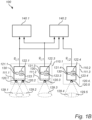
- Figure 1A shows a visual tracking system 100 suitable for performing visual tracking of tracking targets P 1 , P 2 , P 3 .
- the tracking targets P 1 , P 2 , P 3 which may be persons or inanimate objects, are exemplified in figure 1A as a vehicle P 1 and two different persons P 2 , P 3 .
- the technology of visual tracking may be said to rest on an assumption that the tracking targets are possible to recognize with high accuracy based on visual features that are unique or substantially unique within the scope of the visual tracking.
- the unique visual features may include body height, posture, build, facial features and (a combination of) garments and shoes.
- the license plate may be a preferred choice.
- a possible output of the visual tracking may be a list of the locations and indications of when the tracking target was present at these locations.
- the visual tracking system 100 in figure 1A comprises four image sources 120.1, 120.2, 120.3, 120.4, which are arranged to provide images of respective FOVs 129.1, 129.2, 129.3, 129.4, and at least two tracking clients 140.1, 140.2.
- Each tracking client 140 comprises processing circuitry 141 and a memory 142, wherein the memory 142 is suitable for storing, among others, a computer program 143 which is executable by the processing circuitry 141, as well as input and output data of a reidentification process.
- the visual tracking system 100 further comprises an anonymization layer 130; the anonymization layer 130 is a virtual entity which is here implemented in a coordinating entity 150.
- the coordinating entity 150 may be implemented in a dedicated server or host computer in a computer network, or as a process executing on a computer or a virtual machine with additional responsibilities in the visual tracking system 100.
- the coordinating entity 150 runs on processing circuitry 151 and has a memory 152 at its disposal; the functioning of the coordinating entity 150 may be codified as a computer program 153.
- the image sources 120, coordinating entity 150 and tracking clients 140 are linked by wired or wireless data connections, e.g., by being connected to a common data network.
- the data connections from the image sources 120 to the coordinating entity 150 should preferably be protected from unauthorized parties as they convey feature vectors that have not yet undergone anonymization.
- the data connections are sensitive also in such embodiments of the visual tracking system 100 where the feature vectors are computed in the coordinating entity 150, namely, since the data connections convey image data.
- the data connections can be protected from eavesdropping and other attacks by unauthorized parties by means of adequate end-to-end encryption, tunneling, or by letting the data connections pass only through physically protected wired lines - such as a device-internal bus - which are sensibly safe from intrusion.
- the novel techniques proposed herein are utilized to delimit the scope of the visual tracking spatially, and more precisely such that the first tracking client 140.1 shall be permitted to perform visual tracking in the FOVs of a first group 110.1 comprising the first image source 120.1 and the second image source 120.2, and such that the second tracking client 140.2 shall be permitted to perform visual tracking in the FOVs of a second group 110.2 comprising the third image source 120.3 and the fourth image source 120.4.
- the first tracking client 140.1 is supplied with location-annotated first reidentification data items g 1,1 , g 2,1 , g 3,1 , ....
- the second tracking client 140.2 is supplied with location-annotated second reidentification data items g 1,2 , g 2,2 , g 3,2 , ....
- a third and fourth tracking client 140.3, 140.4 may perform reidentification in the FOVs of the second group 110.2 of image sources on the basis of the location-annotated second reidentification data items.
- the image sources 120.1, 120.2, 120.3, 120.4 comprise lenses, photosensitive components (image sensors) and image-processing components, by which they provide digital image data representing still images or video sequences of their respective FOVs 129.1, 129.2, 129.3, 129.4.
- the image sources 120 may for example be digital video cameras.
- each image source 120 further comprises processing circuitry 121 configured to detect subareas m 1 , m 2 , ..., m 6 in said images M such that each subarea contains a tracking target.
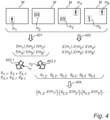
- the upper portion of figure 4 refers to an example where this detection process is applied to four images M ; from what can be observed visually, subareas m 1 , m 4 , m 6 contain the same person at different locations (and consequently, at different points in time), subarea m 5 contains a different person, and subareas m 2 , m 3 contain the same vehicle.
- the detection maybe based on an object detection algorithm or an object classification algorithm, such as a body-part detection algorithm, face detection algorithm, or in the case of vehicles an algorithm configured to detect alphanumeric characters (e.g., on a license plate) or visual features of a vehicle.
- the algorithms can be configured to output bounding boxes, or otherwise separate bounding-box postprocessing may be performed downstream of the algorithm, whereby the subareas m 1 , m 2 , ..., m 6 are obtained.
- each subarea m i preferably carries a globally unique index i .
- the index may be a single index from a sequence shared by all image sources.
- the processing circuitry 121 of the image sources 120 in figure 1A is further configured to compute, for each of the subareas m 1 , m 2 , ... , m 6 , respective feature vectors (or appearance vectors) denoted f ( m 1 ), f ( m 2 ), ... , f ( m 6 ), which represent a visual appearance of the tracking target or targets in these subareas m 1 , m 2 , ... , m 6 .
- a feature vector may alternatively be represented in the form of a string of characters, such as the following string of 43 characters in the base64 alphabet: aAPjFcw7bOw74uD4GEVdpo5vo-Sal1eoguVkYuwc1srRbboOFhLOVOwUPA, which represents 128 bytes of 3 bits each.
- the feature vector together with a suitable distance metric is the basis for matching in the reidentification process, i.e., the assessment whether two feature vectors are sufficiently close with respect to the distance metric that they shall be treated as relating to the same tracking target.
- Various approaches to person reidentification within this framework are reviewed in the following references:
- a feature vector may be described as a low-dimensional representation of the visual appearance of the tracking target.
- the feature vectors may be low-dimensional in the sense that they comprise a small number of components and/or that each component takes values in a set with finite cardinality, e.g., by rounding real numbers to integers.
- a match of two feature vectors x ( x 1 , x 2 , ... , x N )
- y ( y 1 , y 2 , ...
- the feature vectors are computed by a machine-learning model, such as a convolutional neural network (CNN), which has been trained to mimic correct or human-like reidentification decisions.
- the training may include supervised or unsupervised learning.
- the computations do not follow any transparent definition (which is anyhow not essential to the teachings herein) and their result normally cannot be interpreted unambiguously, e.g., in terms of aspects of the appearance of the tracking target. Further, the computations can only be repeated faithfully by the machine-learning model itself.
- the feature vectors computed in this manner can either be compared with respect to a distance metric on closed form - like in equations (2) and (3) - or with respect to a distance metric computed by a machine-learning model.
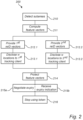
- the architecture shown in figure 1A where the anonymization layer is centralized in the coordinating entity 150 may avoid a need to hand out tracking-rights tokens to multiple parallel processes and/or it may simplify the replacement of a tracking-rights token when a validity period expires. It is understood that, when steps 210 and 211 are performed in the image sources 120 (or co-located therewith), they may correspond to multiple processes which execute in parallel; for example, there may be one process that detects subareas m i and computes feature vectors f ( m i ) for each image source.
- the tracking-rights token ⁇ 1 may be represented as a bitstring.
- the notation [ ⁇ , ⁇ ] refers to a combining operation, such as string concatenation.
- the quantity (4) may have the appearance of a single number, a bitstring, an alphanumeric string, a vector or the like.
- the one-way function is assumed to be noninvertible and sensibly collisionless.
- a hash function can be used, particularly a cryptographic hash function that provides a safety level considered adequate in view of the sensitivity of the image data. Examples are SHA-256, SHA3-512, RSA-1024 and possibly MD5.
- a recipient of the reidentification data items g 1,1 , g 2,1 , g 3,1 , ... can use the reidentification data items without knowing the value of the tracking-rights token ⁇ 1 .
- a proximity-preserving one-way function h proximity-preserving hash function
- the function h is proximity-preserving if, for all feature vectors x, y such that d ( x, y ) ⁇ D 0 , it holds that d h x , h y ⁇ D 0 ′ where D 0 ′ is constant.
- the proximity-preserving one-way function h shall be such that d h x ⁇ , h y ⁇ ⁇ D 0 ′ for some constant D 0 ′ , where ⁇ is a tracking-rights identifier.
- the distance function has to be defined differently when applied to the reidentification data items, since they have a different format or datatype, but this is implicit here so as not to burden the notation unnecessarily.
- the use of a proximity-preserving one-way function will allow a tracking client further downstream in the processing chain to search for matches based on a modified version of the proximity test (3), namely: d g j , 1 , g j ′ , 1 ⁇ D 0 ′ .
- the proximity-preserving property can be achieved by dividing the feature vector into shorter sub-vectors (which have one or more components each) and hashing each sub-vector separately; in such embodiments, the reidentification data item comprises a number of sub-hashes (salted by the tracking-rights token) of the sub-vectors. If the feature vector is divided into sub-vectors with one component each, which are hashed individually, the resulting reidentification data item can be a vector of the same length as the feature vector. Further proximity-preserving hash functions are described in Y. Weiss et al., "Spectral Hashing", in: D. Koller et al. (eds.), Advances in Neural Information Processing Systems 21 (NIPS 2008), ISBN 9781605609492 .
- the reidentification data items g 1,1 , g 2,1 , g 3,1 , ... are annotated with the corresponding locations X ( m 1 ) , X ( m 2 ) , X ( m 3 ) , ... and they are disclosed, in step 213.1, to the tracking clients that are permitted to perform visual tracking in the FOVs of the first subgroup 111.1 of image sources.
- Disclosing the reidentification data items to the tracking clients may include sending them in a message to the tracking clients or storing them in a shared memory to which the tracking clients have access.
- the shared memory may be configured as a publication/subscription (Pub/Sub) messaging service.
- the first tracking client 140.1 is permitted to perform visual tracking in the FOVs of the first subgroup 111.1 of image sources.
- Annotating a reidentification data item does not necessarily imply any modification of the reidentification data item itself; rather, the annotating may be achieved by storing the reidentification data item and its location in a common data structure (as figure 4 suggests), in associated fields of a table and/or by creating a pointer or another computer-readable association from the location to the reidentification data item or vice versa.
- These reidentification data items g 1,2 , g 2,2 , g 3,2 , ... are annotated with the corresponding locations X( m 1 ), X ( m 2 ), X ( m 3 ) , ...
- the second tracking client 140.2 - and the optional third and fourth tracking clients 140.3, 140.4 - are permitted to perform visual tracking in the FOVs of the second subgroup 111.2 of image sources.
- the provision of the first and second reidentification data items corresponds to the processes 403.1 and 403.2, respectively.
- the annotating of the second reidentification data items with locations is illustrated as process 404.
- the method 200 further includes a step 214 of preventing access to the feature vectors. Measures are to be taken to stop any party to inspect or access the feature vectors, or to render such attempts very difficult. To prevent access to the feature vectors, as explained above, the feature vectors can be conveyed on data connections which are protected from eavesdropping and other attacks by unauthorized parties. Further, when the feature vectors are stored or cached, an adequately protected memory can be used. It noted that step 214 is limited, at least in some embodiments, to preventing access to those feature vectors that are under the control of the anonymization layer 130, e.g., which are stored in a memory of a component acting as anonymization layer. In such embodiments, it may be the responsibility of other components of the visual tracking system 100 to prevent access outside the scope of the control of the anonymization layer 130, say, to protect access to data connections upstream of the anonymization layer 130 on which the feature vectors are conveyed.
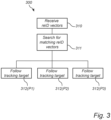
- FIG 3 the behavior of an individual tracking client 140 will now be described in terms of the method 300. It is appreciated that the same operations may be performed in a general-purpose processor.
- the method 300 will be described from the point of view of a tracking client authorized to perform visual tracking of tracking targets in FOVs of a first group 110.1 of image sources, namely, those for which the first tracking-rights token ⁇ 1 has been used to generate the reidentification data items. In the running example, this corresponds to the first tracking client 140.1.
- the tracking client receives first reidentification data items g i ,1 .
- This may include receiving the first reidentification data items g i ,1 in a message or fetching them from a shared memory.
- the scope of the visual tracking is spatially delimited thanks to the non-matchability (1), it may be acceptable to make the first reidentification data items g i ,1 and any second reidentification data items g i ,2 , third first reidentification data items etc. available in the same shared memory.
- Each said first reidentification data item has been derived from a feature vector f ( m i ) which represents a visual appearance of a tracking target in a subarea m i of an image obtained from an image source in the first group, and each first reidentification data item has been annotated with a location X ( m i ) of the respective subarea.
- the first reidentification data items have more precisely been provided using the predefined one-way function h modified by the first tracking-rights token ⁇ 1 specific to the first group of image sources.
- the tracking client then proceeds to search, in step 311, for matching reidentification data items among the received first reidentification data items g i ,1 .
- a further process executing on the processing circuitry 121.3 provides reidentification data items from a further image source 120.3 using the first tracking-rights token ⁇ 1 .
- the first tracking-rights token ⁇ 1 is thus specific to a group of image sources consisting of image sources 120.1, 120.2, 120.3 (and possibly more).
Landscapes
- Engineering & Computer Science (AREA)
- Theoretical Computer Science (AREA)
- Physics & Mathematics (AREA)
- General Physics & Mathematics (AREA)
- Multimedia (AREA)
- Computer Vision & Pattern Recognition (AREA)
- General Engineering & Computer Science (AREA)
- Software Systems (AREA)
- Health & Medical Sciences (AREA)
- General Health & Medical Sciences (AREA)
- Bioethics (AREA)
- Computer Security & Cryptography (AREA)
- Computer Hardware Design (AREA)
- Medical Informatics (AREA)
- Databases & Information Systems (AREA)
- Human Computer Interaction (AREA)
- Technology Law (AREA)
- Automation & Control Theory (AREA)
- Artificial Intelligence (AREA)
- Computing Systems (AREA)
- Evolutionary Computation (AREA)
- Computational Linguistics (AREA)
- Image Analysis (AREA)
Priority Applications (4)
| Application Number | Priority Date | Filing Date | Title |
|---|---|---|---|
| EP23218043.0A EP4575990B1 (de) | 2023-12-19 | 2023-12-19 | Verfahren und vorrichtung zur anonymisierung von reidentifikationsdaten in einem visuellen verfolgungssystem |
| KR1020240174758A KR20250095517A (ko) | 2023-12-19 | 2024-11-29 | 시각 추적 시스템에서 재식별 데이터를 익명화하기 위한 방법 및 장치 |
| US18/978,214 US20250200765A1 (en) | 2023-12-19 | 2024-12-12 | Method and device for anonymizing reidentification data in a visual tracking system |
| CN202411839393.5A CN120182332A (zh) | 2023-12-19 | 2024-12-13 | 在视觉追踪系统中对重识别数据进行匿名化的方法和装置 |
Applications Claiming Priority (1)
| Application Number | Priority Date | Filing Date | Title |
|---|---|---|---|
| EP23218043.0A EP4575990B1 (de) | 2023-12-19 | 2023-12-19 | Verfahren und vorrichtung zur anonymisierung von reidentifikationsdaten in einem visuellen verfolgungssystem |
Publications (3)
| Publication Number | Publication Date |
|---|---|
| EP4575990A1 true EP4575990A1 (de) | 2025-06-25 |
| EP4575990C0 EP4575990C0 (de) | 2025-10-29 |
| EP4575990B1 EP4575990B1 (de) | 2025-10-29 |
Family
ID=89224599
Family Applications (1)
| Application Number | Title | Priority Date | Filing Date |
|---|---|---|---|
| EP23218043.0A Active EP4575990B1 (de) | 2023-12-19 | 2023-12-19 | Verfahren und vorrichtung zur anonymisierung von reidentifikationsdaten in einem visuellen verfolgungssystem |
Country Status (4)
| Country | Link |
|---|---|
| US (1) | US20250200765A1 (de) |
| EP (1) | EP4575990B1 (de) |
| KR (1) | KR20250095517A (de) |
| CN (1) | CN120182332A (de) |
Citations (1)
| Publication number | Priority date | Publication date | Assignee | Title |
|---|---|---|---|---|
| EP3971734A1 (de) * | 2020-09-22 | 2022-03-23 | Grazper Technologies ApS | Auswertungsvorrichtung zur erneuten identifizierung und zugehöriges verfahren, system und computerprogramm |
Family Cites Families (4)
| Publication number | Priority date | Publication date | Assignee | Title |
|---|---|---|---|---|
| US10395385B2 (en) * | 2017-06-27 | 2019-08-27 | Qualcomm Incorporated | Using object re-identification in video surveillance |
| US10607484B2 (en) * | 2017-12-28 | 2020-03-31 | Intel Corporation | Privacy-preserving distributed visual data processing |
| JP7354752B2 (ja) * | 2019-10-15 | 2023-10-03 | オムロン株式会社 | 画像匿名化装置、画像匿名化方法、及びプログラム |
| EP4040319B1 (de) * | 2021-02-09 | 2022-12-14 | Axis AB | Vorrichtungen und verfahren zur sicheren speicherung von medien mit persönlichen daten und zum löschen von gespeicherten persönlichen daten |
-
2023
- 2023-12-19 EP EP23218043.0A patent/EP4575990B1/de active Active
-
2024
- 2024-11-29 KR KR1020240174758A patent/KR20250095517A/ko active Pending
- 2024-12-12 US US18/978,214 patent/US20250200765A1/en active Pending
- 2024-12-13 CN CN202411839393.5A patent/CN120182332A/zh active Pending
Patent Citations (1)
| Publication number | Priority date | Publication date | Assignee | Title |
|---|---|---|---|---|
| EP3971734A1 (de) * | 2020-09-22 | 2022-03-23 | Grazper Technologies ApS | Auswertungsvorrichtung zur erneuten identifizierung und zugehöriges verfahren, system und computerprogramm |
Non-Patent Citations (4)
| Title |
|---|
| L. ZHENG ET AL.: "Person re-identification: Past, present and future'', arXiv preprint", ARXIV: 1610.02984, 2016 |
| M. YE ET AL.: "Deep Learning for Person Re-identification: A Survey and Outlook", ARXIV:2001.04193, 2021 |
| Y. WEISS ET AL.: "Advances in Neural Information Processing Systems 21", article "Spectral Hashing" |
| ZAHRA ET AL.: "Person re-identification: A retrospective on domain specific open challenges and future trends", PATTERN RECOGNITION, vol. 142, 2023, pages 109669 |
Also Published As
| Publication number | Publication date |
|---|---|
| CN120182332A (zh) | 2025-06-20 |
| KR20250095517A (ko) | 2025-06-26 |
| US20250200765A1 (en) | 2025-06-19 |
| EP4575990C0 (de) | 2025-10-29 |
| EP4575990B1 (de) | 2025-10-29 |
Similar Documents
| Publication | Publication Date | Title |
|---|---|---|
| De Cristofaro | An overview of privacy in machine learning | |
| Neff et al. | REVAMP 2 T: real-time edge video analytics for multicamera privacy-aware pedestrian tracking | |
| Zhang et al. | Privacy-preserving machine learning through data obfuscation | |
| CN110941855B (zh) | 一种AIoT场景下的神经网络模型窃取防御方法 | |
| Bajaj et al. | A state-of-the-art review on adversarial machine learning in image classification | |
| US12530475B2 (en) | System and method for object recognition and privacy preservation | |
| CN114255440B (zh) | 匿名重识别的装置、系统及方法 | |
| Subramanian et al. | Hybrid quantum enhanced federated learning for cyber attack detection | |
| Suddala | FADL-DP and CNN-GRU Driven Cloud Framework for Secure Healthcare E-Commerce Platform | |
| Singha et al. | Combination of optimization methods in a multistage approach for a deep neural network model | |
| Demertzis et al. | A Blockchained Secure and Integrity-Preserved Architecture for Military Logistics Operations | |
| Aleisa | Enhancing security in cps industry 5.0 using lightweight mobilenetv3 with adaptive optimization technique | |
| Bandarapu et al. | Blockchain-based federated learning framework for malicious node detection in internet of vehicles (IoV) networks using fog and cloud computing | |
| US20250292618A1 (en) | Altering card device attributes in response to detecting a proximity intrusion | |
| EP4575990A1 (de) | Verfahren und vorrichtung zur anonymisierung von reidentifikationsdaten in einem visuellen verfolgungssystem | |
| US12587525B2 (en) | Altering card device attributes in response to detecting an anomalous location of the card device | |
| Misra et al. | The challenge of collaborative iot-based inferencing in adversarial settings | |
| Grover et al. | Keeping it Low-Key: Modern-Day Approaches to Privacy-Preserving Machine Learning | |
| He et al. | AI‐Driven Secure Map Construction for UAV Inspection in Edge‐Cloud Collaborative IIoT Systems | |
| Hazzazi et al. | High accuracy indoor positioning system using Galois field-based cryptography and hybrid deep learning | |
| Akcay et al. | From See to Shield: ML-Assisted Fine-Grained Access Control for Visual Data | |
| Arri et al. | Real-Time Secure Cloud Transmission Framework for Agricultural Surveillance Using YOLOv5, AES-256, and HMAC-SHA256 | |
| Abdelfattah | Adversarial attacks on multi-modal 3D detection models | |
| Muhammed et al. | Federated Learning for Secure and Privacy-Preserving Facial Recognition: Advances, Challenges, and Research Directions | |
| CN119888622B (zh) | 基于深度学习的执法场所管理监督方法及系统 |
Legal Events
| Date | Code | Title | Description |
|---|---|---|---|
| PUAI | Public reference made under article 153(3) epc to a published international application that has entered the european phase |
Free format text: ORIGINAL CODE: 0009012 |
|
| STAA | Information on the status of an ep patent application or granted ep patent |
Free format text: STATUS: REQUEST FOR EXAMINATION WAS MADE |
|
| 17P | Request for examination filed |
Effective date: 20240903 |
|
| AK | Designated contracting states |
Kind code of ref document: A1 Designated state(s): AL AT BE BG CH CY CZ DE DK EE ES FI FR GB GR HR HU IE IS IT LI LT LU LV MC ME MK MT NL NO PL PT RO RS SE SI SK SM TR |
|
| GRAP | Despatch of communication of intention to grant a patent |
Free format text: ORIGINAL CODE: EPIDOSNIGR1 |
|
| STAA | Information on the status of an ep patent application or granted ep patent |
Free format text: STATUS: GRANT OF PATENT IS INTENDED |
|
| INTG | Intention to grant announced |
Effective date: 20250808 |
|
| GRAS | Grant fee paid |
Free format text: ORIGINAL CODE: EPIDOSNIGR3 |
|
| GRAA | (expected) grant |
Free format text: ORIGINAL CODE: 0009210 |
|
| STAA | Information on the status of an ep patent application or granted ep patent |
Free format text: STATUS: THE PATENT HAS BEEN GRANTED |
|
| AK | Designated contracting states |
Kind code of ref document: B1 Designated state(s): AL AT BE BG CH CY CZ DE DK EE ES FI FR GB GR HR HU IE IS IT LI LT LU LV MC ME MK MT NL NO PL PT RO RS SE SI SK SM TR |
|
| REG | Reference to a national code |
Ref country code: CH Ref legal event code: F10 Free format text: ST27 STATUS EVENT CODE: U-0-0-F10-F00 (AS PROVIDED BY THE NATIONAL OFFICE) Effective date: 20251029 Ref country code: GB Ref legal event code: FG4D |
|
| REG | Reference to a national code |
Ref country code: IE Ref legal event code: FG4D |
|
| U01 | Request for unitary effect filed |
Effective date: 20251029 |
|
| U07 | Unitary effect registered |
Designated state(s): AT BE BG DE DK EE FI FR IT LT LU LV MT NL PT RO SE SI Effective date: 20251104 |
|
| U20 | Renewal fee for the european patent with unitary effect paid |
Year of fee payment: 3 Effective date: 20251119 |
|
| PG25 | Lapsed in a contracting state [announced via postgrant information from national office to epo] |
Ref country code: ES Free format text: LAPSE BECAUSE OF FAILURE TO SUBMIT A TRANSLATION OF THE DESCRIPTION OR TO PAY THE FEE WITHIN THE PRESCRIBED TIME-LIMIT Effective date: 20251029 |
|
| PG25 | Lapsed in a contracting state [announced via postgrant information from national office to epo] |
Ref country code: NO Free format text: LAPSE BECAUSE OF FAILURE TO SUBMIT A TRANSLATION OF THE DESCRIPTION OR TO PAY THE FEE WITHIN THE PRESCRIBED TIME-LIMIT Effective date: 20260129 |
|
| PG25 | Lapsed in a contracting state [announced via postgrant information from national office to epo] |
Ref country code: HR Free format text: LAPSE BECAUSE OF FAILURE TO SUBMIT A TRANSLATION OF THE DESCRIPTION OR TO PAY THE FEE WITHIN THE PRESCRIBED TIME-LIMIT Effective date: 20251029 |
|
| PG25 | Lapsed in a contracting state [announced via postgrant information from national office to epo] |
Ref country code: RS Free format text: LAPSE BECAUSE OF FAILURE TO SUBMIT A TRANSLATION OF THE DESCRIPTION OR TO PAY THE FEE WITHIN THE PRESCRIBED TIME-LIMIT Effective date: 20260129 |
|
| PG25 | Lapsed in a contracting state [announced via postgrant information from national office to epo] |
Ref country code: IS Free format text: LAPSE BECAUSE OF FAILURE TO SUBMIT A TRANSLATION OF THE DESCRIPTION OR TO PAY THE FEE WITHIN THE PRESCRIBED TIME-LIMIT Effective date: 20260228 |
|
| PG25 | Lapsed in a contracting state [announced via postgrant information from national office to epo] |
Ref country code: PL Free format text: LAPSE BECAUSE OF FAILURE TO SUBMIT A TRANSLATION OF THE DESCRIPTION OR TO PAY THE FEE WITHIN THE PRESCRIBED TIME-LIMIT Effective date: 20251029 |