EP4576020A1 - Verfahren und system zur erneuten identifizierung - Google Patents
Verfahren und system zur erneuten identifizierung Download PDFInfo
- Publication number
- EP4576020A1 EP4576020A1 EP23218017.4A EP23218017A EP4576020A1 EP 4576020 A1 EP4576020 A1 EP 4576020A1 EP 23218017 A EP23218017 A EP 23218017A EP 4576020 A1 EP4576020 A1 EP 4576020A1
- Authority
- EP
- European Patent Office
- Prior art keywords
- image
- feature vectors
- objects
- appearance
- image processing
- Prior art date
- Legal status (The legal status is an assumption and is not a legal conclusion. Google has not performed a legal analysis and makes no representation as to the accuracy of the status listed.)
- Granted
Links
Images

Classifications
-
- G—PHYSICS
- G06—COMPUTING OR CALCULATING; COUNTING
- G06V—IMAGE OR VIDEO RECOGNITION OR UNDERSTANDING
- G06V20/00—Scenes; Scene-specific elements
- G06V20/40—Scenes; Scene-specific elements in video content
- G06V20/41—Higher-level, semantic clustering, classification or understanding of video scenes, e.g. detection, labelling or Markovian modelling of sport events or news items
-
- G—PHYSICS
- G06—COMPUTING OR CALCULATING; COUNTING
- G06V—IMAGE OR VIDEO RECOGNITION OR UNDERSTANDING
- G06V10/00—Arrangements for image or video recognition or understanding
- G06V10/40—Extraction of image or video features
- G06V10/46—Descriptors for shape, contour or point-related descriptors, e.g. scale invariant feature transform [SIFT] or bags of words [BoW]; Salient regional features
- G06V10/469—Contour-based spatial representations, e.g. vector-coding
-
- G—PHYSICS
- G06—COMPUTING OR CALCULATING; COUNTING
- G06V—IMAGE OR VIDEO RECOGNITION OR UNDERSTANDING
- G06V10/00—Arrangements for image or video recognition or understanding
- G06V10/70—Arrangements for image or video recognition or understanding using pattern recognition or machine learning
- G06V10/74—Image or video pattern matching; Proximity measures in feature spaces
- G06V10/761—Proximity, similarity or dissimilarity measures
-
- G—PHYSICS
- G06—COMPUTING OR CALCULATING; COUNTING
- G06V—IMAGE OR VIDEO RECOGNITION OR UNDERSTANDING
- G06V10/00—Arrangements for image or video recognition or understanding
- G06V10/70—Arrangements for image or video recognition or understanding using pattern recognition or machine learning
- G06V10/82—Arrangements for image or video recognition or understanding using pattern recognition or machine learning using neural networks
-
- G—PHYSICS
- G06—COMPUTING OR CALCULATING; COUNTING
- G06V—IMAGE OR VIDEO RECOGNITION OR UNDERSTANDING
- G06V20/00—Scenes; Scene-specific elements
- G06V20/40—Scenes; Scene-specific elements in video content
- G06V20/46—Extracting features or characteristics from the video content, e.g. video fingerprints, representative shots or key frames
-
- G—PHYSICS
- G06—COMPUTING OR CALCULATING; COUNTING
- G06V—IMAGE OR VIDEO RECOGNITION OR UNDERSTANDING
- G06V20/00—Scenes; Scene-specific elements
- G06V20/40—Scenes; Scene-specific elements in video content
- G06V20/49—Segmenting video sequences, i.e. computational techniques such as parsing or cutting the sequence, low-level clustering or determining units such as shots or scenes
-
- G—PHYSICS
- G06—COMPUTING OR CALCULATING; COUNTING
- G06V—IMAGE OR VIDEO RECOGNITION OR UNDERSTANDING
- G06V20/00—Scenes; Scene-specific elements
- G06V20/50—Context or environment of the image
- G06V20/52—Surveillance or monitoring of activities, e.g. for recognising suspicious objects
Definitions
- the present disclosure relates to a computer-implemented method for determining similarity in appearance of objects in image frames of at least one video sequence.
- the disclosure further relates to an image processing system configured to perform the method.
- Re-identification in video sequences refers to the process of identifying and tracking an object across different image frames in a video sequence. This may be useful in a number of different applications and for a number of reasons. For example, in surveillance systems, identifying and tracking people or vehicles may be critical for security purposes. In other applications it may be useful to monitor and analyze, for example, the behavior and trajectory of an object over time. Moreover, many automated systems, such as those used in autonomous vehicles or robotics, rely on re-identification and object tracking for decision making.
- object detections in a current frame are associated with object tracks from previous frames.
- association has been based on comparing the state, such as a position, of an object detected in the current frame to a predicted state. More recently methods have been developed that take into account the appearance of the tracked objects.
- feature vectors which capture essential characteristics of an object's appearance, can be used in the re-identification.
- the feature vectors of different frames can be compared or matched to determine a similarity between objects detected in the different frames. Matching algorithms can be used to assess the similarity between the feature vectors to determine if they belong to the same object.
- One way of performing the re-identification is to use machine learning to extract feature vectors.
- a machine learning model may be trained on datasets of object images to generate similar feature vectors for images depicting the same physical object, and deviating feature vectors for images depicting different physical objects.
- a deep learning model may thereby be used as part of a process of tracking objects in a video.
- imaging configurations that are optimized for human users typically involves digital processing of the captured images, which may cause failure in re-identifying an object in different image frames.
- the present disclosure relates to, according to a first embodiment, a computer-implemented method for determining similarity in appearance of objects in image frames of at least one video sequence, comprising the steps of:
- the first raw image data applying the second image processing settings By re-processing the first raw image data applying the second image processing settings if both the one or more second feature vectors differ by more than a first threshold and the first image processing settings differ from the second image processing settings by more than a second threshold, it is possible to obtain one or more updated first feature vectors that can be recompared against the one or more second feature vectors.
- the updated first feature vectors i.e., feature vectors that have been re-processed using the image processing settings of another image frame, can be used in the second comparison to determine whether the difference between the first feature vectors and the second feature vectors was caused by actual feature vector differences, or whether it was caused by the fact that different image processing settings were used for the two image frames.
- the step of comparing the one or more updated first feature vectors to the one or more second feature vectors can be used to update the determined similarity of the first object and the second object.
- One embodiment of the presently disclosed computer-implemented method for determining similarity in appearance of objects in image frames of at least one video sequence comprises the step of updating the determined similarity of the first object and the second object by comparing the one or more updated first feature vectors to the one or more second feature vectors.
- the first raw image data In order to be able to re-process the first raw image data corresponding to the first image area applying the second image processing settings it may be necessary to temporarily store the first raw image data, preferably in a storage medium such as a random-access memory, at least until the one or more first feature vectors and the one or more second feature vectors have been compared. In the event that the first image processing settings differ from the second image processing settings by more than a second threshold, the first raw image data has to be stored until the first raw image data has been re-processed. If the criteria for re-processing are not fulfilled the first raw image data can be discarded, otherwise the first raw image data can be discarded after the re-processing. It is possible to temporarily store the first raw image data only for the first image area to avoid unnecessary use of memory. In the same way the re-processing may only need to be carried out for the first image area.
- a storage medium such as a random-access memory
- the presently disclosed computer-implemented method for determining similarity in appearance of objects in image frames of at least one video sequence can be performed repeatedly, for example, at fixed time intervals or at every n:th image frame in a video sequence to track an object.
- the first/second raw image data, image frame, image settings, processed image, feature vectors etc. can be extended to third, fourth, fifth raw image data, image frame, image settings, processed image, feature vectors etc. with corresponding comparisons.
- the present disclosure further relates to an image processing system comprising: processing circuitry configured to:
- the system may further comprise one or more image sensors, preferably in one or more cameras, for capturing the image frames processed by the processing circuitry.
- the system may further comprise one or more displays for displaying the processed image frames, for example, in the form of one or more video sequences.
- the objects that are detected can be labelled on the display.
- the processing circuitry may be configured to generate or extract metadata in which the objects are labelled according to, for example, their properties, object identifiers, or which object class they belong to.
- the method for determining similarity in appearance of objects determines that the first object in the processed first image frame is the same as the second object in the processed second image frame, or at least that the likelihood is greater than a predefined threshold, a user may be able to follow the object with an appropriate label.
- the extracted information may be used in other applications, such as for analytical purposes.
- the present disclosure relates to a computer-implemented method for determining similarity in appearance of objects in image frames of at least one video sequence.
- the disclosure further relates to a method of tracking one or more objects in at least one video sequence using the presently disclosed method for determining similarity in appearance of objects in image frames of at least one video sequence.
- the method comprises the steps of:
- the method further comprises the steps of:
- the method may further comprise the step of displaying the first object and/or the second object, preferably adding a label to indicate an identity of the object being tracked.
- the first object may be associated with the second object. This may include, for example, providing an indication that the first and second objects are considered to be the same object. This may include the step of outputting metadata, for example in the form of a common label, indicative of an association between the first and second object.
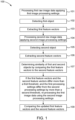
- Fig. 1 shows an example of an embodiment of the presently disclosed method 100 for determining similarity in appearance of objects in image frames of at least one video sequence.
- the computer-implemented method 100 for determining similarity in appearance of objects in image frames of at least one video sequence comprises the steps of:
- the step of detecting a first object in the processed first image frame and the step of detecting a second object in the processed second image frame may be done in several ways.
- the step may, for example, include the use of a convolutional neural network, and may detect objects in substantially real-time.
- One example of a method for object detection is the method described in J. Redmon, S. Divvala, R. Girshick and A. Farhadi, "You Only Look Once: Unified, Real-Time Object Detection," 2016 IEEE Conference on Computer Vision and Pattern Recognition (CVPR), Las Vegas, NV, USA, 2016, pp. 779-788, doi: 10.1109/CVPR.2016.91 , hereinafter referred to as YOLO.
- the YOLO method divides an input image into a grid of cells. For each cell bounding boxes are predicted using a single convolutional network. For each bounding box a likelihood that the detected object belongs to different predefined classes are calculated. Low-confidence bounding boxes can then be filtered out.
- the presently disclosed computer-implemented method for determining similarity in appearance of objects may use the YOLO method or other similar methods capable of detecting objects in images.
- the step of extracting one or more first feature vectors describing the appearance of the first object and/or extracting one or more second feature vectors describing the appearance of the second object may also be carried out in several ways.
- the step of extracting one or more first feature vectors and/or extracting one or more second feature vectors comprises applying a machine learning model, such as a neural network.
- the method may use a convolutional neural network or equivalent.
- the convolutional neural network or equivalent will preferably have been pre-trained to extract feature vectors.
- triplets may comprise an anchor, a positive and a negative.
- the triplets may comprise roughly aligned matching / non-matching objects.
- the loss function which is a function that quantifies the difference between the predicted output and the ground truth, may involve known technologies such as triplet loss and softmax loss.
- One example of a convolutional neural network for extracting feature vectors, and the training of the same, is described in Schroff, F., Kalenichenko, D. and Philbin, J. (2015) "Facenet: A Unified Embedding for Face Recognition and Clustering". Proceedings of the IEEE Conference on Computer Vision and Pattern Recognition, Boston, 7-12 June 2015, 815-823 , hereinafter referred to as FaceNet.
- the machine learning model may have been trained to calculate feature vectors that are closer to each other for objects which are the same and further apart from each other for objects which are different. That is, the distance, as measured by a suitable distance metric such as the L2-norm, between feature vectors of objects which are the same is shorter than the distance between feature features of objects which are different.
- the distance between the feature vectors may thus be used to measure a similarity of the feature vectors and thereby the objects, wherein the similarity increases with decreasing distance between the feature vectors.
- the first and second image frames may be image frames from one image sensor of a camera at different points in time, wherein the first image frame and second image frame are image frames from one video sequence.
- the first image frame may, for example, be captured before the second image frame or the second image frame may be captured before the first image frame.
- the first image frame and second image frame are image frames from multiple image sensors.
- the multiple image sensors may be multiple image sensors depicting different views of a scene.
- the first and second image frames may still be image frames at different points in time.
- the first and second image frames are image frames captured at the same time.
- the first and second image frames may be image frames from two of these image sensors, and, as would be understood by a person skilled in the art, further extended to any number of image sensors and image frames.
- the multiple image sensors may also be sensors of different cameras.
- the first image frame and the second image frame are image frames from multiple image sensors
- the first image frame and second image frame may be image frames from different video sequences.
- the method may further comprise the step of determining a similarity of the first object and the second object by comparing the one or more first feature vectors to the one or more second feature vectors.
- feature vectors may be seen as numerical representations of an object's visual characteristics extracted from the processed first and second image frames, respectively.
- the term 'feature vector' is commonly used in machine learning and would as such be known by a person skilled in the art.
- a number of possible similarity metrics can be used for this purpose.
- the choice of similarity metric may depend on factors such as the content of the scene, properties of the objects and parameters and requirements related to the re-identification.
- Possible similarity metrics include, but are not limited to, Euclidian distance, Manhattan distance, Jaccard similarity, Hamming distance etc. It can be noted that the step of comparing the one or more updated first feature vectors to the one or more second feature vectors may perform the same comparison, i.e. the second comparison may apply, for example, the above described similarity metrics.
- the step of comparing the one or more first feature vectors to the one or more second feature vectors and/or the step of comparing the one or more updated first feature vectors to the one or more second feature vectors may comprise using a similarity metric to calculate a similarity between the one or more first feature vectors and the one or more second feature vectors, and thereby also a similarity between the first object and the second object.
- a further option when comparing the one or more first feature vectors to the one or more second feature vectors is to include a first step of determining which object class the first and second object belong to.
- This is a task that a machine learning algorithm can typically perform with a high level of accuracy.
- the step of determining which object class the first and second object belong to may in practice be performed as part of the step of detecting the first and second object in the processed first image frame and processed second image frame, respectively.
- Commonly known object detectors such as the above-mentioned YOLO and further developments of it, are typically capable of determining a position and an object class for the detected objects.
- the presently disclosed computer-implemented method for determining similarity in appearance of objects is not limited to any specific object detection algorithm or architecture.
- object detectors only include object localization and detection.
- an additional classifier to determine which object class the first and second object belong to.
- architectures capable of performing object classification include AlexNet, VGG16, GoogleNets, EfficientNet and Regnet.
- the method may comprise the step of determining whether the first object and the second object are of the same object class. If the first object and the second object are not of the same class, it can be assumed that they are not the same object. There is then no need to further compare the feature vectors.
- the objects may be any objects
- the presently disclosed method for determining similarity in appearance of objects may be particularly useful for humans.
- the first and second object are humans.
- Modern machine learning-based re-identification methods have the ability to re-identify and track an individual even if the individual, for example, turns around, changes body position etc. between image frames.
- the presently disclosed method for determining similarity in appearance of objects can further improve such re-identification by ensuring that the comparisons of feature vectors are done using the same image processing settings if there is a doubt of whether the objects are the same.
- the presently disclosed method for determining similarity in appearance of objects may be also be used in applications in which the objects are vehicles.
- the first and second object are, accordingly, vehicles.
- Further applications are possible. For example, animals, items in warehouses and shops, and transportation goods can be re-identified and tracked.
- the first raw data is re-processed.
- the first image processing settings differing from the second image processing settings by more than a second threshold may have the meaning that one or more parameters that is part of the processing settings, for example, a gain and/or exposure compensation and/or white balance and/or color adjustment, such as local tone mapping, can be adjusted in a way that it is possible to refer to a quantified difference.
- a gain in the context of processing a raw image may refer to an adjustment of the intensity or brightness of the image.
- the gain may be expressed in decibels (dB), which can be compared from one image processing setting to another. Similar levels exist for other similar settings, including the above listed settings.
- the re-processing may be carried out on the first raw image data corresponding to the first image area. In order to reduce computations, as well as the temporarily stored data, only a portion covering the first image area may need to be re-processed. In this case only the raw image data corresponding to the portion covering the first image area needs to be temporarily stored for re-processing.
- the re-processing is performed on the first raw image data using the second image processing settings.
- the re-processing generates a new processed image, which can be referred to as an updated processed first image.
- the one or more updated first feature vectors can then be re-compared to the one or more second feature vectors.
- first/second raw image data, image frame, image settings, processed image, feature vectors etc. does not necessarily have the meaning that the first image frame is captured before the second image frame. If, for example, the first image frame is captured before the second image frame, it is possible to re-process the first raw image data corresponding to the first image area applying the second image processing settings and extract one or more updated first feature vectors, but it would also be possible to re-process the second raw image data corresponding to the second image area applying the first image processing settings and extract one or more updated second feature vectors, which could then be compared to the one or more first feature vectors. Both of these variants may be useful. For this reason the first/second raw image data, image frame, image settings, processed image, feature vectors etc. may refer to images from different points in time, wherein the "first" is not necessarily captured before the "second".
- the first image area comprising the first object and second image area comprising the second object may refer to regions or sub-areas of the first image frame and the second image frame, respectively. Extracting a region or sub-area of an image frame is sometimes also referred to as cropping.
- the first image area and second image area may refer to an area encapsulating the first/second object, wherein the area is smaller than the area of the entire first/second image frame.
- the first image area and second image area are typically, but not necessarily, rectangular or square-shaped.
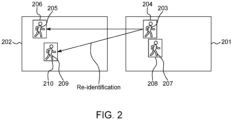
- Fig. 2 shows an example of an embodiment of the presently disclosed method for determining similarity in appearance of objects in image frames of at least one video sequence.
- the image frame to the left is the first image frame 202.
- the image frame to the right is the second image frame 201.
- the first image frame 202 comprises two first objects 205 and 209.
- the second image frame 201 comprises two second objects 203 and 207.
- a first image area 206 in the first image frame 202 comprises the first object 205.
- Another first image area 210 comprises another first object 209.
- a second image area 204 in the second image frame 201 comprises the second object 203.
- Another second image area 208 comprises another second object 207.
- second object 203 in the second image frame 201 could potentially be either the first object 205 or the other first object 209 that has moved to a new position from the first image frame 202 to the second image frame 201.
- the presently disclosed computer-implemented method for determining similarity in appearance of objects in image frames can be used to assess the similarity between the second object 203 and the first object 205 and/or the other first object 209 to re-identify one of the first object 205 and 209 as being the same as the second object 203.
- the step of comparing the one or more first feature vectors to the one or more second feature vectors and/or the step of comparing the one or more updated first feature vectors to the one or more second feature vectors comprises applying a machine learning model, such as a neural network, that has been trained to compare the appearance of two objects based on feature vectors describing the appearance of the two objects.
- Training a machine learning model, such as a neural network may typically involve collecting a training dataset including annotations or other information indicating which objects are the same or different in the different frames.
- a machine learning model may be trained, for example, by using triplet training, on images of objects which are known to be the same or different, to calculate feature vectors that are closer to each other for objects which are the same and further apart from each other for objects which are different.
- the comparison of the feature vectors may be done using a similarity/dissimilarity measure.
- a similarity metric is Euclidian distance.
- squared L2 distances are used to determine object similarity.
- the feature vectors may be provided in any suitable format, such as arrays, database entries, text files, binary formats etc.
- the training may involve other well-known steps, such as data augmentation, transfer learning, validation etc.
- Fig. 3 shows an example of an embodiment of the presently disclosed method for determining similarity in appearance of objects in image frames of at least one video sequence.
- a number of first feature vectors 212 describing the appearance of the first object 205 are extracted.
- a number of second feature vectors 211 describing the appearance of a second object 203 are extracted.
- the next step is to determine a similarity of the first object 205 and the second object 203 by comparing the one or more first feature vectors 212 to the one or more second feature vectors 211.
- first feature vectors 212 and the second feature vectors 211 differ by more than a first threshold and, at the same time, the first image processing settings differ from the second image processing settings by more than a second threshold, first raw image data corresponding to the first image area 206 is re-processed applying the second image processing settings, or vice versa. Based on this is possible to obtain updated first feature vectors that can be re-compared to the one or more second feature vectors.
- the first raw image data corresponding to at least the first image area is temporarily stored until the one or more first feature vectors and the one or more second feature vectors have been compared, and, in the event that the first image processing settings differ from the second image processing settings by more than a second threshold, until the first raw image data has been re-processed.
- the first raw image data and/or the second raw image data may be temporarily stored until the one or more first feature vectors have been compared to the one or more second feature vectors and/or until the first raw image data has been re-processed. After the comparison the raw image data may be discarded.
- the first raw image data and/or the second raw image data is discarded after the one or more first feature vectors have been compared to the one or more second feature vectors and/or the first raw image data has been re-processed.
- the present disclosure further relates to a computer program having instructions which, when executed by a computing device or computing system, cause the computing device or computing system to carry out any embodiment of the presently disclosed method for determining similarity in appearance of objects.
- the computer program may be stored on any suitable type of storage media, such as non-transitory storage media.
- the present disclosure further relates to an image processing system comprising processing circuitry configured to carry out any embodiment of the presently disclosed method for determining similarity in appearance of objects.
- the processing circuitry may comprise a single image processing pipeline, wherein the first image processing pipeline is the same image processing pipeline as the second image processing pipeline, or separate image processing pipelines for processing the first raw image data of the first image frame and the second raw image data of the second image frame. The latter may be useful if there are, for example, multiple cameras for capturing different views of a scene.
- the system may, but does not necessarily have to, include a display for displaying the processed image frames of the at least one video sequence.
- a display for displaying the processed image frames of the at least one video sequence.
- the re-identified objects are not necessarily displayed but used in additional applications, including, for example, further analysis.
- the system may further comprise peripheral components, such as one or more memory units, which may be used for storing instructions that can be executed by the processing circuitry.
- peripheral components such as one or more memory units, which may be used for storing instructions that can be executed by the processing circuitry.
- the system may further comprise internal and external network interfaces, input and/or output ports etc.
- the processing circuitry may comprise a single processor or a processing unit in a multi-core/multiprocessor system.
- the processing circuitry may be connected to a data communication infrastructure.
- the system may include one or more memory units, such as a random access memory (RAM) and/or a read-only memory (ROM), or any suitable type of memory.
- the system may further comprise a communication interface that allows software and/or data to be transferred between the system and external devices.
- Software and/or data transferred via the communications interface may be in any suitable form of electric, optical or RF signals.
- the communications interface may comprise, for example, a cable or a wireless interface.
- the camera(s) may be connected to the processing circuitry by means of one or more Ethernet cables, possibly employing Power of Ethernet.
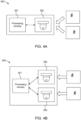
- Figs. 4A-B show two possible configurations of the presently disclosed image processing system 300.
- the image processing system 300 comprises processing circuitry 301 and a camera 302 for capturing the image frames of at least one video sequence, including at least a first image frame and a second image frame. To the right in the example it can be seen how an object has changed between the two image frames.
- the camera 302 may comprise only one image sensors or a plurality of image sensors.
- the image processing system 300 comprises processing circuitry 301 and two cameras 302 for capturing the image frames of at least one video sequence, including at least a first image frame and a second image frame. To the right in the example it can be seen how an object has changed between the two image frames.
- the processing circuitry may have a single image processing pipeline, but it is also possible that each camera has its own image processing pipeline.
Landscapes
- Engineering & Computer Science (AREA)
- Theoretical Computer Science (AREA)
- General Physics & Mathematics (AREA)
- Multimedia (AREA)
- Physics & Mathematics (AREA)
- Computer Vision & Pattern Recognition (AREA)
- Computing Systems (AREA)
- Software Systems (AREA)
- Evolutionary Computation (AREA)
- Health & Medical Sciences (AREA)
- Databases & Information Systems (AREA)
- General Health & Medical Sciences (AREA)
- Medical Informatics (AREA)
- Artificial Intelligence (AREA)
- Computational Linguistics (AREA)
- Image Analysis (AREA)
Priority Applications (4)
| Application Number | Priority Date | Filing Date | Title |
|---|---|---|---|
| EP23218017.4A EP4576020B1 (de) | 2023-12-19 | 2023-12-19 | Verfahren und system zur erneuten identifizierung |
| KR1020240165014A KR20250095504A (ko) | 2023-12-19 | 2024-11-19 | 재-식별을 위한 방법 및 시스템 |
| US18/956,469 US20250200934A1 (en) | 2023-12-19 | 2024-11-22 | Method and system for re-identification |
| CN202411841134.6A CN120182880A (zh) | 2023-12-19 | 2024-12-13 | 用于重新识别的方法和系统 |
Applications Claiming Priority (1)
| Application Number | Priority Date | Filing Date | Title |
|---|---|---|---|
| EP23218017.4A EP4576020B1 (de) | 2023-12-19 | 2023-12-19 | Verfahren und system zur erneuten identifizierung |
Publications (3)
| Publication Number | Publication Date |
|---|---|
| EP4576020A1 true EP4576020A1 (de) | 2025-06-25 |
| EP4576020B1 EP4576020B1 (de) | 2025-11-12 |
| EP4576020C0 EP4576020C0 (de) | 2025-11-12 |
Family
ID=89224186
Family Applications (1)
| Application Number | Title | Priority Date | Filing Date |
|---|---|---|---|
| EP23218017.4A Active EP4576020B1 (de) | 2023-12-19 | 2023-12-19 | Verfahren und system zur erneuten identifizierung |
Country Status (4)
| Country | Link |
|---|---|
| US (1) | US20250200934A1 (de) |
| EP (1) | EP4576020B1 (de) |
| KR (1) | KR20250095504A (de) |
| CN (1) | CN120182880A (de) |
Citations (3)
| Publication number | Priority date | Publication date | Assignee | Title |
|---|---|---|---|---|
| EP3096292A1 (de) * | 2015-05-18 | 2016-11-23 | Xerox Corporation | Verfolgung mehrerer objekte mit generischen objektvorschlägen |
| WO2021237749A1 (en) * | 2020-05-29 | 2021-12-02 | Siemens Aktiengesellschaft | Method and apparatus for object tracking and reidentification |
| US20230360360A1 (en) * | 2022-05-09 | 2023-11-09 | Axis Ab | Object re-identification in video streams |
-
2023
- 2023-12-19 EP EP23218017.4A patent/EP4576020B1/de active Active
-
2024
- 2024-11-19 KR KR1020240165014A patent/KR20250095504A/ko active Pending
- 2024-11-22 US US18/956,469 patent/US20250200934A1/en active Pending
- 2024-12-13 CN CN202411841134.6A patent/CN120182880A/zh active Pending
Patent Citations (3)
| Publication number | Priority date | Publication date | Assignee | Title |
|---|---|---|---|---|
| EP3096292A1 (de) * | 2015-05-18 | 2016-11-23 | Xerox Corporation | Verfolgung mehrerer objekte mit generischen objektvorschlägen |
| WO2021237749A1 (en) * | 2020-05-29 | 2021-12-02 | Siemens Aktiengesellschaft | Method and apparatus for object tracking and reidentification |
| US20230360360A1 (en) * | 2022-05-09 | 2023-11-09 | Axis Ab | Object re-identification in video streams |
Non-Patent Citations (4)
| Title |
|---|
| J. REDMONS. DIVVALAR. GIRSHICKA. FARHADI: "You Only Look Once: Unified, Real-Time Object Detection", IEEE CONFERENCE ON COMPUTER VISION AND PATTERN RECOGNITION (CVPR), 2016, pages 779 - 788 |
| PAMARTHY DIVIJA GOPIKA ET AL: "Unsupervised Person Re-Identification Using Similarity Score", 2023 2ND INTERNATIONAL CONFERENCE ON FUTURISTIC TECHNOLOGIES (INCOFT), IEEE, 24 November 2023 (2023-11-24), pages 1 - 6, XP034553329, DOI: 10.1109/INCOFT60753.2023.10425668 * |
| SCHROFF, FKALENICHENKO, D.PHILBIN, J.: "Facenet: A Unified Embedding for Face Recognition and Clustering", PROCEEDINGS OF THE IEEE CONFERENCE ON COMPUTER VISION AND PATTERN RECOGNITION, 2015, pages 815 - 823, XP032793492, DOI: 10.1109/CVPR.2015.7298682 |
| ZOU ZHIBO ET AL: "Compensation Tracker: Reprocessing Lost Object for Multi-Object Tracking", 2022 IEEE/CVF WINTER CONFERENCE ON APPLICATIONS OF COMPUTER VISION (WACV), IEEE, 3 January 2022 (2022-01-03), pages 2673, XP034086057, DOI: 10.1109/WACV51458.2022.00273 * |
Also Published As
| Publication number | Publication date |
|---|---|
| EP4576020B1 (de) | 2025-11-12 |
| EP4576020C0 (de) | 2025-11-12 |
| US20250200934A1 (en) | 2025-06-19 |
| KR20250095504A (ko) | 2025-06-26 |
| CN120182880A (zh) | 2025-06-20 |
Similar Documents
| Publication | Publication Date | Title |
|---|---|---|
| US10599958B2 (en) | Method and system for classifying an object-of-interest using an artificial neural network | |
| AU2014240213B2 (en) | System and Method for object re-identification | |
| JP6494253B2 (ja) | 物体検出装置、物体検出方法、画像認識装置及びコンピュータプログラム | |
| CN105404884B (zh) | 图像分析方法 | |
| US12131485B2 (en) | Object tracking device and object tracking method | |
| JP4479478B2 (ja) | パターン認識方法および装置 | |
| CN113516146B (zh) | 一种数据分类方法、计算机及可读存储介质 | |
| CN103093212B (zh) | 基于人脸检测和跟踪截取人脸图像的方法和装置 | |
| JP2004199669A (ja) | 顔検出 | |
| CN101095149A (zh) | 图像比较 | |
| WO2022228325A1 (zh) | 行为检测方法、电子设备以及计算机可读存储介质 | |
| CN118918535B (zh) | 智能家居检测和管理方法、装置及计算机设备 | |
| CN114241370A (zh) | 基于数字孪生变电站的入侵识别方法、装置和计算机设备 | |
| CN119169524B (zh) | 基于跨模态融合的异常行为检测方法及系统 | |
| KR20190093799A (ko) | Cctv를 통한 실시간 실종자 얼굴 인식 시스템 및 그 방법 | |
| Tsintotas et al. | DOSeqSLAM: Dynamic on-line sequence based loop closure detection algorithm for SLAM | |
| CN114387670A (zh) | 基于时空特征融合的步态识别方法、装置及存储介质 | |
| KR101268596B1 (ko) | 정사각 코드북과 다중 경계 값이 적용된 텍스쳐 특징을 이용한 전경 검출 장치 및 방법 | |
| EP4576020B1 (de) | Verfahren und system zur erneuten identifizierung | |
| CN116824641B (zh) | 姿态分类方法、装置、设备和计算机存储介质 | |
| CN114241431A (zh) | 一种基于改进Transformer的小目标检测方法 | |
| Chang et al. | Robust abandoned object detection and analysis based on online learning | |
| Zhang et al. | Research on the application of behavioral image feature capture in basketball game video | |
| CN108985216B (zh) | 一种基于多元logistic回归特征融合的行人头部检测方法 | |
| CN116110076B (zh) | 基于混合粒度网络的输电高空作业人员身份重识别方法和系统 |
Legal Events
| Date | Code | Title | Description |
|---|---|---|---|
| PUAI | Public reference made under article 153(3) epc to a published international application that has entered the european phase |
Free format text: ORIGINAL CODE: 0009012 |
|
| STAA | Information on the status of an ep patent application or granted ep patent |
Free format text: STATUS: REQUEST FOR EXAMINATION WAS MADE |
|
| 17P | Request for examination filed |
Effective date: 20240605 |
|
| AK | Designated contracting states |
Kind code of ref document: A1 Designated state(s): AL AT BE BG CH CY CZ DE DK EE ES FI FR GB GR HR HU IE IS IT LI LT LU LV MC ME MK MT NL NO PL PT RO RS SE SI SK SM TR |
|
| REG | Reference to a national code |
Ref country code: DE Ref legal event code: R079 Free format text: PREVIOUS MAIN CLASS: G06V0020520000 Ipc: G06V0010740000 Ref document number: 602023008536 Country of ref document: DE |
|
| GRAP | Despatch of communication of intention to grant a patent |
Free format text: ORIGINAL CODE: EPIDOSNIGR1 |
|
| STAA | Information on the status of an ep patent application or granted ep patent |
Free format text: STATUS: GRANT OF PATENT IS INTENDED |
|
| INTG | Intention to grant announced |
Effective date: 20250901 |
|
| RIC1 | Information provided on ipc code assigned before grant |
Ipc: G06V 10/74 20220101AFI20250825BHEP Ipc: G06V 20/52 20220101ALI20250825BHEP |
|
| GRAS | Grant fee paid |
Free format text: ORIGINAL CODE: EPIDOSNIGR3 |
|
| GRAA | (expected) grant |
Free format text: ORIGINAL CODE: 0009210 |
|
| STAA | Information on the status of an ep patent application or granted ep patent |
Free format text: STATUS: THE PATENT HAS BEEN GRANTED |
|
| AK | Designated contracting states |
Kind code of ref document: B1 Designated state(s): AL AT BE BG CH CY CZ DE DK EE ES FI FR GB GR HR HU IE IS IT LI LT LU LV MC ME MK MT NL NO PL PT RO RS SE SI SK SM TR |
|
| REG | Reference to a national code |
Ref country code: CH Ref legal event code: F10 Free format text: ST27 STATUS EVENT CODE: U-0-0-F10-F00 (AS PROVIDED BY THE NATIONAL OFFICE) Effective date: 20251112 Ref country code: GB Ref legal event code: FG4D |
|
| REG | Reference to a national code |
Ref country code: IE Ref legal event code: FG4D |
|
| U01 | Request for unitary effect filed |
Effective date: 20251112 |
|
| U07 | Unitary effect registered |
Designated state(s): AT BE BG DE DK EE FI FR IT LT LU LV MT NL PT RO SE SI Effective date: 20251118 |
|
| U20 | Renewal fee for the european patent with unitary effect paid |
Year of fee payment: 3 Effective date: 20251121 |
|
| PGFP | Annual fee paid to national office [announced via postgrant information from national office to epo] |
Ref country code: AT Payment date: 20260113 Year of fee payment: 3 |
|
| PG25 | Lapsed in a contracting state [announced via postgrant information from national office to epo] |
Ref country code: ES Free format text: LAPSE BECAUSE OF FAILURE TO SUBMIT A TRANSLATION OF THE DESCRIPTION OR TO PAY THE FEE WITHIN THE PRESCRIBED TIME-LIMIT Effective date: 20251112 |
|
| PG25 | Lapsed in a contracting state [announced via postgrant information from national office to epo] |
Ref country code: NO Free format text: LAPSE BECAUSE OF FAILURE TO SUBMIT A TRANSLATION OF THE DESCRIPTION OR TO PAY THE FEE WITHIN THE PRESCRIBED TIME-LIMIT Effective date: 20260212 |
|
| PG25 | Lapsed in a contracting state [announced via postgrant information from national office to epo] |
Ref country code: HR Free format text: LAPSE BECAUSE OF FAILURE TO SUBMIT A TRANSLATION OF THE DESCRIPTION OR TO PAY THE FEE WITHIN THE PRESCRIBED TIME-LIMIT Effective date: 20251112 |
|
| PG25 | Lapsed in a contracting state [announced via postgrant information from national office to epo] |
Ref country code: RS Free format text: LAPSE BECAUSE OF FAILURE TO SUBMIT A TRANSLATION OF THE DESCRIPTION OR TO PAY THE FEE WITHIN THE PRESCRIBED TIME-LIMIT Effective date: 20260212 |
|
| PG25 | Lapsed in a contracting state [announced via postgrant information from national office to epo] |
Ref country code: IS Free format text: LAPSE BECAUSE OF FAILURE TO SUBMIT A TRANSLATION OF THE DESCRIPTION OR TO PAY THE FEE WITHIN THE PRESCRIBED TIME-LIMIT Effective date: 20260312 |
|
| PG25 | Lapsed in a contracting state [announced via postgrant information from national office to epo] |
Ref country code: PL Free format text: LAPSE BECAUSE OF FAILURE TO SUBMIT A TRANSLATION OF THE DESCRIPTION OR TO PAY THE FEE WITHIN THE PRESCRIBED TIME-LIMIT Effective date: 20251112 |