EP4576031A1 - Procédé et dispositif de vérification d'un élément de sécurité pour un document de sécurité - Google Patents
Procédé et dispositif de vérification d'un élément de sécurité pour un document de sécurité Download PDFInfo
- Publication number
- EP4576031A1 EP4576031A1 EP24210399.2A EP24210399A EP4576031A1 EP 4576031 A1 EP4576031 A1 EP 4576031A1 EP 24210399 A EP24210399 A EP 24210399A EP 4576031 A1 EP4576031 A1 EP 4576031A1
- Authority
- EP
- European Patent Office
- Prior art keywords
- image
- texture
- partial areas
- wavelength range
- light
- Prior art date
- Legal status (The legal status is an assumption and is not a legal conclusion. Google has not performed a legal analysis and makes no representation as to the accuracy of the status listed.)
- Pending
Links
Images




Classifications
-
- G—PHYSICS
- G07—CHECKING-DEVICES
- G07D—HANDLING OF COINS OR VALUABLE PAPERS, e.g. TESTING, SORTING BY DENOMINATIONS, COUNTING, DISPENSING, CHANGING OR DEPOSITING
- G07D7/00—Testing specially adapted to determine the identity or genuineness of valuable papers or for segregating those which are unacceptable, e.g. banknotes that are alien to a currency
- G07D7/20—Testing patterns thereon
- G07D7/2008—Testing patterns thereon using pre-processing, e.g. de-blurring, averaging, normalisation or rotation
-
- G—PHYSICS
- G07—CHECKING-DEVICES
- G07D—HANDLING OF COINS OR VALUABLE PAPERS, e.g. TESTING, SORTING BY DENOMINATIONS, COUNTING, DISPENSING, CHANGING OR DEPOSITING
- G07D7/00—Testing specially adapted to determine the identity or genuineness of valuable papers or for segregating those which are unacceptable, e.g. banknotes that are alien to a currency
- G07D7/06—Testing specially adapted to determine the identity or genuineness of valuable papers or for segregating those which are unacceptable, e.g. banknotes that are alien to a currency using wave or particle radiation
- G07D7/12—Visible light, infrared or ultraviolet radiation
- G07D7/1205—Testing spectral properties
-
- G—PHYSICS
- G07—CHECKING-DEVICES
- G07D—HANDLING OF COINS OR VALUABLE PAPERS, e.g. TESTING, SORTING BY DENOMINATIONS, COUNTING, DISPENSING, CHANGING OR DEPOSITING
- G07D7/00—Testing specially adapted to determine the identity or genuineness of valuable papers or for segregating those which are unacceptable, e.g. banknotes that are alien to a currency
- G07D7/20—Testing patterns thereon
- G07D7/2016—Testing patterns thereon using feature extraction, e.g. segmentation, edge detection or Hough-transformation
-
- G—PHYSICS
- G07—CHECKING-DEVICES
- G07D—HANDLING OF COINS OR VALUABLE PAPERS, e.g. TESTING, SORTING BY DENOMINATIONS, COUNTING, DISPENSING, CHANGING OR DEPOSITING
- G07D7/00—Testing specially adapted to determine the identity or genuineness of valuable papers or for segregating those which are unacceptable, e.g. banknotes that are alien to a currency
- G07D7/20—Testing patterns thereon
- G07D7/202—Testing patterns thereon using pattern matching
- G07D7/2041—Matching statistical distributions, e.g. of particle sizes orientations
-
- G—PHYSICS
- G07—CHECKING-DEVICES
- G07D—HANDLING OF COINS OR VALUABLE PAPERS, e.g. TESTING, SORTING BY DENOMINATIONS, COUNTING, DISPENSING, CHANGING OR DEPOSITING
- G07D7/00—Testing specially adapted to determine the identity or genuineness of valuable papers or for segregating those which are unacceptable, e.g. banknotes that are alien to a currency
- G07D7/20—Testing patterns thereon
- G07D7/202—Testing patterns thereon using pattern matching
- G07D7/205—Matching spectral properties
Definitions
- the invention relates to a method and a device for checking a security element for a security document.
- Optically verifiable security features are those that can be verified by detecting light transmitted through, reflected from, and/or remitted by the security feature.
- Light is defined here as all electromagnetic radiation in the visible, infrared, or ultraviolet wavelength range.
- security documents such as documents that identify a person (ID document)
- a printed image to the security document as a security element, which, for example, shows the face of a person to whom the document is assigned.
- it may be provided to produce image elements of the printed image with different colors.
- four-color printing is known. It may be provided that the color of an image element, for example a fifth color in addition to the four-color printing, is visible when illuminated with light in the visible wavelength range, but not when the same image element is illuminated with light from a different wavelength range, for example with infrared light.
- Such a security element with a printed image is intended for a security document, which has the image element that is visible or invisible depending on the lighting, it must be checked during the production of the security element for the security document whether the image element was correctly created during the production process, in particular during printing. For such a testing process, it was proposed to take an image of the The security element with the printed image when illuminated with light of the wavelength range in which the image element is not visible is to be checked by means of image analysis.
- respective gray value histograms are determined for the image recording on the one hand and a comparison image recording on the other hand, which shows the printed image when illuminated with the light in which the image element is also visible, in order to compare these for the purpose of checking the correct production of the image element, which is visible or not visible under different lighting conditions.
- a comparison image recording on the other hand, which shows the printed image when illuminated with the light in which the image element is also visible, in order to compare these for the purpose of checking the correct production of the image element, which is visible or not visible under different lighting conditions.
- the known testing method proves to be insufficiently reliable for printed images, especially facial images, if, for example, the image element that is supposed to be visible or not visible under different lighting conditions is incomplete or insufficiently invisible, i.e., it still "shines through” in the image captured and used for image analysis.
- the document DE 10 2006 011 143 A1 concerns a security code for application to packaging that, for example, contains a deposit and is recognized via the so-called barcode. There is a risk that the barcode can be easily reproduced in order to manipulate the return deposit system and thus illegally acquire deposit money.
- This security code consists of an IR ink or a combination of a color in the visible range, preferably black, and the IR security ink. One color is visible to the human eye and the other color is invisible as an infrared color, or alternatively, another visible IR color is used.
- the security symbol consists of a individually designed geometry or the EAN code is created entirely or partially using the security ink.
- the object of the invention is to provide a method and a device for testing a security element for a security document, with which the security element can be determined or tested with improved reliability.
- a method for checking a security element for a security document comprising the following: providing a security element with an image comprising a first image element and a second image element, wherein the first image element is visible when illuminated with light from a first wavelength range and when illuminated with light from a second wavelength range that is different from the first wavelength range, and wherein the second image element is visible when illuminated with light from the first wavelength range, but not when illuminated with light from the second wavelength range; capturing an image of the image with a camera device when the image is illuminated with light from the second wavelength range, and determining the second image element by evaluating digital image data that indicate the image.
- the following is provided: dividing the image into partial areas, wherein one of the partial areas is formed to comprise the second image element; determining a respective texture for the partial areas, wherein the texture of the partial area indicates a distribution of gray value intensities within the partial area of the image; Determining a respective texture measure for the partial areas, which indicates the extent to which the partial area is covered by the texture or free of such a texture; and determining the presence of the second image element in the image of the security element if it is found by evaluating the texture measures that the one of the partial areas comprising the second image element is substantially texture-free.
- a device for checking a security element for a security document comprises a camera device, an illumination device, and an evaluation device, which is formed, for example, with one or more processors for data processing and associated programming.
- the device is configured to capture an image of an image of a security element with a camera device, wherein the image has a first image element and a second image element, wherein the first image element is visible when illuminated with light from a first wavelength range and when illuminated with light from a second wavelength range that is different from the first wavelength range, and wherein the second image element is visible when illuminated with light from the first wavelength range, but not when illuminated with light from the second wavelength range, and the image capture can be carried out when the image is illuminated by the illumination device with light from the second wavelength range.
- the device is configured to determine the second image element by evaluating digital image data that indicate the image capture. The following is provided here: subdividing the Image recording in partial areas, wherein one of the partial areas is formed comprising the second image element; determining a respective texture for the partial areas, wherein the texture of the partial area indicates a distribution of gray value intensities within the partial area of the image recording; determining a respective texture measure for the partial areas, which indicates the extent to which the partial area is covered by the texture or is free of such a texture; and determining the presence of the second image element in the image of the security element if it is found by evaluating the texture measures that the one of the partial areas comprising the second image element is substantially texture-free.
- the image comprises image elements produced using different colors, which has the consequence that at least a first image element is visible when the image is illuminated with light of different wavelength ranges, whereas at least a second image element, which is different from the first image element, is either visible or invisible when illuminated with light from different wavelength ranges.
- the image can, for example, be produced as a printed image or printed pattern, wherein different printing inks can be used in particular to produce the first and second image elements. Printing inks are known as such which are visible when illuminated with light from a first wavelength range, for example visible light, but not when illuminated with light from a second wavelength range which is different from the first wavelength range, for example infrared or UV light.
- Printing inks are also known which are visible in both different wavelength ranges.
- black ink of different compositions can be used to achieve the corresponding visibility behavior in light of different wavelength ranges.
- colorants especially printing inks, are known in various forms.
- Such non-visibility of the second image element can be due, for example, to the fact that the light of the second wavelength range is essentially completely reflected by the ink used to produce the second image element. Visibility due to the absorption of light by the ink used for the second image element is then eliminated, which is why the second image element is not visible in the image recording.
- the image is then analyzed or determined.
- a texture analysis for partial areas of the image is used to determine a texture and a texture measure characterizing this texture for the respective partial area.
- the texture measure can be, for example, a value number, a value range and/or a threshold value. More complex texture measures are also possible, for example a matrix characterizing the texture of the assigned partial area or a tuple of numbers. Since non-visibility is expected for the second image element in the captured image, the presence of the second image element in a partial area comprising the second image element in the image of the security element is inferred if a missing texture (texture freedom) is determined for the partial area containing the second image element. This means that a texture provided by the second image element is missing in this partial area.
- the light used for illumination in the different wavelength ranges can be narrowband, using essentially only one wavelength, or broadband, for example white light.
- the texture of the sub-area can indicate a planar or spatial distribution of gray-value intensities within the sub-area.
- a gray-value intensity can be assigned to a single pixel or a group of pixels.
- a digital camera can be used to capture the image of the security element with the image.
- the image can be divided into sub-areas such that neighboring sub-areas abut each other in the area of the edges of the sub-areas. This supports the possibility of determining information regarding the transition of the texture dimension between neighboring sub-areas during texture analysis and using this information for testing. For example, a minimum difference between the texture dimension for neighboring sub-areas of the image can indicate a transition between an image element visible in the image and a essentially invisible (second) image element.
- the partial areas formed when dividing the image can take on different geometric shapes, for example, square or round.
- Triangles, squares, or polygons can be provided when forming the partial areas.
- the edges of the partial areas can abut one another or be spaced apart for at least some of the partial areas.
- the image recording can be divided into partial areas such that one of the partial areas substantially completely overlaps with the second image element.
- the partial area formed as part of the subdivision of the image recording and containing the second image element substantially completely overlaps with the area occupied by the second image element in the image of the security element.
- the second image element can be arranged in a larger or smaller partial area, so that there is no complete overlap.
- the security element can be provided with a printed image comprising the first and second image elements.
- Different printing inks can be used to create the different behavior of the image elements under different lighting conditions (visibility vs. non-visibility).
- Printing inks that are visible when illuminated with light from different wavelength ranges or invisible under light of a specific wavelength, in particular due to their differing reflection and/or absorption behavior for light of different wavelengths, are known as such in various designs.
- the presence of the second image element in the image of the security element can be determined if, upon evaluation of the texture measures, it is found that the texture measure for one of the partial areas comprising the second image element is less than or equal to the threshold texture measure.
- This makes it possible, for example, to use the threshold texture measure to determine a probability for the essentially given texture freedom of the partial area with the second image element in an application-dependent manner, for example if the non-visibility of the second image element in the image recording is only partially given, in particular because the second image element still "shines through" in the image recording, which can, for example, be the result of incomplete reflection of the incident light by the color of the second image element.
- thresholds or limits for the texture freedom to be tested or the probability of texture freedom can be applied.
- Descriptive data can be provided that indicate properties of the second image element, such as edge length, size, shape, area, and/or area contour, and the descriptive data can be evaluated to form one of the sub-areas when dividing the image into sub-areas such that it encompasses the second image element.
- the sub-area of the image can be divided into (image) sub-areas in an application-dependent manner, for example, such that the second image element in the sub-area encompassing the image overlaps the sub-area entirely or only in certain sections.
- the authenticity of the security element or of a security document containing the security element is only determined if both second image elements are categorised or classified as substantially texture-free.
- the method for determining correct production of the image of the security element can be applied, for example, in the context of the production of ID documents, for example after the printed image of the security element has been applied to a document body, such as a plastic card. If it is found that the image of the security element was not produced correctly, the manufactured product must be classified as reject and is either corrected or removed from the further production process.
- the method for checking a security element for a security document is used to check a security document, in particular to determine its authenticity, wherein optionally further security features of the document can be evaluated, as is known per se.
- artificial intelligence can be used in the evaluation device using appropriate software, for example in the form of machine learning.
- a neural network can be used in such a way that the elements of a gray value matrix are passed to the input layer of the neural network.
- a suitable support vector machine can be used to classify the texture metric; for example, a number tuple is used as input, which For example, several gray value matrices are formed from the traces or calculated using several Laws filters.
- Security documents include, for example, ID documents, passports, identity cards, identification cards, driver's licenses, vehicle registration documents, vehicle registration certificates, access authorization cards, company ID cards, access cards, bank cards, credit cards, visas, but also anti-counterfeit labels, admission tickets, banknotes, postage stamps, securities, or the like.
- security documents that embody value, such as postage stamps, securities, or banknotes are also referred to as valuable documents.
- valuable documents are not always possible and, with regard to the present disclosure, is also not essential. For the purposes of the subject matter described here, valuable documents are always understood as security documents.
- Fig. 1 shows a schematic representation of an arrangement with a device 1 for checking or determining an image 2 of a security element 3 on a security document 4, which is, for example, a document for identifying a person (ID document).
- the security document 4 is formed with a document body 5, which is, for example, a plastic card. In other embodiments, the security document 4 is designed, for example, as an ID card or passport.
- the device 1 comprises a camera device 6, for example a digital camera, which is configured to capture an image of the image 2.
- the security element 3 is illuminated with the image 2 by means of an illumination device 7.
- image 2 has a first image element 8 with an upper half of the face and a second image element 9 with a lower half of the face.
- first and second image elements 8, 9 abut one another. In other embodiments, a gap may be formed between the first and second image elements 8, 9.
- image 2 is embodied as a printed image.
- the first image element 8 and the second image element 9 were produced using different printing inks.
- Image 2 can be a color image or a black and white image. In the case of a black and white image, different black inks are used to produce the first and second image elements 8, 9.
- the color of the first image element 8 can be selected such that the first image element 8 is visible when illuminated with light from a first wavelength range as well as when illuminated with light from a second wavelength range that is different from the first wavelength range, in particular for the camera device 6. The visibility is based, for example, on at least partial absorption of the light from the respective wavelength range.
- the second image element 9 is only visible when illuminated with light from the first wavelength range, but not when illuminated with light from the second wavelength range (non-visibility).
- the light from the respective wavelength range can be narrowband or broadband.
- the illumination comprises only light of a few wavelengths or essentially only one wavelength, whereas with broadband light, a plurality of wavelengths contribute to the illumination. as is the case with white light, for example.
- the light from the first wavelength range is white light
- the light from the second wavelength range is infrared or UV light.
- the second image element 9 is not visible when illuminated with infrared or UV light.
- the second image element 9 is not visible at all or only very dimly ("translucent") when recorded with the camera device 6.
- the first image element 8 is visible in an image recorded by the camera device 6 not only when illuminated with the light from the first wavelength range, but also when illuminated with the light from the second wavelength range.
- the device 1 shown can be used for various purposes to check whether the image 2 correctly displays the second image element 9.
- digital image data representing the image captured by the camera device 9 are evaluated with the aid of an evaluation device 10.
- the evaluation device 10 is equipped for this purpose with hardware and corresponding software, in particular programs for digital image analysis.
- the programs can be configured to apply artificial intelligence to the image analysis.
- the verification by means of image analysis can be used to check the correct production of image 2 in the manufacturing process, for example after the image 2 has been applied as a printed image on the document body 5.
- the analysis or verification can be used to check the authenticity of the security document 4 later in use.
- an image recording 20 of the image 2 is made by means of the camera device 6 according to Fig. 2
- the security element 3 is illuminated with light from the second wavelength range by means of the illumination device 7, with the aim of capturing an image by means of the camera device 6 in which the first image element 8 is visible, but not the second image element 9 with the lower half of the face and neck (cf. Fig. 2).
- Fig. 3 For comparison, Fig. 2 shows another image 21 of image 2 illuminated with light from the first wavelength range.
- the first and second image elements 8 and 9 can be seen.
- the image recording 20 is then analyzed by means of the evaluation device 9.
- descriptive data can be provided in the evaluation device 10, which describe the properties of the first and/or the second image element 8, 9 such as edge length, size, shape, area and/or surface contour.
- the description data can be used in the inspection process to divide the captured image 20 into sub-areas. Alternatively, the division of the image 20 into sub-areas can be carried out without reference to or use of the description data.
- Fig. 3 For example, it is provided to divide the image recording 20 into a first partial area 22 with the first image element 8 and a second partial area 23 with the second image element 9 (here - as expected - not visible), wherein the assigned partial area completely captures the respective image element.
- a texture analysis is carried out by means of the evaluation device 10, in which a respective texture is determined for the first and second partial areas 22, 23 formed for this purpose, wherein the texture of the partial area indicates a distribution of gray value intensities within the partial area, for example with a gray value intensity for each image point or each image pixel in the partial area.
- a respective texture measure is also determined, which indicates the extent to which the partial area is covered by the texture or is free of such.
- the texture measure can, for example, be a value number, a value range and/or a threshold value. More complex texture measures are also possible, for example a matrix characterizing the texture of the assigned partial area or a tuple of numbers.
- the texture analysis thus determines, on the one hand, the texture possibly present in the assigned partial area and provides a texture measure which at least makes it possible to determine whether the assigned partial area is essentially free of a texture or has one.
- a texture measure which at least makes it possible to determine whether the assigned partial area is essentially free of a texture or has one.
- further second image elements can be provided in image 2, which are designed in a manner comparable to the second image element 9, at least with regard to the use of the same color, and can thus be analyzed in a similar manner in order to check the correct formation of the second image elements.
- a texture transformation of the image is performed using convolution with filter kernels to determine the texture.
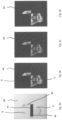
- Fig. 4a shows an image recording 40 of a facial image of a security element, in which - in contrast to, for example, Fig. 3 - the first image element 8, which captures most but not all of the upper half of the face, is missing. Unlike the second image element 9, which captures the lower half of the face, the first image element 8 is not visible during the illumination for image capture 40. The edges of the first and second image elements 8, 9 abut in an area 41.
- a partial area 45 of the upper half of the face lies outside and is visible in the image recording 40, and was therefore not produced with the color that is not visible under the lighting for the image recording 40.
- An area of the filtered images 42, 43 assigned to the partial area 45 then also has a recognizable texture.
- Fig. 4d shows a figure 44 of maximum gray value intensities from figures 42, 43 in the Fig. 4b and 4c
- the maximum of the gray value intensities from the images in the Fig. 4b and 4c Here, too, the freedom of texture is evident in the area with the first image element 8.
- a beam 46 in Fig. 4a serves only to formally anonymize the displayed facial image.
- Fig. 5a and 5b show representations for a captured image 50, 51 (left illustration) and figures 52, 53, which show the result of the texture determination (right illustration).
- figures 52, 53 filter masks according to Laws were again applied to the images 50, 51.
- the filtered figures 52, 53 on the right side in the Fig. 5a and 5b clearly highlight the texture-free areas and thus make them identifiable, even if, as in Fig. 5a , in the image recording 50 the facial image is not arranged centrally in the image recording 50.
- the facial image in which the facial image "shines through”
- the textured and texture-free areas also emerge.
- Beams 54, 55 in Fig. 5a and 5b serve only to formally anonymize the displayed facial image.
- a partial area of the image is essentially free of texture
- an application-specific texture measure is used. For example, a histogram of the images filtered according to the texture analysis can be used for this purpose.
- Figs. 6 and 7 each show - based on previously captured images - certain Figures 60, 70 with four partial areas 60, ..., 63; 70, ... ,73 formed for texture analysis.
- Figures 60, 70 were determined using texture filters according to Law.
- a texture measure P is determined as part of a texture measure determination depending on the number N of image pixels with a gray value intensity above a certain threshold (here, for example: 127):
- ⁇ is a freely selectable scaling parameter, which in some embodiments can make it possible for the result P to lie more accurately in the interval [0;1].
- N is the number of pixels in the corresponding sub-area with a grayscale intensity (after filtering) above a certain threshold
- ⁇ is in the order of magnitude of N.
- the partial areas 60, 63 exhibit a high number of pixels with grayscale intensity.
- the image elements contained therein are therefore not visible under the lighting used for the underlying image acquisition (texture freedom).
- the image elements contained in the partial areas 60, 63 are each invisible, for example, printed with a color that is not visible under the lighting used for the image acquisition.
- the high values for the partial areas 70, 71, and 73 indicate a lack of texture. If, for the facial image captured here and examined using texture analysis, a visible image element in the partial area 71 would also be expected in the image capture (for example, comparable to Fig. 6 ), then the texture analysis determines that the image (in this example: a facial image) of the security element was not produced correctly. This could be due, for example, to the image element expected to be visible in partial area 71 not being printed with the correct color. The image element could also simply not have been printed.
Landscapes
- Physics & Mathematics (AREA)
- General Physics & Mathematics (AREA)
- Engineering & Computer Science (AREA)
- Computer Vision & Pattern Recognition (AREA)
- Spectroscopy & Molecular Physics (AREA)
- Health & Medical Sciences (AREA)
- General Health & Medical Sciences (AREA)
- Toxicology (AREA)
- Image Processing (AREA)
Applications Claiming Priority (1)
| Application Number | Priority Date | Filing Date | Title |
|---|---|---|---|
| DE102023131282.0A DE102023131282B3 (de) | 2023-11-10 | 2023-11-10 | Verfahren und Vorrichtung zum Prüfen eines Sicherheitselements für ein Sicherheitsdokument |
Publications (1)
| Publication Number | Publication Date |
|---|---|
| EP4576031A1 true EP4576031A1 (fr) | 2025-06-25 |
Family
ID=93377934
Family Applications (1)
| Application Number | Title | Priority Date | Filing Date |
|---|---|---|---|
| EP24210399.2A Pending EP4576031A1 (fr) | 2023-11-10 | 2024-11-01 | Procédé et dispositif de vérification d'un élément de sécurité pour un document de sécurité |
Country Status (2)
| Country | Link |
|---|---|
| EP (1) | EP4576031A1 (fr) |
| DE (1) | DE102023131282B3 (fr) |
Citations (3)
| Publication number | Priority date | Publication date | Assignee | Title |
|---|---|---|---|---|
| DE102006011143A1 (de) | 2005-11-04 | 2007-05-10 | Mrv Multi Reverse Vending Gmbh | Sicherheitsmarkierungssystem |
| DE102016201709A1 (de) | 2016-02-04 | 2017-08-10 | Bundesdruckerei Gmbh | Wert- oder Sicherheitsprodukt, Verfahren zum Herstellen eines Vorproduktes und Verifikationsverfahren |
| DE102019129491A1 (de) | 2019-10-31 | 2021-05-06 | Bundesdruckerei Gmbh | Prüfung eines Sicherheitsdokuments auf Basis von Tröpfchenmorphologien |
-
2023
- 2023-11-10 DE DE102023131282.0A patent/DE102023131282B3/de active Active
-
2024
- 2024-11-01 EP EP24210399.2A patent/EP4576031A1/fr active Pending
Patent Citations (3)
| Publication number | Priority date | Publication date | Assignee | Title |
|---|---|---|---|---|
| DE102006011143A1 (de) | 2005-11-04 | 2007-05-10 | Mrv Multi Reverse Vending Gmbh | Sicherheitsmarkierungssystem |
| DE102016201709A1 (de) | 2016-02-04 | 2017-08-10 | Bundesdruckerei Gmbh | Wert- oder Sicherheitsprodukt, Verfahren zum Herstellen eines Vorproduktes und Verifikationsverfahren |
| DE102019129491A1 (de) | 2019-10-31 | 2021-05-06 | Bundesdruckerei Gmbh | Prüfung eines Sicherheitsdokuments auf Basis von Tröpfchenmorphologien |
Non-Patent Citations (3)
| Title |
|---|
| K. I. LAWS: "Textured Image Segmentation, Department of electrical Engineering", IMAGE PROCESSING INSTITUTE, UNIVERSITY OF CALIFORNIA, January 1980 (1980-01-01) |
| K. I. LAWS: "Textured Image Segmentation, Department of electrical Engineering", IMAGE PROCESSING INSTITUTE, UNIVERSITY OF SOUTHERN CALIFORNIA, January 1980 (1980-01-01) |
| NANNI ET AL.: "Different approaches for Extracting Information from the Co-Occurrence Matrix", , PLOS ONE, vol. 8, December 2013 (2013-12-01), pages 83554 |
Also Published As
| Publication number | Publication date |
|---|---|
| DE102023131282B3 (de) | 2025-02-06 |
Similar Documents
| Publication | Publication Date | Title |
|---|---|---|
| EP0585724B1 (fr) | Méthode et dispositif pour la reconnaissance d'images imprimées sur documents | |
| EP1625936A2 (fr) | Procédé d'évaluation qualitative d'un matériau portant au moins une caractéristique d'identification | |
| EP4094234B1 (fr) | Procédé d'authentification d'un document de sécurité | |
| EP2143081B1 (fr) | Procédé et dispositif pour vérifier des documents-valeurs | |
| EP2625673B1 (fr) | Procédé pour contrôler un signe de sécurité optique d'un document de valeur | |
| WO2011147575A1 (fr) | Dispositif de contrôle de l'authenticité de documents de valeur | |
| DE102008041944A1 (de) | Datenverarbeitungsverfahren zur Generierung eines Klassifikators und zur Überprüfung der Echtheit eines Dokuments, Vorrichtung zur Überprüfung der Echtheit eines Dokuments und Computerprogrammprodukt | |
| DE102016115837A1 (de) | Verfahren für die Urheberschaftsbewertung eines Gemäldes sowie eine entsprechende Verwendung | |
| EP2132719A1 (fr) | Procédé et dispositif pour vérifier des papiers-valeurs | |
| CH710713B1 (de) | Authentifizierungsverfahren unter Verwendung von Oberflächenpapiertextur. | |
| DE10132589B4 (de) | Verfahren zur qualitativen Beurteilung von Material | |
| DE102023131282B3 (de) | Verfahren und Vorrichtung zum Prüfen eines Sicherheitselements für ein Sicherheitsdokument | |
| EP1897067B1 (fr) | Procede et dispositif de detection d'une monnaie par utilisation de son image estampee | |
| EP2394250B1 (fr) | Procédé et dispositif pour vérifier des documents par utilisation d'une transformation en ondelettes | |
| AT507266B1 (de) | Verfahren zum automatischen erkennen eines defekts in einer elektronischen darstellung | |
| EP4205091B1 (fr) | Procédé pour produire un identifiant numérique d'un exemplaire d'un produit d'impression, ledit exemplaire présentant au moins une image d'impression, téléphone intelligent ou tablette doté(e) d'un tel dispositif et procédé d'utilisation de ce dispositif | |
| DE102008052248B4 (de) | Verfahren und Vorrichtung für die Überprüfung von Linsenstrukturen | |
| EP1567991B1 (fr) | Procede et dispositif permettant de verifier des documents de valeur | |
| EP4500495B1 (fr) | Procédé d'authentification d'un billet de banque comportant au moins une zone imprimée sur son substrat | |
| WO2014075796A1 (fr) | Dispositif et procédé de contrôle de documents de valeur | |
| DE10009538A1 (de) | Verfahren zur Analyse von Fingerabdruckbildern | |
| DE102021001256B3 (de) | Verfahren zum Erkennen eines Objekts in einem Suchbild, und Verwendung eines Verfahrens zur Bestimmung einer Position und/oder Orientierung eines Sicherheitselements einer Banknote | |
| DE102024116746A1 (de) | Verfahren zum Prüfen eines Wertdokuments mit einem optischen Merkmals, das eine magnetische Eigenschaft hat, und Mittel zur Durchführung | |
| EP3503048B1 (fr) | Procédé et dispositif destinés à la verification d'un document de valeur | |
| DE102023115512A1 (de) | Sicherheitsdokument-verifizierungsvorrichtung und verfahren zum prüfen eines sicherheitsdokuments |
Legal Events
| Date | Code | Title | Description |
|---|---|---|---|
| PUAI | Public reference made under article 153(3) epc to a published international application that has entered the european phase |
Free format text: ORIGINAL CODE: 0009012 |
|
| STAA | Information on the status of an ep patent application or granted ep patent |
Free format text: STATUS: THE APPLICATION HAS BEEN PUBLISHED |
|
| AK | Designated contracting states |
Kind code of ref document: A1 Designated state(s): AL AT BE BG CH CY CZ DE DK EE ES FI FR GB GR HR HU IE IS IT LI LT LU LV MC ME MK MT NL NO PL PT RO RS SE SI SK SM TR |
|
| STAA | Information on the status of an ep patent application or granted ep patent |
Free format text: STATUS: REQUEST FOR EXAMINATION WAS MADE |
|
| 17P | Request for examination filed |
Effective date: 20250728 |
|
| RAP3 | Party data changed (applicant data changed or rights of an application transferred) |
Owner name: BUNDESDRUCKEREI GMBH |