EP4576079A1 - Appareils, procédés et programmes informatiques pour la suppression du bruit - Google Patents
Appareils, procédés et programmes informatiques pour la suppression du bruit Download PDFInfo
- Publication number
- EP4576079A1 EP4576079A1 EP24218995.9A EP24218995A EP4576079A1 EP 4576079 A1 EP4576079 A1 EP 4576079A1 EP 24218995 A EP24218995 A EP 24218995A EP 4576079 A1 EP4576079 A1 EP 4576079A1
- Authority
- EP
- European Patent Office
- Prior art keywords
- audio signal
- output
- signal
- program code
- output signal
- Prior art date
- Legal status (The legal status is an assumption and is not a legal conclusion. Google has not performed a legal analysis and makes no representation as to the accuracy of the status listed.)
- Pending
Links
Images





Classifications
-
- G—PHYSICS
- G10—MUSICAL INSTRUMENTS; ACOUSTICS
- G10L—SPEECH ANALYSIS TECHNIQUES OR SPEECH SYNTHESIS; SPEECH RECOGNITION; SPEECH OR VOICE PROCESSING TECHNIQUES; SPEECH OR AUDIO CODING OR DECODING
- G10L21/00—Speech or voice signal processing techniques to produce another audible or non-audible signal, e.g. visual or tactile, in order to modify its quality or its intelligibility
- G10L21/02—Speech enhancement, e.g. noise reduction or echo cancellation
- G10L21/0208—Noise filtering
-
- G—PHYSICS
- G10—MUSICAL INSTRUMENTS; ACOUSTICS
- G10L—SPEECH ANALYSIS TECHNIQUES OR SPEECH SYNTHESIS; SPEECH RECOGNITION; SPEECH OR VOICE PROCESSING TECHNIQUES; SPEECH OR AUDIO CODING OR DECODING
- G10L21/00—Speech or voice signal processing techniques to produce another audible or non-audible signal, e.g. visual or tactile, in order to modify its quality or its intelligibility
- G10L21/02—Speech enhancement, e.g. noise reduction or echo cancellation
- G10L21/0208—Noise filtering
- G10L21/0216—Noise filtering characterised by the method used for estimating noise
-
- G—PHYSICS
- G10—MUSICAL INSTRUMENTS; ACOUSTICS
- G10L—SPEECH ANALYSIS TECHNIQUES OR SPEECH SYNTHESIS; SPEECH RECOGNITION; SPEECH OR VOICE PROCESSING TECHNIQUES; SPEECH OR AUDIO CODING OR DECODING
- G10L21/00—Speech or voice signal processing techniques to produce another audible or non-audible signal, e.g. visual or tactile, in order to modify its quality or its intelligibility
- G10L21/02—Speech enhancement, e.g. noise reduction or echo cancellation
- G10L21/0208—Noise filtering
- G10L21/0216—Noise filtering characterised by the method used for estimating noise
- G10L21/0232—Processing in the frequency domain
-
- G—PHYSICS
- G10—MUSICAL INSTRUMENTS; ACOUSTICS
- G10L—SPEECH ANALYSIS TECHNIQUES OR SPEECH SYNTHESIS; SPEECH RECOGNITION; SPEECH OR VOICE PROCESSING TECHNIQUES; SPEECH OR AUDIO CODING OR DECODING
- G10L25/00—Speech or voice analysis techniques not restricted to a single one of groups G10L15/00 - G10L21/00
- G10L25/27—Speech or voice analysis techniques not restricted to a single one of groups G10L15/00 - G10L21/00 characterised by the analysis technique
- G10L25/30—Speech or voice analysis techniques not restricted to a single one of groups G10L15/00 - G10L21/00 characterised by the analysis technique using neural networks
-
- G—PHYSICS
- G10—MUSICAL INSTRUMENTS; ACOUSTICS
- G10L—SPEECH ANALYSIS TECHNIQUES OR SPEECH SYNTHESIS; SPEECH RECOGNITION; SPEECH OR VOICE PROCESSING TECHNIQUES; SPEECH OR AUDIO CODING OR DECODING
- G10L21/00—Speech or voice signal processing techniques to produce another audible or non-audible signal, e.g. visual or tactile, in order to modify its quality or its intelligibility
- G10L21/02—Speech enhancement, e.g. noise reduction or echo cancellation
- G10L21/0208—Noise filtering
- G10L21/0216—Noise filtering characterised by the method used for estimating noise
- G10L2021/02161—Number of inputs available containing the signal or the noise to be suppressed
- G10L2021/02165—Two microphones, one receiving mainly the noise signal and the other one mainly the speech signal
-
- G—PHYSICS
- G10—MUSICAL INSTRUMENTS; ACOUSTICS
- G10L—SPEECH ANALYSIS TECHNIQUES OR SPEECH SYNTHESIS; SPEECH RECOGNITION; SPEECH OR VOICE PROCESSING TECHNIQUES; SPEECH OR AUDIO CODING OR DECODING
- G10L21/00—Speech or voice signal processing techniques to produce another audible or non-audible signal, e.g. visual or tactile, in order to modify its quality or its intelligibility
- G10L21/02—Speech enhancement, e.g. noise reduction or echo cancellation
- G10L21/0208—Noise filtering
- G10L21/0216—Noise filtering characterised by the method used for estimating noise
- G10L2021/02161—Number of inputs available containing the signal or the noise to be suppressed
- G10L2021/02166—Microphone arrays; Beamforming
Definitions
- Examples of the disclosure relate to apparatus, methods and computer programs for noise suppression. Some relate to apparatus, methods and computer programs for noise suppression for audio signals in a communication setting.
- Noise suppression for audio signals can be used in communication settings to improve the intelligibility of speech and/or other desired sounds.
- Program code such as machine learning programs can be used to implement the noise suppression.
- an apparatus for noise suppression comprising means for:
- the first audio signal process may comprise a beamforming process, and wherein the beamforming process comprises processing the future frame of the at least two microphone signals using the output signal.
- the output signal may comprise a gain to be applied to at least one of the at least two microphone signals of the beamforming process.
- the output signal may comprise an amplitude to be used for at least one of the at least two microphone signals of the beamforming process.
- the second audio signal process may comprise a spectral noise suppression process.
- the output signal may comprise a gain to be applied to the input of the spectral noise suppression process.
- the output signal may comprise an amplitude to be used for the spectral noise suppression process.
- the program code may receive a single input and provides a single output.
- the program code may comprise a machine learning program.
- the machine learning program may comprise a neural network circuit.
- the same output signal may be applied to future frames of multiple audio signal processes.
- the number of current or previous frames in the obtained audio signal that are used to predict the output signal for a future frame may be selected based, at least in part, on latency requirements.
- the apparatus may be for use in an audio communication setting.
- the audio communication setting may be at least one of;
- an electronic device comprising an apparatus as described herein wherein the electronic device is at least one of: a telephone, a camera, a computing device, a teleconferencing device, a television, a virtual reality device, an augmented reality device.
- a computer program comprising instructions which, when executed by an apparatus, cause the apparatus to perform at least:
- Noise suppression for audio signals can be used in communication settings to improve the intelligibility and/or quality of speech and/or other desired sounds.
- Speech intelligibility reflects how well the content of the speech can be understood. Speech quality is used to describe how comfortable it is for someone to listen to the speech.
- Communication settings can require simultaneous capture and playback of audio signals which can be challenging for performing noise suppression.
- Program code such as machine learning programs can be used to implement the noise suppression.
- Examples of the disclosure provide for improved noise suppression.
- the examples of the disclosure can be used in communication settings that use simultaneous capture and playback of audio signals and/or any other suitable settings.
- Examples of the disclosure enable a program code with low complexity and relaxed latency requirements to be used to implement the noise suppression and/or any other suitable processing.
- the user devices 103A, 103B also comprise audio processing means 111A, 111B.
- the processing means 111A, 111B can comprise any means suitable for processing microphone signals from the microphones 105A, 105B and/or processing means 111A, 111B configured for processing audio signals that are provided to the loudspeakers 107A, 107B and/or playback devices 109A, 109B.
- the processing means 111A, 111B could comprise one or more apparatus 1301 as shown in Fig. 13 and described below and/or any other suitable means.
- the processed audio signals can be transmitted between the user devices 103A, 103B using any suitable communication networks.
- the communication networks can comprise 4G or 5G or other suitable types of networks.
- the communication networks can comprise one or more codecs 113A, 113B which can be configured to encode and decode the audio signals as appropriate.
- the codecs 113A, 113B could be IVAS (Immersive Voice Audio Systems) codecs or any other suitable types of codec.
- Fig. 2 shows an example digital signal process (DSP) chain 201 that can be used for multi-channel noise suppression.
- the DSP chain 201 comprises multiple audio signal processes.
- the multiple audio signal processes can be applied to signals from multiple microphones 105.
- three microphones 105_1, 105_2, 105_3 are used.
- Other numbers of microphones 105 could be used in other examples.
- the microphones 105_1, 105_2, 105_3 are configured to capture multiple audio signals.
- the speech component s x ( t ) can originate from a person 203 talking.
- the person 203 could be participating in a communication session such as a teleconference. More than one person could also be participating in the communication session.
- the noise component n x ( t ) can comprise any unwanted sounds.
- the unwanted sounds comprise traffic noise 205, music 207, babble from other people 209. Other types of wanted sounds and unwanted sounds can be used in other examples.
- the respective microphone signals s x ( t ) + n x ( t ) are provided as inputs to respective Short Time Fourier Transform (STFT) transforms 211_1, 211_2, 211_3.
- STFT transforms 211_1, 211_2, 211_3 are configured to convert the microphone signals s x ( t ) + n x ( t ) to the STFT domain.
- the STFT transforms 211_1, 211_2, 211_3 provide transformed microphone signals E x ( f ) as outputs.
- Other suitable transforms or filter banks can be used to convert signals into frequency domain representation.
- the transformed microphone signals E x ( f ) are provided as inputs to a first audio signal process.
- the first audio signal process comprises a beamforming process 213.
- the beamforming process 213 is configured to combine the transformed microphone signals E x ( f ) into a single signal.
- the beamforming process 213 can comprise a minimum variance distortion less response (MVDR) beamformer or any other suitable type of beamformer.
- MVDR minimum variance distortion less response
- the beamforming process 213 provides a single beamformed signal E ( f ) as an output.
- the single output E ( f ) of the beamforming process 213, or other first audio signal process, is based on the multiple microphone inputs.
- the spectral noise suppression process 215 comprises an elementwise multiplication of the beamformed signal E ( f ) by a frequency dependent mask M(f).
- the maskM(f) in a certain frequency bin has a 1-value if the beamformed signal E ( f ) comprises mostly speech (or other desired sounds).
- the mask M ( f ) in a certain frequency bin has a 0-value if the beamformed signal E(f)comprises mostly noise (or other unwanted sounds). If the beamformed signal E ( f ) comprises both noise and speech in a frequency bin then a mask value between 0 and 1 is used.
- the spectral noise suppression process 215 provides a noise reduced signal S ⁇ ( f ) as an output.
- the noise reduced signal S ⁇ ( f ) is provided as an input to an inverse STFT 217.
- the inverse STFT 217 is configured to convert the noise reduced signal S ⁇ ( f ) back to the time domain.
- the inverse STFT 217 provides the time domain noise reduced signal s ⁇ ( t ) as an output.
- the example DSP chain 201 of Fig. 2 enables signals from multiple microphones 105 to be combined by the beamforming process 213 to suppress noise with minimal speech distortion.
- the use of the spectral noise suppression process 215 in addition to the beamforming process 213 can provide for even better noise suppression.
- the mask M(f) that is used in the spectral noise suppression process 215 can be generated using any suitable means such as machine learning programs. Masks can also be used for the beamforming process 213. This can require multiple masks to be generated for a single DSP chain 201. This can require a complex machine learning program.
- Examples of the disclosure address these issues and provide efficient methods for implementing computer programs such as machine learning programs in audio DSP chains that can be used for noise suppression processing or other types of processing.
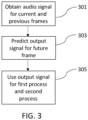
- Fig. 3 shows an example method that can be implemented in examples of the disclosure.
- the method could be implemented by an apparatus 1301 as shown in Fig. 13 .
- the apparatus 1301 could be provided in a client device 103 as shown in Fig. 1 or in any other suitable type of device.
- the apparatus1301 or client device 103 can be for use in an audio communication setting.
- the audio communication setting can be a one-way communication setting or a two-way communication setting.
- the client device 103 could be an electronic device such as a telephone, a camera, a computing device, a teleconferencing device, a television, a virtual reality device, an augmented reality device, and/or any other suitable type of device.
- the method comprises, at block 301, obtaining at least one audio signal for a current frame or one or more previous frames.
- the obtained at least one audio signal is based on at least two microphone signals for the current frame or one or more previous frames.
- the audio signal can be based on two or more microphone signals and some processing that can be performed on two or more microphone signals so as to provide the at least one audio signal.
- the at least two microphone signals can be combined so that they are provided as a single input.
- the microphone signals can be combined using a beamforming process 213 or any other suitable type of process.
- the at least one audio signal comprises an output of a first audio signal process.
- the first audio signal process can comprise a beamforming process 213 or any other suitable type of process.
- the method comprises using a program code to predict an output signal for a future frame.
- the predicted output signal is based, at least in part, on the at least one audio signal for the current frame or one or more previous frames.
- the future frame is a frame that occurs later than the frames for which the audio signal has been obtained.
- the program code can comprise a machine learning program such as a neural network circuit.
- the neural network circuit could be a deep neural network (DNN) or could have any other suitable type of architecture.
- DNN deep neural network
- the method comprises using the output signal for processing the future frame of the at least two microphone signals in a first audio signal process and also using the output signal for processing the future frame of an output of the first audio signal process in a second audio signal process.
- the processing of the future frame of an output of the first audio signal process in a second audio signal process enables noise suppression.
- the same output signal is applied to future frames of multiple audio signal processes.
- the first audio signal process and the second audio signal process can be consecutive processes in which the output of the first audio signal process is provided as an input to the second audio signal process.
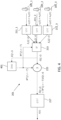
- the first audio signal process and the second audio signal process can be part of a DSP chain 201 as shown in Fig. 4 or could be in any other suitable configuration.
- the first audio signal process can comprise a beamforming process 213.
- the beamforming process 213 can be configured to combine multiple microphone signals into a combined microphone signal.
- the beamforming process 213 can comprise processing the future frame of the at least two microphone signals using the output signal from the program code.
- the output signal can comprise a gain to be applied to at least one of the at least two microphone signals of the beamforming process 213.
- the gain can be a multiplier that is applied to the two or more microphone signals.
- the output signal can comprise an amplitude to be used for at least one of the at least two microphone signals of the beamforming process 213. For instance, the amplitude or the multiplication with the gain can be used to compute the complex power spectral density per microphone signal.
- the amplitudes or the multiplication with the gains for all microphones can be used to compute the complex power spectral density matrices of the noises, speech, or interfering signals. These matrices can be used for obtaining a good configuration of the beamforming process.
- the second audio signal process can comprise a spectral noise suppression process 215.
- the spectral noise suppression process 215 can be configured to further reduce noise in the beamformed microphone signal.
- the output signal from the program code can comprise a gain to be applied to the input of the spectral noise suppression process 215.
- the gain can comprise a multiplier that can be applied to a beamformed microphone signal to obtain a denoised version of the beamformed microphone signal.
- the output signal of the program code can comprise an amplitude to be used for the spectral noise suppression process.
- the amplitude can correspond to the amplitude of the denoised signal to which a prediction of the phase is added to obtain the denoised signal.
- a prediction of the phase could be the phase of the input signal of the spectral noise suppression process 215.
- the output signal can be applied to the future frame of the respective audio signal processes in a frequency domain. Any suitable transforms can be used to convert the microphone signals to a frequency domain and to convert the processed signals back to the time domain.
- the output signal from the computer program can be provided in a format that enables it to be used in the respective audio signal processes in the frequency domain.
- the program code receives a single input and provides a single output. This can reduce the complexity of the program code.
- the single input can comprise any number of features.
- the single input is single in that it is derived from a single audio signal, for example a beamformed microphone signal.
- the single output of the program code can be provided in a format that enables it to be applied to the signals in a DSP chain 210.
- the single output can be applied to multiple audio signal processes.
- the number of current or previous frames in the obtained audio signal that are used to predict the output signal for a future frame can be selected based, at least in part, on latency requirements.
- the program code 401 comprises a machine learning program.
- the machine learning program can be a deep neural network (DNN) or any other suitable type of program code 401. Examples of a DNN are shown in Figs. 8 and 9 .
- the microphone input signals 603 are provided as inputs to a central processing unit (CPU) 605 or a DSP system.
- the CPU 605 is configured to implement a first audio signal process and a second audio signal process.
- the first audio signal process and the second audio signal process can be performed on two or more of the microphone input signals 603.
- the first audio signal process and the second audio signal process can be consecutive processes so that the output of the first audio signal process is provided as an input the second audio signal process.
- the CPU 605 provides an audio signal 607 to the DNN engine 609.
- the audio signal 607 is based on at least two microphone signals 603.
- the audio signal 607 can comprise a combined microphone signal, or features extracted from a combined microphone signal, and/or any other suitable input.
- the combined microphone signal can be obtained by performing beamforming, or any other suitable process, on two or more of the microphone signals 603.
- the audio signal 607 that is provided to the DNN engine 609 comprises a current frame and/or one or more previous frames.
- a single audio signal 607 can be provided from the CPU to the DNN engine 609.
- the DNN engine 609 can comprise a software routine in a DSP or Graphical Processing Unit (GPU), or can be a Hardware accelerator or any other suitable means.
- the DNN engine 609 comprises program code 401 configured to process the audio signal 607 to generate an output signal 611.
- the program code 401 can comprise one or more single-channel DNNs or any other suitable type of program code 401.
- the number of single-channel DNNs that are comprised in the program code 401 can be determined by the number of frames ahead for which the prediction is made, and/or any other suitable factor. For instance, if one frame ahead prediction is used then the program code 401 can comprise only one single-channel DNN. If two frame ahead prediction is used then the program code 401 can comprise two single-channel DNNs.
- the output signal 611 provided by the DNN engine 609 can comprise masks that can be used for the respective audio signal processes of the CPU 605.
- features are extracted from the audio signal and provided as an input to the program code 401.
- the features can be extracted from the audio signal so as to provide an input in a suitable format for the program code 401.
- the program code 401 uses the features extracted from the audio signal to predict an output signal.
- the output signal can comprise a mask, or any other suitable information, that can be used for future frames of at least two audio signal processes in the DSP chain 201.
- the audio signal processes can comprise a beamforming process 213 and a spectral noise reduction process 215 and/or any other suitable audio signal processes.
- a processed signal is output by the DSP chain 201.
- the processed signal can comprise a noise reduced signal.
- Other types of processed signal can be provided in other examples.
- the DNN 801 is trained or configured to map a single input signal to a corresponding output signal.
- the input signals can comprise any suitable inputs such as the output of a beamforming process 213 or any other inputs based on microphone signal.
- the output signal can comprise a mask, or any other suitable information for use in the beamforming process 213 and a spectral noise suppression process 215 and/or any other suitable process.
- the program code 401 receives a single input 901.
- the input 901 comprises an audio signal.
- the input 901 is a single input in that it comprises information derived from a single signal.
- the single signal can be based on two or more microphone signals.
- the single signal could be the output of a beamforming process 213 or other type of process that combines multiple microphone signals.
- the input 901 can be provided in any suitable format.
- the input 901 can be provided in STFT format.
- the input 901 can be provided as the logarithm powers of an STFT frame.
- the input 901 can also be prepended by an STFT to ERB (Equivalent rectangular Bandwidth) grid conversion or a STFT to Bark scale grid conversion or a STFT to Mel-frequency cepstral coefficients conversion to reduce the complexity of the program code 401.
- ERB Equivalent rectangular Bandwidth
- the outputs of each of the GRU layers 903, 905, 907, 909 are provided as inputs to a linear end layer 911.
- the linear end layer 911 combines the respective inputs.
- the output of the linear end layer 911 is provided as input to a sigmoid activation function 913 to generate the output 915 of the program code 401.
- the program code 401 provides a single output 915.
- the single output 915 can be provided in any suitable format.
- the single output can have a dimension that enables it to be applied to a signal with similar dimensions.
- the output 915 can be in an STFT format so that the output 915 can be applied to other STFT signals.
- the output 915 is a single signal but it can be applied to multiple audio processes, for example a beamforming process 213 and a spectral noise suppression process 915.
- the output signal 915 comprises a mask that can be used for the first audio signal process and the second audio signal process.
- the mask can be used for future frames of the respective audio signal processes.
- Any suitable process can be used to train the program code 401.
- An example training objective or loss function that can be used to train such a program code 401 could be as follows: M ⁇ f , ⁇ ⁇ T ⁇ S f ⁇ E f ⁇ 2 where T refers to the number of frames that the program code 401 needs to predict ahead of time.
- Another example training objective or loss function that can be used to train such a program code 401 could be as follows: M ⁇ + T f ⁇ ⁇ S f , ⁇ + T E f , ⁇ + T 2
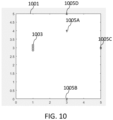
- Fig. 10 shows an example room 1001 and microphone array 1003 that were used with examples of the disclosure to obtain the example results shown in Figs. 11 and 12 .
- the room 1001 has dimensions 5m (x-axis) ⁇ 5m (y-axis) ⁇ 3m (height).
- the microphone array 1003 comprises a linear array of four microphones.
- the respective microphones are spaced at 10cm intervals within the linear array.
- Fig. 11 shows a plot of example results in linear scale
- Fig. 12 shows a plot of example results in dB scale.
- the first plot 1101 in Fig. 11 and the first plot 1201 in Fig. 12 show the captured signal on a first microphone 105. This indicates that there is a significant amount of noise within the signal.
- the second plot 1103 in Fig. 11 and the second plot 1203 in Fig. 12 show the signal after the beamformer process 213 and spectral noise suppression process 215 using examples of the disclosure. These show that the noise is significantly reduced without too much speech distortion.
- the prediction of the output signals for the future frames of the respective audio signal processes provides benefits for the program codes 401 used to make the predictions. As described herein the prediction for future frames can relax the latency requirements and also reduce the complexity if the program codes 401 that are needed.
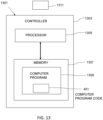
- Fig. 13 schematically illustrates an apparatus 1301 that can be used to implement examples of the disclosure.
- the apparatus 1301 comprises a controller 1303.
- the controller 1303 can be a chip or a chip-set.
- the controller can be provided within a user device 103 such as the user devices 103 shown in Fig. 1 .
- the implementation of the controller 1303 can be as controller circuitry.
- the controller 1303 can be implemented in hardware alone, have certain aspects in software including firmware alone or can be a combination of hardware and software (including firmware).
- the controller 1303 can be implemented using instructions that enable hardware functionality, for example, by using executable instructions of a computer program 1309 in a general-purpose or special-purpose processor 1305 that can be stored on a computer readable storage medium (disk, memory etc.) to be executed by such a processor 1305.
- a computer readable storage medium disk, memory etc.
- the memory 1307 is configured to store a computer program 1309 comprising computer program instructions (computer program code 401) that controls the operation of the controller 1303 when loaded into the processor 1305.
- the computer program instructions, of the computer program 1309 provide the logic and routines that enables the controller 1303 to perform the methods illustrated in the Figs.
- the processor 1305 by reading the memory 1307 is able to load and execute the computer program 1309.
- the apparatus 1301 therefore comprises: at least one processor 1305; and at least one memory 1307 including computer program code 401, the at least one memory 1307 and the computer program code 401 configured to, with the at least one processor 1305, cause the apparatus 1301 at least to perform:
- the computer program 1309 can arrive at the controller 1303 via any suitable delivery mechanism 1311.
- the delivery mechanism 1311 can be, for example, a machine readable medium, a computer-readable medium, a non-transitory computer-readable storage medium, a computer program product, a memory device, a record medium such as a Compact Disc Read-Only Memory (CD-ROM) or a Digital Versatile Disc (DVD) or a solid state memory, an article of manufacture that comprises or tangibly embodies the computer program 1309.
- the delivery mechanism can be a signal configured to reliably transfer the computer program 1309.
- the controller 1303 can propagate or transmit the computer program 1309 as a computer data signal.
- the computer program 1309 can be transmitted to the controller 1303 using a wireless protocol such as Bluetooth, Bluetooth Low Energy, Bluetooth Smart, 6LoWPan (IP v 6 over low power personal area networks) ZigBee, ANT+, near field communication (NFC), Radio frequency identification, wireless local area network (wireless LAN) or any other suitable protocol.
- a wireless protocol such as Bluetooth, Bluetooth Low Energy, Bluetooth Smart, 6LoWPan (IP v 6 over low power personal area networks) ZigBee, ANT+, near field communication (NFC), Radio frequency identification, wireless local area network (wireless LAN) or any other suitable protocol.
- the computer program 1309 comprises computer program instructions that when executed by an apparatus 1301 cause the apparatus 1301 to perform at least the following:
- the computer program instructions can be comprised in a computer program 1309, a non-transitory computer readable medium, a computer program product, a machine readable medium. In some but not necessarily all examples, the computer program instructions can be distributed over more than one computer program 1309.
- memory 1307 is illustrated as a single component/circuitry it can be implemented as one or more separate components/circuitry some or all of which can be integrated/removable and/or can provide permanent/semi-permanent/ dynamic/cached storage.
- processor 1305 is illustrated as a single component/circuitry it can be implemented as one or more separate components/circuitry some or all of which can be integrated/removable.
- the processor 1305 can be a single core or multi-core processor.
- references to "computer-readable storage medium”, “computer program product”, “tangibly embodied computer program” etc. or a “controller”, “computer”, “processor” etc. should be understood to encompass not only computers having different architectures such as single /multi- processor architectures and sequential (Von Neumann)/parallel architectures but also specialized circuits such as field-programmable gate arrays (FPGA), application specific circuits (ASIC), signal processing devices and other processing circuitry.
- References to computer program, instructions, code etc. should be understood to encompass software for a programmable processor or firmware such as, for example, the programmable content of a hardware device whether instructions for a processor, or configuration settings for a fixed-function device, gate array or programmable logic device etc.
- circuitry can refer to one or more or all of the following:
- circuitry also covers an implementation of merely a hardware circuit or processor and its (or their) accompanying software and/or firmware.
- circuitry also covers, for example and if applicable to the particular claim element, a baseband integrated circuit for a mobile device or a similar integrated circuit in a server, a cellular network device, or other computing or network device.
- the apparatus 1301 as shown in Fig. 13 can be provided within any suitable device.
- the apparatus 1301 can be provided within an electronic device such as a mobile telephone, a teleconferencing device, a camera, a computing device or any other suitable device.
- the blocks illustrated in the Figs. can represent steps in a method and/or sections of code in the computer program 1309.
- the illustration of a particular order to the blocks does not necessarily imply that there is a required or preferred order for the blocks and the order and arrangement of the blocks can be varied. Furthermore, it can be possible for some blocks to be omitted.
- the wording 'connect', 'couple' and 'communication' and their derivatives mean operationally connected/coupled/in communication. It should be appreciated that any number or combination of intervening components can exist (including no intervening components), i.e., so as to provide direct or indirect connection/coupling/communication. Any such intervening components can include hardware and/or software components.
- the term "determine/determining” can include, not least: calculating, computing, processing, deriving, measuring, investigating, identifying, looking up (for example, looking up in a table, a database or another data structure), ascertaining and the like. Also, “determining” can include receiving (for example, receiving information), accessing (for example, accessing data in a memory), obtaining and the like. Also, “ determine/determining” can include resolving, selecting, choosing, establishing, and the like.
- a property of the instance can be a property of only that instance or a property of the class or a property of a sub-class of the class that includes some but not all of the instances in the class. It is therefore implicitly disclosed that a feature described with reference to one example but not with reference to another example, can where possible be used in that other example as part of a working combination but does not necessarily have to be used in that other example.
- 'a', 'an' or ⁇ the' is used in this document with an inclusive not an exclusive meaning. That is any reference to X comprising a/an/the Y indicates that X may comprise only one Y or may comprise more than one Y unless the context clearly indicates the contrary. If it is intended to use 'a', 'an' or ⁇ the' with an exclusive meaning then it will be made clear in the context. In some circumstances the use of 'at least one' or 'one or more' may be used to emphasis an inclusive meaning but the absence of these terms should not be taken to infer any exclusive meaning.
- the presence of a feature (or combination of features) in a claim is a reference to that feature or (combination of features) itself and also to features that achieve substantially the same technical effect (equivalent features).
- the equivalent features include, for example, features that are variants and achieve substantially the same result in substantially the same way.
- the equivalent features include, for example, features that perform substantially the same function, in substantially the same way to achieve substantially the same result.
Landscapes
- Engineering & Computer Science (AREA)
- Acoustics & Sound (AREA)
- Computational Linguistics (AREA)
- Signal Processing (AREA)
- Health & Medical Sciences (AREA)
- Audiology, Speech & Language Pathology (AREA)
- Human Computer Interaction (AREA)
- Multimedia (AREA)
- Physics & Mathematics (AREA)
- Quality & Reliability (AREA)
- Evolutionary Computation (AREA)
- Artificial Intelligence (AREA)
- Circuit For Audible Band Transducer (AREA)
- Soundproofing, Sound Blocking, And Sound Damping (AREA)
- Measurement Of Mechanical Vibrations Or Ultrasonic Waves (AREA)
- Feedback Control In General (AREA)
Applications Claiming Priority (1)
| Application Number | Priority Date | Filing Date | Title |
|---|---|---|---|
| GB2319935.9A GB2636834A (en) | 2023-12-22 | 2023-12-22 | Apparatus, methods and computer programs for noise suppression |
Publications (1)
| Publication Number | Publication Date |
|---|---|
| EP4576079A1 true EP4576079A1 (fr) | 2025-06-25 |
Family
ID=89768036
Family Applications (1)
| Application Number | Title | Priority Date | Filing Date |
|---|---|---|---|
| EP24218995.9A Pending EP4576079A1 (fr) | 2023-12-22 | 2024-12-11 | Appareils, procédés et programmes informatiques pour la suppression du bruit |
Country Status (4)
| Country | Link |
|---|---|
| US (1) | US20250210055A1 (fr) |
| EP (1) | EP4576079A1 (fr) |
| CN (1) | CN120199266A (fr) |
| GB (1) | GB2636834A (fr) |
Citations (1)
| Publication number | Priority date | Publication date | Assignee | Title |
|---|---|---|---|---|
| US10755728B1 (en) * | 2018-02-27 | 2020-08-25 | Amazon Technologies, Inc. | Multichannel noise cancellation using frequency domain spectrum masking |
-
2023
- 2023-12-22 GB GB2319935.9A patent/GB2636834A/en active Pending
-
2024
- 2024-12-11 EP EP24218995.9A patent/EP4576079A1/fr active Pending
- 2024-12-18 CN CN202411869736.2A patent/CN120199266A/zh active Pending
- 2024-12-20 US US18/990,653 patent/US20250210055A1/en active Pending
Patent Citations (1)
| Publication number | Priority date | Publication date | Assignee | Title |
|---|---|---|---|---|
| US10755728B1 (en) * | 2018-02-27 | 2020-08-25 | Amazon Technologies, Inc. | Multichannel noise cancellation using frequency domain spectrum masking |
Non-Patent Citations (1)
| Title |
|---|
| ZHONG-QIU WANG ET AL: "STFT-Domain Neural Speech Enhancement with Very Low Algorithmic Latency", ARXIV.ORG, CORNELL UNIVERSITY LIBRARY, 201 OLIN LIBRARY CORNELL UNIVERSITY ITHACA, NY 14853, 22 November 2022 (2022-11-22), XP091374578 * |
Also Published As
| Publication number | Publication date |
|---|---|
| CN120199266A (zh) | 2025-06-24 |
| US20250210055A1 (en) | 2025-06-26 |
| GB2636834A (en) | 2025-07-02 |
| GB202319935D0 (en) | 2024-02-07 |
Similar Documents
| Publication | Publication Date | Title |
|---|---|---|
| CN112017681B (zh) | 定向语音的增强方法及系统 | |
| KR102191736B1 (ko) | 인공신경망을 이용한 음성향상방법 및 장치 | |
| CN114373473B (zh) | 通过低延迟深度学习实现同时降噪和去混响 | |
| EP3189521B1 (fr) | Procédé et appareil permettant d'améliorer des sources sonores | |
| CN111696567B (zh) | 用于远场通话的噪声估计方法及系统 | |
| CN114203163A (zh) | 音频信号处理方法及装置 | |
| EP3275208B1 (fr) | Mélange de sous-bande de multiples microphones | |
| US11380312B1 (en) | Residual echo suppression for keyword detection | |
| US20240177726A1 (en) | Speech enhancement | |
| CN114333874B (zh) | 处理音频信号的方法 | |
| US10937418B1 (en) | Echo cancellation by acoustic playback estimation | |
| US10887709B1 (en) | Aligned beam merger | |
| WO2022256577A1 (fr) | Procédé d'amélioration de la parole et dispositif informatique mobile mettant en oeuvre le procédé | |
| WO2026077160A1 (fr) | Procédé d'amplification sonore locale | |
| CN116312570A (zh) | 一种基于声纹识别的语音降噪方法、装置、设备及介质 | |
| CN115359804A (zh) | 一种基于麦克风阵列的定向音频拾取方法和系统 | |
| Pfeifenberger et al. | Deep complex-valued neural beamformers | |
| JP7591848B2 (ja) | ニューラルネットワークを用いたビームフォーミング方法及びビームフォーミングシステム | |
| EP4571740A1 (fr) | Amélioration de la parole audiovisuelle | |
| EP4576079A1 (fr) | Appareils, procédés et programmes informatiques pour la suppression du bruit | |
| EP4548344A1 (fr) | Dé-réverbération audio | |
| EP3029671A1 (fr) | Procédé et appareil d'amélioration de sources acoustiques | |
| US12531046B1 (en) | Noise reduction and residual echo suppression | |
| Küçük et al. | Direction of arrival estimation using deep neural network for hearing aid applications using smartphone | |
| Kealey | Multi-channel sound enhancement with an unlabeled in-the-wild single channel dataset |
Legal Events
| Date | Code | Title | Description |
|---|---|---|---|
| PUAI | Public reference made under article 153(3) epc to a published international application that has entered the european phase |
Free format text: ORIGINAL CODE: 0009012 |
|
| STAA | Information on the status of an ep patent application or granted ep patent |
Free format text: STATUS: THE APPLICATION HAS BEEN PUBLISHED |
|
| AK | Designated contracting states |
Kind code of ref document: A1 Designated state(s): AL AT BE BG CH CY CZ DE DK EE ES FI FR GB GR HR HU IE IS IT LI LT LU LV MC ME MK MT NL NO PL PT RO RS SE SI SK SM TR |
|
| STAA | Information on the status of an ep patent application or granted ep patent |
Free format text: STATUS: REQUEST FOR EXAMINATION WAS MADE |
|
| 17P | Request for examination filed |
Effective date: 20251222 |
|
| STAA | Information on the status of an ep patent application or granted ep patent |
Free format text: STATUS: EXAMINATION IS IN PROGRESS |